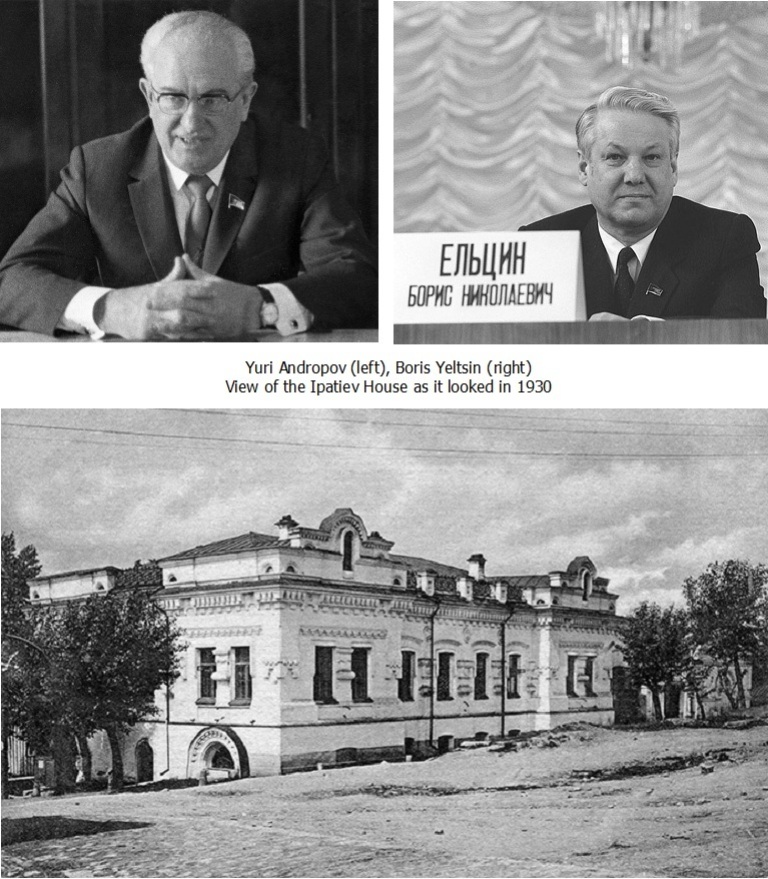
Further to my article How Yeltsin justified the demolition of the Ipatiev House (published on 20th February 2020), I present the following article, researched from Russian media sources. This new article presents some interesting details about the demolition of the infamous house where Russia’s last Tsar, along with his family and four faithful retainers were all brutally murdered by members of the Ural Soviet [Bolsheviks] in the early morning hours of 17th July 1918.
The fate of the Ipatiev House in Ekaterinburg is a story about how the Soviets first tried to turn the site of the regicide into a museum of the revolution, and then, frightened by its symbolic power among a growing number of Orthodox faithful, decided to wipe it off the face of the earth. The murders of the Imperial Family in 1918 and the demolition of the Ipatiev House in 1977 became two acts of the same drama, separated by almost six decades, but connected by one goal – the management of historical memory.
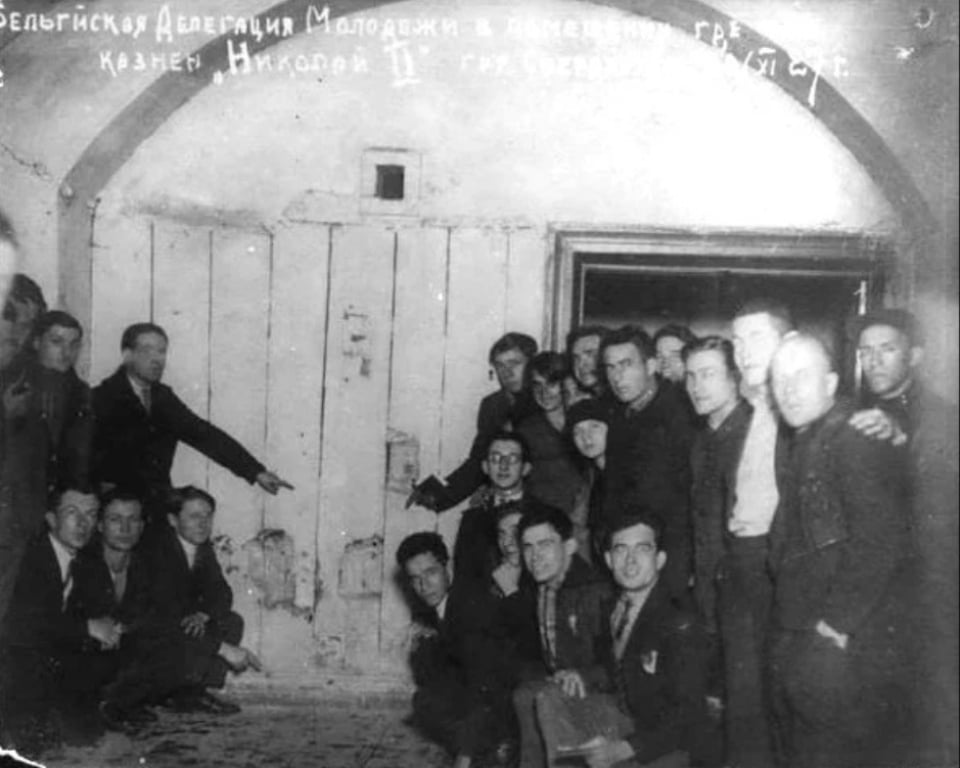
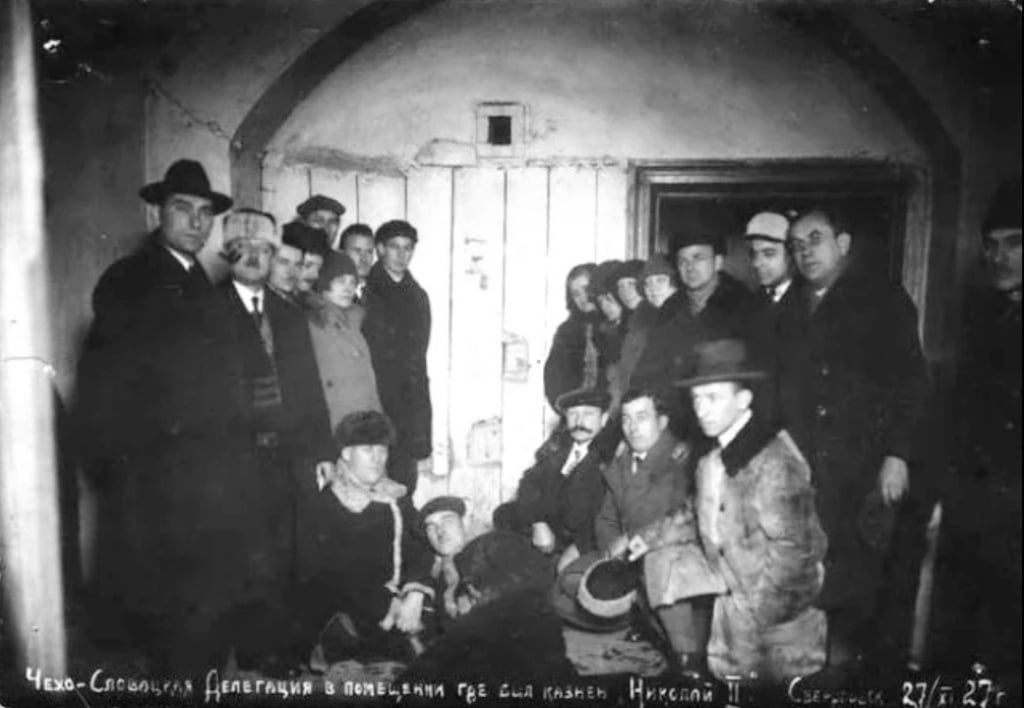
PHOTOS: during the late 1920s and 1930s, it was customary for Communist Party apparatchiks to arrive at the Ipatiev House in Sverdlovsk [Ekaterinburg] in large tour groups, where they would pose – many of them smiling – in front of the bullet-damaged wall of the cellar room in which the Imperial Familu had been brutally murdered by a Bolshevik firing squad in the early morning hours of 17th July 1918.
The fate of the Ipatiev House during Soviet times
The Ipatiev House was a stone mansion built in the 1880s in the pseudo-Russian style. It was situated on the corner of Karl Liebknecht and Clara Zetkin Streets (formerly called Voznesensky Prospekt and Voznesensky Lane). It was initially bought by the engineer Nikolai Ipatiev (1869-1938), and then requisitioned by the Bolsheviks in 1918, as a prison for the Nicholas II, his wife, their five children and four faithful retainers, from April to July 1918.
In Soviet times, it’s fate was paradoxical. At first, the Museum of the Revolution was set up here, and in the “murder room” situated in the basement, tourists posed to have their photos taken. Later, in the 1930s, the museum closed, and the Anti-Religious Museum was established. In subsequent years, it housed educational institutions, then an archive, and during the Great Patriotic War (1941-44) served as a warehouse for the art treasures evacuated from the Hermitage in Leningrad [St. Petersburg].
By the 1970s, a growing interest in the fate of Russia’s last Tsar in the West, that a quiet, unofficial pilgrimage to him began to manifest itself around the former Ipatiev House,. On the days marking the anniversary of the regicide, candles appeared at the walls of the Ipatiev House, people made the sign of cross and prayed. For the authorities, this set off alarm bells.

PHOTO: the demolition of the Ipatiev House did not deter Orthodox Christians from coming to the site to light candles and offer prayers for Russia’s repentance. Sverdlovsk [Ekaterinburg] 1990
Andropov’s secret note
In the summer of 1975, after learning of the pilgraimages to the Ipatiev House, KGB Chairman Yuri Andropov (1914-1984) appealed to the Politburo with a note marked “SECRET”. It said:
“Anti-Soviet circles in the West periodically inspire various kinds of propaganda campaigns around the last Tsar and his family, and in their connection to the former mansion of the merchant Ipatiev in the city of Sverdlovsk [Ekaterinburg].
“The Ipatiev House continues to stand in the center of the city… The mansion is not of any architectural or other value, only a small part of the townspeople and a few tourists are interested in it.
“Recently, foreign specialists have begun visiting Sverdlovsk. In the future, the number of foreigners may increase significantly and the Ipatiev house will become an object of interest for them.
“In this regard, it seems expedient to instruct the Sverdlovsk Regional Committee of the CPSU [Communist Party of the Soviet Union] to resolve the issue of demolishing the mansion as part of the planned reconstruction of the city.”
Andropov was wrong about the lack of “architectural and other value”: the stone mansion was a fine example of pseudo-Russian Art Nouveau style, it was perfectly inscribed in the city’s landscape – one-story on one side and two-story on the other, and inside it was decorated with stucco molding and casting, which by the 1970s were still well preserved.
Nevertheless, the house was indeed the object of growing interest for both locals and foreigners. On the day marking the anniversary of the murders of the Tsar and his family, candles were placed at the threshold of the house, while believers crossed themselves and bowed at the walls. Their numbers grew each year, acting as a precursor to Tsar’s Days.
Rumors spread around the city that UNESCO was going to make the Ipatiev House a “monument to human barbarism”[1] along with Auschwitz. And yet the then leadership of the city – the secretary of the regional committee Yakov Petrovich Ryabov (1928-2018) and the chairman of the city executive committee Vasily Vasilyevich Gudkov (1926-2018) – was in no hurry to carry out the order. Opponents of the demolition of the building included not only local historians, but even the communists – “how can you destroy the monument to the revolution, where the bloody tyrant suffered a well-deserved punishment?,” they cried.
This story ended two years later, when the new secretary of the regional committee, Boris Yeltsin (1931-2007), was instructed to carry out the order of the Politburo, of Which he complied in September 1977.
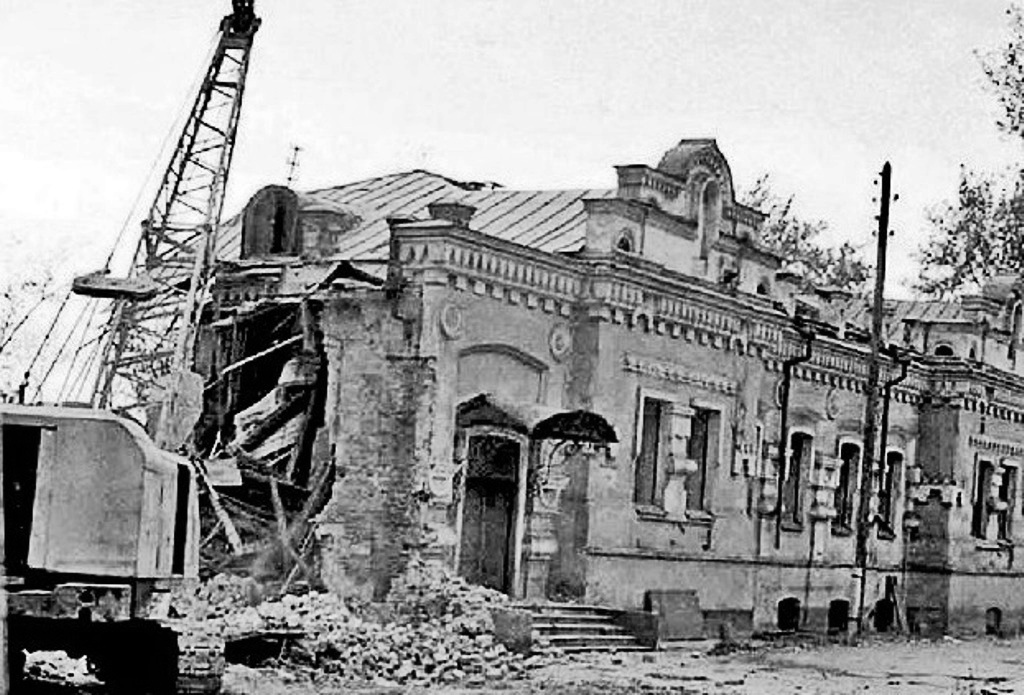
PHOTO: the demolition of the Ipatiev House was carried out on 22-23 September 1977
Could the Ipatiev House have been saved?
In his Russian-language memoir Исповедь на заданную тему / Confession on a Given Topic (1990), the first president of Russia wrote that the building was demolished in one night, immediately after he received a secret package from the Politburo: “It was impossible to resist … In addition, I could not prevent this — the decision of the highest authority of the country, official, signed and formalized accordingly. Not to comply with the Politburo Resolution? I… I could not even imagine the consequences. But even if I had disobeyed, I would have been left without a job… And the new first secretary of the regional committee, who would have replaced me, would still have carried out the order nevertheless.”
Yeltsin was sometimes accused of being overzealous, they say, Ryabov was in no hurry to carry out the order from Moscow. One source claims that there was no “secret package” addressed personally to Yeltsin (this document was indeed never found in the archives), but simply Yeltsin on his own initiative rushed to fulfill an order made two years prior.
It is now impossible to say whether this is true or not. But it is possible that there was an order from Moscow. The year 1978 was approaching – the year which marked the 110th anniversary of the birth of Nicholas II and the 60th anniversary of the execution of the Imperial Family. The “unhealthy interest” in the Ipatiev House would certainly have manifested itself.
In addition, UNESCO could have assigned the Ipatiev House the status of a World Heritage Site, and then it would have been impossible to demolish this building. In a word, whether in writing or orally, but, to all appearances, Boris Yeltsin received an order not to delay any longer.
Before the demolition, local museum workers had the opportunity to take out castings and other fragments of décor from the house. They are now on display in the permanent exhibition The Romanovs in the Urals in the Poklevsky-Kozell House Museum of the Sverdlovsk Regional Museum of Local Lore in Ekaterinburg.
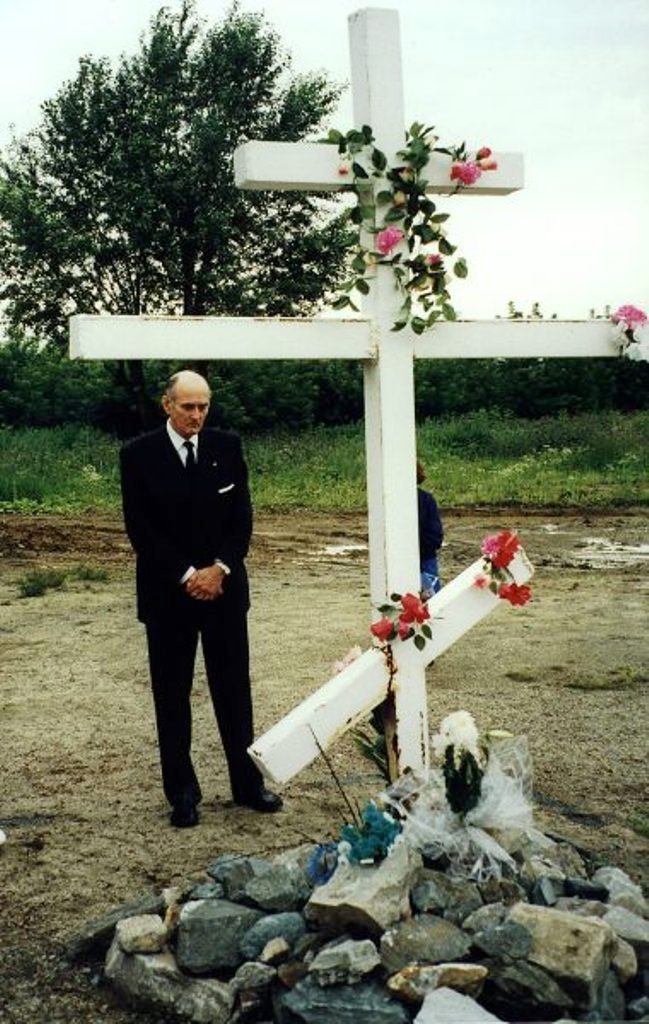
PHOTO: Prince Dimitri Romanovich (1926-2016) near the cross, where the Ipatiev House stood until 1977, demolished after a secret order of the Politburo. 1992
NOTES:
[1] There isn’t a single, officially designated “UNESCO monument to human barbarism”; rather, the term refers to sites where UNESCO and others condemn acts of cultural destruction, looting, or desecration, often by extremist groups or occupying forces, seen as barbarism against shared human heritage.
FURTHER READING
How Yeltsin justified the demolition of the Ipatiev House + PHOTOS
Doomed to Resurrection: Is it Possible to Reconstruct the Ipatiev House? + PHOTOS
“What if” the Ipatiev House was reconstructed? + PHOTOS
Captured on Film by U.S. Cameramen – The Romanov Murder Scene (1918) + VIDEO
Blood reappeared in the Ipatiev House for years after the regicide, claimed eyewitnesses
Excavations at the site of the Ipatiev House in Ekaterinburg in the early 2000s
© Paul Gilbert. 6 January 2026
***
The following NEW title was compiled and edited by independent researchers and Romanov historian Paul Gilbert was published in August 2024.
This fascinating new study features 14 chapters on this tragic event, which include the memoirs of a British intelligence officer and journalist, and two First-English translations. In addition, 11 chapters were written by Paul Gilbert, based on new documents sourced from Russian archival and media sources over the past decade.
Please refer to the link provided for further details about the content of this new title . . .
 Nicholas II
You must be logged in to post a comment.