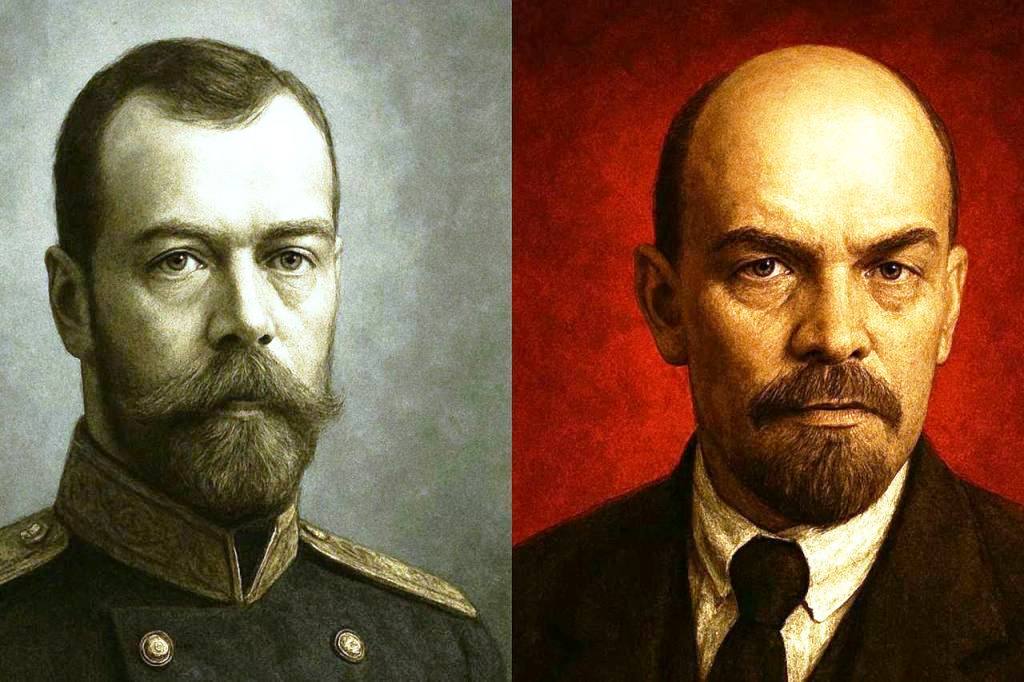
Nicholas II and Vladimir Lenin are two people whose paths crossed only in absentia, through newspapers, police reports and the historical whirlwind of 1917. They never met or even saw each other in person, nor did they exchange letters. The Tsar knew Lenin as a radical emigrant, then as a “German agent”, and in the end as the man who destroyed the Russian Empire.
Recall that while Lenin and the Bolsheviks had little if anything to do with the overthrow of the monarchy in February 1917, he is certainly responsible for the coup d’etat which overthrew the Provisional Government in October 1917, and is widely believed to have given the order to murder not only the Tsar, but his entire family as well.
Early years: just another “seditious” revolutionary
Until 1917, Lenin for Nicholas II was just a surname in police reports. The Okhrana reported on the Social Democrats, on their split into Bolsheviks and Mensheviks, and on Ulyanov [Lenin] himself, who was imprisoned in Siberia, after which he went abroad. But in the Tsar’s diaries for 1900-1916, Lenin is hardly mentioned, either by name or as a threat. Nicholas worried about the Socialist Revolutionary terrorists, about strikes, about the Duma, but an extremist [Lenin] in Switzerland seemed of little interest or concern to the monarch. Historian and scientific director of the Civil Archive of the Russian Federation Sergey Mironenko [b. 1951] notes in the preface to Nicholas II’s diaries: “the Tsar saw a “gang” in the revolutionaries, but did not single out the leaders. Lenin was nothing more than a shadow.”
April 1917: “sealed train” and the German connection
It was during Nicholas II’s house arrest in Tsarskoye Selo, that he learned about Lenin’s return from Germany. For the Tsar, this was proof that Lenin was an agent of Kaiser Wilhelm II. Empress Alexandra Feodorovna in letters and conversations (according to Pierre Gilliard) called Lenin a “German spy”. Nicholas shared few direct words on the matter in his diary, but in the entries of April-May there is contempt for the “traitors” who collaborated with the enemy during the war. The archives confirm that the family discussed the “April Theses”[1] as madness paid for with German gold.
July 1917: Riots of the “Leninists” The summer of 1917
During the summer of 1917, the Imperial Family were being held under house arrest in the Alexander Palace at Tsarskoye Selo. On 3-5 (O.S.) July, riots broke out in Petrograd [St. Petersburg] – the Bolsheviks led sailors and soldiers against the Provisional Government. On 5th (O.S.) July 1917, Nicholas wrote in his diary : “We received news of serious unrest in Petrograd [St. Petersburg] caused by the actions of the Leninists.” This is one of the first direct mentions of Lenin by name. The Tsar saw Lenin as an instigator who sowed chaos in the army and the rear. When the authorities suppressed freedom of speech, Nicholas was somewhat relieved – but he already understood that this man [Lenin] was dangerous.
Escape to Finland: “disappeared like a coward”
After the failure of the July putsch [a violent attempt to overthrow a government], Lenin fled to Razliv, then to Finland. On 8th (O.S.) July 1917, Nicholas recorded in his in his diary: “Lenin and company disappeared.” The tone is contemptuous: not a hero of the revolution, but a fugitive. Pierre Gilliard claims that the Tsar commented on this, saying “it is typical for these “seditious” people to incite others, and then hide themselves.” For Nicholas, as Emperor, as an officer and as a man of honour, such behavior was contemptable.
October coup: “seizure of power by bandits”
On 7th November (O.S. 25th October) 1917, the Bolsheviks stormed the Winter Palace in the capital. Nicholas II and his family were already in Tobolsk. They learned about the uprising through newspapers and rumours. On 26th (O.S.) October 1917, the Tsar wrote in his diary: “In the morning we received news of the coup d’état in Petrograd [St. Petersburg] carried out by the Bolsheviks under the leadership of Lenin and Trotsky.” The Tsar called it “the seizure of power by a gang of bandits.” In the following entries there is pain: “Russia is dying,” he wrote. For him, Lenin became a symbol of the end of the Russian Empire, a man who destroyed everything for which they fought and lived for.
The Brest-Litovsk Peace: “Scoundrels Lenin and Trotsky”
The final blow came in March 1918, when the Bolsheviks signed and then ratified the Brest-Litovsk Peace Treaty. Nicholas II, a patriot and former commander-in-chief of the Russian Imperial Army, declared it a national disgrace. On 3rd (O.S.) March 1918, he wrote in his diary: “Peace has been signed on incredibly difficult terms.” Then, on 9-13 (O.S.) March, the entries in his diary are full of grief – “a shameful peace”, “how hard it is for Russia”. And in one of the March entries, bluntly: “These scoundrels Lenin and Trotsky brought the country to such dishonour.” This was the harshest quote from Nicholas II’s diary – Lenin was a traitor to the Motherland for the Tsar, worse than any enemy at the front.

PHOTO: in April 2021, a bust-monument of Vladimir Lenin was vandalized in the Russian city of Murmansk. Vandals poured red paint over the monument, the colour red symbolizing the blood the Bolshevik leader spilled during his reign of terror.
NOTES:
[1] The “April Theses” were a series of directives issued by Vladimir Lenin in April 1917, upon his return to Russia from exile. They called for the immediate withdrawal of Russia from World War I, the transfer of power to the Soviets, and the implementation of radical socialist reforms. The Theses emphasized the need for revolutionaries to break decisively with the Provisional Government and demanded “all power to the Soviets”. These proposals significantly influenced the course of the Russian Revolution and contributed to the Bolshevik coup d’état in October 1917.
© Рaul Gilbert. 12 January 2025
 Nicholas II
You must be logged in to post a comment.