One of the questions I am asked most is “can you recommend a good book on Nicholas II?”
Putting aside the numerous beautiful pictorials which have been published over the years, I have compiled the following *list of 10 books, which for the most part, present an honest assessment on the life and reign of Russia’s last Emperor and Tsar.
In addition, are the following honourable mentions: Nicholas and Alexandra byRobert K. Massie (1967); Last Years of the Court at Tsarskoe Selo Volume I – 1906-1910 (2010) and Volume II – 1910-1914 (2017) by General Alexandre Spiridovitch; Thirteen Years at the Russian Court (1921/2025) by Pierre Gilliard; At the Court of the Last Tsar (1935) by Alexander Mossolov; and The Coronation of Tsar Nicholas II (2012) edited by Paul Gilbert.
Click HERE to download, print and save a copy of my 22-page
Nicholas II Bibliography of Books (2026). It’s FREE!
*NOTE: all of the books listed here are in English and listed in order of the year they were published. With the exception of Oldenburg’s 4-volume study, all the remaining titles are available from your favourite bookseller. Second hand copies can also be found on eBay, aLibris, Biblio, etc.
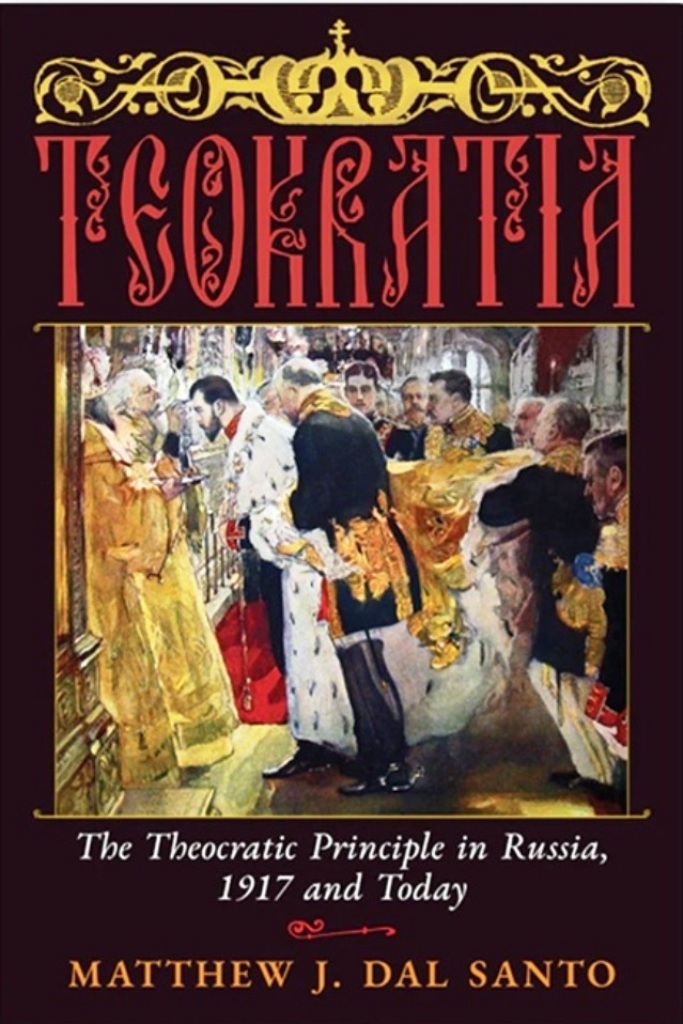
Teokratia: The Theocratic Principle in Russia, 1917 and Today
Author: Matthew dal Santo
Published in 2025 by Angelico Press
546 pages
NOTE: I have selected this title for my ‘Romanov Book of the Year 2025’
Part travelogue, part history, and part theological reflection, Matthew Dal Santo’s new book is a “MUST READ” for any one who shares an interest in the life and reign of Russia’s last Tsar. Dal Santo brilliantly connects themes of contemporary relevance with ‘old Russia’ by unfolding a journey in which he explores the rise and fall of the Romanov family. He investigates how the family is perceived by the Russian people today, in light of their canonization by the Moscow Patriarchate in 2000.
At the heart of his reflections stand two figures, Nicholas II and the theologian Sergei Bulgakov (1871-1944): the tsar represents the fate of Teokratia in Russia, the idea that political rule is a sacred office. It is a scholarly life of Nicholas II set against its background in the history of imperial Russia. It is a journalist’s investigation of attitudes to the martyrs of the Romanov family among ordinary Russians today. It is a travelogue of descriptions, often astonishingly beautiful, of the places associated with Nicholas II and his family, and where the final drama of the dynasty unfolded.
The book serves simultaneously as a spiritual biography of Russia’s last (now sainted) tsar, Nicholas II (1894–1917),exploring the theological sources of Nicholas’s unwillingness, even inability, to grant Russia a constitution as a matter of faith and conscience—questioning as it does so the tensions in not only Bulgakov’s political theology but also the meaning of the place of the emperor/tsar in Eastern Orthodox Christianity.
It is also—and this will not easily be found among other accounts of the coming of the revolutions of 1917—a plea to re-examine the significance of ‘sacral’ monarchy, understood as the symbolization of a Christ-centered order in which ultimate norms and values are raised above the simple adjudication, whether democratic or bureaucratic, of practical affairs.
Last year, after the author sent me a review copy of his book, he sent the following note: “I hope you will feel I have done Nicholas II’s inner, spiritual life justice. That was one of my chief aims.” He did indeed!
Click HERE to download, print and save a copy of my 22-page
Nicholas II Bibliography of Books (2026). It’s FREE!
***
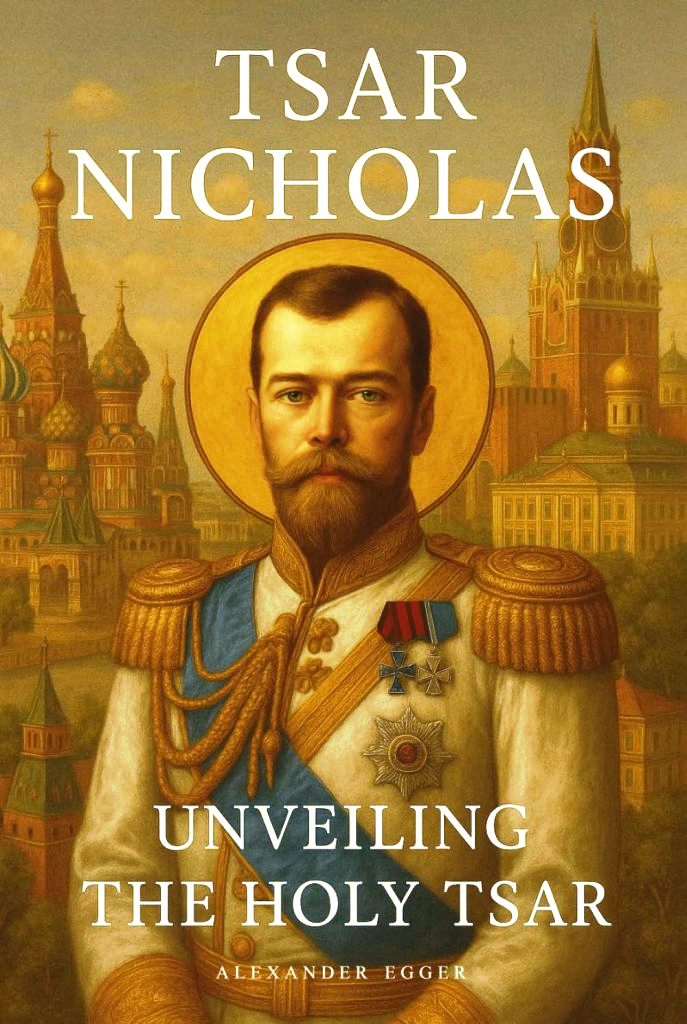
Tsar Nicholas II: Unveiling the Holy Tsar
Author: Alexander Egger
Published Independently in 2024
493 pages
San Francisco based author Alexander Egger’s groundbreaking book is a must for those who wish to understand better the spiritual journey of Nicholas II.
Explore the captivating life of Tsar Nicholas II, in a profound journey through his tumultuous yet spiritually rich reign (1894-1917), torn between the duties of rulership and a deep yearning for spiritual enlightenment, navigated a realm fraught with political intrigue and societal upheaval. Despite these challenges, he emerged as a steadfast champion of the Orthodox faith, dedicated to preserving Russia’s sacred traditions.
This book vividly portrays Nicholas II’s unwavering devotion to God amidst the trials of governance. It delves into his inner conflict, portraying a leader grappling with faith, fate, and destiny. Nicholas II’s spiritual odyssey unfolds as a timeless tale of personal transformation, resonating with those who seek deeper meaning beyond earthly power.
Witness the poignant journey of a ruler who strove to reconcile his role as sovereign with his desire for piety and humble devotion. Through rich narrative and historical insight, this book offers an unforgettable portrait of Nicholas II’s unwavering loyalty to tradition and his quest for solace and salvation.
Tragically, Tsar Nicholas and his beloved family ultimately met their deaths in a gloomy basement in Ekaterinburg. Throughout their lives, they embodied the values of family, humility, nobility, duty, the Russian people, and, above all, the holy Orthodox faith. In the end, they sacrificed their lives for their nation and the Orthodox faith, standing as the early martyrs did before the lions. Having given their lives for Christ, they now intercede on our behalf before Christ.
Click HERE to download, print and save a copy of my 22-page
Nicholas II Bibliography of Books (2026). It’s FREE!
***
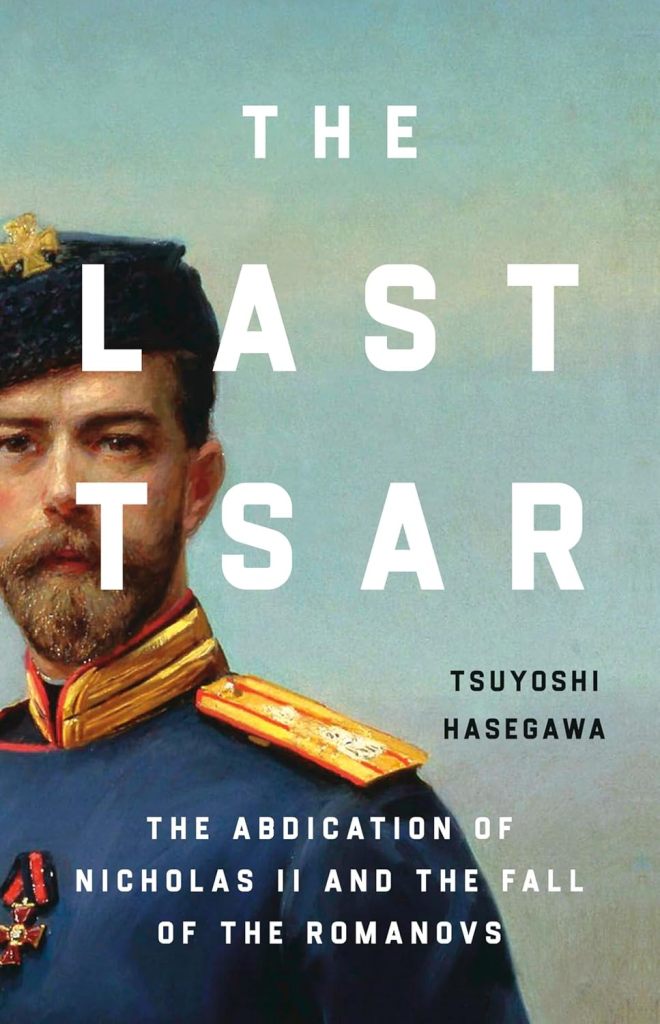
The Last Tsar:
The Abdication of Nicholas II and the Fall of the Romanovs
Author: Tsuyoshi Hasegawa
Published in 2024 by Basic Books
560 pages
In April 2024, I shared some thoughts on The Last Tsar, which were based on the publisher’s summary of the book. My article was published on this blog some 8 months prior to the book’s release in December 2024. Click HERE to read it.
I had some hesitation including this book to my Top 10 recommended reading list, but after some deliberation I decided to include it. First of all, I found Hasegawa’s book very biased against Nicholas II. The author does not hold back from revealing what he thinks of Nicholas II as a ruler, regurgating the same old nasty euphemisms which have existed since the early 20th century, the same ones which were allowed to germinate during the Bolshevik and later Soviet years.
As one reviewer on Amazon wrote: “Humans are all bias to some degree. Historians need to be mindful of our own human nature and try to stick to factual representations of history.” The reviewer then adds: “It is difficult to find real history presented through unbiased factual lens . . when discussing the last Russian Tsar.”
In addition, Hasegawa makes some outrageous statements, the most ridiculous being found on pages 32-33, in which he compares Rasputin’s followers to that of cult leader and mass murderer Charles Manson or Jim Jones and even Donald Trumo’s MAGA movement. I wonder if Hasegawa has met some of the “Kirillists” – aka as “Legitimists”? This is just one example, and certainly not the type of “research” one expects from a “professor emeritus in history”. Perhaps he drank too much sake?
Then there are the sources for his book. While Hasegawa has utilized the vast resources of the Russian archives, presenting many new documents, he also cites some rather dubious sources. In particular, when discussing Grand Duke Kirill Vladimirovich’s treasonous actions following the February 1917 Revolution, he refers to a series of emails from a well-known American social media troll and “Kirillist/Legitimist”, who goes out of his way to present the Kirillovich branch of the Romanov dynasty in any way but truthful!
Having pointed out the negatives of this book, I still recommend this book to those who share an interest in the reign of Russia’s last Tsar. Hasegawae has produced an intimate and highly absorbing account of Russia’s last hereditary autocrat. Hasegawa’s book is like a slow-motion vintage newsreel of Russia approaching the edge. He literally “dissects” the events leading up to the Tsar’s abdication on 15th March (O.S. 2nd March) 1917, which reveal many new details, thus making this book a compelling read.
This book which is based on a trove of new archival discoveries, narrates how the factions of scheming nobles, ruthless legislators, pragmatic generals and even members of the Russian Imperial Family – ALL in one way or another helped to bring about the destruction of the monarchy and the Russian Empire. Nicholas II’s famous words “All around me I see treason, cowardice and deceit!”, ring loud and clear, as Hasegawa reveals the identities of those who betrayed their sovereign.
Click HERE to download, print and save a copy of my 22-page
Nicholas II Bibliography of Books (2026). It’s FREE!
***
The True Story of the Romanov Family
Published in 2024 by the Diaconești Monastery (Moldavia)
68 pages, richly illustrated
A new graphic novel, featuring exceptional illustrations and content that evoke the true story of the last Russian Imperial Family. This books is a labour of love by the nuns of the Diaconești Monastery in Moldavia, motivated by their deep reverence for the Holy Tsar Nicholas II and his family.
Drawing from numerous historical sources—studies, memoirs, and diaries—the nuns have meticulously reconstructed key moments in the life of the Imperial Family and presented them in a visually captivating format suitable for readers of all ages.
From the love story between Nicholas and Alix to the children’s education in the Alexander Palace at Tsarskoye Selo, from the tragedy of the Otsu Incident to the prophetic meeting with the Blessed Pasha Ivanovna of Diveevo, all are captured in exceptional illustrations, crowned with artistic refinement by the eleven Fabergé Imperial Easter Eggs—famous jewels from the Romanov collection—depicted on the book’s title page.
This graphic novel aims not only to captivate Romanov history enthusiasts but also to offer a model of family, faith, and dignity in a world where these values are increasingly under threat. This book is a must read for all dedicated ‘Romanovphiles’.
Click HERE to download, print and save a copy of my 22-page
Nicholas II Bibliography of Books (2026). It’s FREE!
***
The Last of the Tsars: Nicholas II and the Russian Revolution
Author: Robert Service
Published in 2017 by Pan Macmillan (UK)
382 pages, illustrated
The Last of the Tsars was published just before the 150th anniversary of the birth of Emperor Nicholas II in 1868, and the 100th anniversary of his murder in 1918. I have to say that I was reluctant at first to read this book, however, once I got into it, I couldn’t put it down!
This book was researched and written by the well known British historian and Sovietologist Robert Service. Wile the author is clearly not one of Nicholas II’s adherents – he rehashes the negative Bolshevik assessment of the Tsar – this book is still worth a read.
Service’s meticulous research offers some very interesting new details about the last eighteen months of Nicholas II’s life. What sets Service’s book a cut above those previously written, is that he avoids the details of the murder and burial of the Tsar and his family, and instead, explains in intricate detail the events between the Tsar’s abdication in February 1917 and his death in July 1918.
Drawing on Nicholas II’s own diaries and other hitherto unexamined contemporary documents, The Last of the Tsars reveals a compelling account of the social, economic and political foment in Russia in the aftermath of Alexander Kerensky’s February Revolution, the Bolshevik seizure of power in October 1917 and the beginnings of Lenin’s Soviet republic.
Click HERE to download, print and save a copy of my 22-page
Nicholas II Bibliography of Books (2026). It’s FREE!
***
The Romanov Royal Martyrs: What Silence Could Not Conceal
Published in 2019 by Mesa Potamos Publications (Cyprus)
508 pages, illustrated
The Romanov Royal Martyrs: What Silence Could Not Conceal draws on letters, testimonies, diaries, memoirs, and other texts never before published in English to present a unique biography of Tsar Nicholas II and his family. A lively portrait of the Imperial Family emerges from their own personal writings and in the writings of those who lived very close to them. Based strictly on primary sources, the book also brings to light a multitude of unknown and unrevealed facts, which evince that many truths in regard to the life and martyrdom of the Royal Martyrs remain silenced or distorted to this day. The result is a psychographic biography that explores the essential character of the royal family in a deeper and inspiring way.
This voluminous book includes nearly 200 black and white photographs, and also features a 56-page photo insert, of more than 80 high-quality images of the tsar and his family, all of which have been colourised by the acclaimed Russian artist Olga Shirnina (aka Klimbim), and appear here in print for the first time.
The Romanov Royal Martyrs: What Silence Could Not Conceal was my personal choice for Romanov Book of the Year in 2019. Click HERE to read my review, published on 18th November 2019.
Click HERE to download, print and save a copy of my 22-page
Nicholas II Bibliography of Books (2026). It’s FREE!
***
The Court of the Last Tsar: Pomp, Power and Pageantry in the Reign of Nicholas II
Author: Greg King
Published in 2006 by John Wiley & Sons, Inc. (US)
559 pages, illustrated
While a massive body of work has been devoted to the last of the Romanovs, The Court of the Last Tsar is the first book to examine the people, mysteries, traditions, scandals, rivalries, and riches that were part of everyday life during 22+ year reign of Nicholas II.
This richly illustrated volume includes 24-pages of colour photographs; more than 80 black-and-white photos; floor plans of the Winter Palace (St. Petersburg), the Alexander Palace (Tsarskoye Selo), the Grand Kremlin Palace (Moscow), among others.
King’s study draws on hundreds of previously unpublished primary sources, including memoirs, personal letters, diary entries, and official documents. His research invites you to experience dozens of extravagant ceremonies and entertainments attended by members of the Imperial Court, which numbered more than fifteen thousand individuals.
Chief among these, of course, was Nicholas II, Emperor and Tsar who ruled an empire that stretched over one-sixth of the earth’s land surface. His marriage to Princess Alix of Hesse in 1894 and their Coronation in 1896 are two of the most spectacular ceremonies described in this lavish volume.
The Court of the Last Tsar brings the people, places, and events of this doomed but unforgettable wonderland to vivid and sparkling life.
Click HERE to download, print and save a copy of my 22-page
Nicholas II Bibliography of Books (2026). It’s FREE!
***
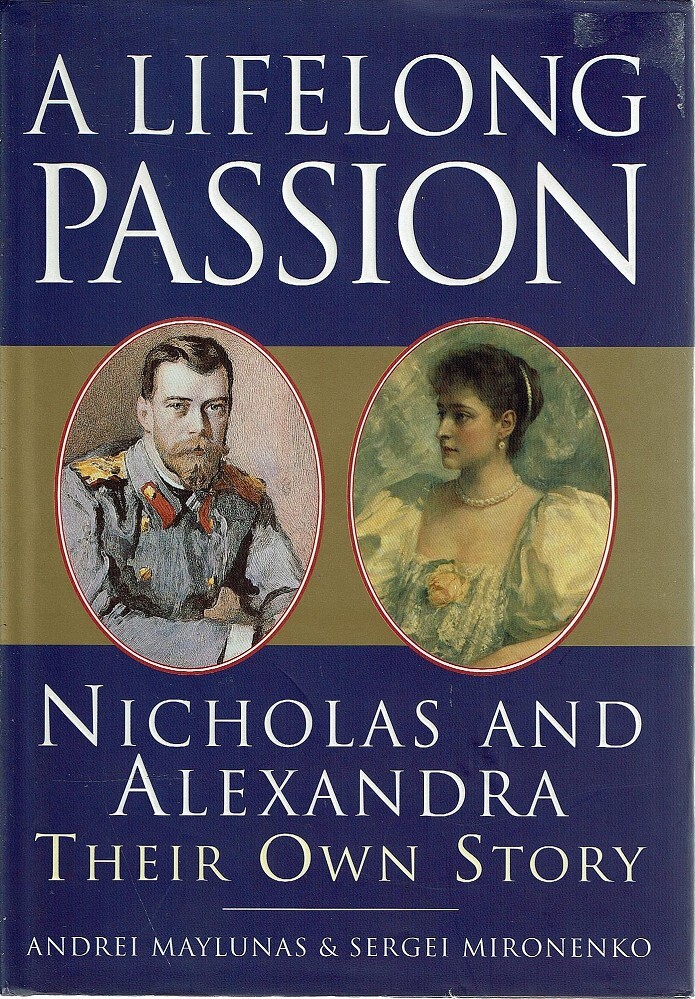
A Lifelong Passion: Nicholas and Alexandra, Their Own Story
Authors: Sergei Mironenko and Andrei Maylenas
Published in 1997 by Doubleday (US); Weidenfeld & Nicolson Ltd (UK)
559 pages, illustrated.
These letters, most of which are published here for the first time, offer an intimate look at some of the most momentous events of the early 1900s, including Russia’s participation in World War I and the fall of the Romanov dynasty in the October 1917 Bolshevik Revolution. Among the correspondents are Alexandra’s beloved but domineering grandmother, Queen Victoria of Great Britain, and Nicholas’ cousin, Kaiser Wilhelm II of Germany. Most poignant, though, are the letters and diaries of the last Tsar and Tsarina, which stand as eloquent expressions of one of the great love affairs of the late 19th and early 20th centuries.
A Lifelong Passion begins in 1884 with the couple’s first childhood meeting and chronicles their intense courtship and first joyful years of marriage. Their happiness, however, was not to last, as they were quickly overtaken by the forces of war and revolution. The discovery that their only son and heir Alexei was stricken with hemophilia opened the family to the formidable and perhaps malign influence of the monk Rasputin, whose gory death is here recounted by one of the murderers. Though unshaken in their love for one another, Nicholas and Alexandra could not hold their country together, and their story ends with a chilling account of their murder by the Bolshevik revolutionaries.
Click HERE to download, print and save a copy of my 22-page
Nicholas II Bibliography of Books (2026). It’s FREE!
***
Nicholas II: Twilight of the Empire
Author: Dominic Lieven
Published in 1993 by St. Martin’s Press (US); Pimlico (UK)
292 pages, illustrated
What is there new to say about Russia’s last monarch? Almost everything. Previous biographies have told of the shy family man, the father of the hemophiliac heir, the victim of the infamous murder at Ekaterinburg in 1918. This book provides new insights into those parts of the story, but it looks above all at Nicholas as political leader and emperor, as it portrays the Old Regime’s collapse and the origins of Bolshevik Russia in a way that will surprise readers.
Nicholas II was not stupid. Nor was he weak as is commonly thought. The dilemmas of ruling Russia were vast and contradictory, and it was an illusion to think that simply by agreeing to become a constitutional monarch Nicholas could have preserved his dynasty and empire. Drawing many eerie parallels to events unfolding in Russia today, Lieven shows that social and technological change had far outstripped the existing political and executive structures. Lieven argues that the inability of the Tsar and his government to recognize these growing anachronisms and to devise new systems constructively helped lead to the devastating chaos out of which the new order arose.
Drawing on his fifteen-year study of Imperial Russia and using archival material and other sources all over the world, Cambridge Research Professor Dominic Lieven shows that the downfall of both the Imperial and Soviet Regimes fit into a pattern of ongoing Russian history, one that bears close scrutiny if we are to understand the turmoil of the post-Cold War period.
Click HERE to download, print and save a copy of my 22-page
Nicholas II Bibliography of Books (2026). It’s FREE!
***
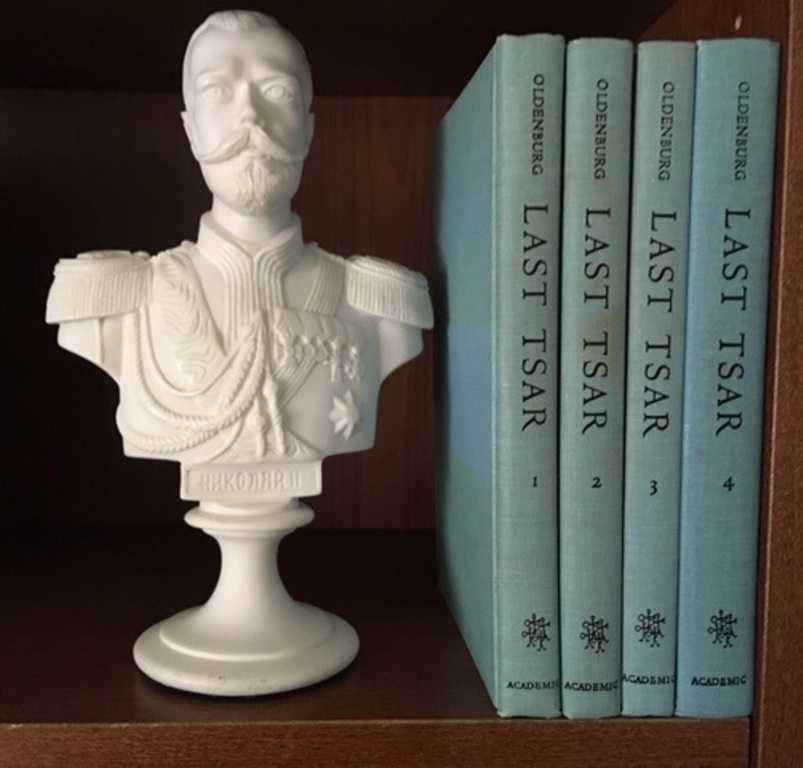
Last Tsar: Nicholas II, His Reign and His Russia – 4 Volumes
Author: Sergei S. Oldenburg
Published in 1975 by Academic International Press (US)
228 pages (Vol. I), 315 pages (Vol. 2), 224 pages (Vol. 3), 356 pages (Vol. 4)
The 4-volume Last Tsar. Nicholas II, His Reign & His Russia by the noted Russian historian and journalist Sergei Sergeiivich Oldenburg (1888-1940), remains the most comprehensive and definitive English language study of Nicholas II’s 22+ year reign to date. Originally published in 1939 in Russian, the first English edition was not published until 1975.
It is a major document in modern Russian historiography. The final contribution of a Russian nationalist historian, it provides uniquely sensitive insights into the character, personality, and policies of Russia’s last tsar. It has no rival as a political biography of Nicholas II and is without peer as a comprehensive history of his reign.
Click HERE to read my article about this highly sought after set and its’ author Sergei Sergeiivich Oldenburg
Click HERE to download, print and save a copy of my 22-page
Nicholas II Bibliography of Books (2026). It’s FREE!
© Paul Gilbert. 22 February 2026



 Nicholas II
You must be logged in to post a comment.