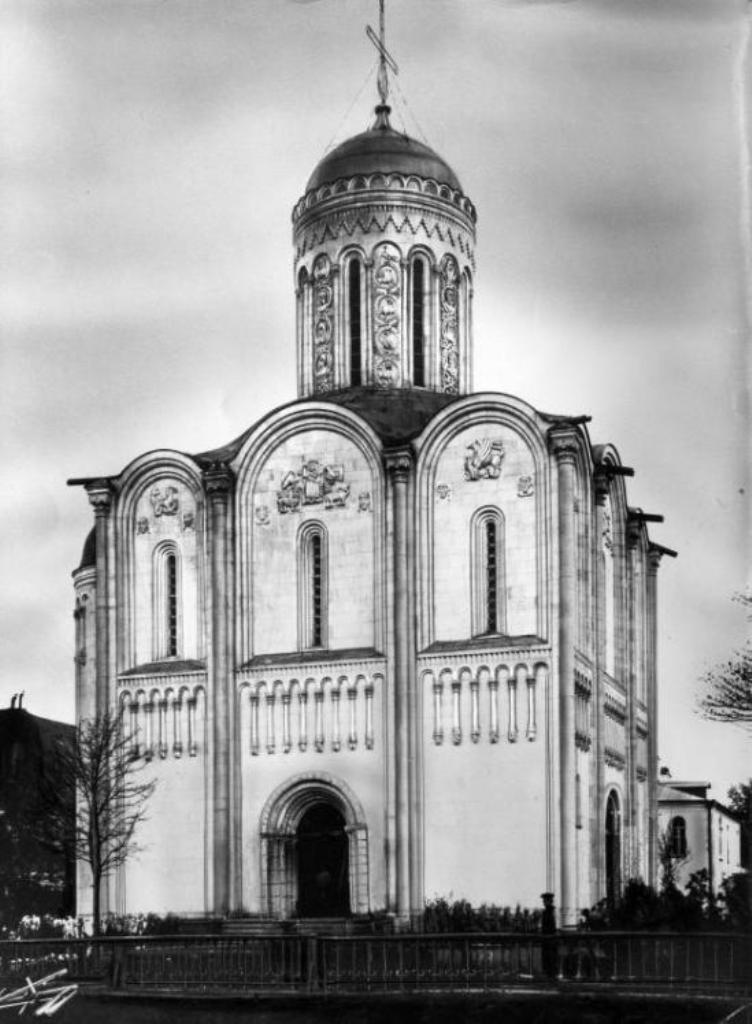
PHOTO: the Church of the Saviour on the Waters in St. Petersburg,
On 23rd March 2026, it was announced that the Church of the Saviour on the Waters, one of the most famous lost churches of old St. Petersburg will be revived. Recall that the church was was constructed in 1910-1911 as a memorial to the sailors who died in the Battle of Tsushima during the Russian-Japanese war (1904-05). The church was destroyed by the Soviets in 1932.
The reconstruction of the Church of the Saviour on the Waters is past of a large-scale renovation of Novo-Admiralty Island.
History and Construction
The site for the construction of the church was at the end of the English Embankment, at the place where the Novo-Admiralty Canal and the Neva river meet, and not far from the Admiralty Shipyards where the ships of the Imperial Russian Navy were built. The location of the church was chosen well. Lined with white stone, it looked very beautiful from the Neva River, closing the perspective of the embankment.
In 1908, a committee was created in St. Petersburg to collect donations for the construction of the memorial church. The honorary chairman of the committee was the only female admiral of the Imperial Russian Navy, the Queen of the Hellenes / Grand Duchess Olga Konstantinovna (1851-1926).
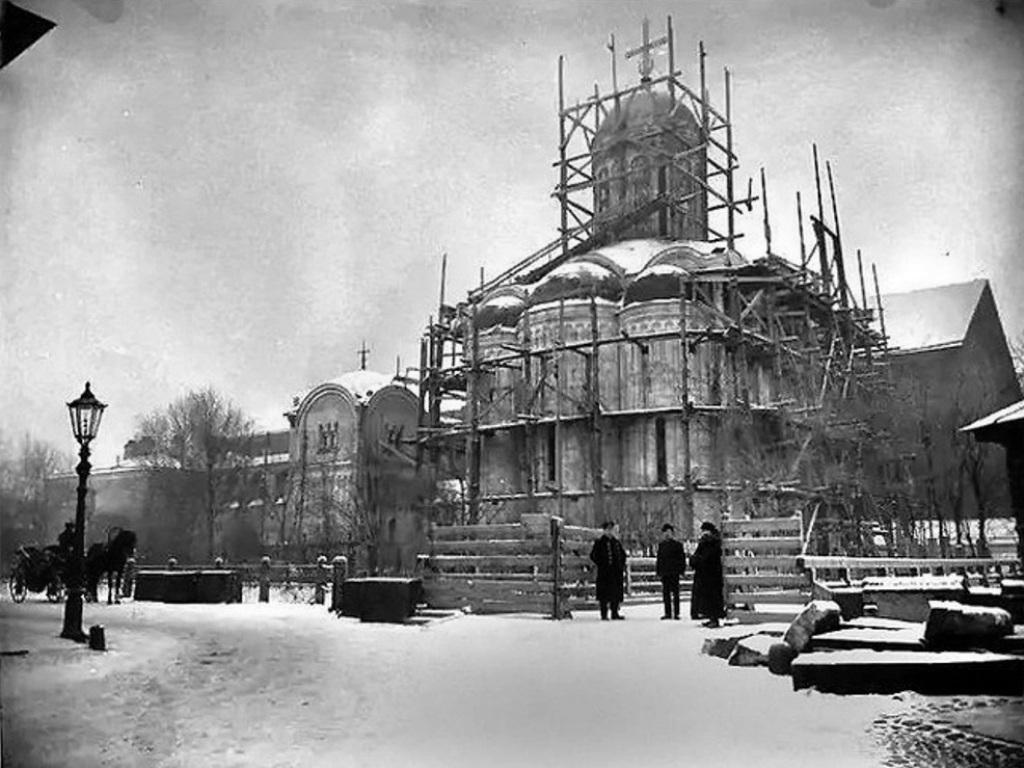
PHOTO: construction of the church took place in 1910-11
The foundation stone of the church was laid by Bishop Nikon (Rozhdestvensky) of Vologda on 28th (O. S. 15th) May 1910, on the day marking the 5th anniversary of the Battle of Tsushima. The event was followed by a procession of the cross from the St. Nicholas Naval Cathedral. Grand Duchess Olga Konstantinovna laid the soldier’s St. George Cross in the foundation stone.
The white-stone church was built in the Neo-Russian Style, by the Russian architect Marian Marianovich Peretyatkovich (1872-1916). The two-storey church consisted of a lower church in the name of St. Nicholas the Wonderworker and an upper one in honour of the Gethsemane Agony of Christ the Saviour. The church was designed for 300-400 parishioners.
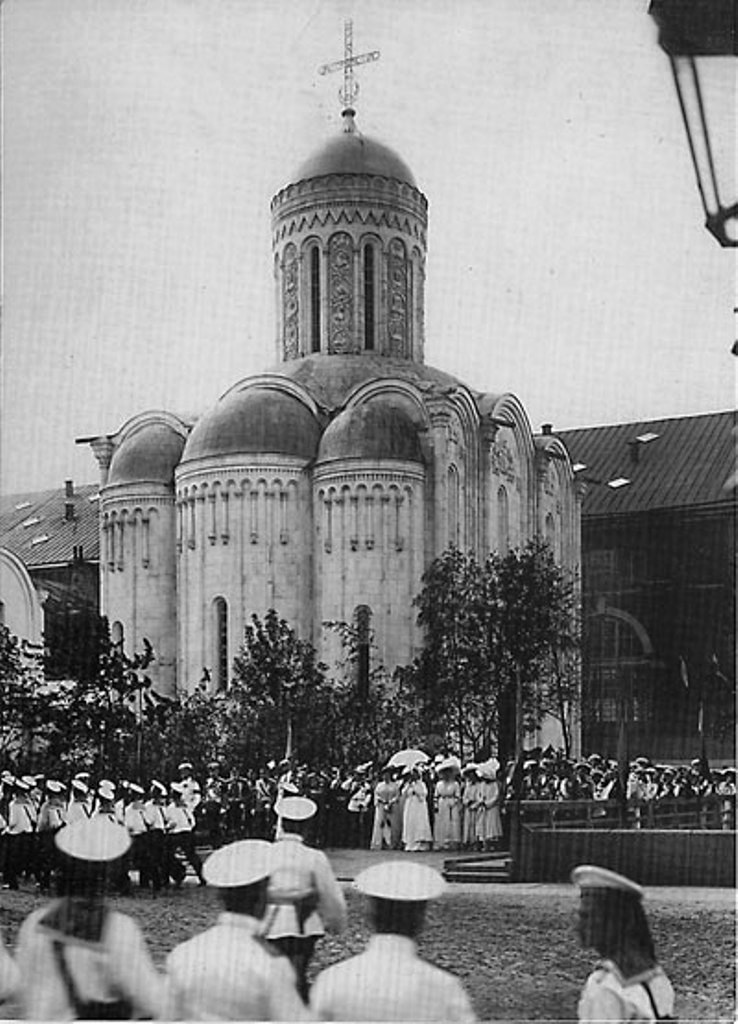
On 10th August (28th July) 1911, the military protopresbyter Georgy Ivanovich Shavelsky (1871-1951) consecrated the lower church,in the presence of the relatives of the victims of the war. The solemn consecration of the upper church took place on 13th August (O.S. 31st July) 1911. It was attended by Emperor Nicholas II and his daughters, Queen Olga of the Hellenes / Grand Duchess Olga Konstantinovna, her brother, Grand Duke Konstantin Konstantinovich (1858-1915), among other members of the Imperial Family.
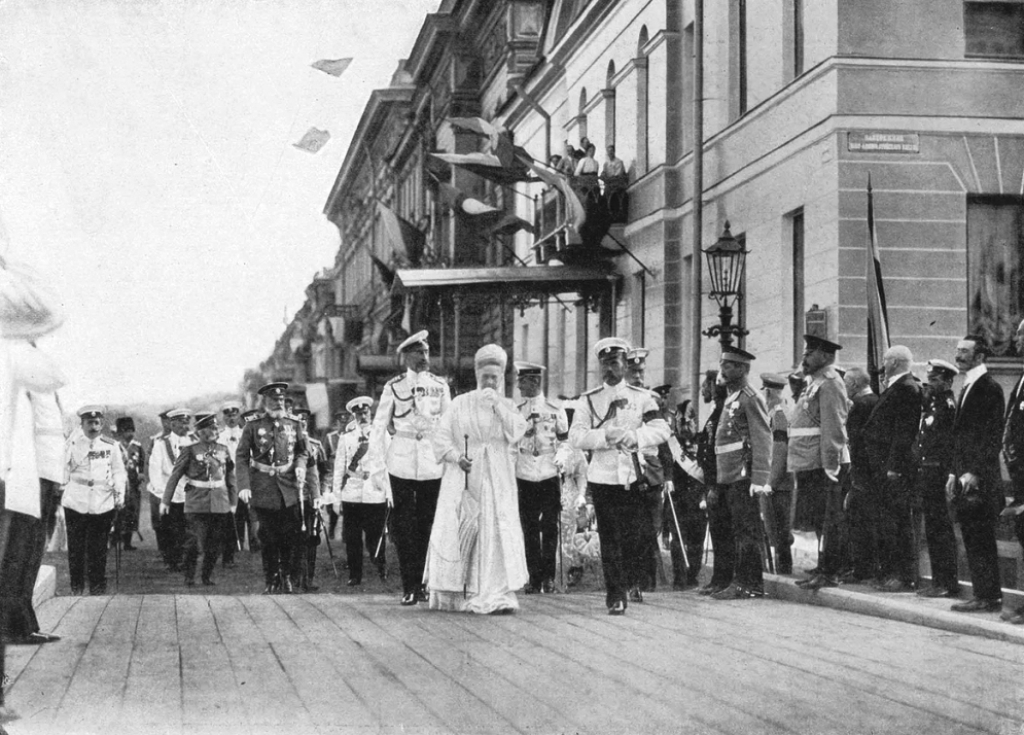
PHOTOS: Emperor Nicholas II along with other members of Imperial family arrive for the consecration of the the Church of the Saviour on the Waters in St. Petersburg, 13th August (O.S. 31st July) 1911
Design and Interior
The church was erected in the likeness of the Vladimir-Suzdal churches of the 12th century. According to the builders, it was supposed to resurrect the wonderful traditions of ancient Russian architecture. Many famous artists participated in the decoration.
The gate led to the church, above which was a belfry and a mosaic icon of the Saviour Not Made by Hands according to a sketch by the famous Russian painter and graphic artist Viktor Mikhailovich Vasnetsov (1848-1926). Relief doors lined with copper imitated the gates of the 13th century in the Suzdal Cathedral of the Nativity of the Virgin. The dome of the church was covered with golden smalt.
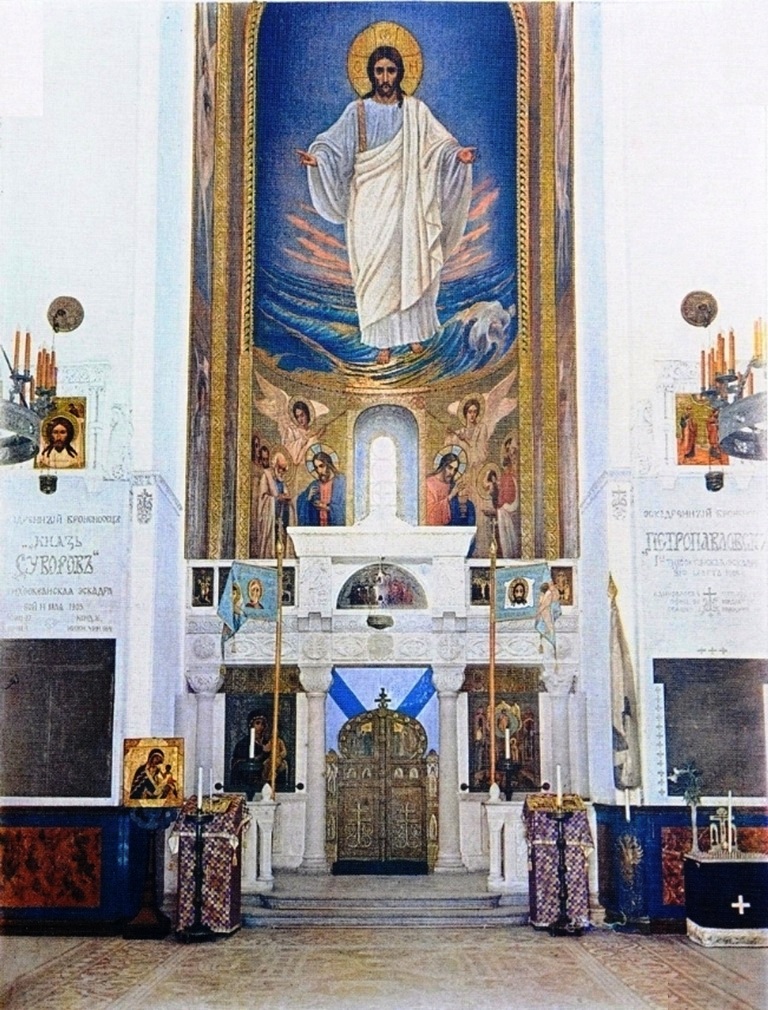
PHOTO: a colour view of the upper church and the mosaic
“The Saviour Walking on the Waters”
In the upper church, on the altar wall, there was a mosaic “The Saviour Walking on the Waters” made according to a sketch by the Russian painter Nikolai Aleksandrovich Bruni (1856-1935). Two mosaic icons – “Praying for the Chalice” and “Carrying the Cross” – on the pillars were made according to sketches by artists Viktor Vasnetsov and Nikolai Bruni.
The iconostasis was made in the ancient style of carved light gray stone and had two tiers. The Holy Doors were made of chased bronze. The altar curtain was the St. Andrew’s flag. Bronze choros chandeliers hung on anchor chains. The white-marble tabernacle was carved in the shape of the church itself.
The entrance to the lower church was through a narrow corridor. The low vaults of the lower church were covered with a continuous painting made by the Russian painter and graphic artist Mikhail Mikhailovich Adamovich (1884-1947), depicting the Gospel scenes and the life of the patron saint of sailors, St. Nicholas the Wonderworker.
The wooden two-tiered iconostasis, covered with brocade and basma, was decorated with bronze overlays. The Holy Doors were donated by the builder of the church Sergei Nikolaevich Smirnov (1877-1958) and dated to the 16th century. The Kazan icon of the Mother of God was embroidered with gold.
A covered gallery connected the church with the tower, where the maritime museum was located, and the belfry, which in turn was connected by a gallery with the clergy house.
The unique memorial church became “a symbol of a mass grave for the heroic sailors who died without burial” in the Russo-Japanese War of 1904-1905.
The Soviet Years to the Present
The Church of the Saviour on the Waters was closed by the Bolsheviks in early 1918. For a short time, irregular services continued to be conducted without too much fuss from the authorities. In 1919, the Soviet authorities concluded an agreement with the parishioners that the building would be transferred to them, and in return, the church was ordered to pay taxes, report on donations, and maintain the building in order. The teaching of doctrine was prohibited. Failure to comply with the orders would result in arrests and imprisonment.
n December 1931, at a meeting of the Presidium of the Leningrad Soviet, it was decided “to transfer the building to the plant for scrapping using materials for construction needs.”
The Soviets wasted little time in looting the church: Icons, vestments, the Gospel, silverware and precious stones were taken during two confiscations. Some were taken to local museums. Less valuable things, such as lamps, chalices, discos – were simply melted down into metal. Some of the mosaics were saved by an employee of the Morozov Museum, and stored in the basements of the museum.
Following the pillaging and looting, the church was blown up in the spring of 1932, despite thousands of signatures collected. The clergy and some of the parishioners were repressed by the local Soviet.
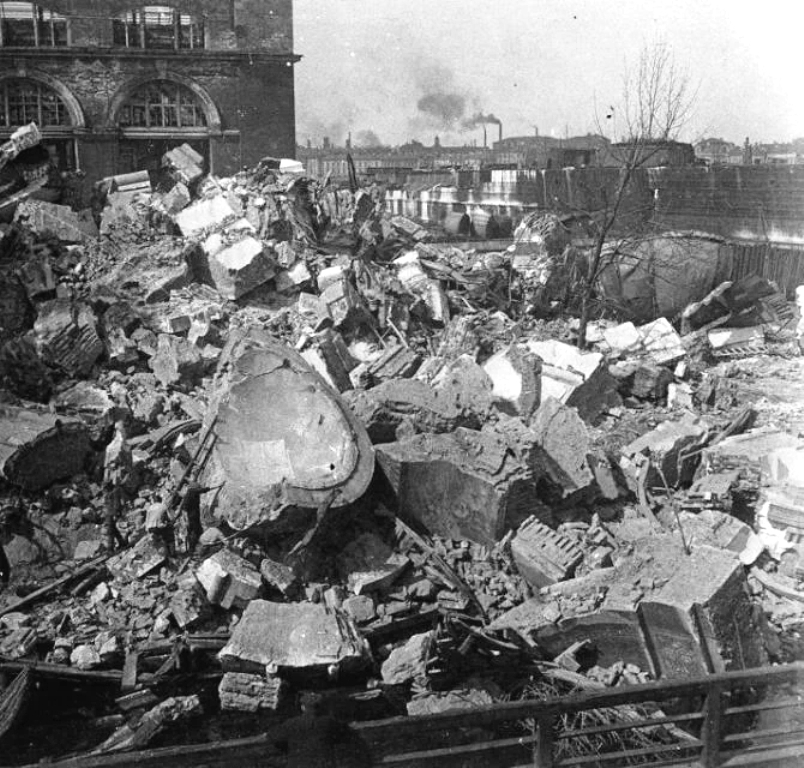
PHOTO: the Church of the Saviour on the Waters
was reduced to a pile of rubble on 8th March 1932
On 27th May 1998, on the 93rd anniversary of the Battle of Tsushima, a small chapel was built on the site of the church. With the blessing of Metropolitan Vladimir of St. Petersburg and Ladoga, a foundation stone, a marble plaque with a canonical commemorative text and the St. George Cross, brought from France by the grandson of one of the builders of the Church of the Saviour on the Waters, were laid in the foundation of the new chapel.
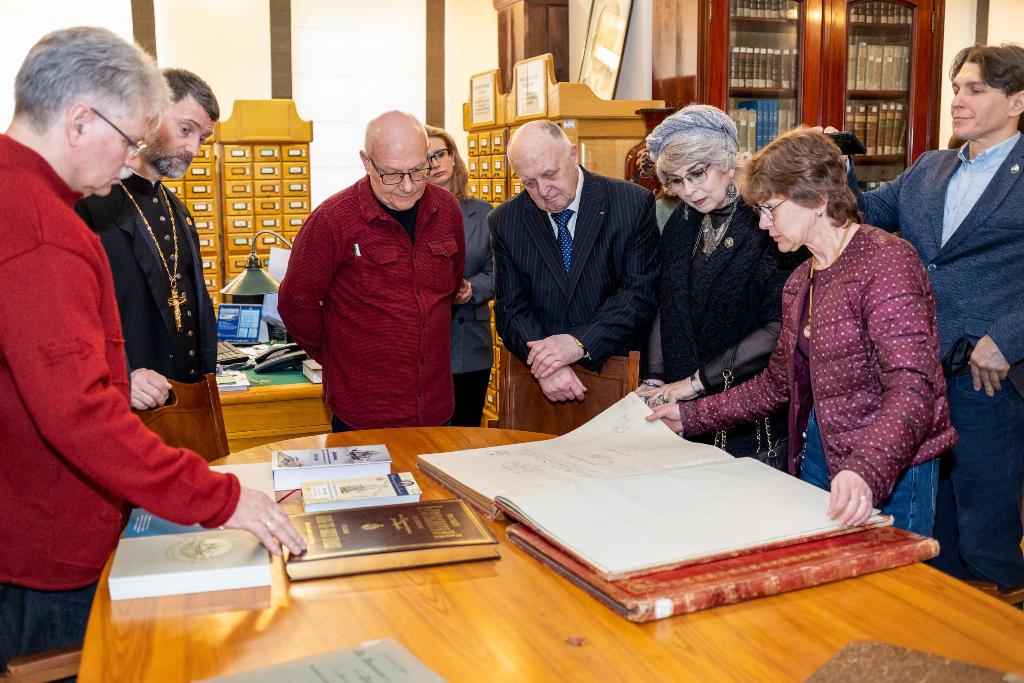
PHOTO: members of the planning working committee meet in St. Petersburg to discuss plans for the reconstruction of the Church Savior on the Waters
Reconstruction
On 23rd March 2026, representatives of the working committee gathered at the Russian Geographical Society in St. Petersburg to discuss the project for the reconstruction of the Church of the Saviour on the Waters. Among them were representatives of the St. Petersburg clergy, descendants of the heroes of the Battle of Tsushima and historians.
The decision to revive the church was made as part of the large-scale redevelopment of the Novo-Admiralteysky Island. The Church Savior on the Waters is one of the most famous lost churches of old St. Petersburg, t was created in memory of the sailors who died during the Russo-Japanese War. The church will be restored at the expense of private philanthropists.
© Paul Gilbert. 26 March 2026
 Nicholas II
You must be logged in to post a comment.