Armchair recreated for Nicholas II’s Working Study

Photo © Tsarskoye Selo Restoration Workshop

The Tsarskoye Selo State Museum continue to recreate items lost from the Alexander Palace during the Second World War . . . the Tsarskoye Selo Restoration Workshop are currently recreating the armchair for the large desk in the Working Study of Emperor Nicholas II.

The chair is being recreated from a vintage 1917 photograph by masters of the Tsarskoye Selo Restoration Workshop, who during the past few years recreated other items of furniture for this interior, as well as other interiors in the recreated Private Apartments of Emperor Nicholas II and Empress Alexandra Feodorovna, located in the Eastern Wing of the Alexander Palace.

Furniture items which have been recreated for the Working Study of Emperor Nicholas II include a large table with a lamp; in June 2023, a beautiful Ottoman and a large Persian Farahan carpet was recreated to upholster the Large Ottoman sofa; in December 2024, a table and chair, among other pieces. Upon completion, each piece was returned to it’s original historic place in the Study.

PHOTO: Nicholas II seated in the armchair (currently being recreated) in 1901

Recall that the Alexander Palace closed in the Autumn of 2015 for an extensive restoration, which saw the reconstruction of the Private Apartments of Emperor Nicholas II and Empress Alexandra Feodorovna, situated in the Eastern Wing of the palace. Work on the project took 6 years to complete. The Alexander Palace reopened it’s doors to visitors in August 2021.

According to the TASS News Agency, the Western Wing of the Alexander Palace at Tsarskoye Selo is now scheduled to open to the public in late 2025.

© Paul Gilbert. 23 September 2025
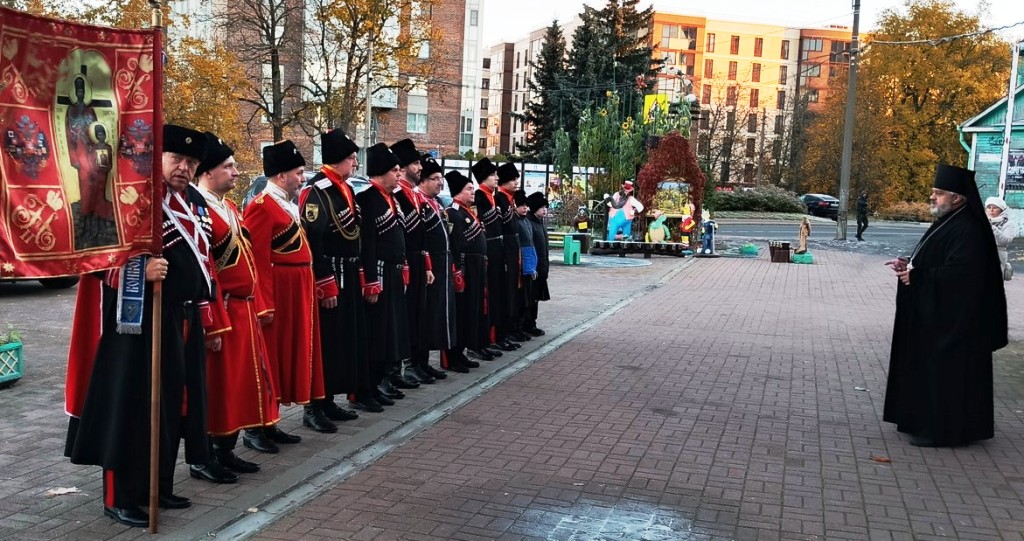
A new bust-monument of Nicholas II installed in Krasnodar

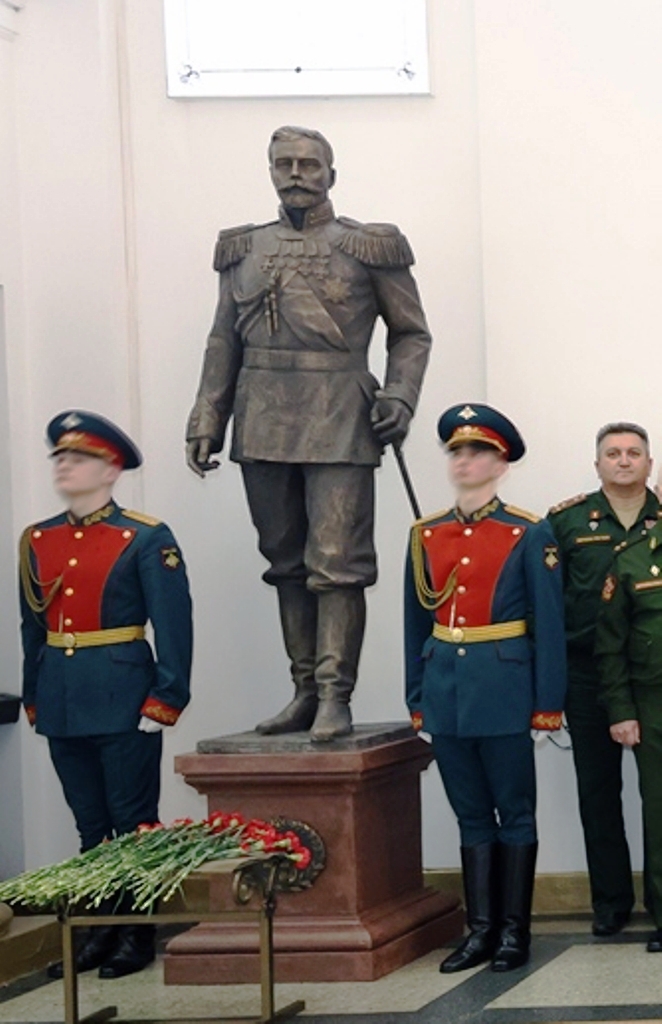
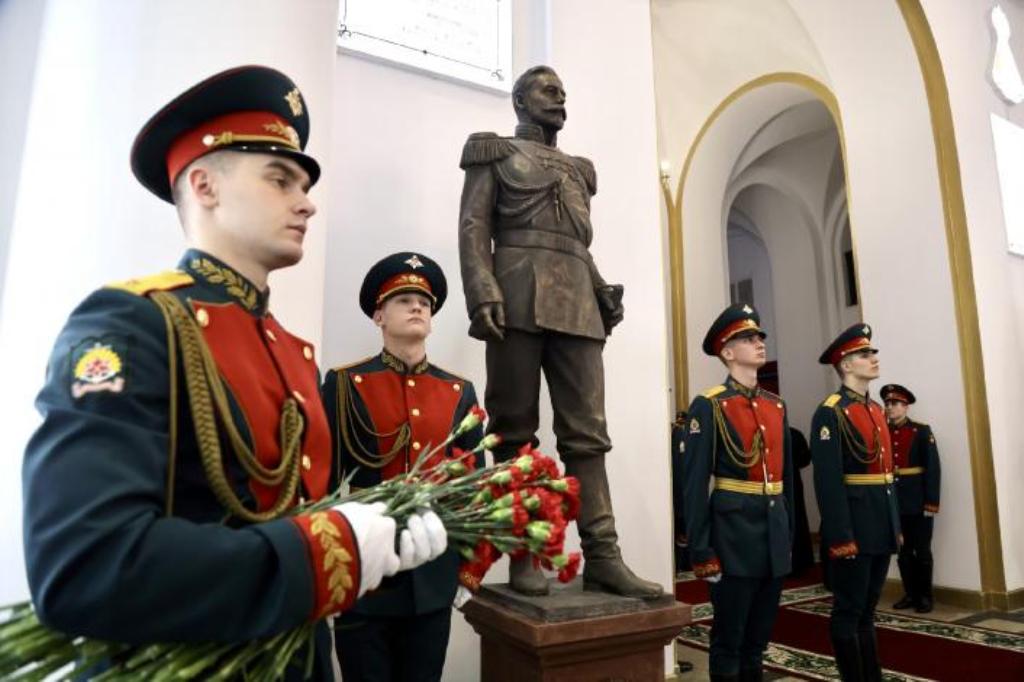
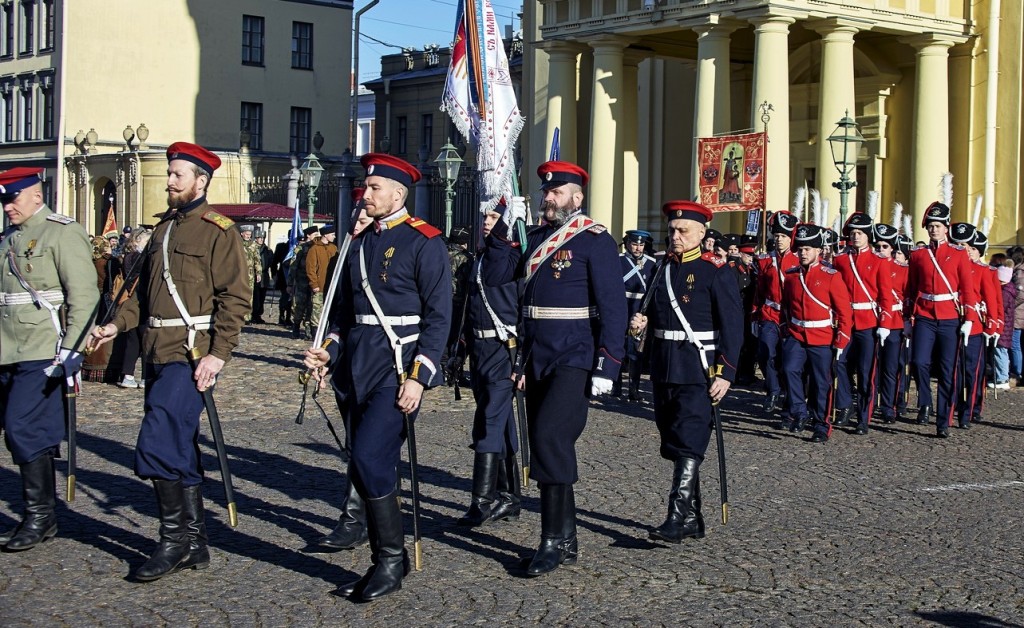
PHOTO: cadets from the Krasnodar Presidential Cadet School form a guard of honour during the opening ceremonies of a new monument to Emperor Nicholas II in the “Cossack city”

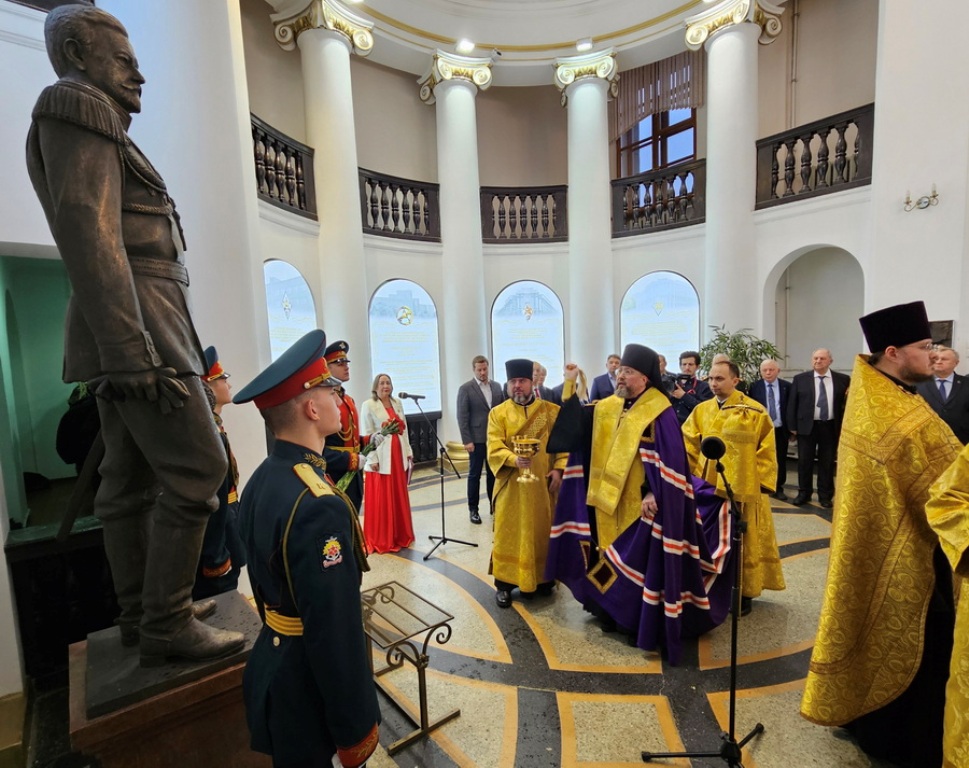
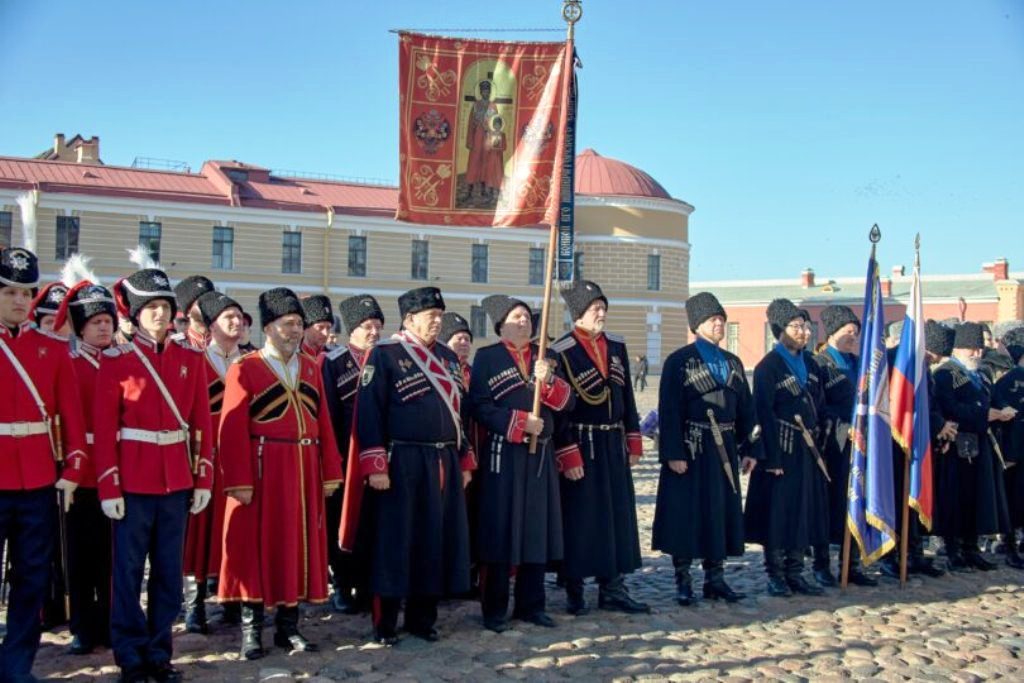
On 21st September 2025, a new bust-monument of Emperor Nicholas II was installed and consecrated on the grounds of the Presidential Cadet School In the Russian city of *Krasnodar. The bust is a copy created by the famous Russian sculptor is Alexander Alekseevich Apollonov (1947-2017).

*Krasnodar is known as the “Cossack city”. Founded in 1793 as a fortress city by the Black Sea Cossacks, it has a rich history tied to the Cossack culture. The city was originally named Yekaterindar, meaning “Catherine’s Gift,” and later renamed Krasnodar, which translates to “Red Gift,” reflecting the city’s imperial past and the Cossack identity. Today, Krasnodar retains its connection to the Cossacks through various historic sites and cultural events.

The opening ceremony was attended by the Lieutenant General of the Foreign Intelligence Service 
Leonid Reshetnikov, Vice-Governor of the Krasnodar Territory and Ataman of the Kuban Cossack Host Society Alexander Vlasov and Minister of Culture of the Krasnodar Territory Victoria Lapina.

Also in attendance were Chairman of the Elisabeth-Sergius Educational Society Foundation (ESPO) Anna Vitalievna, and representatives of the Heritage of the Empire movement, and the leadership of the Presidential Cadet School, city officials, among others.

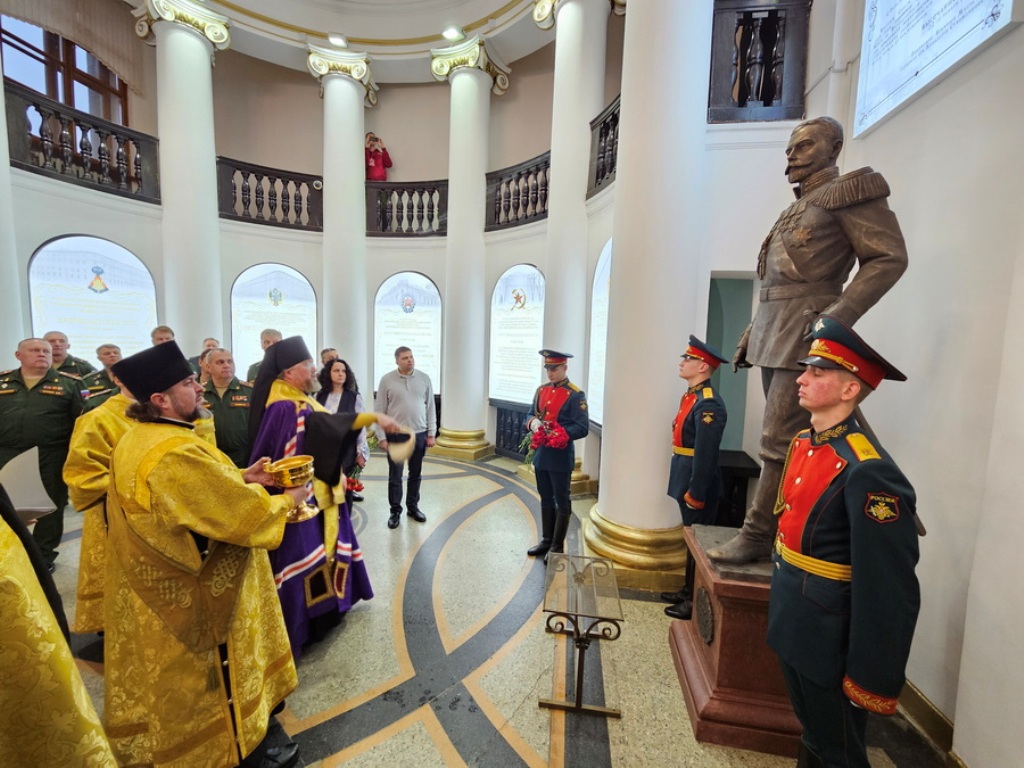
PHOTO: a local Orthodox priest performs the act of consecration on the new monument to Emperor Nicholas II in Krasnodar

The bust was installed as part of the historical and cultural project Imperial Route, which the Krasnodar Territory joined in August 2025. The solemn event included the laying flowers at the monument and the school’s cadets taking part in a solemn march past the monument, along the parade ground.

The Imperial Route project now unites 32 regions of Russia and is aimed at popularizing the history of the House of Romanov. As part of the route, other memorial plaques and sites have also been unveiled in the Krasnodar Territory, including the recent commemoration of the visit of Emperor Nicholas I to Gelendzhik in 1837.

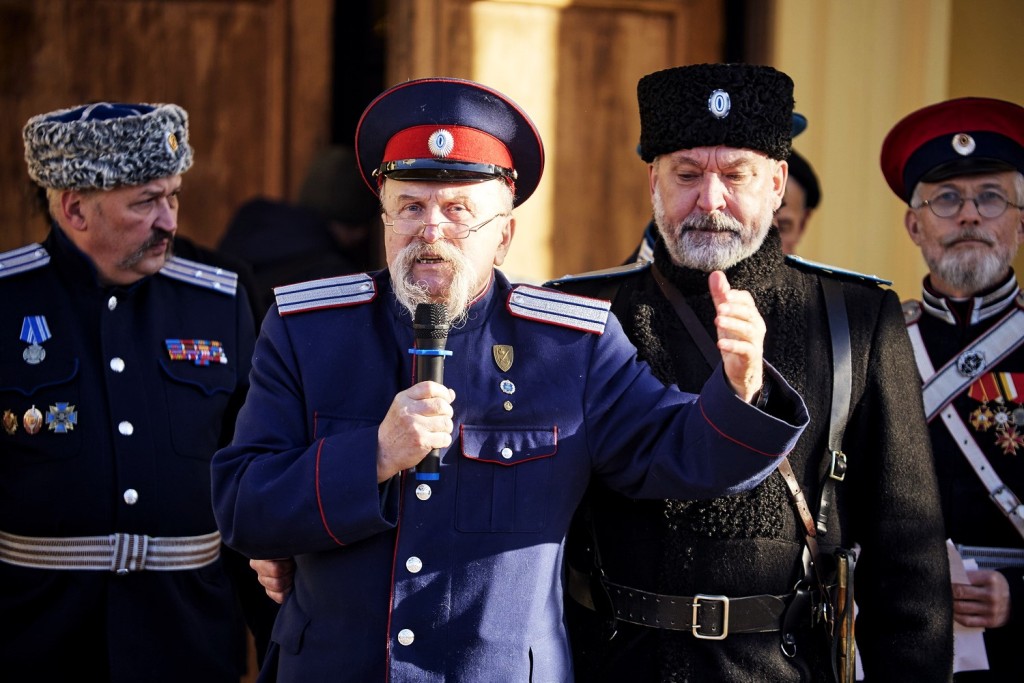
Alexander Vlasov noted the importance of the memory of Nicholas II, emphasizing his contribution to the development of the country and his connection with the Cossack troops. Representatives of the the Kuban Cossack Host Society and invited guests stressed the importance of preserving historical continuity and educating young people on national history.

“The opening of the bust of the last emperor is our tribute to the history of Russia, to the Imperial Family,” said Alexander Vlasov. – I will also remind you that, from 1904, the August Heir of Nicholas II, Tsesarevich Alexei, was the Ataman of all Cossack troops and the honorary chief of several Cossack regiments and schools.

The history of the Kuban and the Cossacks are closely associated with the Russian Imperial family . . .

“In 1888, Emperor Alexander III, along with the heir to the throne Nicholas Alexandrovich [future Emperor Nicholas II] and other members of the Imperial Family visited Yekaterindar. Today, a restored Triumphal Arch, located on the main street in Krasnodar, is a reminder of the historic visit.

PHOTO: cadets from the Krasnodar Presidential Cadet School form a guard of honour during the opening ceremonies of a new monument to Emperor Nicholas II in the “Cossack city”

Since the fall of the Soviet Union in 1991, more than 100 monuments, sculptures, busts and memorial plaques to Nicholas II have been installed in cities and towns across the Russian Federation.

In July, busts of Nicholas II and Tsesarevich Alexei were temporarily placed in the city of Uryupinsk, Volgograd Region, during a commemorative event. Plaster sculptures were installed on the Alley of Heroes, where a monument to Joseph Stalin was located during the Soviet period. After the ceremony, the busts were dismantled.

Russia’s most famous monument to Nicholas II is the monument by Vyacheslav Mikhailovich Klykov (1938-2006) in the village of Taininskoye in the Mytishchi district of the Moscow region. The monument depicts the Emperor wearing his ermine trimmed Coronation robe with regalia and is located on the site of the former travelling palace, next to the ancient near the Church of the Annunciation (1675-1677. The monument has been blown up twice by extremists, each time restored.

© Paul Gilbert. 22 September 2025
Chinese Theater at Tsarskoye Selo to be restored

PHOTO: Early 20th century view of the Chinese Theater of Catherine the Great, situated in the Alexander Park at Tsarskoye Selo

More exciting news from Tsarskoye Selo . . .

On 12th September 2025, the Tsarskoye Selo State Museum and Gazprom’s Cultural Initiatives Support Foundation signed an agreement for the restoration of the 18th-century Chinese Theater and its adaptation for modern use. The theater is situated in the New Garden of the Alexander Park at Tsarskoye Selo.

The restoration of the architectural monument will require at least three billion rubles ($39 millions USD), and take at least eight years to complete. In the next two years, the ruins which have survived to this day will be mothballed, whereupon, specialists will begin reconstruction.

The building is planned to have a large exhibition hall with an area of ​​about 600 square meters, which will host exhibitions and theatrical performances. In addition, the depository of the Tsarskoye Selo State Museum-Reserve will be located here.

PHOTO: A current view of the burned out ruins of the Chinese Theater in the Alexander Park at Tsarskoye Selo

The Chinese Theater was constructed in 1778 by the famous architect Antonio Rinaldi (1709-1794). The first performance was given in the Chinese Theater on 13th June 1779, when the composer Giovanni Paisiello presented his opera ‘Demetrios’ for Empress Catherine II.

In 1892, the premiere of Leo Tolstoy’s play ‘The Fruits of Enlightenment’ was staged here. In the early 20th century, the famous parody ‘Crooked Mirror’ by Alexander Izmailov (1873-1921), was performed here for Emperor Nicholas II and his family.

In 1908-1909, the building was overhauled: the stage was re-equipped with the latest technology for staging large opera and ballet performances. With the outbreak of the First World War, the activities of the Chinese Theater ceased for a long time, the performances resumed only in the summer of 1930.

PHOTO: Artist concept of what the the Chinese Theater in the Alexander Park at Tsarskoye Selo, will look like after the reconstruction, which will begin in 2022, and last about eight years.

On 15th September 1941, when the city of Pushkin (Tsarskoye Selo) was being shelled by the Nazis, the Chinese Theater was completely burnt out. It has remained in a terrible state of neglect and disrepair since – see photo on this page.

Recall that in March 2021, the museum announced plans for the reconstruction of the Chinese Theater, however, the project was put on hold due to lack of financing. Now that financing is in place – thanks to Gazprom – the revival of this beautiful building will once again be the venue for theatrical performances.

© Paul Gilbert. 19 September 2025
The death of Pyotr Stolypin at Kiev, 18th September 1911

PHOTO: Emperor Nicholas II and Prime Minister Pyotr Stolypin (right) in Kiev. This photo was taken the day before an assassination attempt was made on Stolypin’s life in Kiev on O.S. 30th August 1911

During the reign of Emperor Nicholas II (1894-1917), politicians and police officers were murdered as a result of widespread revolutionary violence by leftist revolutionaries. There are no exact statistics on the number of politicians and police officers killed during Nicholas II’s reign, however, it can be argued that hundreds or even thousands of people were killed during this period due to the political violence that spilled over into the revolutionary movement. 

One of the most tragic human losses occurred on 18th [O.S. 5th September] September 1911 – when Pyotr Arkadyevich Stolypin died, following injuries sustained during an attempted assassination in Kiev four days earlier.

Stolypin was a prominent and widely respected Russian politician. He was the third Prime Minister of Russia, and Minister of Internal Affairs of the Russian Empire from 1906 until his assassination in 1911.

Known as the greatest reformer of Russian society and economy, he initiated reforms that caused unprecedented growth of the Russian state.

“Give the state 20 years of internal and external peace, and you will not recognize today’s Russia,” he said. In an interview with one of the newspapers, Stolypin described the ongoing reforms, the main goal of which, according to him, was to create a class of small landowners, which was supposed to lead to the prosperity of the country.

Sadly, Stolypin’s reforms were complicated by the fact that they were not fully implemented due to the tragic death of Stolypin in 1911, the outbreak of the First World War in 1914, the February 1917 and October 1917 revolutions, and then the Civil War. Stolypin himself assumed that all the reforms he conceived would be carried out in a comprehensive manner (and not only in terms of agrarian reform) and would give the maximum effect in the long term (according to Stolypin, “twenty years of internal and external peace” were required

PHOTO: early 20th century painting depicting Dmitry Bogrov
shooting Stolypin at the Kiev Opera House. Artisting unknown

PHOTO: “Stolypin was standing. He slowly turned his face towards us and, with his left hand, made the sign of the cross in the air.” – letter from Nicholas II to his mother

In the autumn of 1911, Stolypin traveled to Kiev despite police warnings that an assassination plot was afoot as there had already been 10 attempts on his life! On 14th September [O.S. 1st September] 1911, there was a performance of Rimsky-Korsakov’s “The Tale of Tsar Saltan” at the Kiev Opera House in the presence of the Tsar and his two eldest daughters, the Grand Duchesses Olga and Tatiana Nikolaevna.

The theatre was occupied by 90 men posted as interior guards. According to Alexander Spiridovich – the head of Nicholas II’s secret personal guard – after the second act “Stolypin was standing in front of the ramp separating the parterre from the orchestra, his back to the stage. On his right were the Minister of the Imperial Court Count Vladimir Fredericks (1838-1927) and the Minister of War Vladimir Sukhomlinov[1] (1848-1926).” His personal bodyguard had stepped out to smoke.

Stolypin was shot twice, once in the arm and once in the chest, by Dmitry Bogrov, a leftist revolutionary. Bogrov ran to one of the entrances and was apprehended. Stolypin rose from his chair, removed his gloves and unbuttoned his jacket, exposing a blood-soaked waistcoat. He never lost consciousness, but his condition deteriorated. He died four days later.

There is a myth that the Tsar and his daughters witnessed the assassination attempt, however, this is not true. In a letter to his mother, Nicholas describes the chain of events on that fateful night:

“ . . . During the second interval we had just left the box as it was so hot, when we heard two sounds as if something had been dropped . . . I ran back into the box to look. To the right I saw a group of officers and other people. They seemed to be dragging someone along: women were shrieking, and directly in front of me in the stalls Stolypin was standing. He slowly turned his face towards us and, with his left hand, made the sign of the cross in the air. Only then did I notice that he was very pale and that his right hand and uniform were bloodstained. He slowly sank into his chair and began to unbutton his tunic . . .

“Olga and Tatiana came back into the box and saw what had happened . . . Then the theatre filled up again, the national anthem was sung, and I left with the girls at eleven. You can imagine with what emotions! Alix knew nothing about it till I told her. She took the news rather calmly. Tatiana was very much upset, she cried a lot and they both slept badly.”

PHOTO: Dmitry Grigoryevich Bogrov (1887-1911)

Bogrov was hanged 10 days after the assassination. On his own request, Stolypin was buried in the Kiev-Pechersk Lavra (see photo below) on 22nd [O.S. 9th September] September 1911.

PHOTO: The grave of Pyotr Arkadyevich Stolypin in the Kiev-Pechersk Lavra

PHOTO: On 27th December 2012, a monument to Pyotr Stolypin was unveiled in Moscow, near the Russian White House, officially known as the House of the Government of the Russian Federation.

Memory Eternal! Вечная Память!

NOTES:

[1] Sukhomlinov was ousted as Minister of War amid allegations of failure to provide the Imperial Russian Army with necessary armaments and munitions for World War I and accused of responsibility for Russia’s defeats in the early Eastern Front. Sukhomlinov was tried for high treason, corruption, and abuse of power in a high-profile case that damaged the reputation of Russia’s fragile Imperial government. According to some historians, the Sukhomlinov scandal may have done more harm to the Romanov monarchy than the lurid scandals associated with Rasputin.

Sukhomlinov lived the remainder of his life in extreme poverty in Berlin, where he was found dead from exposure to cold on a park bench one morning on 2nd February 1926. Sukhomlinov was buried at the Berlin-Tegel Russian Orthodox Cemetery.

© Paul Gilbert. 18 September 2025
Nicholas II wanted reforms, Lenin wanted revolutions: who was right?

The question of whether Nicholas II was right with his desire for reform or Vladimir Lenin with his revolutionary ideology is at the heart of the debate about the fate of Russia in the early 20th century. Emperor Nicholas II, tried to modernize the country through gradual reforms, preserving its traditional foundations and monarchical system. Lenin, on the other hand, advocated a radical breakdown of the old order and the construction of a socialist society through revolution.

In this article, I argue that Nicholas II’s reform-based approach was more correct and patriotic, as he sought stability and prosperity for Russia, while Lenin’s revolutionary ideas led to chaos, civil war, and tragedy, including the deception and murder of the Imperial Family.

Nicholas II: Reforms for the Sake of Stability and Prosperity

Nicholas II, who ascended the throne in 1894, inherited an empire that faced the challenges of modernization, social tensions, and domestic and external threats. His reign was far from perfect, but the Tsar sincerely sought reforms that would strengthen Russia, preserving its national identity and unity.

Economic and social reforms

Under the leadership of Nicholas II, Russia experienced significant economic growth. At the beginning of the 20th century, the country was one of the world’s leaders in industrialization. The construction of the Trans-Siberian Railway linking the east and west of the Russian Empire was completed, promoting trade and mobility for Russians. Industrial production doubled, and Russia became the largest exporter of grain. These achievements show that the Tsar saw the future of the country in economic development and modernization.

The key reform was Pyotr Stolypin’s agrarian reform, which began in 1906. It was aimed at creating a class of independent peasant landowners, which would strengthen agriculture and social stability. Nicholas II supported these measures, realizing that a strong economy and a satisfied peasantry were the basis of a stable state. The reforms were gradual to avoid upheavals, which testifies the foresight of the Tsar.

Political transformations

Nicholas II, despite his commitment to autocracy, made political concessions after the revolution of 1905. The Manifesto of 17th October 1905 introduced the State Duma, laying the foundations of a constitutional monarchy. Although the Duma had limited powers, it was a step toward democratization, showing the Tsar’s willingness to adapt to new realities. His reforms were aimed at preserving the unity of the country, avoiding radical upheavals that could split society.

Protection of traditions and faith

Nicholas II saw Orthodoxy and traditions as the basis of Russian identity. He supported the construction of churches and monasteries, strengthening the spiritual unity of the people. His reforms did not seek to destroy the historical heritage, but on the contrary, used it as a foundation for modernization. This made his approach patriotic, as he cared about preserving the culture of Russia.

Peacekeeping

Nicholas II initiated the Hague Conference of 1899, which was the first step towards international norms of warfare. This demonstrated his desire for peace and stability, which was especially important in the context of growing global conflicts. His efforts earned him a nomination for a Nobel Peace Prize in 1901. Even during the First World War, the Tsar personally participated in the management of the army, showing devotion to duty and country.

Lenin: Revolution for the Sake of Utopia

Vladimir Lenin, on the contrary, advocated a radical destruction of the existing order. His Marxist ideology demanded a revolution that would destroy the monarchy, the church, and capitalism, replacing them with the dictatorship of the proletariat. However, his actions led to disastrous consequences, proving that the revolutionary path was wrong.

Destruction instead of creation

The October Revolution of 1917, led by Lenin, overthrew the Provisional Government and led to a civil war (1917-1922) which claimed millions of lives. The nationalization of industry and collectivization destroyed the economy, causing hunger and poverty. Unlike the reforms of Nicholas II, which strengthened the economy, Lenin’s policy led to devastation. For example, the surplus-appropriation plundered peasants, which caused mass discontent and uprisings, such as the Kronstadt uprising in March 1921.

Red Terror and deception

Lenin sanctioned the first Red Terror, aimed at the destruction of “class enemies.” Thousands of innocent civilians, were executed or sent to gulags. Nicholas II, on the contrary, sought to avoid mass repressions, even during the February 1905 Revolution. Moreover, Lenin played a key role in the tragedy of the last Tsar and his family. The Imperial Family were held under house arrest and then shot in Ekaterinburg in 1918 on the direct order of Lenin. In the Bolshevik leader’s mind, as long as the Tsar, or any member of his family were left alive, they posed a threat to the new order and their reign of terror and repression.

Loss of territories

The Brest-Litovsk Peace Treaty of 1918, signed by Lenin, was humiliating for Russia. Huge territories, including Ukraine and the Baltic states, were given to Germany, which weakened the country. Nicholas II, even during the First World War, fought to preserve territorial integrity. When he took command of the Russian armed forces in August 1915, no further Russian territories were lost to the enemy. Lenin, on the other hand, sacrificed national interests for the sake of preserving his power, which can hardly be called patriotic.

Destruction of traditions

Lenin, as an atheist, declared war on Orthodoxy, destroying churches and persecuting and murdering thousands of members of priests, monks and nuns. This undermined the spiritual foundations of Russia, which Nicholas II defended. Lenin’s revolution rejected the historical legacy, replacing it with a utopian ideology that did not take into account the cultural and national characteristics of the country.

Who was right?

Nicholas II’s reform-based approach was correct, as he sought to modernize Russia without destroying its foundations. His reforms in the economy, agriculture, and politics (among others) were aimed at gradual development that could have led to prosperity had it not been for the revolutionary upheavals of 1917 and 1918.

The Tsar cared about the people, traditions and international prestige of the country, which makes his actions patriotic. His love for Russia was so deep, that he abdicated the throne, in order to save both his family and Russia from further bloodshed. His actions clearly emphasized his sacrifice.

Lenin, on the other hand, chose the path of revolution, which turned into chaos, civil war and the death of millions of innocent victims. His policies destroyed the economy and culture, and the deception and murders of the Imperial Family became symbols of his immoral approach. Popular support for Nicholas II frightened Lenin, as it threatened his power, which led to the regicide in Ekaterinburg.

Lenin, by destroying everything for the sake of a utopian idea, led Russia to disaster. Blackmail, deception and murder of Russia’s last Tsar only confirm that his methods were not only erroneous, but also immoral. History has shown that Nicholas II’s reforms could have made Russia stronger.

© Paul Gilbert. 16 September 2025
In memory of Prince Nicholas Romanovich (1922-2014)

Prince Nicholas Romanovich Romanov
1922-2014

On this day – 15th September 2014 – Prince Nicholas Romanovich Romanov died in Bolgheri, Tuscany, Italy at the age of 91. Following the death of his cousin Prince Vladimir Kirillovich in 1992, Nicholas became his rightful successor as Head of the House of Romanov.

Prince Nicholas was born on 26th September 1922 in Cap d’Antibes near Antibes on the French Riviera. He was the eldest son of Prince of the Imperial Blood Roman Petrovich (1896-1978) and his wife Princess Praskovia Dmitrievna (née Countess Sheremeteva, 1901-1980).

Nicholas Romanovich belonged to the third branch of the first line of the House of Oldenburg-Russia (House of Holstein-Gottorp-Romanov, itself descended from the first branch of the House of Holstein-Gottorp). These three branches are all descended from the first branch of the House of Oldenburg. He is a direct descendant of Emperor Nicholas I (1796-1855).

PHOTO: Three generations: Prince Nicholas Romanovich Romanov with his grandfather (left) Grand Duke Peter Nikolaevich, and his father Prince Roman Petrovich (right)

Childhood, boyhood and youth

As children, Prince Nicholas Romanovich and his brother Dmitri Romanovich were immersed in a Russian atmosphere. he received a private education from Father Zossima, this monk taught him the old Russian school curriculum. Despite their exile, Prince Roman Petrovich and his wife raised their two sons in the Russian spirit, in their daily lives. The brothers observed the Old Style Julian calendar, and the religious holidays of the Russian Orthodox Church.

Nicholas did part of his studies in France, but he aspired to a career in the Italian navy as an officer. To realize his dream, his parents used their close ties to the Italian royal house (his paternal grandmother, Princess Militza of Montenegro, was the sister of Helen of Montenegro, the wife of Victor Emmanuel III of Italy). His grandmother made the necessary arrangements with the members of the House of Savoy. Nicholas Romanovich left his family to continue his studies in Italy, where he was taught by the retired Italian officer, Captain Tommaso Surdi. After completing his studies, the prince would be admitted to the Italian Naval School in Livorno. Suffering from short-sightedness, the prince had to abandon his career in the navy. During the Second World War the Italian fleet suffered terribly, incurring great losses, according to the prince, this myopia may have saved his life.

In 1936, his family moved to Italy, Nicholas Romanovich did classical studies, he graduated in 1942. From his early childhood the prince spoke Russian and French, later he learned English and Italian, his tutor, Marcel Berlinger taught him Latin and ancient Greek.

PHOTO: Prince of the Imperial Blood Roman Petrovich with his wife Princess Praskovia Dmitrievna and children Prince Dimitri (seated on his mother’s lap) and Prince Nicholas (right). Antibes, France. Late 1920s.

World War II and the post-war years

During the Fascist occupation of Rome, members of Nicholas Romanovich’s family lived under the constant threat of deportation, especially the prince’s paternal grandmother, Militza of Montenegro, who found refuge in a convent, and then in Vatican City. The prince’s family resided at the Villa Marlia near Lucca in Tuscany. In September 1943, surrounded by carabinieri, Nicholas and his family were taken to Rome, where they lived for the duration of the war. On 8th September 1943, Italy signed the armistice, and the prince’s family was present at the Villa Savoia (residence of the King and Queen of Italy) and witnessed the departure of Victor Emmanuel III and Queen Elena from Italy. In turn, the members of the prince’s family left Villa Savoia and lived clandestinely for more than nine months.

After the liberation of Rome by the Allies, Nicholas Romanovich was employed in one of the Allied agencies, the Psychological Warfare Branch. When World War II ended, the prince found a job with the United States Information Service (USIS). In 1946, Nicholas and his family moved to Egypt, where the prince held a few odd jobs, but wishing to return to Italy to continue his university studies, Nicholas considered his stay in Egypt as a period of rest. Between 1947 and 1948, the Turkish tobacco trade gave the prince a certain financial ease, he was also employed by an insurance company.

In 1950, Nicholas decided to return to Europe. On the way to Geneva, the prince stopped in Rome, where he met his future wife. Prior to his marriage, he was employed by the British Austin Motor Company, working with the firm’s representative in Italy, Colonel Andrew Constable-Maxwell.

PHOTO: Prince Nicholas Romanovich and his wife Countess Sveva della Gherardesca

Marriage and children

Nicholas Romanovich married Sveva della Gherardesca (b. 1930) on 21st January 1952 in St. Michael the Archangel Church (Russian Orthodox) in Cannes, France, while a civil marriage took place on 31st December 1951 in Florence, Italy. The prince’s wife belonged to the famous Tuscan family della Gherardesca, her father, Count Walfredo della Gherardesca was one of the descendants of Count Ugolino (Ugolin), a character in Dante’s Divine Comedy. Her mother was and the Marchioness Nicoletta de Picolellis.

Prince Nicholas and his wife had three daughters:

  • Natalia Nikolaevna (b. 1952), who married Giuseppe Consolo (b. 1948) in 1973, and had two children;
  • Elisabeth Nikolaevna (b. 1956), who married Mauro Bonacini (b. 1950) in 1982, and had two children;
  • Tatiana Nikolaevna (b. 1961), who married Gian Battista Alessandri (b. 1958) in 1983, divorced in 1988, remarried Giancarlo Tirotti (b. 1947), and had one child.

In 1982, Prince Nicholas and his wife moved to Rougemont, a small mountain village in the canton of Vaud, Switzerland. The couple lived there for seven months every year, usually in the winter. During the rest of the year they stayed in Italy with their daughters.

In January 1955, Nicholas’s brother-in-law died accidentally, and Nicholas Romanovich became the manager of his wife’s Tuscan estate. Between 1955 and 1980, the prince became a breeder of the Chianina cattle breed, some of these cattle were exported to Canada, he was also a winegrower.

PHOTO: Prince Nicholas Romanovich Romanov visiting
Saints Peter and Paul Cathedral in St. Petersburg

Heartbeat from a non-Russian throne

During a BBC(Russia) interview in May 2006, Prince Nicholas Romanovich (1922-2014) confirmed that in 1942, Fascist Italy wanted to make him king of Montenegro, but he refused.

“In 1942 I was only 20 years old” – said Prince Nicholas – “I did not like Mussolini or the Nazis, even if I were a Montenegrin, I would still refuse.”

“More than 60 years have passed since then. I remember being at home in Rome. My father called me and said: “The Italian Minister of the royal court, the Duke of Aquarelle will arrive soon. He wants to talk with you.”

“I asked what he wanted. Father replied: “You will see.” When the minister arrived at the house, I was of course curious to know what he wanted. I was friends with his sons.”

“The minister approached me and said: “The Montenegrin throne is at your disposal. Give your answer – do you accept or not?”

“This surprised me very much, especially since my father had not warned me. I answered no. I said that I am not a Montenegrin. I am Russian, and Montenegro does not interest me. Since he was the minister of the Fascist government, I did not want to admit that I wanted to be to a appointed fascist regime.”

NOTE: Prince Nicholas Romanovich’s grandmother Grand Duchess Militsa Nikolaievna (1866-1951) was the Montenegrin Princess Milica Petrović-Njegoš, daughter of King Nicola I of Montenegro (1841–1921). [She married Grand Duke Peter Nikolaevich (1864-1931) of Russia on On 26 July 1889]

“The minister then told my father that I was already over 16 years old, that I was a dynastic adult, and that he had no right to refuse this wonderful gift offered to his son. My father also refused.”

And so Montenegro was left without a king …

“When the First Great War ended” – added Prince Nicolas – “Montenegro was under the occupation of the Austro-Hungarian armies. My great-grandfather, King Nicola, was forced to leave his country.”

“And when, at the end of the war, attempts to reorganize Europe began, Montenegro was left without its strongest patron, which was Russia . . . Tsarist Russia.”

“The Montenegrin king was left without patronage, and the Montenegrin kingdom disappeared from the world map.”

PHOTO: the Head of the House of Romanov Prince Nicholas Romanovich throws a handful of earth into the grave of Emperor Nicholas II and his family. St. Petersburg, 17th July 1998

Head of the House of Romanov

After the sale of his Tuscan farm, Nicholas began to gather information about the Romanov family in order to write a biography. At the same time, the prince painted watercolours depicting the fictitious operation of a battleship of the Russian Imperial Navy in the Mediterranean, and he affixed to them legends written in his own hand. This work, on the advice of his friend Masolino d’Amico, was presented to a publisher, it was published in 1988 by the publisher the Italian publisher Mondadori, This work was entitled Storia di una corazzàta Tonda [Tr. History of the Tonda battleship].

The interest shown by Prince Nicholas in the country of his ancestors and the changes that had taken place in Russia led the media, particularly television, who pursued him constantly for interviews. As a result, Nicholas gave more than one hundred interviews during his lifetime. In addition, he has appeared in documentaries about Russia’s last Tsar, and has given many lectures on Russia and the Romanov family.

It was Prince Roman Petrovich, who came up with the idea of a family association of the Romanovs in the mid-1970s. It was not until 1979, however, that the Romanov Family Association was officially created. Prince Dmitri Alexandrovich served as it’s first president and Nicholas as vice-president. When Prince Vasili Alexandrovich became president in 1980, Nicholas remained vice-president. In 1989, after the death of Vasili Alexandrovich, Prince Nicholas was elected the new president. It should be noted that Princess Maria Vladimirovna has never joined the Romanov Family Association, nor did her late father Prince Vladimir Kirillovich.

The Romanov Family Association was an organization whose goal was to strengthen the connection between the descendants of the House of Romanov, who were living now scattered across the globe. The association exists to the present day.

The official position of the Romanov Family Association is that the rights of the family to the Russian Throne were suspended when Emperor Nicholas II abdicated for himself and for his son Tsesarevich Alexei in favour of his brother Grand Duke Michael Alexandrovich who then deferred ascending the Throne until a Constituent Assembly ratified his rule. Michael did not abdicate but empowered the Provisional Government to rule.

Following the death of Prince Vladimir Kirillovich on 21 April 1992, Prince Nicholas Romanovich became his rightful successor and rightful Head of the House of Romanov. He was elected pretender to the throne of Russia on 31st December 1992, by members of the Russian Imperial Family in exile, against his cousin the Princess (known as the “Grand Duchess”) Maria Vladimirovna.

In June 1992, the prince visited Russia for the first time, and further visits followed. From 1998, Nicholas Romanovich visited Russia once a year. In July 1998, as head of the House of Romanov, Prince Nicholas Romanovich, attended the ceremonies held on the occasion of the funeral of the last Tsar Nicholas II of Russia in St. Petersburg.

Prince Nicholas led more than 50 Romanov descendants at the funeral of Emperor Nicholas II and his family in St. Petersburg, on 17th July 1998. The writer of this obituary was also in St. Petersburg for this historic event, and it was the one and only time that I met in person both Princes Nicholas and Dmitri Romanovich in person. The meeting took place in the lobby of the Astoria Hotel, and although it was nothing more than a handshake, an introduction and an exchange of a few words. I recall Prince Nicholas smiling and shaking my hand when I told him I had come from Canada for the funeral. I was struck by the warmth and sincerity of this brief encounter. I was even invited to travel on the special coaches which had been arranged to transport the more than 50 Romanov descendants[1] from the Astoria to the SS Peter and Paul Cathedral for the funeral.

As head of the Romanov family, Prince Nicholas was also present at the reburial of the remains of the Dowager Empress Maria Feodorovna in Russia in September 2006. Prince Nicholas and his brother Prince Dmitri had been responsible for lobbying the Danish royal family and the Russian President Vladimir Putin to allow the transfer of the Dowager Empress’s remains to Russia so they could be buried alongside her husband Emperor Alexander III.

PHOTO: an elderly Prince Nicholas Romanovich remains one of
the most highly respected descendants of the Romanov Dynasty

Prince Nicholas Romanovich died in Bolgheri. Tuscany on 15th September 2014, aged 91. His funeral was held on 17th September 2014, at the Church of Saints Jacob and Christopher in Bolgheri. The funeral ceremony was performed by two priests, one from the Roman Catholic Church, the other from the Holy Great Martyr Catherine of the Moscow Patriarchate. At the foot of the coffin lay a wreath of flowers of the Russian tricolor, as well as numerous wreaths and fresh flowers. The condolences of Russian President Vladimir Putin were conveyed to the family of the deceased by Russian Ambassador to the Vatican Alexander Avdeev. A telegram of sympathy signed by the speaker of the State Duma of the Russian Federation Sergei Naryshkin was also read. Prince Nicholas was then interred in the crypt of the Counts della Gherardesca, the burial site of his wife’s family, at the Basilica of St. Francis in Pisa in Tuscany.

Prince Nicholas was survived by his wife, their three children, five grandchildren and three great-grandchildren.

Memory Eternal! Вечная Память!

In 2022, Russian historian Ivan Matveev published a biography Хранитель истории династии. Жизнь и время князя Николая Романова / Keeper of the History of the Dynasty. The Life and Time of Prince Nicholas Romanov.

© Paul Gilbert. 15 September 2025
NOTES:

[1] The only Romanov descendants who did not take part in the funeral ceremonies were Princess Maria Vladimirovna, her son George and her mother Princess Leonida Georgievna (1914-2010). The reason being, that none of them (even to this day) recognize the Ekaterinburg Remains, as those of Emperor Nicholas II, his wife, and their five children. Lord have Mercy!

The fate of four faithful retainers of the Imperial Family

On the night of July 16/17, 1918, a tragic event took place in Ekaterinburg that marked the final fall of Russia into the hellish abyss of devastation and the ensuing Civil War. In the basement of the Ipatiev House, the last Russian Emperor Nicholas II, was shot dead by a gang of Bolshevik criminal thugs. His entire family and four faithful servants, who voluntarily followed the Imperial Family into exile and, later, shared the same fate.

While the lives of Emperor Nicholas II, Empress Alexandra Feodorovna and their five children have been studied in detail, but that of the four faithful retainers remain in the shadows of history. This article provides brief bios of the lives of the Imperial Family’s physician Dr. Eugene Botkin (1865-1918); the maid Anna Demidova (1878-1918); the valet Aloise (Alexei) Trupp (1856-1918); and the cook Ivan Kharitonov (1872-1918).

In 1981, the four faithful retainers, along with the Imperial Family, were canonized as a New Martyr by the Russian Orthodox Church Outside of Russia (ROCOR). In 2016, the Bishop’s Council of the Russian Orthodox Church (Moscow Patriarchate) canonized Dr. Botkin as a righteous passion bearer. They did not canonize the other three servants.

The Canonization Commission, headed by Metropolitan Yuvenaly, considering the issue of the canonization of the the other three faithful servants, noted that:

“… it is not possible to make a final decision on the existence of grounds for the canonization of this group of laymen, who, in accordance with the duty of their Court service, accompanied the Imperial Family during the period of their imprisonment and accepted a violent death. … the most appropriate form of veneration for the Christian podvig[1] of the faithful servants of the Imperial Family, who shared their tragic fate, today can be the perpetuation of this feat in the lives of the Royal Martyrs.”

Святы Царственные мученики, молите Бога о нас!
Holy Royal Martyrs, pray to God for us!

PHOTO: in happier times – Dr. Botkin with Emperor Nicholas II

Evgeny (Eugene) Botkin – Family Physician

Evgeny (Eugene) Sergeevich Botkin was the son of the famous physician Sergei Botkin (1832-1889), who served as one of the  the Court physicians for Emperors Alexander II and Alexander III. Since childhood, Evgeny followed in his father’s footsteps and pursued a career as a doctor. At the beginning of the 20th century, he worked in a hospital for the poor and at the same time lectured to students of the Imperial Military Medical Academy in St. Petersburg. Despite the fact that his dissertation was devoted to the narrow topic of blood composition, in his lectures he covered the very broad aspects of the medical profession, in particular, paying special attention to the psychological aspects of a doctor’s work, instructing future doctors that the patient should be treated with respect and dignity.

In 1904, when the Russo-Japanese War began, Botkin rushed to the Front to head the medical unit of the Russian Red Cross Society. Later he said that he could not remain indifferent to the misfortune that befell his country. Despite the fact that he went to the Front with “the most bloodthirsty feelings”, the war taught him to treat all people, even his enemies: he was equally willing to help both the Russian and Japanese wounded. Evgeny Sergeevich was a deeply religious person, his faith helped and sustained him during this period. He returned home with six military awards, and the impressions of what he saw on the fronts of the Russo-Japanese War formed the basis of a book on the subject.

It was this book that became, perhaps, the main reason that Empress Alexandra Feodorovna chose him as a personal physician for the Imperial Family. In the autumn of 1908, Botkin and his family moved to Tsarskoye Selo. The doctor’s younger children became friends with the Tsesarevich and the Grand Duchesses, and often assisted their father in his work, carrying out simple tasks.

In August 1917, when Botkin went into exile with the Imperial Family, his son Gleb and daughter Tatyana followed their father, but only reached Tobolsk – they were not allowed to go to Ekaterinburg (later both emigrated). In exile, Botkin became a kind of intermediary between the Imperial Family, the guards and the inhabitants of the city: he arranged a visit by a priest to the Governor’s House, arranged hour and a half walks for the Imperial Family, petitioned for a tutor for the Tsesarevich, taught the Russian language and biology to the Tsar’s children, while providing medical services to the residents of Ekaterinburg. Evgeny Sergeyevich never complained either about his health (which was not good) or about the conditions of detention – his letters reflect a positive or at least stoic attitude to all the trials and tribulations that fell to his lot. Only in the last letter, which was never sent, did Botkin admit that he had already “… died, but not yet buried, or buried alive.”

On the fateful night of July 16/17 1918, the guards woke up Botkin and ordered him to wake up all the inhabitants of the Ipatiev House, saying that they were allegedly being transported to another place, since the city was restless. Having gathered everyone in the basement, the executioner-commandant Yakov Yurovsky announced their execution, to which the bewildered Botkin managed to answer only with a question: “So they aren’t taking us anywhere?” The doctor’s body was burned along with the bodies of the Imperial Family. During the excavations, his artificial jaw, a broken pince-nez and a brush for his beard and mustache were found. 

Evgeny Sergeevich Botkin was the only person among the four faithful servants who was canonized by the Moscow Patriarchate of the Russian Orthodox Church. On 3rd February 2016, the Bishop’s Council of the Russian Orthodox Church canonized Botkin as Righteous Passion-Bearer Yevgeny the Physician.

On 16th October 2009, the Prosecutor General’s Office of the Russian Federation decided to rehabilitate 52 close associates of the Imperial Family who had been subjected to repression, including the four faithful servants who perished with the Imperial Family.

On 25th March 2016, on the grounds of the Moscow City Clinical Hospital No 57, Bishop Panteleimon of Orekhovo-Zuevo consecrated the first church in Russia in honor of Righteous Evgeny Botkin.

Anna Demidova – maid

Anna Stepanovna Demidova was born into a bourgeois family in Cherepovets. She learned several foreign languages, played the piano well, was well educated and erudite, but her strong point was always embroidery. In fact, this talent helped her find the main work of her life: the Empress admired Demidova’s embroidery so much that she invited her to serve in the Imperial Family as a maid. Usually, the “room girls” were mainly engaged in helping the Empress with her wardrobe and help her get dressed, but Anna’s main duty was to teach the Tsar’s daughters needlework. Anna Demidova won over the grand duchesses so much so that she became something like another nanny for them. Anastasia loved her most of all, calling her “dear Nyuta” in her letters. Demidova never had her own family and children, as the “room girls” were not supposed to get married. Once she was proposed to hand and heart, but Demidova refused, deciding to stay with the Imperial Family.

In Tobolsk, and later in Ekaterinburg, Demidova took care of the household: she repaired clothes and bed linen, sewed new things, helped the Empress to always look and dress like a lady, as much as possible in such straitened circumstances. On the night of the shooting, Demidova went down to the basement, carrying several pillows with her – everyone thought that they would really be taken somewhere, so they took the necessary things with them. These pillows, however, only prolonged Demidova’s horrific death – during the shooting, the bullets got stuck in the dense down of the pillows. Thinking that it was all over, the maid shouted, “Thank God! God saved me!” Unfortunately, her execution was just beginning. Realizing that the maid was still alive and not even wounded, the executioner Yakov Yermakov stabbed her several times in the chest with a bayonet. Demidova was one of the last to die, her final memories being witness to the violent and bloody deaths of those whom she loved most.

Aloise (Alexei) Trupp – valet

Aloise (Alexei) Trupp came from an ordinary Latvian peasant family. At the age of 18, young Aloise went to serve in the army, where the young handsome Latvian was enlisted in the Life Guards. There he rose to the rank of a non-commissioned officer and was retired on 23rd March 1883. It is believed that he was noticed by Empress Maria Feodorovna, who invited him into the service of the palace as a footman. Aloise enjoyed the trust of the Imperial Family, accompanied them on trips, and watched over the Emperor’s children as if they were his own (he never had children of his own). He also looked after the Emperor’s wardrobe and helped him get dressed. While in the service of Nicholas II, the Tsar had difficulty parting with old clothes, preferring darned to new, but he adored military uniforms – hundreds of different uniforms hung in his closets.

Trupp never forgot about his native land, always giving large sums to help the poor and those suffering from crop failures. He also donated money for the construction of a church in his homeland. While still imprisoned in Tsarskoye Selo, a drunken officer shouted to him and other servants: “You are our enemies. We are your enemies. You are all corrupt here.” In the last months of his life, the “corrupt” servant Trupp served the Emperor free of charge.

In the Ipatiev House, Trupp lived in the same room with the cook Ivan Kharitonov. Despite Trupp’s Catholic faith, he participated in Orthodox services: he sacrificialized[2], carried a candle, and lit and brought censers. One day, while among the guards of the “House of Special Purpose” was his nephew, with whom he spoke his native Latvian. Unlike some of his fellow Latvians, who took part in the execution of the Imperial Family, Trupp remained with the Master of the Russian Land until the very end. On the fateful night of 16/17 July, Trupp and Kharitonov were standing against the wall when the shooting began. “A woman’s squeals and moans… A footman leaning against the wall,” one of the killers would later say.

Ivan Kharitonov – cook

Ivan Mikhailovich Kharitonov was born on 14th June (O.S.) 1870 in St. Petersburg. In 1882, he was encouraged by his father to study cooking, and went to Paris in order to improve his skills, eventually becoming a soup specialist, he even invented a recipe for puree soup made from fresh cucumbers. Kharitonov knew the culinary traditions of different countries, understood Lenten cuisine, and came up with new recipes. In 1888, he was appointed to the Imperial Court as an apprentice cook, and then as a cook. In the period from 1891 to 1895, Kharitonov served in the Russian Imperial Navy. After his service ended, he returned to the Imperial Court, where he was appointed senior cook of the Imperial Kitchen. He had the title of Honourary Hereditary Citizen[3], a result of which he was awarded many orders and medals.

After the February 1917 Revolution, the head waiter Kuba left the service of the Imperial Family, he was replaced by Ivan Kharitonov. Previously, the Imperial Family loved picnics, Emperor Nicholas II would sometimes bake potatoes in ashes himself, but in exile they had to get used to simple food on a regular basis. Nevertheless, Ivan Kharitonov managed to cook exquisite dishes from affordable products, which were becoming more and more scarce. The commandant of the Ipatiev House, Yakov Yurovsky, suddenly “cut off” the supply of fresh food to the captives from sympathetic townspeople and the Ekaterinburg monasteries, saying that it was time for the Imperial Family to get used to eating like prisoners. Despite all the difficulties, Kharitonov managed to make delicious dishes from available products. Dishes such as rasstegai[4], pasta pie, potato dumplings, beetroot salad, and tangerine jelly were prepared, much “to the great joy of everyone”, as Nicholas II wrote in his diary. The last apprentice cooks for Kharitonov were the grand duchesses who helped him in the kitchen, and he taught them how to bake bread.

On the fateful night of 16/17 July, Kharitonov stood in the basement by the wall next to the valet Trupp. The cook was one of the first to die from the shots fired by the firing squad. Ivan Kharitonov was happily married and had 6 children. The family tried to follow their father into exile, but only reached Tobolsk, they were not allowed to join him in Ekaterinburg. This allowed them to survive during the Civil War and the establishment of Soviet power.

The great-grandson of Ivan Kharitonov, Candidate of Historical Sciences Pyotr Valentinovich Multatuli is recognized as one of Russia’s foremost authorities on the life and reign of Nicholas II. He has written numerous books on the subject and lectures in cities across the Russian Federation.

NOTES:

[1] Podvig is defined as an action taken not for one’s own sake, but for the sake of something greater, such as an idea or one’s homeland, often involving significant risks, including the potential for sacrifice. It is also described as a “spiritual struggle” within the context of Orthodoxy, serving as a means to draw closer to Christ on the path of salvation.

[2] In the Orthodox Christian tradition, the term “sacrificialized” refers to the concept of the Eucharist, which is often described as a “bloodless sacrifice.” This means that during the Eucharist, the bread and wine become the Body and Blood of Jesus Christ through the descent and operation of the Holy Spirit, rather than through the shedding of blood. The Eucharist is considered a propitiatory sacrifice offered on behalf of both the living and the dead, symbolizing Christ’s sacrifice for humanity. The Orthodox Church emphasizes that the Eucharist is a true sacrifice, not merely a symbol, and it represents the completion of all other sacraments and the source of all Church doctrines.

[3] The title of Honourary Hereditary Citizen in Russia was established by the Emperor Nicholas I in 1832. This title was granted to individuals who had made significant contributions to the state and society, such as merchants, professionals, and artists. The privileges associated with this title included exemption from corporal punishment, the ability to own gardens and country estates, and the right to ride in a carriage in pairs or quadruplets. The title was hereditary, and children of hereditary honoured citizens received the title from birth. The establishment of this title was part of the imperial state’s effort to create a middle class and stabilize the social structure of Russian towns.

[4] Rasstegai is a traditional Russian dish made from a pastry crust that is filled with a variety of ingredients, such as fish, meat, liver, rice, or mushrooms. The dish features a hole in the center, which is used to add broth to the filling. Rasstegai is known for its flaky pastry crust and has been a popular choice in Russian cuisine, especially during the Tsarist era.

© Paul Gilbert. 14 September 2025
***

I am committed to clearing the name of Russia’s much slandered Tsar. In exchange for this 18-page booklet, please consider making a small $5 or $10 donation in aid of my research. These donations are of great assistance in helping me offset the cost of obtaining and translating documents from Russian archival sources, which are often paid for out of my own pocket. It is these documents which help present new facts and information on the life and reign of Nicholas II. In addition, my research continues to debunking many of the myths and lies which exist more than a century after his death and martyrdom.

Please note, that there is NO obligation, thank you for your consideration!

CLICK HERE TO MAKE A DONATION

Update on the proposed Nicholas II museum complex in Mogliev

PHOTO: artist’s concept for the Emperor Nicholas II
museum complex proposed for Mogliev

On 3rd July 2024, I reported that a new museum complex dedicated to Emperor Nicholas II was being planned for Mogliev in Belarus. The complex was to be constructed on a hill in Gorky Park, next to the Church of the Holy Royal Passion-Bearers. Unfortunately, the proposal was met with protests from locals, who were opposed to the demolition of a 16th-century castle to make way for the new museum complex.

A new place for the museum complex was chosen in the historical heart of Mogliev. As specified in the OJSC “Institute “Mogilevgrazhdanproekt”, the museum complex will be located on the Square of Glory[1], on the site of the former building of the General Headquarters of Emperor Nicholas II, situated in the southwestern part of the adjacent Gorky Park. The museum complex will form a single architectural ensemble within the framework of the Church of the Holy Royal Passion-Bearers.

PHOTO: artists concept for the proposed Emperor Nicholas II museum complex in Mogliev (above), and map showing it’s location in the in the southwestern part of the adjacent Gorky Park

The new museum will be dedicated to the events of the early 20th century: the First World War, the Headquarters of the Supreme Commander-in-Chief of the Russian Imperial Army, the stay of of Emperor Nicholas II in Mogliev, the Knights of St. George, and the February Revolution of 1917.

Walking paths will stretch throughout the park, observation decks, sculptural compositions, small architectural follies, and beautifully landscaped flower beds. The concept of the project provides for the improvement of Gorky Park from the central entrance group of the museum complex to the existing Regional Museum of Local Lore.

The realization of the proposed Nicholas II museum complex is of course is pending approval. Town hall meetings will be held in Mogliev, in which citizens will have an opportunity to have their say.

***

PHOTO: the former Governor’s House and
later General Headquarters in Mogilev. 1915

On 8th August 1915, the Headquarters (Stavka)  of the Supreme Commander-in-Chief of the Armed Forces of the Russian Empire was transferred from Baranovichi to Mogilev. From August 1915 to March 1917, Emperor Nicholas II, served as Commander-in-Chief[2], and the city assumed the role of Military Capital of the Russian Empire.

The Tsar travelled back and forth on the Imperial Train, from Tsarskoye Selo to Mogilev, where he settled in the Governor’s House, situated on Governor’s Square. He was often accompanied by his son and heir Tsesarevich Alexei Nikolaevich.  

The official historiographer in the retinue of Nicholas II, Dmitry Dubensky, describes the Emperor’s quarters as follows:

“The Emperor’s rooms were located on the 2nd floor of the Governor’s House. His Majesty’s office had two windows overlooking the square. It was decorated modestly furnished with simple provincial furniture, a sofa and a small desk, which the Tsar kept some of his papers. Adjacent to this room was the bedroom of His Majesty and Heir with iron camp beds, a washbasin, a dressing table, and several chairs. On the walls over the beds, there were many Orthodox crosses, many of which were gifts from family members.

“From the hall to the left is a dining room, quite large, decorated with simple ordinary furniture. There are two additional rooms for the Minister of the Imperial Court Count Vladimir Borisovich Frederiks (1838-1927) and one for Major-GeneralVladimir Nikolaevich Voeikov (1868-1947).

“In addition, there were small rooms for five or six servants, the Tsar’s valet, cooks, and others.”

Sadly, the former Governor’s House, which housed the General Headquarters was destroyed during the Nazi invasion of 1941-45. In the years following the Great Patriotic War, the Soviets showed no interest in reconstructing the historic building. The only building which survived to the present is the former District Court House, which today houses the Mogilev Regional Museum of Local Lore, which features permanent exhibition rooms dedicated to the stay of Nicholas II in Mogilev, from 1915 to 1917.

NOTES:

[1]  The 16th century square, originally named as Torgovaya Square, was situated on a high hill at the confluence of the Dubrovenka and Dnieper rivers. After the annexation of Mogilev to Russia in 1772, Torgovaya Square was named Governor’s Square. In 1919, the square was named Sovetskaya, and in 2014, the year marking the 70th anniversary of the liberation of Belarus from the Nazi invaders, it was renamed Square of Glory.

[2] On 5th September (O.S. 23rd August) 1915, Emperor Nicholas II assumed personal command of the Russian Imperial Army, after dismissing his cousin, Grand Duke Nicholas Nikolaevich (1856-1929) from the post.

© Paul Gilbert. 14 September 2025

Lord Louis Mountbatten’s letter regarding Anna Anderson

PHOTO: Lord Louis Mountbatten, Anna Anderson,
the Imperial Family and Grand Duchess Anastasia Nikolaevna

The story of the death of the last Russian emperor and his family gave rise to one of the most tenacious legends of the 20th century – the myth of the miraculous salvation of Grand Duchess Anastasia Nikolaevna. Against this background, dozens of impostors tried to pass themselves off as one of the surviving Romanovs, but none of them caused more of a stir than that of Anna Anderson. And none of the relatives of the Imperial Family fought against her claim as fiercely as did Lord Louis Mountbatten (1900-1979), the nephew of Empress Alexandra Feodorovna and maternal uncle of Prince Philip, Duke of Edinburgh (1921-2021).

Epidemic of imposters following the regicide in Ekaterinburg

Recall that on the night of 16/17 July 1918, the Emperor Nicholas II and his family were brutally murdered by a group of deranged Bolshevik thugs in the basement of the Ipatiev House in Ekaterinburg. For many decades following the regicide, the fate of their remains remained a mystery: the first official excavations began only in 1991, and the remains of two children – Maria and Alexei – were discovered years later, in 2007.

This veil of secrecy was to become fertile ground for myths and conspiracy theories. Throughout the 20th century, as historians note, dozens of “false Alexei’s”, “false Olga’s”, “flase Maria’s” and “false Anastasia’s” appeared. One of the most famous, however, was a certain Anna Anderson, who declared herself the youngest daughter of Nicholas II who had miraculously survived the regicide.

Anastasia or Franziska?

Anna Anderson, who at one time was a patient of a psychiatric hospital in Berlin. According to Anderson’s version, given in the publication ’50 Famous Mysteries of the History of the Twentieth Century’ by V. M. Sklyarenko, I. A. Rudycheva and V. V. Syadro, Anderson, claimed that during the shooting in the Ipatiev House, she lost consciousness, and was saved by a Red Army soldier Alexander Tchaikovsky. Together they fled to Bucharest, Roumania. The book claims that Anderson gave birth to a child from Tchaikovsky. The book further claims that the child was immediately taken from the mother and given to an orphanage. Subsequently, the Red Army soldier was killed in a street fight, and Anna ended up in Germany.

PHOTO: letter from Lord Louis Mountbatten to Mr. Woodcock-Clark,
dated 11th March 1975

Many White Russian emigrants gladly believed in Anna Anderson’s story and supported this “false Anastasia” in every possible way. So, according to Viktor Kuznetsov, the author of the book ‘Russian Golgotha’, the “Grand Duchess” in Anna Anderson was recognized by Gleb (1900-1969) and Tatiana (1898-1986) Botkin – the son and daughter of the Tsar’s personal physician, Dr. Evgeny Botkin (1865-1918). The siblings support empowered Anderson: she desperately defended her relationship with the Romanovs in various European courts for more than one decade.

It was only after the DNA analysis did everything fall into place. It turned out that Anna Anderson, or rather Franziska Schanzkovskaya, was not related to the last Russian Imperial Family. However, there are those who even today doubt the results of the scientific evidence of the DNA analysis and continue to believe that Szankowska was really the youngest daughter of Nicholas II.

The Empress’s Nephew vs. False Cousin

According to Anthony Summers and Tom Mangold, the authors of the book ‘The File on the Tsar’ (published in 1976), one of Anderson’s main opponents was the nephew of Empress Alexandra Feodorovna, Louis Mountbatten. Mountbatten took an active part in gathering evidence to expose Anderson as an imposter. He spent thousands of pounds on legal costs, challenging the claims of the pseudo-Anastasia. Anna Anderson lost in the courts, but thanks to litigation, she became famous. However, Mountbatten tried to prevent Anderson’s fame as well. In 1958, he successfully persuaded the BBC to refuse an interview with her.

Some historians maintain that some of the surviving Romanovs in exile and their British and European royal relatives, who believed Anna Anderson’s claim, but simply did not want to accept “Anastasia” into their circle. However, a letter written by Lord Mountbatten, dated 11th March 1975, puts an end to the controversy regarding the identity of Anna Anderson, and also refutes other conspiracy theories.

In this letter (seen in full, in the above photo), addressed to a certain Mr. Woodcock-Clark a collector from Nottingham, England, but about whom little else is known, Mountbatten stated: “There can be no doubt that my cousin Anastasia was murdered with the rest of her family. However, unlike the others, she did not die immediately, but was finished off with bayonets.”

The letter, according to The Daily Mail, the letter was found among the possessions of the late collector. It sold for £200 GBP [$270 USD] including fees at Unique Auctions of Lincolnshire. in October 2020. Terry Woodcock, auctioneer at Unique Auctions, said: ‘It was a fantastic piece of history and we are pleased it has found a new home. . . . This letter is a useful insight into this facet of his momentous life’

‘Anastasia was Mountbatten’s first cousin and he had stayed with the Tsar and his family in the summer of 1908. Their murder in July 1918 deeply shocked him and he carried out extensive correspondence with investigators and writers on the subject throughout his life.

Lord Mountbatten was known to have a particular soft spot for Anastasia’s sister Maria – the third daughter of Nicholas II – and kept a photo of her all his life.

He and his family, especially his mother Princess Victoria of Hesse and by Rhine (1863-1950), who was a sister of both Empress Alexandra Feodorovna (1872-1918) and Grand Duchess Elizabeth Feodorovna (1864-1918), felt great bitterness that the Nicholas II and his family had been allowed by their Allies to perish and he held strong views about the Bolsheviks as a result.

In 1975 – the same year he wrote the letter – he visited Russia. He later wrote: ‘I was over-powered by the emotion of going back to a country I had known fairly well as a child, where so many of my closest family had lived in such tremendous splendour, and then been murdered in this ghastly way. ‘I felt it all the way through, and I was quite exhausted when I came back.’

© Paul Gilbert. 13 September 2025

***

I am committed to clearing the name of Russia’s much slandered Tsar. In exchange for this 18-page booklet, please consider making a small $5 or $10 donation in aid of my research. These donations are of great assistance in helping me offset the cost of obtaining and translating documents from Russian archival sources, which are often paid for out of my own pocket. It is these documents which help present new facts and information on the life and reign of Nicholas II. In addition, my research continues to debunking many of the myths and lies which exist more than a century after his death and martyrdom.

Please note, that there is NO obligation, thank you for your consideration!

CLICK HERE TO MAKE A DONATION

Portraits of Nicholas II by the contemporary Russian artist Yuri Ashikov

It is very rare for a new Romanov exhibition to escape my notice, however, I only just recently learned of a very interesting exhibition of a contemporary Russian artist’s portraits of Emperor Nicholas II, which was held in Moscow in the Spring of 2024.

The Romanovs. Cultural Heritage exhibition showcased portraits of the last Tsar by Yuri Ashikov, a contemporary artist, who is virtually unknown of in the West. The exhibition was held from 28th April to 15th May 2024, in the Museum of Emperor Nicholas II in Moscow.

On display were the artist’s portraits of members of Emperor Nicholas II and his family, painted or drawn in the revived and almost lost, rare school of Russian realism in the portrait class, made popular during the late 19th and early 20th century by the famous Russian artist Valentin Alexandrovich Serov (1865-1911).

It is significant that Valentin Serov was the last artist to paint Emperor Nicholas II. In Yuri Ashikov’s paintings and drawings, you see the whole essence and beauty of the School of Russian Realism in a modern interpretation.

The culture of the late 19th century is directly and very closely related to the style in which the artist’s works are painted. Ashikov has managed to capture his August subject from iconic vintage photographs and paintings of the Tsar and his family. For instance, the portrait used for the exhibition poster (seen above) is based on a 1905 photograph of Nicholas II holding his infant son Alexei on his lap (see photo below) – it is truly beautiful beyond words!

I posted the above photo on my Facebook page several years ago, it was one of a series of four or five similar photos (though there are probably others?), but this one in particular, touched my heart.

This endearing image shows the Emperor Nicholas II seated on the porch of the Lower Dacha, Peterhof, while holding his infant son and heir Tsesarevich Alexei, c. 1905.

The Emperor is seen as a ‘proud papa’ pointing at something which has caught his eye in the garden, and he wants to share with Alexei.

Tsesarevich Alexei Nikolaevich was born in the Lower Dacha at Peterhof on 12th August (O.S. 30th July) 1904. He was named Alexei – in honour of St. Alexius of Moscow (1296–1378).

About the artist – Yuri Ashikov

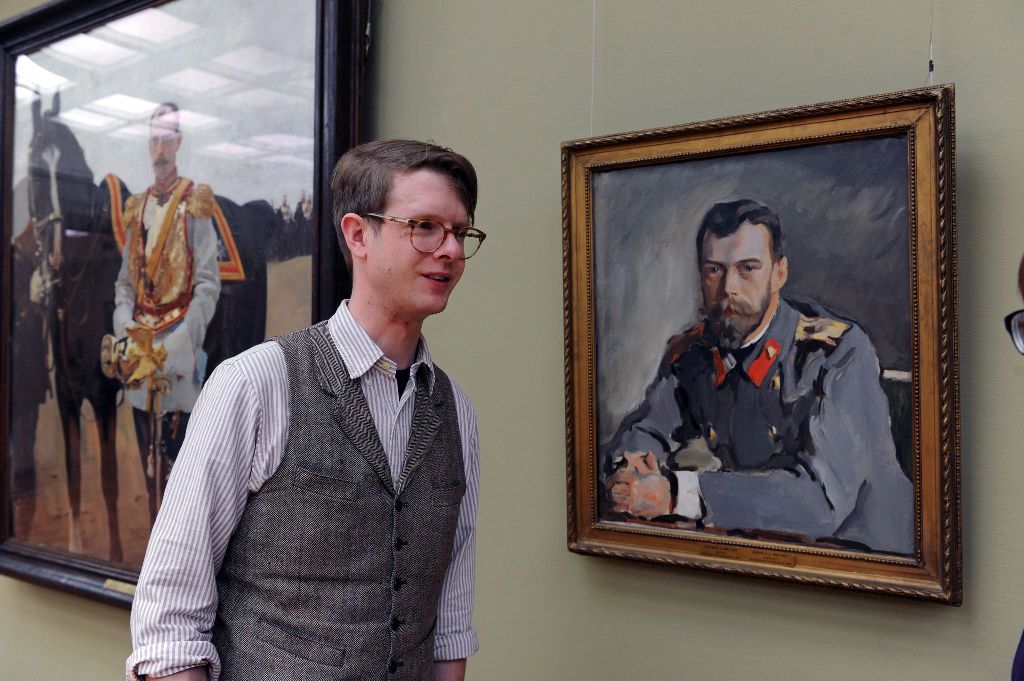
PHOTO: the contemporary Russian artist Yuri Ashikov visiting his “favourite museum”, while posing in front of a portrait of Emperor Nicholas II

Born in 1994, Yuri Ashikov is a contemporary Russian painter, photographer, sculptor, architect and art designer. He graduated, from the Stroganov School Faculty of Design in Moscow, trained in London and Japan, Latvia and Italy, studying not only drawing, but also design and architecture.

For three years, the artist worked on the “Romanov project”, creating a number of both paintings and charcoal drawings of the Tsar, his wife and children. Yuri wrote: “… I want the paintings to be alive, and each work to evoke emotions in the person… Each new project sets its own style, technique and materials. But most of my work I start in the traditional style – with charcoal.”

His exquisite paintings, which are recreated from iconic photographs and paintings of Russia’s last Tsar. They have been exhibited in cities across the Russian Federation, including Moscow and St. Petersburg.

Below, are some of Yuri Ashikov’s portraits of Emperor Nicholas II . . .

© Paul Gilbert. 11 September 2025