Anniversary of the reign of the House of Romanov, 1913
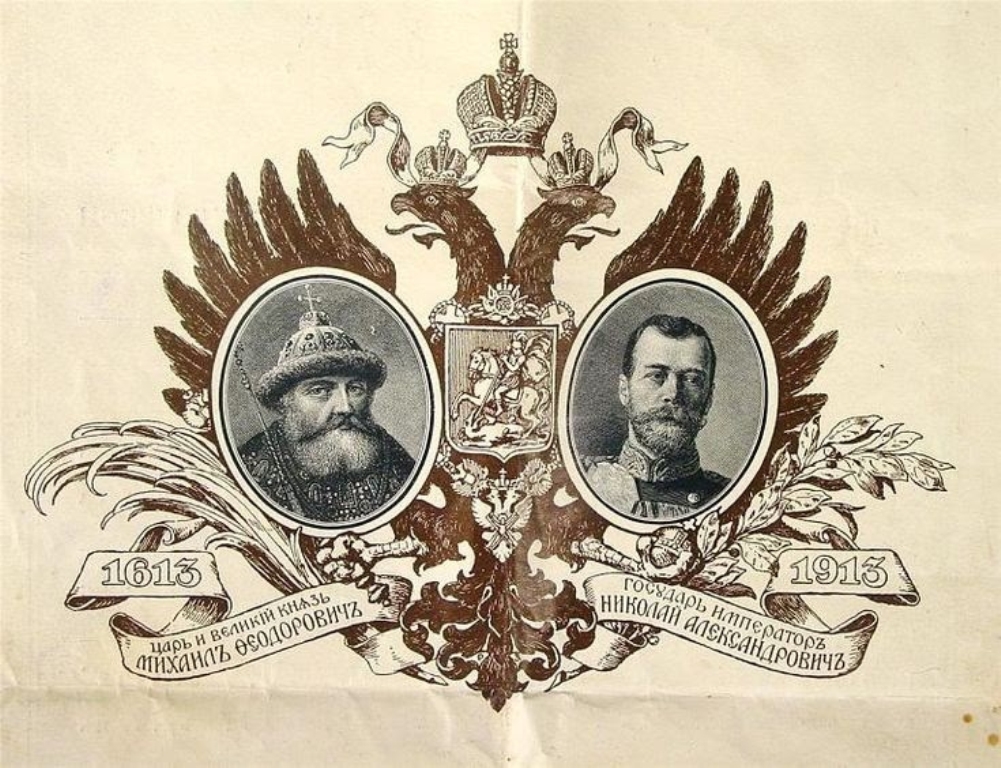
PHOTO: Postcard in honoir of the 300th anniversary of the House of Romanov
NOTE: the date of 6th March 1913 is the day of the celebrations marking the 300th anniversary according to the New Style Gregorian calendar, which is now 13 days ahead of the Old Style Julian calendar, used in Russia during the reign of Russia’s last Tsar. Therefore, the date of 21st February (O.S.) is in fact 6th March (New Style – PG
On 6th March (O.S. 21st February) 1913, the grandiose celebrations marking the 300th anniversary of the House of Romanov began in St. Petersburg. It was on this day in 1613, that a Zemsky Sobor; elected Mikhail Feodorovich Romanov (1596-1645) as Tsar, establishing the House of Romanov.
The day of the “solemn celebration marking the 300th anniversary of the House of Romanov” approved by the “Ceremonial” was 21st February) 1913, [according to the Old Style Julian calendar]. The “Ceremonial” provided that “solemn liturgies will be celebrated in all cathedrals and churches of the Russian Empire, followed by thanksgiving prayers with the intonation of “Many Years to Emperor Nicholas Alexandrovich <… >and to the entire reigning house”. The document also described the procedure for the celebration of solemn services and the arrival of the Emperor and his family in Our Lady of Kazan Cathedral in St. Petersburg, as well as the offering of congratulations to Their Imperial Majesties and other events in St. Petersburg.
In addition, the Emperor ordered a pannikhida [memorial service for the dead] be served in the Peter and Paul Cathedral in St. Petersburg on the eve of the day of celebration, on Wednesday, 20th February.
By a resolution of 4th February 1913, the Holy Synod of the Russian Orthodox Church decreed that Divine Liturgies be performed on 21st February, in all the cathedrals and churches of the empire.
On 13th February 1913, Emperor Nicholas II approved the resolution of the Council of Ministers “on declaring 21st February, 1913 [according to the Old Style Julian calendar] a holiday for all citizens of the Russian Empire. February 21st 1913 fell on the on the eve of Great Lent.
A special role in the upcoming celebrations was assigned to Moscow and Kostroma, from which Mikhail Romanov was called to the throne in 1613. In general, the celebrations took place throughout the Russian Empire. Three years before the upcoming celebrations, the “Committee for the Celebration of the Tercentenary of the Reigning House of Romanov was formed, and Aleksandr Grigoryevich Bulygin (1851-1919) was appointed its chairman.
As part of the preparations for the 300th anniversary, a number of charitable events throughout the Russian Empire were initiated by Nicholas II. Financial resources were allocated for the care of children, and assistance to advanced farmers.
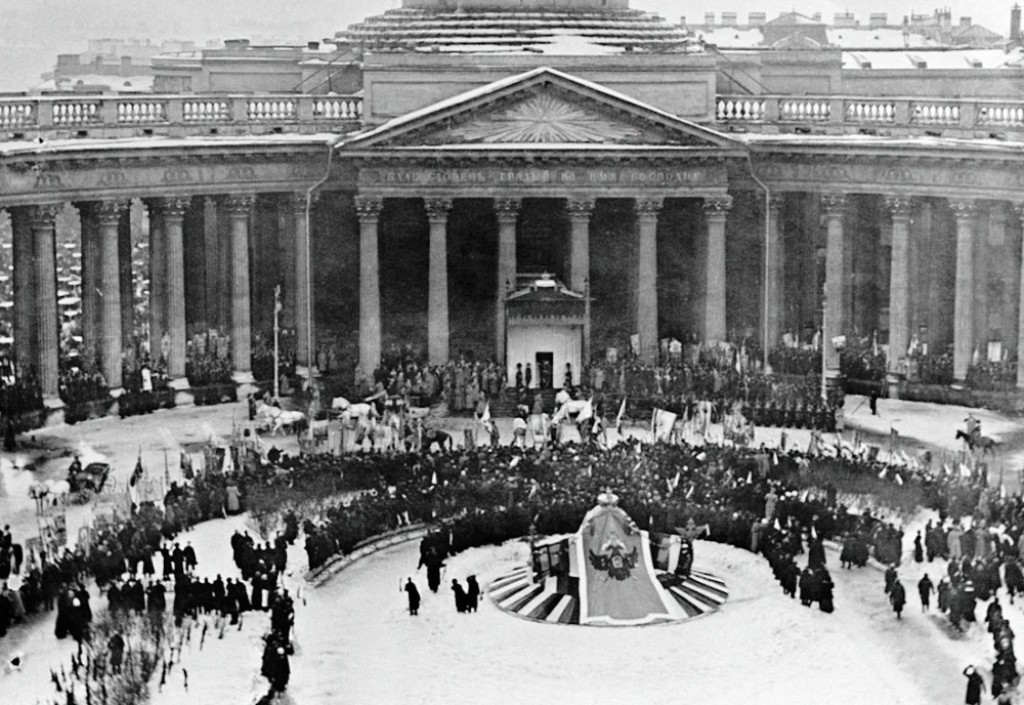
PHOTO: Procession headed by Emperor Nicholas II and his family arrive in front of the Cathedral of Our Lady of Kazan on the day of the beginning of the celebrations marking the 300th anniversary of the House of Romanov, on 6th March (O.S. 21st February), 1913
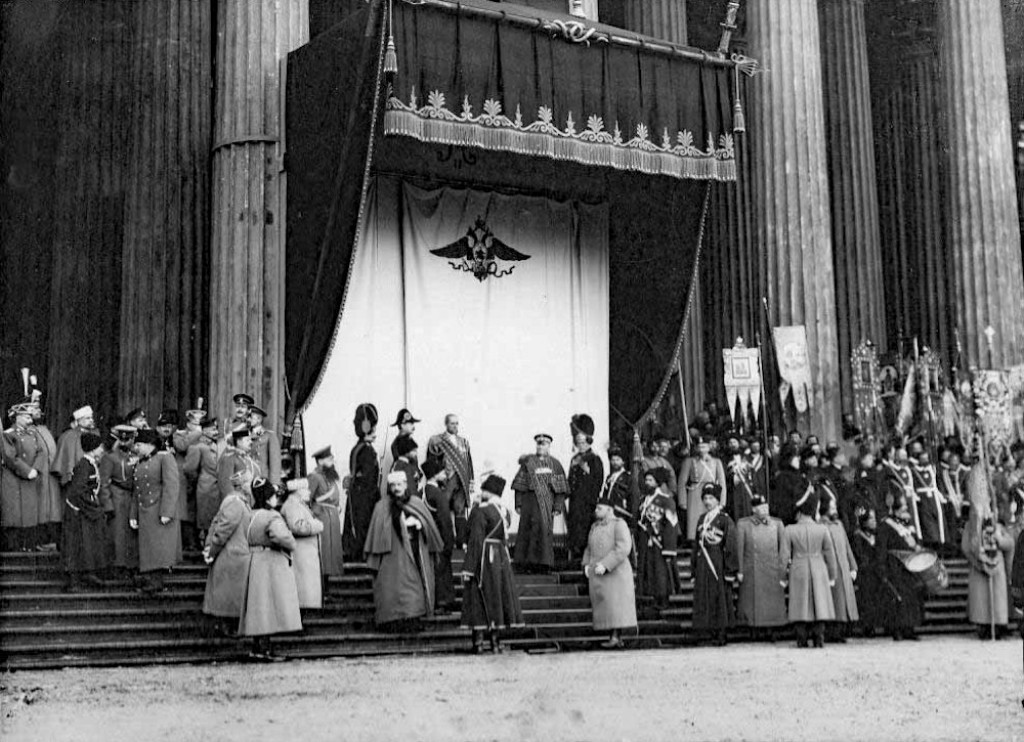
PHOTO: Preparations for a ‘Te Deum’ in honour of the celebrations marking the 300th anniversary of the House of Romanov at the Cathedral of Our Lady of Kazan, St. Petersburg on 6th March (O.S. 21st February) 1913.
Preparations for the 300th anniversary
Preparations for the celebration began three years before the celebration. The “Committee for the Celebration of the Tercentenary of the Reigning House of Romanov” was formed, the chairman of which was appointed Aleksandr Grigoryevich Bulygin, a member of the State Council and Hofmeister of the Imperial Court. The newly formed committee proposed to Nicholas II to promulgate the “Imperial Manifesto” on the occasion of the anniversary, which, among other things, read:
“<… > Through the combined efforts of our crowned predecessors on the Russian throne and all the faithful sons of Russia, the Russian state was created and strengthened <… > In unfailing unity with our beloved people, we hope to continue to lead the state along the path of peaceful organization of the life of the people’s <… > The nobility of Russia sealed with their blood their devotion to the Motherland <… > In the radiance of glory and greatness, the image of a Russian warrior, defender of the faith, throne and fatherland… >May the reverent memory of the feats of the departed serve as a testament for generations to come, and may it unite around our throne all faithful subjects for new labours and feats for the glory and prosperity of Russia <… >». The “Highest Manifesto”, according to the “Ceremonial”, was read in all Russian churches after the Divine Liturgy, and before the solemn prayer service, on 21st February 1913.
On 5th August 1911, in the presence of Grand Duke Mikhail Alexandrovich (the august patron of the building committee), a church was laid in St. Petersburg in honour of the Feodorovskaya Icon, in memory of the 300th anniversary of the reigning house; the main side chapel of the upper church was consecrated on 15th January 1914 by Metropolitan Vladimir (Bogoyavlensky) in the presence of Emperor Nicholas II and members of his family.
In St. Petersburg, sculptors and architects worked on a monument to the anniversary. Not far from the Alexander Nevsky Lavra, a church in honour of the Romanov dynasty was being built (the Cathedral of the Theodore Icon of the Mother of God), and a rotunda was being erected on St. Isaac’s Square. For the celebration, jubilee medals were issued – gold, silver, dark bronze and light bronze – these medals were produced by the Mint in St. Petersburg. In addition, commemorative coins, stamps, postcards, Fabergé eggs, and even household items such as glasses, tablecloths, headscarves and brooches were issued. Thousands of workers were involved in the construction of stalls and kiosks, as well as the installation of masts for standards, banners, and the decoration of buildings.
On the eve of the day of celebration, 20th February 1913, at three o’clock in the afternoon, Patriarch Gregory IV of Antioch (who was invited to Russia for the celebrations), along with Metropolitan Dimitrije of Belgrade and other hierarchs, performed a pannikhida in the Cathedral of SS Peter and Paul in the presence of Their Majesties.
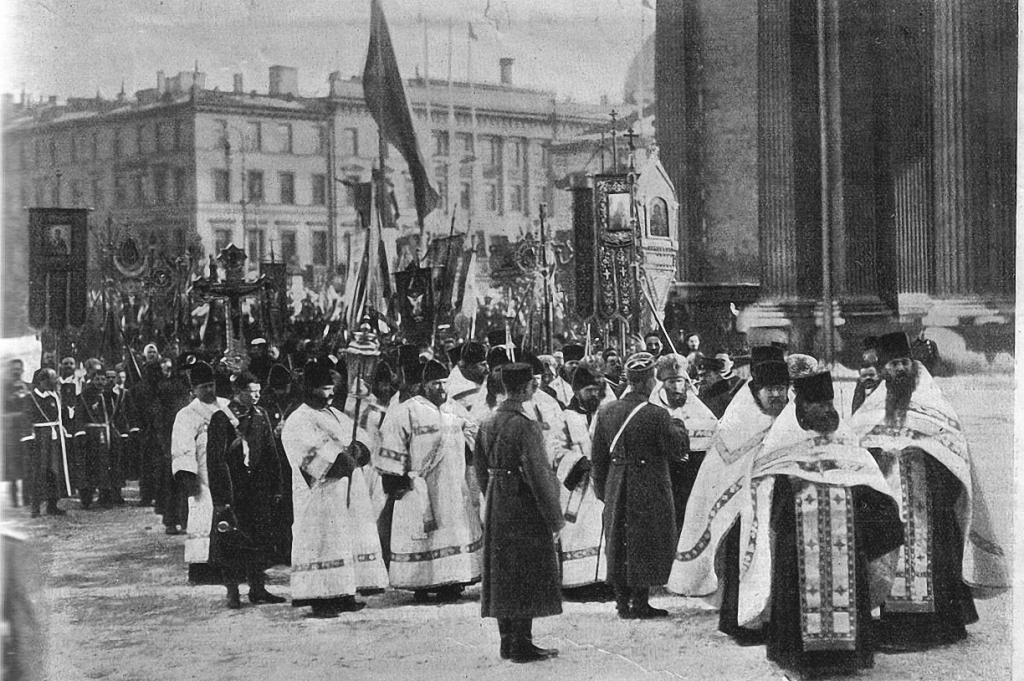
PHOTO: a host of Russian and foreign hierarchs took part in the the solemn liturgy in Our Lady of Kazan Cathedral, situated on Nevsky Prospekt in St. Petersburg
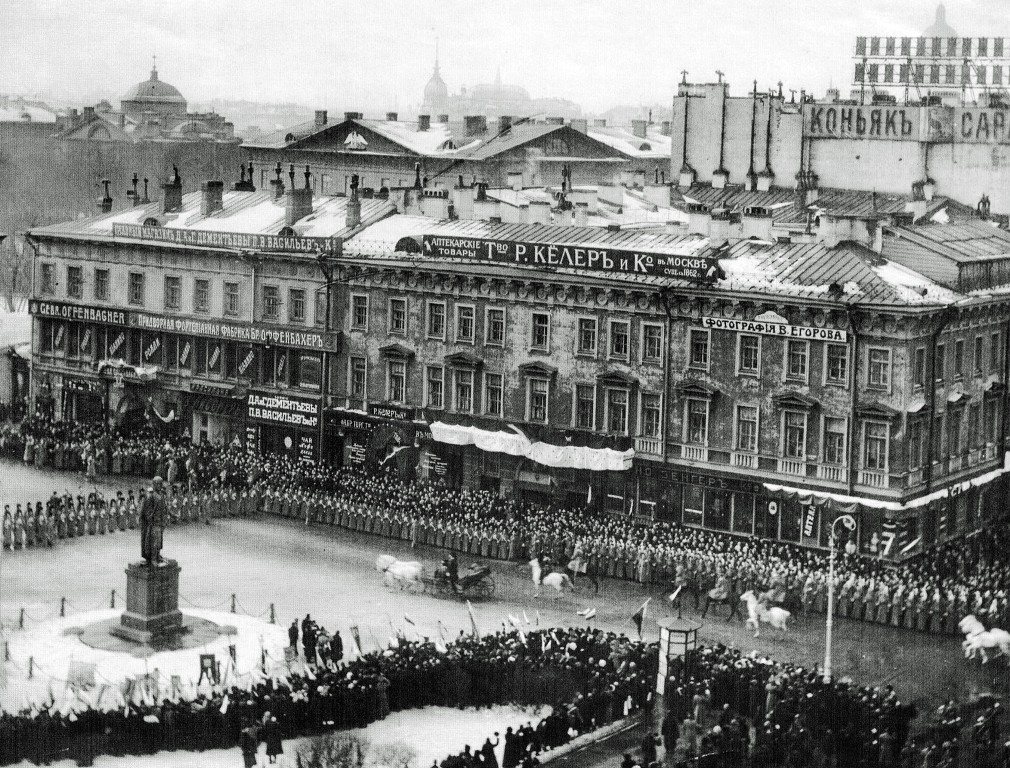
PHOTO: Kazan Cathedral House, situated on Nevsky Prospect, 25. The two-storey building served as the residence of the clergy of Our Lady of Kazan Cathedral Photo by Karl Bulla. 1913.
Events in St. Petersburg, on 21st February 1913
On 21st February 1913, at 8 a.m., twenty-one cannon shots from the Peter and Paul Fortress in St. Petersburg, signaled the beginning of the celebration of the 300th anniversary of the Romanov dynasty began in the Russian Empire.
The Imperial Family travelled from the Winter Palace in a grand procession of carriages and horses to Our Lady of Kazan Cathedral on Nevsky Prospekt, to take part in a prayer service. The route to the Kazan Cathedral was lined with regimental troops and cadets of military educational institutions. Tens of thousands of people crammed the route, all hoping to get a glimpse of the Tsar and his family.
Emperor Nicholas II and his son, the heir to the throne Tsesarevich Alexei Nikolaevich travelled in an open carriage together. They were followed by the four-horse ceremonial carriage of the Dowager Empress Maria Feodorovna and Empress Alexandra Feodorovna, followed by a four-seater carriage with the the Tsar’s daughters: Grand Duchesses Olga, Tatiana, Maria and Anastasia Nikolaevna. The “Imperial convoy” consisted of 100 members of the Imperial Family, which included grand dukes, grand duchesses and princes and princesses of the Imperial Blood.
At the entrance to the cathedral, the Emperor and his family were met by Patriarch Gregory and Metropolitan Vladimir (Bogoyavlensky) of St. Petersburg and Ladoga.
At 11 a.m., the solemn liturgy in Our Lady of Kazan Cathedral was led by Patriarch Gregory IV of Antioch, co-served by a host of Russian and foreign hierarchs.
Inside the cathedral, the protodeacon read the manifesto of the jubilee before the moleben [a liturgical service of supplication or thanksgiving]; the service of the prayer service was led by the Antiochian Patriarch Gregory IV, who read the Gospel in Arabic. The protodeacon then proclaimed “Many Years to Their Imperial Majesties” and to the entire reigning house. The troops outside the cathedral saluted; began the solemn trezvon [bell ringing] of all the churches of St. Petersburg. Cross Processions from many city churches arrived at the cathedral), followed bya salute from the cannons of the St. Petersburg fortress.
Recall that Our Lady of Kazan Cathedral in St. Petersburg served as the court church for the House of Romanov and was dedicated to the Icon of Our Lady of Kazan. which was the most important icon in the Russian Orthodox Church, for it protected Russia and consequently the Romanov dynasty. When the Kazan Cathedral was built, it inherited both the icon and the role of the court church. Imperial family weddings and thanksgiving prayers were all held in the cathedral.
When in St. Petersburg, Empress Alexandra Feodorovna went to the Kazan Cathedral to pray, kneeling in the shadow of a pillar, unrecognized by anyone and attended by a single lady-in-waiting.
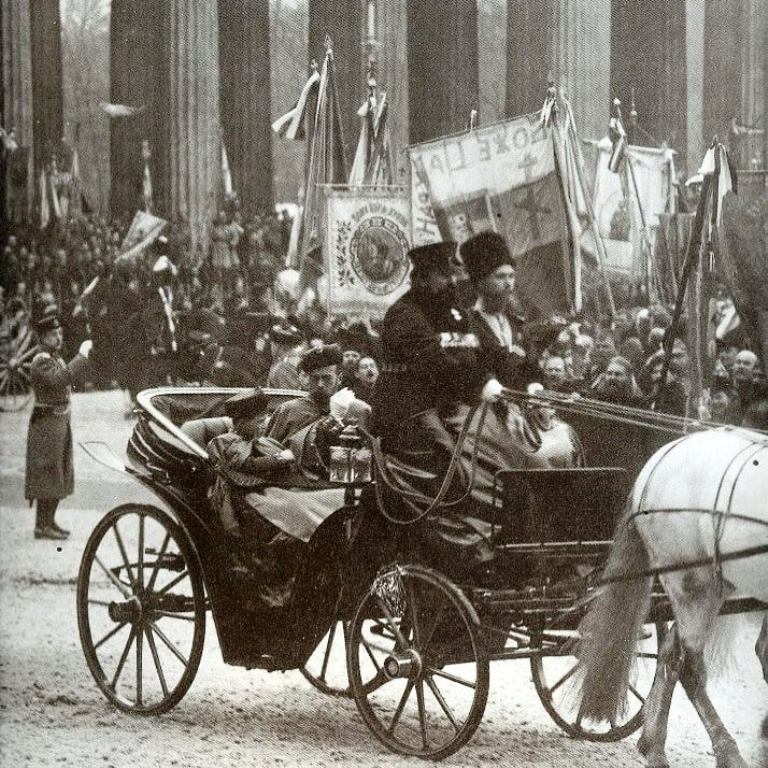
PHOTO: Tsesarevich Alexei Nikolaevich and his father Tsar Nicholas II, passing the Cathedral of Our Lady of Kazan in St. Petersburg, during the celebrations marking the 300th anniversary of the Romanov dynasty in 1913.
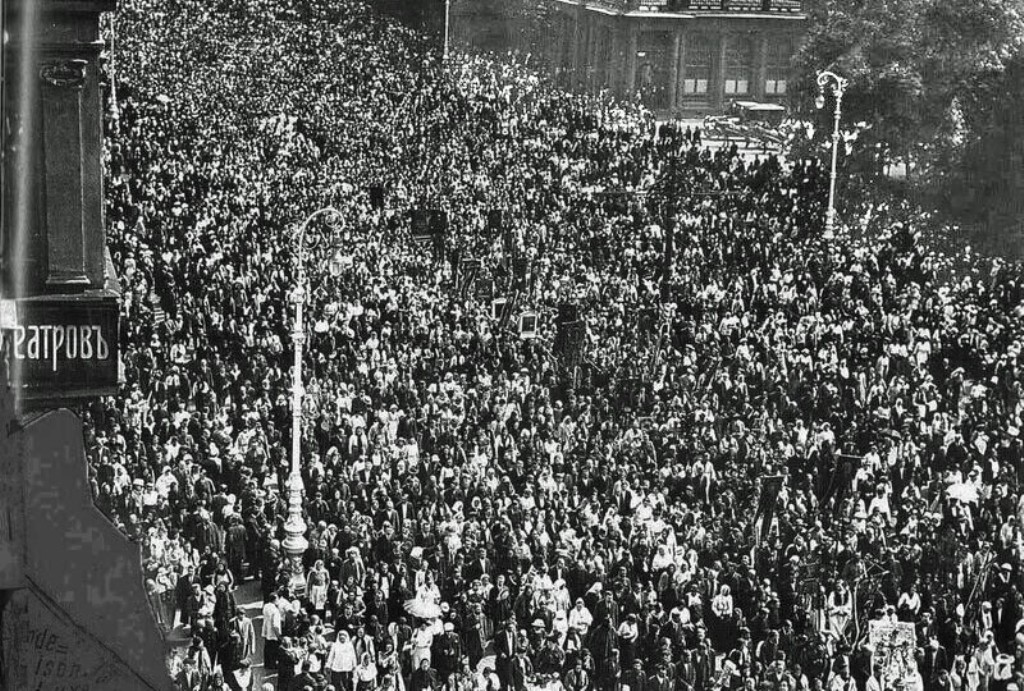
PHOTO: tens of thousands of people lined Nevsky Prospekt on the day marking the 300th anniversary, with the hope of catching a glimpse of their Emperor and his family, on their way to Our Lady of Kazan Cathedral
Tercentenary Tour
Three months later, in May, the Imperial Family went on a pilgrimage, following the route of Mikhail I after his election as the first Romanov Tsar in 1613. Nicholas II and his family set off to visit the ancient towns of Muscovy associated with the founding of the Romanov dynasty. The tour started off in Kostroma, where they arrived in a ‘flotilla of steamboats’ on the Volga, greeted by a large crowd of townspeople. Here Nicholas visited the Ipatiev Monastery, where Mikhail had sought refuge from the invading Poles and the Muscovite civil wars. From there, the tour went to Vladimir, Nizhny Novgorod and Yaroslavl, by rail on the Imperial Train. During their visit to the monastery town of Suzdal, the Imperial Family had to travel in thirty open-top Renaults, as there were no railways.
The pilgrimage ‘climaxed’ when the imperial family triumphantly arrived in the historical capital Moscow, site of the crowning of the first Romanov ruler. The Tsar and his family were greeted at the Alexandrovsky train station, by a large number of dignitaries.
The Tsar mounted a white horse and rode alone, sixty feet ahead of the rest of the party and his Cossack guard escort, towards the Kremlin. All along the route, he was greeted by large cheering crowds. The decorations along Tverskaya Street, included velvet banners donning Romanov symbols spanning the boulevard, buildings covered in pennants, flags, and lights. Even more inventive than those in the capital, garlanded statues of the tsar and a showering of confetti from the people, were ‘even more magnificent than in St. Petersburg.
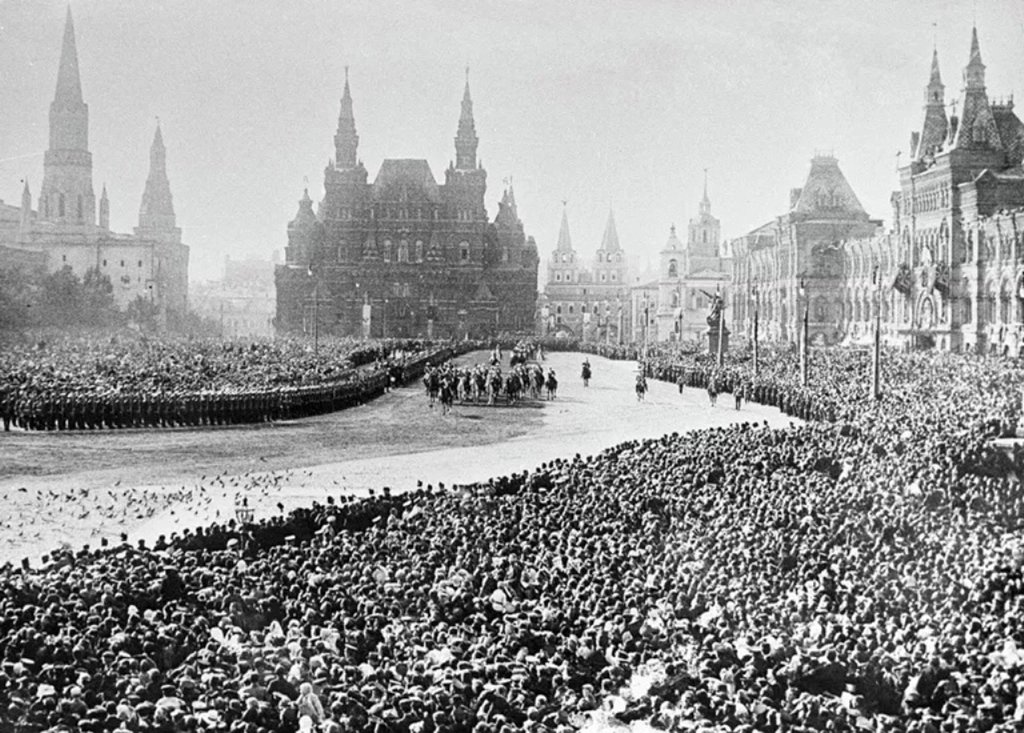
PHOTO: Emperor Nicholas II is greeted by thousands of his subjects on Red Square during the celebrations marking the 300th anniversary of the House of Romanov in Moscow. Many Western historians claim that Nicholas II was not popular during his reign, however, I think that this photo says otherwise.
The Tsar dismounted in Red Square, the convergence point of the religious processions throughout the city. Rows of priests echoing chants and prayers entered the Dormition [aka Assumption] Cathedral. The young Tsesarevich Alexei was, along the rest of the family, was supposed to walk the last hundred yards, however, due to haemophilia, had to be carried by a Cossack guard to the “exclamations of sorrow” from the crowds.
This was all followed by, in the words of historian Orlando Figes, “another round of pageantry and gastronomy. The ball in the Assembly of the Moscow Nobility was particularly lavish.”
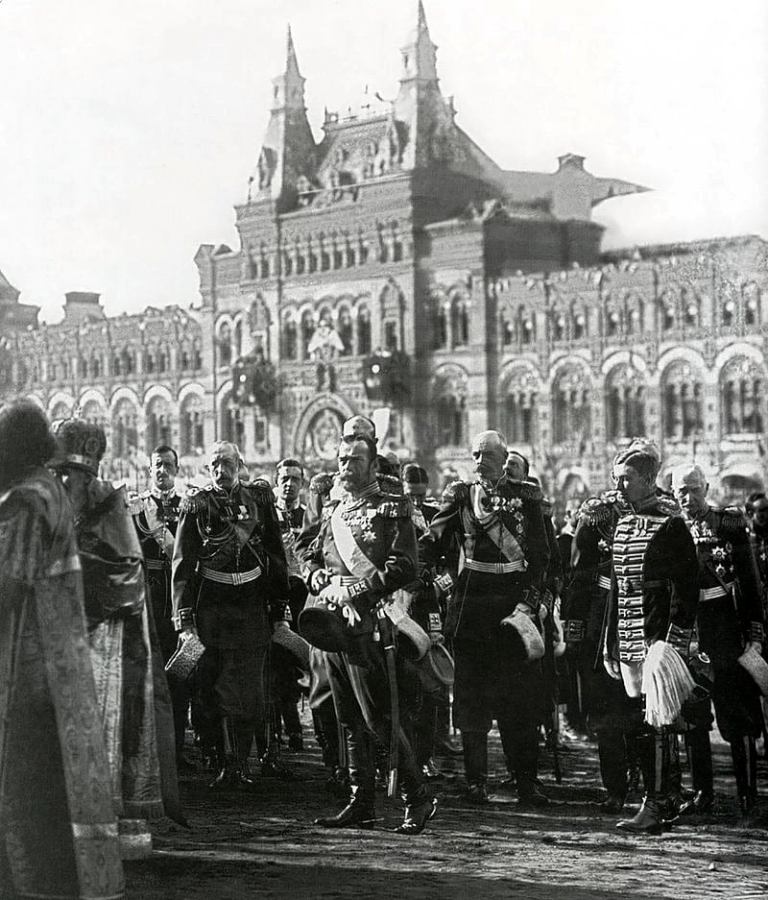
PHOTO: Emperor Nicholas II takes part in a solemn prayer service on Red Square in Moscow, during the celebrations marking the 300th anniversary of the Romanov dynasty, 1913.
© Paul Gilbert. 6 March 2026
 Nicholas II
You must be logged in to post a comment.