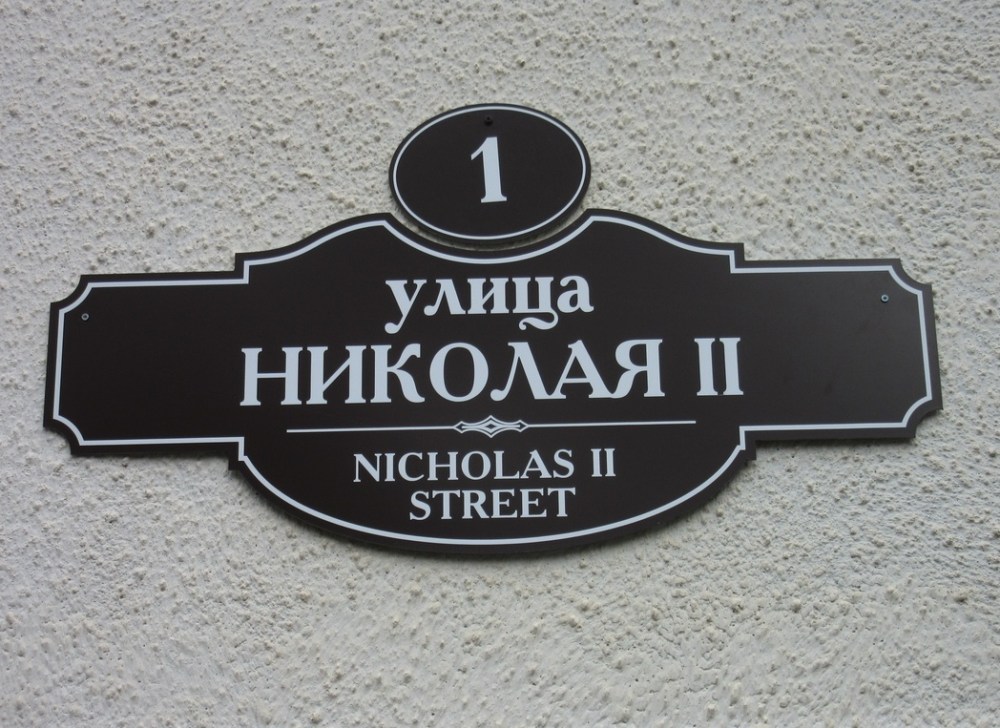
A street leading to the Livadia Palace has been named in honour of Emperor Nicholas II. It is the first street in Russia named in honour of Russia’s last sovereign.
No. 1 Nicholas II Street is home to the Embassy of the Russian Empire, a multimedia project that features three exhibitions: Crimea in the fate of Russia; Nicholas II Living Pictures and The Holy Warriors of Russia.
Construction on Livadia Palace began on 21 January 1910, and after 17 months of construction, the palace was inaugurated on 11 September 1911. Emperor Nicholas II spent about 4 million gold rubles on the palace.
The Imperial family visited Livadia in the fall of 1911 and 1913 and in the spring of 1912 and 1914.
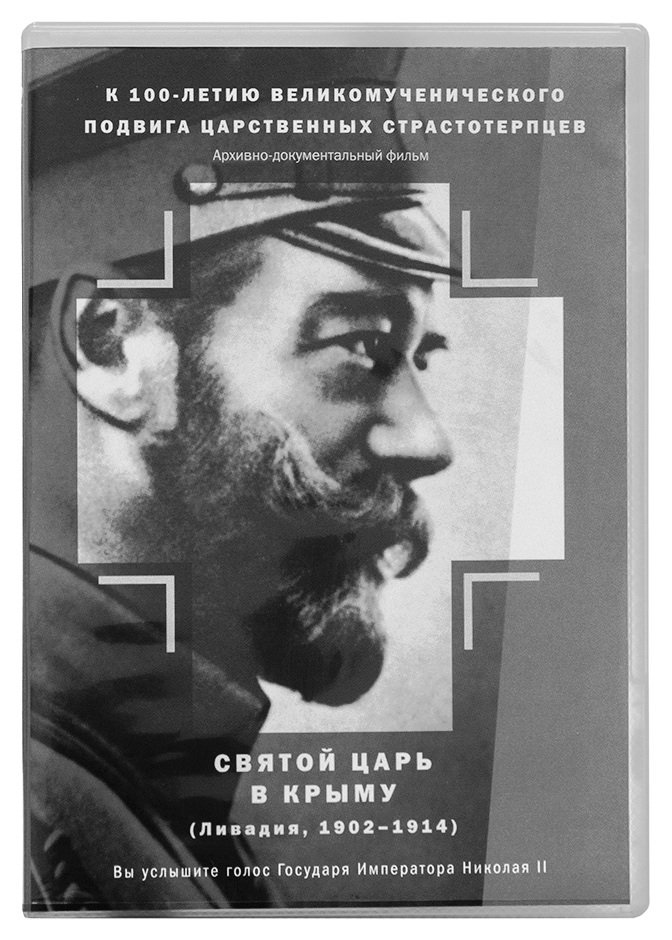
In 2018, a DVD entitled ‘Святой Царь в Крыму (Ливадия, 1902-1914)’ / Tr. ‘The Holy Tsar in Russia. Livadia, 1902-1914)’ was issued in Russia. The release of the DVD was timed to the 100th anniversary of the death of Emperor Nicholas II, on 17th July 1918.
The 36-minute DVD is a compilation of 24 newsreels, all filmed at Livadia, the Imperial estate and residence of the last Tsar and his family. All 24 newsreels are accompanied by pre-revolutionary marches and waltzes.
We see vintage newsreel footage of Emperor Nicholas II, Empress Alexandra Feodorovna, and their five children, set against the backdrop of the old wooden palaces in Livadia, and after 1911, set against the backdrop of Nikolai Krasnov’s elegant white Crimea granite palace Neo-Renaissance-style, which has survived to this day.
The vintage newsreels feature a variety of events at Livadia, including the celebration of the birthday of Empress Alexandra Fedorovna and Holy Easter, White Flower Day, parades and receptions. They are surrounded by officers, Court officials, and members of their extended family, including the Grand Dukes and Grand Duchesses, Count Frederiks, Anna Vyrubova, among many others.
The last time the family of Nicholas II visited in Livadia, was in the spring of 1914. They were due to return in the autumn, however, the outbreak of the First World War on 1st August put an end to this visit.
‘The Holy Tsar in Russia. Livadia, 1902-1914)’ – Part I (duration 18 minutes
‘The Holy Tsar in Russia. Livadia, 1902-1914)’ – Part II (duration 18 minutes
Nicholas II and Alexandra Feodorovna, Grand Palace, Livadia. Autumn 1909
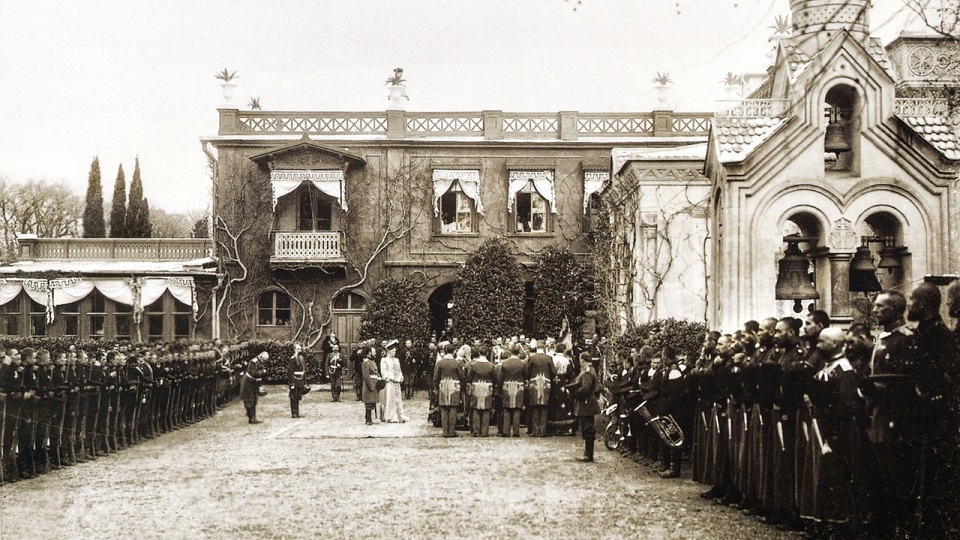
This vintage photo depicts Emperor Nicholas II and Empress Alexandra Feodorovna at Livadia in the early 20th century. It is set against the old wooden Grand Palace, built in 1861 for Emperor Alexander II and his family, by the architect Ippolit Antonovich Monighetti (1819-1878).
The Church of the Exaltation of the Cross (also by Monighetti) and bell tower can be seen to the right. A gallery connected the church to the palace. The church was small, because it was designed only for the imperial family, and was used by three respective emperors: Alexander II, Alexander III and Nicholas II.
It is known that the Imperial family arrived in Livadia with their children on 5th September 1909. It was during this visit, starting from 27th October, that Nicholas II and Alexandra Feodorovna met with the architect Nikolai Petrovich Krasnov (1864-1939) on numerous occasions, to discuss in detail the design of their new white palace, and the decoration of its halls and other rooms. The August couple approved the design on 12th December, just 4 days before leaving Livadia for St. Petersburg.
The old wooden Grand Palace was demolished in 1910, to make way for a new Italian Neo-Renaissance style stone palace, which would serve as the residence of Nicholas II and his family during their visits to Crimea. The Imperial family visited their new white palace in the fall of 1911 and 1913 and in the spring of 1912 and 1914.
Tsesarevich Nikolai Alexandrovich and Princess Alix of Hesse and by Rhine
In 2020, a monument will be established in Alushta (situated 36 km from Yalta), at the site of the historic meeting between Tsesarevich Nikolai Alexandrovich and his future wife, Princess Alix of Hesse and by Rhine.
The St. Basil the Great Foundation has announced a competition for the best monument project commemorating the meeting of the future Emperor Nicholas II and Empress Alexandra Feodorovna in Alushta on 10th October 1894.
It was in the autumn of 1894, that Emperor Alexander III’s health began to further deteriorate. Nicholas obtained the permission of his dying father to summon Alix to the Imperial family’s Crimean palace of Livadia.
A stone laying ceremony will be held at the end of October, at the site of the future monument with a sign on which the historical background of the event 125 years ago will be indicated.
According to the organizer of the contest, the creation of such a monument should be a great cultural event for the Crimea and for the whole of Russia, bearing educational and moral significance, reflecting the of love of the August couple.
The results of the competition for the best design of the monument will be announced on 15th December 2019. The winner of the competition will be determined by a competition committee, headed by Grand Duke Georgy Mikhailovich.

 Nicholas II
You must be logged in to post a comment.