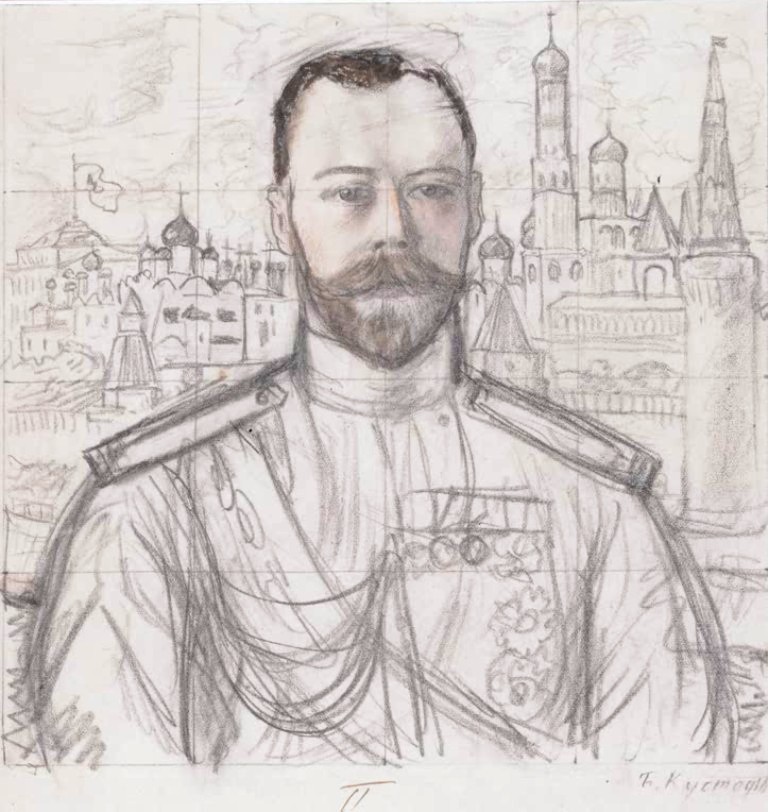
Drawing of Emperor Nicholas II (1914) Artisit: Boris Mikhailovich Kustodiev (1878-1927)
Please note that the articles provided (by links) are for information purposes only, they do not reflect the opinion of the administrator of this blog – PG
Russia’s last Emperor and Tsar Nicholas II, his family, the Romanov dynasty and the history of Imperial Russia, continue to be the subject of books, exhibitions and documentaries. In addition, they continue to generate headlines in the media.
The following articles were published by American and British media services, in the Summer: July, August, and Autumn: September, October, November and December 2025. Click on the title [highlighted in red] below and follow the link to read each respective article:
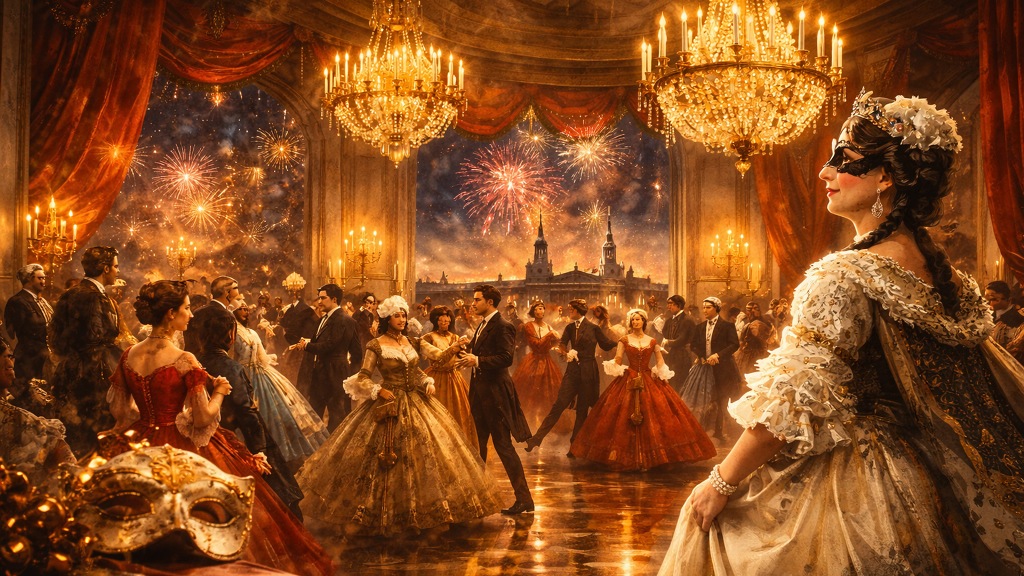
What kind of holiday would it be without cannons? Without masquerades and music?! Here’s how the holidays were celebrated in Tsarist Russia, by the Empresses Anna Ioannovna, Elizabeth Petrovna and Catherine II.
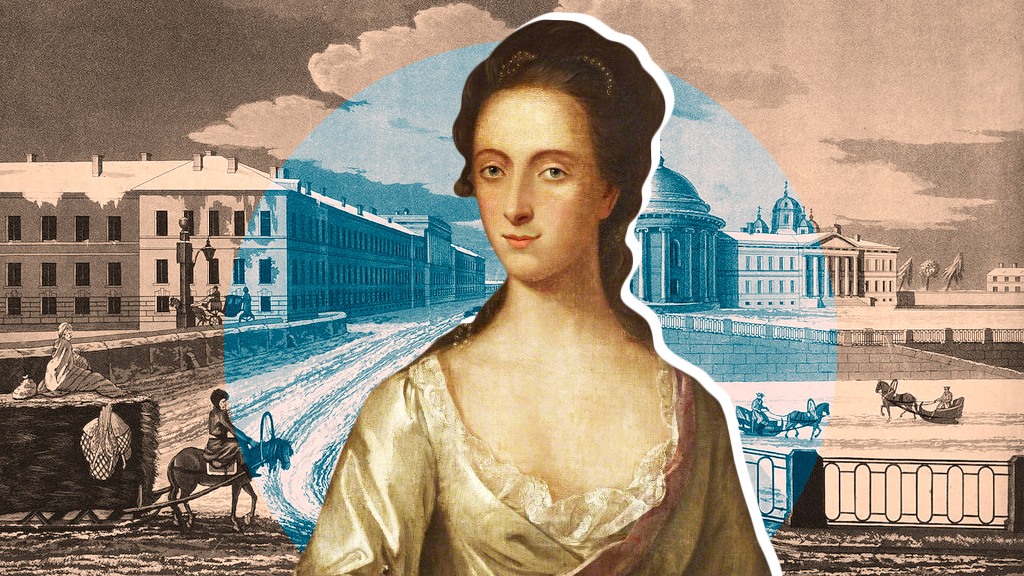
Historians, describing the life of Duchess Elizabeth Pierrepoint Kingston, call it “rich in adventure”. This euphemism conceals a real adventure, complete with bigamy, an escape to Russia and a ship full of treasure.
Elena Molokhovets’s book ‘Gift to Young Housewives’ went through 29 editions from 1861 until the 1917 Bolshevik Revolution. The “culinary bible” of the Russian Empire taught women left without servants the art of managing a household. We’ve selected some tips from it that are still relevant today.
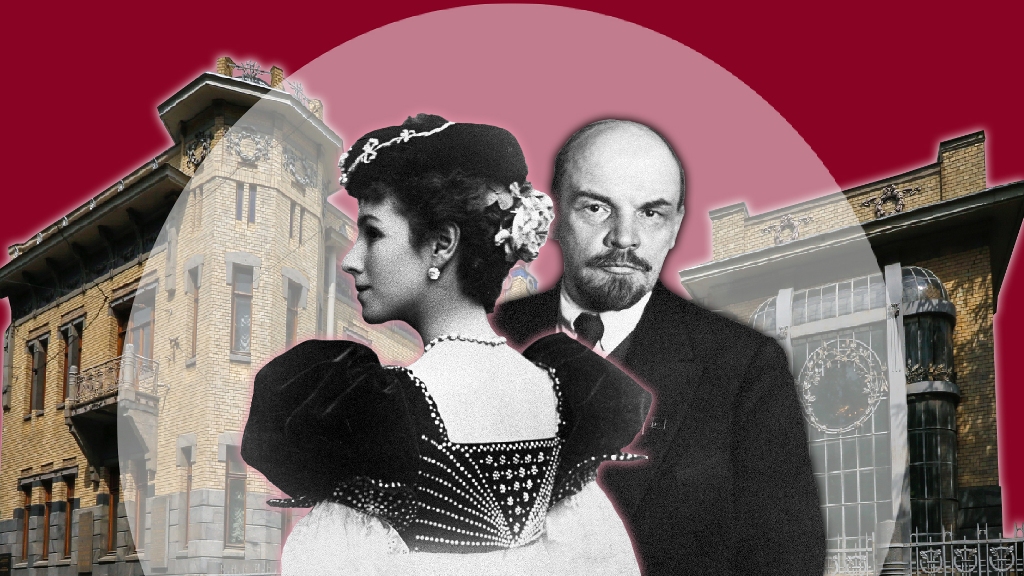
Ballerina Mathilde Kschessinska was not only the prima ballerina of the Mariinsky Theater, but also a socialite, known for her affairs with several Romanov grand dukes.
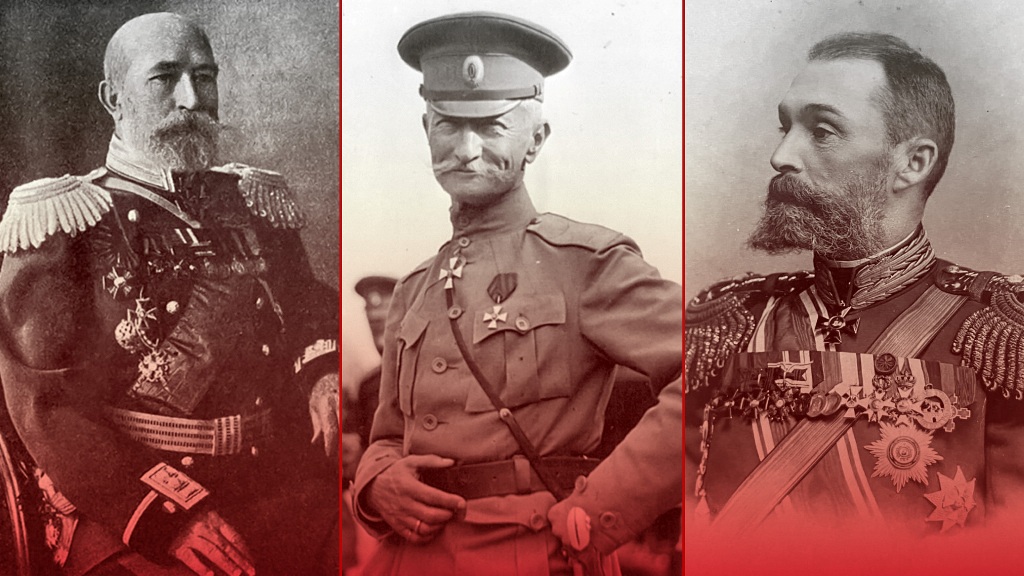
The Soviet government was deeply suspicious of any high-ranking commanders of the Imperial Army and considered them ideological opponents. This meant they had to work extra hard to earn its trust.
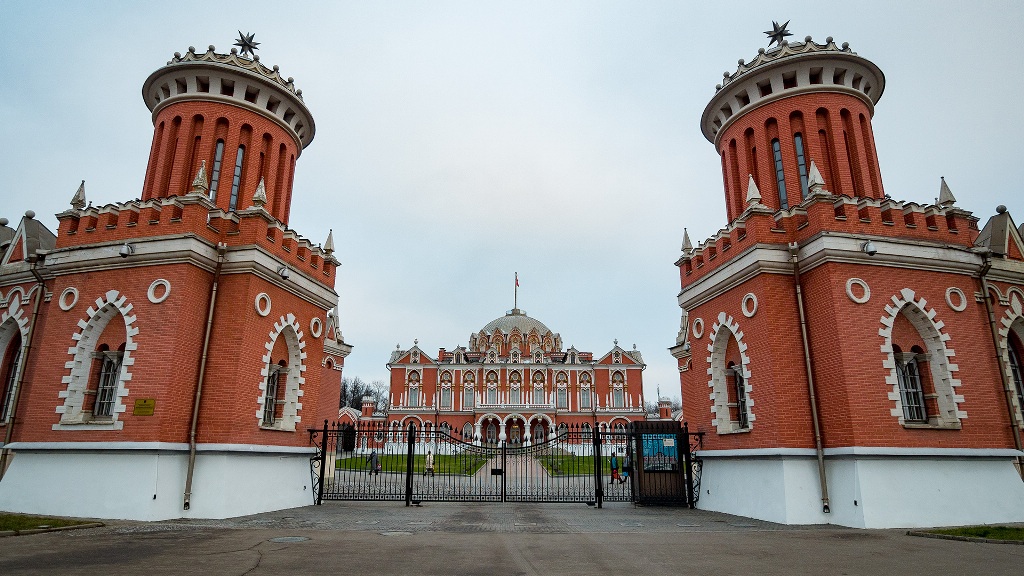
In tsarist times, a trip from point ‘A’ to point ‘B’ was a real adventure that could stretch on for weeks or even months. Of course, there were already roadside inns for travelers, but these were not up to the standard required for emperors and their entourage. Therefore, “travel” palaces had to be specially built – luxurious mansions where one could rest, spend the night and continue the journey with renewed energy. Anna Sorokina takes a look at 8 of these “Travelling Palaces”.
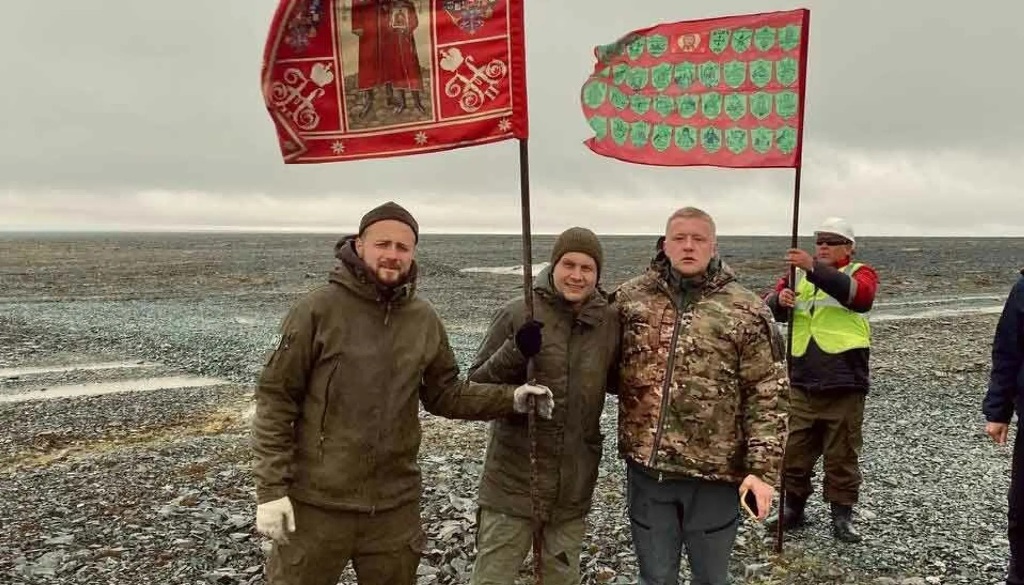
Two representatives of the ultra-conservative TV channel Spas brought a flag depicting emperor Nicholas II from the occupied Ukrainian city of Vuhledar to the archipelago of Severnaya Zemlya.
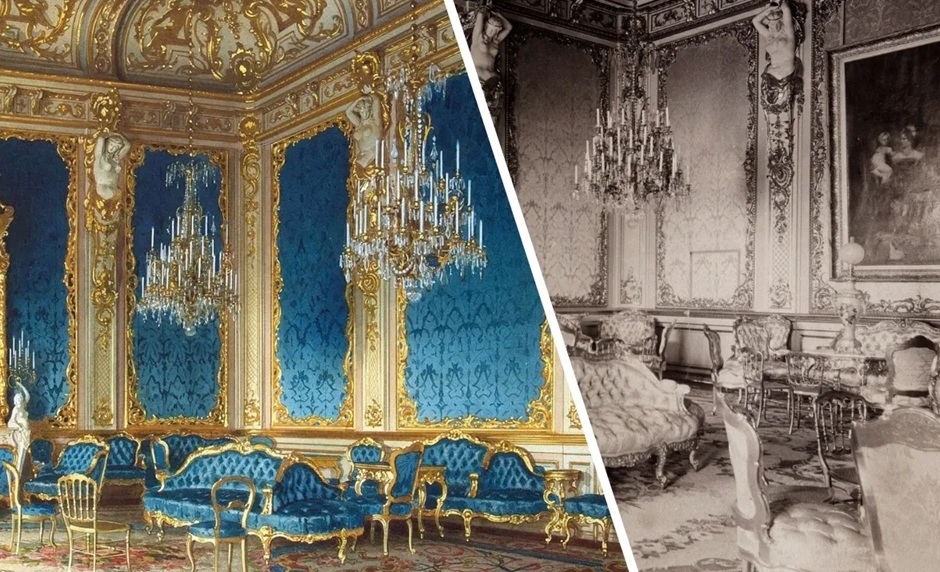
Every now and then, a quiet object in the museum’s collection reveals an extraordinary story. For decades, a heavy leather-bound album, its cover elegantly embossed in gold with the words “Views of His Own Palace and Rooms, St. Petersburg” lay, largely unnoticed, in the Russian History Museum’s archives. According to old museum records, it showed the interiors of the Anichkov Palace, home of Emperor Alexander III.
Please CLICK on the BANNER or LINK above to review my current selection of titles in hardcover, paperback and ebook editions. Listings provide a full description for each title, pricing and a Look inside feature.
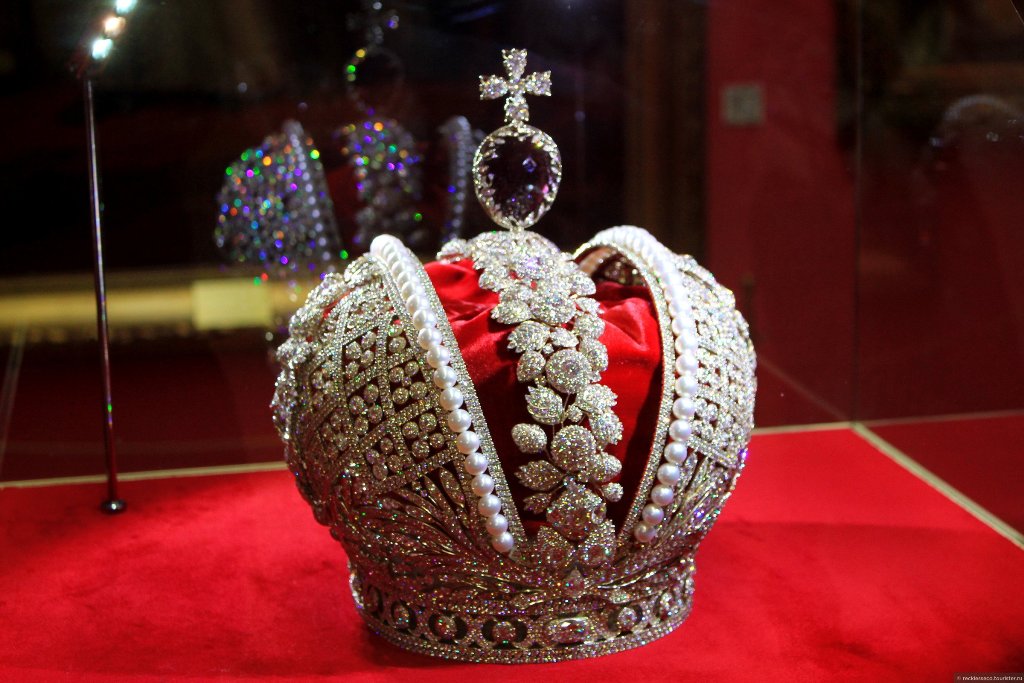
PHOTO: the Great Imperial Crown of the Russian Empire is in the Collection of the Diamond Fund of the Russian Federation in the Moscow Kremlin
The Great Imperial Crown of the Russian Empire was made for the coronation of Empress Catherine II in 1762. The last Russian monarch who wore the Imperial Crown was Emperor Nicholas II, on the day of his Holy Coronation in Moscow, on 27th May (O.S. 14th May) 1896.
The Imperial Crown is a joint creation of a large number of craftsmen, but the main creators were two jewelers – the Frenchman Jérémie Pauzié (1716-1779) and the Swiss Georg Friedrich Eckart. The coronation of Catherine II was scheduled for 22nd September 1762, so there were only two and a half months for it’s preparation.
According to the surviving reports of the Diamond Workshop, it was Eckart who was given 3.96 pounds of gold and 20 pounds of silver for the manufacture of the crown and orb. A request, however, was made to Pauzié to draw a sketch of the proposed crown. The Frenchman’s version strongly resembled the crown of Empress Anna Ioannovna (1730) and looked like “an Orthodox church with its side gables and a raised central part crowned with an onion dome.” The diameter of the lower rim and the upper part of the hemispheres was almost the same, which gave the crown a bulky cylindrical shape. The arc connecting the hemispheres ended with a cross, on which a giant spinel was attached with the wide side down.
When Eckart saw the sketch, he “tore it up in anger.” The Swiss wrote a petition to Catherine with a complaint that the Frenchman’s drawing did not agree with the image of an Imperial Crown at all and was too reminiscent of a church in shape. Eckart created his own sketch of the crown, more elegant and harmonious: “the ellipsoidal hemispheres are strongly curved at the base and spread apart, making the crown look more compact. The dividing arc recessed between the hemispheres carried a cross and a giant spinel, turned wide side up. Due to the fact that Eckart made the frame openwork slotted, the finished crown turned out to be quite light in weight.”
When the frame was finished and it was time to inlay the stones, this work was entrusted to Pauzié. In preparation for the inlay, Pauzié used his original method: he made a wax model of Eckart’s slotted frame and tried different options for the arrangement of stones on it. Such a study made it possible to place each diamond in the most advantageous way, hide defects and emphasize the advantages. Pauzié was assisted in his work by six jewelers from Austria and one from France. Also involved in the creation of the crown were three Russian masters: Ivan Estifeev, Ivan Lipman and apprentice Ivan Nikiforov.
The crown was completed on time. All the masters received cash bonuses in addition to their salaries, Eckart was paid 700 rubles. Pauzié personally placed the finished crown on the head of the Empress, for fitting. Catherine II was “very pleased with it” and said she was confident that she would “somehow be able to hold the crown’s weight” on her head during the four hour coronation ceremony.
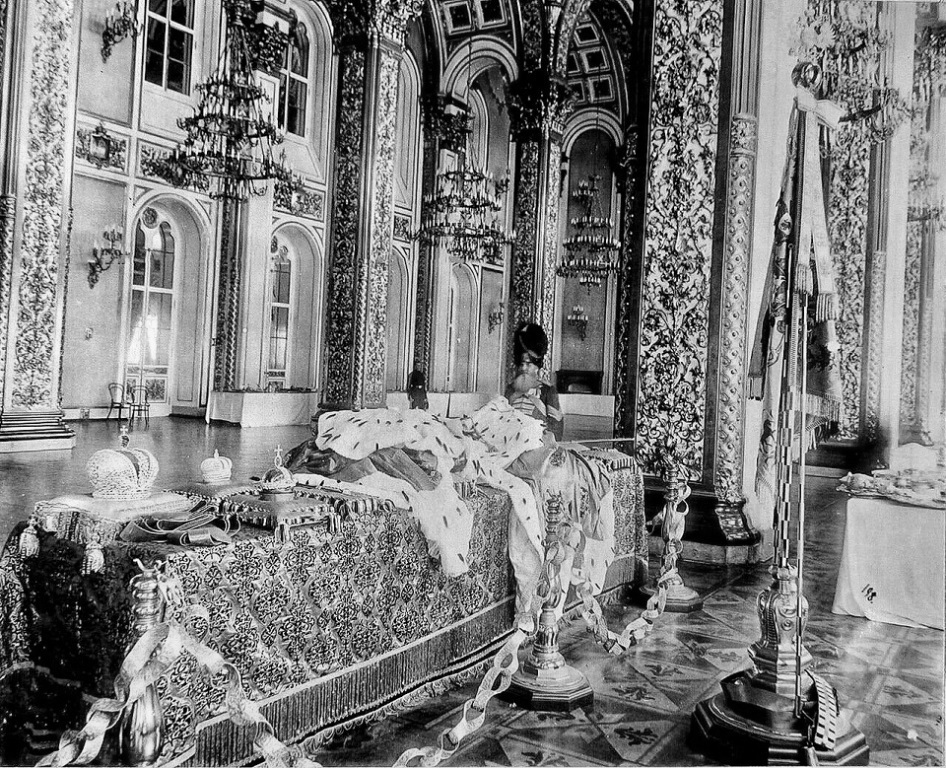
PHOTO: the Great Imperial Crown of the Russian Empire (left), among the Imperial Regalia is laid out on a table in the Grand Kremlin Palace, in preparation for the Holy Coronation of Emperor Nicholas II in May 1896
Designof the Imperial Crown
The image of the Imperial Crown is inspired by Byzantine symbolism, each element of the decoration has a certain meaning. The two hemispheres embody the connection of East and West. At the bottom, the grid of the hemispheres is encircled by laurel branches, a symbol of power and glory, and in the garland drawing, oak leaves and acorns are placed between the hemispheres as an image of the inviolability of the monarchy.
The Great Imperial Crown reflects the change of stylistic eras: it is decorated in the spirit of early Classicism, but also bears traces of the Baroque that preceded it. During the reign of Empress Elizabeth Petrovna (1741-1762), massive Baroque jewelry with large precious stones of bright colors was in fashion. To give the diamonds a certain shade, a thin layer of colored foil was placed under them. From the 1760s, under Catherine II, court jewelry fashion began to change – the natural beauty of the stone began to be valued more highly, jewelry was made in more concise and restrained forms.
“I selected the most suitable materials, and since the Empress wanted not to change the crown after the ceremony, I preferred the largest stones, which were no longer in fashion, and so I created one of the most expensive jewels that ever existed in Europe. Despite the difficult task of making the crown as light as possible, using only the most necessary materials to secure the stones, it still weighed five pounds.”
– Jérémie Pauzié
A total of 5012 stones were used to decorate the crown: 75 pearls weighing 763 carats and 4936 diamonds, their total weight is 2858 carats. The height of the crown with the cross was 27.5 cm, the length of the lower circumference was 64 cm. The total weight of the jewelry is 1993.80 grams. In addition to materials from melted down jewelry from the Imperial Treasury, the work required an additional pound of gold and twenty pounds of silver for a total of 86 thousand rubles. The cost of the finished crown at the time of manufacture was estimated at 2 million rubles!
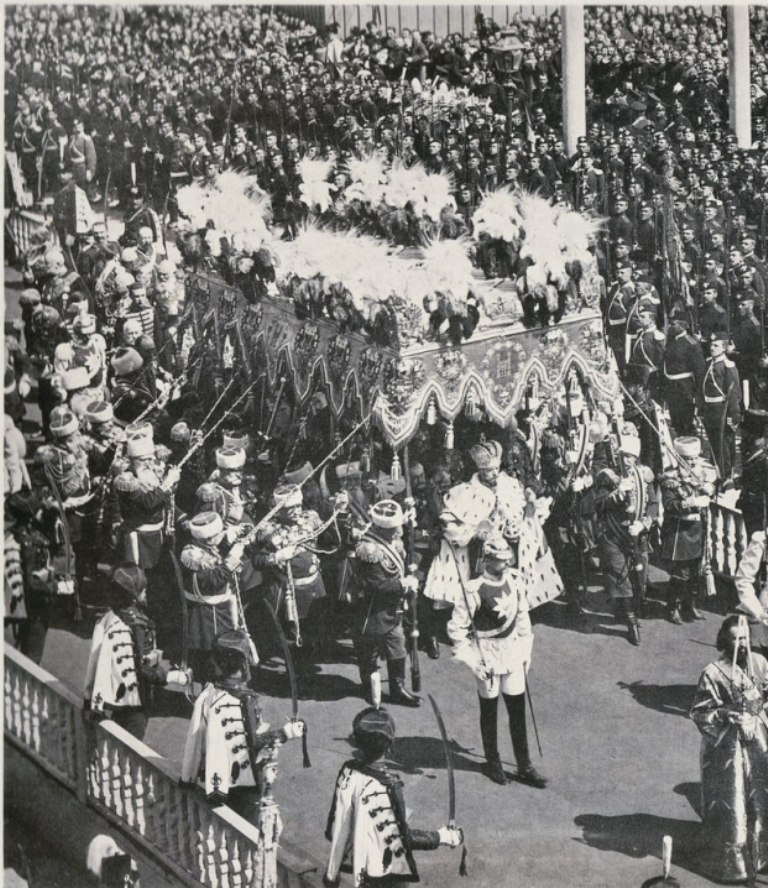
PHOTO: Emperor Nicholas II, wearing the Great Crown of the Russian Empire on the day of his Holy Coronation in Moscow, on 27th May (O.S. 14th May) 1896
After Catherine
The new crown became the main part of the Russian Imperial Regalia and the main symbol of power, it was worn only on the most solemn occasions, and the image was used on all heraldic signs. Following the established ceremony, the Great Imperial Crown was placed on the heads of all subsequent rulers of Russia, from Emperor Paul I (1797) to Nicholas II (1896). For each of the monarchs, the crown was adjusted to personal standards, this work was entrusted only to outstanding jewelry masters. The Great Imperial Crown was an integral attribute of imperial power and was used in solemn ceremonies – holidays, receptions, even funeral processions. The last time the Great Imperial Crown was worn by Nicholas II, was in 1906, during the opening ceremony of the first State Duma on 10th May (O.S. 27th April) 1906.
After the 1917 Revolution
In 1914, the Imperial Regalia, including the Great Imperial Crown, were evacuated from Petrograd [St. Petersburg] to the Armoury Chamber of the Moscow Kremlin. Because of the 1917 Revolution and the ensuing Civil War, the jewels were temporarily forgotten. Only in 1920 was the Gokhran, which collected jewels from the Romanovs, the Armoury, the Russian Orthodox Church, as well as valuables confiscated from private individuals. Many of these items were later sold abroad. In 1921, an official decision was made to use the “jewelry potential” for the benefit of the Communist Party, although the first secret deals date back to 1919.Between 1922 and 1938, the Soviet government auctioned off most of the jewelry that was not recognized as “valuable” to mostly British and American buyers.
It is interesting to note that in 1920, the estimated value of the Great Imperial Crown of the Russian Empire was a staggering$52 million USD!
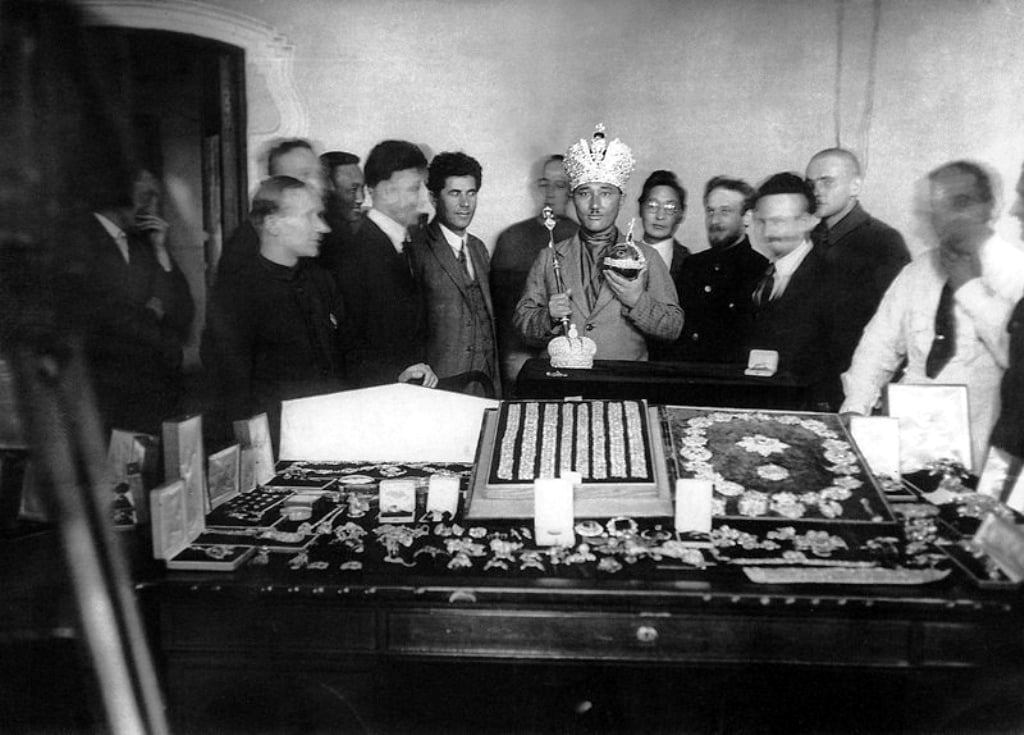
Secret attempts to sell the Great Imperial Crown have been reliably confirmed, when, under the leadership of the Chekist Yakov Yurovsky (1878-1938), the Imperial Regalia and the main treasures of the Romanovs were taken from Moscow to Chita in 1923. The accidental publicity of the future deal created headlines in the international press and served as an impetus to stop the sale of crown jewels. It was this incident, which prompted Josef Stalin to issue a personal decree in 1934, ordering that the “tsar’s trinkets” were no longer to be sold and exported abroad, so as not to harm the reputation of the Communist Party.
PHOTO: “Comrade” Robert Yanovich Karklin (1892-1938) wearing the Great Imperial Crown of the Russian Empire, Chita. 1923
In the photo above, Bolshevik thugs amuse themselves, as “Comrade” Robert Yanovich Karklin (1892-1938) – an authorized representative of the People’s Commissariat of Finance of the RSFSR under the Far Eastern Revolutionary Committee – poses with the Imperial Regalia. Karkin is seen wearing the Great Imperial Crown of the Russian Empire, while holding the Imperial Orb and Sceptre.
Up until a few years ago, this photograph, taken in 1923 in Chita, had never been published, it was kept by Karklin’s daughter Victoria, in the family’s private archive.
Today, the Great Imperial Crown of the Russian Empire is in the Collection of the Diamond Fund of the Russian Federation in the Moscow Kremlin. According to Article No 7 of Federal Law No 41-F3 of 26th March 1998, it is part of an indivisible collection of unique jewelry in federal ownership and is not subject to alienation in any form. The Ministry of Finance of Russia is responsible for the safety of the fund, exclusion from the fund is possible only by personal decree of the president. All exhibits can only be used for exhibition and scientific activities exclusively on the territory of the Moscow Kremlin. The current value of the Great Imperial Crown of the Russian Empire is too great to be calculated or estimated.
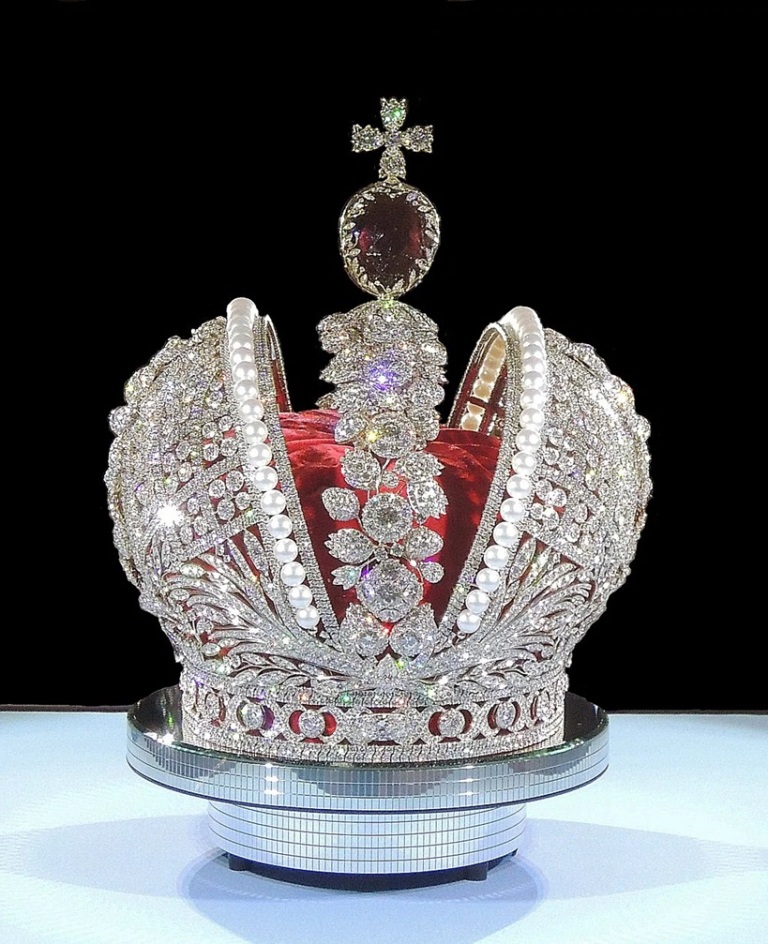
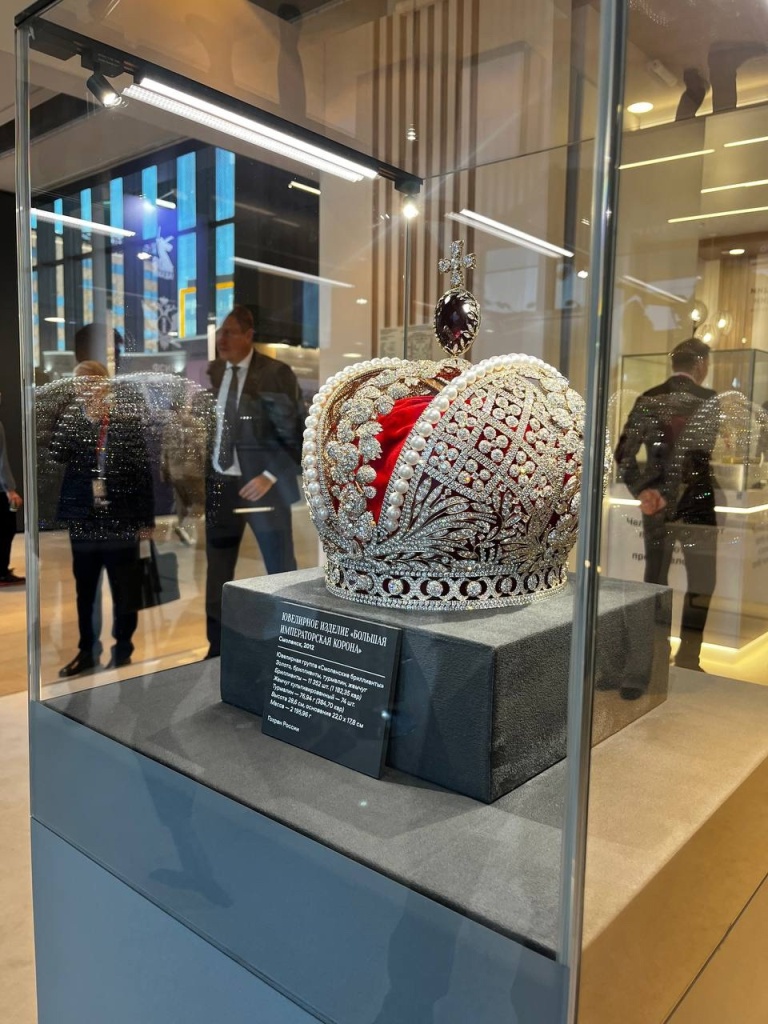
PHOTO: replica of the Great Imperial Crown of the Russian Empire, recreated in 2012
Replica of the Great Imperial Crown
The idea of creating a modern interpretation of the Great Imperial Crown of the Russian Empire, belongs to Kristall-Smolensk – an enterprise with a world reputation, and leader of diamond processing in Russia. In tandem with its subsidiary, the Smolensk Diamonds Jewellery Group, famous for the perfect cut and impeccable setting of its jewellery.
The replica of the Russian Imperial Crown was made in 2012, to commemorate the 400th anniversary of the Romanov dynasty and the 250th anniversary of the original crown.
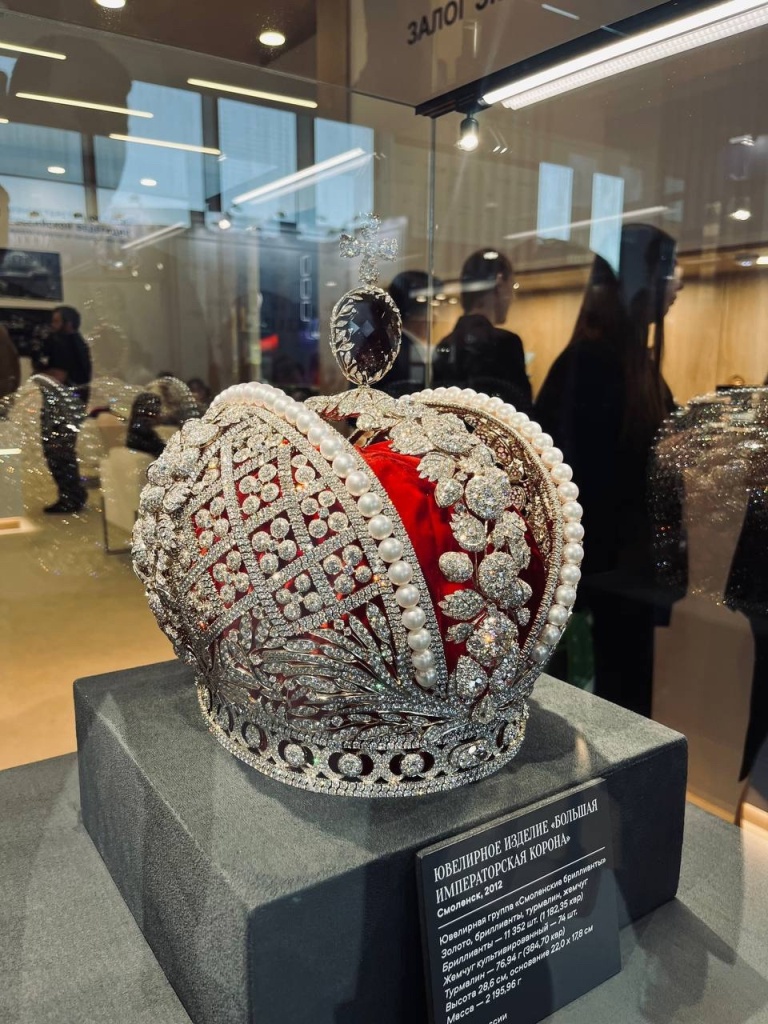
PHOTOS: two views of the replica of the Great Imperial Crown of the Russian Empire, recreated in 2012
More than 60 Smolensk craftsmen worked on the creation of a replica of the Great Imperial Crown for six months. It is made of white gold, encrusted with more than 11,000 diamonds of perfect cut and the highest quality. The sparkle of diamonds is accentuated by the matte brilliance of 74 natural large white sea pearls. Instead of spinel, the product contains a unique natural rubellite weighing almost 384 carats.
The creation and presentation of the Great Imperial Crown in a modern interpretation is a great opportunity to demonstrate the leading world position of the jewellery art of Russia. And two memorable historical dates were excellent occasions – 250 years since the coronation of Empress Catherine the Great (1762) and the four hundredth anniversary of the Romanov dynasty (1613).
CLICK on the image above to watch a short 2-minute VIDEO
This author has viewed both the original Great Imperial Crown of the Russian Empire in the Diamond Fund of the Moscow Kremlin, and the replica, which was on display in The Mint, located in the SS Peter and Paul Fortress, St. Petersburg. Both are exquisite works of jewellery art in their right.
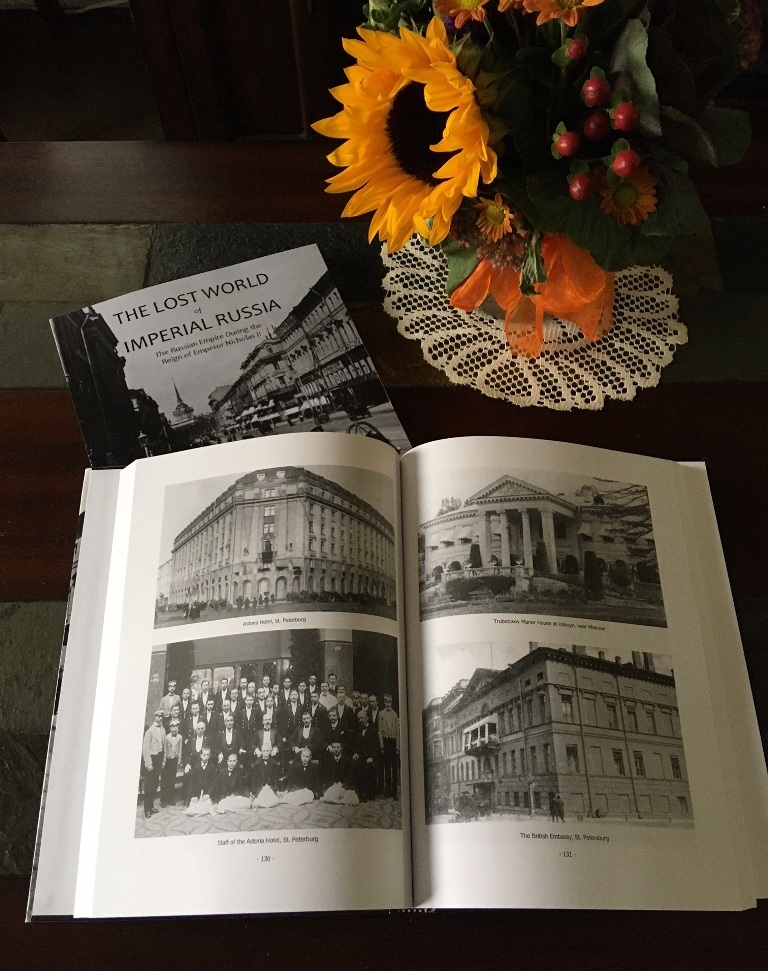
Large 8-1/2″ x 11″ format, 240 pages, featuring 400+ black & white photos
“Keeping the memories of Old Russia alive!”
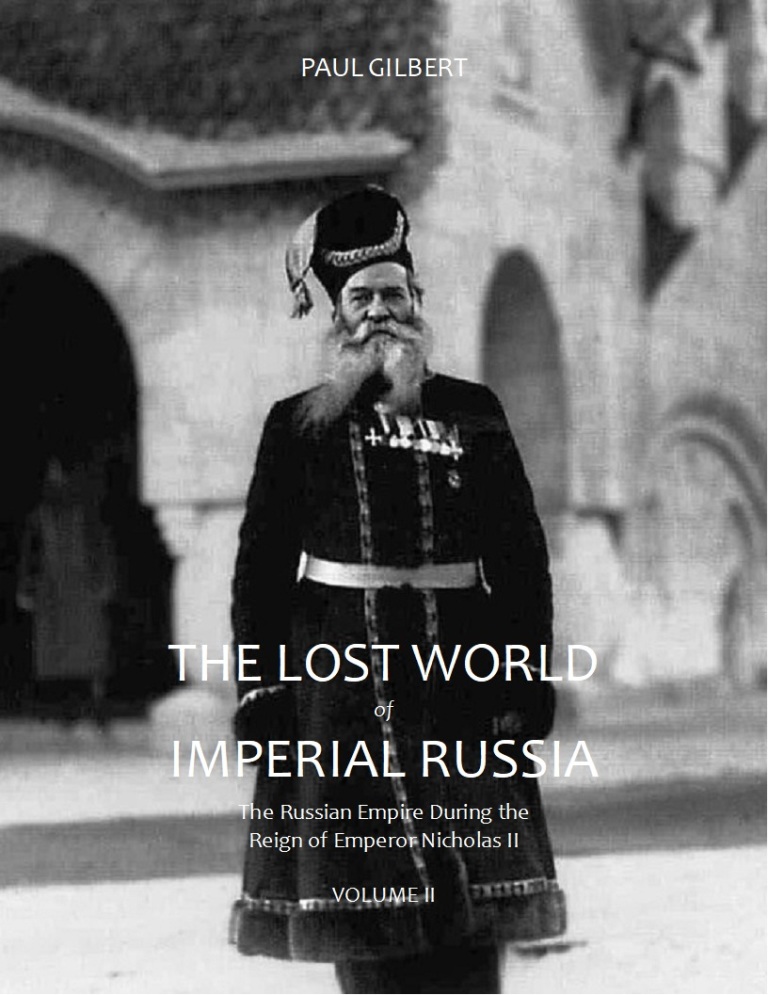
This second volume of The Lost World of Imperial Russia, features more than 400 additional vintage photographs of architectural gems, people and places of the Russian Empire during the reign of Emperor Nicholas II, between 1894 to 1917. This second volume complements Volume I, which was published in September 2022.
Imperial palaces, palatial mansions, seaside villas, suburban dachas, churches, government buildings, all of which reflect a variety of architectural styles, and many which reflect Imperial Russia itself are featured. In addition, are photographs depicting daily life, social activities, life in the Russian Imperial Army and Navy, and much more.
Like Volume One, this second volume is a photographic record of a lost world, one of great historical value in our understanding and appreciation of the Russian Empire during the reign of Russia’s last Tsar.
Volume II is available in both hard cover and paperback editions, 240 pages, richly illustrated with more than 400 vintage black and white photos! AVAILABLE exclusively from AMAZON.
COVER PHOTO: Andrei Alexeevich Kudinov (1852–1915), standing at the Emperor’s Porch at the Feodorovsky Cathedral in St. Petersburg in January 1914. This is probably one of the last photographs taken of him before his death in June 1915. Kudinov served as bodyguard to Grand Duke Alexander Alexandrovich [future Emperor Alexander III]. In December 1878, he was assigned to Grand Duchess Maria Feodorovna [future Empress Maria Feodorovna]; he stayed at this post when she became Empress in 1881 and continued until his death. Photo by Karl Bulla.
***
THE LOST WORLD OF IMPERIAL RUSSIA Volume I – Published in September 2022
*This title is available from AMAZON in the USA, UK, Canada, Australia, France, Germany, Spain, Italy, Netherlands, Poland, Sweden and Japan
Large 8-1/2″ x 11″ format, 242 pages, featuring 400+ black & white photos
“Keeping the memories of Old Russia alive!”
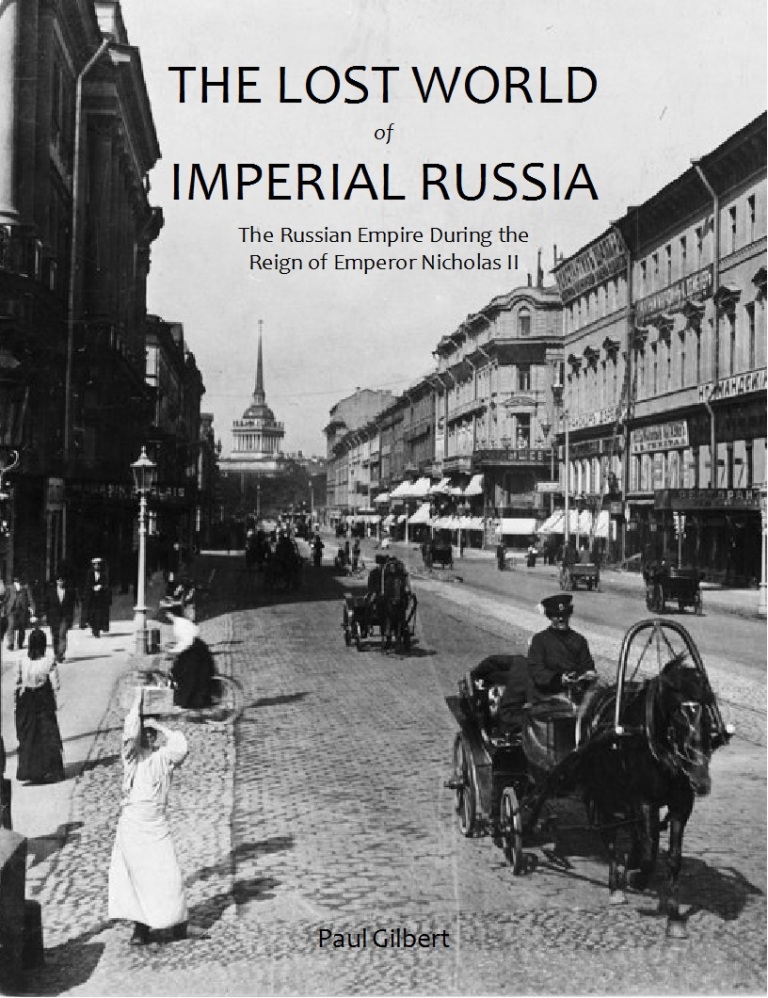
This richly illustrated pictorial is a celebration of the beauty and splendour of a lost world: Imperial Russia during the reign of Emperor Nicholas II, from 1894 to 1917.
More than 400+ black and white photographs showcase Imperial residences, country estates and manor houses, dachas, churches, government buildings, hotels, restaurants, historic events, people and much more.
The Lost World of Imperial Russia, is a remarkable photographic record of one of the world’s greatest empires—one that both attracts and eludes description.
While many of the architectural gems of Imperial Russia have survived to the present day, many others have been lost to history: revolution, civil war, two world wars and 70+ years of Soviet dogma have each taken their toll on Russia’s rich architectural heritage. Many of the photographs in this album remain the only evidence of their existence.
Click HERE to read a REVIEW of this book by Mikhail Smirnov, published on the Russian Faith blog.
I have published nearly 30 titles to date through AMAZON – featuring one of the largest selections of books on Nicholas II, the Romanov dynasty and the history of Imperial Russia.
Please CLICK on the BANNER or LINK above to review my current selection of titles in hardcover, paperback and ebook editions. Listings provide a full description for each title, pricing and a Look inside feature.
Book review by Mikhail Smirnov, published on Russian Faith
A Great Book for those Interested in Orthodox Culture
I had the opportunity to review the new book, “The Lost World of Imperial Russia“, by Russian historian, Paul Gilbert. This book is available at Amazon for a decent price and I do recommend it for your Orthodox library. There are indeed a number of illustrated books on Russia, but this one is from a purely Orthodox perspective, that captures key elements of the Orthodox empire of Russia. Saints such as John of Kronstadt, and many others, are displayed in the book. Many churches and ecclesial events are also displayed…pictures that are very hard to find and very helpful for those who research Russia and plan on visiting Russia. I intend to bring this book the next time I visit, primarily because, again, it is most purely Orthodox.
It’s certainly a good coffee table book, but the more I look at it the more I see it as a travel book. It’s approximately 8.5×11, so it’s not too big, and not very heavy. Most importantly it has the right stuff in it for those who really want to experience Russia in the way we believe it should be experienced.
On that note of experiencing Russia, I would like to add that what Paul reveals here is foundational for Orthodox Christians or those seeking Orthodoxy, but from my experience, the more miraculous experiences happen from how you “live and leave” these areas. Many of these places are holy sites, where saints dwelled and worked, and where angels still dwell and work. So, locating the right place, as you can find in this book, and then praying and maybe even spending time at these places will enable you to experience the grace of God when you need it in everyday life.
Get the book, not necessarily to see nice pics, but to begin your journey to Holy Russia. The war will clear soon and it will be relatively easy to travel there. Open the book, pray to God, and then go!
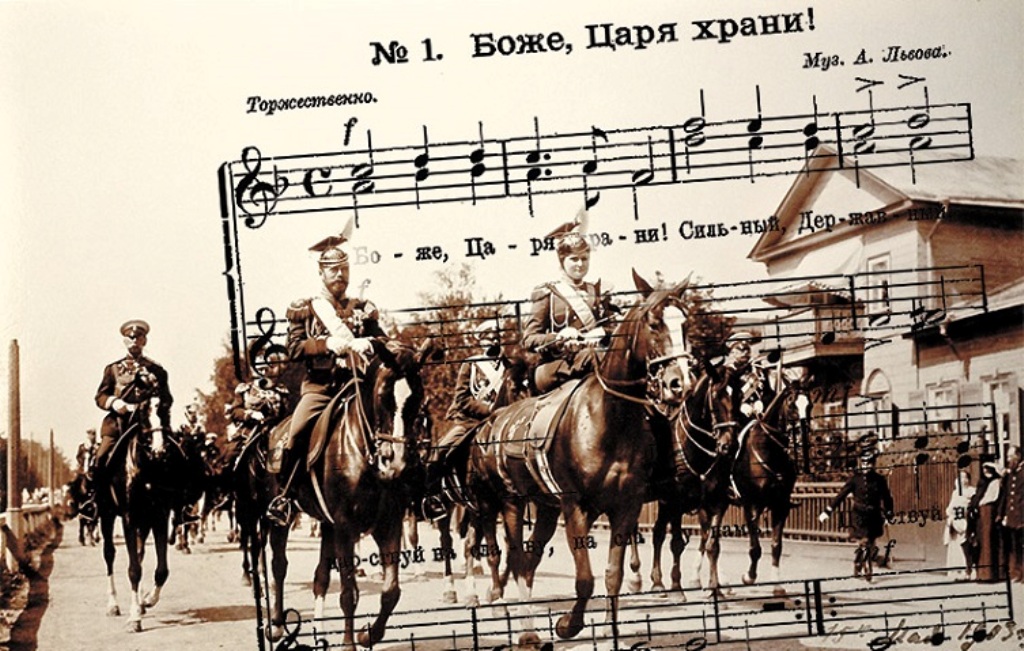
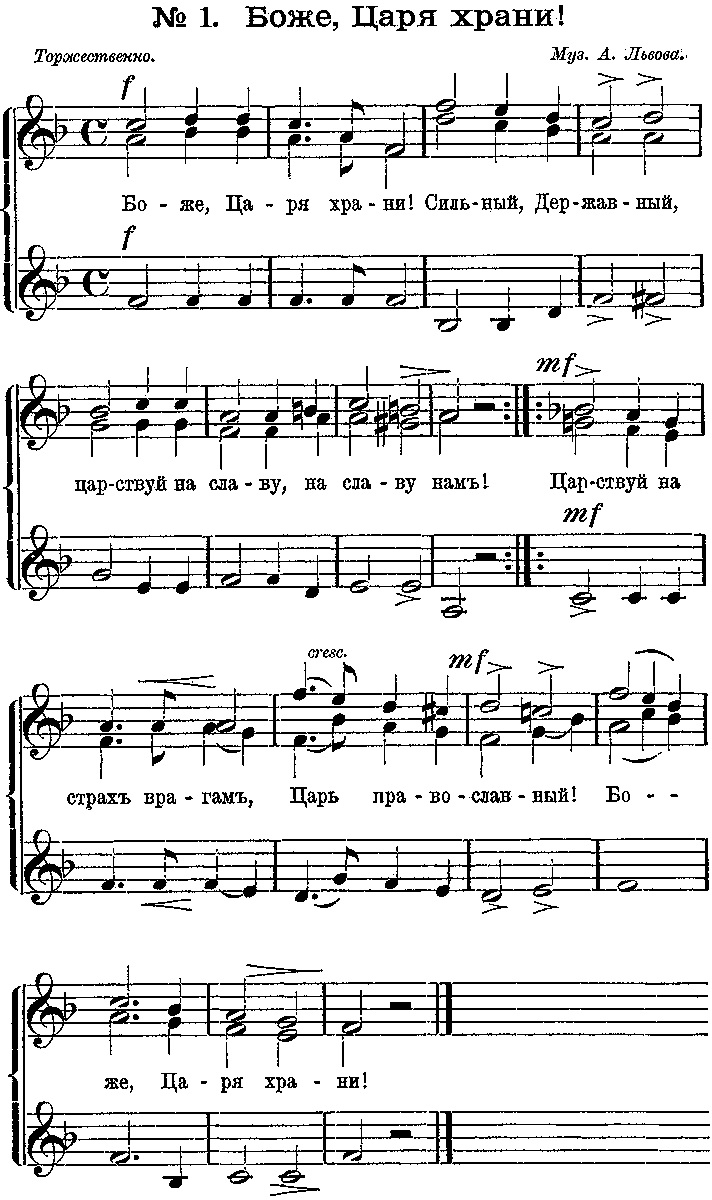
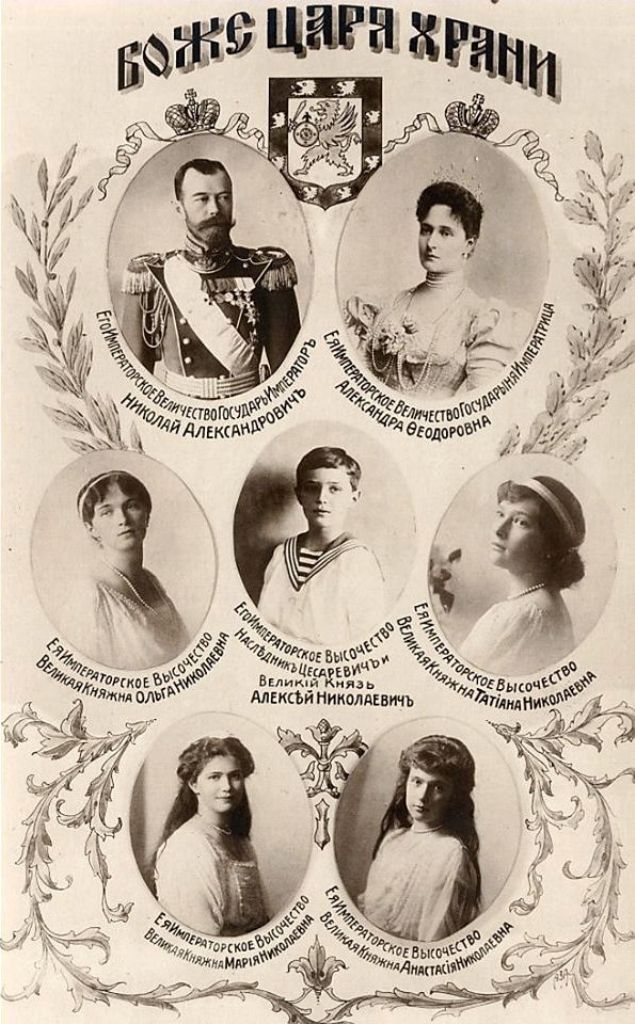
God, Save the Tsar! (Russian: Боже, Царя храни!; transliteration: Bozhe, Tsarya khrani!) was the national anthem of the former Russian Empire. The song was chosen from a competition held in 1833 and was first performed on 6th December (O.S. 23 November) 1833. The composer was violinist Alexei Lvov, and the lyrics were by the court poet Vasily Zhukovsky.
In 1833, Tsar Nicholas I (1796-1855) ordered Count Alexey Fyodorovich Lvov (1799-1870), the violinist and army general who was his court composer and aide-de-camp, to compose new music to replace the air that since 1816 had served as the music for the Russian Empire’s Anthem God Save the Tsar, namely Henry Hugh Carey’s God, Save the King. The lyrics of “God Save the Tsar” (Bozhe Tsarya Khranii) date from 1815 and came from Prayers of the Russian People by Vasily Andreyevich Zhukovsky (1783-1852), an officer and poet who served as tutor to the Tsesarevich Alexander Nikolayevich, the future Tsar-Liberator Alexander II.
After some initial creative difficulties, the melody that would serve as the anthem of the Russian Empire for the remainder of its existence came to Lvov in the course of a single night’s inspiration; he succeeded in creating a work of majesty and power that was suitable for the army, the church and the people – indeed, for the entire realm. None other than the great Alexander Pushkin himself reworked Zhukovsky’s verses to adapt them to Lvov’s new hymn. It was the first national anthem in Russian history to feature music and lyrics by Russian authors.
Upon hearing its beautiful strains for the first time, Nicholas I ordered the work repeated several times. At the close of the final rendition, the Tsar – a stern and military-minded ruler who was to be vilified by Karl Marx and Friedrich Engels as the “Gendarme of Europe” for his crushing of the forces of revolution wherever they appeared – clasped the composer’s hand with tears in his eyes and uttered the single word: “Splendid!”
The public premier of God, Save the Tsar took place on 6 December (O.S. 23rd November) 1833 at the Bolshoi Theater in Moscow, where it was performed by a choir of one hundred singers and two military bands. At Christmas that same year, by the Tsar’s personal order it was performed by military bands in every hall of the Winter Palace in Saint Petersburg. A week later, the Emperor issued a decree declaring the anthem a “civil prayer” to be performed at all parades and official ceremonies. As was the case with the Preobrazhensky March, the most widely-used arrangement for military band of God, Save the Tsar was created by Ferdinand Haase; it was the shortest anthem in the world at eight lines.
During the Coronation of Tsar Alexander II in 1855, Lvov led one thousand singers and two thousand musicians in a rendition of God Save the Tsar, the first performance of the anthem at a coronation. As Lvov directed the choir and orchestra, he, by means of galvanic batteries, set off forty-nine cannons, one by one, sometimes on the beat. At the conclusion, hundreds of Roman candles and rockets soared into the sky.
God, Save the Tsar! remained the Russian Empire’s national hymn until the February Revolution of 1917, after which the Worker’s Marseillaise was adopted as the new national anthem until the overthrow of the Russian Provisional Government in October of the same year.
Sources: Brandenburg Historica; Scenarios of Power (Wortman, Richard S.)
LYRICS
Русский
Боже, Царя храни! Сильный, державный, Царствуй на славу, на славу нам!
Царствуй на страх врагам, Царь православный! Боже, Царя храни!
English translation
God, save the Tsar! Strong, sovereign, Reign for glory, For our glory!
Reign to foes’ fear, Orthodox Tsar. God, save the Tsar!
Below, are a selection of videos which present a variety of renditions of God, Save the Tsar! Боже, Царя храни!, performed by Russian Orthodox and professional choir ensembles – courtesy of YouTube:
1. Beautiful rendition of God, Save the Tsar! with vintage newsreels of the Imperial family. Duration: 2 minutes, 38 seconds
2. Performed by the Kuban Cossack Choir. Duration: 1 minute, 38 seconds
3. Performed by the Mikhailovsky Theatre Orchestra and Choir. Duration: 1 minute, 46 seconds
4. Performed by Varya Strizhak. Duration: 3 minutes, 19 seconds
5. Performed by the Moscow Philharmonic Orchestra, and the State Academic Choir. Duration: 2 minutes, 33 seconds
6. Performed by the Orlic Children’s Church Choir (Serbia). Duration: 1 minute, 24 seconds
7. Performed by The Royal Scots Dragoon Guards.
Duration: 55 seconds
8. Performed by the Columbia Military Band in 1914. Duration: 3 minutes, 16 seconds
Ice cream in its modern version first appeared in Russia, in the 18th century, its recipe, published in Новейшая и полная поваренная книга / The Newest and Complete Cookbook (1791) by Nikolai Maksimovich Yatsenkov.
Mention of ice cream was not only recorded in the memoirs of members of the Imperial Court, but also in the works of poets and writers. The great Russian Romantic writer, poet and painter Mikhail Lermontov (1814-1841), obliged his home cook to serve ice cream daily. Another Russian writer Thaddeus Bulgarin (1789-1859) writes about Venetian ice cream in his novel Ivan Vyzhigin (1829). The poet Gavriil Derzhavin (1743-1816), in honor of his name day, every year arranged a gala dinner, at the end of which ice cream was served in the form of an ancient temple or castle.
One of the scenes that struck the French aristocrat and writer Marquis de Custine (1790-1857) in the summer of 1839, was Muscovites eating ice cream in the Alexander Garden.
“Muscovites: shaved, curled, in tailcoats and white pantaloons, in yellow gloves, sit at ease in front of brightly lit cafes, eat sweet ice cream and listen to music? In the summer this can now be observed in Moscow every evening,” he wrote.
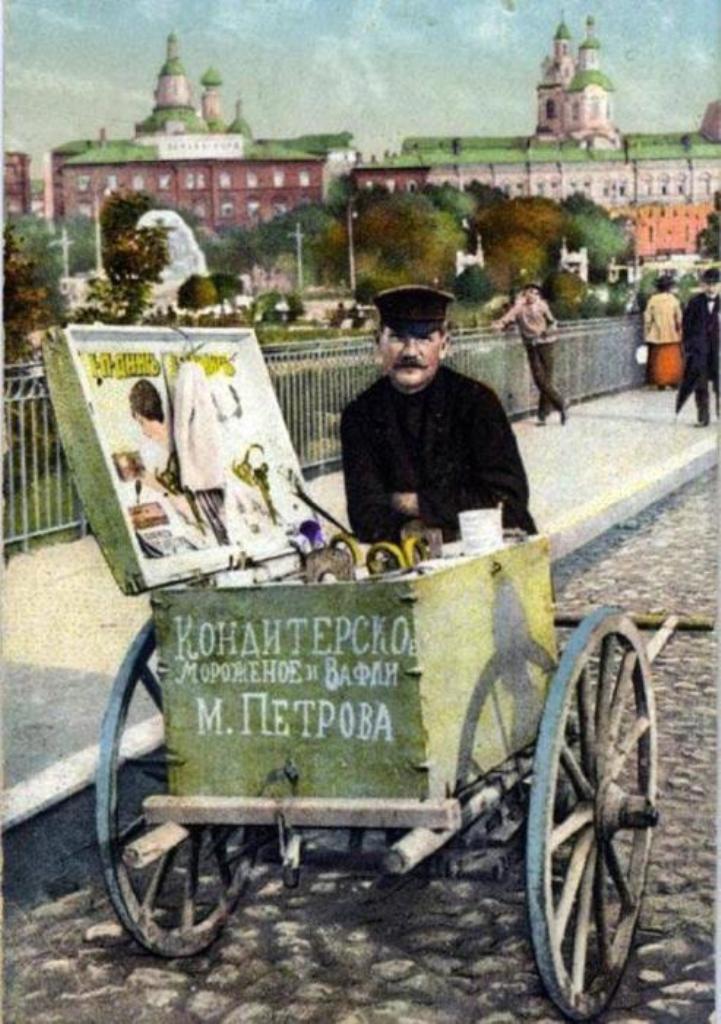
PHOTO: early 20th century Russian ice cream vendor
Expensive pleasure
In the late 18th and early 19th centuries, Russian people were content with traaditional folk dishes: cheesecakes and pancakes, syrniki [sweet cheese pancakes], topped with delicious sour cream and jam. Meanwhile, ice cream had acquired the status of a popular, fashionable and incredibly expensive dessert among Russia’s nobility. The new-fashioned cold treat was present at every social event, ball, and lavish feast.
At the time, sugar was in very short supply and was very expensive, which is why the old ice cream recipes, were considered an expensive pleasure, one which was only available to the very rich. Nevertheless, ice cream was already gaining popularity at Russian tables. By the end of the 18th century, they began to complete dinner with this cold treat more and more often.
The Court cooks slowly and masterfully coped with the whimsical melting product, creating new cold desserts, which included “Vesuvius on the Mont Blanc” – ice cream set on a platter, doused with rum or cognac and set aflame.
The production of ice cream by hand was a time-consuming and small-volume business. The amount of product directly depended on refrigeration equipment, which helped with the process of creating and preserving these cold delicacies.
The full-fledged and well-established production of ice cream in Russia began in the 1830s, when a shop was opened at a Moscow dairy plant, equipped with all the necessary equipment.
By the beginning of the 19th century, ice cream continued to gain popularity and more widely available, including fairs. Writer Pavel Efebovsky wrote in his essay Petersburg Peddlers: “Ice cream is sold by a Russian peasant in a huge tub filled with ice. This tub alone weighs at least three pounds . . . Only it’s expensive: a glass in three sips costs as much as two silver kopecks”.
Up until the middle of the 19th century, ice cream in Russia was prepared exclusively by hand. It was only in 1845, the Swiss-born restaurateur and confectioner Johann-Lucius Isler (1810-1877) patented a machine that made it possible to produce this delicacy mechanically. Isler opened one of the most popular St. Petersburg cafes on Nevsky Prospekt, where they served ice cream with unusual ingredients for that time: fruit liqueur, ground coffee, infusion of orange flowers, pistachios, walnuts. At the same time, three main varieties of cold desserts appeared: sorbetto (or sherbet) – a heavily chilled fruit drink; granito made from frozen fruit juice and ice cream – a dense mass of milk or cream with sugar and various ingredients, similar to modern ice cream.
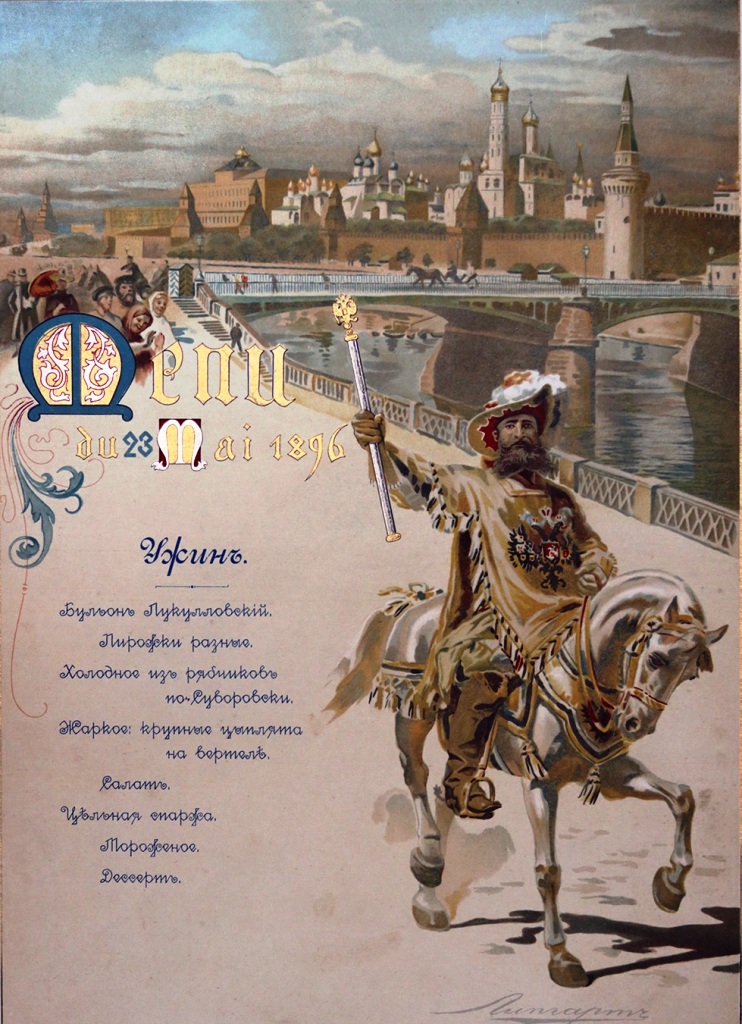
PHOTO: this richly decorated Coronation menu indicates that ice cream was served at the Gala dinner in the Alexander Hall of the Great Kremlin Palace, Moscow, dated 23rd May 1896
Ice cream at the Imperial Court
During the reign of Empress Catherine II, when various overseas amusements and dishes were very fashionable in Russia, recipes for ice cream made from cream and egg whites, included such ingredients as chocolate, lemon, currants, cranberries, raspberries, cherries and oranges.
During the reigns of her successors, ice cream continued to be popular at the Imperial Court. Emperor Alexander I had a French chef named Carem, who invented new types of this dessert to surprise the monarch. Emperor Nicholas I, on the other hand, refused ice cream: based on his solidarity with his brother Michael, who was on a strict diet on the advice of doctors. But the emperor’s wife Empress Alexandra Fedorovna ordered two portions of ice cream from the pastry shop every day for the amount of 1 ruble 72 kopecks.
Richly decorated menus confirm that Мороженое [ice cream] was served to guests at elaborate State Banquets. In particular, ice cream was served to members of the Imperial Family, Russian nobles and visiting foreign delegations, at the Gala dinners held over a three-week period in the Great Kremlin Palace in Moscow, during the festivities marking the Coronation of Emperor Nicholas II in May 1896.
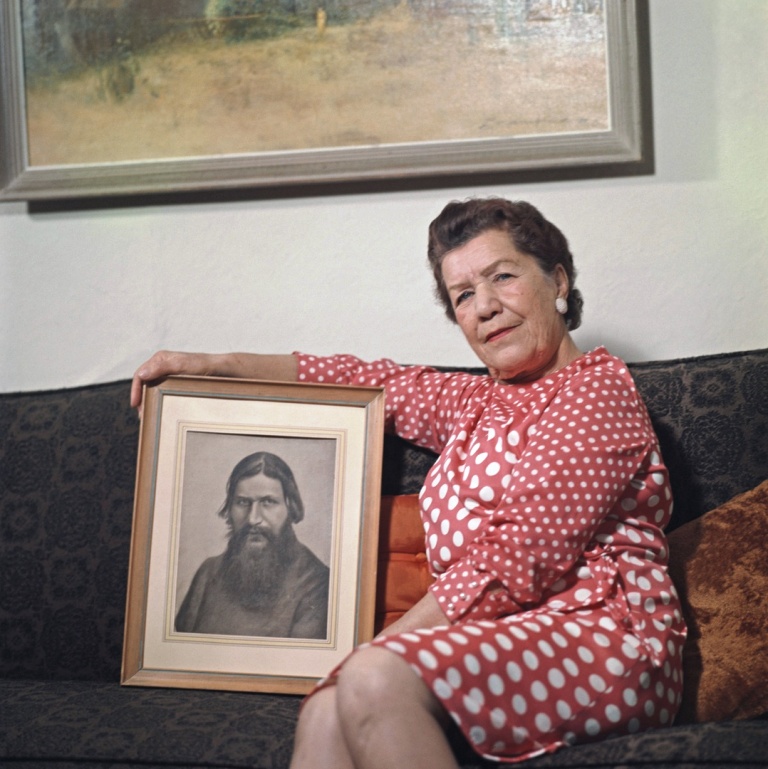
PHOTO: Maria Grigorievna Rasputina with a portrait of her father Grigorii Rasputin, in exile, 1972
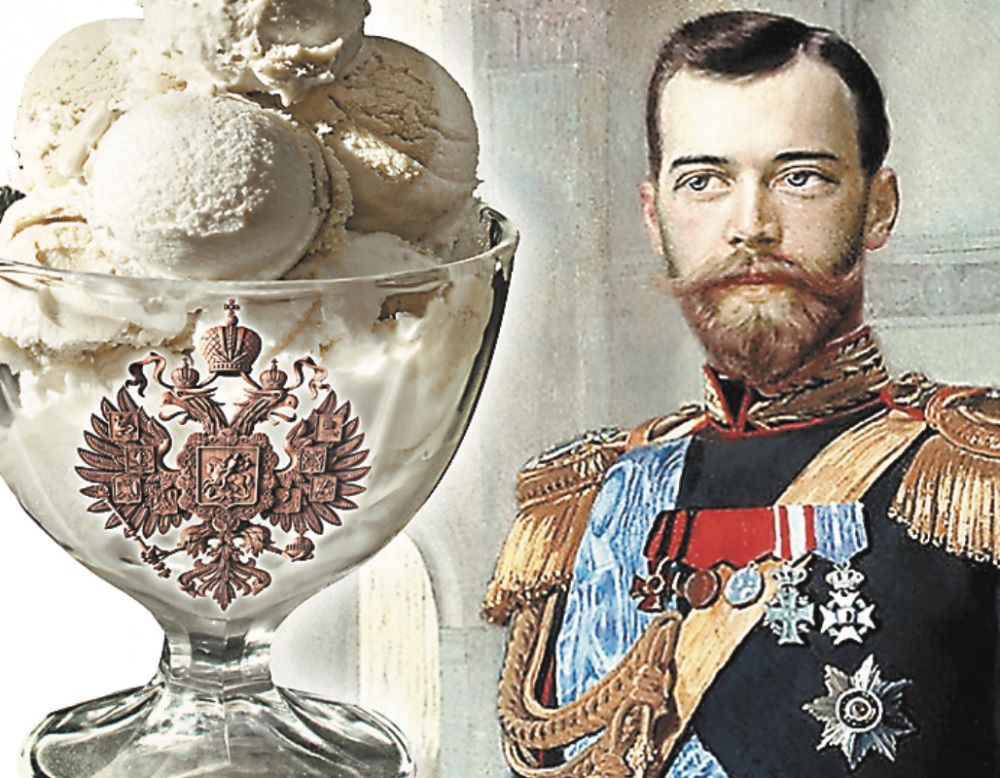
Ice cream was especially popular at table of the last Emperor and his family. The recipe for “Romanov ice cream”, which was invented specifically for Nicholas II, has been preserved to this day. It included sugar, 10 egg yolks, heavy cream, whipping cream and vanilla. “I remember ice cream, the like of which I have never eaten anywhere else,” wrote the daughter of Grigorii Rasputin, Maria (1898-1977).
In any country in the world, its national currency is one of the main guarantors of its independence. Moreover, its issuance is carried out by a central bank owned by the state. Only the United States is different. A private financial company, the US Federal Reserve, is responsible for issuing the dollar, one of the world’s primary reserve currencies. Many believe that its shareholders run the global economy. It is a little known fact that during the early 20th century, Emperor Nicholas II helped finance the authorized capital of the US Federal Reserve System [FRS].
The Russian Empire as the world arbiter
Despite the popular opinion that pre-revolutionary Russia was the gendarme of Europe, in reality it was a world power that sought not only to end wars, but also to create an international body regulating relations between countries. While on the throne, Emperor Alexander II in 1868 initiated the signing in St. Petersburg of the convention on the “rules of war”. This document, in particular, provided for a ban on the use of a number of inhumane types of weapons. Nicholas II followed the example of his grandfather by organizing theFirst World Peace Conference in 1899. With the active participation of the last Russian emperor, a proposal was made to create the League of Nations, the prototype of the UN. It sounds incredible, but even then, at the end of the 19th century, Nicholas II spoke from a high rostrum about the need to end the arms race.
Money is the engine of politics
Simultaneously with the discussion of the creation of the League of Nations at the beginning of the 20th century, proposals were raised for the establishment of an international financial body. Its functions were to include the regulation of financial disputes between different countries. It was then that the proposal to create the US Federal Reserve appeared. From the earliest days of its existence, this financial institution was essentially an international private bank, which was required to have its own authorized capital, denominated in gold. Today, the US dollar is not backed by either gold or the mass of commodities in the United States. But in 1913 everything was different. At the time when the FRS was created, the dollar, like the ruble, was obliged, if necessary, to be exchanged for an equivalent in gold. Not surprisingly, the US Federal Reserve had large reserves of gold as its charter capital.
Where did it come from?
Under US law, however, American banks involved in the creation of the FRS, could not utilize their gold as authorized capital. It was assumed that it would be provided by those countries, for the settlement of financial disputes between which the FRS was created. The major world powers showed little interest in the proposal to finance the authorized capital of the FRS with their own gold and foreign exchange reserves. This was done only by Emperor Nicholas II from Russia’s vast gold reserves. The contribution of the Russian Empire to the US Federal Reserve amounted to 88.8% of its authorized capital in gold! At the same time, Russia was supposed to receive 4% of the invested funds annually, as dividends. However, soon after the establishment of the FRS, the 1917 Russian Revolution broke out, and then the Imperial Family were murdered by order of the new Bolshevik regime.
The USSR, refused to recognize the debts of Tsarist Russia, and, accordingly, did not have any rights to its income from foreign assets. There was no one to pay interest to the FRS. Had the history of Russia taken a different course, perhaps today it would be the owner of the printing press of the world reserve currency.
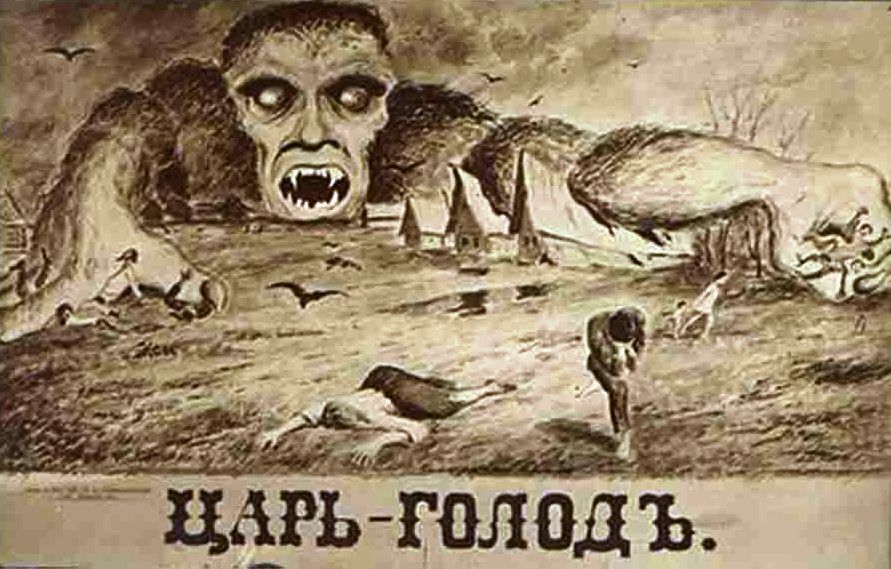
For many years, Soviet historiography was dominated by the notion of “eternal” famine in Imperial Russia. With this lie, the Bolsheviks tried to justify the monstrous famines of the 1920s, 30s and 40s, as well as the constant shortage of food during the Soviet years.
In fact, there were many poor harvests leading to food shortages in Russia before 1912. The largest of them was in 1891, during the reign of Emperor Alexander III (1845-1894). This was the result of a global agrarian crisis in the 1880s, which also affected England, France, Germany, and parts of the United States. The terrible famine in Ireland between 1845-1850, claimed the lives of 1.5 million people. By the beginning of the twentieth century, the consequences of this famine reduced the Irish population by more than 30%.
The crop failure of 1891-92, was caused by severe drought. It affected 25 provinces in the Russian Empire. Between 1891-92, some 30 million people were starving. In 1897, another crop failure in 18 provinces was again caused by drought, worsened by an unfavorable winter, and an invasion of insect pests. Between 1897-98, 27 million people were starving.
In the summer of 1905, there was a subsidence in the Chernozem, Volga, Trans-Volga, and eastern provinces. The crop failures mainly affected traditionally agricultural areas, which, according to official data from the Ministry of Internal Affairs, occupied up to 43% of all arable land in Russia. The last “royal” crop failure occurred in 1911 – it was a reflection of a serious pan-European crop failure due to drought. The crop failure covered a vast territory: all the districts of the Astrakhan, Orenburg, Samara, Saratov, Simbirsk and Ufa provinces, as well as many districts of the Vyatka, Kazan, Nizhny Novgorod, Penza, Perm provinces and the Don Army Region, affecting more than 20 million people in one way or another. In the affected areas, only 1/3 of the grain harvest was harvested against the annual average.
However, it should be noted that crop failures and malnutrition in Imperial Russia did not lead to mass mortality. All the Bolshevik allegations that up to 4 million people a year allegedly starved to death in Russia are an outright lie, which is based on false “annual reports of the College of the Life Chancellery.” It is worth noting that such a body did not even exist in the Russian Empire.
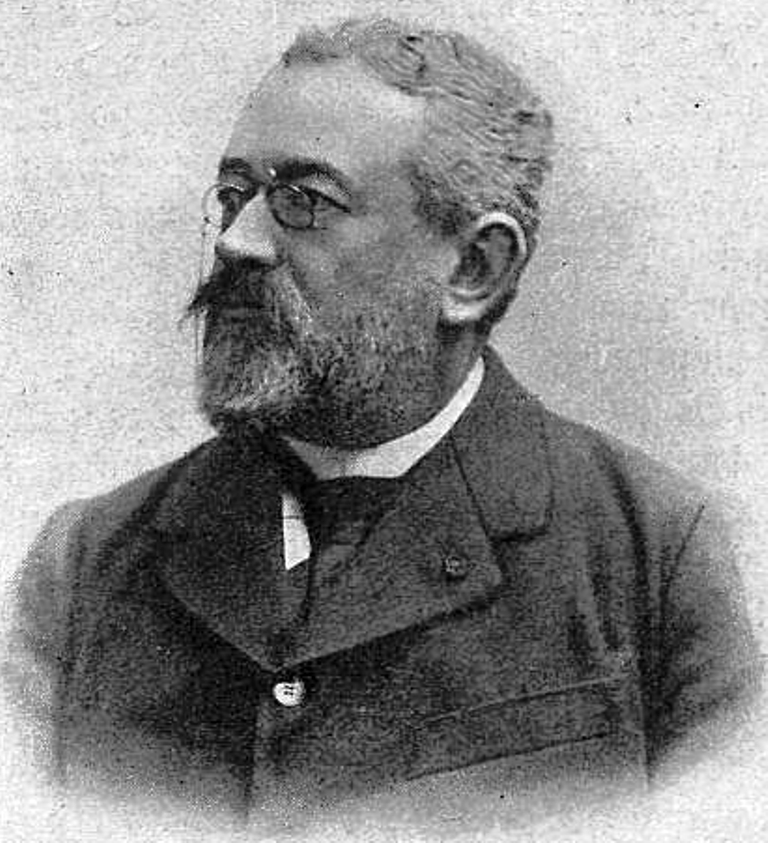
Minister of Agriculture and State Property Aleksei Sergeevich Ermolov (1847-1917)
Between 1892-1905, Minister of Agriculture and State Property Aleksei Sergeevich Ermolov (1847-1917), then the head of the Central Committee for the provision of medical and food assistance to the population, wrote that “not a single death from starvation, or from the complete absence of any food, not to mention the cases of suicides or murders of children due to hunger, were not recorded any where.” Ermolov noted that the population growth in 1906-07 in some provinces (Oryol, Tambov, Ufa) surpassed that of the previous year.
There is no data on deaths due to starvation among Soviet and Russian demographers. In his studies, Russian demographer Adolf Grigorievich Rashin (1888-1960) argued that in the period from 1890-1913 mortality steadily decreased: from 36.7 deaths per 1000 population in 1890 to 27.4 per 1000 population in 1913.
The multi volume work Население России в ХХ веке (The Population of Russia in the 20th Century) unequivocally states that “by 1913 all regions of European Russia reported a significant increase in population”. The Chernozem region and the Volga region, experienced one of the highest rates of population growth in the Empire.
In 1907 a very high natural population growth was recorded (18.1%), 1911 (17%) and 1912 (16.9%). The lowest increase in the first 15 years of the twentieth century was recorded during the troubled year of 1905 (13.9%).
During the alleged “great famine” of 1911-1912, the population grew by more than 3 million people. You can compare this to data on the years of the Soviet famines (1921-22, 1931-33, 1946-48): which resulted in complete cessation of the country’s population growth, and a sharp decline in life expectancy.
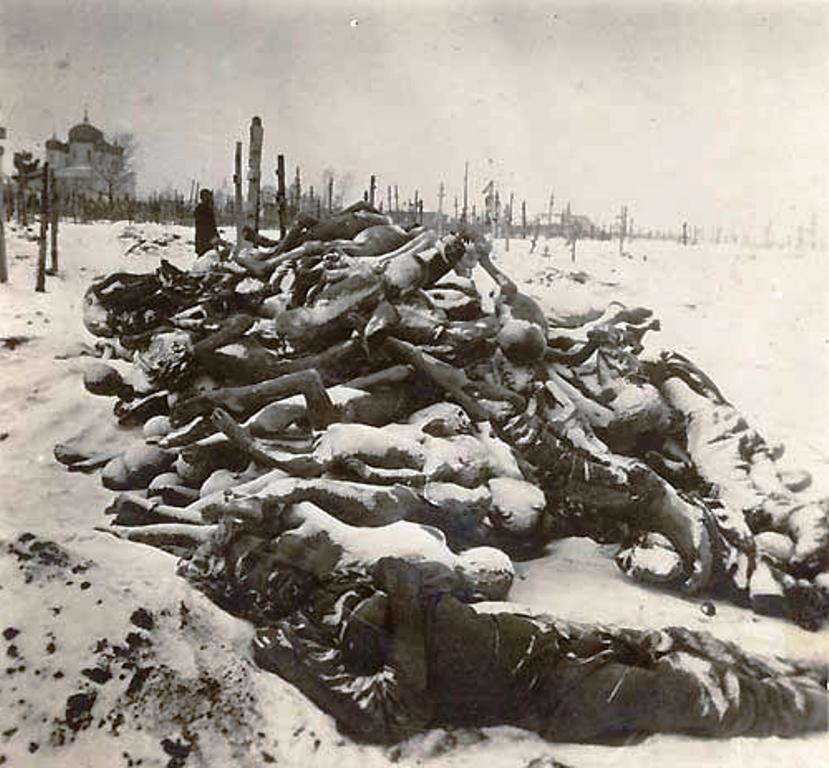
Hundreds of corpses piled up at the local cemetery, during the 1921 Famine in Russia
Thus, the only conclusion that can be made: after the famine of 1891-92, which was accompanied by an acute epidemic of cholera, the Russian Empire did not entail any “starvation deaths”.
It should be noted that the Imperial Government made great effort to combat the effects of crop failures.
In 1897, loans amounting to 5.4 million rubles were granted from the All-Empire capital, in 1898 – 35.2 million (34.4 million poods were purchased for the foodstuffs of the population – bread, and support of cattle breeding by peasants), public works were organized, in particular, the transportation by peasants of grain purchased by the government to provide bread for the hungry.
The death of horses caused by the lack of fodder was compensated by the purchase of horses from the steppe inhabitants of the local breeds and their delivery on favorable terms by the beginning of field work. The supply of feed to needy households was carried out on a “loan basis” (with payment over 3-5 years), in 1898 7 million rubles were spent on these needs.
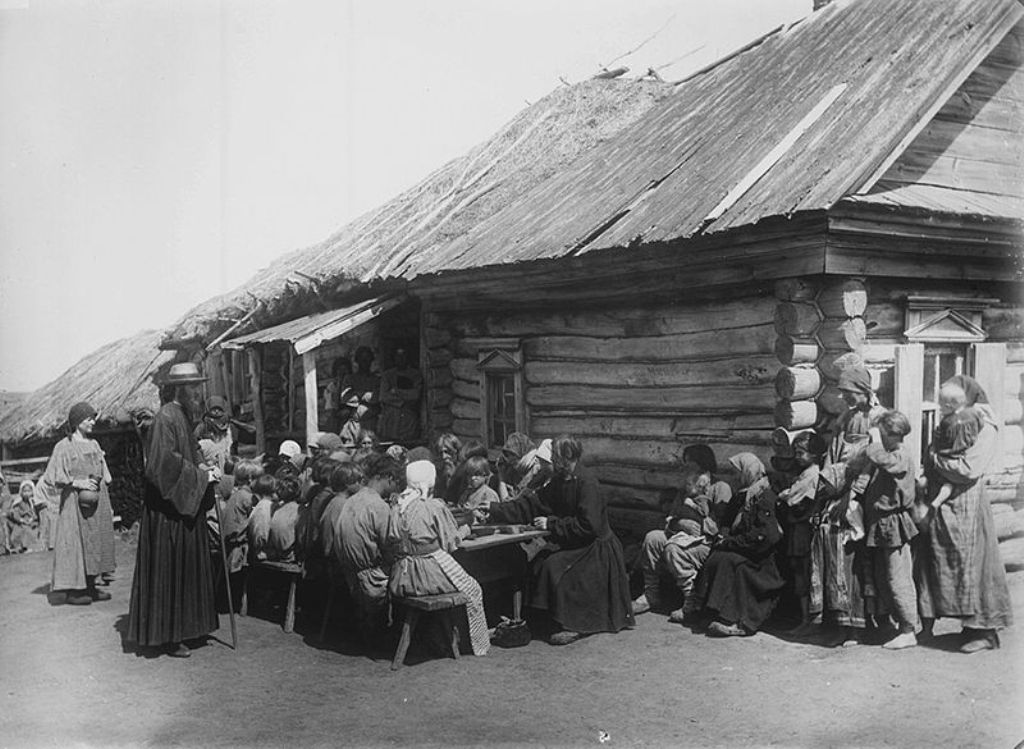
In the canteens opened by the Red Cross, up to 1.5 million people were fed, mainly women, children, old people and the weak, but in exceptional cases, able-bodied men (in the absence of earnings), more than 2 million received rations.
Canteen to feed the hungry in Nizhni Novgorod province, during the famine of 1891-1892
The Guardianship of Diligence and Workers’ Houses, created at the initiative of Empress Alexandra Feodorovna, began to take effect. Among the private philanthropists, the Bessarabian landowner Purishkevich was especially distinguished – thanks to his ebullient activity, some 20 canteens were opened, financed with donations and thereby saving hundreds of people from starvation. His efforts were noticed and greatly appreciated in St. Petersburg.
Everywhere where hunger arose, food centers were opened for children, women, and those incapable of work, each of which fed up to 1000 people.
According to observers, “the food campaign of 1906-1907. was carried out by the Food Department of the Ministry of Internal Affairs with much success.
At the same time, charitable organizations actively supported the hungry. One branch of the Red Cross, with the assistance of local authorities, opened free canteens and food outlets, which issued 270 million meals and rations during the famine. The Holy Synod introduced a gathering for the hungry on all Sundays and twelve feasts.
Private charity played an increasingly significant role. Numerous private trusteeships, local societies, unions, and committees were established. The assistance offered by “private owners” turned out to be of great help to the state, whose stocks were greatly depleted as early as 1905.
For the supply of feed during the crop failure of 1911-12, the government spent 9-12 million rubles, issued loans for food (for example, in Siberia they issued 300 rubles per cow allowance), 16 thousand horses were distributed on favorable terms. Public work for peasants as an experiment decided this time to make the main form of assistance. 42 million rubles were allocated for their implementation, with 84% of the amount spent on wages. The hungry were provided with 222 million meals, under the guidance of priests and teachers in the Volga region alone, more than 7 thousand canteens were opened in schools, where 24 million lunches were provided to children. In general, the campaign was carried out at on a gargantuan level – and it is interesting to note that the state, who were in full control over the situation in both 1901 and 1911, managed to prevent starvation.
Thus, it can be seen that by the beginning of the twentieth century, the state had formed an integrated system of redistribution of food resources, which functioned effectively during periods of crop failure and with the depletion of bread in peasant farms. In addition, measures were constantly taken to support residents of the territories affected by crop failure. The Russian public actively participated in helping the victims, which caused widespread development of charity, and the formation of effective structures for providing assistance to the population. After 1892, deaths from starvation were avoided even under the most unfavorable conditions (such as the “revolutionary situation” of the mid-1900s).




 Nicholas II
You must be logged in to post a comment.