The fate of Nicholas II’s elephants at Tsarskoye Selo
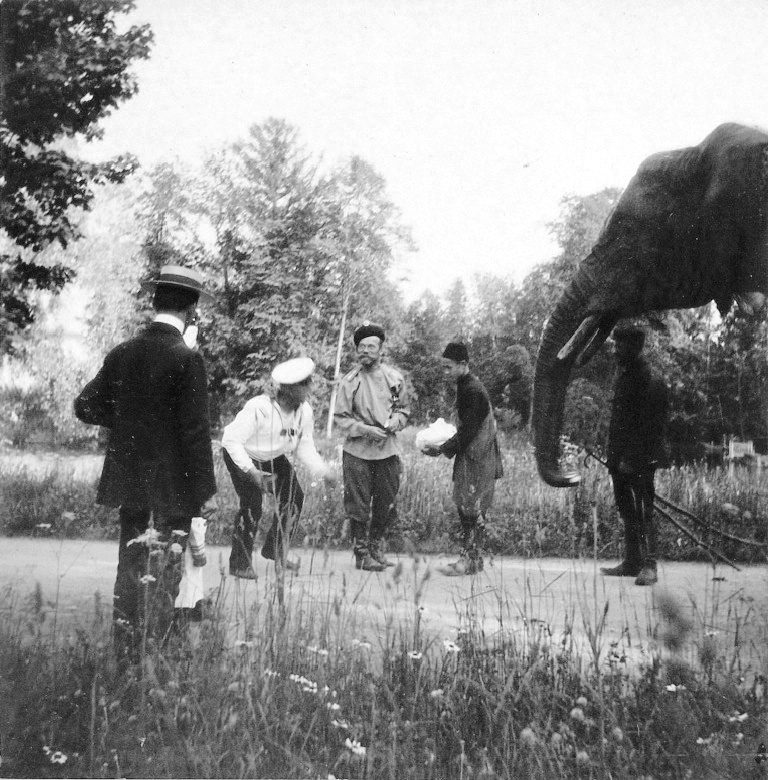
PHOTO: Emperor Nicholas II feeding his “pet” African elephant in the Alexander Park. 1914

One of the favourite pastimes of European monarchs and wealthy aristocrats were menageries, filled with exotic creatures from the four corners of the world. Among the most popular were rhinos, hippos and elephants.

Elephants in Russia during the 19th century

The first elephant was brought to Russia in 1832, and in 1839, the Emir of Bukhara presented Emperor Nicholas I (1796-1855) with another elephant and two camels, which walked from Bukhara to St. Petersburg – a journey which tookr almost a year.

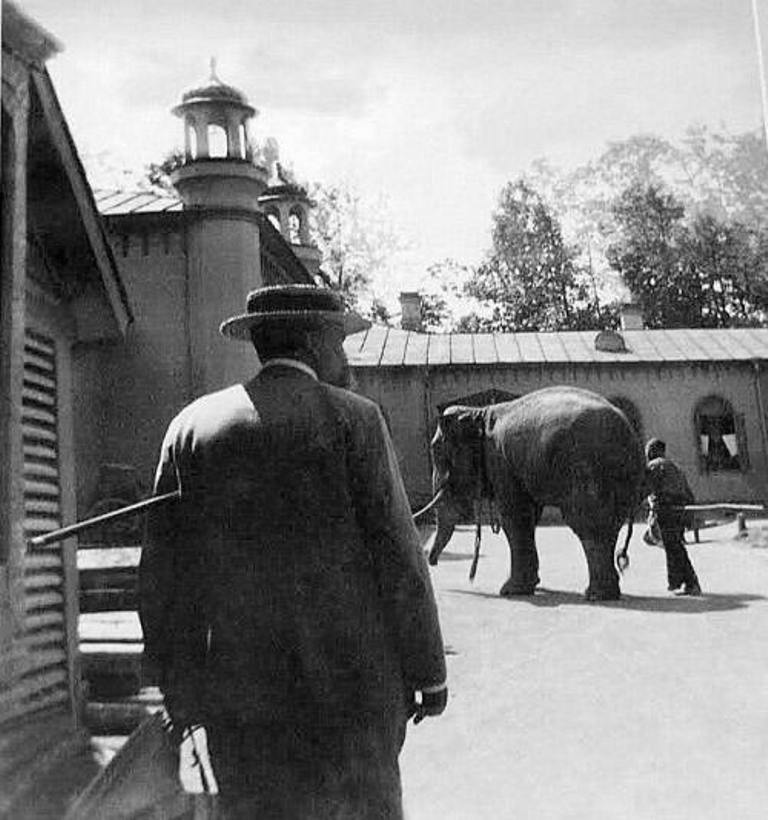
The elephant was taken for a walk daily by an attendant, who noted that the elephant was a “kind and clever animal”. The Tsar’s children fed the elephant with apples and sugar, and together with the caretaker they walked him in the yard of the Elephant Pavilion. 

The elephants became a favorite animal among the Tsar’s children. Visits to see the elephants was part of the educational program for the grand dukes. The children came to feed the old elephant, and the teachers asked them to examine the animal’s teeth and feet, as part of their studies. The grand dukes fed the elephant with apples and sugar cubes and, together with the caretaker, walked it around the courtyard.

The Elephant Pavilion

The elephants were housed in a specially made Elephant Pavilion, constructed during the reign of Emperor Nicholas I, in the far end of the Alexander Park at Tsarskoye Selo.  The wooden pavilion was constructed in 1828 in the Indian style by the Scottish architect Adam Menelaws (1753-1831). The pavilion included small intricate turrets, a large quadrangular courtyard, surrounded by a metal fence, with service buildings and sheds.

According to the caretaker, the male elephants “eats 2 pounds of tortillas fried in butter, 6 pound of hay, sugar cubes and 2 tubs of water, per day.”

In winter, the building was heated, and covered with large felt blankets, so that the elephants lived in warmth during the cold Russian winters. In the summer, they walked in the park and bathed daily in the local pond.

From 1870 to 1872, another elephant from the Emir of Bukhara was brought to Tsarskoye Selo, however, it was transferred to the St. Petersburg Zoological Garden.
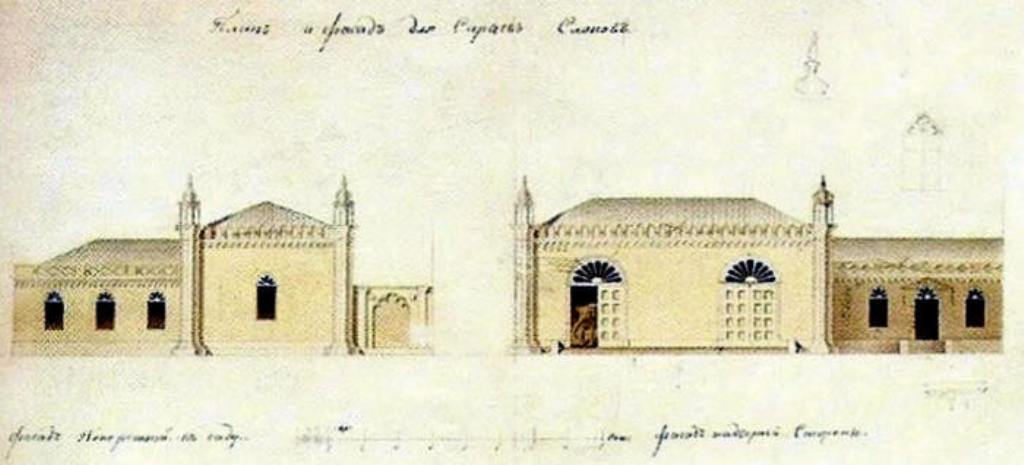
PHOTO: architect’s rendering of the facade of the Elephant Pavilion. 1828 (above; early 20th century view of the courtyard of the pavilion (below)
The last Russian tsar Nicholas II kept elephants

In his 1911 study of Tsarskoye Selo, Sergei Nikolaevich Vilchkovsky (1871-1928), notes that a young elephant lived in Tsarskoye Selo in July 1891.

During his journey to the Far East in 1891-92, Nicholas Alexandrovich, while still a grand duke and tsesarevich, returned to Russia with his first Indian elephant. Five years later – in August 1896 – another elephant arrived from Abyssinia (Ethiopia).

Sadly, the Indian elephant did not live long. The harsh Russian winters and lack of proper care led to the poor animals demise in 1902. The African elephant, faired much better, he lived until 1917.
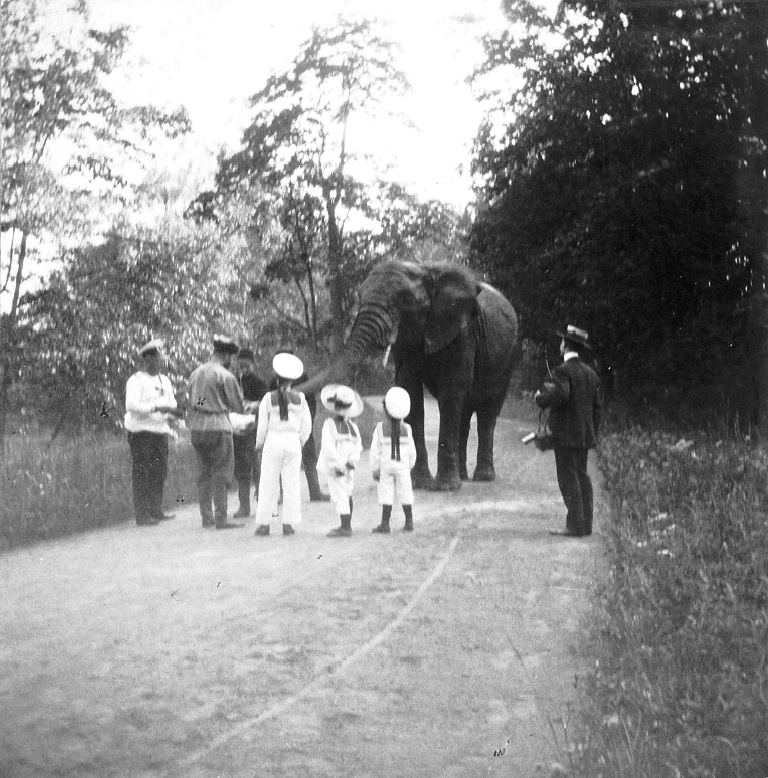
PHOTO: Tsesarevich Alexei (left) and his friends, watch as Tsar Nicholas II preparing to feed the elephant in the Alexander Park. Pierre Gilliard can be seen standing to the right. 1914
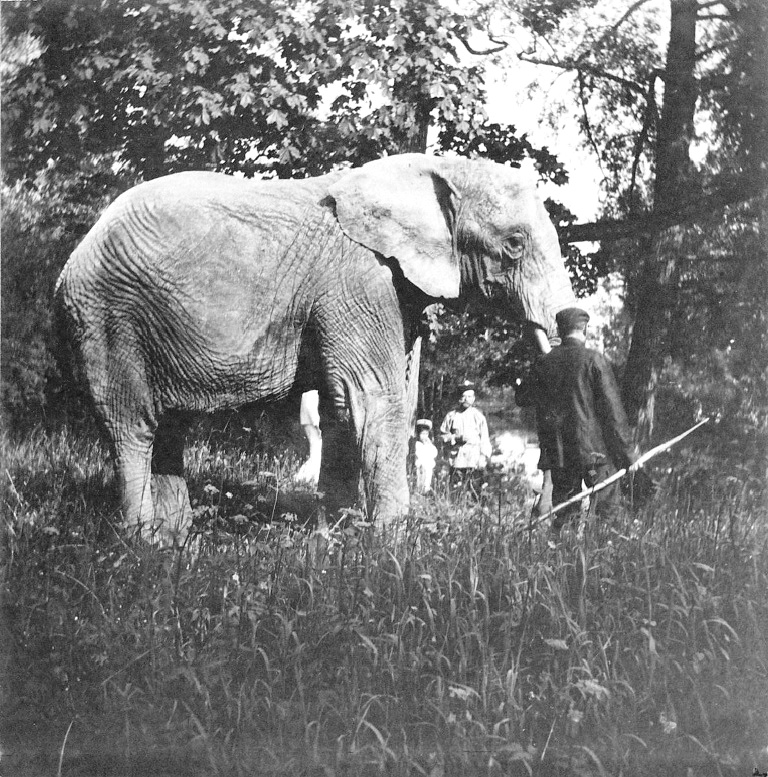
PHOTO: this photo allows us to appreciate the height of this magnificent animal. Nicholas II and his children can be seen standing in the background. 1914

The African elephant was under the care of a Tartar – ironically called Alexei – who always wore a red fez, noted that the elephant was “good-natured and very obedient”. Every day during the summer, the Tatar walked the animal in the Alexander Park, where it was taken to a tiny lake, which was appropriately named “Elephant pond”. The elephant happily plunged into the water, taking water in his trunk, and dousing itself.

It is interesting to note that the animal was never given a name, it was simply called “Elephant”.

The Tsar and his family loved to spend time with the elephant, often bringing their friends and relatives. Nicholas II repeatedly made entries in his diary that he and his son and heir went to watch the elephant bathe. On 9th June 1914, Nicholas made the following entry in his diary: “Alexei and I brought an elephant to our pond and amused ourselves with its bathing.” Being fond of photography, the Tsar took several pictures of his elephant.
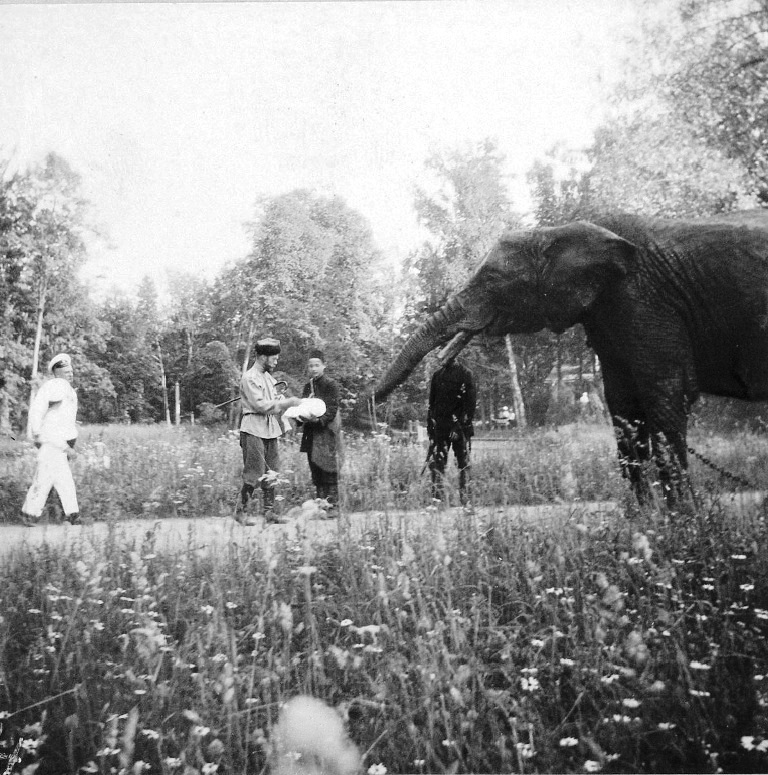
PHOTO: Emperor Nicholas II feeding his “pet” elephant in the Alexander Park. 1914
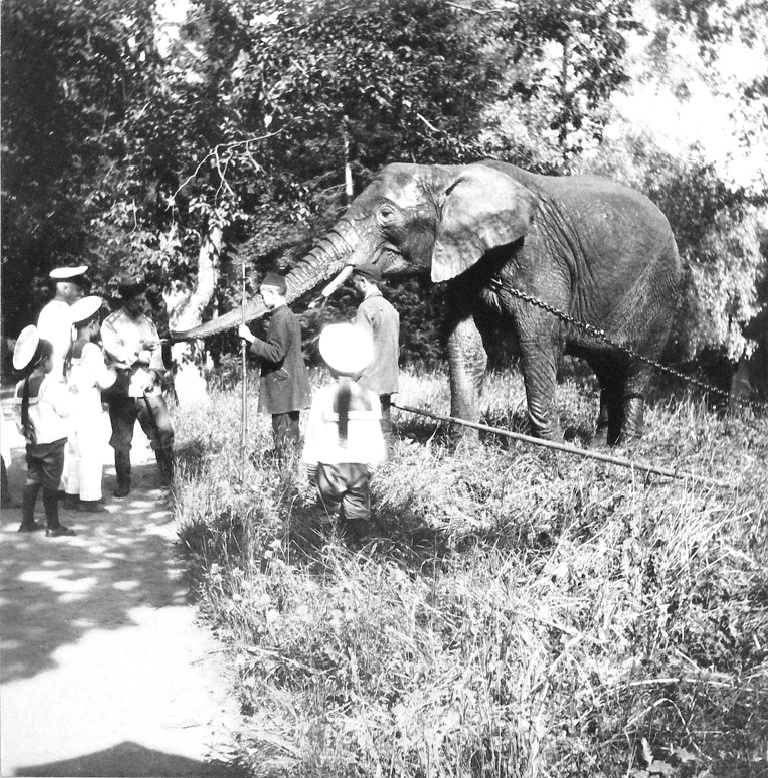
PHOTO: the Emperor distributes treats to his children, all of whom are anxious to feed the elephant. 1914
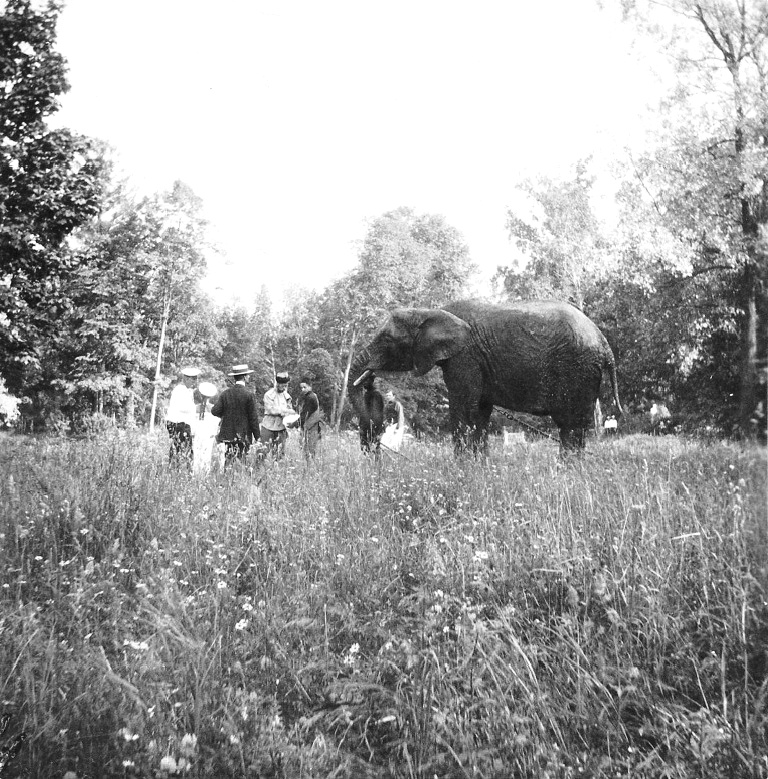
PHOTO: It is interesting to note that the animal was never given a name, it was simply called “Elephant”. 1914

When the Tatar saw the Tsar approach, he bowed low to him and hurried away to bring out the elephant with it’s long, sprawling ears, tiny eyes with long eye lashes, and always moving about. The Tsar was always accompanied by his children among other guests, anxious to watch the animal do tricks.

Alexei [the Tatar] spoke to the elephant in a foreign language, at which the animal obeyed. A number of tree stumps were scattered in the courtyard, and upon command, the elephant began to move them one by one. The elephant then stood on all fours, on the largest. He then lifted his trunk, making a loud trumpet sound, as if greeting us. After each performance, the Tatar gave the elephant a sugar cube, which the elephant put into its mouth. At the end of the visit, the Tatar brought out a large basket of French rolls and offered them to the guests, give to the elephant, who readily took each one with his trunk, and placing them in his mouth. The guests were always charmed by the animal’s gentleness.

When the Tatar tapped the elephant on its front leg, the elephant would lay on its side, at which Alexei [the Tatar] would get behind the animal’s ear and cover himself like a blanket. Then, the elephant stood up, took Alexei with his trunk and sat him on his neck. On Sundays, a saddle was placed on the elephant, which had side seats.
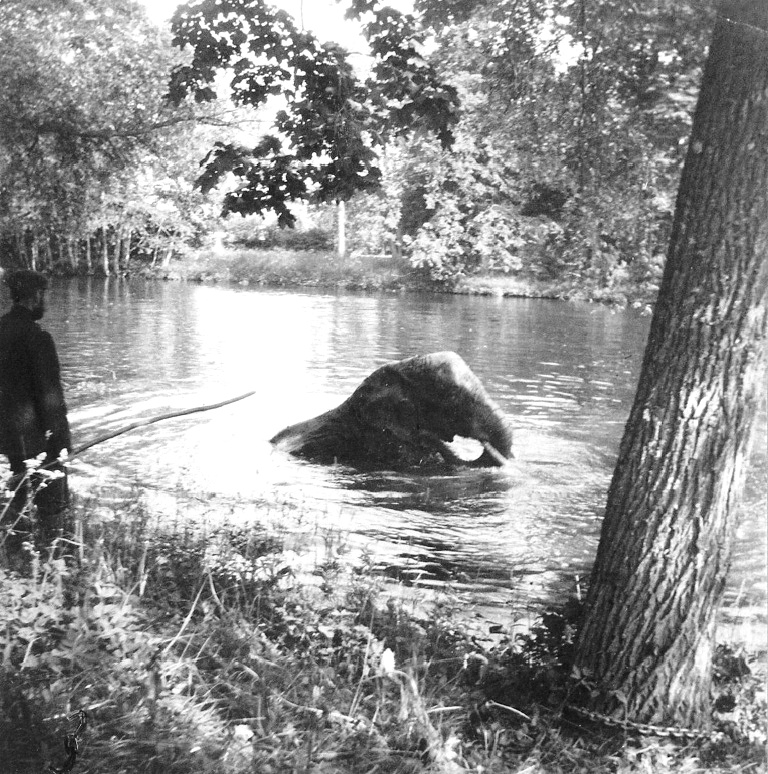
PHOTOS: on warm summer days, the elephant was taken to the “Elephant Pond”, which was located in the Alexander Park at Tsarskoye Selo
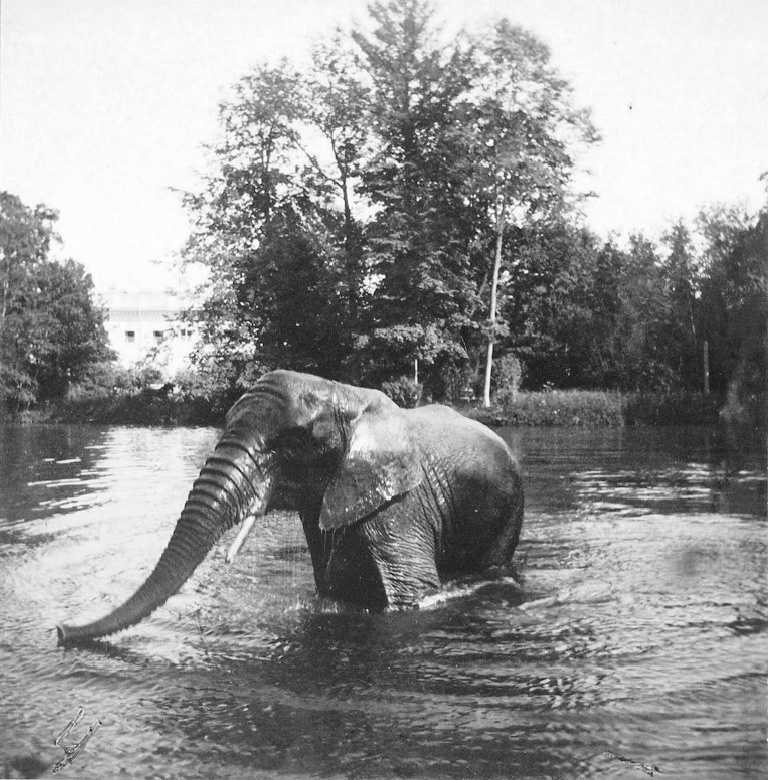
The elephant knelt down again, and the children and adults would climb into the side chairs of the saddle and take for a ride around the coutryard. After riding the elephant, the passengers got out, and others sat in their place. As a reward, the elephant received sweet buns, which he loved very much. When the animal went for a swim in the pond, an entire procession of guests was formed. Alexei [the Tatar] seated on the animal’s neck, led the procession of children and adults, who followed behind to the “Elephant Pond”

The care and maintenance of keeping such an exotic pet did not come cheap: 18 thousand rubles from the treasury were allocated each year. The elephant was fed mostly hay, supplemented with tortillas fried in butter, sugar cubes, apples and other treats.
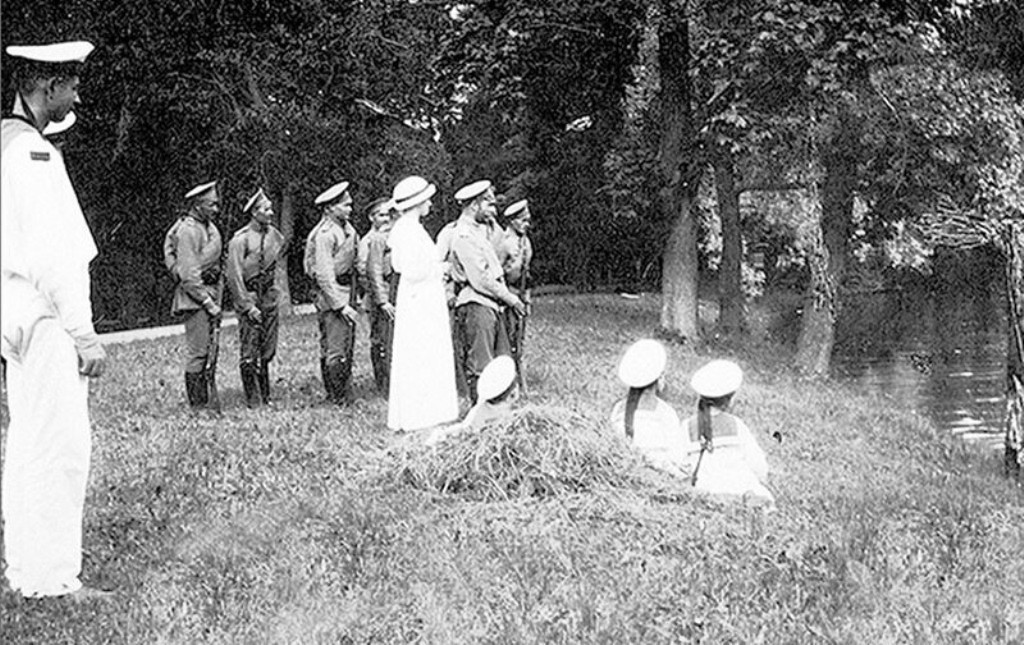
PHOTO: the elephant never failed to charm the Tsar, his children and other visitors, as it swam and splashed about in the pond in the Alexander Park.

The fate of the Tsar’s elephant and the elephant pavilion

Following the 1917 Revolution, Nicholas II was forced to abdicate, whereupon he and his family were forced to live under house arrest in the Alexander Palace. So what happened to the elephant?

There is a widespread myth that during the revolution, that the elephant was shot by sailors. Allegedly, the revolutionaries perceived the elephant as a symbol of autocracy and the luxurious life led by the imperial family.
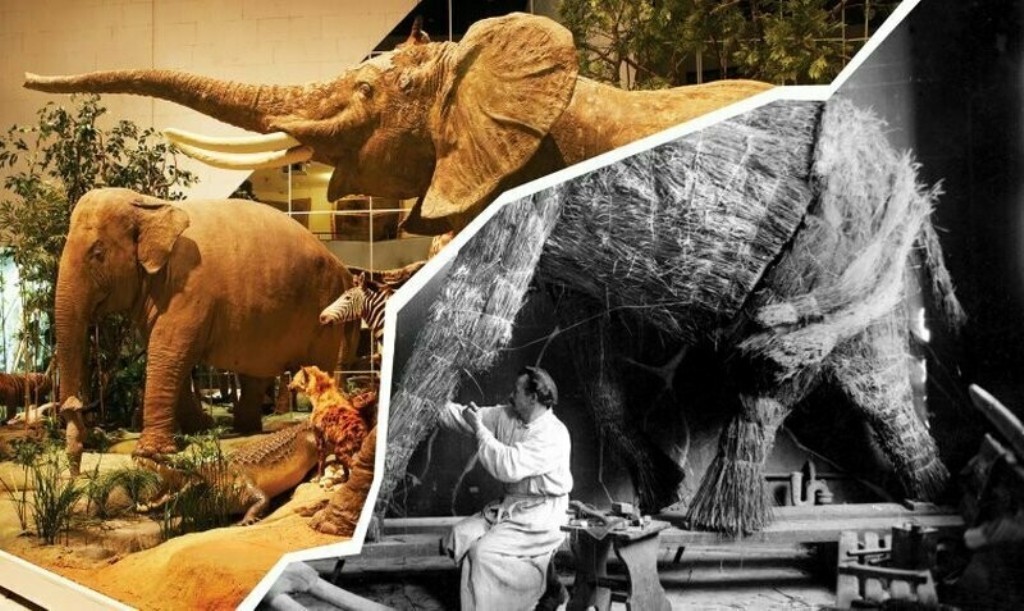
PHOTO: Nicholas II’s African elephant has been preserved to this day, in the Darwin Museum in Moscow

But in reality, they tried to transport the elephant to Moscow, where it would be placed in the city’s zoological gardens. Alas, the animal did not survive the long journey, got sick and died in 1917. However, the elephant was still taken to Moscow, where it was sent to a taxidermist, and into a museum exhibit. It took about ten years: the best taxidermists of the capital worked on the body. So the African pet of Nicholas II can still be seen in the Darwin Museum to this day.

During the Patriotic War of 1941-1944, the Elephant Pavilion in the Alexander Park was severely damaged during the Nazi occupation of Tsarskoye Selo. The only thing which was preserved were the chimneys – everything else was destroyed. There are no plans to reconstruct the Elephant Pavilion at the present time.

© Paul Gilbert. 14 November 2023

***

Paul Gilbert’s Romanov Bookshop on AMAZON

I have published nearly 50 titles to date through AMAZON – featuring one of the largest selections of books on Nicholas II, the Romanov dynasty and the history of Imperial Russia.

Please CLICK on the BANNER or LINK above to review my current selection of titles in hardcover, paperback and ebook editions. Listings provide a full description for each title, pricing and a Look inside feature.
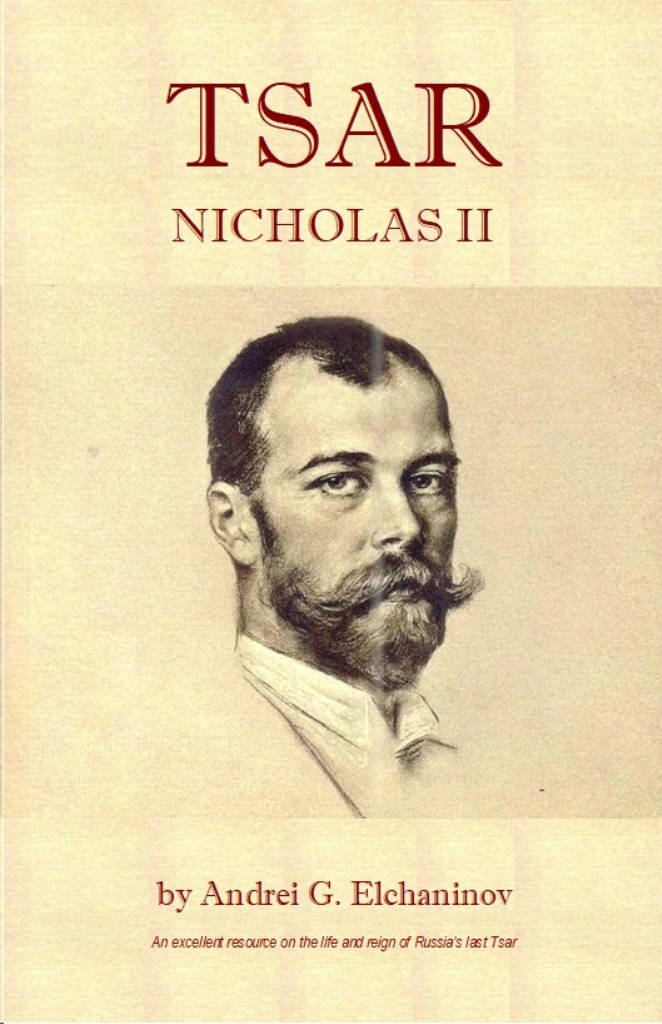
NEW BOOK – Tsar Nicholas II by Alexei G. Elchaninov

*You can order this title from most AMAZON outlets, including
the United States, United Kingdom, Canada, Australia,
France, Germany, Spain, Italy, Netherlands, Poland, Sweden and Japan
*Note: prices are quoted in local currencies

CLICK HERE TO ORDER THE PAPERBACK EDITION @ $14.99 USD

English. 5-1/2″ x 8-1/2″ format. 194 pages with 25 photos

This authorized account of Emperor Nicholas II by Major-General Andrei Georgievich Elchaninov (1868-1918), is an unprecedented biography of a living tsar. It was originally published in 1913, to coincide with the 300th anniversary of the Romanov dynasty. The author served as a professor of military art in the General Staff Academy in St. Petersburg, he later served in the suite of Tsar Nicholas II.

Nicholas II reviewed and corrected the proofs himself in January 1913. He made changes to the text, and requested the removal of sentences describing the Tsesarevich Alexei’s illness.

Elchaninov gathered considerable material for the twelve chapters about Nicholas II’s personal life based on observations and impressions. The first chapters describe Russia’s last Tsar as a caring, devoted and loving husband and father. The remaining chapters focus on his relationship with his government, the church, the army, the Russian people, and the policies which he pursued during the first 18 years of his reign.

Written before the First World War and the 1917 Revolution. Elchaninov writes in glowing patriotic language portraying Nicholas II as an indefatigable “Imperial worker” in the service of Russia’s best interests and the “Sovereign father” of the Russian people.

In addition to Elchaninov’s biography on the Tsar, this new edition features an expanded introduction by independent researcher Paul Gilbert, 25 black and white photographs, and three comprehensive appendices: a chronology of events during the reign of Nicholas II (1894-1917); 100 facts about Nicholas II and the many reforms he made during his reign, and a bibliography of more than 100 English language books written over the past century on Russia’s last Tsar.

This book is an excellent resource tool for any one interested in Russia’s last Tsar!

© Paul Gilbert. 13 November 2023

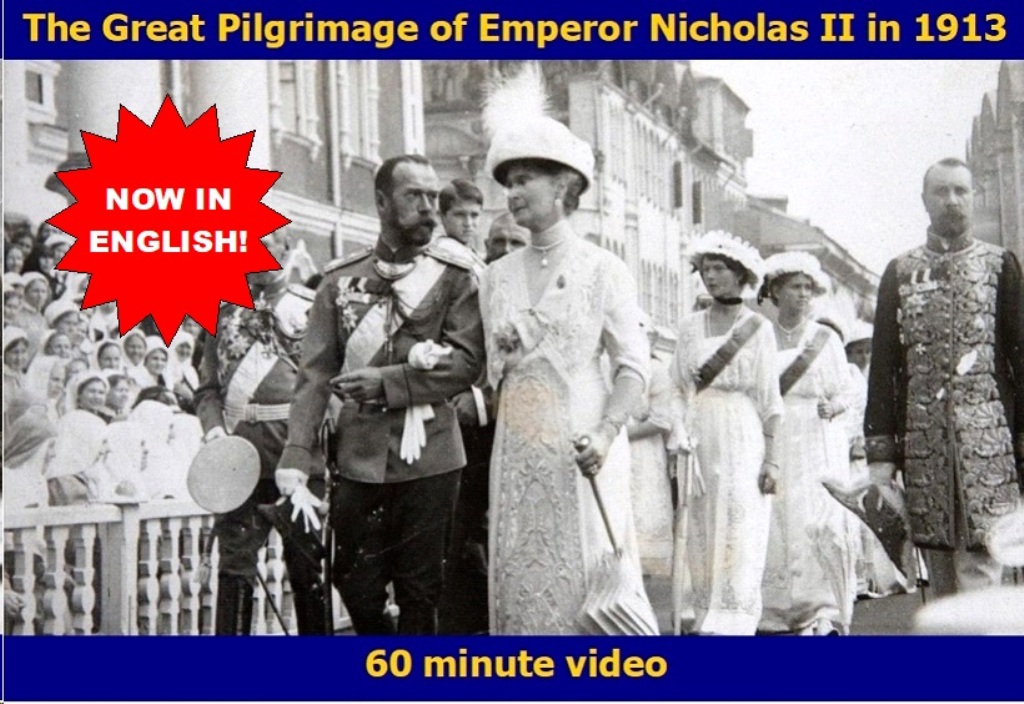
The Great Pilgrimage of Emperor Nicholas II in 1913

NOTE: this page was updated on 9th November 2023, with an ENGLISH-language version – PG

The Museum of Emperor Nicholas II in Moscow have produced a new documentary to mark the 110th anniversary of the pilgrimage ofEmperor Nicholas II to ancient Russian cities during the Romanov Tercentenary in 1913.

The Great Pilgrimage of Emperor Nicholas II” is a one-hour documentary – featuring seven vintage newsreels filmed filmed between 15th to 28th May 1913, when Nicholas II and his family visited 12 ancient Russian cities, which included Vladimir – Suzdal – Bogolyubovo – Nizhny Novgorod – Kostroma – Yaroslavl – Rostov – Petrovsk – Troitskaya Sloboda – Pereslavl-Zalessky – Sergiev Posad – Moscow. * Watch the video located at the bottom of this post. CLICK on the [cc] for ENGLISH subtitles.

The film is based on the materials of the Russian State Archive of Film and Photo Documents (RGAKFD), the Russian State Historical Archive (RGIA), the State Archive of the Russian Federation (GARF) and the Library of Congress of the United States.

During the Soviet years, a significant part of the pre-revolutionary newsreels of the Imperial Family were destroyed, leaving only small fragments of most of the films. After the fall of the Soviet Union in 1991, the Russian State Archives of Film and Photo Documents carried out painstaking work to restore many of these. This was possible that some of newsreel fragments had been stored on different reels, making it possible to restore and edit many of these historic newsreels. In total, some 300 fragments were restored to their original.

The documentary is complemented by musical accompaniment recorded in in the early 20th century, including “God, Save the Tsar!”. The music for the documentary was taken from old gramophone records and wax rollers. They include segments of marches, hymns, waltzes, operas, folk songs, balalaika, bell ringing and church chants.

If you listen closely to the audio you will hear the voice of Nicholas II at [9:35] thanking the regiment as they march past him in Nizhny Novgorod.

Many detractors of Russia’s much slandered Tsar continue to spread the myth that Nicholas II was not popular with the Russian people. This nonsense is quickly debunked by the newsreel footage which shows thousands of people flocking to get a glimpse of the Tsar in each city visited. You can see them cheering and making the sign of the cross as the Tsar passes by.

CLICK on the image above to watch this video.
Duration: 60 minutes. Language: English

***

Numerous scenes depicts the Sovereign being greeted with the traditional bread and salt, meeting local dignitaries, kissing icons, visiting churches and monasteries, reviewing his troops, and much more.

NOTE: the numbers in the brackets [ ] below, correspond to their exact location in the newsreels – PG

The church seen in the opening of the film at [0:46] is Nicholas II’s favourite church at Tsarskoye Selo: the Feodorovsky Sovereign Cathedral .

16 May: Vladimir, Suzdal and and Bogolyubovo [1:12] – in this newsreel, is a splendid view of the Imperial Train.

17 May: Nizhny Novgorod [6:34] – at [7;57] we see the Tsar and his family taking part in a religious procession – at [9:35] if you listen closely to the audio you will hear the voice of Nicholas II thanking the regiment as they march past him.

19 & 20 May: Kostroma [10:51] – in this newsreel, we see the Ipatiev Monastery – the birthplace of the Romanov Dynasty – at [12:10] the Imperial Family arrive in Kostroma on the steamship “Mezhen“, where they see the riverbank lined with people, all of whom have come to get a glimpse of their Batushka Tsar. Many can be seen bowing and making the sign of the cross, some of them even wading into the river – at [15:32] the Imperial Family take part in a religious procession at the Ipatiev Monastery – at [15:46] Emperor Nicholas II and Empress Alexandra Feodorovna descend the staircase of the Trinity Cathedral – at [17:13] the Tsar leaves the Romanov boyar palace – at [17:38] Tsesarevich Alexei is carried in the arms of the Cossack Alexei Petrovich Pilipenko (1887-1972) .

21 May: Yaroslavl [25:41] – at [26:51 the Imperial Family arrive by boat at a specially made pier and pavilion at Yaroslavl.

22 May. Rostov [32:01] – at [35:22] once again, we see Alexei being carried in the arms of the Cossack Alexei Petrovich Pilipenko. He helps the Tsesareich into the awaiting carriage, and you can clearly see that he has trouble walking, and instead hops on one leg to seat himself – the Tsar sits next to him.

23 & 24 May. Petrovsk – Pereslavl-Zalessky – Troitskaya Sloboda – Sergiev Posad [38:33] – at [42:28] Empress Alexandra Feodorovna, Emperor Nicholas II, Tsesarevich Alexei, and one of his sisters get into a waiting carriage at the Trinity Lavra of St. Sergius – the spiritual center of the Russian Orthodox Church – in Sergiev Posad – at [42:57] the other three grand duchesses are joined by their aunt Grand Duchess Elizabeth Feodorovna in the second carriage.

24 to 27 May. Moscow [43:12] – at [43:46] Nicholas II enters Moscow on horseback through the Triumphal Arch – the same gate he entered the city for his coronation in 1896 – at [45:01] “God, Save the Tsar!” is performed – at [47:48] the Tsar and his family stop to pray at the Iverskaya Chapel at the Resurrection Gate, which leads into Red Square. Again, we see Alexei being carried in the arms of the Cossack Alexei Petrovich Pilipenko – at [48:27] Emperor Nicholas II crosses Red Square on horseback – he is greeted by thousands of Muscovites – at [49:26] the Tsar walks past St. Basil’s Cathedral, and enters the Kremlin on foot – at [50:09] is the famous procession seen in many English-language documentaries, of the Imperial Family, their relatives and entourage walking towards the Assumption Cathedral, where Nicholas II was crowned in 1896 – at 51:28] the Imperial procession walks past the Chudov Monastery – at [53:01] the Imperial Family visit the Chambers of the Romanov Boyars – at [55:05] the Imperial Family arrive at the Novospassky Monastery, taking part in a religious procession at [56:25] – Grand Duchess Elizabeth Feodorovna and Grand Duke Kirill Vladimirovich can be seen at [56:45].

© Paul Gilbert. 26 October 2023

Second Nicholas II museum opens in Moscow

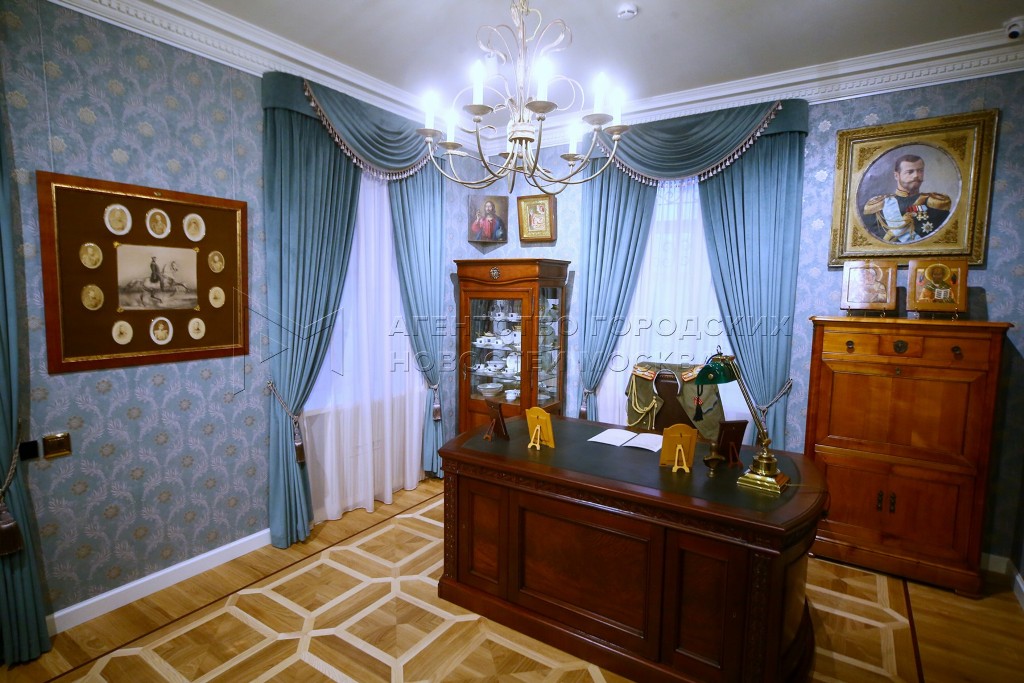
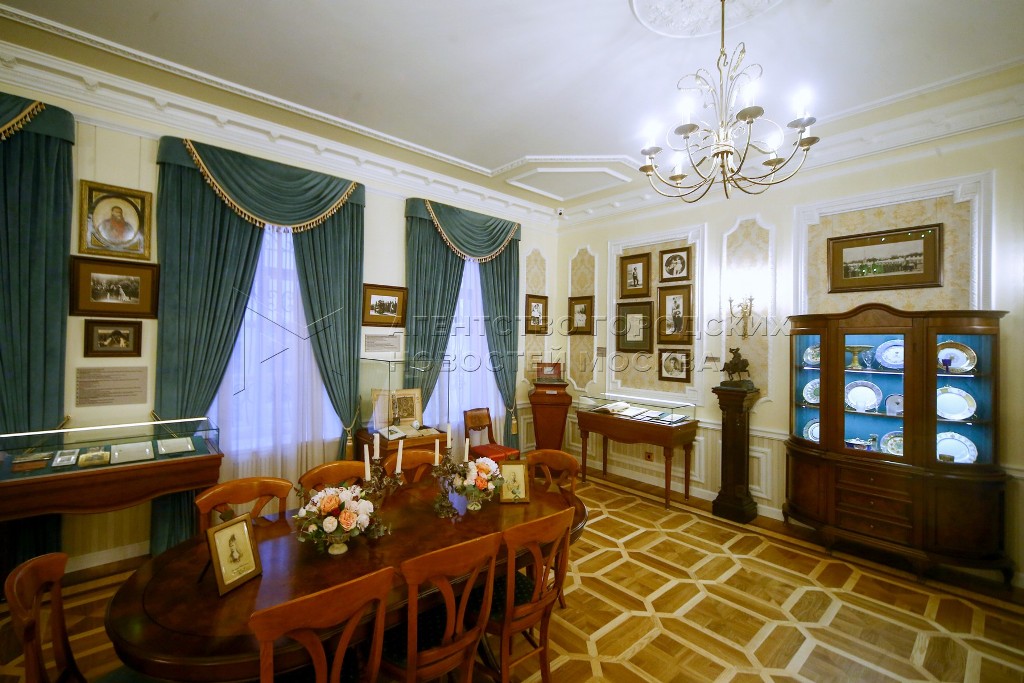
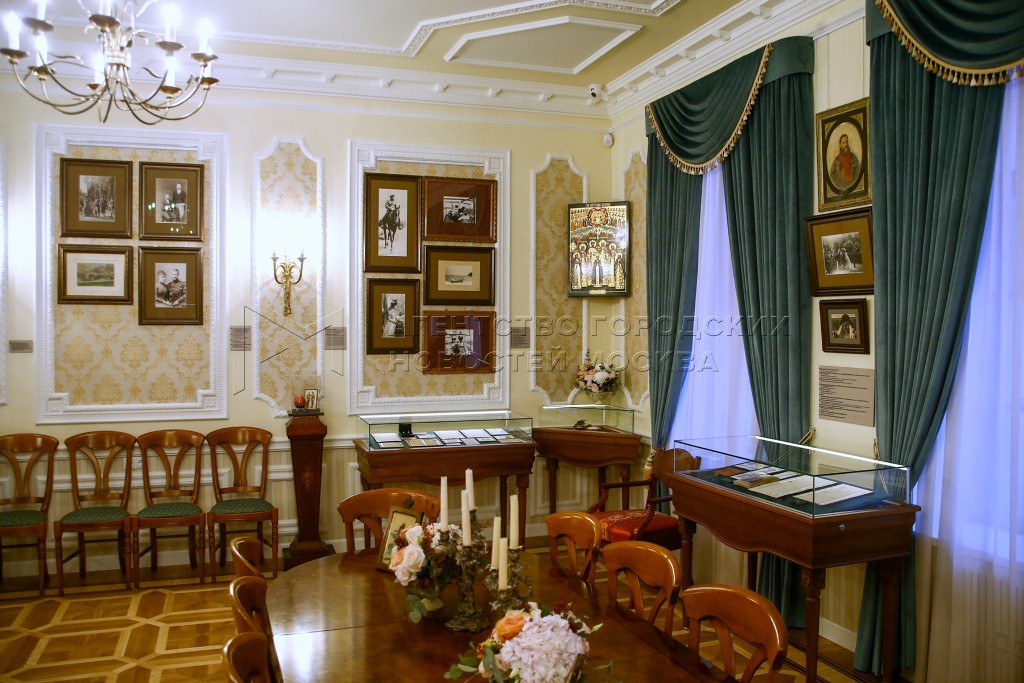
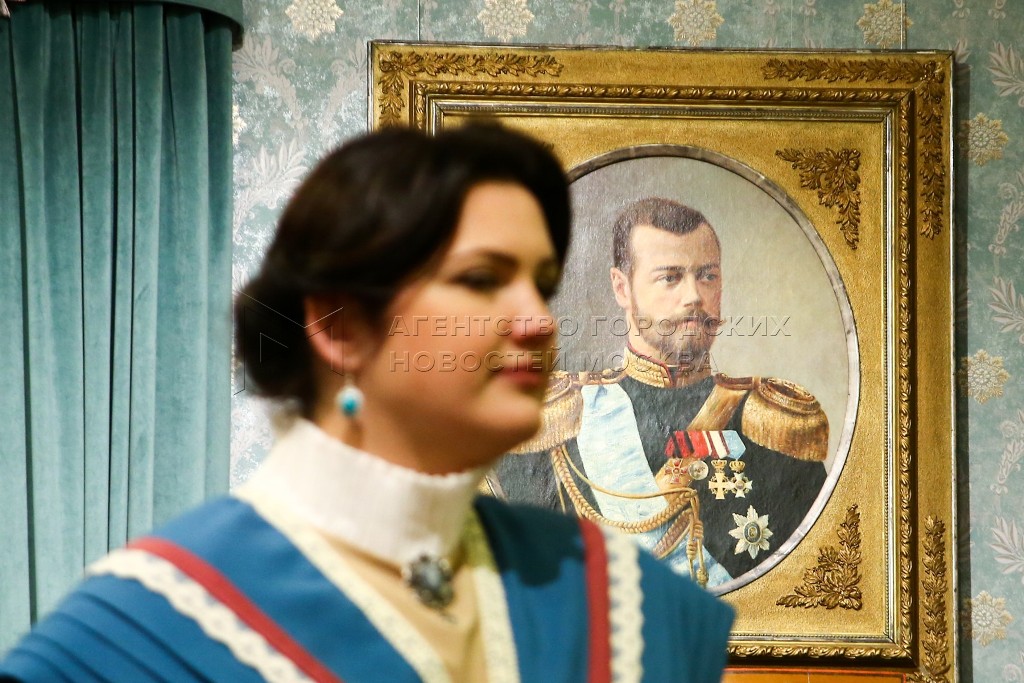
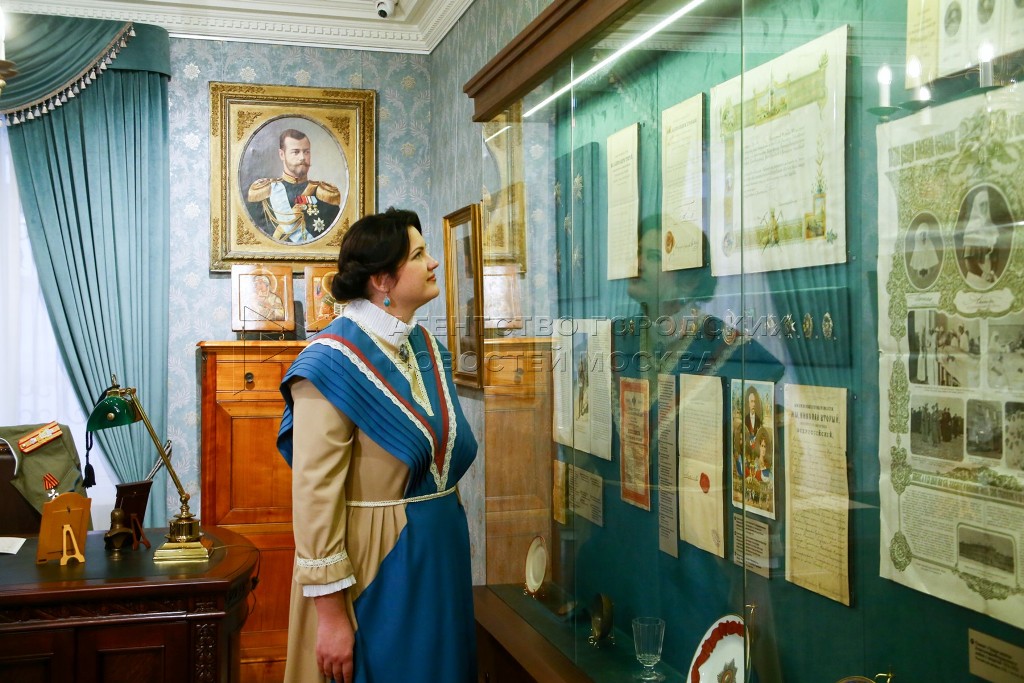
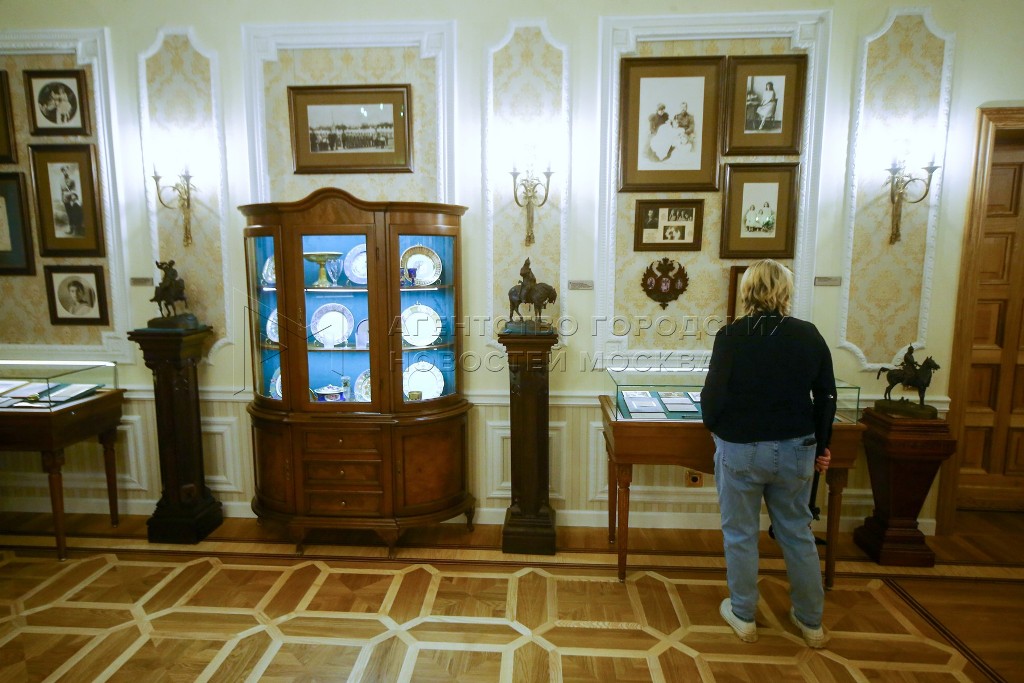
PHOTO: interior view of the new Museum in Memory of Emperor Nicholas II and His Family, situated in the Belaya Dacha in Moscow.

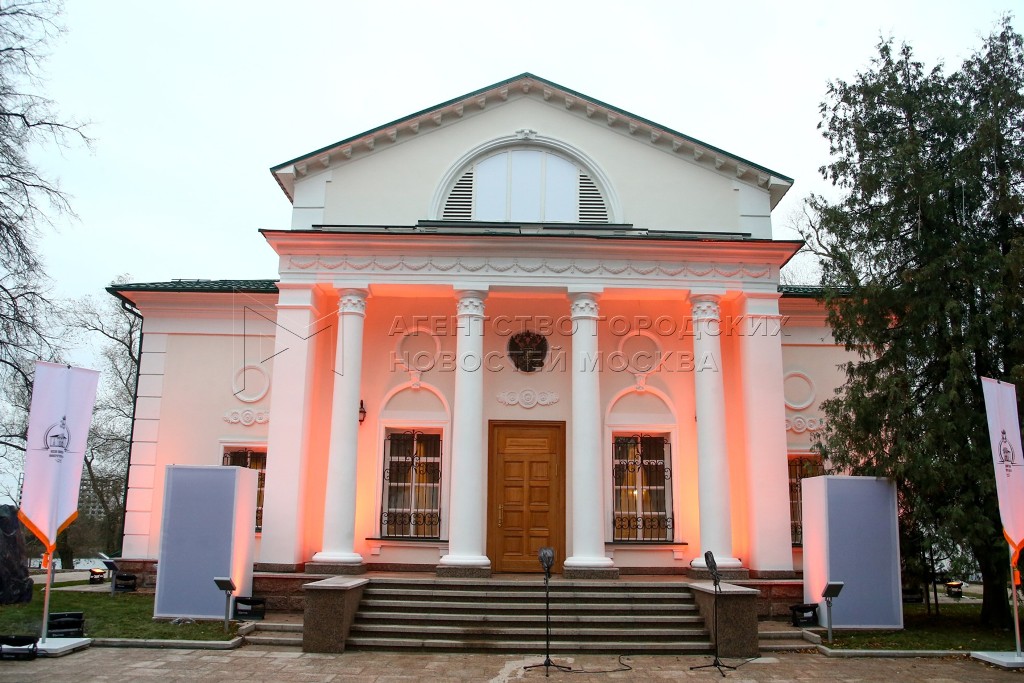
On 5th November 2023, the Museum in Memory of Emperor Nicholas II and His Family opened at the newly restored Belaya Dacha estate in the city of Kotelniki of the Moscow district. It is the second dedicated to Emperor Nicholas II to be opened in Moscow – the first being the Museum of Emperor Nicholas II.

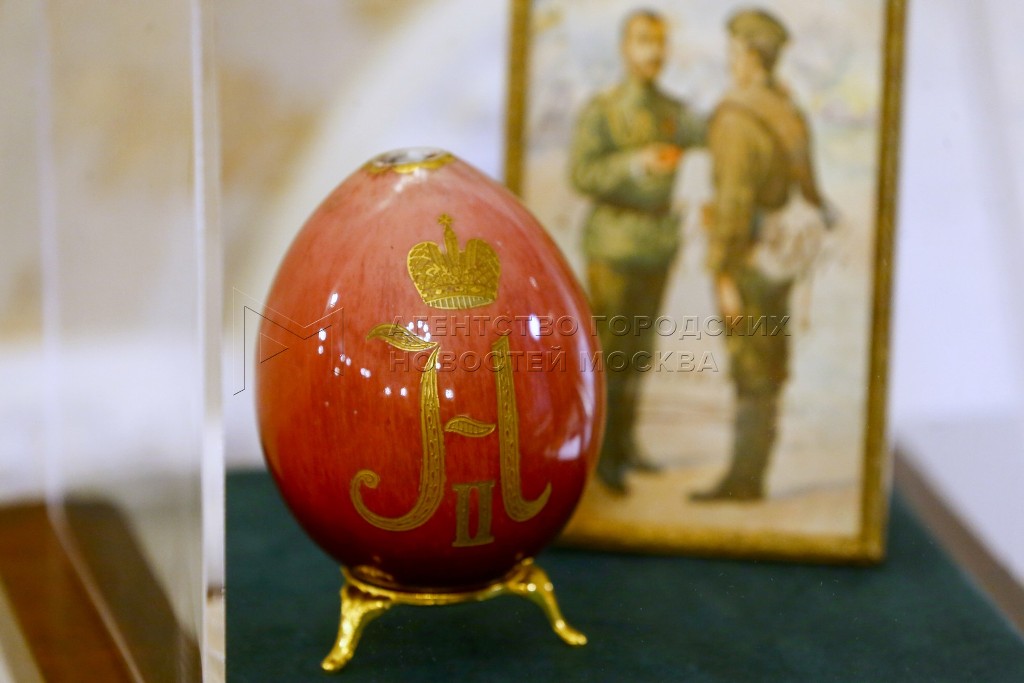
The permanent exhibition, which is located on the first floor of the museum, feature about 300 unique exhibits, including many personal items belongings to the Imperial Family. Among them is a piano belonging to Nicholas II’s mother Dowager Empress Maria Feodorovna. Also on display, are the letters of Tsesarevich and Grand Duke Nicholas Alexandrovich [the future Emperor Nicholas II] to Alexandra Feodorovna, written between 1890-91, during a trip to Japan, where an attempt was made on his life.

In addition, a letter from Empress Maria Feodorovna to Emperor Wilhelm II, received by him two days before Germany declared war on Russia, vintage photographs of the last Tsar and his family and other unique exhibits are also displayed.

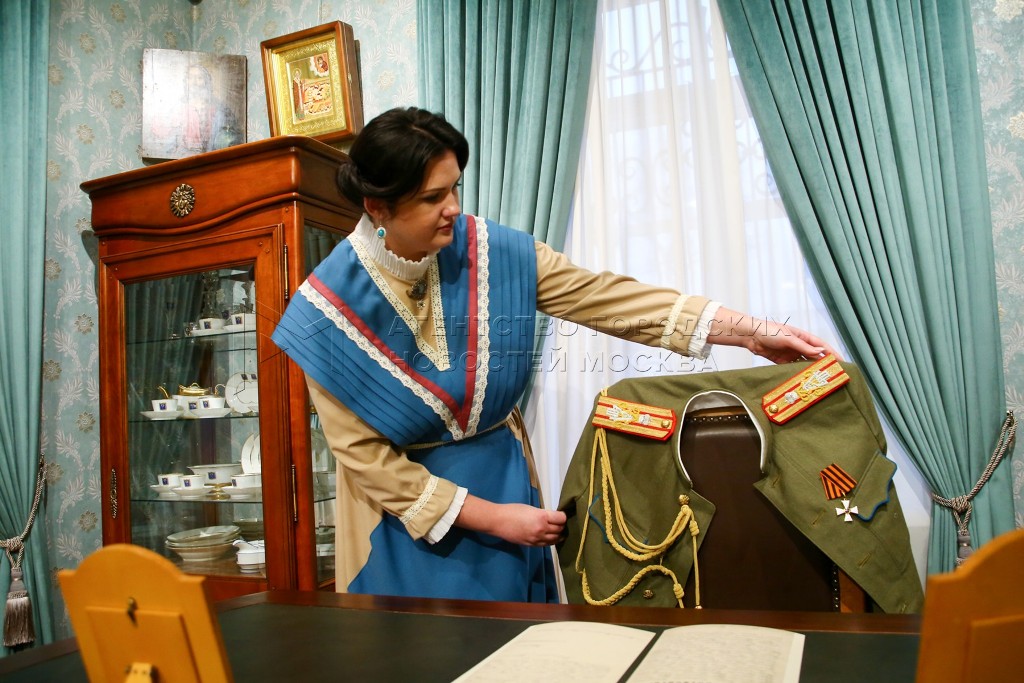
Draped over a chair in the recreated study of the Tsar, is an exact copy of a uniform of Nicholas II. It looks very simple, as it reflects how the Emperor dressed when he went out to greet his soldiers, thus demonstrating respect for his army.

“Exhibits for the museum have been collected over the last three years, from private collections and auctionsall over the world,” said Lyudmila Grosarchuk, curator of the museum.

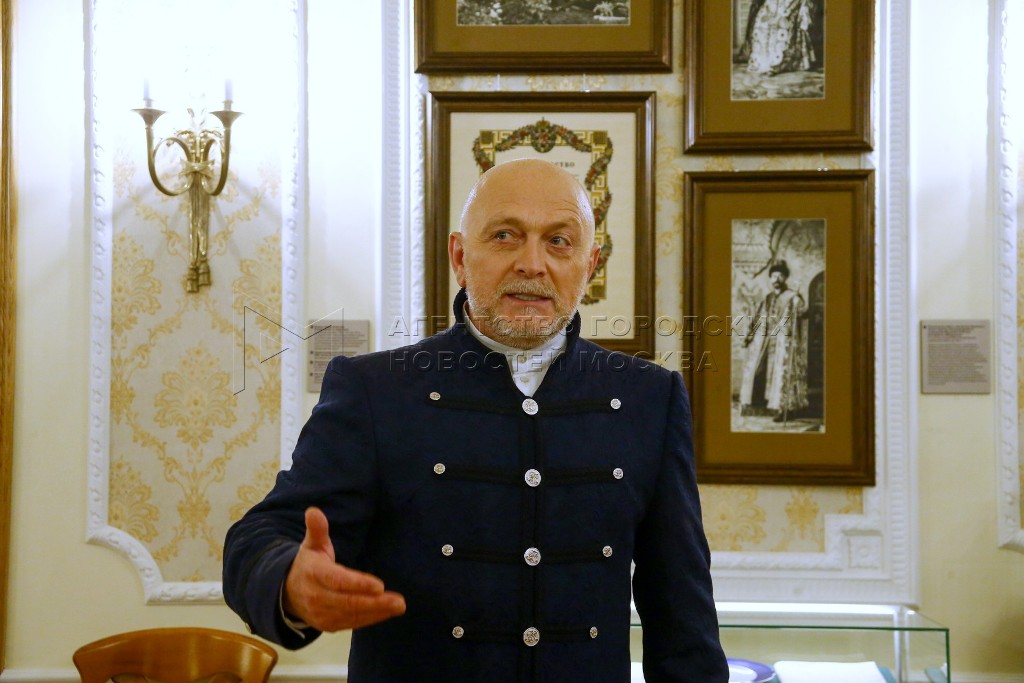
“We are bringing back to our country, to our home, what was scattered so carelessly following the 1917 Revolution,” added Viktor Semyonov, Chairman of the Museum Supervisory Board.

At the opening of the museum, the first visitors were given a tour of the exhibition and the and museum. A performances by the State “Berezka” Dance Ensemble, Russian opera star Hibla Gerzmava, and People’s Artist of Russia Sergey Migitsko.

As a symbol of the unity of Russian museums, an oak from Tsarskoye Selo was planted on the grounds of estate.

***

PHOTO: the Belaya Dacha estate mansion (above), now home of the private museum of the family of the last Russian Emperor Nicholas II in Moscow. Viktor Semenov (below), Chairman of the Board of Trustees of the The Museum in Memory of Emperor Nicholas II and His Family.

© Paul Gilbert. 6 November 2023

The Rehabilitation of Emperor Nicholas II

On 1st October 2008, the Presidium of the Supreme Court of the Russian Federation granted the judicial rehabilitation of Emperor Nicholas II and his family. Ninety years after a Bolshevik execution squad gunned down the last Tsar and his family, the country’s supreme court declared the Imperial family as “victims of political repression.” The regicide was condemned, and that the false accusations against the Tsar, that he was an enemy of the people…were at long last proven to be false.

By finding the Tsar a victim of political terror, the court has completed the remarkable transformation of the discredited man who died with his family in the cellar of the Ipatiev House in the early hours of 17th July, 1918 on the orders of the Ural Soviet.

Throughout the years of the Soviet Union, government propaganda vilified the last Tsar, giving him the derogatory nickname “Bloody Nicholas” and accusing him and his family of a litany of crimes.

It is important to note, that the Supreme Court’s decision overturned a ruling by the same court in November 2007 that the killings did not qualify as political repression, but premeditated murder. The Prosecutor General’s Office of the Russian Federation, stated in court that “the requirements for rehabilitation do not comply with the provisions of the law due to the fact that these persons were not arrested for political reasons, and no court decision on execution was made.”

Four weeks later, on 30th October 2008, it was reported that the Prosecutor General’s Office of the Russian Federation ruled to rehabilitate 52 people from the entourage of Emperor Nicholas II and his family.

Some readers will argue that the Court’s judicial rehabilitation was unnecessary because the Tsar had not committed any crime, which of course is true! For the sake of historical justice, however, it was the responsibility of a post-Soviet Court to overturn the Bolshevik’s decision to condemn and justify the murder of Russia’s last Tsar. In addition, his rehabilitation defeats the myths and lies of both the Bolshevik and Soviet regimes.

Up until the Supreme Court’s ruling, Nicholas II remained falsely accused of crimes in which he did not commit. According to the existing code of laws, the Russian Federation is the lawful successor of Soviet Russia and of the Union of Soviet Socialist Republics [USSR]. From the purely juridical stand­point, all the criminal charges, incriminations and verdicts of repression pronounced since 7th November 1917 continue to carry legal authority until the government officially rehabilitates the victims. A paradoxical situation thus occurred, where the head of the Russian government has offered up repentance for the bloody violence carried out by representatives of the government on members of the Imperial House and their servants, relatives and friends; where the immediate members of the family of Emperor Nicholas II along with Grand-Duchess Elizabeth Feodorovna have been recognized as saints by the Russian Orthodox Church; yet where, from the judicial point of view, they can legally be considered “criminals,” since they were executed as “enemies” of the government.

Russia’s Supreme Court ruled that Nicholas II, was unlawfully killed by Bolshevik authorities. The ruling negates the Bolshevik claims used to instigate the 1917 revolution, and the murder of the Tsar and his family the following year. His rehabilitation reinstates the good name of Nicholas Alexandrovich Romanov, and to legally declare that he was innocent and had suffered unjustly.

Georgy Ryabykh, a spokesman for the Russian Orthodox Church said the “decision can only be welcomed. It strengthens the rule of law, restores historical continuity and 1,000 years of state tradition”.

Ivan Artsishevsky (1950-2021), Director of the Romanov Family Association also praised the ruling: “the fact that the Russian state took responsibility for that murder is a step towards repentance … and the rehabilitation of all innocent (Bolshevik) victims.”

It should come as no surprise that the rehabilitation was denounced by the Communists, who said it was “cynical” and would “sooner or later be corrected.” In response, Russian lawyer German Lukyanov (1961-2022) noted that the ruling was “a final decision that cannot be challenged.” 

“Rehabilitation is necessary for the modern state, so that the image of Russia throughout the world is associated not with basements covered in blood, but with the image of a civilized state that has renounced the Soviet past and condemned it,” he added.

© Paul Gilbert. 1 October 2023

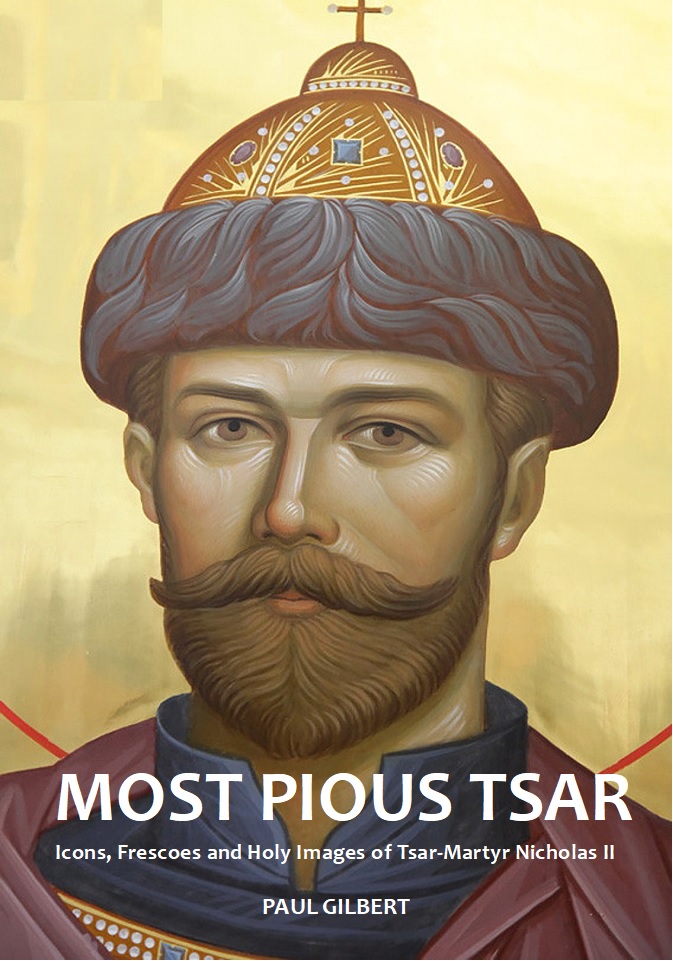
NEW BOOK: Most Pious Tsar

*You can order this title from most AMAZON outlets, including
the United States, United Kingdom, Canada, Australia,
France, Germany, Spain, Italy, Netherlands, Poland, Sweden and Japan
*Note: prices are quoted in local currencies

CLICK HERE TO ORDER THE HARD COVER @ $50.00 USD

CLICK HERE TO ORDER THE PAPERBACK EDITION @ $40.00 USD

English. Large 7″ x 10″ format. 162 pages with 132 photos in FULL COLOUR

In 1938, Russia’s last tsar Nicholas II was canonized by the Serbian Orthodox Church. On 1st November 1981, he was canonized as a new martyr by the Russian Orthodox Church Outside Russia (ROCOR). On 20th August 2000, after 8 years of study, he was canonized as a passion bearer by the Moscow Patriarchate, although the people had already been venerating him as a saint for a long time, and this canonization was simply a confirmation of a fact that already existed by itself.

Since these historic dates, icons of Russia’s last Tsar have been installed in Orthodox churches across Russia and around the world. In addition home icons have been mass produced and sold for veneration by Orthodox Christians. This book features more than 130 of these icons in full colour.

Inside, are a series of articles, plus an introduction, in which the author explains iconography, Nicholas II as a martyr or passion bearer, the veneration of icons, intercession, miracles, non-canonical icons, frescoes, and more.

This book also includes a Prayer and Akathist to the Holy Martyred Tsar.

This book will not only appeal to Orthodox and non-Orthodox persons, but for any one who shares an interest in icons and iconography, as well as adherants to the Holy Royal Martyr Nicholas II.

© Paul Gilbert. 8 September 2023

Nicholas II assumes command of the Russian Imperial Army, 1915

On this day – 5th September (O.S. 23rd August) 1915 – Emperor Nicholas II assumed the position as Commander-in-Chief of the Russian Imperial Armed Forces.

After the great retreat of the Russian army in the summer of 1915, the Tsar removed his cousin Grand Duke Nicholas “Nikolasha” Nikolaevich (1856-1929) of the position on 21st August 1915.

In the order, the Tsar wrote with his own hand: “With firm faith in God’s mercy and with unshakable confidence in the final victory, we will fulfill our sacred duty of defending the Motherland to the end and will not disgrace the Russian land. Nicholas”.

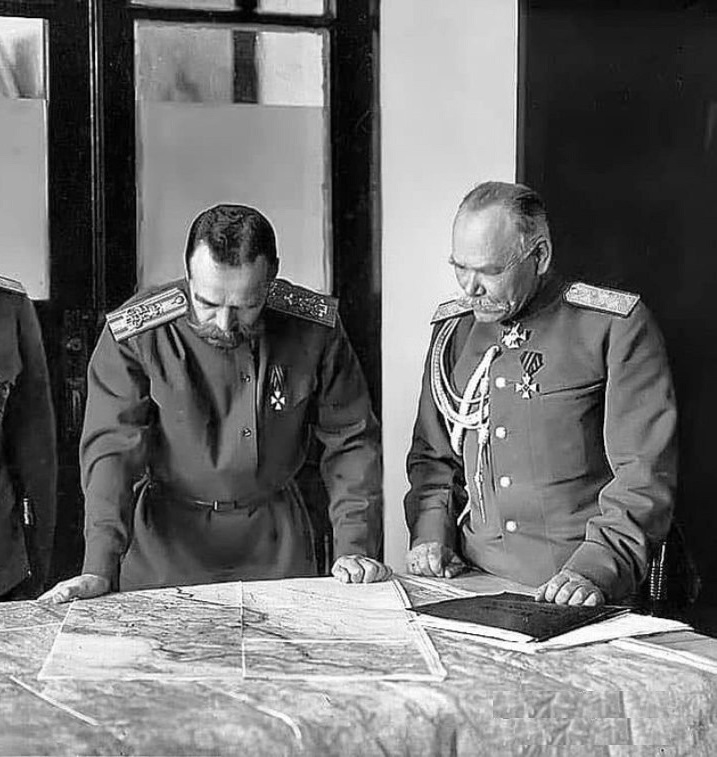
Some historians have wrongly suggested that Nicholas II’s decision was disastrous, citing that the move was largely symbolic. It was at this stage of his reign that the Tsar’s patriotism reached its zenith. He travelled up and down the Eastern Front on the Imperial Train, in his motorcars and even on horseback to show himself to his troops, boasting morale, reviewing troops, inspecting field hospitals and preside over meetings with his chief-of-staff General Mikhail Vasilyevich Alekseyev (1857-1918).

PHOTO: Nicholas II with his chief-of-staff General Mikhail Vasilyevich Alekseyev

When Nicholas II assumed command of the Russian armed forces, he appointed Alekseyev as Chief of Staff of the General Headquarters and placed in charge of all military operations. He served in this capacity from August 1915 to March 1917.

According to Russian historian George Mikhailovich Katkov (1903-1985): “Alexeev was a modest and reserved man, an educated general, to whom the Tsar treated extremely attentively . . . . Every morning the Tsar and Alexeev discussed the affairs of the front for several hours. They apparently understood each other well, and there is no indication that the Emperor tried to impose any strategic or tactical ideas on his Chief of Staff. In fact, Alexeev was the commander-in-chief, and each of his undertakings was supported by the Sovereign.”

History has now proved that Russia made great gains under Nicholas II’s command. For instance, shortly after he assumed command of the armed forces, the Russian Imperial Army carried out at least 15 major victorious operations, not counting the Brusilov Breakthrough. Russia’s military historians now believe that had the revolution not interfered, Russia was bound to have won the war.

On 1st September (O.S. 19th August) 1916, he wrote the following in a letter to Empress Alexandra Feodorovna:

“Thank God, the news is good – on the first day of our offensive we captured 300 officers and more than 15,000 Austrian and German soldiers…”

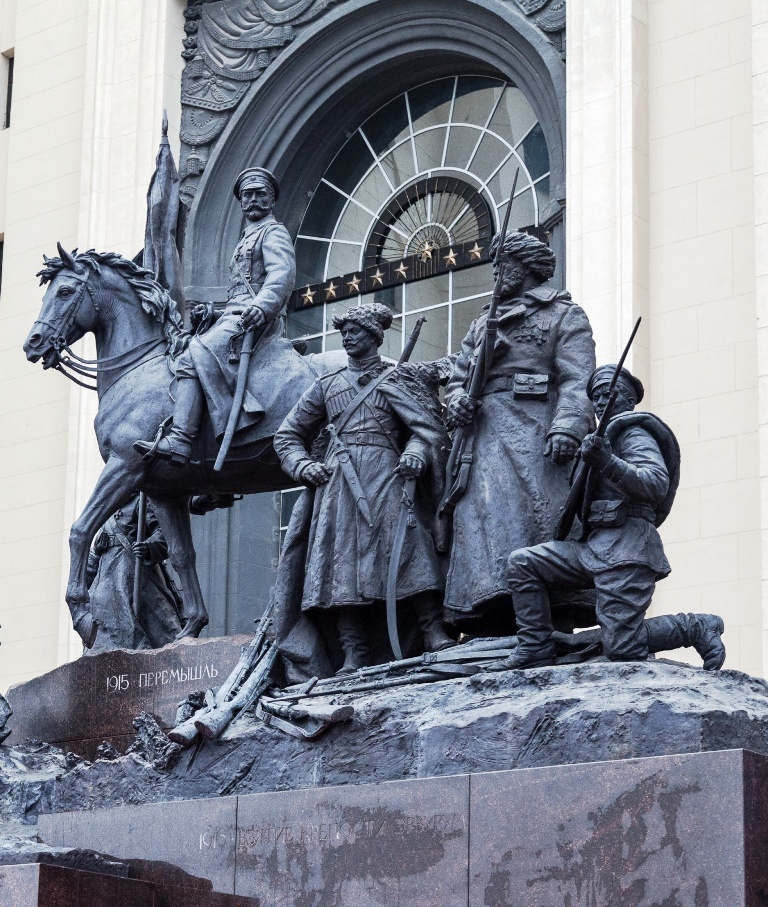
On 16th December 2013, Russia’s Defense Minister Sergei Shoigu opened a sculptural composition dedicated to the heroes of World Wars I and II on the grounds of the National Defense Control Center (NDCC) building – situated on Frunze Embankment in Moscow. The WWI monument (above) features Nicholas II on horseback, recognizing and honouring his efforts during the Great War.

FURTHER READING:

“They did not betray their oath” – the fate of the generals who remained loyal to Nicholas II + PHOTOS

© Paul Gilbert. 5 September 2023

Cathedral in memory of Nicholas II under construction in Murmansk

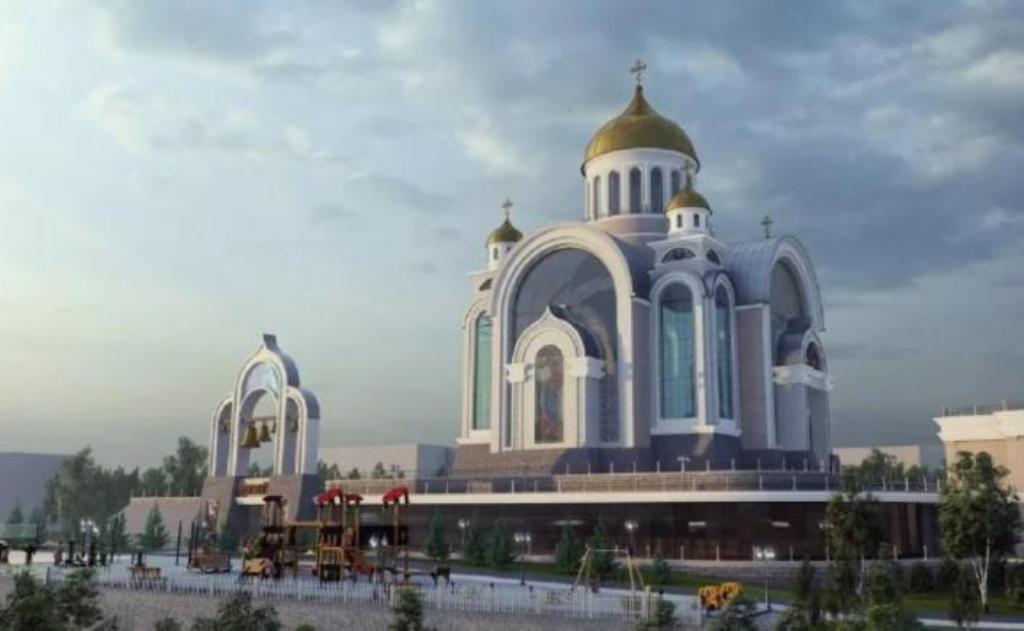
PHOTO: artist concept of the cathedral named in honour of Nicholas II in Murmansk

Construction has begun on a new cathedral named in honour of the Holy Royal Martyr Nicholas II in Murmansk, Russia’s first ice free port founded in 1916 by Nicholas II and named Romanov-on-Murman.

“With the blessing of His Holiness Patriarch Kirill of Moscow and All Russia, the new Russian Orthodox temple will bear the name of the Holy Transfiguration of St. Nicholas Cathedral,” stated Metropolitan Mitrofan of Murmansk and Monchegorsk.

The idea to build a church in honour of the last Tsar in Murmansk is the initiative of the Murmansk diocese. The cathedral will be erected on the site of a former amusement park on the street named after Konstantin Burkov, a veteran of the Soviet-Finnish and Great Patriotic Wars, a Pomeranian sailor who made a significant contribution to the development of the Kola Arctic and was awarded the highest state award of the USSR – the Order of Lenin. In November 2022, Metropolitan Mitrofan presented the project to Patriarch Kirill. During that meeting, the head of the Russian Orthodox Church noted that the style of the temple should correspond to the traditions of the Russian North and promised to support the project.

***

In recent years, Emperor Nicholas II has been commemorated in a number of projects in Murmansk and the surrounding region:

  • In June 2019, Murmansk Airport was reamed Nicholas II-Murmansk Airport
  • In July 2019, plans were announced for a bust-monument to Nicholas II, to be installed in front of the main terminal at Nicholas II-Murmansk Airport

© Paul Gilbert. 27 August 2023

‘The Romanovs: An Imperial Family’ a film by Gleb Panfilov

“A legacy that defied Bolshevik and Soviet attempts of erasure”

***

OBITUARY: the famous Soviet and Russian film director and screenwriter Gleb Anatolyevich Panfilov (1934–2023), died on 26th August 2023, at the age of 89. Memory Eternal! Вечная Память!

***

More than a century has passed since the murder of Emperor Nicholas II and his family brought an end to the Russian monarchy and the Russian Empire. The Soviet Union is no more. But the grandeur of pre-Soviet, Tsarist Russia continues to occupy the imagination of people across the world and the last Russian Imperial family has entered the annals of cinema in many a memorable work of moving images.

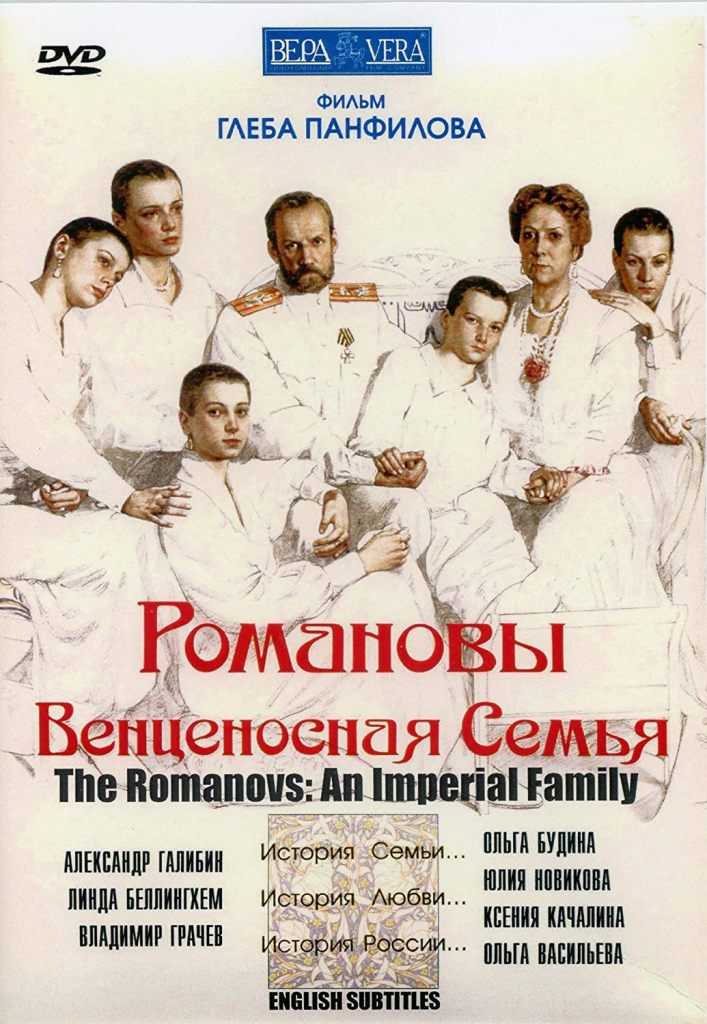
Among the cinematic works created around the Romanov family who were brutally murdered by the Ural Soviet on 17th July 1918, is the historical drama film ‘The Romanovs: An Imperial Family’. The Russian made which was released in 2000 having premiered at the 22nd Moscow Film Festival. This film is a must watch not only for ‘Romanovophiles’ but also for history buffs and movie lovers who enjoy the historical drama genre. Directed by internationally acclaimed Russian film director Gleb Anatolyevich Panfilov (1934-2023), it is a Russian language movie with Russian actor Aleksandr Galibin as Emperor Nicholas II and British actress Lynda Bellingham as Empress Alexandra Feodorovna.

The directorial craft of the movie brings to life the perceptions and perspectives of Nicholas II and his family during the last stage of their lives and shows how the imperial family perceived and responded to news of the turmoil in the country that was creating a tide of antipathy towards the monarchy. The narrative shows the humaneness of the Tsar and his family bringing to life their humanity which makes this an endearing film.

Contrary to what Soviet propaganda sought to perpetuate during the reign of communism in Russia, that the Imperial family were cold and uncaring towards the masses, Panfilov’s vision shows how the Romanovs were caring people with admirable humane qualities and talents which even their captors could not help but secretly appreciate.

The movie is quite compelling with a cast of good actors and a plot structure that drives forward the drama of events and action principally through the somewhat insular characters of the Imperial family. Galibin delivers a superb performance as His Imperial Majesty Tsar Nicholas. The character that is brought to life in Panfilov’s directorial vision is one who is much a human with his principal weakness being perhaps that he was torn between how to focus and devote himself and his efforts on being a good father while also being a good monarch and to win the love and respect of all.

The Tsar and Tsarina are shown as two loving humans who are solid in their spousal and parental love. The Imperial children are portrayed as children who feel emotions of sadness, fear, anger and love just like any other, and how they are made hapless victims of a political agenda that overawes all forms of governance and power that formed the old order of imperial Russia.

The revolution is not shown in prominence through extensive scenes of armed conflicts but as more a series of events brought to the knowledge of the Tsar and his family at various stages from February 1917 to the fated day of their massacre in Ekaterinburg on 17th July 1918. Their grasp of matters that near their unseen doom, as a gradual and coldly unnerving series of changes in their household brings to life the ‘psychological environment’ the Imperial family inhabited in their last days. The Tsar and his family are meant to endure suffering that is much more psychological than physical and thus the slow torment and torture of the Romanovs at the hands of the communist red army captors are brought to life.

The Ipatiev House, In what is called the ‘House of Special Purpose’ by the Bolsheviks, a residence located in Ekaterinburg in Western Siberia, the Imperial family is kept under guard, after the Tsar’s abdication and monarchical rule ends and the family finds themselves being political prisoners. However, the ‘House of Special Purpose’ becomes the slaughter house where the massacre of the imperial family and their remaining staff takes place past midnight on 17th July 1918. The murder carried out by the Bolsheviks brings the narrative of the Romanovs to an end. The scene which follows as the end of the film is documentary footage of the scene of canonization of the Romanov family in Russiain 2000.

The final scene is a strong message that one sees at the end of the film when reading it in context of post-Soviet Russia. The statues of Lenin who founded the Union of Soviet Socialist Republics (USSR) have been brought down with the end of the Soviet Union and his legacy now enjoys no glory among Russians. The Romanovs, however, have once again been reborn in their nation’s collective heart and soul, to remain adored in the Russian people’s memory.

The Romanovs: An Imperial Family’ is presented in this post in 13 x 10 minute videos, with ENGLISH subtitles.

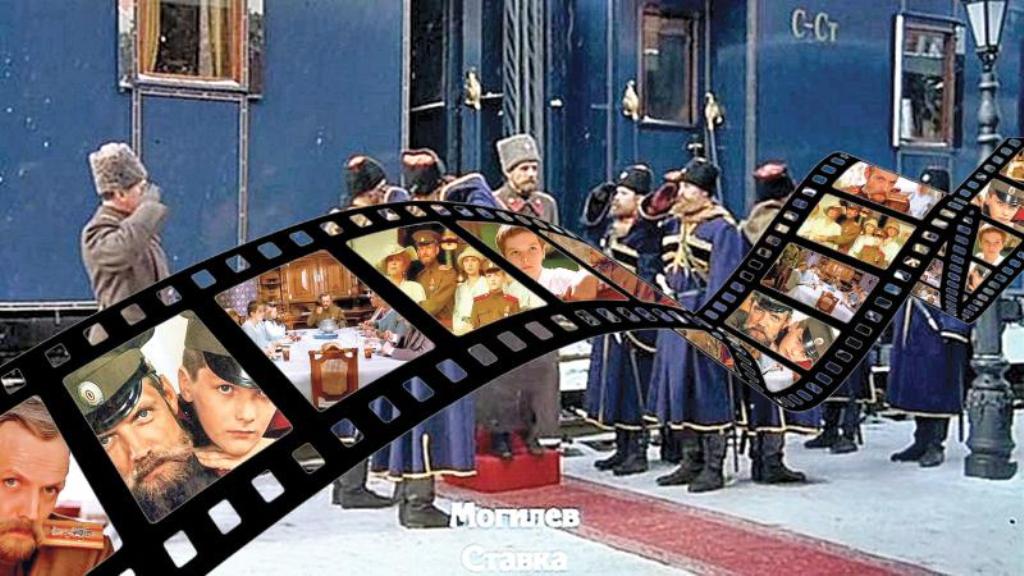
This film presents the most historically accurate version of events available to an English audience to date. Unlike Massie’s ‘Nicholas and Alexandra’ (1971), Panfilov filmed entirely in Russia, with many scenes filmed inside the Alexander Palace at Tsarskoye Selo. Furniture was specially created for this film, which can be seen on display in the palace to this day. The recreation of the private apartments of the Imperial family in the Alexander Palace and the Tsar’s Imperial Train are truly remarkable.Overall, the film is visually stunning!

I invite you to make yourself a cup of tea or pour a glass of your favourite wine, sit back, relax and enjoy ‘The Romanovs: An Imperial Family’ – PG

© Dilshan Boange / Paul Gilbert. 20 September 2020

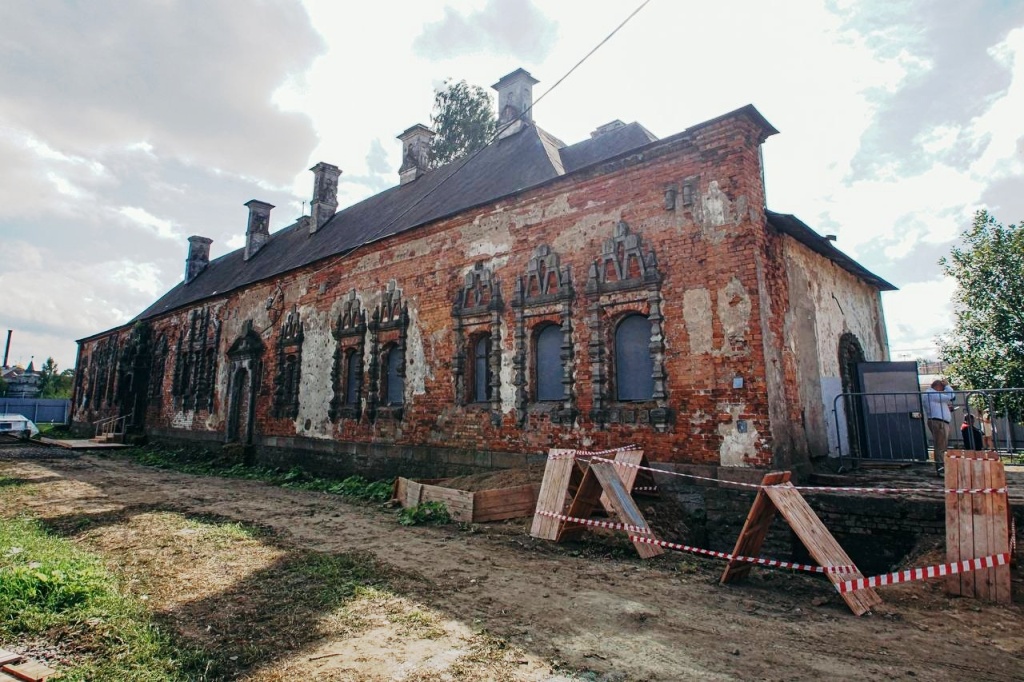
Imperial Railway Pavilion in Tsarskoye Selo is being restored

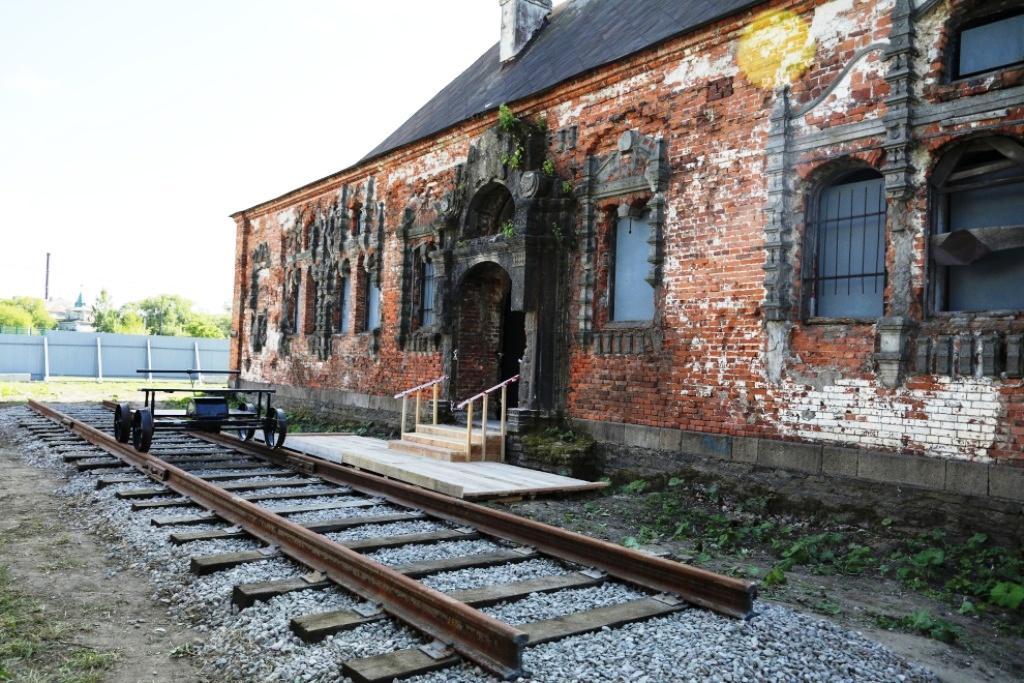
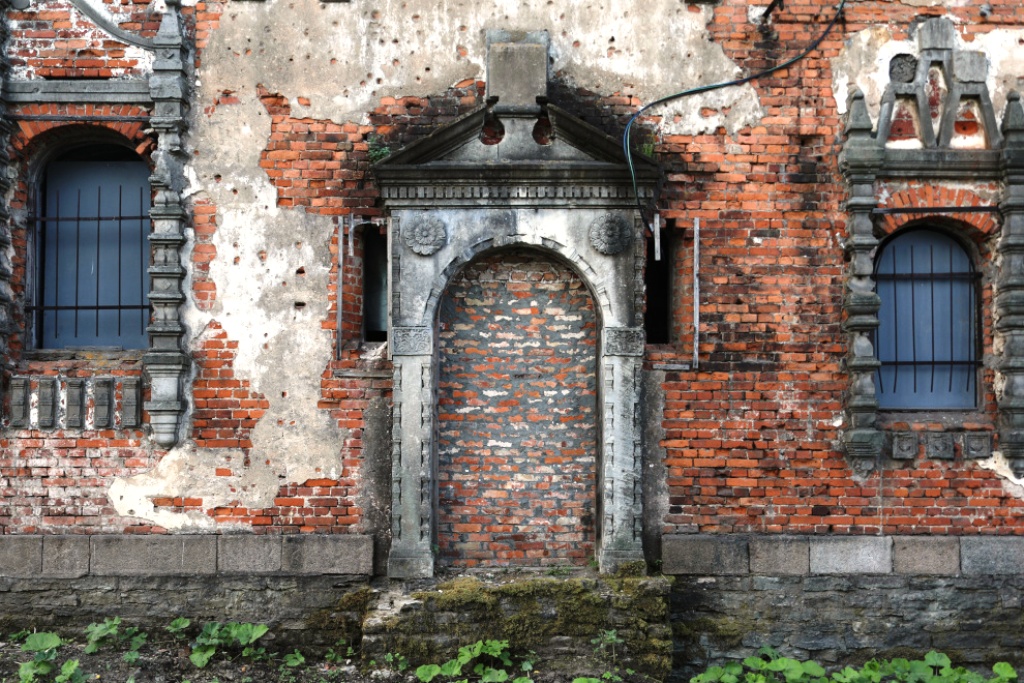
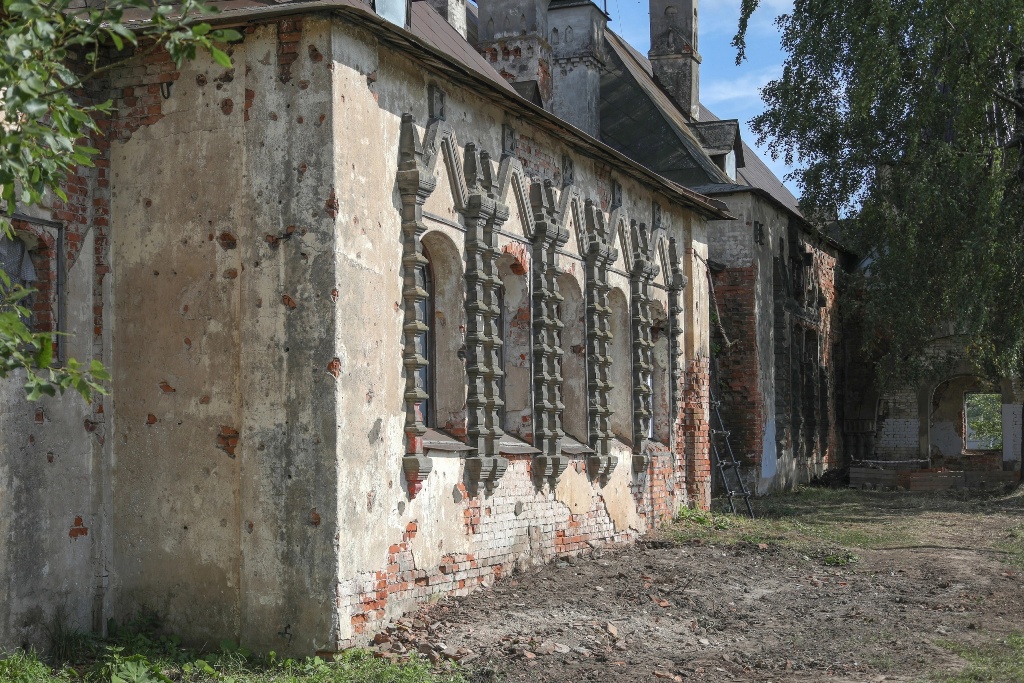
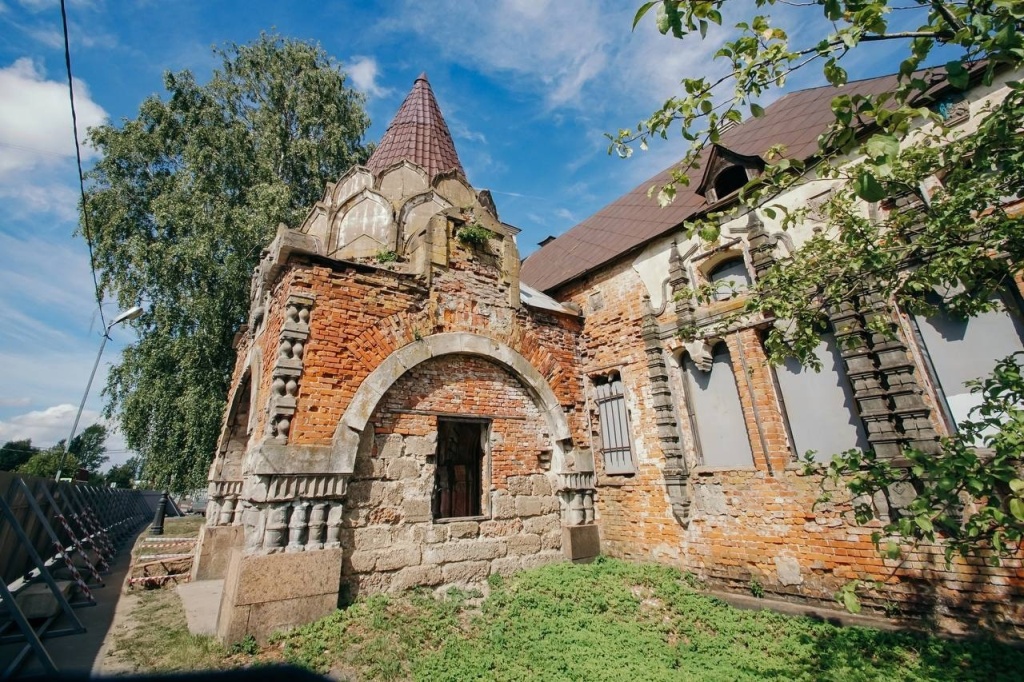
It’s official! After decades of delays and lack of funding, restoration of the Imperial Railway Pavilion to its original historic look in Pushkin (Tsarskoye Selo) is now underway. Having survived the revolution, war, vandalism and the elements, it is nothing short of a miracle that it has survived to the present day.

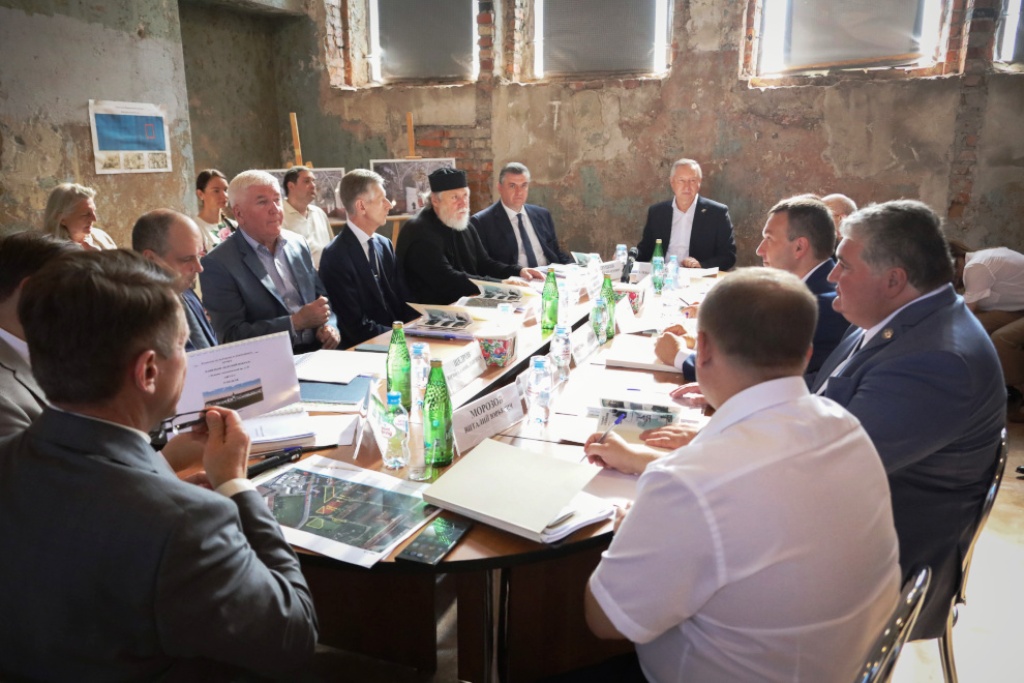
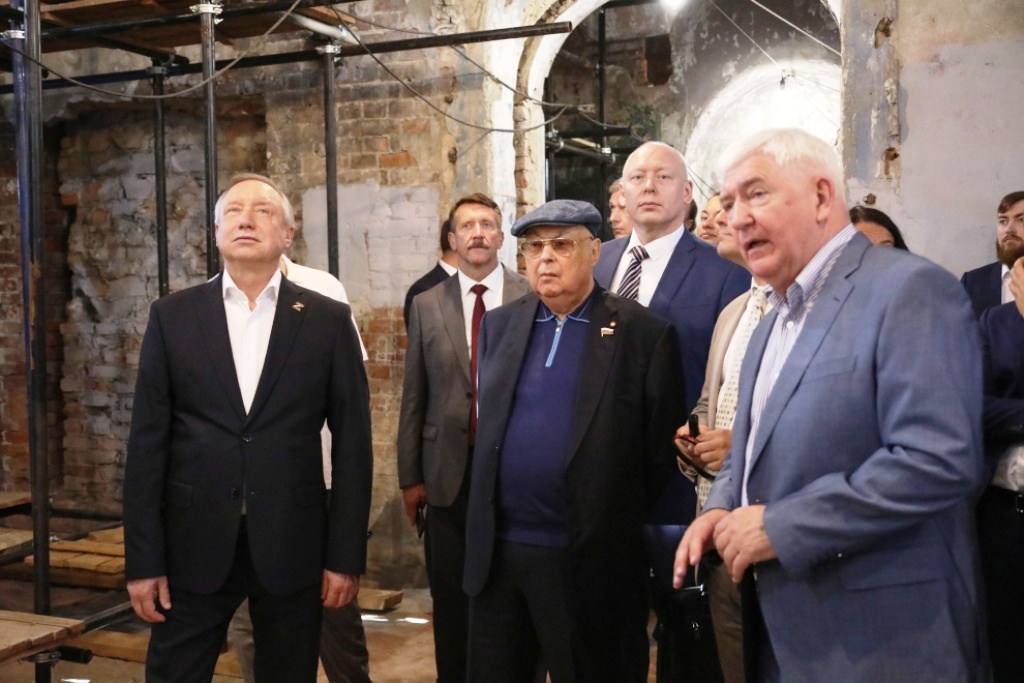
The project has some very high profile supporters, including the governor of St. Petersburg, Alexander Beglov and State Duma deputy Vladimir Resin. The official announcement was made during the first meeting of the Board of Trustees of the Tsarskoye Selo Station Foundation, which was held on 17th August in the Imperial Hall of the pavilion.

“We have created a special fund to restore the Imperial Railway Pavilion, the only imperial railway station in Russia. Ideas for the building’s use after the restoration has been completed are currently being developed. Funding will be provided at the expense of the city and federal budgets, as well as private and corporate donors,” Beglov said.

PHOTO: the first meeting of the Board of Trustees of the Tsarskoye Selo Station Foundation, was held on 17th August 2023, in the Imperial Hall of the pavilion

One of the finest examples of the Neo-Russian style

The construction of a special branch line from the Vitebsk Railway Station in St. Petersburg to the Alexander Palace in Tsarskoye Selo began in 1895. It was deemed a matter of security to provide safe transport links between the capital and the suburban residence for the Tsar and his family. The line was also convenient for government officials who arrived daily by train with their reports to the Tsar when he was in residence.

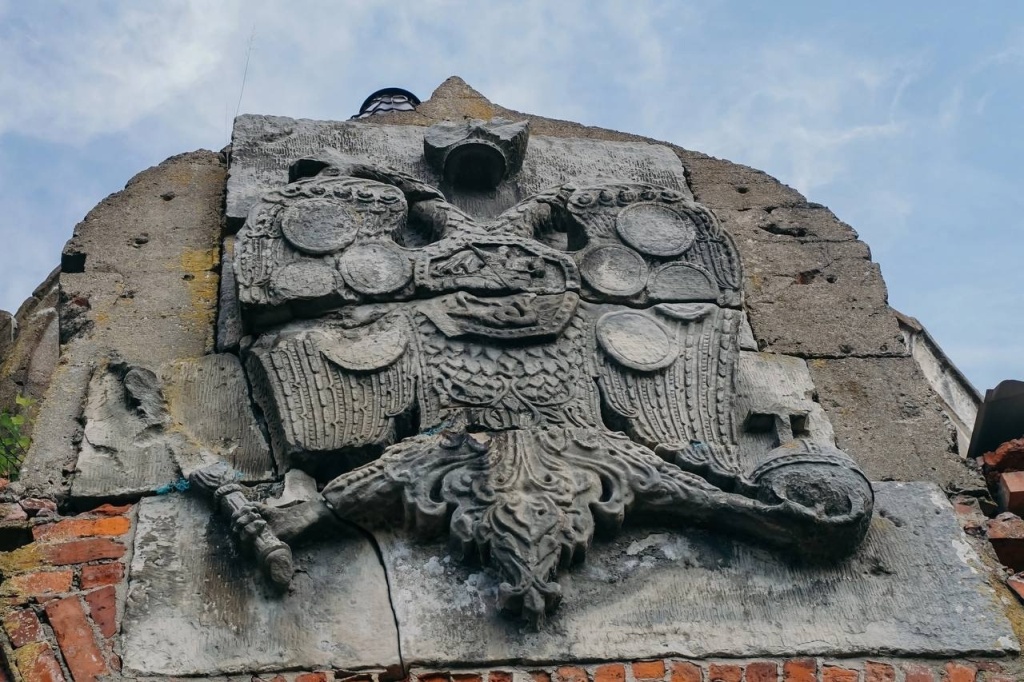
The original Imperial Pavilion was constructed of wood in 1895, however, it was destroyed by fire on 25th January 1911. A new stone pavilion designed by architect V.A. Pokrovsky, was constructed in the same Neo-Russian style as the buildings of the nearby Feodorovsky Gorodok [Town]. The Imperial Railway Pavilion served as a terminus for the Tsar’s Imperial Train. It was here that Emperor Nicholas II greeted many foreign dignitaries. A special road was laid from the station to the Alexander Palace.

The richly decorated interiors were stylized as chambers with heavy stone vaults. The decoration of the facades and interiors corresponded to the grand presentation of the station, being an example of a synthesis of architecture, monumental painting and decorative art, which successfully combined the forms of ancient Russian architecture of the 17th century. with construction technologies and materials characteristic of the modern era. The imperial chambers of the station were painted by the artist M. I. Kurilko, reflecting the chambers of the beloved suburban palace of Tsar Alexei Mikhailovich.

The fate of the Imperial Railway Pavilion during the Soviet years

In 1918, the station was renamed the Uritsky[1] Pavilion and was used as a dormitory and canteen for workers of the Track Repair of the Mechanical Plant, created on the basis of the Imperial Railway Repair Depot. The Imperial emblems were removed and the building and adapted for housing. The rails and sleepers were dismantled and used for the construction of other railway lines. The 200-meter passenger platform was dismantled in the 1930s. The pavilion was badly damaged during the Great Patriotic War (1941-45).

The dormitory was moved in the 1970s, the former station closed and has not been used since. The former Imperial Railway Pavilion was declared an object of cultural heritage of Russia of federal significance, an act which saved the building from demolition.

The rebirth of the Imperial Railway Pavilion

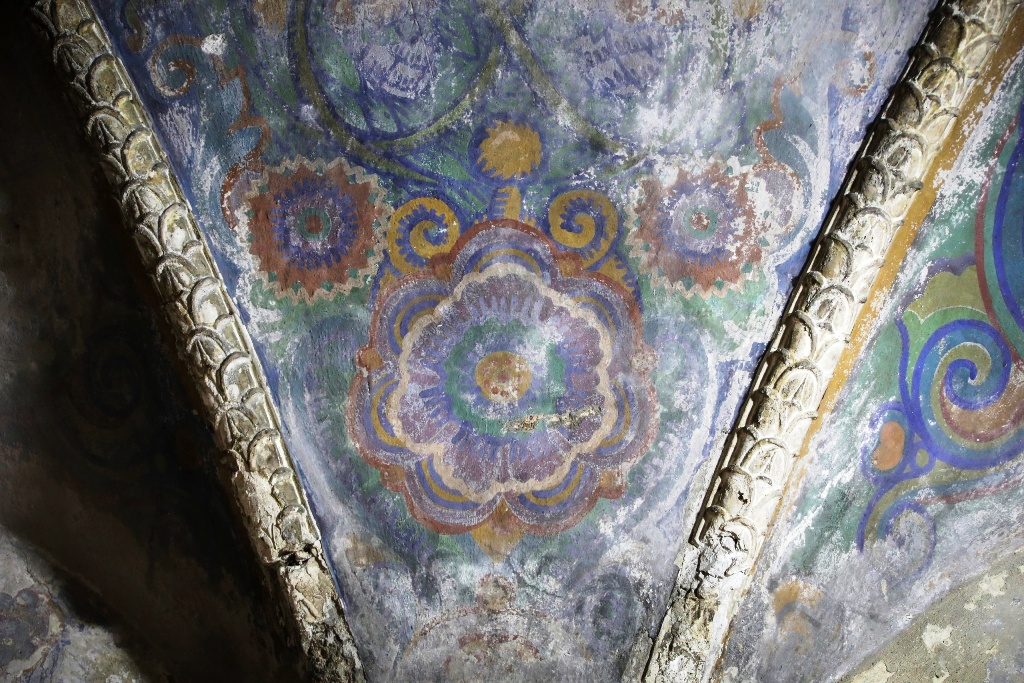
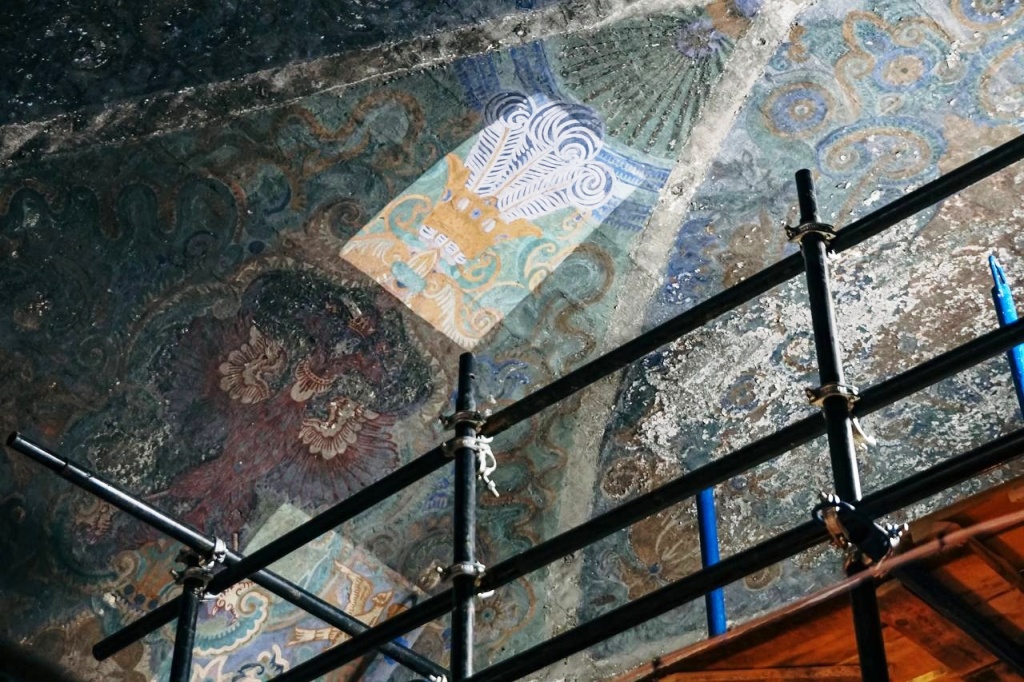
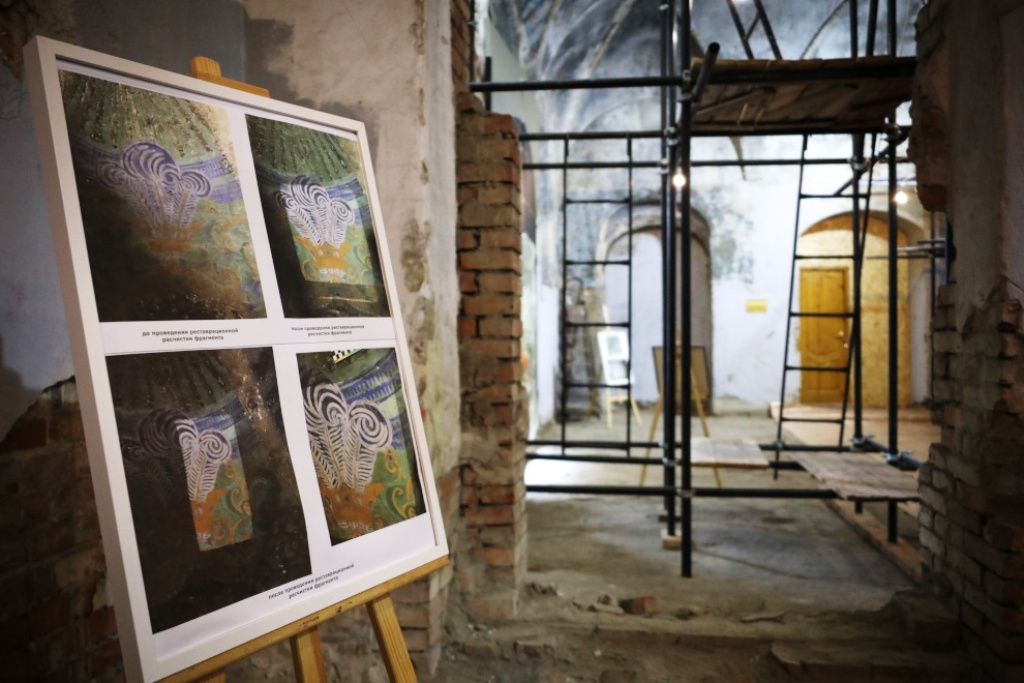
The Imperial Railway Pavilion in Tsarskoye Selo will be completely restored in its original form, including the terminal building, the platform and canopy, as well as the unique interior paintings, some of which have already been partially uncovered by restorers.

According to restorers, many of the building’s original details have surprisingly been well preserved. The historical painting of the dome of the main entrance to the Tsar’s Station has been miraculously preserved – see photos above, one of which shows an area which had been cleaned, revealing the colourful painting underneath. Early 20th century watercolours of the interiors – which have been preserved in archives – will be of great assistance to artists in their efforts to restore the once beautiful interior to its historic original.

The restoration of the Imperial Railway Pavilion will be one of the stages in the integrated development of the territory, which includes the Feodorovsky Gorodok (Town), Fermsky Park[2] and other facilities. This combined with the restoration of the Feodorovsky Sovereign Cathedral and the Alexander Palace will complete a revival of some of the most notable buildings associated with the life of Russia’s last Tsar, one which the Bolsheviks and Soviets failed to destroy.

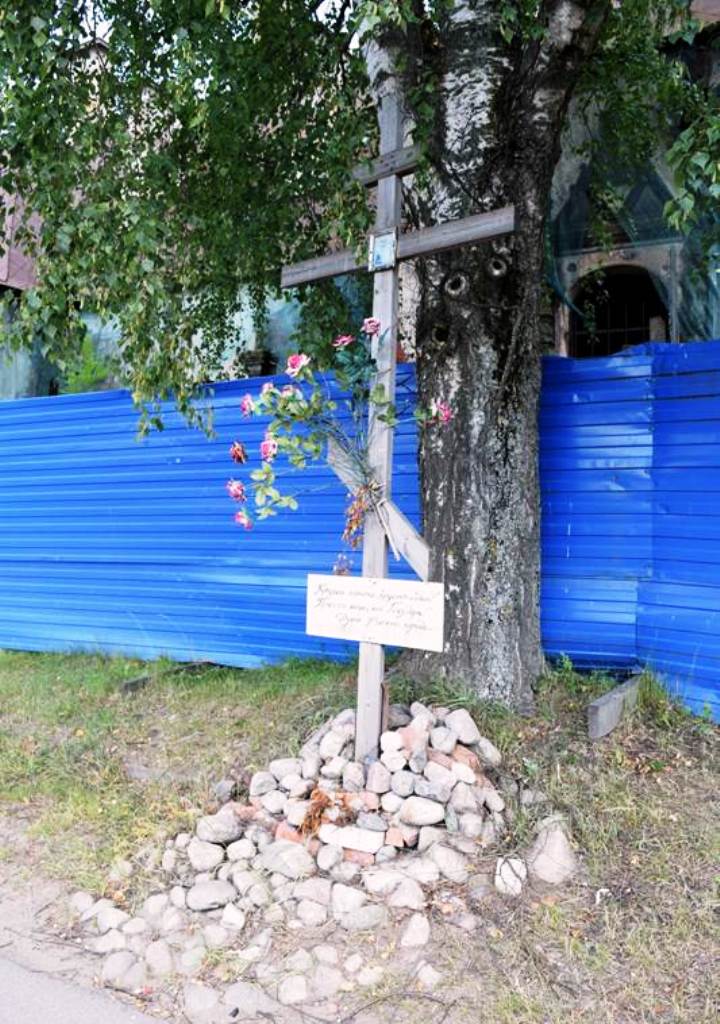
Several years ago, a wooden Orthodox cross – seen in above photo – was installed outside the Imperial Railway Pavilion at Tsarskoye Selo. The inscription on the plaque reads: “All around is betrayal and cowardice and deceit! Forgive us, sovereign” and signed: “The soul of the Russian people.”

NOTES:

[1] Moisei Solomonovich Uritsky (1873-1918) served as Chief of the Cheka of the Petrograd Soviet. After his assassination in 1918, Lenin initiated the first Red Terror on 20th September 1918.

[2] Fermsky Park is located near the Fedorovskiy Gorodok [Town] and Alexander Park. It was arranged by Adam Menelaws in 1818–1820 as a grazing area at the nearby imperial farm. A pond was dug in the park for watering.

FURTHER READING:

Update on the restoration of the Imperial Railway Pavilion at Tsarskoye Selo – published on 16th April 2024

Further to my August 2023 announcement that the Imperial Railway Pavilion at Tsarskoye Selo would be restored, I am pleased to provide the following update, which includes photos [taken in March 2024] of the progress being made on this important historic project, one which is closely connected to Emperor Nicholas II.

The sad state of the Imperial Railway Pavilion in Tsarskoye Selo includes 20 PHOTOS! – originally published on 29th December 2019

Imperial Railway Pavilions During the Reign of Nicholas II – originally published on 23rd October 2019

© Paul Gilbert. 18 August 2023

***

If you enjoyed this article, then please consider making a donation to my research, which helps me with the acquisition of documents from Russian sources and the cost of having them translated into English for the first time.

Not only do these documents give voice to the works of a new generation of Russian historian, they are of immense historic value in helping me with my efforts to clear the name of Russia’s much slandered Tsar.

Donations can be made in US dollars by credit card or PayPal.

CLICK HERE TO MAKE A DONATION

Thank you for your interest and support of my work.

PAUL GILBERT