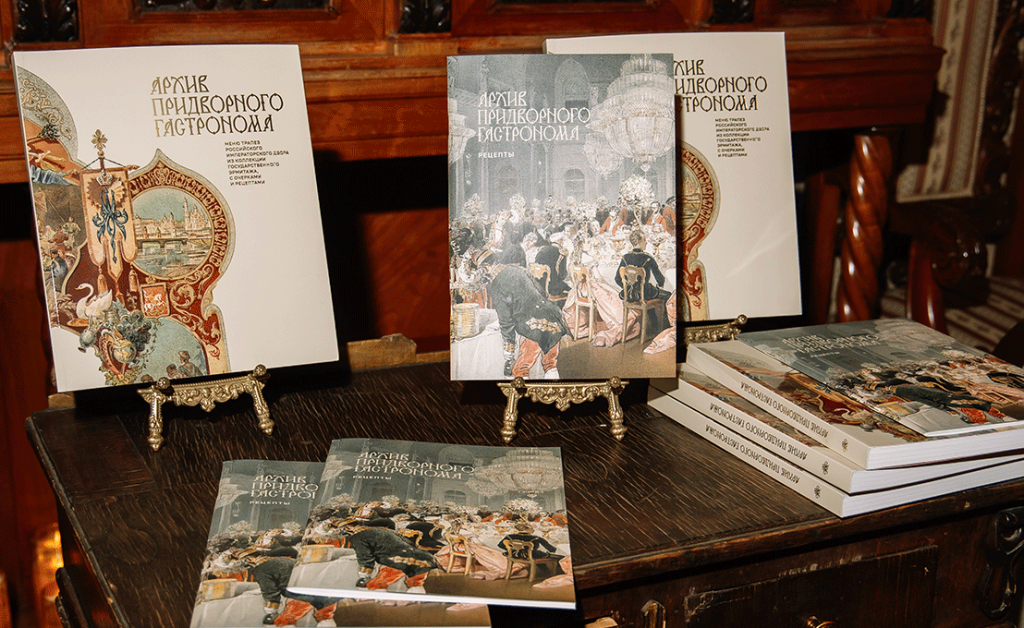
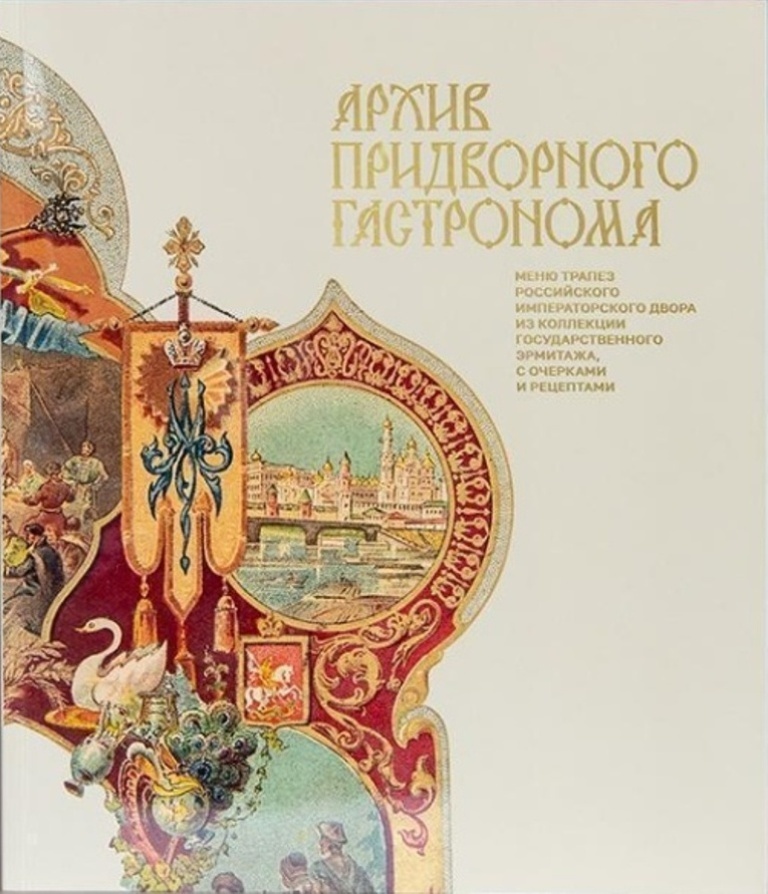
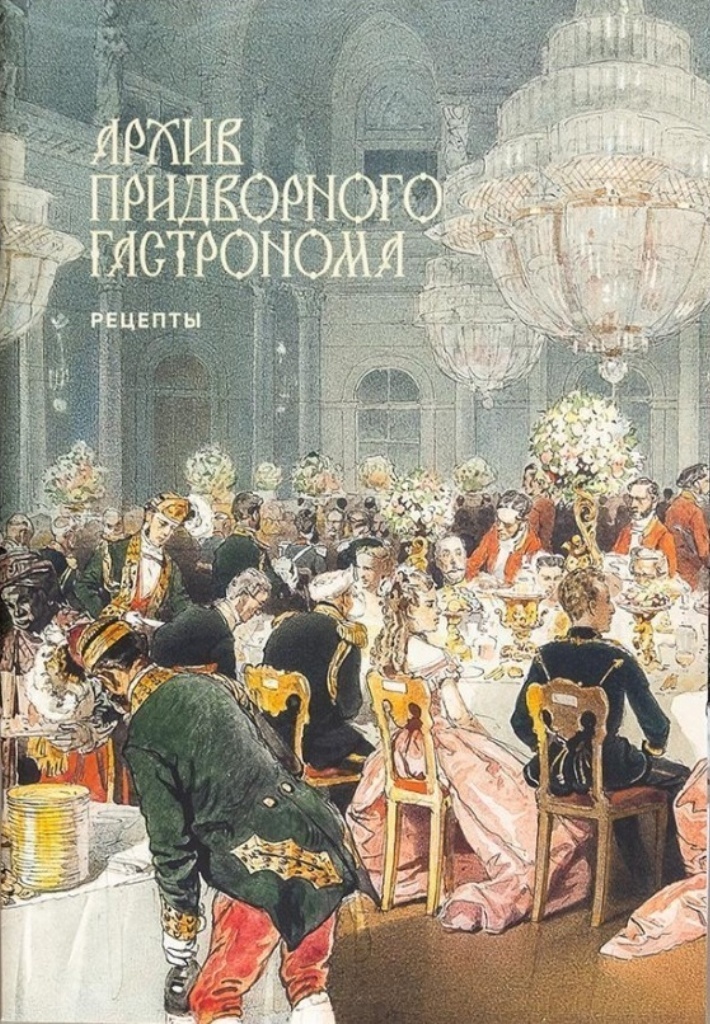
PHOTO:Архив придворного гастронома. Меню трапез российского императорского двора / The Archive of the Court Gastronome. Menus and Meals of the Russian Imperial Courtand recipe supplement
NOTE:this post is for information purposes only. Due to the current Western economic sanctions against Russia, it is currently not possible to order this book from Russia. Nor do I know of any bookseller outside of Russia that offers this title for sale– PG
the State Hermitage Museum has issued a very interesting new book Архив придворного гастронома. Меню трапез российского императорского двора / The Archive of the Court Gastronome. Menus and Meals of the Russian Imperial Court. The publication of this book is a joint project of the State Hermitage Museum (St. Petersburg), the retail company Magnit and the Hermitage 21st Century Foundation.
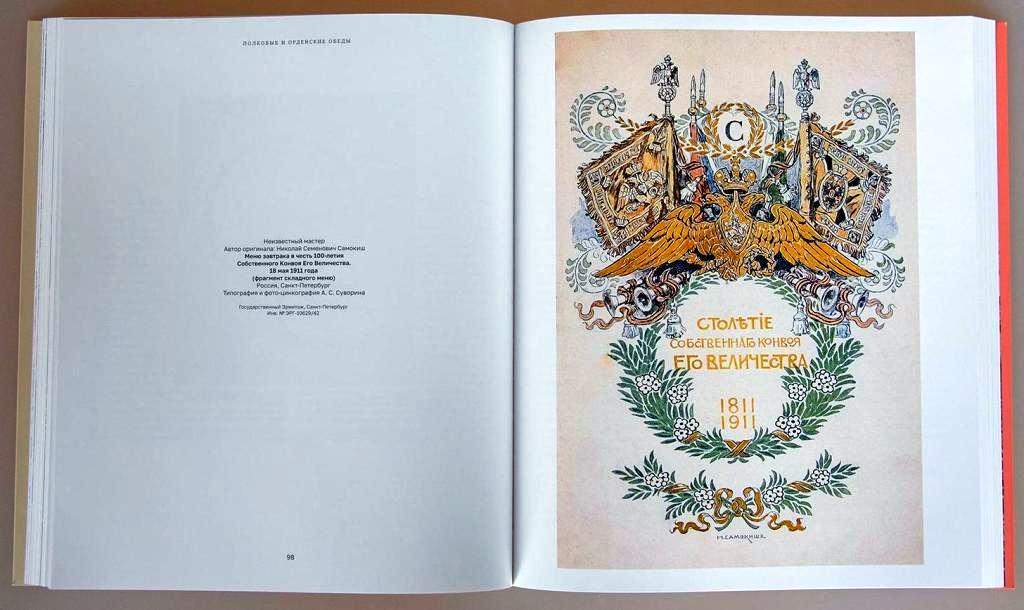
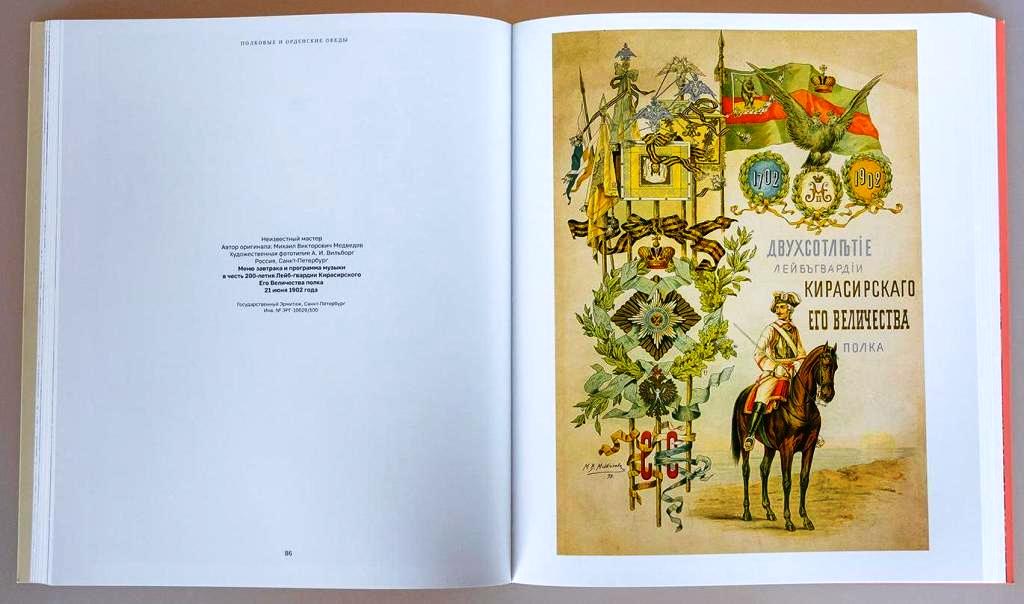
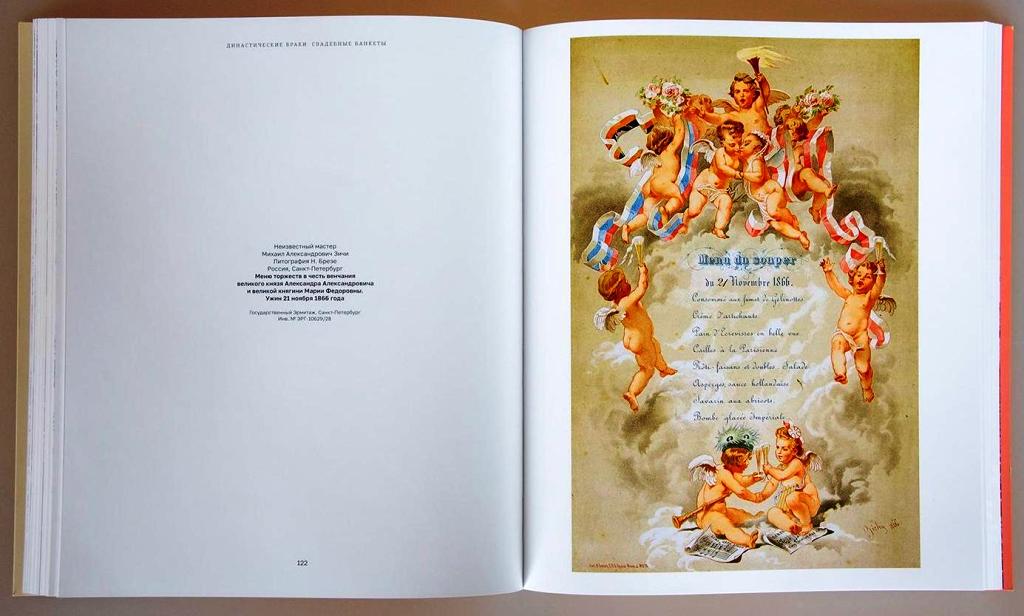
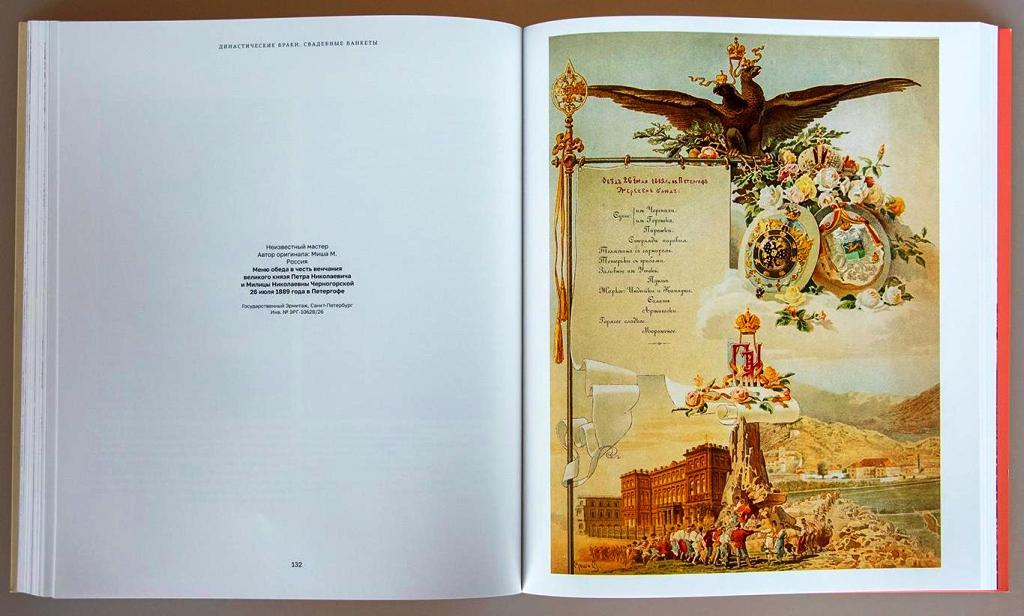
This title has been published in a limited edition printing of only 1,000 copies. It is only available in Russian, there is no English edition, nor is one planned. Below, are a small sampling of some of the beautiful menus of imperial banquets, created by outstanding Russian artists: Viktor Vasnetsov (1848-1926), Ivan Bilibin (1876-1942) and others.
The book contains several sections: coronation celebrations and major Russian holidays, regimental and order dinners, diplomatic receptions, wedding banquets, Orthodox feasts, hunting meals, yacht dinners. Each section contains a detailed description of the historical era and celebrations with colourful menus and illustrations.
Leafing through the pages of the Archive of the Court Gastronome, readers will learn what privileged guests were served at the coronations of Emperors Alexander III and Nicholas II, how the tables were set for wedding celebrations of members of the Imperial Family, what was served during the gala dinner in honour of the 300th anniversary of the Romanov dynasty in 1913, as well attributes of meals served in the Imperial residences, hunting lodges, Imperial yachts and much more.
The authors of the book include: Yulia Vadimovna Sharovskaya – head of the Fine Art Sector of the State Hermitage’s Department of the History of Russian Culture; Irina Radikovna Bagdasarova – leading researcher in the Department of the History of Russian Culture.
In addition, the publication has a special printed supplement with recipes. These are recipes which have been adapted to modern times, taken from pre-revolutionary cookbooks. The recipes were reproduced by the Gastronom.ru team in their own kitchens, using up-to-date ingredients and cooking methods.
Some of the recipes from this book can be found at the Gastronom.ru web site, as part of the Tsar’s Kitchen project. These recipes [in Russian only] provide an opportunity for food-lovers to taste some of the delicacies enjoyed by members of the Imperial Family and their guests more than a century ago.
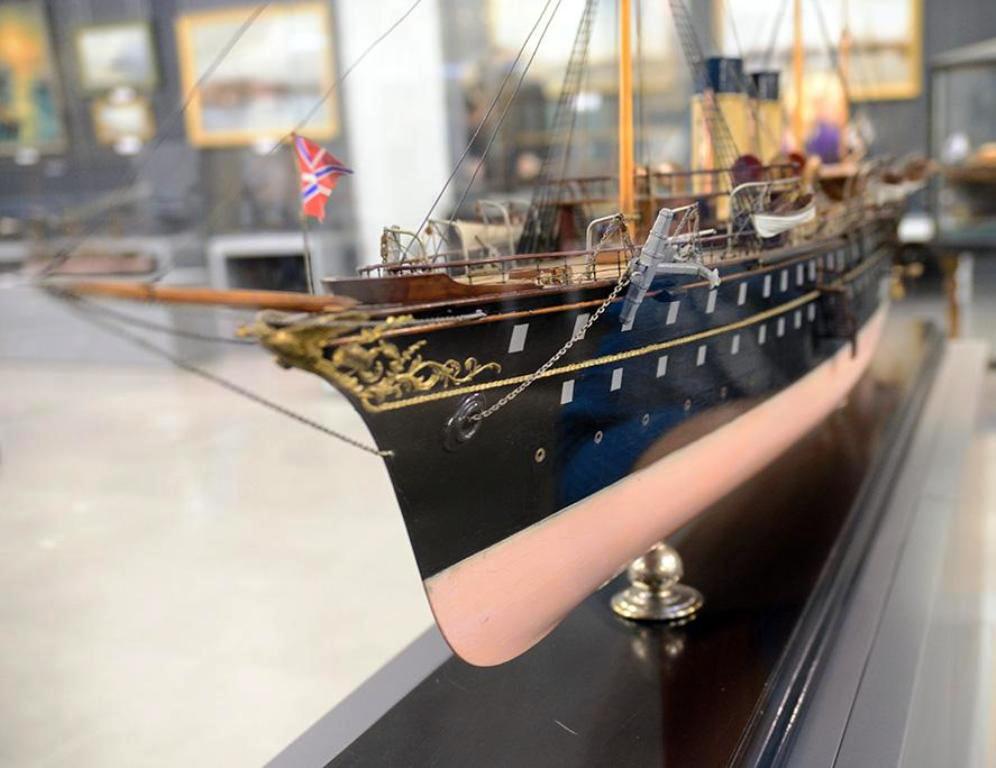
PHOTO: Model of the Imperial Yachts Polar Star «Полярная звезда» From the Collection of the Central Naval Museum, St. Petersburg
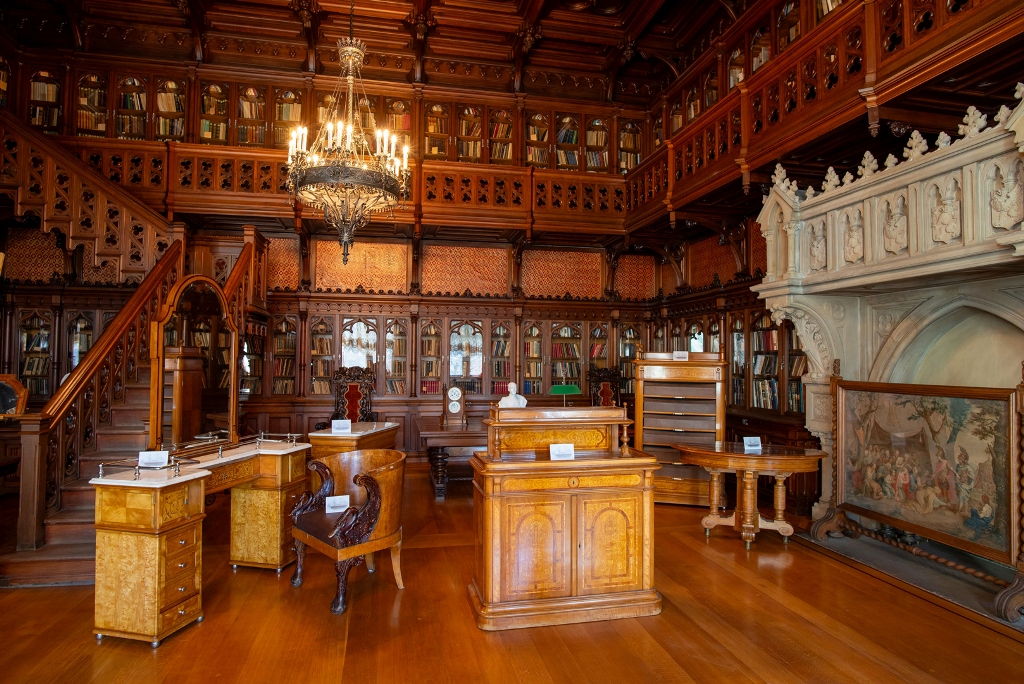
On 29th June 2024, an exhibition of furniture from Emperor Alexander III’s yacht Polar Star«Полярная звезда» opened in the Gothic Library of Emperor Nicholas II situated in the Winter Palace (State Hermitage Museum) in St. Petersburg. The pieces have been donated to the Hermitage by Mikhail Yuryevich Karisalov, a Russian industrialist, art patron and hereditary collector.
The set is made up of ten items: two tables, an armchair, two low cupboards, a dressing mirror, a cartonniere (filing cabinet), two doors and a mirror from a cupboard. They were all made at Nikolai Feodorovich Svirsky’s (1851-after 1915) factory to designs by the architect Nikolai Vasilyevich Nabokov (1838-after 1907) -who also designed the furniture for the Gothic Library.
Svirsky’s factory specialized in producing pieces decorated with marquetry using “our own method”. The distinctive feature of the craftsmen’s signature was extremely intricate, literally jeweller-like, detail work in the inlaid designs, making it possible to convey the subtlest nuances of colour.
In 1889 Svirsky put his creations on show at the 1889 Paris Exposition, where he was awarded the Grand Prix and a gold medal. In 1894 the Svirsky Factory was granted the honorary title of Supplier to the Imperial Court, and two years later his products were awarded a gold medal at the All-Russian exhibition in Nizhny Novgorod.
The manufacture of the furnishings for all the cabins aboard the Imperial Yacht Polar Star that was built for the Imperial amily’s long-distant voyages would be one of Svirsky’s most significant commissions. The correspondent of the Pravitelstvenny Vestnik (Government Messenger] newspaper wrote: “Regarding the interior finishing of the yacht, it must be said that this is something wholly exceptional and perfect in its elegance; there is not gaudy, eye-catching splendour here, but there is artistic splendour… On the right, from the Imperial Dining-Room, a door leads into Her Majesty the Empress’s [Maria Feodorovna] boudoir; there the walls and furniture are upholstered with English waxed cretonne; the cupboard, toilet table, writing desk and doors are covered with superb inlay work…”
PHOTO: 10 pieces of furniture from the Imperial Yacht Polar Star, on display in the Gothic Library of Emperor Nicholas II in the State Hermitage Museum, St. Petersburg
The exhibition includes two items that the journalist mentioned – the Empress’s “toilet table” and a low cupboard inlaid with Maria Feodorovna’s monogram МФ (MF).
Emperor Alexander III and Empress Maria Feodorovna are known to have sailed all around Europe on the Polar Star. On arrival in different countries, they would happily show off the exquisite interiors of their floating home. Following the death of A;exander III in 1894, the Polar Star became the personal yacht of the Dowager Empress, which she used for her visits to Denmark and Great Britain.
After the October Revolution, the yacht became the headquarters of the Bolsheviks’ Central Committee of the Baltic Fleet (Tsentrobalt), then in the 1930s it was refitted to serve as a floating base for submarines. Later, a cable was run from the yacht, which was moored on the Neva River in front of the Hermitage, to provide electricity to the museum halls. Click HERE to learn about the fate of the Imperial Yacht Polar Star.
For the Hermitage, the items of furniture from the Polar Star are of especial value – from artistic, historical and memorial points of view. After the temporary exhibition in the Gothic Library, the set will find a place within the display devoted to the Art Nouveau era in the General Staff Building, where a separate room showcasing Svirsky’s works will be go on permanent display.
The exhibition curator is Natalia Yuryevna Guseva, Candidate of Art Studies, Deputy Head of the State Hermitage’s Department of the History of Russian Culture, keeper of the Russian furniture collection.
NOTE: the 6th and final episode ‘Ceremonial and Service‘ was added to this post on 9th August 2023 – PG
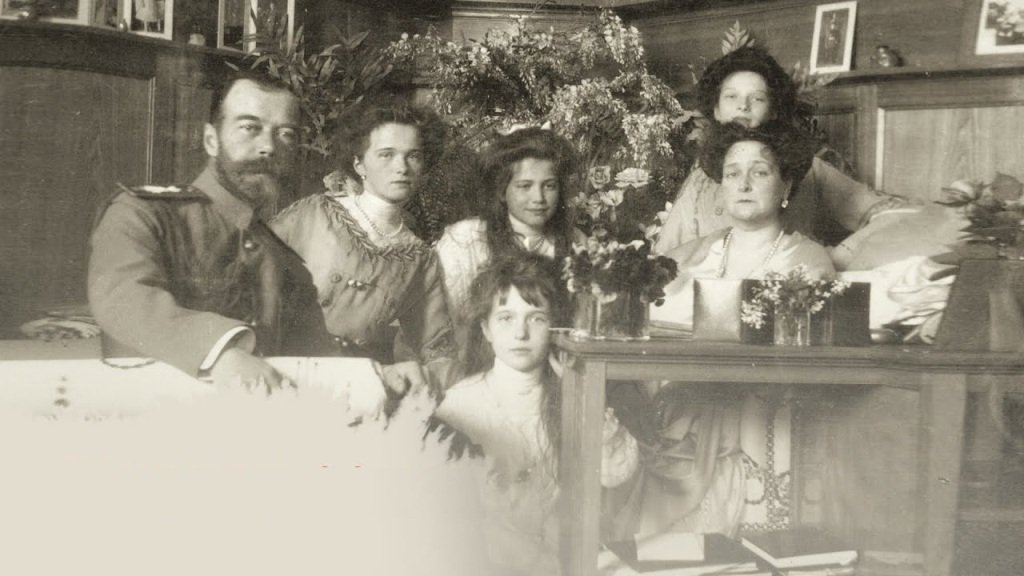
The State Hermitage Museum has released 5 short videos about the children of Emperor Nicholas II and Empress Alexandra Feodorovna: Grand Duchesses Olga, Tatiana, Maria, Anastasia Nikolaevna and Tsesarevich Alexei Nikolaevich.
NOTE: all of the videos listed below are in Russian, however, do not allow that to stop you from watching this richly detailed series, featuring vintage newsreel footage and still photographs. You can still follow the gist of the audio in English, by doing the following:
[1] click on the YouTube link, located in the banner at the bottom of the video
[2] turn on Google Translator, which will translate the text only
[2] click on the close captioning option [CC] option, located in the banner at the bottom of the video
The closed captioning will appear in English on your screen, allowing you a better understanding of the people, places and events presented in the video.
Part 1 – Pages of life
Duration: 16 minutes, 46 seconds
Part 1 is based on the memoirs of contemporaries, historical photographs and newsreels, as well as modern video footage of places associated with the life of the family of Nicholas II and Empress Alexandra Feodorovna: the Winter Palace, the Alexander Palace in Tsarskoye Selo and their Crimean residence in Livadia. It presents “portraits” of the Grand Duchesses Olga, Tatiana, Maria, Anastasia and Tsesarevich Alexei, compiled from the memoirs of people who knew them closely. You will learn about the serene childhood and youth of the August children, their upbringing and education, about the family’s summer vacation in Yalta and about traveling on the Imperial Yacht “Shtandart“, as well as their participation in the official side of life: court ceremonies, military parades and Celebrations.
Part 2 – The upbringing and education of the Grand Duchesses
Duration: 8 minutes, 29 seconds
Part 2 focuses on the education of the daughters of Nicholas II – Grand Duchesses Olga, Tatiana, Maria and Anastasia, about their daily routine and what role their mother, Empress Alexandra Feodorovna, played in the upbringing of the girls. The film is based on the memoirs of contemporaries, historical photographs and newsreels, as well as modern video filming of places associated with the day-to-day life of the Imperial family.
Part 3 – In the circle of the family
Duration: 8 minutes, 38 seconds
Part 3 explores the private world of the Imperial family, about the joint leisure activities enjoyed by the Imperial children and their parents, they books they read, what sports they were engaged in, their passion for photography and much more. The film is based on the memoirs of contemporaries, historical photographs and newsreels, as well as modern video filming of places associated with the life of the Imperial family.
Part 4 – Travels on the Imperial Yacht “Shtandart“
Duration: 6 minutes, 56 seconds
In Part 4 we travel on the imperial Yacht “Shtandart” – one of the most favorite pastimes of the family of Nicholas II – including walks along the Finnish skerries, enjoying their summer holidays, their day-today life and activities while living onboard their famous yacht. The film is based on the memoirs of contemporaries, historical photographs and newsreels of the life of the Imperial family. The State Hermitage Museum thanks the State Archives of the Russian Federation for the images provided for the film.
Part 5 – Rest in Livadia
Duration: 9 minutes, 4 seconds
Part 5 explores the day-to-day life of Nicholas II and his family at their Crimean residence Livadia in between 1911-1914: how the Imperial Family traveled to the Crimea, the celebrations marking the 16th anniversary of Grand Duchess Olga and the name day of Tsesarevich Alexei, their participation in charity bazaars, including the “White Flower Day”, in which Empress and her children took part. The film is based on the memoirs of contemporaries, historical photographs and newsreels of the life of the Imperial family, as well as modern filming of the Livadia Palace.
Part 6 – Ceremonial and Service
Duration: 11 minutes, 46 seconds
In the 6th and final part we learn about the duties of the Grand Duchesses and the Tsesarevich, who were trained from childhood to serve Russia. These include their activities and responsibilities as regimental chiefs, their participation in the celebrations marking historical anniversaries and significant events, as well as how their service to the Fatherland changed after the outbreak of the First World War. This film is based on the memoirs of contemporaries, historical photographs and newsreels of the life of the Imperial Family, provided by the State Archives of the Russian Federation.
I have published more than 30 titles to date through AMAZON – featuring one of the largest selections of books on Nicholas II, the Romanov dynasty and the history of Imperial Russia.
The net proceeds from the sale of each book help fund my research in clearing the name of Russia’s much slandered Tsar.
Please CLICK on the BANNER or LINK above to review my current selection of titles in hardcover, paperback and ebook editions. Listings provide a full description for each title, pricing and a Look inside feature.
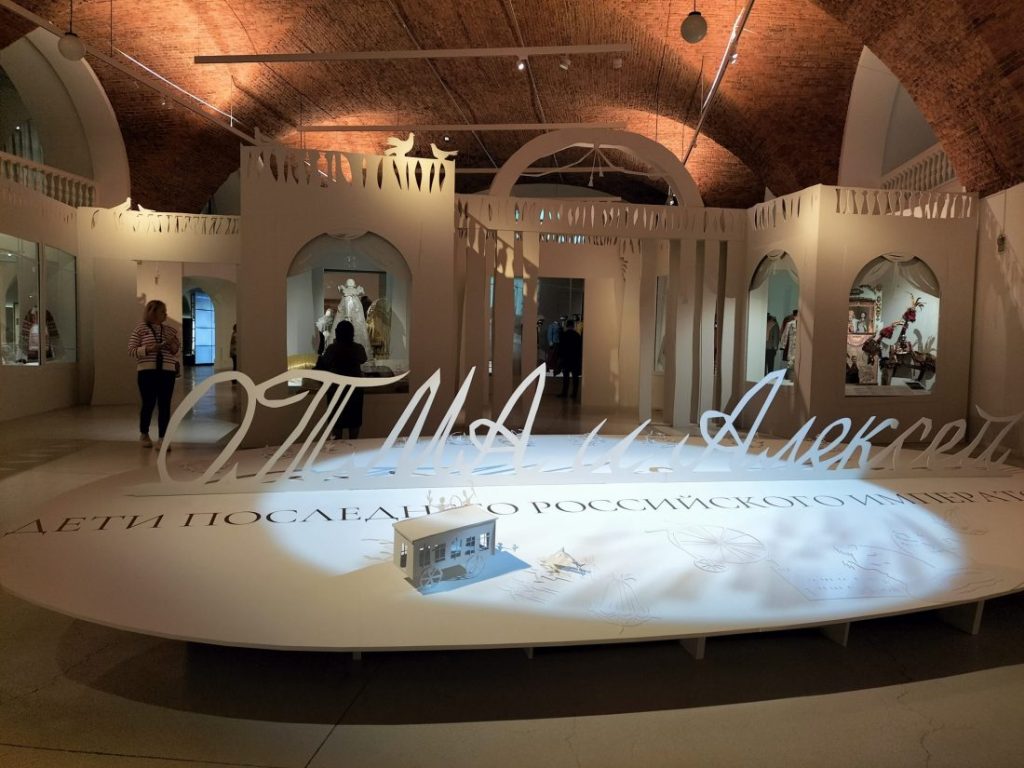
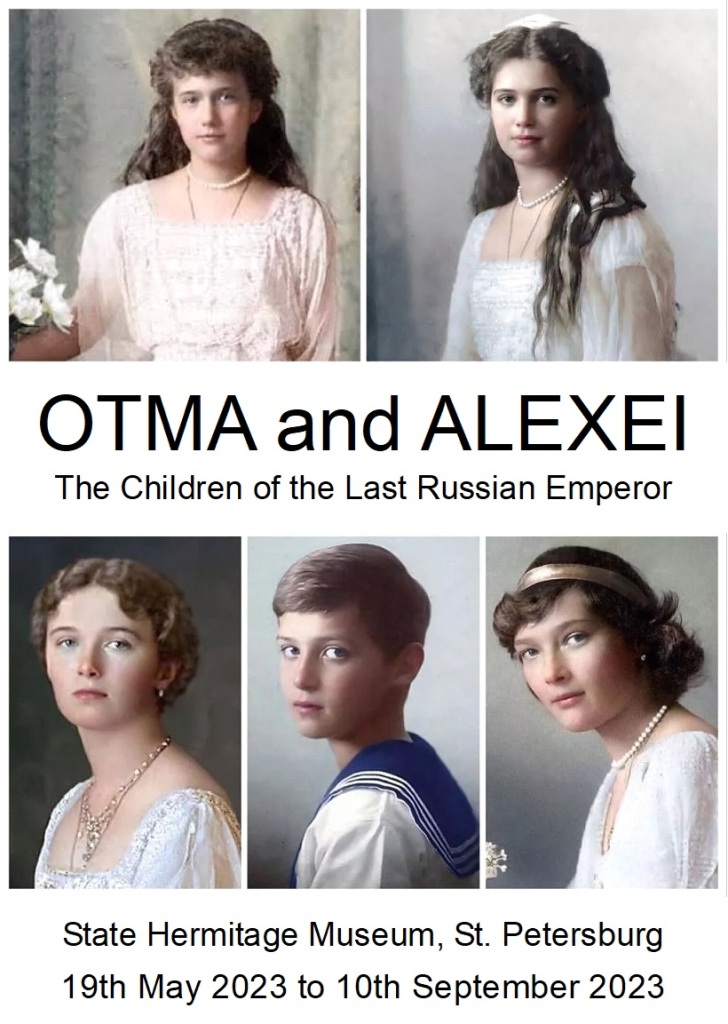
On 19th May 2023, a new exhibition “OTMA and Alexei. The Children of the Last Russian Emperor” opened in the Manege of the Small Hermitage, in the State Hermitage Museum in St. Petersburg.
The exhibition was originally planned to be held in the Hermitage Amsterdam, however, it was cancelled due to EU sanctions against Russia.
The exhibition spans the period from 1895 to 1914 – that is to say, exploring their days of untroubled childhood and youth, unaffected as yet by the First World War and the revolution that followed.
The Emperor’s daughters, Grand Duchesses Olga, Tatiana, Maria and Anastasia, born at two-year intervals, were very friendly with each other and signed their letters to their parents with the initial letter of each of their names. Hence the abbreviation OTMA. The youngest child and only boy – Alexei, Tsesarevich and heir to the throne – was the favourite of the entire family.
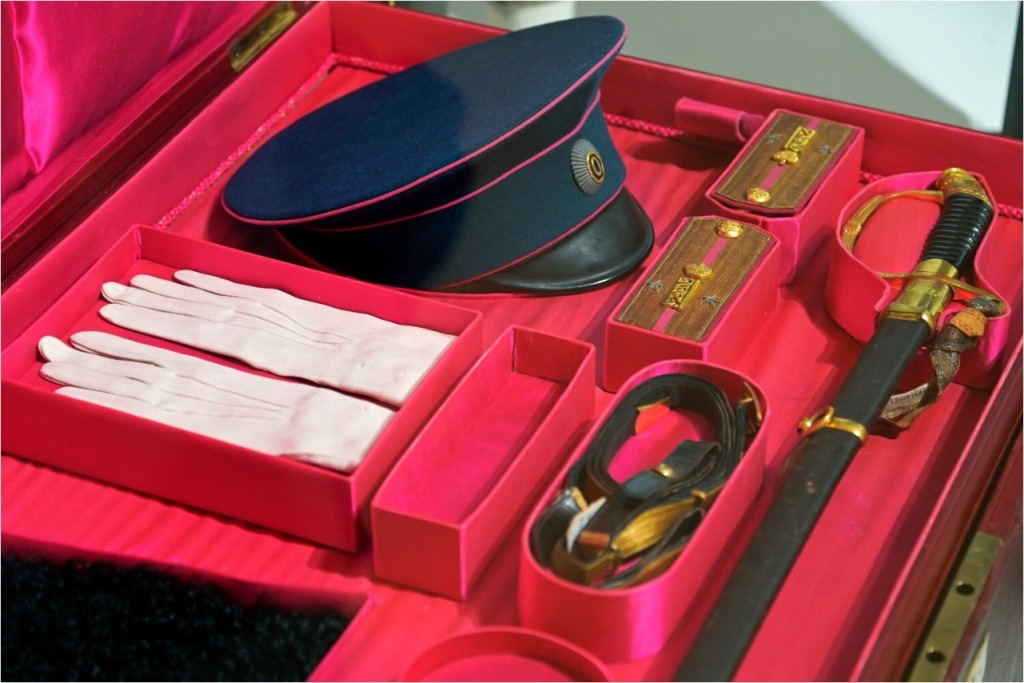
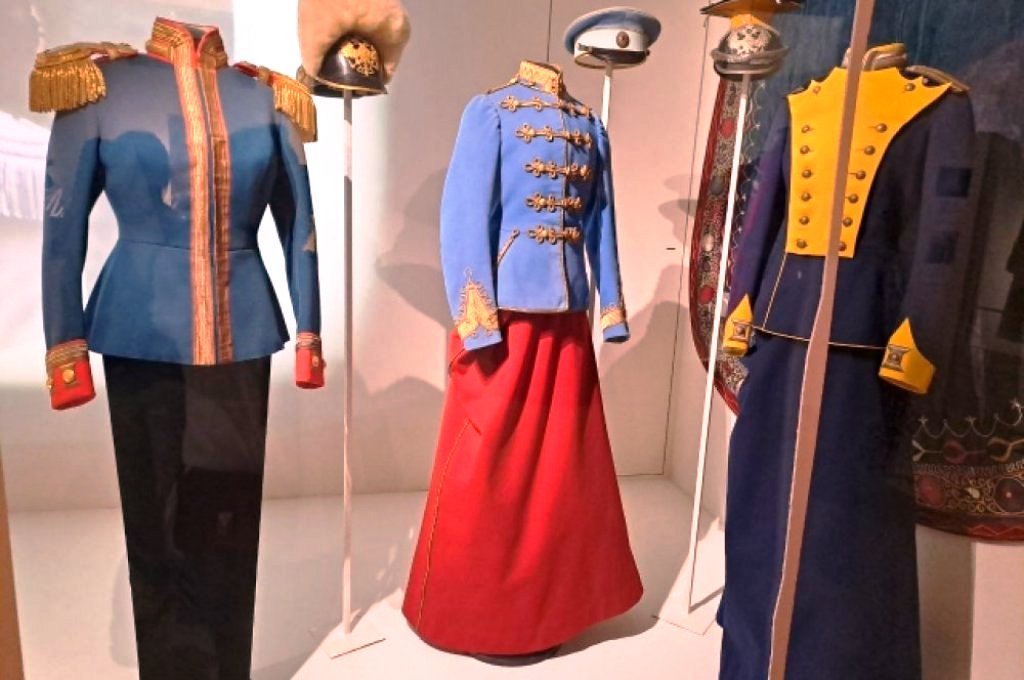
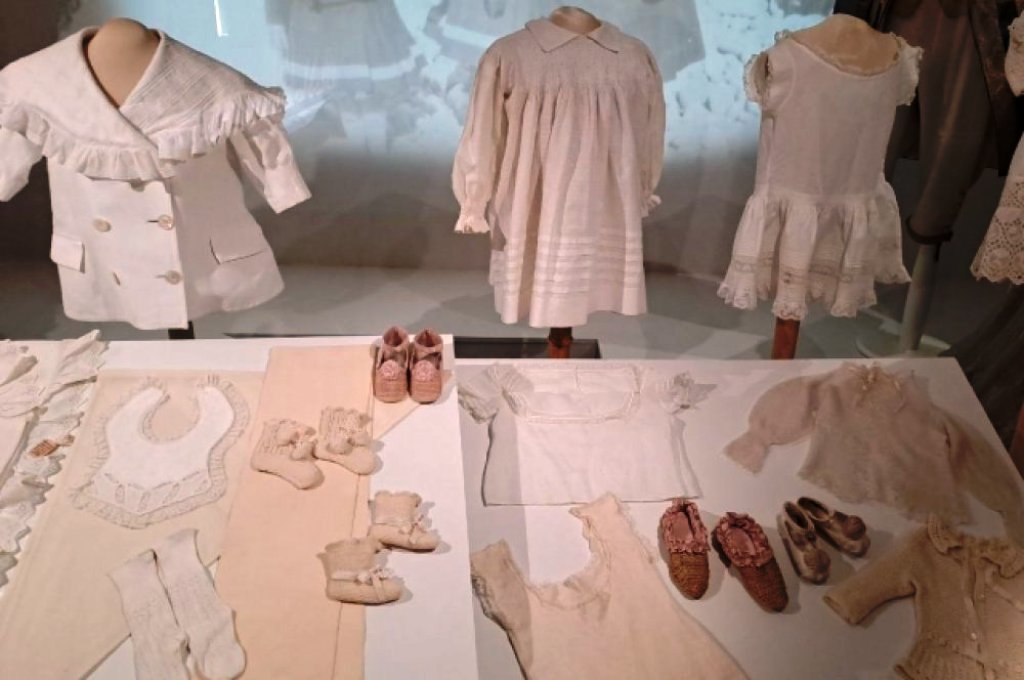
The exhibition showcases more than 270 items, including a unique group of personal belongings and costumes from the stocks of the Hermitage: from baby jackets to formal court dresses, as well as toys and items that the imperial family used in their everyday life. Of particular interest is the clothing of Tsesarevich Alexei Nikolayevich, who from an early age wore uniforms of the regiments of which he was the ceremonial patron. Many items on display at this exhibition are being shown for the first time after the completion of lengthy restoration that has brought these historically significant pieces back to life.
As Mikhail Borisovich Piotrovsky, General Director of the State Hermitage, stated: “The tragic end of this happy family, which everyone knows, makes each everyday object emotionally charged and the whole exhibition a dreadful omen.”
Much attention is devoted in the exhibition to telling about the children’s family upbringing and education. Artistic and documentary artefacts – personal possessions, toys, books, favourite games that shaped the individual nature of each sibling – present details of the children’s daily life. It would, however, be difficult to reveal their characters using just the “world of objects”. Archive documents and photographs serve as accompanying illustrations and include many of the items on display.
Besides exhibits from the stocks of the State Hermitage, the display also includes items on loan from the Tsarskoye Selo State Museum-Preserve and the State Archive of the Russian Federation (GARF) in Moscow.
The exhibition curators are Yulia Valeryevna Plotnikova, leading researcher in the State Hermitage’s Department of the History of Russian Culture, and Yulia Vadimovna Sharovskaya, head of the Fine Art Sector in that department.
The exhibition “OTMA and Alexei. The Children of the Last Russian Emperor” is included in the price of all tickets to the State Hermitage Museum. The exhibition runs until 10th September 2023.
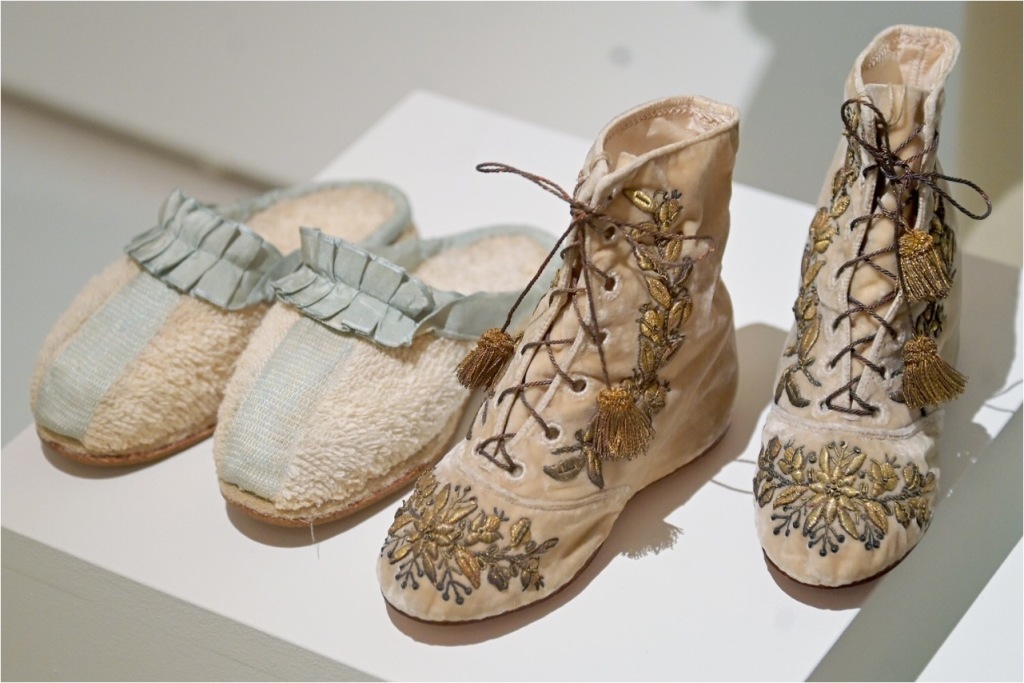
The exhibition is arranged along chronological and thematic lines. The first part shows the early childhood of the Grand Duchesses, including items of infants’ and children’s clothing – baby jackets, blouses, chemises, and some pieces of knitwear made by Empress Alexandra Feodorovna herself among them. Here visitors will find little lace-trimmed cambric frocks with coloured silk underskirts that the girls wore in early childhood; white piqué overcoats with wide turn-down collars and broad-brimmed hats made of unstiffened cambric. The display also contains accessories – footwear, fans and umbrellas. The rarer articles from the wardrobe of the grown-up Grand Duchesses have marks making it possible to tell who exactly wore them, since the Empress liked to dress her daughters identically not only as young children, but at a more advanced age as well.
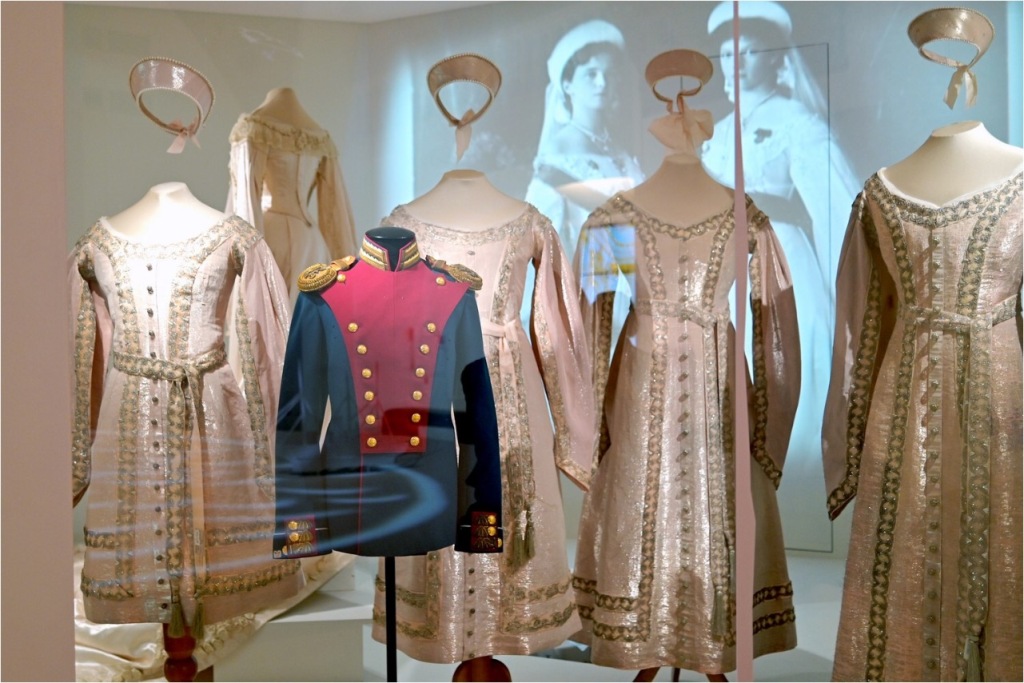
Items in the exhibition that seem to have come off the pages of the fashion magazines of the day give an idea of how girls were clothed in the late 19th and early 20th centuries. There were, however, certain articles that set the children of the imperial family apart from others of the same age belonging to even well-to-do families. These include the Grand Duchesses’ formal court dresses: from the childish ones sewn in 1904 for the baptism of the heir to the throne, to those for the teenage girls and young ladies made in Olga Bulbenkova’s famous atelier, and also Tsesarevich Alexei’s uniforms. Immediately after his birth, the heir to the throne was “enrolled in the military” and appointed ceremonial patron of several Guards regiments, having the corresponding uniforms made for him. As he grew older, Alexei took part in parades and reviews along with his father. All the Grand Duchesses were also patrons of regiments. Olga, Tatiana and Maria even had special unforms sewn for them.
Photographs and watercolours show the imperial family’s favourite places: their primary residence – the Alexander Palace at Tsarskoye Selo; the palace at Livadia in the Crimea for the spring and autumn seasons, and also their “second home” – the imperial yacht Shtandart. Voyages on that ship were a treat to which the children eagerly looked forward, bringing some variety to their heavily regulated lives. The girls were dressed in sailor costumes and the Tsesarevich in naval unform, from which only two sailor’s caps have survived. The family spent the summer months at the Lower Dacha in Peterhof, which no longer exists. The exhibition includes two pieces of furniture made at Friedrich Melzer’s factory in Saint Petersburg – one for the drawing-room of the Lower Dacha, the other for the Grand Duchesses’ schoolroom at the Alexander Palace.
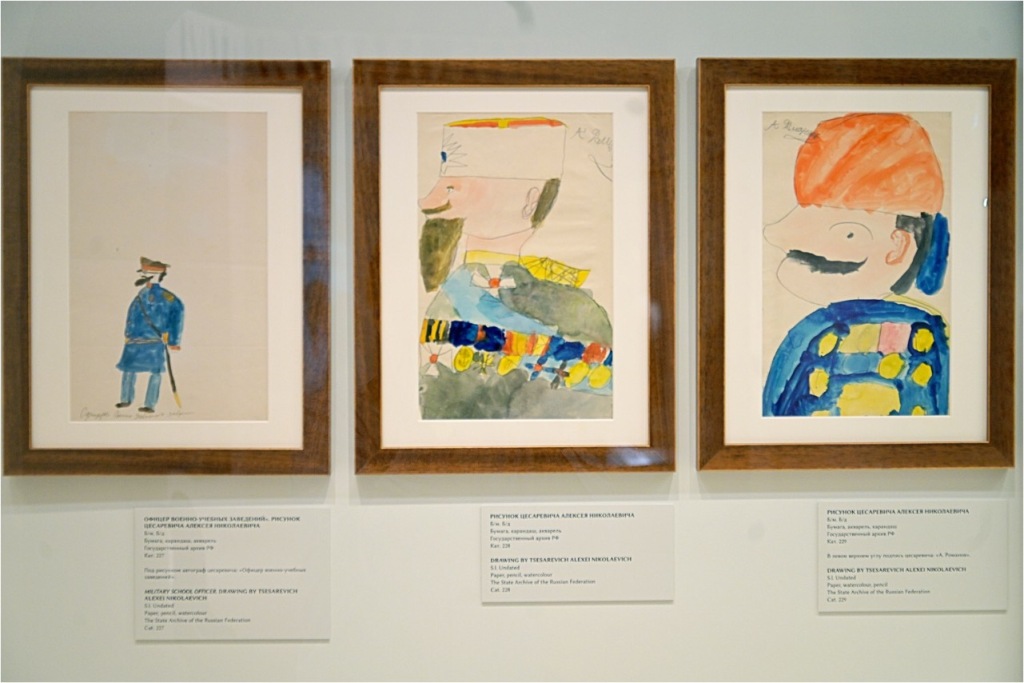
Separate attention is paid in the display to Tsesarevich Alexei. The long-awaited heir to the throne was dearly loved by his parents and sisters. The children spent much time playing and doing other activities together. Despite his serious illness – haemophilia, in his rare moments of good health, the Tsesarevich strove to live a normal life, which included both schoolwork and amusements. In order to recreate the everyday world of the heir to the throne more precisely, the State Hermitage and the State Archive have provided from their collections a boy’s military uniform, toys, letters, drawings, exercise books and a timetable of lessons.
The characters of all five children can be grasped from a unique set of materials – personal diaries, family letters, schoolwork and exercise books. The two eldest siblings, Olga and Tatiana, studied well, were diligent and neat, reading extensively. Grand Duchess Maria was very fond of drawing but fell short of her elder sisters when it came to learning. The youngest, Anastasia, had the nickname Shvybzik (perhaps “little imp”) and was the most playful and lively. She disliked learning but was very good in comic roles in the family’s amateur dramatics and took a leading part in games. Tsesarevich Alexei was a very bright youngster, but his lessons were often interrupted due to the illness that affected him throughout his life.
The sisters shared their parents’ love of photography. Each of them had her own Kodak camera that was enthusiastically used to take many pictures of themselves, their family and friends, hundreds of them then being pasted into albums. Two of those albums, embellished with the Grand Duchesses’ own drawings, feature in the display.
***
EXHIBITION CATALOGUE
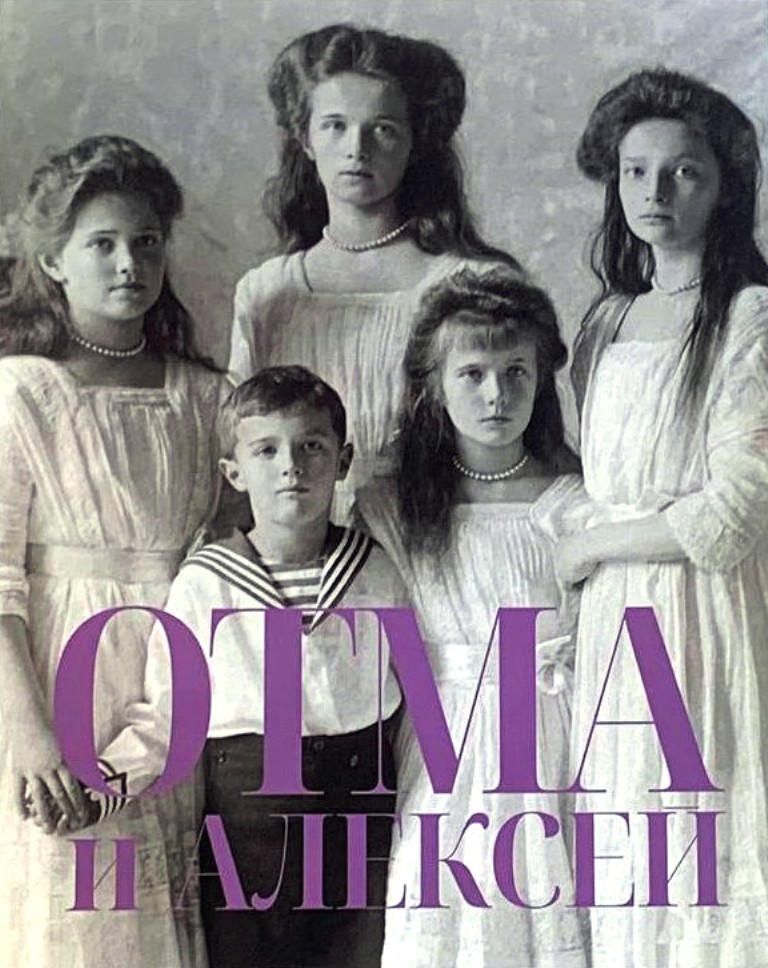
A richly illustrated Russian language catalogue has been prepared for the exhibition (State Hermitage Publishing House, 2023), which includes an introduction by Mikhail Piotrovsky, General Director of the State Hermitage Museum. The authors of the articles are Y.V. Plotnikova, A.V. Sabenina (State Archives of the Russian Federation), M.P. Filiptseva (Tsarskoye Selo State Museum).
NOTE: this post is for information purposes only. I regret that I do not know how to obtain copies, or if any of these titles will ever be translated to English – PG
PHOTO: cover of the Russian language exhibition catalogue
A new exhibition OTMA and Alexei. The Children of the Last Russian Emperor will open next month at the State Hermitage Museum in St. Petersburg.
The exhibition which will open on 19th May [Nicholas II’s birthday] in the Manege of the Small Hermitage is a joint project of the State Hermitage Museum, the Tsarskoye Selo State Museum and the State Archives of the Russian Federation (GARF).
The exhibition will cover the period from the birth of Nicholas II and Alexandra Feodorovna’s first child Olga in 1895 to August 1914, and the Imperial Family’s house arrest in the Alexander Palace and their subsequent exile to Siberia.
Among the more than 300 exhibits, are Court dresses and other accessories worn by the Grand Duchesses from the State Hermitage Museum’s Costume Collection, as well as toys and other personal items of the Imperial Children from the Tsarskoye Selo State Museum.
Of particular interest to visitors will be the military uniforms of Tsesarevich Alexei Nikolaevich, who from childhood wore the uniforms of the regiments under his patronage. Many of these uniforms will be displayed for the first time following the completion of their restoration.
A richly illustrated Russian language catalogue has been prepared for the exhibition (State Hermitage Publishing House, 2023), which includes an introduction by Mikhail Piotrovsky, General Director of the State Hermitage Museum. The authors of the articles are Y.V. Plotnikova, A.V. Sabenina (State Archives of the Russian Federation), M.P. Filiptseva (Tsarskoye Selo State Museum).
“This is a very touching exhibition”, said Mikhail Piotrovsky, general director of the museum. Piotrovsky noted that the exhibition was originally planned to premiere at the Hermitage Amsterdam (Netherlands), however, the exhibit has been cancelled, due to current EU sanctions on Russia.
OTMA was an acronym used by the four daughters – Grand Duchesses Olga, Tatiana, Maria and Anastasia – of Emperor Nicholas II and Empress Alexandra Feodorovna, as a group nickname for themselves, built from the first letter of each girl’s name in the order of their births. It was with this acronym that they signed their letters to their parents. Alexei’s initial is an addition made in the late 20th century.
The Children of the Last Russian Emperor. OTMA and Alexei exhibition will run from 19th May 2023 to 10th September 2023 at the State Hermitage Museum in St. Petersburg.
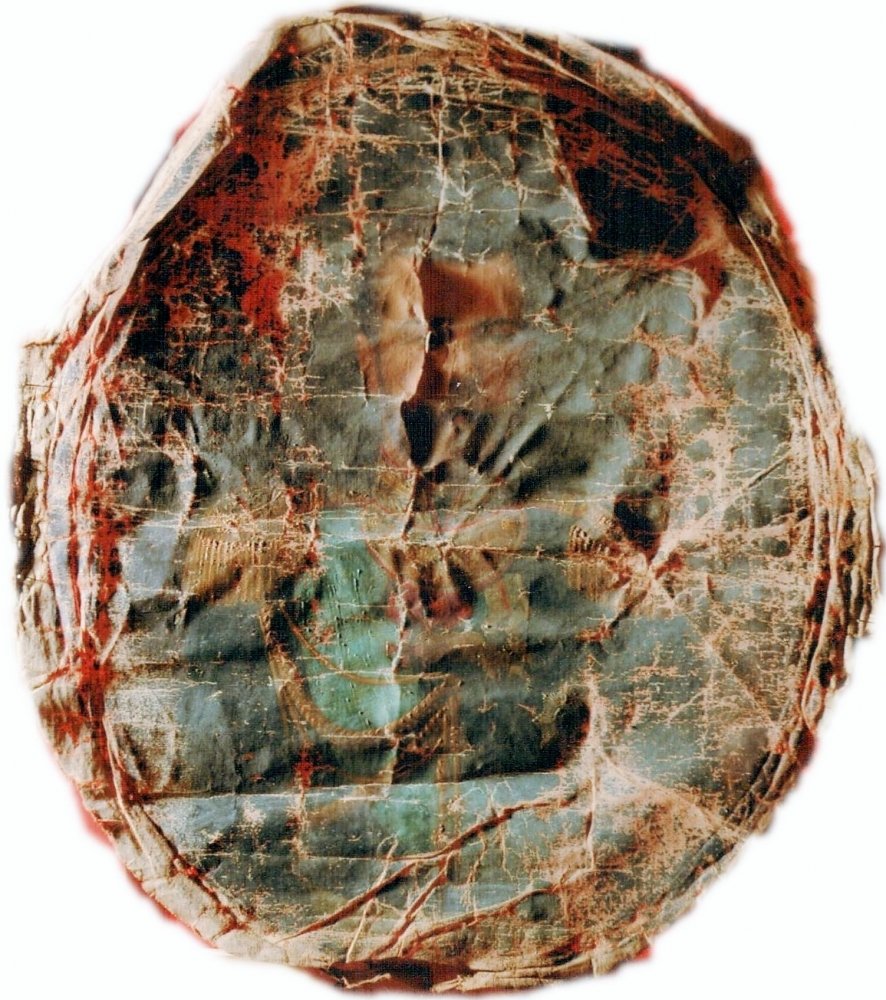
PHOTO: “as if in a misty haze, one could discern the face of Emperor Nicholas II”
In 2018, the State Hermitage Museum in St. Petersburg in cooperation with the Russian-American Cultural and Educational Society ‘Rodina’, embarked on a joint project headed by Candidate of Cultural Studies Viktor Faibisovich, on the restoration of a little-known portrait of Russia’s last tsar.
In 2004, a Moscow collector brought the portrait from the United States to the State Hermitage Museum, after discovering it in the Russian-American Cultural and Educational Society Museum.
The Rodina Society was founded in 1954 by Russian émigrés in Lakewood, New York. The head of Rodina, O.M. Krumins, noted that the portrait was brought from Paris in the late 1950s among other rarities of the Life Guards of the Semyonovsky, Izmailovsky and Pavlovsky regiments, the Nikolaevsky cavalry and the Konstantinovsky artillery schools.
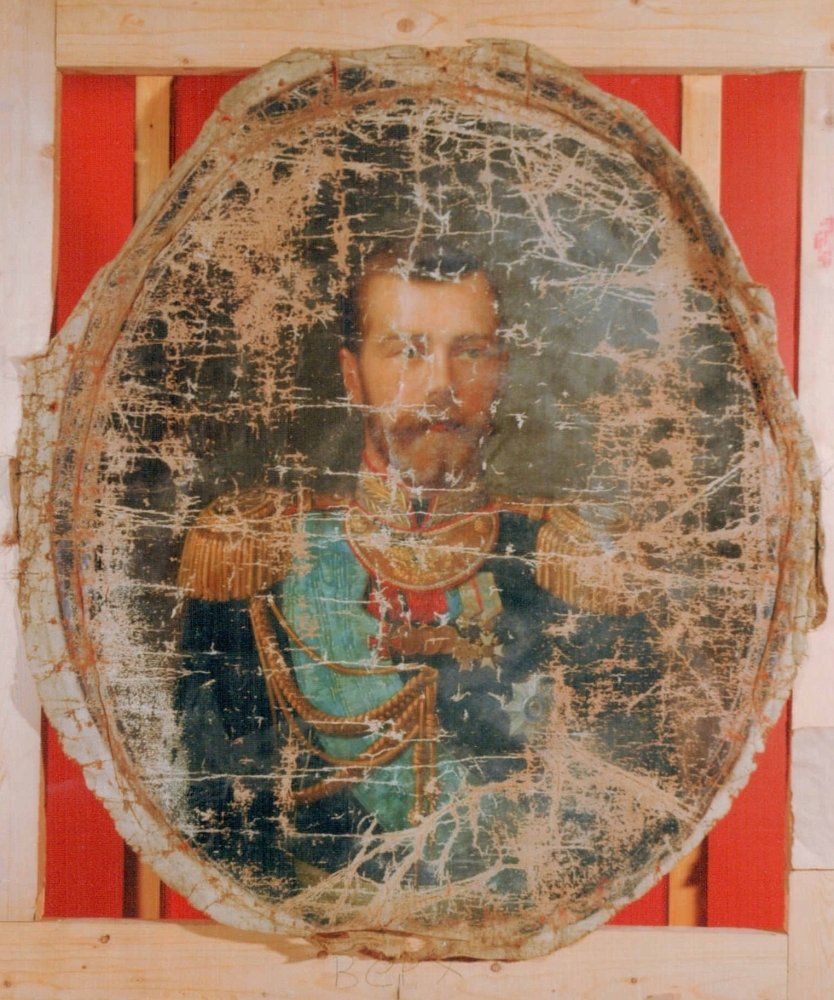
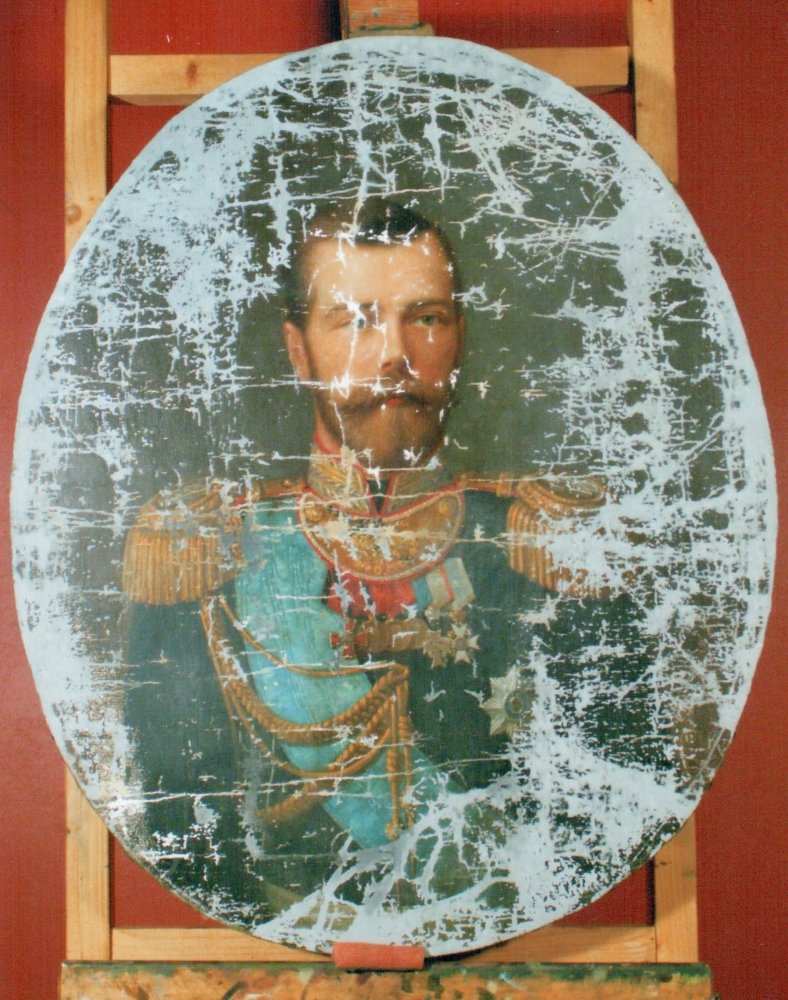
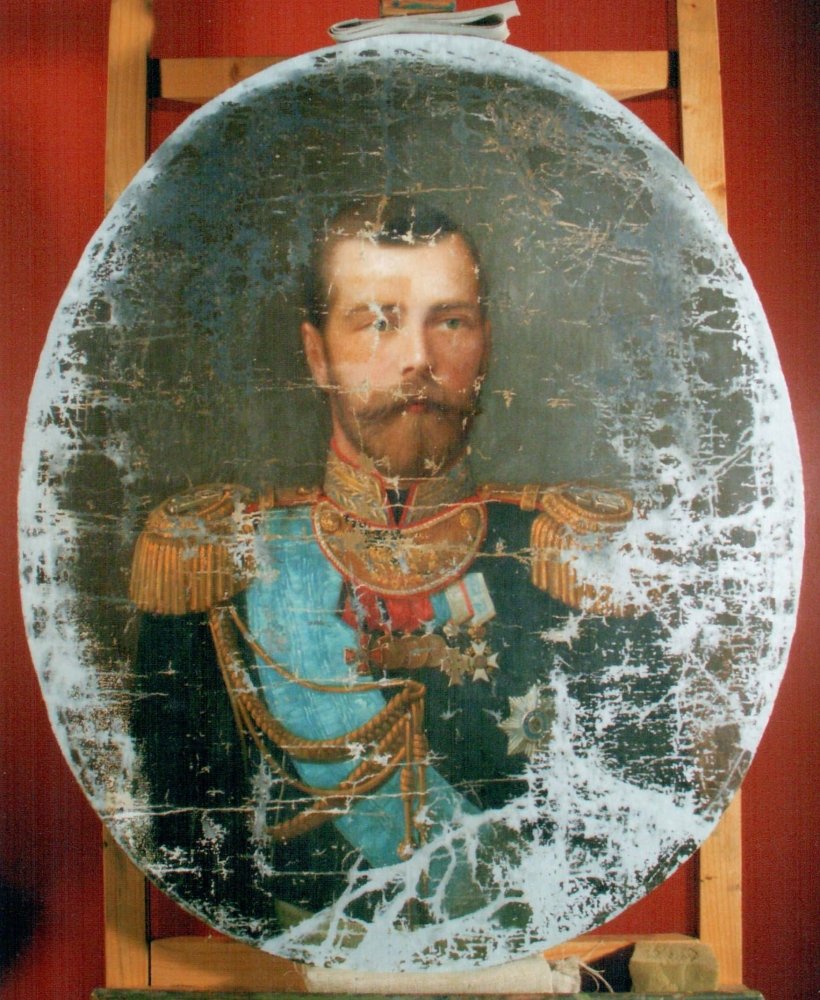
The portrait was in a terrible state, nearly destroyed after years of neglect. Within the remnants of the layer of paint, covered with numerous craquelures [a network of fine cracks in the paint or varnish of a painting], as if in a misty haze, one could discern the face of Emperor Nicholas II, distorted by a deep vertical fracture. But the portrait was in such a terrible state as the canvas had remained rolled up for almost half a century.
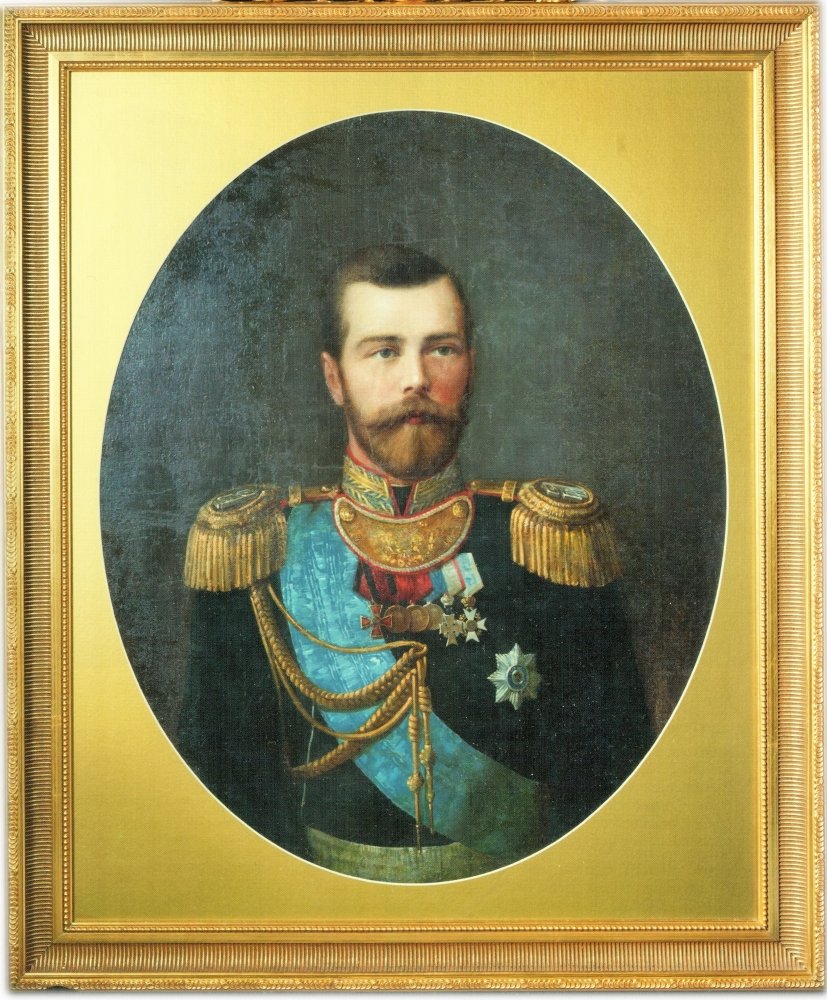
The restoration was entrusted to the masters of the Russian Academy of Painting, Sculpture and Architecture in St. Petersburg . It was established that Nicholas II was depicted in the ceremonial uniform of the Semenovsky Life Guards Regiment. The emperor was appointed chief of this regiment in 1894. Scrupulous attribution made it possible to establish that the portrait was made no earlier than 1896.
But how did it end up in Paris in the middle of the 20th century?
The photos show the various stages of restoration of the portrait
Semenovsky order
The portrait was commissioned by the officers of the Semyonovsky Life Guards Regiment, and hung in the dining room of the officers’ Assembly Hall. A certificate to confirm this was left by an officer of the regiment Yu.V. Makarov: “This dining room, the largest room in the Assembly, was so large that it could accommodate 130-150 diners. On the wall opposite from the entrance, right in the middle, hung a large half-length portrait of the sovereign founder of the regiment, Emperor Peter the Great, in dark oak In a quadrangular frame, the emperor was depicted in a green caftan, with a blue Semyonov collar. Two smaller portraits of Emperor Nicholas II in our uniform and Empress Alexandra Feodorovna in oval gold frames were positioned on either side of Peter’s portrait.”
The officers’ Assembly Hall was the center of regimental life. It was from here that in August 1914 the Semyonovsky Life Guards Regiment set out for battle. During the First World War, the regiment lost 48 officer. Then, in March 1917, the regiment lost its sovereign chief Nicholas II. In April, Colonel Alexander Vladimirovich Popov (1880-1963) was appointed the last Commander of the Semenovsky Life Guards Regiment.
It is to him that we owe the preservation of the portrait of Nicholas II.
PHOTO:Colonel Alexander Vladimirovich Popov (1880-1963) Last Commander of the Semenovsky Life Guards Regiment
In December 1917, the Semyonovsky Life Guards regiment was disbanded. All military ranks, in accordance with the Decree of the Soviets of Workers ‘and Soldiers’ Deputies on the destruction of estates and civilian ranks, were ordered to remove their shoulder straps and hold elections for commanding officers in the new Semyonovsky Guards Regiment. Popov refused to participate in the elections, and transferred the interim duties of commander to Colonel N.K. von Essen (1885-1945). On 10th December 1917 left for Petrograd, taking with him the portrait of Emperor Nicholas II.
The photos show the various stages of restoration of the portrait
Preserved memory
Popov was one of the initiators of the formation of guards units in the White movement. The revived Semyonovsky Life Guards Regiment fought in the South of Russia. Alexander Vladimirovich carried the portrait of the last sovereign chief through the entire Civil War.
In 1919 he emigrated to France and lived in Paris, where he headed the Association of the Semyonovsky Life Guards Regiment in France, was a member of the Union of Zealots in memory of Emperor Nicholas II, the Society of Lovers of Russian Military Antiquity, the Union of Russian Cadet Corps, and an honorary member of the Union of Transfiguration. Popov also served as director of the regimental museum, in which he sacredly kept the portrait of Nicholas II. In the late 1950s, when it became more and more difficult to preserve museum exhibits, they were transferred to the United States.
A few years later, 82-year-old Colonel Popov passed away. In the magazine Sentinel under the heading “Unforgotten graves” was placed a modest mention: “On March 28, 1963, the chairman of the Association of the Semenovsky Life Guards Regiment, the last commander of the regiment, Colonel Alexander Vladimirovich Popov, died in Paris.”
He was buried in the Sainte-Genevieve-des-Bois Cemetery in Paris.
PHOTO: the portrait of Nicholas II, after restoration
After the death of the collector who brought the portrait of Nicholas II to Moscow, the portrait was donated to the Museum of the Russian Guard in the General Staff Building [across from the State Hermitage Museum] in St. Petersburg.
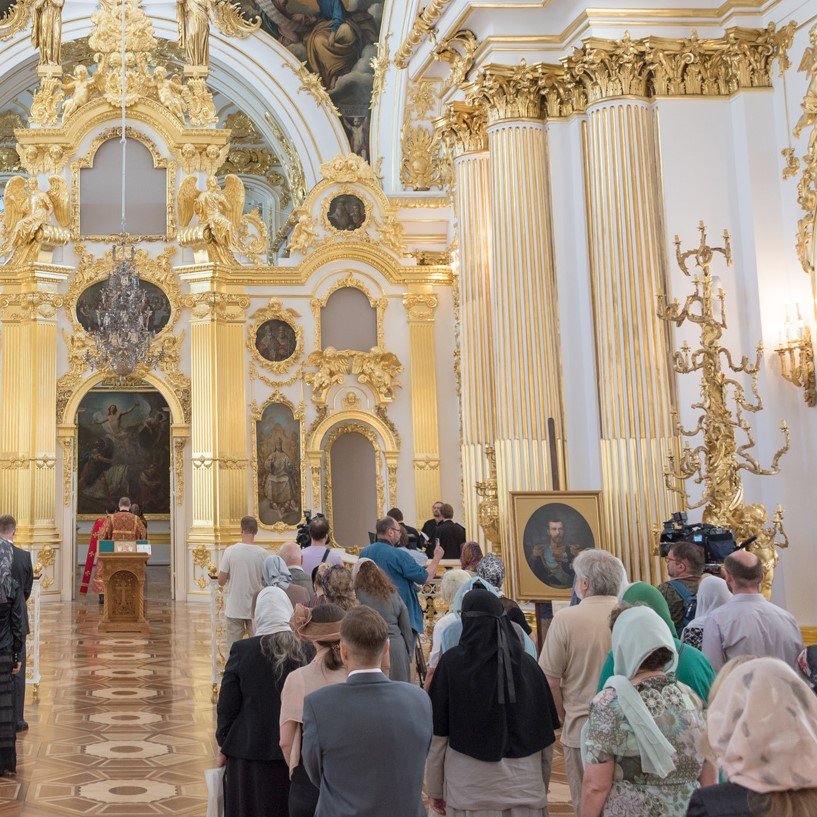
PHOTO: the restored portrait of Nicholas II displayed in the Winter Palace in 2018
On 17th July 2018, the day marking the 100th anniversary of the death and martyrdom of Russia’s last emperor and tsar, a Divine Liturgy was performed in the Church of the Savior Not Made by Hands [the home church of the Imperial Family] in the Winter Palace, led by the rector of the Prince Vladimir Cathedral, Archpriest Vladimir Sorokin. The restored portrait of Nicholas II by an unknown artist of the late 19th-early 20th centuries was displayed in the cathedral. Popov would have been pleased.










 Nicholas II
You must be logged in to post a comment.