Furniture from the Imperial Yacht ‘Polar Star’ gifted to State Hermitage Museum

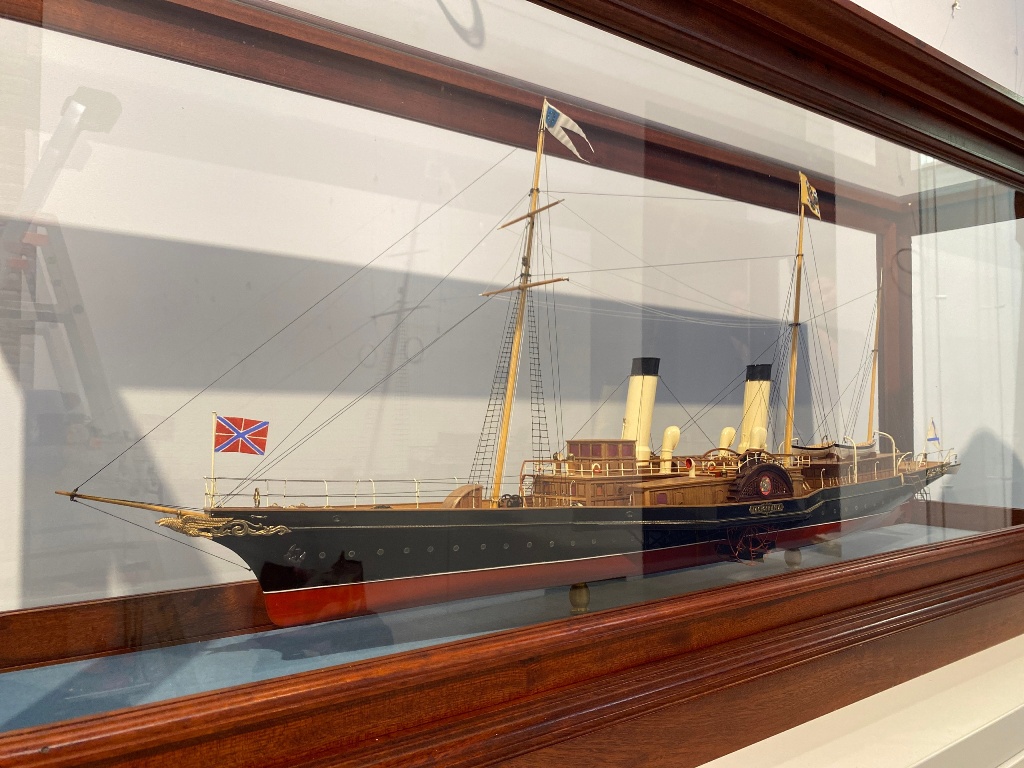
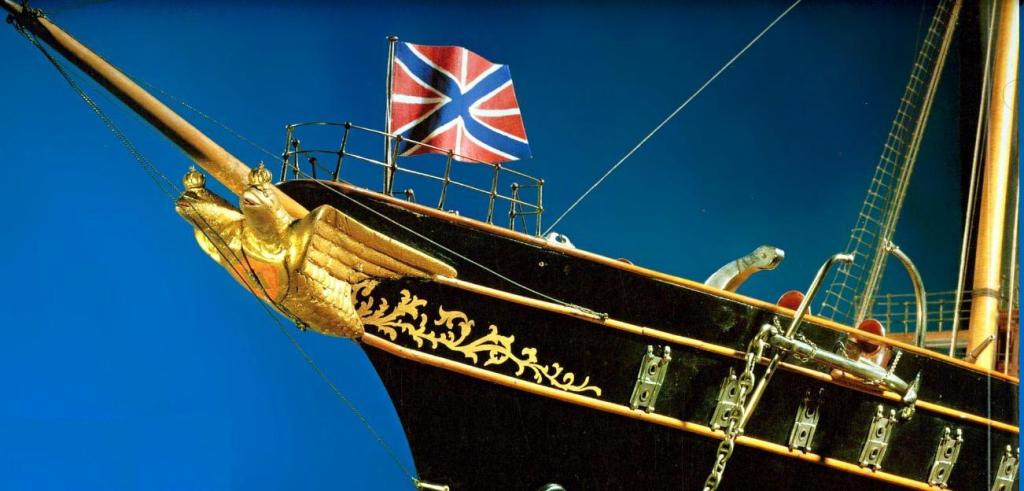
PHOTO: Model of the Imperial Yachts Polar Star «Полярная звезда»
From the Collection of the Central Naval Museum, St. Petersburg

On 29th June 2024, an exhibition of furniture from Emperor Alexander III’s yacht Polar Star «Полярная звезда» opened in the Gothic Library of Emperor Nicholas II situated in the Winter Palace (State Hermitage Museum) in St. Petersburg. The pieces have been donated to the Hermitage by Mikhail Yuryevich Karisalov, a Russian industrialist, art patron and hereditary collector.

The set is made up of ten items: two tables, an armchair, two low cupboards, a dressing mirror, a cartonniere (filing cabinet), two doors and a mirror from a cupboard. They were all made at Nikolai Feodorovich Svirsky’s (1851-after 1915) factory to designs by the architect Nikolai Vasilyevich Nabokov (1838-after 1907) -who also designed the furniture for the Gothic Library.

Svirsky’s factory specialized in producing pieces decorated with marquetry using “our own method”. The distinctive feature of the craftsmen’s signature was extremely intricate, literally jeweller-like, detail work in the inlaid designs, making it possible to convey the subtlest nuances of colour.

In 1889 Svirsky put his creations on show at the 1889 Paris Exposition, where he was awarded the Grand Prix and a gold medal. In 1894 the Svirsky Factory was granted the honorary title of Supplier to the Imperial Court, and two years later his products were awarded a gold medal at the All-Russian exhibition in Nizhny Novgorod.

The manufacture of the furnishings for all the cabins aboard the Imperial Yacht Polar Star that was built for the Imperial amily’s long-distant voyages would be one of Svirsky’s most significant commissions. The correspondent of the Pravitelstvenny Vestnik (Government Messenger] newspaper wrote: “Regarding the interior finishing of the yacht, it must be said that this is something wholly exceptional and perfect in its elegance; there is not gaudy, eye-catching splendour here, but there is artistic splendour… On the right, from the Imperial Dining-Room, a door leads into Her Majesty the Empress’s [Maria Feodorovna] boudoir; there the walls and furniture are upholstered with English waxed cretonne; the cupboard, toilet table, writing desk and doors are covered with superb inlay work…”

PHOTO: 10 pieces of furniture from the Imperial Yacht Polar Star, on display in the Gothic Library of Emperor Nicholas II in the State Hermitage Museum, St. Petersburg

The exhibition includes two items that the journalist mentioned – the Empress’s “toilet table” and a low cupboard inlaid with Maria Feodorovna’s monogram МФ (MF).

Emperor Alexander III and Empress Maria Feodorovna are known to have sailed all around Europe on the Polar Star. On arrival in different countries, they would happily show off the exquisite interiors of their floating home. Following the death of A;exander III in 1894, the Polar Star became the personal yacht of the Dowager Empress, which she used for her visits to Denmark and Great Britain.

After the October Revolution, the yacht became the headquarters of the Bolsheviks’ Central Committee of the Baltic Fleet (Tsentrobalt), then in the 1930s it was refitted to serve as a floating base for submarines. Later, a cable was run from the yacht, which was moored on the Neva River in front of the Hermitage, to provide electricity to the museum halls. Click HERE to learn about the fate of the Imperial Yacht Polar Star.

For the Hermitage, the items of furniture from the Polar Star are of especial value – from artistic, historical and memorial points of view. After the temporary exhibition in the Gothic Library, the set will find a place within the display devoted to the Art Nouveau era in the General Staff Building, where a separate room showcasing Svirsky’s works will be go on permanent display.

The exhibition curator is Natalia Yuryevna Guseva, Candidate of Art Studies, Deputy Head of the State Hermitage’s Department of the History of Russian Culture, keeper of the Russian furniture collection.

© State Hermitage Museum / Paul Gilbert. 15 July 2024

The last divine service for the Imperial Family in Ekaterinburg

On this day – 14th July (O.S. 1st July) 1918 – Archpriest Ioann Storozhev performed the last divine service for the Imperial Family in Ekaterinburg.

In October 1918 – three months after the death and martyrdom of Emperor Nicholas II and his family, Fr. John Storozhev, recalled the devine service he performed in the Ipatiev House on 14th July (O.S. 1st July) :

“… Taking up our [Fr. John Storozhev and Deacon Vasily Buimirov] places, the deacon and I began the reader’s service [similar to a liturgy, but much shorter since it does not include the Eucharist]. At a certain moment in the service, it is required to read the prayer “With the Saints Give Rest”. For some reason, on this particular occasion, the deacon, instead of reading, sang the prayer, and I, too, began to sing, somewhat disconcerted by this departure from the customary practice. But we had scarcely begun when I heard the members of the Romanov family, standing behind us, fell to their knees, and here I suddenly felt the sublime spiritual comfort that comes from shared prayer.

“This experience was even stronger when, at the end of the service, I read a prayer to the Mother of God, which, in highly poetic and moving words, expressed the plea of the afflicted person to be supported in his sorrows and receive the strength to bear his cross worthily.

“In addition, the deacon recited the Ectenia [often called by the better known English word litany], and I sang. Two of the grand duchesses sang along with me, and sometimes Nicholas Aleksandrovich sang in a low bass (for instance, he sang the “Our Father” and some other things). The service was uplifting and good, and the family prayed fervently.

PHOTO: Archpriest Ioann Vladimirovich Storozhev (1878-1927)

“The Tsar was clad in a khaki tunic and trousers with tall boots. On his chest he wore a St. George’s Cross. He had no shoulder boards [epaulettes]. He impressed me with his firm gait, his calmness. and especially his manner of looking steadfastly and firmly into one’s eyes. I didn’t notice any fatigue or traces of low spirits in him. It seemed to me that he had barely visible gray hair in his beard. His beard had been longer and wider when I saw him the first time. It seemed to me now to be trimmed.
“After the service, everyone approached the cross and the deacon handed prosphora [a small loaf of leavened bread used in Orthodox liturgies] to Nicholas Alexandrovich and Alexandra Feodorovna. Upon departing, I walked very close to the former grand duchesses, and heard a whispered “Thank you”. I don’t think it was just my imagination

“The deacon and I were silent until we reached the Art School building, and here, suddenly, he said to me: “You know, father, something’s changed there. Something’s happened”. His words struck a chord with me, and I stopped and asked why he he had gotten that impression. “Well, they were all different somehow. And also nobody sang.” And I have to say that, truly, this service of 14/1 July was the only one at which none of the Romanov’s sang with us (and the deacon had been present at all five services at the Ipatiev House).”

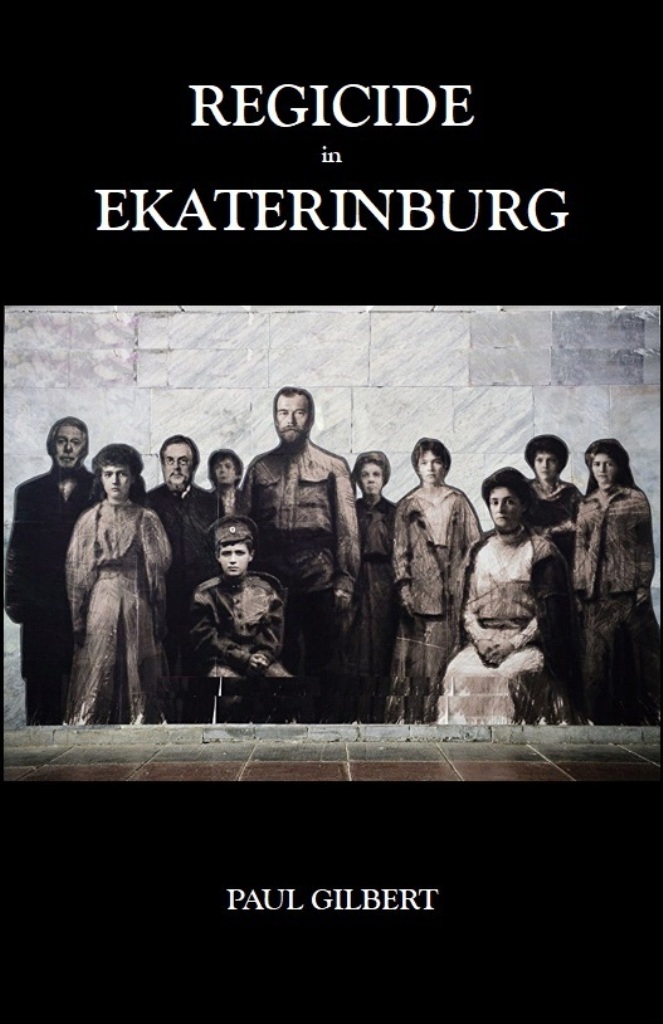
Source: The Last Sacred Service Observed by the Imperial Family in Yekaterinburg. The Testimony of Archpriest Ioann Vladimirovich Storozhev. First English translation published in Regicide in Ekaterinburg, compiled and edited by Paul Gilbert.

© Paul Gilbert. 14 July 2024

***

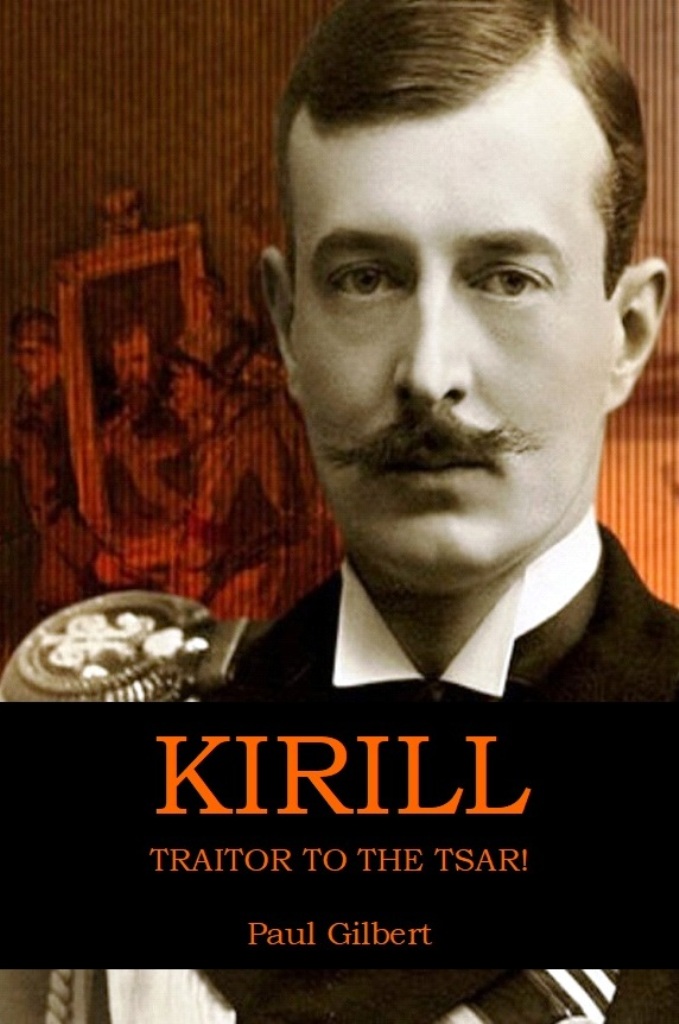
The following NEW title was compiled and edited by independent researchers and Romanov historian Paul Gilbert was published in August 2024. 

This fascinating new study features 14 chapters on this tragic event, which include the memoirs of a British intelligence officer and journalist, and two First-English translations. In addition, 11 chapters were written by Paul Gilbert, based on new documents sourced from Russian archival and media sources over the past decade.

Please refer to the link provided for further details about the content of this new title . . .

CLICK HERE TO READ MORE ABOUT THIS TITLE

Prince Ivan Ratiev: the man who saved the Imperial Regalia in 1917

PHOTO: Prince Ivan Dmitrievich Ratiev (1868-1958)

Prince Ivan Dmitrievich Ratiev (1868-1958) was a Georgian prince and a prominent officer of the Imperial Russian Army. He later served as a high-ranking official at the Winter Palace in St. Petersburg.

Ratiev was born in Oryol on 17th July 1868, into a branch of the Georgian princely house of Ratishvili, which had emigrated to the Russian Empire in 1724. He graduated from the Oryol Cadet Corps and then from the Nicholas Cavalry College. In 1890 he joined the 44th Nizhegorod Dragoon Regiment, deployed in Georgia. 

In 1896, he married Ekaterina Irakliyevna, née Princess Gruzinskaya (1872–1917), a great-granddaughter of King Heraclius II of Georgia (1720-1798) and a lady-in-waiting of Empress Alexandra Feodorovna (1872-1918). The couple had two children: Dmitri (1899-1926), and Olga (1902-1987).

PHOTO: Prince Ivan Dmitrievich Ratiev with his wife
Ekaterina and their two children Dmitri and Olga

Ratiev retired from army service due to a trauma sustained in a horse race at Tbilisi in 1907. He then studied at Academy of Fine Arts in Paris and, after his return to Russia, worked for the Ministry of the Imperial Court in St. Petersburg. He was assigned to an army cavalry unit of the Winter Palace with the rank of rittmeister [riding master]. By the Imperial Order of 6th December 1913, he was made a lieutenant-colonel of the Imperial Guard cavalry and an acting Police Master of the Winter Palace. Promoted to the rank of colonel in 1916, Prince Ratiev was appointed as a deputy commandant of the Winter Palace in April 1917, two months after the February Revolution overthrew the tsar Nicholas I

It was during the storming of the Winter Palace in October 1917, for which Ratiev is best known. Thanks to his heroic efforts, he managed to save the Imperial Regalia[1] from being looted or destroyed by revolutionary thugs.

On 7th November (O.S. 25th October) 1917, Ratiev did not flee his post like so many others during these turbulent time, instead he ordered his guards to transfer the Imperial Regalia to safer parts of the Palace. The prince sent his 16-year-old son Dmitri and two of his most trusted grenadiers to guard the secret depository, which, among other precious objects, which included the Russian Imperial Crown adorned with 4936 diamonds, the Orb and the Sceptre incorporating the Orlov diamond.

Upon confronting the revolutionaries, Ratiev negotiated with the Bolshevik leader Vladimir Alexandrovich Antonov-Ovseenko (1883-1938), who oversaw the armed assault of the Palace, which led to successful negotiations to preserve the Imperial Regalia.

PHOTO: The Imperial Regalia: crowns, orb, and sceptre laid out in preparation for the historic crowning of Russia’s last tsar Nicholas II in Moscow on 27th May (O.S. 14th May) 1896

The Soviet leadership publicly expressed their gratitude to Prince Ratiev in the 5th November 1917 edition of Izvestia[2] for his “self-sacrificing efforts to protect and preserve the people’s treasures” and appointed him the chief commandant of the Winter Palace and of all state museums and palaces in the Petrograd district.

In March 1919, Ratiev escorted the “golden echelon”, a train carrying Russia’s gold reserve, following the transfer of the Russian government from Petrograd to Moscow. During the journey, however, Ratiev was pressured into surrendering the train and even being fired upon at Tver. Ratiev retired from the state service shortly thereafter and worked as a translator for various organizations of Moscow for several years. 

His subsequent life was marred by the loss of his wife and son, the latter who drowned while swimming in the Moscow River. In March 1924, Ivan Ratiev, his daughter Olga and sister Sophia were arrested on charges of belonging to a “counter-revolutionary monarchist organization.”

Initially, Ratiev was sentenced to five years in the Gulag, however, due to his service in 1917, the sentence was commuted to exile to Ekaterinburg, where the family spent 3 years.

In 1931, Ratiev moved to the Georgian capital of Tbilisi, where he lived as a “state pensioner”. He died on 28th April 1958, at the age of 89.

NOTES:

[1] Before the 1917 Revolution, the Imperial Regalia, which included the Imperial Crown, orb and sceptre, were stored in the Diamond Chamber of the Winter Palace in St. Petersburg. In May 1896. the Imperial Regalia were transported by train and under heavy guard to Moscow, for the Holy Coronation of Emperor Nicholas II. During the First World War, the Imperial Regalia was moved to Moscow and stored in the Armory Chamber of the Kremlin. In 1922, the Soviet Diamond Fund was established. Today, the Imperial Regalia is stored in the Diamond Fund vault (opened in 1967).

[2] Izvestia (“The News”) is a daily broadsheet newspaper founded in February 1917, Izvestia, which covered foreign relations, was the organ of the Supreme Soviet of the Soviet Union, disseminating official state propaganda. It is now described as a “national newspaper” of Russia.

© Paul Gilbert. 11 July 2024

The sakkos from the coronation of Nicholas II on display in Russia for the first time

A new exhibition Russian Masters. Artistic Traditions and Ideals has opened at the State Museum of the History of Religion in St. Petersburg. The exhibition presents objects of the Orthodox liturgy and reveals their symbolic meaning, including vestments, censers, lampadas, crosses, icons in luxurious casings, and items of Russian silversmithing of the 19th-early 20th centuries.

Among the 100 items on display is an episcopal liturgical vestment – sakkos – which was made for the Orthodox clergy who participated in the Holy Coronation of Emperor Nicholas II, held in Moscow on 27th May (O.S. 14th) May 1896. It is made of a rich brocade fabric and intricately decorated with traditional Russian eagles. The sakkos is being exhibited for the very first time.

The exhibition Russian Masters. Artistic Traditions and Ideals runs until 25th January 2025.

***

The sakkos is a vestment worn by Orthodox bishops instead of the priest’s phelonion. The bishop wears the sakkos when he celebrates the Divine Liturgy and other services when called out by the rubrics.

© Paul Gilbert. 10 July 2024

Efforts to locate the remains of Nicholas II and his family during the Brezhnev era

PHOTO: Nikolai Anisimovich Shchelokov (1910-1984)

Nikolai Anisimovich Shchelokov (1910-1984) was a Soviet statesman. From 1966 to 1982 he served as Minister of Internal Affairs of the USSR. He was a member of the Communist Party of the Soviet Union (CPSU) from 1931 to 1984, and member of the Central Committee of the CPSU from 1968 to 1983.

Shchelokov was the first person who began the search for the remains of Emperor Nicholas II and his family. When asked about the initiative, Shchelokov told the film director, screenwriter, acclaimed author Geliy Trofimovich Ryabov (1932-2015): “We, as Russian people, must fulfill our duty and find the remains of the Tsar”. Shchelokov ordered the head of the Sverdlovsk Internal Affairs Directorate for their full cooperation in the search.

What made the representative of the highest echelon of Soviet power, who had been building communism all his life, deviate so radically from the general line of the party and make every effort to resurrect one of the darkest pages of early 20th century Russian history?

PHOTO: Leonid Ilyich Brezhnev (1906-1982)

Acquaintance with Leonid Brezhnev

Born on 13th November 1910 in the family of a metallurgist, Nikolay Shchelokov got his first job as a horseman in a mine at the age of 16, and at the same time received a higher education at the Dnepropetrovsk Metallurgical Institute.

After spending a year at the Dnepropetrovsk Metallurgical Plant, Nikolay Shchelokov was elected 1st Secretary of the Krasnogvardeysky District Committee of the Communist Party (Bolsheviks) of Ukraine in Dnepropetrovsk. It was during the years 1938-39 that he first met with Leonid Ilyich Brezhnev (1906-1982), who later took the post of General Secretary of the Central Committee of the CPSU, and persuaded his old acquaintance to move to Moscow and head the Ministry of Internal Affairs.

Nikolai Anisimovich received this offer in 1966, and before that he managed to become a participant in the Great Patriotic War (1941-45), after which he was appointed to the post of executive secretary of the party commission at the political department of the Carpathian Military District, where Leonid Brezhnev served as the head.

From August 1946, Shchelokov held a position in the Ministry of Industry of the Ukrainian ASSR, worked in the apparatus of the Communist Party of the same republic, and in 1951 he was sent to the Moldavian ASSR, where he rose to the post of second secretary of the Central Committee of the Communist Party.

In Moscow

Having lured the energetic leader to Moscow, Brezhnev set him the task of reviving the Ministry of Internal Affairs abolished in 1960 by Nikita Sergeyevich Khrushchev (1894-1971).

His mandate was to restore the fallen authority of the police in Soviet society To do this, among other things, he used the power of art. It was during this period that many detective stories appeared in bookshelves, where law enforcement officers where depicted to the reader in a positive light, and films about the daily exploits of ordinary employees of the Ministry of Internal Affairs were released on cinema screens.

Shchelokov coped with the duties assigned to him brilliantly, for which he was awarded the title of Hero of Socialist Labor of the USSR.

PHOTO: Nikolai Shchelokov with his daughter Irina Shchelokova

Friendship with dissidents

An interesting fact about Nikolai Anisimovich was his open friendship with dissidents who had liberal and monarchist views.

Among the disgraced personalities with whom he had warm relations were the musician Mstislav Rostropovich, the singer Galina Vishnevskaya, the writer Alexander Solzhenitsyn, the artist Ilya Glazunov, and Archbishop Pimen of Saratov and Volsk.

Perhaps it was after communicating with them that Shchelokov had the idea to find the remains of the murdered Imperial Family and bury them according to the Christian rite.

According to the memoirs of Irina Shchelokova (d. 2021), the daughter of the Minister of Internal Affairs, her father could not be convicted of dissent. She explained his interest in the last Tsar and his family by his high level of erudition, a keen sense of justice, as well as the fact that her father got hold of materials -which were classified at the time – regarding the investigation of the circumstances of the death of Nicholas II and his family.

At the same time, Boris Konstantinovich Golikov, an assistant to Shchelokov, believed that his boss became obsessed with the idea of finding the remains of the Romanovs after a meeting with a former NKVD officer, a certain “Snegov”. The latter was taken into custody in the 1930s and sat in the same cell with a prisoner who participated in the burial of the bodies of the Imperial Family in July 1918. Subsequently, this man was shot, but he managed to tell “Snegov” about the burial place of the remains, which the latter later told Shchelokov, and even handed him a hand-drawn map.

PHOTO: Geliy Trofimovich Ryabov (1932-2015)

Help for filmmakers

To implement his plan to find the remains of the Romanovs, Nikolai Anisimovich sought the help of Geliy Ryabov, co-author of the book “Born by the Revolution”.

According to Ryabov’s memoirs, who held the position of consultant of the Ministry of Internal Affairs on cultural issues, in 1976, he was supposed to visit Sverdlovsk (now Ekaterinburg) on a working trip. Before embarking on his journey, he was summoned by Shchelokov and casually told that not so long ago he had visited the Ipatiev House, where the Imperial Family had been murdered by the Ural Soviet (Bolsheviks) on 17th July 1918. He communicated this information to Ryabov in the hope of getting him interested in the case and was not mistaken.

The writer, having arrived in the capital of the Urals, also wanted to visit the site where the Tsar and his family had been murdered, and somehow without any problems received the appropriate permission. After making a tour of the house, Ryabov was inspired by the idea of finding the remains of Nicholas II and his family.

Returning to Moscow, Ryabov turned to Shchelokov with a request for assistance in this dangerous assignment. The delighted Minister of Internal Affairs contacted Leonid Brezhnev and asked him to provide Ryabov with access to the “Tsar’s Archive”.

A month later, the Secretary General gave his go-ahead, and Ryabov plunged headlong into the study of classified documents, trying to find at least some clue.

As a result, his efforts were crowned with success aftern he discovered the “Yurovsky Note” – written by the commandant of the Ipatiev House and chief executioner of the the Imperial Family, which contained the coordinates of the burial place of the bodies of the Tsar and his family.

Having provided Ryabov with accurate topographic maps of the area, and having organized his protection and unhindered work, Shchelokov began to wait for news of the investigation. On 1st June 1979, Geliy Trofimovich and geologist Alexander Avdonin, who helped him in the search, found the sought-after remains.

However, Shchelokov did not manage to organize a dignified reburial of the Imperial Family’s remains, he was forced to abandon his search by a discrediting campaign that began against him.

Alternate versions

At was at this time, that several more interpretations of why the Minister of Internal Affairs abandoned the search for the remains of the Imperial Family.

Some researchers argued that he did not act on his own, but carried out the order of higher authorities who wanted to find and destroy the bones of the murdered Imperial Family.

Other theories included an outrageous claim insisting that Shchelokov wanted a royal burial in order to find and remove any jewelry from the gravesite.

Even more ridiculous was from Igor Bunich’s work of fiction “The Tale of Lawlessness, or the Syndrome of Nicholas II” a hypothesis is put forward that Shchelokov launched a search for the remains of the Romanovs in order to secretly sell them to the West. The buyer was allegedly a certain monarchical structure associated with the British Royal Family. For the deal, the Home Secretary was allegedly offered £200,000, of which £30,000 was given to him as an advance and spent by him on the organization of the search operations.

It was not until 1991, that the remains of Emperor Nicholas II and his family were exhumed and later buried in the SS Peter and Paul Cathedral in St. Petersburg on 17th July 1998.

© Paul Gilbert. 9 July 2024

Caucasian sword belonging to Nicholas II to be auctioned in London

Despite Western sanctions against Russia, which include the cancelation of all cultural exchanges [i.e. exhibitions, auctions, etc.], works of Imperial Russian art continue to break records at British, American and French auctions. Paintings by Aivazovsky, Vereshchagin and Repin, luxurious pieces of jewelry made by Fabergé, find their new buyers. Despite the political chaos, the antique market continues to thrive.

On 13th July 2024, a unique Caucasian shashka, which, according to researchers belonged to Emperor Nicholas II, will be sold at the Apollo Art Auctions in London,

The extremely fine-quality Caucasian shashka given to Nicholas II, when he was Tsesarevich (heir apparent). Research suggests the saber was presented to Nicholas during a tour of the Caucasus with his father Emperor Alexander III, in 1888. An Arabic inscription in gold on the blade translates to: (M)ay the dominance of the owner of this sword grow, and his life, and his greatness, and may Allah bless his family, and he will achieve his goal.

It is also monogrammed with the Cyrillic letters “HA” – “NA” in English – (for Nicholas Alexandrovich), surrounded by a golden laurel and surmounted by the Imperial Russian Crown. Its wonderfully-decorated scabbard bears a calligraphic Arabic inscription that would be the equivalent of a European maker’s mark. Translated, it says “Abdullah worked.”

Held in consecutive European private collections, including the Eugene Mollo collection (Switzerland), it is the first royal sword ever to be offered for public sale. It requires an opening bid of £1,200,000 ($1,516,300 USD).

Photos provided in this post are courtesy of the Apollo Art Auctions

© Paul Gilbert. 8 July 2024

New museum dedicated to Nicholas II to be built in Mogilev

PHOTO: Emperor Nicholas II reviews his troops on the square in front
of General Headquarters in Mogliev during the First World War

A new museum complex is to be constructed in Mogliev, situated in eastern Belarus, about 76 kilometres (47 miles) from the Russian border. The complex will be built on a hill in Gorky Park, next to the Church of the Holy Royal Passion-Bearers – the family of the last Russian Emperor Nicholas II, who were canonized as saints in 1981 by the Russian Orthodox Church Outside Russia (ROCOR), and in 2000 as passion-bearers by the Moscow Patriachate.

On 8th August 1915, the Headquarters (Stavka)  of the Supreme Commander-in-Chief of the Armed Forces of the Russian Empire was transferred from Baranovichi to Mogilev. From August 1915 to March 1917, Emperor Nicholas II, served as Commander-in-Chief[1].

The Tsar travelled back and forth on the Imperial Train, from Tsarskoye Selo to Mogilev, where he settled in the Governor’s House, situated on Gubernatorskaya Square. He was often accompanied by his son and heir Tsesarevich Alexei Nikolaevich.  

The new museum will be dedicated to the events of the early 20th century: the First World War, the Headquarters of the Supreme Commander-in-Chief of the Russian Army, the stay of of Emperor Nicholas II in Mogliev, the Knights of St. George, and the February Revolution of 1917.

The timing of the project has yet to be announced, however, the following architectural drawings gives us a first glimpse of the museum complex. As you can see, the building complements that of the adjoining Church of the Holy Royal Passion-Bearers:

NOTES:

[1] On 5th September (O.S. 23rd August) 1915, Emperor Nicholas II assumed personal command of the Russian Imperial Army, after dismissing his cousin, Grand Duke Nicholas Nikolaevich (1856-1929) from the post.

© Paul Gilbert. 3 July 2024

Nicholas II in the news – Spring 2024

Russia’s last Emperor and Tsar Nicholas II, his family, the Romanov dynasty and the history of Imperial Russia, continue to be the subject of books, exhibitions and documentaries. In addition, they continue to generate headlines in the media.

The following 7 articles were published by American and British media services, in April, May and June 2024. Click on the title [highlighted in red] below and follow the link to read each respective article:

Holy Grand Duchess Anastasia Nikolaevna (1901-1918) + PHOTOS

June 18th (O.S. 5th June) marked the 123rd anniversary of the birth of the fourth daughter of Emperor Nicholas II and Empress Alexandra Feodorovna—Grand Duchess Anastasia Nikolaevna. In this article Maria Tobolova writes about Anastasia’s life, death and martyrdom.

Source: Orthodox Russia. 26 June 2024

Holy Grand Duchess Tatiana Nikolaevna (1897-1918) + PHOTOS

June 11th (O.S. 29th May) marked the 127th anniversary of the birth of the second daughter of Emperor Nicholas II and Empress Alexandra Feodorovna—Grand Duchess Tatiana Nikolaevna. In this article Maria Tobolova writes about Tatiana’s life, death and martyrdom.

Source: Orthodox Russia. 17 June 2024

Women’s dress code at the tsar’s court: dresses in Russian style + PHOTOS

Empresses, grand duchesses, princesses and maids of honor wore kokoshniks with precious stones and ‘sarafans’ (sundresses) decorated with expensive lace. This was exactly what court etiquette demanded.

Source: Russia Beyond. 14 June 2024

The most BEAUTIFUL tiaras of Russian empresses + PHOTOS

The Imperial Family’s casket contained many tiaras, some of which had huge diamonds and emeralds. What happened to them after the 1917 Bolshevik Revolution?

Source: Russia Beyond. 7 June 2024

Russian Classes: How to refer to relatives

Get familiar with the Romanov family and learn Russian!

Source: Russia Beyond. 8 May 2024

Imperial Splendor: Artifacts from Tsar Nicholas II’s Coronation + PHOTOS & VIDEO

The coronation of Tsar Nicholas II in May of 1896 was a spectacle of grandeur that was to be the last of its kind. The artifacts preserved from this historic event, housed at the Russian History Museum in Jordanville, NY, offer a tangible connection to the opulence and solemnity of that day.

The museum collection contains dozens of objects and documents relating to this occasion: books, photographs, programs, menus, porcelain, prints, and commemorative scarves and beakers. The following selection reflects the artistic trends of the time, but also encapsulates a significant moment before the fall of an empire.

Spurce: Russian Historical Museum

“Какие прекрасные лица”… “What Beautiful Faces” + 80 PHOTOS

Anton Pospelov has compiled a wonderful collection of more than 80+ vintage photographs of Nicholas II, Alexandra Feodorovna and their children, from their private family albums . . .

Source: Orthodox Russia. 28 March 2024

© Paul Gilbert. 30 June 2024

***

CLICK HERE TO REVIEW THE CATALOGUE

The fate of an icon gifted by the last Russian empress to Anastasia Hendrikova in October 1917

PHOTO: an icon depicting St. John of Tobolsk, gifted by Empress Alexandra Feodorovna to Anastasia Hendrikova in 1918, sold at a Paris auction to a private collector in 2021

The former lady in waiting to Empress Alexandra Feodorovna, Countess Anastasia Hendrikova (1888-1918) has been very much in the news of late. On 30th May 2024, the Perm Diocese announced that a forensic study confirmed the identity of Hendrikova’s remains, along with those of Ekaterina Schdeider, On 9th June 2024, a Funeral (Memorial) Litany was served in a Perm church. In recent days, yet another story about Hendrikova appeared in the Russian mdeia which deserves mention.

In August 1917, Anastasia Hendrikova voluntarily followed Emperor Nicholas II and his family into exile to Siberia, where they were held under house arrest for 8 months. During those difficult days, Hendrikova proved to be a great source of comfort to Empress Alexandra Feodorovna, to whom she was devoted. She helped the Empress endure the hardships of exile and imprisonment.

On 29th October 1917, the Empress presented her devoted maid of honour with an icon depicting the image of St. John (Maximovich) of Tobolsk[1]. On the back of the icon the Empress had written the inscription «Спаси и сохрани / 29.X.1917 / Тобольск / Александра» [“Save and Protect. 29.10.1917 / Tobolsk / Alexandra”]. The size of the icon measured 22.3×17.3 cm. In a wooden case — 25.3 × 20.3 cm. 

On the reverse of the icon case, there is a bronze engraved plate with the inscription “This icon was given by H.I.M. Alexandra Feodorovna, to maid of honour Countess Anastasia Vasilievna Hendrikova during the stay of the Imperial Family in Tobolsk.”

PHOTO: Countess Anastasia Hendrikova (1888-1918) 

On the part of the Empress, it was indeed a gift of great value and affection, a testimony of deep friendship in sharing the suffering of imprisonment. Countess Hendrikova was then 29 years old.

After her imprisonment in Perm and the murder of the Imperial Family, Countess Anastasia Hendrikova was taken from prison to the Cheka on 21st August 1918, where she was interrogated. One of the investigators asked her whether “she voluntarily followed the Romanovs to Tobolsk. She replied that she went voluntarily.

“Well,” he replied “since you are so devoted to them, tell us: if we were to let you go now, would you return to them again and continue to serve them?”

“Yes, until the last day of my life,” she replied. A few weeks later, Anastasia Hendrikova was shot by the Bolsheviks on the night of 3/4 September 1918 in Perm.

PHOTOS: (above) on the back of the icon Empress Alexandra wrote an inscription “Save and preserve / 29.X.1917”; (below) a bronze engraved plate with an inscription dedicated to Anastasia Hendrikova from the Empress.

After Hendrikova’s murder, the icon found it’s way into the hands of her brother Count Pyotr (Peter) Hendrikov[2]. For many years, he kept the icon as a family shrine and took it with him when he went to live in France. In his old age, he donated the icon to the orphanage church of the Russian Military Invalids situated near Paris.

But in 2001, the unexpected happened – the church and the orphanage were destroyed by fire. The ancient icon could have been lost forever, had it not for the priest Mikhail Gudkov, who found the precious relic among the burned out ruins of the church.

Father Mikhail cherished the historical value of the icon, and before his death he passed it on to his son.

In the autumn of 2021, the ancient icon, which has become a symbol of boundless love and loyalty, went under the hammer at a Moscow’s famous Litfond Auction House[3], as part of their “Relics of the House of Romanov” sale. The auction was held on 30th September 2021. The icon of St. John of Tobolsk was listed at 1.6 million rubles [$18,400 USD] and sold for 2.6 million rubles [$30,000 USD] to a private collector in Russia.

NOTES:

[1] In August 1915, Emperor Nicholas II sanctioned the canonization of St. John (Maximovich) of Tobolsk (1651-1715). The solemn glorification of John of Tobolsk took place the following year, on 10th June 1916. He was the last saint to be canonized during the reign of Russia’s last Tsar.

[2] Pyotr (Peter) Vasilyevich Hendrikov (1883-1942) died in Paris on 13th February 1942.

[3] The Litfond auction house is the undisputed leader among auction houses in Russia, occupying about 60% of the market. About 100 auctions are organized in Moscow and St. Petersburg each year.

© Paul Gilbert. 18 June 2024

Photo exhibit dedicated to the Imperial Family opens in Belgrade

On 14th June 2024, a small photo exhibition dedicated to Emperor Nicholas II and his family opened in Belgrade, the capital of Serbia. The exhibition Christian Love Is Stronger Than Death features 100 vintage black and white photographs.

The exhibition project was created with the desire and goal of introducing the personalities and deeds of the last Russian Tsar and his family to the Serbian people. The exhibition’s organizers hope to awaken the memory of the Imperial Family, get to know more closely about the life and sacrificial service of the last Russian Tsar, his wife and their five children. In doing so, the organizers made an effort in selecting photos which reflect the beauty of the Imperial Family, their everyday life and service for the benefit of the Fatherland and its people.

The exhibition consists of black-and-white photographs from historical archives and personal albums of the Imperial Family. The exhibition is thematically divided into three sections. The first section features photos of Nicholas II and his family, taking part in events, such as parades and processions, etc. This section of photos reflect all the beauty of the Slavic character, and also provides insight into the fashion and style of clothing from the late 19th and early 20th centuries.

The second second section features photographs from the personal albums of the Imperial Family, all of whom were avid amateur photographers. It is well known that Nicholas II was especially fond of photography. Many of these images are informal and taken spontaneous, often capturing their subject in natural settings, carefree, laughing and enjoying their close knit family time. In these photographs, visitors will see members of the Imperial Family walking and resting in the Alexander Park at Tsarskoye Selo or Livadia, the August children playing games, taking part in their favourite outdoor activities, etc. These photos are considered rare, only because they were taken by family members and never intended for public display.

The third and last section of the exhibition features photos of military themes. They depict the Emperor blessing his troops before going to war, trying out new weapons used by his army, presenting orders and medals, and introducing his son and heir to the secrets of warfare.

This section also includes photos of the Empress and her four daughters engaged in humanitarian work. They visited the wounded, helped sick soldiers with deeds and kind words. From their diaries, it is known that they assisted even in the most difficult operations. Their acts of mercy are documented while nursing soldiers.

The collection of photographs of the Imperial Family was provided by Hieromonk Ignatius (Shestakov), a brother of the Sreten Monastery in Moscow, who is also one of the exhibitions organizers.

The Christian Love Is Stronger Than Death exhibition runs from 14th to 20th June 2024 at at 17 Kralja Milana Street (across from Belgradeanka) in the Serbian capital.

***

*As I have noted in similiar posts, I support any initiative – big or small – to help keep the memory of Nicholas II and his family alive in post-Soviet Russia – PG

© Paul Gilbert. 18 June 2024