
The Alapaevsk Martyrs painted in 1997 by the contemporary Russian artist Vera Glazunova
The above painting include: Grand Duchess Elizabeth Feodorovna, Grand Duke Sergei Mikhailovich, Princes of the Imperial Blood Ioann, Konstantin and Igor Konstantinovich, Prince Vladimir Paley (son of Grand Duke Paul Alexandrovich), and two faithful servants: sister of the Marfo-Mariinsky Convent Varvara Alekseevna (Yakovleva), and Fyodor Semyonovich (Mikhailovich) Remez, secretary of the Grand Duke Sergei Mikhailovich – PG
***
WARNING: please be aware that this post includes graphic images of the dead bodies of the Alapaevsk victims, which some readers may find disturbing.
On this day – 18th July 1918 – Grand Duchess Elizabeth Feodorovna was murdered by the Bolsheviks in Alapaevsk. According to Russian historian and author Ludmila Kulikova, there are still many conjectures surrounding her death.
In 2019, a new book titled «Крестный путь преподобномученицы Великой княгини Елисаветы Феодоровны на Алапаевскую Голгофу / The Way of the Cross of the Holy Martyr Grand Duchess Elisabeth Feodorovna to the Alapaevsk Golgotha» was published in Russia.
The Russian language book by Ludmila Kulikova, features 728 pages!, with photographs, and copies of original documents. It presents a new account of the life and death of the Grand Duchess, revealing many new details.
Kulikova challenges the findings presented by Lubov Miller in her book Grand Duchess Elizabeth of Russia: New Martyr of the Communist Yoke, published in 2009. The Russian author disputes Miller’s popular held belief, that the Grand Duchess and the other Alapaevsk victims were thrown into the mine alive. Kulikova also disputes Millers’ claims that the victims could be heard singing an Orthodox hymn from the mine shaft, that Elizabeth Feodorovna bandaged the head wound of Prince Ioann Konstantinovich in the dark, and more. According to Kulikova: “they are all myths!”
Kulikova points out that the findings of Lubov Miller are not confirmed by any documents of the original investigation and forensic medical examination. In order that readers can see for themselves, she decided to publish all the documents of the preliminary investigation on the murder of the Grand Duchess and members of the House of Romanov, which was conducted in 1918, by the investigator Nikolai Alekseevich Sokolov (1882-1924)..
There are a lot of documents in the file: protocols of the inspection of the mine, the bodies and personal items found, the results of the forensic medical examination, the interrogation of witnesses. These materials have not been published in full in Russia, only excerpts.

Receipt signed by Grand Duchess Elizabeth and other members of the Imperial family
with regard to their transfer from Ekaterinburg to Alapaevsk, dated 19th May 1918
There was no singing of an Orthodox hymn from the mine
– With regard to the belief that after being pushed into the mine, the victims began to sing an Orthodox hymn, they are referring to the testimony of one of the witnesses, a local resident Alexander Samsonov. Samsonov brewed moonshine in the forest not far from Alapaevsk, but still far from the mine where the murder took place.
Acquaintances came to to warn him that he had been denounced for making moonshine (it was against the law). Samsonov hid the bottles and the still and returned home in the evening. The murder of the Alapaevsk martyrs was committed that night.
The version could also have come from the memories of one of the participants in the murder – Vasily Ryabov (his memoirs were written later, but Kulikova gives an excerpt from them in my book). Ryabov tells how Elizabeth Feodorovna was first pushed into the mine, then Varvara, and suddenly everyone heard them floundering in the water, trying to save each other.
It was in these “memories” that he mentions the victims singing an Orthodox hymn “Save Lord, Your people” from the bottom of the mine. But none of this is supported by facts: the water was at the very bottom of the mine, but had been filled with debris. None of the bodies made it to the water.

The bodies of the Alapaevsk Martyrs were brought to the morgue in the
cemetery of the Church of St. Catherine. Alapaevsk. October 1918

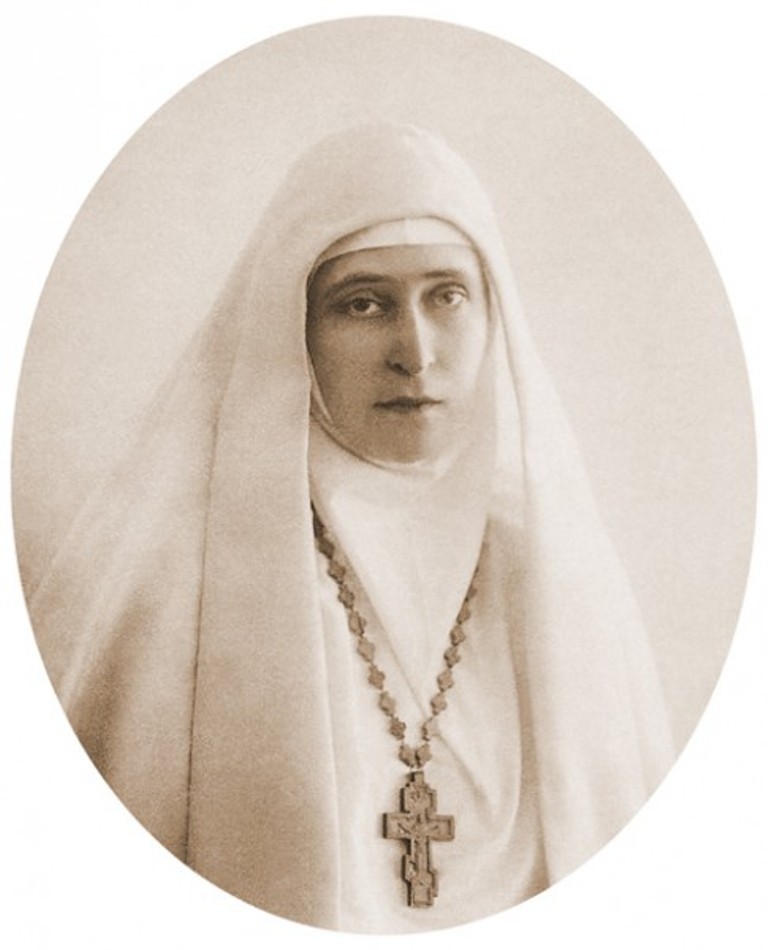
Grand Duchess Elizabeth Feodorovna

Varvara (Yakovleva)

Grand Duke Sergei Mikhailovich

Fyodor Semyonovich (Mikhailovich) Remez

Prince Ioann Konstantinovich

Prince Igor Konstantinovich

Prince Konstantin Konstantinovich

Prince Vladimir Paley
First they were killed, then thrown into the mine
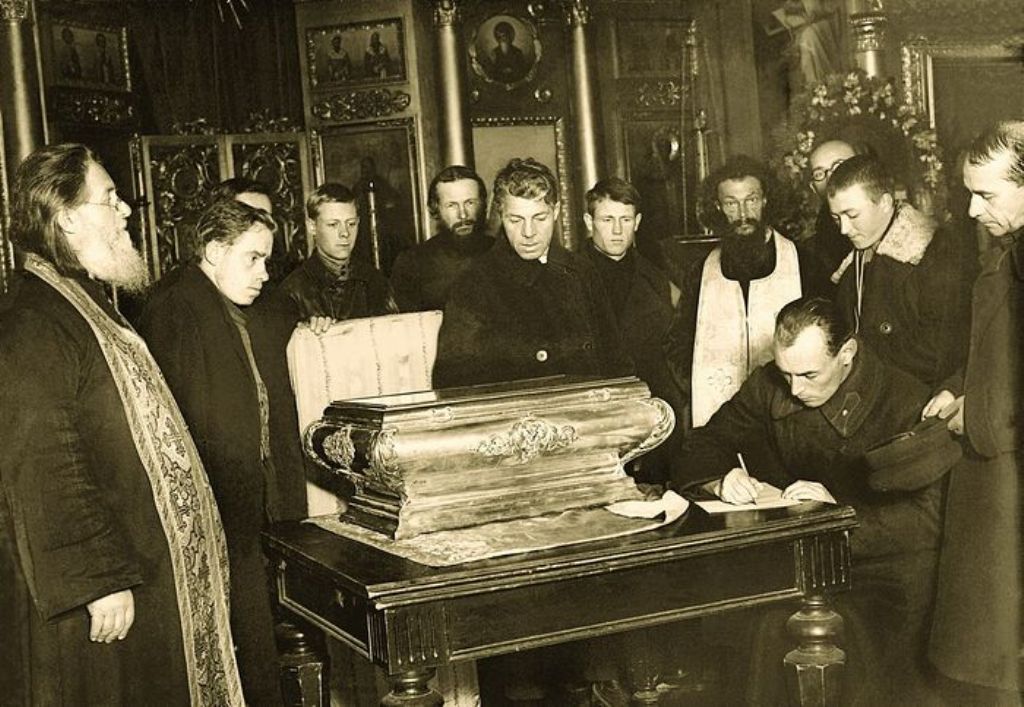
– After Alapaevsk was liberated from the Bolsheviks in September 1918 and occupied by the Siberian government troops, the search for the bodies of the members of the Imperial family began. The bodies were recovered and buried on 18th October, but the crypt was opened on 26th October, to exhume the bodies.
Materials of the forensic medical examination and autopsy show that all eight Alapaevsk martyrs were first inflicted with fatal blows, and then the bodies were thrown into the mine. The grenades the killers threw into the mine did not explode. More precisely, only one exploded, at the very top.
The conclusion of the examination and autopsy of the bodies was as follows: the death of seven of the *eight victims was due to blows with a blunt object on the head (one of them was also hit in the region of the heart) or as a result of falling into a mine. (* Only Grand Duke Sergei Mikhailovich showed a bullet hole in the crown of his head.)
The modern forensic experts to whom I passed the case file say that if these injuries were the result of falling into the mine, they would not be the same for all the victims.
The specialists with whom I spoke, consider the traces of injuries to be the result of a strong blow, and the murder weapon, presumably, could have been an ax with a wide blade and a short hatchet – exactly what they found in the mine. The killers most likely hit their victims with the side of the ax, resulting in cerebral edema and death.
Perhaps it was a method of murder that had already been repeatedly tested: the trauma left little (if any) chance of survival.
Only one of the victims of the massacre was still alive after the blow – Fyodor Semyonovich Remez, secretary of the Grand Duke Sergei Mikhailovich. Fyodor Remez. Having gathered his last strength, he managed to crawl along the track which transported the coal to the engine room. This is where his body was found.
Perhaps, for a short time, a glimmer of life still glowed in Varvara Alekseevna Yakovleva, judging by the fact that her fingers were “set in the formation of the blessing of the Cross”, as recorded in the file.
I believe that this was the fate of Remez and Varvara, because the killers treated the servants differently: they struck a blow, and pushed their bodies into the mine shaft. The main goal of the murderers was to kill the Romanovs.
The fact that Elizabeth Feodorovna was already dead when she fell into the mine is indicated by the position in which her body was found. Her body lay vertical, her arms folded over her body. If a living person falls down a depth of 15 metres (50 ft.), it would be impossible to fold ones arms so evenly.
It should also be noted that both hands of Elizabeth Feodorovna were tightly clenched, fingers bent, her nails sunk into the skin – this happens when a person is in severe pain.
In one hand, she clutched two laced bags containing some small items. Her head, eyes and nose were tied with a handkerchief folded in four layers. So, even if she remained alive in the mine, her position and the scarf on her face and head, from which she did not free herself, do not correspond to the version about bandaging the wounded grand duke.
All this speculation came about because Lubov Miller, who lived in Australia, came to Russia to work in the archives, but many archives were still closed at that time. The first edition of her book was published in 1988, therefore, she had no way of checking all the facts.

Malshikov and his team at the mine where the Alapaevsk Martyrs bodies were thrown
Facts show that there was no monastic tonsure
– There is a version that Elizabeth Feodorovna also took monastic vows with the name Alexia – in honor of Saint Alexei of Moscow, whom she especially venerated.
There are no documents confirming the tonsure of the martyrs, but that is not the point, because the tonsure would be secret. Proof of this absence, Kulikova cites the following:
The materials of the investigation describe in detail all the clothes in which the Grand Duchess and sister Varvara wore at the time of their death. Everything! And nowhere is the obligatory part of the monastic vestment mentioned – the paraman, which is worn under the clothes mentioned. Neither on Elizabeth Feodorovna or Varvara Alekseevna.
Monks wear Paraman constantly as a sign of their accepted vows. The Alapaevsk prisoners lived in anticipation of death, so it is difficult to imagine that Elizabeth Feodorovna and Varvara Alekseevna, for some reason, removed them. Icons, crosses, a belt were found on the Alapaevsk martyrs, as well as small personal items, including documents and some money. But there was no paraman.
Of course, those who described the items removed from the murdered victims might not have known the correct term for this item – after all, the commission was secular, civil. But a description of some sort would have been noted in the documents anyway, along with the descriptions in which they note a cape (for Elizabeth Feodorovna ), and a hood (for Varvara Alekseevna) .
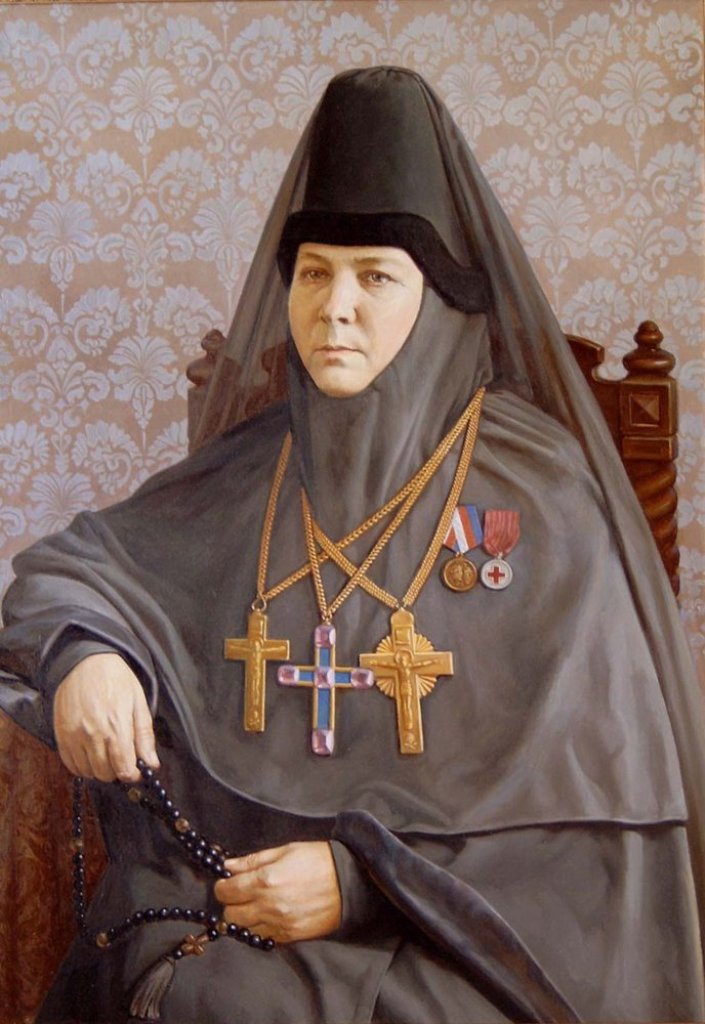
Based on this, it can be assumed that Elizabeth Feodorovna did not receive monastic tonsure. And it is wrong to call Varvara Alekseevna a *nun, she was a *sister. [*Nuns take solemn vows and are cloistered, that is, they reside, pray and work within the confines of a monastery. Sisters take simple vows and live a life governed by the particular mission, vision, and charism – PG.]
Kulikova notes that her book contains a rare photograph in which we see Varvara Alekseevna Yakovleva. This photograph is from the English archives, from the Collection of Princess Victoria. The photograph, taken in 1914, shows the Grand Duchess among the wounded soldiers in the hospital at the Martha-Mariinsky Convent. Next to her are two sisters, and one of whom is Varvara Alekseevna. Kulikova adds that she is completely different from the photos we have seen to date, which leads the author to suspect that perhaps we have been looking at photos of another person for the past century?

The Holy Protection Cathedral on the grounds of the Marfo-Mariinski Convent in Moscow
Where did the Grand Duchess bequeath to be buried?
– Grand Duchess Elizabeth Feodorovna and sister Varvara were buried in the Church of Mary Magdalene at Gethsemane in Jerusalem. Many historians write that she bequeathed to be buried there. In fact, she mentioned this when in 1888 she visited Jerusalem with her husband and was at the consecration of the church, noting “how good it was here” and how she would “like to be buried here”. But let us not forget that she was then only 23 years old!
In her last spiritual will and testament, written in 1914, Grand Duchess Elizabeth Feodorovna specifically expressed:
“I ask you to bury me in a crypt under the church I have now built in the name of the Protection of the Most Holy Theotokos in my possession on Bolshaya Ordynka in Moscow at my *convent of mercy. <…>
If I am tonsured, live in a skete and die there, then I will still be buried in my *convent in Moscow, at the place indicated above <…>. If I die abroad or outside Moscow, I ask you to put it in a coffin, close it completely, transport it to Moscow and bury (without opening the coffin) where I have indicated above.”
[The convent in Moscow which she is referring to in her last spiritual will and testament is of course the Marfo-Mariinsky (Martha and Mary) Convent, which has survived to this day – PG]
It is clear that in 1921, when the bodies of Elizabeth Feodorovna and Varvara Alekseevna were taken out of China, it was easier to transport them to the Holy Land than anywhere else: Jerusalem was under the British mandate, and Elizabeth Feodorovna ‘s sister , Princess Victoria, turned to the government with a request for assistance.
But even then Princess Victoria wrote to her brother Ernst: “I hope that I will find a crypt there under the church where they can stay until they can be taken to Moscow.”
This did not happen, but now times have changed. The Martha-Mariinsky Convent was revived, the tomb, which Elizabeth Feodorovna arranged for herself and painted by Pavel Korin, has been restored. We will pray that the testament of the Holy Martyr Elizabeth will be fulfilled and that she will finally return to her native home.
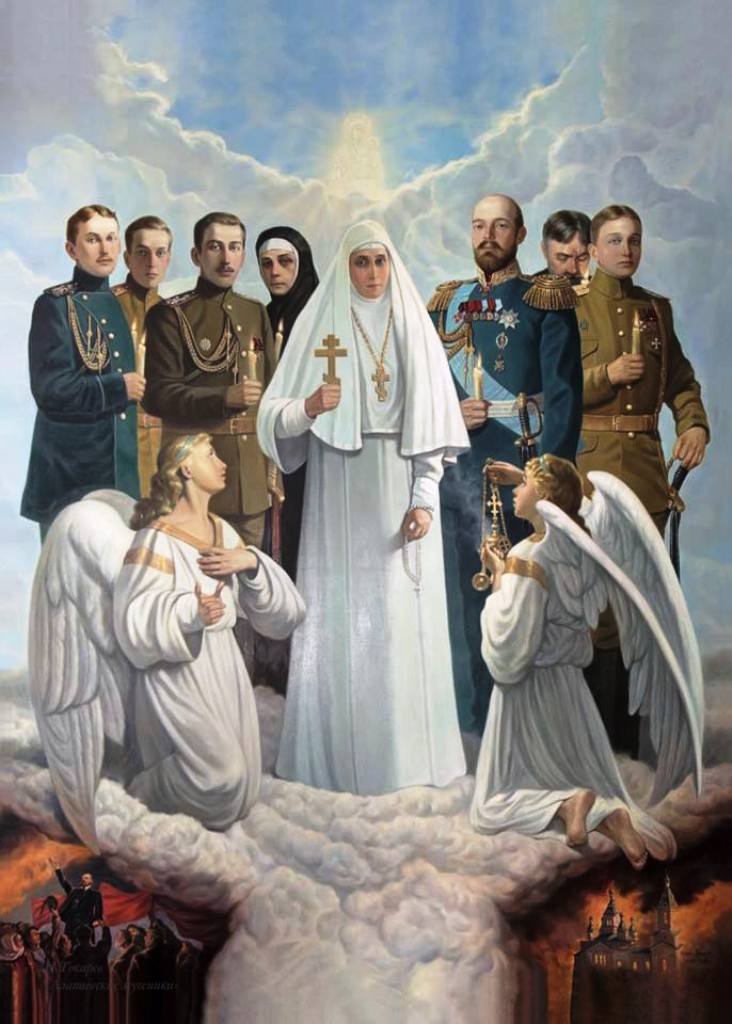
Martyrs of Alapaevsk, painted in 2018 by contemporary Russian artist I. Tokarev
***

About Ludmila Kulikova:
Lyudmila Kulikova is a member of the Imperial Orthodox Palestine Society, and laureate of the Grand Duchess Elizabeth Feodorovna Prize. She specializes in research of the history of the Russian Orthodox Church, and materials for the glorification of her fellow countryman.
She is currently writing a book about the life of Valentina Sergeevna Gordeeva (1863-1931), who originally served as a maid of honour at the Russian Court. After the arrest of the Grand Duchess in 1917, she became the abbess of the Marfo-Mariinski Convent until its closure in the first half of the 20th century. She died in 1931 in exile in Turkestan (Kyrgyzstan).
***
NEW BOOK: Ella. Grand Duchess Elizabeth. Saint Elizabeth the New Martyr
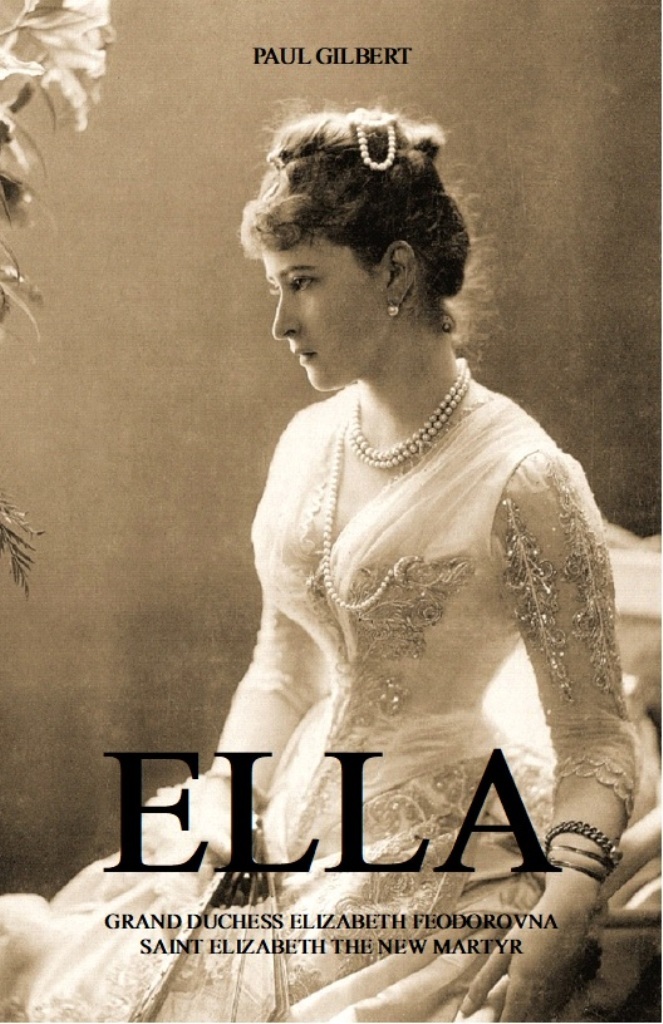
CLICK HERE TO ORDER THE PAPERBACK EDITION @ $13.99 USD
English. 160 pages with 48 black & white photos
More than a century after her death and martyrdom, Grand Duchess Elizabeth Feodorovna (1864-1918) remains of one of the most beloved and respected members of the Russian Imperial Family. Affectionately known as Ella, she became famous in Russian society for her dignified beauty and charm, and later for her piety and acts of charity among the poor.
This new book features 7 essays – including 2 researched and written by Paul Gilbert. Read about Ella’s Hessian family; her relationship with her British grandmother Queen Victoria and her sister Alexandra, the last Russian Empress; her life in Imperial Russia; her years a a nun and abbess of her own convent of mercy in Moscow; her arrest, imprisonment and brutal murder; her burial in the Holy Land; her canonization; and how she is commemorated today in post-Soviet Russia.
Learn about her marriage and often misunderstood relationship to Sergei, a Russian grand duke and son of Emperor Alexander II, who from 1891 and 1905 served as Moscow’s Governor-General. Learn why the couple had no children and rumours that Sergei was homosexual. After her husband’s assassination in 1905, Ella departed the Imperial Court and became a nun, founding the Marfo-Mariinsky Convent dedicated to helping the downtrodden of Moscow.
In 1918, Ella was arrested and subsequently murdered by the Bolsheviks near Alapaevsk. In 1981, she was canonized by the Russian Orthodox Church Outside Russia, and in 1992 by the Moscow Patriarchate.
© Paul Gilbert. 18 July 2024








 Nicholas II
You must be logged in to post a comment.