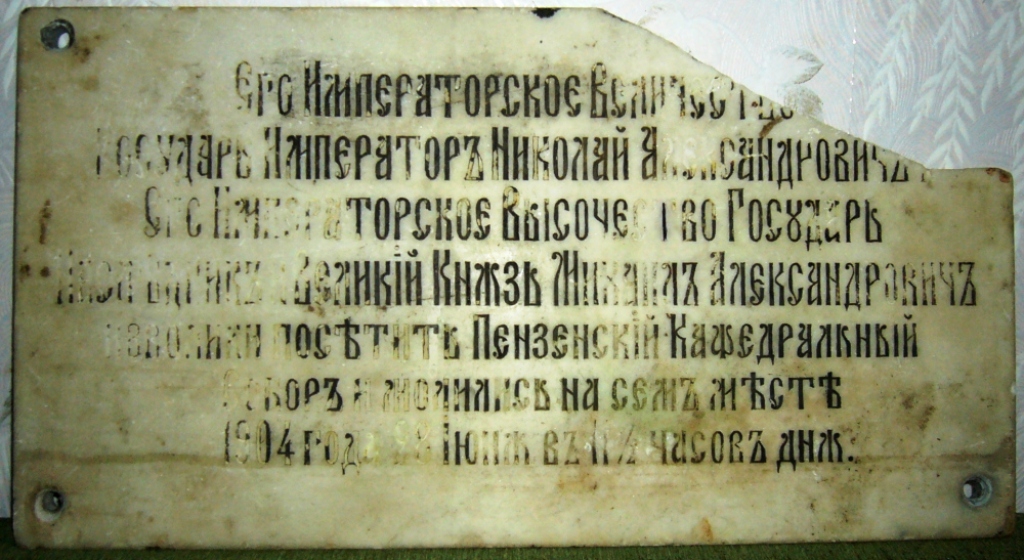
PHOTO: memorial plaque in memory of Emperor Nicholas II’s visit to Penza in 1904
On 19th June 2022, a memorial plaque installed at the beginning of the 20th century on one of the columns of the Cathedral of the Saviour [aka Spassky Cathedral] in memory of Emperor Nicholas II’s visit to Penza in 1904 was returned to the Penza Diocese. During his visit, the sovereign held a review of Russian troops who were being sent to the Russo-Japanese War, followed by a liturgy held in the Cathedral of the Saviour.
This memorial plaque, installed by the Penza City Duma, became the first memorial plaque in the Penza region. The inscription on it reads: “His Imperial Majesty the Sovereign Emperor Nikolai Alexandrovich and His Imperial Highness the Sovereign Heir Grand Duke Mikhail Alexandrovich deigned to visit the Penza Cathedral and prayed at this place on June 28, 1904 at 11 ½ o’clock in the afternoon.”
The words on the commemorative plaque turned out to be prophetic. The cathedral, located on the Cathedral Square of the city was blown up by the Bolsheviks in 1934. In 2010, reconstruction of the cathedral began, and took 12 years to complete.
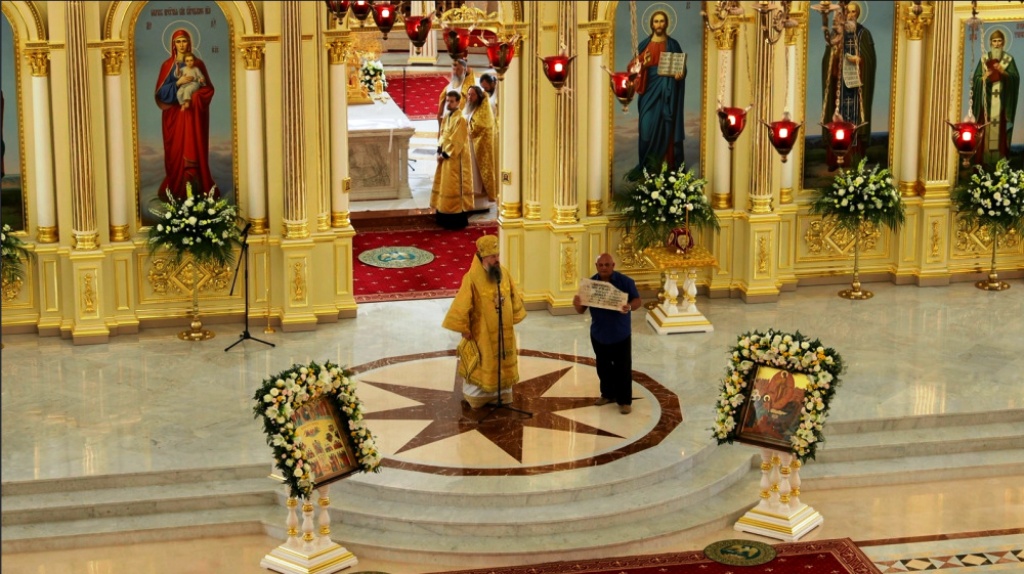
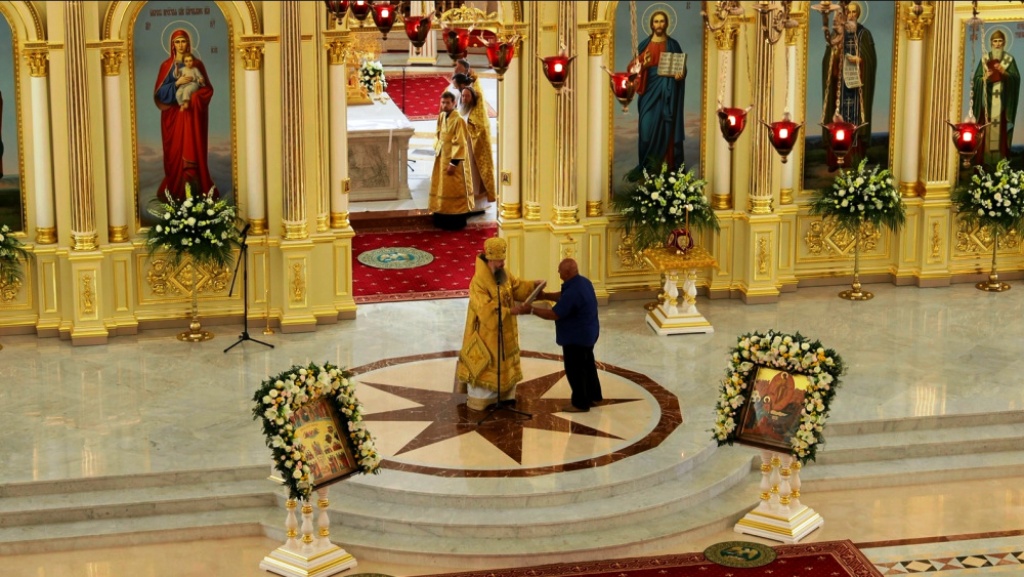
PHOTO: Igor Sergeevich Shishkin (right) holds the historic memorial plaque, during the handing over ceremony at the Cathedral of the Saviour, on 19th June 2022
On 19th June 2022, His Holiness Patriarch Kirill of Moscow and All Russia performed the rite of the Great Consecration of the Cathedral of the Saviour in Penza, concelebrated by the clergy of the Penza diocese, and read out a decree on conferring the status of a cathedral.
For decades it was believed that the memorial plaque had been lost or destroyed. This was based on the recollections of Penza residents, who recalled that in February 1918, armed Bolsheviks came to the cathedral and smashed the plaque with their rifle butt. But as it turned out, the plaque miraculously survived. The parishioners hid it by burying it in the ground not far from the cathedral.
About twenty years ago, rumours surfaced that the memorial plaque had survived and was mostly intact [only a corner was broken off]. Local historians carried out a search of the former grounds, as a result of which the plaque ended up in the hands of the famous Penza collector Igor Sergeevich Shishkin, who today returned the memorial plaque to its rightful place.
The handover ceremony of the memorial plaque took place before the great consecration of the Cathedral of the Saviour, which was performed by His Holiness Patriarch Kirill of Moscow and All Russia during his primatial visit to the Penza Diocese.
On 22nd April, I was diagnosed with Stage 2 Colon Cancer. No one ever wants to hear their doctor utter the words “tumour” or “cancer” – each word inflicting both shock and fear into a person – I was no exception. I recall that the first thing that popped into my head at that moment, was whether the cancer had spread? I would not know for sure until a C-Scan was performed, for which I had to wait another 3+ weeks. Until then, the waiting and uncertainty only fanned the flames of my fears.
In the days leading up to my C-Scan and surgery, I filled my time with the “best medicine”: prayers, positive thoughts, and laughter. I reached out to my family, friends, and to the many people who follow me on my blog and Facebook pages. I was simply overwhelmed by the love and support I received from thousands of people – many of them from people whom I have never met – from all over the world.
In addition, prayers were being said for me by Orthodox and non-Orthodox clergy in the United States, Canada, Australia, Britain and Russia.
One of the most inspiring messages I received, one which had a very profound effect on me, was the following, sent by a friend:
“You must remember that you have your work on Nicholas II to complete and it is YOU who have been chosen from above by His Majesty. May God be with you, dear Paul!”
On 14th May, I had my C-Scan, and 3 days later, the doctor called me with the results. I was so relieved to learn that the cancer had not spread to any of my vital organs or my bones. Glory to God for all things!
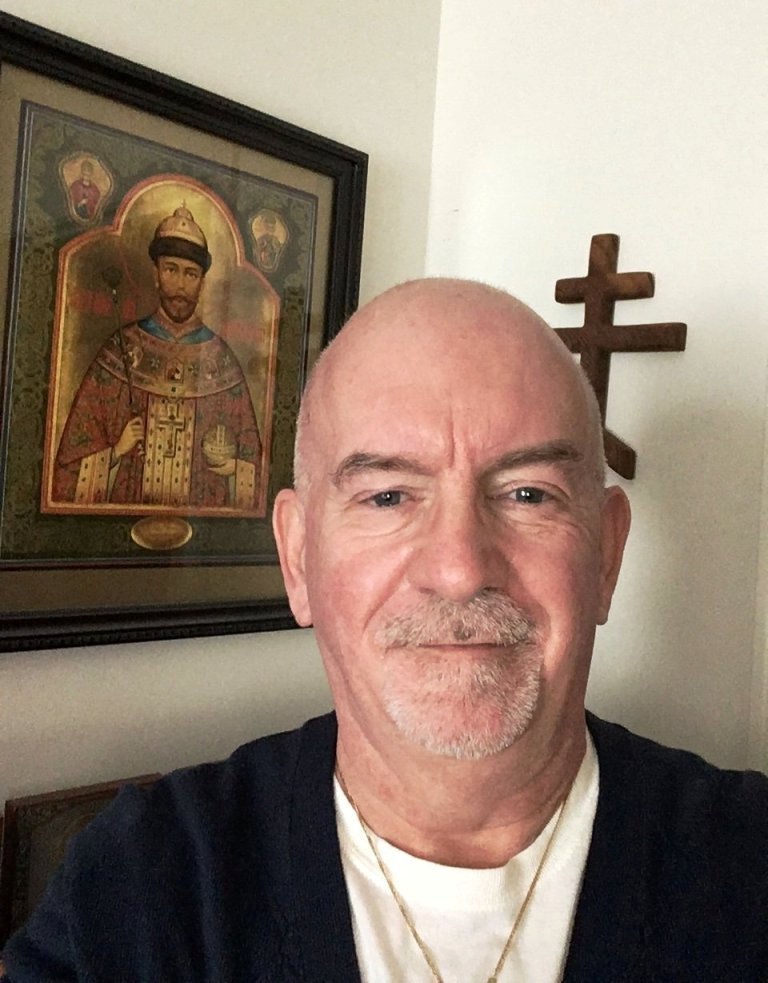
PHOTO: Paul Gilbert poses in front of his lithograph copy of the original miraculous Myrrh-Streaming Icon of Tsar-Martyr Nicholas II, gifted by Ija Schmit(1936-2018) in 1996
The intercession of Tsar-Martyr Nicholas II
Just two days before my admission to hospital, I was doing some spring cleaning – simply to keep my mind occupied – when I discovered a large firm envelope hidden behind some boxes in the back of my closet. I discovered that the envelope contained a large 12″ x 15″ colour lithograph copy of the miraculous Myrrh-Streaming Icon of Tsar-Martyr Nicholas II (seen in photo above).
This icon had been gifted to me back in 2000 by a friend in California. I could not believe that it lay hidden and forgotten alI these years! I was quite overcome with emotion, because I knew that this was an exact lithograph copy of the miraculous Myrrh-Streaming Icon of Tsar-Martyr Nicholas II, the same miracle-working icon which has been venerated by Orthodox Christians for more than two decades.
I placed the icon in a frame and hung it on a wall in my home. I then began to pray to God through the intercession of Tsar-Martyr Nicholas II, to help me get through my surgery and healing. I prayed for strength and courage, and I prayed for good health. Not only do I want to live to a ripe old age, I want to return to my beloved Russia, and I also want to continue my work in clearing the name of Russia’s much slandered Emperor and Tsar.
As some of you may already be aware, I have been considering entering the Russian Orthodox Church for several years now, and during that time have spent many hours in prayer and solitude in Orthodox churches, praying to God and venerating icons of Orthodox saints. In my home, I have icons of the Holy Royal Martyrs and Russian saints, which I venerate on a daily basis.
On the morning of Friday, 20th May, I arrived at Oshawa General Hospital for my surgery. My blood pressure and blood sugars went through the roof! Prior to surgery, my blood pressure exceeded 200!!, that is how stressed I was. When I was taken into the operating room, I repeatedly made the sign of the Orthodox Cross over myself, recited the Lord’s Prayer, the Jesus Prayer, and Psalm 23. Just before the anaesthesiologist administered the medication, I was filled with calm and peace . . .
The next thing I knew, I was coming out of the anesthetic in the hospital recovery room. The following morning, the surgeon came to see me and informed me that “the surgery went very well”, that the tumour had been successfully removed. “Lord my God, I called to you for help, and you healed me.” (Psalm 30:2).
I have nothing but praise for the doctors and nurses at the hospital, all of whom went over and above the call of duty to ensure that I received the best possible care. After spending a few days in Oshawa General, I was sent home. I spent much of my recovery in bed sleeping or resting in my favourite armchair with a cup of tea and a good book. I still have some minor pain, and limited mobilty, however, my health continues to improve with each new day.
My post-surgery care now requires me to have regular blood work done and a C-Scan every six months plus an annual colonoscopy over the next two years. In addition, and despite the fact that the surgeon had successfully removed the tumour, the oncologist informed me that due to the fact that the cancer had penetrated the wall of my colon, that I undergo chemotherapy for a period of 6 months, which I agreed to.
While my cancer was not life-threatening, it could have been. The surgeon informed me that he had also removed three pre-cancerous [changes to cells that make them more likely to develop into cancer] polyps, noting that if I had I left it another year, that my situation would be much worse. I was one of the lucky ones, as the cancer was detected in its early stages.
I am the first to admit that my cancer journey pales in comparison to those of many others, it was a journey which nevertheless has had a profound impact on me, one which God willing, will add many more years to my life, and lead me to fulfill my heartfelt aspiration to enter the Russian Orthodox Church.
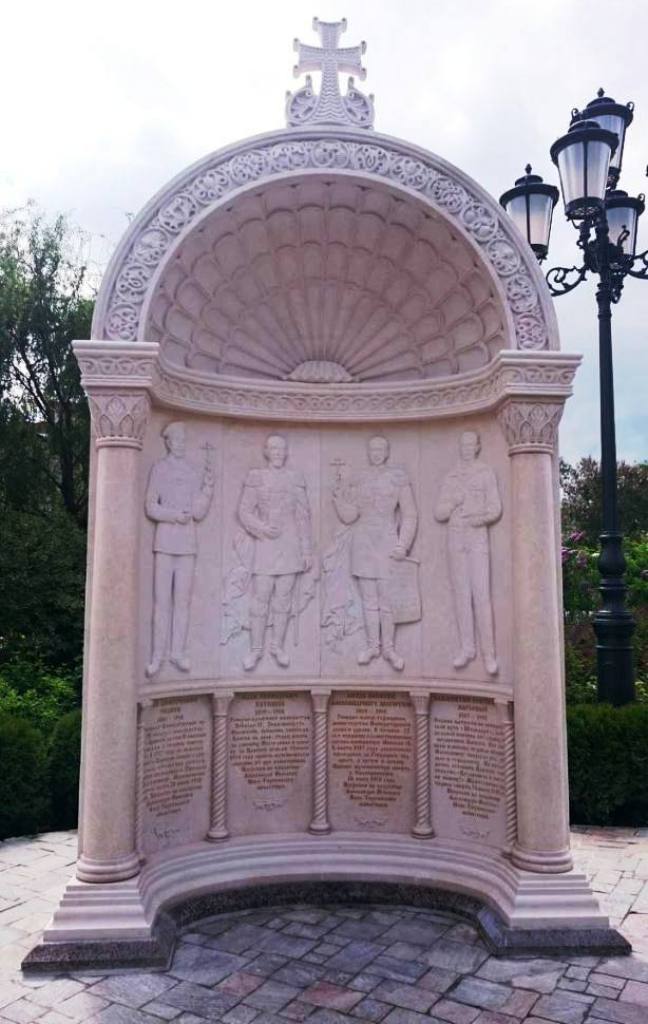
On 13th June, a new monument to four faithful servants of Emperor Nicholas II, was installed and consecrated on the grounds of Novo-Tikhvin Convent.
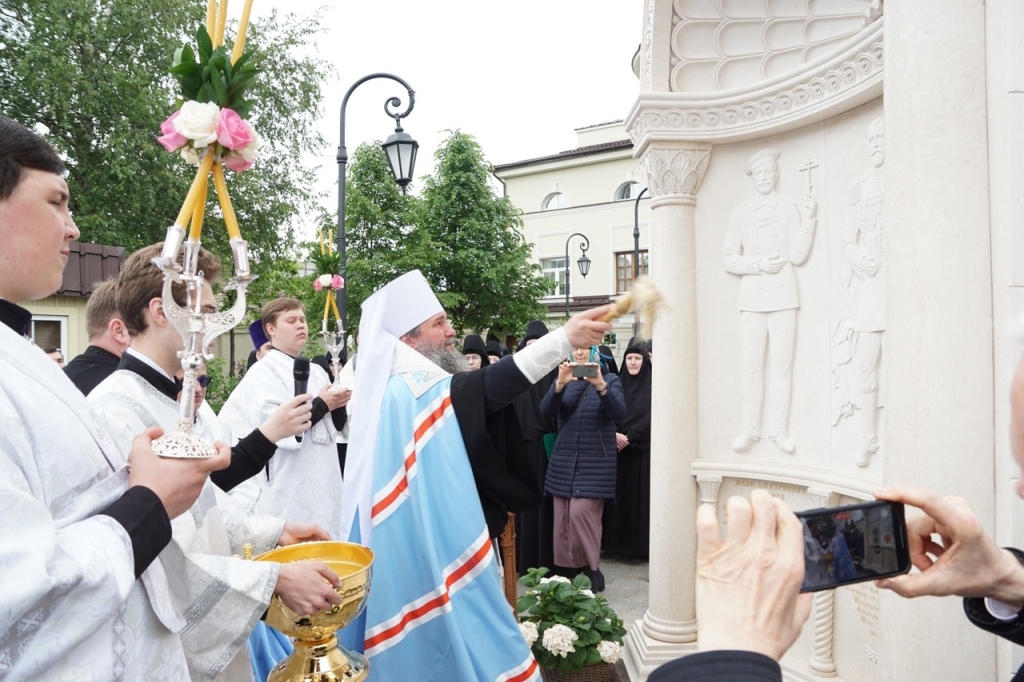
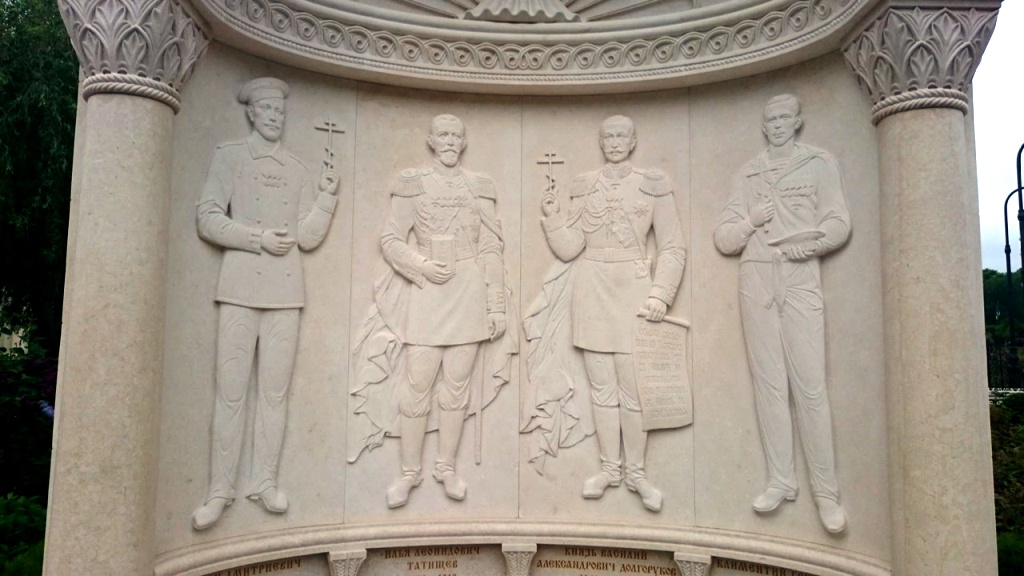
The monument featuring four bas-reliefs, honours Prince Vasili Alexandrovich Dolgorukov (1868-1918), Lieutenant General Ilya Tatishchev (1859-1918), Tsesarevich Alexei’s “nanny” sailor Klimenty Grigorievich Nagorny (1887-1918) and boatswain Ivan Dmitriyevich Sednev (1881-1918). It was installed in Zelenaya Grove, of the convent, and the solemn consecration was performed by Metropolitan of Yekaterinburg and Verkhoturye Evgeny.
PHOTO: Metropolitan of Yekaterinburg and Verkhoturye Evgeny performing the act of consecration
They were all eventually buried in the cemetery of the Novo-Tikhvin Convent, although their respective graves were lost during the Soviet years. The necropolis is gradually being restored, sadly, however, the burial place of these four faithful servants has not yet been found.
PHOTO: detail of the four bas-relief images, from left to right: Ivan Sednev, Lieutenant General Ilya Tatishchev, Prince Vasily Dolgorukov and Klimenty Nagorny
The four-meter stone stele with relief images of the Tsar’s four faithful servants was made at the St. Petersburg workshop of Mikhail Parfentiev, the sketches for the monument were prepared by the sisters of the Novo-Tikhvin Convent.
Tatishchev, Dolgorukov, Nagorny and Sednev were canonized by the Russian Orthodox Church Outside Russia (ROCOR) in 1981, and rehabilitated by the Prosecutor General’s Office of the Russian Federation on 16 October 2009. They have yet to be canonized by the Moscow Patriarchate.
Memory Eternal! Вечная Память!
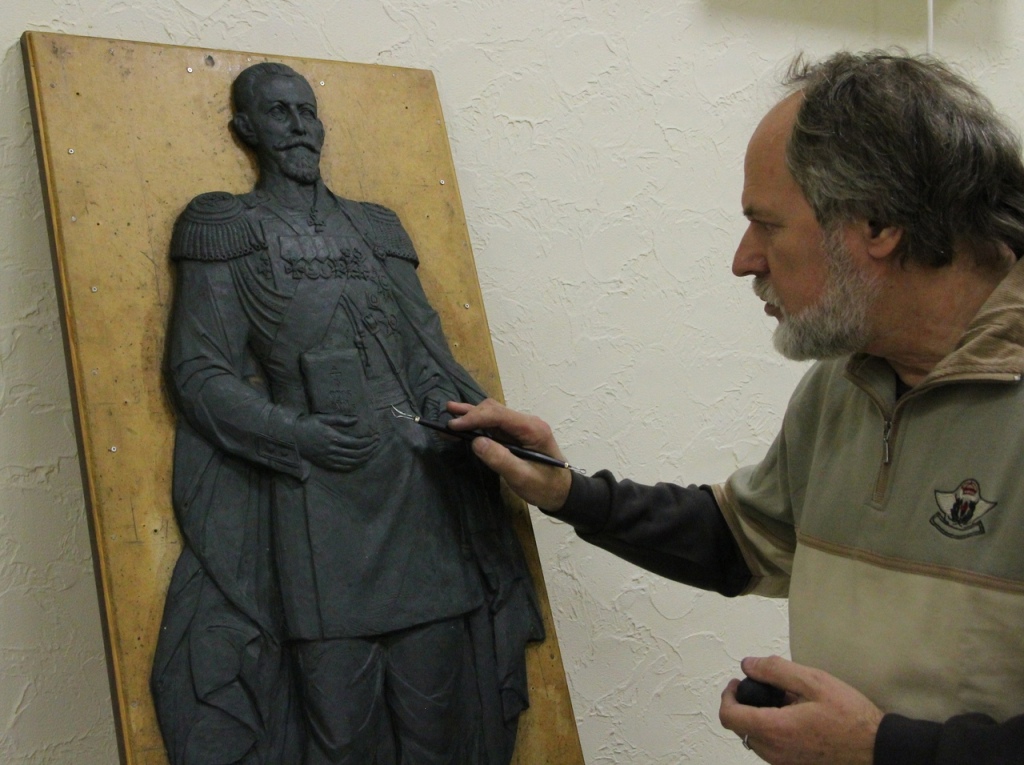
PHOTO: sculptor prepares bas-relief model of Lieutenant General Ilya Tatishchev
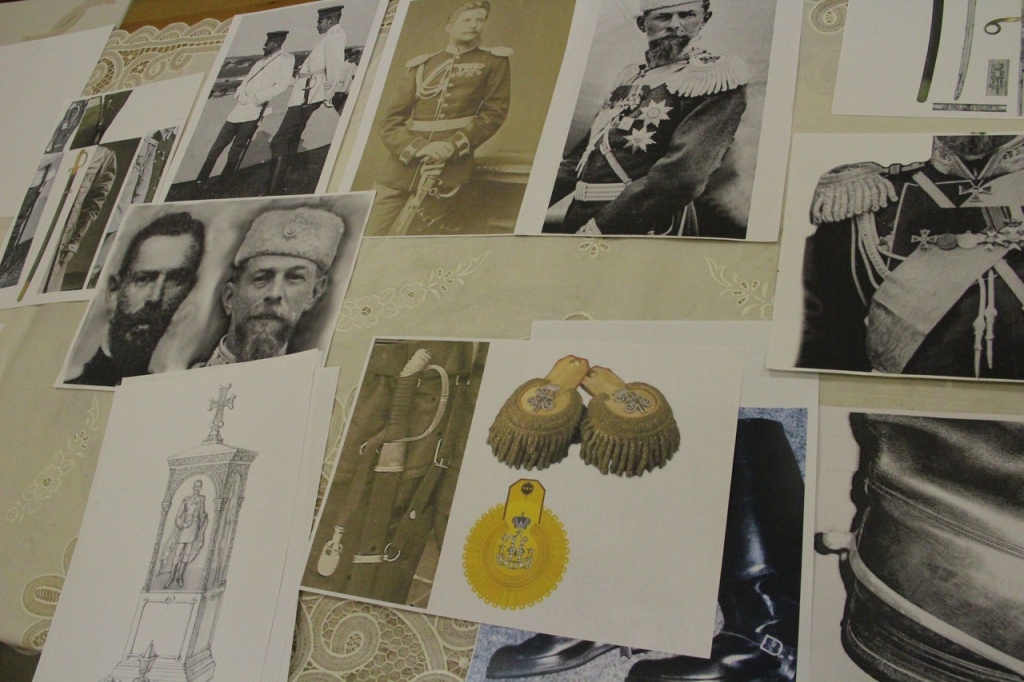
The sketches for the monument were prepared in the icon-painting workshop by the sisters of the Novo-Tikhvin Convent Striving for historical accuracy, the sisters consulted on archival documents and photographs of the uniforms and respective awards worn by Prince V. A. Dolgorukov, I. L. Tatishchev, K. G. Nagorny and I. D. Sednev. In addition, they consulted with historians and other experts on the history of the uniforms of the Russian Empire. At the same time, in order to show the height of the feat of the Tsar’s faithful subjects, who in fact were martyred, the sisters supplemented the images with details characteristic of icons: holding Orthodox crosses in their hands, and fluttering cloaks worn on their shoulders – this is customary for depicting Orthodox martyrs on icons. General Ilya Tatishchev is depicted holding the Gospel, which he knew by heart.
PHOTO: drawings and photos of Lieutenant General Ilya Tatishchev
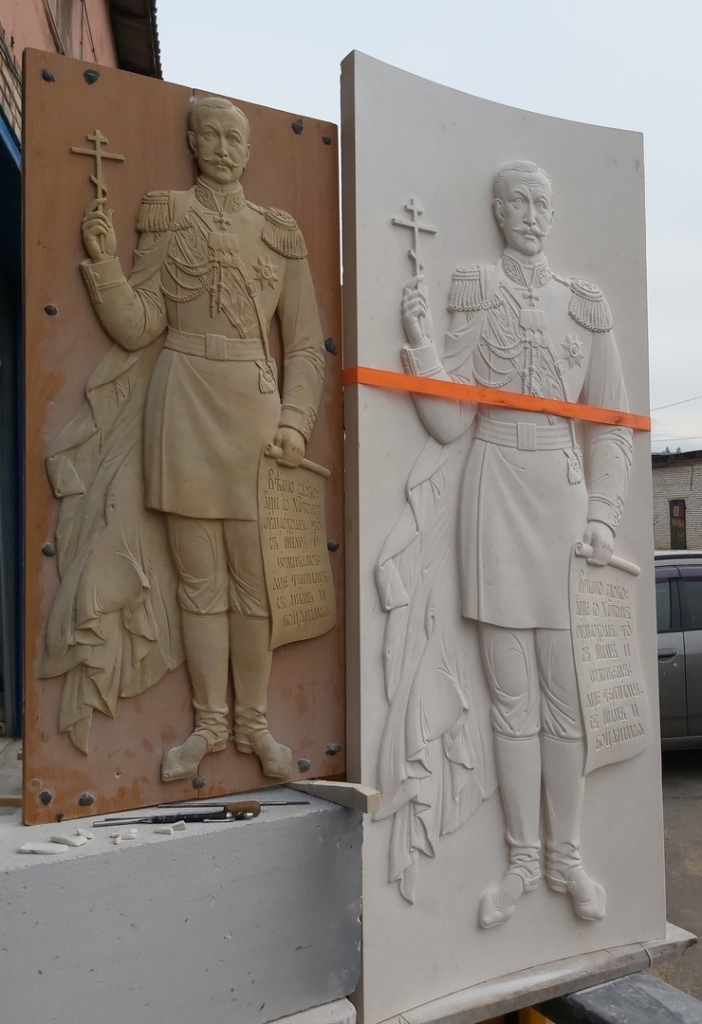
PHOTO: plaster and stone bas-relief of Lieutenant General Ilya Tatishchev
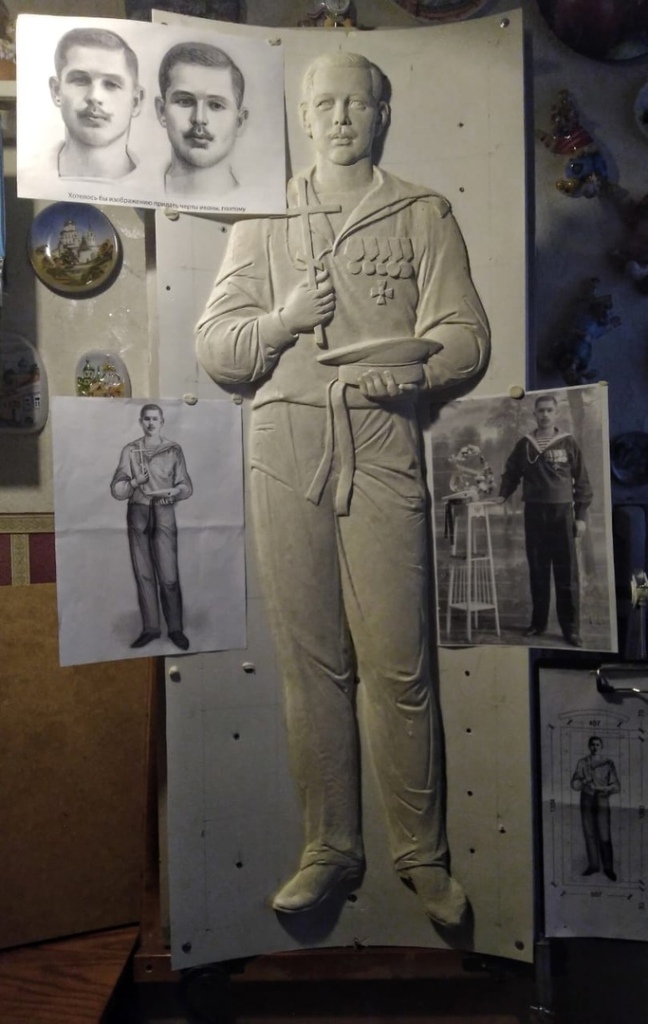
When the sketches were ready, the sculptors got down to work. First, it was necessary to make models from plasticine – a putty-like modelling material made from calcium salts, petroleum jelly and aliphatic acids. In order to “turn” a drawing into a three-dimensional figure, the sculptor constantly checks it with photographs. From the plasticine model, an exact plaster copy is made, and from that, the stone carvers copy the image. The talented masters of the St. Petersburg workshop of Mikhail Parfentiev carefully worked on every detail of the four-meter stele with relief images of the Tsar’s subjects. Work on the monument took nearly three years to complete.
PHOTO: sketches, photos and stone bas-relief of Klimenty Grigorievich Nagorny
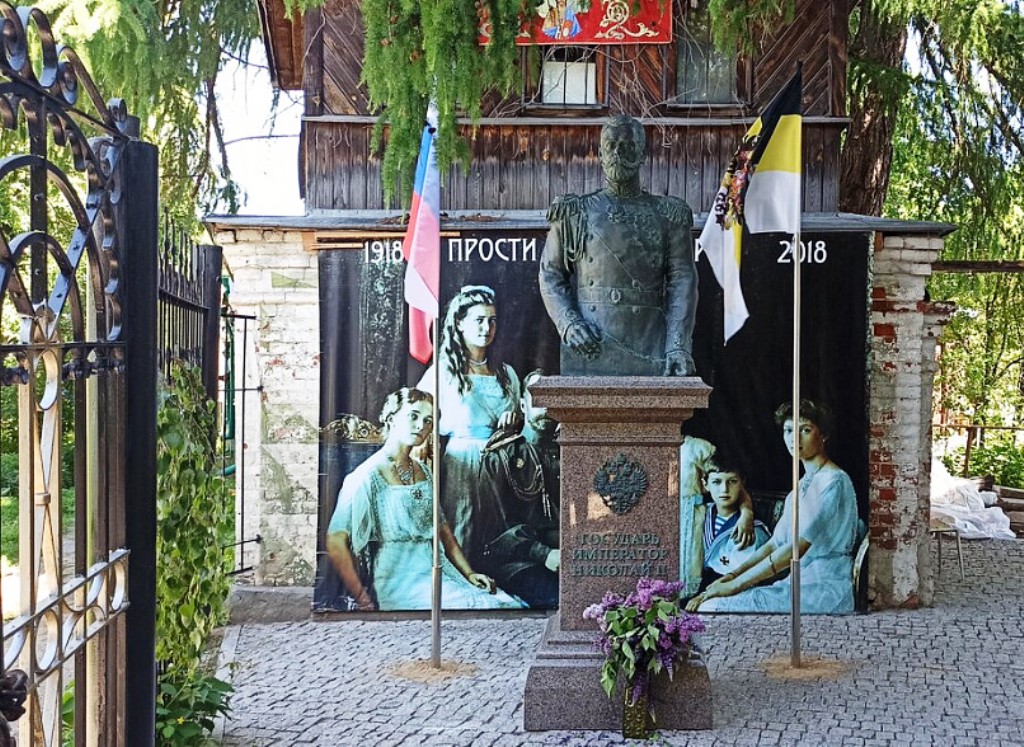
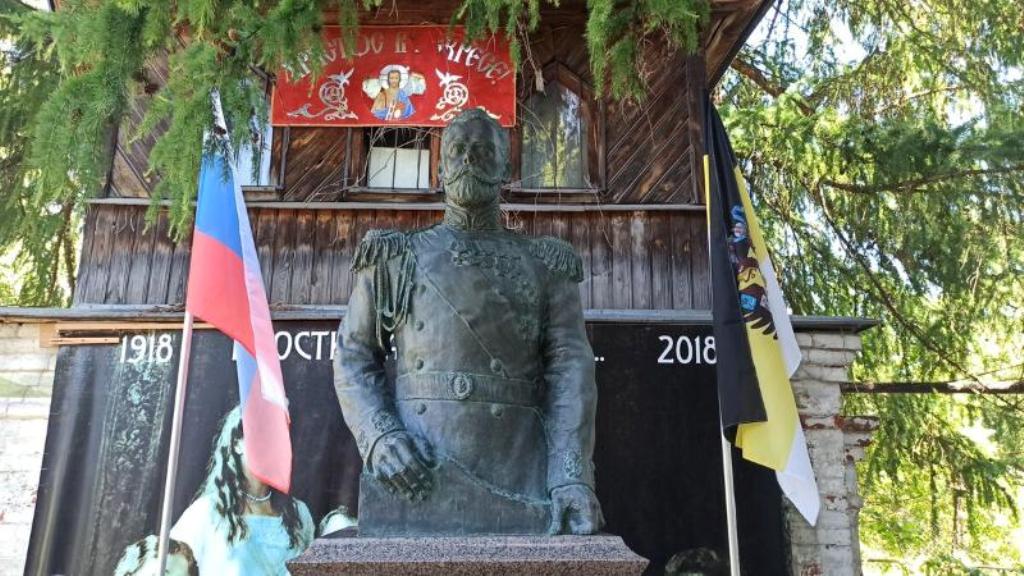
On Saturday 11th June – the eve of Russia Day and the feast of the Holy Trinity – a new monument to Emperor Nicholas II was unveiled on the grounds of the Church of the Life-Giving Trinity, located on Muzeynaya Street in Vladimir, Russia. The flags of the Russian Federation and the Russian Empire were placed on either side of the monument.
The bronze monument was created by the famous Vladimir sculptor Ilya Shanin. The pedestal was created by Nikolai Andrianov, and the memorial plaques by Yuri Tumarkin and artist Olga Rozanova.
Readers may recall that I reported on this new monument back in late 2021. ClickHERE to read this article – PG
The initiative to install the monument came from the rector of the Holy Trinity Church, Father Evgeny Borovskikh, and Ilya Shanin. A fundraiser was announced in November 2021, the cost of casting and installation of the monument amounted to 1.5 million rubles [$20,000 USD], the entire amount of which was raised by private donors.
In January 2022, sculptor Ilya Shanin announced that he wanted the installation of the monument to take place in May 2023, to coincide with 110th anniversary of the Emperor’s only visit to Vladimir, on 16th May 1913.
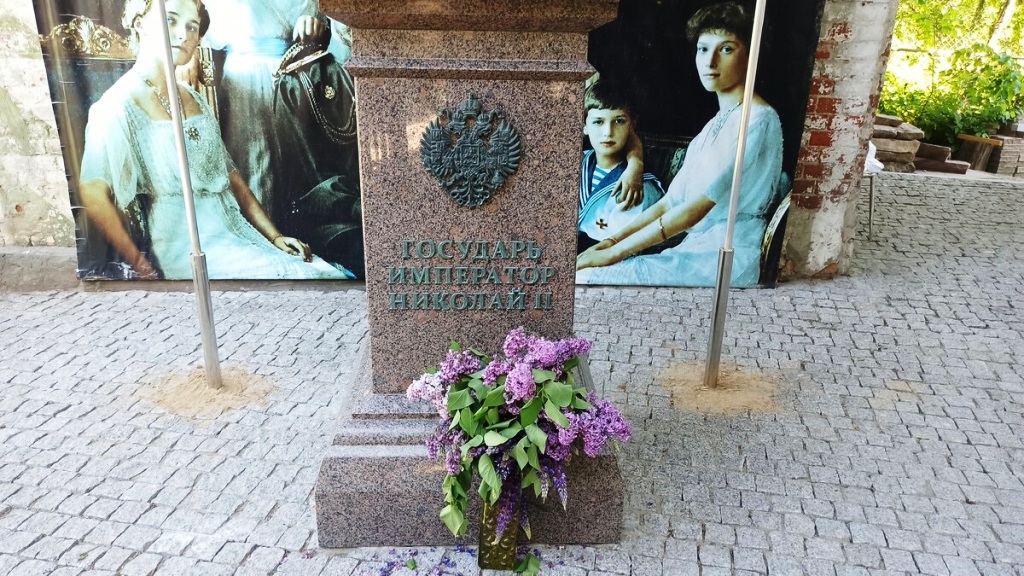
PHOTOS: Close up views of the sculpture and pedestal
The bronze monument of Nicholas II was made at a factory in Smolensk. He is presented from the waist up wearing a ceremonial uniform, with a ribbon over his shoulder, crosses, orders and medals. The height of the monument is 125 centimeters [app. 4 ft.] without the pedestal. The granite pedestal was made in St. Petersburg. On the pedestal there is an inscription «Государь император Николай II» – “Sovereign Emperor Nicholas II”.
The monument is set against the backdrop of a large colourized photograph of the Imperial Family. The photo is famous, and part of a series taken in 1913 marking the 300th anniversary of the Romanov Dynasty. These black-and-white photos were mass produced and sold as postcards, the proceeds of which went to various charities supported by the Imperial Family.
It is interesting to add, that within 24 hours of the announcement of plans to install this monument to Emperor Nicholas II, local Bolsheviks and atheists reared their ugly heads in protest. The local branch of the Communist Party opposed its installation. The communists declared that they were “categorically against perpetuating the memory of ‘Nicholas the Bloody'”, as he organized the mass execution of unarmed workers in St. Petersburg and dragged Russia into two unnecessary wars.
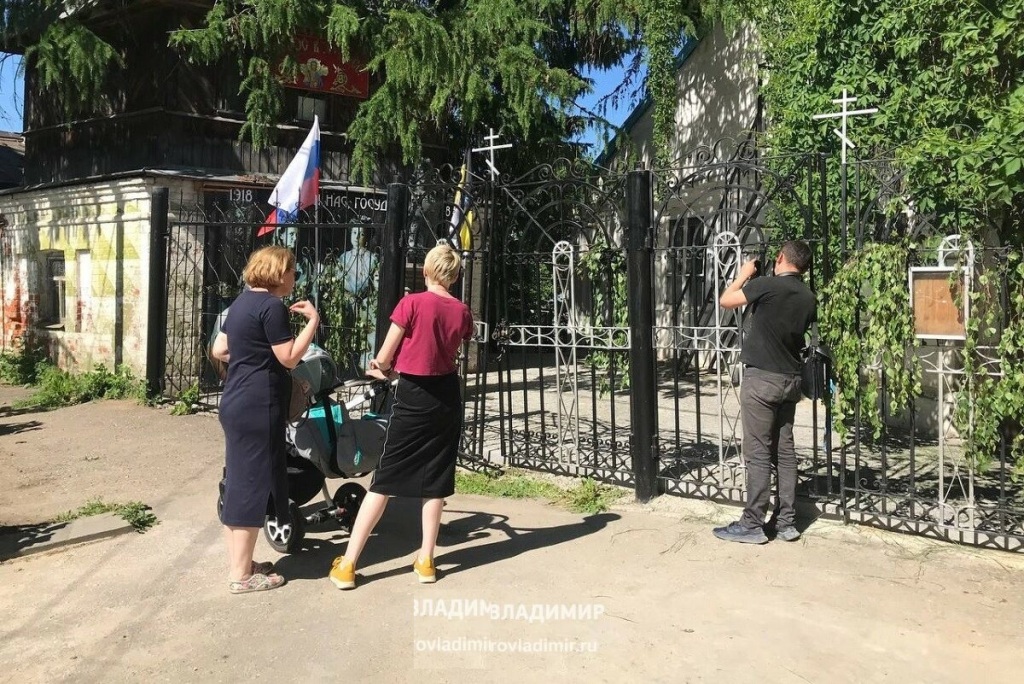
Apparently, access to the monument is at present only possible during worship. The rest of the time the gates to the church are closed. Despite this, Vladimir residents still come to look at the bronze Nicholas II and take photos through the fence bars (see photo below).
It is known that Nicholas II came to Vladimir only once – on 16th May 1913, as part of the celebrations marking the 300th anniversary of the Romanov Dynasty.
The Vladimir Region is now home to two of Russia’s finest monuments to Emperor Nicholas II. In September 2021, Russia’s second largest monument to Nicholas II [featuring 8 colour photos + VIDEO] was also installed in the village of Sanino, Petushinsky District, Vladimir Region.
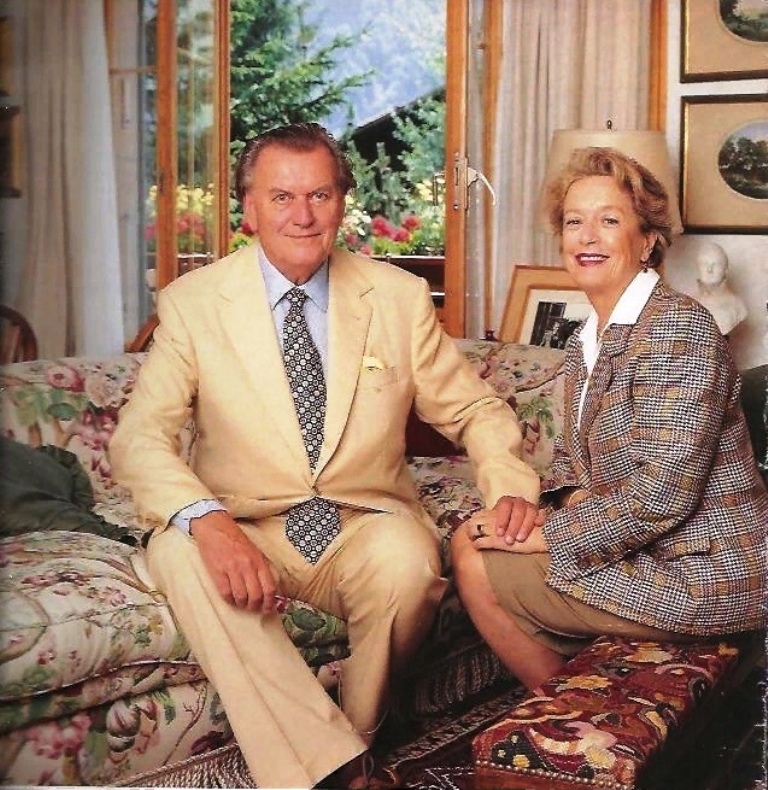
PHOTO: Prince Nikolai Romanovich and his wife Countess Sveva della Gherardesca
Thirty years ago, in June 1992 the Head of the House of Romanov (1992-2014) and president of the Romanov Family Association, Prince Nikolai Romanovich (1922-2014), visited Russia for the first time.
The trip had been arranged by a group of Italian entrepreneurs, friends of Nikolai Romanovich, who decided to take him together with his wife Princess Zveva, with them to Russia as a guide, giving him an opportunity to talk about the country that occupied such a special place in his life.
Nikolai Romanovich dreamed of coming to Russia through Finland, a symbolic journey in the opposite direction to those who fled from Bolshevik Russia following the 1917 Revolution and later the Civil War after 1918, towards the young independent Finnish state, symbolizing the hope of salvation. But his Italian friends chose a different route: first Moscow, and then St. Petersburg.
Later, Princess Zveva recalled their first journey home to Russia: “It was an incredible journey in terms of emotional intensity. It lasted three days, and during this time Nikolai Romanovich did not sleep, so as not to miss anything. We went from Moscow to St. Petersburg by train. I watched him sitting in the compartment, already an elderly man, eagerly looking out the window – at the forests, at the fields, villages, absorbing all the images that flashed before him. Thus, at the age of 69, he discovered this great country, which had always occupied a central place in his life.”
Their first visit to the Motherland was not accompanied by a media frenzy, there were no flashes of cameras or media crews documenting their every word and filming their every move. For Russia, their visit simply passed unnoticed. Nikolai Romanovich and his wife arrived quietly, without any pomp or ceremony, nor meetings with officials.
Nikolai Romanovich later spoke about his first impressions of Russia: “What surprised me? Nothing! As if it was meant to happen and it did. I remember when the plane landed. I didn’t kiss the asphalt at the airfield. I had my passport in hand. There was an official, I showed him my passport, he said “go” in Russian. All around me, I heard Russian voices. I am in Russia. I always said: “I will return to Russia.” I never said: I will come. It was always “I’ll be back”. And I returned. Because I never really left it. You see, we have always had the feeling that we belong to Russia, but Russia does not belong to us.”
Once in St. Petersburg, the Prince wasted little time and immediately ordered a taxi, telling the driver to drive along the Neva River. Stopping, the Prince got out of the taxi and walked down to the bank, he put his hand into the water, while saying to himself with a smile: “Now my Neva!”. He had been waiting for this moment all his life.
Prince Nikolai Romanovich continued to visit Russia, including July 1998, where he led *50 descendants of the Romanov family for the interment of Emperor Nicholas II and members of his family in the Saints Peter and Paul Cathedral in St. Petersburg. It was during this visit that I met Prince Nikolai in the lobby of the Astoria Hotel. I was permitted to travel in the coach with members of the Russian Imperial Family to the historic burial that day.
* It is interesting to note, that the only Romanov descendants who did not attend the funeral were Princess Maria Vladimirovna, her mother Princess Leonida and her son Prince George Mikhailovich.
The legitimate Head of the House of Romanov
Prince Nikolai considered that following the death of Prince Vladimir Kirillovich in 1992 that he was head of the House of Romanov and his rightful successor. With the exception of Princess Maria Vladimirovna and her mother Princess Leonida, Prince Nikolai was recognized by the rest of the family as head of the Romanov family.
The official position of the Romanov Family Association has always been that the rights of the family to the Russian Throne were suspended when Emperor Nicholas II abdicated for himself and for his son Tsesarevich Alexei Nikolaevich. * Please read my article “The Russian Imperial House ended with the murder of Nicholas II”, originally published on 17th February 2021
While he never had any aspirations of claiming the Russian throne, there is no question that Prince Nikolai Romanovich would have made a worthy and highly respected Tsar!
* * *
Prince Nikolai was born on 26th September 1922 in Cap d’Antibes near Antibes, France, the eldest son of Prince Roman Petrovich (1896-1978) and his wife Princess Praskovia Dmitrievna (née Countess Sheremeteva, 1901-1980), and a descendant of Emperor Nicholas I (1796-1855).
In 1950, Prince Nikolai and the Countess Sveva della Gherardesca (b. 15 July 1930), daughter of Count Walfred della Gherardesca and Nicoletta de Piccolellis, met at a party in Rome. Sveva is a member of the Italian della Gherardesca noble family from Tuscany and a direct descendant of Count Ugolino della Gherardesca. They were married in Florence in a civil ceremony on 31 December 1951 followed by a religious ceremony on 21 January 1952 in the Russian Cathedral at Cannes
On 15th September 2014 – Prince Nikolai Romanovich Romanov died in Tuscany, Italy at the age of 91. He was survived by his wife, their three children, five grandchildren and three great-grandchildren.
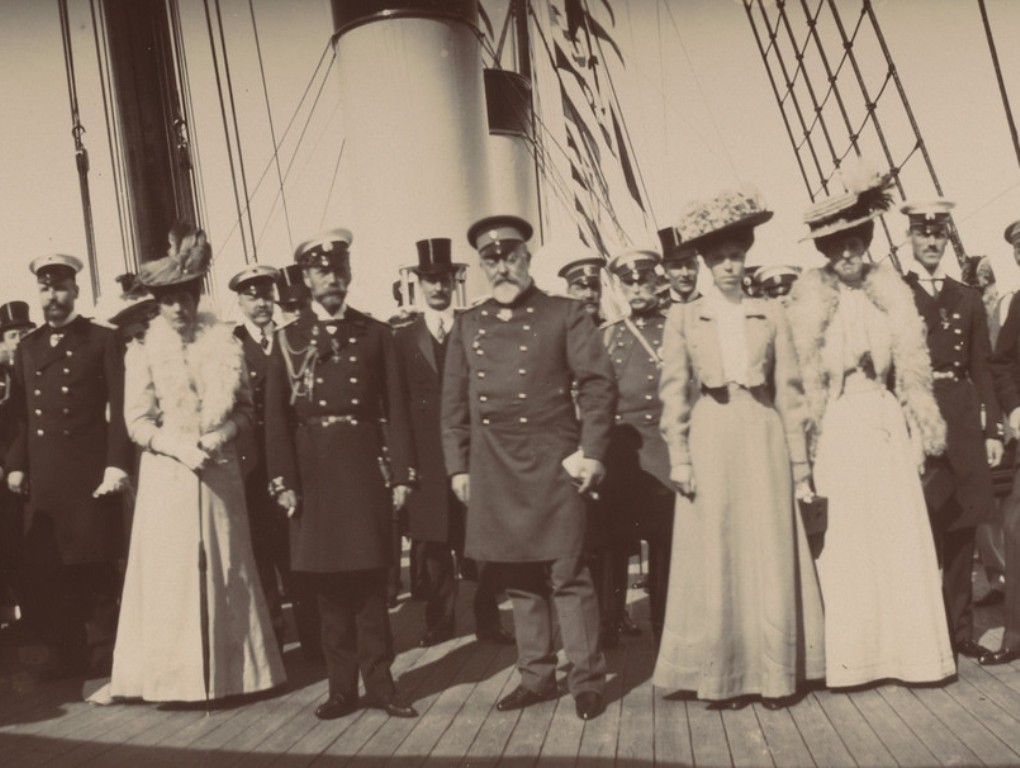
PHOTO: Pyotr Stolypin, Queen Alexandra, Emperor Nicholas II, King Edward VII, Vladimir Frederiks, Grand Duchess Olga Alexandrovna, Empress Alexandra Feodorovna, and Grand Duke Mikhail Alexandrovich, on the deck of the Russian Imperial Yacht.
On 9th June 1908, a meeting of the Russian Imperial and British Royal families took place in Reval [today Tallinn, Estonia]. The historic meeting marked the first visit of a reigning British monarch to the Russian Empire, although Edward had previously visited Russia as His Royal Highness The Prince of Wales in 1866, when he attended the wedding of the future Russian Emperor Alexander III in St. Petersburg. The meeting at Reval in 1908, served as an important diplomatic purpose in the aftermath of the 1907 Anglo-Russian Entente, which settled colonial disputes and instigated the Triple Entente.
King Edward VII arrived on the royal yacht Victoria and Albert roadstead of the port of Reval. He was accompanied by his wife Queen Alexandra (sister of the Dowager Empress Maria Feodorovna) and daughter of Princess Victoria of Great Britain. They were met by the Emperor, the Empress, their five children, Dowager Empress Maria Feodorovna, Grand Duke Mikhail Alexandrovich, Grand Duchess Olga Alexandrovna, and Queen Olga of the Hellenes (nee Russian Grand Duchess Olga Konstantinovna). In addition, the Emperor was accompanied by prominent members of his retinue, including Prime Minister Pyotr Stolypin, and the minister of the Imperial Court, Vladimir Frederiks.
On the morning of 9th June 1908, the hills and the wooded shores of the bay were crowded with thousands of well wishers. At 7 o’clock, the Imperial Train arrived in Revel from Peterhof. Crowds of children lined up to greet the Emperor and his family: “It is impossible to describe the delight of the children when the Imperial Family passed by. Their Majesties … were very touched,” the head of Nicholas II’s secret personal guard Alexander Spiridovich recalled. Passing the cheering crowds, the Imperial family proceeded from the train station to the port, where they boarded the Imperial Yacht Standart. Two other Russian Imperial Yachts were also in port, including the yacht of the Dowager Empress, the Polar Star and the smaller steam yacht Alexandria.
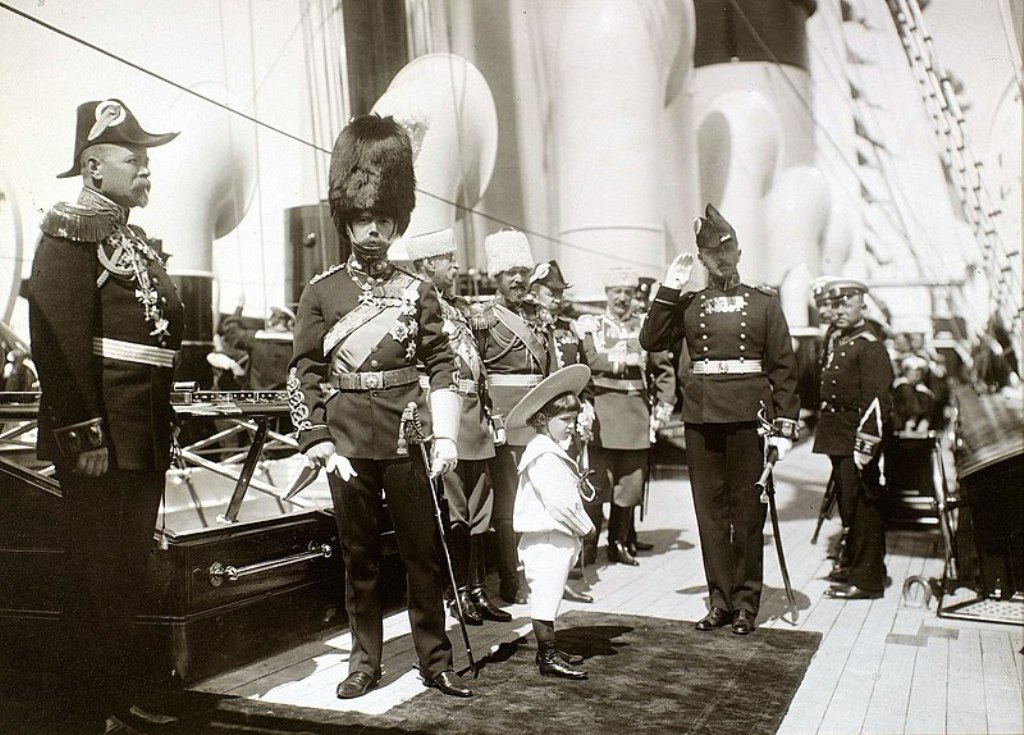
PHOTO: Nicholas dressed in the uniform of Colonel-in-Chief of the Royal Scots Greys, on the deck of the Imperial Yacht Standart. His son and heir Tsesarevich Alexei is standing beside him. 9th June 1908
Prior to meeting the British king, Nicholas dressed in the uniform of Colonel-in-Chief of the Royal Scots Greys. Nicholas II was appointed an honorary member of the distinguished regiment by Britain’s Queen Victoria in 1894, after he became engaged to Princess Alix of Hesse (Alexandra Feodorovna), who was Victoria’s granddaughter. King Edward, in turn, put on the uniform of the Russian Imperial Army, but it turned out to be clearly too small for him, but despite this, the king looked by no means impressive.
The British yacht Victoria and Albert anchored in the roadstead between the Standart and the Polar Star. The Imperial and Royal yachts were surrounded by British and Russian warships, also lying in the roadstead.
On board Nicholas greeted the British King by saying, “It is with feelings of the deepest satisfaction and pleasure that I welcome your Majesty and her Majesty the Queen to Russian waters. I trust that this meeting, while strengthening the many and strong ties which unite our Houses, will have the happy results of drawing our countries closer together, and of promoting and maintaining the peace of the world.”
An eyewitness recalled: “While the guests were very cordial towards one another, it was felt that Edward showed some condescension towards his nephew – he seemed to patronize him … he warmly hugged and kissed the Empress, and then carefully looked at the grand duchesses, who looked a little embarrassed. Then he went up to the heir [Alexei], took him in his arms and kissed him.”
The Dowager Empress Maria Fedorovna was delighted to once again meet her beloved sister Alexandra, the British Queen, with whom she maintained a prolific correspondence throughout her life. A luncheon was served on the Dowager Empress’s yacht, the Polar Star, but no speeches were made at this affair. The menu was traditional for such occasions: Toulouse consommé, pâté, champagne lobster, truffle and grouse rolls, vol-au-vents, Nantes duck, vanilla peaches and frozen strawberry puree.
At five o’clock, tea was arranged on the Royal Yacht Victoria and Albert. The Tsar arrived without his wife, since the Empress suffered from another attack of sciatica.
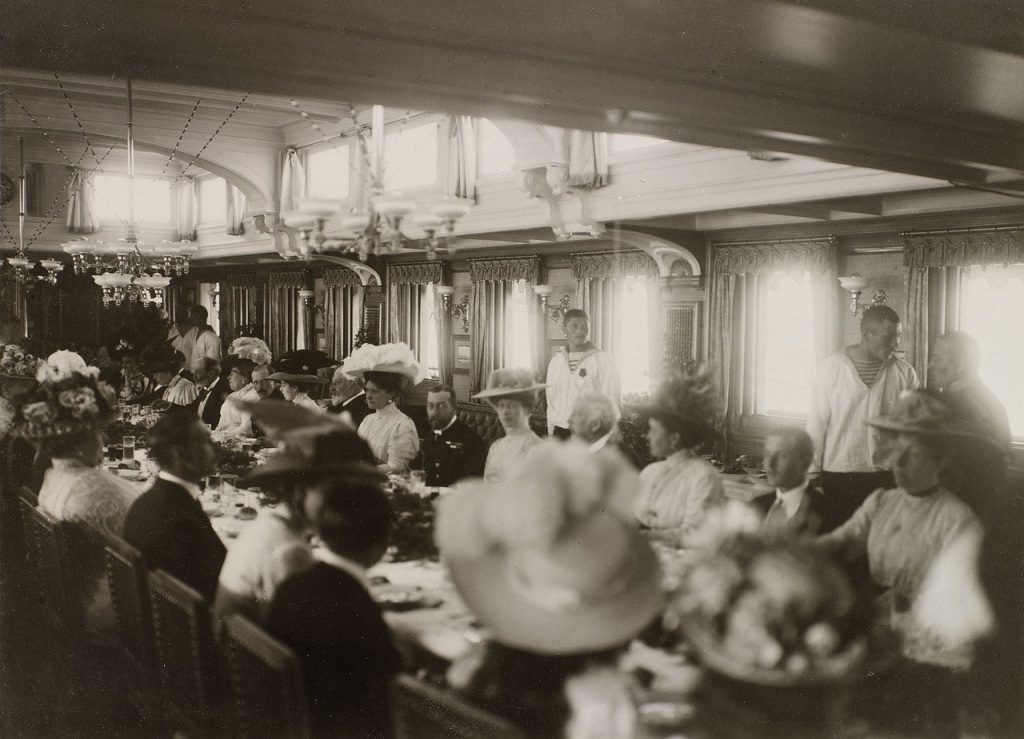
PHOTO: Imperial hosts and Royal guests gather for a state banquet in the dining hall of the Imperial Yacht Standart. Empress Alexandra Feodorovna can be seen in the center of the photograph, seated between King Edward VII [on the left], and His Royal Highness The Prince of Wales [future King George V, on the right]
At 8 pm, the hosts and guests gathered together for a state banquet on the Imperial Yacht Standart. During dinner, the orchestra played works by Borodin, Wagner, Liszt, Grieg, Glazunov and Gounod, while the monarchs made official speeches, both in English. The King thanked the Emperor for the warm welcome, recalling his previous visit to Russia, when he was still Crown Prince, and expressed hope for the Anglo-Russian alliance to be strengthened: “I believe that this will serve to closer uniting the ties that unite the peoples of our two countries, and I am sure that this will contribute to a satisfactory peaceful settlement of certain important issues in the future. I am convinced that this will not only contribute to a closer rapprochement between our two countries, but will also help maintain peace throughout the world,” Edward VII said. The emperor answered in the same spirit.
Early in the evening, boatloads of German and Russian residents steamed about in the roadstead and serenaded the Imperial and Royal visitors with national folk songs. After the sun set and darkness set in, the warships were all illuminated, and the Imperial Yachts Polar Star and Alexandria displayed special electrical effects.
The following day, the Emperor and Empress received a delegation from Reval, after which they again received British guests at lunch, during which a misunderstanding occurred. The King turned to the Empress and joked about the terrible accent with which the Grand Duchesses spoke English. The criticism hurt the Empress, especially since the King himself spoke English with a clear German accent. But the conclusions were made and soon the Grand Duchesses were appointed a new English tutor – Charles Sidney Gibbes, who after the revolution would follow the Imperial Family into exile to Siberia.
The inevitable exchange of gifts took place that day. The King presented his nephew with a sword made by Wilkinson, on which were engraved the words: “To His Imperial Majesty the Emperor of All Russia from His Loving Uncle Edward, Revel 1908.” The Emperor, in turn, presented his uncle with a jade vase with cabochon moonstones and chalcedony.
PHOTO: King Edward VII and and Emperor Nicholas II, Reval. 1908
That evening, dinner was served on the Royal Yacht Victoria and Albert. Shortly after the arrival of the Imperial couple, the King was faced with a dilemma. Who will accompany him to dinner: the Queen or the Dowager Empress? English protocol required that the Sovereign’s wife should precede the Dowager Empress, but this could offend Maria Feodorovna, who was also his wife’s sister. On the other hand, if the Empress was forced to take second place, she might well take the opportunity to leave. The King handled the situation with his usual aplomb. Taking both ladies by the arms, he declared: “Tonight I will enjoy the unique honour of inviting two Empresses to dinner.” After dinner, the King and his Imperial guests sat in comfortable chairs, coffee and liquors were served. There were also dances during which the Grand Duchess Olga Alexandrovna danced with the British Admiral John Fisher (1841-1920). Around midnight, the Imperial couple, having said goodbye to the guests, left the Victoria and Albert and returned to the Standart.
At 3 o’clock in the morning, the Victoria and Albert weighed anchor and arrived in Port Victoria in Kent three days later.
CLICK on the IMAGE above to view an album of photographs of the meeting of the Russian Imperial and British Royal families at Reval, on 9th June 1908
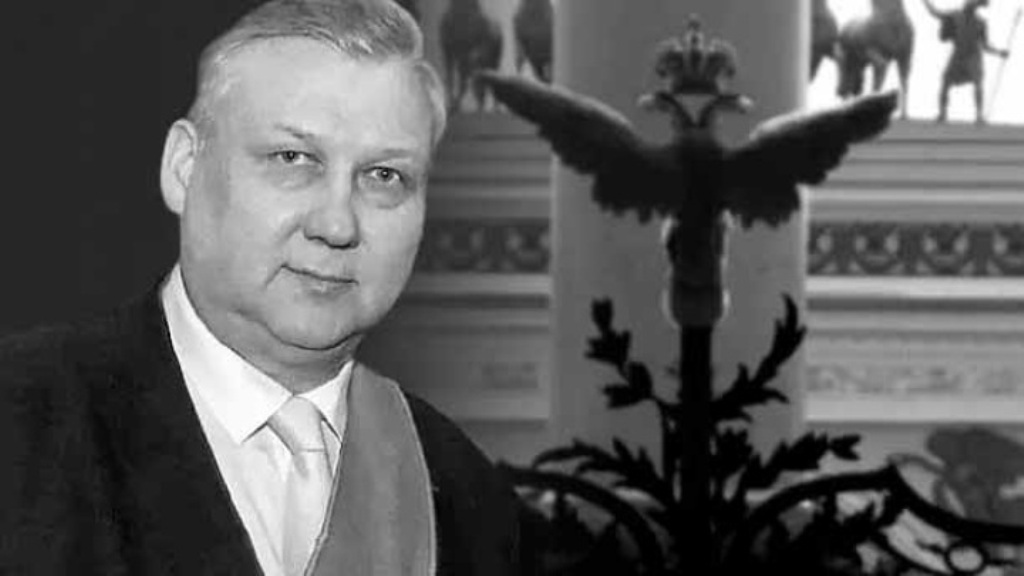
On 19th May, the prominent Russian lawyer German Yuryevich Lukyanov, died in Moscow at the age of 60.
Lukyanov was born on 30th October 1961 in Saratov. In 1984 he graduated from the Saratov Law Institute (forensic and prosecutorial department). In 1984-1986 he passed military service in the Armed Forces of the USSR. From 1987 to 1989 he served as an investigator of the Military Prosecutor’s Office of the Moscow Air Defense District (PVO). He retired from the reserve with the rank of Senior Lieutenant of Justice. In 1990 he began practicing law, and in 2001 became a member of the Moscow Bar Association.
In 1995, he was appointed legal representative for Princess Leonida Georgievna (1914-2010) and later her daughter Princess Maria Vladimirovna, the latter of whom he continued to serve to the present day.
Lukyanov’s legacy is worthy of honouring, because he worked for years to achieve the exoneration of Emperor Nicholas II, his family and their four faithful retainers, who were all brutally murdered by the Bolsheviks in 1918.
German Yuryevich Lukyanov died on 19th May 2022, the day marking the 154th anniversary of the birth of Russia’s last Emperor and Tsar. Some time ago Lukyanov had developed a severe form of COVID-19, recovered and returned to work.
It is symbolic that the Lord called German Lukyanov to Himself on the birthday of the Holy-Martyr Tsar Nicholas II, whose memory he sacredly honoured.
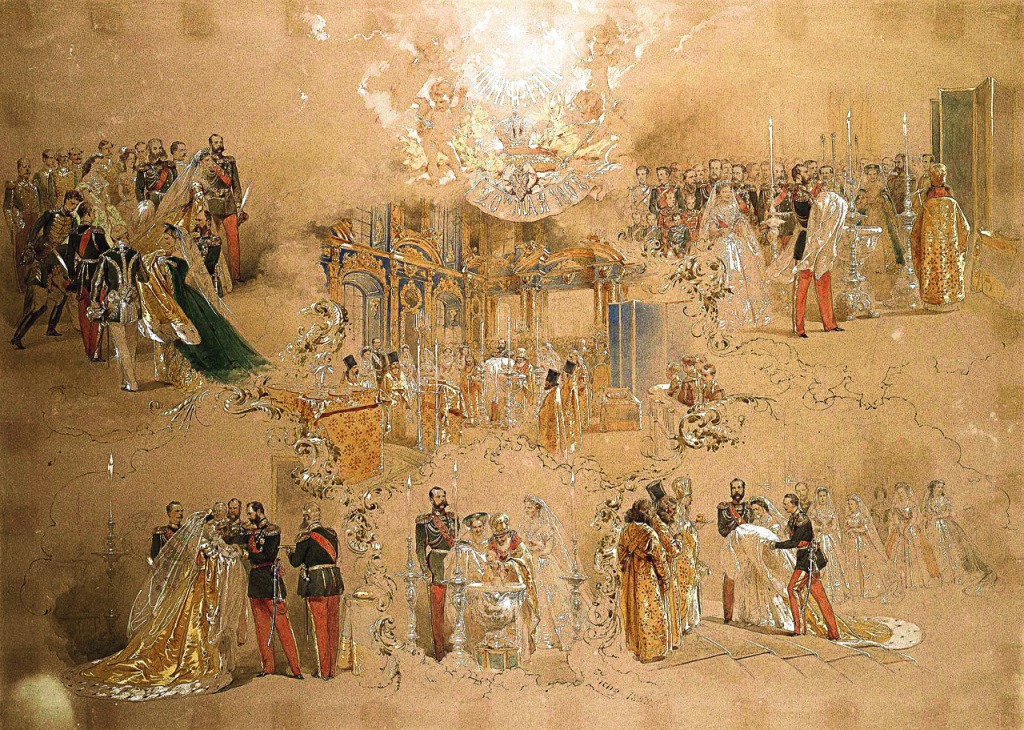
PHOTO: the baptism of Grand Duke Nicholas Alexandrovich [future Tsesarevich and Emperor] on 2nd June (O.S. 20th May) 1868, by Mihály Zichy (1827-1906). The watercolour depicts four baptismal scenes, and two of them show Alexander II holding his grandson in his arms.
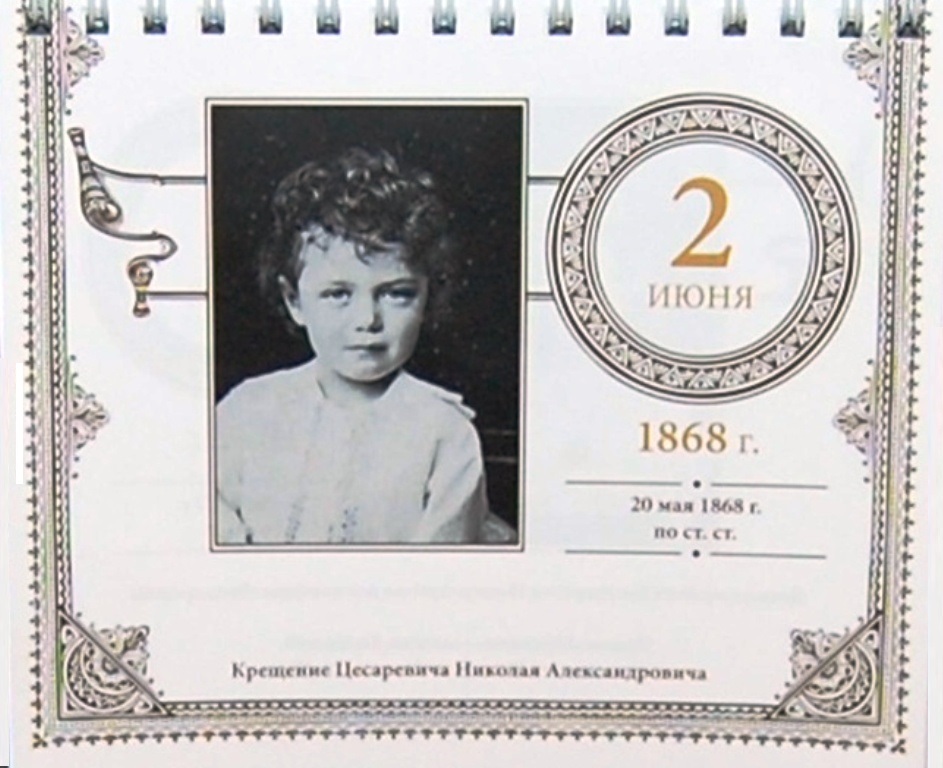
Two weeks after his birth, on19th (O.S. 6th) May 1868, His Imperial Highness Grand Duke Nicholas Alexandrovich was baptised in the Church of the Resurrection of Christ in the Catherine Palace at Tsarskoye Selo. The baptism was performed by the Imperial family’s confessor Protopresbyter Vasily Bazhanov (1800-1883).
The infant’s grandfather Emperor Alexander II, took a very active role in this historic ceremony. He clearly understood that not only was this his first grandson, but also that a future Emperor was being baptised. It is noteworthy that during the baptism, both Alexander II and his son, Grand Duke Alexander Alexandrovich [future Alexander III], acted as assistants to the lady of state. The fact that the father, breaking tradition, took an active part in the baptism[1], apparently, was due to its historic significance. Two emperors, current and future, held their successor in their arms, strengthening the foundation of the infant’s legitimacy.[2]
As for the mother [future Empress Maria Feodorovna], she did not have the right to be present at the baptism of her baby at all [in accordance with a tradition that originates in the Old Testament]. However, even if Maria Fedorovna wanted to break the custom, she could not do so, due to the fact that her doctors advised her not to walk following the birth of her son, and instructed her to rest on that eventful the day. [3]
It was Alexander II and Grand Duchess Elena Pavlovna, who carried the baby to the font for baptism. In addition, Nicholas Alexandrovich’s godparents, his Danish grandmother and uncle, Queen Louise and Crown Prince Friedrich took part.
Grand Duke Alexander Alexandrovich described the day’s events as follows: “The entrance was magnificent, and there were a lot of people in the palace and also in the garden. The little one was transported in a golden carriage with much pomp and ceremony, accompanied by an escort on horseback. During the ceremonial procession through the halls of the Grand Palace at Tsarskoye Selo, the newborn was carried to the palace church by the lady of state Princess [Alexandra Aleekseevna] Kurakina (1840-1919), supported on the one side by the State Chancellor Prince [Alexander Mikhailovich] Gorchakov (1798-1883), and on the other by Field Marshal Prince Alexander [Ivanovich] Baryatinsky (1815-1879) – both old and lame, but they endured excellently and helped as much as they could. The field marshal walks very decently, although with a cane. Tsarskoye Selo was unrecognizable that day; the streets were full of people and carriages, the whole city is celebrating. At 5 o’clock, a large banquet was held in the Great Hall, which was lit splendidly by the sun. It’s been a very tiring day, and poor Mama [Empress Maria Alexandrovna] is very tired. After the baptism, the entire family gathered at my place [the Alexander Palace] to congratulate Minnie [Grand Duchess Maria Feodorovna], and all little ones were there too. An excellent breakfast was served, and then everyone went home.”
Nearly 13 years later, in March 1881, Grand Duke Nicholas Alexandrovich became the Heir Tsesarevich, and in October 1894, he became Russia’s last Emperor and Tsar.
NOTES:
[1] According to Orthodox tradition at that time, the father was required to leave the church at the time of the baptism of his child, giving way to the godfather. Emperor Nicholas II was not in the church when his son Alexei was baptised in August 1904.
[2] Zimin, Igor Viktorovich. Children’s world of imperial residences. Life of monarchs and their environment. Baptism of children. 2010
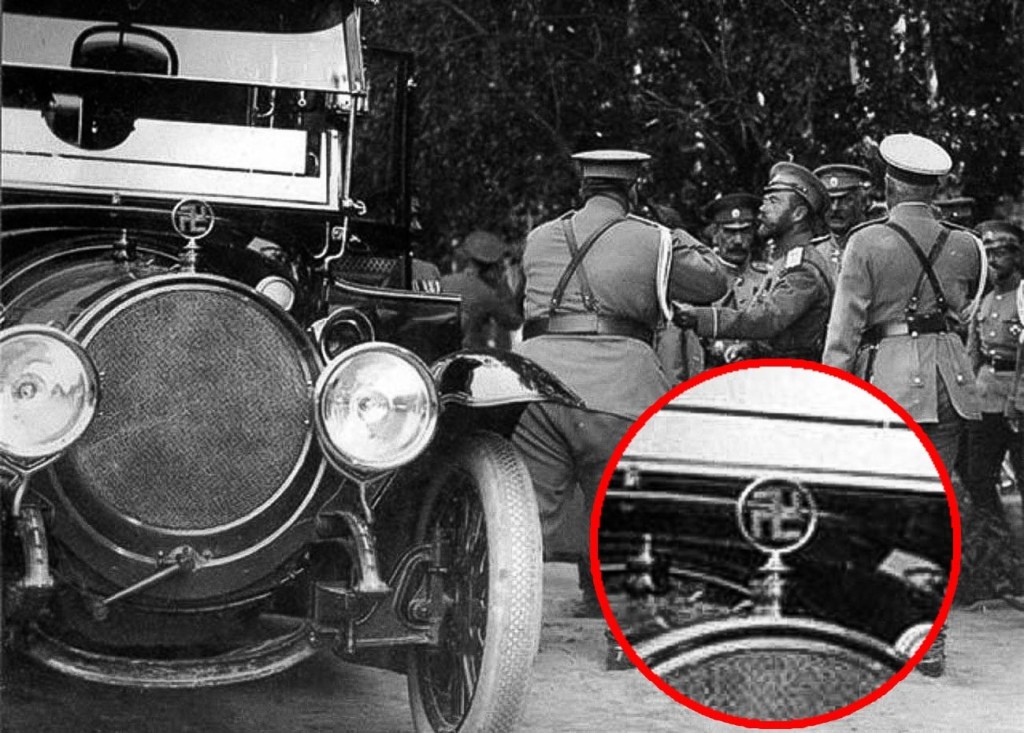
PHOTO: Emperor Nicholas II’s favourite Delaunay-Belleville motorcar, sporting a left-facing swastika (counter clockwise) on the hood. Tsarskoye Selo 1913
The swastika symbol is an ancient religious symbol in various Eurasian cultures, now also widely recognized for its appropriation by the Nazi Party and by neo-Nazis. It continues to be used as a symbol of divinity and spirituality in Indian religions, including Hinduism, Buddhism and Jainism. It generally takes the form of a cross, the arms of which are of equal length and perpendicular to the adjacent arms, each bent midway at a right angle.
In the 1930s the German Nazi Party adopted a right-facing (clockwise) form and used it as an emblem of the Aryan race. As a result of World War II and the Holocaust, in the West it continues to be strongly associated with Nazism, anti-Semitism, white supremacism, or simply evil.
In 19th century Russia, however, the swastika had a completely different meaning. The left-facing swastika (counter clockwise) swastika, best described as a “sacred solar cross”, was adopted as a symbol of the Russian Empire. In the years before the Russian Revolution, it was used on the facades of houses, depicted on icons, clothes and dinner plates, as well as Emperor Nicholas II’s favourite motorcar.
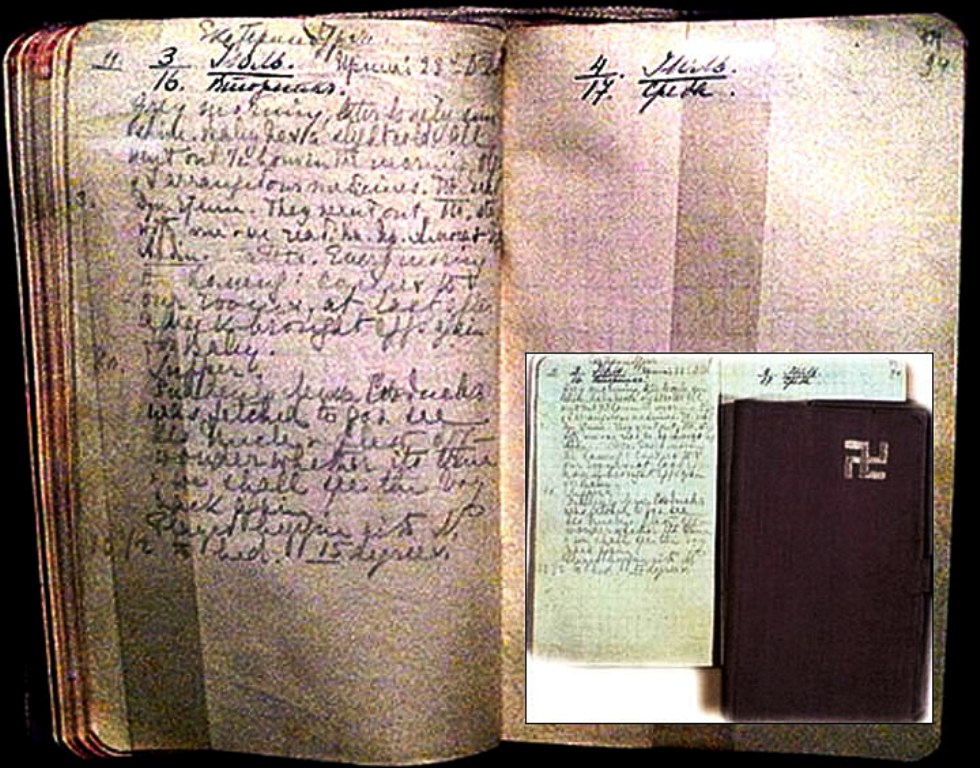
PHOTO: the last diary [1917] of Empress Alexandra Feodorovna, was embroidered with a left-facing swastika (counter clockwise)
In addition, the left-facing swastika (counter clockwise) was a favourite symbol of Empress Alexandra Feodorovna. She wore a talisman in the form of a swastika, wearing it everywhere for happiness, including on her letters from Tobolsk and Ekaterinburg. In a letter dated 16 December 1917 to Anna Vyrubova, she wrote: “Always to be recognized by my sign 卐.”
According to Vladimir Kozlov & Vladimir Krustalev, in her 1917 diary, Alexandra noted the anniversary of a person’s death with a swastika. In Sanskrit, svastika means “well-being”. When her daughter, Grand Duchess Tatiana Nikolaevna gave her mother the little notebook in which the diary was kept, she embroidered a swastika on the cloth cover [depicted in the photo above] she made for it.[1]
In settling in her room in the Ipatiev House at Ekaterinburg, Alexandra inscribed a swastika on a window frame, followed by the date 17 [N.S. 30] April 1917, and another swastika on the wall over her bed.
In addition, investigator Nikolai Sokolov , who investigated the murder of the Imperial family, suggested that persons from the Emperor’s entourage were part of a secret organization. According to him, in their correspondence, among other things, they used the swastika.
NOTES:
[1] Ed. Vladimir Kozlov & Vladimir Krustalev. The Last Diary of Tsarista Alexandra. Yale University Press, 1997
In 1913 – the year marking the 300th anniversary of the Romanov Dynasty – Emperor Nicholas II and his family arrived in Crimea for a 4-month stay. From 14th August to 17th December, the Imperial family lived at the beautiful Livadia Palace, situated on the southern coast overlooking the Black Sea.
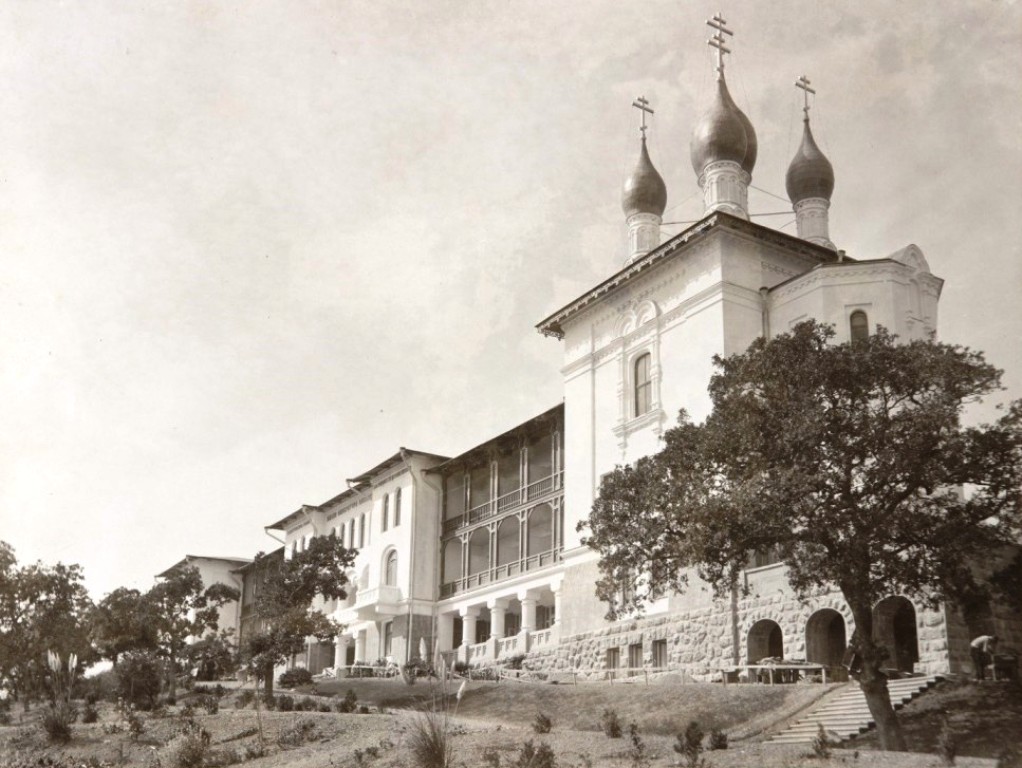
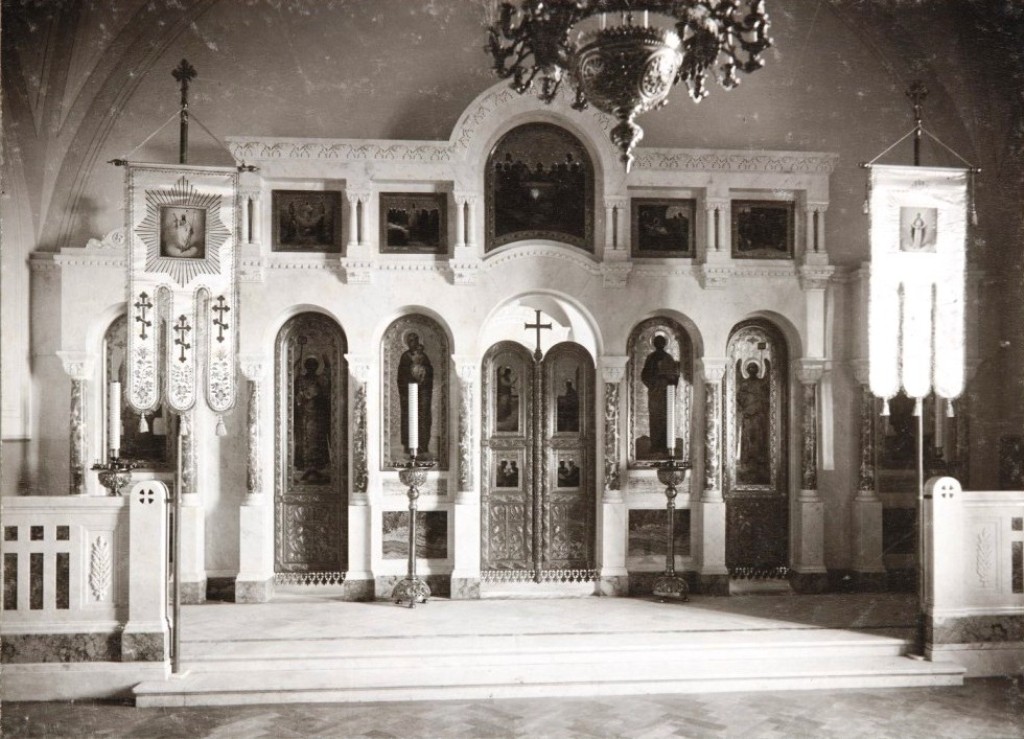
At the end of September 1913, a sanatorium named after Emperor Alexander III (1845-1894) was opened in Alupka for students and teachers of theological schools in Russia. It was an elongated three-story building, where on the east side the premises of the third floor were intended for the church. The interior of the church was illuminated by a large bronze chandelier, and featured a marble iconostasis and solea[1].
This sanatorium was located in the western part of Alupka on land that once belonged to the Vorontsovs, whose heirs at the beginning of the 20th century divided it into plots for long-term lease. Plot No. 72 was rented free of charge by the Synod for a climatic sanatorium for teachers of parochial schools. In 1913, here, according to the project of the architect N.P. Kozlov, at the expense of the School Council of Russia, a sanatorium building was erected, designed for 100 guests. The sanatorium had separate rooms, a well-equipped kitchen, a common refectory, and, most importantly, its own five-domed Church of St. Alexander Nevsky.
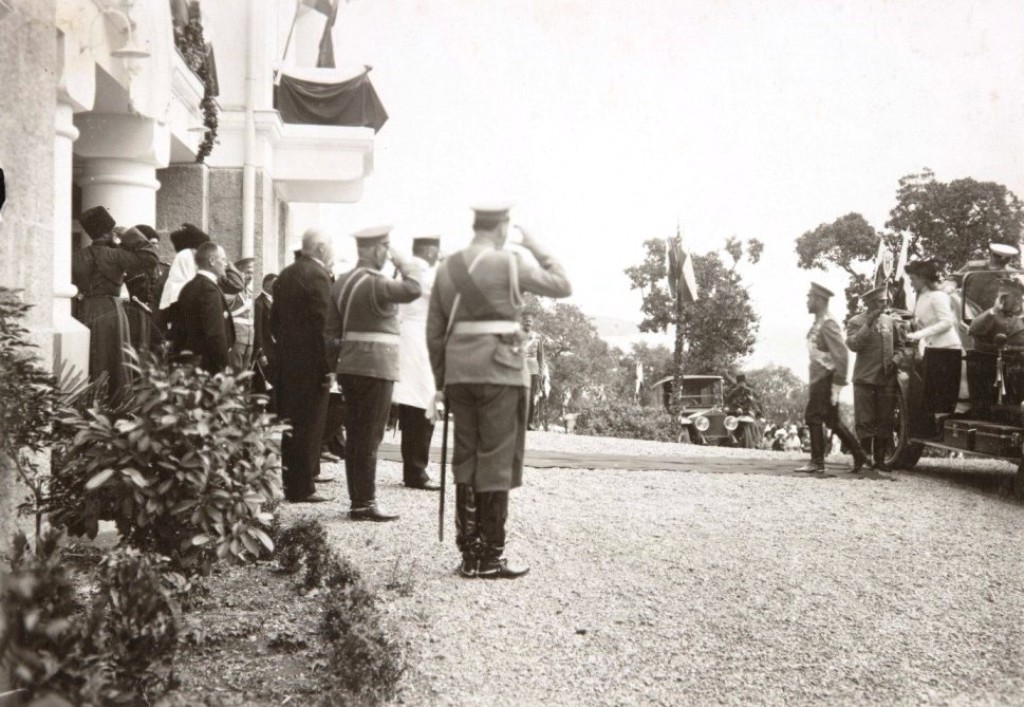
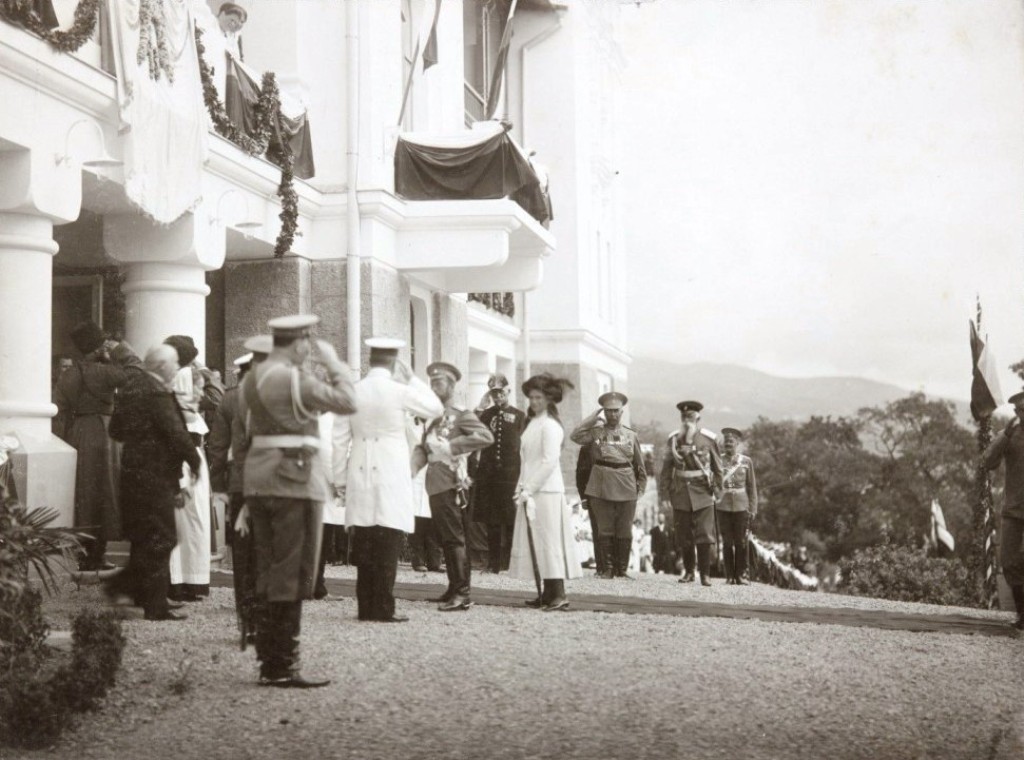
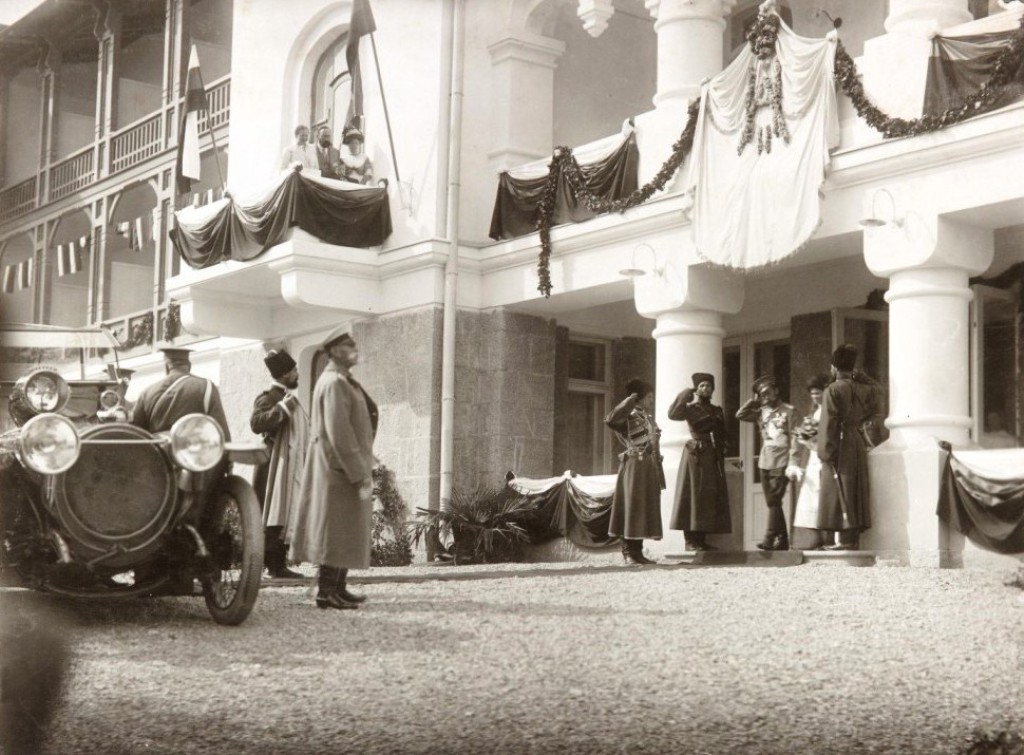
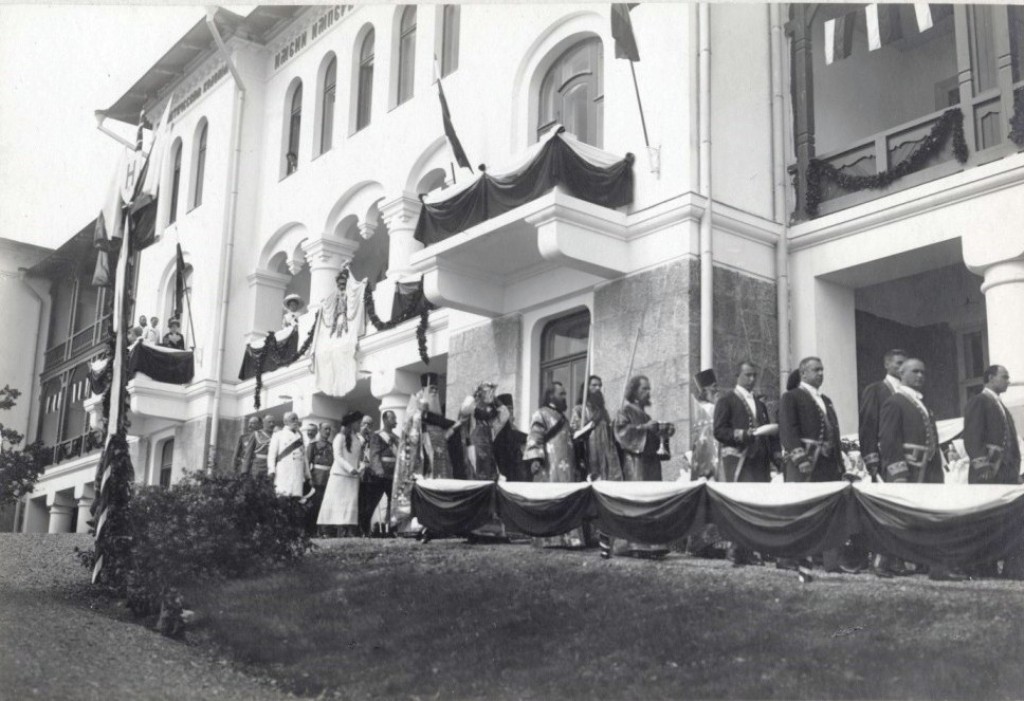
The church was consecrated in memory of the Emperor and his heavenly patron Saint Alexander Nevsky. The grand opening of the sanatorium in Alupka was attended by Emperor Nicholas II, his daughter Grand Duchess Maria Nikolaevna, Minister of the Imperial Court Count Vladimir Frederiks, local dignitaries and members of the clergy.
Here is an excerpt from the diary of Nicholas II for 22nd September 1913: “At 9 ½ I went with Maria and Frederiks to Alupka for the consecration of the Church of the Climatic Sanatorium for students of church schools. A beautifully arranged big house for 80 and even up to 100 guests.”
Nicholas II accompanied by Grand Duchess Maria Nikolaevna, and his retinue arrived in front of the main entrance, which was decorated with garlands of flowers and canvases with imperial monograms. They were solemnly greeted by representatives of the city authorities, their wives and the clergy, headed by V.K. Sabler, who in 1911-1915 served as chief prosecutor of the Synod.
To perpetuate the historical event of Nicholas II’s attendance at the consecration, court photographer K.F. Hahn and Alupka photographer A.E. Zimmerman, captured the historic event on camera.
Several photographs have survived to this day which show a general view of the sanatorium and the Church of St. Alexander Nevsky, the interior of the church and the arrival and procession headed by Emperor Nicholas II.
After the advent of Soviet power, by order of the Chief Commissioner for Crimea, the sanatorium for clergy, along with the church, among other noble estates of Alupka, were nationalized and became the property of the Russian People’s Republic. In June 1923, the Presidium of the Executive Committee of the Crimea issued a decision to close the Alexander Nevsky Church and transfer the movable property of the temple to the Special Storage of the Yalta District Executive Committee. The liquidated church was transferred to the property of the administration of the sanatorium of the People’s Commissariat of Railways (NKPS). In Soviet times, a climatic sanatorium named after V.I. F.E. Dzerzhinsky.
The Church of St. Alexander Nevsky suffered neglect and disrepair, and in 1927, the building sustained significant damage during an earthquake.
In the spring of 1996, through the efforts of the Crimean and Simferopol Metropolitan Lazarus, the building was returned to the Church, and now a sanitarium named after St. Luke of Crimea is located here. The Church of Alexander Nevsky was also restored, in which divine services are held, as well as a Sunday school.
Today, the five onion-shaped domes of St. Alexander Nevsky Church are visible from different vantage points in Alupka.
NOTES:
[1] a platform or a raised part of the floor in front of the inner sanctuary in an Eastern Orthodox church on which the singers stand and the faithful receive communion.


 Nicholas II
You must be logged in to post a comment.