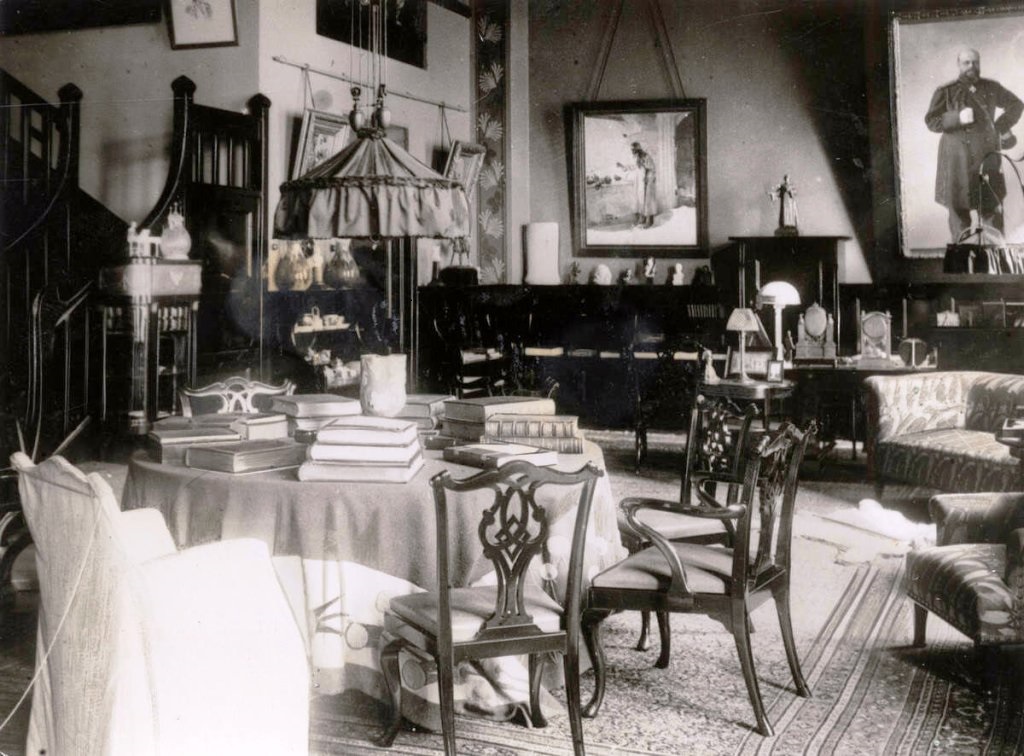
Restoration of Lighting Fixtures for the Alexander Palace

PHOTO: Chandelier for Empress Alexandra Feodorovna’s Corner Reception Room

The restoration of two chandeliers and three lanterns for the Alexander Palace has been completed. They will decorate Empress Alexandra Feodorovna’s Corner Reception Room, as well as the Small and Large Libraries.

PHOTO: Colour autochrome of the Corner Reception Room, taken in 1917

In the Corner Reception Room, visitors will see a 30 candle chandelier made of ruby-coloured ​​glass, which had been preserved from the historical collection of the Alexander Palace, but kept in Pavlovsk. Originally, two identical chandeliers were located in the Concert Hall (demolished), a spacious two-story room designed by Giacomo Quarenghi (1744-1817) in the east wing of the palace. At the beginning of the 20th century, during the reconstruction of the hall, one of the chandeliers was moved to the Empress’s Corner Reception Room. The second chandelier was used to decorate the Mirror Study, which was part of the private apartments of Empress Catherine II, located in the Zubov Wing of the nearby Catherine Palace. After the completion of the restoration of the Alexander Palace, this elegant chandelier will be returned to take its original place. The deep ruby red colour of the glass elements of the chandelier perfectly match the soft pink tint of the imitation marble walls of the Corner Reception Room.

PHOTO: restored lighting fixtures for the Small and Large Libraries

For the Small Library, an eight candle chandelier has also been restored. It is decorated with glass vases-balusters, decorating the central rod, pyramids of cut crystal and a crowning cobalt vase with a fountain made of almond-shaped pendants.

An earlier type of pendant lamps, which were used in palace interiors, were lanterns, consisting of a conical body of glass in a mount of gilded bronze and a crystal set in the form of garlands with pendants. The candlestick was placed inside the flask; such lanterns reliably protected the oscillating flame from constant drafts.

PHOTO: Colour autochrome of the Large Library, taken in 1917

From 1796 to 1941, the Large Library (originally the Dining Room) was lit by three large lanterns with six candles each (now used in the lobby of the Pavlovsk Palace). The Large Library of the Alexander Palace will be lit by three 18th century lanterns, one of which comes from the historical collection, the other two purchased.

During the restoration process, the craftsmen removed dirt from the lighting fixtures, carried out the restoration of the crystal pendant, recreated the lost parts from glass and bronze with subsequent galvanic gilding, and installed new electrical wiring.

The restorers also managed to almost completely recreate one of the lanterns using the existing analogue, adding an 18th century glass flask. The original piece is the only thing that has survived from a hanging or table lamp. For many years, the flask was kept in the museum’s funds, it was intended to be used for such a restoration.

The restoration work which lasted four months was carried out by the Yuzhakova Studio (St. Petersburg) with the participation of masters Alexei Gvozdev, Vyacheslav Gizimchuk and Dmitry Rosenthal.

NOTE: all photos © Tsarskoye Selo State Museum-Reserve

© Paul Gilbert. 16 November 2020

New Metropolitan of Ekaterinburg confirms: “ROC in no hurry to recognize Ekaterinburg remains”

PHOTO: Bishop Evgeny of Ekaterinburg and Verkhotursky

According to Bishop Evgeny of Ekaterinburg and Verkhotursky the Russian Orthodox Church ( ROC ) will not rush to recognize the Ekaterinburg remains – those of Emperor Nicholas II and his family. The newly appointed metropolitan made the comments during a press conference held on Saturday, 12th December in Ekaterinburg. On 8th December 2020, by the decision of the Holy Synod, Vladyka Evgeny was appointed Metropolitan of the Ekaterinburg Diocese.

“I had an opportunity to communicate with those on the commission who investigated the remains … there are many arguments and evidence that these are indeed the remains of the Tsar and his family. But at the same time, there are still many questions that have not yet been answered. His Holiness Patriarch Kirill of Moscow and All Russia stated that the ROC is not in any hurry to complete their investigation by a certain date. We will wait for answers to these questions. This is not some kind of artifact … For us it is a matter of principle, these are holy passion-bearers, these are people who have played a significant role in the spiritual life of our people, and in the state, so the church is in no hurry, fulfilling the words of the holy patriarch,” added Vladyka Evgeny.

“The church will recognize the remains only if there is not an ounce of doubt. If doubts remain, then we will not rush, we will wait. We do not want to offend their memory by making hasty decisions,” he added.

In the summer of 2018, the official representative of the Investigative Committee, Svetlana Petrenko, said that a repeated comprehensive study confirmed the authenticity of the remains of Emperor Nicholas II and his family, who were shot on 17th July 1918 in Ekaterinburg.

Earlier, Evgeny Pchelov, associate professor of the Historical and Archival Institute of the Russian State Humanitarian University, who took part in the research, told journalists about the completion of the historical and archival examination, which, according to him, confirmed the authenticity of the “Ekaterinburg remains.” According to Pchelov, thanks to a comprehensive analysis of primary sources, it was possible to recreate a fairly complete picture of what happened in the days leading up to the deaths of the Imperial family, and the subsequent days which followed the brutal murder. He emphasized that some specific  questions remained unclear, but “the main picture was clarified.”

On 16th July 2018, the eve of the 100th anniversary marking the deaths of Nicholas II and his family, the Investigative Committee of the Russian Federation reported that since the resumption of the investigation in 2015, investigators carried out a wide range of new tests, including 37 different forensic examinations. In total, more than two thousand historical sources were analyzed.

The Investigative Committee stated that “on the basis of numerous expert examinations, the committee concluded that the remains belong to Nicholas II, his family and their four retainers.” At the same time, the committee noted that, “excluding the possibility of ambiguous interpretation of certain circumstances associated with the murders, other examinations necessary for the investigation shall continue.”

In addition, the investigation into the murder of Nicholas II and members of his family intends to identify all those involved in the execution and qualify their actions in accordance with the Criminal Code of the Russian Federation. This part of the investigation is extremely important! Should the *regicides be found guilty of their heinous crime, then lawmakers and historians will be forced to rewrite history. It is a well known fact that after the murders of the Tsar and his family, that many of the *murderers [Yurovsky, Ernakov, etc.] enjoyed a “celebrity” status among the Bolsheviks and revolutionaries. To now find them guilty of their crime a century later, this then clears the way for the names of streets, squares and buildings named in their “honour” of these criminals to be changed, and the removal of any monuments and memorials from the Russian landscape.

*For more information on the regicides, please read my article: The fate of the regicides who murdered Nicholas II and his family, published on 28th October 2020 – PG

Human remains, presumably belonging to the Imperial family, were found in July 1991 on the Old Koptyakovskaya road near Ekaterinburg. The remains of nine people were found in the grave. Forensic studies confirmed the identity of the remains as those of Nicholas II, his wife Alexandra, three of their five children and their four retainers.

In July 2007, during archaeological excavations south of the site of the first burial, the remains of two more people were found, presumably Tsesarevich Alexei and his sister Maria. Forensic studies concluded the identity of the remains as those of Alexei and Maria.

In 2000, the Moscow Patriarchate canonized Nicholas II and his family members as passion-bearers. After the opening of the burial near Yekaterinburg, the remains of members of the imperial family were buried in St. Catherine’s Chapel of the Peter and Paul Cathedral in St. Petersburg. However, the Church did not recognize these remains as genuine due to a lack of evidence. In the fall of 2015, the investigation into the death of the Imperial family was reopened.

Holy Royal Martyrs, pray to God for us!
Святы Царственные мученики, молите Бога о нас!

***

CLICK on the IMAGE above or the LINK below to order my book
‘Bones of Contention: The Russian Orthodox Church and the Ekaterinburg Remains’
Published 2020. 156 pages + 55 illustrations. Price: $20 + postage

© Paul Gilbert. 13 December 2020

The Charity of the Holy Tsar Nicholas II

Since the time of Christ and the Apostles, Christians have selflessly served people, carried out charity work, cared for the sick and the needy, observing the Lord’s commandment “love thy neighbour.” As a true Christian, Tsar Nicholas II, adhered to the centuries-old tradition of mercy, considering it his sacred duty to help his subjects in need.

The financial affairs of the Russian Emperor were handled by the Cabinet of His Imperial Majesty [housed in the Anitchkov Palace, situated on the corner of the Nevsky Prospekt and the Fontanka in St. Petersburg] which was part of the Ministry of the Imperial Court, whose officials kept records of the receipts and expenses of all members of the House of Romanov. The Cabinet annually released 200 thousand rubles from the State Treasury for the personal needs of the Emperor. From this amount, some 20 thousand rubles was spent on wardrobe and other personal expenses. The Tsar’s income was further supplemented by income from his estates.

PHOTO: The Cabinet of His Imperial Majesty in 1894

As Tsesarevich he received an inheritance of 4 million rubles in gold, from his great-grandmother [Empress Alexandra Feodorovna, born Princess Charlotte of Prussia, 1798-1860] of which, he spent most of it on helping the starving during the Russian famine of 1891-1892. At that time he headed the “Special Committee of the Heir Tsesarevich Nicholas Alexandrovich” for the fight against hunger.

By the time of his coronation, Nicholas II had 1,320,000 rubles in his account. Not wanting to burden the state treasury, the Emperor paid for almost his entire coronation at his own expense (898 thousand rubles).

The first act published on his behalf after his accession was a rescript addressed to the Moscow Governor-General Grand Duke Sergei Alexandrovich (1857-1905): 15 thousand rubles for distribution, “among the residents of Moscow who most needed help.” In addition, several hundred thousand rubles were distributed to the victims of the Khodynka Tragedy [30th (O.S. 18th) May 1896]. The sovereign “ordered the issue of 1000 rubles for each orphaned family, and that the funeral expenses be paid.” The families of the victims received annual state benefits until February 1917.

Most of the Emperor’s personal money went to donations, pensions, the maintenance of boarders, hospitals, educational institutions, charitable organizations, for benefits, gifts and monetary awards. The courtiers received expensive gifts from the Tsar twice a year. Gifts were also distributed to the heads of the railways, the chiefs of the gendarme units who ensured the protection of the Imperial family, the gamekeepers after the end of a hunt in Białowieża or Spala, etc.

One of the long-standing myths spread by revolutionary circles and aimed at discrediting the tsarist dynasty was that of “Romanov capital” stashed in foreign banks. The legend has it that Nicholas II had over 600 million gold rubles in the Bank of England. 

Emperor Alexander III (1845-1894), in fact, deposited his personal capital (about 90 million gold rubles) in the Bank of England, which he inherited from his father Emperor Alexander II (1818-1881). Emperor Nicholas II, however, did not want to keep this money in England. He found it necessary to transfer the funds to Russia and place them in Russian loans. This transaction, however, was hampered with great difficulties: in an effort to keep the vast fortune in Britain, the Bank of England put up all sorts of obstacles to stop the funds from being returned to Russia. It took the exceptional tact of the Head of the State Bank of the Russian Empire Eduard Pleske (1852-1904), who was forced to personally travel to London to resolve the matter. The money was transferred to Russia, and from that time the Tsar did not have any capital abroad. This helps explain the difficult financial situation of the members of the Russian Imperial family, who managed to flee after the revolution and settle abroad.[ 1 ]

The proceeds from the Bank of England were spent on charity. According to Russian historian and writer Ivan Lukyanovich Solonevich (1891-1953), the tsar had a civil list of 30 million rubles a year. These funds helped to offset a variety of projects, including funding Russia’s finest theaters, the irrigation of lands which resulted in the suitable land for farming and cultivation of new crops, etc.[ 2 ] Money was also used to pay pensions and other requests for financial assistance. Every day the sovereign received a large number of letters asking for help, and no one was refused.

PHOTO: Women’s Medical Institute, St. Petersburg

Donations to various charitable purposes from Nicholas II ‘s “own funds” were significant. The emperor, according to the tradition established in the Imperial family, supported the activities of the Red Cross. In July 1896. 400 rubles were transferred to the Committee for the Care of Sisters of the Red Cross on behalf of Nicholas II. In 1896, he supported the idea of ​​opening a women’s medical institute in St. Petersburg, and ordered the allocation of 65 thousand rubles from the funds of the Cabinet of His Imperial Majesty. for the purchase of a plot of land for the construction of a hostel for students from other cities .[ 3 ] Quite often, the Tsar acted anonymously. In 1901 he ordered to transfer 50 rubles to the editorial office of the Russian Invalid magazine – as a donation from an “unknown person”.

Throughout his reign, the Tsar generously supported the construction of new churches from his personal funds. An impressive amount from the personal budget of Nicholas II was donated for the construction of the Orthodox church of St. Mary Magdalene in Darmstadt, home of his wife Alexandra Feodorovna. In 1898-1899 194,732 rubles were spent on the construction of this church, and an additional 23 thousand rubles for the decoration of the interiors.  Another major donation by Nicholas II was associated with the canonization of Seraphim of Sarov (1754-1833). For the Diveyevo Monastery, the Tsar allocated 44,424 rubles from his own funds in 1903. and an additional 11,434 rubles in 1904. Among other churches funded from the Tsar’s personal funds, the magnificent Feodorovsky Sovereign Cathedral in Tsarskoye Selo, consecrated in 1912, should be noted. In addition to the upper church, the cathedral had a lower church – the Cave in the name of St. Seraphim of Sarov. This cathedral was built with large funds provided by the Sovereign.[ 4 ] In 1913, the Tsar donated 1,000 rubles for the construction of an almshouse in memory of his personal confessor, Protopresbyter Father Ioann Yanyshev (1826-1910).

Emperor Nicholas II ‘s concern for the Russian Orthodox Church extended far beyond the borders of his Empire. Thanks to the sovereign’s generous donations, 17 new Russian churches were built in European cities, each distinguished by their own beauty. In 1898. he donated 5,000 rubles for the completion of the Russian Orthodox Cathedral of the Most Holy Trinity in Buenos Aires, Argentina. Orthodox churches in Greece, Bulgaria, Serbia, Romania, Montenegro, Turkey, Egypt, Syria, Libya, Palestine and the United States, all benefited from donations made by Nicholas II. The Tsar also paid for entire sets of silver vestments, icons and liturgical books, which were sent to the dioceses of Serbian, Greek, Bulgarian, Montenegrin, Antioch, Constantinople and Jerusalem Autocephalous Orthodox Churches, not to mention the generous subsidies for their maintenance and upkeep.

PHOTO: Feodorovsky Sovereign Cathedral, Tsarskoye Selo

The Tsar’s spiritual activity was inextricably linked with charity, guardianship, caring for the poor and the needy. Compassion and heartfelt concern were characteristic of all members of the Imperial Family. Many hospitals, orphanages and schools for the blind were dependent on Imperial philanthropy.

Nicholas II also donated significant sums to support education, science and art. In the period from 1896 to 1913. he provided assistance to various educational institutions in the amount of 66,157 gold rubles. From  the beginning of his reign, the Tsar donated 2 million rubles annually to support Russian art. Thanks to the personal financial support of Emperor Nicholas II, the Russian Museum of His Imperial Majesty Alexander III [renamed the State Russian Museum in 1917], the country’s first state museum of Russian fine arts, was opened in St. Petersburg in 1895. The State Memorial Museum of A.V. Suvorov – the first memorial museum in Russia – was also founded by Nicholas II. The Tsar’s personal funds supported the Academy of Arts, three theaters in St. Petersburg and two in Moscow, the imperial ballet and students of the ballet school.

In 1900, the tsar, using his own money, built the People’s House in St. Petersburg, a leisure and cultural centre built with the intention of making art and cultural appreciation available to the working classes of the Imperial capital. A colossal building, it featured an opera house with 7,000 seats, a theater hall with 1,500 seats, concert halls where the best orchestras and the best artists performed. The People’s House had a library, a reading room and an amusement park. The entrance fee to the People’s House was purely symbolic (10 kopecks).

PHOTO: Nicholas and Alexandra attend the opening of the Russian Museum
of His Imperial Majesty Alexander III in St. Petersburg on 17th March, 1898

The Emperor, being an excellent athlete, supported projects related to the development of sports in Russia . In 1911, the tsar allocated 5 thousand rubles to the Bogatyr Physical Education Society from his own funds.

Nicholas II continued the traditional donations of his father Alexander III for the arrangement of charity trees and annually allocated several hundred rubles “for a Christmas tree for poor children”… In 1913, the Romanov Committee, a state-run charitable institution under the patronage of the Emperor, was organized “to provide charity to the orphans of the rural state”. The committee allocated 500,000 rubles for 1914; 5,000 given personally by the Emperor. In 1913, the All-Russian Guardianship for the Protection of Motherhood and Infancy was established by a personalized imperial decree, with the goal of reducing infant mortality in Russia, setting up shelters for mothers and children, Russia’s first dairy kitchens, children’s hospitals, maternity hospitals, etc. The Tsar allocated capital in the amount of one million ten thousand rubles for the establishment of the “Guardianship”, donated by St. Petersburg and Moscow private commercial banks at his disposal in commemoration of the 300th anniversary of the House of Romanov (1613-1913).

The Emperor often traveled across Russia. For example, there are memories of his visit to the Bryansk province in 1915. While visiting the families of workers of a mechanical plant in the village of Bezhitsa, Nicholas II left expensive gifts. The master, who greeted him with the traditional bread and salt, was presented with a gold watch. The Emperor also gave money to the children of workers who met him at the Bryansk plant.

According to the memoirs of Anatoly Alexandrovich Mordvinov (1870-1940), aide-de-camp to Nicholas II: “His kindness was not of a superficial quality, did not show itself outwardly and did not diminish from countless disappointments. He helped as much as he could, out of his own funds, without thinking about the amount requested, including people to whom, I knew, he was personally not disposed”.

PHOTO: the People’s House of Nicholas II, St. Petersburg

The Bolsheviks created the myth that Nicholas II and his family lived in decadent luxury, that the Tsar and his family spent lavish sums of money on their own needs, although in fact they lived rather modestly in their residences at Tsarskoye Selo [Alexander Palace] and Peterhof [Lower Dacha]. Nicholas II was thrifty and modest in his personal habits, tastes and dress. Colonel Eugene Stepanovich Kobylinsky (1875-1927) said: “He was very modest in his needs. I saw him at Tsarskoye Selo wearing worn-out trousers and boots.” To support this or that charity, the Tsar was often forced to curb his own personal expenses. Sometimes he would tell members of his family to live modestly for 2 or 3 months. Nicholas II donated so much that he sometimes had to ask for an advance from the amount that was annually assigned him by the Cabinet of His Imperial Majesty.

Prince Dmitry Dmitrievich Obolensky (1844-1931) recalled: “In my Tula estate, the village of Shakhovskoye, a stone church was being built, and on the occasion of the war there was a hitch in the construction. And so, thanks to the generosity of the Tsar, it was possible to complete the construction, and in 1915, during the consecration of this church by the Tula Archbishop Parthenius, to proclaim many years for the beloved Monarch.[ 5 ]

Once, when the Tsar and his family stopped at one of the railway stations, a local official turned to him, complaining that his small salary was not enough for his large family. The generous Tsar promised that he would give him 30 rubles a month, and Tsesarevich Alexei said that he would add another 40 from his own funds.

Mrs. O.P. Ollengren , the headmistress of the Vasileostrovskaya Women’s Gymnasium, said that often in the evenings the Tsar invited her to his study and, despite being very busy and tired, asked to present him with lists of the most needy children who were under her care. The sums that the Emperor donated from his personal funds were sometimes very large. Once Mrs. Ollengren dared to say that the sum was too much, that he could not find enough for everyone, to which the Emperor firmly answered: “The Tsar must provide for everyone.” At the end of the audience, always in a whisper, he asked her “not to say a word to anyone” about his help.

PHOTO: Nicholas II visiting wounded Russian soldiers. 1914

At the beginning of the First World War, Emperor Nicholas II, donated 200 million rubles for the needs of the army, to help the wounded, the crippled and their families. During the war, the expenses of Nicholas II provided funds for medical equipment to numerous hospitals and institutions, and increased many times over. In 1916 and 1917. for these purposes the Emperor spent 427,763 and 431,583 rubles, respectively .[ 6 ] The donation on behalf of the Emperor and his wife to the Charity Committee of the Grand Duchess Tatiana Nikolaevna “for providing temporary assistance to victims of hostilities” amounted to 425 thousand rubles. From his personal funds, the tsar donated 100 thousand rubles to the International Committee of the Red Cross in Geneva to help Russian prisoners of war who were in concentration camps of those nations at war with Russia.

As a result of all the expenses associated with the war, the treasury was empty. In March 1917, an audit by the Provisional Government revealed that the former tsar, instead of the supposed millions, had only 908 thousand rubles in his account.

As Grand Duke Alexander Mikhailovich recalled: “Looking back at the life that the Imperial Family led, I must admit that this way of life could not be compared with the life of the wealthy tycoons of the capital. I doubt whether the kings of steel, cars or oil would have been content with such a modest yacht that belonged to the Tsar. And I am convinced that not a single head of any large enterprise would have retired from business as poor as the Tsar was on the day of his abdication.”

Yes, the tsar became financially impoverished, but until the last minute of his life he remained a highly spiritual person, devoted to the Orthodox faith, the Fatherland and his people. In 2000, by the decision of the Holy Synod of the Russian Orthodox Church, he and his family were glorified in the rank of holy royal passion-bearers in the host of new martyrs and confessors of Russia.

It is impossible to list all the acts of mercy and charity of Holy Tsar Nicholas II, but let his selfless acts of charity serve as an example for the new Russian capitalists and for all of us Orthodox Christians.

CLICK on the IMAGE above or LINK below to watch the VIDEO
‘Nicholas II: The Last Orthodox Tsar of Russia with Paul Gilbert

NOTES

[ 1 ] Prince Dmitry Obolensky. Emperor Nicholas II and his reign (1894-1917). “Tsar and Russia”, publishing house “Otchiy Dom”, M., 2017, p. 163.

[ 2 ] I.L. Solonevich. The myth of Nicholas II. “Tsar and Russia”, M., 2017, p. 493.

[ 3 ] A. Sokolov, I. Zimin. Charity of the Romanov family. Х1Х – the beginning of the XX century. Everyday life of the Russian imperial court. M., St. Petersburg. Tsentropolygraph. Russian Troika – St. Petersburg. 2015. – URL: https://www.litmir.me/br/?b=266759&p=1 .

[ 4 ] E.E. Alferyev. Emperor Nicholas II as a man of strong will. Holy Trinity Monastery, Jordanville, 1983. Reprint. edition 1991, p. 80.

[ 5 ] Prince Dmitry Obolensky. Emperor Nicholas II and his reign. Decree. cit., p. 164.

[ 6 ] A. Sokolov, I. Zimin. Decree. op. – URL: https://www.litmir.me/br/?b=266759&p=1 .

© Paul Gilbert. 12 December 2020

Recreation of Furniture for the Mauve (Lilac) Boudoir in the Alexander Palace

This is the second article about the recreation of the Mauve (Lilac) Boudoir in the Alexander Palace. Click HERE to read the first article The history and restoration of the Mauve (Lilac) Boudoir in the Alexander Palace, published on 4th November 2020 – PG

NOTE: all photos © Tsarskoye Selo State Museum-Reserve

***

Empress Alexandra Feodorovna’s Mauve (Lilac) Boudoir was a favourite room for the Imperial family and their guests. It was in this room that the Empress, often together with Nicholas II came to relax, read books, played music, make handicrafts on the couch, and drank tea at a round table. In winter, the room was decorated with fragrant bouquets of white lilacs, grown in the imperial greenhouses at Tsarskoye Selo. The decoration of the Mauve Boudoir, which was part of the Empress’s private chambers, was completed in a short time, in just two and a half months in 1895.

According to documents and drawings, approved by the Empress herself, the F. Melzer & Co. in London, England produced a set of furniture, which consisted of a built-in sofa, built-in shelves and a set of two plateaus (jardinieres) for plants, etc.

PHOTOS: details depicting the current look of the recreated Mauve (Lilac) Boudoir

Sadly, almost all of the furniture items in this room were destroyed during the Great Patriotic War (1941-45). Employees of the Scientific Fund Department of the Museum-Reserve did a lot of research and preparatory work, discovered archival documents and photographs that were used for the recreation of the furniture for the Mauve Boudoir.

In photographs preserved in the Collection of the Tsarskoye Selo State Museum and in photographs from the albums of the historical collection of the Alexander Palace (now stored in the State Archives of the Russian Federation in Moscow), allowed experts to view individual pieces of furniture items in the Mauve Boudoir from different angles, thus making it possible to recreate exact copies of the structural elements and decoration details for the room.

The matter of painting panels, doors and cabinet furniture required a separate study. In the colour scheme of the panels, two shades were used, this can be seen in colour autochromes and is confirmed by archival details from the workshops. The recipe found in the archive, indicating the materials of painting and their proportional ratios, helped restorers to define a modern analogue and apply it when painting the furniture of the Mauve Boidoir in two tones, says Anna Tarkhanova, senior researcher at the Museum-Reserve, who took an active part in the work on the reconstruction of the interior.

PHOTOS: experts review historic photos and drawings for the
recreation of the furniture for the Mauve (Lilac) Drawing Room

The only original item to survive from the Empress’s study was a writing-table, which entered the collection of the museum-reserve in 1999, also helped in solving this issue. During the Great Patriotic War, the table had not been evacuated. It was found in a deplorable state after the war in the Alexander Park by the former curator of the Alexander Palace, Anatoly Mikhailovich Kuchumov (1912-1993). In 2018, restorers conducted test clearing of the paint layer of the table, determined the initial colour of its finish and, on the basis of this, made a decision on the colour scheme of the panels, built-in furniture and doors of the Mauve Boudoir. In 2020, the masters of the Tsarskoye Selo Amber Workshop restored the table and recreated the lost details, based on photographs and archival descriptions.

The work on the recreation of the upholstered and cabinet furniture of the Mauve Boudoir was also carried out by specialists from the Tsarskoye Selo Amber Workshop (director Boris Igdalov) in accordance with the design developed in 2019-2020 by the Studio 44 Architectural Bureau in St. Petersburg.

For the upholstery of the furniture set, fabrics, cords, fringes and tassels were recreated according to historical samples that are kept in the Tsarskoye Selo and Pavlovsk Museum-Reserves. When restoring fabrics, the technologists were guided by the design approved by the museum-reserve and the Renaissance workshops for the restoration of ancient monuments based on materials presented by the museum. The analysis of the fibers of the fabric, the type of threads, their colour and the style of weaving the fabric, as well as the fabrication itself, was carried out by specialists of the famous Italian firm RUBELLI. The trim items were made at the English company Tassel & Trim and the Polish company Re Kon Art. The process of ordering, manufacturing and delivery of these elements for the rooms’ decor was supervised by Janusz Szymanyak, director of the Renaissance Workshops for the Restoration of Antiquities.

PHOTO: colour autochrome of the Mauve (Lilac) Boudoir, taken in 1917

***

The Mauve Boudoir is one of 15 interiors situated in the eastern wing of the palace, scheduled to open in 2021. Among the other interiors are the New Study of Nicholas II, Moorish Bathroom of Nicholas II, Working Study of Nicholas II, Reception Room of Nicholas II, Pallisander (Rosewood) Living Room, Mauve (Lilac) Boudoir, Alexandra’s Corner Reception Room, the Imperial Bedroom, among others.

In the future, the Alexander Palace will become a memorial museum of the Romanov family – from Catherine the Great to Nicholas II, showcasing the private, domestic life of the Russian monarchs who used the palace as an official residence. The eastern wing of the palace will be known as the Museum of the Russian Imperial Family. The multi-museum complex, which includes the Western wing is scheduled for completion no earlier than 2024.

***

Dear Reader: If you enjoy all my updates on the restoration of the Alexander Palace, then please help support my research by making a donation in US or Canadian dollars – donations can be made by GoFundMe, PayPal, credit card, personal check or money order. Click HERE to make a donation or click HERE to buy one of my Nicholas II calendars – the net proceeds help fund my work. Thank you for your consideration – PG

© Paul Gilbert. 9 December 2020


The History and Restoration of the Working Study of Nicholas II in the Alexander Palace

PHOTO: view of the Working Study of Nicholas II, as it looked in 1917

The Working Study of Emperor Nicholas II was decorated in 1896-1897, by Roman Meltzer (1860-1943) and furniture master Karl Grinberg. Grinberg was invited to repair the existing furniture from the mid-1870s. He had previously performed work on the decoration of the apartments of the daughter of Emperor Alexander II (1818-1881) Grand Duchess Maria Alexandrovna (1853-1920) and her husband the Alfred, Duke of Saxe-Coburg and Gotha (Duke of Edinburgh, 1844-1900).

The interior was decorated in the English style, with the upper walls painted a dark red and walnut panels on the bottom. The furniture was also made of walnut and upholstered in green morocco leather. One side of the room was occupied by a large ottoman (a copy of the one in the study of Emperor Alexander III), upholstered with a Persian carpet, as well as an L-shaped writing desk. Above it, a lamp was attached to a special rod, which easily rose and fell to the desired height. Next to the table was an Italian Savonarola armchair, decorated with carvings and upholstered in brown leather.

As the name implies, this business-style room was intended for work – here the Emperor read papers, including numerous correspondence, received foreign ministers and dignitaries and listened to reports.

PHOTOS: views of the Working Study of Nicholas II, as it looked in 1917


The interior was decorated with vases, mantel clocks, jubilee and souvenir glasses, miniature watercolours and photographs of the Imperial family and their relatives. Since Nicholas II loved to smoke, the Study was also filled with objects for smoking – pipes, cigarette cases, lighters, and ashtrays.

The Working Study featured special built-in cupboards with shelves which held about one thousand books from the Emperor’s library. Among these were biographies and memoirs, Russian and military history, as well as politics and religion, as well as albums, magazines, manuscripts and brochures.

Between 1918-1930s, the Study along with the other private apartments of the Imperial family was part of the museum, created by the Bolsheviks, unfortunately, it was completely lost during the Great Patriotic War (1941-45).

PHOTO: the current look of the recreated Working Study of Nicholas II

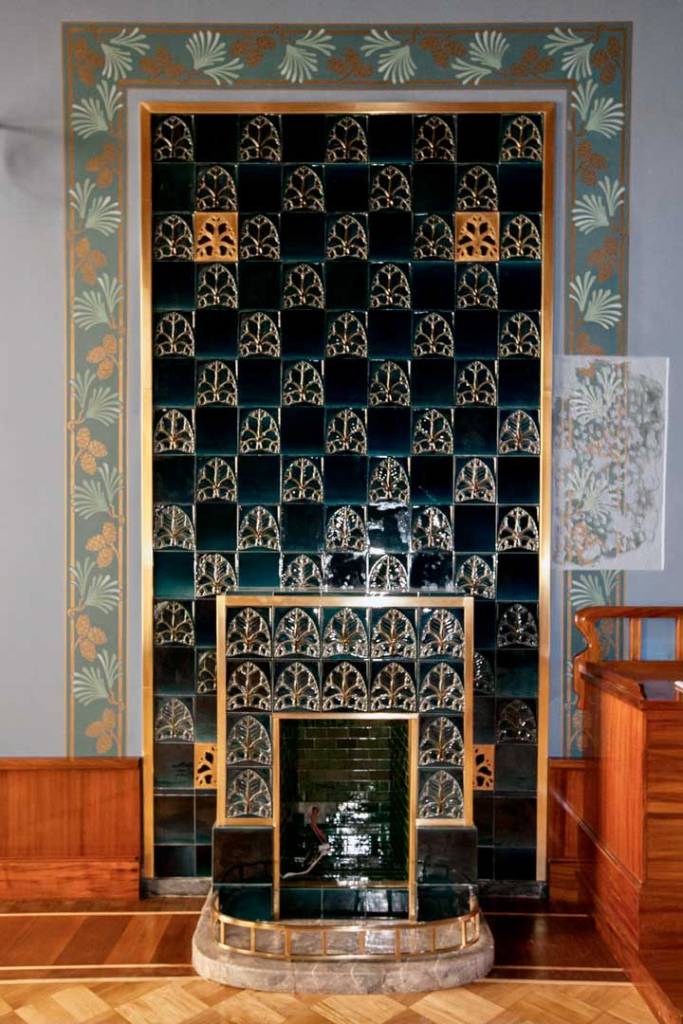
The recreated interior features wood paneling, built-in furniture and a carpet. The curtains were restored according to the samples preserved in the museum’s funds. Thanks to the pieces of tiles found in the pool of the Emperor’s Moorish Bathroom, it was possible to accurately restore the finish of the fireplace. The recreation of items of furniture will include an ottoman, a desk with a a lamp, and armchairs. Paintings and mantel clocks preserved in the funds of the Pavlovsk Museum-Reserve will be returned to the Alexander Palace to decorate the study.

Click HERE to read my article Ottoman recreated for Working Study of Emperor Nicholas II in the Alexander Palace, published on 28th June 2023.

***

The Working Study of Nicholas II is one of 15 interiors situated in the eastern wing of the palace, scheduled to open in 2021. Among the other interiors are the New Study of Nicholas II, Moorish Bathroom of Nicholas II, Reception Room of Nicholas II, Pallisander (Rosewood) Living Room, Mauve (Lilac) Boudoir, Maple Drawing Room, Alexandra’s Corner Reception Room, the Imperial Bedroom, among others.

In the future, the Alexander Palace will become a memorial museum of the Romanov family – from Catherine the Great to Nicholas II, showcasing the private, domestic life of the Russian monarchs who used the palace as an official residence. The eastern wing of the palace will be known as the Museum of the Russian Imperial Family. The multi-museum complex, which includes the Western wing is scheduled for completion no earlier than 2024.

© Paul Gilbert. 25 November 2020

Those Who Served the Tsar: Prince Vladimir Nikolayevich Orlov (1868-1927)

PHOTO: Emperor Nicholas II and Prince Vladimir Orlov

This is the first in a series of biographical essays about the men who served Emperor Nicholas II between 1894 to 1917, researched primarily from Russian sources by Independent Researcher Paul Gilbert

Prince Vladimir Nikolayevich Orlov was born in Brussels, Belgium on 13th January 1869 (O.S. 31st December 1868). He was one of two sons born to Prince Nikolai Alekseevich Orlov (1827-1885) and Princess Ekaterina Nikolaevna Trubetskaya (1840-1875). Vladimir had one brother Prince Alexei Nikolaevich Orlov (1867-1916),

Vladimir’s father served as adjutant general, cavalry general, and diplomat in Brussels, Paris and Berlin, as well as a military writer. His great grandfather was Count Fyodor Grigorievich Orlov (1741-1796), who along with his brothers Counts Alexis and Grigory Orlov, took part in a coup which placed Catherine the Great on the Russian throne in 1762.

In 1887 Vladimir entered the junior special class of the Corps of Pages in St. Petersburg, from which he graduated in 1889 as a cornet in the Life Guards Horse Regiment. He held numerous distinguished ranks during his life, including Lieutenant (1893), Staff Captain (1899), Captain (1901), Colonel (1904), Major-General (1909, enrolled in the suite), and Lieutenant-General (1915).

In 1900 Orlov participated in the Summer Olympics held in Paris, competing in equestrian sports: the four-in-hand competition which is a carriage driven by four horses, with the reins arranged so that one driver can control all four horses. Very little is known of the 1900 event, which had at least 28 carriages entered. The title was won by Belgian Georges Nagelmackers.

PHOTO: Emperor Nicholas II and Prince Vladimir Orlov

On 7th January 1901, he was appointed Assistant Chief, and he received his first post as Adjutant, thanks to the patronage of the Minister of the Imperial Court Baron Vladimir Borisovich Fredericks (1838-1927). It was on this date, that he entered the close circle of the emperor and empress. The prince recalls in his diary as follows: “While on duty, I often dined and had breakfast with the sovereign; at first it was very difficult for me, because I was terribly shy, but then little by little it began to pass”.

Orlov, who bore the nickname “Fat Orlov,” was an exceedingly rich man. He was a highly cultivated man, sarcastic, with a dry humour, and enjoyed great social prestige. He was “a witty and charming man with a great knowledge of the world, he was a typical representative of aristocratic culture and, in addition to his native language [Russian], he spoke English, French, German, Italian, Spanish and Serbian.”

For many years he was one of the most trusted people of Nicholas II. With no thought whatever for his personal career, he was devoted to the Tsar and to the cause of the Russian monarchy, devoted in the highest sense in which the word can be used.

Prince Vladimir Nikolayevich Orlov also served as one of Nicholas II’s closest advisors, and on 26th August 1906, he was appointed Chief of the Military Campaign Chancellery of His Imperial Majesty. a position he held until 1915. As the head of the military cabinet, Orlov was a keen technologist interested in military applications of the motor car. 

PHOTO: Orlov dressed as a 17th falconer for the
1903 Costume Ball in the Winter Palace

Prince Orlov married twice. His first wife Princess Olga Konstantinovna Beloselskaya-Belozerskaya (1872-1923), goddaughter of Princess E.P. Trubetskoy and Count P.P. Shuvalov, maid of honour, daughter of Prince K.E.Beloselsky-Belozersky and N. D. Skobeleva. In society, she was known as the first fashionista and the most elegant woman in St. Petersburg. In her salon, playing cards and dancing reigned. In 1917, their son Nikolai (1896-1961) married Princess of the Imperial Blood Nadezhda Petrovna (1898-1988), they had two daughters.

His second wife Countess Elizaveta Alexandrovna Luders-Weimarn (1883-1969).

It was Prince Orlov who seems to have integrated automobiles into the life of the Imperial Family. In 1904 he drove his own Delaunay-Belleville to the Alexander Palace at Tsarskoye Selo Then, as described by court official Alexander Mosolov (1854-1939), “Orlov placed his automobile at the Tsar’s disposal, and driving excursions became an almost daily diversion… After that, he never relinquished his role as chauffeur”.

“We never had a single accident on any of our excursions; of course, I was always extremely careful. I didn’t consider it appropriate for a subject to crush his Tsar,” said Orlov.

In the autumn of 1905 Nicholas himself decided to acquire some automobiles. “I can no longer impinge upon Orlov’s good will. Buy two or three cars, but let Orlov choose them. He knows better than any professional”.

As the Emperor’s collection of automobiles grew, the construction of Imperial Garages begun at Tsarskoye Selo, Peterhof, St. Petersburg (Winter Palace) and Livadia. On 18th February 1907, a fleet administration, with Prince Orlov at its head, was officially established within the Ministry of the Imperial Court.

Prince Orlov encouraged the Imperial Family’s interest in automobiles in every way he could. It was he who arranged for Tsesarevich Alexis to be presented with a small, two-seater Bébé Peugeot, which measured 2445 x 1140 mm. This little car had debuted at the Paris Auto Show in 1904.

The automobile trips became more frequent, which helped to bring Vladimir Nikolaevich closer to Nicholas II. They had long conversations, the emperor took an interest in the opinion of the prince. From that moment on, the family’s attitude toward the prince changed significantly. He became especially close. The Dowager Empress Maria Feodorovna affectionately called him “Vladi”.

PHOTO: Orlov chauffeuring Nicholas II and Alexandra Feodorovna
in a Delaunnay-Belleville, 1905

Subsequently, the role of chauffer was transferred to 25-year-old Adolphe Kégresse (1879-1943), a Frenchman with impeccable references specially assigned to this position by Orlov himself. This was done, and Orlov was entrusted with the organization of the Imperial Garage at Tsarskoye Selo.

Like many who served the Emperor, Orlov held a negative view on Rasputin. On 19th August 1915, after an unsuccessful attempt to discredit Rasputin in a newspaper, both he and Vladimir Dzhunkovsky (1865-1938), First Deputy Interior Minister, were discharged from their posts.

Upon learning of Orlov’s dismissal, the Empress Dowager Maria Feodorovna wrote to Grand Duke Andrei Vladimirovich: “This was not done by my dear boy. He is too kind to do such a thing. He loved both of them [Orlov and Dzhunkovsky] very much. No, this is her [Alexandra Feodorovna] doing. She alone is responsible.”

On 25th August 1915, Orlov was banished by the Tsar in 1915 to the Caucasus, where he served under the Viceroy Grand Duke Nicholas Nikolaevich (1856-1929).

On 16th November 1915, Orlov was appointed assistant of civil affairs of the Viceroy in the Caucasus. On 31st March 1917, he was dismissed from service due to illness with a uniform and a pension.

PHOTO: Chateau Belfontaine in Samois-sur-Seine, where Orlov lived in exile

After the October Revolution of 1917, Orlov lived at Tchair, the Crimean estate of Grand Duke Nicholas Nikolaevich. He followed members of the Imperial family into exile, settling in France, where he lived until the end of his days. Prince Vladimir Nikolayevich Orlov died on 29th August 1927 at his estate Chateau Belfontaine, situated near Paris. He was buried in the Samois-sur-Seine cemetery, Seine-et-Marne, Ile-de-France, France.

© Paul Gilbert. 1 December 2020

The History and Restoration of the Maple Drawing Room in the Alexander Palace

PHOTO: view of the Maple Drawing Room, as it looked in 1917

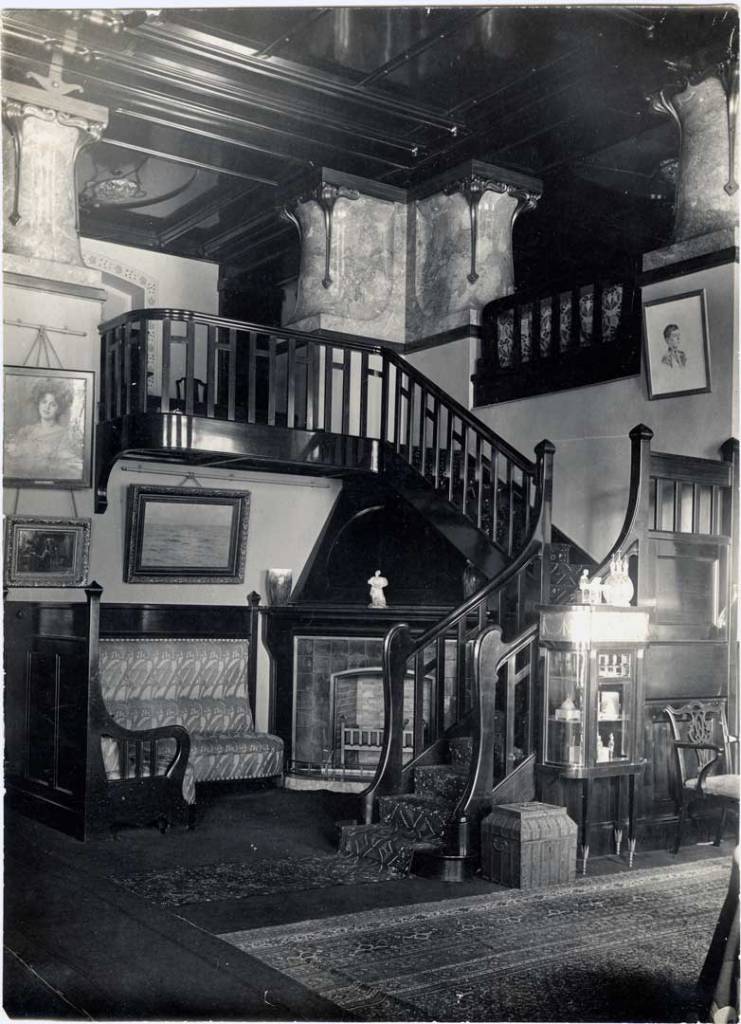
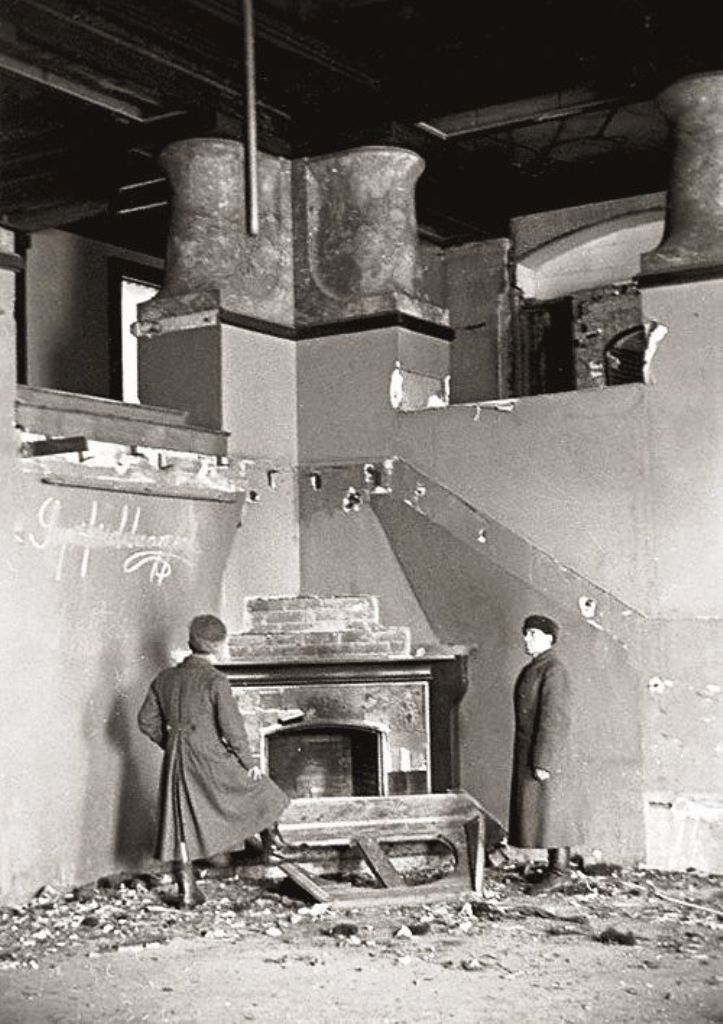
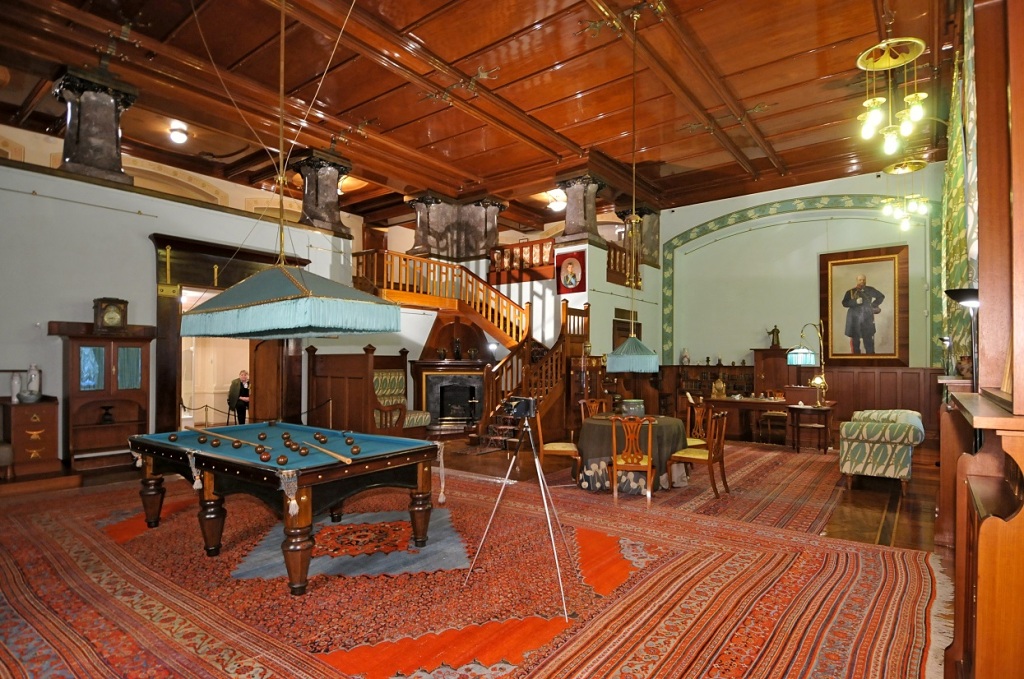
The Maple Drawing Room in the Alexander Palace is a vivid example of the Russian Art Nouveau Style. This interior, as well as the New Study of Nicholas II and the children’s rooms on the second floor, was created on the site of the former Concert Hall, built according to the design of Giacomo Quarenghi (1744-1817), which had not been used for its intended purpose for many years.

The works were carried out by the Meltzer brothers’ firm in 1902–1904. The walls were painted a warm pink colour and decorated with mouldings of rose stems, foliage and flowers unfolding along the upper walls and ceiling.

Roman Meltzer proposed an original solution for lighting the Maple Drawing Room: along the perimeter of the room, separating the walls from the ceiling plafond, there was a large cornice that masked about two hundred electrical lamps.

PHOTO: former Concert Hall before its demolition

A mezzanine was installed which connected the room to the Emperor’s New Study. Its decoration was a “Tiffany style” mantel mirror in a metal frame with multi-coloured glass inserts featuring stylized roses.

The interior had several cozy corners where the Empress could do needlework, reading and painting. The children often played or did their homework in this room, the family often joined the Empress in this room at five o’clock for tea..

The Maple Drawing Room was decorated with a showcase, the walls and a door made of mirrored glass.  It contained Faberge’s Imperial Easter Eggs from the collection of Alexandra Feodorovna, as well as Italian Venetian glass vases.

The drawing room was always decorated with fresh flowers: tropical plants and palms were placed in tubs, cut flowers of different varieties from the garden and nursery were placed in vases year-round.

PHOTO: post-war view of the Maple Drawing Room

The interior decoration was significantly damaged during the Great Patriotic War (1941-45). In the post-war period, during the adaptation of the palace as the Pushkin Museum, some of the surviving elements of the Maple Drawing Room – including parts of the mezzanine and wall mouldings – were destroyed as objects of “no value”.

Researchers, architects, designers and restorers have carried out a large and complex work to recreate the stucco decoration of the room’s historic interior, including the carved mezzanine and built-in maple furniture, returning the interior to its original appearance.

PHOTOS: the current look of the recreated Maple Drawing Room

PHOTOS: the current look of the recreated Maple Drawing Room

The stucco decoration was recreated from surviving colour autochromes, vintage photographs and rare analogs, for example, the preserved decoration in the mansion of Heinrich Gilse van der Pals on Angliysky Prospekt in St. Petersburg, where the same decorative technique was used.

The mezzanine which originally connected the Maple Drawing Room to the Emperor’s New Study had been sealed off when the Alexander Palace reopened as a museum in the 1990s. During the current restoration process, when the walls were opened which connected the two rooms, a small fragment of the original decoration of the Maple Drawing Room was discovered, which assisted experts with regard to the original shade of pink and the design of the rose-stucco reliefs used in the original interior.

The unique lighting system used in the Maple Drawing Room will also be restored.

PHOTO: Empress Alexandra Feodorovna on the Alexander Palace balcony

It was from the Maple Drawing Room that Empress Alexandra could step out onto her iron balcony, through a door in one of the room’s large windows. The famous balcony was created in 1896 by the Court architect Silvio Amvrosievich Danini (1867-1942). The balcony was a favourite place for the Empress and her family year-round, even during the cold Russian winters. They often took their meals and teas here Heavy curtains were hung between the columns of the balcony to provide protection from sun or bad weather. It was here that many iconic photos of the Imperial Family were taken.

Sadly, the balcony did not survive to the present day, and despite the extensive restoration work carried out in the Alexander Palace, there are no plans to recreate the balcony at this time. Having said that, let us hope that if funding should be made possible, that the palace administration will reconsider such a project for the future.

***

The Maple Drawing Room is one of 15 interiors situated in the eastern wing of the palace, scheduled to open in 2021. Among the other interiors are the New Study of Nicholas II, Moorish Bathroom of Nicholas II, Working Study of Nicholas II, Reception Room of Nicholas II, Pallisander (Rosewood) Living Room, Mauve (Lilac) Boudoir, Alexandra’s Corner Reception Room, the Imperial Bedroom, among others.

In the future, the Alexander Palace will become a memorial museum of the Romanov family – from Catherine the Great to Nicholas II, showcasing the private, domestic life of the Russian monarchs who used the palace as an official residence. The eastern wing of the palace will be known as the Museum of the Russian Imperial Family. The multi-museum complex, which includes the Western wing is scheduled for completion no earlier than 2024.

© Paul Gilbert. 25 November 2020

Nicholas II, the Union of the Russian People and the Black Hundreds

History tells us of the assassination and murder by revolutionaries of ministers and other government officials during the reign of Russia’s last tsar Nicholas II, however, there were a number of powerful counter-revolutionary political organizations and groups who carried out their own campaigns after the 1905 Revolution.

The most popular among them were the Union of the Russian People (URP), known not just for their anti-socialist, anti-liberal, and anti-Semitic views. but also for standing up against revolutionaries in defence of the monarchy and the Tsar.

The Union of the Russian People (URP) was a loyalist right-wing nationalist political party, the largest among the Black Hundreds monarchist political organizations in the Russian Empire between 1905 and 1917.

Who, making prayer, honours the people and the Tsar, in whom neither conscience nor mind staggers, who saves Russia from troubles under a hail of slander, he is called the Black Hundred!

For Faith, Tsar and Fatherland!

Orthodoxy! Autocracy! Nationality!

Holy Russia, keep the Orthodox faith, in it is your affirmation!

The movement was founded in October 1905, by two minor government officials Alexander Dubrovin (see below) and Vladimir Purishkevich, who participated in the killing of Grigori Rasputin in 1916. The URP’s aim was to rally the Russian people behind nationalism and the Tsar. By 1906 it had over 300,000 members. Its paramilitary armed bands, called the Black Hundreds, fought revolutionaries violently in the streets. Its leaders organised a series of political assassinations of deputies and other representatives of parties which supported the Russian Revolution of 1905.

Monarchy is an idea, a moral idea, that is, the idea of ​​harmony and justice, honesty and decency, trust and respect of people for each other. The monarchy is based on the best qualities of the human conscience and strives to maximize human self-realization, not as a unit of the electorate, but as a highly spiritual and self-sufficient person. A monarchist will not agree that the state should be ruled by a politician, instead he will prefer a person who has been trained and educated to rule. 

In his book “Manual of the Monarchist – Black Hundreds” (1906), the founder of the Black Hundreds Vladimir Andreevich Gringmut (1851-1907) wrote: “The enemies of the autocracy called the “Black Hundreds” simple Russian people, which during the armed revolt of 1905 stood up and defended the autocratic Tsar. Is this an honourable name, “Black Hundred”? Yes, very honourable!”

In 1905, the Union of the Russian People was established to protect the Faith, Tsar and Fatherland from godless revolutionaries The emergence of the Union of the Russian People in the fall of 1905, when all major cities of the Russian Empire were engulfed in revolutionary unrest, and the murders of the Tsar’s loyal servants had become an almost daily occurrence. Nearly 1000 Black Hundred organizations sprang up across the Empire, calling on the Russian people to stand under the banners bearing the sacred words for any Russian Orthodox patriot: “Orthodoxy, Autocracy, Nationality.” Among them were the Society for the Active Struggle against Revolution and Anarchy that emerged in St. Petersburg, the Russian Assembly, the Society of Russian Patriots in Moscow, the Russian Brotherhood in Kiev, the Patriotic Society in Tiflis, the Tsar-People’s Russian Society in Kazan, the People’s Monarchist the party in Saratov, the White Banner Union in Nizhny Novgorod, the People’s Party of Order in Kursk,

The Russian people woke up and all over the country rising up to fight against revolutionary sedition, creating for these purposes numerous national unions, societies and organizations. But the Union of the Russian People had become a truly massive, all-Russian movement, rallying many thousands of Russian patriots under its banners. It is quite symbolic that the Union first declared itself on 4th November (O.S. 22nd October), 1905, on the day of the Feast of the Kazan Icon of the Mother of God, on the day of overcoming the turmoil of the 17th century.

The first organizational meeting of the Union took place on 21st November (O.S. 4th December) 1905, in  the Mikhailovsky Manege in St. Petersburg. The meeting was attended by more than 20,000 people, including members of the clergy, monarchists, and prominent members of the nobility.

The Union’s Manifesto expressed a ‘plebeian mistrust’ of every political party, as well as the bureaucracy and the intelligentsia. The group looked at these as obstacles to ‘the direct communion between the Tsar and his people’. This struck a deep chord with Nicholas II, who also shared the deep belief in re-establishment of autocratic personal rule, as had existed in the Muscovite state of the 1600s.

PHOTO: John of Kronstadt (1829-1909)

Several prominent members of the Russian Orthodox Church supported the organisation, among them the Imperial family’s close friend and future Orthodox Saint John of Kronstadt (1829-1909), Hieromonk Iliodor (1880-1952), and Hermogenes, Bishop of Tobolsk and Siberia (1858-1918). It also had support from leading members of the Imperial Court and government, including Grand Duke Nikolai Nikolayevich (1856-1929), Alexander Trepov (Prime Minister from 1916-17), and Minister of the Interior Nikolay Maklakov (1871-1918).

Emperor Nicholas II was highly supportive of the Union and patronised it: he wore the badge of the Union, and wished the Union and its leaders ‘total success’ in their efforts to unite what he called ‘loyal Russians’ in defence of the autocracy. The Tsar also gave orders to provide funds for the Union, and the Ministry of the Interior complied by funding the Union’s newspapers.

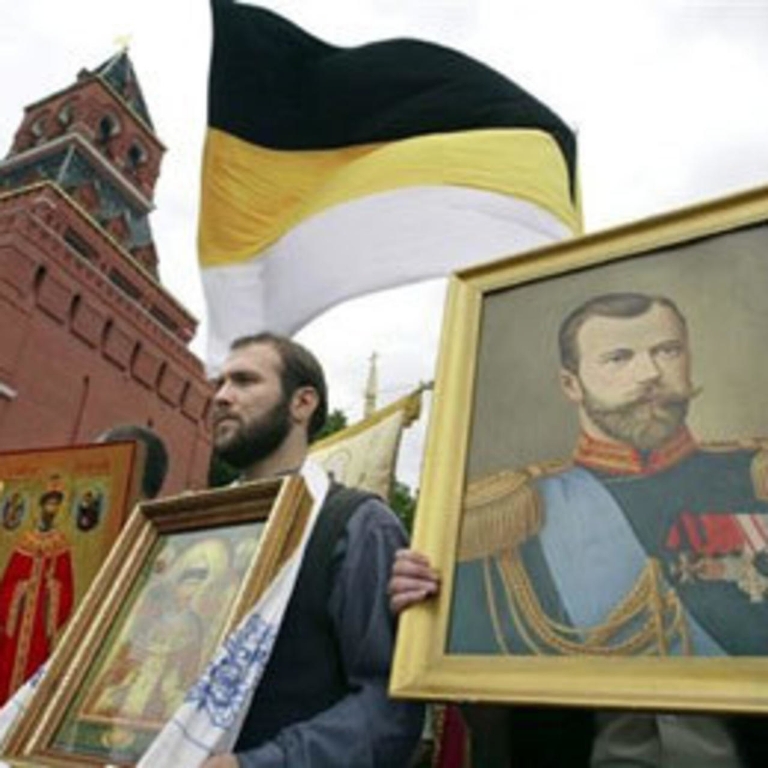
Following the 1905 Revolution, the Union was horrified by Tsar Nicholas II’s refusal to strike down harshly on the Leftist revolutionaries. The Union, therefore, decided to organise this for the Tsar, and organised paramilitary bands, which came to be known as the ‘Black Hundreds’ by the democrats, to fight revolutionaries in the streets. These militant groups marched through the streets holding in their pockets knives and brass knuckles, and carrying religious symbols such as icons and crosses and imperial ones such as patriotic banners and portraits of Tsar Nicholas II.

PHOTO: «Ру́сское зна́мя» (Russian Banner), newspaper of the URP

On 28th November 1905, the first issue of the printed organ of the Union of the Russian People – the newspaper «Ру́сское зна́мя» (Russian Banner) was published. The newspaper with a very symbolic name soon became the flagship of patriotic journalism, the fighting organ of the Russian resistance to the growing political turmoil.

On 23rd December 1905, Emperor Nicholas II received a deputation of 24 members of the Union of the Russian People, headed by its leader Alexander Ivanovich Dubrovin (born 1855).

During the reception, Fr. Arseny presented the Tsar with an icon of the Archangel Michael, under whose shadow the Union was born, and made a very welcoming speech. Dubrovin read out an address in which he reported to the Tsar about the rapid growth of the Union’s membership throughout the Empire, noting that “the heart of the people sensed that the Union of the Russian People rallied for an important and urgent matter.” The chairman assured the Tsar of the loyalty of members of the organization to him.

In conclusion, Dubrovin presented the Emperor with the insignia of the Union of the Russian People for both Himself and and for his son and Heir Tsesarevich Alexei Nikolaevich, asking him to accept them on behalf of the Union. The Emperor, having carefully examined them, received them, thanking Dubrovin. By accepting the insignia, the Tsar and Tsesarevich thus became members of the Union of the Russian People.

Apollon Maikov, who read the address from a group of loyal residents in the capital, fervently concluded: “Sovereign, we will all die for you!” The Tsar, who graciously accepted the deputation, wished the Union of the Russian People to grow and prosper, expressing the hope that with the help of God and the Russian People, He would be able to accomplish a lot for the good of Russia. Thanking everyone, the Tsar praised the monarchists: “Trust in God and trust in Me”. The good news of the highest reception of the Union deputation, the gracious treatment extended by the Sovereign to its members and his acceptance of their insignia as a member of the organization contributed to the further growth of the Union’s ranks and the realization of their activities.

Another significant event in the life of the Union of the Russian People was the solemn consecration of the banner of the Union, which took place on 26th November 1906 on the day of memory of the Holy Great Martyr and Victorious George (consecration of the Church of the Great Martyr. George in Kiev) in the Mikhailovsky Manege in the presence of about 30 thousand supporters. To the general joy of those present at this solemn event, Fr. John of Kronstadt, who, ascending the dais, bowed on all four sides to the people, who, in turn, responded with a low bow to the revered priest. Fr. John spoke to the monarchists, the essence of which was that “as a body without a soul is dead, so Russia is dead without an all-enlightening Orthodox Faith and life-creating Autocratic Power.” Then Bishop Sergius (Stragorodsky) arrived, and the divine service began, culminating in the singing of many years to the Sovereign and the House of Romanov, as well as to the founders and leaders of the Union of the Russian People and eternal memory to all who fell for the Faith, the Tsar and the Fatherland. Having sprinkled the Union banner with holy water, Fr. John of Kronstadt, kissing the banner with reverence, handed it to Dubrovin, after which the Black Hundreds, who were present at the consecration of the banner and banner, swore allegiance to Orthodoxy, Autocracy and the Russian people.

PHOTO: “The days of vengeance have befallen us …
let us repent so that the Lord will not destroy us”
From the Collection of the State Museum of the History of Religion, St. Petersburg

Between 1905-1907, an unknown artist painted “The days of vengeance have befallen us … let us repent so that the Lord will not destroy us”, marking the 1905 revolution and the creation of the Union of the Russian People. The ideological component of the painting is a call to the Russian people to abandon the revolution, to repent for participating in it; protect the tsar and preserve the monarchy, otherwise the wrath of God will overtake Russia and the Russian people will perish.

While many believe that the artist of the painting is unknown, a number of prominent contemporary Russian experts believe with a high degree of probability, that the artist is Apollon Apollonovich Maikov, one of the founders of the Union of the Russian People. His work depicts the founders of the Union of the Russian People, with the inscription

“Now, following the example of angels, the main founders of the Union of the Russian People. In the sacred books it is said that when people deviated into idolatry, God destroyed them”.

In the centre of the painting, under a light conical pillar that rises to the sky, is the Crucifixion . Near the Crucifixion in the same pillar are depicted the Emperor Nicholas II praying to God for the salvation of Russia, his wife Alexandra Feodorovna and their children. Above the Crucifixion there are two soaring angels with a crown in their hands. The light pillar, which rises to the sky and in which the Romanovs are depicted, symbolizes prayer. A conical pillar is connected to a light cloud. The New Testament Trinity is depicted inside the cloud and around it, in the same bright cloud, praying saints… The connection of the pillar and the cloud symbolizes the connection of the prayer of the celestials – the saints and the Imperial family. In the lower part of the picture, around the praying Imperial family, the Black Hundreds defenders of the monarchy with flags of Russia are depicted, among them in the foreground are the founders of the Union of the Russian People. In the center is Hegumen Arseny, who holds the Cross and the Gospel in his hands, next to him is John of Kronstadt, who holds the Cross in his hands; on the right and left sides of them – the remaining 12 founders of the Union of the Russian People: Alexander Dubrovin; Ivan Baranov; Vladimir Purishkevich; Nikolay Oznobishin; Vladimir Gringmut; Prince Alexander Shcherbatov; Pavel Bulatsel; Rostislav Tregubov; Nikolay Zhedenov; Nikolay Bolshakov; Father Iliodor; and Apollon Maikov. Hegumen Arseny and Archpriest John of Kronstadt symbolize the Saviour, and the twelve other founders of the Lord’s disciples are the apostles; who, like angels, protect the autocartic power from the demons- revolutionaries; the revolution itself, according to the author of the picture, is idolatry .

The semi-ring of the Black Hundreds depicted in the picture is surrounded by revolutionaries with red banners. Individual revolutionaries have pistols in their hands, from which they shoot at the Black Hundred monarchists; some of whom fall dead. Fiery bonfires and pools of blood are depicted between monarchists and revolutionaries. Shots, puddles of blood and bonfires symbolize terrorism and the 1905-1907 revolution in Russia. In the upper part of the picture, black clouds are depicted around the light cloud in which the New Testament Trinity is located; lightning bolts are directed from the clouds to the heads of the revolutionaries. Lightning bolts symbolize the wrath of God against the revolutionaries.

The painting today hangs in the State Museum of the History of Religion, St. Petersburg.

PHOTO: Alexander Ivanovich Dubrovin

The Union was dissolved in 1917 in the wake of the Revolution, and its leader, Alexander Ivanovich Dubrovin (born 1855) placed under arrest. There is much debate surrounding Dubrovin’s death. According to one historian Philip Rees, Dubrovin was shot in 1918 for his activities against the October Revolution. A number of other sources however place Dubrovin alive after this date and his actual date of death remains unresolved. It is known that on 21st October 1920, Dubrovin was arrested in Moscow by the Cheka. He was charged as an organizer of pogroms, murders etc. in 1905-1917 when he was the chairman of URP. In their entirety these corpus delicti (components of crime) were qualified under the Criminal Code Article “the counter-revolutionary activity”. No activity after the 1917 Revolution has been incriminated to Dubrovin.

Dubrovin’s files at the Federal Security Service of the Russian Federation (FSB) archives document two consecutive death sentences dated 29th December 1920 and 21st April 1921 which indicates that at least one time Dubrovin’s appeal for amnesty was satisfied. No documental traces of the actual implementation of this sentence were found. Meanwhile, according to the Small Soviet Encyclopedia published in 1929 Dubrovin was still alive by that date.

PHOTO: badge of the Union of the Russian People (URP)

On 22nd November 2004, a meeting to revive the Union of the Russian People (URP) was held in Moscow, chaired by the Russian sculptor Vyacheslav Klykov (1938-2006), famous for his magnificent monument to Emperor Nicholas II in Taininskoye (Mytishchi), which is situated about 19 km northeast of Moscow. The meeting set the groundwork for a modern-day Russian Orthodox – monarchical organization, recreated in 2005 on the basis of the ideology of the pre-revolutionary Union of the Russian People.

© Paul Gilbert. 23 November 2020

Exhibition dedicated to Nicholas II opens at Murmansk Airport

A permanent photo exhibition dedicated to Emperor Nicholas II has opened in the terminal building of Murmansk Airport.

The exhibition consists of two parts. The first part contains unique archival documents and photographs about the founding of Romanov-on-Murman, which turned out to be the last city founded during the reign of Nicholas II in 1916.

The second part will tell passengers and visitors to the airport about the history and development of Romanov-on-Murman, which today has grown into Russia’s largest city north of the Arctic Circle – Murmansk [the town was renamed in April 1918].

Deputy Governor of the Murmansk Region Vladimir Evmenkov took part in the opening ceremony of the exposition, who expressed his gratitude to the management of the NOVAPORT holding and the Murmansk airport for the efforts invested in the creation of the exhibition.

Representatives of the Murmansk and Monchegorsk Diocese of the Russian Orthodox Church, headed by Metropolitan Mitrofan of Murmansk and Monchegorsk, took an active part in its preparation.

Metropolitan Mitrofan sincerely thanked all the airport employees who put a lot of effort into creating the exhibition. He noted that for the Russian Orthodox Church, the life of the last Russian emperor is the life of a saint and it is very important that residents of the Murmansk region and visitors to the Arctic region to acquaint themselves with the historical facts about his life. 

In June 2019, Russian President Vladimir Putin officially renamed the country’s airports, including Murmansk Airport, which was renamed in honour of Emperor Nicholas II. An online poll launched in Russia in autumn 2018 asked the public to nominate and vote on famous figures whose names could be given to more than 40 airports across Russia. Nicholas II received 68,260 votes (48%) for the renaming of Murmansk Airport.

Reconstruction of the square in front of the air terminal is coming to an end, after which a bust-monument of Nicholas II will be installed on the square in front of the main terminal.

Additional construction at the airport will include a new terminal for domestic flights within Russia. The name of Nicholas II will be placed on the facades of each of the two terminals.

© Paul Gilbert. 20 November 2020

Recreation of the textile decoration for the Imperial Bedroom in the Alexander Palace

PHOTO: detail of the English chintz recreated for the Imperial Bedroom

This is the second of two articles on the Imperial Bedchamber, one of the personal rooms of Empress Alexandra Feodorovna situated in the eastern wing of the Alexander Palace. The first article The History and Restoration of the Imperial Bedchamber in the Alexander Palace, was published on 14th October 2020.

The decoration of this room is highlighted by the rich use of the same fabric: the walls and furniture are upholstered in an English chintz pattern in the form of wreaths of small pink flowers and ribbons, specially made by the English manufacturer Hindley. The same material was used to make the curtains for the windows and doors, as well as the alcove.

PHOTO: sample of the original pattern made by Charles Hindly & Sons

Charles Hindley & Sons had existed since the early 19th century. In 1909 the company filed for bankruptcy and was resold twice. The latest information about the Hindley manufactory dates back to 1921, when the company ceased to exist. Unfortunately, the museum’s hopes of finding a “historical” manufacturer for the fabric in Great Britain did not materialize.

Since the end of the 19th century, the term “chintz” has been used to describe a cotton decorative fabric in plain weave – usually with a large floral pattern and a glossy front side. This fabric was mainly suitable for interior decoration.

Chintz, along with unwaxed chintz, was used in the decoration of the Alexander Palace, notably for the interiors of the Imperial Bedchamber and Children’s Rooms, the latter of which were located on the second floor of the east wing of the palace.

PHOTO: detail of the English chintz recreated for the Imperial Bedroom

A sample of the original chintz, which was discovered in the funds of the Pavlovsk State Museum Reserve, served as a direct analogue for reproducing the pattern and texture of the fabric. It was important to achieve an exact match between the colour scheme and the degree of waxing.

The recreation of the textile decoration for the Imperial Bedchamber (draperies for the alcove, doors and windows) were based on this surviving sample. Thus, it became possible to reproduce the historic ambiance of the elements of the windows, doors and alcove thanks to the original drapery samples of the Imperial Bedchamber. In addition, when working on the drapery project, the craftsmen relied on numerous colour autochromes taken in 1917, as well as pre-war black and white photographs.

PHOTO: detail of the English chintz recreated for the Imperial Bedroom

To recreate the lining fabric and lace for decorating the walls and ceiling inside the alcove, as well as the trimmings, historical samples of the same time were used. When recreating the color scheme of trimmings and carpets, the main reference point was the color palette of the chintz. Fragments of historical carpets in the halls of the Alexander Palace served as an example of the degree of pile height and density of the structure of the carpet base.

The fabrics, trimmings and carpets were made by the specialists of Renaissance Workshops for the Restoration of Antiquities (St. Petersburg). The production and hanging of curtains, marquises and draperies for the alcove – by the master of the company “Le Lux” (St. Petersburg).

The work on the reconstruction of the fabric decoration for the Imperial Bedchamber – from the preliminary design to the implementation in the material – lasted more than two years.

PHOTO: colour autochrome of the Imperial Bedroom, taken in 1917

***

The Imperial Bedroom is now one of 15 interiors in the eastern wing of the palace, scheduled to open in 2021. Among the other interiors are the Moorish Bathroom of Nicholas II, Working Study of Nicholas II, Reception Room of Nicholas II, Pallisander (Rosewood) Living Room, Mauve (Lilac) Boudoir, Alexandra’s Corner Reception Room, and the New Study of Nicholas II, among others.

In the future, the Alexander Palace will become a memorial museum of the Romanov family – from Catherine the Great to Nicholas II, showcasing the private, domestic life of the Russian monarchs who used the palace as an official residence. The eastern wing of the palace will be known as the Museum of the Russian Imperial Family. The multi-museum complex, which includes the Western wing is scheduled for completion no earlier than 2024.

***

Dear Reader: If you enjoy all my updates on the restoration of the Alexander Palace, then please help support my research by making a donation in US or Canadian dollars – donations can be made by GoFundMe, PayPal, credit card, personal check or money order. Click HERE to make a donation. Thank you for your consideration – PG

© Paul Gilbert. 18 November 2020