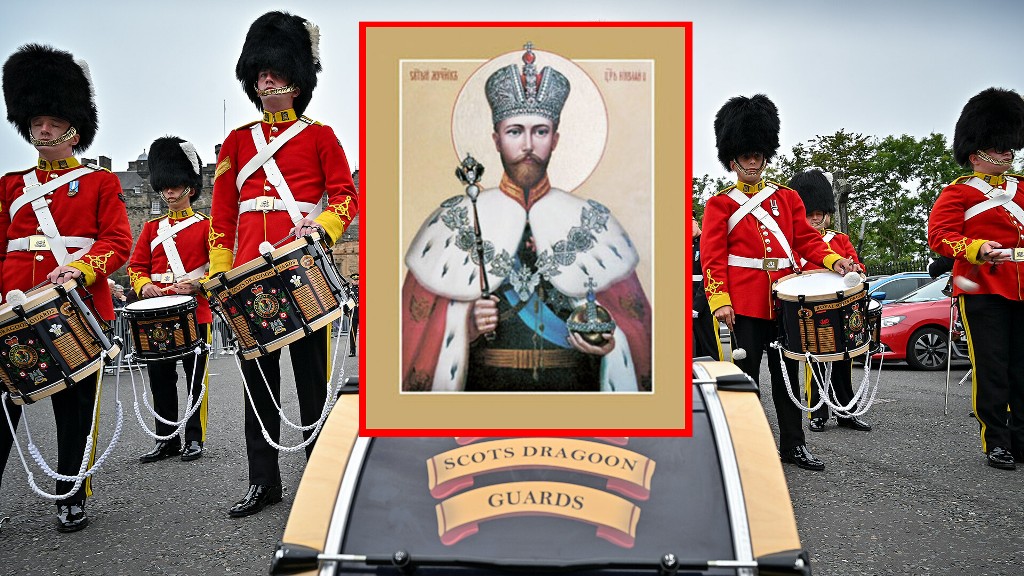
Icon of the Tsar-Martyr Nicholas II and the Royal Scots Dragoon Guards

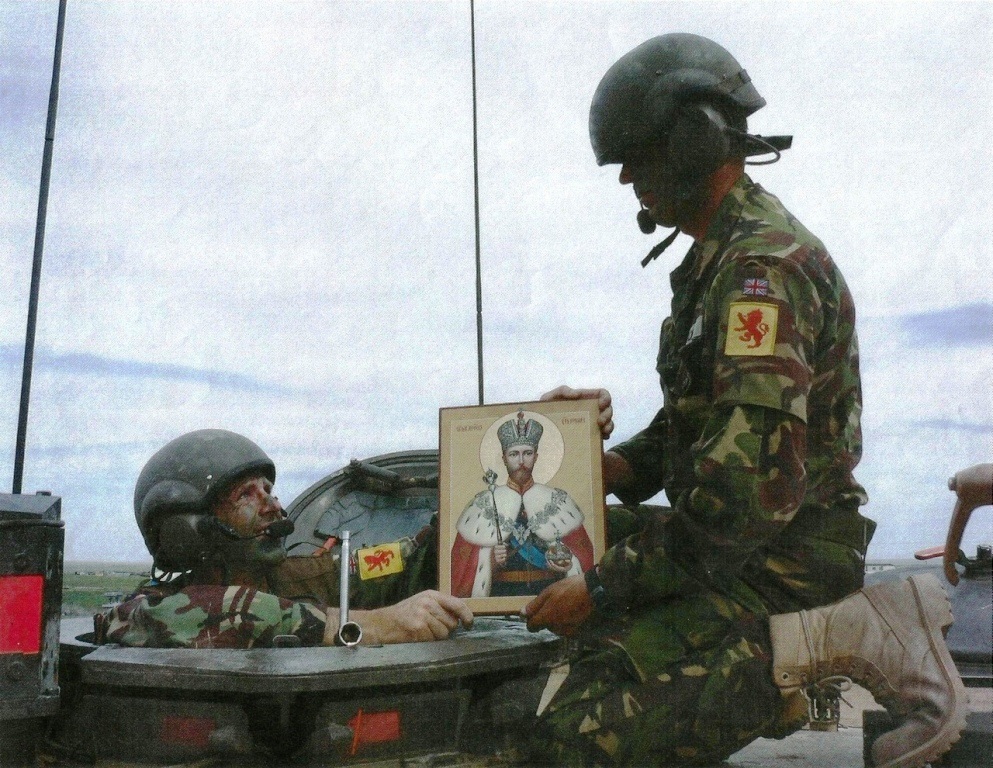
PHOTO: Scots Dragoon Guards marching with the icon of Tsar-Martyr Nicholas II

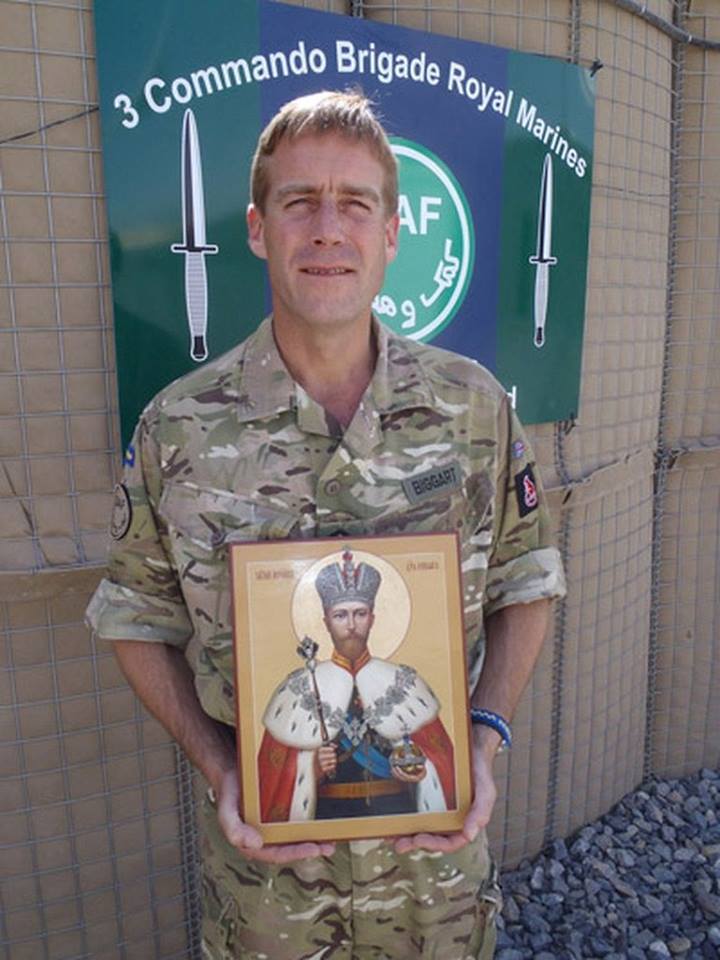
Lieutenant Colonel Johnny Biggart, commander of the elite Scottish military unit Scots Dragoon Guards, holds the icon of the Tsar-Martyr Nicholas II. This photo was taken in 2012 in Lashkar Gah, Afghanistan.

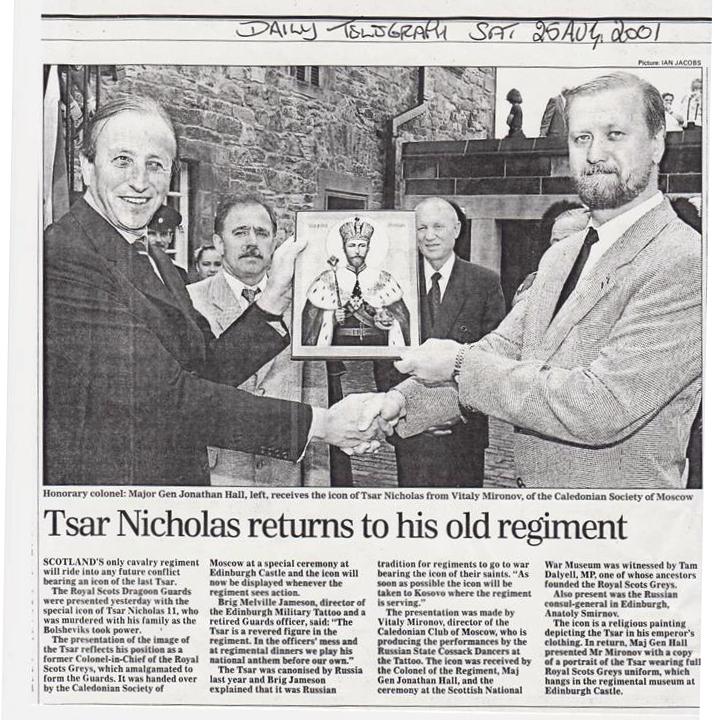
The icon was presented to the regiment in August 2001 by the Moscow Caledonian Club “on behalf of the Russian people”. The icon of the holy martyr Nicholas II accompanies the Scots Dragoon Guards Scottish regiment wherever they are deployed. 

Tsar Nicholas II was appointed Honourary Colonel-in-Chief of the Royal Scots Greys by Britain’s Queen Victoria in 1894, after he became engaged to Alexandra Feodorovna (Princess Alix of Hesse), who was Victoria’s granddaughter.

To this day Tsar Nicholas II is commemorated by the Royal Scots Dragoon Guards (which the Royal Scots Greys became in 1971), by the playing of the Russian Imperial anthem at certain mess functions. 

PHOTO: Newspaper shows Vitaly Mironov presenting icon to Major-General Hall

The Director of the Moscow Caledonian Club Vitaly Mironov notes that the idea to present an icon to the Scots Dragoon Guards Scottish regiment was one shared with historian Dr. Dmitry Fedosov, who then commissioned a church artist to paint this special icon. The icon was solemnly handed over by Mironov to the regimental commander on 24th August 2001, during a special ceremony in Edinburgh Castle in the presence of Mr. Smironov, the Consul General of the Russian Federation; the oldest member of the British Parliament Tam Dalyell; a large number of journalists and artists of the Russian Cossacks State Dance Company, who regularly perform in the Edinburgh Military Tattoo. 

When the producer of the Edinburgh Military Tattoo, Brigadier Melville Jameson asked Mironov “on behalf of whom do we want to present this icon to the regiment?”, he replied – “please mention that it was not done on our own behalf, but on behalf of ALL RUSSIAN PEOPLE.”

“This is extremely important for us,” added Mironov,  “because we considered the very fact of painting this icon and its presentation to the glorious Scottish regiment, as an act of the deepest repentance of ALL OF OUR PEOPLE for the greatest evil that our ancestors did to the Tsar, his family and members of the household … It is our history and our common historical memory.”

PHOTO: Lieutenant Colonel Johnny Biggart holds the icon of Tsar-Martyr Nicholas II

PHOTO: Scots Dragoon Guards holding the icon of Tsar-Martyr Nicholas II

I would like to take this opportunity to thank Vitaly Moronov for supplying me with this information and the importance of this icon of Tsar-Martyr Nicholas II.

Click HERE to read the article Bonded in the Old Faith: Saint Andrew, Nicholas II, and the Birdcatchers by Monk Theodore, published in Orthodox Life on 13th December 2020

© Paul Gilbert. 4 May 2021

Historic link between Nicholas II and St. Nicholas Cathedral in New York

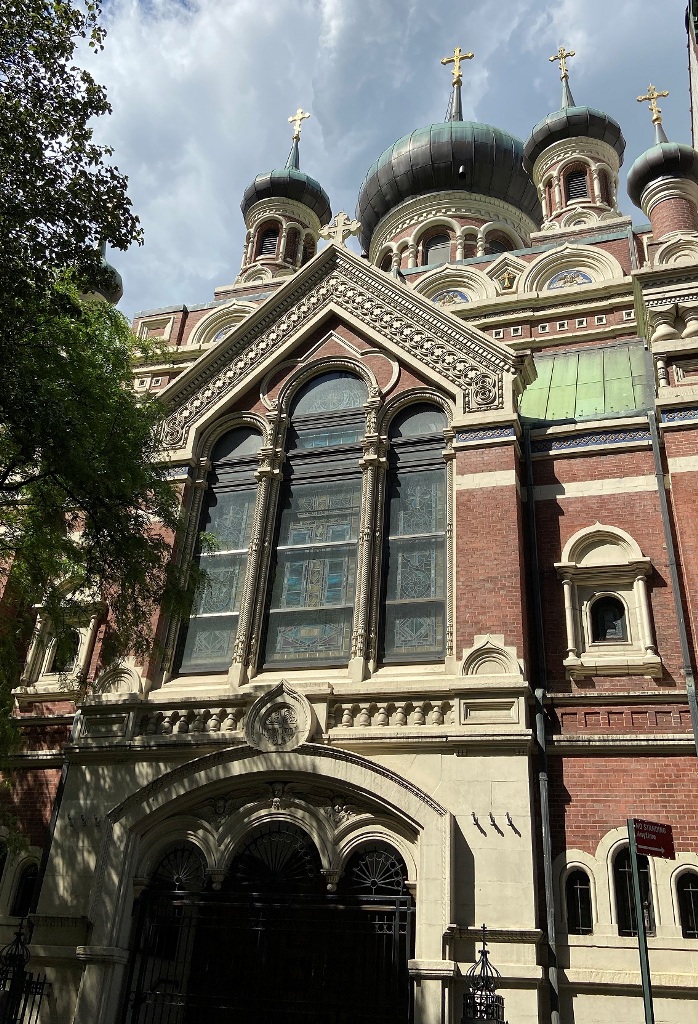
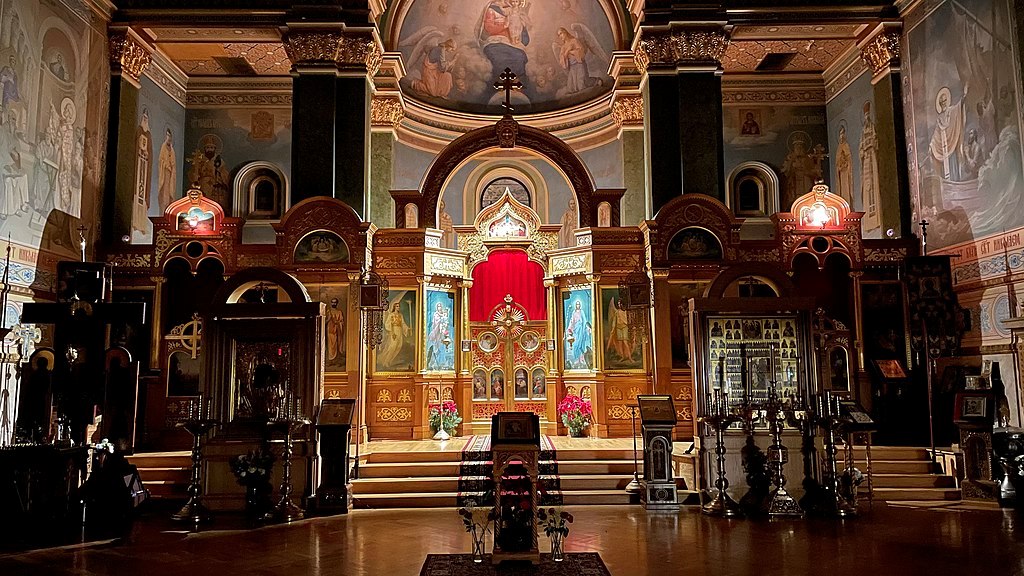
PHOTO: St. Nicholas Russian Orthodox Cathedral
was built in the Moscow Baroque style in 1902

This month marks the 124th anniversary of the laying of the foundation stone for St. Nicholas Russian Orthodox Cathedral, located in the Upper East Side of Manhattan, New York City. The cathedral serves as the administrative center of the Russian Orthodox Church in North America, and houses the representation of the Moscow Patriarchate in the United States.

On 25th August 1899, a plot of land of about 700 m² was purchased on 97th Street, between Madison and 5th Avenue, on which it was planned to build a cathedral that could accommodate 900 worshipers, as well as premises for a Sunday school, festive meetings and an apartment for clergy.

The cathedral was constructed in the Moscow Baroque style by the architect Ivan Viktorovich Bergezen. In 1900, permission to raise funds for the construction of the church was issued by Emperor Nicholas II, who on his own behalf donated 7,500 gold rubles to the project.

PHOTO: the iconostasis of St. Nicholas Russian Orthodox Cathedral

The foundation stone of the church was laid by Bishop Tikhon, the head of the Russian Church in the Aleutian Islands and North America – the future Patriarch of Moscow and All Russia Tikhon (1865-1925) on 22nd May 1901.

On 23rd November 1902, a consecration service, the first to be held in the completed church, was led by Bishop Tikhon. Bishop Charles Chapman Grafton, representing the Episcopal Church, participated in the service. The Russian Holy Synod elevated St. Nicholas Church to Cathedral status in December 1903, and the Diocesan Seat of North America was transferred from San Francisco to New York in 1905. Restoration work was carried out on the Cathedral between 1954 and 1960.

Today St. Nicholas Cathedral continues to serve the needs of the Russian Orthodox Church in this country as it has since its founding.

© Paul Gilbert. 4 May 2021

Memories of Nicholas and Alexandra’s love that have transcended time

PHOTO: aerial view of Schloss Wolfsgarten, near Darmstadt

Hidden away from the eyes of most visitors to Wolfgarten in Germany and the State Hermitage Museum in Russia, are two haunting mementoes etched into simple window panes of each of the two former royal residences. Despite revolution, two world wars and palace renovations, these glass windows with inscriptions written by Emperor Nicholas II and Empress Alexandra Feodorovna have miraculously survived to this day.

Wolfsgarten, Germany

Schloss Wolfsgarten is a former hunting seat of the ruling family of Hesse-Darmstadt, located in the German state of Hessen, situated 15 kilometers south of Frankfurt. The hunting lodge was established between 1722 and 1724 by Landgrave Ernst Ludwig of Hesse-Darmstadt. In 1768, Wolfsgarten was abandoned until the 1830s when the grand ducal family began to restore and expand the property. From 1879, Wolfsgarten became a favourite country retreat for Grand Dukes Ludwig IV and his son Ernst Ludwig, brother of Princess Alix, the future Empress Alexandra Feodorovna.

PHOTO: the years marking visits by Nicholas and Alexandra are etched in a window at Schloss Wolfsgarten

In November 1903 Nicholas II and Alexandra Feodorovna visited the *divorced and not yet remarried Grand Duke Ernst Ludwig. It was on this occasion, that the couple updated the record of their visits to Wolfsgarten, by carving the year on a glass window, as they had done on prior visits in 1896 and 1899 respectively. The Imperial couple returned to Wolfsgarten in 1910.

*On 19th April 1894 Ernst Ludwig married his cousin Victoria Melita von Edinburgh, among the European royals and nobility in Coburg. Ernst and Victoria divorced on 21st November 1901. Victoria married Grand Duke Kirill Vladimirovich on 8th October 1905.

On 9th October 1937, Ernest Louis died after a long illness at Schloß Wolfsgarten. He received what amounted to a state funeral on 16 November 1937 and was buried next to his daughter, Elisabeth, in a new open air burial ground next to the New Mausoleum he had built in the Rosenhöhe park in Darmstadt.

PHOTO: contemporary view of the Winter Palace (State Hermitage Museum)

Winter Palace, St. Petersburg

From December 1895, Emperor Nicholas II and Empress Alexandra Feodorovna, resided for periods during the winter in the Winter Palace. They extended and redesigned the rooms which had been prepared for Nicholas, as Tsesarevich two years earlier. The architect Alexander Krasovsky was commissioned to redecorate a suite of rooms in the northwest corner of the palace.

Following the events of Bloody Sunday in 1905, Nicholas II and his family abandoned the Winter Palace in favour of the more private Alexander Palace at Tsarskoye Selo. From this date until the fall of the monarchy, the Winter Palace was used only for formal state occasions.

PHOTO: Alexandra records a memory from March 1902 on a window in her Study

On 25th October 1917, following the Provisional Government’s arrest in the Small Dining Room of the Winter Palace, an eyewitness account records a systematic destruction of the Imperial apartments by the Bolsheviks. The only original interior to have survived to the present is Nicholas II’s Gothic Library. The remainder of the Imperial couple’s private apartments including the bulk of their contents have been lost.

One tiny memento, however, has survived. Hidden from view by a lace curtain in the former Study of Empress Alexandra Feodorovna, a memory was recorded by Alexandra. On 7th March 1902, taking her diamond ring, she etched the following in one of the windows: “Nicky 1902 looking at the Hussars. 7 March”.

In 1926 the former living quarters of the Imperial couple were handed over to the State Hermitage Museum for use as exhibition halls. The same year the décor of the Study was destroyed: the yellow damask wall covering was removed and the vault painting with flowers and garlands was painted over (it has since been restored). The viewing platform in the corner was dismantled, from which the Imperial couple liked to look at the Neva River at different times of the year from “Alix’s window” as Nicholas II used to call it in his diary.

Today, Room 185 houses the exhibition dedicated to the work of the famous St Petersburg furniture maker Heinrich Gambs. On view here are pieces of furniture and objects of decorative and applied art executed in the Classicism style.

CLICK on the VIDEO below, which shows not only the former Study of Alexandra Feodorovna, but also the view from the window, which will give you a better perspective of where the engraved window is exactly:

© Paul Gilbert. 4 May 2021

The fate of Nicholas II’s hunting lodge in the Caucasus

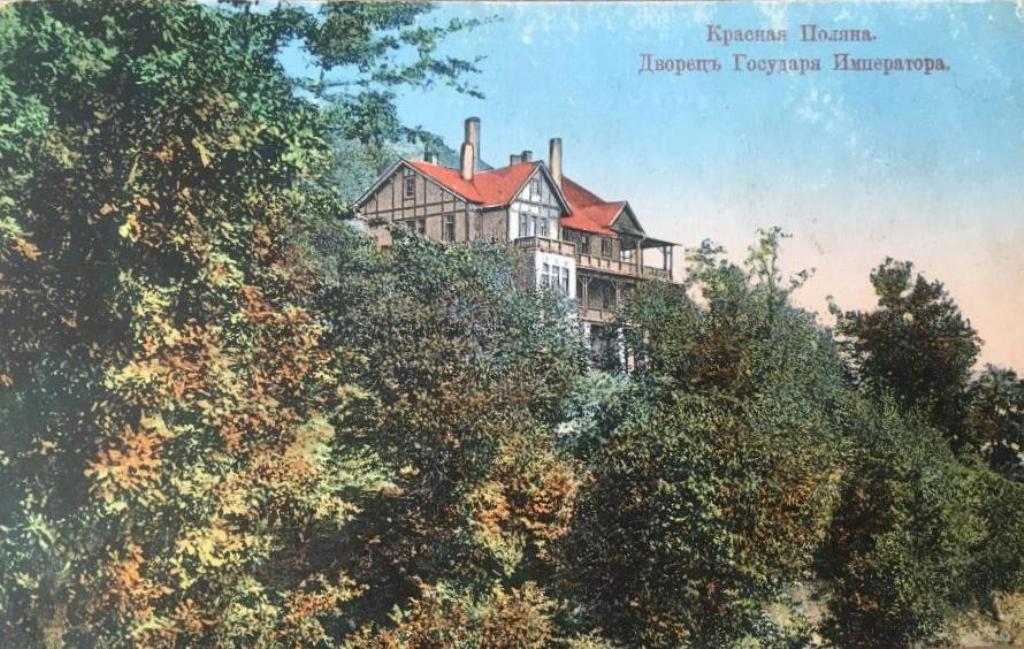
PHOTO: early 20th century postcard of Nicholas II’s hunting lodge in the Caucasus

The history of the village of Krasnaya Polyana is closely connected with the Romanovs. It was here, in 1864, that the Caucasian War ended. A victory parade and solemn prayer service was attended by the commander-in-chief of the Russian army, Grand Duke Mikhail Nikolaevich (1832-1909), who served for 20 years as the Governor General of Caucasus (1862–1882).

In 1898, a decision was made to rename the village of Krasnaya Polyana to the city of Romanovsk [named in honour of the Imperial Family]. After the construction of the highway from Adler [Sochi, Krasnodar Territory of Russia], the flat lands were divided into 300 sections, and the slopes of the mountains – into 70. It was at this time, that the development and settlement of Romanovsk began.

In 1902, on the advice of the mayor of St. Petersburg Daniil Vasilyevich Drachevsky (1858-1918), who owned an estate on the shores of the Black Sea and a dacha in the mountains of Krasnaya Polyana, Emperor Nicholas II leased a plot of land for 40 thousand rubles for a period of 15 years. The forests on the slope of Mount Achishkho were declared a protected area, and only members of the Imperial Family and senior government officials were permitted to hunt there.

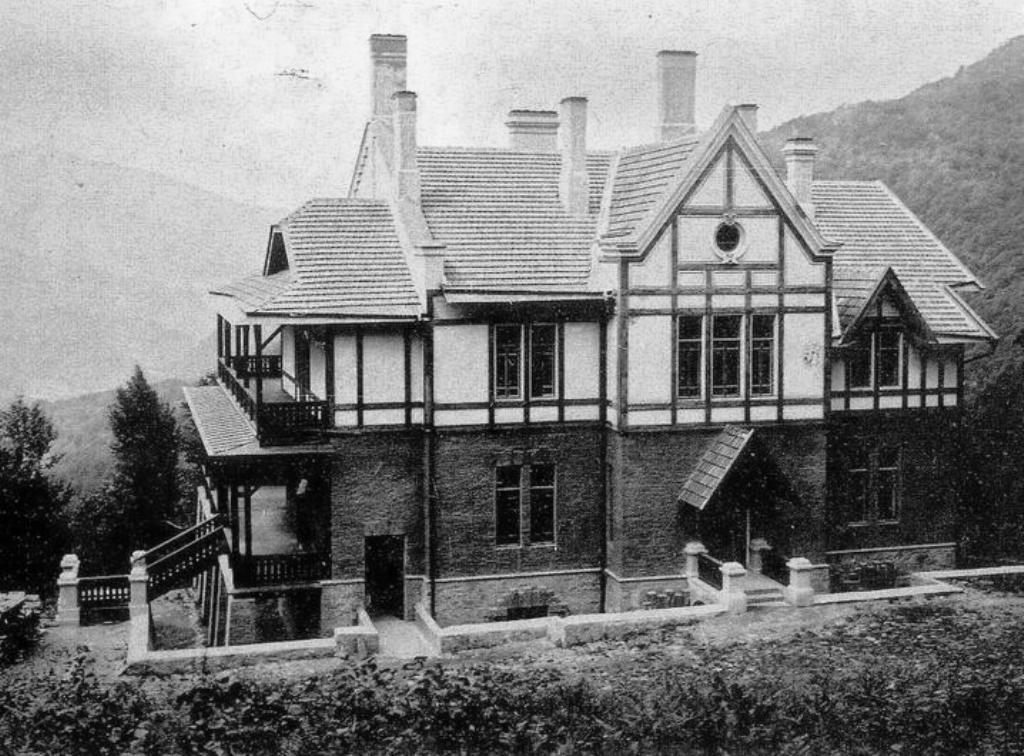
PHOTO: Nicholas II’s hunting lodge was constructed in the traditional English style

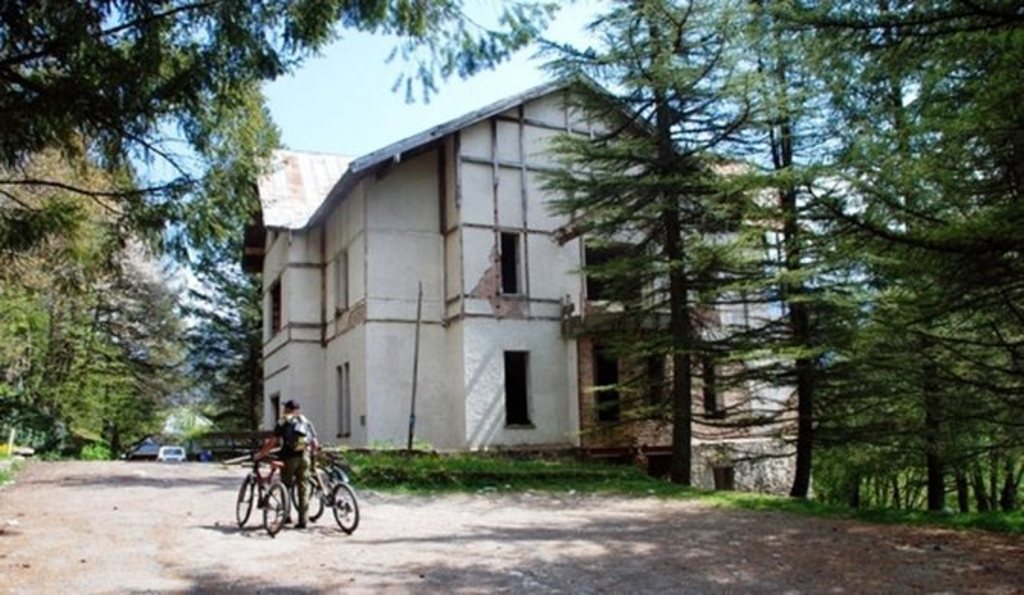
A new hunting lodge for Nicholas II was constructed in the traditional English style. The three-storey lodge was completed in 1903, and contained 50 rooms. A telephone was installed in the lodge, which connected to the post and telegraph office and security. In addition to the main building, a huntsman’s house was built just below the main building, as well as a stone guardhouse and a protective wall. According to one source, the Emperor showed little interest in the project.

In September 1903, the hunting lodge received its first guests. It is known for certain that Nicholas II himself never visited it. However, the Grand Dukes Alexander (1866-1933) and Sergei Mikhailovich (1869-1918) frequently visited the hunting lodge. When members of the Imperial Family were not in residence, the hunting lodge was also open to tourists visiting the region. After the outbreak of the First World War in 1914, the lodge was rarely visited by the grand dukes, all of whom had dedicated themselves to the war effort.

In 1920, Nicholas II’s hunting lodge was nationalized, and became the “property of the people”. Initially it housed a sanatorium for the Red Army.

During World War II, the building was converted into a hospital for wounded soldiers. They were brought here for the health benefits of the mountain-sea climate of Krasnaya Polyana. By 1945, more than 120 doctors and nurses staffed the hospital.

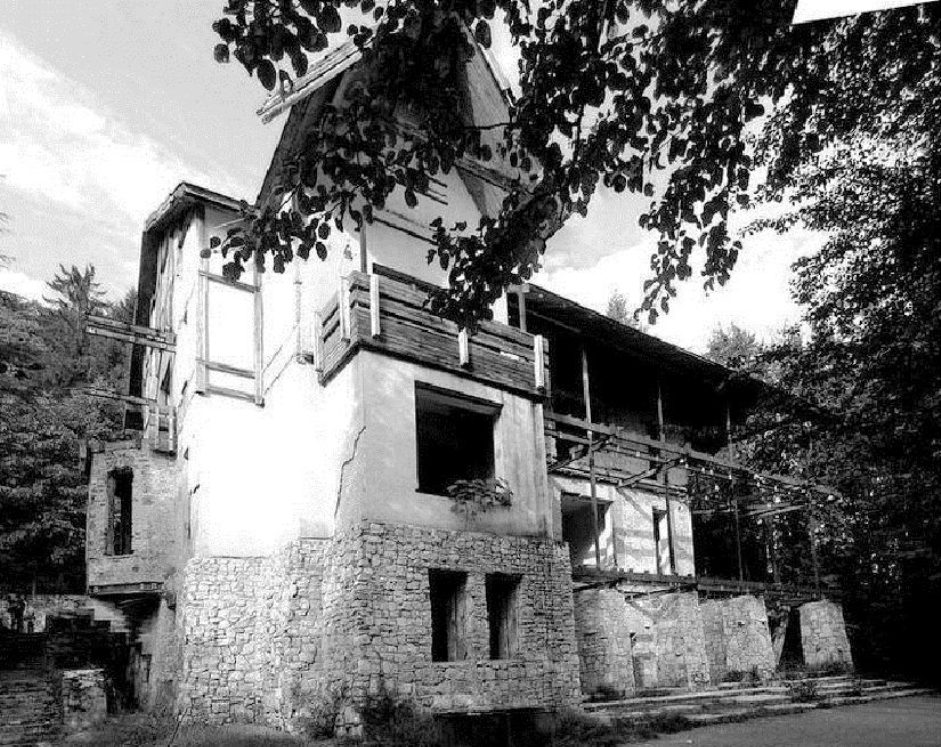
PHOTO: the abandoned hunting lodge of Nicholas II, as it looked in the mid-1990s

In the post-war period, Joseph Stalin visited Krasnaya Polyana, visiting the former hunting lodge, which by that time had fallen into disrepair. In 1949, Stalin gave the order to restore the building, and to build a path connecting the lodge with the main building of the Red Army sanatorium.

In 1961, the house and the accompanying sanatorium buildings were transferred to the Central House of Sports of the Soviet Army. In 1963, construction began on the buildings of the Krasnaya Polyana military camp site, situated one kilometer from the former tsar’s hunting lodge. In 1965, the building officially became part of the Krasnaya Polyana camp site of the USSR Ministry of Defense.

In 1967, work began on the intensified modernization of the camp site, as a result of which an observation deck, a parking lot, a public toilet, and a restaurant were constructed. The hunting lodge itself became a 4-star hotel with a restaurant. Guest rooms were decorated with Persian carpets, crystal vases and porcelain. The rooms were equipped with modern bathrooms.

Until the collapse of the USSR in 1991, the tsar’s hunting lodge was still in good condition. At the decisive stage of Perestroika, the building was transferred into the hands of an anonymous private individual.

PHOTO: the former hunting lodge of Nicholas II, as it looks today

In the first half of the 1990s, the building was privately owned by a legal entity registered in the Cayman Islands. The former hunting lodge itself was used as an ordinary hotel. In 1995, the building was abandoned, as was the restaurant, the latter of which had been very popular in the 1980s. Before abandoning the building, its owners stripped it of all its interior decoration, and also exposed the windows.

In 2008, the lodge fell into the possession of Elena Baturina, the wife of the mayor of Moscow, a billionaire according to Forbes. By 2011-2012, the former tsar’s hunting lodge had fallen into a terrible state of neglect and disrepair, the entrance to the building was completely exposed to the elements as well as vandalism.

In May 2013, work began on the reconstruction of the former lodge, with its completion scheduled by February 2014, for the opening of the Olympic Games in Sochi.

The former hunting lodge of Nicholas II in the village of Krasnaya Polyana did not open its doors to visitors during the Olympic Games. Instead, the building and the adjacent territory were purchased by a private individual. Sadly, almost nothing remained of the historic buildings former appearance, following the reconstruction. Entrance to the territory is now prohibited.

© Paul Gilbert. 1 May 2021

Descendants of Russian aristocrats against the Russian Imperial House

PHOTO: Rebecca Bettarini, George Mikhailovich and Maria Vladimirovna

Earlier this month, a group of seventeen descendants of Russian aristocrats penned an open letter to the President of the Russian Federation Vladimir Putin, regarding the illegal claims from the descendants of the Russian Imperial House – Maria Vladimirovna Romanova and her son George Mikhailovich [of Prussia].

Dear Vladimir Vladimirovich!

On behalf of the many zealots of the history of Russia, as well as the descendants of the historical families of Russia, we appeal to you, to bring to your attention the falsification of the history of our country.

On 20th January 2021, on the website of the so-called “Russian Imperial House”, an announcement was made regarding the upcoming wedding of the so-called “Grand Duke George Mikhailovich” and a certain “hereditary noblewoman” Miss Rebecca Bettarini. The upcoming wedding was presented to the whole world, as the “event of the century”, of which Russia has not seen the likes of for more than a hundred years.

At the same time, the upcoming event is cynically compared with the marriage of the last Russian Emperor Nicholas Alexandrovich and Empress Alexandra Feodorovna, Holy Royal Martyrs, which took place in 1894.

It is painful to see how before our very eyes there is again an attempt to legitimize the rights of the descendants of the Kirillovich branch of the Romanov family to the throne – rights that they do not have and cannot have.

For 30 years now, various supporters of the so-called “Russian Imperial House” have been trying to obtain a special status from the state for Maria Vladimirovna and her son George Mikhailovich, shamelessly falsifying both the history of the Imperial House and the history of Russia itself.

We firmly declare that we do not recognize any special rights for Maria Vladimirovna and her son George of Prussia, who according to all dynastic laws belongs not to the Russian Imperial, but to the Prussian Royal House.

The great-grandfather of George of Prussia, Grand Duke Kirill Vladimirovich, due to an unauthorized marriage with a divorced cousin by the Emperor, was deprived of the right to the throne by Emperor Nicholas II.

Kirill Vladimirovich himself de facto renounced his rights in the days of the February Revolution, when on 1st March 1917 (before the abdication of Nicholas II) he marched with the Guards crew to the Duma and swore allegiance to the revolutionary authorities.

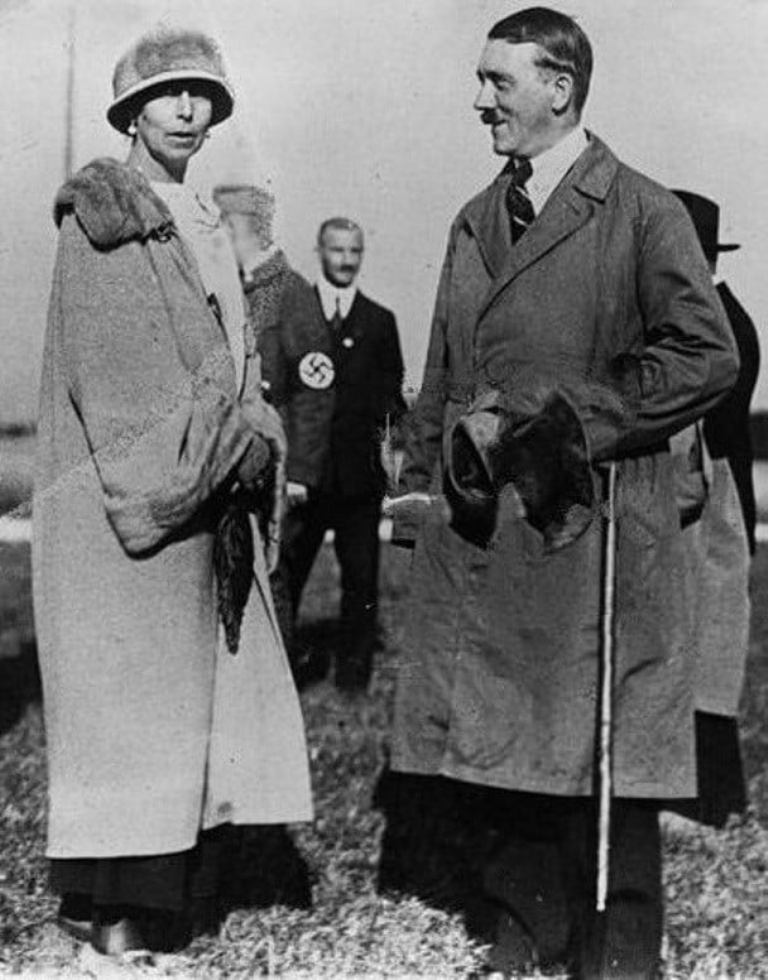
PHOTO: Grand Duchess Victoria Feodorovna with Adolf Hitler. September 1923.

George’s great-grandmother, Grand Duchess Victoria Feodorovna was an honorary guest at party congresses of the NSDAP [Nazi Party], where she was photographed with Hitler. Her son, George’s grandfather, Vladimir Kirillovich, after the outbreak of war in June 1941, openly supported Nazi Germany, in a special appeal urging the Russian emigration to rally under her banners.

After the war, fearing retaliation, Vladimir Kirillovich tried to hide in Liechtenstein, but the local authorities did not let him in. He then fled to Spain, where he settled under the protection of Franco.

In 1948, Vladimir Kirillovich secretly married the divorced Mrs. Kirby, nee Princess Leonida Georgievna Bagration-Mukhranskaya, entering into a morganatic marriage, which, according to the laws of the Russian Empire, denied any rights to the throne to his offspring.

The daughter of this marriage, Maria Vladimirovna, married Prince Franz Wilhelm of Prussia, a direct descendant of the German Emperor Wilhelm II, who, as you know, declared war on Russia in 1914.

Franz Wilhelm’s father, that is, George’s own grandfather, Prince Karl Franz of Prussia during the Second World War served as a lieutenant in the armoured division of the Nazi Wehrmacht. For military distinctions on the Polish front, he was awarded the Iron Cross.

Vladimir Kirillovich arbitrarily granted his son-in-law the title of Grand Duke, and Franz Wilhelm himself converted to Orthodoxy before marriage, becoming “Mikhail Pavlovich.” The marriage ended in divorce in 1985, and “Mikhail Pavlovich” returned to his Lutheran faith. From this marriage, a son, George, was born, who, according to all laws, belongs to the Prussian Royal House. However, in 1992, at the request of the Russian ambassador to Paris, Yuri Alekseevich Ryzhov, who did not understand the situation, George received a Russian passport with the surname Romanov, while according to German and French documents, his surname appears as Prussian.

Not finding a bride supposedly “equal” to his status, Prince George of Prussia decided to marry an Italian citizen Rebecca Bettarini, who unexpectedly became a “hereditary noblewoman” and, having converted to Orthodoxy in the Peter and Paul Cathedral in St. Petersburg, became known as Victoria Romanovna.

The false “nobility” of Bettarini was created by Maria Vladimirovna herself, who has no right to do so. Maria actively, and completely illegally distributes orders, medals and even titles of the Russian Empire. While many orders and awards of the Russian Empire have been officially restored in the modern Russian Federation, an ordinary civilian, and not a representative of the state, distributes the same order in appearance and name to her supporters on behalf of the “Imperial House”! How can we not call them fake?

Maria Vladimirovna “awarded” the Italian diplomat Roberto Bettarini with the Order of St. Anne of the 1st degree, thanks to which his daughter turned out to be a “hereditary noblewoman of the Russian Empire”!

This whole story – the history of the Kirillovich branch of the Romanovs and their descendants in the 20th century – is a series of betrayals, lies, deceit, scams and forgeries. And now they are trying to present another forgery to the people under the guise of “Imperial House” and “Imperial wedding”.

Moreover, it has already been announced that the wedding of George of Prussia and his bride should take place in St. Isaac’s Cathedral in St. Petersburg, the former cathedral of the Russian Empire!

Suffice it to say that in this cathedral, when it was still made of wood, only one of the Russian sovereigns, Peter the Great, was married there! And now the self-styled heir to the Russian throne, the self-styled Grand Duke and Tsarevich, the great-grandson of the one who betrayed the oath, the grandson of the one who called on the Russian emigration to fight Russia on the side of Nazi Germany, and the man whose ancestors fought in the ranks of the Wehrmacht and before that the First World War was unleashed—will now take place there! It is impossible to imagine a greater mockery of Russian history.

We declare that neither Maria Vladimirovna nor George of Prussia have the slightest right to be considered members of the Russian Imperial Family and heirs to the Russian throne. Another adventure of this family causes irreparable damage to Russia and plays into the hands of the forces trying to discredit the great history of our country.

With deep respect and faith in the triumph of truth!

  • Natalya Aleksandrovna Vinokurova – Deputy Head of the Department for Relations with Political and Public Organizations and the Media of the Permanent Mission of the Republic of Crimea to the President of the Russian Federation.
  • Vladimir Nikolaevich Grekov – Chairman of the Association in memory of His Majesty’s Life Guards Cossack Regiment.
  • Nikolai Nikitich Dobrynin is a member of the Society for the Memory of the Imperial Guard.
  • Lidia Vladimirovna Dovydenko – editor-in-chief of the Berega magazine, secretary of the Russian Writers’ Union, candidate of philosophical sciences.
  • Igor Vasilievich Zhuravkov is a full member of the Russian Geographical Society.
  • Count Sergei Alekseevich Kapnist – Chairman of the Main Directorate of the Russian Red Cross Society of the old organization.
  • Alim Alimovich Krylov is a member of the Association for the Memory of His Majesty’s Life Guards Cossack Regiment.
  • Prince Nikita Dmitrievich Lobanov-Rostovsky is an honorary member of the presidium and co-founder of the International Council of Russian Compatriots, an honorary member of the Russian Academy of Arts.
  • Gleb Borisovich Lukyanov is a member of the St. Petersburg branch of the All-Russian Society for the Protection of Historical and Cultural Monuments.
  • Dmitry Dmitrievich Lobkov – Chairman of the Regional Coordinating Council of Russian Compatriots in America, New Zealand and Australia.
  • Ivan Yurievich Matveev – Deputy Chairman of the Imperial Society of Zealots in Memory of Emperor Paul I.
  • Princess Julia Romanova is the widow of Prince Mikhail Andreevich, an honorary member of the Association of members of the Romanov family.
  • Anton Andreevich Skirda – Chairman of the Council of the Federal Building Association of Consumer Society “OUR DOM”.
  • Prince Alexander Alexandrovich Trubetskoy – Chairman of the Society for the Memory of the Imperial Guard, Chairman of the Franco-Russian Alliance Association, member of the International Coordinating Council of Russian Compatriots.
  • The Marquis Ivan Farache di Villaforesta is the grandson of Prince Ioann Konstantinovich, an honorary member of the Association of the members of the Romanov family.
  • Ekaterina Sergeevna Fedorova – Doctor of Culturology, Professor of Lomonosov Moscow State University.
  • Count Pyotr Petrovich Sheremetev – Chairman of the Russian Musical Society in Paris and Rector of the Paris Russian Conservatory named after Sergei Rachmaninoff. Honorary Chairman of the Presidium of the International Coordinating Council of Russian Compatriots.

Click HERE to read my article Paul Gilbert Cuts Ties with the Russian Imperial House, published on 5th February 2021.

© Paul Gilbert. 28 April 2021
Plots against Nicholas II by members of the Imperial Family

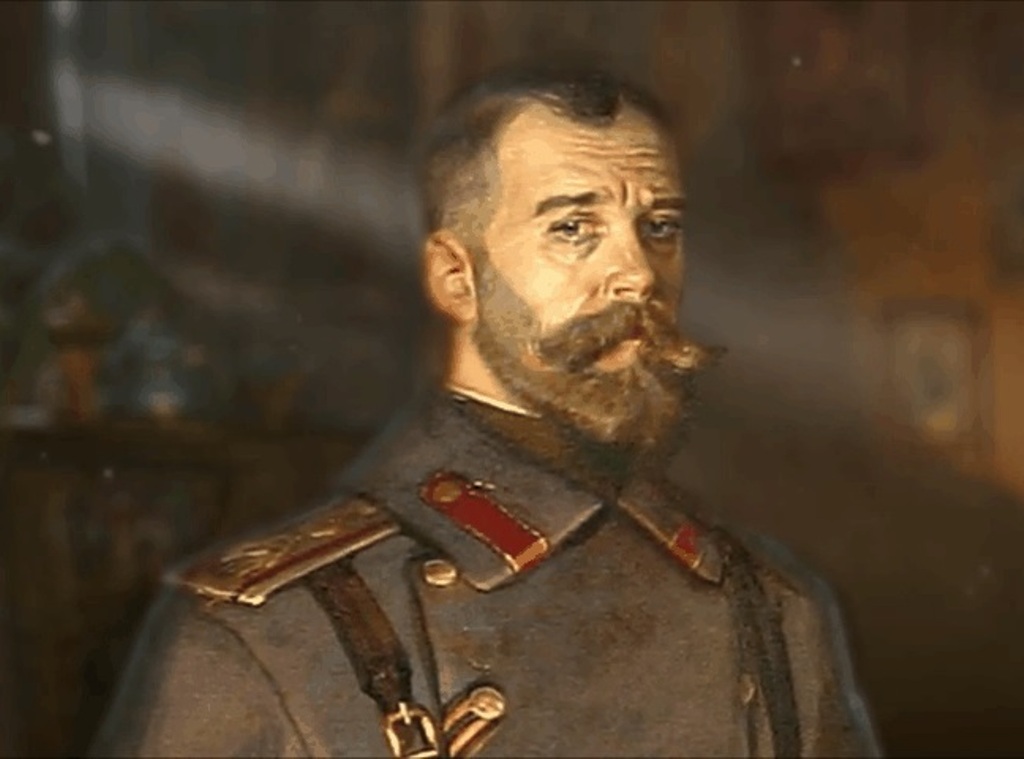
PHOTO: detail from a painting of Nicholas II by Pavel Ryzhenko (1970-2014)

Historian and author Brian Moynahan (1941-2018) writes about the plots hatched against Nicholas and Alexandra by members of the Imperial Family, following the murder of Grigory Rasputin, :

“At the weekend, over cards and liqueurs in the Imperial Yacht Club, the grand dukes aired plans to remove Alexandra to a nunnery. Sometimes Nicholas was to go too, to be replaced by one of themselves. [Grand Duke] Mikhail [Alexandrovich], his kindly and weak-willed brother, was one candidate. He had left Russia before the war after a clandestine marriage to the ex-wife of a captain in his own regiment. He had come back with the war, but his command of a Cossack brigade had been disastrous and he had been shuffled off to an obscure inspectorship. [Grand Duke] Nikolai Mikhailovich, the tsar’s cousin, had a more realistic claim, for his relative liberalism had won him the nickname “Nicholas Egalité.” Cynical, disparaging, and jealous by temperament, he was a historian who “worked only with words,” and was “too fond of scandal” to act decisively.

“No secrecy was observed in these intrigues. On Sunday, Petrograd rang with details of a coming coup. One theory was that a famous fighter pilot, Captain Kostenko, intended to crash his aircraft onto the imperial limousine. Another had several grand dukes plotting to use four regiments for a night march on the palace at Tsarskoye Selo to force the emperor to abdicate in favour of his son and a regent. Prince Gabriel Constantinovich gave a supper party for his mistress, a former actress, on Monday, December 26. The guests included Grand Duke Boris [Vladimirovich], the industrialist Alexei Putilov, a dozen officers, and a squad of elegant courtesans. They talked nonstop about the conspiracy and the details of which the regiments were to be seduced. All this was done with “the servants moving about, harlots looking on and listening, gypsies singing.”

“Tongues loosened by streams of Brut Imperial [a French sparkling wine] were heard by Okhrana agents. Nicholas and Alexandra were informed. They sent the grand dukes no Christmas presents that year and soon moved them and Rasputin’s murderers out of Petrograd. Grand Duke Dmitri [Pavlovich] was ordered to join the army staff in Persia, Yusupov was exiled to his family estates in the south. Vladimir Purishkevich had already gone to the front, where the military police were keeping an eye on him. The other grand dukes were sent to their estates or away on urgent naval business. The press was forbidden to mention Rasputin’s name.”

Source: Comrades. 1917 Russia in Revolution (1992) by Brian Moynahan (1941-2018)

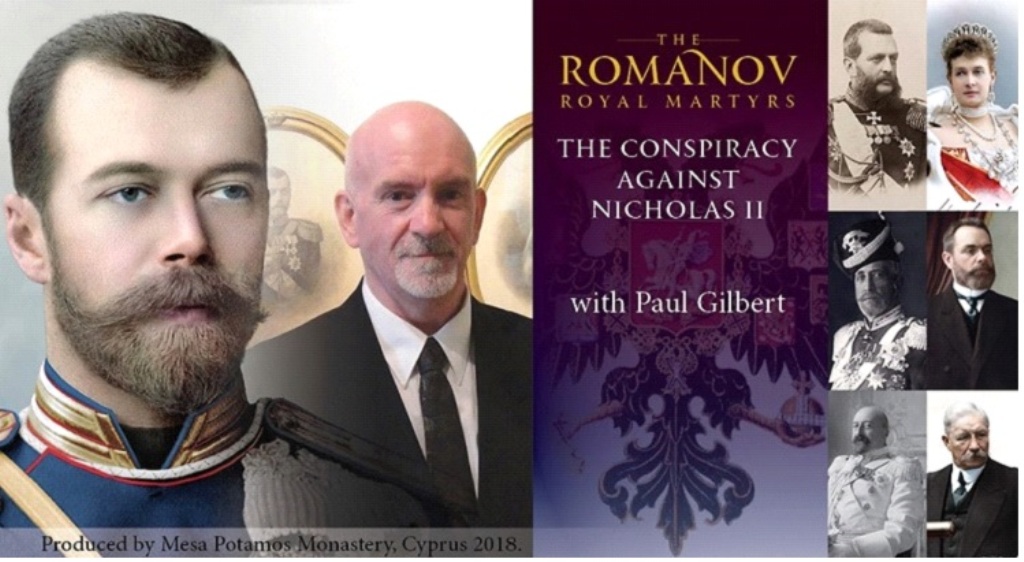
CLICK on the LINK to watch THE CONSPIRACY AGAINST NICHOLAS II with Paul Gilbert

The Tsar’s poignant diary entry of March 2nd 1918 bore much truth to the betrayal by his ministers, generals, soldiers, and even members of his extended family who turned their back on their sovereign breaking their oath of allegiance and thus committing treason in the process. Even his distant relations, members of the various royal families of Europe, turned their back on the Emperor. Treachery was indeed everywhere.

© Paul Gilbert. 26 April 2021
Vandals destroy monument to Tsar’s family in Tatarstan

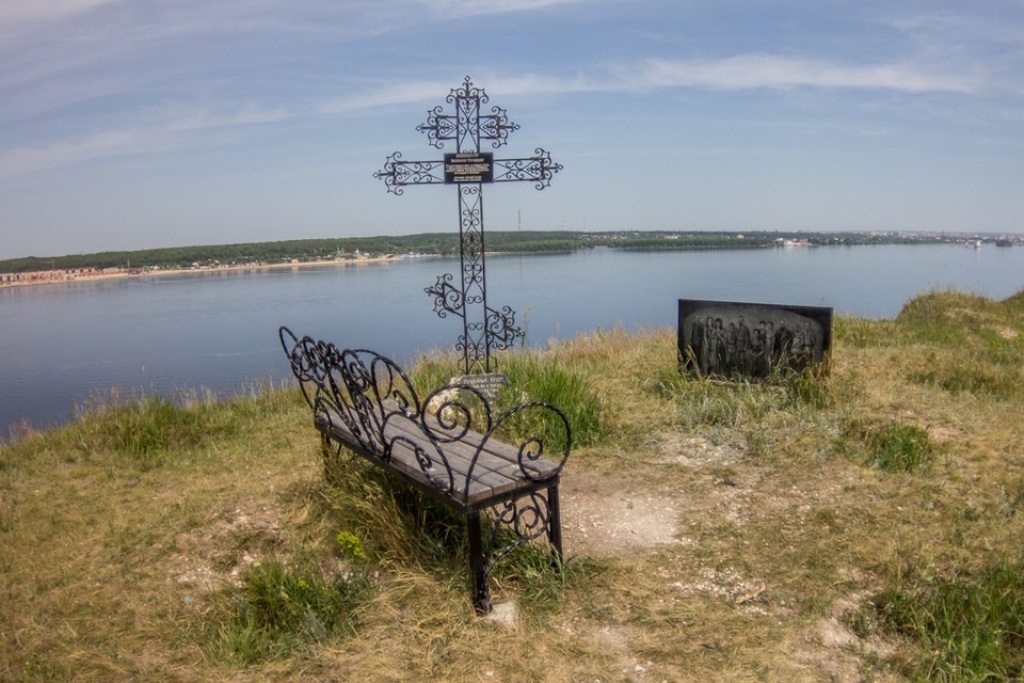
PHOTO: the memorial dedicated to the Holy Royal Martyrs situated on a cliff overlooking the Volga River, near the village of Pechishchi, consists of a Cross, a black-granite monument and a simple bench

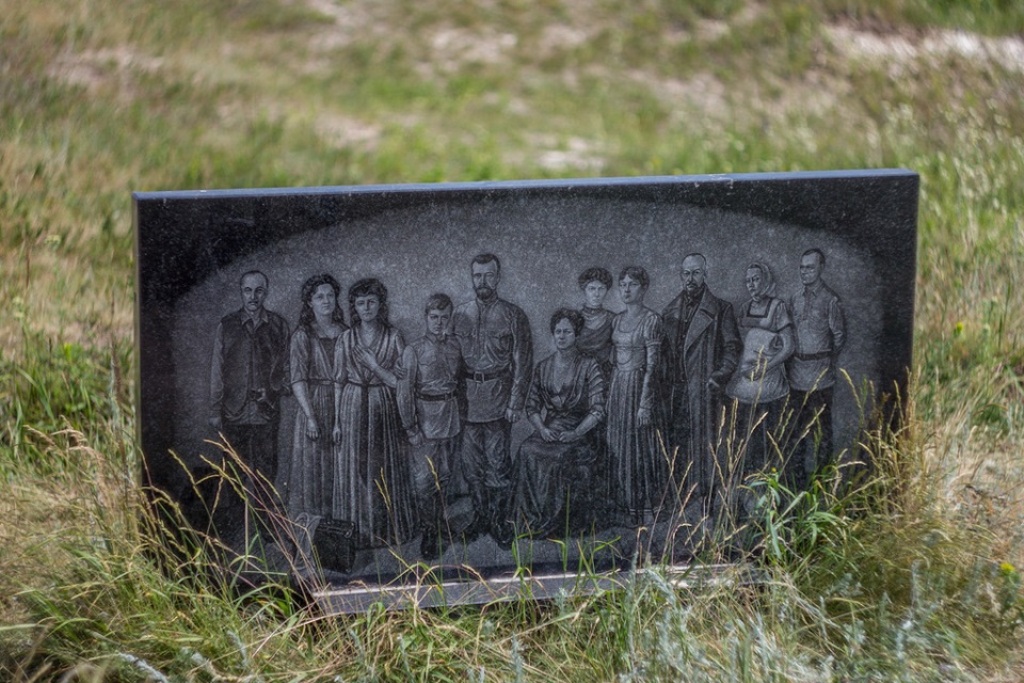
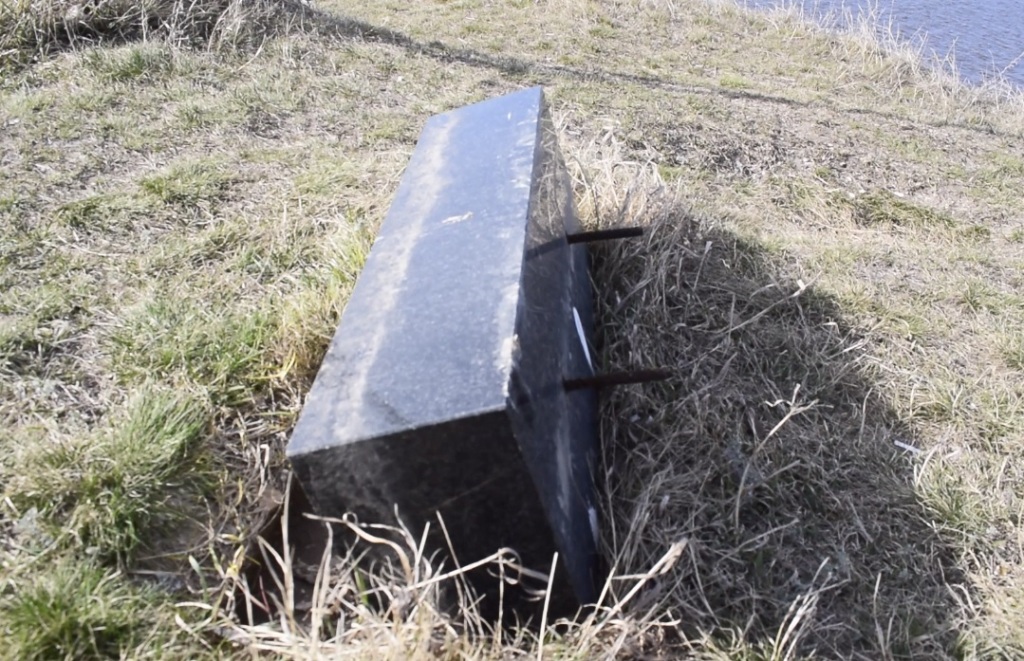
Vandals have destroyed a memorial dedicated to the Holy Royal Martyrs situated on a cliff overlooking the Volga River, near the village of Pechishchi, Verkhneuslonsky district of Tatarstan. The monument bearing the images of Nicholas II, Alexandra Feodorovna and their five children was knocked from its pedestal and thrown over the side of a cliff. The Orthodox Cross was untouched by the vandals.

The composition includes an iron veneration cross and black granite monument were erected on 17th July 2013, to mark the 400th anniversary of the Romanov dynasty, and to honour the memory of Nicholas II and his family, who were murdered in Ekaterinburg on 17th July 1918. A small bench was added, allowing visitors a place for solitude and reflection at the Holy Orthodox site.

PHOTOS: the black granite monument to the Holy Royal Martyrs – before (above) and after (below) Bolshevik sympathizers threw it over the nearby cliff

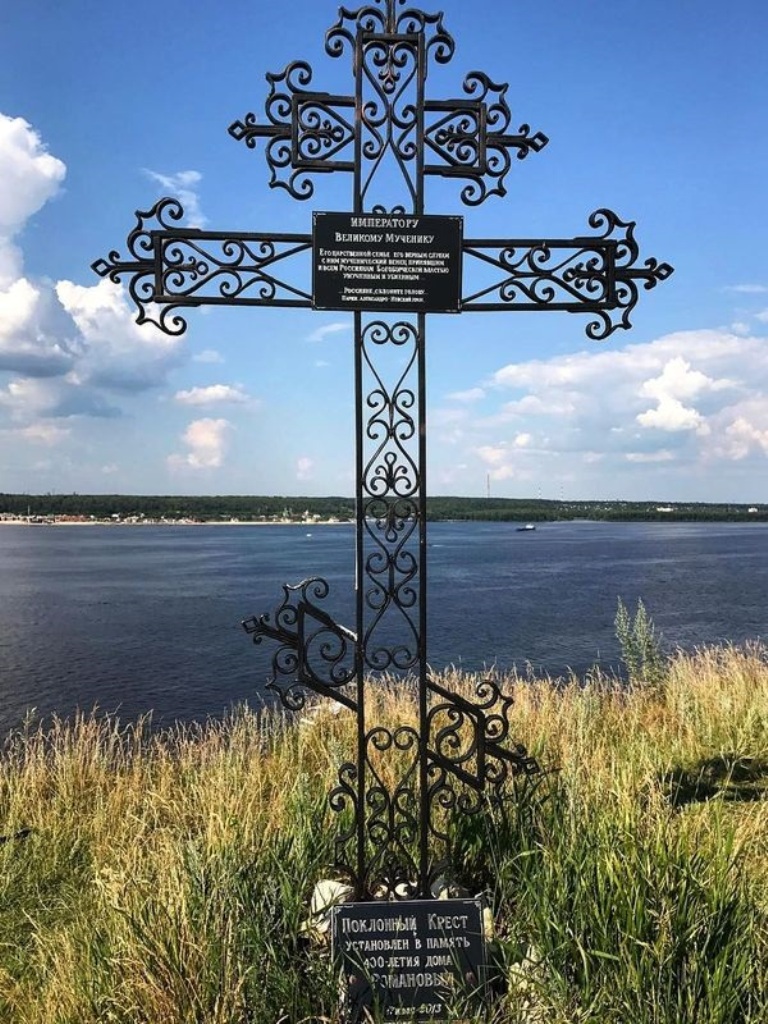
The plaque’s inscription on the Cross (below) reads:

“Императору великому мученику, его царственной семье, его верным слугам, с ним мученический венец принявшим, и всем россиянам, богоборческой властью умученным и убиенным. Россияне, склоните головы. Париж, Александро-Невский храм”.

“To the great martyr Emperor, his royal family, his loyal servants, who accepted the martyr’s crown with him, and to all Russians tortured and slain by the godless power. Russians, bow your heads. Alexander Nevsky Cathedral, Paris.”

Who the vandals are and how they managed to throw the multi-ton slab over the cliff remains unknown. although local officials claim those responsible would have needed heavy equipment to carry out their act of vandalism.

During the last decade, a number of monuments to Russia’s last emperor and tsar have been the target of vandals – mostly Bolshevik radicals.

“Father, forgive them, for they know not what they are doing.”

© Paul Gilbert. 22 April 2021

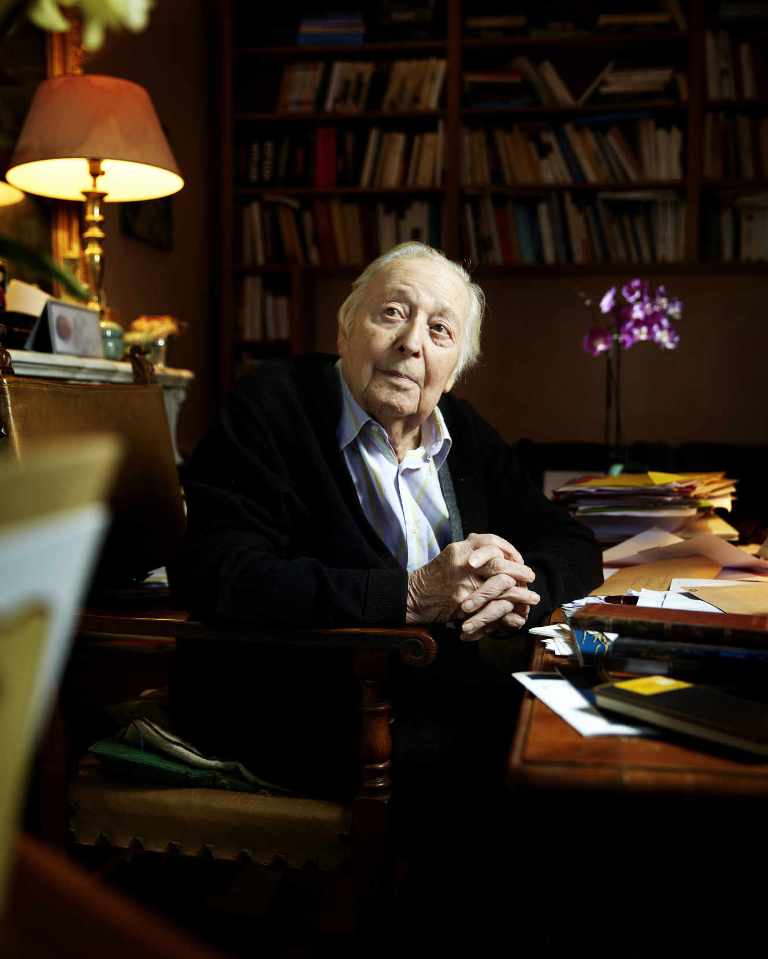
Obituary: French historian and author Marc Ferro (1924-2021)

PHOTO: French historian and author Marc Ferro (1924-2021)

Marc Ferro was born on 24th December 1924 in Paris. In 1941, he lived with his mother Oudia Firdmann and stepfather. Ferro was 5 years old when his father died. His mother was a designer at Worth, the first haute couture house in the French capital.

Ferro was a student at the Lycée Carnot. During the German occupation of Paris, he was the victim of the new Vichy regime’s rabid anti-Semitic policies, due to the Jewish origin of his mother. His philosophy professor, Maurice Merleau-Ponty recommended that Ferro and his classmates flee the occupied zone as soon as possible. Ferro took refuge in Grenoble as it was located in an unoccupied zone. His mother was deported and died on 28th June 1943 at Auschwitz.

Between 1948 and 1956, Ferro taught at the Lycée Lamoricière in Oran, in French-occupied Algeria. He was then appointed professor in Paris, at a number of higher learning schools. He later served as Director of studies at the École des Hautes Etudes en Sciences Sociales. At the beginning of the 1960s Ferro specialized in Soviet history, focusing on the Russian Revolution of 1917 .

The popular French historian and author is probably best known for his books on early 20th-century European history, the Russian Revolution and Emperor Nicholas II.

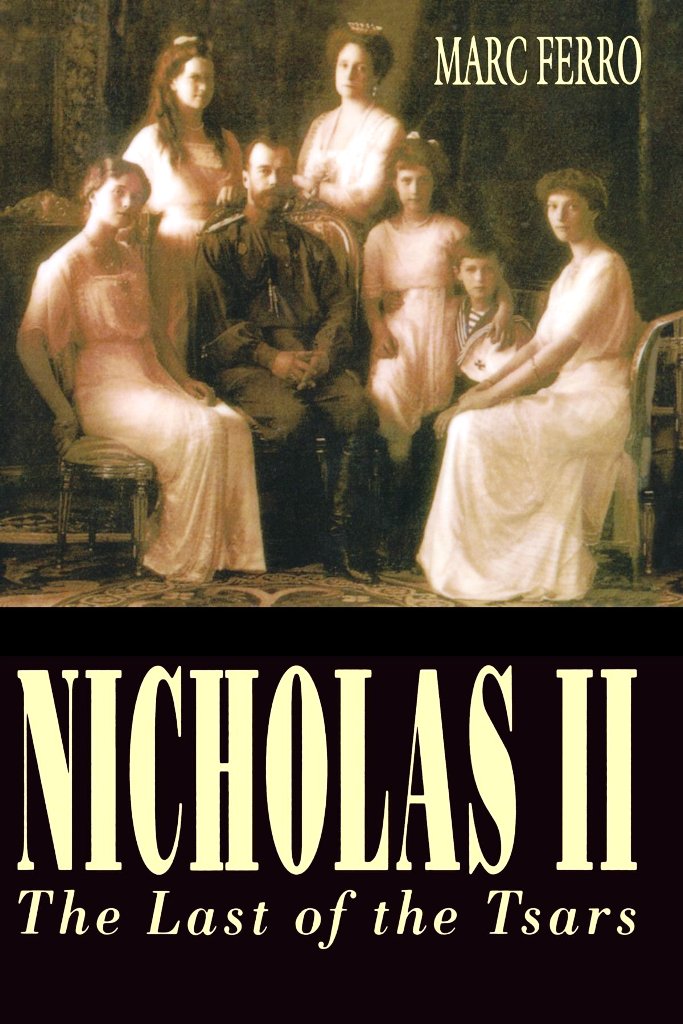
PHOTO: English edition of Nicholas II: Last of the Tsars (1991)

In 1990, his book Nicholas II: Last of the Tsars, was published and translated into many languages. Sadly, Ferro like most Western historians paint Russia’s last emperor and tsar in a very poor light.

For his biography, Ferro researched extensively in Russian archives to illuminate Nicholas II’s character. Ferro paints a portrait of “a reluctant leader, a young man forced by the death of his father into a role for which he was ill-equipped”.

“A conformist and traditionalist, Nicholas admired the order, ritual, and ceremony identified with the intangible grandeur of autocracy, and he hated everything that might shake that autocracy – the intelligentsia, the Jews, the religious sects”.

Ferro documents Nicholas II’s reign, as “one of continual trouble: a humiliating war with Japan; the 1905 revolution that forced Nicholas to accept a constitutional assembly, the Duma; the international crisis of 1914, leading to World War I; and finally the Revolution of 1917, forcing his abdication”.

The French historian believes that the Tsar was “utterly opposed to change and to the ferment of ideas that stirred his country, who felt it was his duty to preserve intact the powers God had entrusted in him”.

Ferro also provides an intimate portrait of Nicholas’s personal life: his wife Alexandra; his four daughters, Olga, Tatiana, Maria, and Anastasia; his son and heir Alexei, who suffered from haemophilia; and the various figures in the court, most notably Rasputin, whose ability to revive the frequently ailing Alexis made him indispensable to the Tsaritsa”.

Perhaps most intriguing is Ferro’s chapter on the fate of the Tsar and his family, examining all the rumours and contradictory testimony that swirl around this still popular conspiracy theory. Ferro concludes that Alexandra and her daughters may have survived the revolution, and the woman who later surfaced in Europe claiming to be Anastasia may well have been so.

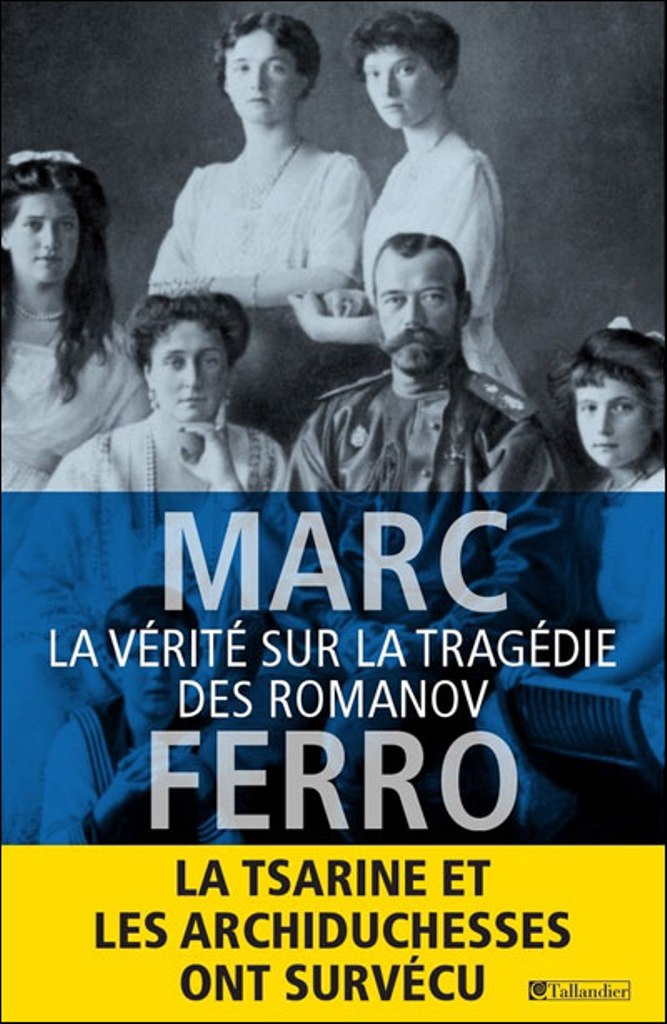
PHOTO: La Vérité sur la tragédie des Romanov (2012)

In 2012, Ferro published a second book La Vérité sur la tragédie des Romanov [The Truth about the tragedy of the Romanovs], in which he explores even further his belief that the Empress and her daughters survived the bloody regicide.

Ferro never believed the official version of the deaths of the Imperial Family in Ekaterinburg on 17th July 1918. He questions the murder of the Romanovs, based on a series of documents, allegedly discovered in the Vatican archives. The sudden death or execution of judges or witnesses, truncated documents, stolen investigation files, controversial DNA tests, put Ferro on the trail of a sacrilegious hypothesis: that the Empress and her four daughters were saved thanks to to a secret agreement between the Bolsheviks and the Germans. According to Ferro’s book, only the fate of the Tsarevich, Alexei, remains unknown, due to lack of “reliable” sources.

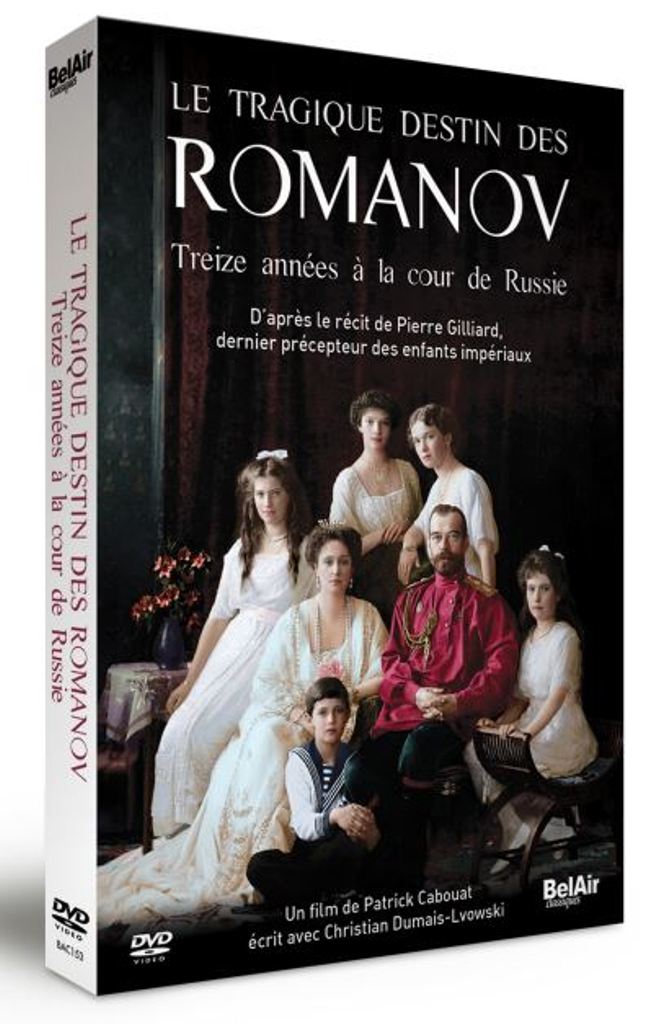
PHOTO: La Vérité sur la tragédie des Romanov DVD (2018)

In 2018, a French-language documentary was released in DVD format. The 1 hour 26 minute film presents a series events surrounding Nicholas II’s reign based on Ferro’s research: Bloody Sunday 1905, the February 1905 Revolution, the abdication of the Emperor, the coming to power of Lenin, the Tsesarevich’s haemophilia, Rasputin, the Empress’s alleged political influence over Nicholas. Among those interviewed in the documentary are actor Pierre Carbonnier who quotes Pierre Gilliard, and the participation of historians Hélène Carrère d’Encausse, Orlando Figes, Jean-Jacques Marie, historian of photography Daniel Girardin and Pierre-Frédéric Gilliard, nephew of Pierre Gilliard .

Marc Ferro died due to complications of COVID-19, on 21st April 2021, at the age of 96, in Saint-Germain-en-Laye (Yvelines), surrounded by his family.

© Paul Gilbert. 22 April 2021

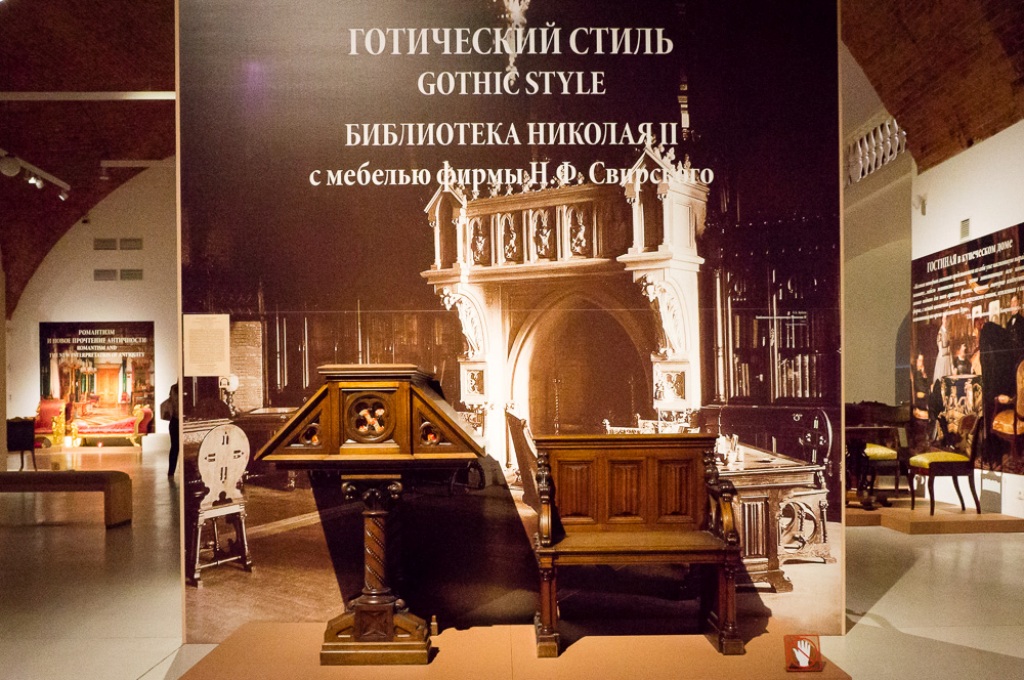
Gothic Library of Nicholas II in the Winter Palace

PHOTO: The Gothic Library of Emperor Nicholas II in the Winter Palace, as it looks today

The Gothic Library of Emperor Nicholas II in the Winter Palace in St. Petersburg, remains one of the most beautiful interiors to have survived to the present day. In addition, the library is the only interior of the Emperor’s private apartments in the Winter Palace to have retained its historical appearance without undergoing any changes.

This library was created in 1894-95 by the Russian architect Alexander Fedorovich Krasovsky (1848 – 1918). Krasovsky embodied the restrained spirit of old English castles: an abundance of wood trim, a ceiling with caissons and openwork chandeliers, bookcases placed along the walls as well as a massive fireplace. For it’s decoration, the architect made extensive use of the English Gothic style.

This interior with its decorative panels of tooled and gilded leather, monumental fireplace and tall windows with tracery carry visitors back to the Middle Ages, thus creating an incredible historical ambiance. It also features a coffered walnut ceiling embellished by quatrefoils. On the desk is a porcelain sculpture portrait of Nicholas II, an identical copy of the original the biscuit porcelain bust of the Emperor completed in 1896 by the Russian sculptor Léopold Bernstamm.

The library was located in a separate wing of the private apartments of Nicholas II. To accommodate the vast library, an upper balustrade and staircase were added. The walls above the bookcases were decorated with panels of embossed gilded leather.

An important element of the interior was the Gothic fireplace decorated with images of griffins and lions – heraldic figures of the family coats of arms of the House of Romanovs and the House of Hesse-Darmstadt, to which the empress belonged.

PHOTO: Furniture for the Gothic Library of Nicholas II, designed by N. V. Nabokov, made by N. F. Svirsky

The furniture which decorates the room was designed by the architect Nikolay Vasilyevich Nabokov (1838 – after 1907), and made by Nikolai Fedorovich Svirsky, at his workshop located at 45/47 Borovaya Street in St. Petersburg. The Russian State Historical Archive [RGIA] has preserved Svirsky’s furniture design drawings to the present day. Some of his creations for the Gothic Library were displayed in a temporary exhibition held in the State Hermitage Museum in 2018.

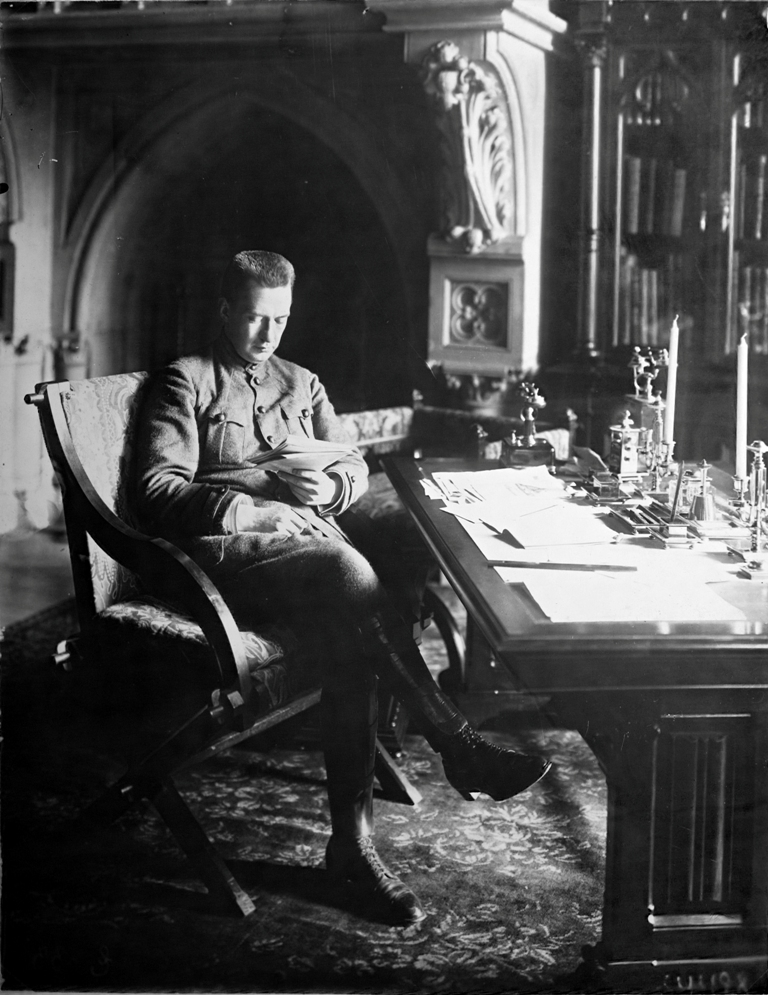
In 1905, Nicholas II and his family moved to Tsarskoye Selo, where they took up permanent residence in the Alexander Palace. Following his abdication in February 1917, the Imperial Residences were all nationalized under the new Provisional Government. It’s leader Alexander Kerensky (1881-1970) wasted little time in acquisitioning the Gothic Library for his own personal use.

PHOTO: Kerensky seated in Nicholas II’s Gothic Library in the Winter Palace, 1917

In March 1917, a decree was issued declaring the contents of the Winter Palace as state property. Only a portion of the library’s original book collection have been *preserved. Today’s caretakers in the State Hermitage mUSEUM confirm that the Emperor read all the books that were kept, often leaving his notes in them.

*In the 1930s and early 1940s, 10,915 titles, 15,720 volumes from Nicholas II’s library in the Winter Palace, were sold to various libraries in the United States, including Harvard, NYPL, and Stanford. In addition, about 2,800 volumes were acquired by the Library of Congress in Washington, D.C.

I am pleased to share a link to a beautiful three-dimensional panorama of the Gothic library of Nicholas II in the Winter Palace, courtesy of the State Hermitage Museum – Click HERE to view.

***

Click HERE to read my article Nicholas II’s apartments in the Winter Palace – includes photos, video and plan – published on 30th August 2022

© Paul Gilbert. 22 April 2021

New documentary series defends the reign of Nicholas II

A new Russian language documentary is “important for historical parallels”, experts say, by dispelling the myth that Russia was a backward nation during the reign of Nicholas II – 1894 to 1917.

More than a hundred years have passed since the catastrophic events of the February 1917 Revolution in Petrograd, but their significance has not diminished during the last 100+ years.

The February Revolution left behind a lot of questions. With all the chronological clarity of those events, their interpretations to this day contradict each other. What was the Russian Empire like on the eve of the February Revolution? What was the position of the peasants and workers? What was the state of the economy and events of the First World War? For decades (especially during the Soviet period) it was believed that life in Russia at that time was characterized by poverty, backwardness, military devastation. oppression by the autocracy, etc. So, what is the truth?

In his new Russian language documentary series Гибель империи. Российский урок / Death of the Empire. Russian Lesson [18 episodes, each one a duration of 15 to 20 minutes] Metropolitan of Pskov and Porkhov Tikhon (Shevkunov), analyzes the economy of the Russian Empire, its domestic and foreign policy, the activities of the tsar, military, political elites, but most importantly, the state of Russian society during that period.

Metropolitan Tikhon clearly notes that during the First World War, the Russian Empire was neither economically nor militarily in any worse state than that of other countries. On the eve of the First World War, the Russian economy was developing rapidly, the standard of living rose significantly, the population during the reign of Nicholas II increased by 50 million people.

By 1917, Russia had increased the production of cast iron 4 times, copper 5 times, coal 5 times, and from 1911 to 1914 the machine-building industry increased 2 times. Before World War I, Russia produced 9.4% of world GDP and was ranked 4-5 in the world in terms of its volume. Most importantly, the land issue was not a decisive factor in the revolution. So, by 1916, in the European part of Russia, 90% of arable land was in the hands of the peasantry, and100% in the Asian part of the empire.

A key factor in the tragedy of 1917 was played out by Russia’s so-called “allies” – Great Britain and France, who directly indulged the conspirators. The British delegation led by Lord Alfred Milner (1854-1925) presented an ultimatum to the Emperor on the eve of the revolution, in which he demanded, a change in the state system in Russia with the introduction of the concept of “responsible” (before the Duma) government. An outrageous demand by a foreign power, especially during war with Germany. In the aftermath of the Tsar’s abdication in 1917, the “allies” abandoned the Russian Sovereign, who in the end, was the only true ally who honoured his commitment to the war.

PHOTO: Metropolitan of Pskov and Porkhov Tikhon (Shevkunov)

The betrayal of the elites was even more tragic. At the beginning of 1917, Russia was on the verge of winning the war – during the planned spring-summer offensive. The Russian Imperial Army would surely have broken through the German positions, which would have resulted in the enemy being forced to cede all the territories to Russia, promised under the Sykes-Picot Agreement and enormous reparations. The commander-in-chief of the German army General Erich Ludendorff (1865-1937), even admitted: “Our defeat seemed inevitable.” But then the February Revolution broke out in Russia.

One of the main problems of pre-revolutionary Russia was its “enlightened” society, who literally dreamed of a revolution. Many prominent writers, scientists and publicists supported the underground movements in one way or another, some even through financing and campaigning.

Russia’s “enlightened” society created, in fact, a parallel state. It had almost all the attributes of statehood – its own army (terrorist), its own mass media, its own informal budget, its own “courts” and governing bodies. As a result, by 1917, public opinion in Russia was prepared for a conspiracy and a change of power. however, in the end, many of those who were so thirsty for revolution then perished during the civil war and the subsequent Bolshevik repressions.

The key problem of the Russian people, according to the testimonies of eyewitnesses of the events cited by Father Tikhon, was the colossal impatience of the people and their pliability to the provocative speeches of revolutionary agitators. It is simply amazing how in 1917 a significant number of people fell so easily for the fables about “freedom, equality and brotherhood” – who in the end received any such promises.

Malicious gossip and revolutionary propaganda, helped to turn the people against their Tsar. Lies spread like wildfire during the war years. References were made to the “bloody tsarist regime”. Emperor Nicholas II was referred to as “an alcoholic”, and his wife as “a German spy”, as well as the “destructive influence of Grigory Rasputin”. References to the “bloody tsarist regime”, were published daily by the liberal press, often prompted by Western propaganda. German planes dropped leaflets with cynical cartoons of Nikolashka in the trenches of Russian soldiers.

“Russia was ruined by gossip,” Vladyka Tikhon quotes the outstanding Russian writer Ivan Lukyanovich Solonevich (1891-1953), a devout monarchist, who believed that “monarchy was the only viable and historically justified political system for Russia”.

© Paul Gilbert. 21 April 2021

***

Dear Reader

If you enjoy my articles, news stories and translations, then please help support my research by making a donation in US or Canadian dollars to my project The Truth About Nicholas II – please note that donations can be made by GoFundMePayPal, credit cardpersonal check or money order. Thank you for your consideration – PG