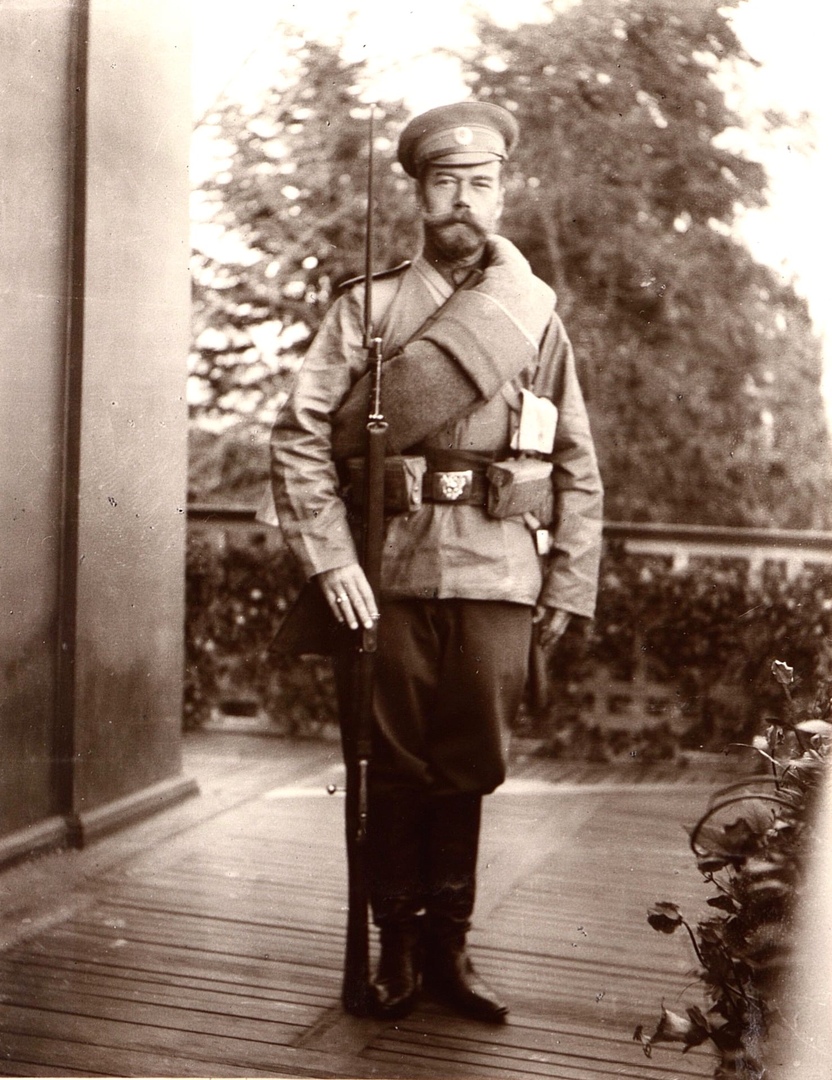
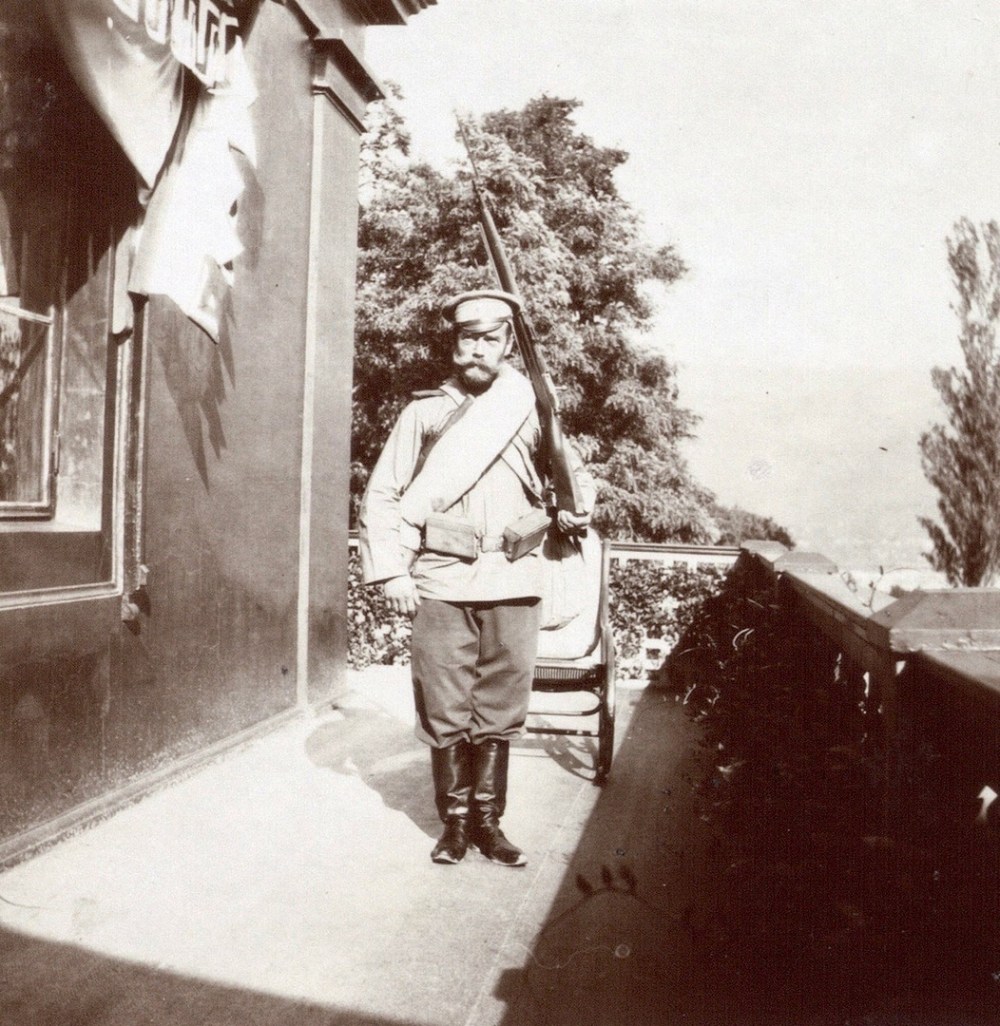
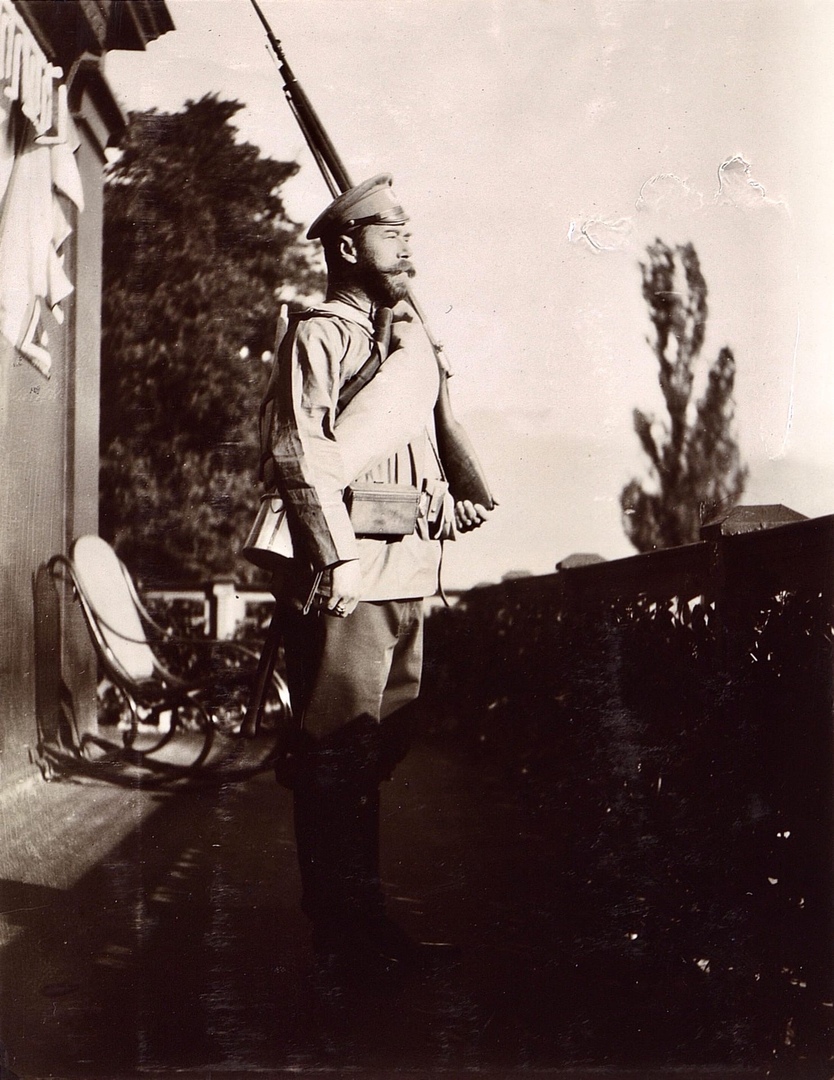
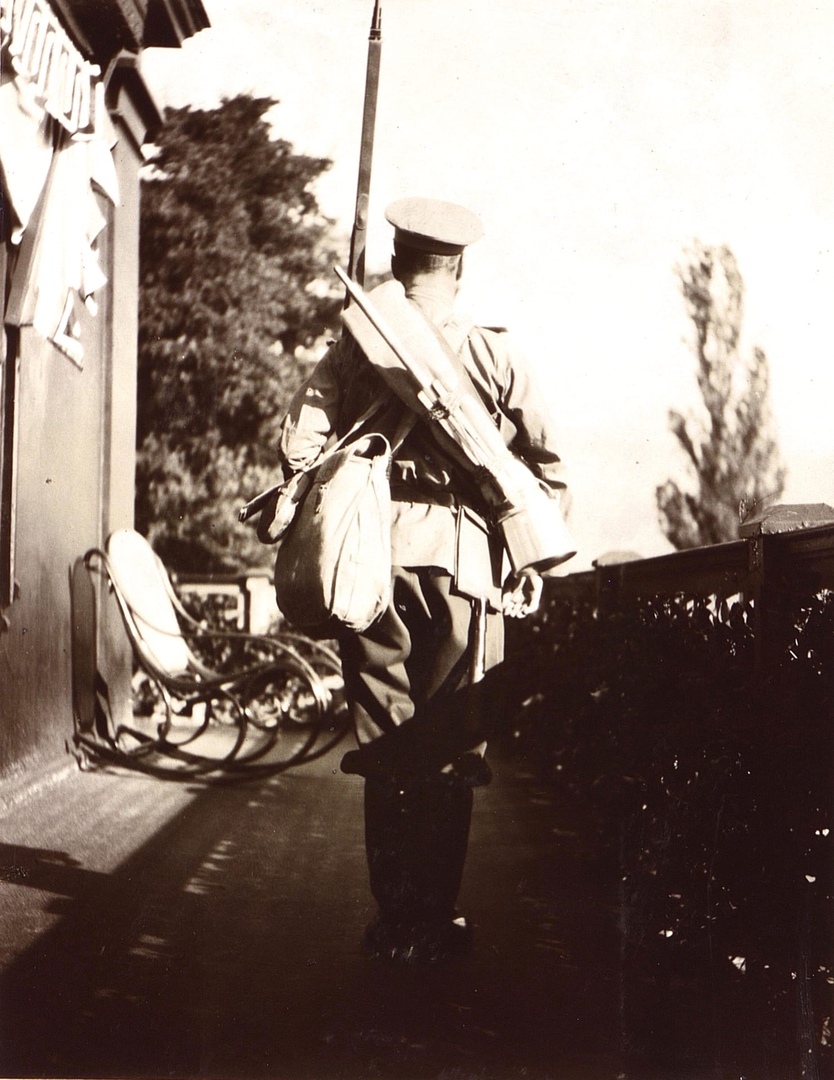
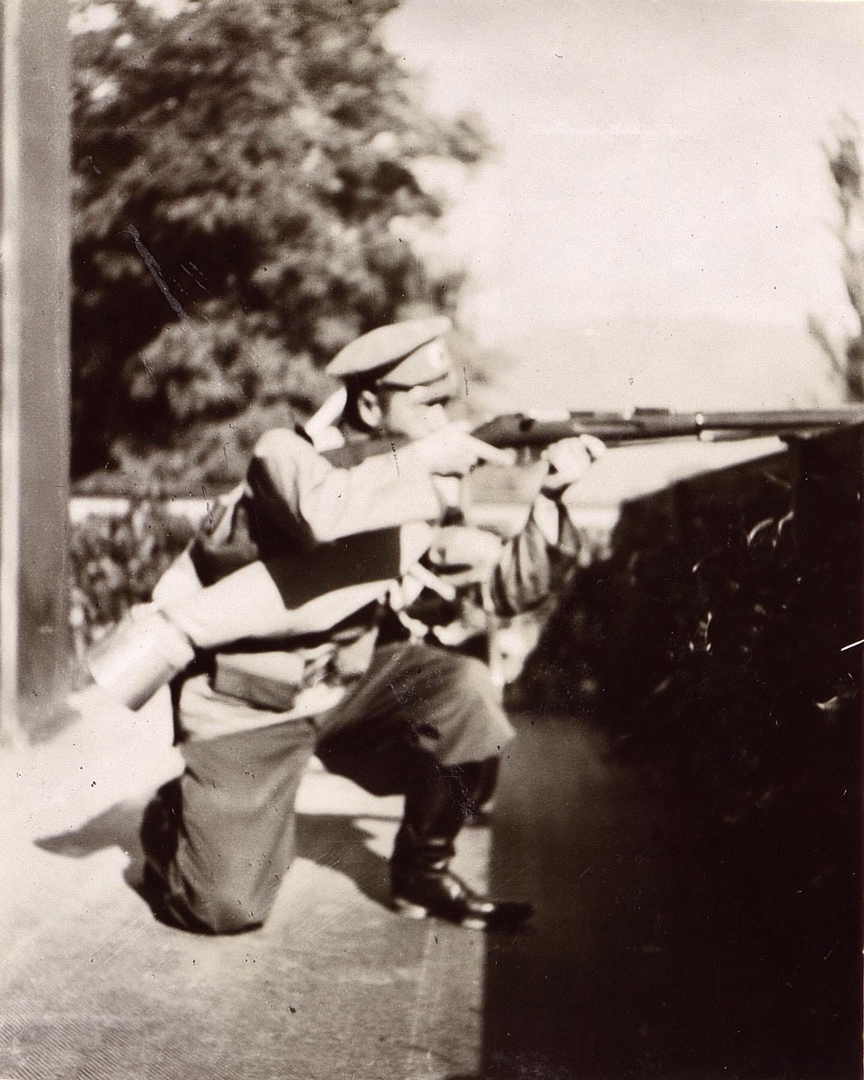
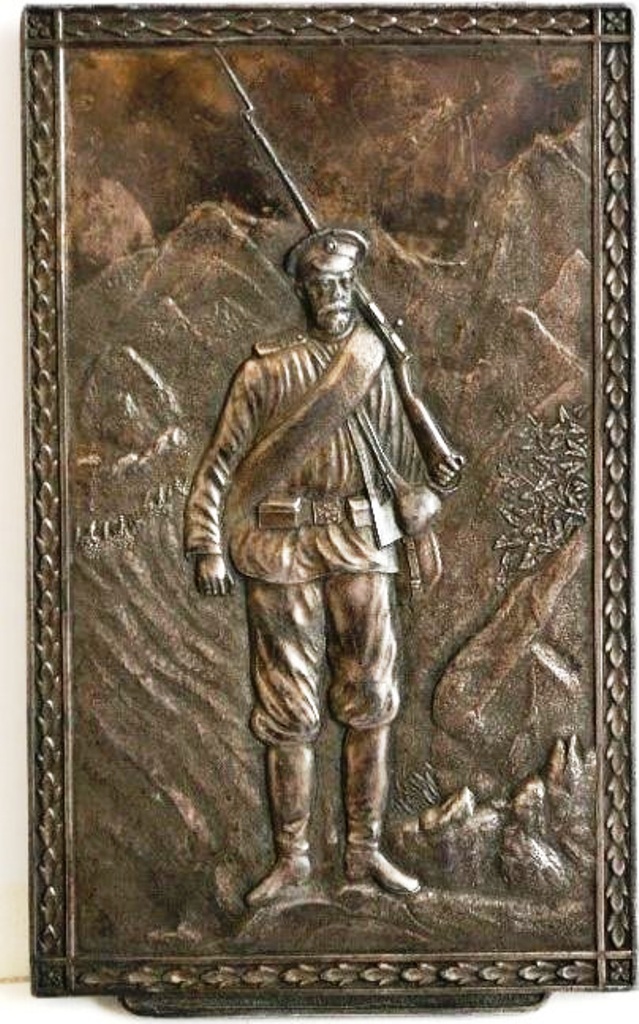
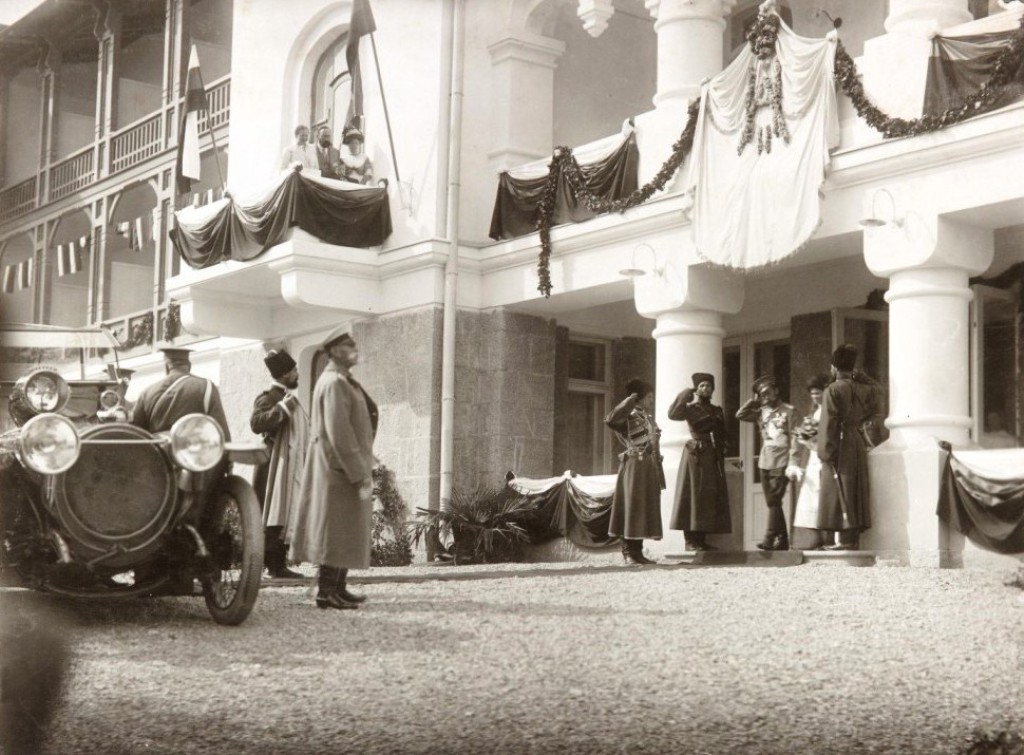
This series of photographs depict Emperor Nicholas II wearing the uniform of a private soldier in Livadia. During the autumn of 1908, the Tsar made it his duty to run tests on new uniforms for the soldiers of his army.
In 1909, Vladimir Aleksandrovich Sukhomlinov (1848-1926) the Minister of War was at work on an important reform, the determination of the type of clothing and equipment to be worn and carried in future by every Russian infantryman. When considering the modifications proposed by the Minister, the following provides a convincing proof of the extreme conscientiousness and sense of duty which inspired Nicholas II, as head of the Russian Imperial Army. The Tsar wanted full knowledge of the facts, and decided to test the proposed new equipment personally.
The Emperor told only Alexander Alexandrovich Mossolov (1854-1939), who served as Minister of the Court and the Commander of the Palace of his intention. They had the full equipment, new model, of a soldier in a regiment camping near Livadia brought to the palace. There was no falang, no making to exact measure for the Tsar; he was in the precise position of any recruit who was put into the shirt, pants, and uniform chosen for him, and given his rifle, pouch, and cartridges. The Tsar was careful also to take the regulation supply of bread and water. Thus equipped, he went off alone, covered twenty kilometres out and back on a route chosen at random, and returned to the palace. Forty kilometres — twenty-five miles — is the full length of his forced march; rarely are troops required to do more in a single day.
The Tsar returned at dusk, after eight or nine hours of marching, rest-time included. A thorough examination showed, beyond any possibility of doubt, that there was not a blister or abrasion of any part on his body. The boots had not hurt his feet. Next day the reform received the Sovereign’s approval.
The Tsar regarded himself as a soldier — the first professional soldier of the Russian Empire. In this respect he would make no compromise: his duty was to do what every soldier had to do.
Excerpted from At the Court of the Last Tsar by A.A. Mossolov. English edition published in 1935
PHOTO: bas-relief depicting Emperor Nicholas II testing new uniforms for the soldiers of his army
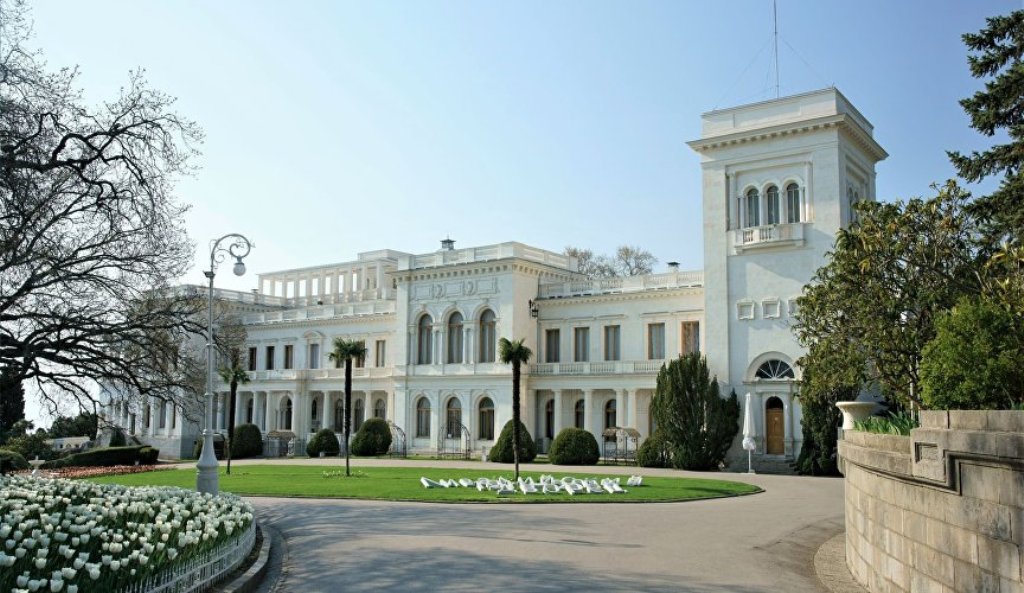
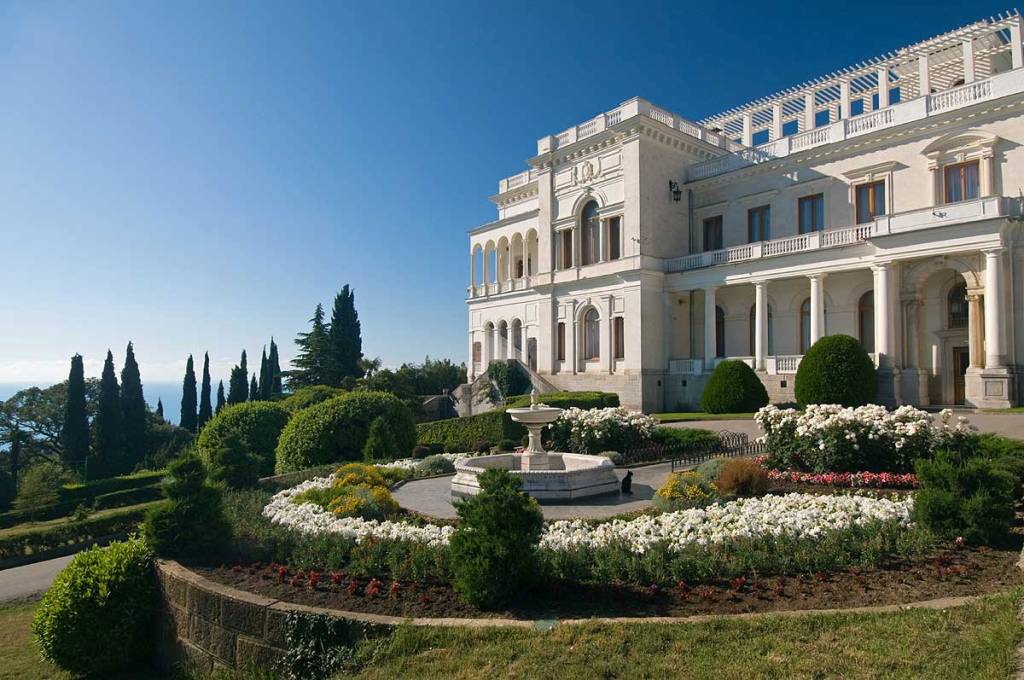
PHOTO: facade, main entrance and garden of Livadia Palace
July marks the 100th anniversary of the opening of Livadia Palace Museum. The former residence of Emperor Nicholas II and his family in Crimea, was opened to the public as a museum in 1922, however, it closed 5 years later due to a lack of visitors.
Today, the “White Pearl of Crimea”, is framed by gardens filled with the aroma of roses… classical melodies unobtrusively pour from the speakers… a queue of visitors wait patiently at the ticket booth to purchase tickets, all eager to see how the last Russian emperor and his family lived, with their own eyes. According to staff estimates, the palace today receives an average of 500 guests daily.
A similar scenario played out 100 years ago, only instead of tourists, it was students and Red Guards who roamed the halls and rooms of the palace. Thanks to archival documents, we know that in 1923 the Livadia Palace was visited by 30 thousand people, while nearby Alupka Palace, for example, received only half that number.
A hundred years ago, there were actually two Livadia palaces available for visiting – the Maly or Small wooden palace, which belonged to Alexander III (it was demolished after the Great Patriotic War), and the new Grand White Palace (built on the site of the Bolshoi or Large wooden palace). In the Small Livadia Palace only 3 rooms were open to visitors, while in the new Grand White Palace 10 rooms were open to visitors: 2 downstairs and 8 upstairs. It should be noted, that at this time, the palace-museum would have still been left intact, although it is known that some items were stolen during the Revolution and Civil War.
The museum then was only open to receive visitors four times a week, from 3 pm to 6 pm. And although visitors paid an entrance fee, sometimes the money received was not even enough to cover the salaries of the museum’s few employees.
On 30th April 1918, German troops entered Livadia, and immediately proceeded to plunder the palace.
In 1922, the Museum of the Life of the Romanov Royal Family, opened in Livadia Palace. During the 1920s, the Soviets used Livadia Palace solely for propaganda purposes: the people could see what luxurious interiors the Imperial family lived in, the expensive materials the furniture were made of, thus causing indignation among many.
On 21st December, 1920, Lenin signed a decree according to which “the palaces of the former tsars and grand dukes should be used as sanatoriums and health resorts for workers and peasants.” In 1925, the first sanatorium was opened in Livadia Palace, offering free treatment of peasants.
The Soviet poet Vladimir Vladimirovich Mayakovsky (1893-1930), who visited here in 1927, wrote the poem “Miracles”, in which a key line reads: “In the royal palace, now live sanatorium men.”
It was in the same year, that the museum was closed with a sign on the main entrance “closed due to lack of interest among visitors”.
After that, the question arose about the distribution of the contents of the Livadia Palace: they were simply transferred to other Crimean museums. For example, a number of carpets were given to the Palace of the Emir of Bukhara (1880-1914) in Yalta, while other items of decorative, applied and fine arts – to the Alupka Palace and the Kroshitsky Art Museum in Sevastopol. The dolls and toys of the Imperial children were given to orphans, while the curtains which adorned the imperial bedchambers and other rooms of the palace were made into clothes for the poor. Sadly, most of the historical furnishings have been lost, and it was only in the 1990s, that some pieces of the furniture were returned to the palace, and are now part of the museum.
During the Second World War, a ceremony marking the successful completion of the German Crimean Campaign (1941–1942), with the capture of Sevastopol by the German 11th Army under the command of General Erich von Manstein, and Manstein’s promotion to the rank of Generalfeldmarschall (field marshal), was held in the garden of Livadia Palace on 6th July 1942. Participants included officers, non-commissioned officers and soldiers who were awarded the German “Ritterkreuz” (Knight’s Cross) and the “Deutsches Kreuz in Gold” (German Cross in Gold).
Some 70 years later, Livadia Palace underwent an extensive restoration and received the status of a state museum. In November 1993, Livadia Palace received the status of a museum. On 16th July 1994, the exposition The Romanovs in Livadia was opened in the former private rooms of the Imperial family on the second floor of the palace.
Today, Livadia Palace is the most popular museum in Crimea. The first floor of the palace-museum is dedicated to the famous Yalta Conference, attended by US President Franklin D. Roosevelt, British Prime Minister Winston Churchill, and Soviet leader Joseph Stalin, on 4th–11th February 1945.
The permanent exposition dedicated to Nicholas II and his family in Livadia is located on the 2nd floor of the palace, in 16 rooms, each of them featuring original elements and details.
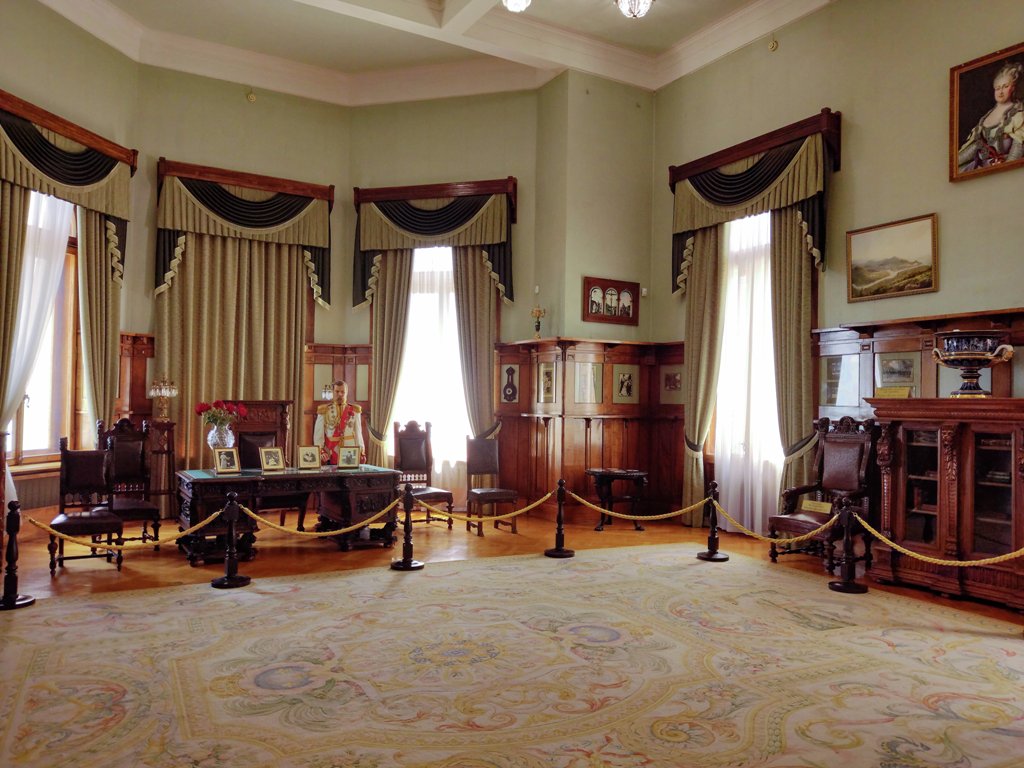
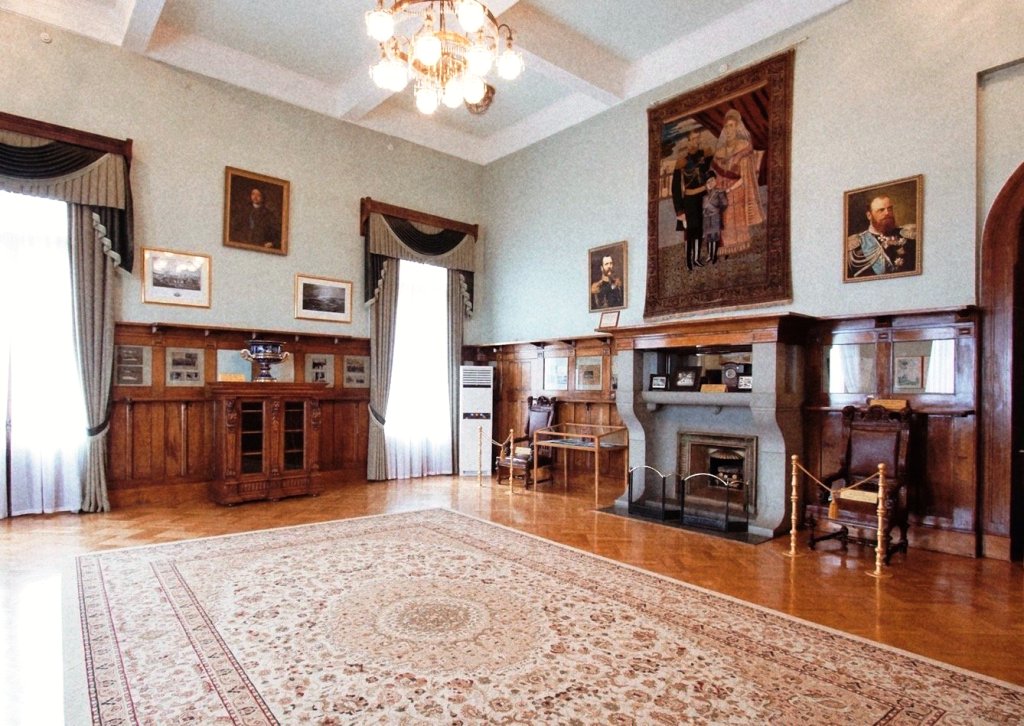
PHOTO: the Emperor’s favourite room – his study
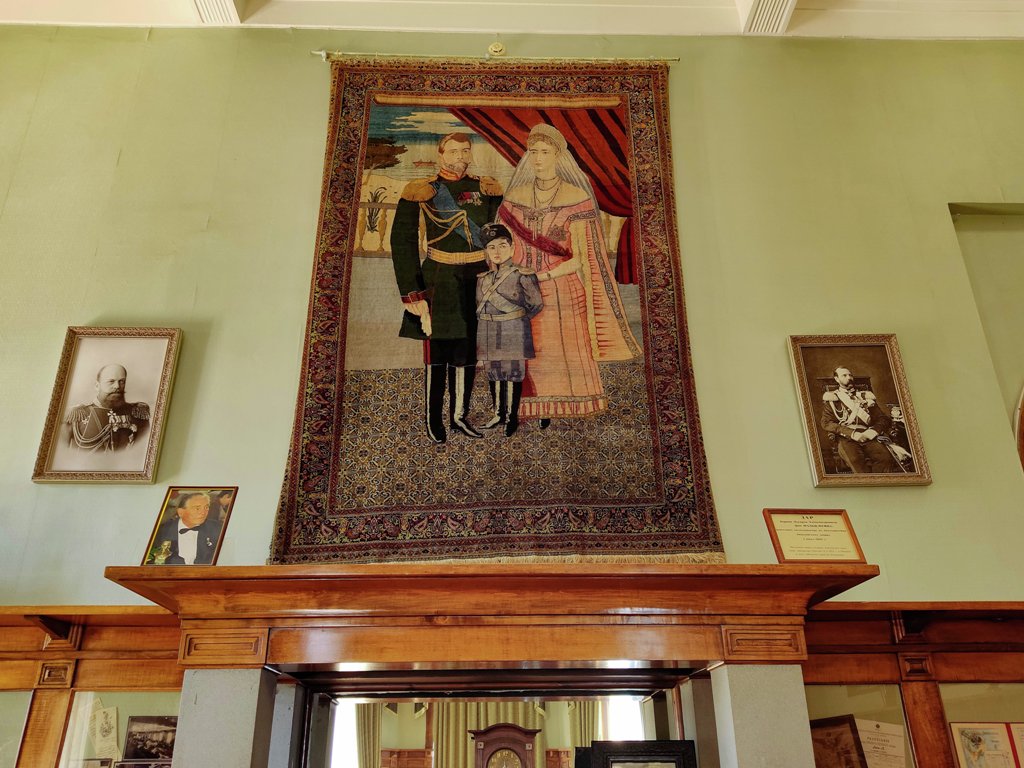
PHOTO: handmade wall carpet gifted to Nicholas II by the Shah of Persia in 1913
PHOTO: very few items from the Tsar’s Study have survived to the present
Visitors can now see the Emperor’s favourite room – his study, the main highlight of which is a handmade wall carpet depicting Nicholas II, Alexandra Feodorovna and Tsesarevich Alexei, a gift to the family in 1913 by Ahmad Shah Qajar of Persia (1898-1930) – in honour of the 300th anniversary of the Romanov dynasty. After the 1917 Revolution, many items from the palace were stolen, including this carpet, which ended up abroad. In 1983, a collector bought it at an auction in Germany and donated it to the palace 10 years later.
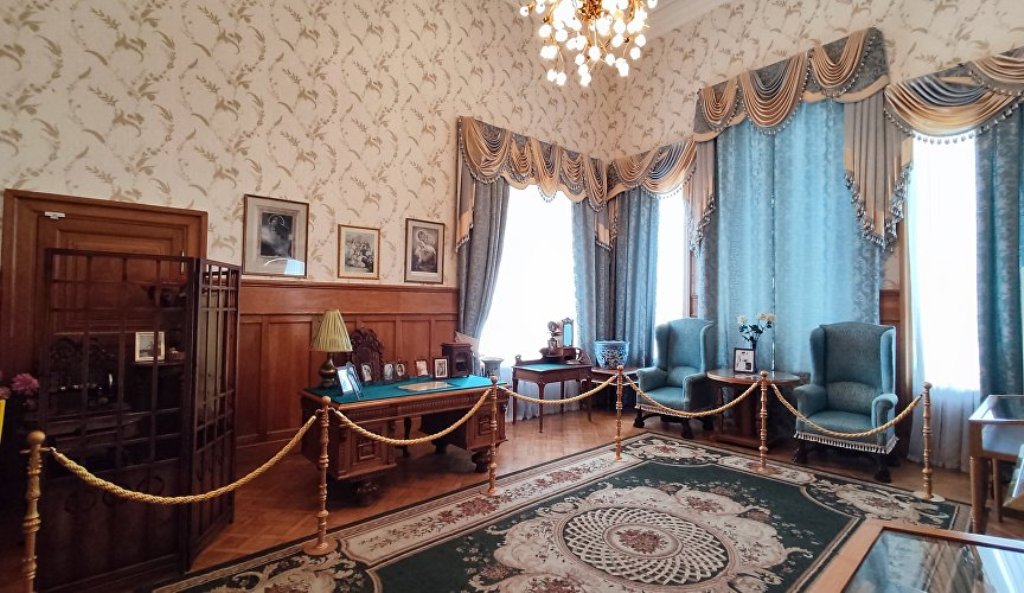
PHOTO: Empress Alexandra Feodorovna’s study
Visitors to the study of the Empress, will find a cozy, homely atmosphere as opposed to a work place: for example, family photographs are displayed on the table in frames, a sewing machine is silent in the corner, and Easter decorations with imperial engraving are hung behind the glass of the sideboard.
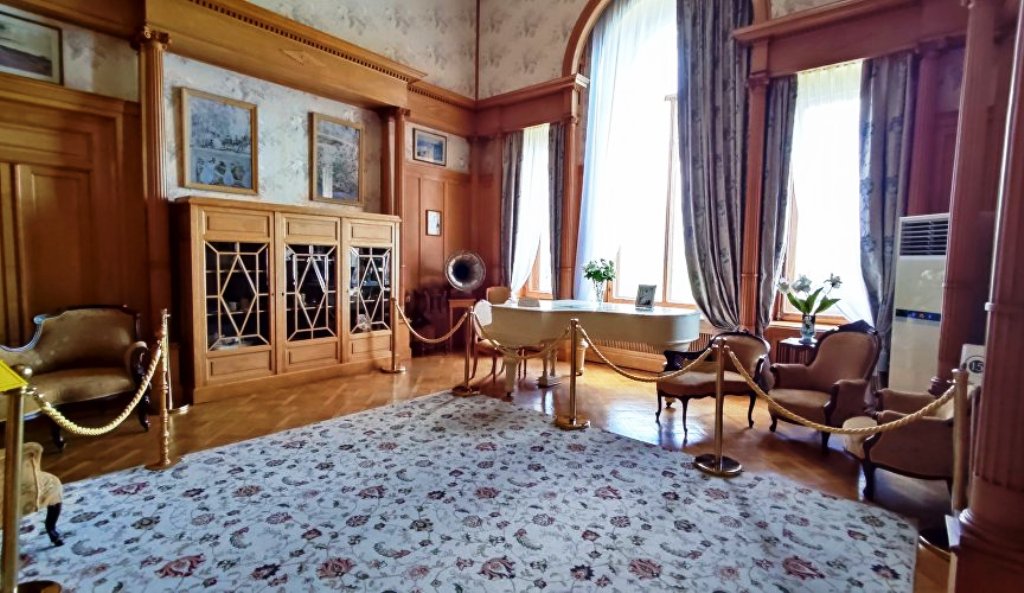
PHOTO: music room in Livadia Palace
In the music room there is a Becker grand piano, in which the Empress often played with her daughters. Today, performances of the Tauride Blagovest Chamber Choir are held in this room.
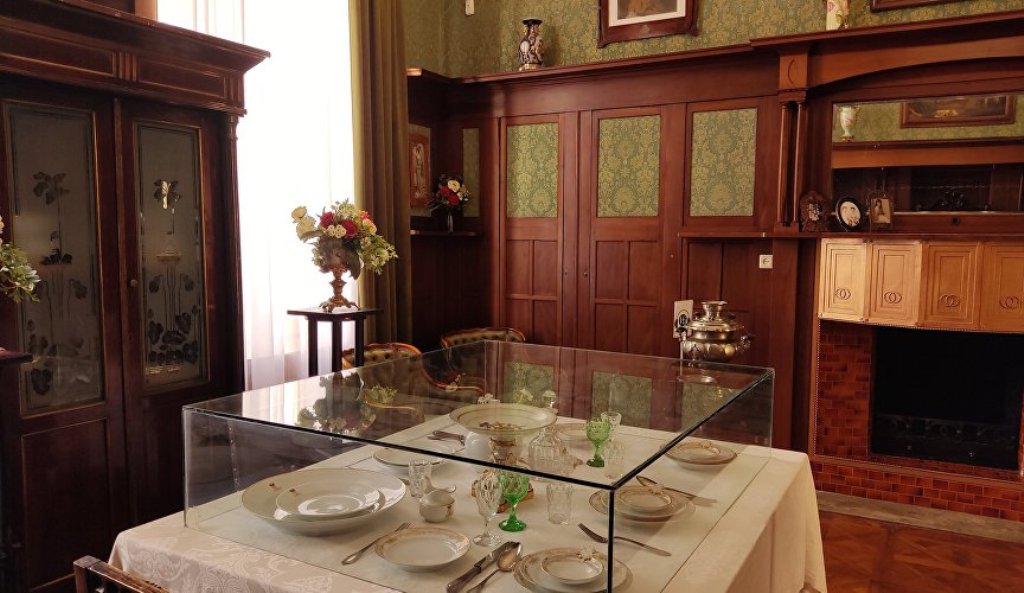
In addition, is a small family dining room with authentic dishes and utensils of the Imperial family, a classroom for the grand duchesses, the imperial bedroom, the children’s rooms, a library, among others.
PHOTO: Small Family Dining Room
PHOTO: the former bedroom of the grand duchesses
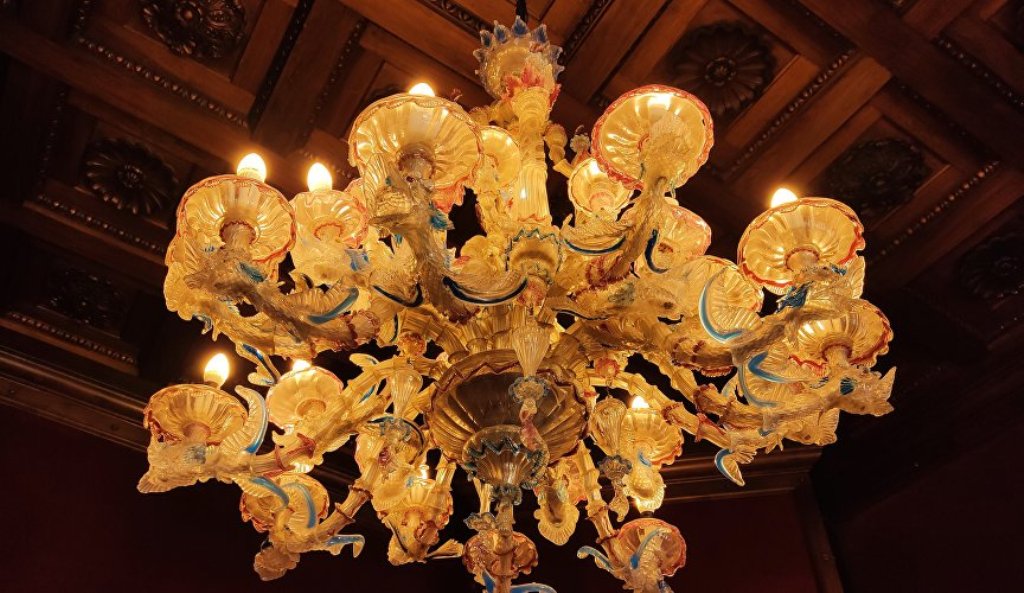
Museum staff like to draw the attention of visitors to the original pieces which have been preserved to this day, emphasizing their own disbelief at how some of the exhibits managed to survive to this day. For example, the Murano glass chandelier in the waiting room on the 1st floor, which has been hanging there since 1912. Just like the chandelier in the reception room, made of bronze and glass. And also fireplaces, mirrors and pieces of furniture.
PHOTO: an original Murano glass chandelier, 1912
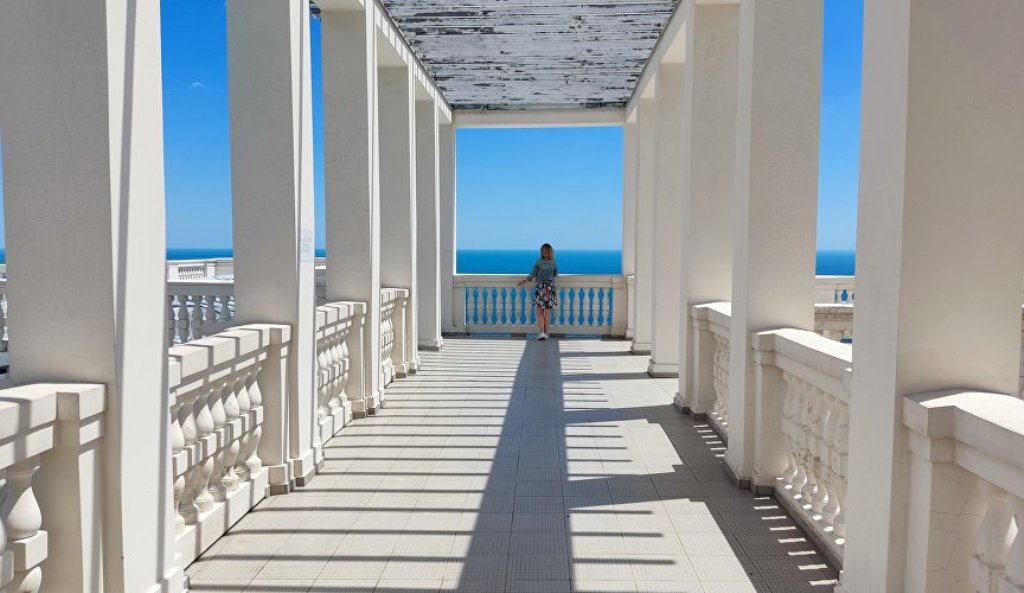
The palace also features a solarium on the roof, where the Imperial family enjoyed the sun and breathtaking views of the Black Sea. A narrow staircase leads to the roof, and in the time of Nicholas II it was possible to reach it by a tiny lift (elevator), which was restored several years ago.
PHOTO: the solarium on the roof of the palace offers views of the Black Sea
Interesting facts about Livadia Palace
It is known that the Imperial family arrived in Livadia with their children on 5th September 1909. It was during this visit, starting from 27th October, that Nicholas II and Alexandra Feodorovna met with the architect Nikolai Petrovich Krasnov (1864-1939), Yalta’s most fashionable architect, on numerous occasions, to discuss in detail the design of their new white palace, and the decoration of its halls and other rooms. The August couple approved the design on 12th December, just 4 days before leaving Livadia for St. Petersburg.
The old wooden Bolshoi or Grand Palace, the residence built in the 1860s for Emperor Alexander II, was demolished in 1910, to make way for a new stone palace, which would serve as the residence of Russia’s last emperor and his family during their visits to Crimea.
The palace was built in a remarkably short time span of 17 months, at a cost of about 4 million gold rubles, paid for by Nicholas II. The palace was inaugurated on 11th September 1911. Some 2,500 workers worked around the clock. At night, the large-scale construction site was illuminated by many torches. After the construction was completed, the walls of the palace were covered with a special chemical composition that protected the stone from weathering and pollution.
A power station was built nearby, generating electricity for the entire estate. The palace also featured two types of heating: fireplaces and central water heating. The palace was also equipped with telephones and a lift for the Empress. It is interesting to note, that it was thanks to a modern system of reinforced concrete ceilings, which prevented the destruction of the palace from a strong earthquake in 1927.
PHOTO: Italian Courtyard
PHOTO: Arab Courtyard
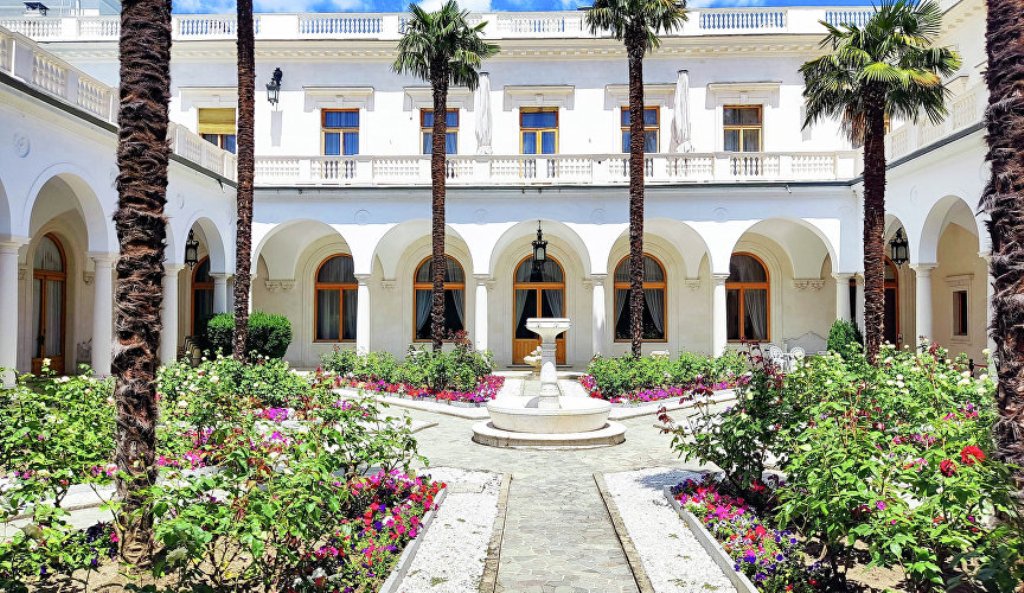
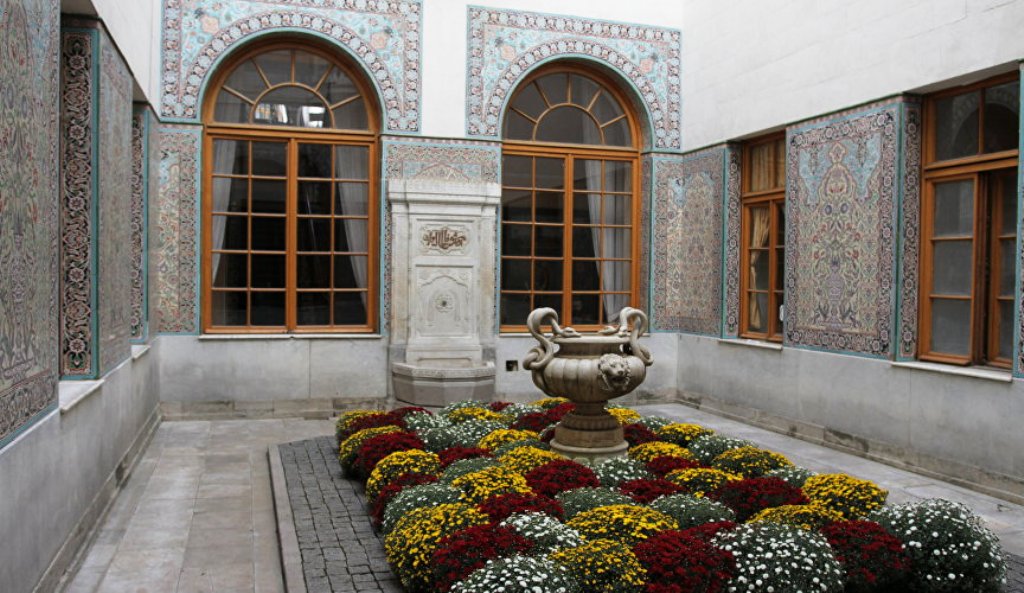
Krasnov had constructed a comfortable, spacious palace. The palace was built in the Italian Renaissance style – the style was personally chosen by Nicholas II. None of the four façades of the palace resembles the other. The new Imperial residence featured 116 rooms, one large courtyard [the Italian Courtyard, where Nicholas II and his family were often photographed] and three small courtyards, as well as a number of outbuildings.
While the palace was built as a summer residence for Nicholas II and his family, they only stayed here four times: twice in the fall – in 1911 and 1913, and twice in the spring – in 1912 and 1914, each time staying for several months at a time. On 12th June 1914, the Imperial family left Livadia, not suspecting that they were saying goodbye to her forever. On 1st August, Germany declared war on Russia.
The Imperial family would arrive on the Imperial Train at Sevastopol, where they boarded the Imperial Yacht Shtandart/Standart, and sailed along the southern coast of Crimea to Yalta, and from there by *motorcar to Livadia. [*The Emperor maintained His Imperial Majesty’s Own Garage at Livadia, one of four in Russia, which housed his collection of motorcars].
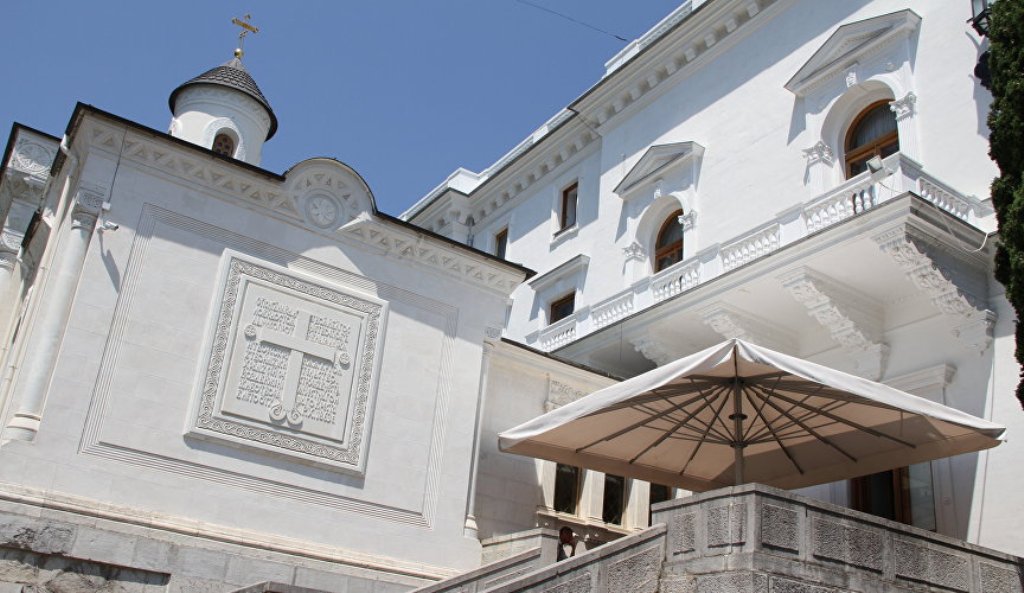
Today, the Livadia Palace and Park ensemble occupies more than 36 hectares, in addition to the Grand White Palace, it includes the Svitsky building, the house of the Minister of the Imperial Court Count Vladimir Frederiks (1838-1927), the Church of the Exaltation of the Cross, and a picturesque park with preserved structures (arbors, fountains) from the tsarist period.
PHOTO: view of the Church of the Exaltation of the Cross (left)
On 2nd November [O.S. 20 October] 1894 – Emperor Alexander III died in the Small Palace. His early death at the age of 49, was the result of terminal kidney disease (nephritis). A requiem was held for the Emperor in the Church of the Exaltation of the Cross.
It was also on this day, that Tsesarevich Nicholas Alexandraovich Romanov ascended the throne as Russia’s last emperor and tsar, pledging his oath of allegiance to Russia in the palace church. In addition, the holy righteous John of Kronstadt anointed Princess Alice of Hesse in this church, and thus became the Orthodox faithful Grand Duchess and future Empress Alexandra Feodorovna.
During his stay in Livadia, in the autumn of 1900, Nicholas II became gravely ill, with what proved to be a rather serious form of typhoid. Despite being pregnant for the fourth time and in a lot of pain, Alexandra nursed him back to health, six months later, in the Spring of 1901.
PHOTO: view of the garden, main facade and entrance to Livadia Palace
The entrance to the summer imperial residence is guarded by two marble lions – although they do not have the traditional lush mane and look more like Egyptian sphinxes. At the main entrance to the palace and in the famous Italian Courtyard, there are white marble benches with winged lions on the armrests. These benches were brought here from Venice. Also, the Istria fireplace was brought from Venice, which is located in the Main lobby of the palace.
Two original sculptures can also be seen in the White Hall. The first is Penelope, the symbol of marital fidelity, the wife of Odysseus. Penelope was purchased by the inhabitants of Odessa as a gift to Empress Maria Alexandrovna (grandmother of Nicholas II), on her first visit to the Livadia estate in 1863. The second figure is a chimera, or satyr, a collective image from antiquity.
The historical park has preserved trees planted more than a century ago. It is decorated with Turkish gazebo, Ruschuk column, marble fountains and benches.
PHOTO: bust-monument of Emperor Nicholas II
PHOTO: monument to Emperor Alexander III, installed on the site of the old Bolshoi (Large) wooden Palace
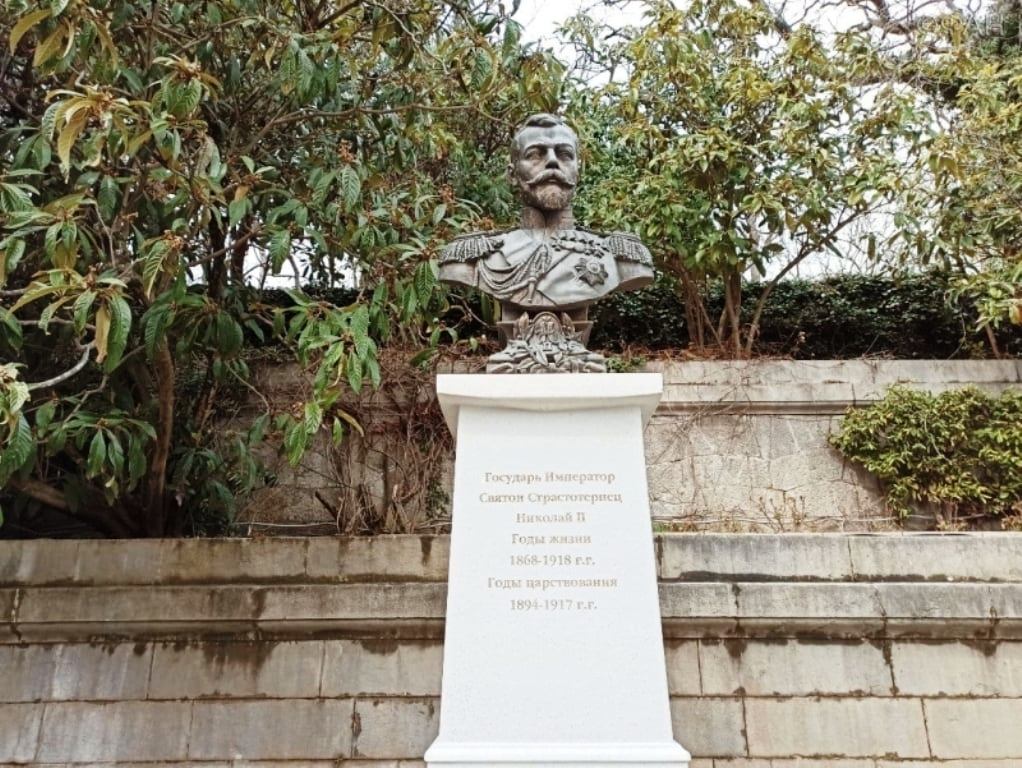
On 19th May 2015, a bust-monument of Emperor Nicholas II was installed at the main entrance to the Livadia Palace. It is made according to the model of the sculptor A. A. Appolonov from artificial stone and bronzed. The pedestal is made of marble.
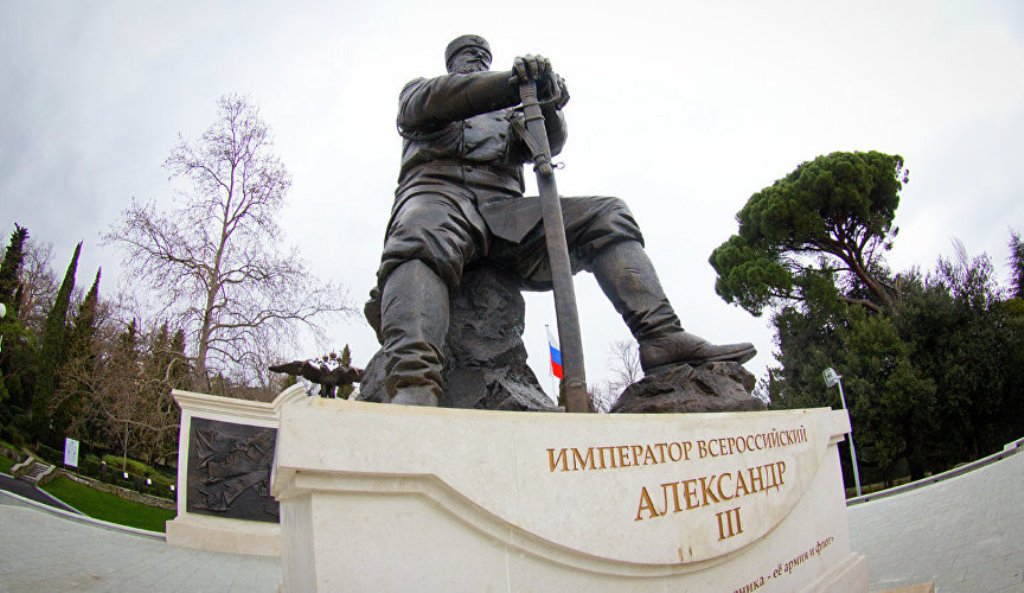
On 18th November 2017, in the presence of the President of the Russian Federation Vladimir Putin, a monument to Emperor Alexander III was unveiled in the park of the Livadia Palace – on the site where the Bolshoi or Large wooden palace once stood.
PHOTO: Chapel of the Holy Royal Martyrs
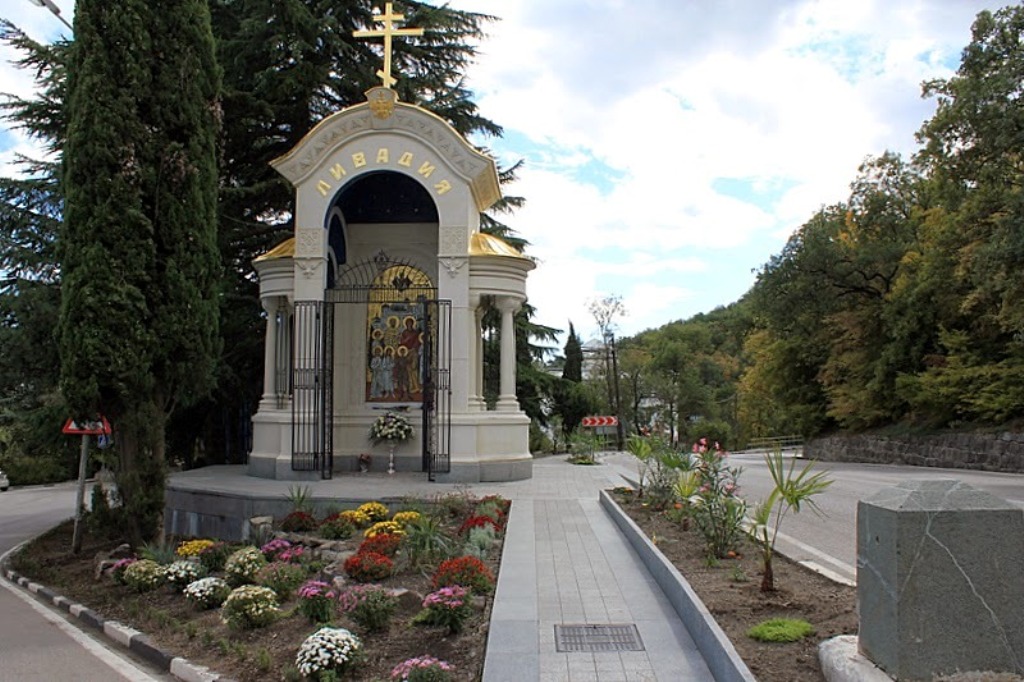
On 22nd September 2013, as part of the celebrations marking the 400th anniversary of the Romanov dynasty, the Chapel of the Holy Royal Martyrs was consecrated. The chapel which is situated at the entrance to Livadia Palace was erected in honour of the 150th anniversary of the Exaltation of the Cross Church of the Imperial family at Livadia and in memory of the Holy Royal Martyrs. A magnificent mosaic tile icon depicting the Holy Royal Martyrs dominates the tiny chapel interior. The chapel is open to all comers, liturgies are held on major Orthodox holidays.
PHOTO: Nicholas II Conference in the White Hall at Livadia Palace, 20-22 October 2019
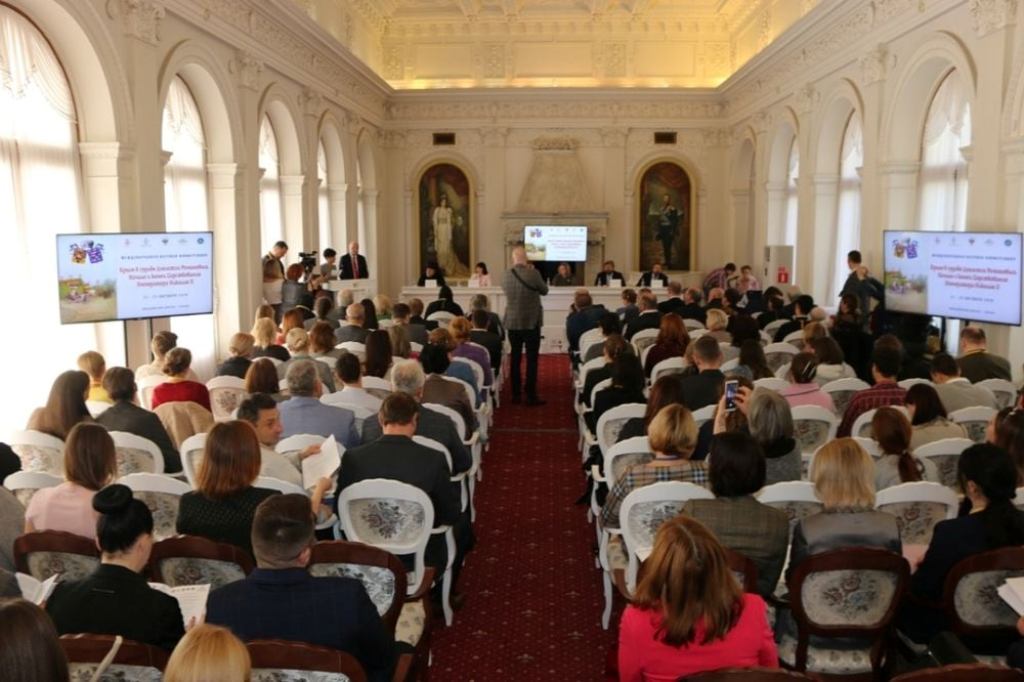
Between 20-22 October 2019, the international conference ‘Crimea and the Fate of the Romanov Dynasty. The Beginning and End of the Reign of Emperor Nicholas II,’ opened in the White Hall of Livadia Palace. The conference was attended by leading Russian historians, publicists, archivists and writers. The objective of the conference was to discuss the truth about the Tsar’s family and the and the achievements that Russia made during the reign of Nicholas II. The international conference was timed to the 125th anniversary of the accession to Orthodoxy of Princess Alix of Hesse-Darmstadt – the future Empress Alexandra Feodorovna and the 100th anniversary of the escape of members of the Russian Imperial House from Crimea. In addition, this year marks 125 years since the death of Emperor Alexander III in Livadia. Crimea played a crucial role in the fate of the Romanovs, who played an important role in the development of the peninsula.
In 1913 – the year marking the 300th anniversary of the Romanov Dynasty – Emperor Nicholas II and his family arrived in Crimea for a 4-month stay. From 14th August to 17th December, the Imperial family lived at the beautiful Livadia Palace, situated on the southern coast overlooking the Black Sea.
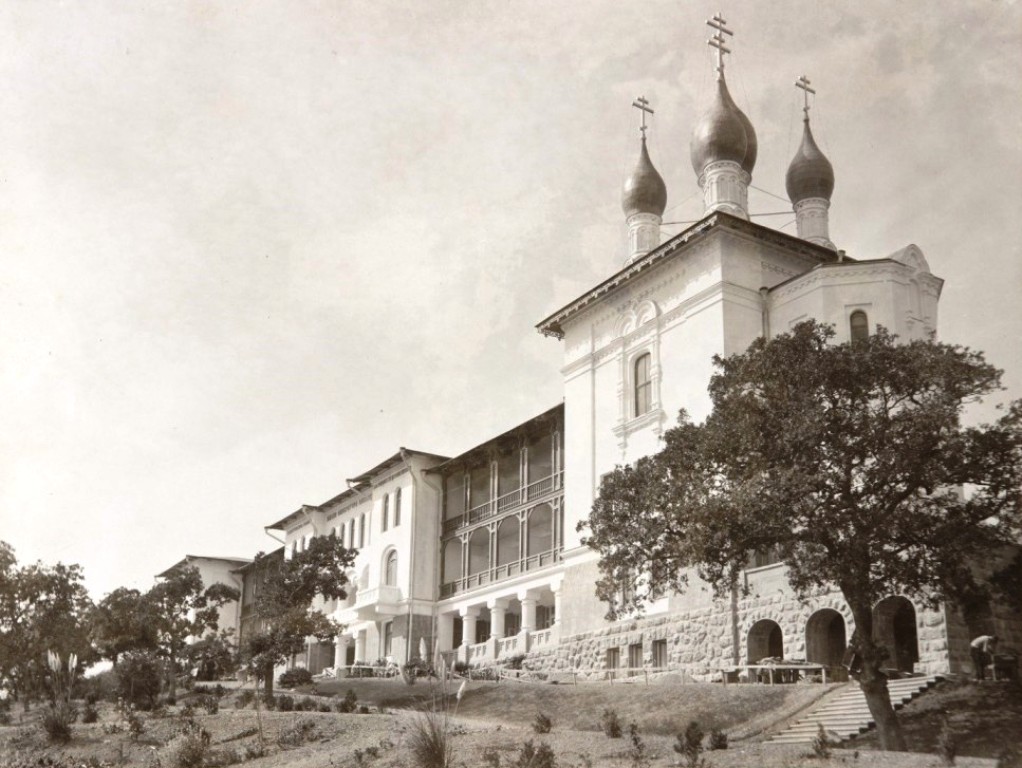
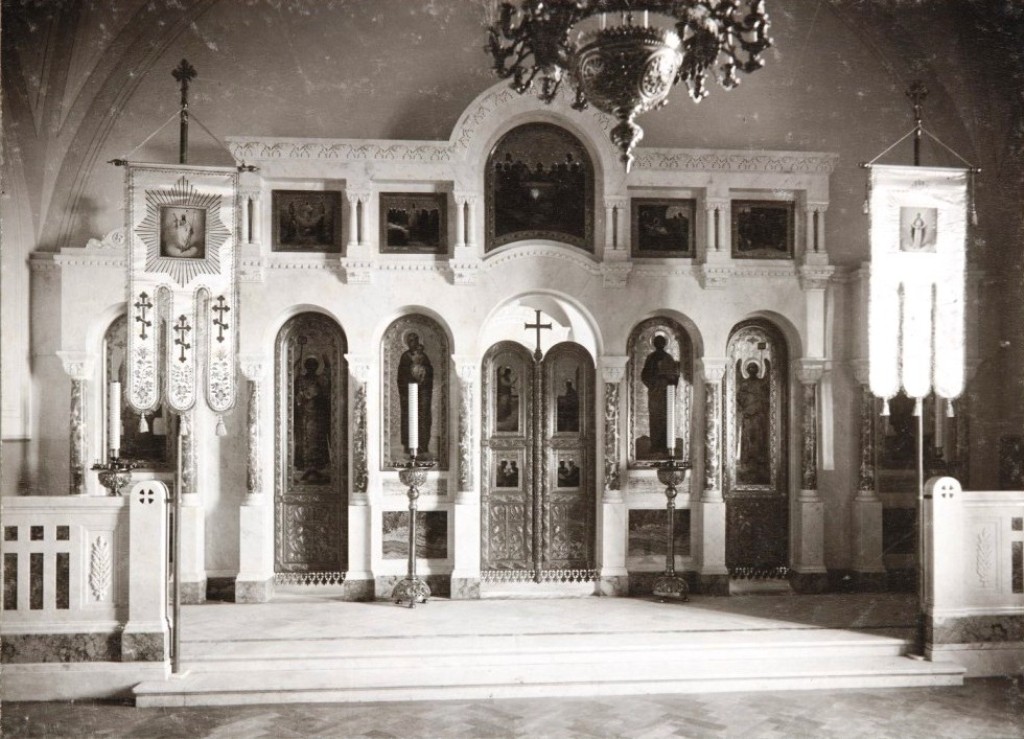
At the end of September 1913, a sanatorium named after Emperor Alexander III (1845-1894) was opened in Alupka for students and teachers of theological schools in Russia. It was an elongated three-story building, where on the east side the premises of the third floor were intended for the church. The interior of the church was illuminated by a large bronze chandelier, and featured a marble iconostasis and solea[1].
This sanatorium was located in the western part of Alupka on land that once belonged to the Vorontsovs, whose heirs at the beginning of the 20th century divided it into plots for long-term lease. Plot No. 72 was rented free of charge by the Synod for a climatic sanatorium for teachers of parochial schools. In 1913, here, according to the project of the architect N.P. Kozlov, at the expense of the School Council of Russia, a sanatorium building was erected, designed for 100 guests. The sanatorium had separate rooms, a well-equipped kitchen, a common refectory, and, most importantly, its own five-domed Church of St. Alexander Nevsky.
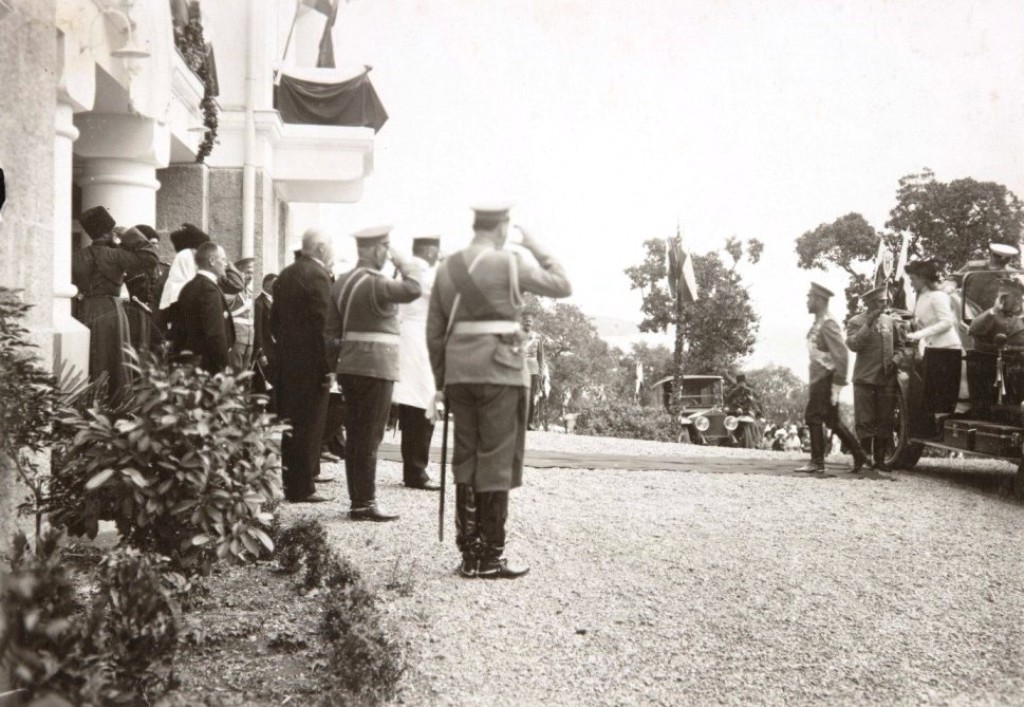
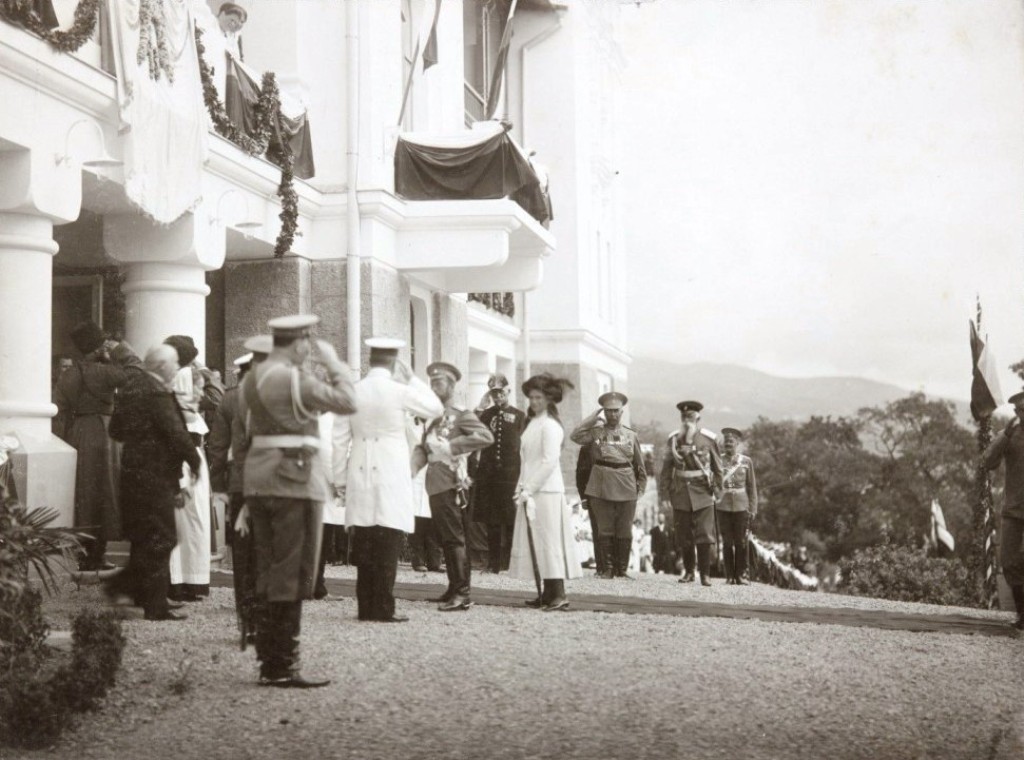
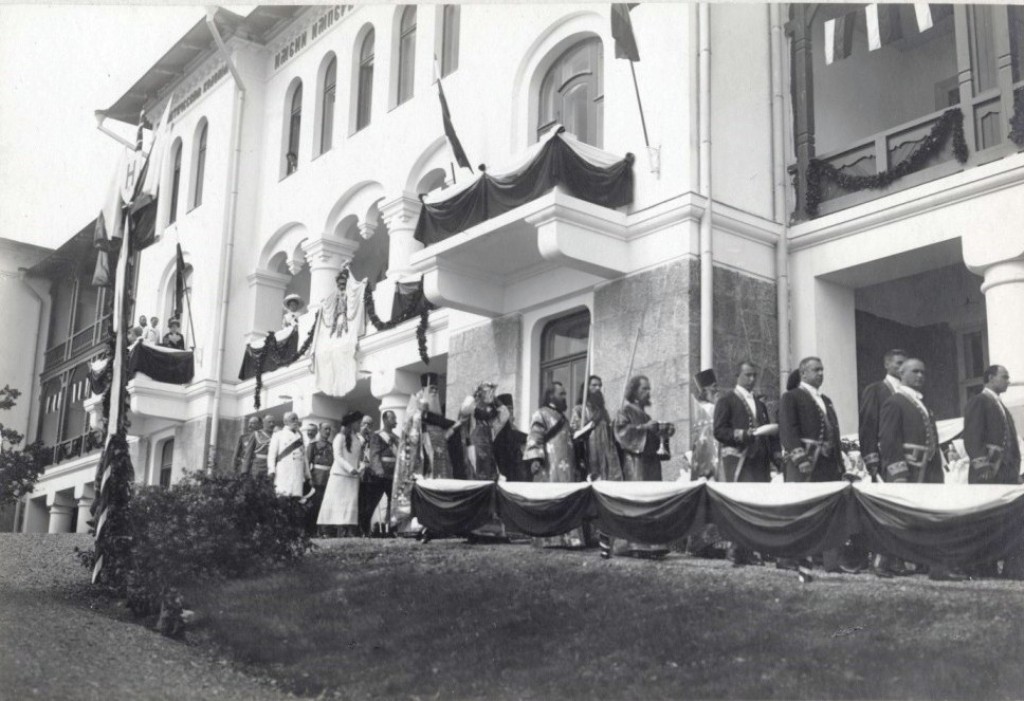
The church was consecrated in memory of the Emperor and his heavenly patron Saint Alexander Nevsky. The grand opening of the sanatorium in Alupka was attended by Emperor Nicholas II, his daughter Grand Duchess Maria Nikolaevna, Minister of the Imperial Court Count Vladimir Frederiks, local dignitaries and members of the clergy.
Here is an excerpt from the diary of Nicholas II for 22nd September 1913: “At 9 ½ I went with Maria and Frederiks to Alupka for the consecration of the Church of the Climatic Sanatorium for students of church schools. A beautifully arranged big house for 80 and even up to 100 guests.”
Nicholas II accompanied by Grand Duchess Maria Nikolaevna, and his retinue arrived in front of the main entrance, which was decorated with garlands of flowers and canvases with imperial monograms. They were solemnly greeted by representatives of the city authorities, their wives and the clergy, headed by V.K. Sabler, who in 1911-1915 served as chief prosecutor of the Synod.
To perpetuate the historical event of Nicholas II’s attendance at the consecration, court photographer K.F. Hahn and Alupka photographer A.E. Zimmerman, captured the historic event on camera.
Several photographs have survived to this day which show a general view of the sanatorium and the Church of St. Alexander Nevsky, the interior of the church and the arrival and procession headed by Emperor Nicholas II.
After the advent of Soviet power, by order of the Chief Commissioner for Crimea, the sanatorium for clergy, along with the church, among other noble estates of Alupka, were nationalized and became the property of the Russian People’s Republic. In June 1923, the Presidium of the Executive Committee of the Crimea issued a decision to close the Alexander Nevsky Church and transfer the movable property of the temple to the Special Storage of the Yalta District Executive Committee. The liquidated church was transferred to the property of the administration of the sanatorium of the People’s Commissariat of Railways (NKPS). In Soviet times, a climatic sanatorium named after V.I. F.E. Dzerzhinsky.
The Church of St. Alexander Nevsky suffered neglect and disrepair, and in 1927, the building sustained significant damage during an earthquake.
In the spring of 1996, through the efforts of the Crimean and Simferopol Metropolitan Lazarus, the building was returned to the Church, and now a sanitarium named after St. Luke of Crimea is located here. The Church of Alexander Nevsky was also restored, in which divine services are held, as well as a Sunday school.
Today, the five onion-shaped domes of St. Alexander Nevsky Church are visible from different vantage points in Alupka.
NOTES:
[1] a platform or a raised part of the floor in front of the inner sanctuary in an Eastern Orthodox church on which the singers stand and the faithful receive communion.
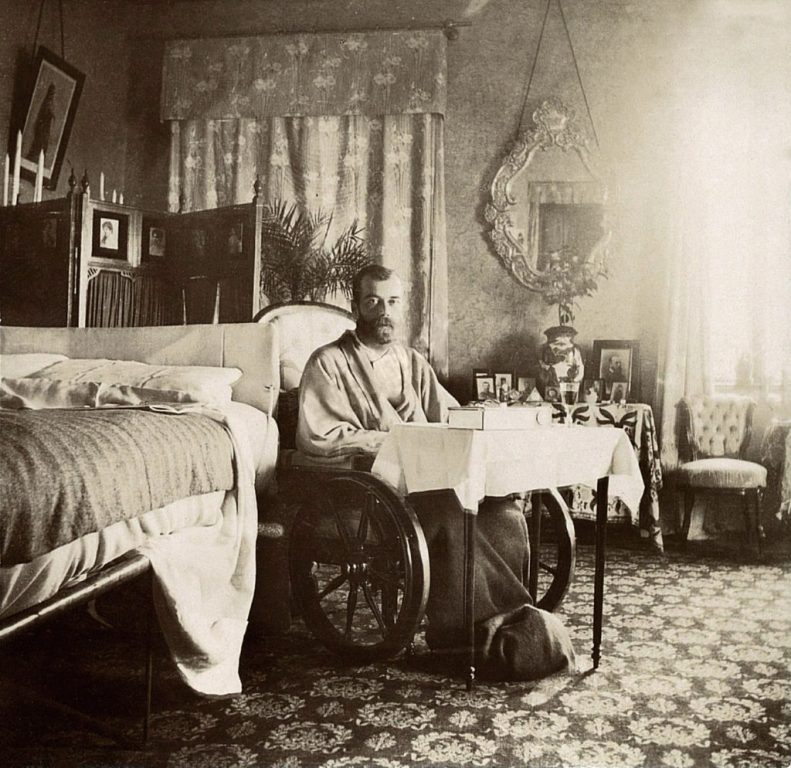
PHOTO: Emperor Nicholas II recovering from typhoid at Livadia, December 1900
During Tsarist times, typhoid, or “spotted fever”, affected every one from paupers to emperors—the often fatal illness did not discriminate. This intestinal infection caused by a specific type of Salmonella bacterium was a frequent guest in the imperial residences. And all because of poor sanitation. For example, the kitchen of the Winter Palace in St. Petersburg, only stopped taking water directly from the Neva River in 1868, while mineral filters and urns for boiling water were only installed in the palace in the 1920s! And we are talking here only of the water used by the Imperial Family: servants, valets, stokers and porters lived in, and bustled in and out of, the Winter Palace. The common folk and acquaintances that came to visit the Imperial Family in their tiny rooms had a very careless attitude to personal hygiene and as a result, the palace was teeming with lice, bedbugs, cockroaches and, of course, mice.
It is not surprising then that under these conditions that Empress Maria Alexandrovna, the spouse of Emperor Alexander II, their son Alexander Alexandrovich (future Alexander II) and the latter’s daughter Xenia Alexandrovna all caught typhoid fever.
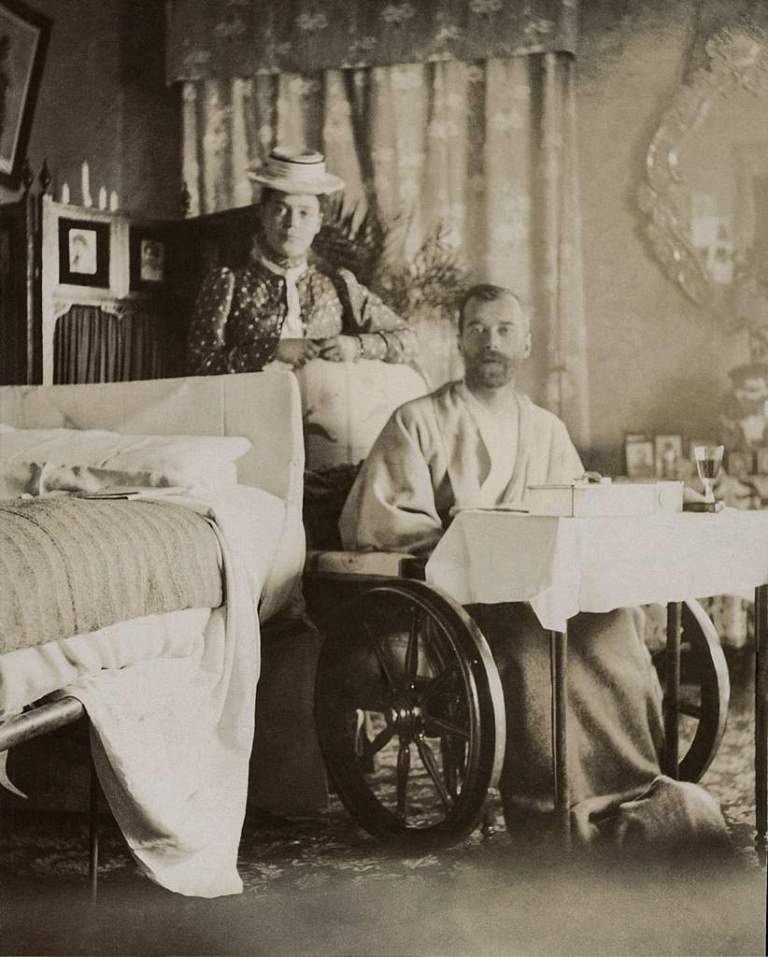
During his stay in Livadia[1] in the autumn of 1900, Nicholas II became gravely ill with typhoid. Initially, doctors were afraid to diagnose the disease for a long time and then they argued about what medication to prescribe.
The Emperor fell ill with what proved to be a rather serious from of typhoid. The Empress had a great horror of the illness, but a crisis always found her self-possessed and resourceful. She nursed the Emperor herself, even doing the night nursing, and acted as his private secretary when he was able to attend to papers, transmitting his decisions to his Ministers. The Empress wrote to her sister, Princess Louis [aka Victoria of Battenberg], at the time:
“Nicky really was an angel of patience during his wearisome illness, never complaining, always ready to do all one bid him. His old valet and I nursed him. The shock of his illness and feeling myself necessary gave me new strength, as I had been very wretched before. I rebelled at a nurse being taken and we managed perfectly ourselves.”
Orchie [Alexandra’s old nurse] would wash his face and hands in the morning. She would bring the Empress her meals, where she would take them while resting on the sofa in her husband’s room. She suffered from head and heartache, the latter from nerves and many sleepless nights. When Nicholas began getting better, she read to him.
He first had a digestive upset on 22nd October 1900, and almost immediately the Emperor’s temperature rose to 39-40 degrees Celsius (102-104 degrees Fahrenheit). The high temperature and severe headache, coupled with food poisoning, continued until 12th November.
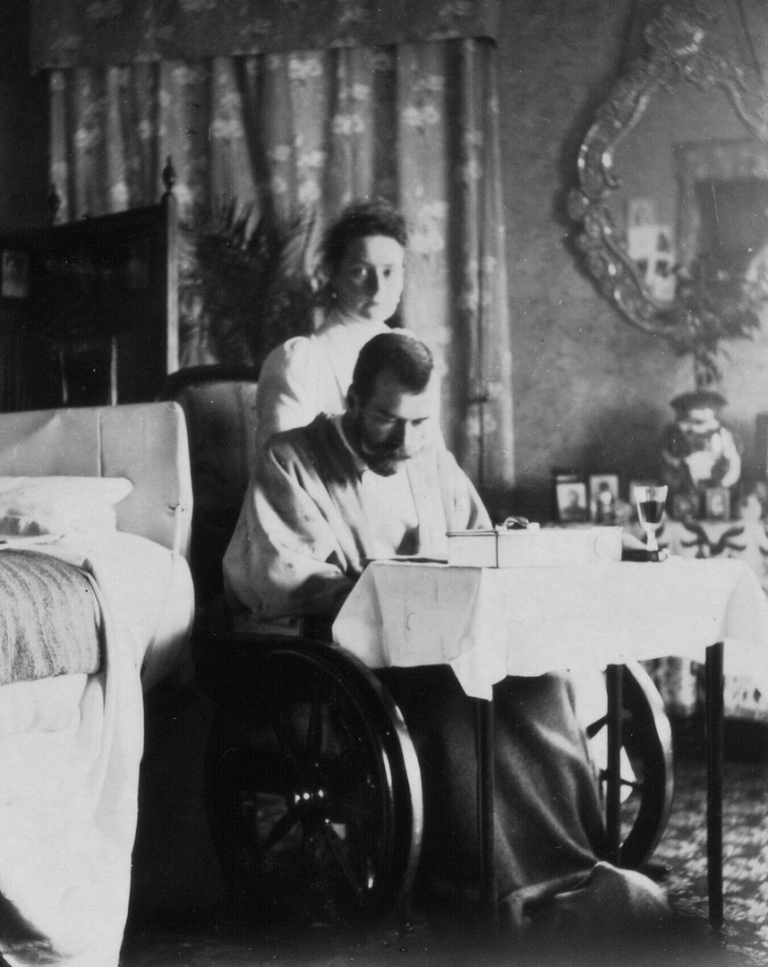
PHOTO: Alexandra Feodorovna standing behind her husband, who is seated in a wheelchair while recovering from typhoid. Nicholas II is seated in front of a table, wearing a dressing gown, and a rug placed over his legs. Livadia, Crimea. December 1900
The Emperor actually received no treatment. Despite being pregnant for the fourth time and in a lot of pain, Alexandra nursed him back to health, rarely leaving his side. While Alexandra Feodorovna was the one who looked after him, his sister Grand Duchess Xenia Alexandrovna, recorded her brother’s illness and recovery:
“Poor Nicky is lying in bed, he didn’t sleep at all at night because of terrible pains in his back. In the morning his temperature was 38.2 – during the day 38.7. His eyes are tired and pale! [Dr.] Girsh says that it’s influenza! Thank God there’s nothing in the lungs, or in general anywhere else. Poor Alix [Alexandra Feodorovna] – she looks very tired.” – Xenia’s diary, 27th October 1900
“Later on I drove to Livadia and looked in on Nicky for a minute. The back of his neck hurts terribly, and he doesn’t know where to turn his head. All the pain from his back and legs has gone upwards, and he is suffering terribly. Poor Alix has forgotten about her own sickness and is moving around more. Girsh is adamant, that it isn’t typhoid (we asked him). Girsh asked Nicky to call someone else, to put everyone’s mind at rest – it was decided to call for [Dr.] Tikhonov.” – Xenia’s diary, 29th October 1900
“We met Tikhonov, who told us that several symptoms of typhoid had developed, and that they were almost sure that it was typhoid! At Livadia we immediately questioned Girsh. It’s astounding that influenza should suddenly turn into typhoid!
“At Livadia we immediately questioned Girsh. It’s astounding that influenza should suddenly turn into typhoid! With Alix’s permission Professor Popov was sent for; we had lunch alone together downstairs; a little later [Count] Fredericks arrived, tearing his hair and saying he was in a terrible position, that everyone wanted news, while he was not allowed to tell anyone anything. He wanted us to persuade Alix to allow a bulletin to be published, which we were able to do. She agreed that there is nothing worse than trying to conceal things! We telegraphed poor Mama. Thank God Alix is so calm.” – Xenia’s diary, 31st October 1900
“Thank the Lord, Nicky had an excellent night – he slept until morning, his temperature was 38.7 and he felt well. Alix called me to see Nicky – he was in remarkably good spirits, and chatted and joked. Alix was also in a good mood, having slept well. They didn’t want to let me go, but in the end I left of my own accord, as he needs complete rest and had been talking to much.
“All the unnecessary furniture has been removed from the bedroom, and will be taken into Alix’s drawing room this afternoon. Alix is now sleeping in another bed, at least the doctors have achieved that much.” – Xenia’s diary, 1st November 1900
“They are not happy that Nicky’s temperature is so low 36°, but the pulse is good at 66. They are afraid of a haemorrhage, God preserve us! It’s so terrifying, help us God, save our Nicky!” – 13th November 1900
PHOTO: Nicholas II recovering from typhoid fever, with his sister Grand Duchess Xenia Alexandrovna. Livadia, Crimea.December 1900.
Against this background, discussions about who should succeed Nicholas II, in the event that he should die. The Empress attempted to persuade her husband to change the Laws of Succession to allow females to inherit the throne in the absence of any male heirs in order for their four-year-old daughter Grand Duchess Olga Nikolaevna [2] to inherit the empire, as opposed to her uncle, Grand Duke Michael Alexandrovich. Ultimately, these changes did not take place.
After 13th November, the Tsar’s temperature started coming down and on 30th November, for the first time, Nicholas spent half an hour on his balcony. “It was sunny, warm and still… Thank God my typhoid was mild and I didn’t suffer at all during the whole time. I had a strong appetite and now my weight is increasing noticeably every day…”
Nicholas recovered six months later, in May-June 1901, however, little Olga came down with typhoid. Alexandra would nurse their eldest daughter through her illness.
On the 24th November 1900 Nicholas wrote to his mother:
“About my little wife I can only say that she was my guardian angel, looked after me better than any sister of mercy!”
NOTES:
[1] Up until 1911, Nicholas II and his family stayed in the Small Livadia Palace during their visits to Crimea, after which they lived in the iconic white stone palace, which was constructed on the site of the Large Livadia Palace. The Small Palace survived until the Great Patriotic War (1941-45).
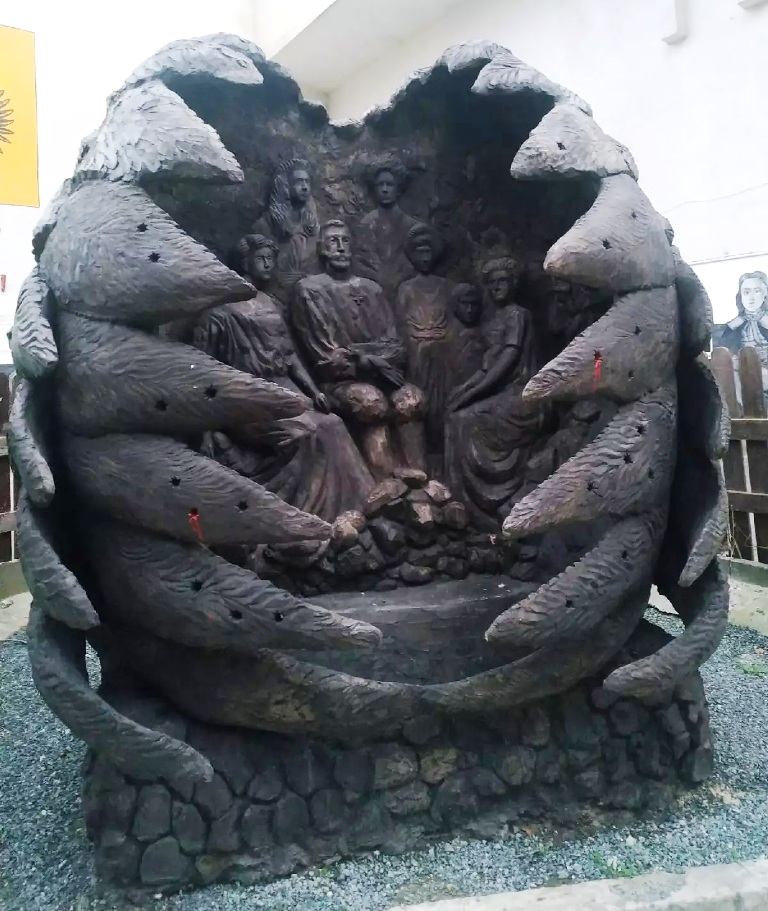
PHOTO: Imperial Family monument in Yalta, by the sculptor Yuri Mayorov
On 1st October 2021, a new and yet eccentric sculpture to Emperor Nicholas II and his family was installed in Yalta, one which has raised the eyebrows of local residents and a wave of criticism and ridicule.
The monument by sculptor Yuri Mayorov, depicts the Imperial Family enveloped by the wings of an angel, was unveiled on the grounds of the former “Livadia” sanatorium, which is situated near the famous Imperial palace.
Yalta residents took to social media to share their negative opinions of the sculpture, describing the wings as a “strange toothy shell” and to associate it with a “plant-predator”, or the “armour of an armadillo”, or various vulgarities of the “Freudian” sense.
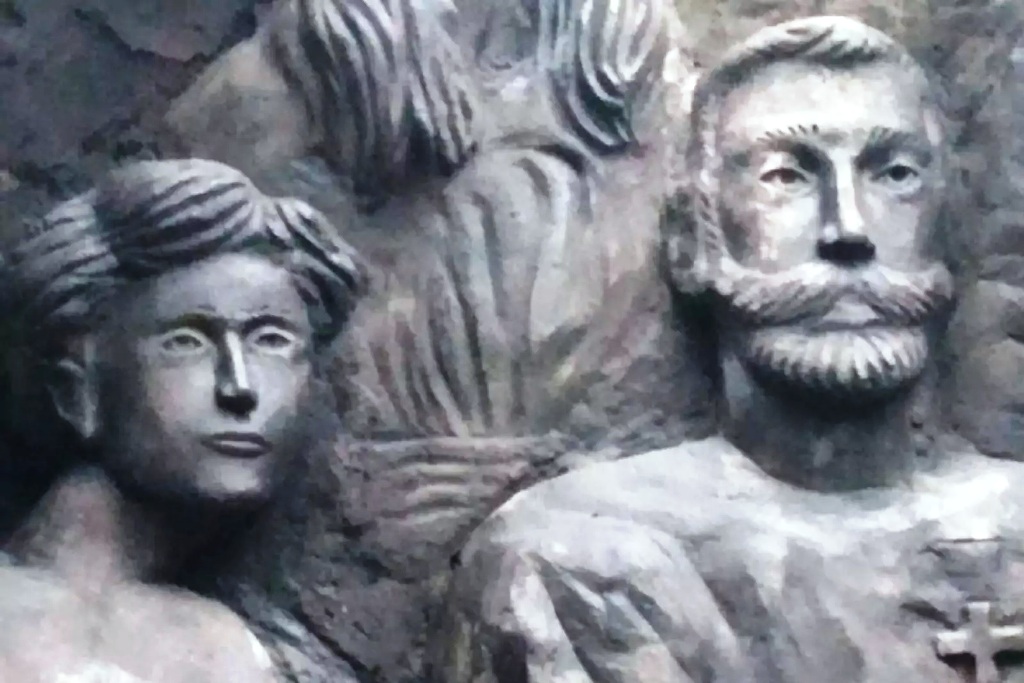
For some locals, the sculpture resembles a “cocoon” and reminiscent of the “xenomorph egg” from the movie “Alien”. Other critics, noted that the faces of the members of the Imperial Family look “dead and sketchy”, while others criticized the holes in the “angel’s” wings, because they resembled bullet holes,
PHOTO: detail of Grand Duchess Olga and Emperor Nicholas II
The sculptural composition was installed five meters from the monument to the participants of the Yalta Conference – Stalin, Churchill and Roosevelt. The installation of the monument depicting the murdered members of the Imperial Family near that of a monument to Stalin seemed unethical to many.
The unusual sculpture was installed on the grounds of Kurort Livadia LLC, which owns the former Livadia sanatorium. The project and its installation is that of the White Eagle Monarchist Society.
The sculpture was paid for by businessman Konstantin Malofeev, a devout monarchist, who openly supports the restoration of monarchy in Russia. Unfortunately, he openly supports the claim of Princess Maria Vladimirovna and her son Prince George Romanov-Hohenzollern. Malofeev is the owner of the Tsargrad TV channel, and the Tsargrad LLC – the founder of the Livadia Resort company.
UPDATE: SCULPTURE DISMANTLED on 11th December
Earlier today, the controversial sculpture of the Imperial Family was dismantled and taken away from its location on the former “Livadia” sanatorium, situated near the famous Imperial palace.
“There was a wave of negativity in relation to our monument. People began to write that they would come and destroy it. To spare the monument from vandalism, we decided to move it to a safe place. It will be stored in a closed area, I don’t want to tell its location,” said Andrei Krupin, director of the educational center where the sculpture was installed.
The Ministry of Culture of the Republic of Crimea noted that the sculpture caused controversy due to the poor quality of execution. At the same time, the Ministry of Culture said that it has nothing to do with the Livadia Palace.
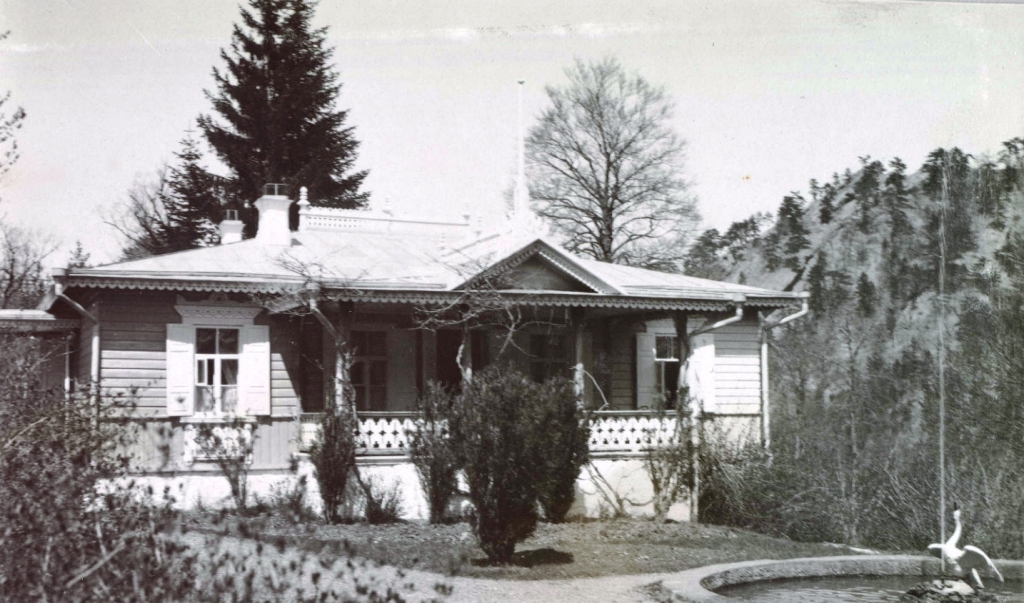
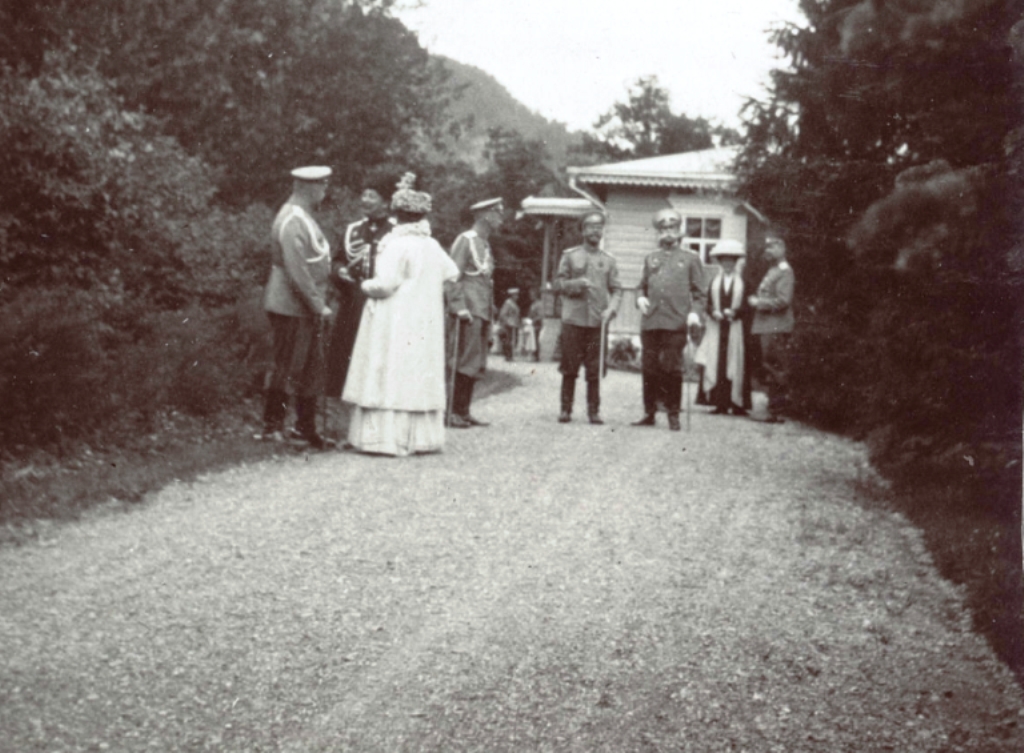
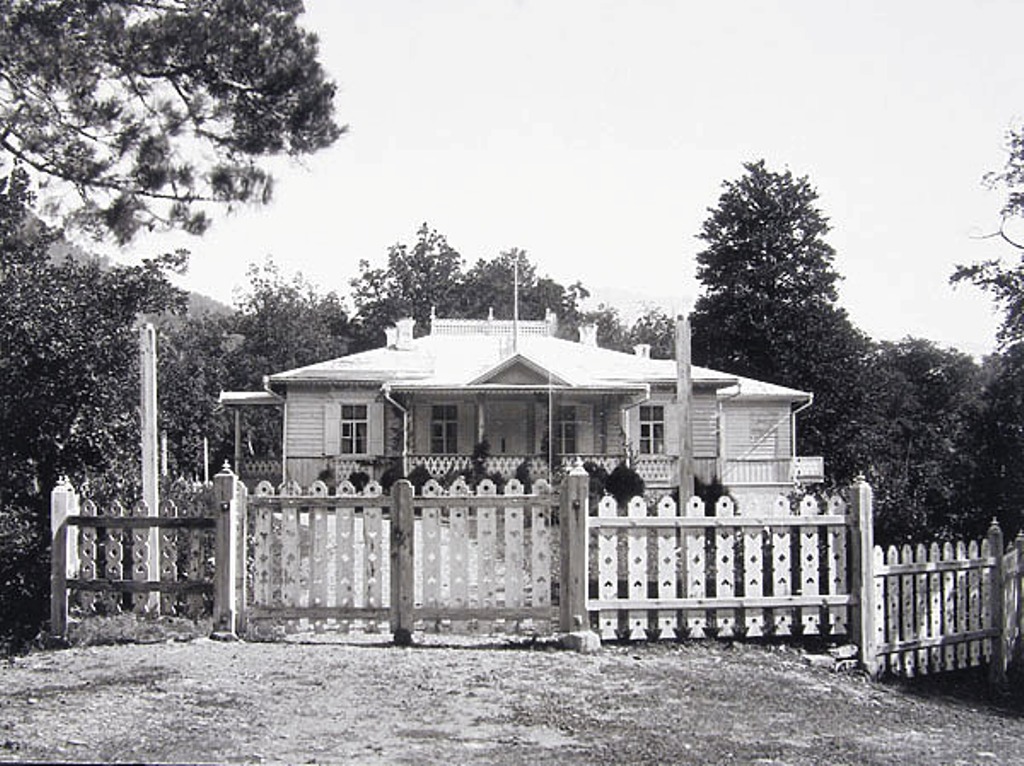
PHOTO: Beshuiskaya dacha, Nicholas II’s hunting lodge in Crimea
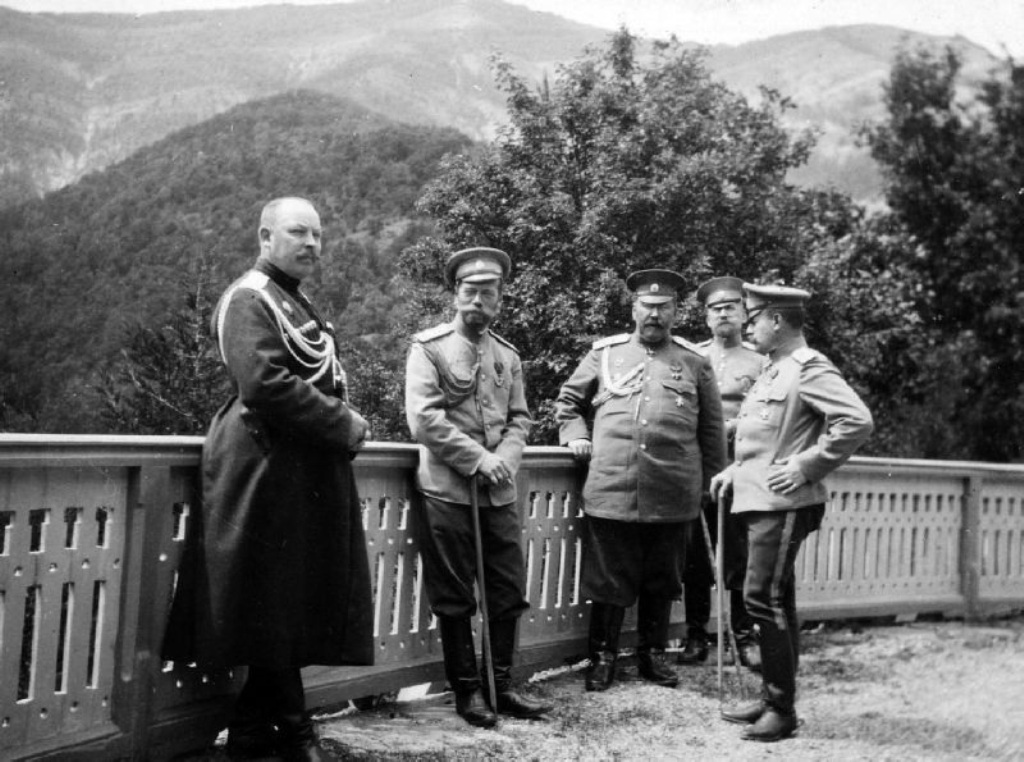
The beginning of His Majesty’s Own Hunt in the Crimean mountains was established by Emperor Alexander II (1818-1881) in the 1860s from the Nikitskaya dacha, situated in the Yuzhno-Berezhansky Forest, near Livadia. Subsequently, the Tsar’s Hunt in Crimea expanded, with two additional state forest dachas established in the Beshuisky and Ayan forest districts (Crown Lands).
From 14 to 18 October 1880, a hunt was organized for Tsesarevich Alexander Alexandrovich (future Emperor Alexander III) in the Beshuisky forest. It was this hunting trip which prompted the construction of the Beshuiskaya dacha, situated 60–70 yards from the Kosmo-Damianovsky Monastery. The hunting lodge was completed by September 1884. It is interesting to note, that not a single nail was used in it’s construction.
PHOTO: Nicholas II and Count Frederiks in front of Beshuiskaya dacha
The Beshuiskaya dacha was a one-story wooden building on a stone foundation, and consisted of 8 rooms: a living room with an office, a bedroom, two servants’ rooms, a pantry and a bathroom. Following the example of his grandfather and father, Nicholas II came here repeatedly for hunting and to visit the monastery.
The most professional and promising employees from the tsar’s hunting estates at Spala, and later from Białowieża, were transferred to Crimea. In the fall of 1913, Edmund Vladislavovich Wagner was appointed Head of His Majesty’s Own Hunt in the Crimea. In total, the staff of His Majesty’s Own Hunt in 1913-1917, including the gamekeepers, consisted of thirty people.
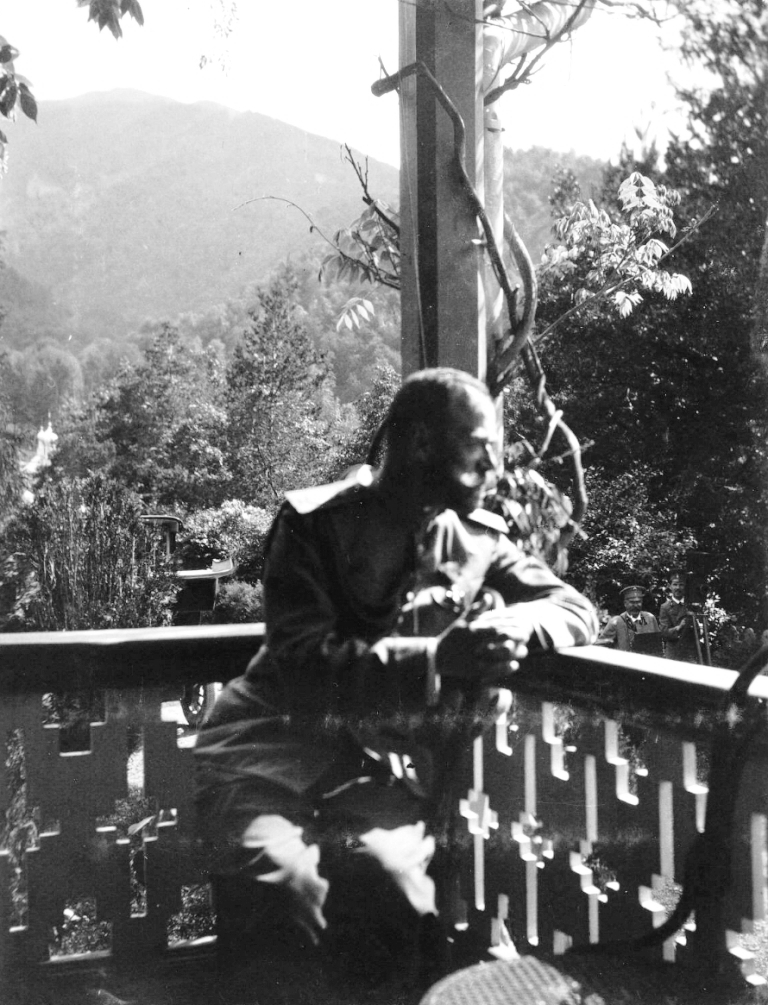
PHOTO: Nicholas II relaxing on the balcony of Beshuiskaya dacha
Nicholas II records one of his Crimean hunts on 17th September 1913:
“… I got up at 3 o’clock and went hunting, and killed one deer . . . The weather was excellent and the day was very warm. I returned to the house by 9 o’clock. Drank tea with my daughters, who had been at the early Mass. We sat on the porch until 12 o’clock when they brought my deer. We had breakfast and left at exactly one o’clock to Livadia, where we arrived at 3.20 … “
During his last visit to the southern coast of Crimea in the spring of 1914, the emperor made several trips to Beshuiskaya, but these were not for hunting, but entertaining and hiking with his family, relatives, officers and members of his retinue.
Empress Alexandra Feodorovna, hoping for a miracle, chose a healing spring at the Kosmo-Damianovsky Monastery, for the treatment of Tsesarevich Alexei, who suffered with hemophilia. However, the journey from Livadia to the monastery was rather long and burdensome.
By 1910, the Imperial Garage in Livadia was completed, the roads used by the Tsar had to be made suitable for his motorcars. That same year, construction began of the Romanov Highway, a mountain route which connected Upper Massandra with the Tsar’s hunting lodge and the nearby monastery. The road was completed in the fall of 1913, making it suitable for motor traffic.
The advantages of the new highway reduced the distance between the Imperial residences by more than twenty kilometers. Thanks to this, the travel time was reduced: judging by the diary entries of Nicholas II, He usually got from Livadia to the Hunting Lodge in about three hours.
The date of 6th May 1914, turned out to be the last time that Emperor Nicholas II and his Family would drive along the scenic Romanov Road from Livadia to visit Beshuiskaya dacha, their hunting dacha in Crimea. Within a few short months, the outbreak of the First World War, their joyful happy days would forever remain in the past.
PHOTO: another view of Beshuiskaya dacha, Nicholas II’s hunting lodge in Crimea
PHOTO: Eriklik, the dacha built for Empress Maria Alexandrovna near Livadia
Eriklik was the name of a dacha, built for Empress Maria Alexandrovna (1824-1880), wife of Emperor Alexander II (1818-1881), near Livadia in Crimea. The dacha was built on the advice of her physician Dr. Sergei Petrovich Botkin (1832-1889) [father of Dr. Eugene Botkin (1865-1918), who was murdered with Nicholas II and his family by the Bolsheviks on 17th July 1918] , who recommended that the Empress spend autumn and winter in the south, where the mountainous and coniferous air would benefit her declining health.
The construction of the dacha involved designer A.I. Rezanov and the famous architects A.G. Vincent , V.I.Sychugov, and was built between April-August 1872.
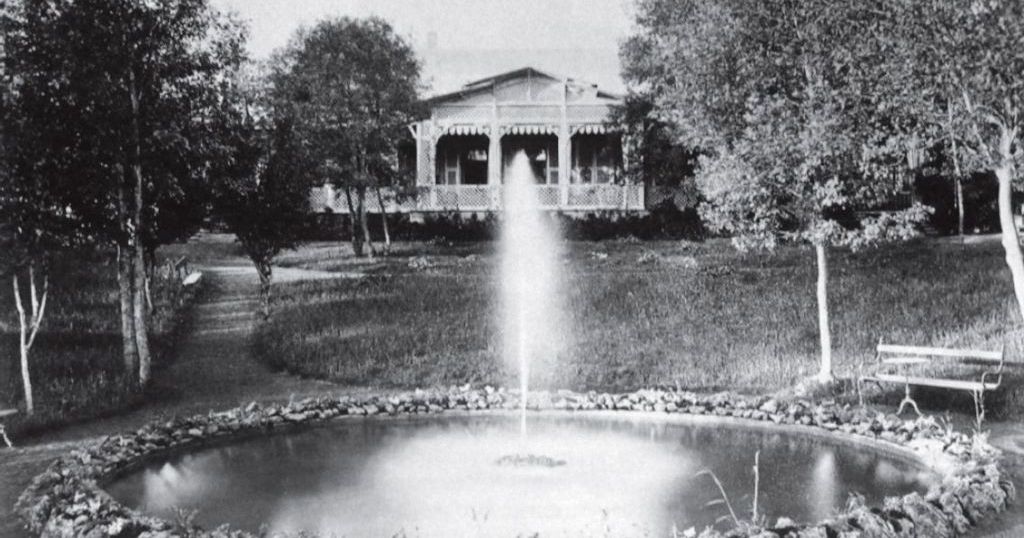
A beautiful park parterre with a system of paths and a round fountain were arranged in front of the dacha, the vegetation was cleared in order to maximize the panoramic view of the mountains and the Black Sea. The architectural complex was created by assimilating the nature of Crimea set against the symbolic views of the mountain landscape.
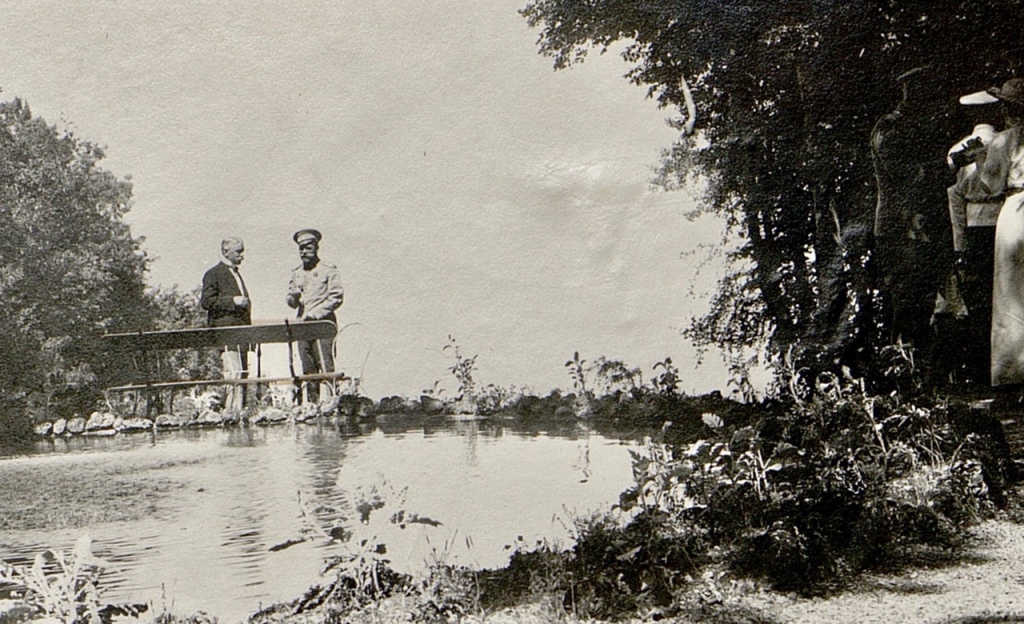
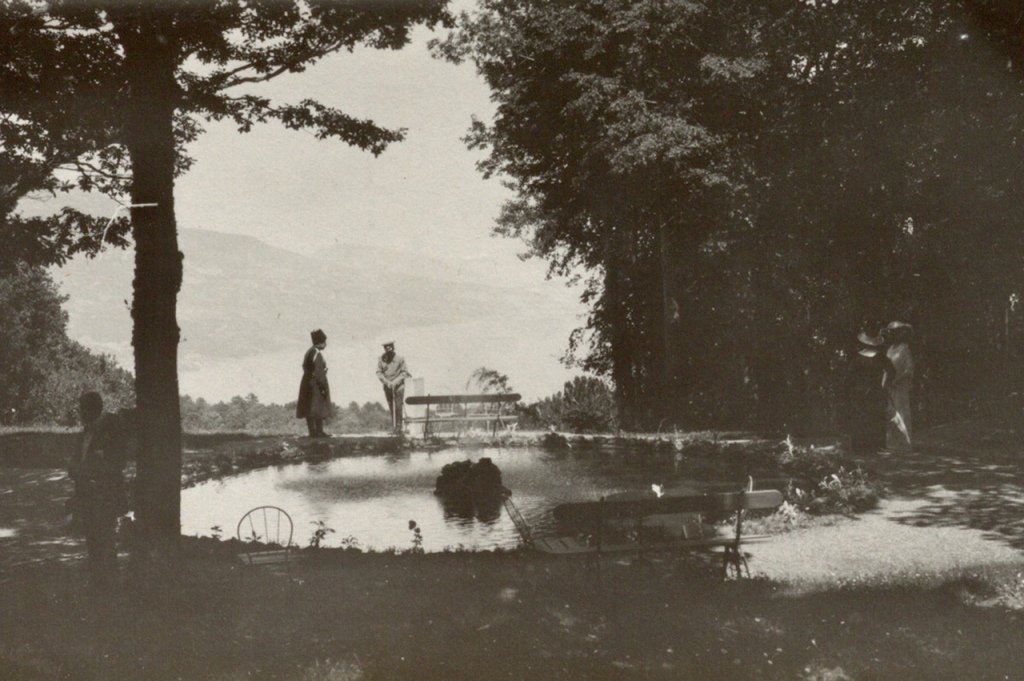
PHOTOS: Emperor Nicholas II at the fountain in the garden at Eriklik, 1914
The wooden one-story dacha, consisted of three wings, connected to each other and 8-10 rooms. The Empress’s rooms faced the most beautiful views, an adjoining room was reserved for the dining room, behind it were the rooms for Alexander II. The servants’ quarters were located behind the Empress’s rooms. The dacha had a wooden patio. The dacha also included a wooden veranda, a gazebo in the garden and several outbuildings.
After the death of Maria Alexandrovna, the palace remained empty. During their stays in Crimea, Nicholas II with his family, often visited Eriklik, where they enjoyed quiet walks and picnics.
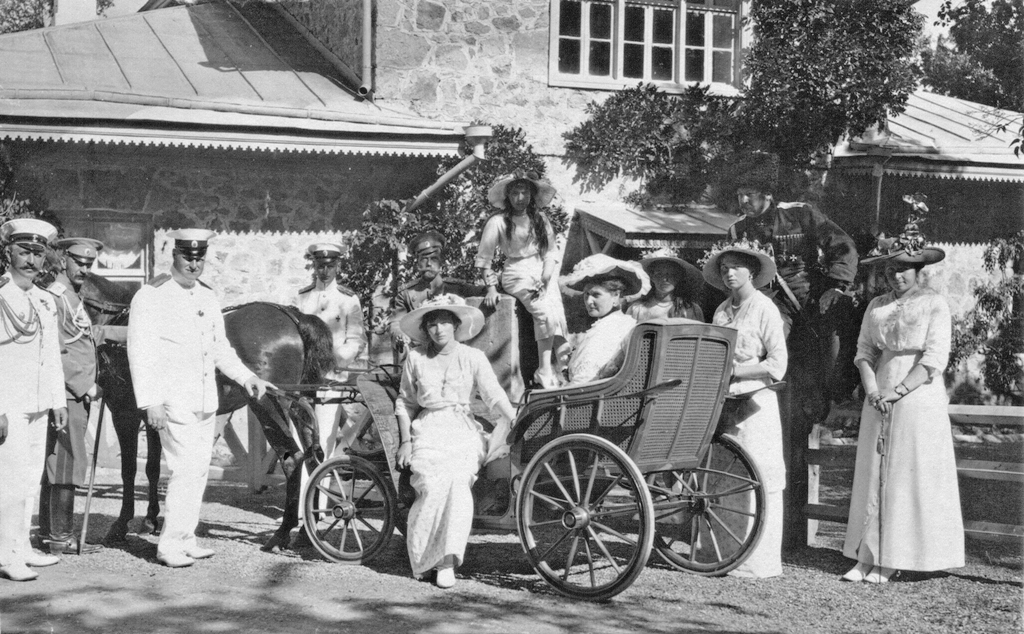
PHOTO: the Imperial Family visits Eriklik in May 1914
On 28th May 1914, three days before leaving the Crimea, the Tsar’s family arrived in Eriklik for breakfast. They were joined by other members of the Russian Imperial family who were staying at their respective Crimean residences at Ai-Todor, Kharax and Kichkine, as well as officers of the Imperial Yacht Standart. After breakfast, everyone walked together and relaxed in the garden. Grand Duchess Olga Nikolaevna noted in her diary that the day was “warm and sunny”. It was to be their last journey to Crimea.
Following the 1917 Revolution, a health resort for tuberculosis patients was opened in the dacha. At the beginning of the 20th century, the wooden dacha fell into decay, and in the middle of the 20th century was demolished.
If you found this article interesting, then please help support my research by making a donation in US or Canadian dollars to my projectThe Truth About Nicholas II– please note that donations can be made by GoFundMe, PayPal, credit card, personal check or money order. Thank you for your consideration – PG
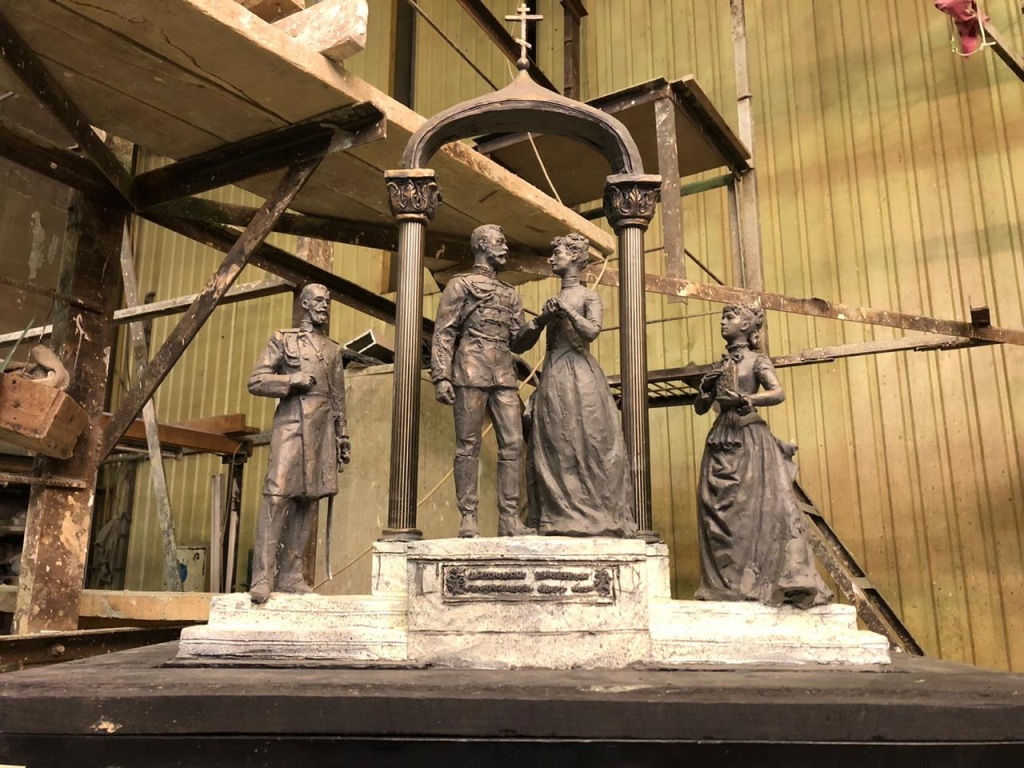
Grand Duke Sergei Alexandrovich (left), Tsesarevich Nicholas Alexandrovich, Princess Alix of Hesse and by Rhine, and Grand Duchess Elizabeth Feodorovna (right)
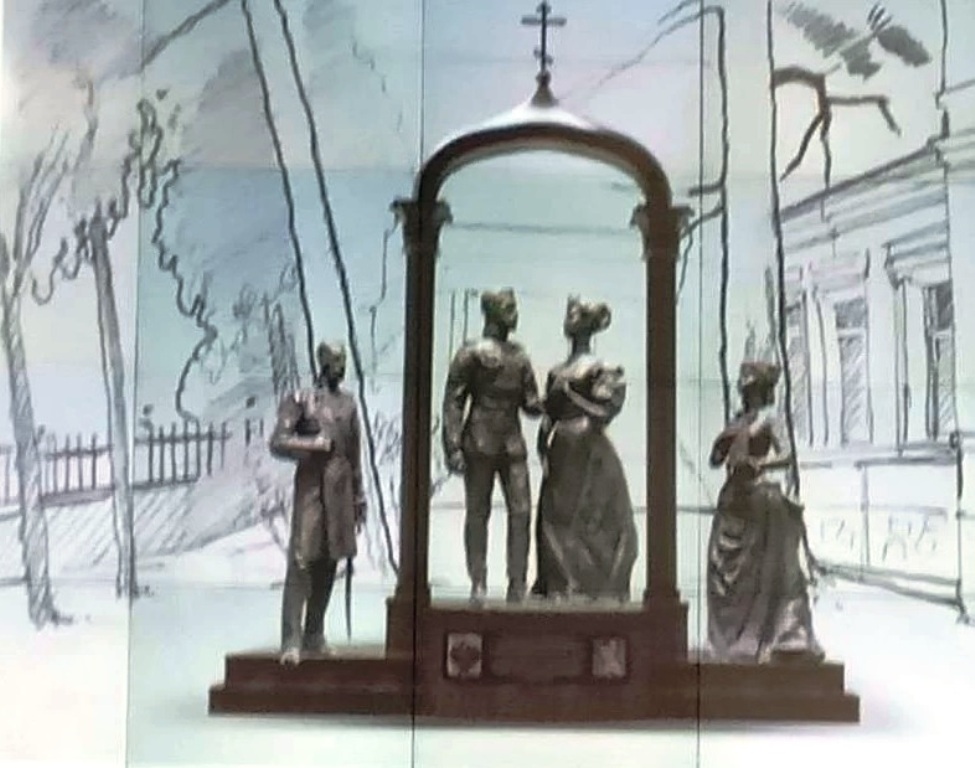
On 20th February 2020, I published an article Monument to Nicholas and Alexandra to be established in Crimea, a new monument marking a unique day, to be installed in the Russian city of Alushta, (situated 36 km from Yalta in Crimea) in the autumn of this year.
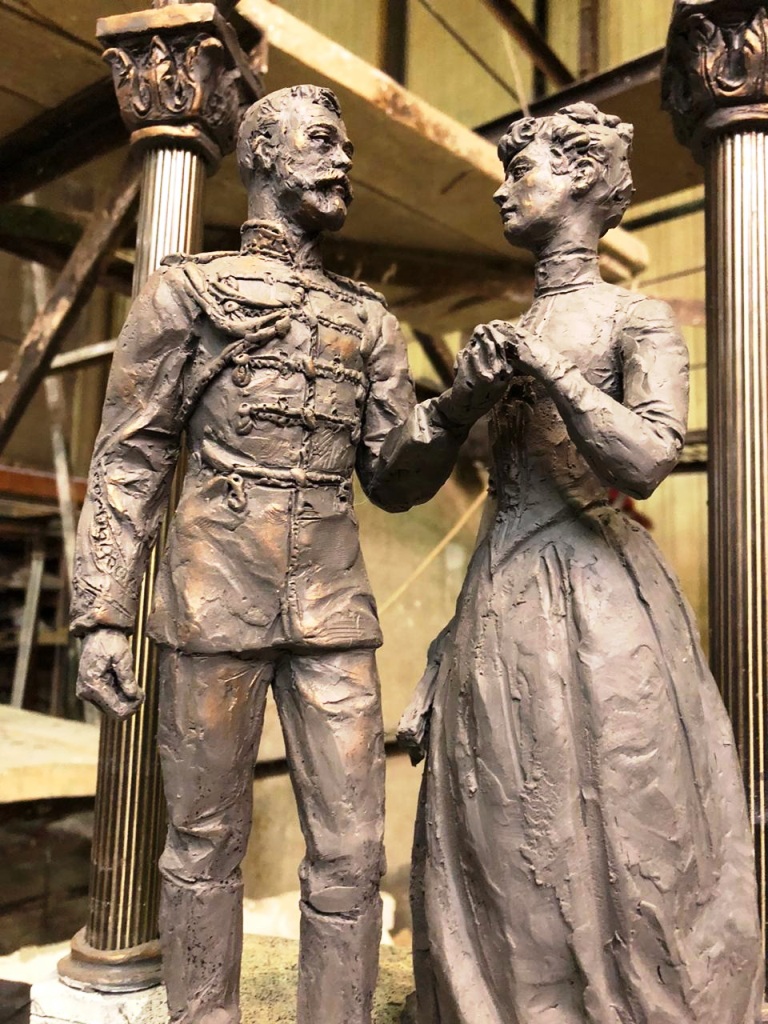
The photographs depicted in this update, show the progress on the monument, which features Tsesarevich Nicholas Alexandrovich (future Emperor Nicholas II, Princess Alix of Hesse and by Rhine (future Empress Alexandra Feodorovna), Grand Duke Sergei Alexandrovich and his wife Grand Duchess Elizabeth Feodorovna.
It was in the autumn of 1894, that Tsar Alexander III’s health began to further deteriorate. Nicholas obtained the permission of his dying father to summon Alix to the Imperial family’s Crimean palace of Livadia.
Tsesarevich Nicholas Alexandrovich and Princess Alix of Hesse and by Rhine
The monument will be established in the Crimean town of Alushta on 10th October 2020, the same date in which the meeting of Tsesarevich Nicholas Alexandrovich and his future wife Princess Alix of Hesse and by Rhine took place in 1894. The cost of the monument will be 18,500,000 rubles ($242,000 USD).
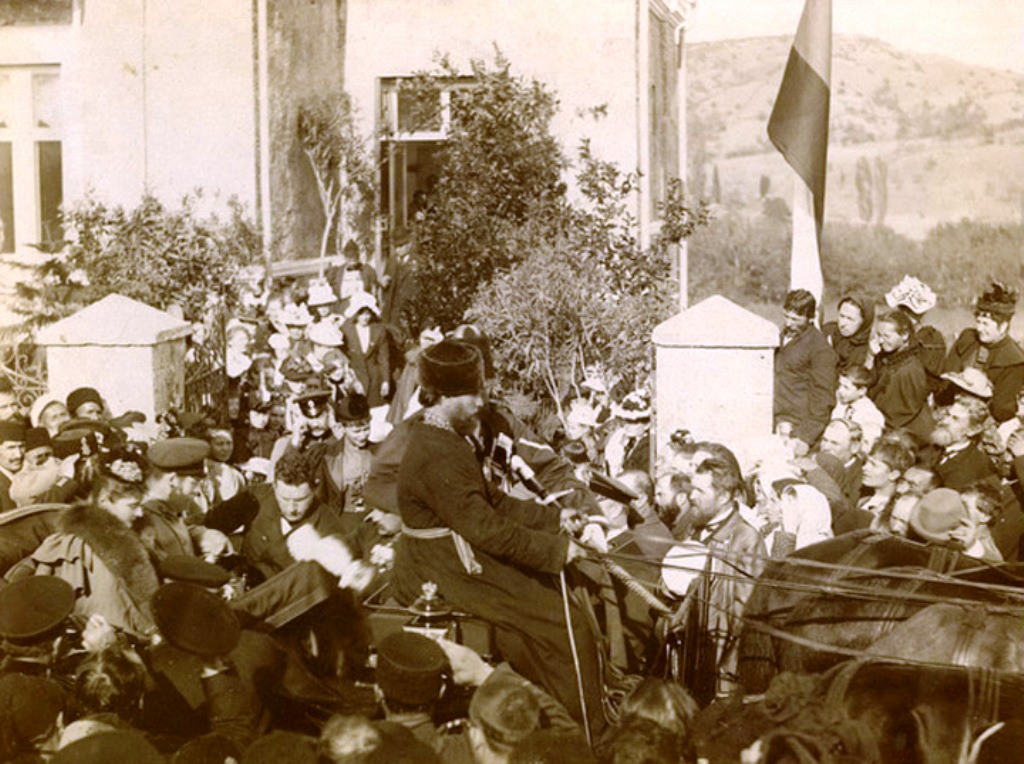
Meeting of the Tsesarevich and his bride in Alushta. 10 October 1894
Tsesarevich Nicholas Alexandrovich wrote in his diary that day:
At 9.30 I set out with Uncle Sergei to Alushta, where we arrived at one o’clock in the afternoon. Ten minutes later my beloved Alix arrived from Simferopol with Ella. After luncheon I got into the carriage with Alix and we drove together to Livadia.
My God! What a joy to meet her here at home and to have her near to me—half my cares and worries have been lifted from my shoulders. I was overcome with emotion when we went in to the dear Parents. Papa was weaker today, and Alix’s arrival, together with his talk with Father Ioann [John of Kronstadt], have worn him out!
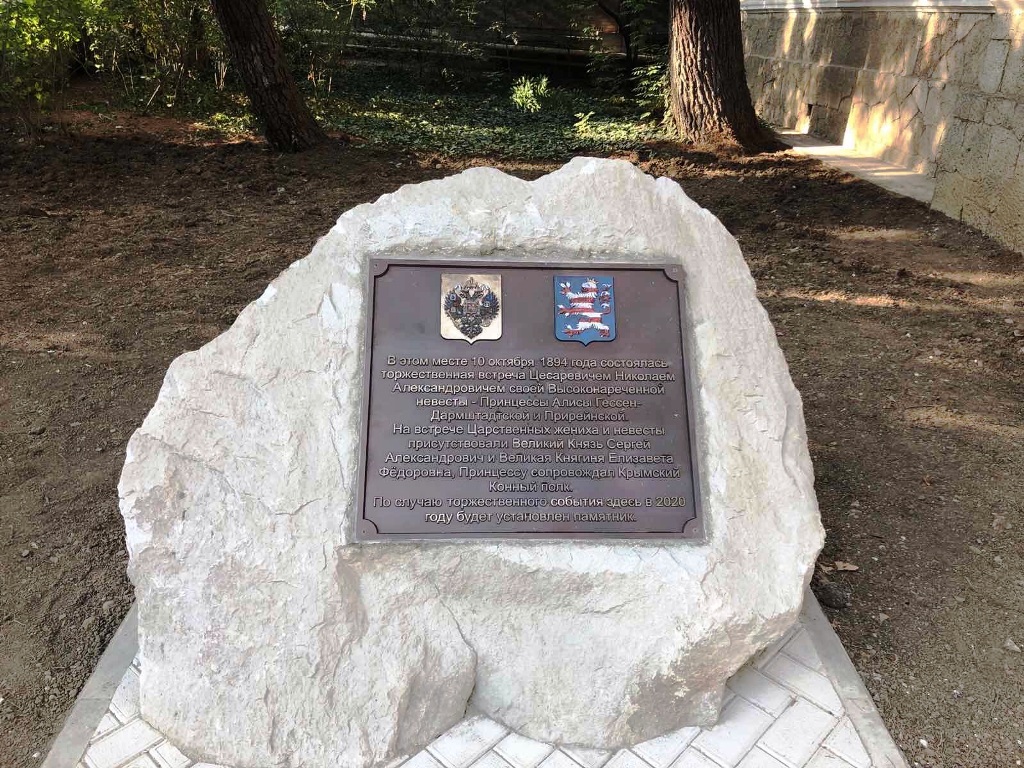
Memorial plaque marking the spot where the monument will be installed in Alushta
On 20th October 2019. a memorial plaque was solemnly opened in Alushta, at the site of the historical meeting between Tsesarevich Nikolai Alexandrovich and his future wife, Princess Alice of Hesse-Darmstadt, on 10th October 1894.
Baron Eduard Oleg Alexandrowitsch von Falz-Fein’s collection of art included a portrait of Tsar Nicholas II
On 17th November 2018, Baron Eduard Oleg Alexandrowitsch von Falz-Fein died in a house fire in Vaduz, Liechtenstein, at the age of 106. The Russian-born Liechtensteiner businessman, journalist, sportsman and art collector, may very well have been the last person who recalled meeting Tsar Nicholas II.
“There are almost no contemporaries who knew Nicholas II,” wrote Eduard Alexandrovich von Falz-Fein in 2017 – “It has been 100 years since I saw the kind eyes of the Sovereign, and I remember the warmth of his hands when he held me as a child. Nothing can erase that cheerful and happy memory! The comprehension of those years leaves me in deep sadness. The Lord gave us a peaceful and bright joy to remember the August Family and their sincere love, their devotion to Russia!”
Eduard Alexandrovich von Falz-Fein was born on 14th September 1912 in the village of Gavrilovka, situated in the Kherson region of the Russian Empire. Today, it is part of Ukraine.
“We were big landowners, the peasants loved us, because we paid well,” said Eduard Alexandrovich about his childhood – “For New Year and Christmas, all employees received gifts, and on their birthday the employee was given the day off. Uncle had the largest zoological garden in the world, where more than three thousand animals and birds from around the world were collected. Every day, a distinguished guest came to see the zoo, and if no one came for a long time, mother would say: “How is this so! Nobody loves us anymore? ”
Probably the most honoured guest to the estate was made by Tsar Nicholas II. In the Spring of 1914, Eduard Alexandrovich’s uncle Friedrich invited the sovereign to Askania-Nova, who arrived on 29th April 1914, staying for 2 days. “No one knew what they talked about, noted Eduard Alexandrovich, – “most likely, about the approaching war.”
On the occasion of their august guest, Falz-Fein announced a three-day holiday for his employees, allocating money for refreshments. The peasants raised toasts and cheered, as they drank to honour the tsar’s visit.
On the evening of the 29th, the tsar was invited to dinner, which included soup, consomme, various pies, sterlet, wild goat with croquettes, poivrade sauce, roast chicken and partridges, a traditional fried pig, caviar and Bavarian cheese, all of which was complimented with a selection of fine Crimean winse.
The following morning, the Tsar was given a lavish breakfast in the garden, and it was at this time that little –year-old Eduard Alexandrovich was honoured to be planted on the lap of Nicholas II.
Nicholas II did not boast of his title Autocrat of the Russian Empire. He was relaxed and at ease, talking freely with the senior caretaker of the zoo, Klimentiy Siyanko, the coachman Reznichenko, the shepherd Samuel Sukonko, the estate manager Iosif Kiriltsev, and the scientific observer Grote.
The sovereign was delighted with what he saw on the estate. Nicholas II gave Friedrich Eduardovich his portrait with a dedicatory inscription (a mark of highest respect) and ordered his ajutant Vorontsov-Dashkov to present gifts on his behalf to the estates’ employees.
Falz-Fein sent a gift for Empress Alexandra Feodorovna: a luxurious fan made of peacock feathers with an enamel pen made by Rene Lalique.
In the photo above, Baron Eduard Oleg Alexandrowitsch von Falz-Fein (right) is visiting his friend, the senior male and former head of the Romanov Family Association Prince Nicholas Romanovich (1922-2014) at this home in Switzerland.
Together, they are looking at a copy of Romanoff: Un Album de Famille, a series of magnificent pictorials produced by Jacques Ferrand in the 1980s and early 1990s. Each volume featured hundreds of photos of members of the Russian Imperial Family, including the Tsar and his family, grand dukes and grand duchesses, princes and princesses of the imperial blood, etc. Ferrand received exclusive publication rights from members of the Imperial Family who fled Russia after the 1917 Revolution.
Tsar Nicholas II (left) with Friedrich Eduardovich Falz-Fein (standing next to the tsar), at the latter’s estate Askania-Nova, in Crimea, 29th April 1914
In a letter dated May 8, 1914, to his mother the Dowager Empress Maria Feodorovna, Nicholas II writes about his visit to Askania-Nova:
“On April 29, early in the morning, I went by motor through Simferopol and Perekop to Askania-Nova, where I arrived at 4 p.m. There I was met by the owner himself [Friedrich Eduardovich Falz-Fein], the old mother, her daughter, who is married to Paker, the granddaughter and another son, that is, the brother of Falz-Fein. They are completely Russian and easy people to talk with. I was offered tea in the garden. Herons, ducks, geese and cranes walked around the table, looked at us and some came up and pushed with their beaks, begging us to give them bread.
“Then the master led me past large cages with all kinds of birds living together, to the pond, filled with several hundred ducks, geese, swans, and flamingos of different breeds. Then we went to the famous menagerie, the size of the military field in Gatchina, with a huge fence around. Different deer, goats, antelopes, wildebeests, kangaroos and ostriches live there, all year round in the open and in the open, and also all together.
“An amazing impression, like a picture from the Bible, as if the animals came out of Noah’s Ark! From there we went to his lovely park, which Falz-Fein planted and laid out in 1888, after he found water. All our northern bushes and trees grow here, which is also strange in the steppe. Then, in a motor, I drove around his huge herd of sheep, cows, bison, horses, zebras and camels. These herds graze for six months in the steppe, far from his house, and he encouraged me to approach them.
“Still, I did not see everything, because there was not enough time. In the evening I dined with them and went to bed early. Three gentlemen (accompanying) me were: Voeikov, Drenteln and Sashka Vorontsov.
“The next morning, April 30, we went to the steppe and continued to inspect the herds: they also showed us the shearing of the sheep. In the garden in one of the ponds, are red fish – carp, ides, and roaches. He explained to me that it is very simple: you just need to provide them with a lot of sun and feed the fish meat! He made a brood of his best horses, which is what he is most pleased with, and they are really remarkably good and beautiful! He sells 120 horses annually for cavalry repairs.
“Before I left, the Falz Feyn family served breakfast in the garden, although it was 9.30 in the morning. Having said goodbye to them, we went the other way back and examined several new peasant farms, who had been evicted from the villages after three years. They themselves are very satisfied. Their homes, households, fields and orchards make the most pleasant impression. Everything is so clean, neat and they themselves do not look like ordinary peasants!
“Then we drove to Simferopol and through Bakhchisaray to Ai-Petri, home. Arrived in Livadia before dinner. So I did 587 miles in two days, almost as much as from St. Petersburg to Moscow … ”
The stay of Nicholas II in Askania-Nova was recorded on film by court photographer V.K. Trikler (representative of the French film rental company) and has been preserved to this day – see below:
The above image is an artist drawing of a monument that will be established in the Crimean town of Alushta later this year, in honour of the meeting of Tsesarevich Nicholas Alexandrovich and his future wife Princess Alix of Hesse and by Rhine on 10th October 1894, the date that will be inscribed on the monument.
In April 1894, Nicholas’s engagement to Alix was announced. When it became clear that the health of the Tsesarevich’s father Emperor Alexander III was serious, Alix was invited to the Crimea. The couple met at the Dove Cottage, where Alix stopped on the way to Livadia. Princess Alix travelled with her sister Ella to Livadia to receive the blessing of the dying emperor. Nicholas was accompanied by his uncle Grand Duke Sergei Alexandrovich (Governor of Moscow). It is this historic moment – the meeting of four people – that will be depicted by sculptors.
According to the project manager, vice president of the St. Basil the Great Foundation, Mikhail Wilter, “the cost is estimated at about 18.5 million rubles. This includes four bronze sculptures, a granite pedestal, and an arch. The height of the monument is five meters, the length of the stone is about four meters, and the height of the figures themselves is more than two meters. We expect this project to be implemented in 2020. Part of the funds will come from the Saint Basil the Great Charitable Foundation, and we hope that Crimeans will also contribute to this important project,” said Wilter.
“The composition will consist of four figures – the couple themselves – Nicholas II and Alexandra Feodorovna, her sister Grand Duchess Elizabeth Feodorovna and her husband Grand Duke Sergei Alexandrovich, both of whom were present at the meeting of the future Imperial Couple. The arch unites two loving hearts – Nicholas and Alexandra, and is also crowned with an Orthodox cross. I would like the monument to be consecrated so that you can approach, even baptize, as they are saints. Newlyweds can come to the monument to have their wedding photos taken, ”said Irina Makarova, one of the sculptors participating in the project.
“The uniqueness of the sculpture is that all four people died tragically, three of them canonized by the Orthodox Church: Nicholas II, Alexandra Fedorovna and Elizaveta Fedorovna. This is a real human story,” said the author of the project Maxim Batayev, the other sculptor participating in the project.
The bronze and granite monument will be installed in the garden of the city library in October, while the territory surrounding it will be improved and planted with cypress trees.



 Nicholas II
You must be logged in to post a comment.