The Fate of Nikolai Nikolaevich Ipatiev, 1869-1938
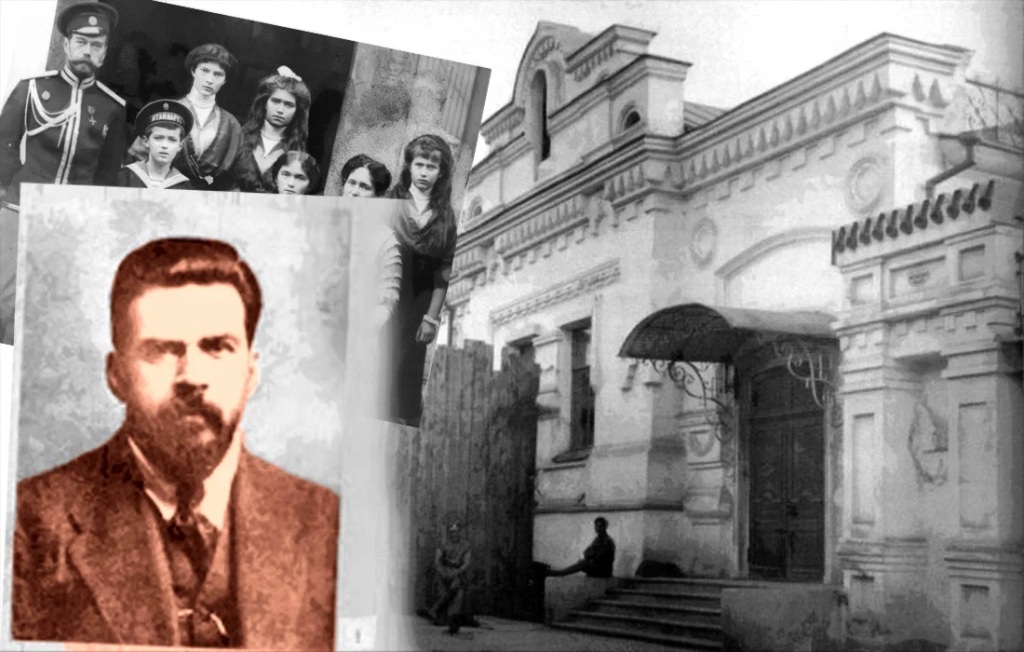
While the tragic fate of Russia’s last tsar, his family and their four faithful retainers is well known, the life and fate of the owner of the notorious house in Ekaterinburg, where they were brutally murdered on 17th July 1918 – Nikolai Nikolaevich Ipatiev (1869-1938), remains less familiar.

Nikolai was born on 18th February 1869 in Moscow, to Nikolai Alekseevich Ipatiev (1839-1890) a well-known architect in Moscow, who held a prominent and influential post – one of the three official architects of the first Russian Insurance Society – the most respected in the country. His wife Anna Dmitrievna Ipatieva (nee Glika) came from a family that gave Russia many remarkable intellectuals.

In addition to Nikolai, the couple had two other children, a daughter Vera and a brother Vladimir (1867-1952), who became a famous chemist, who is considered one of the founders of petrochemistry in the United States.

Nikolai was a graduate of the 3rd Moscow Cadet Corps, the Nikolaev Engineering School in St. Petersburg and the Military Engineering Academy. In 1906, after serving in the army, he retired with the rank of engineer captain and settled in Ekaterinburg, where he began working as a civil engineer. He later opened a very successful company engaged in the laying of railroad tracks.

At first, Nikolai lived in a rented apartment, but his business was so successful, that two years later in 1908, he was able to buy a two-storey stone mansion at Voznesenskaya Gorka, 49/9 paying the former owner 6 thousand rubles. He became the third owner of the house since it’s construction in the 1880s.

Nikolai and his wife lived on the upper floor of the house, while the main floor was used for his thriving business. The interiors were richly decorated with iron castings, stucco mouldings, and the ceilings were decorated with artistic painting. The house was equipped with all the modern amenities: electricity, sewerage, a bathroom with a water heater, a wine cellar, and even a telephone.

He took part in the construction of the Ekaterinburg-Perm railway. He was active in public and local history activities. He also participated in the development of the project for the construction of the building of the Ural Mining Institute. He also served as an engineer of the Railway Troops of the Russian Armed Forces, a unit in the engineering corps of the Imperial Russian Army.
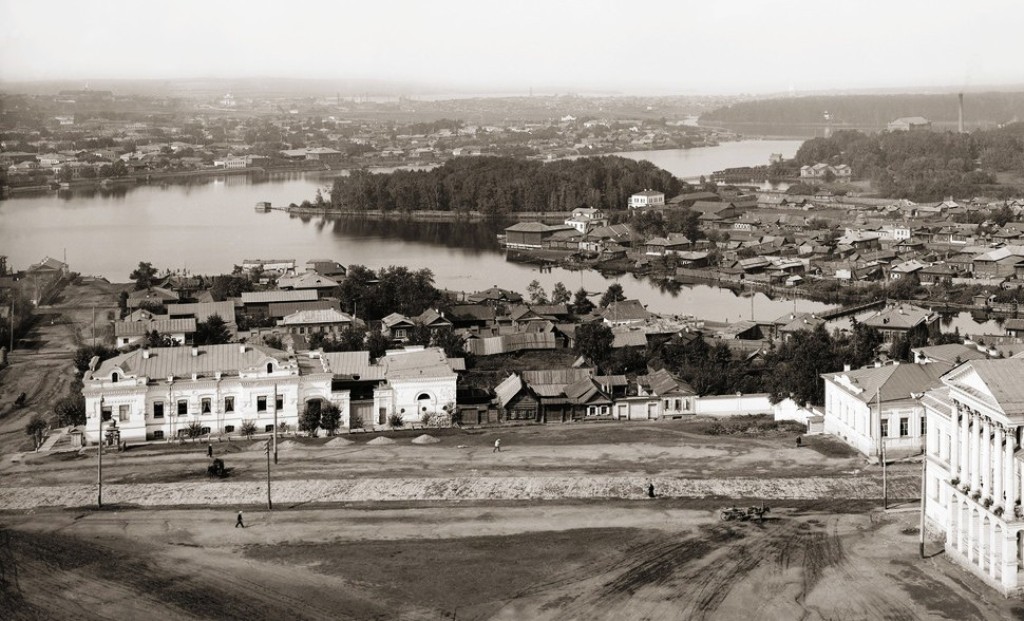
PHOTO: early 20th century view of the Ipatiev House (left) from the bell tower of the Ascension Church

THE BOLSHEVIKS EVICT THE IPATIEV’S

Nikolai Ipatiev and his wife Maria Feodorovna Ipatieva (1876-1953), led a quiet and peaceful life until April 1918, when the Bolsheviks suddenly knocked on the door of their house. Nikolai’s memories of that day are preserved in the State Archives of the Russian Federation (GARF).

“On 27th April, Commissar Zhilinsky [Alexander Nikolaevich Zhilinsky, 1884-1937] came to me and, announced that my house would be occupied for the needs of the council, and then ordered me to clean the entire house by 29th April,” writes Nikolai. “Having overheard the order, my wife asked Zhilinksy, among other things, whether the integrity of our belongings that we would leave in the house would be guaranteed to us; Zhilinsky replied to this that the people who would be living in the house would not damage anything.”

The choice and location of the Imperial family’s place of imprisonment is explained by Alexander Dmitrievich Avdeev (1887-1947), the first commandant of the Ipatiev House [renamed “House of Special Purpose” by the Bolsheviks] in his memoirs, that it was located “… almost in the very centre of the city, in such a place that its defence against an external attempt to free the former tsar was favourable in all respects … ”

Ipatiev was able to take only a small number of personal belongings from the house. He locked the cabinet with his valuable books in his office. His wife locked their dishes in the dining room. The rest of their belongings were locked in the basement pantry, a room adjacent to the one where the regicide was carried out, and then locked with a key.

“The keys to the locked rooms were left with me, while the members of the Commission sealed the rooms themselves with the Soviet seal,” said Ipatiev. “I had moved our folded kitchen and table utensils, chests with clothes and linen into the carriage house . After some time, the Chairman of the App. Committee Sergei Egorovich Chutskaev (1876-1944) demanded from me the keys to all the locked rooms in order to check what was in them and, after inspecting the rooms, he replaced seals on them.”

Until the very last moment, Ipatiev did not know who exactly the Bolsheviks were preparing his house for. Only after 29th April, when he had already moved out [Nikolai and his wife moved to the village of Kurinskoye], did his neighbour inform him that the ex-tsar Nicholas II, his wife and one of his daughters [Grand Duchess Maria] had been settled in the mansion. The rest of the family members were brought later.

A high double wooden fence exceeding the windows of the second floor in height, was built around the outer perimeter of the house, closing it off from the street. The fence had a single gate in front of which a sentry was constantly on duty, two guard posts were placed inside, eight outside. Machine guns were installed in the attics of neighbouring buildings.The Imperial family were held under house arrest in the Ipatiev House for 78 days, from 28th April to 17th July 1918.
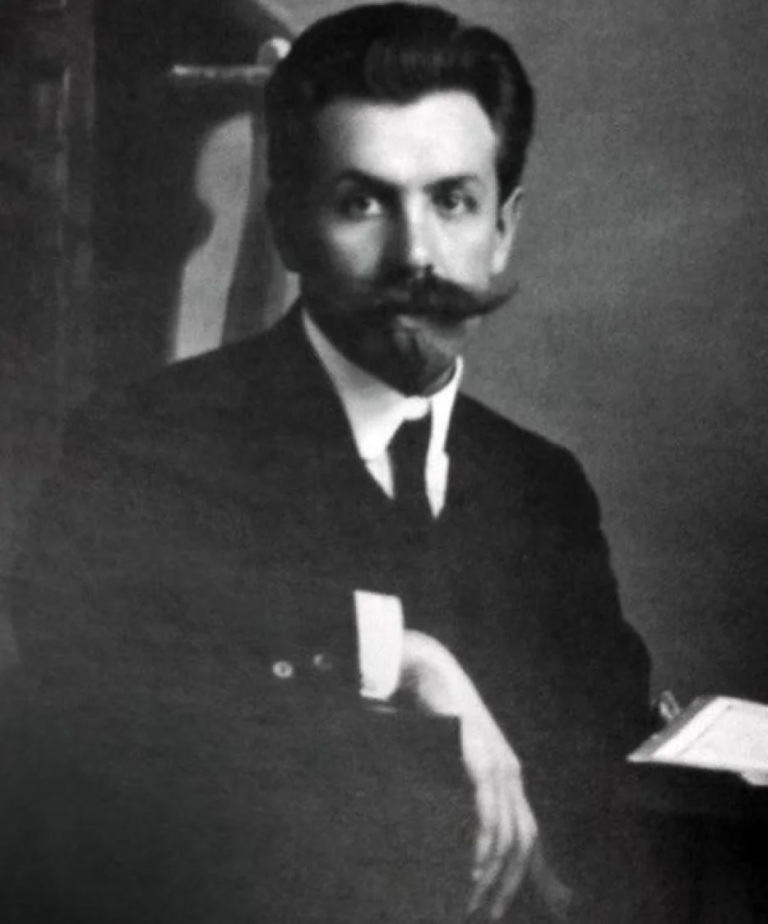
PHOTO: Nikolai Nikolaevich Ipatiev (1869-1938)

“THE TENANT HAS LEFT”

Before leaving, Nikolai Ipatiev made an agreement with his cousin Yevgenia Poppel that she would send him a telegram with certain words if the Bolsheviks suddenly vacated his house. And such a telegram came to him on 22nd July – five days after the murder of the Imperial Family. It contained only four words: “The tenant has left,” whereupon Nikolai and his wife returned to Ekaterinburg.

An article appeared in the newspaper Ural Worker – stating that, “at the numerous requests of the workers, the blood-drinking tsar was shot.”

On the same day, Nikolai Nikolaevich was summoned to the local Cheka, who returned to him, the keys to his own house. By that time, all traces of blood had been washed away, the floors swept, the personal belongings of the dead packed and taken away. Nikolai and his wife never returned to the “bloody house” again, even leaving his belongings, which he had stored in the house.

Later, during an interview Ipatiev noted that “in all the years of the existence of the house, no one had died in it. And then, overnight, eleven people were all murdered at once … “

On 25th July, Ekaterinburg was occupied by the Czechoslovak Corps. Upon the arrival of the White Army, Admiral Alexander Vasilyevich Kolchak (1874-1920), ordered the Ipatiev House sealed, “the crime scene was to remain intact.” He ordered investigator Nikolai Alekseevich Sokolov (1882-1924), to launch an investigation into the fate of Nicholas II and his family, and the events which took place in the house of engineer Ipatiev, where bullet marks were discovered in the basement walls.
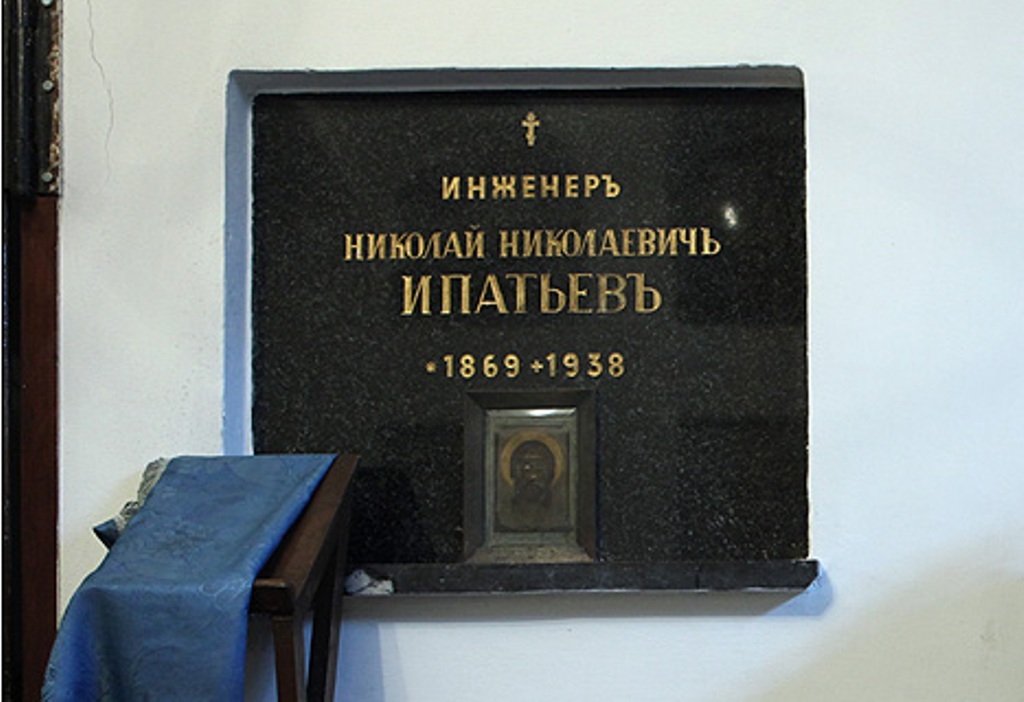
PHOTO: Nikolai Ipatiev’s grave at the Olshansky Cemetery in Prague

LIFE AND DEATH IN EXILE

On 28th July, 1919, Ekaterinburg was retaken by the Reds, Nikolai Ipatiev was now considered an “enemy of the Bolsheviks”, forcing him to flee the Urals.

Nikolai and his wife Maria evacuated from Ekaterinburg with the Whites. They travelled across Siberia to Japan, then moved to Turkey, but eventually ended up in Czechoslavakia in 1920, where they settled in Prague, teaching at the Civil Engineering Institute.

Nikolai died there on 20th April 1938, and buried in the crypt of the Assumption Church, at the Olshansky Cemetery in Prague. His burial niche is decorated with an orthodox icon of the Saviour Made Without Hands. On the church’s website, they note in one line: “N.I. Ipatiev, in whose house the last Russian Emperor and his august family were killed. Maria died in Prague in 1953, and is buried near her husband.

On 22-23 September 1977, the Ipatiev House in Ekaterinburg where Emperor Nicholas II and his family were held under house arrest for 78 days before being murdered, was razed to the ground. Click HERE to read my article How Yeltsin justified the demolition of the Ipatiev House, published on 25th February, 2020.

© Paul Gilbert. 14 July 2022
Program for the XXII Tsar’s Days in the Urals – 2022

From 12th to 20th July, the 22nd annual Tsar’s Days will be held in the Urals [Ekaterinburg and Alapaevsk], which includes a series of solemn events [16th to 18th July] dedicated to Emperor Nicholas II and his family, who met their death and martyrdom in Ekaterinburg 104 years ago, on 17th July 1918.

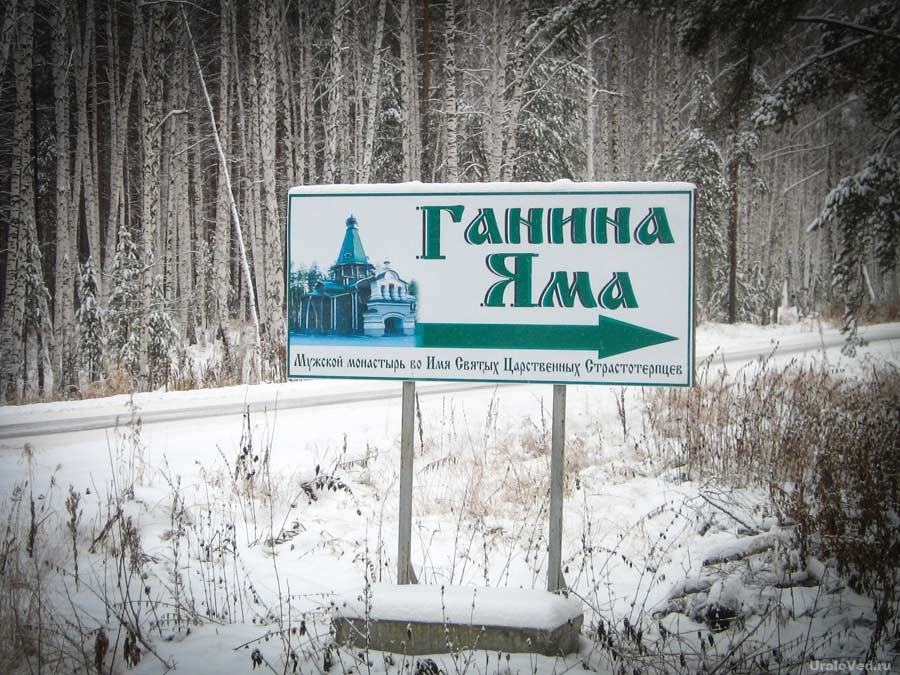
The main events are the night Divine Liturgy, which is performed on the square in front of the Church on the Blood, built on the site of the Ipatiev House, where members of the Imperial Family and their faithful subjects ended their earthly days, and the 21-km [13 miles] Cross Procession to the Monastery of the Holy Royal Martyrs at Ganina Yama, on the site of which the regicides first disposed of the Imperial family’s remains, before returning the following day to exum thre remains and bury them in two separate graves at *Porosenkov Log.

On 18th July, similar events will be held in Alapaevsk, where 8 additonal members of the Romanov dynasty and their faithful servants [see below] met their death and martydom.

The Ekaterinburg Martyrs – 11 victims

Emperor Nicholas II, Empress Alexandra Feodorovna, Grand Duchesses Olga, Tatiana, Maria, Anastasia, Tsesarevich Alexei Nikolaevich, and their four faithful retainers Dr. Eugene Botkin (court physician), Alexei Trupp (footman), Ivan Kharitonov (cook), and Anna Demidova (Alexandra’s maid).

The Alapaevsk Martyrs – 8 victims

Grand Duchess Elizabeth Feodorovna, Grand Duke Sergei Mikhailovich, Princes of the Imperial Blood Ioann, Konstantin and Igor Konstantinovich, Prince Vladimir Paley (son of Grand Duke Paul Alexandrovich), and two faithful servants: sister of the Marfo-Mariinsky Convent Varvara Alekseevna (Yakovleva), and Fyodor Semyonovich (Mikhailovich) Remez, secretary of the Grand Duke Sergei Mikhailovich.

In addition, the XXI International Festival of Orthodox Culture will be held in Ekaterinburg from 12th-20th July. The festival features many events in honour of the Holy Royal Martyrs, including divine services, religious processions, exhibitions, concerts, conferences and other events.

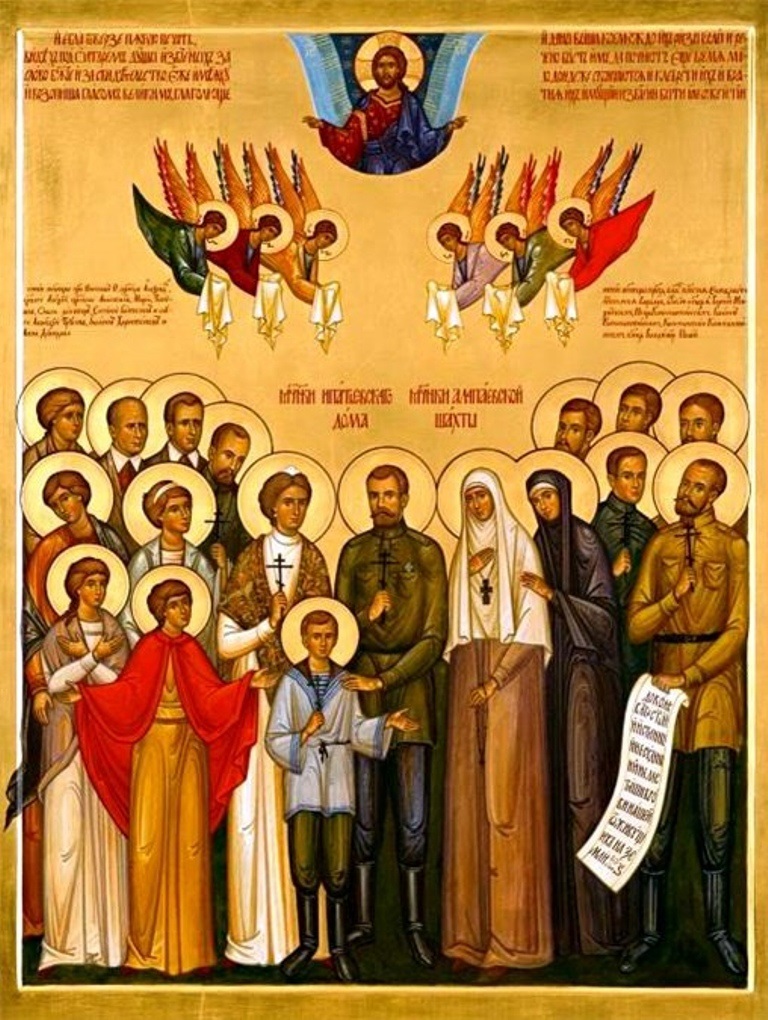
PHOTO: icon depicting the Ekaterinburg and Alapaevsk Martyrs

SERVICE CALENDAR

July 16, Saturday

09:00 – Divine Liturgy at the altar of the Holy Royal Martyrs, situated in the Lower Church of the Church on the Blood in Ekaterinburg.

13:00 — Cross procession along the route in which the Holy Royal Martyrs travelled upon arriving in Ekaterinburg [from Tobolsk] on 30th April 1918, from the Shartash Train Station [Kuibysheva street, 149-a] to the Church on the Blood. Route: [Tsarskaya street, 10] along the route: railway station Shartash – Kuibyshev street – Vostochnaya street – Chelyuskintsev street – Sverdlov street – K. Liebknecht street).

15:00 – Small Vespers with Akathist to the Holy Royal Martyrs. Confession. In the Lower Church of the Church on the Blood.

16:30-20:00 – All-night vigil, on the square in front of the Church on the Blood.

17:00-20:00 – All-night vigil, at the Monastery of the Holy Royal Martyrs at Ganina Yama.

23:30-02:00 – Divine Liturgy, on the square in front of the Church on the Blood.

July 17, Sunday

~ 02:30 – Traditional 21-km [13 miles] Cross Procession from the Church on the Blood to the Monastery of the Holy Royal Martyrs at Ganina Yama Route: Tsarskaya street, 10 – st. Tolmacheva – Lenin Ave. – V. Isetsky Boulevard – st. Kirov – st. Bebel – st. Technical – st. Reshetskaya – Railway forest park – pos. Shuvakish – Ganina Yama.

Upon the arrival of the procession, a Liturgy to the Holy Royal Martyrs will be performed at the Field kitchen.

06:00 – Divine Liturgy (early). Church on the Blood. In the Lower Church, altar at the site of the martyrdom of the Holy Royal Martyrs aka the Imperial Room [built on the site of the murder room, located in the basement of the Ipatiev House].

09:00 – Divine Liturgy (late). Church on the Blood, Upper Church

09:00 – Divine Liturgy. Monastery of the Holy Royal Martyrs at Ganina Yama.

17.00 – All-night vigil. Church of St. Sergius of Radonezh, at Ganina Yama.

17.00 – All-night vigil. Monastery in the Name of the Holy New Martyrs and Confessors of the Russian Church, Alapaevsk.

July 18, Monday

00:00 – Divine Liturgy. Holy Trinity Archbishop’s Compound, Alapaevsk.

02:30 – Small Vespers with Akathist to the Holy Royal Martyrs Grand Duchess Elizabeth Feodorovna and nun Varvara. Holy Trinity Archbishop’s Compound, Alapaevsk.

03:30 – Procession from the Holy Trinity Bishops’ Metochion to the Napolnaya School [where Grand Duchess Elizabeth along with other members of the Imperial family and their servants were held under arrest] and further to the Monastery in the Name of the Holy New Martyrs and Confessors of the Russian Church, Alapaevsk.

05:30 – Divine Liturgy (early). Monastery in the Name of the Holy New Martyrs and Confessors of the Russian Church, Alapaevsk.

09:00 – Divine Liturgy (late). Monastery in the Name of the Holy New Martyrs and Confessors of the Russian Church, Alapaevsk.

Tsar’s Days in the 21st century

The first procession in memory of the Holy Royal Martyrs, headed by Metropolitan of Ekaterinburg and Verkhoturye Kirill, took place in 2002, in which more than 2 thousand pilgrims and about 100 clerics participated. In 2012, for the first time since the construction of the Church on the Blood in Ekaterinburg, an all-night vigil and Divine Liturgy were performed in the open air.

In 2017 an estimated 60,000 people took part; in 2019, 60 thousand participated; in 2020, 10 thousand people [due to COVID], and in 2021, 3 thousand people [once again, due to COVID]. In addition, up to 2 thousand people gathered an alternative religious procession of the schismatic and tsarist monk Sergius (Romanov) in the Sredneuralsk Convent in Honour of the Icon of the Blessed Virgin Mary.

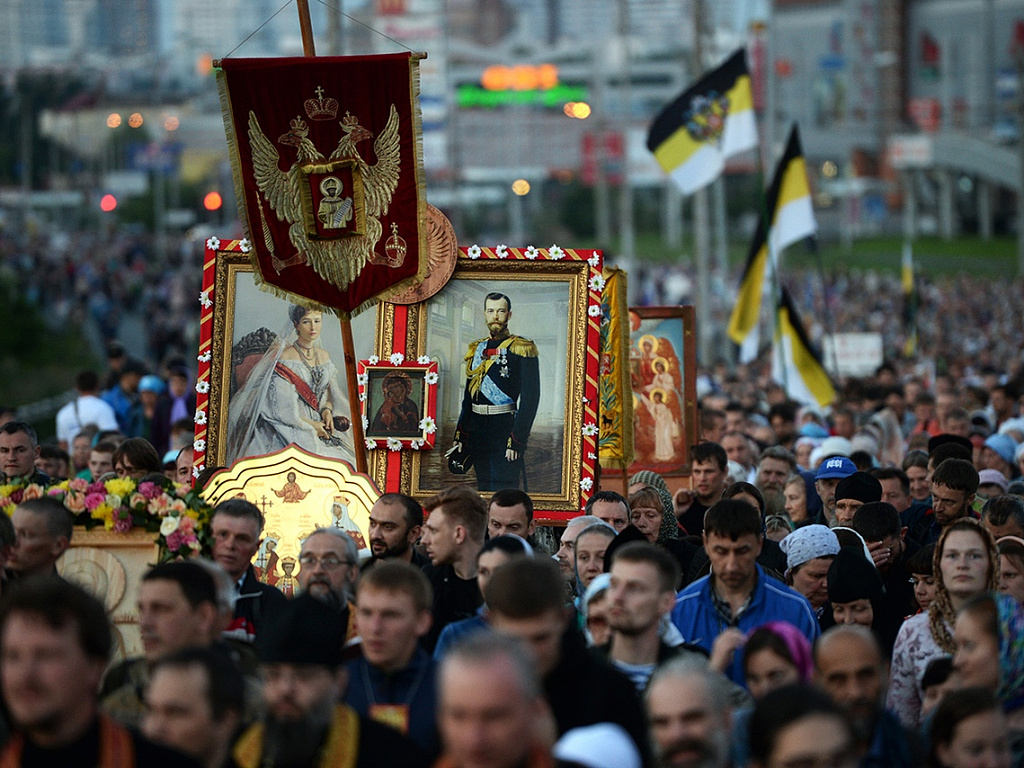
In 2018, more than 100,000 Orthodox Christians, monarchists, among others from across Russia and around the world took part in the Patriarchal Liturgy and procession of the cross from the Church on the Blood to the Ganina Yama.

Click HERE to read my article What is Tsar’s Days? – published on 15th May 2021

*NOTE: due to the fact the Moscow Patriachate does not yet recognize the Ekaterinburg Remains as authentic, the Cross Procession does not stop at Porosenkov Log, where the remains of the Imperial family were unearthed in two separate graves in the late 1970s and 2007.

The Holy Synod of the Russian Orthodox Church (ROC) have confirmed that the Bishops’ Council, will meet in Moscow at the end of 2022, during which they will review the findings of the Investigative Commission and deliver their verdict on the authenticity of the Ekaterinburg Remains.

Summer 2022 Appeal

If you enjoy my articles, news stories and translations, then please help support my research by making a donation in US dollars to my project The Truth About Nicholas II – please note that donations can be made by PayPal or credit card. Thank you for your consideration – PG

© Paul Gilbert. 5 July 2022

Arson suspected near the Romanov Memorial

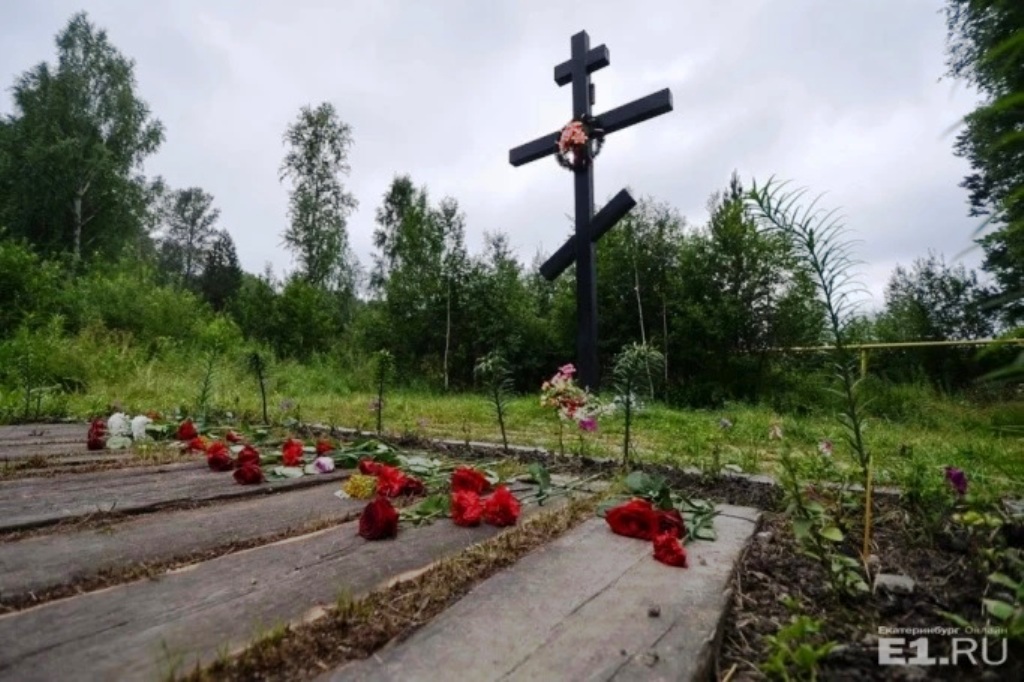
PHOTO: a large Orthodox cross marks the spot – covered with rail ties – where the remains of Nicholas II, his wife, three of their children, and four servants were exhumed in 1991

On the evening of Tuesday 3rd May, a fire broke out in the Porosenkov Log near Ekaterinburg, almost reaching the Romanov Memorial. According to Ilya Korovin, Director of the Romanov Memorial Charitable Foundation, the fire came within 50 to 70 meters of the main grave site, where the remains of Emperor Nicholas II, Empress Alexandra Feodorovna, three of their children and four servants were exhumed in 1991.

Two emergency vehicles were dispatched to the scene at around 6:30 in the evening. Firefighters were able to extinguish the fire before coming within 10 meters of a gas pipeline, which runs in behind the memorial site. Firefighters struggled with the fire for about two hours, bringing the fire under control shortly after eight in the evening. Had the fire not been contained, a massive explosion would most certainly have occurred if the flames had reached the pipeline. According to the emergency crews, “it was definitely arson”.

The area of the fire spread to about 4 thousand square meters, mostly forest. The fire did not cause any damage to the territory in or around the Romanov Memorial. “From the gas pipeline to the road, everything burned out—an area of about 100 square meters,” added Ilya Korovin – “Where there was once a swamp, is now nothing more than a large black sport, and an unpleasant smell.”

© Paul Gilbert. 4 May 2022

Pilgrimage to Ganina Yama – “for reflection and prayer”

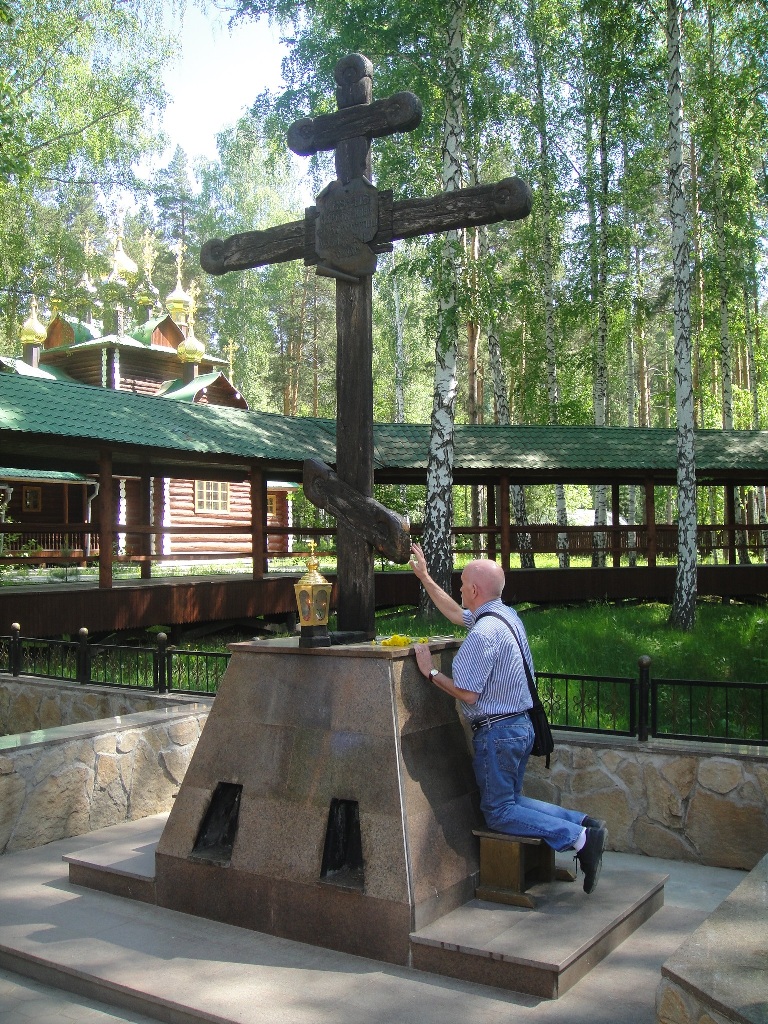
PHOTO: the author [Paul Gilbert] of this article praying at Ganina Yama. A wooden causeway has been built around the edge of the mine shaft, a tall Orthodox cross marks the edge of the mine shaft – visible as a depression in the ground – where the remains of Nicholas II and his family were first discarded by the regicides.

In the pre-dawn hours of 17th July 1918, a crime of the most heinous kind was committed in the basement of the Ipatiev House in the Ural city of Ekaterinburg. It was here that members of the Ural Soviet [Bolsheviks] murdered Russia’s last Tsar, his wife and their five children, as well as the family’s four faithful retainers. The regicide remains one of the darkest pages in 20th Russian history.

Following the murders, the regicides secretly transported their bodies to the abandoned Isetsky mine, located near the Four Brothers tract, situated four kilometres southeast of the village of Koptyaki, and some 15 km (10 miles) north of the Ural city, where their remains were subsequently thrown into a 9 ft. deep pit. The site is today known as Ganina Yama.

Fearing that the burial site was no longer a secret, the regicides returned to the site the night after the first burial, retrieved the bodies from the mine and transported them to a second burial site known as Porosyenkov Log, situated 3.5 km from the original site.

On 20th August 2000, Emperor Nicholas II and his family were glorified as passion bearers[1] by the Council of Bishops of the Russian Orthodox Church[2]. On 23rd September 2000, during his visit to the Urals, Patriarch Alexei II (1929-2000) visited the Ganina Yama tract and, having blessed the establishment of the monastic monastery, put his signature on the master plan of the monastery[3]. The first stone of the monastery was laid on 1st October 2000. On 27th December, the Holy Synod officially “blessed the opening of a monastery in the name of the Holy Royal Martyrs in the Ganina Yama tract”. On 28th December, the all-male Monastery of the Holy Royal Martyrs was established here.

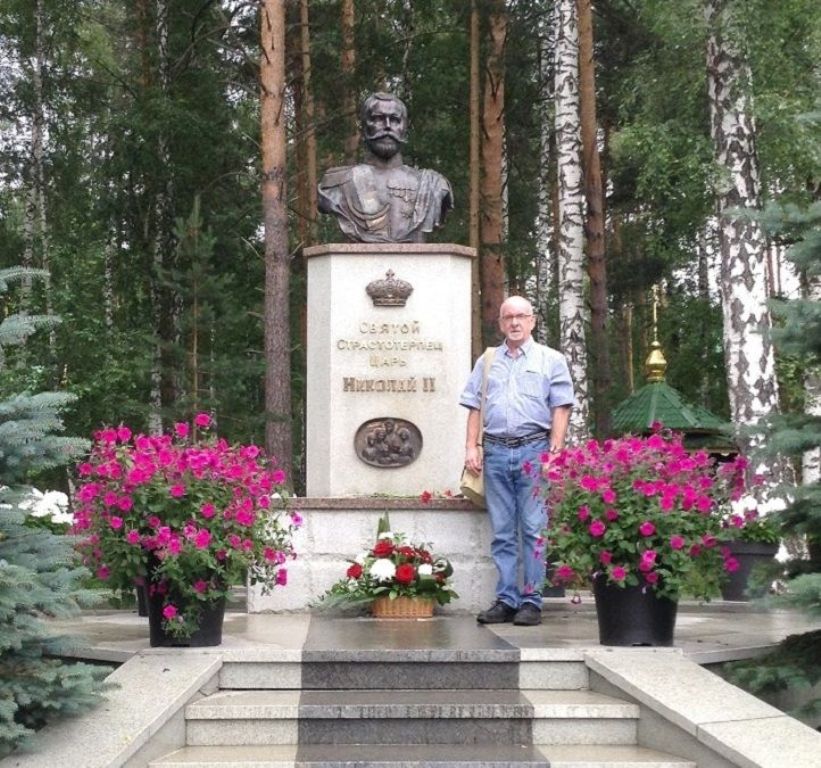
PHOTO: the author [Paul Gilbert] standing next to the monument to Emperor Nicholas II, installed on the grounds of Monastery of the Holy Royal Martyrs on 19th May 2008, the Sovereign’s birthday

Following their canonization, the Russian Orthodox Church declared the Ganina Yama site holy ground. The grounds were therefore dedicated to honour the family’s humility during their house arrest and their status as political martyrs. With financial assistance from the Ural Mining and Metallurgical Company, the Church constructed the Monastery of the Holy Royal Martyrs at the site in 2001. A tall cross marks the edge of the mine shaft, visible as a depression in the ground.[3]

Seven wooden chapels were later constructed at the site, one for each member of the Imperial Family. Each chapel is dedicated to a particular saint or relic. The katholikon [the main church of the monastery] is dedicated to the Theotokos Derzhavnaya [Reigning Icon of the Mother of God], an icon particularly revered by the monarchists.

Since the opening of the monastery, Ganina Yama has become not only a place of spiritual pilgrimage, but also a historical and educational center. Up to 10 thousand pilgrims visit Ganina Yama each month. They come mostly from the Ural region, however, increasing numbers from across Russia, and foreign countries as far away as the United States and Australia make the journey to honour the memory of the Holy Royal Martyrs. Most of the pilgrims are Orthodox Christians and monarchists, but Ganina Yama also welcomes the “curious” visitor, those who seek to learn about Russia’s last Tsar and his family. In July of each year, the number of pilgrims swells by the tens of thousands for the events marking Tsar’s Days.

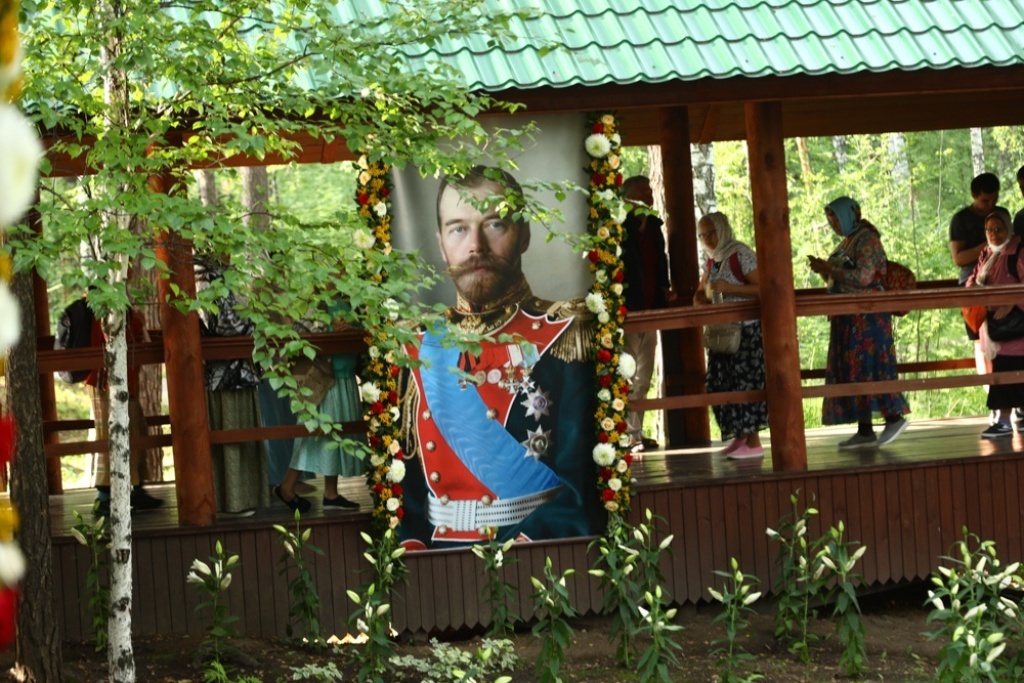
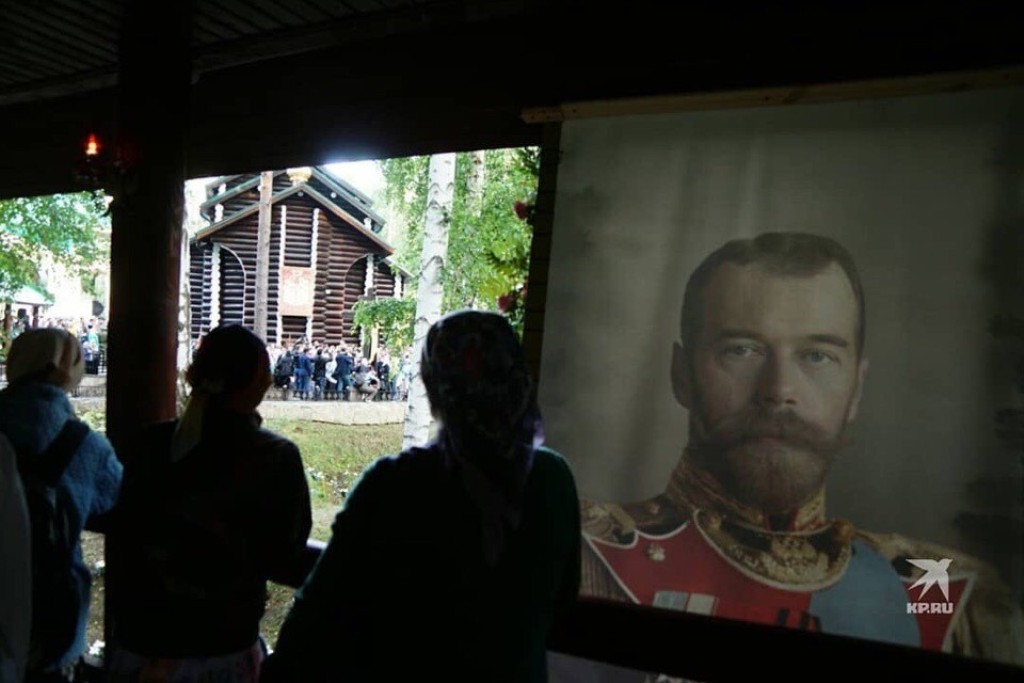
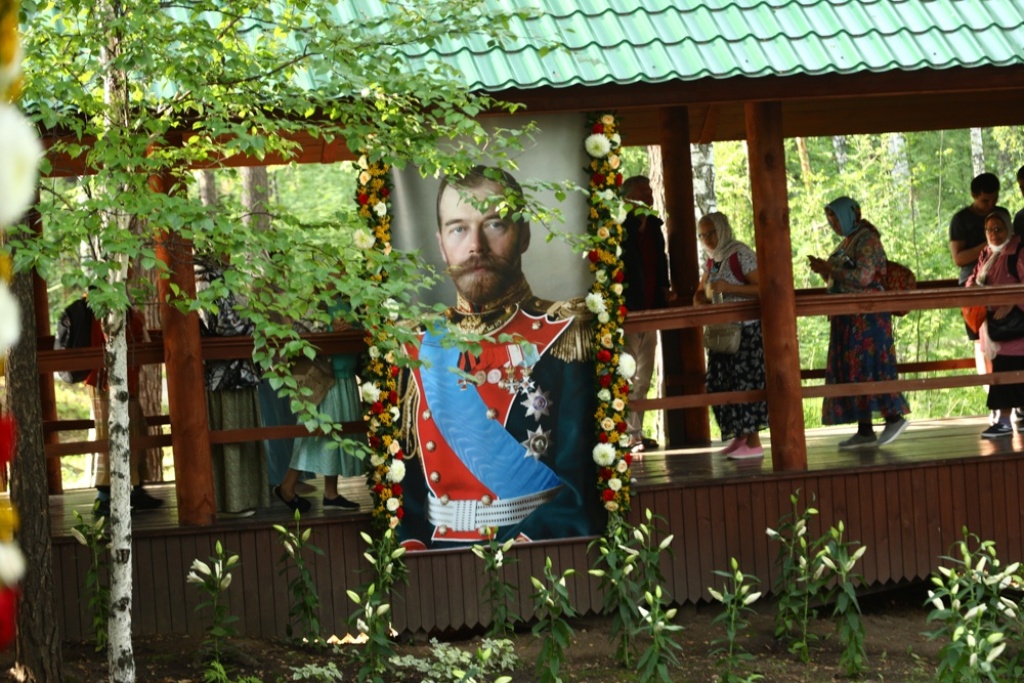
A wooden causeway surrounds the abandoned mine shaft – visible as a depression in the ground – where the remains of Nicholas II and his family were first discarded after their brutal murder. The area is filled with fragrant white lilies[4]. In 2018, seven portraits [colourized by Olga Shirnina aka KLIMBIM] of Nicholas II and his family were installed around the causeway.

On the night of 16/17 July, a night-long service is held at the Church on the Blood in Ekaterinburg ]built on the site of the Ipatiev House]. At daybreak, tens of thousands of pilgrims take part in a 21 km [13 miles] Cross procession [a four hour journey on foot] from the Church on the Blood in Ekaterinburg to the Monastery of the Holy Royal Martyrs in Ganina Yama, where a Divine Liturgy is performed at the edge of the abandoned pit. In 2018, an estimated 100,000 people from across Russia and around the world took part.

Once a bastion of Bolshevism, Ekaterinburg has slowly shed its status as the “capital of atheism”. Since the fall of the Soviet Union in 1991, the Urals has experienced a revival of faith, with Ekaterinburg at the into the center of Orthodox Russia in the Urals. Ekaterinburg has done more to honour Nicholas II and his family than any other city in Russia.

For those who wish to honour the memory of Russia’s last Emperor and his family, a pilgrimage “for reflection and prayer” to the Urals is a once in a lifetime experience. If you are planning to visit Ekaterinburg during Tsar’s Days, I highly recommend visits to the places which memorialize the last days of Emperor Nicholas II and his family – in particular the Church on the Blood, Ganina Yama and Porosenkov Log.

Holy Royal Martyrs, pray to God for us! 
Святы Царственные мученики, молите Бога о нас! 

Visiting Information

The Monastery of the Holy Royal Martyrs at Ganina Yama is open daily from 09:00 to 18:00. Admission is FREE, although a donation box is located in the welcome center, near the entrance.

Visitors should allow approximately 3-4 hours for their visit. The monastery also has a museum and exhibition center – located on the ground floor of the Church of the Reigning Mother of God – which hosts numerous temporary exhibitions throughout the year.

In addition, the monastery offers a small cafe with refreshments and snacks; a gift shop, which offers books, icons and souvenirs, all the proceeds of which help with the maintenance and upkeep of the monastery.

On the weekends believers can attend the evening service on Saturdays, and the Divine Liturgy on Sundays. When visiting the monastery and churches, visitors are required to adhere to the Orthodox dress code: for instance, women must cover their heads – scarves and long aprons are available for tourists at the entrance to the monastery.

In addition, the monastery offers accomodation at the Diocesan Pilgrimage Center, providing pilgrims with a place to pray, rest and eat. The hotel has standard rooms, a conference room, a children’s room and a prayer room, Wi-Fi access and parking.

NOTES:

[1] Despite their official designation as “passion-bearers” in 2000, by the Council of Bishops of the Russian Orthodox Church, Emperor Nicholas II and his family are referred to as “martyrs” in Church publications, icons, and in popular veneration by the people.

[2] Emperor Nicholas II and his family were canonized as martyrs by the Russian Orthodox Church Outside of Russia (ROCOR) in 1981, however, it was not until 2000, that they were canonized by the Moscow Patriachate.

[3] It has come to this author’s attention, that the Monastery of the Holy Royal Martyrs at Ganina Yama is sometimes referred to by some Westerners as “Romanovland“, a disrespectful comparison to an amusement park.

[4] White lilies are considered to be a representation of Christ’s purity and divinity, also symbolizing resurrection.

© Paul Gilbert. 11 April 2022

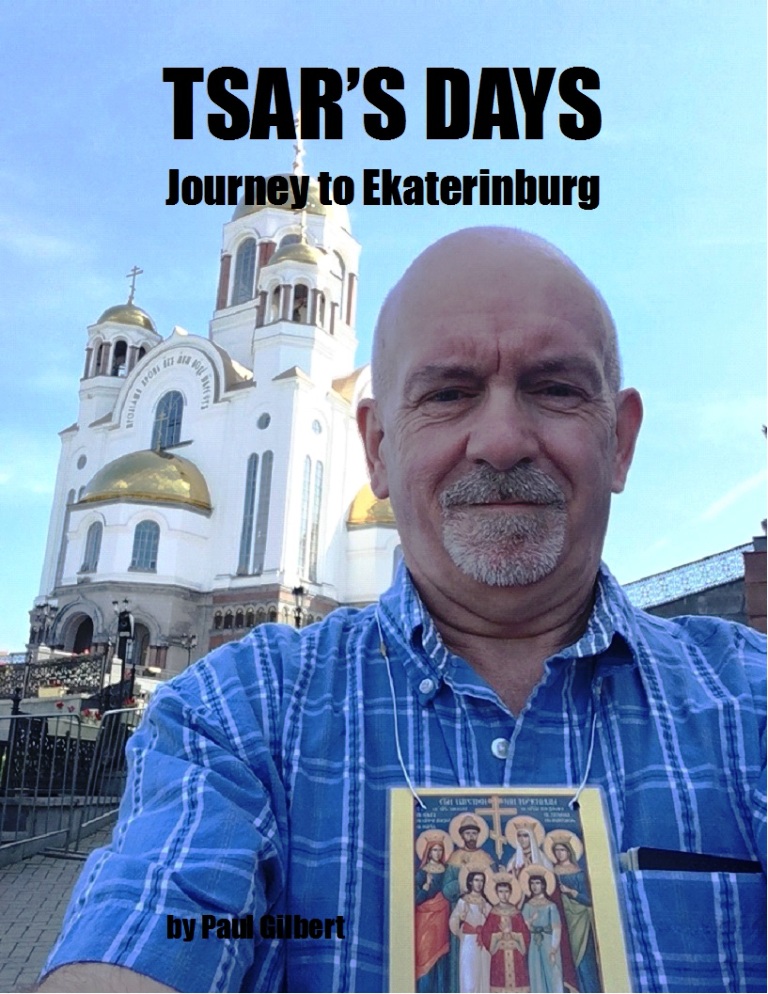
Tsar’s Days: Journey to Ekaterinburg

*This title is available from AMAZON in the USA, UK, Canada,
Australia, France, Germany, Spain, Italy, Netherlands and Japan

CLICK ON THE LINK BELOW TO ORDER FROM AMAZON

HARD COVER EDITION @ $40 USD

PAPERBACK EDITION @ $25 USD

BOOK DESCRIPTION

Hardcover and Paperback editions. 152 pages + Richly illustrated with nearly
200 COLOUR PHOTOS, 65 of which were taken by the author

***

On 17th July 1998, independent researcher and writer Paul Gilbert travelled to St. Petersburg, for the interment of Emperor Nicholas II and his family. Twenty years later to the day, he journeyed to Ekaterinburg, to take part in Tsar’s Days and the events marking the 100th anniversary of the Tsar’s death and martyrdom.

In his own words and photographs, he shares his own personal experiences and impressions of the places associated with the last days of Emperor Nicholas II and his family, including the Church on the Blood, Ganina Yama, and Porosenkov Log. In addition, he writes about his visits to no less than three museums dedicated to the Holy Royal Martyrs, exhibitions, and the Patriarchal Liturgy performed on the night of 16/17 July by His Holiness Patriarch Kirill of Moscow and All Russia.

This book is complemented with 24 illustrated news articles about events leading up to Tsar’s Days in the Urals, from 1st to 31st July 2018.

Gilbert’s solemn journey to the Urals allowed him to experience history in the making, and to honour the memory of the Holy Royal Martyrs, a century after their death and martyrdom.

It may be years before most of us can visit Russia again, in the meantime, you can visit Ekaterinburg through the pages of this book from the comfort of your favourite chair.

© Paul Gilbert. 26 February 2022

Russian sculptor proposes removal of monuments to Bolsheviks in Ekaterinburg

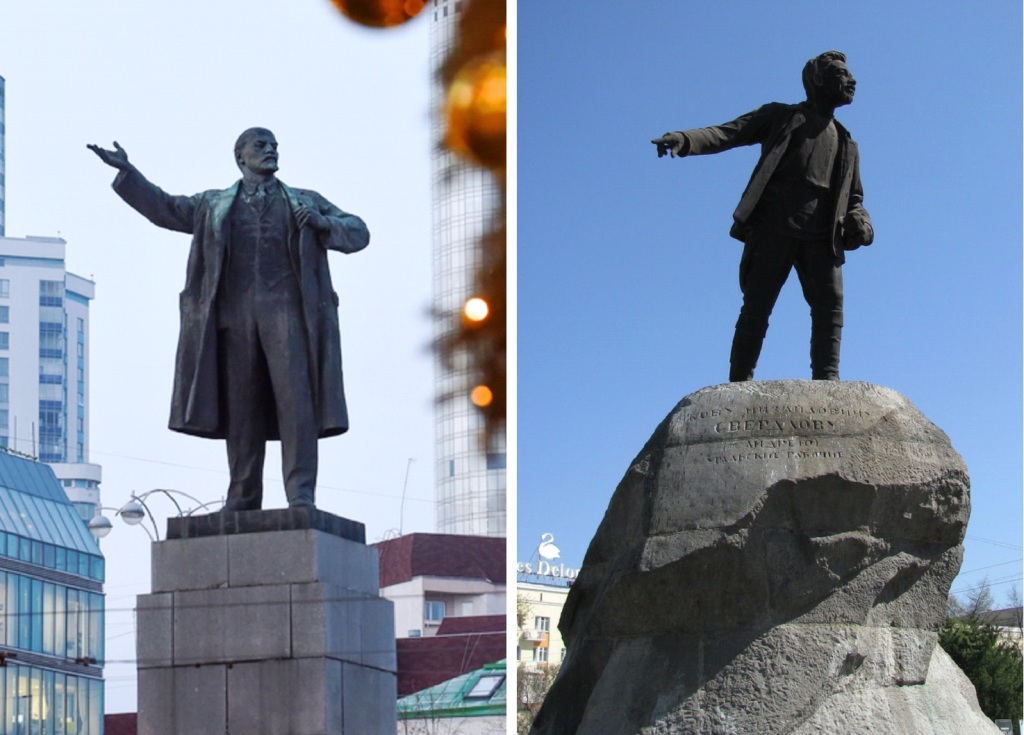
PHOTO: monuments to Lenin and Sverdlov in Ekaterinburg

The famous Russian sculptor Konstantin Vasilievich Grunberg has proposed replacing monuments of the Bolshevik leaders Vladimir Ulyanov (Lenin) and Yakov Sverdlov in Ekaterinburg with monuments to Emperor Alexander II (1818-1881) and *Empress Catherine I (1684-1727).

*Ekaterinburg was founded on 18th November 1723 and named after the Russian emperor Peter the Great’s wife, who after his death became Empress Catherine I, Yekaterina being the Russian form of her name.

Grunberg believes that by replacing the Bolshevik monuments will help solve the problem with city-planning concept. Although Ekaterinburg is called the capital of the Urals, little of the city’s history is reflected in the the center of Russia’s 4th largest city.

“Lenin’s monument should be removed from the 1905 Square, and in his place a bronze monument to Emperor Alexander II should be returned to its original pedestal” said Konstantin Grunberg.

In 1906, a monument to Alexander II [demolished by the Bolsheviks in 1917] was installed on Cathedral Square [renamed 1905 Square],near the Epiphany Cathedral [demolished by the Bolsheviks in 1930]. The monument to Lenin was installed on the site in the early 1950s.

Grunberg made the same proposal regarding the monument to Sverdlov [opened in 1927], which is situated on the Paris Commune Square in the middle of Lenin Avenue between the Ural Federal University and the Opera and Ballet Theater. The sculptor has proposed that a monument to Empress Catherine I would look more appropriate.

“Throw the monuments to Lenin and Sverdlov into a pit!” Grunberg suggested.

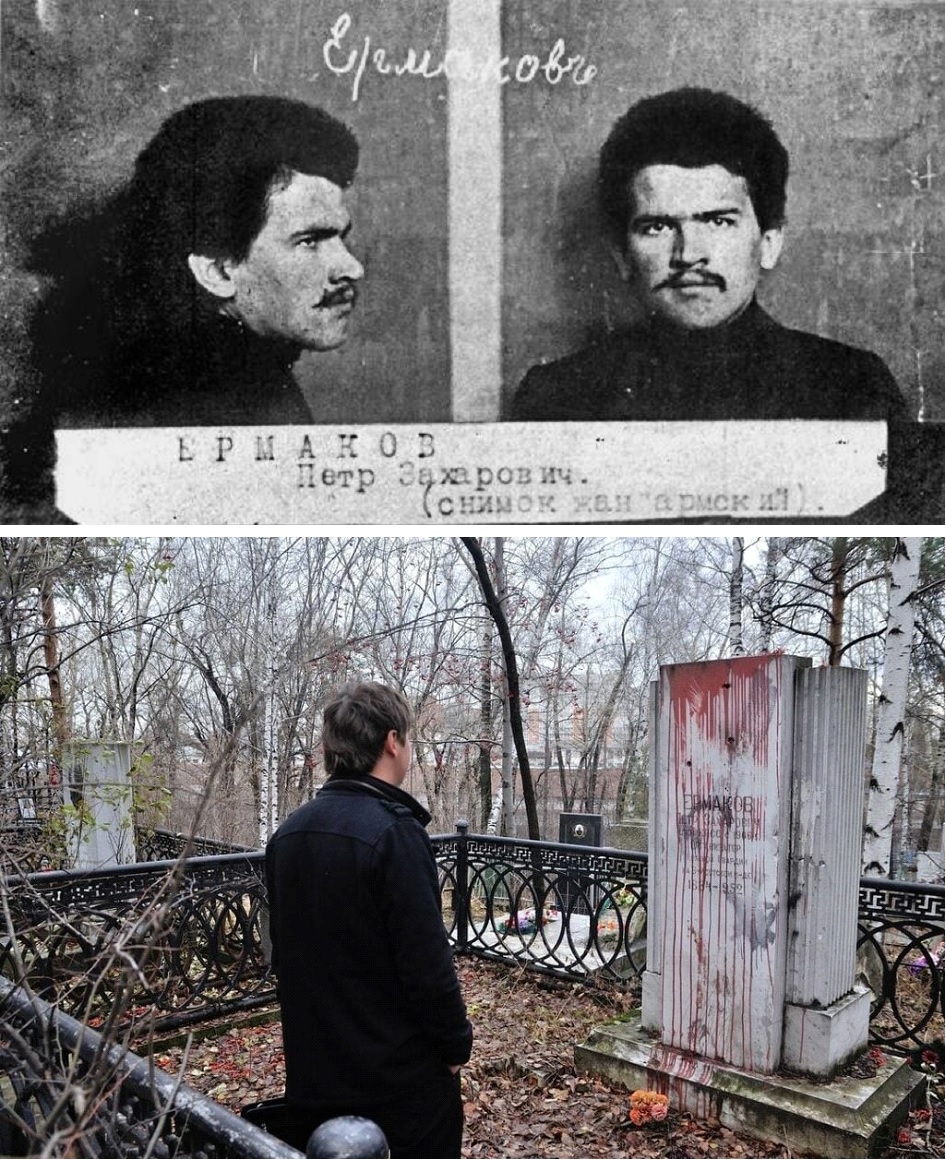
PHOTO: ‘You reap what you sow’ – local monarchists take revenge on the Bolshevik revolutionary and murderer Peter Zakharovich Yermakov (1884-1952), by dosing his grave with red paint symbolizing blood

Konstantin Grunberg also called for debunking the image of the revolutionary “hero” Pyotr Yermakov, who participated in the murder of the Imperial Family and whose grave is located in the cemetery next to the grave of the writer Pavel Bazhov. “People still bring flowers to his grave. We need to destroy this regicide’s grave!” the sculptor said.

Yermakov died in Sverdlovsk on 22 May 1952 from cancer at the age of 67 and was buried in Ivanovo Cemetery in Ekaterinburg.

In 1951, at a reception, which gathered all the local Party elite in Sverdlovsk, Yermakov approached Soviet Red Army General Georgy Zhukov [1896-1974] and held out his hand. Frowning in disgust Zhukov looked Yermakov in the eye, and muttered, “I do not shake the hands of the murderers.”

Yermakov’s Mauser revolver, which he alleges fired the fatal shot which ended the life of Russia’s last Tsar is preserved today in the Museum of History and Archaeology of the Urals in Ekaterinburg.

Every year, since the 1990s, Yermakov’s grave has been vandalized by local monarchists, who douse his gravestone with red paint.

The red paint symbolizes the blood which this evil man spilled, and his involvement in the brutal murder of Nicholas II and his family on 17th July 1918.

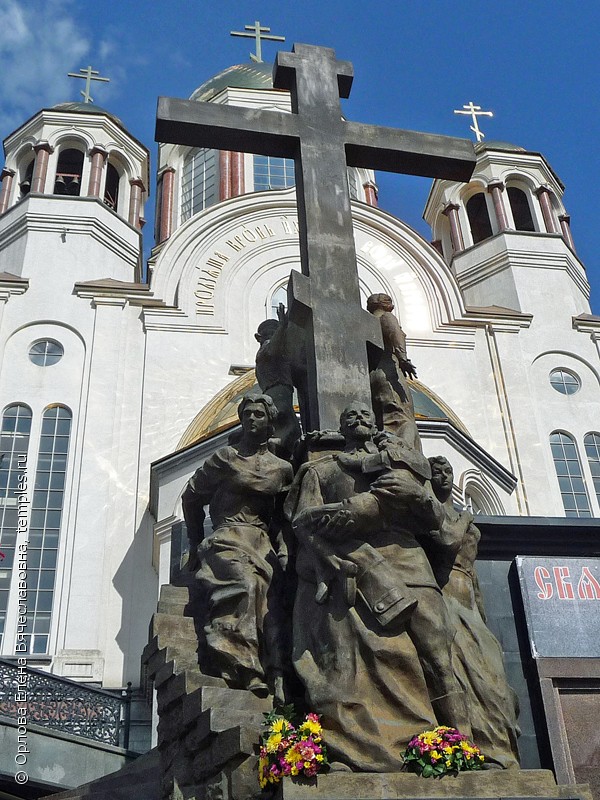
PHOTO: Grunberg’s monument to the Holy Royal Martyrs, Church on the Blood

Konstantin Vasilievich Grunberg [born in Sverdlovsk in 1944] is a famous Russian sculptor who has eight monuments to his credit. Among them is the sculptural composition of the Holy Royal Martyrs situated at the entrance to the Lower Church of the Church on the Blood in Ekaterinburg. The composition which was officially unveiled and consecrated on 28th May 2003, depicts the Imperial Family descending the 23 steps in the basement of the Ipatiev House, where they met their death and martyrdom on 17th July 1918.

© Paul Gilbert. 15 January 2022

Moscow to host conference on Imperial Family’s murder

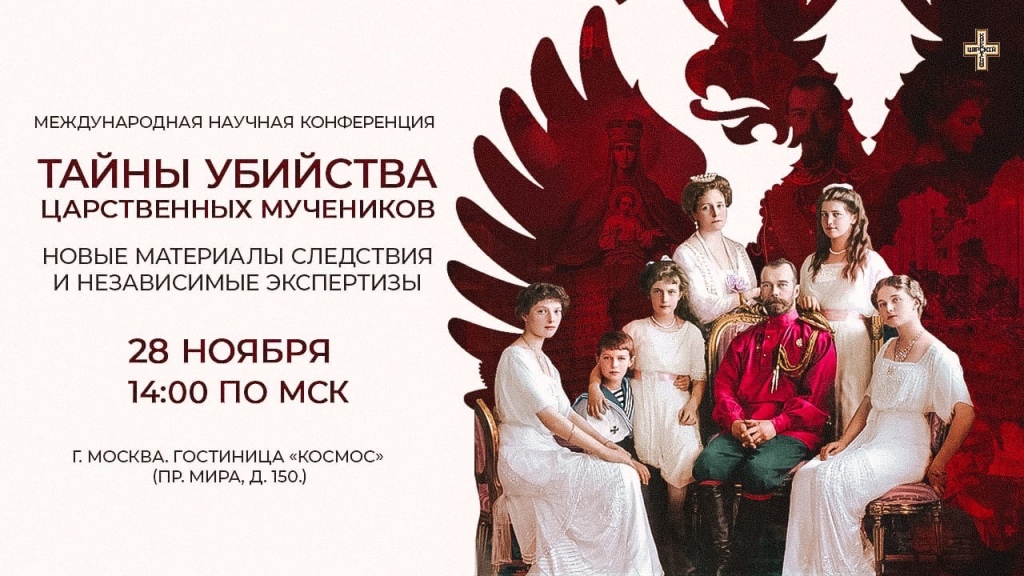
On 28th November 2021, the international scientific conference “Secrets of the Murder of the Royal Martyrs. New Materials of the Investigation and Independent Examinations,” will be held in the large congress hall of the Cosmos Hotel in Moscow.

The conference is a joint project of three Orthodox foundations in pursuance of the resolutions of the Councils of Bishops in 2016 and 2017, which provide for a broad public discussion of the materials of a comprehensive examination of the investigation, which were carried out between 2015 to 2021.

The conference will be attended by more than 15 scientists involved in the process of studying the Ekaterinburg Remains, currently interred in the Catherine Chapel, a side chapel of the SS Peter and Paul Cathedral in St. Petersburg. Each speaker will be alloted 15-20 minutes.

The first cohort of specialists consists of “experts of modern investigation”: forensic physician, doctor of medical sciences, professor Vyachesl av Popov, forensic physician, doctor of medical sciences, professor Vladimir Trezubov, geneticist, doctor of biological sciences Yevgeny Rogaev, anthropologist, candidate of biological sciences Denis Pezhemsky , forensic doctors, Doctor of Medical Sciences Viktor Z vyagin and Sergey Nikitin, Doctor of Historical Sciences Lyudmila Lykova, Candidate of Historical Sciences, Associate Professor Evgeny Pchelov. The participation of the investigator V. Soloviev and M. Molodtsova is also expected.

The second cohort of conference participants includes “independent experts”: forensic expert, candidate of medical sciences Yuri Grigoriev, forensic medical expert-criminalist, candidate of medical sciences Konstantin Teplov, dentist-orthopedist of the highest category Emil Agadzhanyan, doctor of historical sciences , professor at the Sorbonne Andrey P Achinsk th (France), Candidate of Historical Sciences Peter Valentinovich Multatuli, historians Leonid Bolotin, Inn and Simon, Mark Knyazev, a lawyer, a doctor juridich Sgiach Science Mikhail l Kuznetsov, a lawyer, PhD in law, Ph.D. George Shayryan.

The organizers of the conference are President of the St. Basil the Great Russian Educational Foundation Vasily Boyko, Chairman of the Women’s Orthodox Patriotic Society of the Patriarch Hermogenes Foundation Galina Ananyina, Director of the International Foundation for Slavic Writing and Culture Aleksander Bochkarev.

NOTE: the conference will be telecast LIVE [in Russian] at 6:00 am EST on 28th November.
CLICK on the image below to set a REMINDER

© Paul Gilbert. 26 November 2021

“ROC will not recognize Ekaterinburg remains,” claims prominent Russian forensic scientist

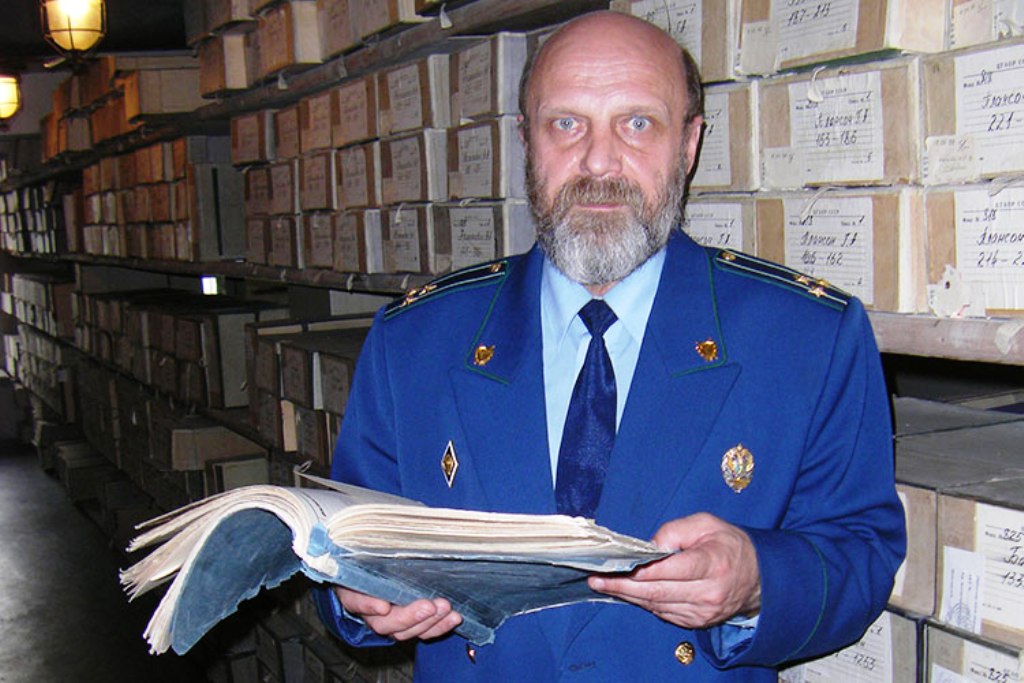
PHOTO: Vladimir Soloviev the State Archives of the Russian Federation in Moscow

A very troubling interview was published in today’s edition of Бизнес Online [Business Online], whereby legendary forensic scientist Vladimir Soloviev stated: “there will no recognition of the Ekaterinburg remains in November by the Bishops’ Council of the Russian Orthodox Church (ROC).” Below, is a condensed version of the interview.

Now retired, Vladimir Nikolaevich Soloviev, senior investigator and forensic expert at the Main Department of Criminalistics (Forensic Center) of the Investigative Committee of the Russian Federation, who from 1991 to 2015 led the investigation into the deaths of the Imperial Family. Over the years, the case of the Ekaterinburg remains took up much of his professional career.

BO: Do you know what is happening today with the ROC’s investigation?

VS: All work on the identification of the Ekaterinburg remains was completed a long time ago. As far as I know, a historical examination is still underway. But this can be carried out indefinitely.

Marina Molodtsova, who heads the investigation team today, is a good and qualified specialist. I have no issues with her. But, she is a person of the system. If she is issued an order – she salutes. Putin gave carte blanche to the patriarch, and until such time that the president gives an order for closure, the investigation will continue.

BO: At the end of June, the Holy Synod of the Russian Orthodox Church decided to submit the results of the examinations on the identification of Ekaterinburg remains for consideration by the Bishops’ Council, which is to be held in November. But, frankly, after everything that has happened during the last 30 years, it is hard to believe that the issue of recognizing the remains will be resolved this year.

VS: I can’t believe it either, and there will be no recognition of the Ekaterinburg remains by the Bishops’ Council of the Russian Orthodox Church, when they meet in November. Patriarch Kirill is a very proud person. He would have to explain in front of everyone why the Lord does not love him, why he did not enlighten him during these 30 years. After all this time, Kirill was against the recognition of the remains. He was, in fact, the main ideologist of this position. Vsevolod Chaplin (1968-2020), shortly before his death, told me about a conversation he had with the Patriarch. According to Chaplin, Kirill told him that he would do anything to avoid resolving the issue of the Ekaterinburg remains during his life.

I foresee that at the Bishop’s Council they will say that the church is not completely satisfied with the results of the research and investigation, and that something is missing, yet . . . again!

BO: In an interview given to me a few days before his death, Geliy Trofimovich Ryabov (1932-2015), bitterly said: “When I decided to make our discovery public [grave of Nicholas II and family members in 1991], I naively believed that it would contribute to reconciliation, by bringing closure to our country’s history. But I did not take into account that this war would be permanent. At a certain moment, I came to the conclusion that if I knew how all this would turn out, I probably would not have disclosed the burial place of the Imperial Family.” Have you ever had such thoughts, or regrets that you got involved in this, as it is now obvious is hopeless?

VS: Of course, in terms of career, I resigned, so to speak, but not on a high note. First of all, of course, the church and the church community did their best to discredit me. They accused me of anything! But, if there was an opportunity to go back in time, 30 years ago, I would do it all over again.

I will say, however, that perhaps it was good that this case has been dragging on for as long as it has. If it was completed within the “normal” time frame and the remains were immediately buried, the image of the Imperial Family would have quickly faded away, come to naught. It is thanks to all these scandals that their tragic fate received so much attention by so many scientists and experts.

© Paul Gilbert. 18 July 2021

Tsar’s Days in Ekaterinburg 2021

PHOTO: members of the Double-Headed Eagle Society carry an icon of the Holy Tsar-Martyr Nicholas II on the square in front of the Church on the Blood in Ekaterinburg

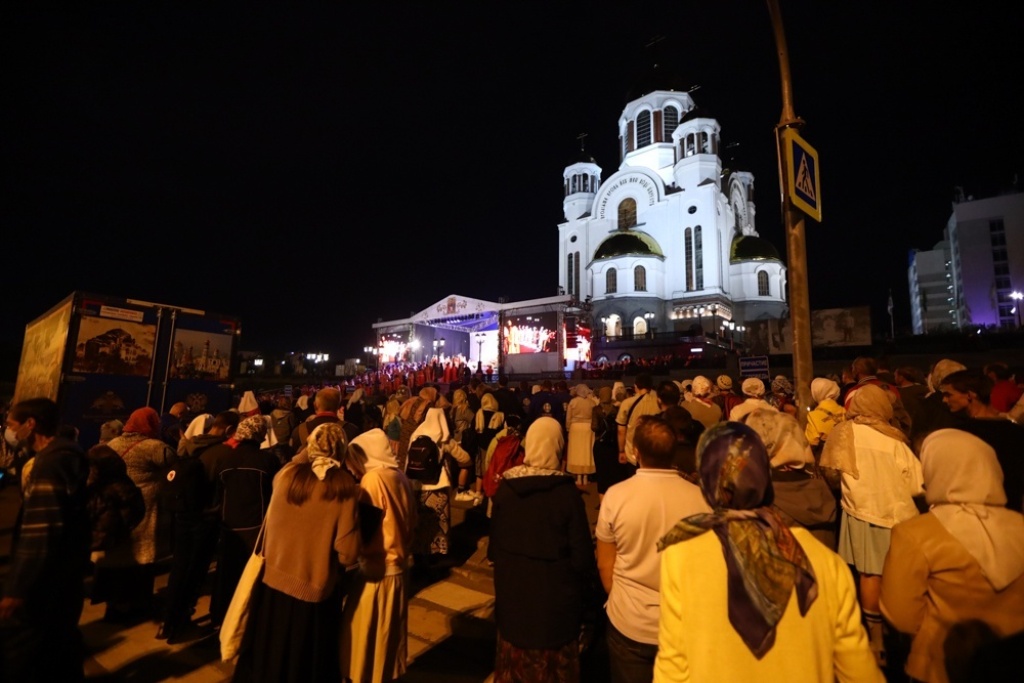
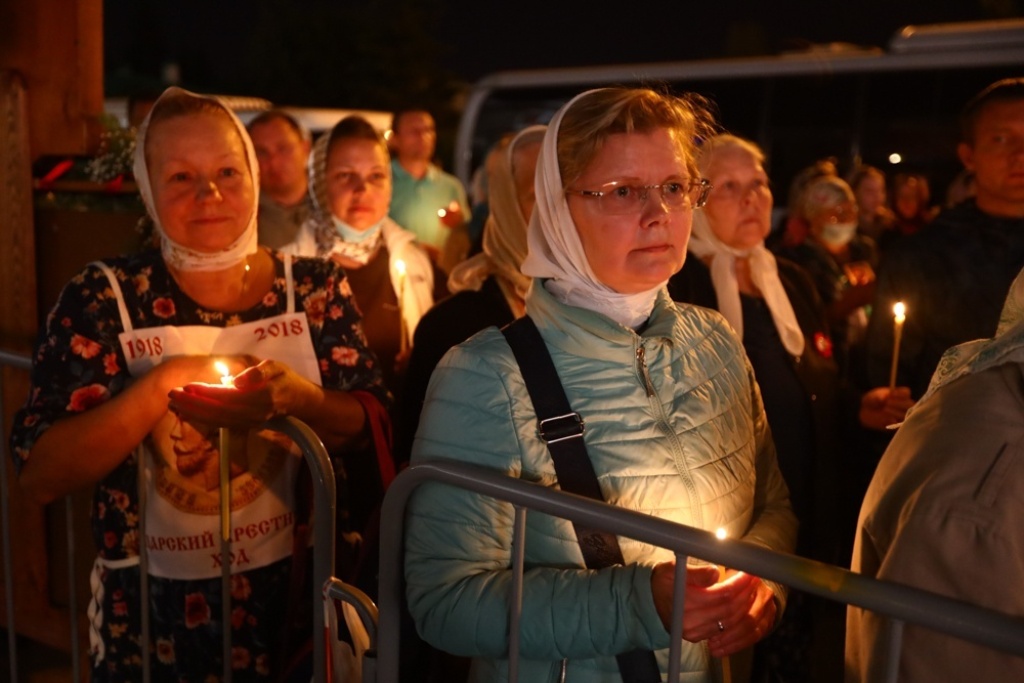
On the night of 16/17 July, a Divine Liturgy in memory of the Holy Royal Martyrs, took place on the square in front of the Church on the Blood in Ekaterinburg. The Divine Liturgy and Cross Procession are the highlights of the annual Tsar’s Days held in the Ural capital.

Traditionally, several tens of thousands of people participate in the Tsar’s Cross Procession – 10 thousand in 2020 [due to COVID], 60 thousand in 2019 and 100 thousand in 2018 [100th anniversary]. Despite the pandemic, an estimated 3 thousand Orthodox Christians and monarchists took part in this year’s Divine Liturgy.

PHOTO: on the night of 16th July 2021, an estimated 3 thousand pilgrims attended the Divine Liturgy at the Church on the Blood in Ekaterinburg

In addition, the memory of the Holy Royal Martyrs was honoured with Divine Liturgies held in Orthodox churches across Russia and around the world. In addition, many people lit candles in front of icons, while offering prayers in the privacy of their homes around the globe. The author of this article was one of them.

The Divine Liturgy was led by eight bishops of the Russian Orthodox Church: Metropolitan Eugene of Yekaterinburg and Verkhotursky, Metropolitan of Tashkent and Uzbekistan Vikentiy, Metropolitan of Chelyabinsk and Miassky Alexy, Bishop of Orsk and Gaysky Irenaeus, Bishop of Isilkul and Russian-Polyansky, Bishop Theodosius of Nizhny Novgorod and Nizhny-Polyan Kamyshlovsky Methodius, Bishop of Zlatoust and Satka Vincent.

PHOTO: Orthodox Christians gather on the square in front of the Church on the Blood to honour the memory of the Holy Royal Martyrs

Metropolitan Eugene addressed the faithful, who had assembled on the square in front of the church:

“The sacred, solemn, tragic, joyful night has come, which we call the Tsar’s night within the Tsar’s Days. A night that combines in itself the tragedy of Good Friday, the Gethsemane struggle that the Holy Royal Martyrs experienced at this place. And on the same night, the great joy of the Resurrection of Christ and the glory into which the Holy Royal Martyrs entered from this place is revealed. All this is experienced very closely by every person, and we have the opportunity to draw here both the hope of the resurrection and our strength to endure these Gethsemane temptations.

“At this time 103 years ago, the August Family, having prayed to God, saying: “In Thy hands, O Lord, I commend my spirit,” just like we do when to go to sleep. And after a few minutes, footsteps sounded along the corridors, they began to be raised, woken up and taken to the basement. We know today what glory it ended with. And I would like to wish everyone to be inspired by their faith, humility and patience,” – said Metropolitan Eugene.

The night service was broadcast live by the Soyuz Orthodox TV channel to 87 countries around the world. You can watch the Divine Liturgy in its entirety, by clicking on the VIDEO below, duration 2 hours and 41 minutes:

Vladyka conveyed to the participants in the Divine Liturgy the blessing of His Holiness Patriarch Kirill to be attentive to each other and to observe all the necessary health and safety measures during the pandemic. He called on everyone to pray for the sick and also for their doctors. Metropolitan Eugene also emphasized, that when the Cross Procession to Ganina Yama begins, “I will put on a mask and, which I hope, will set a good example so that we all show humility – this is our discipline, this is our strength.”

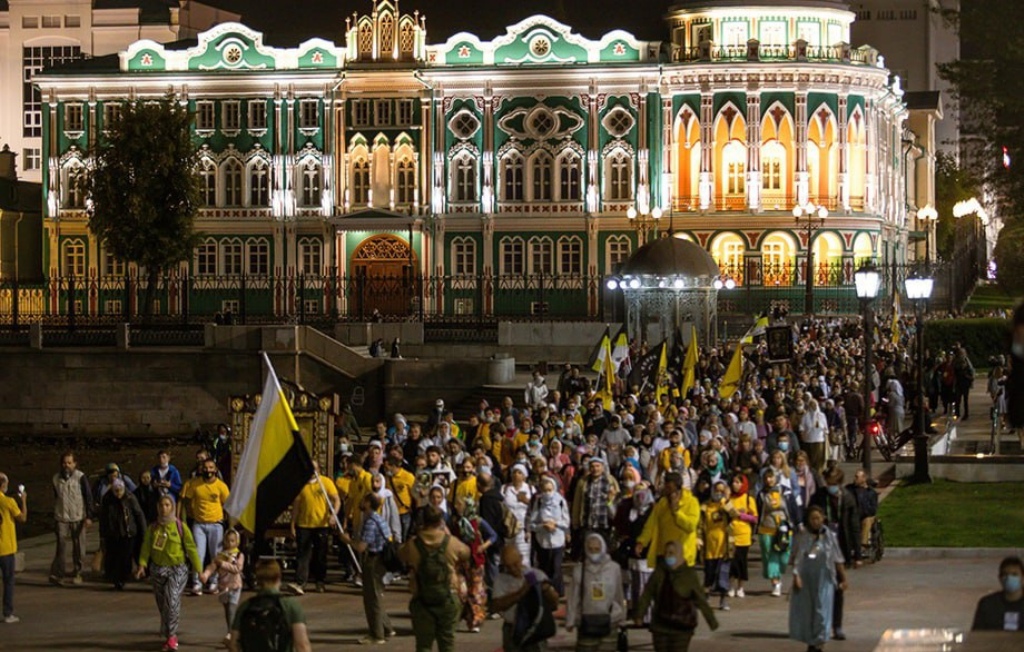
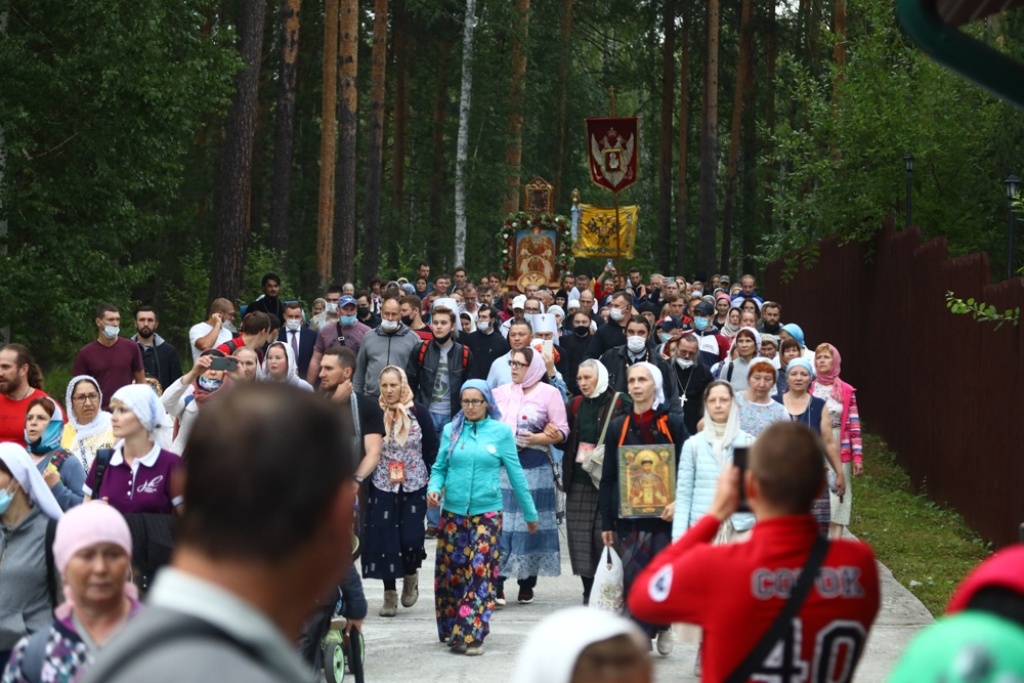
Following the Divine Liturgy, a Cross Procession took place from the Church on the Blood to the Monastery of the Holy Royal Martyrs at Ganina Yama. Pilgrims follow the route in which the bodies of the Imperial Family were transported to Ganina Yama – a distance of 26 km (16 miles), taking about four to five hours to walk on foot.

PHOTO: in the early morning hours of 17th July 2021, an estimated 2 thousand pilgrims participated in a Cross Procession from the Church on the Blood to the Monastery of the Holy Royal Martyrs at Ganina Yama

Due to the fact that the Governor of the Sverdlovsk Region cancelled this years Cross Procession (due to the COVID situation), the head of the Ekaterinburg Diocese, Metropolitan Eugene of Ekaterinburg and Verkhotursky defied the order, and led 2 thousand believers on today’s Cross Procession to Ganina Yama. This year, however, the roads were not closed to traffic, forcing the pilgrims to walk on narrow sidewalks and the shoulder of the highway to safely make the journey.

PHOTO: pilgrims arrive on foot at the Monastery of the Holy Royal Martyrs at Ganina Yama, after walking a distance of 26 km (16 miles) from the Church on the Blood, a journey taking about four to five hours

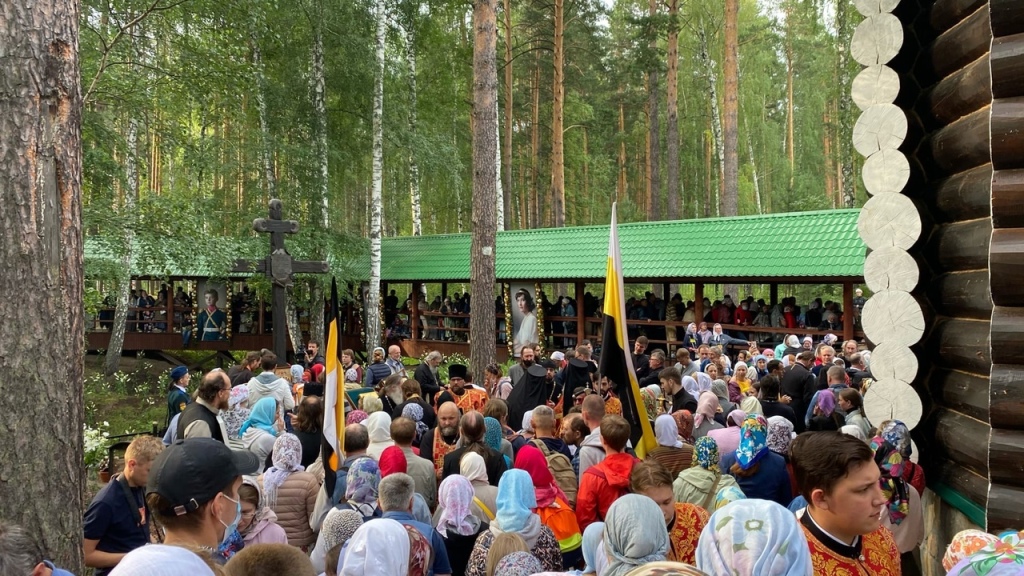
At approximately 6:30 am, another Divine Liturgy was performed at Mine No. 7, where the bodies of members of the Imperial Family and their loyal servants were thrown into the mineshaft by their killers. More than 80 clergymen prayed together with the arch-pastors of the Russian Orthodox Church.

PHOTO: Divine Liturgy was led by Metropolitan Eugene of Yekaterinburg and Verkhoturye at the Cross, erected over Mine No. 4, where the bodies of the Holy Royal Martyrs were thrown by their killers into an abandoned mine

The Divine Liturgy was led by Metropolitan Eugene of Yekaterinburg and Verkhoturye, Metropolitan of Tashkent and Uzbekistan Vikenty, Bishop of Isilkul and Russian-Polyansky Theodosius, Bishop of Nizhny Tagil and Nevyansk Theodosius.

Holy Royal Martyrs, pray to God for us! 🙏
Святы Царственные мученики, молите Бога о нас! 🙏

© Paul Gilbert. 17 July 2021

Ekaterinburg’s annual Tsar’s Cross Procession cancelled

PHOTO: tens of thousands participate in the annual Cross Procession in Ekaterburg

The Governor of the Sverdlovsk Region Yevgeny Kuyvashev announced today, that the traditional Tsar’s Cross Procession, which is held annually in Ekaterinburg on the anniversary of the death and martyrdom of Emperor Nicholas II and his family, has been cancelled due to a significant increase in the number of COVID-19 cases in the region.

In the past four days, more than 300 new cases of the coronavirus have been recorded in the region every day. Since the beginning of the pandemic in early 2020, more than 96 thousand people contracted the virus in Ekaterinburg and the Sverdlovsk region, 3.9 thousand of whom died. Russia is now experiencing a third wave and ranks fifth in the highest number of cases. More than 5.6 million cases have been recorded in Russia with more than 138 thousand deaths.

“This year the Cross Procession during Tsar’s days will not be held … The new strain t hat is spreading throughout the region is even more dangerous. Many more people are now in need of oxygen, the hospitals are filled to capacity. Therefore, we are cancelling the procession this year,” the governor stated.

Kuyvashev also published a photo from last year’s procession, in which, according to the Ekaterinburg Diocese, only 10 thousand people participated. The governor noted that despite the pandemic, many of the pilgrims did not use masks and did not practice social distancing. As a result, many of those who participated in last years’ Cross Procession, fell ill with the coronavirus shortly thereafter. He stressed that next year, providing the pandemic has been eliminated, it will be possible to hold a procession “on an even larger scale than before.”

Traditionally, several tens of thousands of people participate in the Tsar’s Cross Procession in the Ural city – 60 thousand in 2019 and 100 thousand in 2018. The procession follows the same route that the regicides carried the murdered remains of the Imperial Family and their faithful servants to an abandoned mine at Ganina Yama. The procession does not go to Porosnkov Log, where the regicides buried them in a second unmarked grave. The route of the procession begins at the Church on the Blood in Ekaterinburg to the Monastery of the Holy Royal Martyrs at Ganina Yama – a distance of 26 km (16 miles), taking about four to five hours to walk on foot.

PHOTO: Metropolitan Evgeny of Ekaterinburg and Verkhotursky

The head of the Ekaterinburg Diocese, Metropolitan Evgeny of Ekaterinburg and Verkhotursky was quick to respond to the governor’s announcement, by writing in his Telegram page about the importance of upholding the tradition of the Tsar’s Cross Procession, sacred to many Orthodox Christians and monarchists, and about the choice of each of us in a situation where there can be no ideal solutions.

“The tradition of the Tsar’s Cross Procession from the Church on the Blood to Ganina Yama has outgrown the framework of the so-called Tsar’s Days events and has become sacred for tens of thousands of people. And now people will continue to follow the holy path. But, will they walk along safely blocked streets? Or on narrow sidewalks next to dangerously speeding cars? Time will tell.

“In the current pandemic situation, there are no perfect solutions. Everyone must independently find a balance between courage and fear, responsibility and caution.

I will definitely go!”, declared Vladyka Yevgeny.

“The decision of the authorities, who have cancelled this years Tsar’s Cross Procession, is well founded, however, one should not stigmatize believers as the culprits of the spread of the coronavirus.

“Our goal is not death from fear of the coronavirus or from the coronavirus itself, but life with God and love for our neighbours.

“I urge everyone to take maximum precautions to protect themselves and of those around them. I pray that the Lord will preserve all of us in health and long life, and I bless you to add caution and love for your dearest to your prayer” Vladyka Yevgeny concluded.

© Paul Gilbert. 8 July 2021