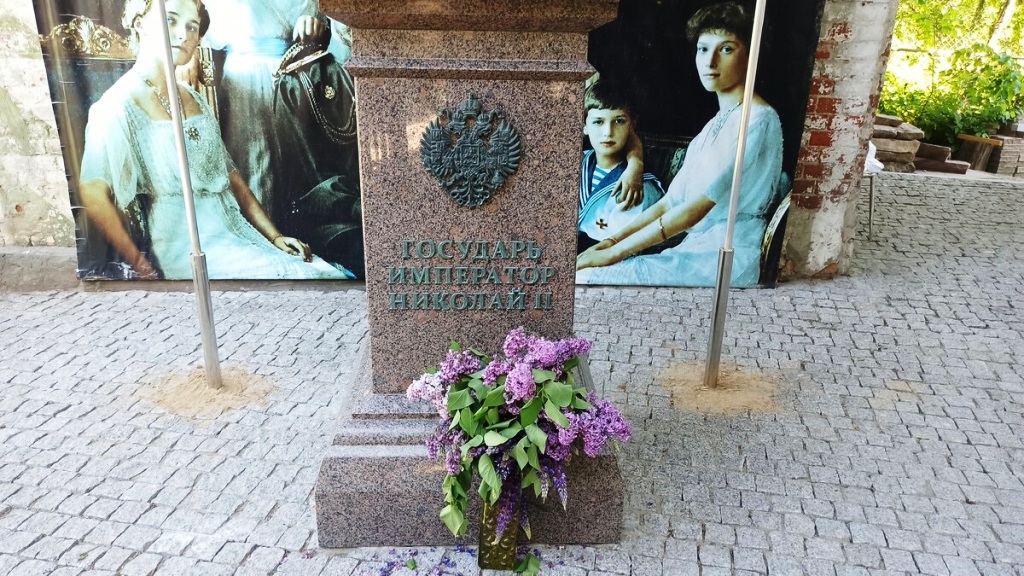
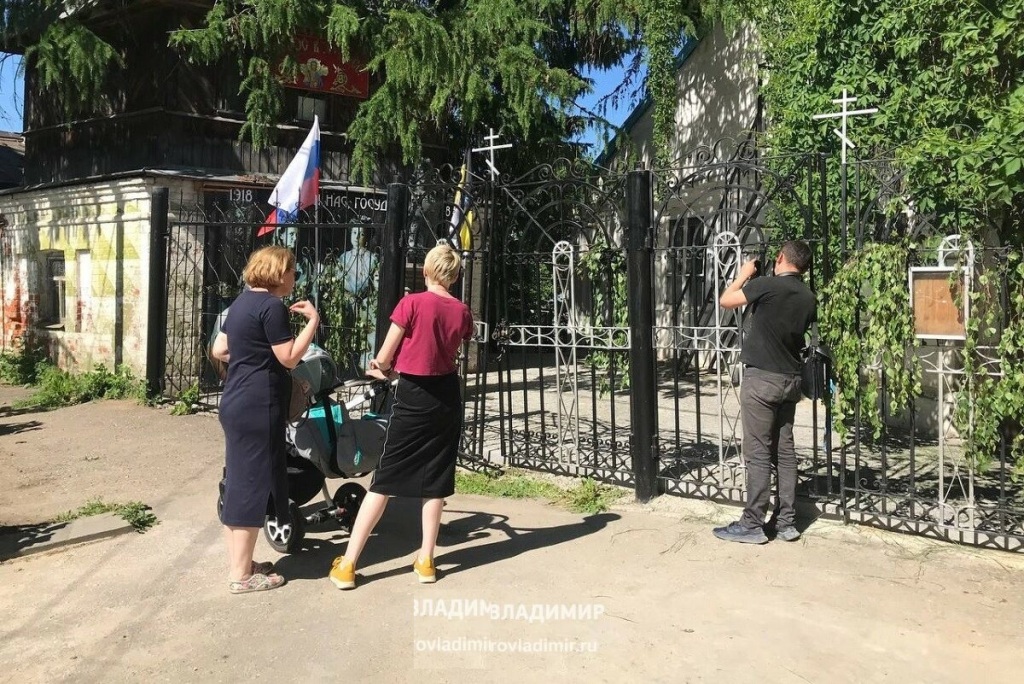
Russia’s second largest monument to Nicholas II erected in the Vladimir region

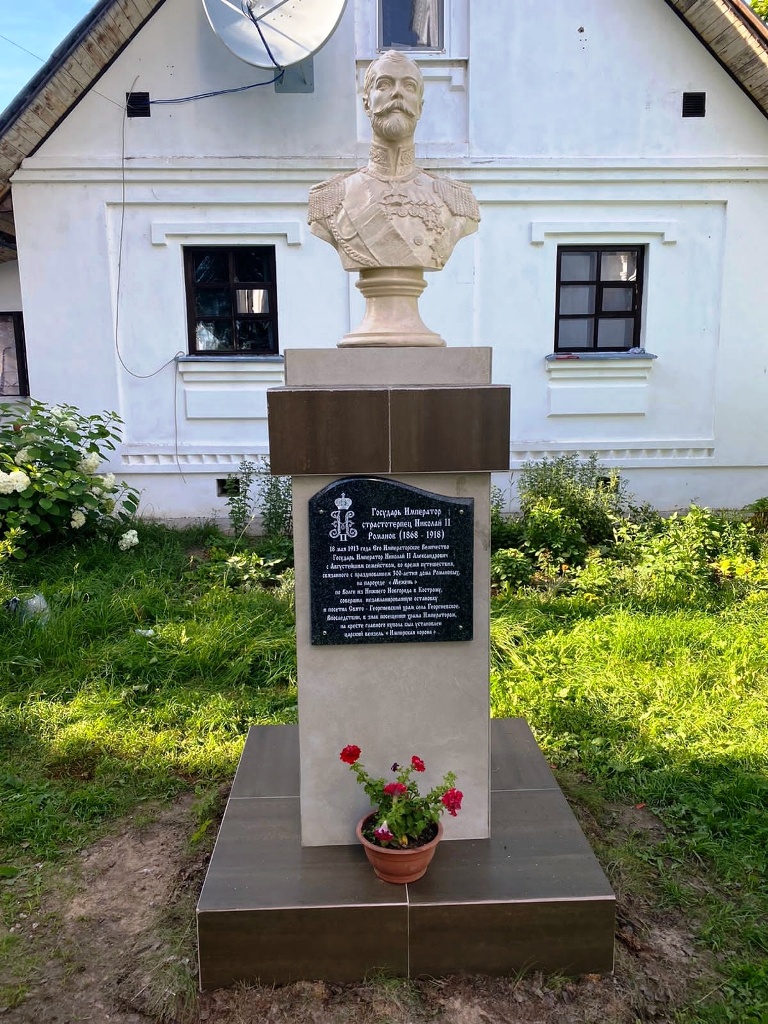
On 14th September, a new monument to Emperor Nicholas II was opened in the Russian village of Sanino, situated in the Petushinsky District of the Vladimir Region. The new monument is the first in the Vladimir region, and the country’s second largest monument to Russia’s last Tsar.

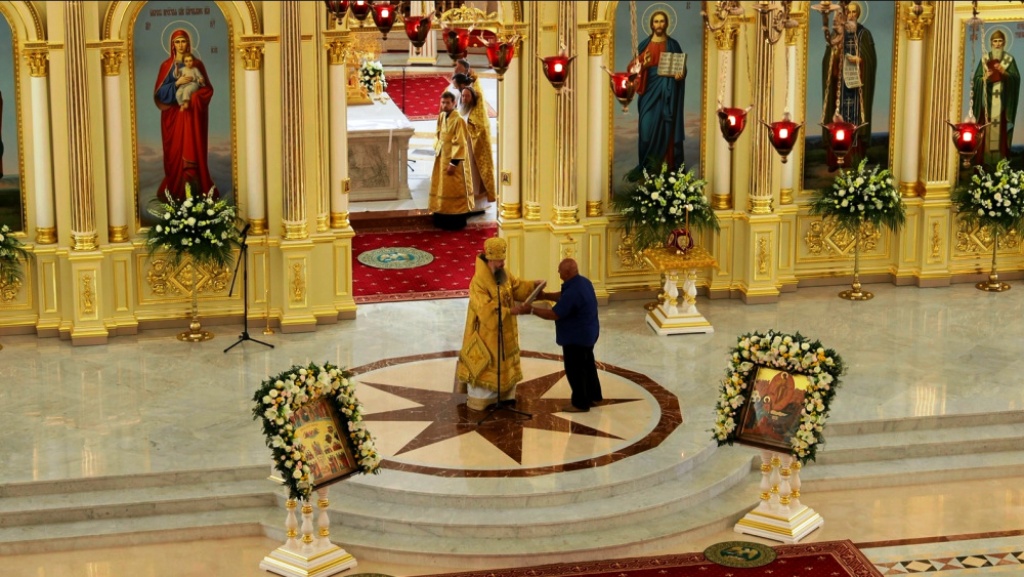
The bronze monument was made by the Moscow sculptor Rovshan Rzayev. It was installed on the grounds of the Church of the Chernigov Icon of the Mother of God in the village of Sanino. The opening of the monument was timed to coincide with the patronal feast day. A Divine Liturgy was led by Metropolitan Ambrose of Tver and Kashin. About 500 people took part in the service, procession, unveiling and consecration of the monument.

PHOTO: Metropolitan Ambrose of Tver and Kashin performs the act of consecration

PHOTO: more than 500 people attended the unveiling and consecration ceremony

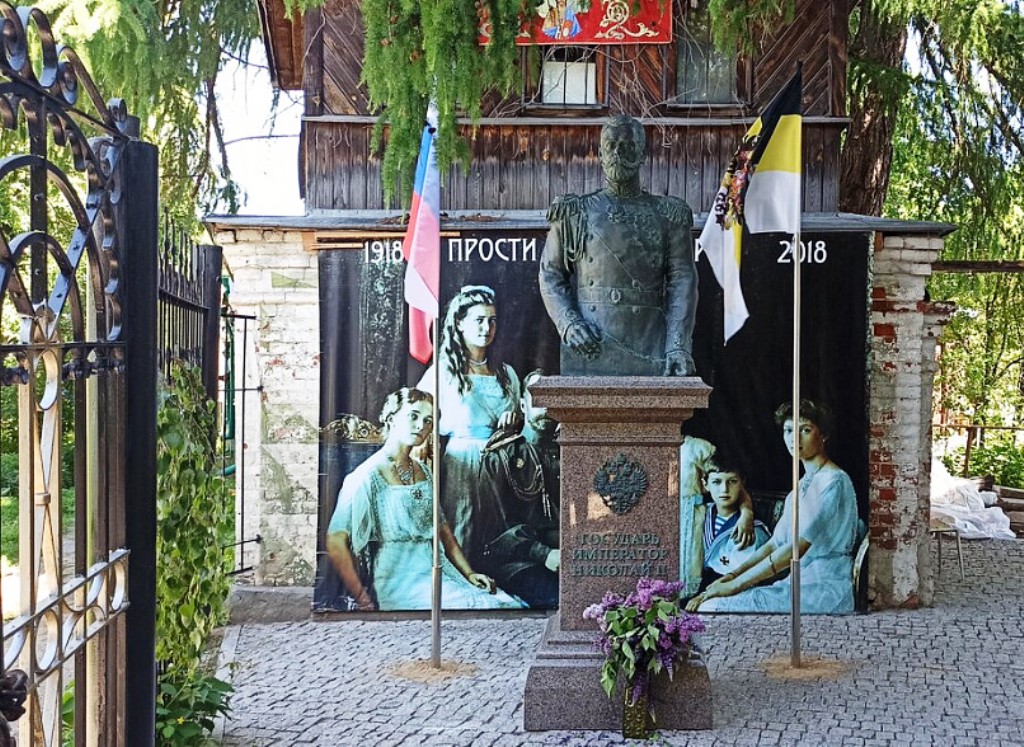
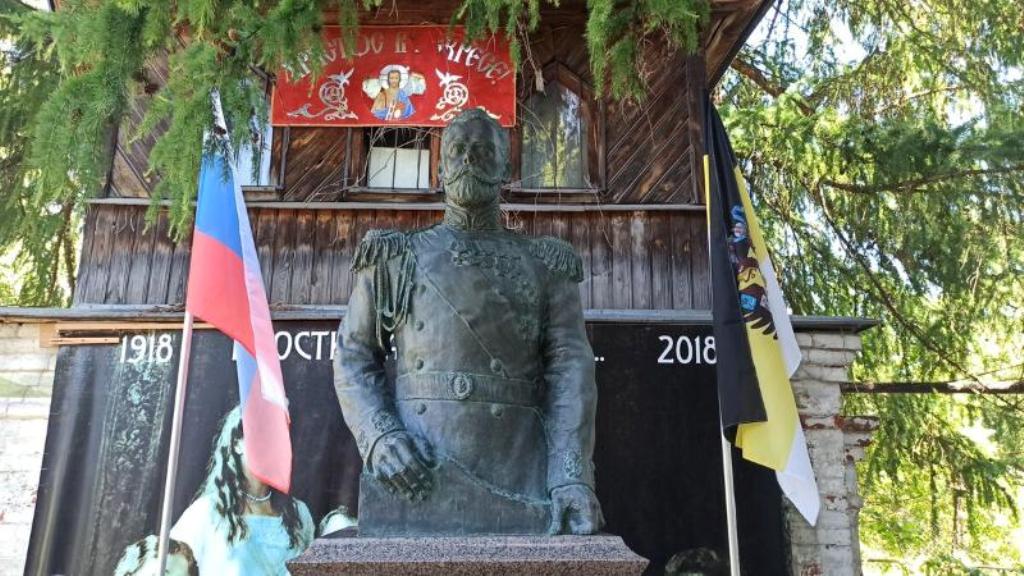
The height of the monument [with pedestal] is 3 meters [nearly 10 ft.]. The Tsar is depicted in uniform, wearing his coronation mantle, a sword on his left side. He is holding an orb in his left hand, while the fingers of his right hand are poised to make the sign of the cross. The figure stands on a massive pedestal with the inscription “Nicholas II Tsar and Passion-Bearer.”

PHOTO: “Nicholas II. Tsar and Passion-Bearer.”

PHOTOS: front and rear views of Russia’s second largest monument to Nicholas II

During the Soviet years, Nicholas II was vilified and forgotten. Not a single memorial of any kind existed in the Soviet Union, however, during the last 30 years more than 100 monuments, busts and memorials in honour of Nicholas II have been erected in more than 30 regions of the country.

© Paul Gilbert. 16 September 2021

5 NEW Romanov Titles

I am pleased to offer 5 additional Romanov titles on AMAZON in both PAPERBACK and EBOOK editions. The bulk of these titles are books which I published in paperback editions about 20 years ago, and have been out of print for some time. I decided to repackage each with new covers, and updated with prefaces and introductions. In addition, are also new titles.

Please note that some of these titles are available in both paperback and eBook editions, while others are available in either just paperback or eBook editions at the present time.

Prices for eBooks start at $9.99 USD, paperback editions start at $12.99 USD. Each title offers a FREE Look Inside feature.

All of these books are available from any AMAZON site in the world and are priced in local currencies [CLICK on any of the following links]: Canada, United Kingdom, Germany, France, Spain, Italy, Netherlands, Japan, India, Brazil, Mexico and Australia

Please refer to the links provided below to view this month’s selection – PG

MISHA: GRAND DUKE MICHAEL ALEXANDROVICH
Compiled and Edited by Paul Gilbert

AMAZON’S #1 New Release in Historical Russia Biographies

CLICK HERE TO ORDER PAPERBACK EDITION

Grand Duke Michael Alexandrovich (1878-1918) was the youngest son of Emperor Alexander III and Empress Maria Feodorovna, and the younger brother of Russia’s last emperor Nicholas II.

This book explores the milestones in the life of Grand Duke Michael in a series of essays by four distinct authors, and complemented with 50 black and white photographs.

Among them are the memories of Princess Olga Pavlovna Putyatina, who in February 1917, offered refuge to the grand duke at her flat on Millionnaya Street in Petrograd.

Independent researcher Paul Gilbert offers two fascinating essays: the first reviews an album of some 200 photographs taken by Grand Duke Michael, during his stay at Knebworth House in Hertfordshire. England, 1913-1914 . The album sold at auction for more than 2 million rubles ($34,000 USD).

The final essay examines the myth that Michael was the last Tsar of Russia, he was not. Nicholas II remained Emperor and Tsar of Russia until the day of his death and martyrdom on 17th July 1918.

Grand Duke Mikhail Alexandrovich and his Secretary Nikolai Nikolaevich Johnson, were both murdered by the Bolsheviks near Perm on 13 June 1918. Their remains have never been found.

MEMOIRS OF THE PAGES TO TSAR NICHOLAS II
by Dr. Thomas E. Berry

CLICK HERE TO ORDER THE PAPERBACK EDITON

The history of the Corps des Pages in Russia dates back to the days of Peter the Great. Each of his successors made changes or improvements up until the end of the monarchy in 1917.

The Corps des Pages was both a military and a Court institution which prepared young men to serve the Tsar and his family at Court. Many would also go on to serve in the military or enter into the diplomatic or civil service of the Russian Empire. The chief among the Pages of the Chamber was ipso facto the Page of the Chamber of the Tsar. The Tsarina and each member of the Imperial Household had a Page of the Chamber assigned to them, as did all the Grand Dukes and Grand Duchesses. As a rule, Pages of the Chamber and Pages were invited to participate in many Imperial Court events.

These memoirs provide eyewitness accounts of their education and training at the Vorontsov Palace in St. Petersburg. From here, these young men went on to serve the Russian Imperial family. Their recollections of the elegance of the Russian Court as well as many, new intimate details of Emperor Nicholas II, provide us with a rare glimpse into his private world.

The memoirs also tell of the sadness and heartache felt as the First World War swept them, their country and monarchy into history. Some lived to tell of the destruction brought on by war and the revolution and reflect on a world lost forever.

CORONATION OF TSAR NICHOLAS II
by Paul Gilbert

CLICK HERE TO ORDER THE PAPERBACK EDITION

Six eyewitness accounts of the crowning of Russia’s last tsar with more than 200 rare vintage photographs & illustrations

The pomp and pageantry surrounding the Coronation of Nicholas II is told through the eye-witness accounts of six people who attended this historic event at Moscow, held over a three week period from 6th (O.S.) to 26th (O.S.) May 1896.

The authors came from all walks of life and different nations: Francis W. Grenfell and Mandell Creighton, Bishop of Peterborough (Great Britain); John A. Logan, Jr., Kate Koon Bovey and Richard Harding Davis (United States); and Boris Alexandrovich Engelgardt (Russia).

Historians have left us only brief descriptions of this historic event, but it is thanks to the authors of this unique book that we are grateful. They recorded their observations in diaries and letters, leaving to posterity a first-hand record that allows modern-day readers to relive the crowning of Russia’s last tsar and the splendour and opulence of a world that is gone forever.

These exceptional memoirs offer a wealth of information that include the preparations and events leading up to and during the coronation festivities, the tsar’s entry into Moscow, the procession to the cathedral, the crowning of the tsar and the celebrations that followed. No two memoirs are alike; each of the authors guides the reader through this historic event through his or her own eyes.

Paul Gilbert is an independent researcher specializing in the study of the life and reign of Emperor Nicholas II. He has committed his research to clearing the name of Russia’s much slandered Tsar.

MEMORIES OF THE RUSSIAN COURT
by Anna Taneeva-Vytrubova

CLICK HERE TO ORDER THE EBOOK EDITION

Due to her privileged position at the Court of the last Russian Tsar and her close association to the Imperial Family, Anna Vyrubova’s memoirs are highly regarded by those who share a special interest in Nicholas II and his family.

From the summer of 1905 on, Anna Vyrubova centered her life on the Empress Alexandra and became a part of the Tsar’s family. In order to be closer to the family, Anna moved into a summer home at Tsarskoye Selo, just two hundred yards from the Alexander Palace, and her telephone was connected directly to the palace switchboard.

Her memories provide a rare peek into the private world of the Imperial Family, sharing many intimate details and personal impressions. She sailed with them on the Imperial Yacht ‘Standart’ to the Finnish islands and Livadia in Crimea.

In 1920 Anna escaped to Finland and lived quietly at Vyborg. There she wrote these remarkable memoirs which offer a unique eyewitness testimony of the life and character of Empress Alexandra, Emperor Nicholas II and their five children. Vyrubova describes a diverse array of incidents in the life of the Imperial family which collectively attest to the sincere and loving nature of the often misunderstood Empress.

Anna took vows as a Russian Orthodox nun but was permitted to live in a private home because of her physical disabilities. She died in 1964 at the age of 80, in Helsinki, where her grave is located in the Orthodox section of Hietaniemi cemetery. This book was first published in 1923.

MEMORIES OF RUSSIA 1916-1919
by Princess Olga Paley

CLICK HERE TO ORDER THE EBOOK EDITION

Every victim of the Bolshevik Revolution of 1917 had a story to tell. One of the most tragic was that of Princess Olga Valerianovna Paley (1865-1929) the morganatic second wife of Grand Duke Paul Alexandrovich (1860-1919).

Born in 1865, she married an officer of the Imperial Guard of Russia, Erich Augustinovitch von Pistohlkors, the couple had four children.

Grand Duke Paul Alexandrovich, a long-time friend of Pistohlkors, often spent his evenings with the Pistohlkors couple in Tsarskoye Selo; where he became smitten with Olga’s beauty, elegance, and her worldly and lively spirit. Their affair resulted in the birth of a son, Vladimir

Their affair created a scandal at Court and the Emperor forbid his uncle to marry Olga. Following her divorce from Pistolkors, Olga and Paul defied Nicholas II, resulting in their expulsion from Russia. They married in Livorno, Italy, and settled in an elegant mansion built in Boulogne-sur-Seine, France for several years. It was here that Olga gave birth to two more daughters,

In 1904, Prince-Regent Leopold of Bavaria titled Olga Countess of Hohenfelsen, and upon their return to Russia, the Tsar created the title of Princess Paley for her and their children.

During the revolution, her husband the Grand Duke and their son Vladimir were captured and murdered by the Bolsheviks. Olga and her daughters escaped to Finland and then returned to Paris, where she died in 1929.

Princess Olga Paleys memories are a poignant, often harrowing account of the ‘last happy days’ before the disintegration of the empire, and the Tsar’s abdication. She records in stark detail the actions of the revolutionary officials, the increasing humiliation and cruelty that she and her husband, who was already in poor health, suffered under the new order, the ‘reign of blackguardism’ as they gradually requisitioned or destroyed her property and that of the other Romanovs, and how they responded to each gesture of brutality with dignity during ‘the dreadful calvary of 1918’. It is a moving document by one who survived, while so many of those closest to her did not.

Click HERE to view 4 NEW Romanov titles published in August 2021

© Paul Gilbert. 16 September 2021

Nicholas II Calendar 2022
LIMITED PRINTING OF ONLY 200 COPIES!

I am pleased to offer copies of my 2022 calendar, dedicated to Emperor, Tsar and Saint Nicholas II, with a limited printing of only 200 copies!
Each month features a full-page black and white photograph of Russia’s last monarch, printed on quality glossy stock.

Nearly 70 major holidays in the United States, Canada, Great Britain, Australia and Russia are featured, with room to write in your own special dates and events.

Also featured, are the birth dates of members of Nicholas II, Alexandra Feodorovna, and their five children, as well as important dates in the reign of Russia’s last tsar.

The entire net sales from this calendar assist me with my research, but also with translation costs, the maintenance costs of my web site and news blog, as well as the organization and promotion of events.

The price of each calendar is $10 + postage (rates are noted on the order page, link below). I can ship to any country by Canada Post

NOTE: the postage rates quoted are for SINGLE copies ONLY! If you want to order more than one calendar, then please contact me by email at royalrussia@yahoo.com

Payment can be made securely online with a credit card or PayPal or by personal check, money order or cash – click HERE to download and print a mail order form

Thank you for your support of my research and dedication to clearing the name of Russia’s much slandered tsar

© Paul Gilbert. 4 September 2021

State Hermitage Museum restores rare portrait of Nicholas II

PHOTO: “as if in a misty haze, one could discern the face of Emperor Nicholas II”

In 2018, the State Hermitage Museum in St. Petersburg in cooperation with the Russian-American Cultural and Educational Society ‘Rodina’, embarked on a joint project headed by Candidate of Cultural Studies Viktor Faibisovich, on the restoration of a little-known portrait of Russia’s last tsar.

In 2004, a Moscow collector brought the portrait from the United States to the State Hermitage Museum, after discovering it in the Russian-American Cultural and Educational Society Museum.

The Rodina Society was founded in 1954 by Russian émigrés in Lakewood, New York. The head of Rodina, O.M. Krumins, noted that the portrait was brought from Paris in the late 1950s among other rarities of the Life Guards of the Semyonovsky, Izmailovsky and Pavlovsky regiments, the Nikolaevsky cavalry and the Konstantinovsky artillery schools.

The portrait was in a terrible state, nearly destroyed after years of neglect. Within the remnants of the layer of paint, covered with numerous craquelures [a network of fine cracks in the paint or varnish of a painting], as if in a misty haze, one could discern the face of Emperor Nicholas II, distorted by a deep vertical fracture. But the portrait was in such a terrible state as the canvas had remained rolled up for almost half a century.

The restoration was entrusted to the masters of the Russian Academy of Painting, Sculpture and Architecture in St. Petersburg . It was established that Nicholas II was depicted in the ceremonial uniform of the Semenovsky Life Guards Regiment. The emperor was appointed chief of this regiment in 1894. Scrupulous attribution made it possible to establish that the portrait was made no earlier than 1896.

But how did it end up in Paris in the middle of the 20th century?

The photos show the various stages of restoration of the portrait

Semenovsky order

The portrait was commissioned by the officers of the Semyonovsky Life Guards Regiment, and hung in the dining room of the officers’ Assembly Hall. A certificate to confirm this was left by an officer of the regiment Yu.V. Makarov: “This dining room, the largest room in the Assembly, was so large that it could accommodate 130-150 diners. On the wall opposite from the entrance, right in the middle, hung a large half-length portrait of the sovereign founder of the regiment, Emperor Peter the Great, in dark oak In a quadrangular frame, the emperor was depicted in a green caftan, with a blue Semyonov collar. Two smaller portraits of Emperor Nicholas II in our uniform and Empress Alexandra Feodorovna in oval gold frames were positioned on either side of Peter’s portrait.”

The officers’ Assembly Hall was the center of regimental life. It was from here that in August 1914 the Semyonovsky Life Guards Regiment set out for battle. During the First World War, the regiment lost 48 officer. Then, in March 1917, the regiment lost its sovereign chief Nicholas II. In April, Colonel Alexander Vladimirovich Popov (1880-1963) was appointed the last Commander of the Semenovsky Life Guards Regiment.

It is to him that we owe the preservation of the portrait of Nicholas II.

PHOTO: Colonel Alexander Vladimirovich Popov (1880-1963)
Last Commander of the Semenovsky Life Guards Regiment

In December 1917, the Semyonovsky Life Guards regiment was disbanded. All military ranks, in accordance with the Decree of the Soviets of Workers ‘and Soldiers’ Deputies on the destruction of estates and civilian ranks, were ordered to remove their shoulder straps and hold elections for commanding officers in the new Semyonovsky Guards Regiment. Popov refused to participate in the elections, and transferred the interim duties of commander to Colonel N.K. von Essen (1885-1945). On 10th December 1917 left for Petrograd, taking with him the portrait of Emperor Nicholas II.

The photos show the various stages of restoration of the portrait

Preserved memory

Popov was one of the initiators of the formation of guards units in the White movement. The revived Semyonovsky Life Guards Regiment fought in the South of Russia. Alexander Vladimirovich carried the portrait of the last sovereign chief through the entire Civil War.

In 1919 he emigrated to France and lived in Paris, where he headed the Association of the Semyonovsky Life Guards Regiment in France, was a member of the Union of Zealots in memory of Emperor Nicholas II, the Society of Lovers of Russian Military Antiquity, the Union of Russian Cadet Corps, and an honorary member of the Union of Transfiguration. Popov also served as director of the regimental museum, in which he sacredly kept the portrait of Nicholas II. In the late 1950s, when it became more and more difficult to preserve museum exhibits, they were transferred to the United States.

A few years later, 82-year-old Colonel Popov passed away. In the magazine Sentinel under the heading “Unforgotten graves” was placed a modest mention: “On March 28, 1963, the chairman of the Association of the Semenovsky Life Guards Regiment, the last commander of the regiment, Colonel Alexander Vladimirovich Popov, died in Paris.”

He was buried in the Sainte-Genevieve-des-Bois Cemetery in Paris.

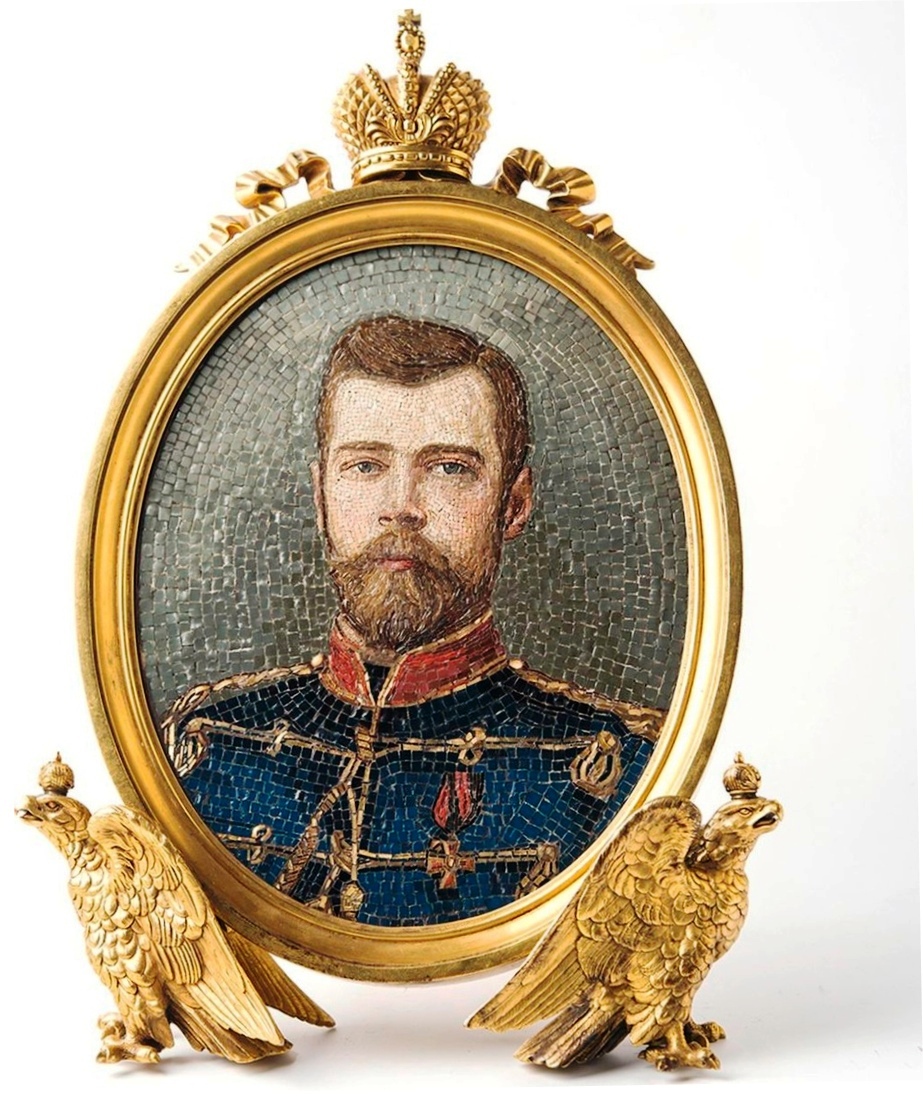
PHOTO: the portrait of Nicholas II, after restoration

After the death of the collector who brought the portrait of Nicholas II to Moscow, the portrait was donated to the Museum of the Russian Guard in the General Staff Building [across from the State Hermitage Museum] in St. Petersburg.

PHOTO: the restored portrait of Nicholas II displayed in the Winter Palace in 2018

On 17th July 2018, the day marking the 100th anniversary of the death and martyrdom of Russia’s last emperor and tsar, a Divine Liturgy was performed in the Church of the Savior Not Made by Hands [the home church of the Imperial Family] in the Winter Palace, led by the rector of the Prince Vladimir Cathedral, Archpriest Vladimir Sorokin. The restored portrait of Nicholas II by an unknown artist of the late 19th-early 20th centuries was displayed in the cathedral. Popov would have been pleased.

© Paul Gilbert. 1 September 2021

4 NEW Romanov titles

I am pleased to offer 4 Romanov titles on AMAZON in both PAPERBACK and EBOOK editions. These are books which I published in paperback editions about 20 years ago, and have been out of print for some time. I decided to repackage each with new covers, and updated with prefaces and introductions.

Please note that these titles are only available in eBook editions at the present time, paperback editions are in the works, and will be announced as they become available.

Prices for eBooks start at $9.99 USD, paperback editions start at $12.99 USD. Each title offers a FREE Look Inside feature.

All of these books are available from any AMAZON site in the world and are priced in local currencies [CLICK on any of the following links]: Canada, United Kingdom, Germany, France, Spain, Italy, Netherlands, Japan, India, Brazil, Mexico and Australia

NOTE: the book covers depicted below are the eBook editions! The book covers for the paperback editions are different. Please refer to the links provided below to view – PG

THE REAL TSARITSA
by Lili Dehn

CLICK HERE TO ORDER EBOOK EDITION

CLICK HERE TO ORDER PAPERBACK EDITION

Rumour was busy in her lifetime with amazing tales about the late Empress of Russia; how much or little truth lay behind such rumours was known only to her few closest friends, and one of the few was Lili Dehn (1888-1963).

Great-granddaughter of Prince Koutousoff, the famous defender of Moscow against Napoleon I, Lili Dehn was admitted, after her presentation at Court, into the home circle of the Tsaritsa, and a great friendship grew up between them. Her study of the Empress’s personality, habits, views, life as she led it, is intimate and illuminating. Here is the truth about Rasputin, with new light on the legend of his power over the Royal Household, the inner reason for the scandalous reports circulated concerning him and the Empress, and a grim, enthralling account of his death and burial. Lili Dehn was the first person to whom the Empress came with the news of the Tsar’s abdication, and she witnessed his return after that supreme humiliation.

There are dramatic elements in the narrative of the early days of the Revolution; life at Tsarskoe Selo while the Tsar and his family were under arrest; and in the record of the writer’s own imprisonment and adventurous escape. The interest of the book is intensified by the often deeply pathetic letters written to Lili Dehn by the Tsaritsa from captivity. This revelation at first hand of the whole tragedy of the Empress, as a wife and a mother, and of all that led to the downfall of a great dynasty, makes a profoundly human appeal.

LADIES OF THE RUSSIAN COURT
by Meriel Buchanan

CLICK HERE TO ORDER EBOOK EDITION

CLICK HERE TO ORDER PAPERBACK EDITION

The daughter of Sir George Buchanan (1854-1924), British Ambassador at St. Petersburg in the First World War, lived among the Russian Imperial Court amid the fading glories of an age now past.

The stories which make up these six portraits are drawn from her own memories, stories of women whose lives were lived in the bright light that shines on royalty, many of whom she knew in their everyday existence.

In this gallery of portraits are included the Dowager Empress Marie Feodorovna, wife of Emperor Alexander III and mother of Emperor Nicholas II; the Grand Duchess Marie Pavlovna, the wife of Grand Duke Vladimir Alexandrovich; the Grand Duchess Elizabeth Feodorovna, the wife of the Grand Duke Sergei Alexandrovich and sister of Empress Alexandra Feodorovna; the Grand Duchess Victoria Feodorovna, the wife of the Grand Duke Cyril Vladimirovich; the Grand Duchess Olga Nicholaievna, eldest daughter of Emperor Nicholas II; and finally, Princess Zenaide Yousoupoff, the mother of the infamous Prince Felix Yousoupoff.

In dealing with these ladies of the Russian Court, the author evokes all the mystery, fascination, splendour, and elegance of Tsarist Russia. Ms Buchanan writes with a charm and ease most fitting to the characters she describes.

LAST DAYS AT TSARSKOE SELO
by Count Paul Benckendorff

CLICK HERE TO ORDER EBOOK EDITION

CLICK HERE TO ORDER PAPERBACK EDITION

Count Paul Benckendorff (1853-1921), belonged to the closest circle of Emperor Nicholas II. Following the collapse of the monarchy in 1917, Benkendorff and his wife shared the captivity of the Imperial Family at Tsarskoe Selo.

After the end of the First World War, he was accepted into court service: Adjutant General (1905). General of the Cavalry (1912). Ober-marshal of the Imperial Court. Benckendorff was also a Member of the State Council of the Russian Empire and the Imperial Yacht Club.

Benkendorff’s narrative provides a detailed eye-witness account of the Tsar’s abdication, his transfer to Tsarskoe Selo and his daily life in the Alexander Palace, where he was held under house arrest from February to August 1917.

Throughout his memoirs, Benckendorff characterizes Nicholas II and his wife Alexandra Feodorovna as courageous, gracious, and poised despite their obvious concern for their family.

Due to his age and poor health, Benckendorff was unable to follow the Emperor and his Imperial Family’s into exile to Tobolsk. One of the very few who were faithful, he parted with his Sovereign for the last time on 14th (O.S. 1st) August 1917.

TSAR NICHOLAS II
by A.G. Elchaninov

CLICK HERE TO ORDER EBOOK EDITION

CLICK HERE TO ORDER PAPERBACK EDITION

This short biography was originally published in 1913, to coincide with the 300th anniversary of the Romanov dynasty. The author served as a major-general in the Tsar’s suite, and a professor of military art in the General Staff Academy in St. Petersburg.

Many contemporary historians claim that Nicholas II was not fit to rule the Russian Empire. Elchaninov, however, rebukes these claims based on first-hand experience.

The first chapters describe Russia’s last Tsar as a caring, devoted and loving husband and father. The remaining focus on his relationship with his government, the church, the army, the Russian people, and the policies which he pursued during the first 18 years of his reign.

Written before the First World War and the 1917 Revolution. Elchaninov writes in glowing patriotic language portraying Nicholas II as an indefatigable “Imperial worker” in the service of Russia’s best interests and the “Sovereign father” of the Russian people.

This new expanded edition features an introduction by independent researcher Paul Gilbert, and two detailed appendices: a chronology of events during the reign of Nicholas II (1894-1917); and 100 facts about Nicholas II and the many reforms he made during his reign.

© Paul Gilbert. 31 August 2021

Healthcare reform under Nicholas II

PHOTO: Nicholas II with wounded soldiers at a military hospital near the front in World War I. Artist: Pavel Viktorovich Ryzhenko (1970-2014)

During the 1920s, the Bolsheviks boasted of how they had improved healthcare in Russia after the overthrow of Nicholas II, however, this is just one more lie which the new order utilized in their campaign to discredit the reforms of Russia’s last Tsar. And to this day, Nicholas II’s detractors continue to claim that the Russian people “suffered” and that the Tsar did “nothing” to help them.

During the reign of Nicholas II, the population of the Russian Empire increased from 122 million in 1894 to 182 million in 1914 – an increase of 62 million! Given such a staggering increase in the country’s population, Nicholas II’s health care reforms were nothing short of impressive.
After Nicholas II ascended the throne in 1894, healthcare reform in the Russian Empire became the subject of special concern for the new Emperor. It was during his reign that the development of medicine and healthcare accelerated throughout the Russian Empire.

On 11th January 1897, Nicholas II approved a Special Commission on measures to prevent and combat plague, chaired by Duke Alexander Frederick Constantin of Oldenburg [1] whom the Tsar allowed to use the premises of the Emperor Alexander I Fort at Kronstadt for experimental anti-plague purposes. In October 1897, Oldenburg traveled to Turkestan to take emergency measures to prevent the plague from entering the Empire, for which he received “His Imperial Majesty’s deepest gratitude for the labours incurred” for his efforts to spare European Russia and the rest of Europe from plague penetrating their borders.

PHOTO: preparation of anti-bacterial plague drugs in the Plague Control Laboratory of the Emperor Alexander I Fort at Kronstadt

One of the main reasons for the spread of disease, was of course poor sanitation. As a result, in August 1908, Nicholas II advised the Minister of Internal Affairs to pay “serious attention to the dismal state of sanitation in Russia. It is necessary at all costs to achieve its improvement”. The Emperor emphasized the need to be able to “prevent epidemics, not just fight them”. He demanded that the case of streamlining the sanitary-medical organization in Russia be urgently developed and submitted for legislative consideration.

Various commissions were established during Nicholas II’s reign to prevent the occurrence of highly infectious diseases. In March 1912, the Emperor approved the Interdepartmental Commission for the revision of medical and sanitary legislation, writing in the margins of the Journal of the Council of Ministers: “This is to be done at an accelerated pace.” The head of the commission was appointed the chairman of the Medical Council of the Ministry of Internal Affairs, honorary life surgeon academician Georgy Ermolaevich Rein (1854-1942). In the spring of 1912, the commission presented its project for the transformation of the central and local authorities of medical and sanitary affairs. After reviewing it, Nicholas II noted: “Submit to the Council of Ministers. Continue to conduct business at an accelerated rate. “

Nicholas II supported the introduction of a territorial system of medical districts within the Russian Empire, a system not found anywhere else in the world at the time. This system was later adopted by the Bolsheviks, who appropriated its authorship. In the course of the health care reform in the Russian Empire, a three-tier structure of medical assistance to the population was formed: a medical department, a county hospital, and a provincial hospital. Treatment in these health facilities was free of charge.

The opening of new hospitals and medical institutions developed at a rapid pace. The number of hospitals increased from 2,100 in 1890 to 8,110 in 1912 and 8,461 in 1916 +170 psychiatric hospitals. The number of hospital beds increased from 70,614 in 1890 to 227,868 in 1916. The number of doctors also increased from 13,000 in 1890 to 22,772 doctors in 1914 and 29,000 in 1916.

In addition, there were 5,306 medical districts and paramedic points. By 1914 there were 28,500 medical assistants, 14,194 midwives, 4,113 dentists, 13,357 pharmacies. In 1913, 8,600 students studied at 17 medical universities.

In 1901, 49 million people received medical care in Russia, three years later, in 1904 – 57 million, in 1907 – 69 million, in 1910 – 86 million and in 1913 – 98 million. These efforts led to a significant decrease in overall mortality. In the period 1906-1911 there were 29.4 deaths per thousand inhabitants, 26 deaths per thousand in 1911, and 25 per thousand in 1912.

Mortality from smallpox decreased 2.5 times, from typhus decreased 2 times, from acute childhood diseases decreased 1.4 times. In the period from 1891 to 1895 – 587 thousand people died on average from acute infectious diseases, and steadily decreased during the period from 1911 to 1914 to 372 thousand people.

On 19th March 1899, Russia’s first ambulance station was opened in St. Petersburg.

PHOTO: the first ambulance station was opened in St. Petersburg on March 19, 1899

Under Nicholas II, Russian scientific medicine received world recognition, which could not have developed without state support. For the first time, Russian medical scientists were awarded the Nobel Prize: physiologist Ivan Petrovich Pavlov (1904) and microbiologist Ilya Ilyich Mechnikov (1908). Russian medical science carried out pioneering studies of the structure of the brain, and the origins of such fields of medicine as forensic psychiatry, gynecology and hygiene. At the beginning of the 20th century. more than 150 general and specialized scientific medical journals were published in Russia.

Despite the advancements in health care in the Russian Empire, serious health problems remained. For instance, at the beginning of the 20th century Russia experienced a high mortality rate from common widespread infections: plague, smallpox, cholera, typhoid. It was not until the 1940s and the invention of antibiotics did things improve.

Infant mortality under Nicholas II steadily declined. The downward trend in mortality (both children and adults) began before the revolution. According to statistics, the death rate during the reign of Nicholas II per 1000 people had been steadily decreasing.

PHOTO: Medical examination of children in a children’s clinic, St. Petersburg. 1903

Emperor Nicholas II also made efforts to fight against drunkenness. Both the Tsar and Russian society, considered the situation with drunkenness in Russia depressing. Russian historian and journalist Sergei Sergeiivich Oldenburg (1888-1940) wrote that in 1913, “The Tsar, during his trip to the Russian provinces, saw bright manifestations of gifted creativity and labour; but next to this, with deep sorrow, one saw sad pictures of national weakness, family poverty and abandoned households – the inevitable consequences of a drunken life.”

In 1913, the year marking the 300th anniversary of the House of Romanov, Emperor Nicholas II stated that he “came to the firm conviction that the welfare of the treasury should not be made dependent on the ruin of my loyal subjects.”

From 1914, schools of the Ministry of Public Education have been instructed to teach high school students a course in hygiene with the obligatory reporting of information about the dangers of alcohol. In March 1914, the Holy Synod of the Russian Orthodox Church decided to establish a national day of sobriety on 29th August[2], the day of the Beheading of John the Baptist. This holiday was held annually and collected donations for the fight against drunkenness.

By 1913, there were about 1,800 temperance societies in Russia with a total number of members of more than half a million.

As a result of this important decision of Nicholas II, serious changes took place in the country, affecting both the private life of people and their health, and the economy of Russia. The Emperor noted: “Sobriety is the basis of the well-being of the people.”

On 11th August 1908, Emperor Nicholas II initiated the creation of a unified state health care system. In July 1914, a few days before the outbreak of World War I, a bill to create the Ministry of Health was introduced to the Council of Ministers. On 1st September 1916, the Chairman of the Medical Council of the Russian Empire, Honorary Life Surgeon, Academician Georgy Ermolaevich Rein (1854-1942), who held these duties until 27th February 1917. Thus, Georgy Ermolaevich became the first and last Minister of Health of the Russian Empire.

PHOTO: in 1897, the Women’s Medical Institute (the first medical institute of this kind in Russia) opened in St. Petersburg

NOTES:

[1] Father-in-law of Nicholas II’s younger sister Grand Duchess Olga Alexandrovna (1882-1960), who was married to his only son Duke Peter Alexandrovich (1868-1924), from August 1901 to October 1916.

[2] A national Day of Sobriety was revived in 21st century Russia, today an unofficial Russian holiday instituted by the Russian Orthodox Church. The date of 11th September (O.S. 29th August) was chosen because on this day Orthodox Christians celebrate the Beheading of the Holy and Glorious Prophet, Forerunner and Baptist John. On this day, the faithful are expected to observe a strict fast, which includes abstinence from alcohol.

© Paul Gilbert. 7 August 2021

Nicholas II’s passion for ice hockey

PHOTO: Grand Duke George, Grand Duchess Xenia, Grand Duke Mikhail and Grand Duke Nicholas Alexandrovich [future Emperor Nicholas II] playing ice hockey on the skating rink of the Anichkov Palace, St. Petersburg. 1880s.

Emperor Nicholas II, was perhaps the most avid sportsman of all Russian tsars. He took up cycling at an early age, and, and from the 1890s developed a great passion for lawn tennis. In addition, he enjoyed hiking, swimming, shooting, and all kinds of physical activity, from long walks in the park with his dogs, chopping wood and shovelling snow.

In his youth, Nicholas also enjoyed ice skating and hockey. He learned how to skate during his family’s residency at Gatchina, where the garden would be flooded during the winter months, whereby the children of Emperor Alexander III would ice skate.

When the garden of the Anichkov Palace – the residence of Alexander III in St. Petersburg – was expanded, ice mountains and a skating rink were arranged in the garden. The August children: Nicholas, George, Xenia, Mikhail and later Olga, gathered here with invited friends, the Emperor often taking part in their games on the frozen ice.

Nicholas knew how to skate, but he was not a big fan, he preferred ice hockey. He even played hockey without skates, but in boots, with bent sticks [see photos], chasing a rubber ball.

During his first years as Emperor, Nicholas Alexandrovich managed to find time to visit the skating rink at the Anichkov Palace, where his mother Dowager Empress Maria Feodorovna was living at the time. During the winter of 1894–1895, when the 26-year-old Tsar was overwhelmed with his duties as Emperor and Autocrat. In addition, his young wife Empress Alexandra Feodorovna demanded attention. Nevertheless, during the winter of 1895, Nicholas managed to enjoy the skating rink at the Anichkov Palace on three separate occasions: 13th and 20th January and 8th February respectively.

PHOTO: Grand Duke Nicholas Alexandrovich [future Emperor Nicholas II] with members of his family playing ice hockey on the skating rink of the Anichkov Palace, St. Petersburg; his father Emperor Alexander III is seated on the far right. Late 1880s-early 1890s.

Nicholas II was delighted when he discovered that his beloved Alix also knew how to skate, especially since his 23-year-old wife constantly complained of pain in her legs. The tsar wrote: “We skated, Alix is very good on them.” Due to health issues, Alexandra Feodorovna was forced to hang up her ice skates.

In January 1896, Nicholas II and Alexandra Feodrovna settled down in the new apartments prepared for them in the Winter Palace. As a loving son, the Emperor and his wife went daily to tea at the Anichkov Palace to see his mother, where he often took the opportunity to skate for a couple of hours on the rink with old friends.

On 4th January 1896, Nicholas II wrote in his diary: “Went to breakfast in Anichkov. We walked in the garden and played as before on the rink; Xenia and Sandro were skating.” Nicholas II often visited the skating rink that winter. In January 1896 he visited the rink 13 times. Even in bad weather Nicholas skated regardless: “There was a blizzard on the rink, so you could hardly see the balls”; “A strong wind was blowing, preventing the balls from flying”; “The fog was very thick, so it was difficult to play on the rink because the balls were not visible.”

However, life took its toll. The Emperor matured, his family grew rapidly. Political problems grew, and by the early 1900s, his winter skating rinks, which he enjoyed so much moved into the realm of dreams past.

© Paul Gilbert. 2 August 2021

Did Saint Seraphim of Sarov predict the death and martyrdom of Russia’s last tsar?

PHOTO: Emperor Nicholas II, Empress Alexandra Feodorovna and Grand Duchess Elizabeth Feodorovna were present at the canonization of Seraphim of Sarov (1754-1833) on 1 August (O.S. 19 July) 1903

On 1st August, Russian Orthodox Christians celebrate the canonization of Seraphim of Sarov (1754-1833), one of the most revered saints in the Russian Orthodox Church.

During his reign, the pious Emperor Nicholas II sanctioned the canonization of more saints than any previous sovereign. Among those glorified during his reign were: St. Theodosius of Chernigov (glorified in 1896), St. Isidore of Yuriev (1897), St. Euphrosyne of Polotsk (1909), St. Anna of Kashin (1910), St. Joasaph of Belgorod (1911), St. Hermogenes of Moscow (1913), St. Pitirim of Tambov (1914), St. John (Maximovich) of Tobolsk (1916) and St. Paul of Tobolsk (1917).

At the end of January (O.S.) 1903, the Most Holy Synod, having received approval from Emperor Nicholas II, announced Seraphim’s forthcoming glorification. In early July 1903, his relics were transferred from their original burial place to the Church of Saints Zosimus and Sabbatius in Sarov.

A beautiful marble shrine was arranged by Nicholas II and Alexandra Feodorovna – “a luxurious work of art in the Russian style of Moscow,” said Metropolitan Veniamin (Fedchenkov). In addition, the August couple provided a new cypress coffin to receive the relics. The rug which covered the tomb was embroidered by the Empress’s own hands.

The solemn canonization festivities took place in Sarov on 1st August (O.S. 19th July) 1903 and were attended by Emperor Nicholas II, his wife Empress Alexandra Feodorovna, his mother Empress Maria Feodorovna, and numerous grand dukes and grand duchesses of the Imperial Family. More than 100,000 faithful from across the Russian Empire arrived in Sarov to take part in the Cross Procession.

The events at Sarov marked a momentous occasion in the life of Nicholas II. It was during this visit that the Emperor received a letter written by the saint some 70 years earlier. Shortly before his death in 1833, the saint had written this letter, sealed it with five wax seals and addressed it “to the fourth sovereign who will arrive in Sarov, and as yet is not known”.

PHOTO: wall painting depicting Emperor Nicholas II and Empress Alexandra Feodorovna with Blessed Parasceva Fool-for-Christ, in the Church of Our Lady of Kazan of the Diveyevo Monastery

He then gave it to Elena Motovilova, whose husband is now well-known for recording his conversation with the saint about the acquisition of the Holy Spirit. She kept that letter for seventy years and gave it to the Tsar at the glorification ceremony.

Although the Sovereign never revealed the letter’s contents, it is believed that it was a prophecy of the bloodshed that would engulf Russia in less than fifteen years. According to the recollections of eyewitnesses, after reading the letter the Emperor wept bitterly.

Seraphim of Sarov correctly predicted the inevitable death of the Emperor and his family. He said that after him there will be no more tsars in Russia. But he noted that Nicholas II would be elevated higher than all the tsars, apparently anticipating the canonization of the Imperial family.[1] The saint also predicted future trials for Russia: the plundering of monasteries and church property, the tragic death of a large number of people, troubled times and rebirth after.

Furthermore, on the return trip from Sarov, the Imperial Family visited St. Seraphim’s Diveyevo Convent where Blessed Parasceva Fool-for-Christ [2] spoke to them for several hours; it is said that she foretold to them their own martyrdom as well as that of Holy Russia.

Following the Bolshevik Revolution, as part of their persecution of the Russian Orthodox Church, the Bolsheviks confiscated many relics of saints, including St. Seraphim. The fate of the letter remains unknown.

In 1991, St. Seraphim’s relics were rediscovered after being hidden in a Soviet anti-religious museum for seventy years. This caused a sensation in post-Soviet Russia and throughout the Orthodox world. A crucession (religious procession) escorted the relics, to her final resting place, near the altar of the Trinity Cathedral of the Seraphim-Diveevsky Monastery. [3]

PHOTO: Icon of Saint Tsar-Martyr Nicholas II holding an icon of Saint Seraphim of Sarov

NOTES:

[1] On 1st November 1981, Emperor Nicholas II and his family were canonized as new martyrs by the Russian Orthodox Church Abroad (ROCOR), however, it was not until 20th August 2000, that they were canonized as passion bearers by the Moscow Patriarchate of the Russian Orthodox Church.

[2] Praskovya Semyonovna Dybina was born in 1795. The famous nun confessor died on 5th October (O.S. 22nd September) 1915, at the age of 120.

On 31st July 2004, Blessed Paraskeva was numbered among the locally revered saints of the Nizhny Novgorod diocese, and on 6th October of the same year, the Council of Bishops of the Russian Orthodox Church established her church-wide veneration. The holy relics were uncovered on 20th September 2004 and now rest in the Church of Our Lady of Kazan of the Seraphim-Diveevsky Monastery. Her memory is celebrated on 5th October (O.S. 22nd) September.

[3] The Seraphim-Diveevsky Monastery is situated 12 km from Sarov, and 185 km from the city of Nizhny Novgorod.

© Paul Gilbert. 1 August 2021

Nicholas II and the opening of the Romanov Museum in Kostroma, 1913

PHOTO: Nicholas II opens the Romanov Museum in Kostroma, 19th May 1913

The idea of ​​creating the Romanov Museum belonged to the chairman of the Kostroma Provincial Scientific Archive Commission, who proposed opening a special Romanovsky department “for collecting and storing information and data about the ancestors of the ancestor of the reigning house of Tsar Mikhail Fedorovich.” His proposal was supported by Emperor Nicholas II, who approved the official use of the name “Romanovsky department”.

As the number of exhibits multiplied each year, the Romanovsky department ran out of space, and the question of creating a separate museum building arose. In 1907 the governor of Kostroma Alexei Porfirievich Veretennikov (1860-1927), reported to Moscow about the funding for the construction of the museum (donated by the Kostroma City Duma, industrialists, nobles and local residents) and a plot of land for the future museum. The permission to use the name “Romanov Museum” and the promise of co-financing came from Moscow.

In 1908, the project of the building was developed by the architect Nikolai Ivanovich Gorlitsyn (1870-1933), the construction began in 1909. In 1912, Nicholas II issued an order of 35 thousand rubles for the completion of the internal arrangement and interior decoration of the Romanov Museum, as well as the external decoration necessary for the opening of the museum.

In May 1913, Nicholas II and his family arrived in Kostroma as part of the celebrations marking the 300th anniversary of the Romanov dynasty and attended the official opening of the Romanov Museum. The Emperor and his family became the first visitors to the museum and left their names in the memorial book, which has survived to this day.

Currently, the Romanov Museum has several expositions, but one remains unchanged – about the role of Kostroma in the history of the Romanov dynasty.

***

Bust of Nicholas II unveiled in Kostroma

Earlier this week, a new bronze bust of Emperor Nicholas II was presented to the Romanov Museum in Kostroma, where it now stands in the foyer of the museum [photo above]. The Emperor is depicted wearing the uniform of the Guards crew, complete with orders and medals.

The inscription on the wall reads: “The Romanov Museum began construction on 21 June 1909, and opened on 19 May, 1913 in the presence of their Imperial Majesties, the Tsesarevich Alexei and the August daughters of their Imperial Majesties”

The bronze bust was created by the contemporary Moscow sculptor Vasily Moskvitin [photo below]. The sculptor who is passionate about Russian history, has created sculptures and busts dedicated to Russian princes and saints, including Patriarch Tikhon (1865-1925).

The theme of the last emperor is the latest in the work of Moskvitin. For the Romanov Museum in Kostroma, however, the master decided to create a different sculptural portrait.

“Yes, he was also made to wear a crown of thorns, however, I did not want to present Nicholas II in the tragic image he is so often depicted. Instead, he is presented as the living soul of a person, to reveal his true character. Nicholas II was a very intelligent person, cheerful, with radiant eyes, which emitted kindness. I tried to capture all these features in my bust,” said Moskvitin.

© Paul Gilbert. 23 July 2021