This second video features another tune, which was apparently a favourite of Emperor Nicholas II and his Family. Click on the image above to listen to Я ехала домой /I was on my way home, a romanice, which tells us a short story through the eyes of Empress Alexandra Feodorovna’s heart. [Duration: 3 minutes, 11 seconds]
The romance “I Was on my way home”, composed by Marie Poiret in 1901 or 1905, is about the love and tenderness of a woman’s heart. The romance became very famous and was part of the repertoire of many performers of the time, including Alexander Vertinsky, Keto Dzhaparidze, Rada Volshaninova, Alla Bayanova among others.
Maria Yakovlevna Poiret (1864-1933) was a Russian dramatic actress, journalist, poet, writer and composer. Her fame has reached our time as the author of several romances, including “I was on my way home”. She also wrote the lyrics to such tunes as “Swan Song”, “I Don’t Want to Die”, as well as to the music of other composers.
NOTE: the translation is not perfect, but it will give you the gist of the lyrics – ENJOY!
I was going home, my soul was full
Unclear for myself, some kind of new happiness.
It seemed to me that everyone with such a fate,
They looked at me with such affection.
I was on my way home… Two-horned moon
I looked out of the windows of the boring car.
The distant annunciation of the morning bells
He sang in the air like a gentle string…
I was driving home, I was thinking about you,
My thought was anxiously both confused and torn.
A sweet slumber touched my eyes.
Oh, if only I had never woken up again…
Set against the background of this romance are a number of images depicting Empress Alexandra Feodorovna riding on the Imperial Train [these images have been photoshopped]. In addition are vintage photos of Nicholas and Alexandra. The vocals of this haunting romance is performed by the popular contemporary Russian singer Irina Krutova. The video was created by Irina Koroteeva (Moscow).
NOTE: Stay tuned for additional videos, featuring more favourite tunes of Nicholas II and his family.
More favourite tunes of Nicholas II and his family:
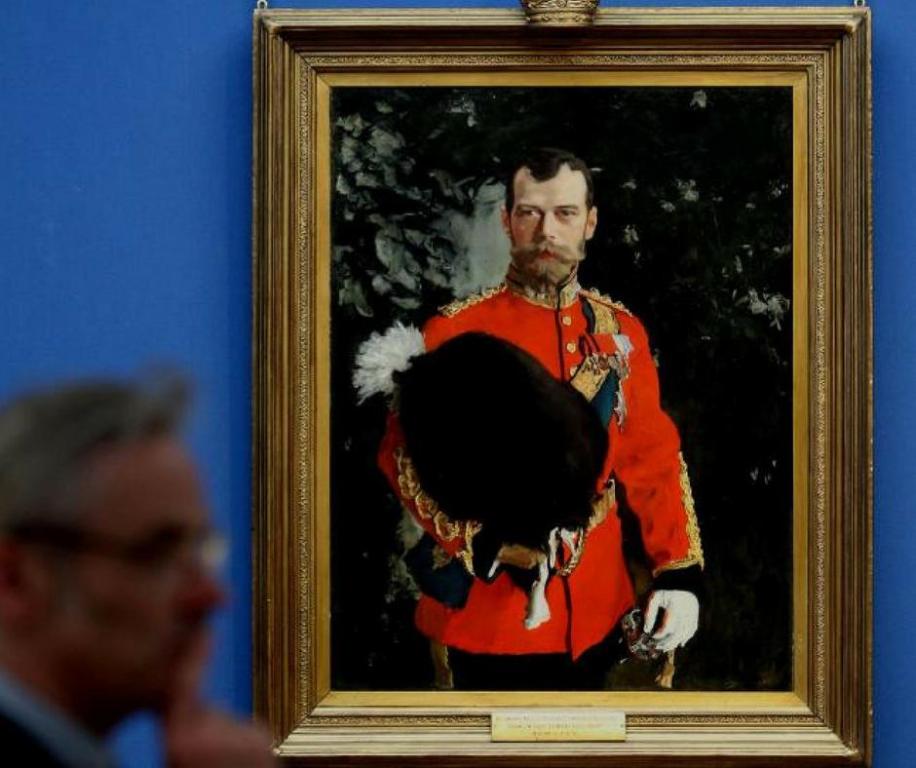
PHOTO: Portrait of Emperor Nicholas II in the uniform of Colonel-in-Chief of the Royal Scots Greys (1902). Artist: Valentin Alexandrovich Serov (1865-1911)
In 2025, a portrait of Emperor Nicholas II, painted in 1902 by the Russian artist Valentin Alexandrovich Serov (1865-1911) will be shown at the National Army Museum in London at an exhibition dedicated to the art of battle during the era of Queen Victoria (1837-1901).
The National Army Museum in London will host a major exhibition Myth and Reality: Military Art in the Age of Queen Victoria, which runs from 1st July to 1st November 2026.
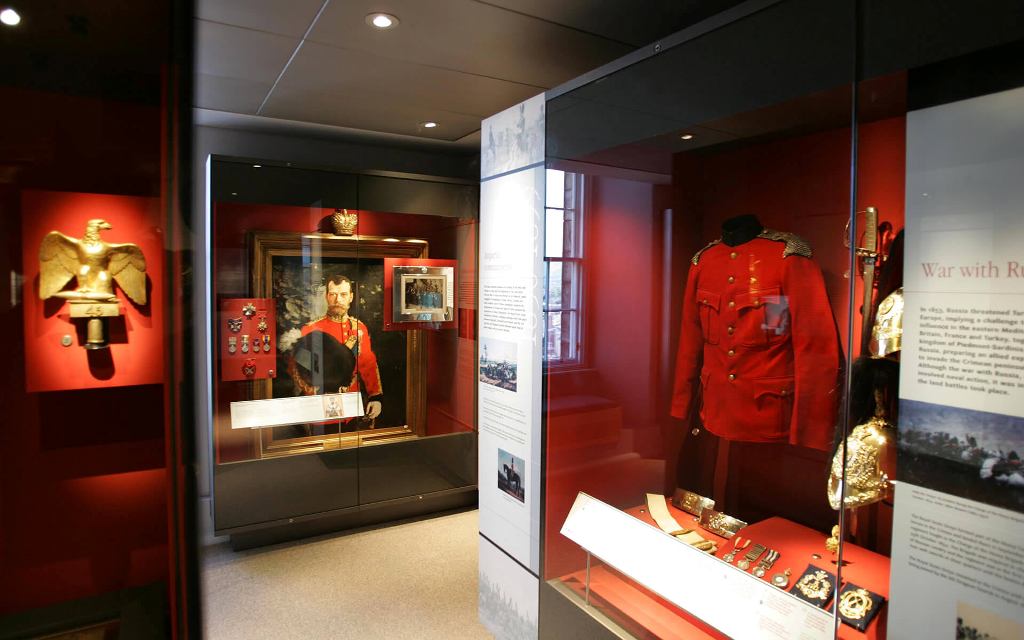
The exhibition will showcase over 140 works of art from the museum’s collection, including works on loan from other museums and private collections. Among these is Serov’s portrait of Nicholas II, on loan from the Royal Scots Dragoon Guards Museum in Edinburgh.
In Serov’s portrait, painted in 1902 in a lively impressionist manner, Russia’s most famous portrait artist, was able to convey the remarkable resemblance of the two Royal cousins: Nicholas II (1868-1918) and his elder cousin, the British King George V (1865-1936).
In Serov’s portrait, the young Russian Emperor is dressed in the uniform of Colonel-in-Chief of the Royal Scots Greys. This title was granted to him in 1894 by Queen Victoria on the occasion of the wedding of her granddaughter Princess Alix of Hesse and by Rhine to the future Emperor of Russia.
In 1902, the Emperor commissioned a portrait from Valentin Serov and, upon completion, presented the work to his Scottish Regiment. The portrait was taken to Edinburgh, to the castle where the headquarters of the Royal Scots Greys were located.
In 1971, the Royal Scots Greys was reformed and changed its name to the Royal Scots Dragoon Guards. But the portrait of the honorary commander of the regiment remained in its place in the living room of the regimental castle.
In the 2010s, the Board of Trustees of the regimental fund of the Royal Scots Dragoon Guards Regiment summoned an expert in Russian painting to Edinburgh. The insurance valuation of Serov’s work was valued at £15 million ($18 million USD).
Serov’s portrait of Emperor Nicholas II (1902) is on permanent display in the Royal Scots Dragoon Guards Museum, located in the New Barracks at Edinburgh, Scotland.
The Myth and Reality: Military Art in the Age of Queen Victoria exhibition, runs from 1st July 2025 to 1st November 2026 at the National Army Museum in London.
*You can order this title from most AMAZON outlets, including the United States, United Kingdom, Canada, Australia, France, Germany, Spain, Italy, Netherlands, Poland, Sweden and Japan *Note: prices are quoted in local currencies
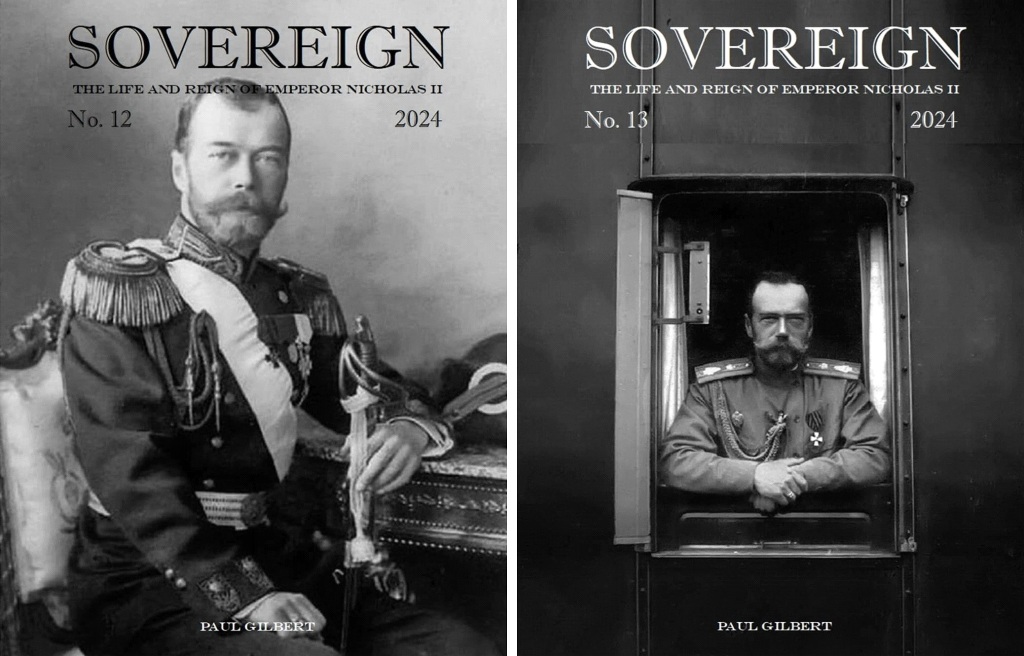
English. Large format 8-1/2″ x 11-1/2″. 130 pages. 124 Black & White photos
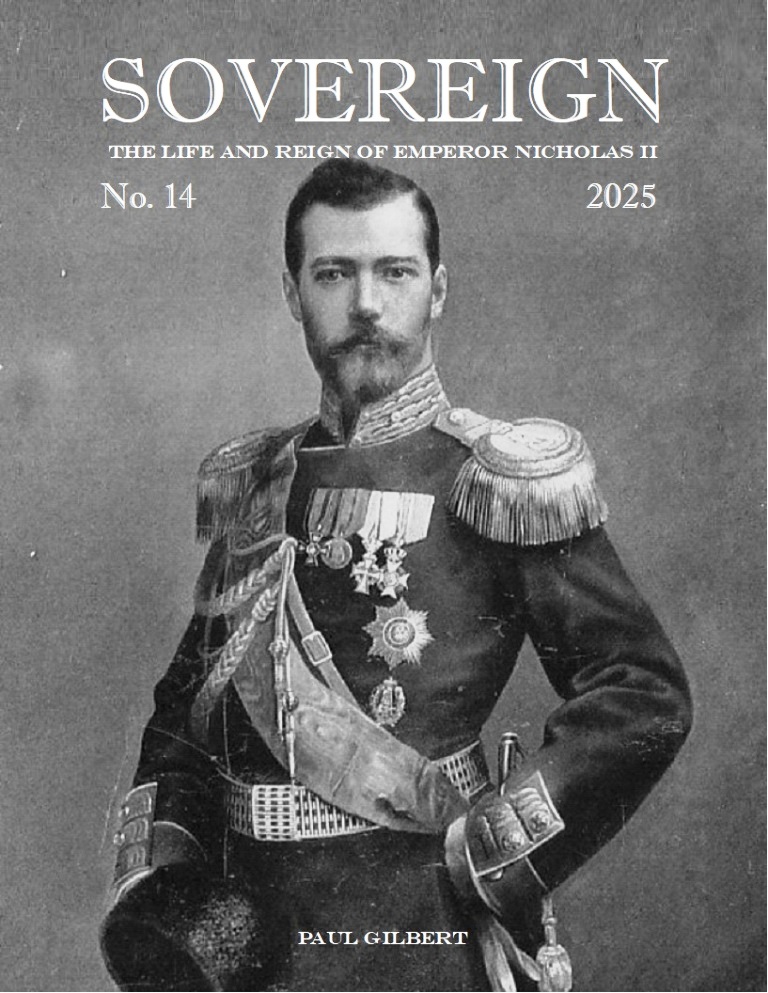
The No. 14 Winter 2025 issue of SOVEREIGN features articles about Russia’s last Tsar, his family, the Romanov dynasty and the history of Imperial Russia. These articles have been researched and written by independent historian and author Paul Gilbert. His works are based on new research from Russian archival and media sources.
In an effort to preserve his 30+ years of research, the author has reproduced a selection of the more than 800 articles he has written for his blog in a printed format for the first time. The author has updated many of these articles with additional facts and photos. In addition, this issue features 2 new works translated from Russian, and published in English for the first time.
In less than 24 hours of its release on AMAZON ON 8th January 2025, the No. 14 issue of my semi-annual publication SOVEREIGN is the ‘#1 NEW RELEASE in the RUSSIAN HISTORY’ category!
The No. 14 issue features the following 18 articles:
[1] 120th anniversary of Tsesarevich Alexei Nikolaevich’s baptism
[2] 130th anniversary Nicholas II ascension to the throne
[3] 130th anniversary of the wedding of Nicholas II and Alexandra Feodorovna
[4] Protecting the Tsar
[5] Nicholas II attends consecration of monument to his father in Moscow, 1912
[6] Monuments of Nicholas II and his family in and around Ekaterinburg
[7] Redevelopment of the Russian Imperial Navy During the Reign of Nicholas II
[8] The myth of hunger during the reign of Nicholas II
[9] The fate of Nicholas II favourite motorcar
[10] Emperor Nicholas II and King Edward VII Meet at Reval,1908
[11] Queen Elizabeth II receives Grand Duchess Olga Alexandrovna, 1959
[12] Telephones in the Alexander Palace during the reign of Nicholas II
[13] How British Intelligence tried to get Nicholas II out of Russia
[14] “The daughters were wearing diamond shields” – Yakov Yurovsky
[15] Nicholas II and his canine companions
[16] Those who served the Tsar: Vladimir Voeikov (1868-1947)
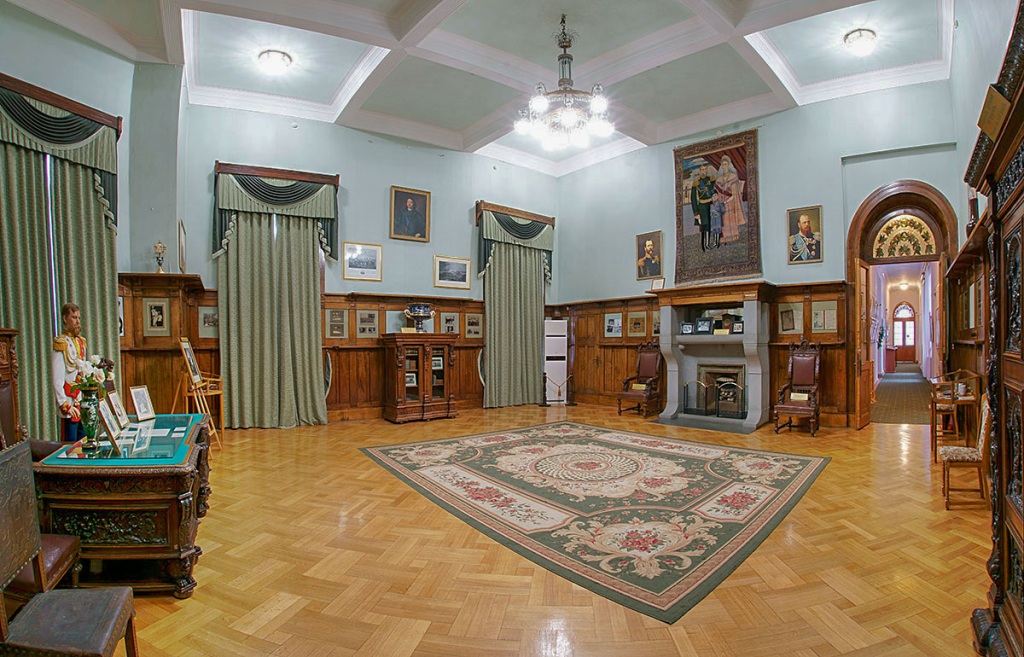
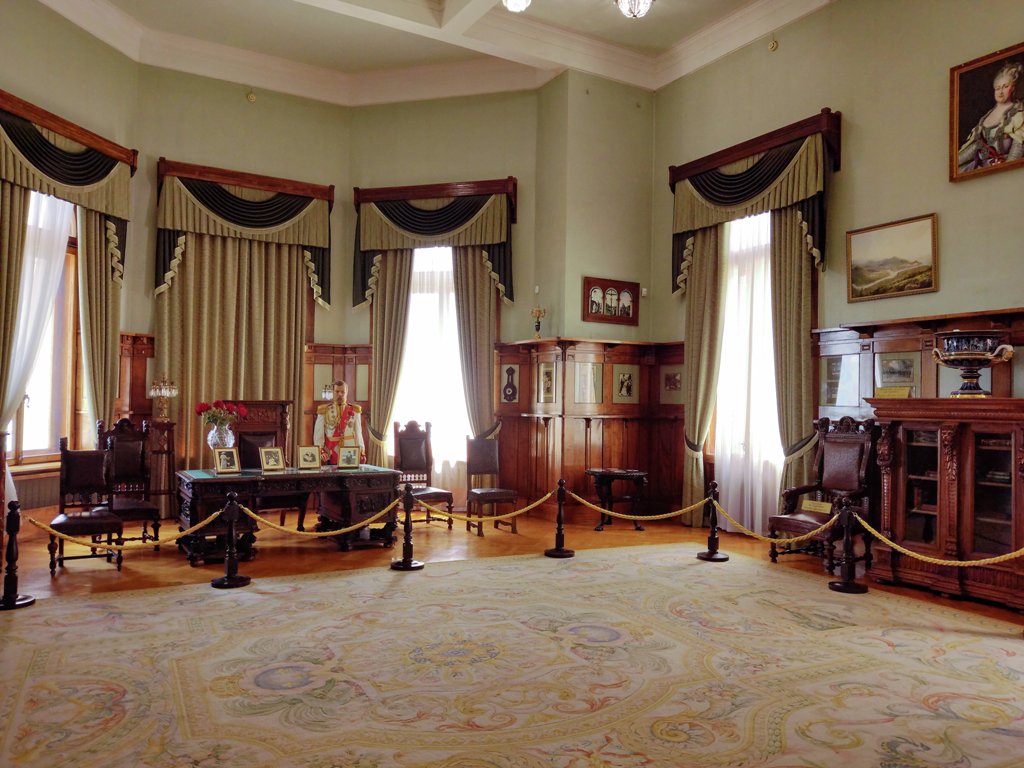
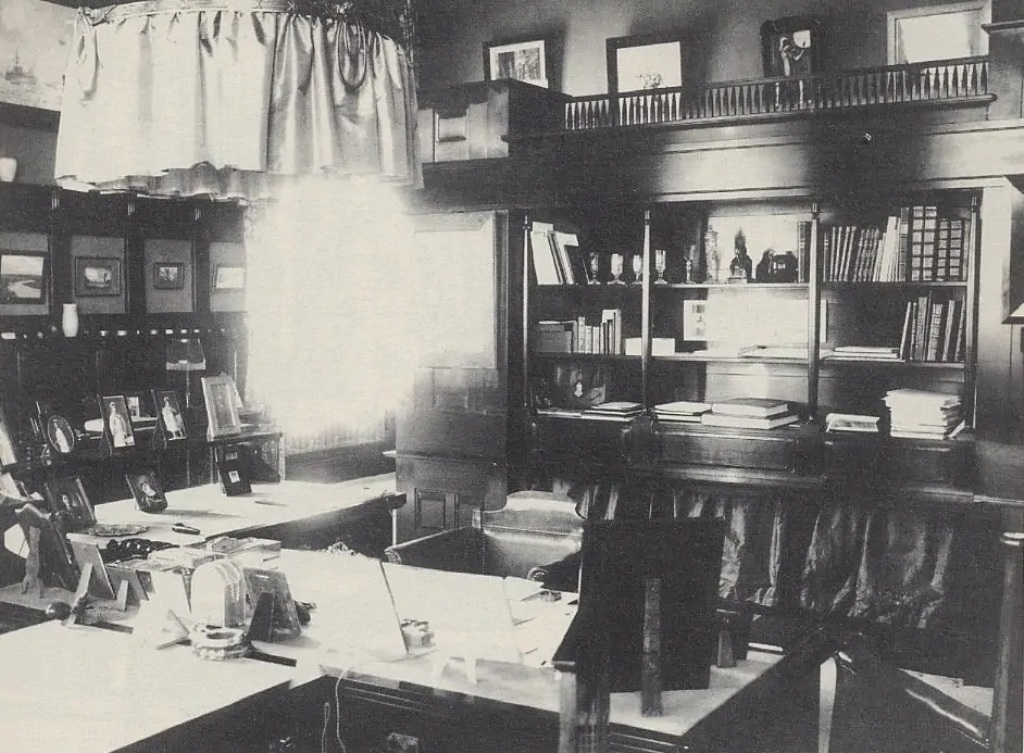
PHOTO: the Emperor’s Study in Livadia Palace, as it looks today
According to Natella Sheremeteva, one of the founders of the Foundation for the Preservation of Historical Cultural Heritage, the Study of Emperor Nicholas II in the Livadia Palace, Crimea will be recreated in 2025.
“The Foundation’s projects will provide close cooperation with Crimean museums. The expositions of the Crimean palace-museums should be improved and replenished with antiques from private collections. Assistance in this will be provided by the Foundation . . . One of the immediate priorities is to assist the Livadia Palace in recreating the Study of Emperor Nicholas II”, she said during a cultural event held in Yalta over the weekend.
Sheremeteva, who is also curator of the Antique Art Gallery, added: “We have been operating for more than 20 years. We are quite well known and respected in St. Petersburg. This year, a decision was made to relocate to Yalta, our services are needed here more.”
“In 2025 we will begin to recreate the historic interior of the Study of Emperor Nicholas II in the Livadia Palace,” said Sheremeteva.
In turn, Alexander Balinchenko, Director of the Alupka Palace and Park Museum, who was present at the event, thanked the Foundation for the Preservation of Historical Cultural Heritage, for its philanthropic activities and wished fruitful cooperation: “This is a very important event for all of us!”
It is not clear if the furniture will be recreated for the Emperor’s Study, as was done with the New Study and Working Study of Nicholas II in the Alexander Palace at Tsarskoye Selo. It is important to note that the desk which is currently on display in this interior is not the original, it is merely a replacement. The cost to recreate furniture for this interior would be costly, and only possible with the financial assistance of a large Russian corporation of wealthy oligarch.
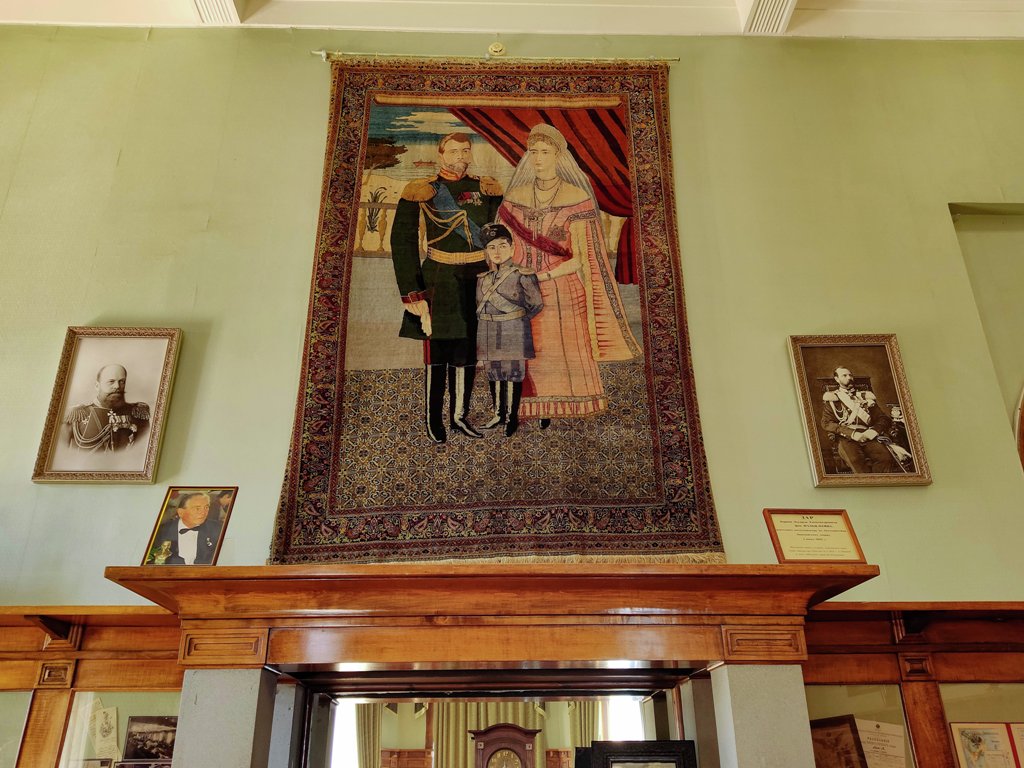
PHOTO: the Emperor’s Study in Livadia Palace, as it looks today
In 1913, the unique carpet – seen on above photo – was gifted by Ahmad Shah Qajar Shah of Persia to the family of Emperor Nicholas II on the occasion of the celebration of the 300th anniversary of the Romanov dynasty. After the Revolution, the carpet among other items came into the possession of *Baron Eduard von Falz-Fein.
After the fall of the Soviet Union in 1991, von Falz-Fein dedicated a significant part of his life to the return of historical and cultural monuments to Russia, including the priceless carpet, which he gifted to Livadia Palace, where it remains on display to this day. It is one of the few original items from the Study of Emperor Nicholas II to have survived to the present day.
*Baron Eduard Oleg Alexandrowitsch von Falz-Fein (14 September 1912 – 17 November 2018) was born in Imperial Russia, and fled with his parent to Germany in 1918. He lived for most of his life in Liechtenstein, where he became a successful athlete, businessman and philanthropist. It is interesting to note that Falz-Fein funded much of the research on the identification of the Romanov family remains. He died in Vaduz on 17 November 2018, at the age of 106!
History of the Studay of Emperor Nicholas II in Livadia Palace
One of the most beautiful interiors of the Livadia Palace was the Emperor’s Study, which was located on the second floor. In 1911, Nicholas II wrote in his diary: “I am delighted with my upper study.”
Despite his abscence from the northern capital, the Emperor faithfully carried out his duties during his stays in Crimea. Couriers arrived by train from St. Petersburg, with “piles of papers and documents”, which were delivered to the imperial residence at Livadia. Nicholas II diligently read the documents, often writing notes and signed them in his Study daily. He regularly met with officials (ambassadors, political and state figures), whom Nicholas II received, always in uniform.
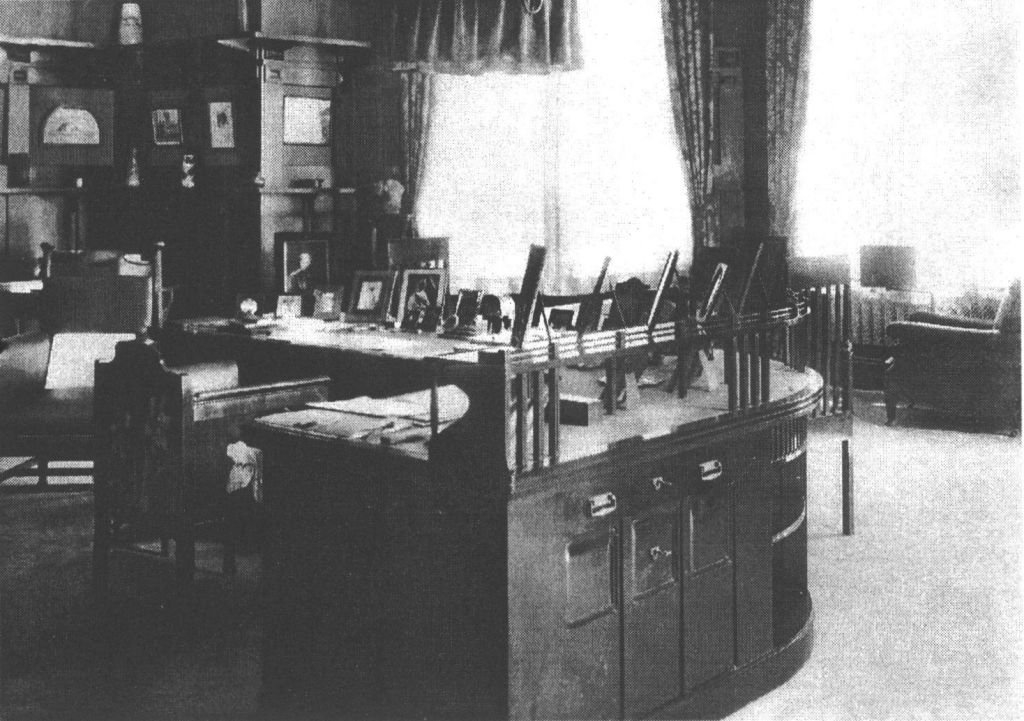
PHOTOS: the Study of Emperor Nicholas II in Livadia Palace as it looked in 1912-1914
The furniture and the wall panels with shelves in the Emperor’s Study were made by the craftsmen of the F.F. Tarasov Furniture Factory in St. Petersburg and the K.V. Zibrecht Factory in Moscow.
The furniture was made from ash wood with baitsovka in a dark greenish-brown tone. They were complemented with green Moroccan leather chairs and armchairs, embossed with the image of the iris flower in the Art Nouveau style.
The furniture was composed in such a way that the natural light, which flooded the spacious interior, gave the impression that the Emperor’s Study was divided into two parts – a working part, a business one, facing the windows of the bay window, and a corner part, in which Nicholas would relax while smoking a cigarette in front of a massive fireplace made of gray-green diorite.
While the original wall panels and fireplace have survived, none of the furniture – including the Emperor’s desk – has not survived to the present day. On 30th April, 1918, German troops entered Livadia and immediately began to plunder the palace. Any remaining items of furniture and decoration were transferred to other museums. Livadia Palace then became a sanitorium. In 1993 the Livadia Palace received the status of a museum.
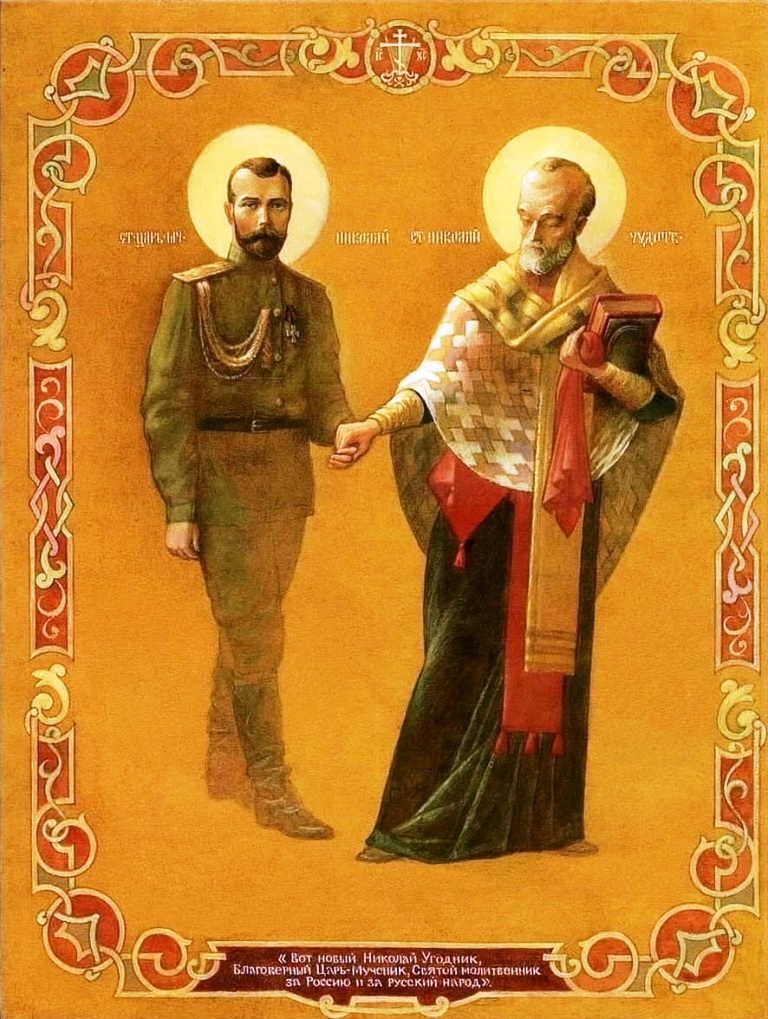
PHOTO: contemporary icon depicting the Holy Tsar-Martyr Nicholas II and Saint Nicholas of Myra – aka Nicholas the Wonderworker (born 270- died 343 A.D.)
Today – 19th (O.S. 6th) December – the Russian Orthodox Church celebrates the name day of Emperor Nicholas II. The Tsar’s patron saint is Saint Nicholas of Myra – aka Nicholas the Wonderworker (born 270- died 343 A.D.).
Upon his birth on 19th (O.S. 6th) May 1896, the future Emperor and Tsar of Russia received the traditional Romanov name – “Nikolai” (Nicholas). His name can be attributed to “naming a male after an uncle” (a custom which dates from the Rurik dynasty), in which Nicholas was named in memory of his father’s elder brother and mother’s fiancé, Tsesarevich Nikolai Alexandrovich (1843-1865), who died at the age of 21. The names, patronymics, and namesake saints of the Tsesareviches themselves (Nicholas of Myra) and their fathers (Alexander Nevsky) coincided. The Holy Tsar-martyr Nicholas II’s name day is marked on 6th December according to the Old Style Julian calendar, the day on which St. Nicholas the Wonderworker died.
Nicholas the Wonderworker was a Christian saint, Archbishop of Myra in Lycia (Byzantium). He is revered as a miracle worker, considered the patron saint of sailors, merchants and children.
A patron saint is a person who has special meaning, and is often represented in pictures, icons, or statues. Most Orthodox Christians have a patron saint, and they usually receive this saint on the day of their baptism.
Russians celebrate name days separately from birthdays. Celebrations range from the gifting of cards and flowers to full-blown celebrations similar to birthday parties. Such a celebration begins with attendance at the divine services marking that day (in the Russian tradition, the All-Night Vigil and Divine Liturgy), and usually with a festive party thereafter. The Russian Imperial Family followed the tradition of giving name day gifts.
Before the October Revolution of 1917, Russians regarded name days as important as, or more important than, the celebration of birthdays, based on the rationale that one’s baptism is the event by which people become “born anew” in Christ.
Nicholas II took particular joy in celebrating his name day, and recorded his memories in his diary . . .
From the diary of Emperor Nicholas II of 19th (O.S. 6th) December 1915:
“Sunday. It was strange and pleasant to spend my name day at home! We attended mass. The whole family arrived for breakfast; We sat in the small library at three tables. Then we went to Alexei and sat with him…”
From the diary of Emperor Nicholas II of 19th (O.S. 6th) December 1916:
“We got up early and in the morning the congratulations began. Walking back from the church, I greeted the units that celebrate their holidays today. The report, under Shuvaev, was short. A lot of people were eating breakfast. I received gifts from Alix and the children…”
From the diary of Emperor Nicholas II of 19th (O.S. 6th) December 1917:
“My name day was spent calmly and not following the example of previous years. A moleben [prayer service] was served at 12 o’clock. The soldiers of the 4th regiment in the garden, who were on guard, all congratulated me, and I congratulated them on their regimental holiday. I received three pies and sent one of them to the guard.” [The Imperial Family were living under house arrest in Tobolsk at the time, it would be Nicholas’s last name day – Ed.]
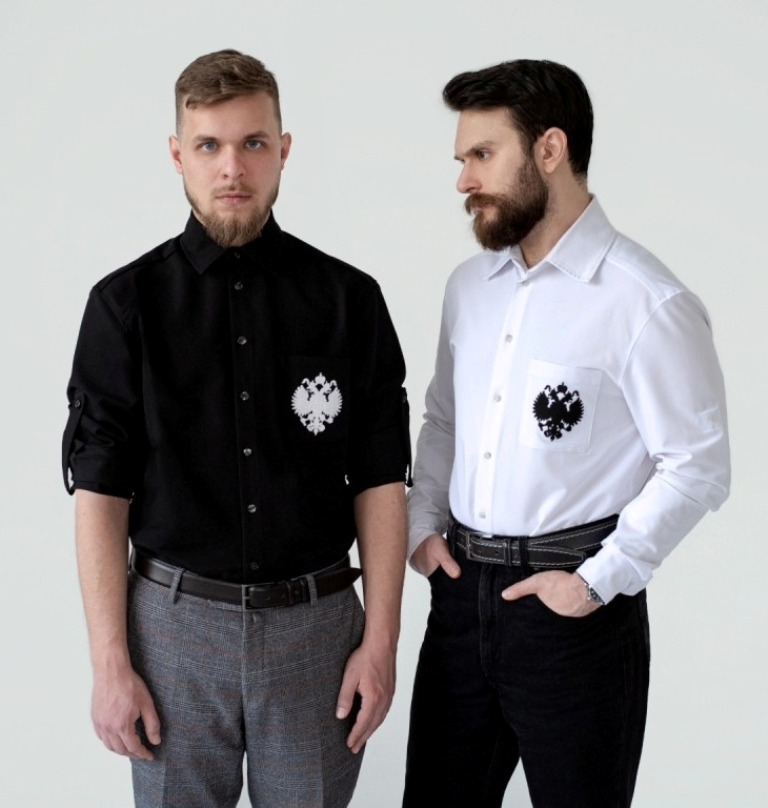
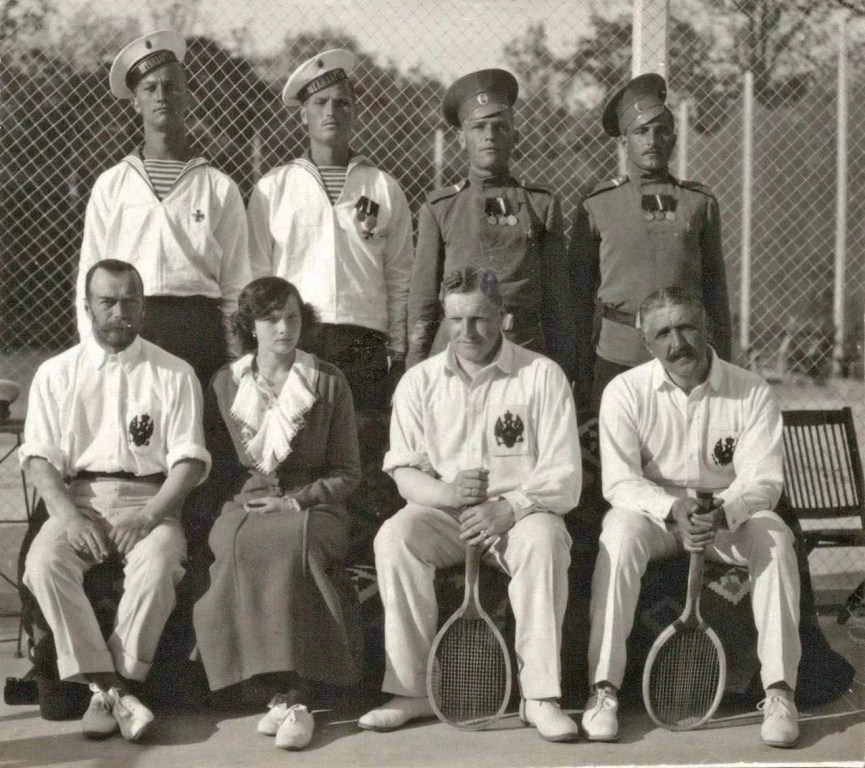
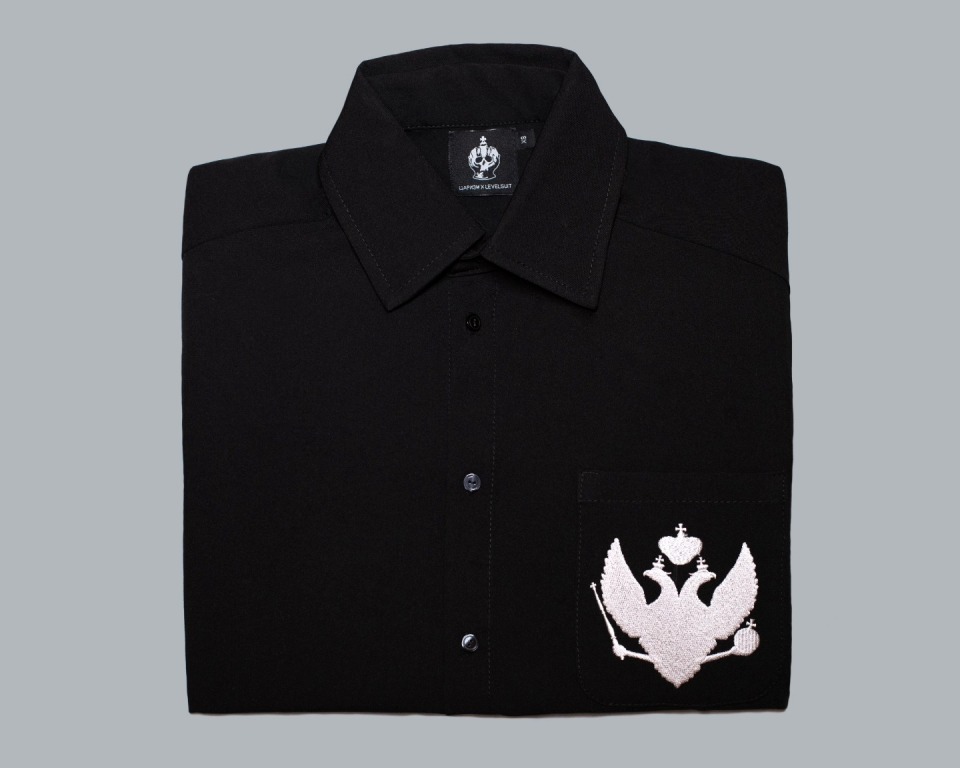
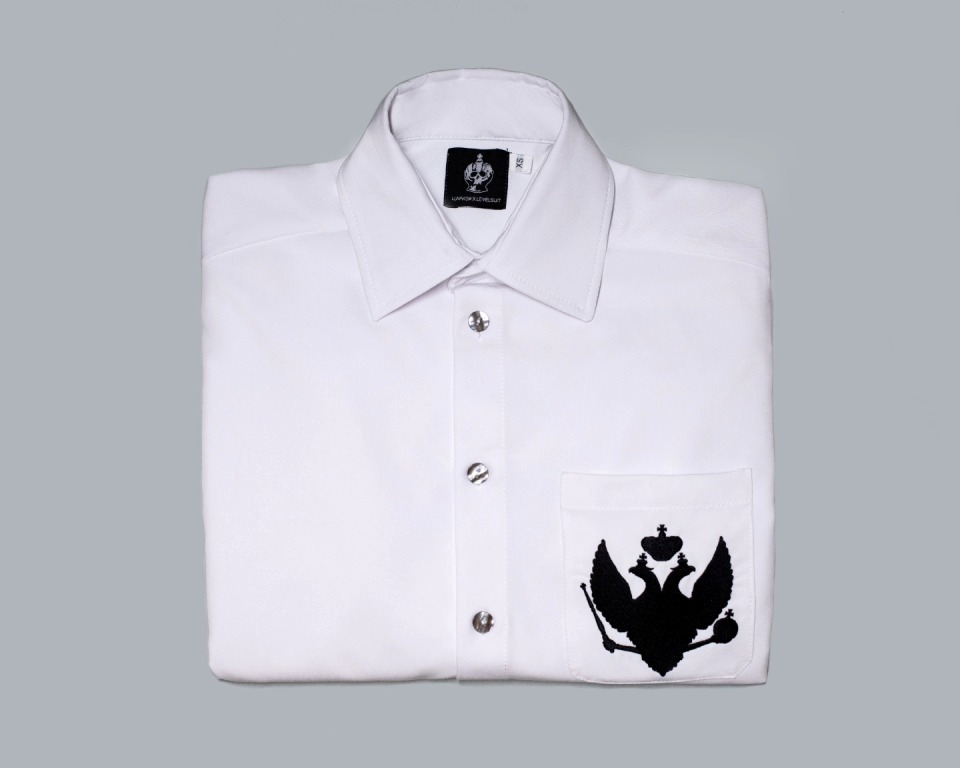
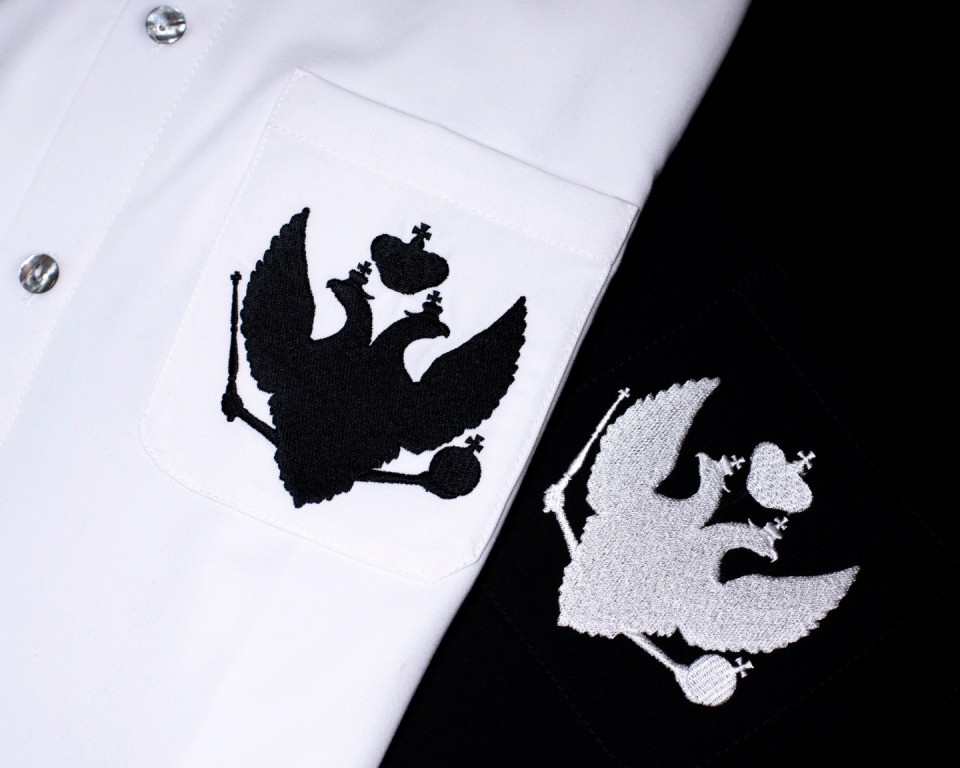
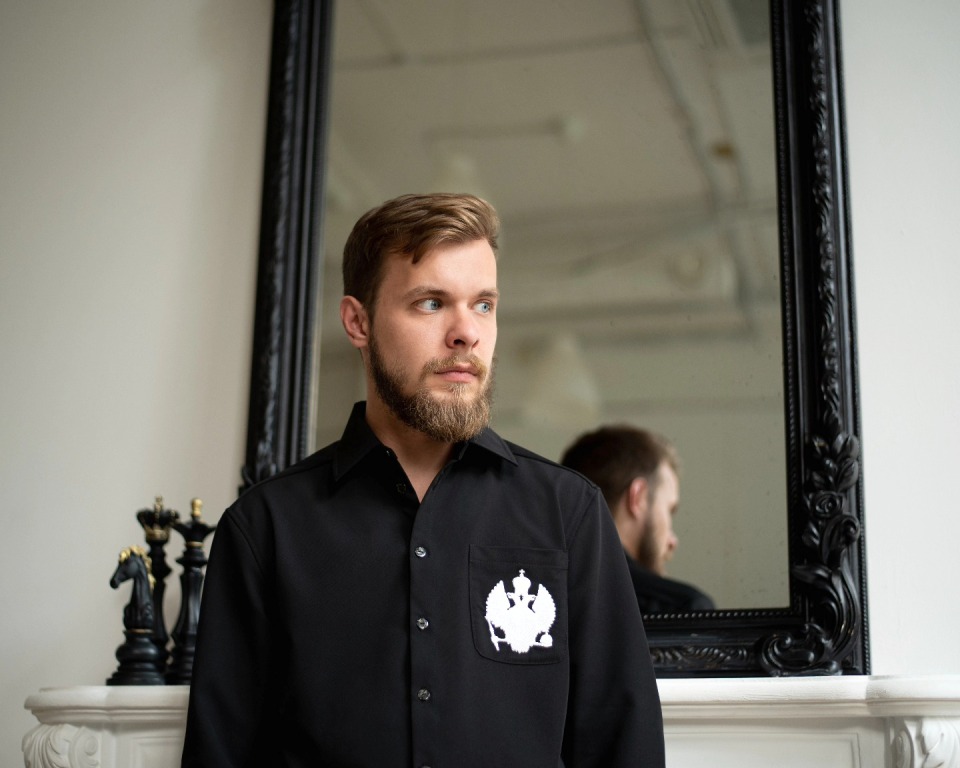
A famous Moscow atelier has recreated an iconic shirt initiated by Emperor Nicholas II in 1913. The shirt designed by Levelsuit, feature the Imperial Russian Coat-of-Arms embroidered on the left pocket. The white shirt is almost identical to the one worn by the Tsar in early 20th century photographs.
In 1913, on the initiative of Emperor Nicholas II, a sports uniform for the Russian Imperial Army was created. The idea was thoroughly researched, in which designs were developed for different sports: gymnastics, fencing, athletics, yachting, cross-country skiing and tennis.
PHOTO: Emperor Nicholas II (with his daughter Grand Duchess Tatiana Nikolaevna), wearing the shirt during a tennis match at Livadia, in the Spring of 1914
It was the imperial uniform for tennis players that served as the prototype for Levelsuit’s new shirt.
This consisted of a white tennis shirt made of thin linen, soft cuffs and small, flat mother-of-pearl buttons. In the middle of the chest there is a slit with a bow fold and three pleats on the sides. The embroidered coat of arms was similar to that of yachtsmen’s shirts, on the left side of the chest. The shirt was worn with white flannel or cloth trousers, and a tricolor belt. The uniform turned out to be so comfortable and stylish, that it was regularly worn by the Emperor himself, who was an excellent and enthusiastic tennis player.
Levelsuit’s new design is almost an exact copy of the shirt worn by the Imperial Tennis Team and by the Tsar. The shirts, which are available in white or black, are currently only available in Russia.
Unfortunately, for those of us in the West, it is currently not possible to order one of these shirts, due to the economic sanctions against the Russian Federation. Both MasterCard and Visa have suspended operations in Russia, making it impossible to order any goods online for the foreseeable future.
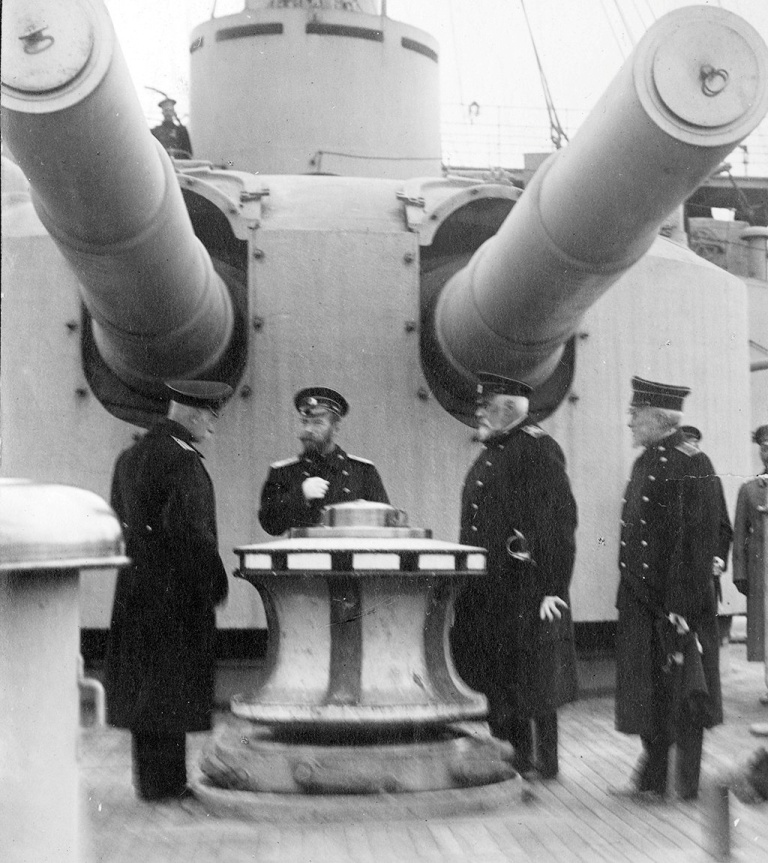
PHOTO: Emperor Nicholas II on the deck of the Imperial Russian Navy cruiser “Россия / Russia“. 15th Jamuary 1915. Standing to the Emperor’s right is the commander of the Baltic Fleet, Nikolai Ottovich von Essen (1860-1915).
The Chief of Staff of the Guards Troops and Petersburg Military District Lieutenant General Baron A.P. von den Brinken (1859 – 1917) wrote about Nicholas II’s affection for the navy and sailors: “The Tsar, always so kind and gentle, at anyone’s attempt to say something negative against the navy becomes literally furious, thumps his fist on the table, and stops listening”.
Formally established in 1696 under Emperor Peter I (1672-1725), the Imperial Russian Navy served as the navy of the Russian Empire until 1917. It was expanded in the second half of the 18th century and by the early part of the 19th century, it reached its peak strength, behind only the British and French fleets in terms of size.
The navy then went into a period of decline in the first half of the 19th century, due to Russia’s slow technical and economic development. It had a revival in the latter part of the century during the reign of Emperor Nicholas II (1894-1917), but lost most of its Pacific Fleet along with the Baltic Fleet, both of which were sent to the Far East and subsequently destroyed in the disastrous conflict of 1904. The second phase of Nicholas II’s military life was marked by his participation in the reorganization of the navy after the catastrophic Russo-Japanese War.
The Imperial Russian Navy had mixed experiences during the First World War, with Germany generally gaining the upper hand in the Baltic Sea, while Russia established its absolute dominance on the Black Sea. The February Revolution of 1917 marked the end of the Imperial Russian Navy; its officers had mostly aligned with the Tsar, and the sailors split to fight on either side. The surviving ships were taken over by the Soviet Navy when it was established in 1918.
***
VIDEO: vintage newsreels of Nicholas II and the Imperial Russian Navy Duration: 12 minutes with music
The above video presents a collection of vintage newsreels from the Russian State Documentary Film & Photo Archive at Krasnogorsk (RGAKFD), which show Emperor Nicholas II with the Imperial Russian Navy as he reviews the squadrons, talks to the Russian sailors, officers and admirals, and participates in the other naval events.
During the reign of Emperor Nicholas II the Imperial Russian Navy continued to expand in the later part of the 19th century, regaining its position as the third largest fleet in the world after Britain and France. The expansion was notably accelerated under Nicholas II who had been influenced by the American naval theoretician Alfred Thayer Mahan. Russian industry, although growing in capacity, was not able to meet the demands of the burgeoning Imperial Navy and some ships were ordered from Britain, France, Germany, USA, and Denmark. French naval architects in particular had a considerable influence on Russian designs.
At the end of the Russo-Japanese War in 1905, Russia had fallen from being the third greatest naval power to sixth place. It was then that the focus of Russian naval activities shifted back from the Far East to the Baltic. The task of the Baltic Fleet was to defend the Baltic Sea and St Petersburg from Imperial Germany.
On 19th March 1906, by decree of Emperor Nicholas II, the Maritime General Staff was organized with the Main Naval Staff, which assumed the functions of the operational body of the Imperial Navy. At first, attention was directed to the creation of mine-laying and a submarine fleet. In the same year, a new program for naval shipbuilding, the Russian Armed Forces Development and Reform Program, known as the “Small Shipbuilding Program”, which was approved by Emperor Nicholas II on 6th June 1907, began to be developed and actively discussed, but later the amount of appropriations was reduced, and the program itself was renamed the “Distribution of Allocations for Shipbuilding” (before 1911 it was planned to finish the ships already started for the Baltic Fleet – 4 battleships and 3 submarines, as well as a new naval base, and for the Black Sea Fleet – 14 destroyers and 3 submarines) and was partially approved by the State Duma in the spring of 1908.
VIDEO: ships of the Russian Imperial Fleet 1894-1917 Duration: 3 minutes with music
The Bosnian Crisis in 1909 again raised the issue of the expansion of the fleet and new battleships , cruisers, and destroyers were ordered for the Baltic Fleet. It is worth noting that, on the personal orders of Emperor Nicholas II, new battleships were laid, which had previously rejected by the State Duma.
A worsening of relations with Turkey meant that new ships including the Imperatritsa Mariya-class battleships were also ordered for the Black Sea Fleet. The total Russian naval expenditure from 1906-1913 was $519 million, in fifth place behind Britain, Germany, the United States and France.
From 1909, active preparation and discussion of a new shipbuilding program took place. The “Ten Year Shipbuilding Program (1910-1920)” – the so-called “Great Shipbuilding Program”, which in its final version envisaged the construction for the Baltic Fleet: 8 battleships, 4-linear cruisers, 18 destroyers and 12 submarines; for the Black Sea Fleet – 9 Novik type destroyers and 6 submarines; ships for the Pacific Fleet, as well as the rearmament and modernization of several battleships – Tri Sviatitelia, Dvenadsat Apostolov, and Georgii Pobedonosets. The program was approved on 25th March 1910, by Emperor Nicholas II, but was not reviewed by the State Duma until 1911.
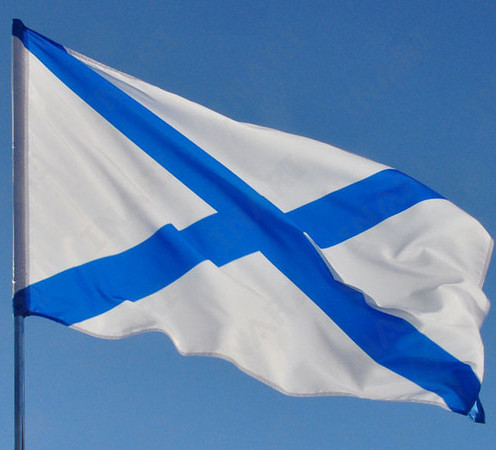
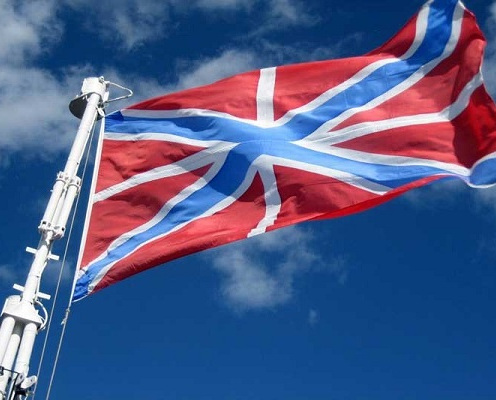
PHOTO: the white and blue ensign or Andreyevsky flag, and the red, blue and white naval jack of the Imperial Russian Navy
The re-armament program included a significant element of foreign participation with several ships (including the cruiser Rurik) and machinery ordered from foreign firms. After the outbreak of World War I, ships and equipment being built in Germany were confiscated. Equipment from Britain was slow in reaching Russia or was diverted to the Western Allies’ own war effort.
By March 1918, the Russian Revolution and the Treaty of Brest-Litovsk made the Germans masters of the Baltic Sea and German fleets transferred troops to support newly independent Finland and to occupy much of Russia, halting only when defeated in the West. The Russians evacuated the Baltic Fleet from Helsinki and Reval to Kronstadt during the Ice Campaign of the Baltic Fleet in March 1918.
The Black Sea was the domain of the Russians and the Ottoman Empire but it was here that the Imperial Russian Navy established its absolute dominance. It possessed a large fleet based in Sevastopol and it was led by two skilled commanders: Admiral Eberhart (1856-1919) and Admiral Kolchak (1874-1920) (who took over in 1916).
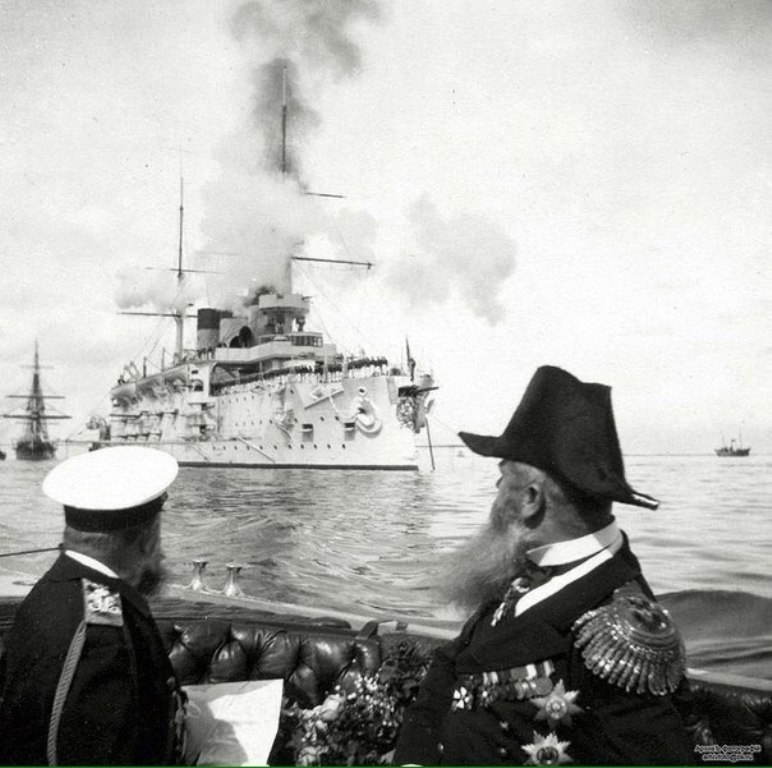
PHOTO: Grand Duke Alexei Alexandrovich and Admiral S.O. Makarov watch the newly constructed battleship Oslyabya, during maneuvers on the Baltic Sea, 1899
After Admiral Kolchak took command (August 1916), the Imperial Russian fleet mined the exit from the Bosporus, preventing nearly all Ottoman ships from entering the Black Sea. Later that year, the naval approaches to Varna were also mined. The greatest loss suffered by the Russian Black Sea fleet was the destruction of the modern dreadnought Imperatritsa Mariya, which blew up in port on 7th October 1916, just one year after it was commissioned. The sinking of the Imperatritsa Mariya was never fully explained; it could have been sabotage or a terrible accident.
The Revolution and subsequent Civil War devastated the Russian Navy. Only the Baltic fleet based at Petrograd remained largely intact, although it was attacked by the British Royal Navy in 1919. Foreign Interventionists occupied the Pacific, Black Sea and Arctic coasts. Most of the surviving Black Sea Fleet warships, with crews loyal to the White Russian movement, became part of Wrangel’s fleet under the control of commander Pyotr Nikolayevich Wrangel (1878-1928) and after evacuating White forces and civilians from the Crimea were eventually interned in Bizerta, Tunisia. Russian sailors fought on both sides in this bloody conflict. The sailors of the Baltic fleet rebelled against harsh treatment by the Soviet authorities in the Kronstadt Rebellion of 1921.
The surviving ships formed the core of the Soviet Navy on its 1918 establishment, though the remnants of Wrangel’s fleet never returned to Russia.
PHOTO: View of the “Боярин / Boyarin” a second-rank protected cruiser built for the Imperial Russian Navy by Burmeister & Wain in Copenhagen, Denmark. Laundced in 1901, the hull featured a magnificent double-headed eagle bearing the monogram of Emperor Nicholas II. She served in the Russian Pacific Fleet and was sunk by a Russian naval mine near the entrance to Port Arthur, Manchuria, just after the start of the Russo-Japanese War.
***
FURTHER READING
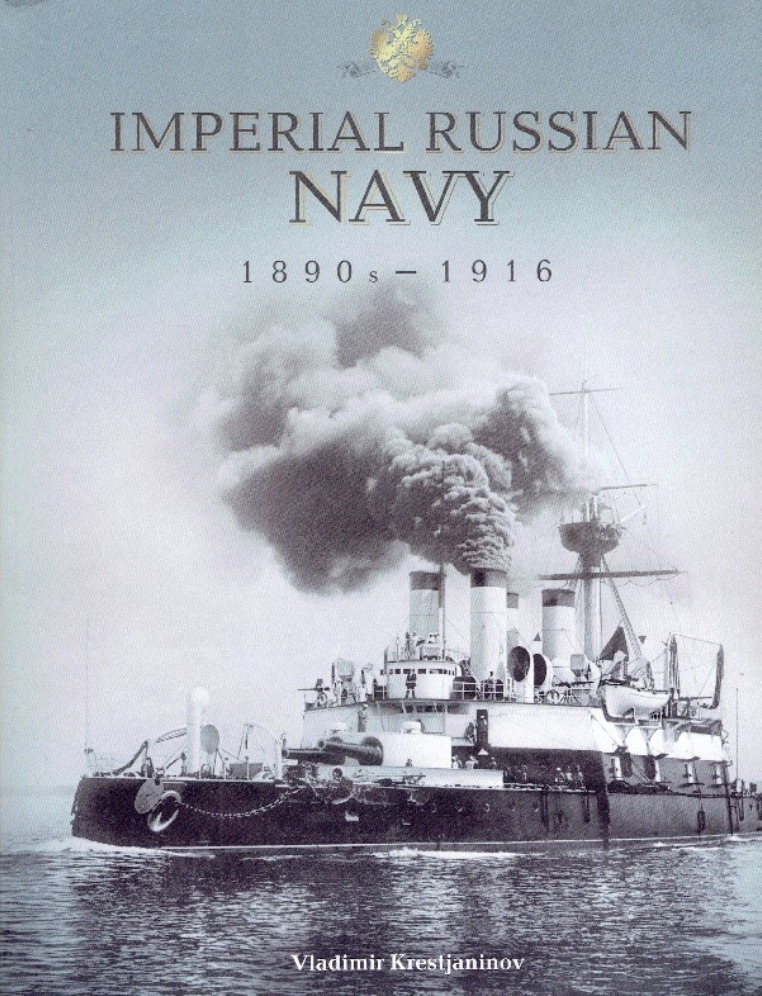
One of my many interests is the Russian Imperial Navy, during the reign of Nicholas II. In 2013, Uniform Press published an excellent book ‘The Imperial Russian Navy 1890s-1916’ by Vladimir Krestjaninov. I highly recommend this title to any one else who shares an interest in this subject.
“Russia has only two true allies,” said Emperor Alexander III, “its army and navy.”
This unique look at the Russian Imperial Navy in photographs from the late 19th and early 20th centuries, features 430 black and white images from archives, museums and private collections. It explores how the Russian Navy’s construction and activities were shaped largely by the interests, opinions and policies of Russia’s last tsar Nicholas II.
It includes a foreword by the author, and chapters such as ‘The Imperial Family and the Navy,’ and eleven other topics. It is interesting to note that the Imperial yachts were under the administration of the Naval Guards Corps.
Large soft cover format with 262 pages. Published by Uniform Press in 2013
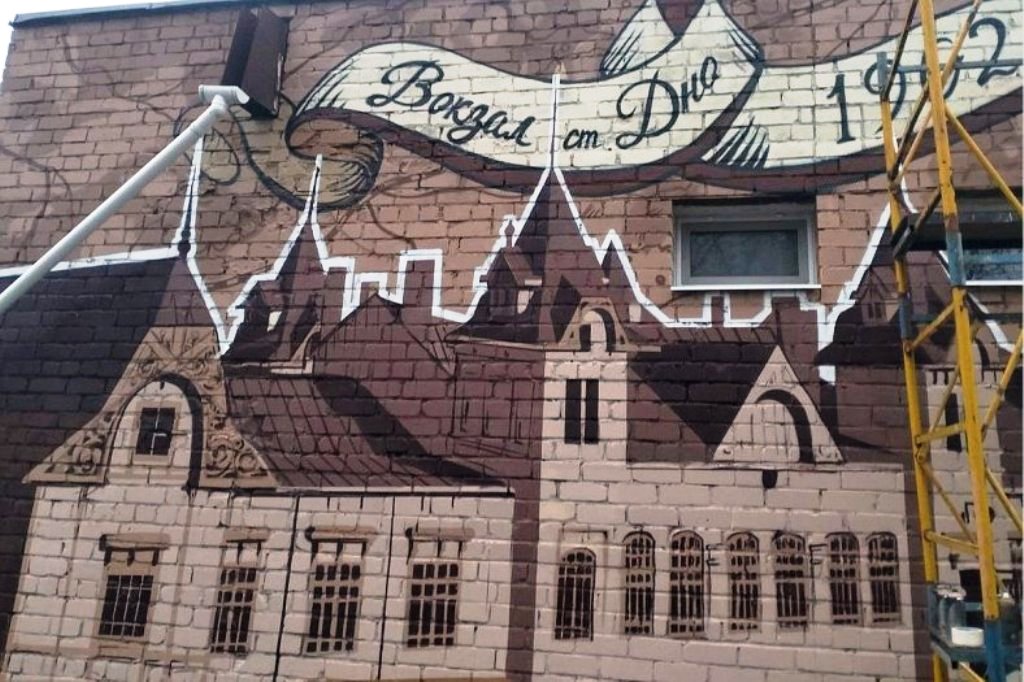
PHOTO: modern-day murual depicting the train stain in Dno
On 14th (O.S. 1st) March 1917, at 15:00, Emperor Nicholas II arrived at Dno on the Imperial Train, where an urgent telegram from State Duma Chairman Mikhail Rodzianko[1] awaited him:
“Dno station. To His Imperial Majesty. I am now leaving for Dno Station by emergency train to report to you, Sire, on the state of affairs and the necessary measures to save Russia. I earnestly ask you to wait for my arrival, for every minute counts.“
Without waiting for Rodzianko, the Tsar ordered the Imperial Train[2] to proceed on to Pskov, where he would meet up with Rodzianko, however, the chairman never arrived. On the night of 1st/2nd March, during a conversation with General Ruzsky[3] Rodzianko explained his “non-arrival” by the impossibility of leaving Petrograd in a situation where the revolutionary events in the capital threatened to develop into anarchy.
Emperor Nicholas II abdicated the following day, on 15th March (O.S. 2nd) March 1917, bringing an end to more than 300 years of the Romanov dynasty and the monarchy in Russia.
The Sovereign abdicated in the heartfelt belief that his abdication would save the honour of the army, prevent civil war and keep Russia in the war against Germany.
Sadly, it did not. In his diary, Nicholas wrote: “I am surrounded by betrayal, cowardice, and deceit.”
In memory of Emperor Nicholas II’s historic stop at Dno in March 1917, a mural of the pre-war railway station has been recreated, on the building of the museum and exhibition center in Dno. The artists of the mural are Ivan and Nikita Trakhov, both of whom are residents of Pskov.
“The mural will remind everyone of our history, the station, which Nicholas II saw from the window of his train,” said Mikhail Shaurkin, who serves as the head of the Dnovsky district .
The idea for the mural was conceived by the head of the museum Sergey Egorov. He wanted to recreate the historic look of the station as it looked more than a century ago. According to him, “many tourists, as well as residents of the city, are surprised to learn that there was a railway station in Dno before the Great Patriotic War.”
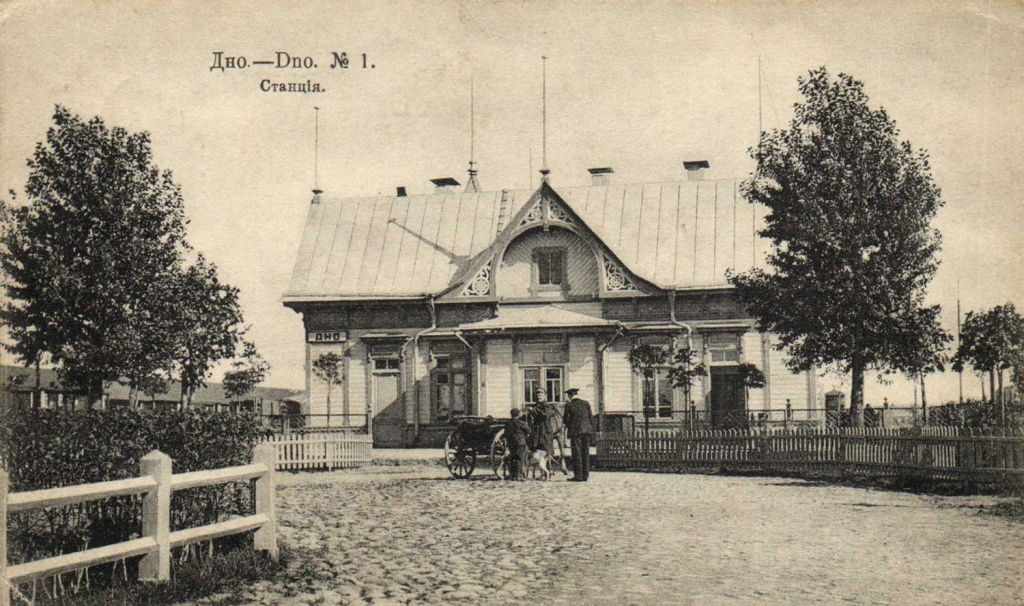
PHOTO: early 20th century postcard depicting the old wooden station at Dno
The original train station at Dno was constructed of wood in the Art Nouveau style. During the Great Patriotic War (1941-45) the building was destroyed by fire. After the war, a new station was built, which stands to this day.
NOTES:
[1] In an open act of treason against the Emperor, Grand Duke Kirill Vladimirovich wearing a red ribbon on his shoulders, under which the Marine of the Guard followed their commander, marched to Petrograd, where he presented himself at the State Duma, where he reported to Duma Chairman Mikhail Rodzianko. “I have the honour of appearing before Your Excellency,” said the Grand Duke . . . “I am at your disposal, as is the entire nation. I wish Russia only good.”
[2] With the outbreak of World War I, the Imperial Train became both a travelling residence for the Emperor, as well as a military field office, equipped with telephone and telegraph communications. A telephone network was installed for communication between all cars, each carriage having it’s own telephone.
[3] Nikolai Vladimirovich Ruzsky (1854-1918) was a Russian general, member of the state and military councils, best known for his role in World War I and the abdication of Tsar Nicholas II. He was shot by the Bolsheviks on 18th October 1918.
NOTE: the English language edition of this book is now available in both hard cover and paperback editions. You can now order this book direct from the following suppliers in the United States:
In addition, you can order this book directly from the publisher in Romania. Books are shipped by mail or courier (DHL). I had NO problem ordering a copy, and received it promptly.
HOW TO ORDER FROM THE PUBLISHER:the order page is a bit confusing, because the actual order instructions located at the bottom of the page are in Romanian. Simply use Google (or similar) to translate, the rest is simply.
Click HERE to order your copy. Scroll down to the bottom of the page. Select ‘COVER TYPE’ – hard cover or paperback. To the left of the ‘ADD TO CART’ button, you must select how many copies you want. Click on ‘VIEW CART’ and ‘CONTINUE TO CHECKOUT’. payment is in Euros, credit cards accepted – PG
***
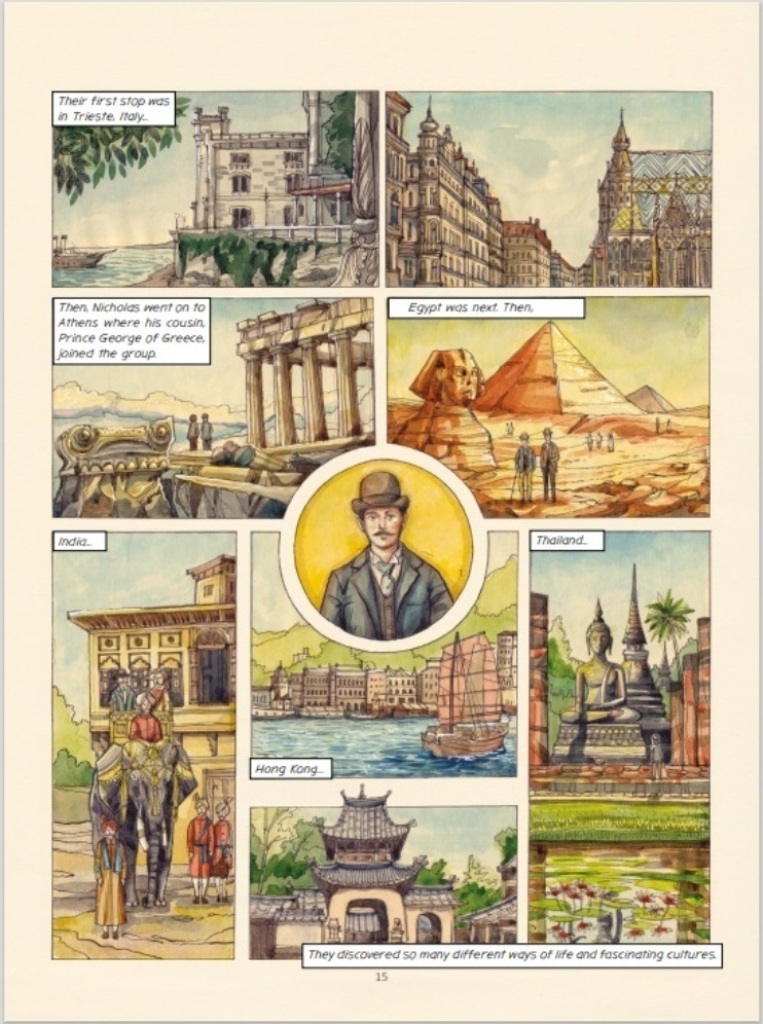
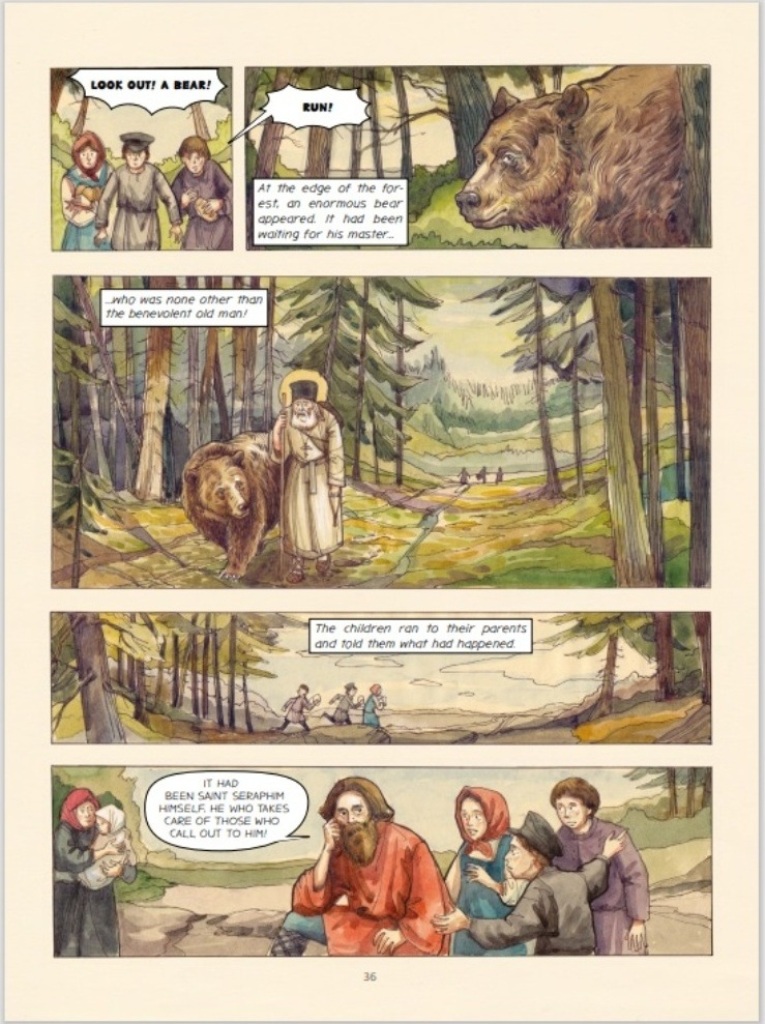
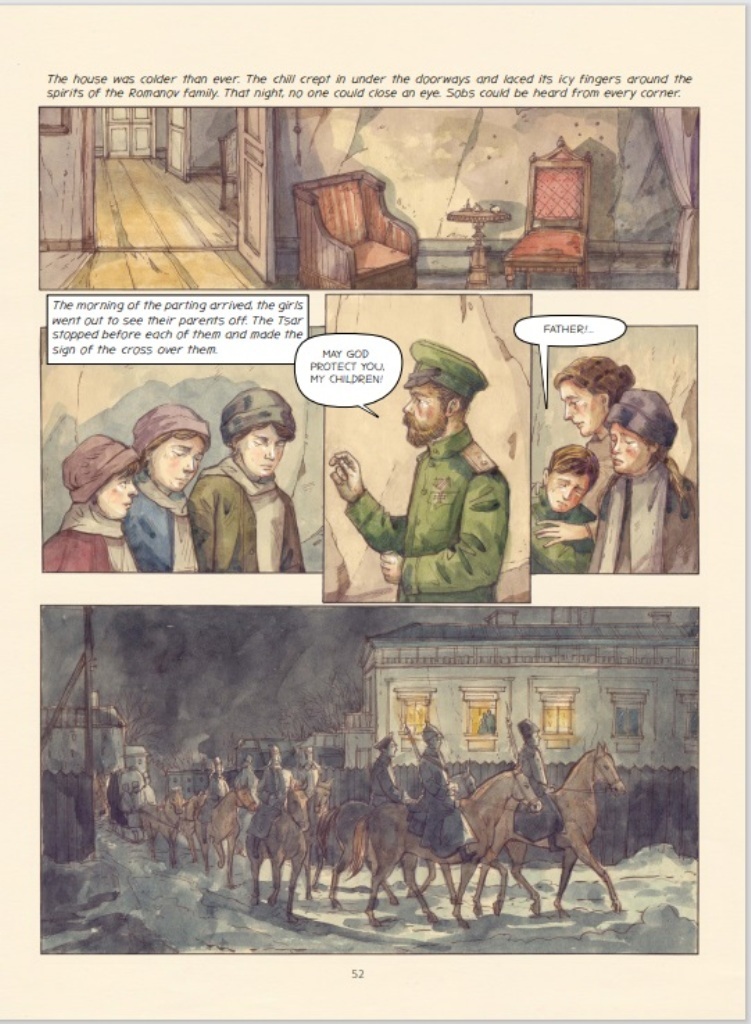
The publishing division of the Diaconești Monastery in Moldavia, Romania, have published an exiting new title: The True Story of the Romanov Family.
Although an abundance of books have been written about the Imperial Family, the present work is an unparalleled graphic study. Drawing from a wealth of historical sources, including memoirs, diaries, letters and scholarly works on the Imperial Family, the publisher has painstakingly recreated key moments in their private and public lives. In addition, eleven Faberge eggs, meticulously painted by Romanian artist Ovidiu Gliga are prominently featured in the book.
The text of the book is complimented by Ovidiu Gliga’s artwork. Over the past four years, the publisher has collaborated closely with this exceptional artist, whose artwork helps envelope the reader. His work for this book is showcased in the video found at the end of this summary. This book has been issued in both English and Romanian editions, in both hard cover and paperback formats.
CLICK on each image below, to enlarge and view page in greater detail
According to the publisher, “this project has been a labour of love, driven by our admiration for these revered saints and our desire to present their lives in a visually engaging format suitable for readers of all ages. We believe it fills a significant void in the literature about the Imperial Family, offering a detailed exploration of their lives and the enduring impact on Russia’s history.”
It is interesting to note, that the monastery’s inspiration for this project was profoundly influence by the popular book The Romanov Royal Martyrs: What Silence Could Not Conceal, published in 2019 by the Mesa Potamos Monastery in Cyprus, which the nuns of the Diaconești Monastery translated into Romanian.
The Romanian-based publisher has prepared a 2-minute English language video, which will give readers a sample of this unique publishing project, including a glimpse of it’s content and Ovidiu Gliga’s beautiful colour illustrations.
CLICK on the red arrow below to start the VIDEO . . .
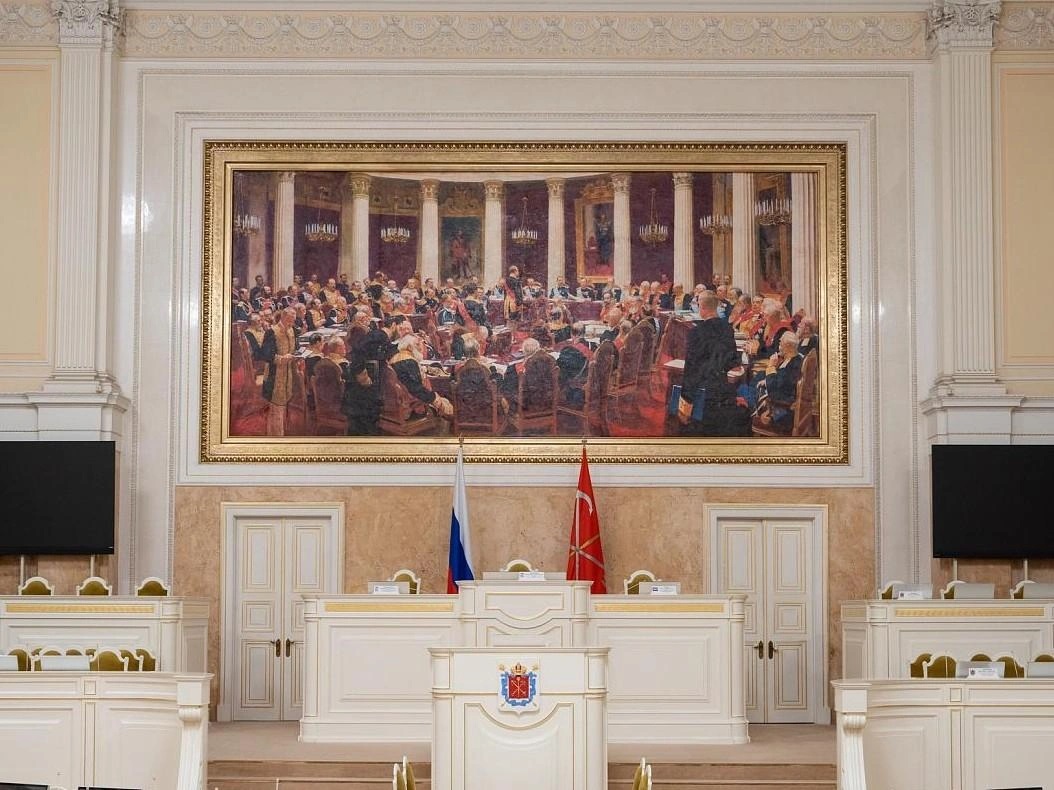
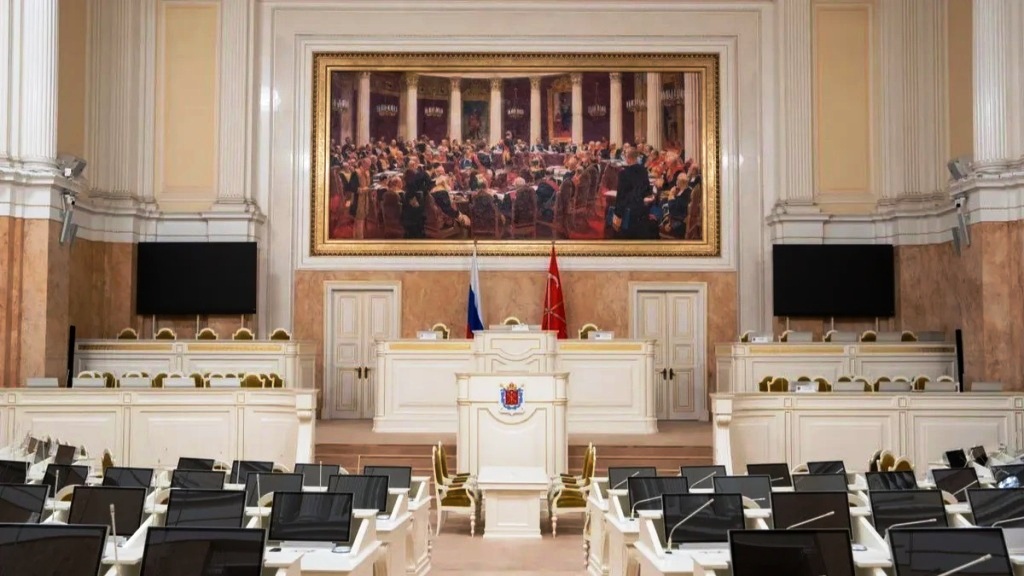
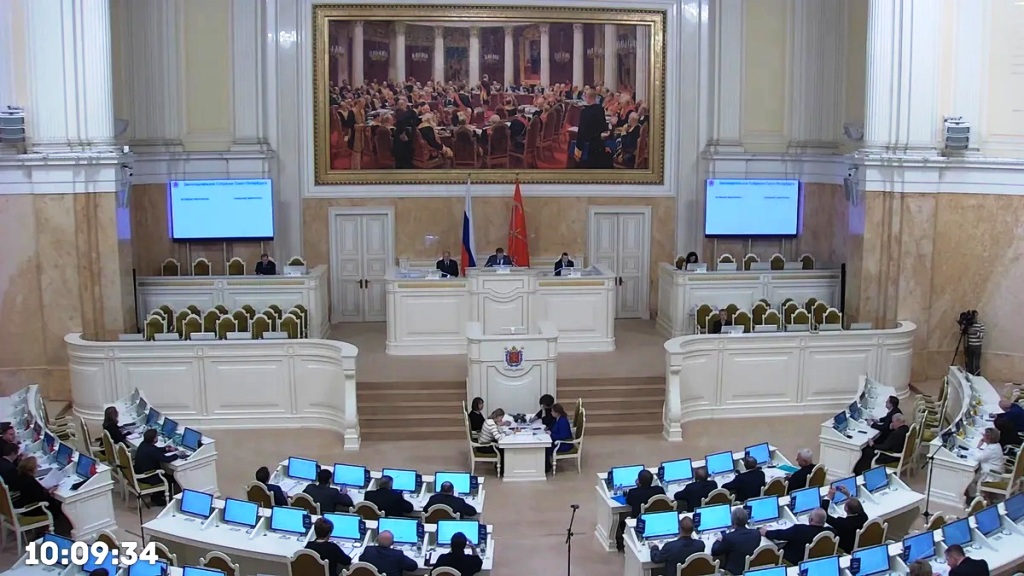
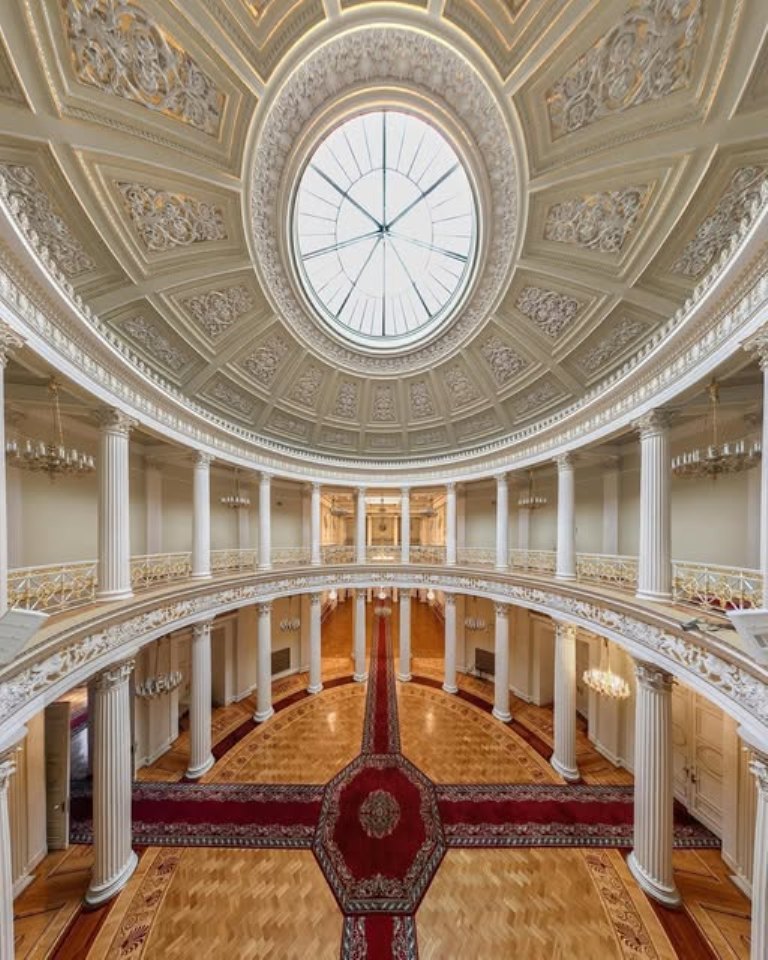
PHOTOS: in December 2024, a copy of “The Ceremonial Meeting Of The State Council 7 May 1901” by Ilya Repin, was installed in the Great Hall of the Mariinsky Palace in St. Petersburg
One of the most iconic paintings which reflects the splendour of the Russian Empire has to be “The Ceremonial Meeting Of The State Council 7 May 1901”, by Ilya Yefimovich Repin (1844-1930). A copy of the great Russian artist’s masterpiece was recently installed in the Great Hall of the Mariinsky Palace in St. Petersburg. The palace has been the site of the Legislative Assembly of Saint Petersburg since 1994.
An exact copy of Repin’s painting was a gift from the St. Petersburg artist Oleg Lukyanov for the 30th anniversary of the city parliament. “We thank Oleg Lukyanov, and the director of the State Russian Museum Alla Manilova for this wonderful gift,” said Speaker Alexander Belsky at the opening of the legislature on 4th December 2024.
The chairman of the Legislative Assembly also noted that specialists worked on the painting for more than two months, while the final touches took an additional six days. An exact copy of the canvas is made in the technique of “urban fresco”, which makes it possible to achieve full compliance with the original painting.
Ilya Repin’s masterpiece was first presented to the public in St. Petersburg on 4th January 1904. The painting depicts Emperor Nicholas II and members of the State Council after the emperor read out a charter in honour of the centenary of the establishment of the Indispensable Council (the predecessor of the State Council).
PHOTOS: two views of copy of “The Ceremonial Meeting Of The State Council 7 May 1901” by Ilya Repin, was installed in the Great Hall of the Mariinsky Palace, in St. Petersburg
***
A brief history of Repin’s masterpiece
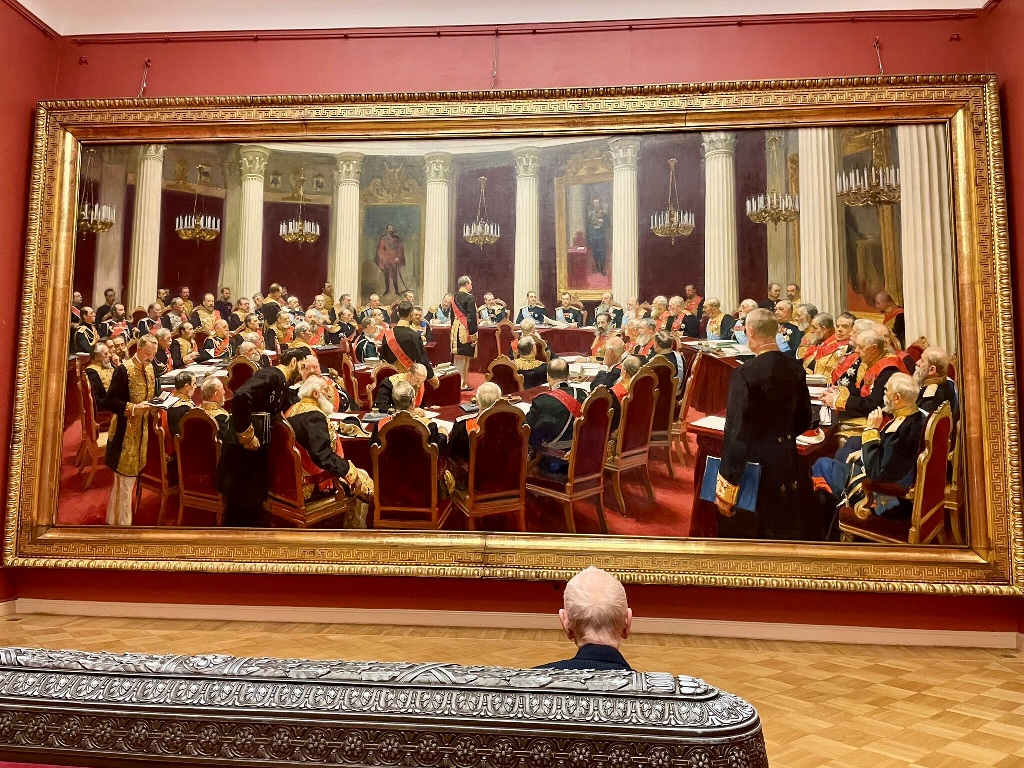
PHOTO: the original “The Ceremonial Meeting Of The State Council 7 May 1901” by Ilya Repin, today hangs in the State Russian Museum in St. Petersburg. The canvas is so large, that it takes up an entire wall, in a hall dedicated to Repin’s masterpiece.
The original “The Ceremonial Meeting Of The State Council 7 May 1901” by Ilya Repin, has been in the collection of the State Russian Museum since 1938. The canvas is so large, that it takes up an entire wall, in a hall dedicated to Repin’s masterpiece.
It is among the most significant and largest paintings from the collection of the State Russian Museum: the large-format canvas measuring 4 by 8 meters [ 13 ft. by 26 ft.].
Painted under a state order, the painting truly conveys the splendor of the Russian Empire. More than a century ago, the political and bureaucratic elite in uniforms attend a solemn meeting in the Round Hall of the Mariinsky Palace. Secretaries are carrying anniversary medals, the future Minister of Internal Affairs Vyacheslav Plehve is standing in front of Tsar Nicholas II, who has finished reading a charter on the occasion of his 100th anniversary. The canvas was created specifically for the Mariinsky Palace, where meetings of the State Council were held.
“The Ceremonial Meeting Of The State Council 7 May 1901” is a collective portrait featuring no less than 81 figures. It was painted one hundred and twenty one years ago (1903), in which Repin was paid a large fee. The customer of the canvas, Emperor Nicholas II, was pleased with the result.
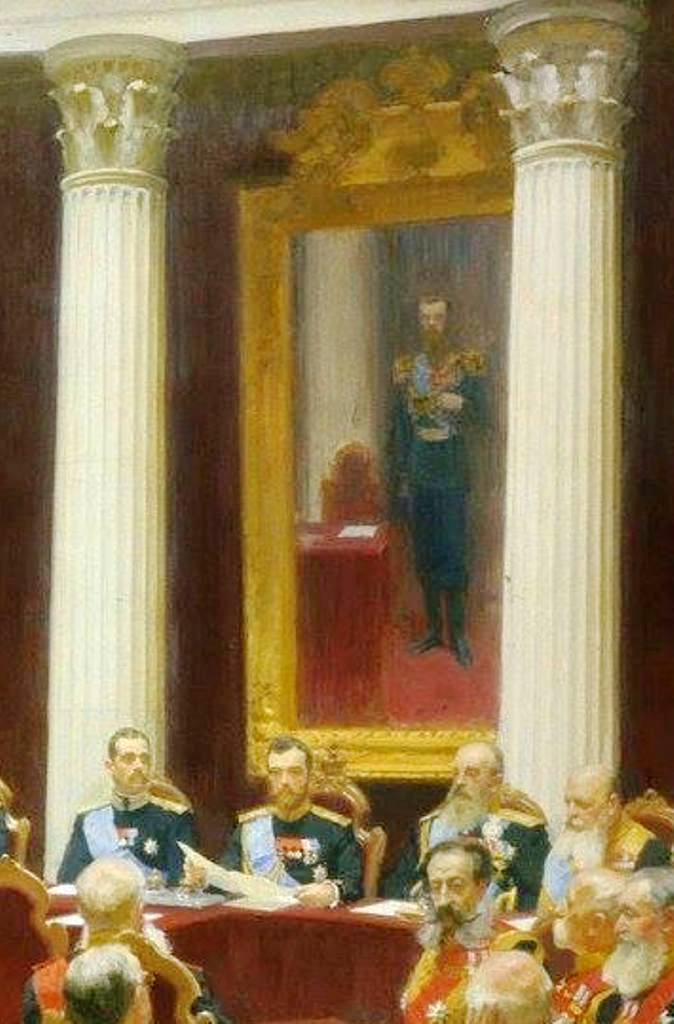
PHOTO: detail from Repin’s painting, which shows Emperor Nicholas II seated between two pillars, under a ceremonial portrait of himself – also by Ilya Repin – painted in 1895. His brother Grand Duke Mikhail Alexandrovich is seated to his right, and Grand Duke Mikhail Nikolayevich (1832-1909), who served as Chairman of the State Council, from 1881 to 1905, is seated to his left.
Founded in 1801 by Emperor Alexander I (1777-1825), the State Council celebrated its centenary with a ceremonial sitting in the Round Hall of the Mariinsky Palace in St. Petersburg on 7th May 1901. All the members of the State Council and the State Chancellery attended in full-dress uniform. Emperor Nicholas II and senior members of the Imperial Family are flanked by their ministers. Repin painted the scene from behind the chairs on the right (next to the columns.
He rapidly sketched the original modello on a canvas on which the perspective of the hall had already been marked out, working from a previously selected point. The artist later turned this study into a large picture with the help of two students from the Imperial Academy of Arts: Boris Kustodiev (1878-1927) and Ivan Kulikov (1875-1941). Every member of the State Council is depicted in natural and diverse poses, with strong physical resemblances.
PHOTO: the Round Hall in the Mariinsky Palace, as it looks today
***
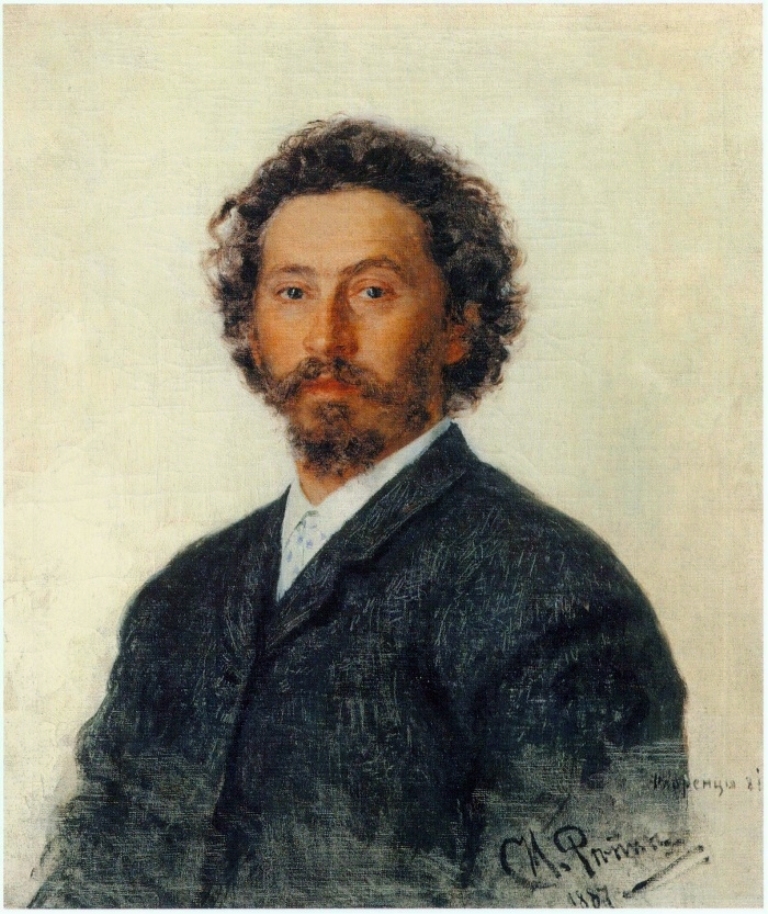
Ilya Yefimovich Repin (1844-1930)
Self-portrait (1887 From the Collection of the State Tretyakov Gallery (Moscow)
Ilya Yefimovich Repin (1844-1930) was a Ukrainian-born Russian painter. He became one of the most renowned artists in Russia in the late 19th to early 20th centuries. His works can be seen today in some of Russia’s most famous museums, including the Tretayakov Gallery in Moscow, the State Russian Museum in St. Petersburg, and the artist’s country estate of Penates, near St. Petersburg, among many others.
Following the ascension of Nicholas II to the throne in 1894, Repin painted a number of ceremonial portraits of the new Emperor. One of these, painted especially for the State Duma in 1905, was lost (among many others) following the February and October 1917 Revolutions.
It is interesting to note that Repin, who was an anti-monarchist, didn’t seem to mind being paid handsomely for the numerous ceremonial portraits and other commissioned paintings by Emperor Nicholas II. One of his most famous works, is The Wedding of Nicholas II and Alexandra Feodorovna (1894), which today hangs in the State Hermitage Museum in St. Petersburg.
Repin warmly welcomed the February 1917 Revolution, which overthrew the autocratic monarchy and proclaimed a republic, an event for which he was very happy. Shortly after the October Revolution of 1917, Repin would regret his support of the overthrow of the monarchy. After Lenin and the Bolsheviks launched the first Red Terror, Repin abruptly changed the bias of his work from anti-monarchist to anti-Bolshevik.
Repin died on 29th September 1930, at the age of 86, and was buried at his country estate Penates, in Kuokkala, now Repino, St Petersburg. His home is now a museum and a UNESCO World Heritage Site.





 Nicholas II
You must be logged in to post a comment.