Grand Duke Mikhail Alexandrovich – the Perm Period (1918)
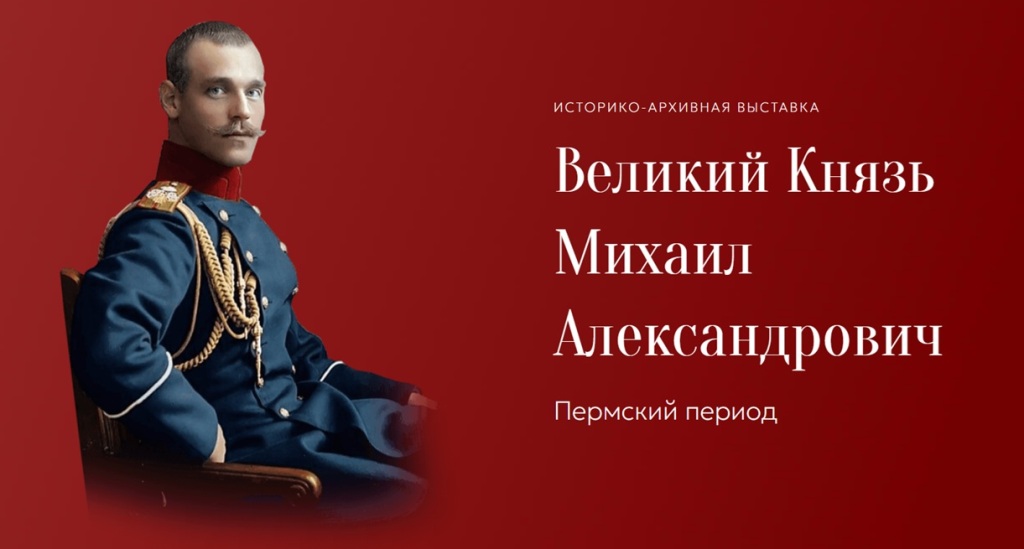
PHOTO: poster for the exhibition Grand Duke Mikhail Alexandrovich. The Perm Period

After years of planning, a permanent historical and archival exhibition dedicated to the fate of Grand Duke Mikhail Alexandrovich, his faithful secretary Nicholas Johnson[1] and the tragic events of June 1918[2], has opened in the building of the former Korolev Rooms Hotel in Perm.

The first of the Romanovs to fall at the hands of the Bolsheviks was Grand Duke Mikhail Alexandrovich, the younger brother of Emperor Nicholas II. His fate is inextricably linked with Perm, where he spent the last months of his life – from March to June 1918 – and subsequently murdered[2].

The historical and archival exhibition Grand Duke Mikhail Alexandrovich: The Perm Period is designed to shed light on this episode in early 20th century Russian history. This exhibition is not just a collection of documents and photographs, but instead, takes a hard look into the drama of a man who finds himself in the epicenter of a historical hurricane.

The exhibition is unique in its reliance on authentic archival documents, many of which are exhibited for the first time. It debunks myths and restores a chronology of events based on documented facts. Visitors have the opportunity to learn, not only about the fate of the Grand Duke, but also to understand the atmosphere of that time, the motives of the characters and the fatal chain of events that led to his murder. For Perm, this exhibition is of particular importance, as it reveals one of the darkest and most significant pages in the history of the city.

The choice of the place for the exhibition was selected not accidental – the venue is situatedd in the building of the former Korolev Rooms Hotel[3], where the Grand Duke passed the last few weeks of his life.
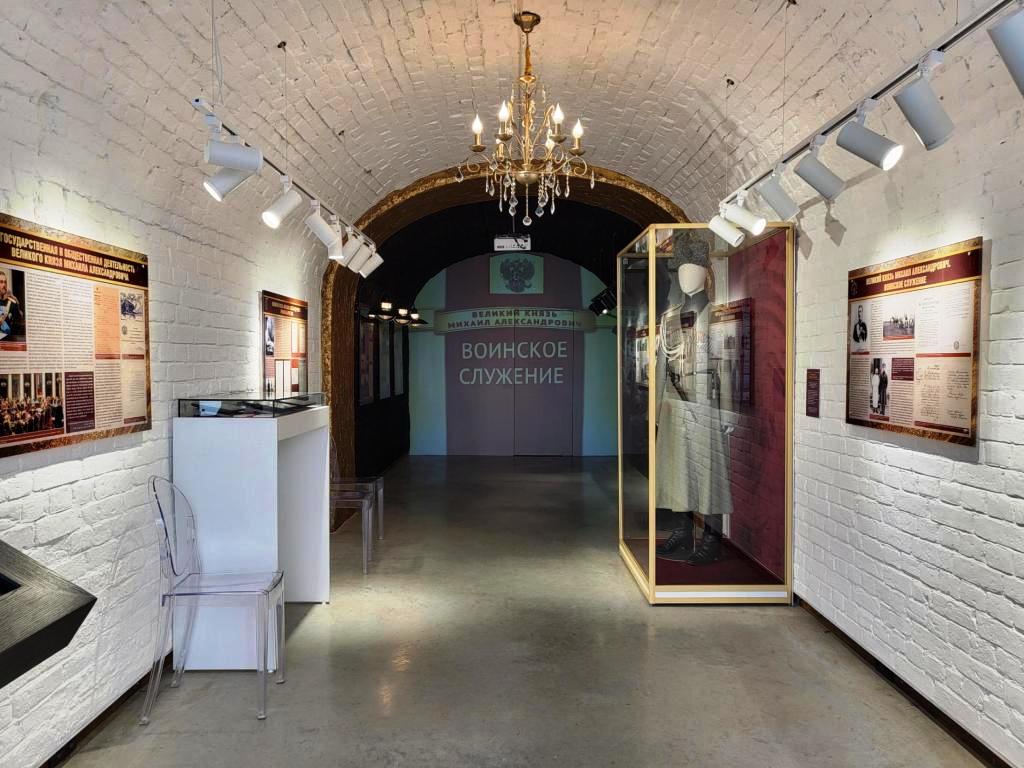
PHOTO: view of one of the halls showcasing the exhibition Grand Duke Mikhail Alexandrovich. The Perm Period

The creation of the permanent exhibition is the first step towards a museum dedicated to Grand Duke Mikhail Alexandrovich. The project is a monumental effort which has united historians, archivists, local historians, museum workers, members of the Russian Orthodox Church, public figures and supported by local and regional government authorities.

For the first time, visitors to the exhibition will have the opportunity to gain access to the former Korolev Rooms Hotel, where they can view a large number of unique documents and photographs, and see a replica of the military uniform worn by the Grand Duke during his service as Commander in the Caucasian Native Cavalry Division.

Visitors can also watch a unique archival newsreel depicting Grand Duke Mikhail Alexandrovich, see 3D models of the signs of charitable societies of which he was a trustee, as well as hear audio recordings of the memories of participants and eyewitnesses of the events of June 1918.

The exhibition is a joint project of the Foundation for the Revival of the Elisabeth-Sergius Educational Society Foundation (ESPO), the Perm State Archive of Social and Political History, the Perm Museum of Local Lore, and the Central Exhibition Hall of Perm.
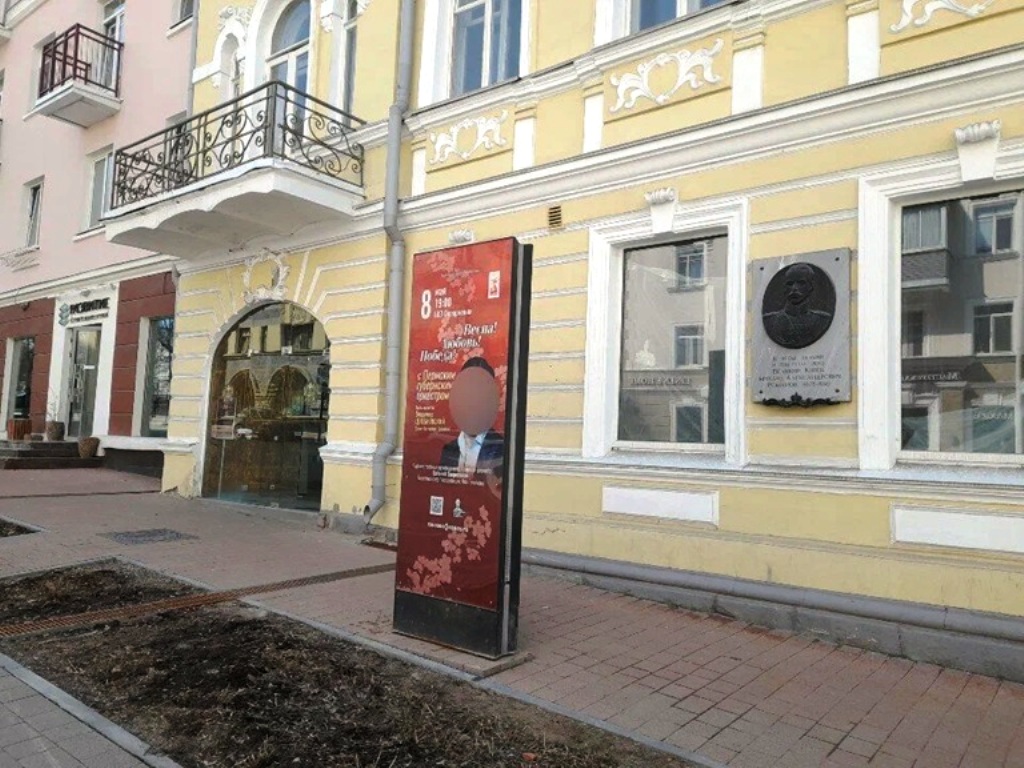
PHOTO: entrance to the exhibition in the former Korolev Rooms Hotel, where from May 1918, Grand Duke Mikhail Alexandrovich and his faithful secretary Nicholas Johnson, were held under house arrest.

The historical and archival exhibition Grand Duke Mikhail Alexandrovich: Perm Period is much more than a collection of old papers and photographs. This is a powerful and poignant reminder of the human tragedy that unfolded against the backdrop of global historical cataclysms. It allows visitors to not only learn the facts about the final days of Grand Duke Mikhail Alexandrovich, but to feel and to breathe the era, its cruelty and uncertainty.

NOTES:

[1] Despite his British-sounding first and last names, Nicholas Nikolaevich Johnson (1878-1918) was actually Russian, he was born in St. Petersburg and baptized in the Russian Orthodox faith. He served as Grand Duke Mikhail Alexandrovich’s private secretary from December 1912.

[2] On the night of 12/13 June 1918, Grand Duke Mikhail Alexandrovich, together with his secretary Nikolai Johnson, were taken to a forest outside Perm, and murdered by the leader of the local secret police, Gavril Myasnikov, with the connivance of other local Bolsheviks. Their remains have never been found. In 1981, Grand Duke Michael and Nicholas Johnson were canonized as New-Martyrs of Russia by the Russian Orthodox Church Outside Russia (ROCOR).

[3] In 1998, a memorial plaque to Grand Duke Mikhail Alexandrovich was installed on the façade of the former Korolev Rooms Hotel in Perm.

FURTHER READING:

Search for Grand Duke Mikhail Alexandrovich’s remains resumes near Perm + PHOTOS

The myth that Grand Duke Mikhail Alexandrovich was Russia’s last Tsar

© Paul Gilbert. 31 October 2025

***
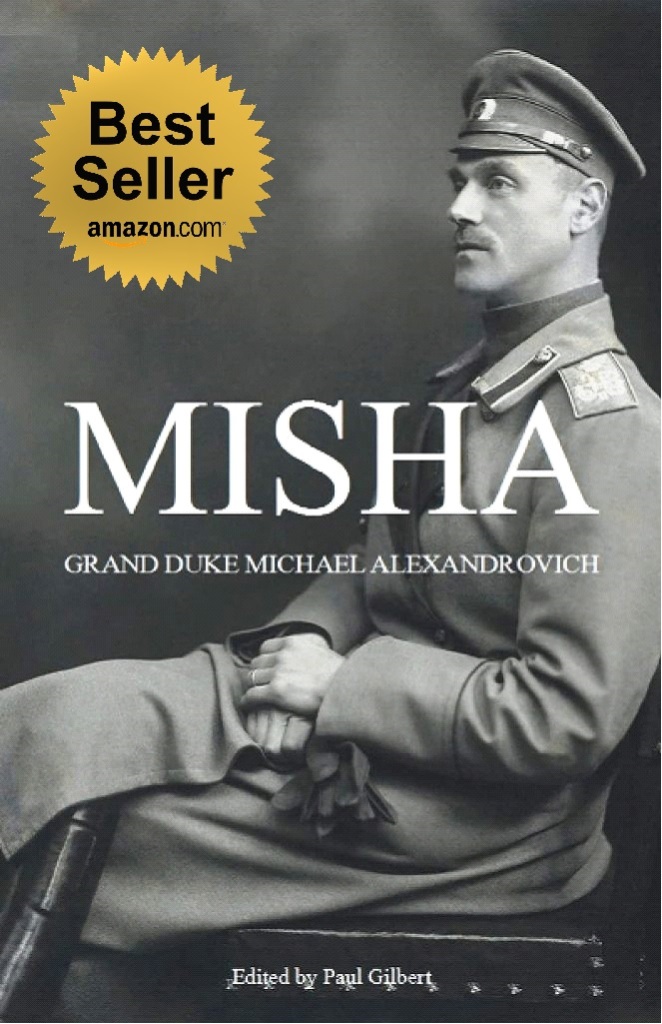
MISHA: GRAND DUKE MICHAEL ALEXANDROVICH
Compiled and Edited by Paul Gilbert

Paperback edition. 136 pages + 50 black & white photographs

CLICK HERE TO ORDER PAPERBACK EDITION

Grand Duke Michael Alexandrovich (1878-1918) was the youngest son of Emperor Alexander III and Empress Maria Feodorovna, and the younger brother of Russia’s last emperor Nicholas II.

This book explores the milestones in the life of Grand Duke Michael in a series of essays by four distinct authors, and complemented with 50 black and white photographs.

Among them are the memories of Princess Olga Pavlovna Putyatina, who in February 1917, offered refuge to the grand duke at her flat on Millionnaya Street in Petrograd.

Independent researcher Paul Gilbert offers two fascinating essays: the first reviews an album of some 200 photographs taken by Grand Duke Michael, during his stay at Knebworth House in Hertfordshire. England, 1913-1914 . The album sold at auction for more than 2 million rubles ($34,000 USD).

The final essay examines the myth that Michael was the last Tsar of Russia, he was not. Nicholas II remained Emperor and Tsar of Russia until the day of his death and martyrdom on 17th July 1918.

Grand Duke Mikhail Alexandrovich and his Secretary Nikolai Nikolaevich Johnson, were both murdered by the Bolsheviks near Perm on 13 June 1918. Their remains have never been found.
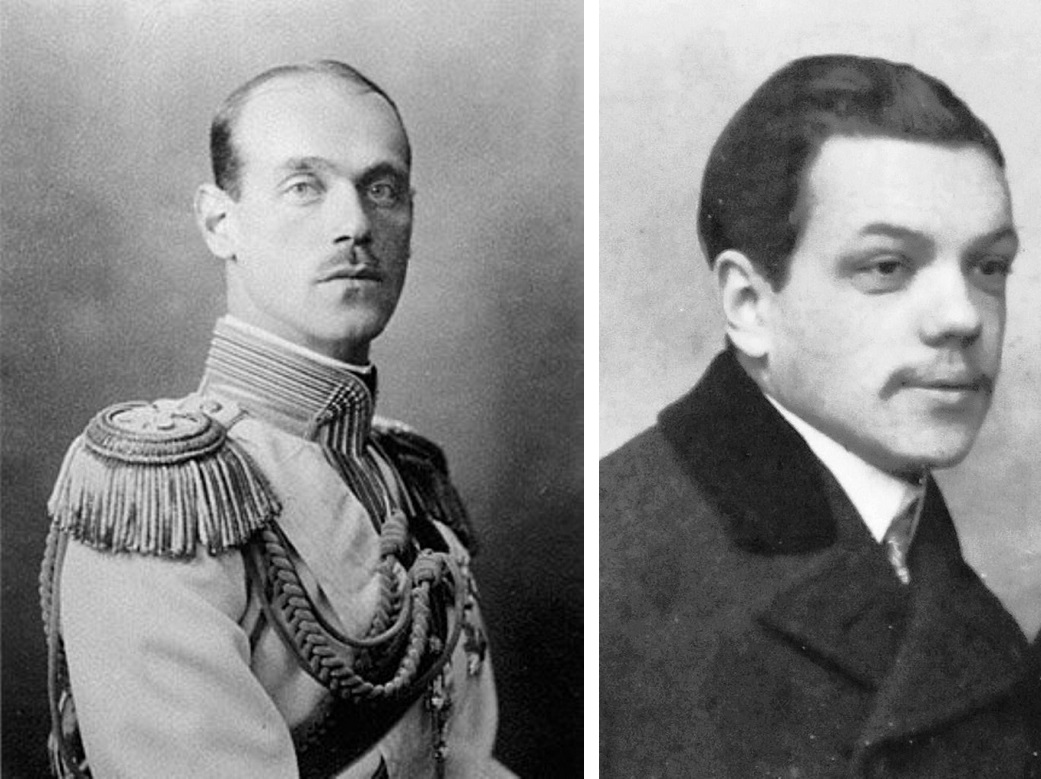
Search for Grand Duke Mikhail Alexandrovich’s remains resumes near Perm

PHOTO: Grand Duke Mikhail Alexandrovich (1878-1918)
and his secretary Nikolai Nikolaevich Johnson (1878-1918)

On 18th September 2024, Russian media sources reported that the search for the remains of Grand Duke Mikhail Alexandrovich and his secretary Nikolai Johnson have resumed near Perm, where they were both murdered by the Bolsheviks on 13th June 1918. The circumstances surrounding the last days of their lives and their burial site remain unknown.

Recall that the search for the remains came to a halt in the summer of 2022, which resulted in the excavations having to to be postponed until the autumn of this year.

The new search-investigation has now shifted to a new location, to which the remains of Mikhail Alexandrovich and Nikolai Johnson could be buried at the confluence of the Gaiva and Kama Rivers, opposite the former village of Ust-Gaiva. It is noteworthy that wooden crosses which had been erected in 1918 at the grave site, have not survived to the present day.

The new site is based on information discovered by the search team while searching the State Archive of the Perm Region, which led them to the alleged burial site. The team acknowledged that the development of their investigation was aided by interviewing witnesses and local residents who had information about the installation of the crosses near Ust-Gaiva.

Following the murder of Grand Duke Mikhail Alexandrovich and Nikolai Johnson, the place of their burial turned out to be unknown. It was only until, a few years later, when the killers began to publish their memoirs, each of them describing the events of that night in their own words. One wrote that “after the murder we drove along the Solikamsk tract and turned right into the forest after 4 kilometers”, another wrote “they were shot either 200 or 300 meters from the road”. Neither killer provided any details about where the remains were buried.

The search for the grave of Mikhail Alexandrovich and Nikolai Johnson has been going on for more than a quarter of a century. At first, amateurs tried to find the burial place, which included Perm journalists and local historians. Then forensic investigators took up the case – as part of the investigation into the murder of Emperor Nicholas II and his family. For several years in a row, members of an international search expedition came to Perm, but their search yielded no results, because they were searching in the wrong place.

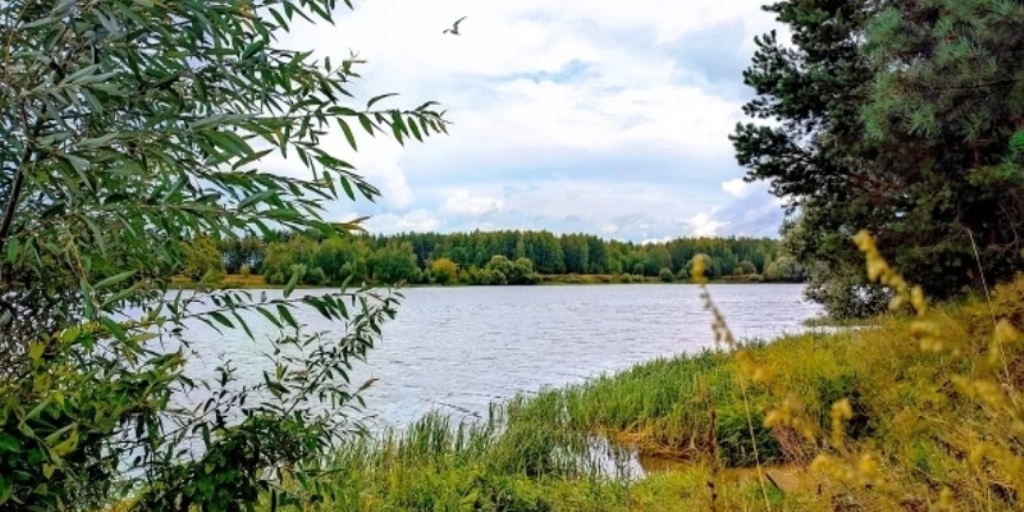
PHOTO: view of the confluence of the Gaiva River with the Kama, opposite the former village of Ust-Gaiva, where the remains of Grand Duke Mikhail and Nikolai Johnson are believed to be buried

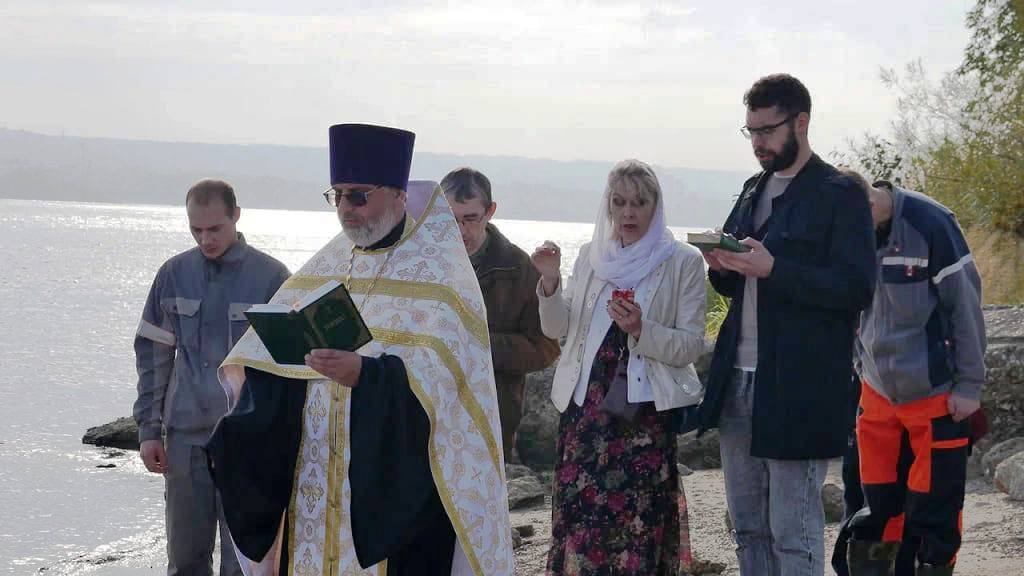
PHOTO: an Orthodox priest performs a panikhida [prayer for the dead] at the confluence of the Gaiva River with the Kama, opposite the former village of Ust-Gaiva, where the remains of Grand Duke Mikhail and Nikolai Johnson are believed to be buried

Gruesome eye-witness details

According to a member of the expedition, journalist Vyacheslav Degtyarnikov, the search team were contacted by “Natalia”, a resident of Ust-Gaiva. She said that in 1963, when she was 8 years old, her mother took her to the mouth of the Gaiva River [see photo above], to the place where it flows into the Kama, opposite the former village of Ust-Gaiva. There were two wooden crosses there. And her mother told Natalia that the brother of the last Russian tsar and his friend were buried here.

According to an eye-witness by the name of Trutnev, in June 1918, two phaetons arrived at his house, in one there were armed men, and in the other – two corpses. Trutnev claims that he recognized one of the bodies as that of the Grand Duke.

“Photos of Mikhail Alexandrovich were repeatedly published in Perm newspapers that year,” noted Vyacheslav Degtyarnikov. “The killers brought the corpses to Trutnev’s house, where they demanded a container to bury the remains. He showed them a large barrell-like container. Such containers were used at the Nobel factory, and the residents of Motovilikha took them home to ferment cabbages. Trutnev was forced to remove his cabbages and give the container to the killers. The corpses were dismembered and placed inside.

“Then Trutnev, accompanied by one of the killers, crossed the Kama River by a boat. At the mouth of the Gaiva there was already a grave dug, in which he buried the container with the remains. He returned to the site at a later date, and there he erected two wooden crosses and looked after the grave all his life. Before his death, he told Natalia’s grandfather about the site, and bequeathed him to take care of the grave and crosses”.

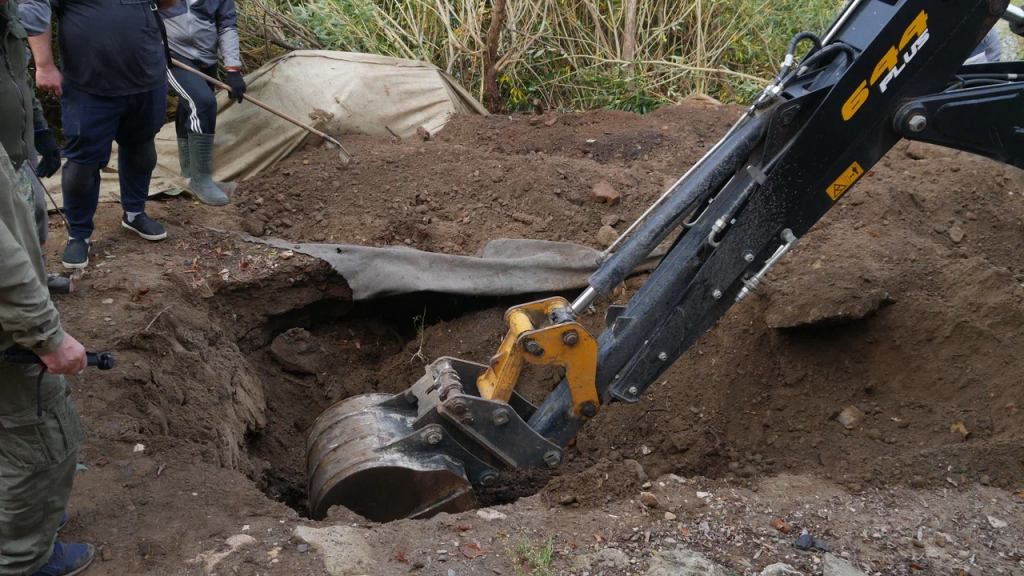
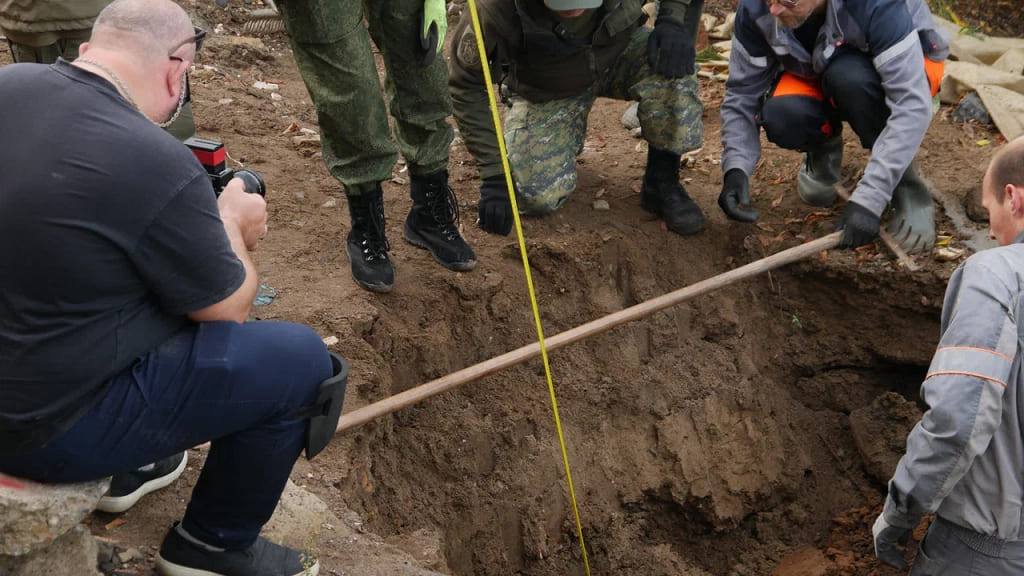
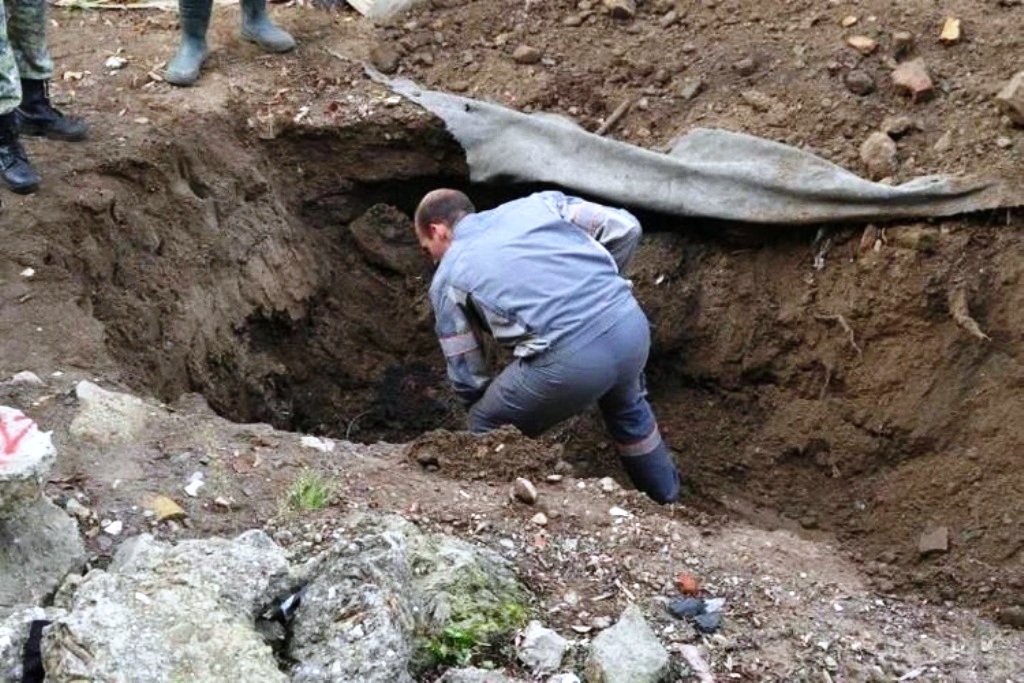
PHOTOS: excvations at the confluence of the Gaiva River with the Kama, opposite the former village of Ust-Gaiva, where the remains of Grand Duke Mikhail and Nikolai Johnson are believed to be buried

PHOTOS: excvations at the confluence of the Gaiva River with the Kama, opposite the former village of Ust-Gaiva, where the remains of Grand Duke Mikhail and Nikolai Johnson are believed to be buried

New information

As previously noted, the search for the remains of Grand Duke Mikhail and Nikolai Johnson, was supposed to begin in the summer of 2022. But the excavations had to be postponed. They resumed only in September of this year.

Previously, members of the Investigative Committee of the Russian Federation met with scientists and historians at the State Archive of the Perm Region, where they studied photographs with views of Perm and its environs, taken in the 1930s. But photo depicting the wooden crosses could not be found.

Excavations were carried out at the place calculated from the memories of the Perm woman. But the remains of the Grand Duke and his secretary could not be found. But a new eyewitness testimony has since come forward, which resulted in the search being shifted to a new site.

One of the oldest residents of Gaiva, 94-year-old Anna Ivanovna, recalled that she saw two wooden crosses. They were near the narrow-gauge railway running from the bridge over the Gaiva to the Kama. Now only sleepers remain from the old railway line. But where it ran is still clearly visible – a section 600 meters long along the riverbank. Unfortunately, the old woman could not recall the exact place where the crosses were located.

The existence of the wooden crosses near the Gaiva was also recalled at the end of the last century by the famous Perm scientist Georgy Chagin. Perm historian Lev Pereskokov also saw them more than once in his childhood.

“In the mid-1960s, my parents and I often drove by car from Zaprud, where we lived, through the Kama to Verkhnyaya Kurya,” he said. “At Sosnovy Bor there was a road covered with paving stones. I recall looking out of the window, and saw two old gray crosses in the gaps between the bushes. Once I even asked my father to stop the car, so that we could look at them, but there was no time”, he added.

“The search team are appealing to locals who perhaps remember exactly where the crosses were located opposite the old village of Ust-Gaiva, and any one who has preserved old photographs,” said Vyacheslav Degtyarnikov. “In any case, the search will continue”.

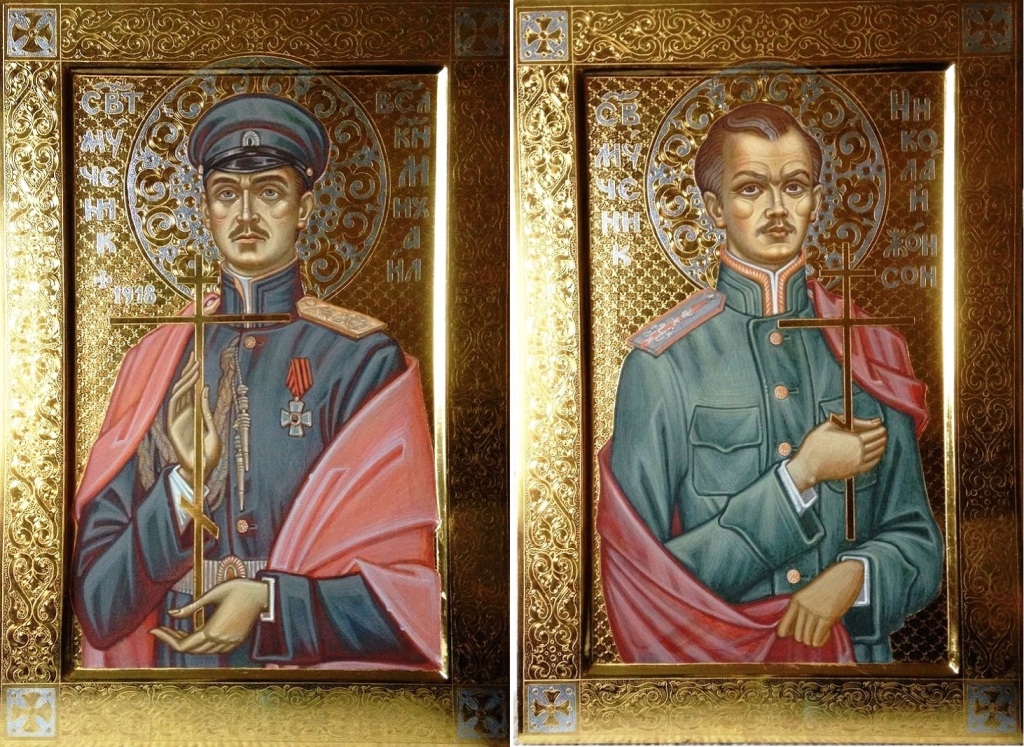
Icons depicting the Holy Royal Martyr Grand Duke Mikhail Alexandrovich (1878-1918) and Nicholas Nikolaevich Johnson (1878-1918). Canonized by the Russian Orthodox Church Outside of Russia (ROCOR) on 1st November 1981.

Memory Eternal! Вечная Память! ☦️

© Paul Gilbert. 28 September 2024

Memorial Litarny and monument for Anastasia Hendrikova and Ekaterina Schneider in Perm

PHOTOl the coffins containing the relics of Sts. Anastasia Hendrikova and Ekaterina Schneider, lie in the Church of the Dormition of the Most Holy Theotokos in Perm

NOTE: this article was originally written under a different title and published on Sunday, 9th June 2024. It was partially revised on Friday, 14th June 2024, and updated with 12 new photographs – PG

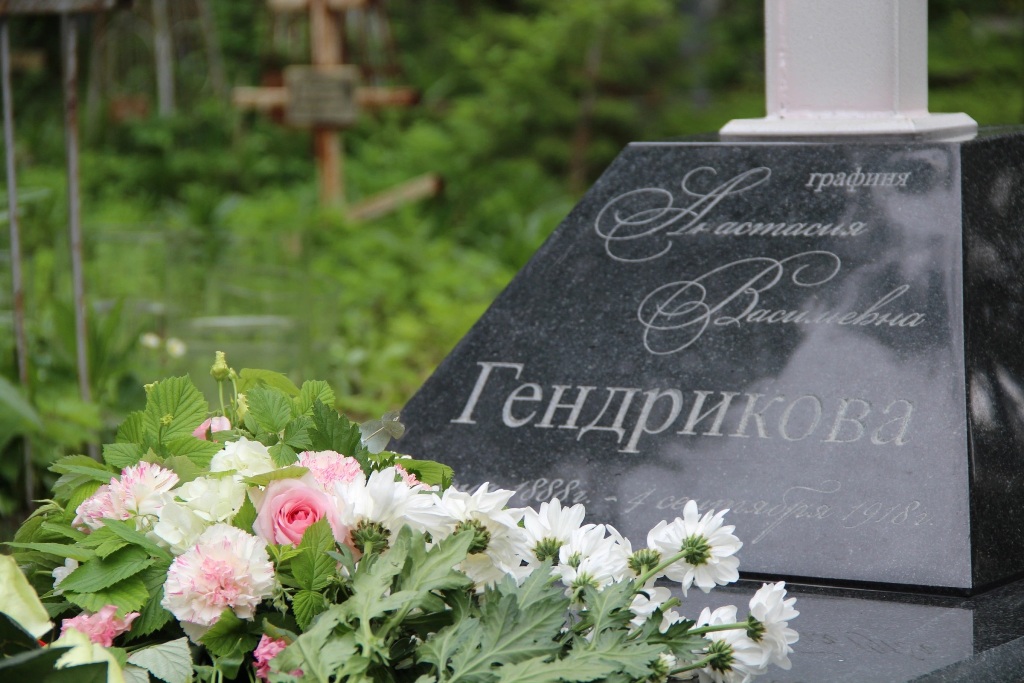
On Sunday, 9th June 2024, a memorial to two faithful servants of the Imperial Family, Anastasia Hendrikova and Ekaterine Schneider was installed near the Church of All Saints, situated at the site where they were buried in 1919, in the Old Yegoshikha Cemetery in Perm.

The service was attended by the Chairman of the Imperial Orthodox Palestinian Society (IOPS) Sergei Stepashin, Chairman of the Elisabeth-Sergius Educational Society Foundation (ESPO) Anna Vitalievna Gromova, clergy of the Perm diocese, local authorities, historians, academic, museum curators and parishioners.

The consecration ceremony was followed by a Funeral (Memorial) Litany, served at the coffins containing the relics of Sts. Anastasia Hendrikova and Ekaterina Schneider, by Metropolitan Methodius of Perm and Kungur in the Church of the Dormition of the Most Holy Theotokos.

At the end of the service, His Eminence Metropolitan Methodiy of Perm addressed the faithful with an archpastoral address, in which he noted the significance of the event for the Perm region, saying that by the grace of God, after the research and labours undertaken, the honest remains of faithful servants of the Imperial Family were discovered and identified.

Recall that on 30th May 2024, the head of the Publishing Department of the Perm Diocese Olga Troitskaya, announced that forensic tests confirmed the identity of the remains as those of Anastasia Hendrikova and Ekaterina Schneider, in Perm, where they were shot by the Bolsheviks in September 1918.

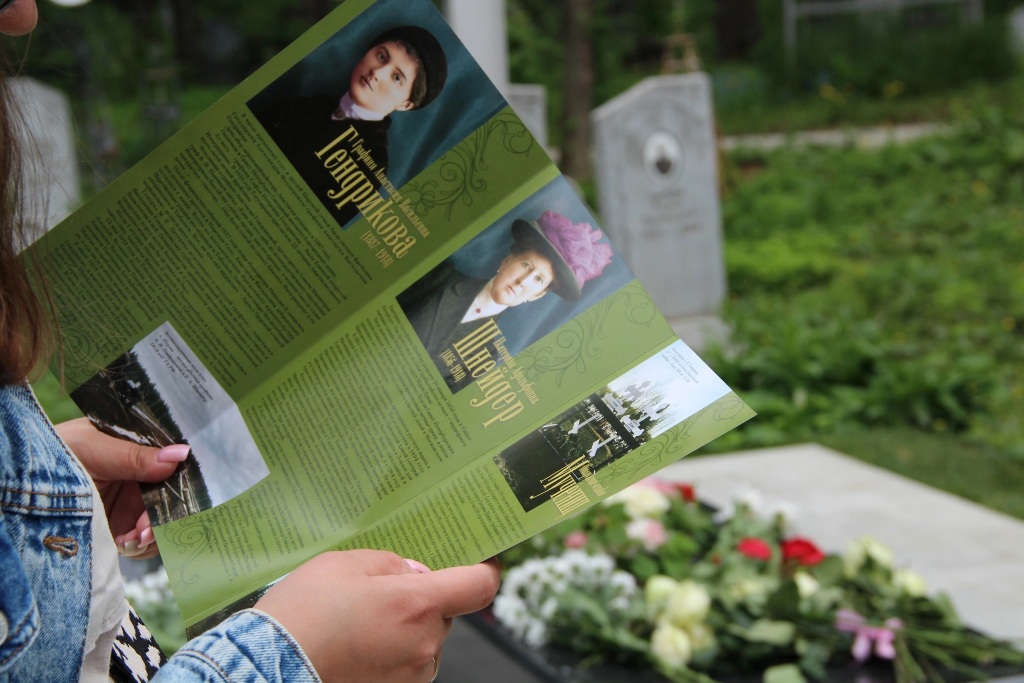
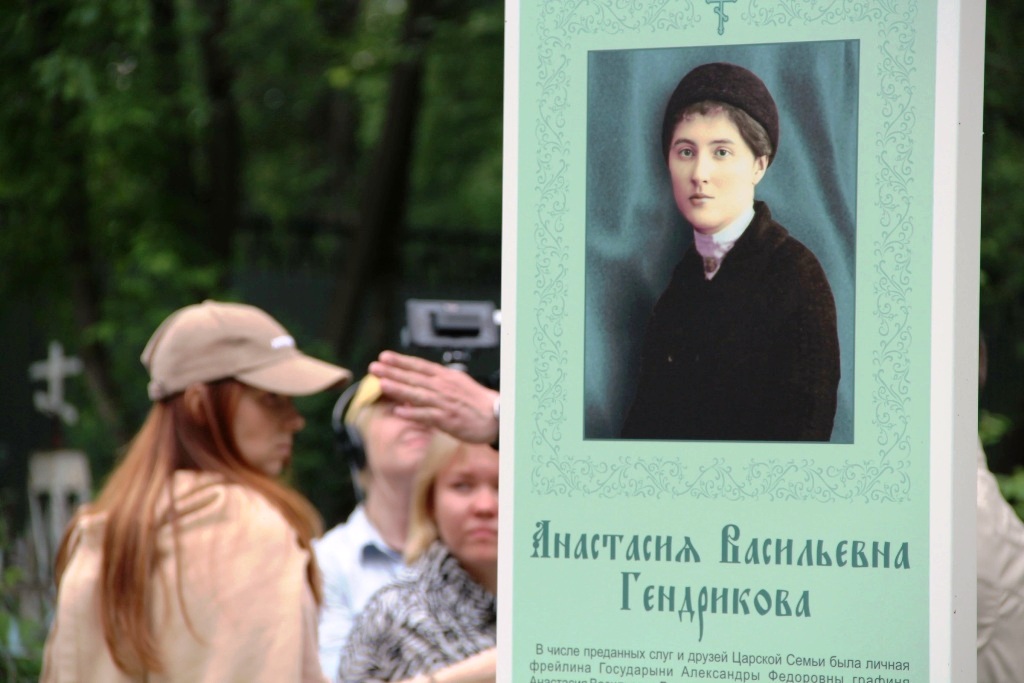
Countess Anastasia Vasilievna Hendrikova (1888-1918), served as a maid of honour to Empress Alexandra Feodorovna. Ekaterina Adolfovna Schneider (1856-1918) initially taught at the Moscow Nikolaev Orphan Institute. She also taught Russian to Grand Duchess Elizabeth Feodorovna. Later, Schneider became a devoted friend and confidant to Empress Alexandra Feodorovna.

***

In May 1918 Anastasia Hendrikova and Ekaterina Schneider arrived in Ekaterinburg from Tobolsk, however, they were not admitted to the Ipatiev House, but were instead, taken by train – along with 33 other prisoners – to Perm, where they were transferred to a local prison. They prayed fervently and tried to remain cheerful, although both were exhausted by the illnesses and burdens of imprisonment.

On the night of 3rd/4th September 1918, Hendrikova and Schneider were awakened and taken with 11 other prisoners outside the city to the irrigation fields situated on the 5th verst of the Siberian Highway, where they were all shot. According to the Whites investigation at the time, they were both shot at point blank range followed by a strong blow to the back of the head.

On 19th May 1919, the bodies of Hendrikova and Schneider were recovered by the Whites, who buried their remains in the Yegoshikha Cemetery in Perm. Their graves were marked with Orthodox crosses.

After the Bolsheviks had established power in the region, the graves of Hendrikova and Schneider were destroyed, and their location was lost. It was not until 2020, that the site where Hendrikova and Schneider’s remains were believed to be buried was established, thanks to a century-old photograph taken on the day of their burial – 16tj May 1919.

The remains of Hendrikova and Scehndier were exhumed on 8th September 2020, followed by a thorough forensic study, which lasted nearly four years. On 20th May 2024, an announcement was made, confirming that the remains were indeed those of Hendrikova and Schneider.

PHOTO: Sts. Anastasia Hendrikova (1888-1918) and Ekaterina Schneider (1856-1918)

On 1st November 1981, both Anastasia Hendrikova and Ekaterina Schneider were canonized by the Russian Orthodox Church Outside of Russia (ROCOR) as New Martyrs and Confessors of Russia. Schneider was canonized in spite of the fact she was a Lutheran, however, she has not been canonized by the Moscow Patriarchate due to her faith.

On 16th October 2009, the General Prosecutor’s Office of the Russian Federation decided to rehabilitate 52 persons of the Imperial family and their retainers who had been subjected to repression, including Hendrikova and Schneider.

The photographs posted with this article are courtesy of the Elisabeth-Sergius Educational Society Foundation (ESPO) and the Perm diocese.

© Paul Gilbert. 9 June 2024 – Revised 14 June 2024