Is it still possible to visit Russia?
NOTE: The purpose of this article is to address the many queries which I have received over the past few months, with regards to whether it is (a) still possible to visit Russia, and (b) if it is safe to visit Russia during these troubled times. The answer is “YES!”, you can still visit Russia, however, making arrangements are now much more challenging.

If you are even considering visiting Russia in the near future, I urge you to read the following. It is important to take into account, that things in Russia can change overnightPaul Gilbert

This page was last updated on 22nd FEBRUARY 2023

When the Alexander Palace reopened to the public on 14th August 2021, many Romanovphiles – myself included – began making plans to return to St. Petersburg, in order to visit the reconstructed interiors of the private apartments of Emperor Nicholas II and Empress Alexandra Feodorovna in the Alexander Palace. Sadly, with the onset of the COVID-19 pandemic, the hopes and plans of many were dashed.

The COVID-19 pandemic hit Russia very hard. Since April 2020, more than 18 million cases and more than 372 thousand deaths have been reported. As a result, Russia closed its land borders to foreigners as a precautionary measure to try to stop the spread of coronavirus. While it was still possible to visit via air, Russia imposed very strict measures regarding vaccines, etc.

I myself, was scheduled to visit Russia in September 2020, however, Aeroflot were forced to cancel my flights to St. Petersburg and Ekaterinburg due to COVID.

On 15th July 2022, the Russian government lifted COVID-19 related entry restrictions. You may enter Russia by air, sea or land via any country, but non-Russian nationals must still produce a negative PCR test taken within 48 hours before their arrival in Russia.

On 24th February 2022, Russia began a military invasion of Ukraine. The world responded with swift sanctions, which have now made it near impossible to visit Russia. This latest move has had a very negative effect on foreign travel to Russia, impacting plans for many of us, who were hoping to return to rediscover the Romanov legacy, a subject which is so near and dear to many of us.

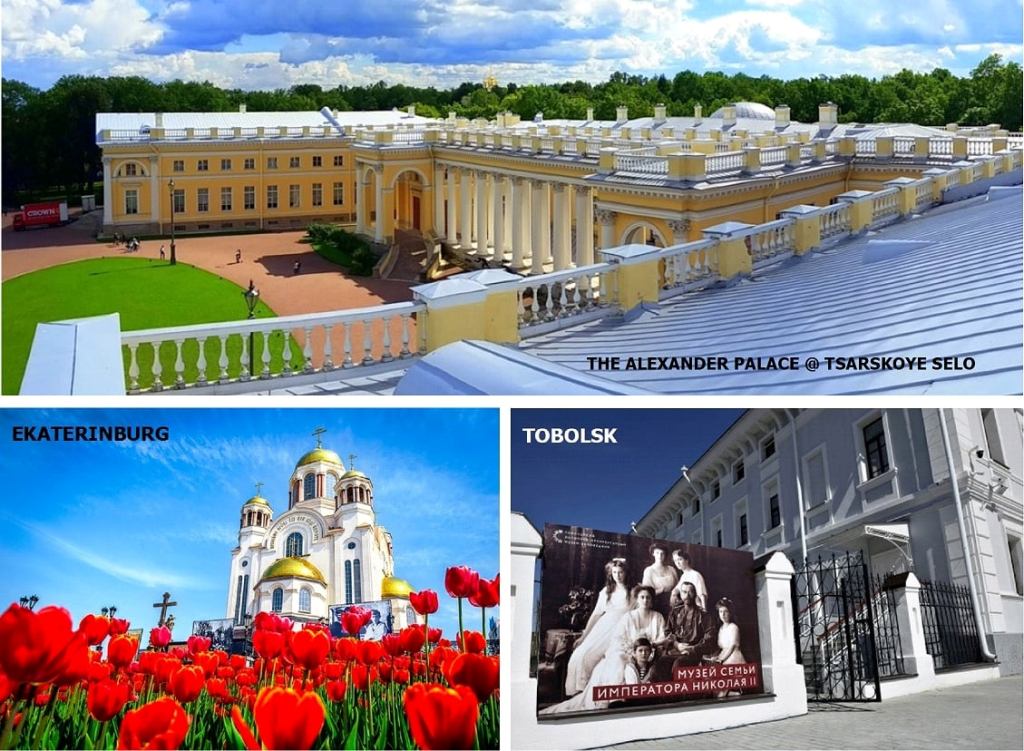
Prior to the outbreak of hostilities, I was already making plans to visit Russia in July 2023. My itinerary included St. Petersburg, Ekaterinburg and Tobolsk. On the agenda for this journey was the Alexander Palace at Tsarskoye Selo; the Museum of Emperor Nicholas II in Tobolsk; and the ceremonies marking the 300th anniversary of the founding of Ekaterinburg.

Warnings against visiting Russia

The governments of the United States, Canada, Great Britain, Australia and the European Union, have all issued warnings to nationals about visiting Russia, urging them to “avoid all travel to Russia due to the impacts of the armed conflict with Ukraine, including limited flight options and restrictions on financial transactions”.

While popular tourist destinations such as Moscow, St. Petersburg and Ekaterinburg are far removed from the current Russian-Ukranian conflict, there still remain risks, which must be taken into consideration before planning a visit. Please consult your respective government advisories for the latest updates.

Many of the countries which imposed sanctions, have restricted financial transactions and air connections with Russia. Russia has retaliated with similar measures.

The sanctions, the suspensions and the Russian retaliation may have an important impact on the availability and the provision of essential services.

The value of the Russian ruble is currently volatile and the value of holdings of rubles may fluctuate considerably.

If you decide to visit Russia despite government advisories, it is a good idea to register and update them with your contact information through your respective embassy. Please be aware that in the case of an emergency, you should not depend on your government to help you leave the country.

The U.S. Department of State has advised Americans of the potential for the singling out and harassment of U.S. citizens by local police and government security officials . . . and the possibility of violence against U.S. citizens by right-wing nationalists.

Some embassies are reporting an increased police presence and ID checks. As a result, you should keep your passport and Russian visa with you at all times. It is important to make copies of both, and keep them separate, such as a hotel safe.

In addition, please be aware that foreigners holding Russian citizenship “may be subject to call-up for mandatory military service.”

In August 2022, Ukraine began bombing of Crimea. There is no question that this region will continue to be a target of the Ukrainian armed forces therefore, this region should be avoided!

Updated travel advisory for US citizens

On 13th February 2023, the United States Embassy in Moscow informed its citizens to leave Russia immediately due to the war in Ukraine and the risk of arbitrary arrest or harassment by Russian law enforcement agencies.

“US citizens residing or traveling in Russia should depart immediately,” the US embassy in Moscow said. “Exercise increased caution due to the risk of wrongful detentions.”

“Do not travel to Russia,” the embassy said. Those who choose to stay or who have not yet determined a way to leave have essentially been advised to lay low and avoid contentious areas. 

The United States has repeatedly warned its citizens to leave Russia. The last such public warning was in September 2022 after President Vladimir Putin ordered a partial mobilization.

“Russian security services have arrested US citizens on spurious charges, singled out US citizens in Russia for detention and harassment, denied them fair and transparent treatment, and convicted them in secret trials or without presenting credible evidence,” the embassy said.
Tourism to Russia Plummets to 4% of Pre-Pandemic Levels Amid Ukraine War

Foreign tourism to Russia fell below 4% of its pre-pandemic levels in 2022 as the country faced international condemnation over its invasion of Ukraine, the Association of Tour Operators of Russia (ATOR) has said.

A mere 200,100 tourists traveled to Russia last year, according to ATOR’s breakdown of Federal Security Service (FSB) border service data.

That marks a 96.1% decrease from the 5.1 million tourists who had visited Russia in 2019, before the start of the Covid-19 pandemic.

“The reasons are clear: closed skies between Russia and the vast majority of European countries, as well as the inability to use foreign-issued Visa and Mastercard cards in Russia,” ATOR said Wednesday, referring to the airspace closures and financial sanctions passed by Ukraine’s Western allies shortly after the invasion.

So, is it still possible to visit Russia?

Despite the sanctions imposed on Russia earlier this year by the United States, Canada, UK and EU, Russia has not closed its borders to foreign visitors. For the palaces, museums, art galleries and theatres, it is still business as usual. As far as shopping and dining goes, most of the major Western-owned hotel chains, retailers and restaurants have closed their doors.

The cost of transportation and transit time have increased significantly and remain very volatile due to high demand, limited flight availability and rerouting. Contact your travel agent or tour operator to determine if the situation will disrupt travel arrangements.

In May 2022, the UK government designated Aeroflot, Rossiya Airlines, Ural Airlines and Russian Railways for the purposes of UK sanctions. This means that British nationals and others who are bound by UK sanctions are prohibited from entering into transactions which result in making funds directly or indirectly available to these companies, such as purchasing tickets from them. On 23 May 2022, the Office for Financial Sanctions Implementation issued a general licence which means that for journeys originating in, or within, Russia, British nationals may purchase tickets from these companies without breaching UK sanctions.

The Russian aviation sector has been severely impacted by Western sanctions in the wake of the war in Ukraine. Aeroflot, in particular, landed in deep water with the grounding of planes and canceling flights to many international destinations.

Western countries have stopped deliveries of commercial airliners – popular with many Russian carriers – and spare parts and have obliged their lessors to return liners already leased from Russia.

It is important to note that Russian airlines suffered a number of incidents on their domestic services that saw more than 130 incidents including 28 plane crashes in 2022. In addition, there have been at least seven accidents involving air transport in the Russian Federation since the beginning of 2023. The main reason for mass breakdowns is due to the lack of proper maintenance of aircraft due to the shortage of spare parts in the country. Major Western plane makers Boeing and Airbus halted deliveries of new foreign jets and spare parts, forcing Russian airlines to “cannibalize” grounded aircraft. 

It is still possible, however, to book flights on 3 foreign carriers – see below – to Moscow, St. Petersburg and Ekaterinburg.
Flights from North America, UK and EU

Following the outbreak of hostilities on the territory of Ukraine, Russian carriers are prohibited from flying to the EU countries, the UK, the USA, and Canada. At the same time, 11 airports in the south and central part of Russia have been closed since 24th February 2022.

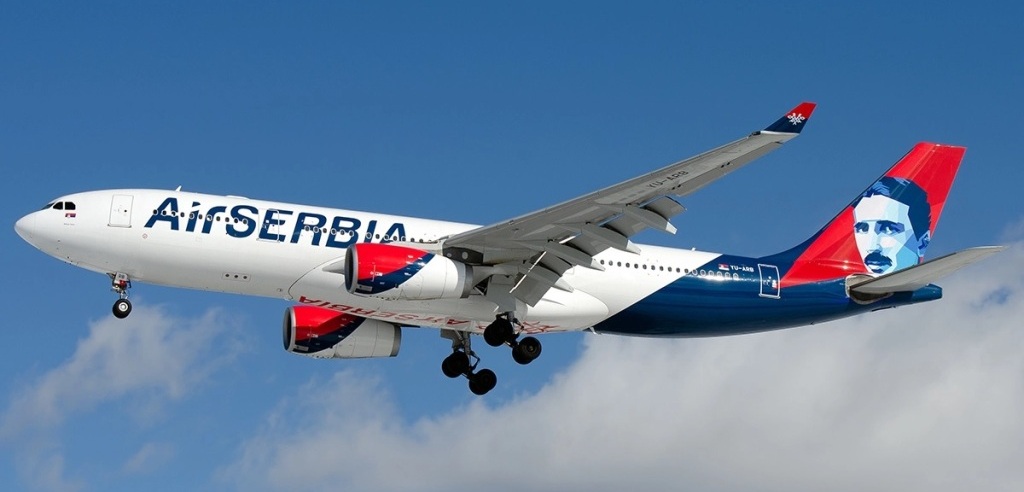
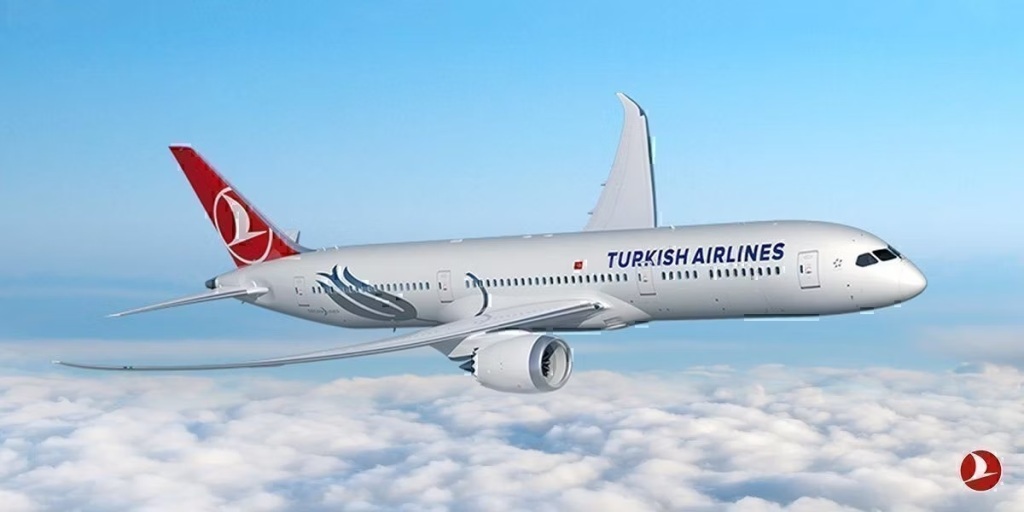
For Americans and Canadians, there are currently only 2 airlines offering flights to Russia: Air Serbia (via Belgrade) from New York (Daily) and Chicago (3 x a week beginning April 2023) to Moscow and St. Petersburg; Turkish Airlines (via Istanbul) to Moscow, St. Petersburg and Ekaterinburg.

NOTE: Air Serbia is currently evaluating a third North American route to Toronto, which would cater to the large Serbian and Balkan diaspora in Canada.

Both Air Serbia and Turkish Airlines offer flights from numerous cities in the UK and EU, with convenient connections to Moscow and St. Petersburg.

For Australians, Emirates offer flights from Sydney, Melbourne, and Perth (among other cities) to Moscow, St. Petersburg and Ekaterinburg – the latter via partner Fly Dubai.
By coach and train from Helsinki and Tallinn

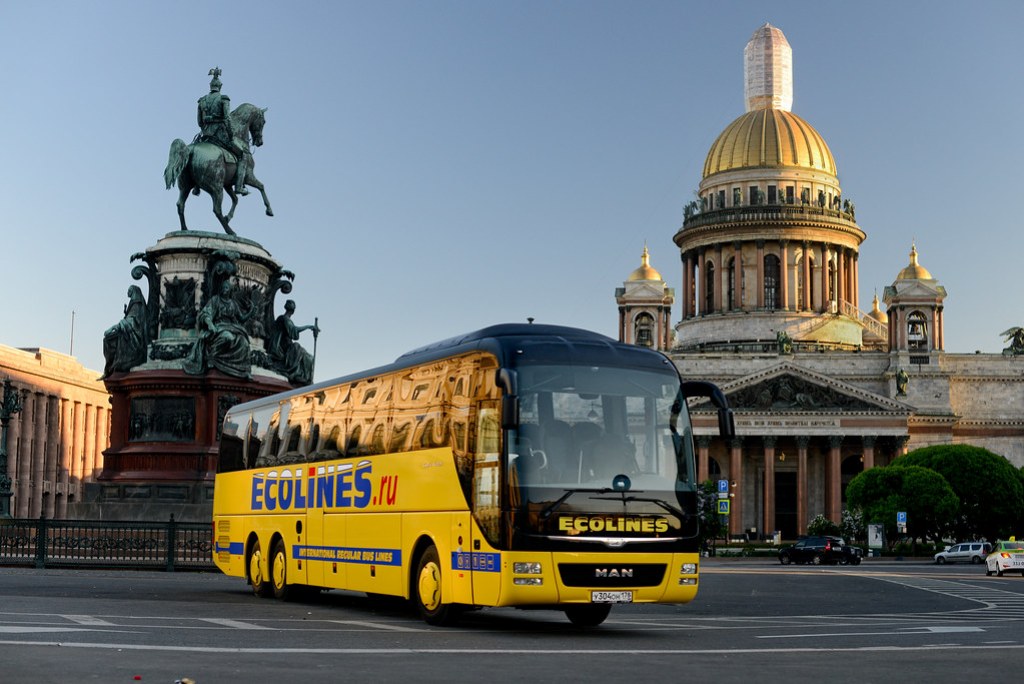
In addition, it is still possible to reach St. Petersburg by coach from Helsinki and Tallinn. International bus carriers Lux Express and Ecolines. Currently, Lux Express offers 4 daily buses from Helsinki St. Petersburg, while Ecolines offers 2 daily buses. Please note that seats sell out quickly, due to the high demand. 

You can also travel by coach from Tallinn (Estonia) to St. Petersburg. Ecolines also offer 2 daily buses, while Lux Empress offer 4 weekly buses on the route.

Finnish Rail has currently suspended all trains from Helsinki to St. Petersburg and Moscow. 

Accomodations

It is no longer possible to book accommodations in Russia using an online travel agency (ie. Expeida, Tripadvisor, etc.) or directly through Russian hotel web sites. Again, this is due to the inability to use foreign-issued credit cards in Russia. While you can still book a hotel via the respective hotel, you will be forced to pay for your stay upon arrival in cash.

Please note that the hotel can supply the necessary documents in which you will need to apply for a Russian Tourist Visa. In addition, they can also arrange transfer from the airport upon your arrival.

Russian Visas

The Russian Federation still maintain diplomatic relations with the United States, Canada, UK and EU, and have not restricted travel by nationals of these countries to Russia. Please consult the web site of the Russian Federation in your country to download and print Russian visa applications.
Currency exchange

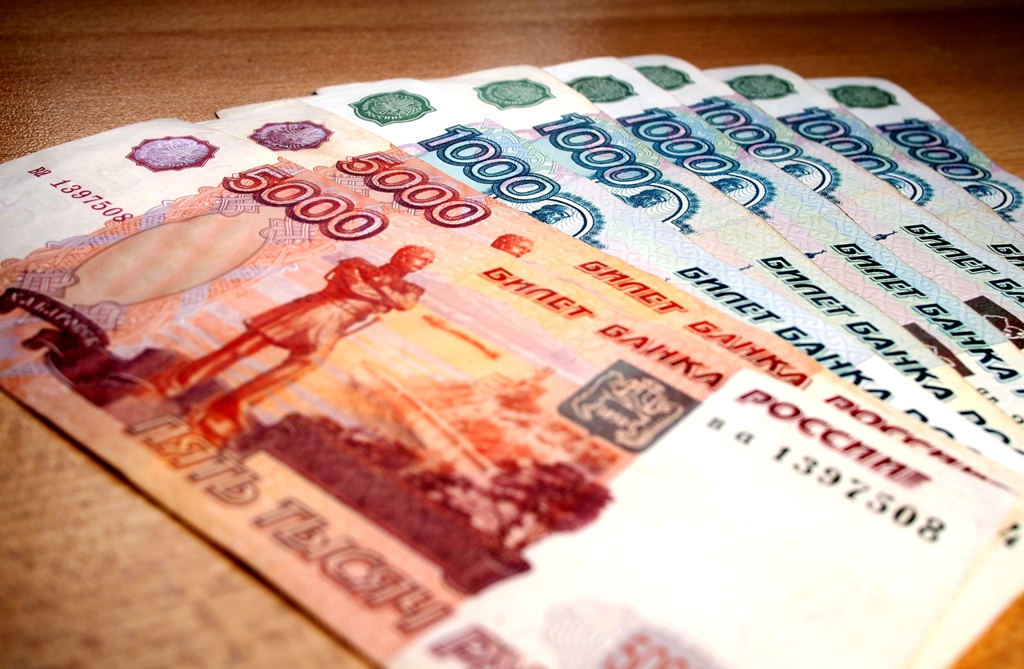
You are entitled to import/export up to $10,000 USD in cash into Russia, but sums over $3000 should be declared at customs. This applies to all foreign currencies and to rubles, with the exact quantities varying slightly from currency to currency.

MasterCard and Visa have suspended operations in Russia. This means that MasterCard and Visa cards issued outside of Russia will not work at Russian merchants or ATMs. You should be aware that it may not be possible for you to access your funds through Russian banks or to make payments to Russian businesses with non-Russian credit/debit cards.

You can change dollars and euros to rubles at any bank or foreign currency exchange outlet.

Disclaimer: the information contained in this article is for information purposes only. It is based on information from sources believed to be reliable. Should you embark on a visit to Russia during these troubled time, I urge you to err on the side of caution. I will not be held responsible for any problems which you may encounter in the planning of your visit, or during your stay in Russia. I will endeavour to update this page as new details are made available to me – PG

© Paul Gilbert. 6 July 2022
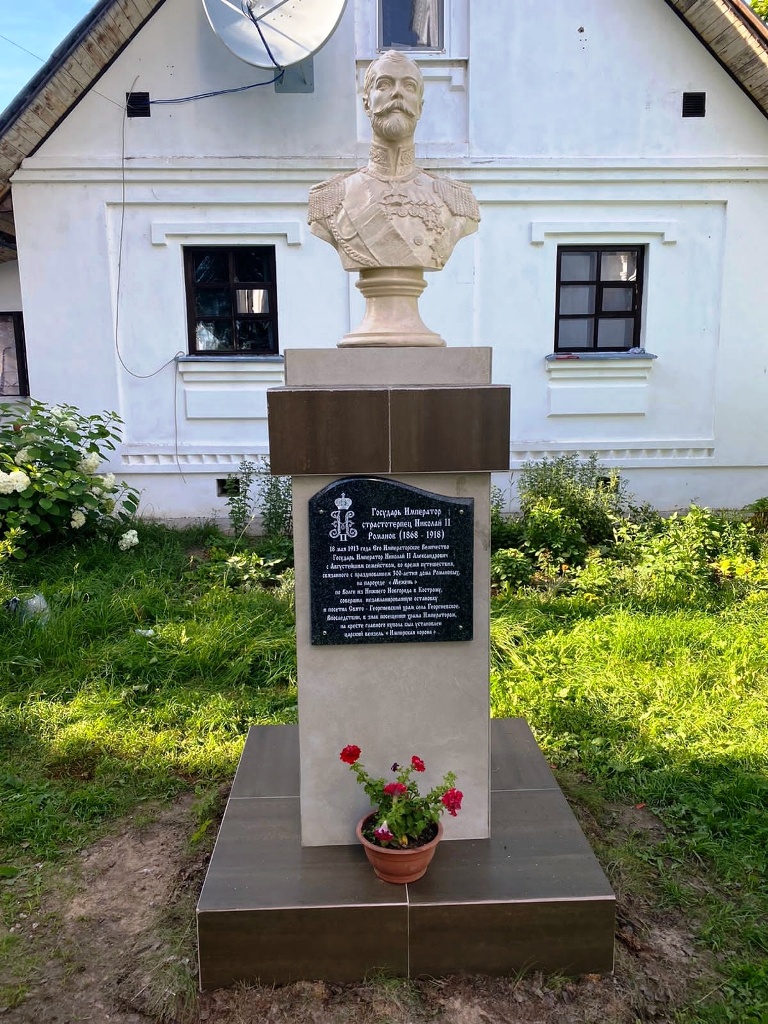
Monument to Nicholas II consecrated in Ivanovo region

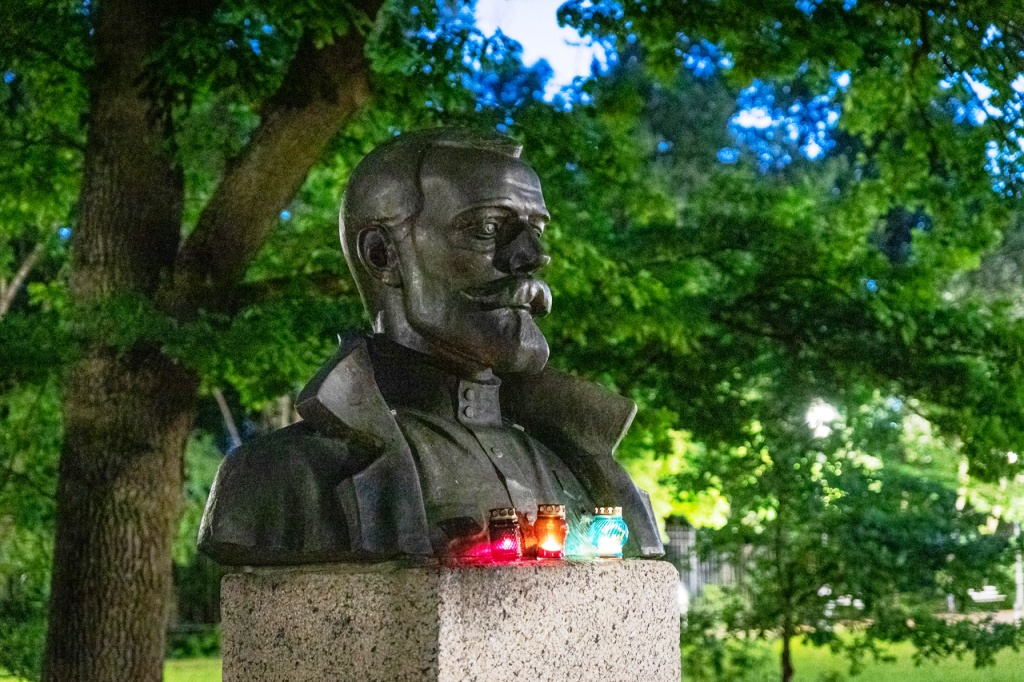
The unveiling and consecration of a new bust-monument to Emperor Nicholas II took place on 5th August, on the grounds of St. George’s Church, situatedin the village of Vali (the formerly Georgievskoye), situated in the Kineshma district of the Ivanovo region.

The consecration of the bust-monument was performed by the former rector of St. George’s Church, and now Bishop Methodius of Kamensky and Kamyshlovsky.

The bust-monument was installed in memory of Emperor Nicholas II’s visit here during the events marking the 300th anniversary of the Romanov dynasty. It was on 18th May 1913, that the last Russian Tsar with the August family, while traveling on the steamship Mezhen from Nizhny Novgorod to Kostroma, made an unscheduled stop here. He was so taken by the beauty of the village and its church, that he left gifts, including an icon of the Mother of God “Joy of All Who Sorrow”.

PHOTO: final touches were made on the installation of the bust-monument last week

The bust was made by craftsmen from the Kursk region with funds raised by parishioners and sponsors. St. George’s Church was built at the beginning of the 19th century on the left bank of the Volga River. During the Soviet era, the church was not closed, nor was it subjected to desecration. To this day, the church has maintained its original decoration intact.

PHOTO: the consecration of the bust-monument to Nicholas II was performed on 5th August, on the grounds of of St. George’s Church, situated in the Kineshma district of the Ivanovo region

© Paul Gilbert. 6 August 2022

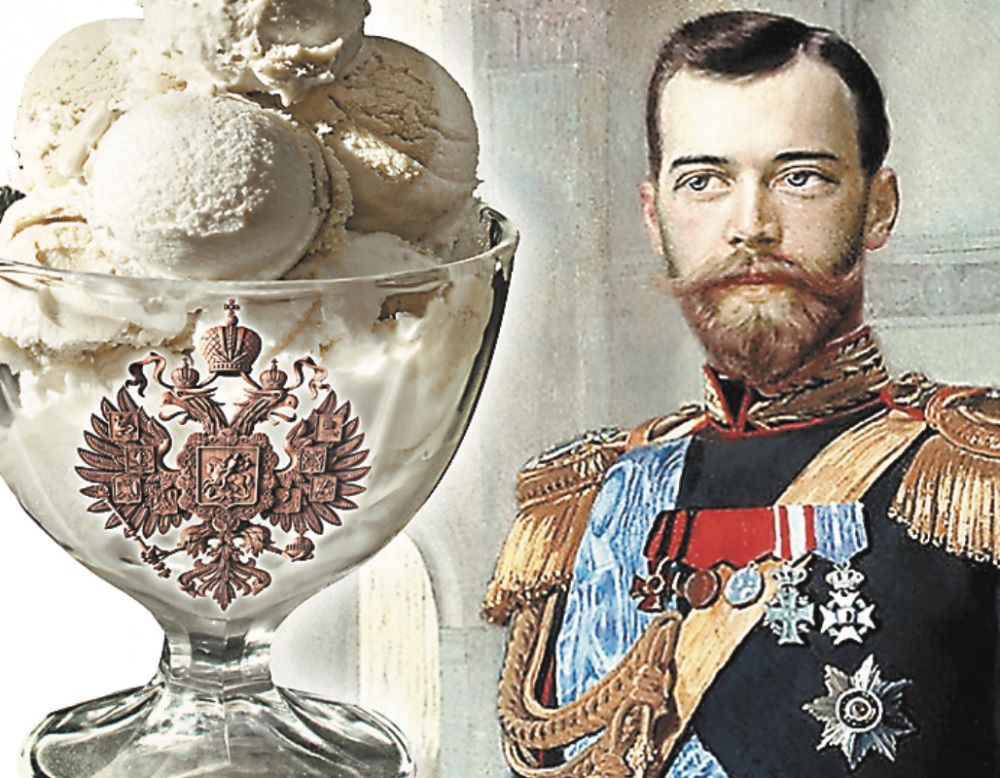
What kind of ice cream was served to Nicholas II?

Ice cream in its modern version first appeared in Russia, in the 18th century, its recipe, published in Новейшая и полная поваренная книга / The Newest and Complete Cookbook (1791) by Nikolai Maksimovich Yatsenkov.

Mention of ice cream was not only recorded in the memoirs of members of the Imperial Court, but also in the works of poets and writers. The great Russian Romantic writer, poet and painter Mikhail Lermontov (1814-1841), obliged his home cook to serve ice cream daily. Another Russian writer Thaddeus Bulgarin (1789-1859) writes about Venetian ice cream in his novel Ivan Vyzhigin (1829). The poet Gavriil Derzhavin (1743-1816), in honor of his name day, every year arranged a gala dinner, at the end of which ice cream was served in the form of an ancient temple or castle.

One of the scenes that struck the French aristocrat and writer Marquis de Custine (1790-1857) in the summer of 1839, was Muscovites eating ice cream in the Alexander Garden.

“Muscovites: shaved, curled, in tailcoats and white pantaloons, in yellow gloves, sit at ease in front of brightly lit cafes, eat sweet ice cream and listen to music? In the summer this can now be observed in Moscow every evening,” he wrote.

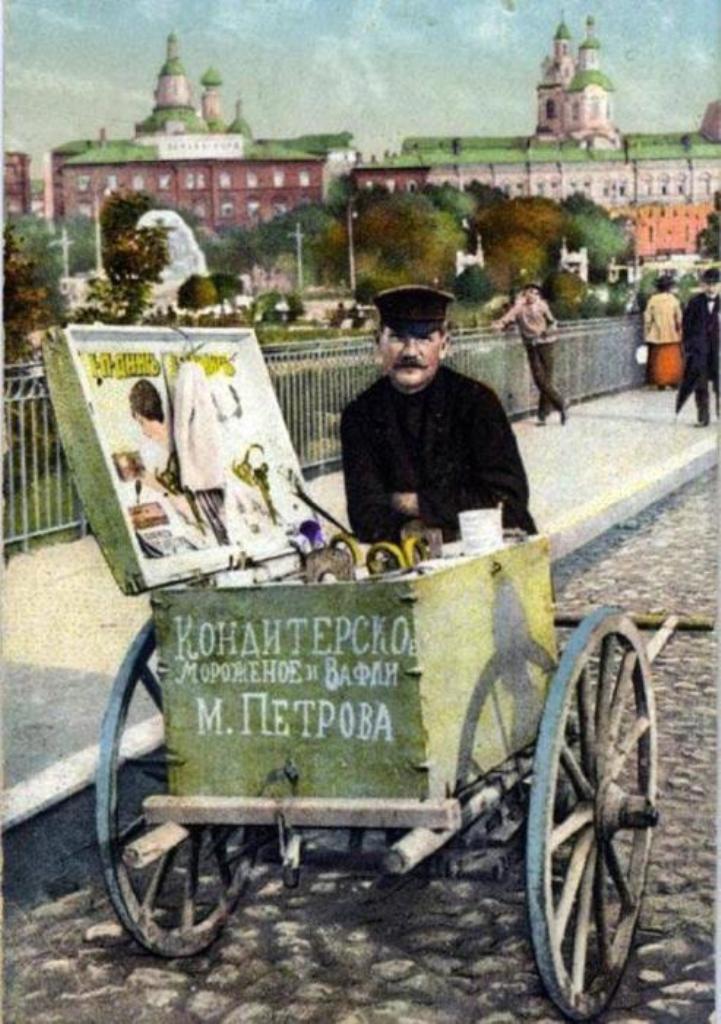
PHOTO: early 20th century Russian ice cream vendor

Expensive pleasure

In the late 18th and early 19th centuries, Russian people were content with traaditional folk dishes: cheesecakes and pancakes, syrniki [sweet cheese pancakes], topped with delicious sour cream and jam. Meanwhile, ice cream had acquired the status of a popular, fashionable and incredibly expensive dessert among Russia’s nobility. The new-fashioned cold treat was present at every social event, ball, and lavish feast.

At the time, sugar was in very short supply and was very expensive, which is why the old ice cream recipes, were considered an expensive pleasure, one which was only available to the very rich. Nevertheless, ice cream was already gaining popularity at Russian tables. By the end of the 18th century, they began to complete dinner with this cold treat more and more often.

The Court cooks slowly and masterfully coped with the whimsical melting product, creating new cold desserts, which included “Vesuvius on the Mont Blanc” – ice cream set on a platter, doused with rum or cognac and set aflame.

The production of ice cream by hand was a time-consuming and small-volume business. The amount of product directly depended on refrigeration equipment, which helped with the process of creating and preserving these cold delicacies.

The full-fledged and well-established production of ice cream in Russia began in the 1830s, when a shop was opened at a Moscow dairy plant, equipped with all the necessary equipment.

By the beginning of the 19th century, ice cream continued to gain popularity and more widely available, including fairs. Writer Pavel Efebovsky wrote in his essay Petersburg Peddlers: “Ice cream is sold by a Russian peasant in a huge tub filled with ice. This tub alone weighs at least three pounds . . . Only it’s expensive: a glass in three sips costs as much as two silver kopecks”.

Up until the middle of the 19th century, ice cream in Russia was prepared exclusively by hand. It was only in 1845, the Swiss-born restaurateur and confectioner Johann-Lucius Isler (1810-1877) patented a machine that made it possible to produce this delicacy mechanically. Isler opened one of the most popular St. Petersburg cafes on Nevsky Prospekt, where they served ice cream with unusual ingredients for that time: fruit liqueur, ground coffee, infusion of orange flowers, pistachios, walnuts. At the same time, three main varieties of cold desserts appeared: sorbetto (or sherbet) – a heavily chilled fruit drink; granito made from frozen fruit juice and ice cream – a dense mass of milk or cream with sugar and various ingredients, similar to modern ice cream.

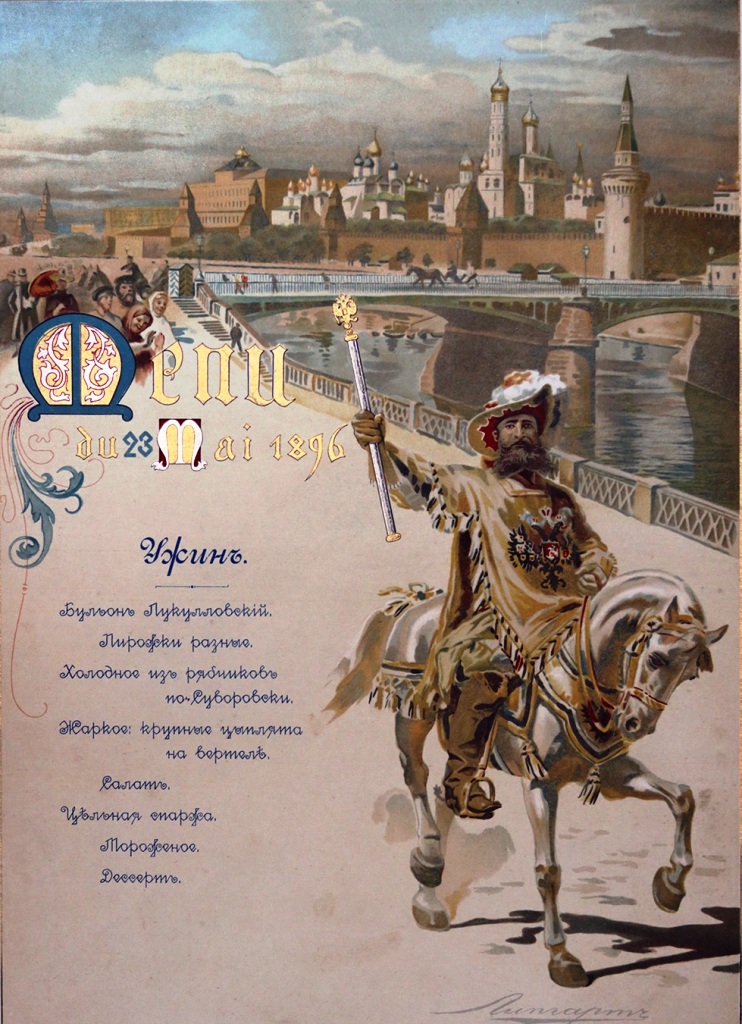
PHOTO: this richly decorated Coronation menu indicates that ice cream was served at the Gala dinner in the Alexander Hall of the Great Kremlin Palace, Moscow, dated 23rd May 1896

Ice cream at the Imperial Court

During the reign of Empress Catherine II, when various overseas amusements and dishes were very fashionable in Russia, recipes for ice cream made from cream and egg whites, included such ingredients as chocolate, lemon, currants, cranberries, raspberries, cherries and oranges.

During the reigns of her successors, ice cream continued to be popular at the Imperial Court. Emperor Alexander I had a French chef named Carem, who invented new types of this dessert to surprise the monarch. Emperor Nicholas I, on the other hand, refused ice cream: based on his solidarity with his brother Michael, who was on a strict diet on the advice of doctors. But the emperor’s wife Empress Alexandra Fedorovna ordered two portions of ice cream from the pastry shop every day for the amount of 1 ruble 72 kopecks.

Richly decorated menus confirm that Мороженое [ice cream] was served to guests at elaborate State Banquets. In particular, ice cream was served to members of the Imperial Family, Russian nobles and visiting foreign delegations, at the Gala dinners held over a three-week period in the Great Kremlin Palace in Moscow, during the festivities marking the Coronation of Emperor Nicholas II in May 1896.

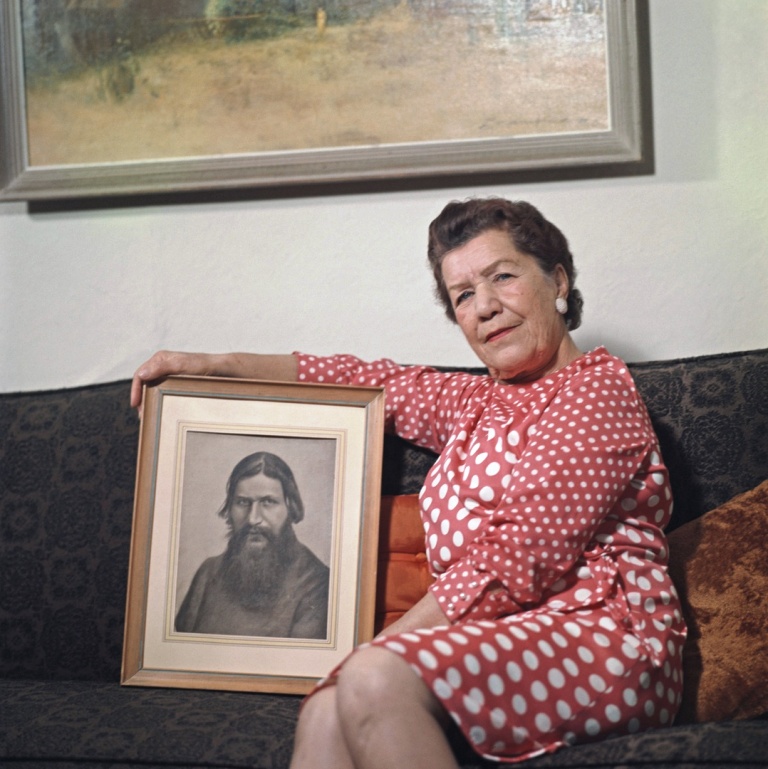
PHOTO: Maria Grigorievna Rasputina with a portrait of her father Grigorii Rasputin, in exile, 1972

Ice cream was especially popular at table of the last Emperor and his family. The recipe for “Romanov ice cream”, which was invented specifically for Nicholas II, has been preserved to this day. It included sugar, 10 egg yolks, heavy cream, whipping cream and vanilla. “I remember ice cream, the like of which I have never eaten anywhere else,” wrote the daughter of Grigorii Rasputin, Maria (1898-1977).

FURTHER READING:

Nicholas II’s menu: culinary preferences of Russia’s last Tsar + PHOTOS

© Paul Gilbert. 2 August 2022

Honouring Imperial Russia’s WWI soldiers

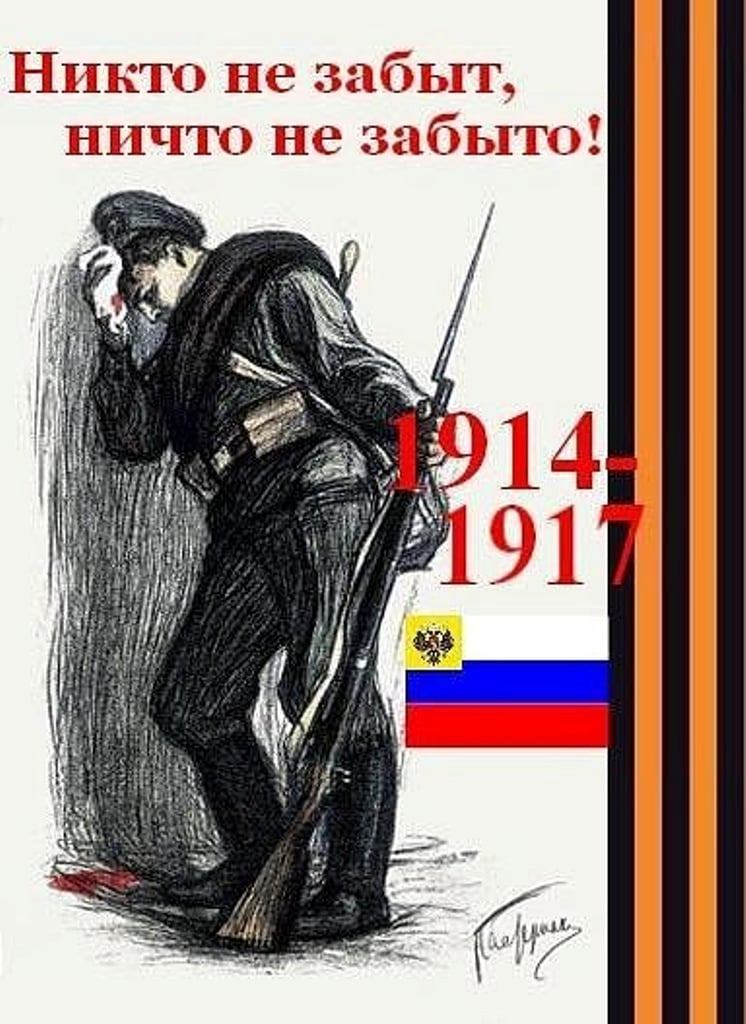
Никто не забыт, ничто не забыто!
No one is forgotten, nothing is forgotten!

Russia’s entry into World War One in August 1914, was based on Russia’s commitment to defending Orthodox Serbia, its pan-Slavic roles, its treaty obligations with France, its concerns over German or Austro-Hungarian dominance in the Balkan region, and its concern for protecting its status as a great power.

1st August – marks the official Day of Remembrance of Imperial Russian soldiers who died in the First World War of 1914-1918. The commemoration day was officially introduced by Russian President Vladimir Putin in 2012. It is on this day, which officials lay wreaths to World War I memorials, Russian cities organize exhibitions dedicated to the war and military units hold solemn assemblies.

During the Soviet years, the First World War and those brave Russian soldiers who gave their lives for the Fatherland, was virtually ignored and forgotten. Soviet dogma dictated that the Great War was a clash of imperialist powers.

How many Russian soldiers laid down their lives “For Faith, Tsar and Fatherland!”? How many fathers, husbands, sons never returned home? According to some estimates, the number exceeds 1,600,000 people, the largest number of casualties among the soldiers and officers of the countries participating in the First World War. The estimate does not include civilian casualties.

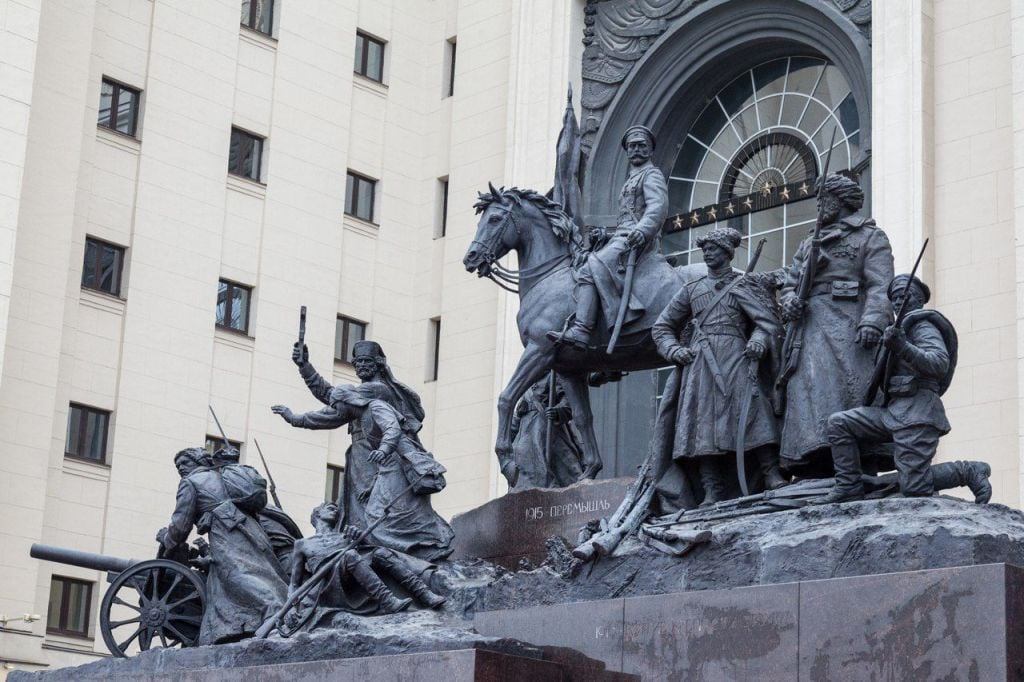
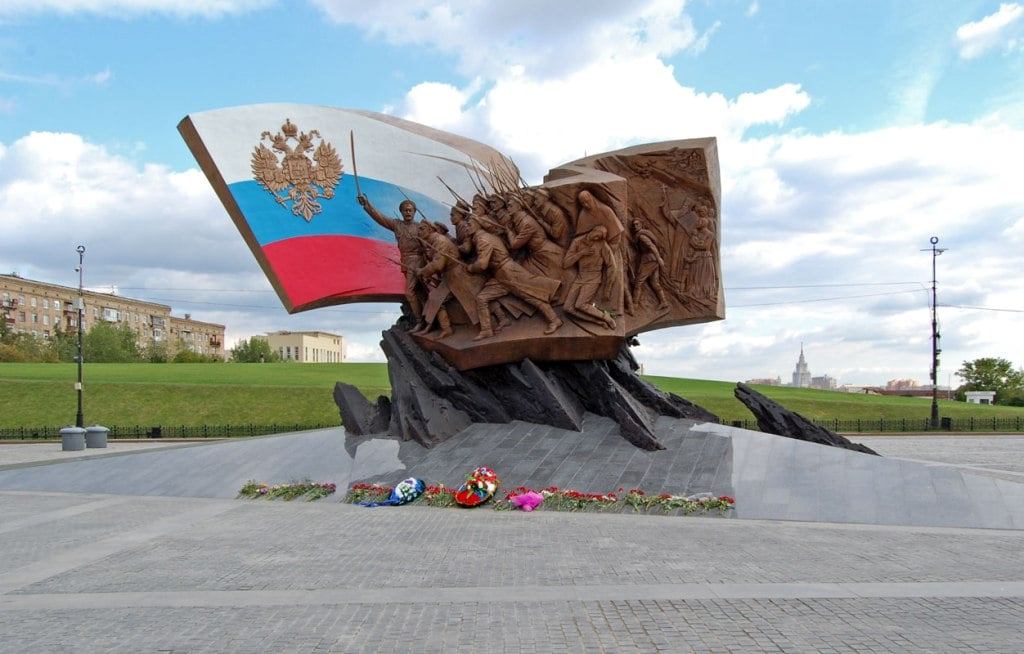
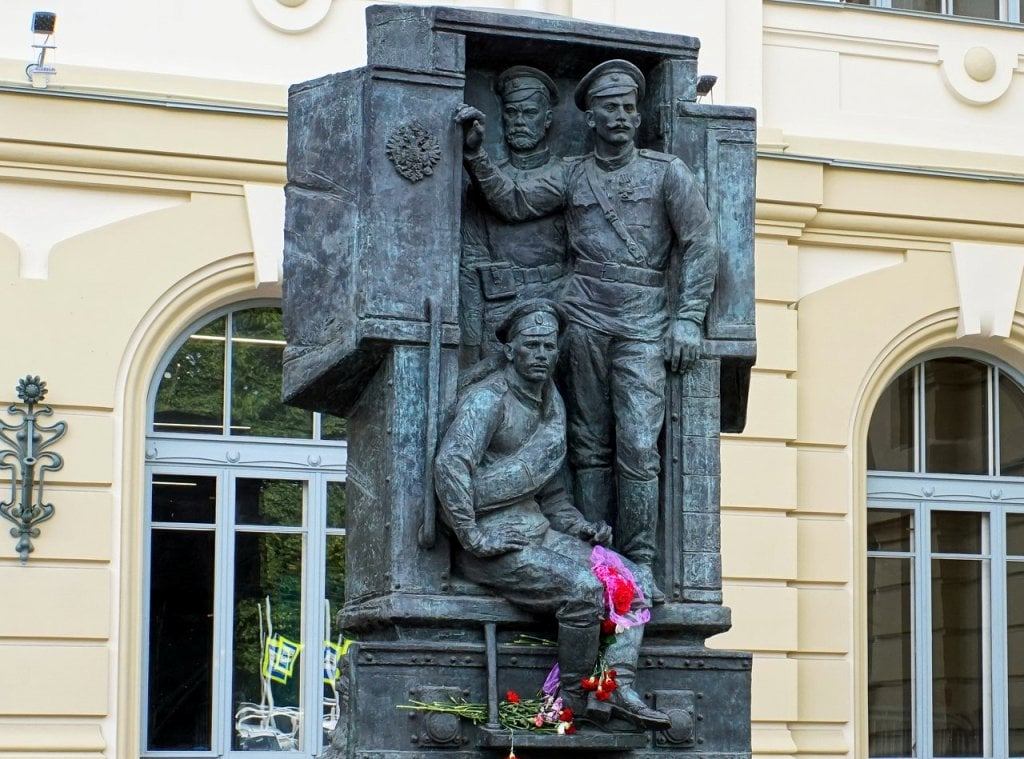
Dozens of monuments to soldiers of the Russian Imperial Army, who fought and died during World War One, have since been erected in major cities across Russia. Below, are just three of the finest:

On 16th December 2014, Russia’s Defense Minister Sergei Shoigu opened a sculptural composition dedicated to the heroes of World Wars I and II on the grounds of the Ministry of Defence on the Frunze Embankment in Moscow.

The WWI monument features Emperor Nicholas II on horseback, recognizing and honouring his efforts during the Great War.

Monument to the Heroes of the First World War on Poklonnaya Hill in Moscow, opened on 1st August 2014. Grand Duchess Elizabeth Feodorovna is depicted in this monument, providing aid to a wounded soldier.

Monument to the Heroes of the First World War in St. Petersburg, installed at the Vitebsk Railway Station on 1st August 2014. It was from this station, that Emperor Nicholas II travelled on the Imperial Train along a specially built line to Tsarskoye Selo.

Никто не забыт, ничто не забыто!
No one is forgotten, nothing is forgotten!

© Paul Gilbert. 1 August 2022

The latest from “MASHA” and “GOSHA”

PHOTO: Maria “MASHA” Vladimirovna and her son George “GOSHA” Mikhailovich

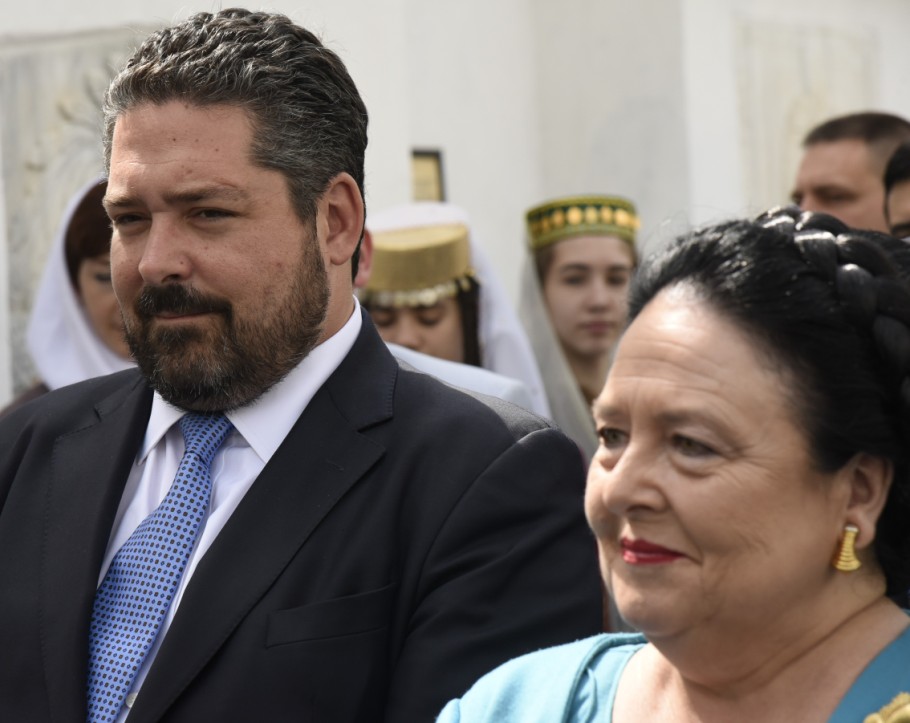
The ongoing antics of the Spanish born Princess Maria “Masha” Vladimirovna and her son Prince George “Gosha” Mikhailovich (Hohenzollern), the self-proclaimed “Empress” and “Tsesarevich” to the non-existent Russian throne, continue to pop up in the Russian media.

A son for Gosha!

In May of this year, Gosha and his Italian born wife Rebecca Bettarini announced to the world that they were now breeding, and that their first child is due in October. On 21st July, the couple announced that they were expecting a boy.

Their adherants – a small group of Legitimist zealots, most of whom are American – wasted little time in taking to social media to coo and gush over the news.

Victoria stated in an interview with the French magazine Paris Match, “this baby will be the first Romanov born in Russia after my husband’s grandfather, Prince Vladimir Kirillovich, in 1917” – who was born in the city of Porvoo in the Grand Duchy of Finland in August 1917.

The Russian language site Legitimist.ru noted that the newborn son would be “recognized as a morganatic descendant only, having no right to inherit the Russian Throne”.

Despite this, in an effort to solidify the non-existent claims of both herself and that of her son, it is not a question of “if” but “when” Princess Maria Vladimirovna will elevate her grandson’s status to “grand duke”.

Rebecca Bettarini was received into the Russian Orthodox Church on 12th July 2020, in the SS. Peter and Paul Cathedral in St. Petersburg. Princess Maria Vladimirovna conferred on Madame Bettarini the title of “Her Serene Highness the Most Serene Princess,” taking the name Victoria Romanovna.

It is very important to note, that Maria Vladimirovna never had or has any authority to hand out titles or awards as she is not and never has been a ruling monarch. Despite this, Maria actively, and completely illegally distributes orders, medals and even titles of the Russian Empire. While many orders and awards of the Russian Empire have been officially restored in the modern Russian Federation, an ordinary civilian, and not a representative of the state, distributes the same order in appearance and name to her supporters on behalf of the “Imperial House”.

In addition, despite her insistence that she has no aspirations of being Empress of Russia, she does nothing to dissuade the Russian language sites, from identifying her as “Head of the Russian Imperial House H.I.H. The Empress Grand Duchess Maria Vladimirovna.” This of course is nonsense, she is a princess, nothing more!

“No shows” at this years’ Tsar’s Days events in the Urals

Much to this writer’s surprise, not a single descendant of the Romanov family attended the Divine Liturgy held in Ekaterinburg on the night of 16/17 July. The anniversary of the regicide is very important to both Orthodox Christians and monarchists.

Neither Princess Maria Vladimirovna and her son Prince George Mikhailovich (Hohenzollern), the self-acclaimed “heads” of the “Russian Imperial Family” failed to attend the 104th anniversary marking the death and martyrdom of Emperor Nicholas II and his family.

Western sanctions and the war in Ukraine cannot be used as excuses by either one of them. Despite the fact that most foreign airlines have ceased flying into Russia, it is still possible to reach St. Petersburg, Moscow and even Ekaterinburg from Europe via 3 foreign carriers.

Gosha who resides in Moscow, is the only Romanov descendant currently living in Russia, so one can only speculate his absence this year?

Let us not forget that it was Masha’s great-grandmother Grand Duchess Maria Pavlovna, who was openly hostile towards both the last Emperor and Empress. In addition, Masha’s grandfather and Gosha’s great-grandfather Grand Duke Kirill was a traitor to Russia’s last Tsar.

GOSHA stops short of condoning Putin’s “special operation”

“The Russian Imperial House does not make statements of a political nature . . . ”, claims Maria Vladimirovna, words of wisdom her son may want to take into consideration . . .

In recent weeks, Gosha has weighed in on the Russia/Ukraine situation. He has been quoted on Russian social media [Вера и Верность], stopping short of condoning Putin’s “special operation”:

“Ukraine for me has been and remains a part of the Fatherland in the highest sense of the word.” 15th July 2022
“Unfortunately, Western partners have chosen the path of an ultimatum against Russia, which, as we see, does not entail a solution to the Ukrainian issue, but, on the contrary, aggravates not only it, but, as a result, other world problems,” 27th June 2022.

Click HERE to read my article ‘The unholy alliance of Maria and Vlad‘, published on 5th March 2022

© Paul Gilbert. 28 July 2022
Livadia Palace marks 100th anniversary as a museum

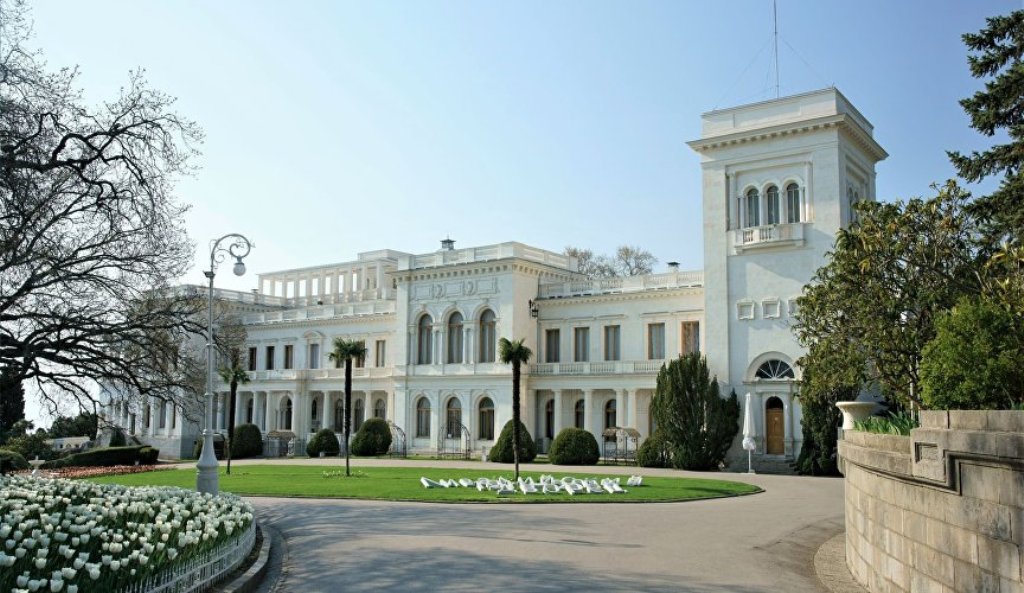
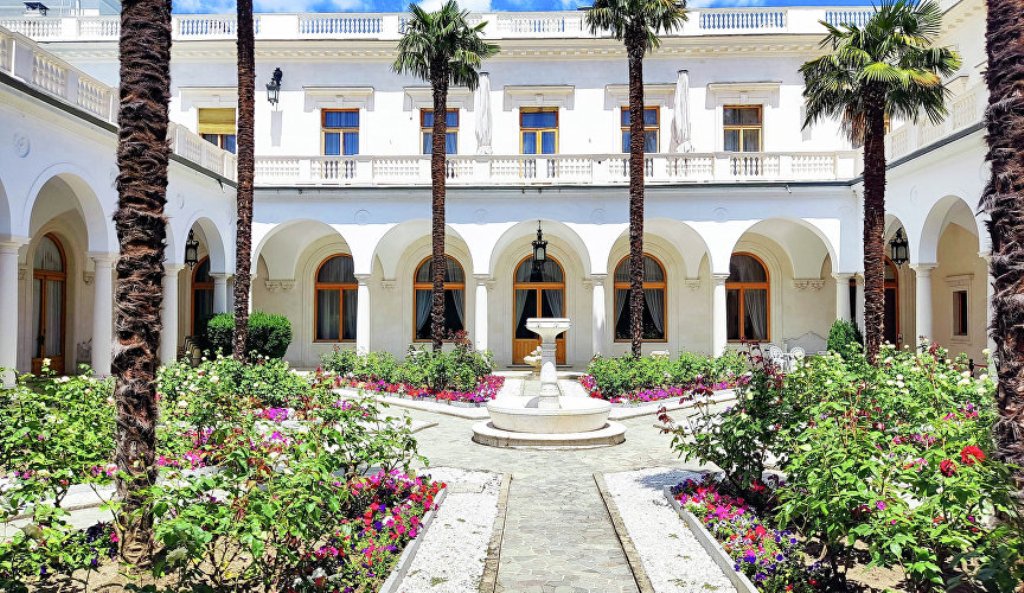
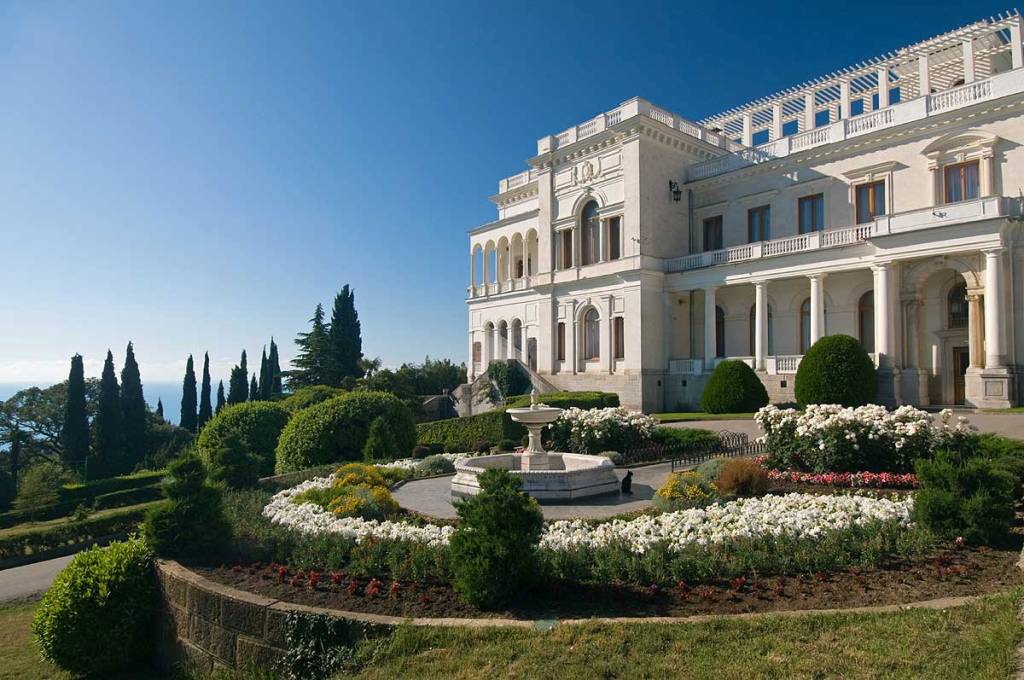
PHOTO: facade, main entrance and garden of Livadia Palace

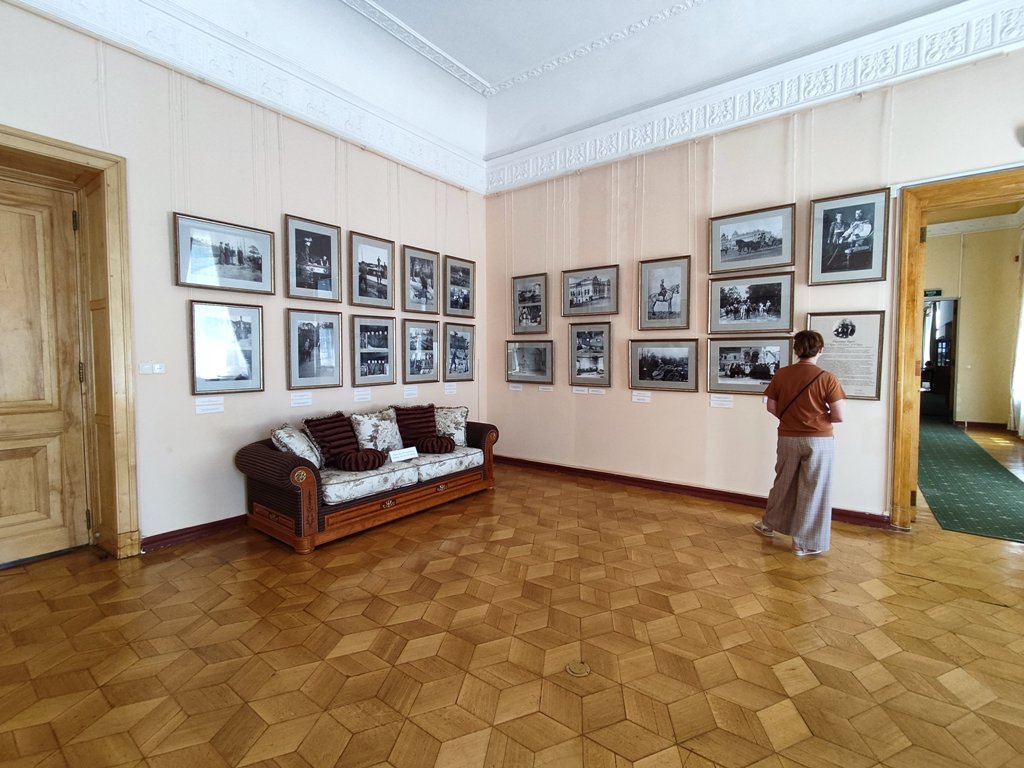
July marks the 100th anniversary of the opening of Livadia Palace Museum. The former residence of Emperor Nicholas II and his family in Crimea, was opened to the public as a museum in 1922, however, it closed 5 years later due to a lack of visitors.

Today, the “White Pearl of Crimea”, is framed by gardens filled with the aroma of roses… classical melodies unobtrusively pour from the speakers… a queue of visitors wait patiently at the ticket booth to purchase tickets, all eager to see how the last Russian emperor and his family lived, with their own eyes. According to staff estimates, the palace today receives an average of 500 guests daily.

A similar scenario played out 100 years ago, only instead of tourists, it was students and Red Guards who roamed the halls and rooms of the palace. Thanks to archival documents, we know that in 1923 the Livadia Palace was visited by 30 thousand people, while nearby Alupka Palace, for example, received only half that number.

A hundred years ago, there were actually two Livadia palaces available for visiting – the Maly or Small wooden palace, which belonged to Alexander III (it was demolished after the Great Patriotic War), and the new Grand White Palace (built on the site of the Bolshoi or Large wooden palace). In the Small Livadia Palace only 3 rooms were open to visitors, while in the new Grand White Palace 10 rooms were open to visitors: 2 downstairs and 8 upstairs. It should be noted, that at this time, the palace-museum would have still been left intact, although it is known that some items were stolen during the Revolution and Civil War.

The museum then was only open to receive visitors four times a week, from 3 pm to 6 pm. And although visitors paid an entrance fee, sometimes the money received was not even enough to cover the salaries of the museum’s few employees.

On 30th April 1918, German troops entered Livadia, and immediately proceeded to plunder the palace.

In 1922, the Museum of the Life of the Romanov Royal Family, opened in Livadia Palace. During the 1920s, the Soviets used Livadia Palace solely for propaganda purposes: the people could see what luxurious interiors the Imperial family lived in, the expensive materials the furniture were made of, thus causing indignation among many.

On 21st December, 1920, Lenin signed a decree according to which “the palaces of the former tsars and grand dukes should be used as sanatoriums and health resorts for workers and peasants.” In 1925, the first sanatorium was opened in Livadia Palace, offering free treatment of peasants.

The Soviet poet Vladimir Vladimirovich Mayakovsky (1893-1930), who visited here in 1927, wrote the poem “Miracles”, in which a key line reads: “In the royal palace, now live sanatorium men.”

It was in the same year, that the museum was closed with a sign on the main entrance “closed due to lack of interest among visitors”.

After that, the question arose about the distribution of the contents ​​of the Livadia Palace: they were simply transferred to other Crimean museums. For example, a number of carpets were given to the Palace of the Emir of Bukhara (1880-1914) in Yalta, while other items of decorative, applied and fine arts – to the Alupka Palace and the Kroshitsky Art Museum in Sevastopol. The dolls and toys of the Imperial children were given to orphans, while the curtains which adorned the imperial bedchambers and other rooms of the palace were made into clothes for the poor. Sadly, most of the historical furnishings have been lost, and it was only in the 1990s, that some pieces of the furniture were returned to the palace, and are now part of the museum.

During the Second World War, a ceremony marking the successful completion of the German Crimean Campaign (1941–1942), with the capture of Sevastopol by the German 11th Army under the command of General Erich von Manstein, and Manstein’s promotion to the rank of Generalfeldmarschall (field marshal), was held in the garden of Livadia Palace on 6th July 1942. Participants included officers, non-commissioned officers and soldiers who were awarded the German “Ritterkreuz” (Knight’s Cross) and the “Deutsches Kreuz in Gold” (German Cross in Gold).

Some 70 years later, Livadia Palace underwent an extensive restoration and received the status of a state museum. In November 1993, Livadia Palace received the status of a museum. On 16th July 1994, the exposition The Romanovs in Livadia was opened in the former private rooms of the Imperial family on the second floor of the palace.

Today, Livadia Palace is the most popular museum in Crimea. The first floor of the palace-museum is dedicated to the famous Yalta Conference, attended by US President Franklin D. Roosevelt, British Prime Minister Winston Churchill, and Soviet leader Joseph Stalin, on 4th–11th February 1945.

The permanent exposition dedicated to Nicholas II and his family in Livadia is located on the 2nd floor of the palace, in 16 rooms, each of them featuring original elements and details.

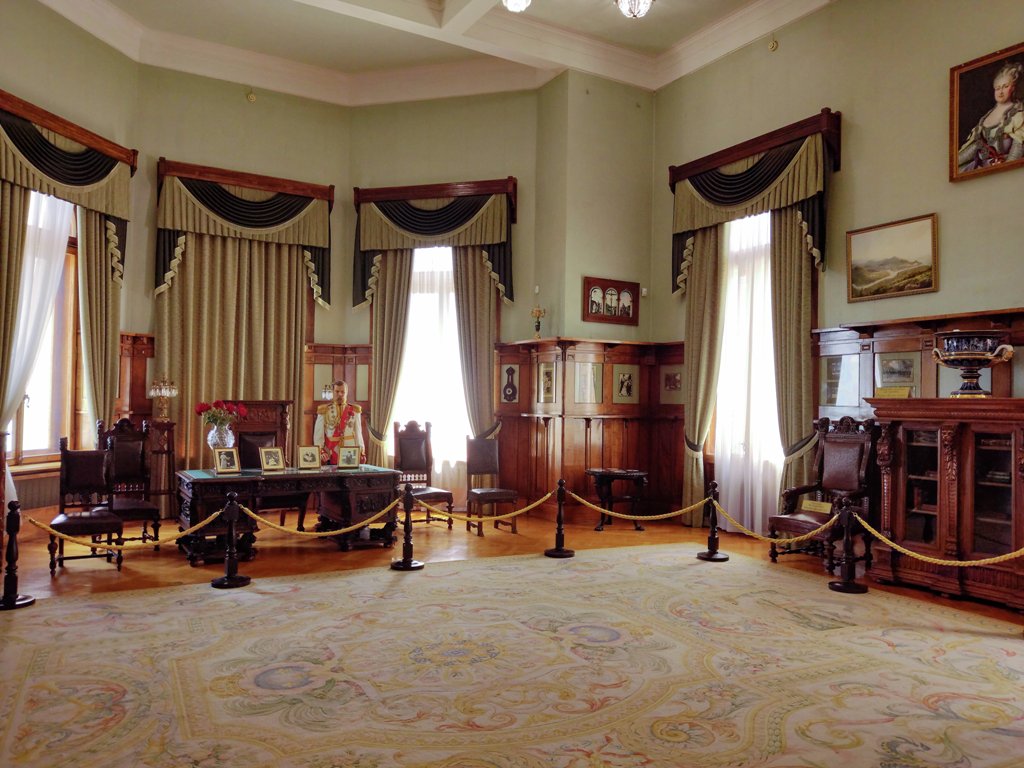
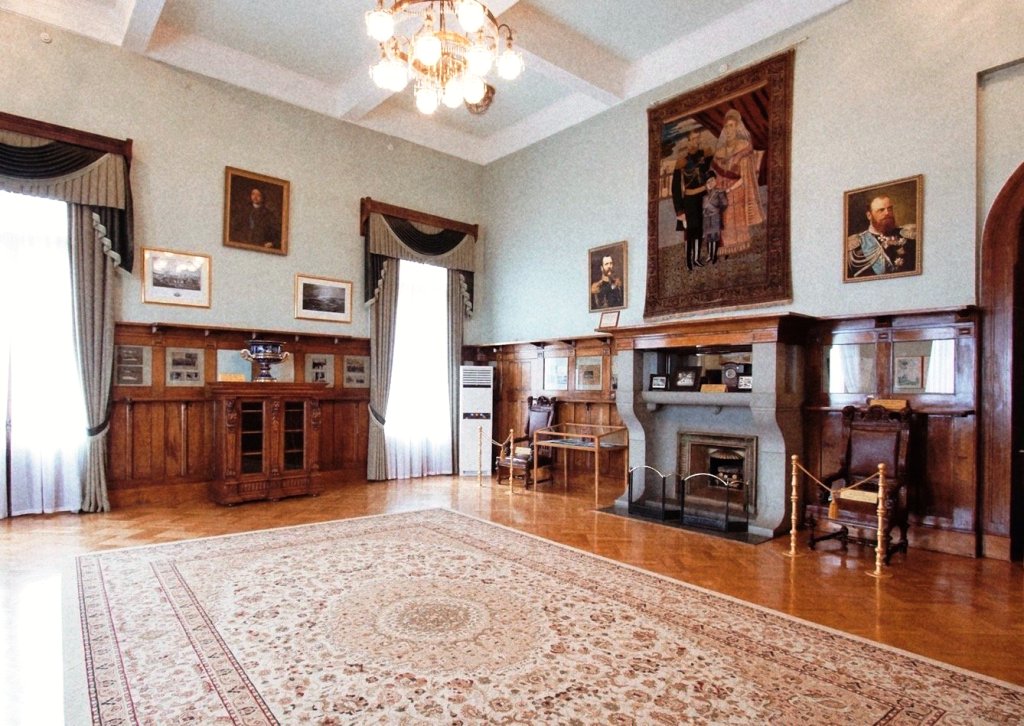
PHOTO: the Emperor’s favourite room – his study

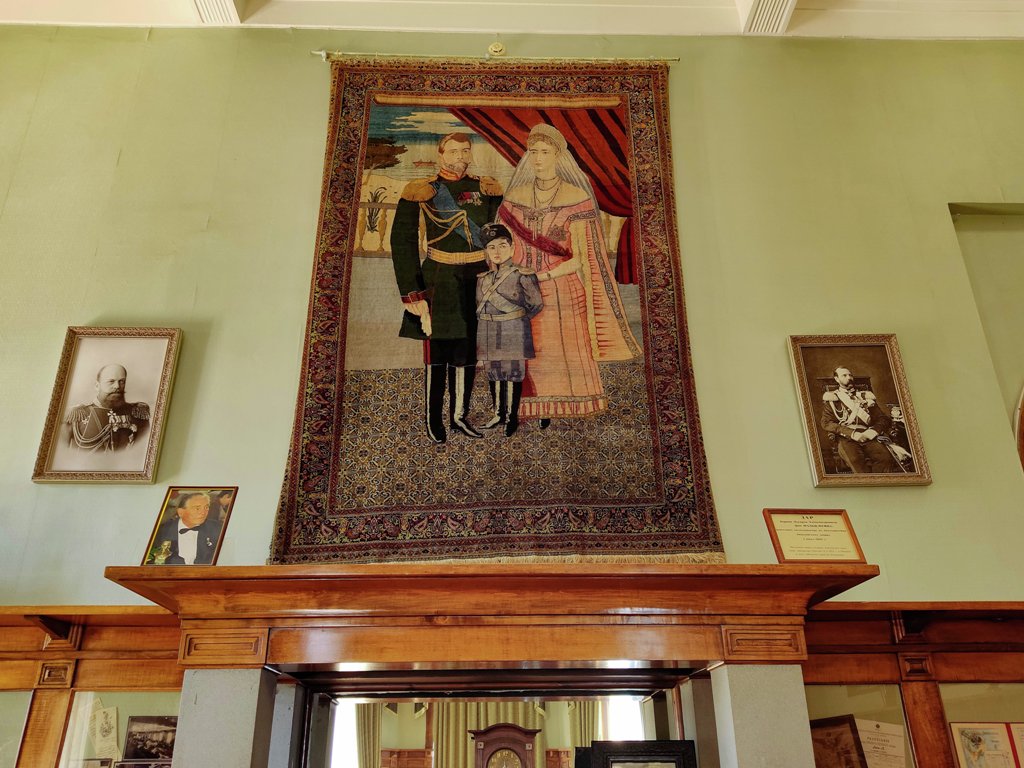
PHOTO: handmade wall carpet gifted to Nicholas II by the Shah of Persia in 1913

PHOTO: very few items from the Tsar’s Study have survived to the present

Visitors can now see the Emperor’s favourite room – his study, the main highlight of which is a handmade wall carpet depicting Nicholas II, Alexandra Feodorovna and Tsesarevich Alexei, a gift to the family in 1913 by Ahmad Shah Qajar of Persia (1898-1930) – in honour of the 300th anniversary of the Romanov dynasty. After the 1917 Revolution, many items from the palace were stolen, including this carpet, which ended up abroad. In 1983, a collector bought it at an auction in Germany and donated it to the palace 10 years later.

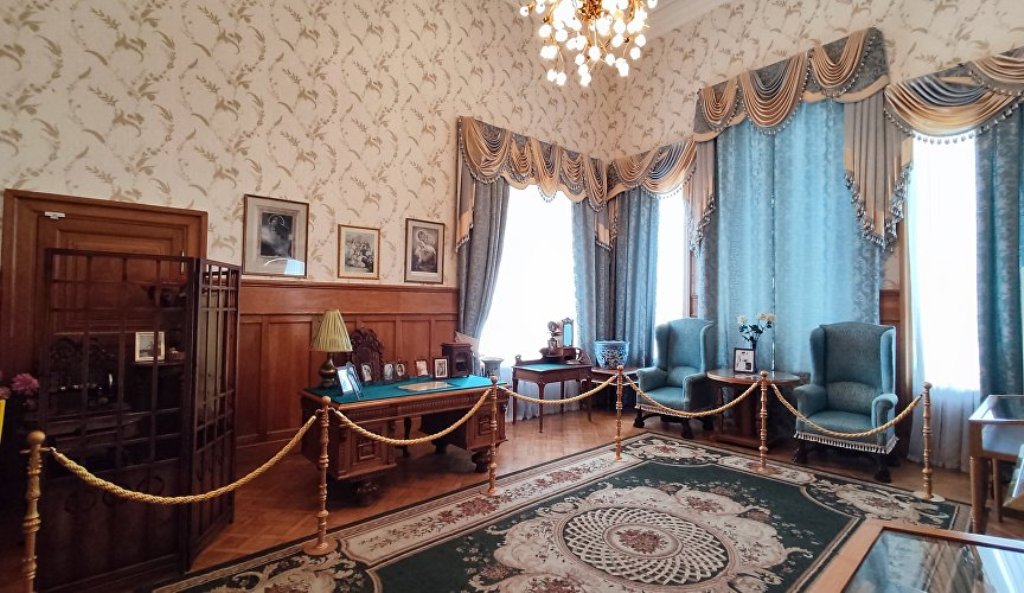
PHOTO: Empress Alexandra Feodorovna’s study

Visitors to the study of the Empress, will find a cozy, homely atmosphere as opposed to a work place: for example, family photographs are displayed on the table in frames, a sewing machine is silent in the corner, and Easter decorations with imperial engraving are hung behind the glass of the sideboard.

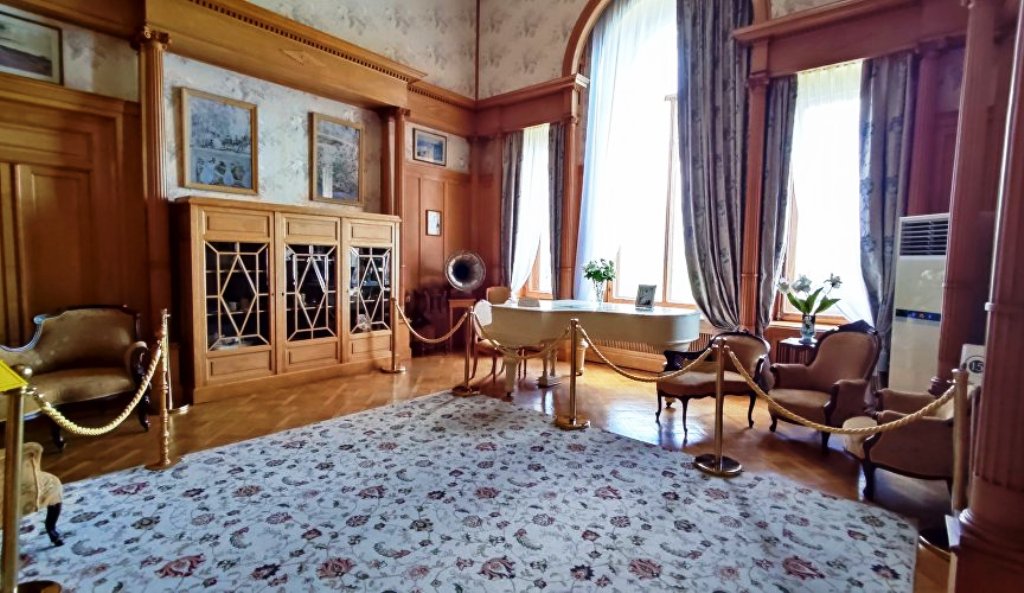
PHOTO: music room in Livadia Palace

In the music room there is a Becker grand piano, in which the Empress often played with her daughters. Today, performances of the Tauride Blagovest Chamber Choir are held in this room.

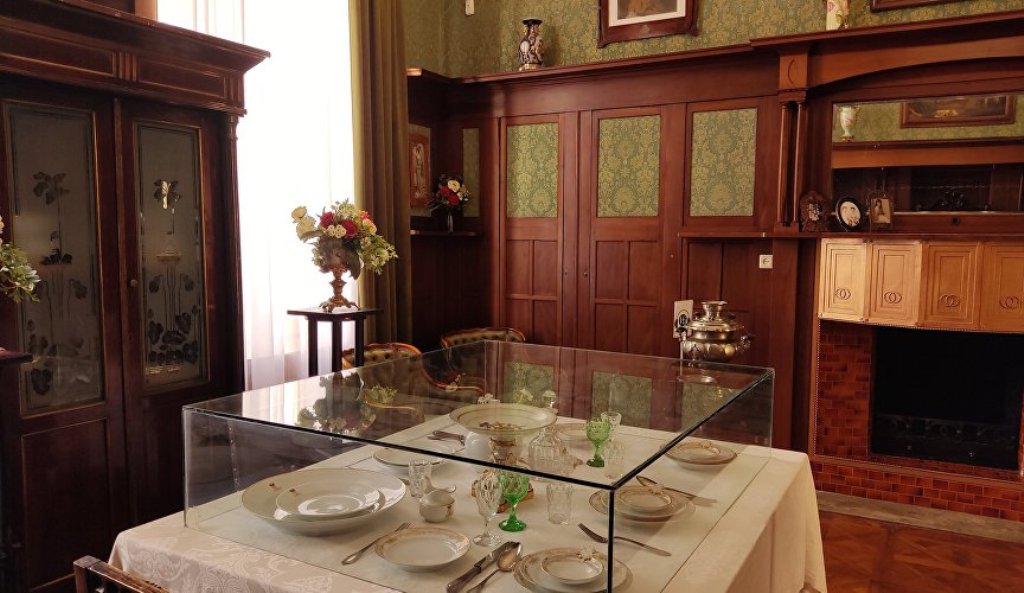
In addition, is a small family dining room with authentic dishes and utensils of the Imperial family, a classroom for the grand duchesses, the imperial bedroom, the children’s rooms, a library, among others.

PHOTO: Small Family Dining Room

PHOTO: the former bedroom of the grand duchesses

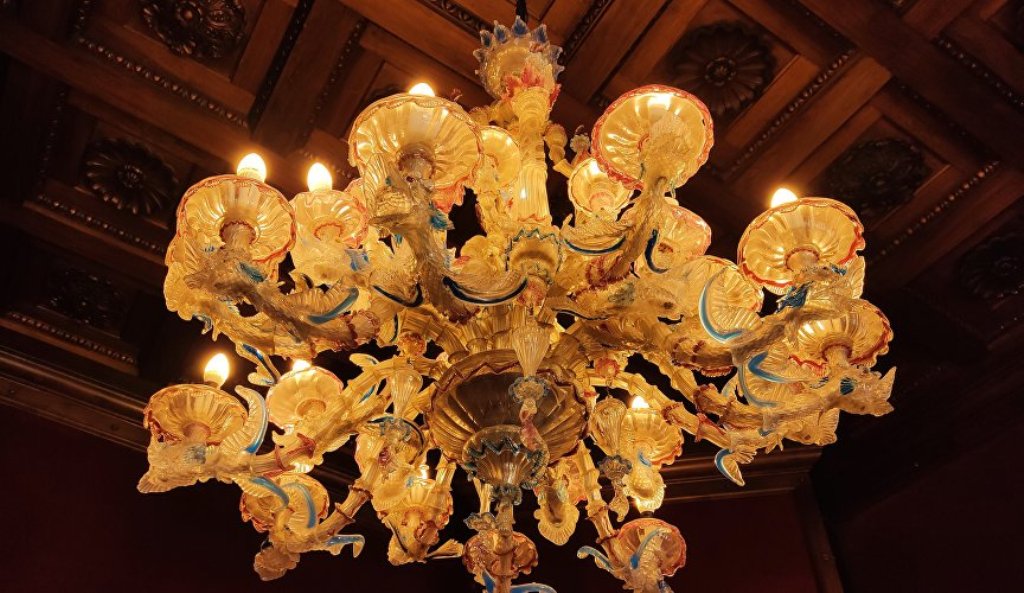
Museum staff like to draw the attention of visitors to the original pieces which have been preserved to this day, emphasizing their own disbelief at how some of the exhibits managed to survive to this day. For example, the Murano glass chandelier in the waiting room on the 1st floor, which has been hanging there since 1912. Just like the chandelier in the reception room, made of bronze and glass. And also fireplaces, mirrors and pieces of furniture.

PHOTO: an original Murano glass chandelier, 1912

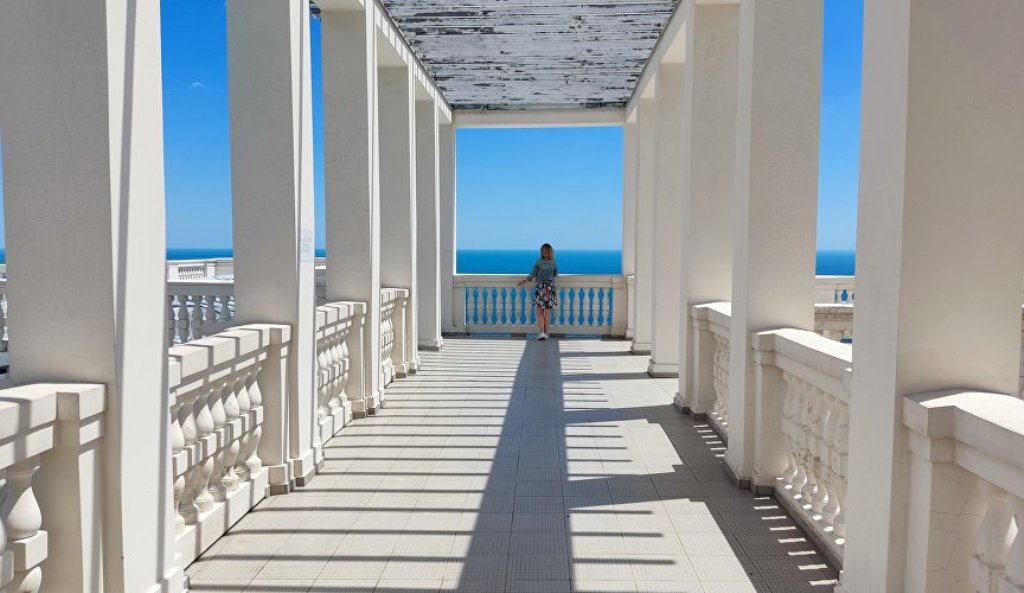
The palace also features a solarium on the roof, where the Imperial family enjoyed the sun and breathtaking views of the Black Sea. A narrow staircase leads to the roof, and in the time of Nicholas II it was possible to reach it by a tiny lift (elevator), which was restored several years ago.

PHOTO: the solarium on the roof of the palace offers views of the Black Sea

Interesting facts about Livadia Palace

It is known that the Imperial family arrived in Livadia with their children on 5th September 1909. It was during this visit, starting from 27th October, that Nicholas II and Alexandra Feodorovna met with the architect Nikolai Petrovich Krasnov (1864-1939), Yalta’s most fashionable architect, on numerous occasions, to discuss in detail the design of their new white palace, and the decoration of its halls and other rooms. The August couple approved the design on 12th December, just 4 days before leaving Livadia for St. Petersburg.

The old wooden Bolshoi or Grand Palace, the residence built in the 1860s for Emperor Alexander II, was demolished in 1910, to make way for a new stone palace, which would serve as the residence of Russia’s last emperor and his family during their visits to Crimea.

The palace was built in a remarkably short time span of 17 months, at a cost of about 4 million gold rubles, paid for by Nicholas II. The palace was inaugurated on 11th September 1911. Some 2,500 workers worked around the clock. At night, the large-scale construction site was illuminated by many torches. After the construction was completed, the walls of the palace were covered with a special chemical composition that protected the stone from weathering and pollution.

A power station was built nearby, generating electricity for the entire estate. The palace also featured two types of heating: fireplaces and central water heating. The palace was also equipped with telephones and a lift for the Empress. It is interesting to note, that it was thanks to a modern system of reinforced concrete ceilings, which prevented the destruction of the palace from a strong earthquake in 1927.

PHOTO: Italian Courtyard

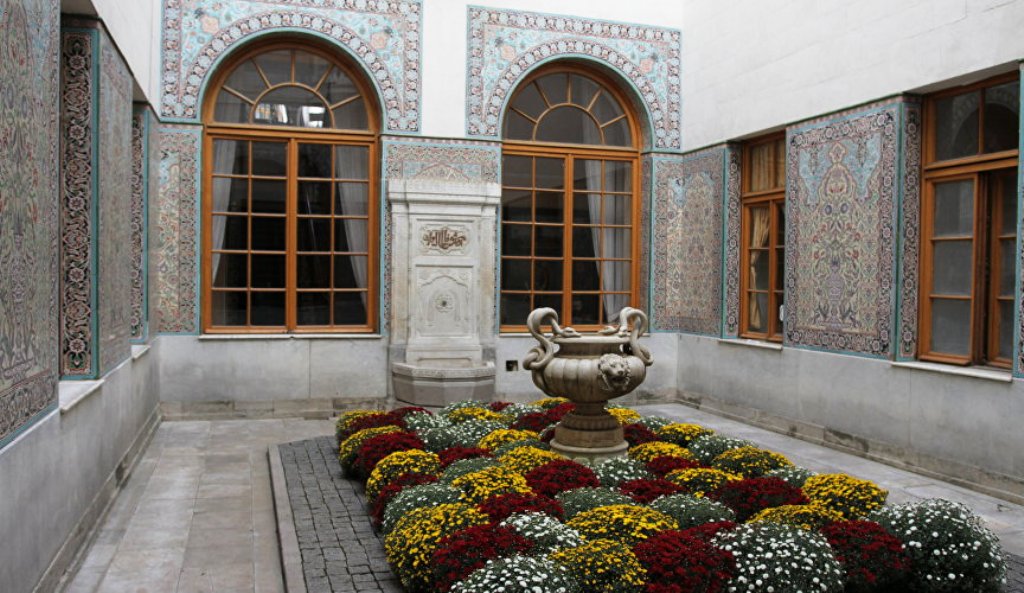
PHOTO: Arab Courtyard

Krasnov had constructed a comfortable, spacious palace. The palace was built in the Italian Renaissance style – the style was personally chosen by Nicholas II. None of the four façades of the palace resembles the other. The new Imperial residence featured 116 rooms, one large courtyard [the Italian Courtyard, where Nicholas II and his family were often photographed] and three small courtyards, as well as a number of outbuildings.

While the palace was built as a summer residence for Nicholas II and his family, they only stayed here four times: twice in the fall – in 1911 and 1913, and twice in the spring – in 1912 and 1914, each time staying for several months at a time. On 12th June 1914, the Imperial family left Livadia, not suspecting that they were saying goodbye to her forever. On 1st August, Germany declared war on Russia.

The Imperial family would arrive on the Imperial Train at Sevastopol, where they boarded the Imperial Yacht Shtandart/Standart, and sailed along the southern coast of Crimea to Yalta, and from there by *motorcar to Livadia. [*The Emperor maintained His Imperial Majesty’s Own Garage at Livadia, one of four in Russia, which housed his collection of motorcars].

Click HERE to VIEW 2 vintage newsreels The Holy Tsar in Russia. Livadia, 1902-1914 – duration: 18 minutes each.

Today, the Livadia Palace and Park ensemble occupies more than 36 hectares, in addition to the Grand White Palace, it includes the Svitsky building, the house of the Minister of the Imperial Court Count Vladimir Frederiks (1838-1927), the Church of the Exaltation of the Cross, and a picturesque park with preserved structures (arbors, fountains) from the tsarist period.

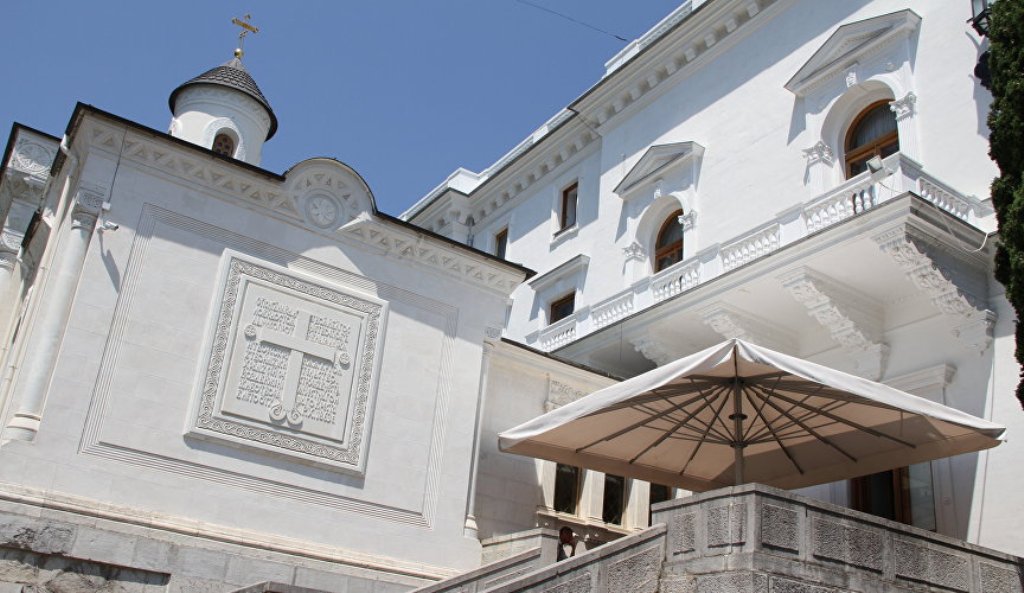
PHOTO: view of the Church of the Exaltation of the Cross (left)

On 2nd November [O.S. 20 October] 1894 – Emperor Alexander III died in the Small Palace. His early death at the age of 49, was the result of terminal kidney disease (nephritis). A requiem was held for the Emperor in the Church of the Exaltation of the Cross.

It was also on this day, that Tsesarevich Nicholas Alexandraovich Romanov ascended the throne as Russia’s last emperor and tsar, pledging his oath of allegiance to Russia in the palace church. In addition, the holy righteous John of Kronstadt anointed Princess Alice of Hesse in this church, and thus became the Orthodox faithful Grand Duchess and future Empress Alexandra Feodorovna.

During his stay in Livadia, in the autumn of 1900, Nicholas II became gravely ill, with what proved to be a rather serious form of typhoid. Despite being pregnant for the fourth time and in a lot of pain, Alexandra nursed him back to health, six months later, in the Spring of 1901.

PHOTO: view of the garden, main facade and entrance to Livadia Palace

The entrance to the summer imperial residence is guarded by two marble lions – although they do not have the traditional lush mane and look more like Egyptian sphinxes. At the main entrance to the palace and in the famous Italian Courtyard, there are white marble benches with winged lions on the armrests. These benches were brought here from Venice. Also, the Istria fireplace was brought from Venice, which is located in the Main lobby of the palace.

Two original sculptures can also be seen in the White Hall. The first is Penelope, the symbol of marital fidelity, the wife of Odysseus. Penelope was purchased by the inhabitants of Odessa as a gift to Empress Maria Alexandrovna (grandmother of Nicholas II), on her first visit to the Livadia estate in 1863. The second figure is a chimera, or satyr, a collective image from antiquity.

The historical park has preserved trees planted more than a century ago. It is decorated with Turkish gazebo, Ruschuk column, marble fountains and benches.

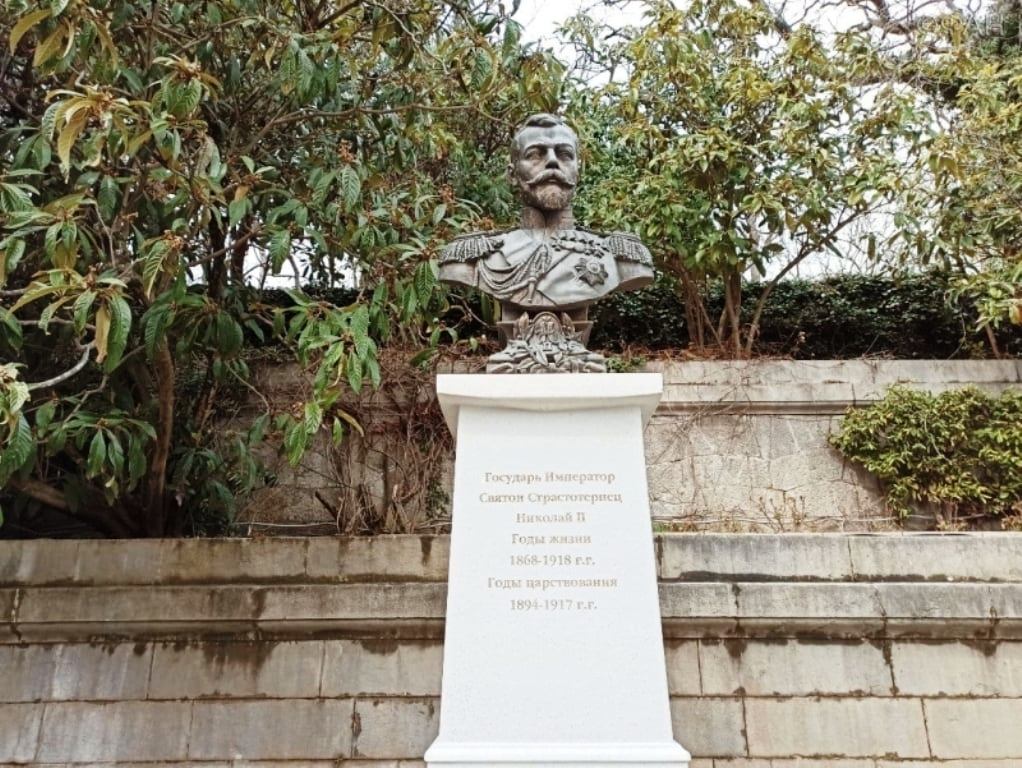
PHOTO: bust-monument of Emperor Nicholas II

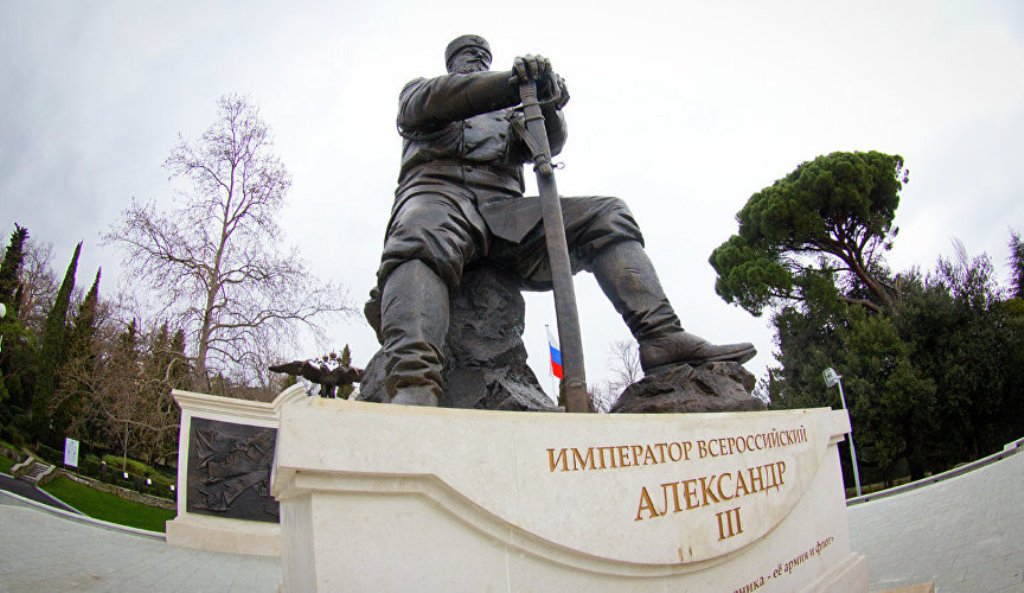
PHOTO: monument to Emperor Alexander III, installed on the site of the old Bolshoi (Large) wooden Palace

On 19th May 2015, a bust-monument of Emperor Nicholas II was installed at the main entrance to the Livadia Palace. It is made according to the model of the sculptor A. A. Appolonov from artificial stone and bronzed. The pedestal is made of marble.

On 18th November 2017, in the presence of the President of the Russian Federation Vladimir Putin, a monument to Emperor Alexander III was unveiled in the park of the Livadia Palace – on the site where the Bolshoi or Large wooden palace once stood.

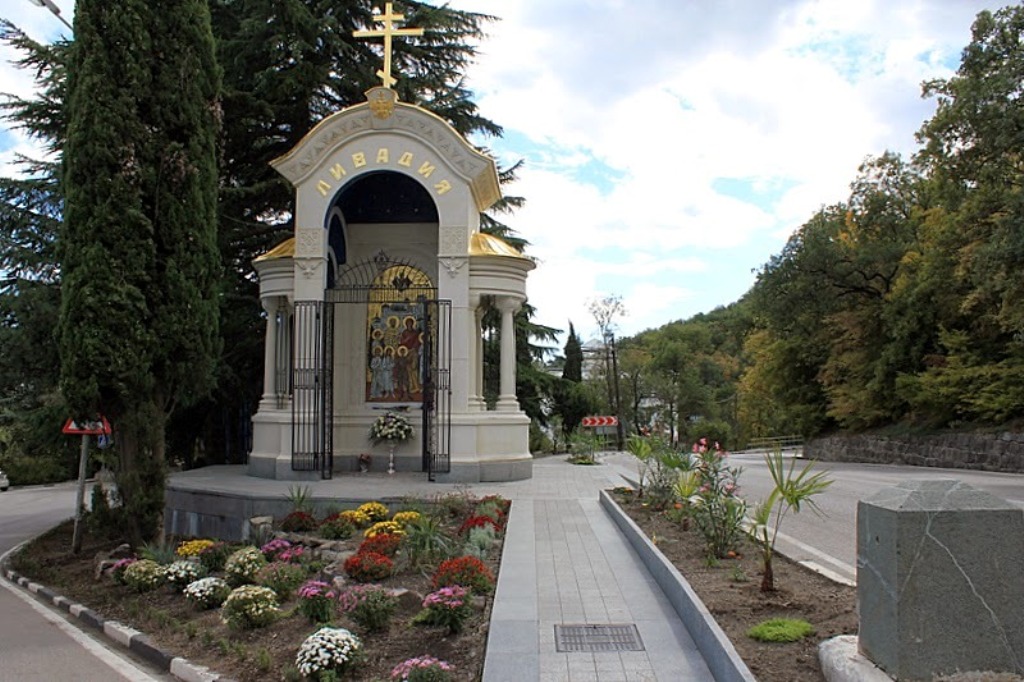
PHOTO: Chapel of the Holy Royal Martyrs

On 22nd September 2013, as part of the celebrations marking the 400th anniversary of the Romanov dynasty, the Chapel of the Holy Royal Martyrs was consecrated. The chapel which is situated at the entrance to Livadia Palace was erected in honour of the 150th anniversary of the Exaltation of the Cross Church of the Imperial family at Livadia and in memory of the Holy Royal Martyrs. A magnificent mosaic tile icon depicting the Holy Royal Martyrs dominates the tiny chapel interior. The chapel is open to all comers, liturgies are held on major Orthodox holidays.

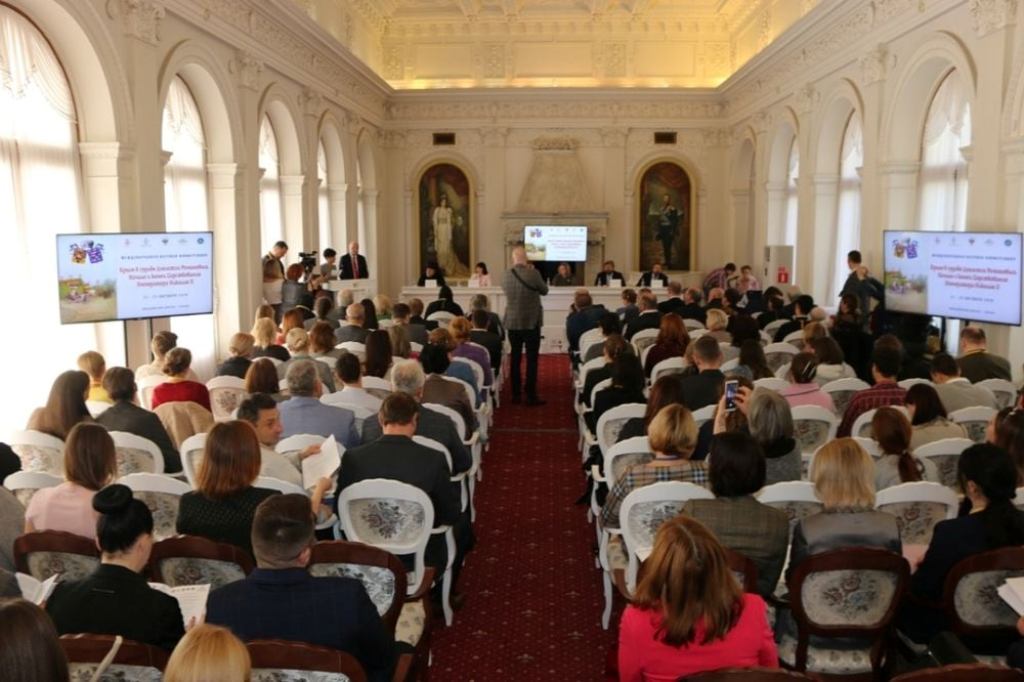
PHOTO: Nicholas II Conference in the White Hall at Livadia Palace, 20-22 October 2019

Between 20-22 October 2019, the international conferenceCrimea and the Fate of the Romanov Dynasty. The Beginning and End of the Reign of Emperor Nicholas II,’ opened in the White Hall of Livadia Palace. The conference was attended by leading Russian historians, publicists, archivists and writers. The objective of the conference was to discuss the truth about the Tsar’s family and the and the achievements that Russia made during the reign of Nicholas II. The international conference was timed to the 125th anniversary of the accession to Orthodoxy of Princess Alix of Hesse-Darmstadt – the future Empress Alexandra Feodorovna and the 100th anniversary of the escape of members of the Russian Imperial House from Crimea. In addition, this year marks 125 years since the death of Emperor Alexander III in Livadia. Crimea played a crucial role in the fate of the Romanovs, who played an important role in the development of the peninsula.

© 25 July 2022. Paul Gilbert

Myrrh-streaming icon of Tsar Nicholas II brought to Ekaterinburg for Tsar’s Days

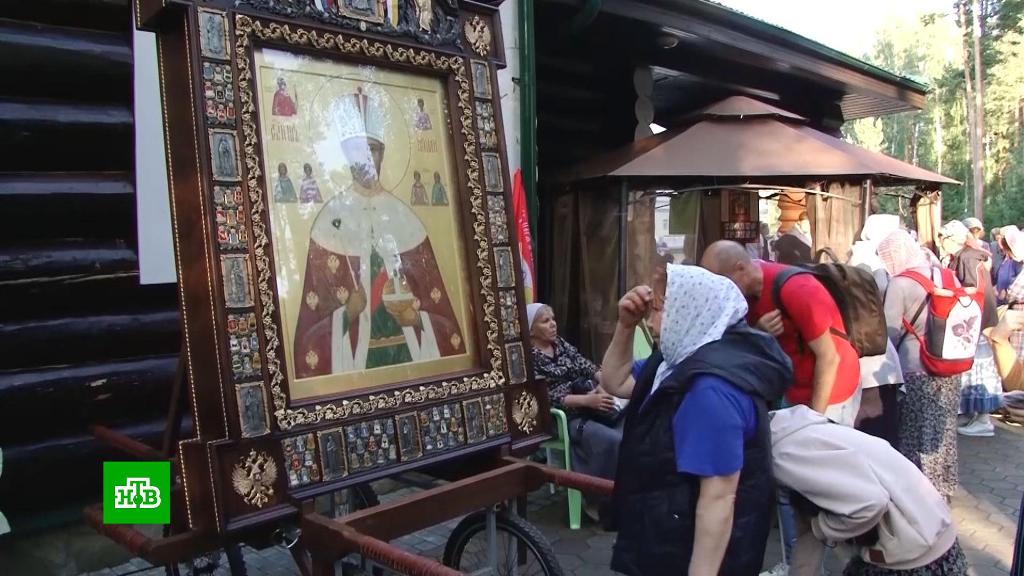
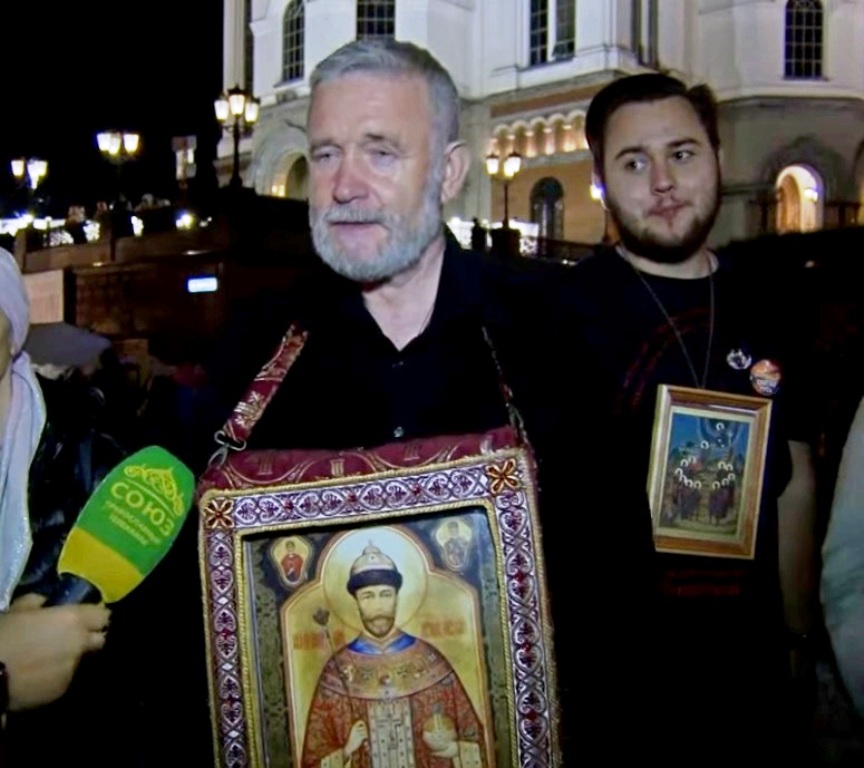
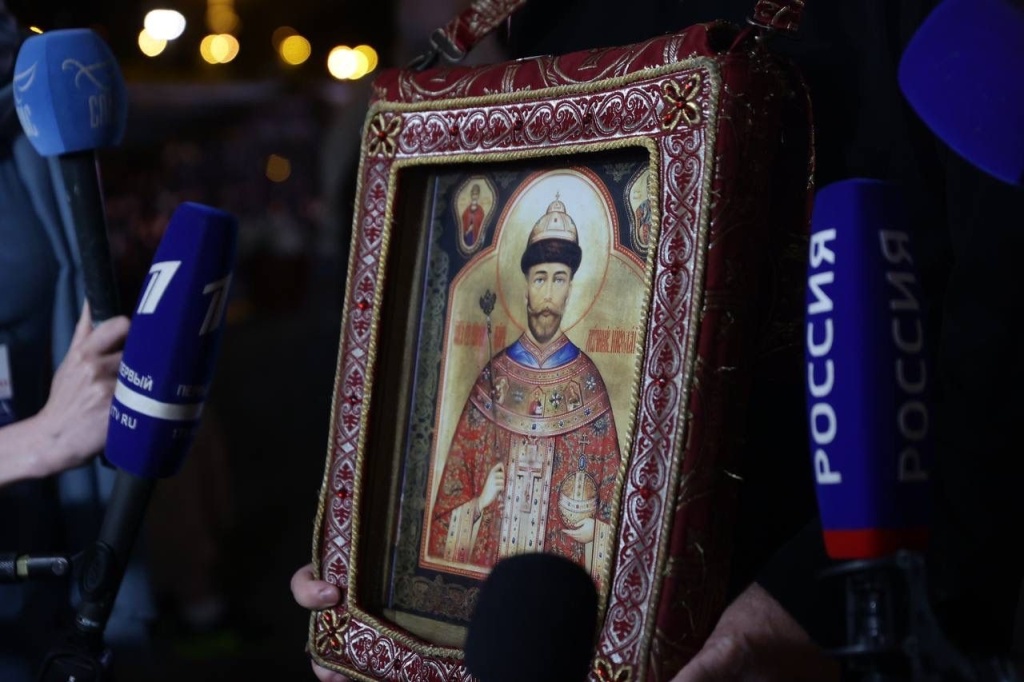
PHOTO: Alexander Chernavsky carries the miraculous Myrrh-Streaming Icon of Tsar-Martyr Nicholas II, during the 21-km Cross Procession from the Church on the Blood in Ekaterinburg to the Monastery of the Holy Royal Martyrs at Ganina Yama

The annual Cross Procession held during Tsar’s Days in Ekaterinburg on 17th July is known for many miraculous events. It was during this year’s procession, that the miraculous Myrrh-Streaming Icon of Tsar-Martyr Nicholas II, once again began to stream myrrh. The icon was brought from Moscow, by the head of the Military Orthodox Mission, Alexander Chernavsky, and this miracle was witnessed by the film crew of the Orthodox Soyuz TV channel, headed by correspondent Svetlana Ladina.

“This is the 30th annual Cross Procession in which we are taking part. The icon of the Tsar-Martyr Nicholas II has been streaming myrrh since 1998, and today, look, droplets of myrrh on the icon itself and along the frame have appeared like “diamonds”. I think the Sovereign is happy that we are here, and these “diamonds” bless all the participants in the procession. Kiss and pray for the sovereign to open our eyes and heart,” – said Alexander Chernavsky.

The icon of the Russian Emperor Nicholas II was painted in the United States of America even before the sovereign was glorified in Russia by the Moscow Patriarchate. And this event has an amazing story . . .

VIDEO: interview with Alexander Chernavsky, and coverage of the Cross Procession from the Church on the Church on the Blood in Ekaterinburg to the Monastery of the Holy Royal Martyrs at Ganina Yama

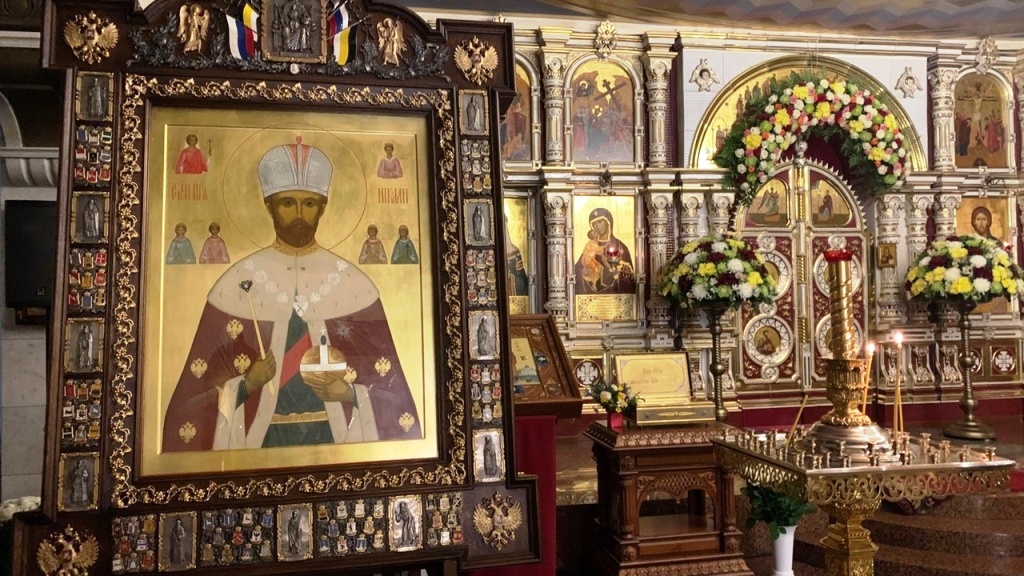
The miraculous Myrrh-Streaming Icon of Tsar-Martyr Nicholas II

The Icon of Tsar-Martyr Nicholas was commissioned by Ija Schmit (1936-2018), a Russian émigré in the United States, who used money inherited from her mother to have the icon painted in 1996.

Paul Gilbert first met Ija in 1998, when she joined his annual Romanov Tour to Russia, which that year included Moscow and Crimea. Ija was accompanied by her husband Harvey and their daughter Nina. It was during this visit that she told me about this icon, a copy of which she later gifted me.

The icon would be dedicated to the future canonization of Tsar-Martyr Nicholas in Russia[1], and in memory of her mother. After Ija’s initial inspiration to have the icon painted, she contacted iconographer Paul Tikhomirov, himself a Russian immigrant, to see if he was interested in her project. Tikhomirov’s response was, “I will make the icon shine!” They decided to depict Nicholas II in coronation robes [1996 was the 100th anniversary of his coronation in Moscow], with St. Nicholas, his patron saint, and St. Job, on whose feast day Nicholas was born, in the upper right and left hand corners. Below the figures would be printed in Russian, “This Holy Icon is for the Canonization of the Tsar-Martyr in Russia.”

Ija received the finished icon on 12th May 1996 and then traveled to Texas, where it was blessed by Bishop Constantine (Yesensky), an old family friend, who had served as Bishop of Great Britain. The icon, however, was not intended solely for family veneration. Ija and her husband, Harvey Schmit, had already arranged to have paper copies of the icon printed to commemorate the 100th anniversary of the coronation of Tsar Nicholas II on 27th May (O.S. 14th) 1996.

Forty-four thousand copies of the icon were printed. The distribution of the icons [printed in three sizes], was handled by Ija’s own non-profit organization, the Society Honoring Russian Nobility, and income from the icons sold in the West purchased food and medicine for needy pensioners and orphans in Russia. A fourth, smaller version of the icon was printed by the thousands and given away in Russia without charge.

As word of the icon spread, Christians from Russia, Ukraine, Belarus, and even Serbia, began writing and requesting copies. The Society has met all these requests and distributed more than twenty thousand icons in Russia alone.

PHOTO: Alexander Chernavsky holding the miraculous Myrrh-Streaming Icon of Tsar-Martyr Nicholas II, at the Monastery of the Holy Royal Martyrs at Ganina Yama

On a visit to Russia in late 1996, Father Herman [Ija Schmit’s brother] presented a number of prints to Fr. Juvenaly, the priest at the St. Nicholas Almshouse in Ryazan. On 16th (O.S. 2nd) March 1998 (the anniversary of Tsar Nicholas II’ abdication and the miraculous appearance of the Reigning Icon of the Mother of God. Fr. Juvenaly blessed Dr. Oleg Belchenko with one of the prints, which the doctor took with him back to Moscow. The paper icon had been given to him in a glassfronted, three-dimensional wooden icon-case (a kiot) and Dr. Belchenko set it in a prominent place in his Moscow apartment. On 5th September, Dr. Belchenko noticed that a red spot had appeared over the right eyelid of the Tsar. The following day a second red spot appeared over the left eye. Dr. Belchenko first compared the icon with a smaller print to be sure that he had simply overlooked the distinctive marks. The smaller icon did not match. Dr. Belchenko then called Sretensky Monastery of the Meeting of the Lord to ask what he should do. The monks asked him to bring the icon of Tsar Nicholas to the monastery the following morning. Dr.Belchenko arrived early and stood through the liturgy holding the icon in a plastic bag at his side. At the end of the liturgy a moleben and blessing of the waters was held. The officiating priest recognized Dr. Belchenko, and knowing that he had come with the icon, had the choir sing a troparion for Tsar-Martyr Nicholas. Following the troparion, Dr. Belchenko noticed one of the parishioners staring at him. Finally, the man approached and asked, “What is that fragrance?” Dr. Belchenko replied: “You are probably smelling incense – I am sorry, I can’t smell anything myself because I have a cold.” The man persisted: “No. I tell you, the fragrance is coming from somewhere around you… the smell is much more refined than incense.” Dr. Belchenko replied impatiently, “You should be ashamed of talking such nonsense while the service is going on!” The man moved away embarrassed, but within a few moments other worshippers filtered over, curious about the fragrance and asking what was in the package. “Nothing, only an icon,” he replied. “Show it to us.” As Dr. Belchenko opened the package and took out the icon, the remarkable scent filled the church.

The icon of Tsar Nicholas II was displayed for veneration in the monastery church for three weeks. After Dr. Belchenko took it home, the fragrance continued to a lesser degree, and as word began to spread, Muscovites increasingly asked to come to his apartment to venerate the icon. Dr. Belchenko felt that his home was too small to accommodate many visitors, so he asked an Orthodox friend, Alla Dyakova, to keep the icon in her flat, where those who wished could venerate it. When asked how he was able relinquish such a treasure, Dr. Belchenko answered, “The icon is not mine. It belongs to all Russians.”

On 19th October, Alla Dyakova and Fr. Peter Vlashchenko, a married priest from the Ivanovo region, took the icon to Elder Kyril of St. Sergius Lavra, who was in Peredelkino, outside Moscow. Elder Kyril venerated the icon and blessed Fr. Peter and Alla with the words, “Go. Take the icon to whomever asks for it.”

On 1st November, the icon was brought to the Martha-Mary Convent in Moscow, founded by Grand Duchess Elizabeth Feodorovna, the sister- in-law of Tsar Nicholas II and herself a new-martyr. The day not only marked the birthday of Elizabeth, but the anniversary of Tsar Nicholas’ assuming the throne at his father’s death in 1894. The icon of Tsar Nicholas was placed on the analogion next to an icon of Grand Duchess Elizabeth. Throughout the Divine Liturgy the icon of the Tsar poured forth waves of fragrance, filling the chapel.

It is worth mentioning that the popular veneration of the Tsar-Martyr played an important role in the canonization of the Imperial Family at the Jubilee Bishops’ Council of the Russian Orthodox Church in 2000 among the Holy New Martyrs and Confessors of Russia.

In August 2000, the Russian Church met at a synod in the Christ the Saviour Cathedral, Moscow. Amongst the things discussed was the issue of canonization. The eagerly-awaited news finally escaped the cathedral’s walls to the faithful gathered outside: Tsar Nicholas II and his family were now recognized as Saints! The date of their martyrdom was now recorded in Orthodox calendars around the world as their feast day. It is certain that influential in this decision were two paper icons of the martyrs, both of which exuded sweet-smelling myrrh and so revealed those Saints to be themselves “a sweet aroma of Christ unto God” (2 Cor 2:15).

The keeper of the miraculous image, the Moscow surgeon Oleg Ivanovich Belchenko, has travelled around Russia for many years, bringing the icon to to churches and monasteries arousing veneration of the Holy Royal Martyrs wherever it went through its aromatic myrrh. Many Orthodox Christians believe that their prayers have been answered by God through the intercession of the Tsar and his family.

Lately, due to his age, Oleg has handed over this honourary mission to Alexander Fedorovich Chernavsky, a publicist, head of the Orthodox Mission for the Revival of the Spiritual Values of the Russian People. The Myrrh-Streaming Icon of Tsar Nicholas II, appears with the same unpretentious simplicity with which the late Tsar laid down his throne and bore his final months of house arrest before his death and martyrdom.

Holy Tsar Martyr Nicholas II, Pray to God for Us! 

NOTES:

[1] The desire of many Russian Orthodox Christians for the canonization of Tsar Nicholas and his family does not stem from a belief that their personal lives were blameless, although from historical accounts and the family’s own letters it is obvious that they were Christians of great integrity. The widespread desire for the family’s canonization is based on the fact that Tsar Nicholas and his family were murdered as a result of his position as the sacramentally anointed Orthodox monarch of Russia.

© Paul Gilbert. 21 July 2022
Night Liturgy at Tsarskoye Selo, 16/17 July 2022
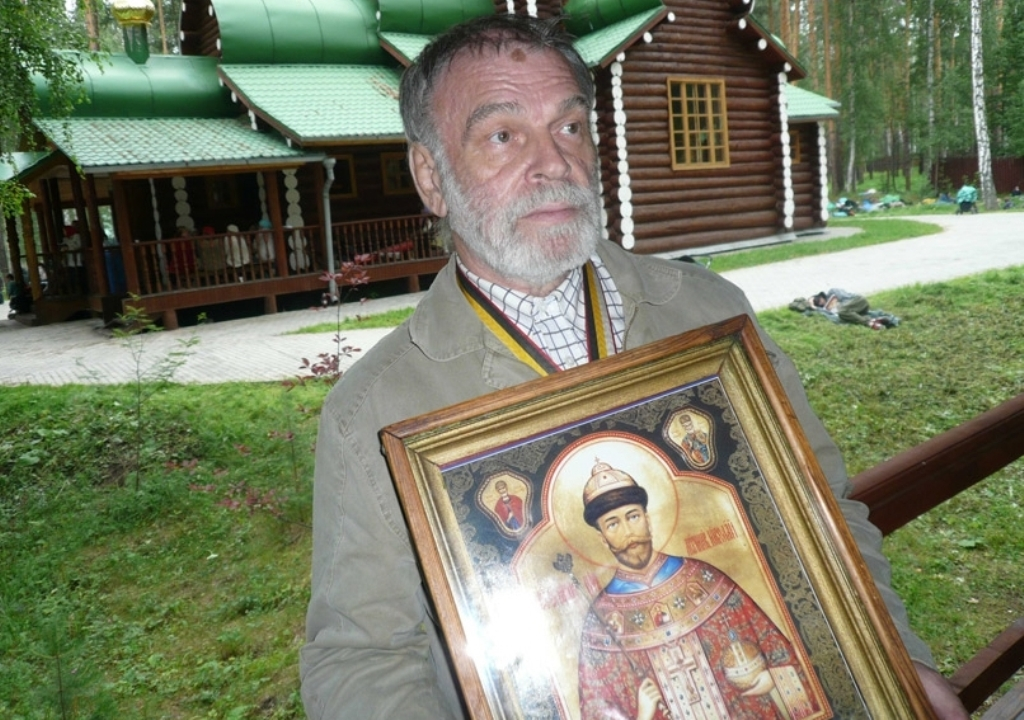
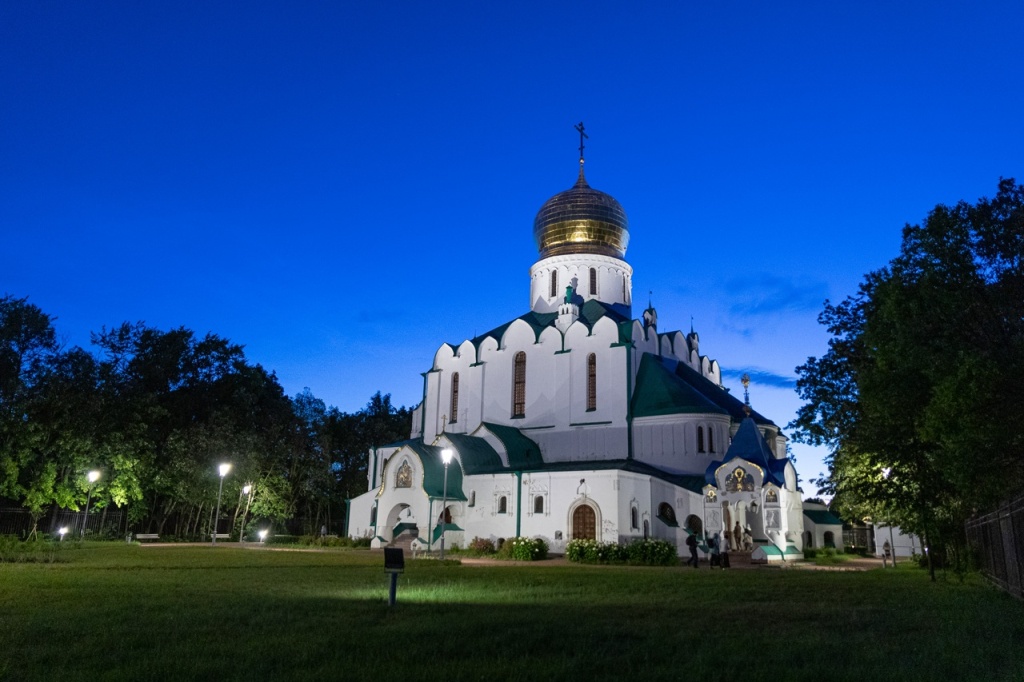
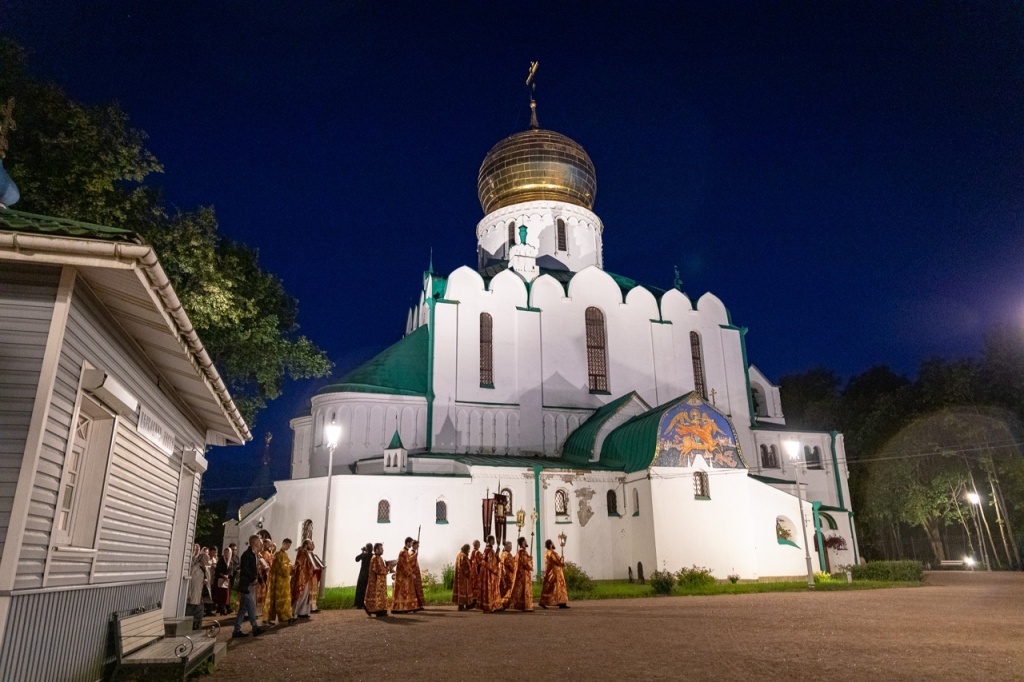
PHOTO: the Feodorovsky Sovereign Cathedral at Tsarskoye Selo

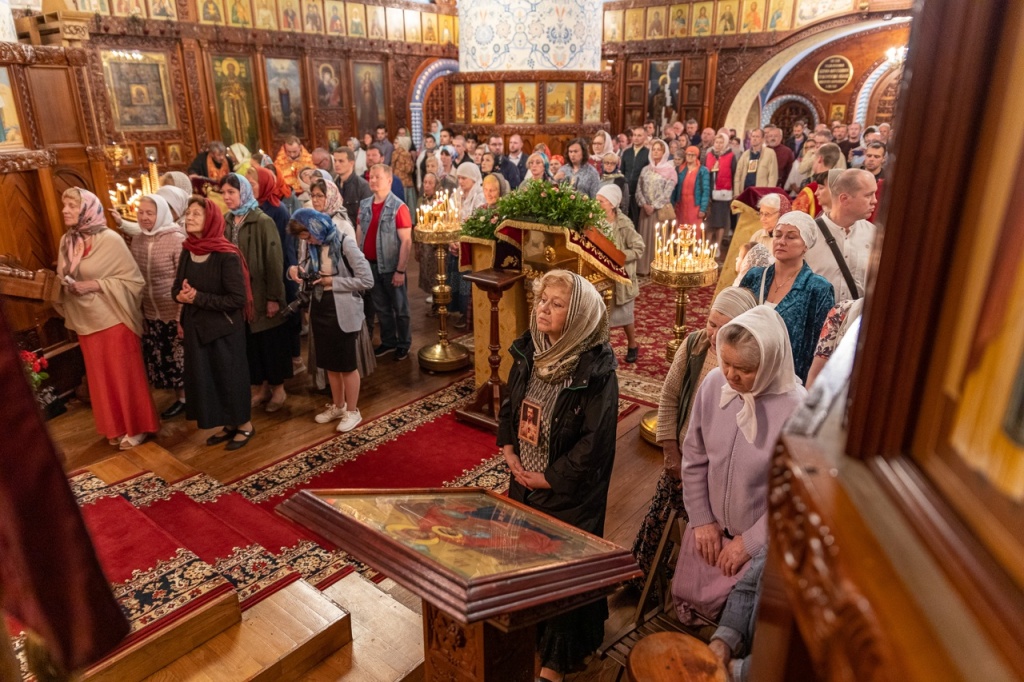
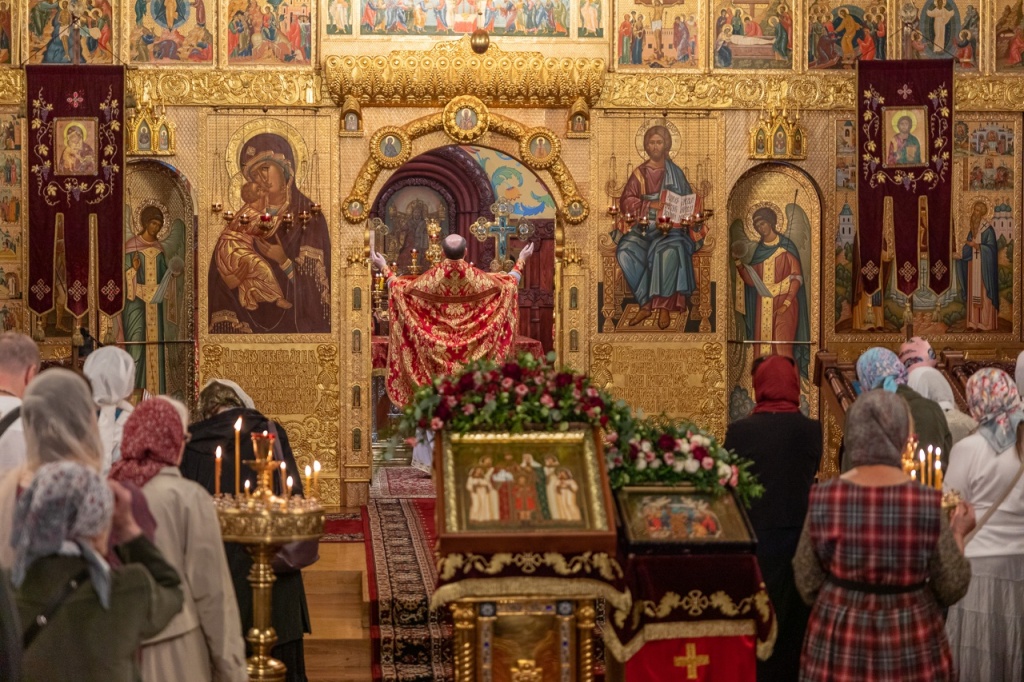
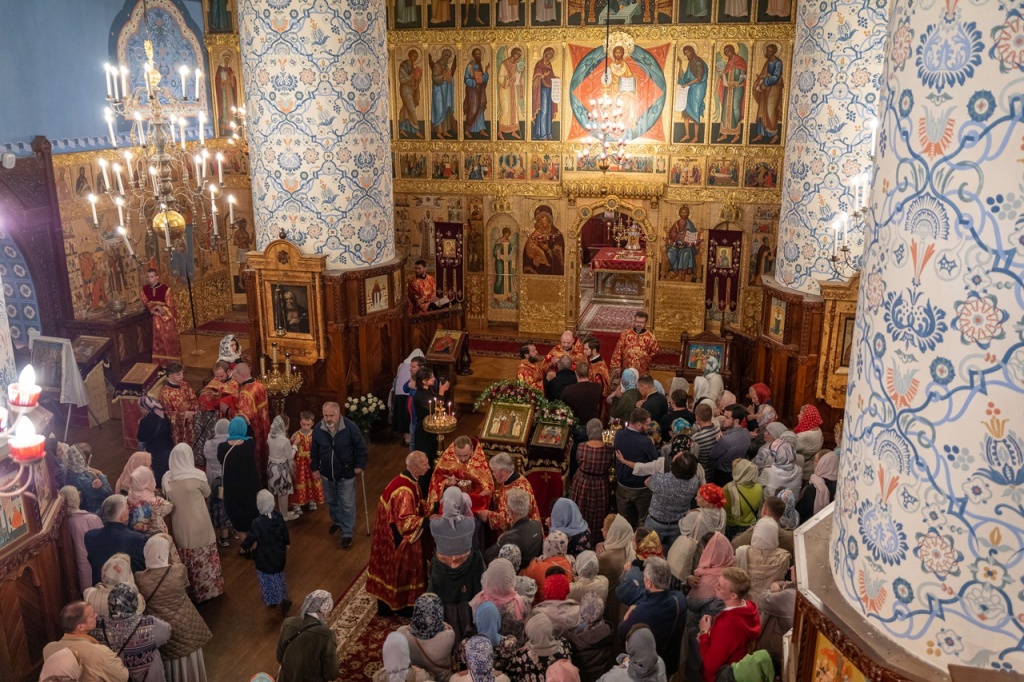
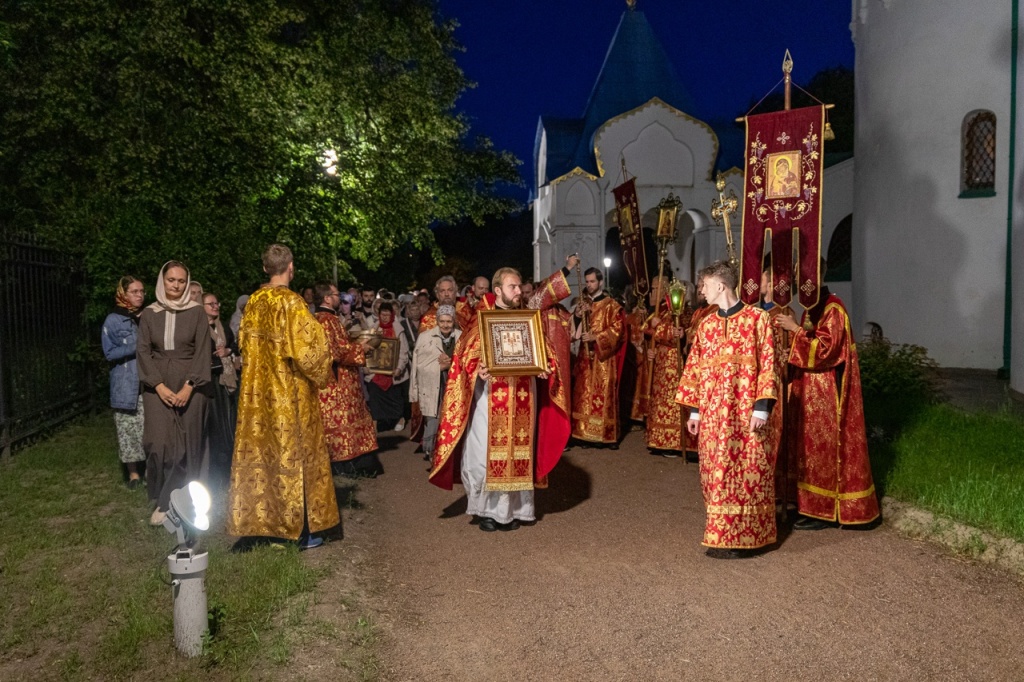
On the night of 16/17 July, a solemn Divine Liturgy was held in the Feodorovsky Sovereign Cathedral at Tsarskoye Selo, in memory of the Holy Royal Martyrs who were murdered that same date in 1918, in the Ural city of Ekaterinburg.

A large number of worshipers gathered for the Divine Litury, led by the rector of the cathedral, Father Herman Ranne, co-served by the clergy of the cathedral.

Every year on this day, people from Pushkin [Tsarskoye Selo], St. Petersburg and other towns, come to the Feodorovsky Sovereign Cathedral to prayerfully honour the memory of the last Russian emperor and his family.

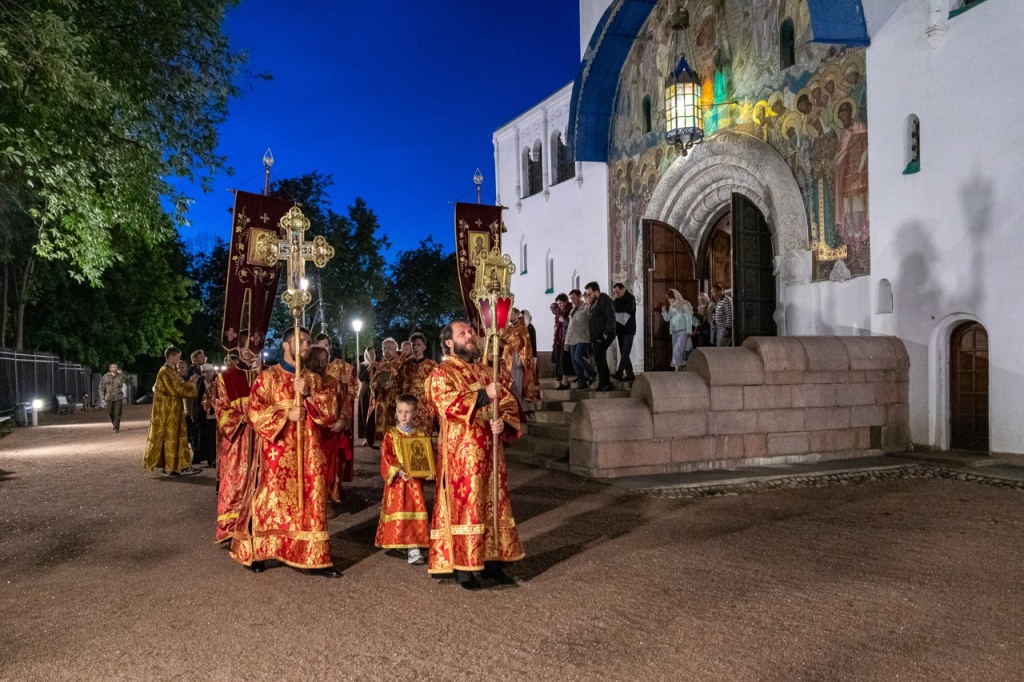
Following the Divine Liturgy, a Cross Procession was held around the cathedral.

A brief history of the Feodorovsky Sovereign Cathedral

On 2nd September (O.S. 20th August) 1909, Sovereign Emperor Nicholas II laid the first foundation stone for the Feodorovsky Sovereign Cathedral in Tsarskoye Selo, which became the house church of the Imperial Family, while they were in residence in the nearby Alexander Palace.

A solemn Divine Liturgy was performed by His Grace Theophan, Bishop of Yamburg (1872-1940), attended by the Emperor and members of his family. The cathedral was built in the old Russian style. Three years later, on the same day in 1912, the Feodorovsky Sovereign Cathedral was consecrated.

The Cave Church, situated in the Lower Church, where the Imperial Family came to pray, was consecrated in memory of St. Seraphim of Sarov (there was a special “royal room” in the church), and the upper church was consecrated in memory of the Feodorovskaya Icon of the Mother of God, the patron icon of the Romanov family. During the days of Great Lent, the Emperor remained to pray in the church until late at night.

After the revolution, the cathedral was closed, it was badly damaged during the Great Patriotic War. In 1991 the cathedral was transferred to the Russian Orthodox Church, restoration of the Cathedral lasted nearly 20 years.. Russia’s first monument to Nicholas II was established on the grounds of the Feodorovsky Sovereign Cathedral in 1993.

Click HERE to view more colour photos of the Feodorovsky Sovereign Cathedral, during a visit by a modern-day group of Cossacks in January 2020

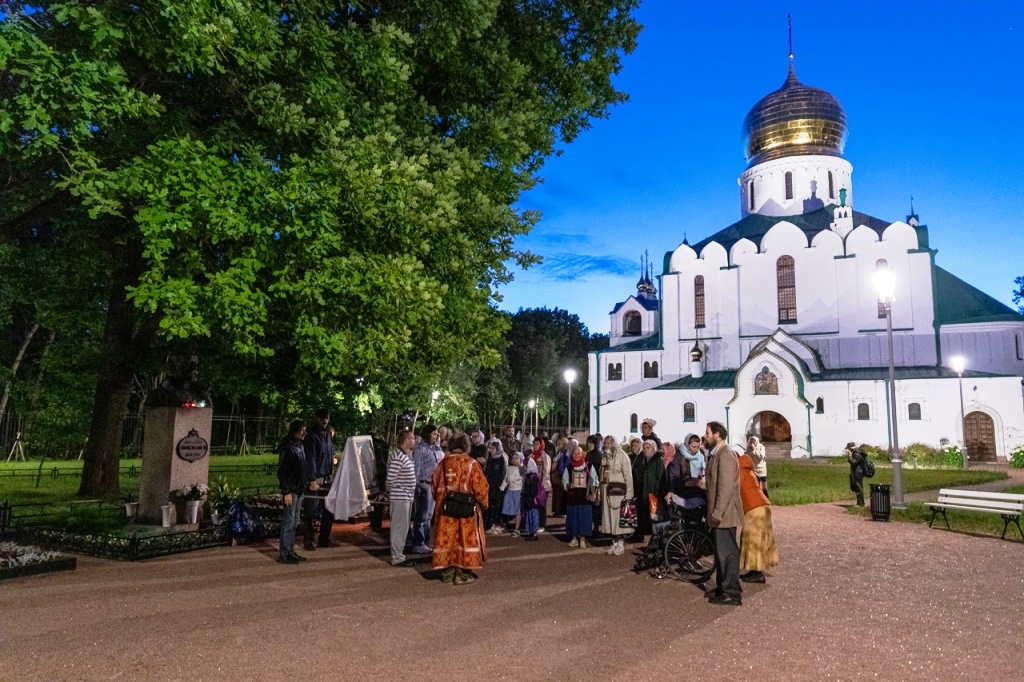
PHOTO: worshipers gather at the monument to Tsar-Martyr Nicholas II, located in the garden behind the Feodorovsky Sovereign Cathedral

First monument to Nicholas II in Post-Soviet Russia

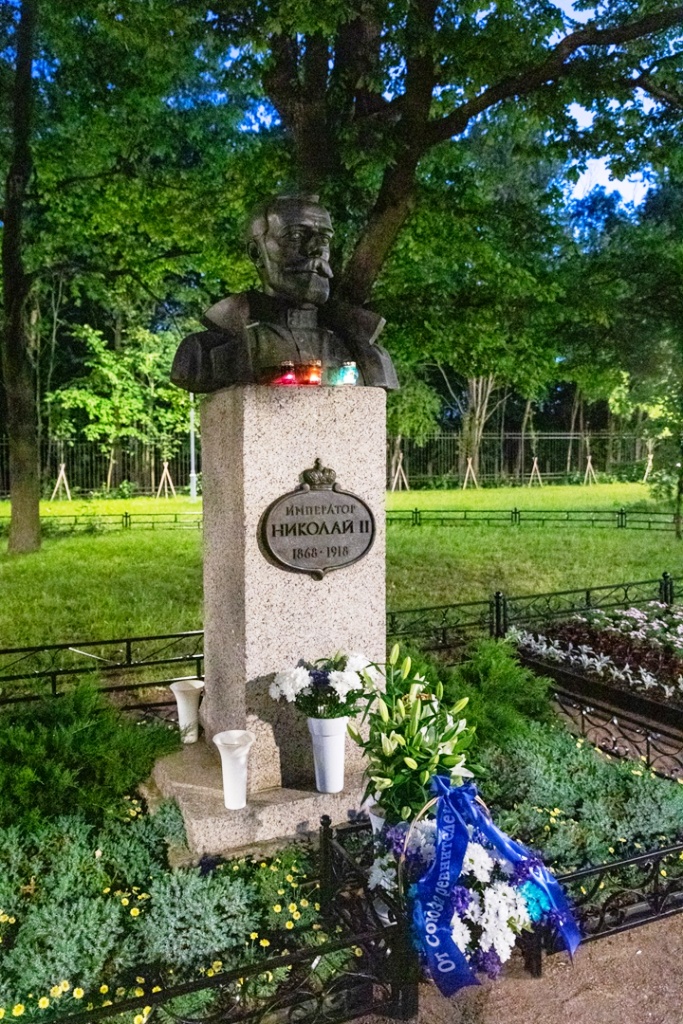
Situated in the garden behind the Feodorovsky Sovereign Cathedral at Tsarskoye Selo, is the monument to Tsar-Martyr Nicholas II, created by the St. Petersburg sculptor Victor Vladimirovich Zaiko (born 1944).

Erected and consecrated on 17th July 1993, it was the first monument to Nicholas II to be erected in Post-Soviet Russia.

The monument stands in front of a small group of oak trees, seen in the background, which were planted by Nicholas II and his family on 4 May (O.S. 21 April) 1913. Of the seven trees planted, only four have survived to the present day.

© Paul Gilbert. 21 July 2022
Divine Liturgy 16th July 2022, Church on the Blood, Ekaterinburg

On 16/17 July – the eve marking the 104th anniversary of the death and martyrdom of Emperor Nicholas II, his family and four faithful retainers, commemorative services were held in the Ural city of Ekaterinburg and in the Monastery of the Holy Royal Martyrs at Ganina Yama.

PHOTO: icon of the Holy Tsar-Martyr Nicholas II, Lower Church

PHOTO: pilgrims attend vespers in the Lower Church

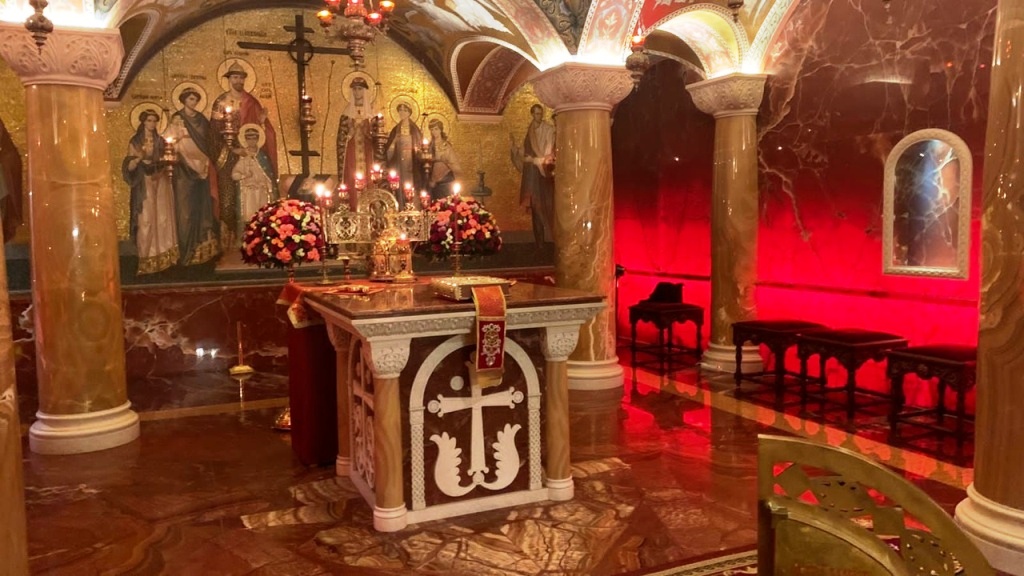
PHOTO: view of the Imperial Room (above and below), Lower Church

On the afternoon of 16th July, small vespers with an akathist to the holy Royal Passion-Bearers were performed by the archpastors of the Russian Orthodox Church, headed by Metropolitan Vincent of Tashkent and Uzbekistan, in the lower church of the Church on the Blood.

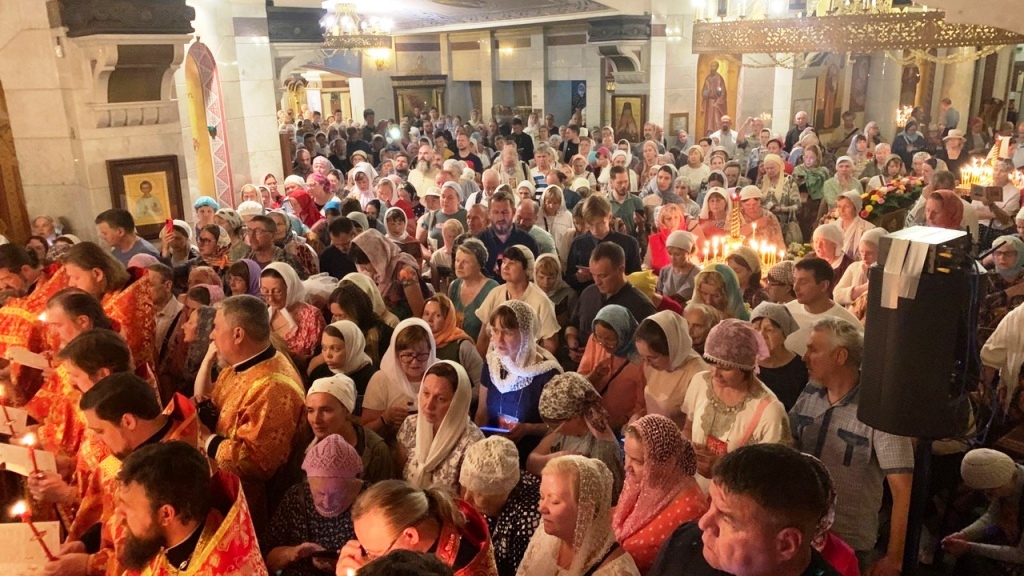
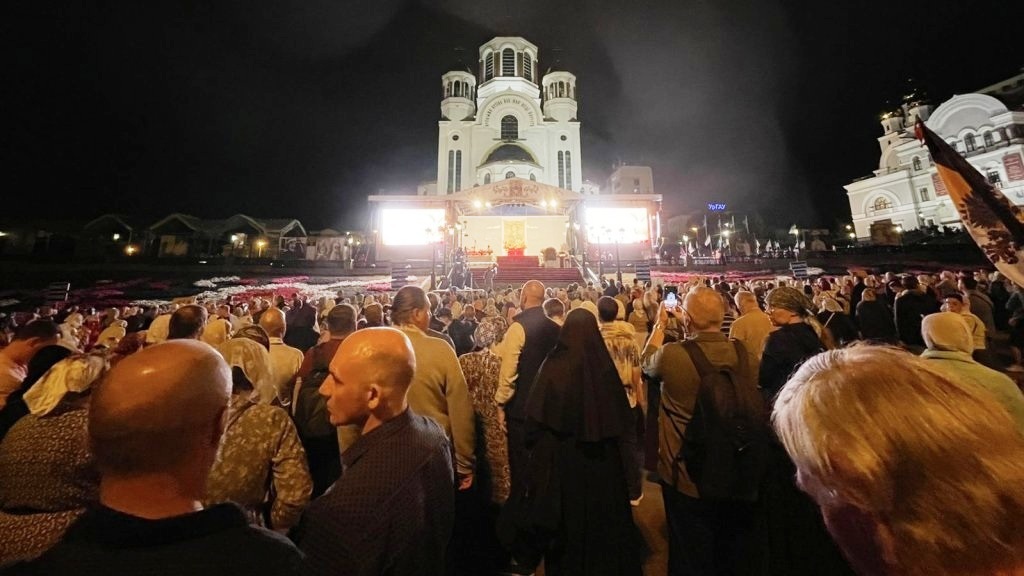
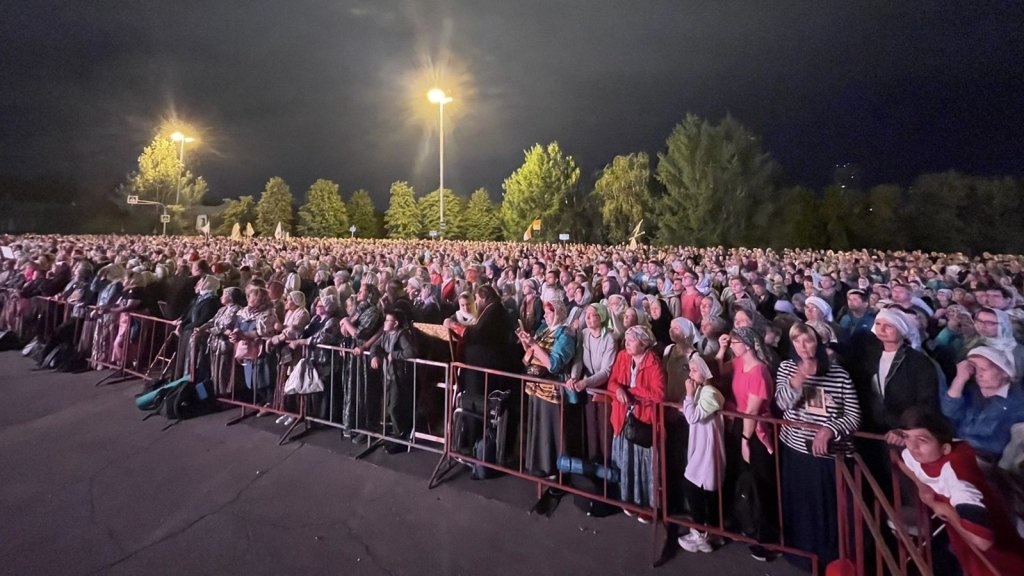
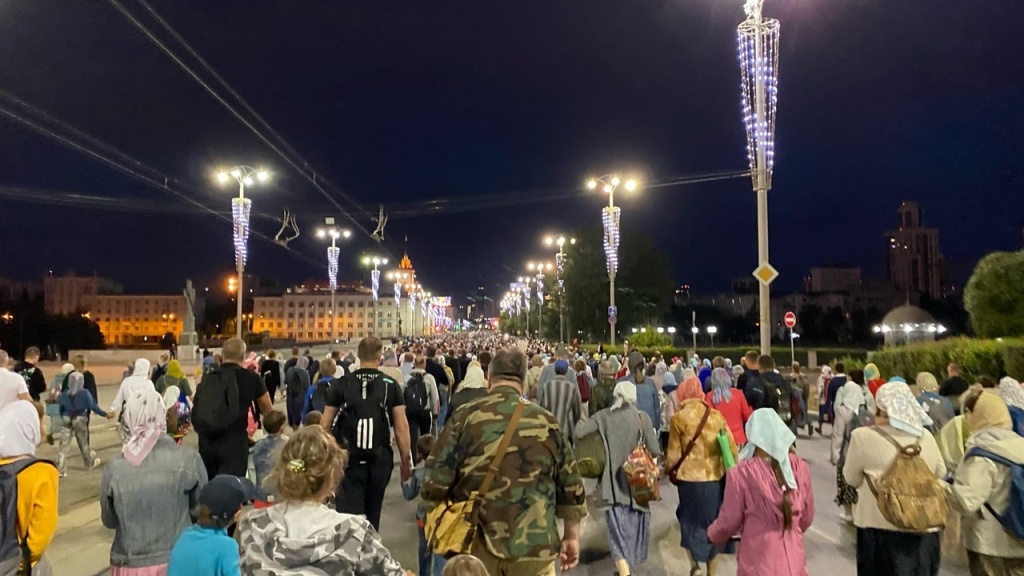
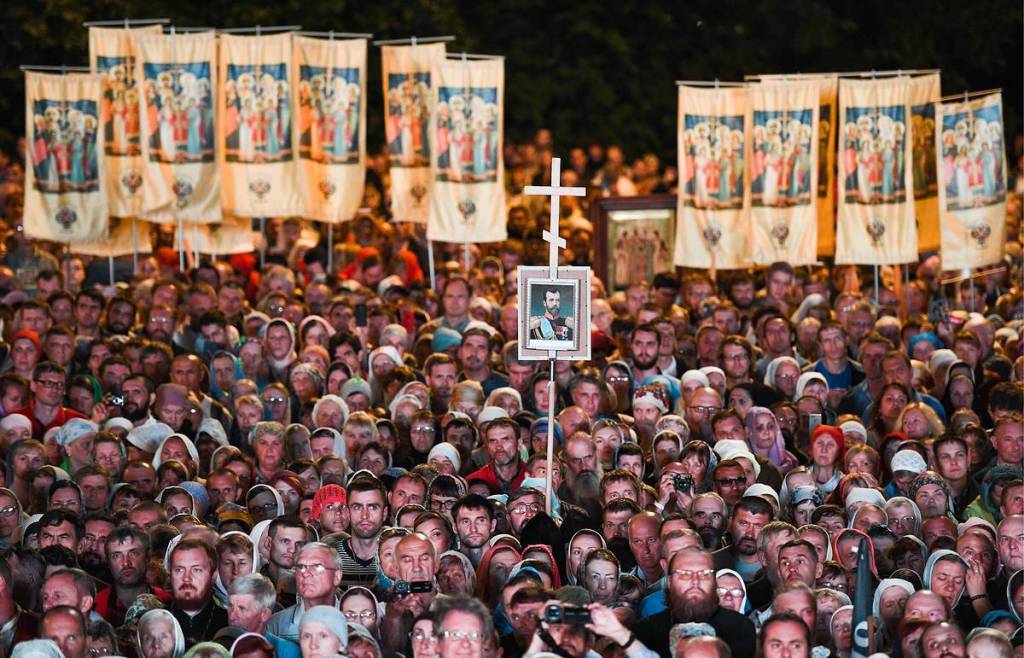
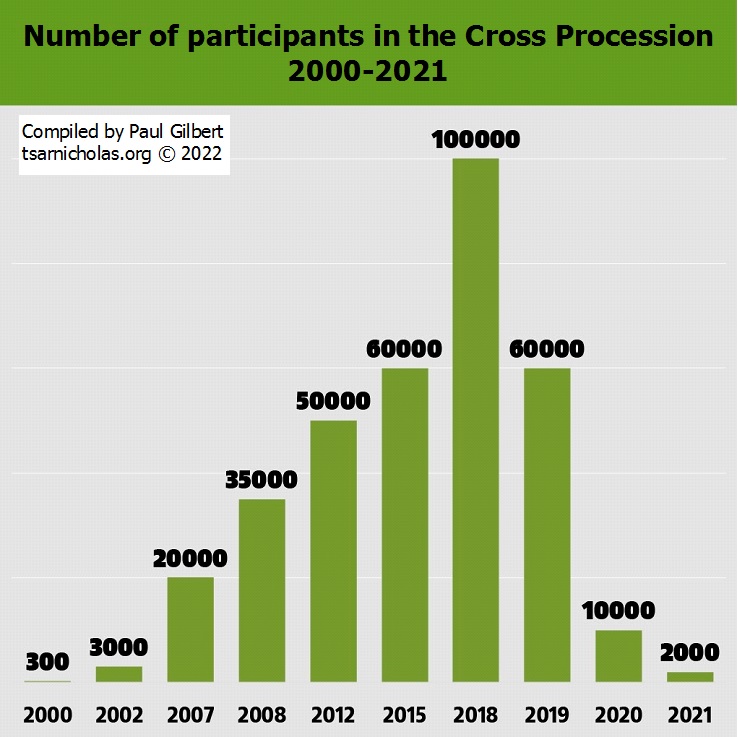
On the night of 16th July, an all night vigil was held on the square in front of the Church on the Blood. An estimated 46,000 Orthodox pilgrims took part in the Divine Liturgy, followed by a Cross Procession to the Monastery of the Holy Royal Martyrs at Ganina Yama.

The Divine Liturgy began at 23:30, and was broadcast live across Russia by the Orthodox TV channel Soyuz, and available to watch on the YouTube channel and on the website of the Soyuz TV channel.

PHOTO: pilgrims gather on the night of 16th July on the square in front of the Church on the Blood

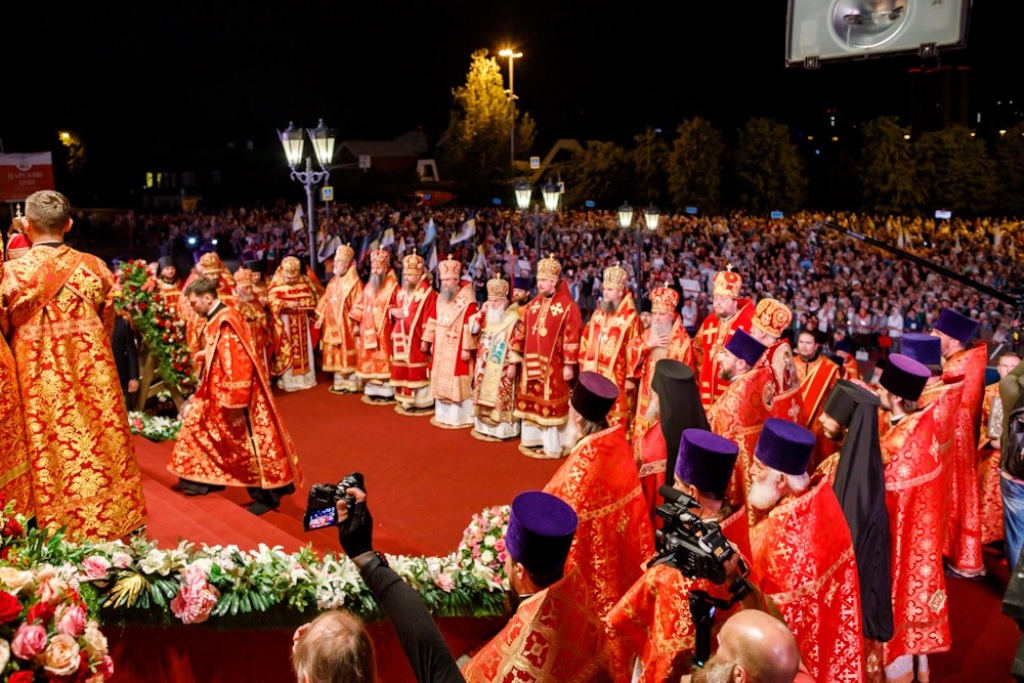
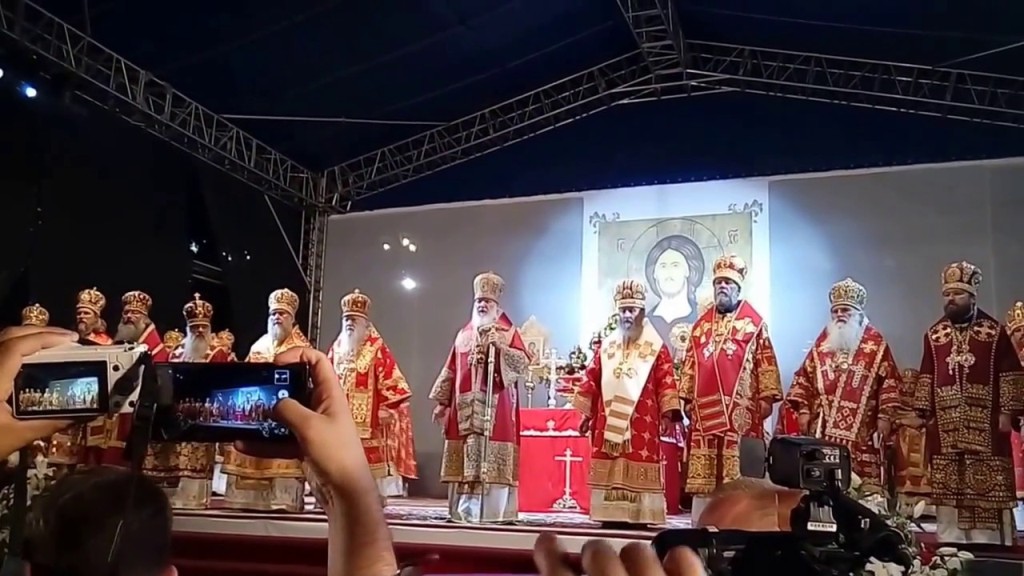
The Divine Liturgy was led by nine bishops of the Russian Orthodox Church: Metropolitan Eugene of Yekaterinburg and Verkhoturye; Metropolitan Vikenty of Tashkent and Uzbekistan; Metropolitan Alexy of Chelyabinsk and Mias; Archbishop Nikolay of Salekhard and Novo-Urengoysk; Bishop Feodosy of Isikul and Russko-Polyansk, Bishop Theodosius of Nizhny Tagil, Bishop Methodius of Kamensk and Kamyshlov, Bishop Vladimir of Shadrinsk and Dalmatov, Bishop Vikenty of Zlatoust and Satka. The archpastors were co-served by the clergy of the Yekaterinburg Diocese.

Special guests at this years’ Divine Liturgy included: governor of the Sverdlovsk region Yevgeny Vladimirovich Kuyvashev, and historian and writer Pyotr Valentinovich Multatuli, the great-grandson of Ivan Kharitonov (1872-1918), who served as the Head Cook of the Imperial family. 

“I consider the story of the murder of Emperor Nicholas II and his family in Ekaterinburg, an important part of Ural history, Ural self-consciousness – this tragic page in history will forever remain with us, many future generations will have to remember this and repent of this sin,” – said Kuyvashev.

PHOTO: the miraculous Myrrh-Streaming Icon of Tsar-Martyr Nicholas II

PHOTO: the Divine Liturgy was led by nine bishops of the Russian Orthodox Church

The expedition commander of the International Space Station, Oleg Artemiev, delivered a message of congratulation to those participanting in Tsar’s Days: “I want to convey to the parishioners and pilgrims of the Church on the Blood my warmest congratulations on the Tsar’s Days, and to all Ekaterinburg residents on the upcoming 300th anniversary of the city of St. Catherine, which, God willing, we will celebrate together in 2023″.

PHOTO: an estimated 46,000 pilgrims took part in this year’s 21-km Cross Procession from the Church on the Blood in Ekaterinburg to the Monastery of the Holy Royal Martytrs at Ganina Yama

PHOTO: the procession nears the Monastery of the Holy Royal Martyrs at Ganina Yama

Following the Divine Liturgy, at about three o’clock in the morning, the combined choirs of the Ekaterinburg Diocese began to sing God Save the Tsar!, they were enthusiastically joined by the tens of thousands of pilgrims on the square.

It was at this point, that the pilgrims assembled for the 21-km [13 miles] Cross Procession from the Church on the Blood to the Monastery of the Holy Royal Martyrs at Ganina Yama. The route of the this years procession remained unchanged from previous years, passing along the same route that the regicides transported the bodies of members of the Imperial family in 1918.

Foreign vistors from the USA, Germany, Serbia, Ukraine, Moldova, the Baltic countries, Uzbekistan and other countries also took part in this year’s Cross Procession. The column of pilgrims stretched along the road for kilometers. The procession was surrounded by police officers, 12 streets in the city center were closed. The pilgrims were accompanied by 10 mobile help groups of the Orthodox Mercy Service and volunteers of the Tsar’s Days.
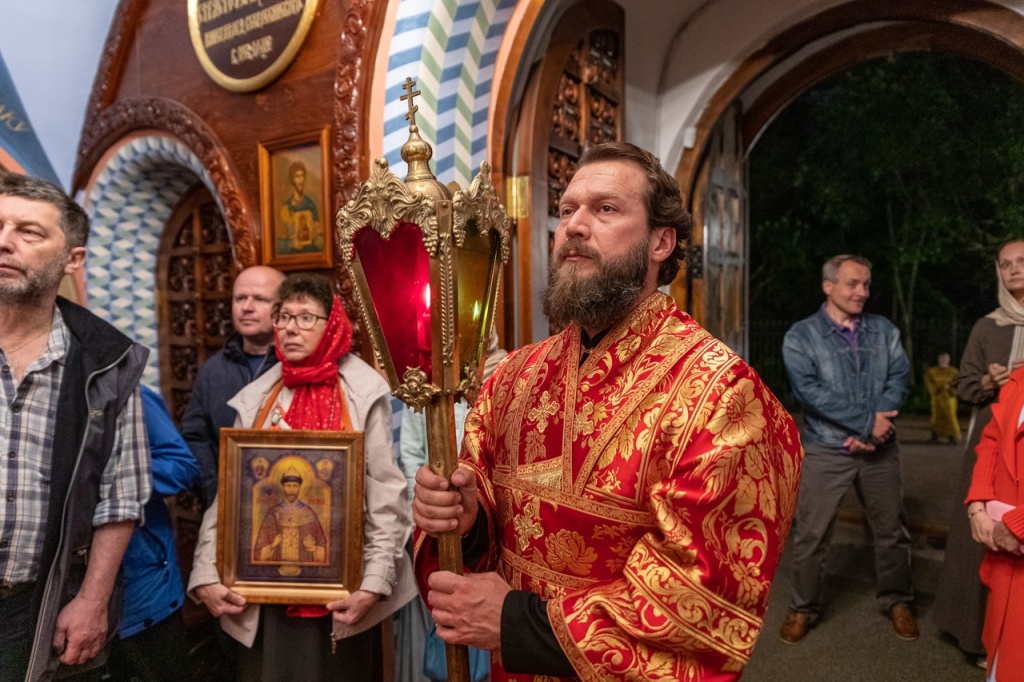
PHOTO: pilgrims arriving at the Monastery of the Holy Royal Martyrs

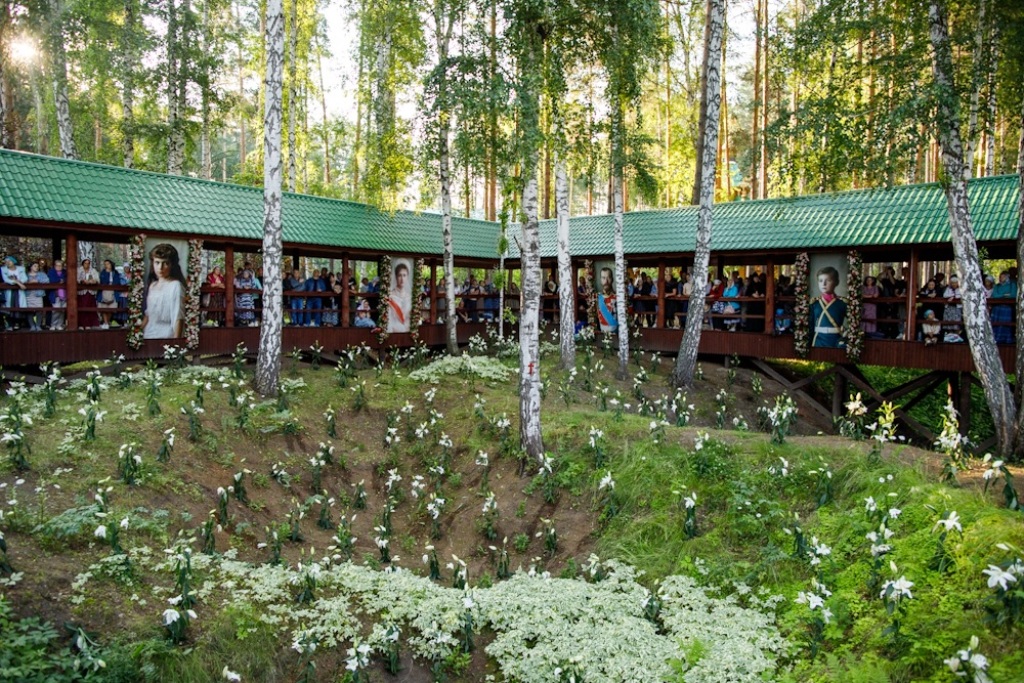
PHOTO: pilgrims line the the wooden causeway which surrounds the abandoned mine shaft at Ganina Yama, reflecting on the crime which took place here on 17th July 1918

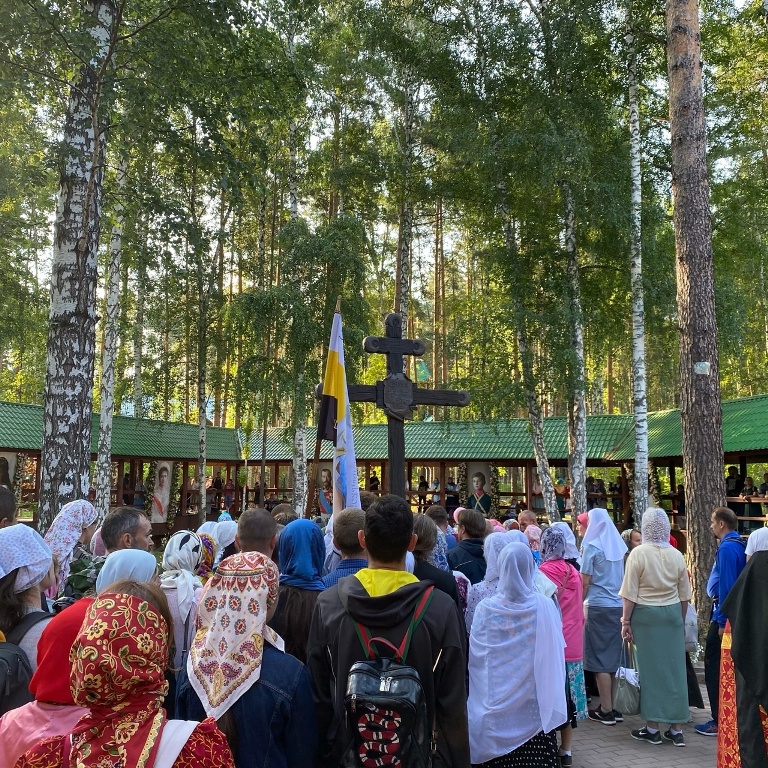
PHOTO: pilgrims pray at a tall Orthodox cross, which marks the edge of the mine shaft, where the regicides threw the remains of Tsar Nicholas II and his family

The first pilgrims of the Cross Procession began to arrive at the Monastery of the Holy Royal Martyrs at about 7:00 a.m. The brethren of the monastery greeted the pilgrims with the ringing of bells. Upon arrival at the monastery, a Divine Liturgy was performed at the tall Orthodox cross located on the edge of Mine No. 7, where the bodies of members of the Imperial family and their faithful servants were thrown by the regicides. The Divine Liturgy was led by Metropolitan Vikenty of Tashkent, Metropolitan Eugene of Yekaterinburg, Archbishop Nicholas of Salekhard, Bishop Theodosius of Isilkul, and Bishop Theodosius of Nizhny Tagil. At the end of the service, Bishop Vincent and Bishop Eugene heartily thanked all the participants in the procession for their spiritual achievement.

After the prayer service, all the pilgrims were offered a hearty meal of buckwheat porridge, bread and tea, prepared by volunteers in the field kitchen. Drinking water was freely available for everyone, and a first-aid post was available. Many pilgrims sought rest under the shade of trees. A fleet of 17 buses provided by the UMMC and the regional Ministry of Transport, offered FREE transport for pilgrims to Ekaterinburg and Sredneuralsk.

© 19 July 2022. Paul Gilbert

***

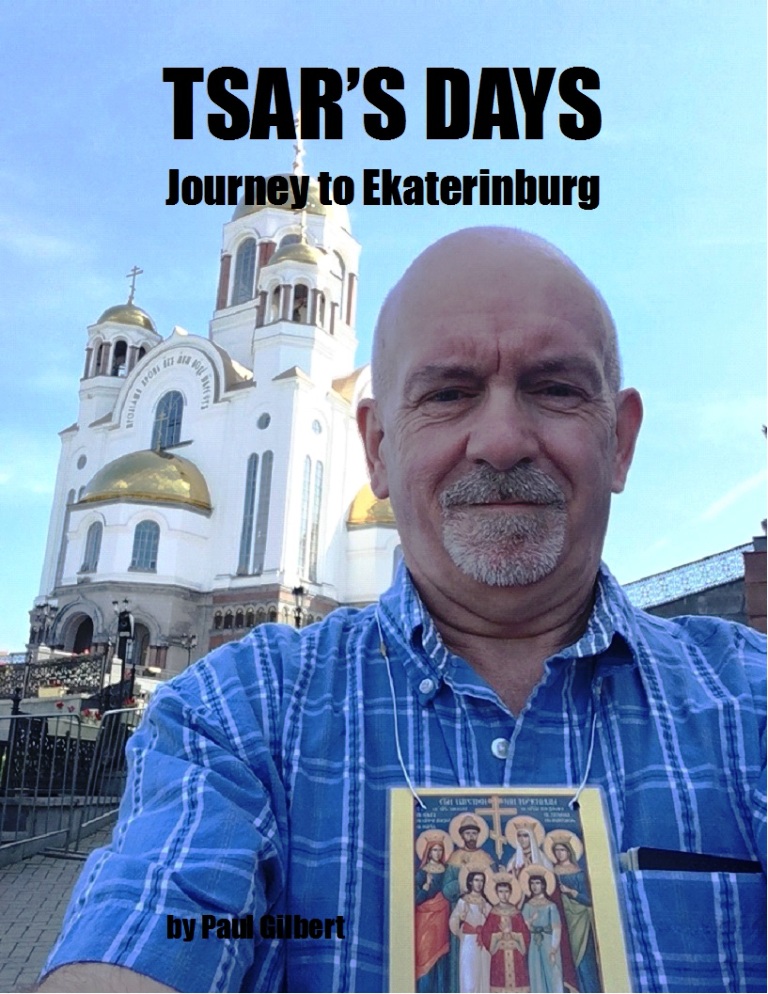
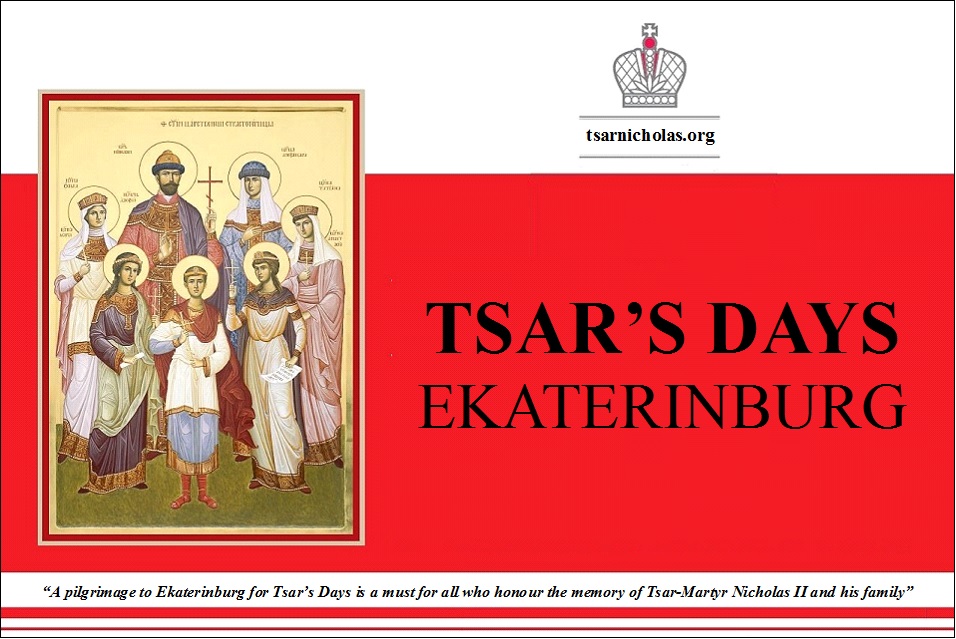
TSAR’S DAYS
Journey to Ekaterinburg
by Paul Gilbert

BOOK DESCRIPTION

Hardcover and Paperback editions. 152 pages + Richly illustrated with nearly 200 COLOUR PHOTOS, 65 of which were taken by the author

CLICK ON THE LINK BELOW TO ORDER FROM AMAZON

HARD COVER EDITION @ $40 USD

PAPERBACK EDITION @ $25 USD

Read all about my journey to Ekaterinburg – my 3rd visit to the Urals – in July 2018, to take part in the events marking the 100th anniversary of the deaths and martyrdom of Nicholas II and his family.

On 17th July 1998, independent researcher and writer Paul Gilbert travelled to St. Petersburg, for the interment of Emperor Nicholas II and his family. Twenty years later to the day, he journeyed to Ekaterinburg, to take part in the events marking the 100th anniversary of the Tsar’s death and martyrdom.

In his own words and photographs, the author shares his experiences and impressions of this historic event, which include visits to the Church on the Blood, Ganina Yama, Porosenkov Log, the Patriarchal Liturgy, exhibitions, and much more.

In addition are 24 illustrated news articles about events leading up to Tsar’s Days in the Urals, from 1st to 31st July 2018.

Gilbert’s solemn journey to the Urals allowed him to experience history in the making, and to honour the memory of the Holy Royal Martyrs, a century after their death and martyrdom.”

What is Tsar’s Days?

Tsar’s Days before the 1917 Revolution

This year marks the 30th anniversary of Tsar’s Days in Ekaterinburg. Tsar’s Days in Russia actually began during the Tsarist era, however, it was banned during the Soviet years. It was restored in Ekaterinburg in 2002, to mark the deaths and martyrdom of Nicholas II and his family on 17th July 1918.

The Tsar’s Days were divided into two groups – solemn and high solemn days.

The first group included the coronation, accession to the throne, birthdays, as well as the namesake [see below] of the emperor, empress-mother, empress-wife, and the heir to the throne. The second group included birthdays and namesakes of other members of the Imperial Family.

  • A namesake consists of celebrating a day of the year that is associated with one’s given name. The celebration is similar to a birthday. Russians celebrate name days [именины in Russian] separately from birthdays. Such a celebration begins with attendance at the divine services marking that day [in the Russian tradition, the All-Night Vigil and Divine Liturgy], and usually with a festive party thereafter. Before the October Revolution of 1917, Russians regarded name days as important as, or more important than, the celebration of birthdays, based on the rationale that one’s baptism is the event by which people become “born anew” in Christ. The Russian Imperial family followed a tradition of giving name-day gifts, such as a diamond or a pearl.

On high solemn days, special prayers were held in churches: on birthdays, a general thanksgiving service was performed, and on the day of the namesake, a prayer service to the saint of the same name [i.e. Nicholas II + Saint Nicholas of Myra]. On the day of the accession to the throne of the sovereign-emperor and his coronation, prayers were served for a special rite.

The solemn days, were postponed until the following Sunday. If the solemn day fell on the first week of Great Lent , it was postponed to the Feast of the Triumph of Orthodoxy. If it fell during Holy Week (the last week of Great Lent) or the first day of the celebration of Easter, the solemn day was postponed to Monday of Bright Week.

On 7th March 1917, the Holy Synod, in response to the February Revolution, began to call the “reigning” House of Romanov in the past tense and abolished “Tsar’s Days”. The corresponding decree of the Provisional Government appeared on 16th March of the same year.

Below, is a list of the four high solemn days celebrated for Nicholas II in 1913 [dates are noted in the Old Style Julian Calendar]:

May 6 – Birth of Sovereign Emperor Nicholas Alexandrovich ;
May 14 – Sacred Crowning of Their Imperial Majesties;
October 20 – Accession to the throne of Sovereign Emperor Nicholas Alexandrovich;
December 6 – Namesake of Sovereign Emperor Nicholas Alexandrovich.

Tsar’s Days in Post-Soviet Russia

In the 21st century, Tsar Days have taken on a whole new meaning. The annual holidays are held in mid-July in the Ekaterinburg diocese, during which divine services are held, a cross procession in memory of the death and martyrdom of Emperor Nicholas II and his family, as well as a festival of Orthodox culture, including exhibitions and other social events.

The name is taken from the pre-revolutionary Tsar’s Days, timed to coincide with the anniversaries of solemn events in the lives of members of the Romanov Dynasty. The dates of the modern Tsar’s Days are timed to the dates of 21st July 1613 – the day of the anointing of the first tsar of the Romanov dynasty, Mikhail Fedorovich, and 17th July 1918 – the day of the brutal murders of the last Emperor of Russia Nicholas II and his family, in the Ipatiev House in Ekaterinburg and 18th July – the day of the murders of Grand Duchess Elizabeth Feodorovna, Grand Duke Sergei Mikhailovich, Princes of the Imperial Blood Ioann, Konstantin and Igor Konstantinovich, Prince Vladimir Paley (son of Grand Duke Paul Alexandrovich) in Alapaevsk.

Events

As part of the Tsar’s Days, an all-night vigil is held in the Church on the Blood in Ekaterinburg, which includes a Divine Liturgy followed by a Cross Procession. The Tsar’s Days Festival celebrates Orthodox culture in the Ekaterinburg Diocese. Dozens of religious and secular public events dedicated to the tsarist theme are held, including exhibitions, concerts, conferences and other events.

Some of the city’s museums and churches become venues for exhibitions dedicated to Emperor Nicholas II, his family and other members of the Romanov dynasty, who were murdered in Ekaterinburg and Alapaevsk.

The main event, for which Orthodox pilgrims come to Ekaterinburg, is the solemn divine liturgy, which takes place on the night of the murder of the Holy Royal Murders – 16/17 July, in the Church on the Blood. At the end of the Liturgy, tens of thousands of pilgrims take part in the 21 km Cross procession from the Church on the Blood in Ekaterinburg to the Monastery of the Holy Royal Martyrs in Ganina Yama.

Pilgrims from other cities in Russia organize pilgrimages from their cities to Ekaterinburg to participate in the Tsar’s Days. A growing number of Russian cities [i.e. St. Petersburg, Kazan, etc.] are today organizing their own Tsar’s Days events, but on a much smaller scale than that of Ekaterinburg.

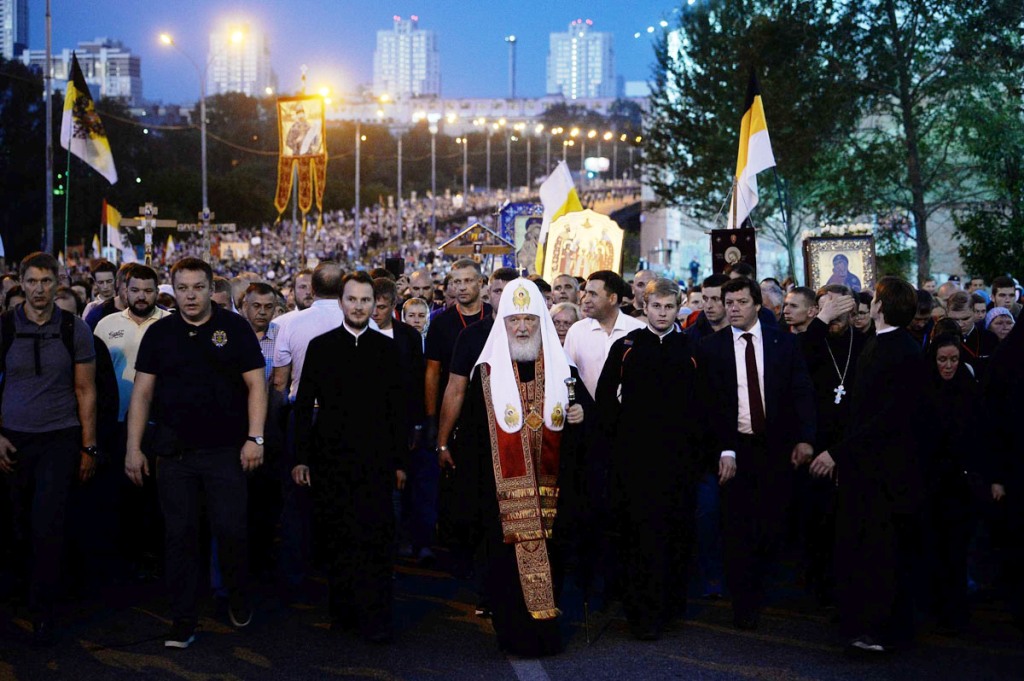
PHOTO: His Holiness Patriarch Kirill delivers a Divine Liturgy outside the Church on the Blood on the night of 16/17 July 2018 (above); His Holiness Patriarch Kirill leads the 21 km Cross Procession from the Church on the Blood in Ekaterinburg to the Monastery of the Holy Royal Martyrs in Ganina Yama (below)

100th anniversary of the death of members of the Romanov family

In 2018, the Tsar’s days in the Ekaterinburg Diocese were timed to coincide with the 100th anniversary of the deaths and martyrdom of members of the Romanov family in Ekaterinburg and Alapaevsk. The centenary celebrations also included the XVII Tsar’s Days Festival of Orthodox Culture, a five-day visit by the head of the Russian Orthodox Church and a meeting of the Holy Synod.

The first procession in memory of the Holy Royal Martyrs, headed by Metropolitan of Ekaterinburg and Verkhoturye Kirill, took place in 2002, in which more than 2 thousand pilgrims and about 100 clerics participated. In 2012, for the first time since the construction of the Church on the Blood in Ekaterinburg, an all-night vigil and Divine Liturgy were performed in the open air.

In 2017 they estimated crowds of up to 60,000 people. In 2019, 60 thousand participated, and in 2020, 10 thousand people [due to COVID]. In addition, up to 2 thousand people gathered an alternative religious procession of the schismatic and tsarist monk Sergius (Romanov) in the Sredneuralsky Nunnery.

In 2018, more than 100,000 Orthodox Christians, monarchists, among others from across Russia and around the world took part in the Patriarchal Liturgy and procession of the cross from the Church on the Blood to the Ganina Yama.

The events marking Tsar’s Days in 2018, fell on the tail end of the 2018 Football World Cup which was held in Ekaterinburg that year. It was estimated that as many as 200,000 people flocked to the city to commemorate the 100th anniversary of the regicide, undoubtedly the largest public demonstration yet of the growing significance of the Russia’s last emperor and tsar in the cultural, historical and spiritual life of modern-day Russia.

*NOTE: due to the fact the Moscow Patriachate does not yet recognize the Ekaterinburg remains as authentic, the Cross Procession does not stop at Porosenkov Log, where the remains of the Imperial family were unearthed in two separate graves in the late 1970s and 2007 – PG

*  *  *

On 17th July 2018, independent researcher and writer Paul Gilbert travelled to Ekaterinburg, to take part in the events marking the 100th anniversary of the Tsar’s death and martyrdom.

In his own words and photographs, the author shares his experiences and impressions of this historic event, which include visits to the Church on the Blood, Ganina Yama, Porosenkov Log, the Patriarchal Liturgy, exhibitions, and much more.

Available in both hardcover and paperback editions. 152 pages. Nearly 200 COLOUR photos – many of them taken by me, during my visit to Ekaterinburg in July 2018. Click HERE to order your copy

© Paul Gilbert. 17 July 2022