Russia’s only church built in honour of Nicholas II’s Coronation
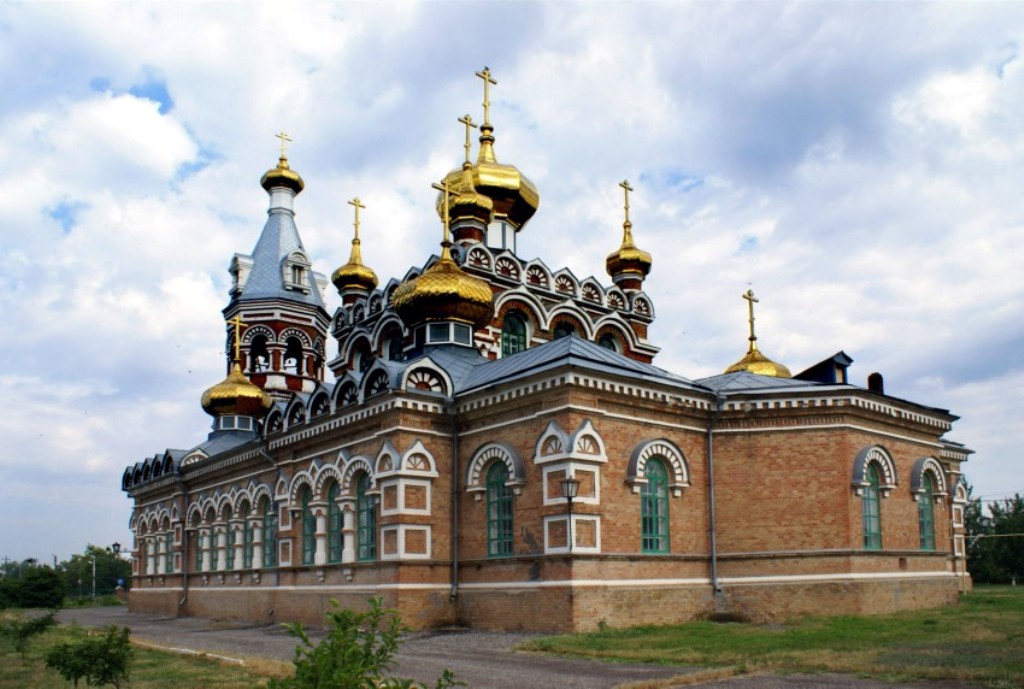
PHOTO: view of the Holy Trinity Church, built in the Neo-Russian style in the village of Bolshaya Martynovka

The beautiful Holy Trinity Church, in the village of Bolshaya Martynovka, Rostov Oblast, was built in the Neo-Russian style[1], it is the only church in Russia constructed in honour of the Coronation of Emperor Nicholas II, held in Moscow on 27th May (O.S. 14th) May 1896.

The Holy Trinity Church was built on the site of the original wooden church, built in 1799, which consisted of a parish school, a hostel for pilgrims, a priest’s house, as well as service and outbuildings. In May 1895, the inhabitants of Bolshaya Martynovka decided to demolish the old wooden church, and in its place build a new stone church.

The site of the new church was consecrated on 14th (O.S.) May 1896, on the day of the Coronation of Emperor Nicholas II. The first stone of the buildings foundation was laid the next day.

For the construction of the new church, the inhabitants made 300 thousand baked bricks, collected 3 thousand measures of grain and raised about 15 thousand rubles, which was then an impressive amount. Unfortunately, this money was not enough and in 1900, the residents were forced to turn to the diocesan authorities with a request to allow them to collect additional donations. Their request was granted and by 1902, the additional funds had been collected, which allowed construction to resume.
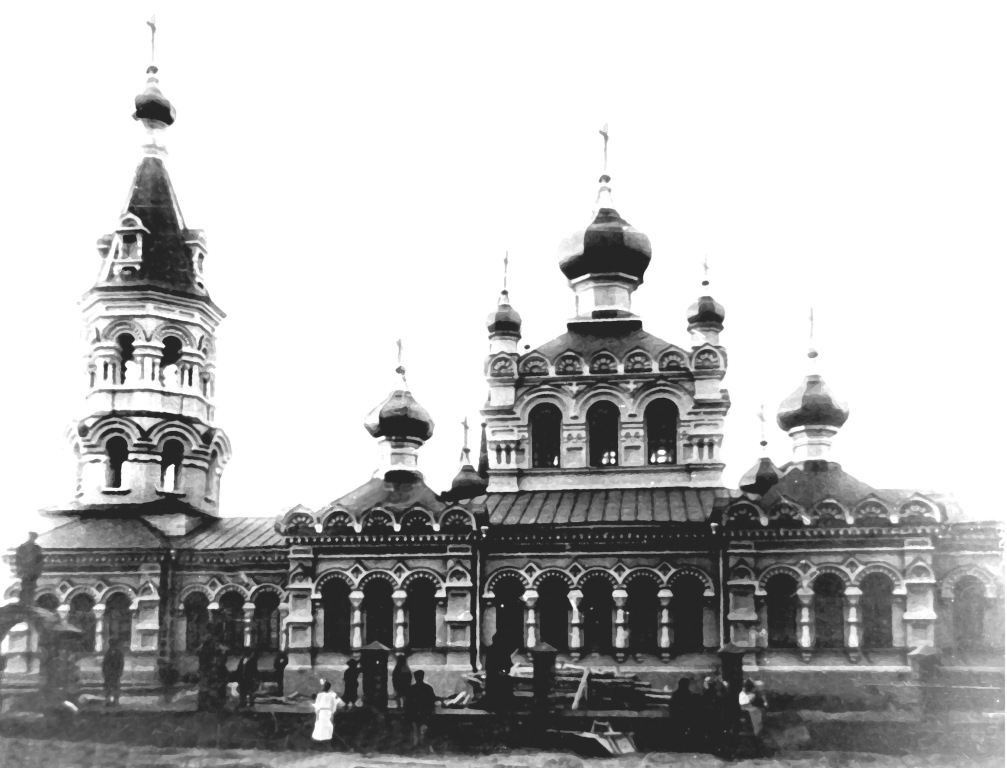
PHOTO: early 20th century view of the Holy Trinity Church in the village of Bolshaya Martynovka

The Holy Trinity Church was completed in 1904. It consisted of three chapels: the central one – in the name of the Holy Trinity, the right one – in the name of the Holy Tsarina Alexandra[2], the left – in the name of St. Nicholas the Wonderworker[3].

According to local residents, the renowned Russian opera singer Feodor Chaliapin (1873-1938) visited Bolshaya Martynovka on two separate occasions. The first time was in 1904, shortly after the consecration Holy Trinity Church. It was during this visit that Chaliapin sang along with the church choir. His second visit occurred during the Russian Civil War, when he came to visit the local landowner Suprunov. It was during this visit that Chaliapin was almost shot, having been mistaken for a bourgeois, due to his attire, which included a luxurious fur coat and hat. A singer of the church choir recognized the opera singer and saved him from execution.

In 1930 the Soviets ordered the Holy Trinity Church closed. Local residents recall how Bolshevik thugs broke the iconostasis, destroyed the domes, removed the bells and threw them in the river, and plastered over the unique frescoes made by the icon painter Elisey Grigoryevich Cherepakhin (1837-1922). In the years which followed, the former church housed a granary, a convoy and an MTS workshop, and from 1951, a utility warehouse.

When the building was returned to the Russian Orthodox Church in 1991, the artists who began the restoration discovered bullet holes made by drunken Bolsheviks some 60 years earlier.

In 1991, the Holy Trinity Church was returned to the Russian Orthodox Church and restoration began, which was completed in 2004. In 2013, the windows of the church were replaced and heating installed, while a beautiful garden was planted on the grounds surrounding the church. According to Father Vladimir, additional restoration work is ongoing.

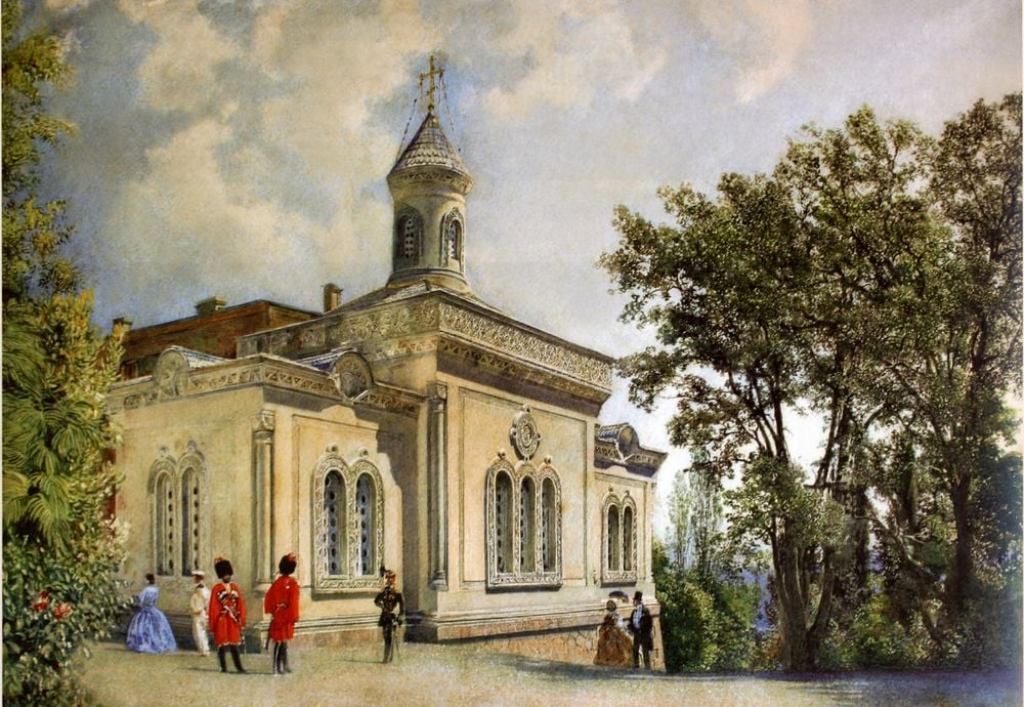
Situated near the church is a small brick chapel commemorating the martyrdom of Emperor Alexander II[4].
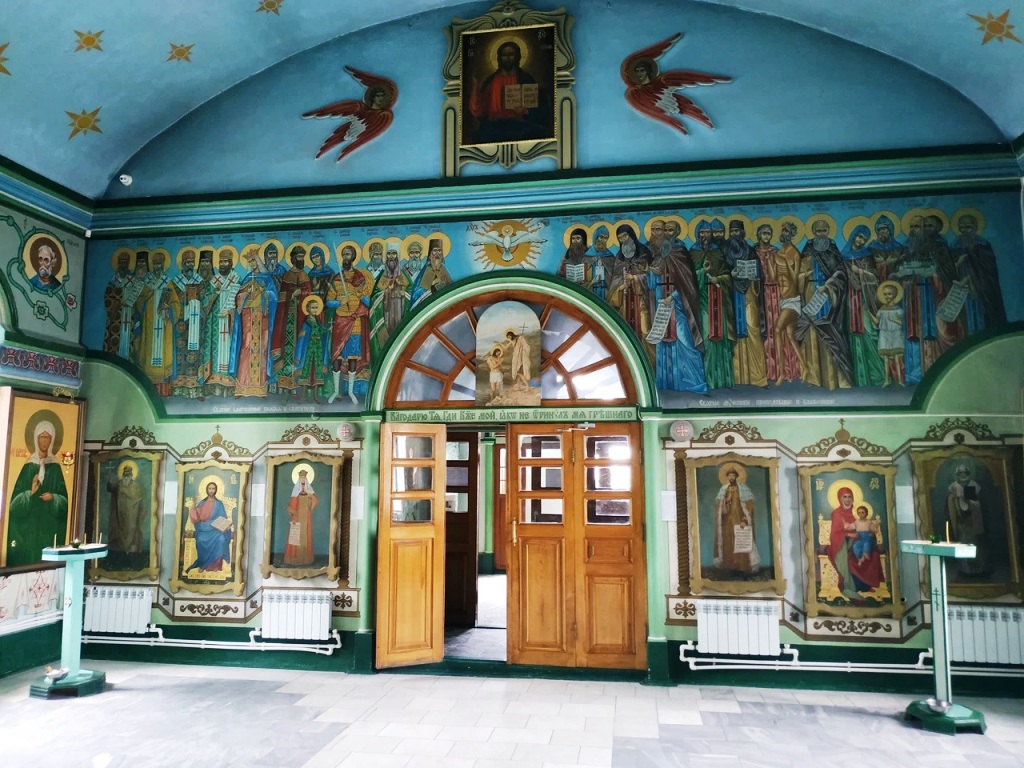
PHOTO: views of the interior of the Holy Trinity Church, showcasing it’s frescoes and icons (above) and view of the main iconostasis of main central chapel (below)
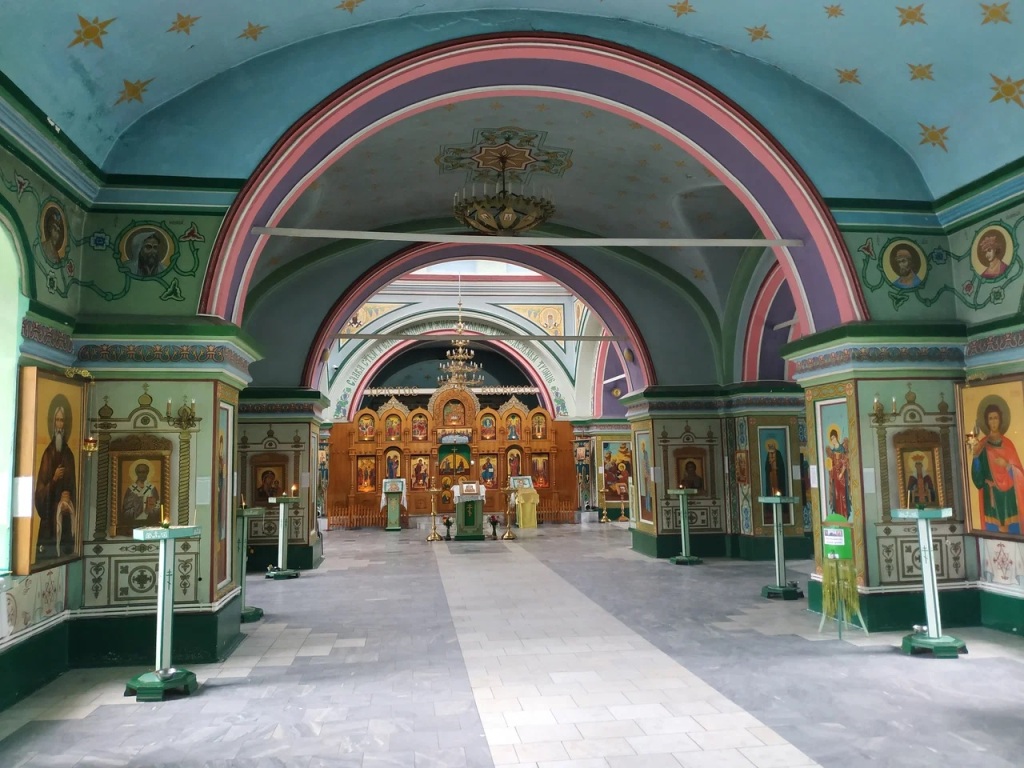
The Holy Trinity Church exists today only thanks to donations, which, unfortunately, are not enough and the abbot has to ask for financial assistance for the upkeep of the church from local business representatives. Today, the church is once again open to locals for prayer and worship, but there are few parishioners who attend. About 50 people attend the service on weekends. The relics of Paul of Taganrog, the Great Martyr Timothy and the Matrona of Moscow are even kept in the church.

Despite the fact that the Holy Trinity Church in Bolshaya Martynovka is recognized as a historical and cultural monument of the 19th century, the rector of the church Father Vladimir notes that church is virtually unknown to pilgrims and tourists visiting the region, as it is not even listed in any tourist guide. In addition, the village Bolshaya Martynovka [pop. 6,000] has no hotels or places where one could eat and rest.
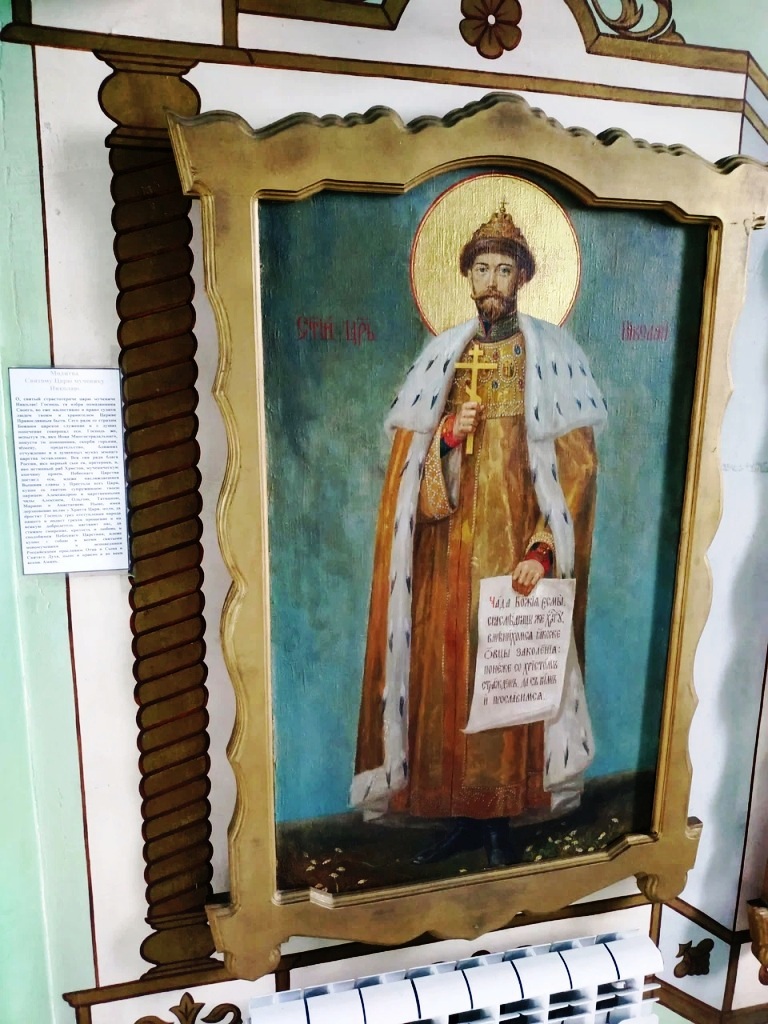
PHOTO: icon depicting the Holy Tsar-Martyr Nicholas II, located in the chapel of of St. Nicholas the Wonderworker, located in the Holy Trinity Church, in Bolshaya Martynovka
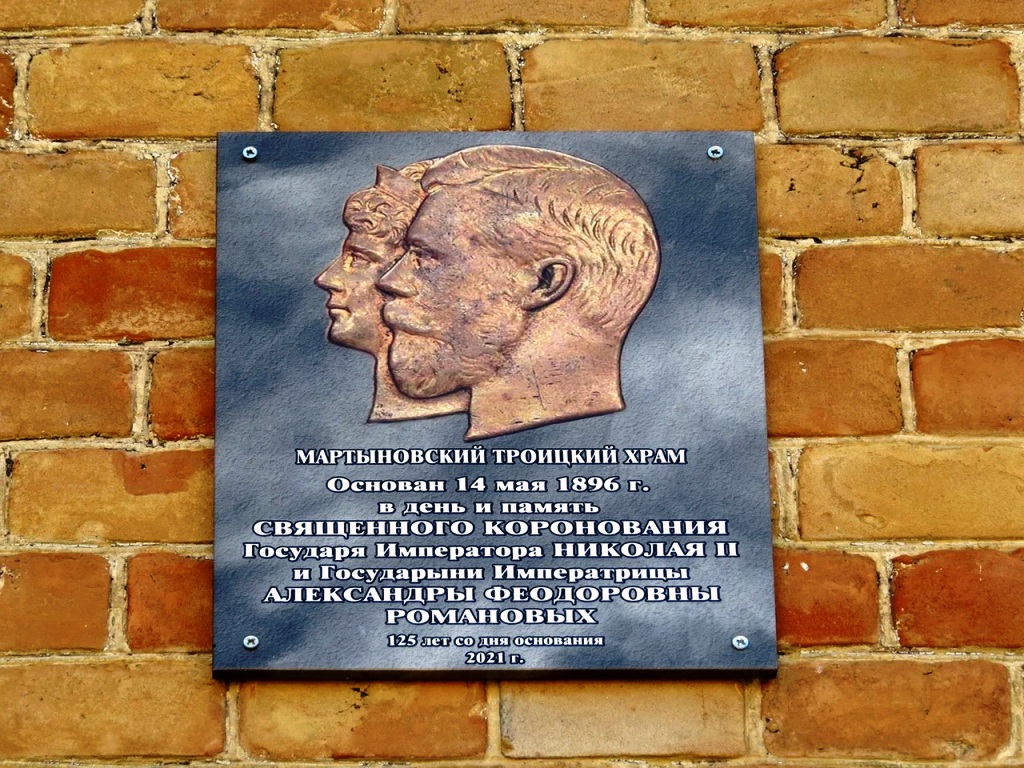
On 14th May 2021, a memorial plaque (above) was installed on the facade of the Holy Trinity Church, bearing the images of Emperor Nicholas II and Empress Alexandra Feodorovna. The plaque marks the 125th anniversary of the founding of the church and the historic Coronation in 1896. The inscription reads:

The Holy Trinity Church
was founded on 14 May 1896
on the day and memory of the
sacred coronation of
Sovereign Emperor Nicholas
and Sovereign Empress
Alexandra Feodorovna
Romanov
125 years from the date of foundation 2021

© 12 November 2022

NOTES:

[1] Neo-Russian style is also referred to as Russian Revival, Pseudo-Russian, or Russian Byzantine style: a number of different movements within Russian architecture that arose in the second quarter of the 19th century and was an eclectic melding of Byzantine elements and pre-Petrine (Old Russian) architecture.

[2] St. Alexandra, Empress, Martyr, Wife of Diocletian

[3] St. Nicholas the World Wonderworker is the patron saint of Emperor Nicholas II

[4] the chapel was built in memory of the assassination of Emperor Alexander II in St. Petersburg on 13 March (O.S. 1st) March, 1881

Archival Documentary of the Russian Royal Family

CLICK on the above image to watch this video. ENGLISH. Duration: 43 minutes

This documentary prepared by the Museum in Memory of Emperor Nicholas II’s Family features rare footage, made from 98 fragments of film from 1896-1916 shot in Moscow, Kiev, St. Petersburg, Tsarskoye Selo, Livadia, Chisinau, Yevpatoria, Kostroma, Odessa. Yalta, Nizhny Novgorod, Borodino, Diveyevo, Rostov the Great, Tallinn, Mogilev, Oreanda, and Sevastopol. The material used in the film is from the Russian State Film and Photo Archive, the Russian State Archive of Phonodocuments, and private collections. The music is comprised of fragments from the favorite works of Emperor Nicholas II.

While many people are familiar with photographs of Nicholas II participating in solemn and gala events in cities and towns throughout the Russian Empire, this documentary features some unique vintage footage of Russia’s last Emperor and Tsar.

03:51 – Nicholas II and the grand dukes carry the coffin with the relics of St. Serephim

06:40 – the foundation of the Feodorovsky Sovereign Cathedral in Tsarskoye Selo

07:40 – the Emperor and his family visiting the St. Petersburg Mosque

09:33 – the Emperor and his family taking part in a procession at the Pechersk Lavra Caves Monastery in Kiev

15:10 – Nicholas II and his family at the Chapel of the Iveron Icon of the Mother of God in Moscow

26:08 – the Imperial Children in matching outfits, playing on the deck of the Imperial Yacht Standart

33:15 – Tsesarevich Alexei playing with his dog Joy

33:55 – Nicholas II and his family embarking on a boat ride on the Dnieper River, near Mogilev, August 1916

41:50 – Nicholas II at the celebration of His Majesty’s Imperial Guard on 4th October 1916, the last film of the Imperial Family before the Tsar’s abdication the following year

· · ─── ·•· ─── · ·

VIDEO CHAPTERS and HIGHLIGHTS

· · ─── ·•· ─── · ·

00:00 Intro

00:27 Part 1: Spiritual Life

  • this part focusts on the piety of Emperor Nicholas II, it includes film footage of the Tsar and his family attending religious ceremonies in various parts of the Russian Empire, the laying of the foundations for new Orthodox churches, visits to monasteries and churches, attending molebens, and more.

19:34 Part 2: His Majesty’s Vacationing

  • includes film footage of Nicholas II kayaking in the Finnish skerries; playing tennis at Livadia including footage of Empress Alexandra Feodorovna taking part; hunting; motoring in the Tsar’s favourite Delauney-Belleville; sailing on the Imperial Yacht Standart; the Grand Duchesses taking part in games with junior officers; Tsesarevich Alexei playing with his friends, under the watchful eye of his boatswain Derevenko; among others.

35:39 Part 3: Emotional Characteristics

  • includes an interesting examination of the facial expressions, movements and nervous habits of Nicholas II, which include his constant stroking of his moustache; smooths and adjusts his uniform, touches his cap or crumples his gloves; Empress Alexandra Feodorovna is seen constantly bowing her head low with particular respect to those around her; the Grand Duchesses smiling often and sweetly; various scenes of the Tsar receiving the tradtional bread and salt.

· · ─────── ·•· ─────── · ·

A film by Konstantin Kapkov
© Copyright of the Museum in Memory of Emperor Nicholas II’s Family.
Producer: Victor Semyonov
Screenwriter: Konstantin Kapkov
Editing: Vladimir Samorodov
Music Selection: Alexander Kosov
Sound Engineer: Galina Siver
English translation and dubbing: Aleksander Brooks
Executive editors: Archpriest Alexander Derevyanko & Nadezhda Khmeleva

· · ─────── ·•· ─────── · ·

This video is produced as part of the project for the book “The Romanov Royal Martyrs”, which is an impressive 512-page book, featuring nearly 200 black & white photographs, and a 56-page photo insert of more than 80 high-quality images, colorized by the acclaimed Russian artist Olga Shirnina (Klimbim) and appearing here in print for the first time.

Click HERE to read Romanov Book of the Year for 2019: ‘The Romanov Royal Martyrs’ by Paul Gilbert, originally published on 18th November 2019

· · ─────── ·•· ─────── · ·

Click HERE to EXPLORE the book

Click HERE to ORDER the book

© The Romanov Royal Martyrs. 12 November 2022

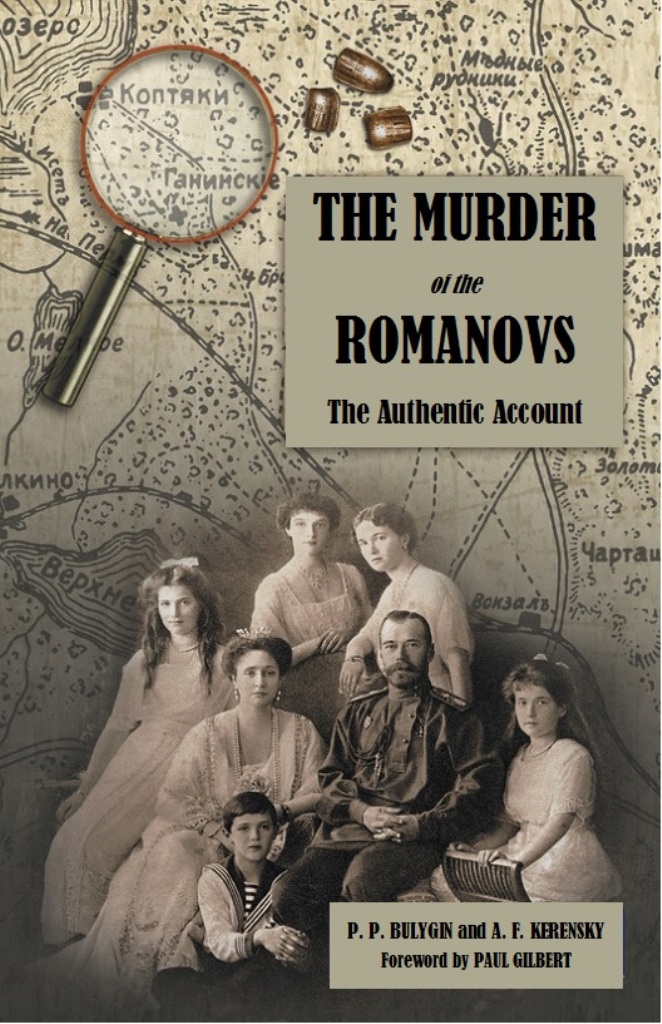
    The Murder of the Romanovs: The Authentic Account

    *This title is available from AMAZON in the USA, UK, Canada, Australia,
    France, Germany, Spain, Italy, Netherlands, Poland, Sweden and Japan

    CLICK HERE TO ORDER THE PAPERBACK EDITION @ $19.99 USD

    CLICK HERE TO ORDER THE HARD COVER EDITION @ $24.99 USD

    English. 8-1/2″ x 5-1/2″ format, 336 pages, illustrated

    Bulygin’s memoirs are of great historical importance, providing details of the last days of Emperor Nicholas II and his family, and the investigation into their murder, which continues to this day. Originally published in 1935, this is the first English-language edition in nearly 90 years!

    This book falls into two parts: the first by Alexander Fyodorovich Kerensky (1881-1970), the second by Captain Paul Petrovich Bulygin (1896-1936). Both Bulygin and Kerensky write from personal experience and eye-witness accounts.

    In the first part, Provisional Party leader Alexander Kerensky offers a firsthand account of the events leading to the downfall of the Russian monarchy in February 1917. Kerensky outlines the background, and the steps leading to the regicide. He explains in his own words, his personal impressions of Nicholas II, his family and his entourage. He goes on to discuss why he chose to send the Tsar and his family into exile to Tobolsk. The main body of his memoirs, however, is a first hand account of the murder, of the abortive attempts to forestall it, and attempts to rescue the Imperial Family, told with a fervour and horror that time has failed to erase.

    In the second part, Captain Paul Bulygin recalls the last months and death of Emperor Nicholas II and his family. Bulygin, who was a member of the Imperial Guard, reconstructs his role in an attempt to rescue the Imperial Family, during their captivity in Ekaterinburg, between April to July 1918.

    Paul Bulygin served as an officer in the Russian Imperial Army, formerly in command of the personal guard of Nicholas II’s mother the Dowager Empress Maria Feodorovna. In 1919, he assisted Nikolai Sokolov, in his investigation of their death in Ekaterinburg.

    Bulygin argues that the order to murder the Tsar and his family came directly from Lenin.

    Paul Gilbert’s Romanov Bookshop on AMAZON

    I have published more than 30 titles to date through AMAZON – featuring one of the largest selections of books on Nicholas II, the Romanov dynasty and the history of Imperial Russia. These include both new titles and reprints of titles which have out of print for years.

    Please CLICK on the BANNER or LINK above to review my current selection of titles in hardcover, paperback and ebook editions. Listings provide a full description for each title, pricing and a Look inside feature.

    © Paul Gilbert. 7 November 2022

    On this day in 1894: Nicholas II ascended the throne

    PHOTO: Tsesarevich and Grand Duke Nicholas Alexandrovich. 1894

    On this day – 2nd November[1] [O.S. 20th October] 1894, Tsesarevich and Grand Duke Nicholas Alexandrovich ascended the throne as Russia’s last emperor and tsar.

    It was on this historic day, that Nicholas Alexandrovich inherited the throne from his father Alexander III (1845-1894), who ruled Russia for only 13 years. Government officials, courtiers and troops of the Imperial Russian Army, among others, all took an oath of allegiance to their new emperor.

    In the Church of the Exaltation of the Cross [adjacent to Livadia Palace], Nicholas pledged his oath of allegiance to Russia solemnly promising to protect the autocracy firmly and unswervingly, like his late father.

    It was also in the Church of the Exaltation of the Cross, that the holy righteous John of Kronstadt anointed Princess Alix of Hesse, who became the Orthodox faithful Grand Duchess and future Empress Alexandra Feodorovna.

    NOTE: The Church of the Exaltation of the Cross has survived to this day – PG

    ***

    Though Nicholas Alexandrovich was heir-apparent to the throne, his father failed to prepare him for his future role as Tsar. He attended meetings of the State Council; however, as his father was only in his forties, it was expected that it would be many years before Nicholas succeeded to the throne. Alexander’s assumptions that he would live a long life and had years to prepare Nicholas for becoming Tsar proved wrong, as by 1894, Alexander’s health was failing.

    Russia’s finance minister, Count Sergei Yulyevich Witte (1849-1915), suggested to the Tsar that Nicholas be appointed to the Siberian Railway Committee. According to Witte, Alexander argued that Nicholas was not mature enough to take on serious responsibilities. Witte stated that if Nicholas was not introduced to state affairs, he would never be ready to understand them.

    Nicholas was only 26 years old when his father died suddenly after a long and serious illness, at the age of 49.

    PHOTO: the Church of the Exaltation of the Cross [adjacent to Livadia Palace]

    On 27th (O.S. 14th) November 1894, Nicholas Alexandrovich married Grand Duchess Alexandra Feodorovna (future Empress Alexandra Fedorovna). Their nuptials fell on the birthday of the Dowager Empress Maria Feodorovna, and court mourning could be slightly relaxed. The ceremony was held in the Grand Church (the home church of the Imperial Family) of the Winter Palace in St. Petersburg.

    A respectable period of mourning was the reason his coronation was postponed for a year and a half. The Holy Coronation of Emperor Nicholas II and Empress Alexandra Feodorovna, took place on 27th (O.S. 14th) May 1896 in the Assumption Cathedral of the Moscow Kremlin. It would be the last coronation of a Romanov Tsar.

    During the reign of Nicholas II, Russia made considerable progress in all areas of life, while experiencing tremendous growth in its economy. Under his reforms, the Russian Empire reached an unprecedented level of economic development. However, this time was also marked by the growth of revolutionary sentiments.

    Click HERE to read 70 facts about Emperor Nicholas II and his reign, originally published on 13th July 2021.

    His Imperial Majesty Sovereign Emperor Nicholas II reigned over the Russian Empire for more than 22 years. He abdicated on 15th March 1917 (O.S. 2nd March) 1917.

    Some historians argue that the act of abdication was invalid for two reasons: one, because it was signed in pencil, violating all the necessary legal and procedural methods and format, and thus had no legal force; and two, because the instrument of abdication was never officially published by the Imperial Senate.

    Regardless, as God’s Anointed, Nicholas II could not be displaced during his lifetime. Since the will of God was nowhere manifest, neither in the naming of his brother Grand Duke Mikhail Alexandrovich to the throne, nor in the Tsar’s signing of the instrument of abdication, his status as Tsar remained inviolate and unassailable. He remained Emperor until the day of his death and martyrdom on 17th July 1918. Ot was on this day, that the Russian Imperial House ceased to exist.

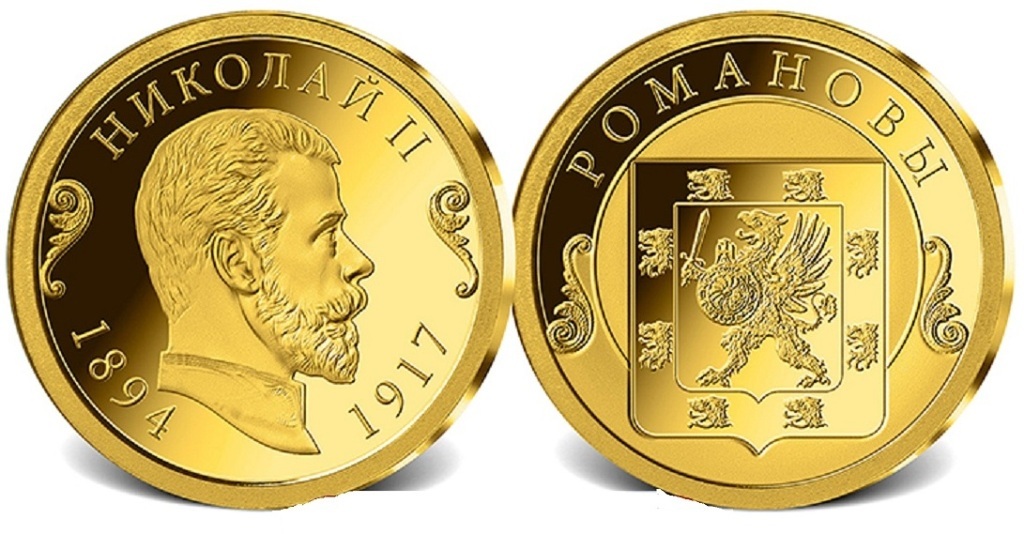
    In 2018, a commemorative medal was issued, marking the 124th anniversary of Nicholas II’s ascension to the throne in 1894. The medal was the first of The Romanovs. Golden Collection to be minted by the Imperial Mint in Moscow.

    NOTES:

    [1] In recent years there has been much confusion by non-Orthodox Christians and Westerners with regard to the correct dates of important events (births, deaths, marriages, etc.) among members of the Russian Imperial Family, according to the New Style calendar.

    As an example, is the date marking the death of Alexander III and the accession to the throne of Nicholas II. This happened on the day of Saint Artemius the Great Martyr and the righteous youth Artemiy, on 20th October (2nd November). And if this day is celebrated on 1st November or 3, then we are not commemorating the memory of these saints. Do not rely on any dates on Wikipedia which often provide the incorrect dates of the Gregorian calendar for the late 19th and early 20th centuries.

    With the passage of every leap day that is on the Julian (Old Style) Calendar but not on the Gregorian Calendar, the difference between the two calendars grows another day. Currently, the Gregorian Calendar is thirteen days ahead of the Julian Calendar. Beginning on 14th March 2100 (29th February 2100 Julian), the difference will be fourteen days.

    © Paul Gilbert. 2 November 2022

    New Romanov baby “cannot rightfully be considered a member of the Russian Imperial Family” – says Romanov Family Association

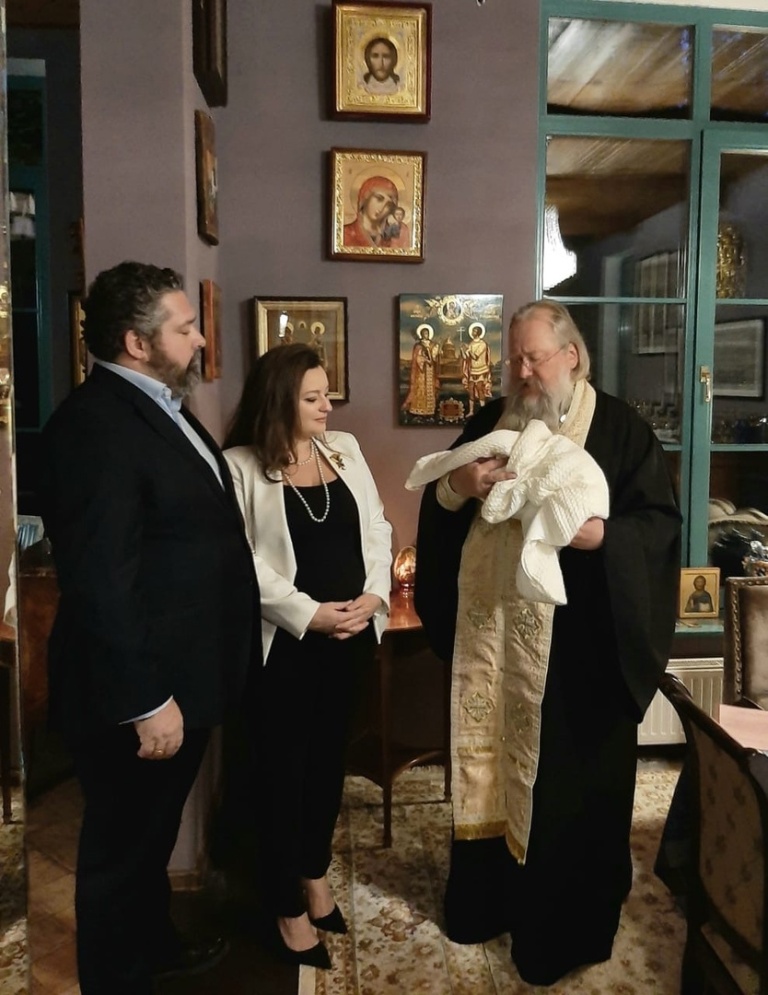
    PHOTO: Prince George of Prussia, his wife Victoria, née Rebecca Bettarini, and Father Nikon (Belavenets), holding the recently born Prince Alexander of Prussia

    On Thursday, 27th October 2022, the ROMANOFF FAMILY ASSOCIATION issued the following statement, regarding Prince Alexander of Prussia, who was born on 21st October to Prince George of Prussia, and his wife Victoria, née Rebecca Bettarini:

    The ROMANOFF FAMILY ASSOCIATION has been informed that on Friday, 21st October 2022 His Royal Highness Prince George of Prussia, and his wife Victoria, née Rebecca Bettarini, have welcomed a son, Prince Alexander of Prussia.

    The Romanoff Family Association has already officially and firmly expressed its position on the illegitimate claims of Her Serene Highness Princess Maria Vladimirovna and her son, His Royal Highness George of Prussia to be members of the Russian Imperial Family and to bear the titles of Grand Duchess and Grand Duke of Russia. [cf. Annexes 1 and 2]

    The Romanoff Family Association sends its best wishes to the newborn prince of Prussia who, being a descendant of the tsars of Russia by female and unequal lineage, cannot rightfully be considered a member of the Russian Imperial Family according to the Fundamental Laws of the Russian Empire and the Statutes of the Russian Imperial Family.

    Princess Olga Andreevna
    President
    ROMANOFF FAMILY ASSOCIATION

    Prince Rostislav Rostislavovich
    Vice-President
    ROMANOFF FAMILY ASSOCIATION

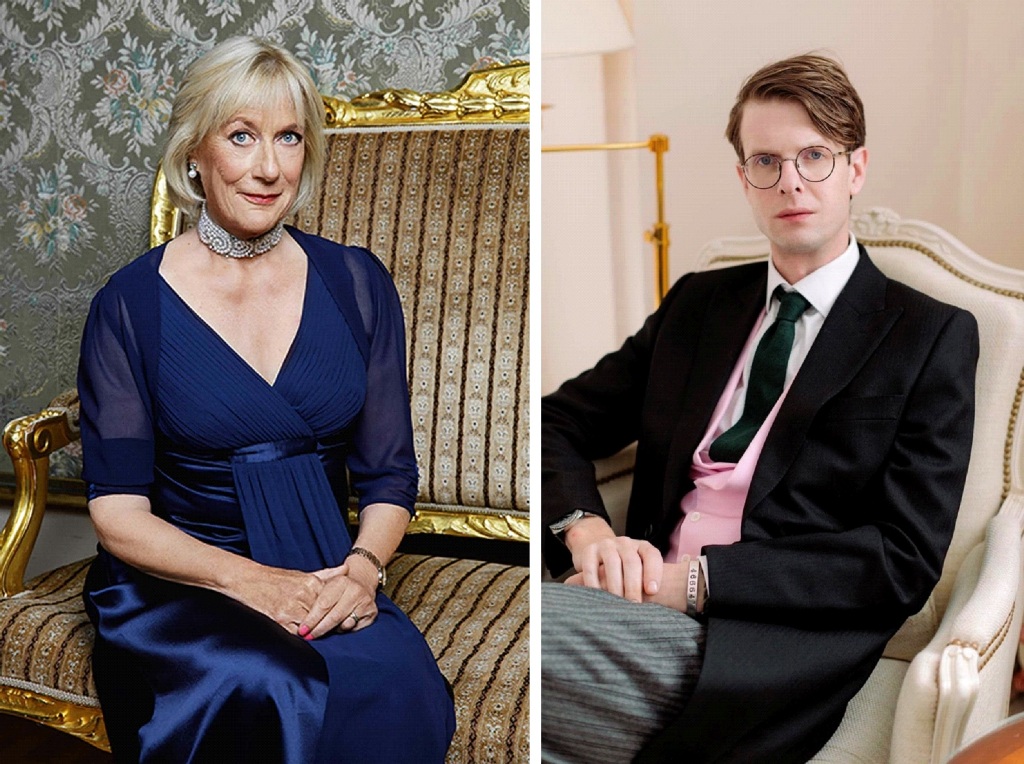
    PHOTO: Princess Olga Andreevna and Prince Rostislav Rostislavovich

    Annexe 1 : declaration of 1970.
    Annexe 2 : declaration of 1981.

    Annexe 1:
    April 1970
    Declaration by the princes Vsevolod, Roman and Andrew of the House of Russia.
    As representatives of the three lines of the Imperial House of Russia, we wish to declare our attitude towards certain “proclamations”, recently published by prince Vladimir Kirillovitch, who is known as Grand Duke and Head of the Imperial House of Russia.

    1. Prince Vladimir’s wife has the same status as the wives of all the other Princes of the Blood Imperial of Russia.
    2. It follows that we do not recognize the right of Prince Vladimir’s wife to the title of Grand Duchess.
    3. It also follows that we do not recognize her daughter Maria as a Grand Duchess and that we regard the proclamation of Princess Maria Vladimirovna as future “Guardian of the Throne of Russia” and eventual “Head of the House of Russia” as an arbitrary and illegal act.

    Annexe 2:
    25 March 1981
    Declaration
    The Romanoff Family Association has been informed that Her Serene Highness Princess Maria Vladimirovna, wife of His Royal Highness Prince Franz Wilhelm of Prussia, has given birth to a son, His Royal Highness Prince Georgiy of Prussia.

    Keeping well in mind that all matters of dynastic importance can only be resolved by the great Russian people, on Russian territory, the Romanoff Family Association wishes to remind that in autumn 1976 at the time of the wedding of Her Serene Highness, the Princess Maria Vladimirovna, Their Highness the Princes Roman Petrovitch, Andrey Alexandrovitch, Dmitri Alexandrovitch, Rostislaw Alexandrovitch and Vassili Alexandrovitch issued and signed the following statement:

    “We the members of the Imperial Family, born before the abdication of the Emperor Nicholas II, protest against the willful unwarranted act of Prince Vladimir Kirillovitch who gave to the husband of his daughter Maria Vladimirovna the illegal title of Grand Duke of Russia.

    We also protest against the decision of Prince Vladimir Kirillovitch to declare his daughter Maria Vladimirovna the sole heiress to the throne, foreseeing the beginning of a new dynasty of Hohenzollern – Romanoff.

    We consider such intentions to be an infringement on the rights of the members of the Romanoff Family, which we must protect”.

    The Romanoff Family Association keeping the above document in mind states that the happy event in the Royal House of Prussia does not concern the Romanoff Family Association as the newborn Prince is neither a member of the Imperial House of R ussia, nor is he a member of the Romanoff family.

    Prince Vassili Alexandrovitch
    President, Romanoff Family Association.

    © Romanoff Family Association. 1 November 2022

    Orthodox cross consecrated in memory of Nicholas II and his family near Tyumen

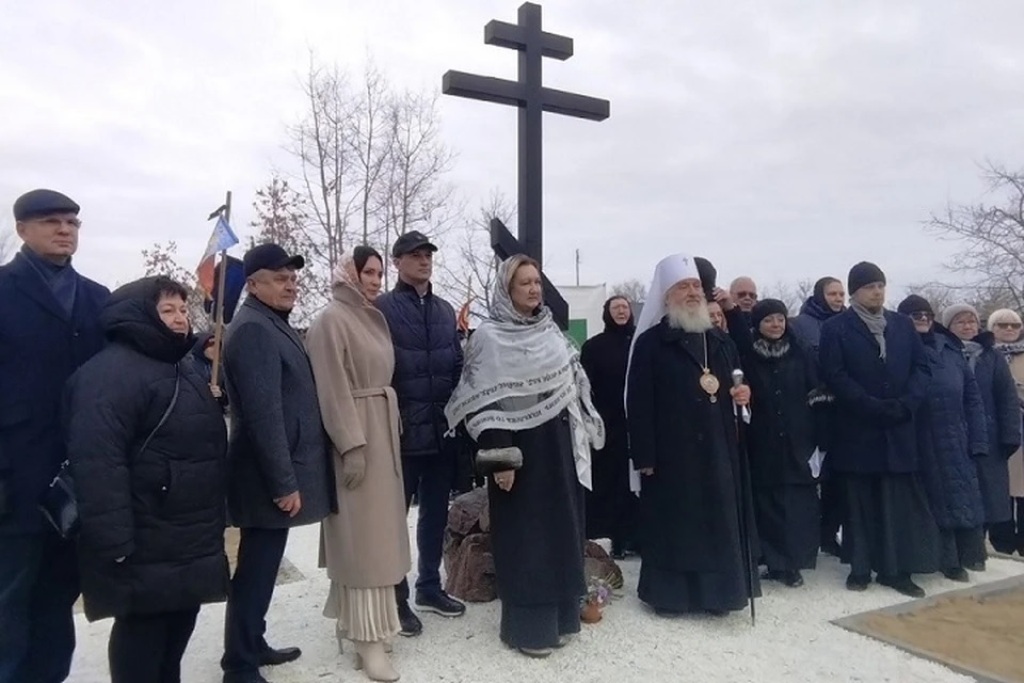
    PHOTO: Chairman of the Elisabeth-Sergei Educational Society Foundation (ESPO) Anna Gromova and Metropolitan Dimitry of Tobolsk and Tyumen pose with parishioners, in front of the memorial cross in the village of Ievlevo

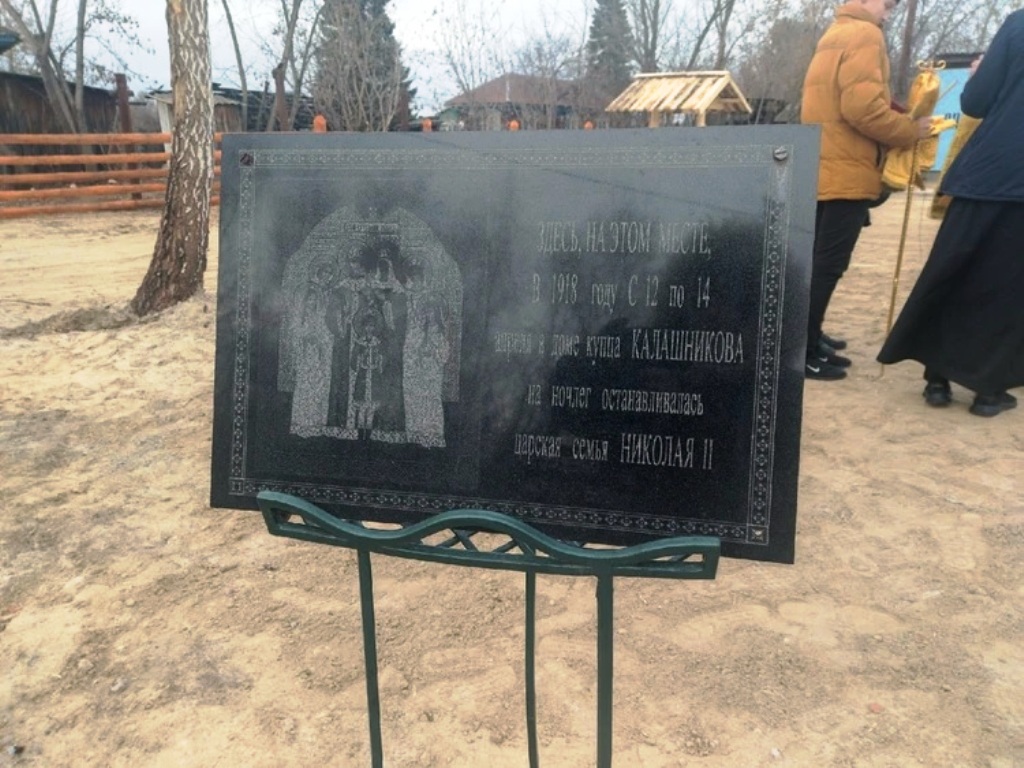
    At 4 am on 26th (O.S. 13th) April 1918, Emperor Nicholas II, Empress Alexandra Feodorovna, along with their daughter Grand Duchess Maria Nikolaevna, and several retainers departed Tobolsk for their journey to Ekaterinburg. Their first stop enroute was at the village of Ievlevo, where they spent the night under the watchful gaze of a convoy of Bolshevik convicts and thugs.

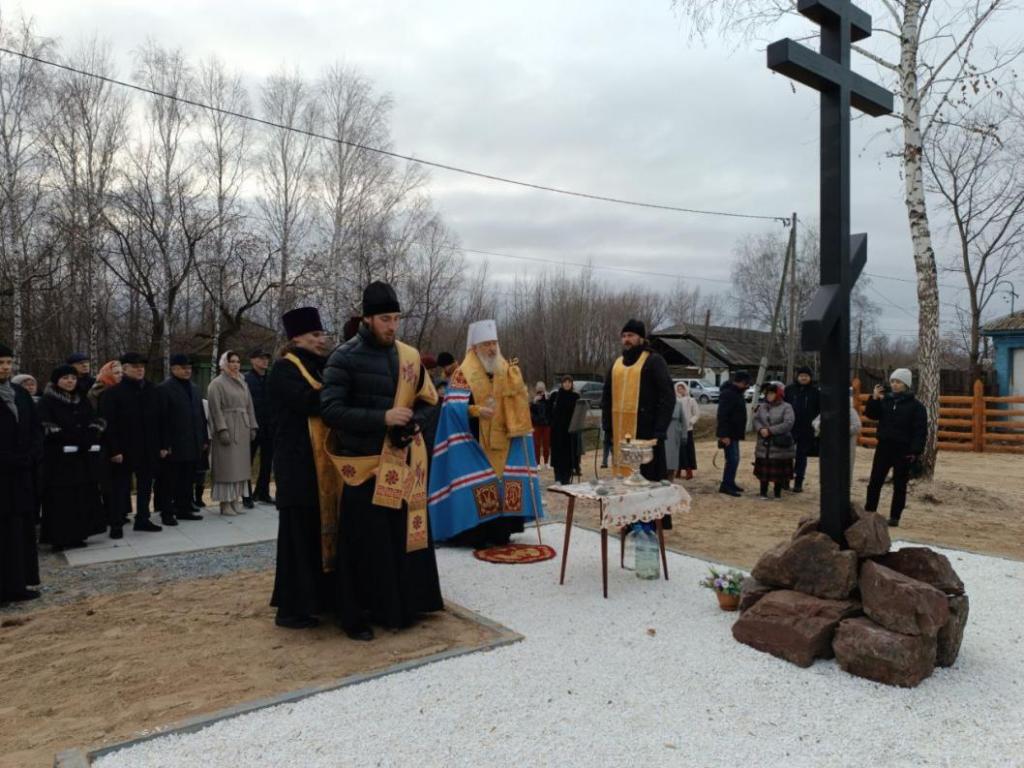
    On 31st October 2022, a memorial cross was installed and consecrated in the village of Ievlevo, situated in the Yarkovsky district near Tyumen. The consecration of the cross was performed by Metropolitan Dimitry of Tobolsk and Tyumen.

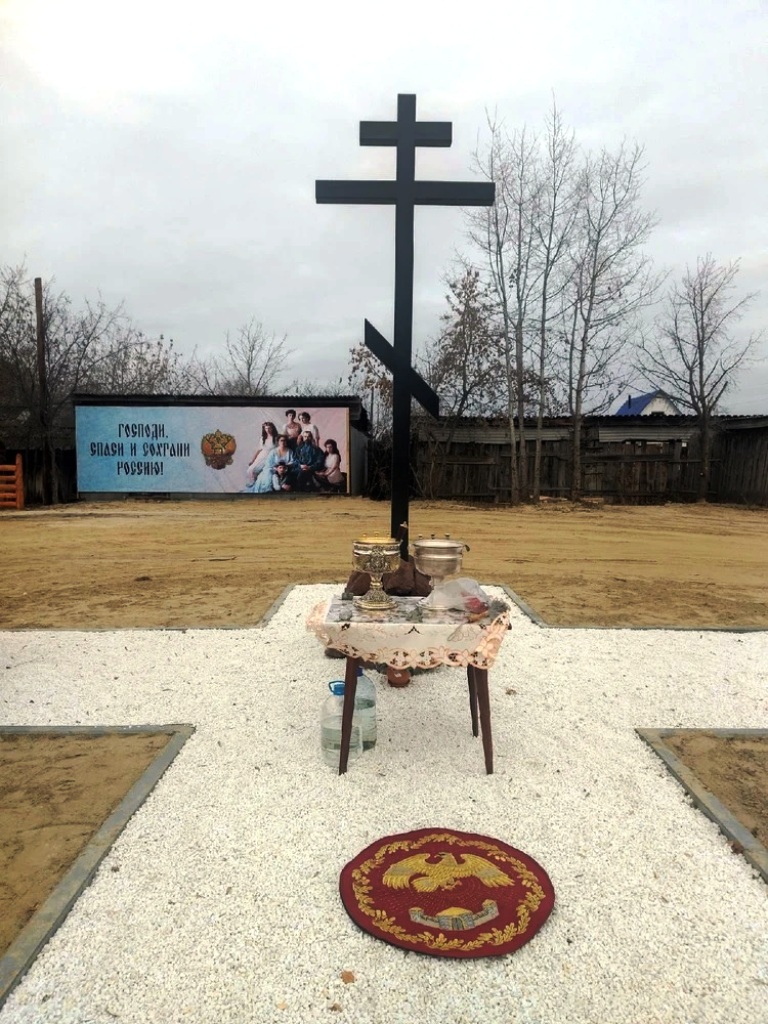
    The cross and metal plaque were installed on the grounds of the future Church of the Archangel Michael, which is currently under. construction. Once completed, the Elisabeth-Sergei Educational Society Foundation (ESPO), has pledged to create a museum and a spiritual and educational pilgrimage center. The memorial cross and future museum will become part of the Imperial Route.

    According to Deputy Governor of the Tyumen Region Andrey Panteleev, when Anna Gromova began work on the Imperial Route, Tyumen and Tobolsk were designated as the main locations, and the Museum of the Family of Nicholas II (opened in April 2018) became the pearl of the Imperial Route in the Tyumen Region.

    “It is very important that the Imperial Route should include the places associated with the Holy Royal Martyrs were. Many regions across Russia are taking part in this unique project, which will allow both Russians and foreigners to learn about the life and times of the last Tsar and his family”, – added Panteleev.

    The Tyumen Region currently features a number of museums and monuments to Emperor Nicholas II and his family: including the Monument to the Holy Royal Martyrs, established in Tyumen in 2017; and the Tsar’s Pier Museum, which includes one room dedicated to the Imperial Family, which includes photos, letters and more.

    PHOTO: church utensils used for the consecration of the cross memorial

    PHOTO: Metropolitan Dimitry of Tobolsk and Tyumen performs the consecration of the cross memorial

    ***

    It was on 17th (O.S. 4th) August 1917, that the Imperial Family arrived in Tyumen, after being sent into exile from the Alexander Palace at Tsarskoye Selo, on 14th (O.S. 1st( August.

    It was on this day that the two trains carrying Nicholas II, his family, and servants arrived in the evening at Tyumen. The following day, they sailed up the rivers Tur, Tobol and Irtysh on the steamer ‘Rus’, to Tobolsk.

    Nicholas wrote in his diary: “We advanced unbelievably slowly, in order to reach Tyumen late at night. There the train went right up to the jetty, so that we were able to get straight onto the steamer.

    “Ours is called ‘Rus’! They started loading our things, which took all night. God only knows when poor Alexei got to bed again? The bustle and noise went on all through the night and prevented me from getting to sleep. We left Tyumen at about 6 o’clock.”

    Upon arrival in Tobolsk, the Imperial family were placed under house arrest in the former governors house until April 1918. On 30th (O.S. 17th) April 1918, Emperor Nicholas II, Empress Alexandra Feodorovna and Grand Duchess Maria were handed over to the Ural Soviets in Ekaterinburg.

    PHOTO: a metal plaque informs pilgrims and visitors that the Tsar and his family stopped here for one night in April 1918, on their journey to Ekaterinburg, where they would meet a martyr’s death on 17th July

    © Paul Gilbert. 31 October 2022

    Nicholas II plants oak trees at the Feodorovsky Sovereign Cathedral, April 1913

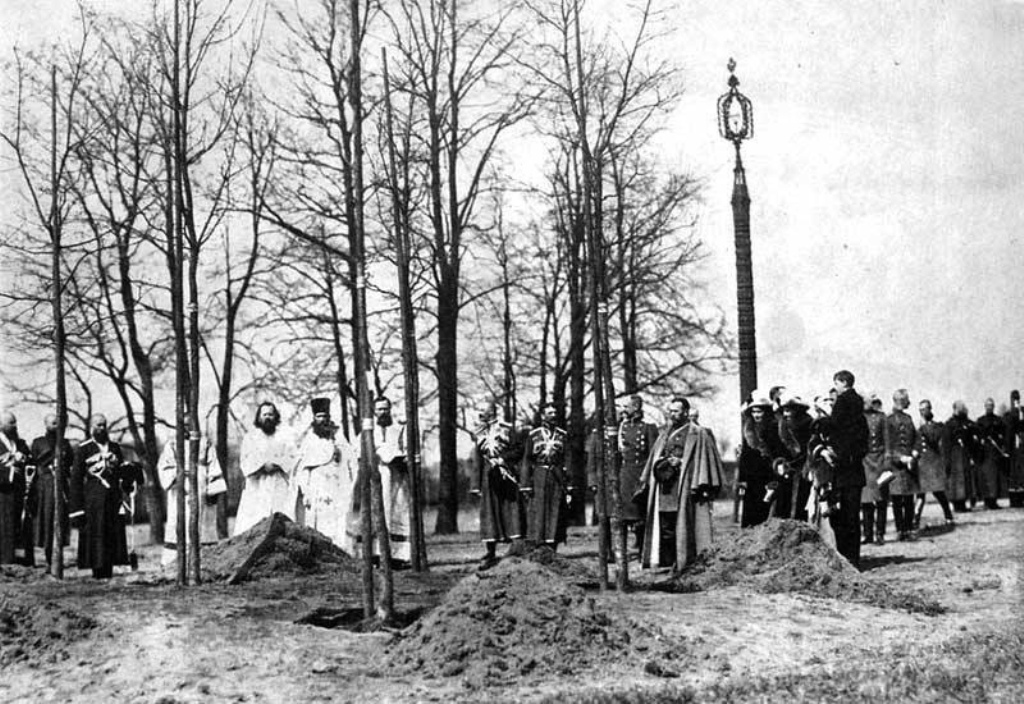
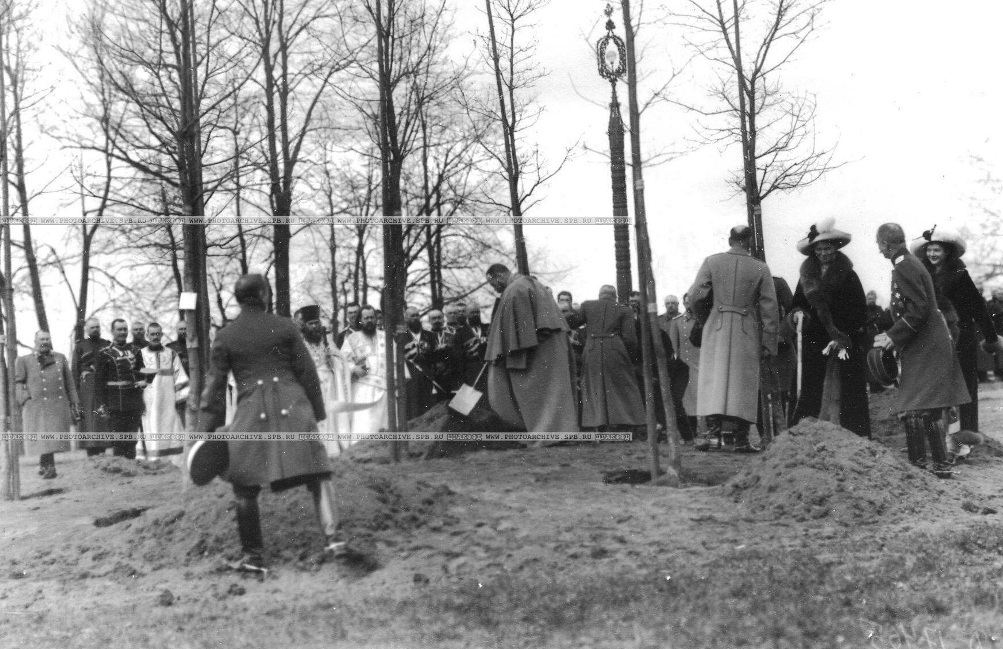
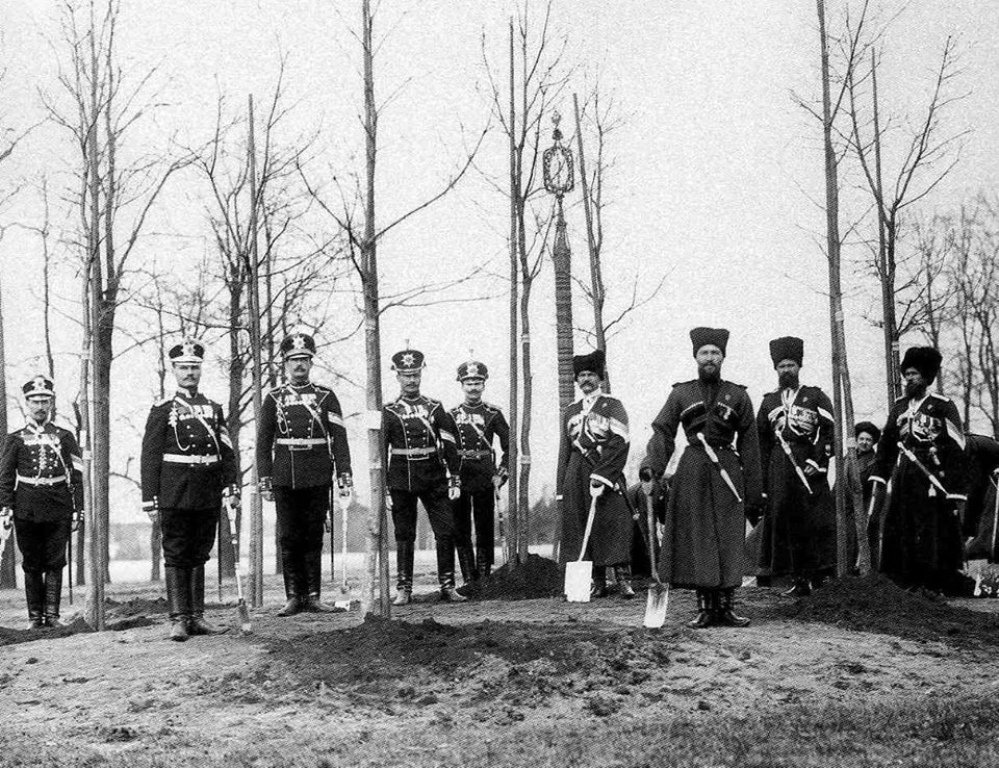
    PHOTO: Emperor Nicholas II, his family and retinue planting seven oak trees on the square, in front of the Feodorovsky Sovereign Cathedral at Tsarskoye Selo, 1913

    Construction of the house church of the Imperial Family at Tsarskoye Selo

    The Feodorovsky Sovereign Cathedral was constructed between 1909 – 1912 by order of Emperor Nicholas II, to serve as the regimental church of His Imperial Majesty’s Own Convoy. In addition, the cathedral served as the house church for the Imperial family, while they were in residence in the Alexander Palace.

    Construction of the Cathedral began in 1908, financed by Emperor Nicholas II, who contributed 150,000 gold rubles, a considerable sum, from his own personal funds.

    On 2nd September (O.S. 20th August) 1909, Nicholas II laid the first foundation stone. The solemn Divine Liturgy was performed by His Grace Theophan, Bishop of Yamburg, attended by the Emperor and members of his family. The Cathedral was built in the old Russian style. Three years later, on the same day in 1912, the Feodorovsky Sovereign Cathedral was consecrated.

    An alley lined with fragrant linden trees ran from the cathedral to the Imperial Railway Pavilion nearby. Sadly, in the 1950s, the largest lime trees were transported to the replanted on Nevsky Prospekt in Leningrad [St. Petersburg].

    PHOTO: Emperor Nicholas II, his family and retinue planting seven oak trees on the square, of the Feodorovsky Sovereign Cathedral at Tsarskoye Selo, 1913

    The Imperial Family plant oak trees on the grounds of the Cathedral

    On 4th May (O.S. 21st April) 1913, Emperor Nicholas II and his family planted a group of oak trees on the grounds of the Feodorovsky Sovereign Cathedral. It was one of many events marking the 300th anniversary of the Romanov Dynasty, held that year throughout the Russian Empire, in which the Tsar and his family took part. A total of seven trees were planted that day, with each member of the Imperial Family, beginning with the Tsar, planting a single oak tree each.

    The trees were planted on the grounds of the square, which is situated on the southern facade of the Cathedral. It was through this square, that the Imperial Family arrived at the Cathedral, entering via the Royal Porch. During the winter months, when the days saw little daylight, the square was illuminated with lanterns, giving it a serene ambiance.

    Of the seven trees planted, only four have survived to the present day, the other three were cut down during the Nazi German occupation of Pushkin [Tsarskoye Selo, 1941-44].

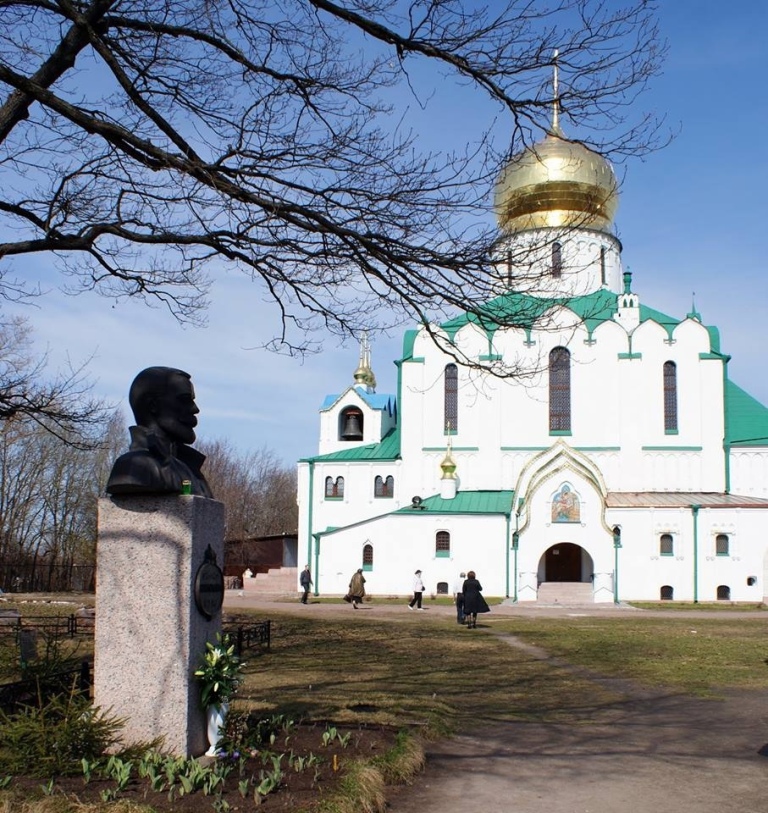
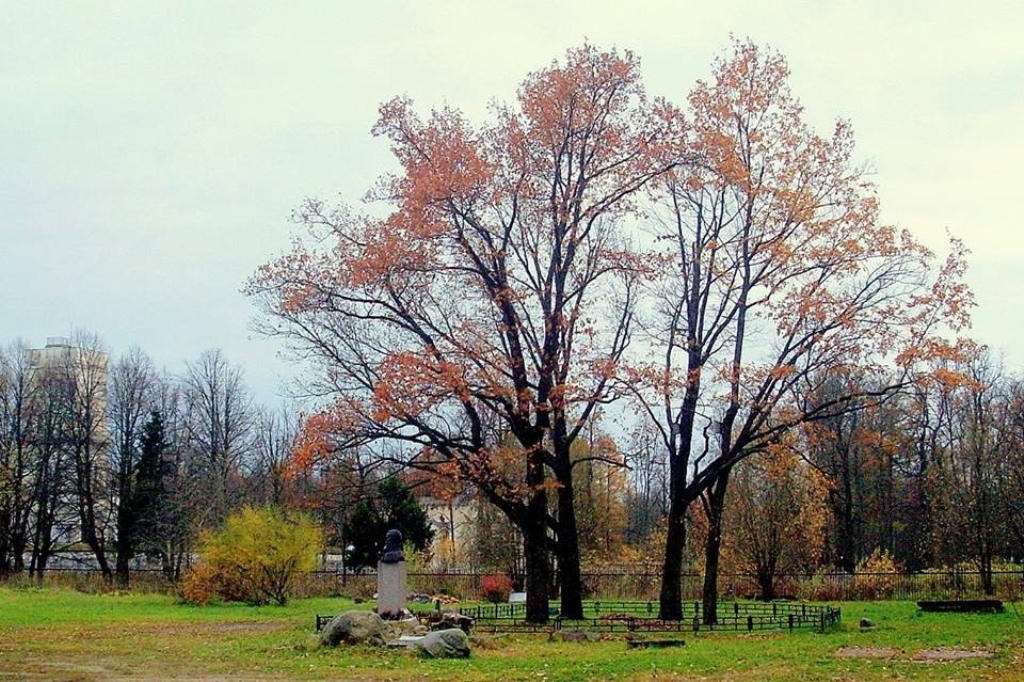
    The four oaks can be seen behind a bust-monument to Tsar-Martyr Nicholas II – the first to be installed in post-Soviet Russia. A stone marker and plaque [see photo at the end of this article] mark the spot, where they were planted more than a century ago. It is nothing short of a miracle that they have survived.

    PHOTO: Russia’s first monument to Nicholas II was consecrated on 17th July 1993, on the grounds of the Feodorovsky Sovereign Cathedral at Tsarskoye Selo

    The first monument to Nicholas II in post-Soviet Russia

    Situated in the garden [square] behind the Feodorovsky Sovereign Cathedral at Tsarskoye Selo, is a bust-monument to Tsar-Martyr Nicholas II, the work of St. Petersburg sculptor Victor Vladimirovich Zaiko (born 1944).

    Installed and consecrated on 17th July 1993, it was the first monument to Nicholas II to be erected in Post-Soviet Russia. Since its installation nearly 30 years ago, more than 100 monuments, busts and memorials to Russia’s last Tsar, have been installed across the Russian Federation.

    As previously noted, the bust-monument stands in front of the four surviving oak trees, seen in the background, which were planted by Nicholas II and his family on 4th May (O.S. 21st April) 1913.

    The monument was consecrated on 17th July 1993, the day marking the 75th anniversary of the death and martyrdom of Nicholas II and his family.

    PHOTO: view of Russia’s first monument to Nicholas II and the remaining oak trees which he and his family planted in 1913, on the grounds of the Feodorovsky Sovereign Cathedral

    PHOTO: a wider view of the four remaining oak trees, planted by Nicholas II and his family in 1913, on the grounds of the Feodorovsky Sovereign Cathedral

    PHOTO: a stone marker reads [translation]: 21 April / 4 May 1913. On this spot the Holy Royal Martyrs Sovereign Emperor Nicholas II, Sovereign Empress Alexandra Feodorovna, Tsesarevich Alexei and Grand Duchesses Olga, Tatiana, Maria, Anastasia planted seven memorial oaks.

    © Paul Gilbert. 25 October 2022

    FDR wanted to buy Livadia Palace in final days of WWII

    PHOTO: FDR arriving at Livadia Palace in February 1945

    On 22nd April 2017, a bust of Franklin Delano Roosevelt (1882-1945), the 32nd President of the United States commonly known as FDR, was unveiled in Yalta, Crimea on a street named in his honour.

    Back in the 1960s, one of Yalta’s oldest streets was named after Franklin D. Roosevelt. The city authorities decided to commemorate the 32nd US president’s participation in the 1945 Yalta Conference of the “Big Three” leaders of the anti-Hitler coalition.

    Roosevelt impressed by Crimea

    The 1945 Yalta Conference was held in the Palace of Livadia, the former residence of Emperor Nicholas II and his family, situated on the southern coast of Crimea, overlooking the Black Sea.

    It was at Livadia Palace, where the largest group of the US delegation was housed. The reason for the decision to accommodate the American delegation in the Livadia Palace was because of the physical condition of the US leader who had been bound to a wheelchair after contracting polio in 1921.

    The palace left a great impression on the American leader. In fact, according to a transcript of a conversation with Stalin in February 1945, Roosevelt said that he felt very well in Livadia and stated that when he would no longer be president, he would like to ask the Soviet government to sell Livadia to him. He noted that he was fond of breeding trees and would plant lots of them in the hills around the palace’s vicinity.

    “Roosevelt’s personal apartment was located on the ground floor and he could move around by himself, quite easily. It should be noted however that a slight lapse in security was permitted as the delegation and its leader were accommodated where the sessions were being held. Though the frontline was far away, security measures during the conference were unprecedentedly tight,” says Dmitry Blintsov, a research fellow at the Livadia Palace museum’s exhibition department.

    PHOTO: Churchill, FDR and Stalin pose for photos in the Italian Courtyard of Livadia Palace, February 1945

    The Livadia Palace and its picturesque park impressed the US leader so much that he asked Stalin, in earnest or not, to sell it to him. The transcript of Roosevelt’s personal meeting with Stalin of February 4, 1945 puts it as follows:

    “Roosevelt says he feels very well in Livadia. When he is no longer president, he would like to ask the Soviet government to sell Livadia to him. He is fond of gardening. He would plant lots of trees in the hills around Livadia.”

    Roosevelt arrived in Yalta accompanied by his daughter Anna. Winston Churchill’s daughter, Sarah, and one of the daughters of US Ambassador to Russia Averell Harriman, Kathleen, were also there. “I think their daughters provided psychological support to their fathers after the long and heated political debates so far away from their homes,” the historian suggests.

    Nevertheless, despite the positive impressions from Livadia, upon returning home Roosevelt said that he had been shocked to see the devastation that the German Nazi forces had inflicted on Crimea.

    “During my stay in Yalta, I saw the kind of reckless, senseless fury, the terrible destruction that comes out of German militarism… And even the humblest of the homes of Yalta were not spared… I had read about Warsaw and Lidice and Rotterdam and Coventry—but I saw Sevastopol and Yalta! And I know that there is not room enough on earth for both German militarism and Christian decency” – said FDR, in his address to Congress, 1945.

    © Paul Gilbert. 24 October 2022

    ROC delays decision on Ekaterinburg Remains “INDEFINITELY!”

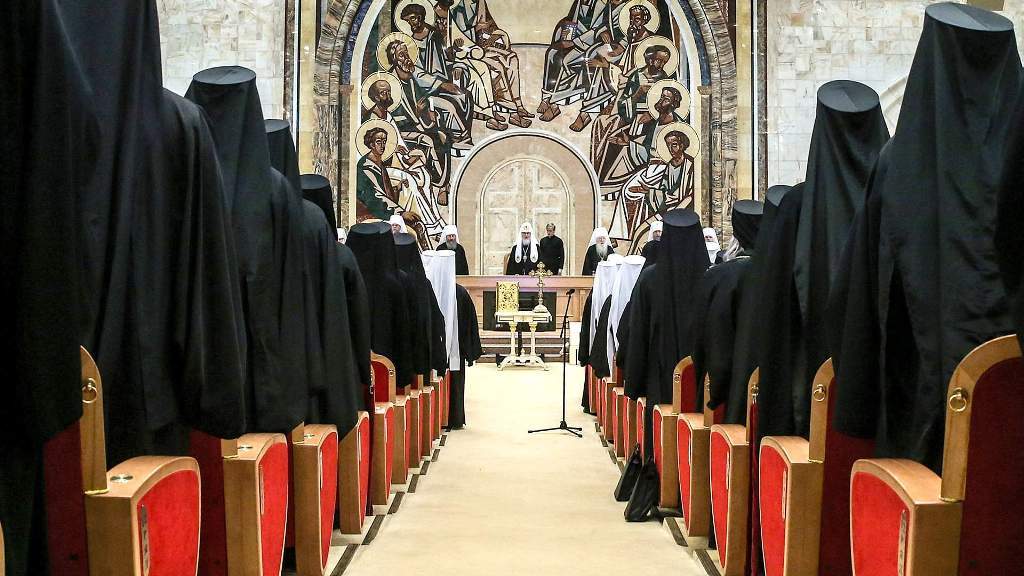
    PHOTO: His Holiness Patriarch Kirill of Moscow and All Russia presides over the meeting of Bishops’ Council of the Russian Orthodox Church in Moscow, 2017

    On 25th August 2022, the Holy Synod of the Russian Orthodox Church announced that it has once again postponed the dates for the Bishops’ Council meeting – which was scheduled to meet in Moscow next month – and has now been postponed “indefinitely”, citing the “current situation in the world”.

    “Since the international situation continues to make it difficult for many members of the Bishops’ Council to arrive in Moscow [from foreign countries], a decision has been made to postpone the meeting indefinitely . . . ” the Synod’s resolution states (Journal No. 66) dated 25th August 2022.

    Bishops of the Russian Orthodox Church (Moscow Patrairchate) from more than 70 countries cannot travel to Moscow, due to Western sanctions, which have banned air travel to Russia from many countries around the world.

    The Bishops’ Council was originally scheduled to meet in Moscow from 15th to 18th November 2021, however, this was delayed “due to the difficult COVID-19 situation.” The meeting was thus rescheduled for 26th to 29th May 2022. This meeting was also delayed due to the Russian-Ukranian conflict, and postponed until the end of 2022.

    A key item on the agenda of the Bishops’ Council meeting is a definitive decision of the Church on the authenticity of the Ekaterinburg remains.

    The Council of Bishops is the highest body of the hierarchical administration of the Russian Orthodox Church. The Council reviews and approves church dogmas, determines the position of the Russian Orthodox Church on important issues of public life. Thus, at the council of 2000, a decision was made to canonize more than a thousand new martyrs – which included Emperor Nicholas II and his family.

    According to the charter of the Russian Orthodox Church, the Council of Bishops is convened at least once every four years. The previous council took place in Moscow, from 29th November to 2nd December 2017. Between councils, issues of church life are decided by the Holy Synod, which meets every four months.

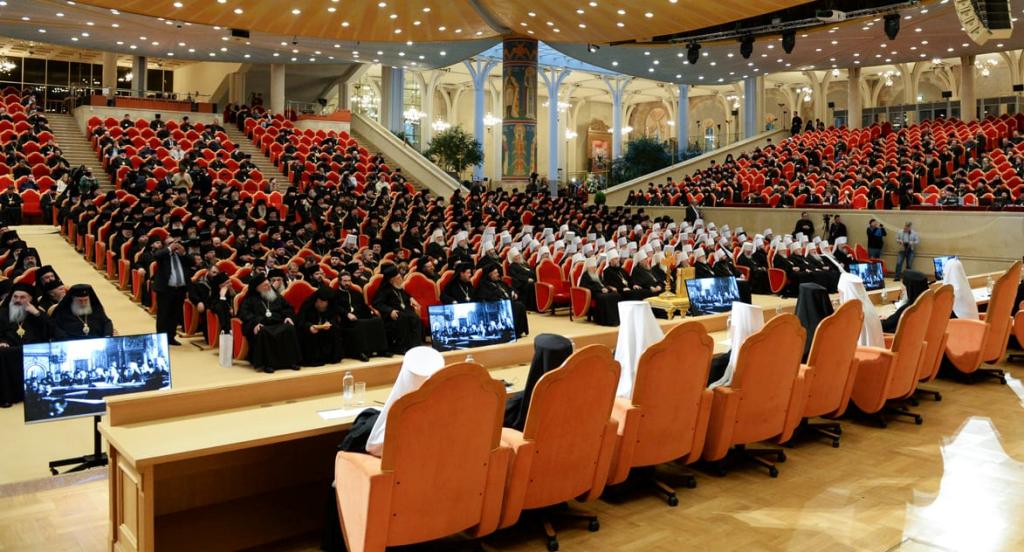
    PHOTO: on 29th November 2017, some 347 bishops from across Russia and around the world, took part in the Bishops’ Council of the Russian Orthodox Church in Moscow

    As of 2019, the Russian Orthodox Church was present in 77 countries – including Russia; with 309 dioceses (of which 19 are in foreign countries); 382 bishops; 40,514 clerics (35,677 presbyters, 4,837 deacons); 38,649 churches or other places of worship where Divine Liturgy is served, not including 977 parishes abroad; 1012 monasteries (972 monasteries in the canonical territory (474 ​​male, 498 female) and 40 in other countries); 5,883 monks and 9,687 nuns (including cassocks) live in monasteries; 5 academies and 50 seminaries in which, at the beginning of the 2018-2019 academic year, approx. 14 thousand students; OK. 11,000 Sunday schools with over 175,000 pupils; 145 Orthodox educational organizations; almost 150 maternity protection centers; there are 70 rehabilitation centers, 18 resocialization centers, 67 counseling centers for drug addicts; over 90 shelters for the homeless; there are 10 mercy buses (mobile points for helping the homeless); over 450 charity canteens; more than 160 church humanitarian centers; more than 450 sisterhoods of mercy; over 500 volunteer charity groups; more than 250 charitable voluntary associations of various profiles.

    According to the Press Service of the Patriarch of Moscow and All Russia, the Bishops, members of the Holy Synod of the Russian Orthodox Church will return to this issue, when they meet again in December.

    Sadly, whatever decision the Bishops’ Council makes, it is sure to cause a schism among Believers who are divided on the authenticity of the remains. Many still adhere to Nikolai Alekseevich Sokolov’s (1882-1924) theory that the bodies of the Imperial Family were completely destroyed with fire and acid at the Four Brothers Mine.

    ***

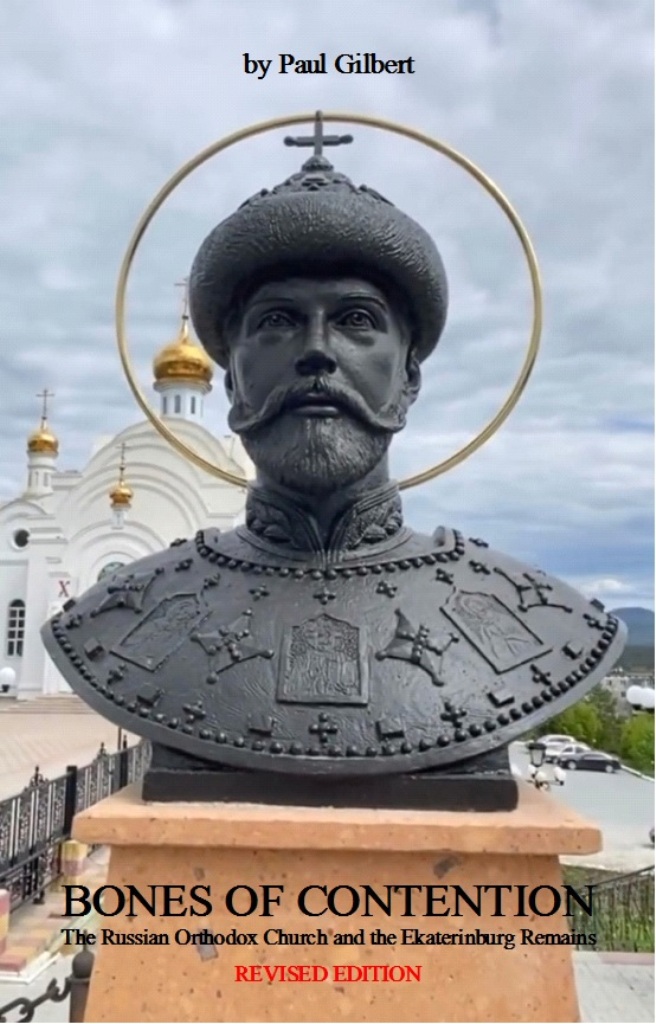
    BONES OF CONTENTION (Revised Edition)
    The Russian Orthodox Church and the Ekaterinburg Remains
    By Paul Gilbert

    CLICK HERE TO ORDER FROM AMAZON

    Full-colour covers, 206 pages + 90 black & white photographs

    Originally published in 2020, this NEW REVISED & EXPANDED 2021 EDITION features an additional 40+pages, new chapters and 90 black and white photos. It is the most up-to-date source on the highly contentious issue of the Russian Orthodox Church and their position on the Ekaterinburg Remains.

    The world awaits a decision by the Bishops’ Council of the Russian Orthodox Church, who will meet in Moscow at some point, during which they will review the findings of the Investigative Commission and deliver their verdict on the authenticity of the Ekaterinburg Remains.

    The reopening of the investigation into the death of Nicholas II and his family in 2015, caused a wave of indignation against the Russian Orthodox Church. This book presents the position of both the Moscow Patriarchate and the Investigation Committee.

    This is the first English language title to explore the position of the Orthodox Church in Russia with regard to the Ekaterinburg remains. The author’s research for this book is based exclusively on documents from Russian media and archival sources.

    This unique title features an expanded introduction by the author, and eight chapters, on such topics as the grounds for the canonization of Nicholas II and his family by the Moscow Patriarchate in 2000; comparative details of the Sokolov investigation in 1919, and the investigations carried out in the 1990s to the present; reluctance of the Moscow Patriarchate to officially recognize the remains as authentic; interesting findings of Russian journalist, producer and screenwriter Elena Chavchavadze in her documentary Regicide. A Century of Investigation; and the author’s own attempt to provide some answers to this ongoing and long drawn-out investigation for example: “Will Alexei and Maria be buried with the rest of their family?” and “Will the Imperial Family remains be reinterred in a new cathedral in Ekaterinburg?”.

    This new revised and expanded edition also includes two NEW chapters!

    Interviews with Vladimir Soloviev, Chief Major Crimes Investigator for the Central Investigate Department of the Public Prosecution Office of the Russian Federation and Archpriest Oleg Mitrov, a member of the Synodal Commission for the Canonization of Saints – BOTH key players in the Ekaterinburg remains case, reveal the political undertones of this to this ongoing and long drawn-out investigation.

    ABOUT THE AUTHOR

    Independent researcher Paul Gilbert has spent more than 25+ years researching and writing about the Russian Imperial Family. His primary research is focused on the life, reign and era of Nicholas II. On 17th July 1998, he attended the tsar’s interment ceremony at the SS Peter and Paul Cathedral in St. Petersburg. Twenty years later, he attended the Patriarchal Liturgy on the night of 16/17 July 2018, held at the Church on the Blood in Ekaterinburg. Since his first visit to the Urals in 2012, he has brought prayers and flowers to both Ganina Yama and Porosenkov Log on numerous occasions.

    © Paul Gilbert. 20 October 2022

    The Children’s Island and Pavilion at Tsarskoye Selo

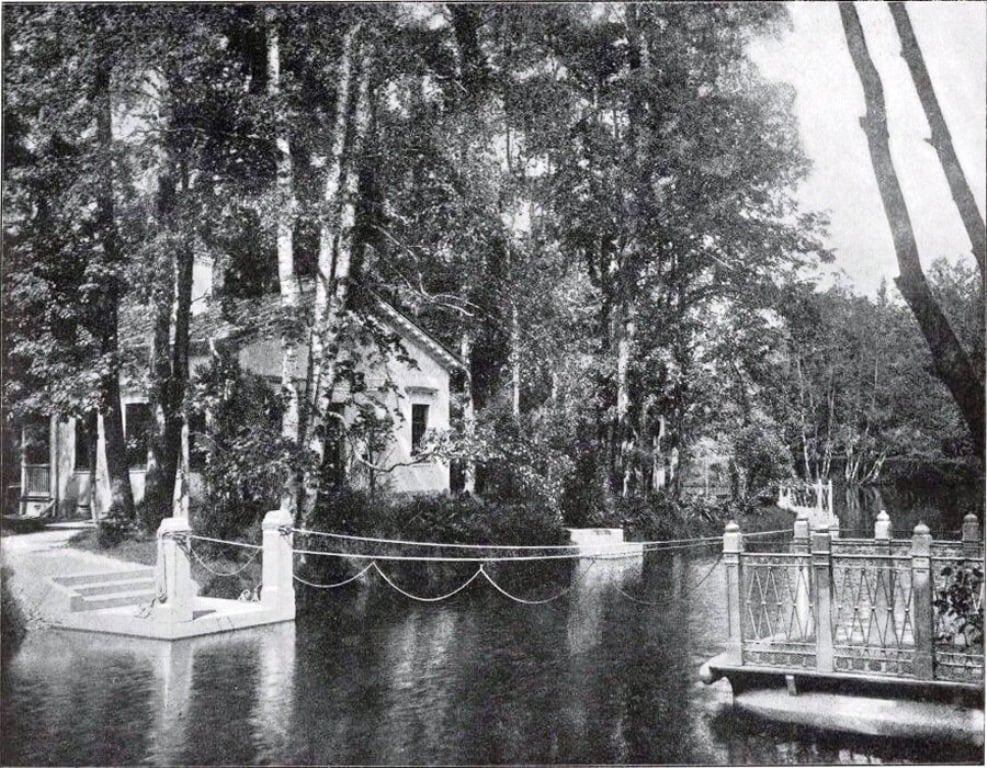
    PHOTO: This early 20th century photo of the Children’s Island, clearly shows the Pavilion, the granite piers and the pull-ferry

    Situated just a short walk from the Western Wing of the Alexander Palace at Tsarskoye Selo, stands a tiny island in one of the lakes and ponds which dot the Alexander Park. It is dominated by a tiny dilapidated toy-like house.

    The island and pond were created in 1817, by the famous Scottish architect and landscape gardener Adam Menelaws (1753-1831), it is a peaceful setting, lush and green, with tall, mature trees which offer a cool shade from the hot afternoon sun.

    In the summer of 1824, the island was presented to the children of Grand Duke Nicholas Pavlovich (future Emperor Nicholas I) by his brother, Emperor Alexander I.

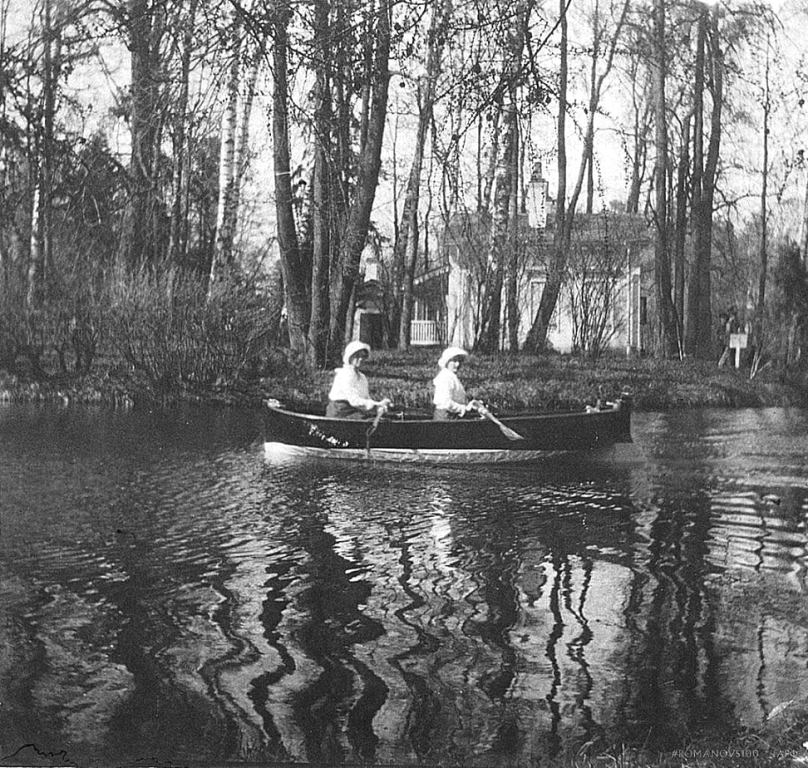
    The tiny pavilion was constructed in the Empire Style in 1830, according to a design by the architect Alexei Gornostayev (1808-1862). The pavilion had two entrances, one of which had a white wooden awning and porch, neither of which has survived.

    PHOTO: Two of the grand duchesses paddling on the pond which surrounds the island. You can clearly see the white awning and porch, neither of which have survived

    The interior consisted of a drawing room, complete with two white ceramic tile fireplaces, the ceilings painted in the Empire Style, and parquet floors decorated with beautiful carpets. Four furnished smaller rooms adjoined the drawing room.

    In 1904, the pavilion was wired for electricity, a telephone was installed with a direct line to the Alexander Palace.

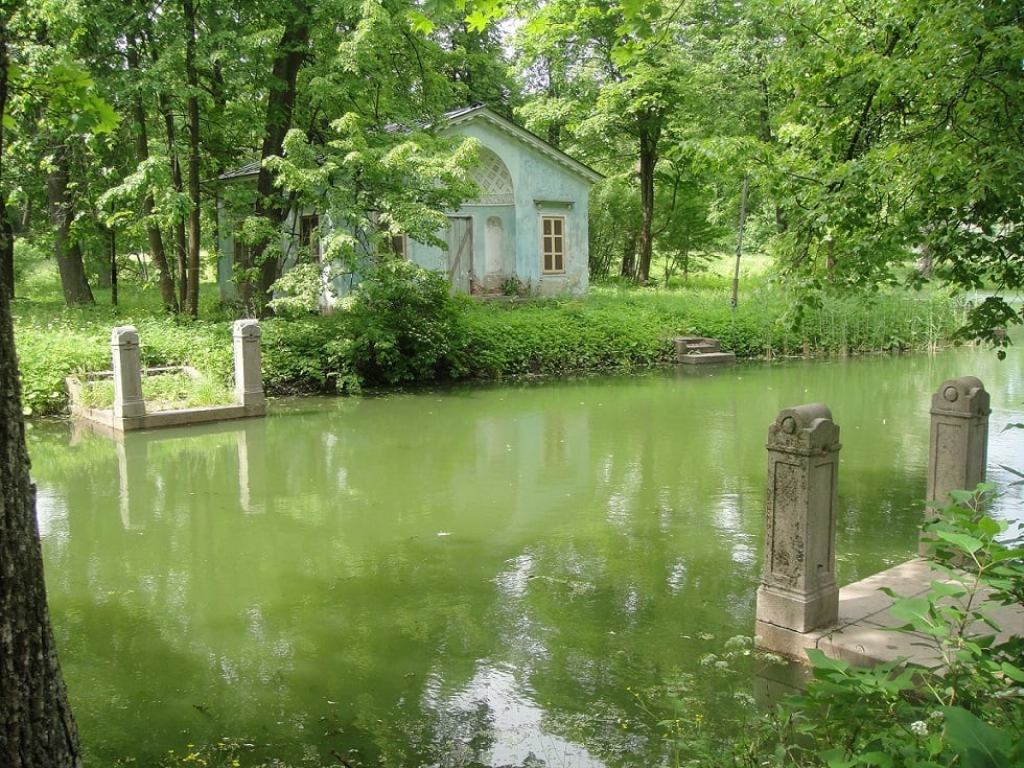
    The island was separated from the mainland, with small granite pier on each side. From the shoreline, the island could be reached by a pull-ferry, whereby sailors would pull ropes sending the ferry and its passengers over to the island and back.

    For nearly a century, the island and pavilion became a summer refuge for the children of four successive emperors: Nicholas I, Alexander II, Alexander III and Nicholas II.

    While the Children’s Island was off-limits to adults, it was in fact enjoyed by all generations of the Imperial family. In April 1895, Nicholas II and his young wife “got up early and sat a long time at the Children’s Island, enjoying the weather.” A few days later the young couple, took a small boat through the channels of the Alexander Park, “peaceful…drank tea together on the Children’s Island. The happiness is indescribable.” In April 1896, Nicholas II wrote in his diary: “I worked at the Children’s Island in the snow.”

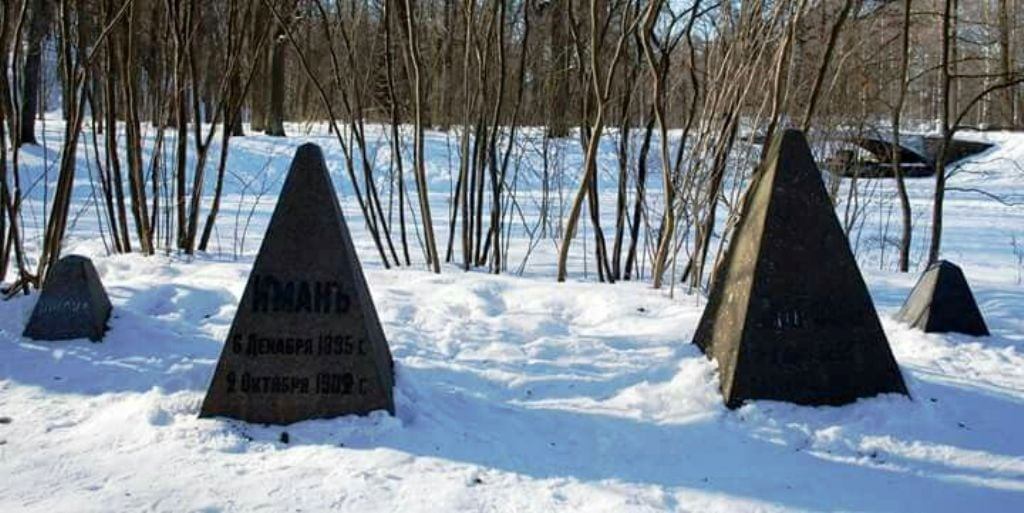
    PHOTO: The pet cemetery, consisting of four graves is situated on the western side of the island

    In the late 19th century, the Imperial family built a cemetery on the western side of the island, where they buried their beloved canine companions. The gravestones have survived to this day.

    The names and dates of each of the family dogs are still clearly visible:

    Шилка ▪ Shilka
    1894-1910
    Иманъ ▪ Iman
    December 6, 1895 – October 2, 1902
    Воронъ ▪ Voron
    December 1889 – September 1895
    Эра ▪ Era
    1894 – 1906

    Click HERE to read my article Nicholas II’s canine companions, originally published on 22nd May 2021

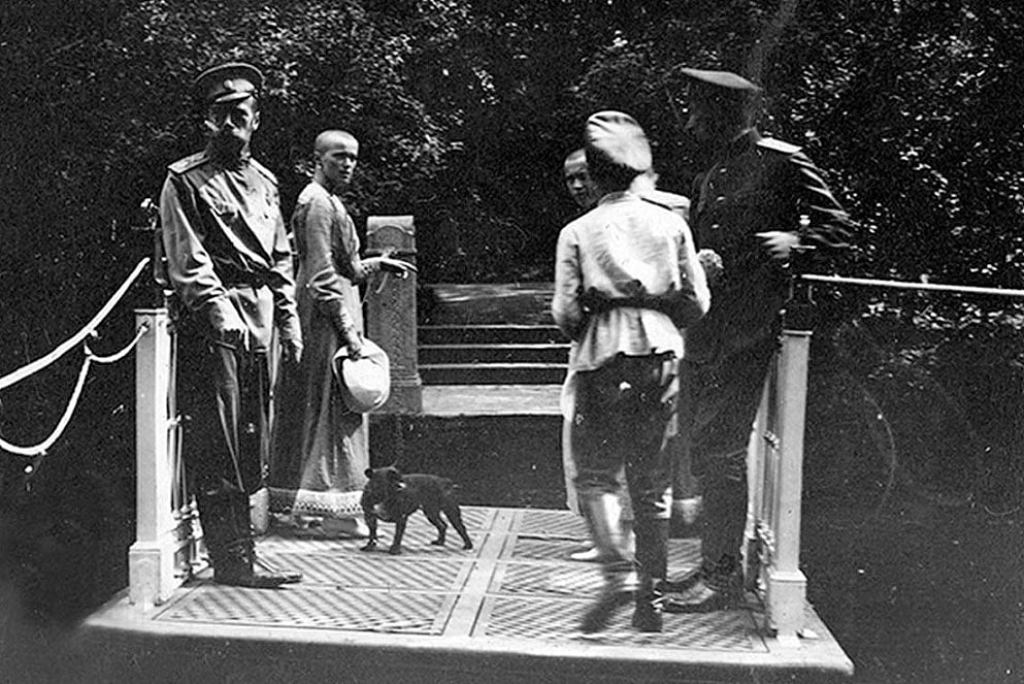
    PHOTO: Emperor Nicholas II, Tsesarevich Alexei, two of theGrand Duchesses, an unknown soldier, and one the family dogs a black Boston Terrier, travelling across to the island on the pull-ferry. This photo was taken during the Imperial family’s house arrest in the Alexander Palace in 1917. The family’s freedom was restricted within the Alexander Park.

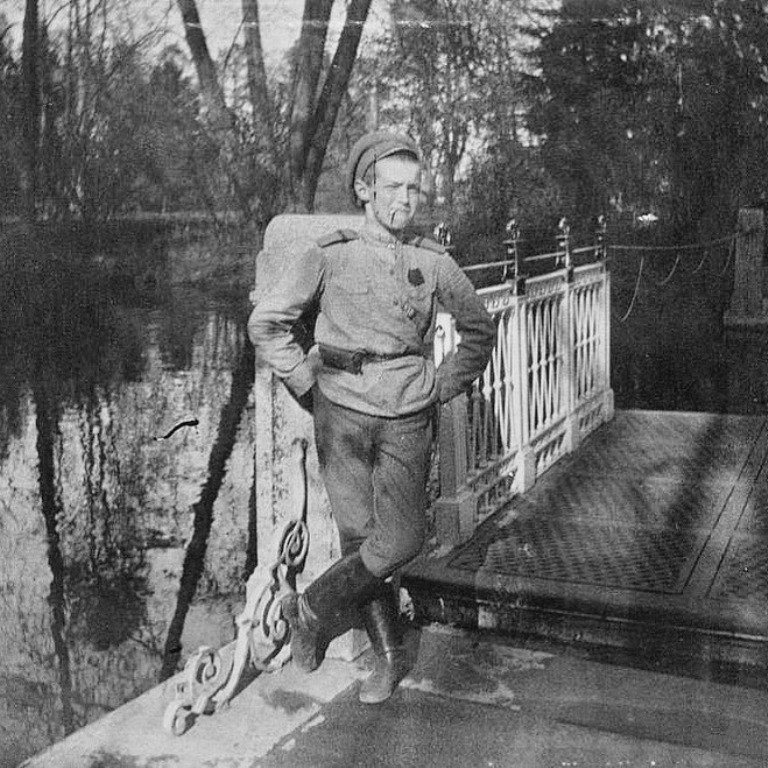
    PHOTO: Tsesarevich Alexei Nikolaevich, posing with a cigarette in his mouth, while leaning against the granite pier and pull-ferry, during the Imperial Family’s house arrest in 1917

    Even after their father’s abdication in March 1917, and the restrictions placed on them during their house arrest at the Alexander Palace, the children still visited the Children’s Island. “Papa walks on the outer reaches of the garden where they chop and saw dry trees. Alexei plays on the Children’s Island, runs barefoot and sometimes swims,” wrote Grand Duchess Olga to her friend, Pyotr Petrov, 19th June, 1917.

    PHOTO: The current state of the Children’s Island, which shows the dilapidated state of the pavilion, the doors and windows boarded up. The granite piers are overgrown with weeds, the pull-ferry long gone

    The Children’s Pavilion has sat in a terrible state of decline and disrepair for decades. In the 1990s, it became a popular hangout for the homeless and drug users. They left the interiors in a horrid state. The pavilion has since been boarded up. According to Ekaterina Eparinova, a research historian at Tsarskoye Selo, the palace-museum have plans to restore the island and pavilion once they can secure funding.

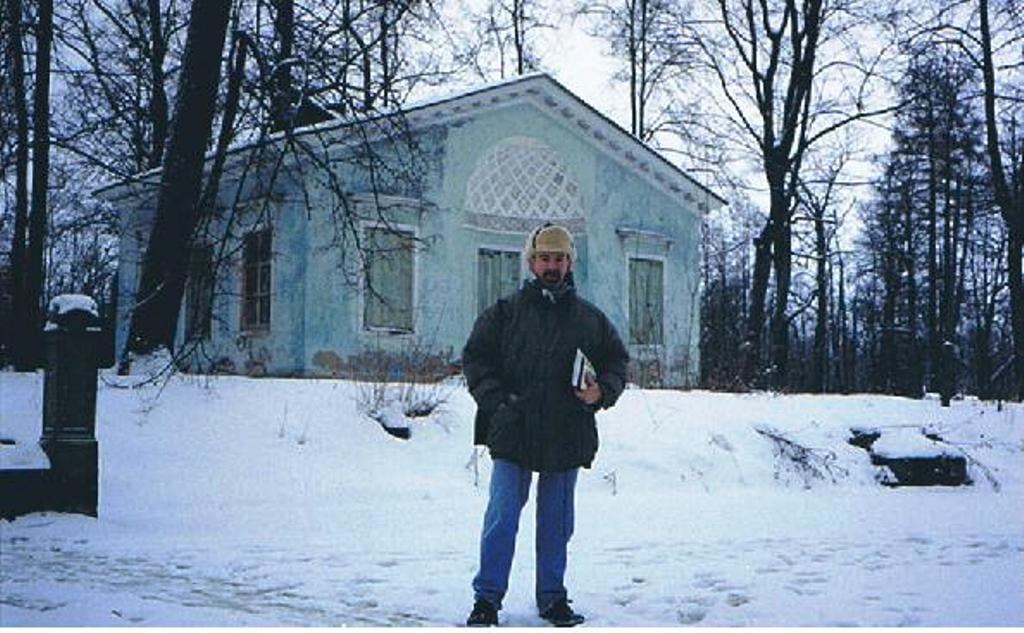
    PHOTO: Paul Gilbert standing on the frozen pond, between the shoreline and the island. What a marvellous experience it was for this author to explore the island, pavilion and cemetery

    During my winter visits to Tsarskoye Selo, I have on two occasions walked across the ice and explored the Children’s Island and Pavilion. I took many photos of the Pavilion, as well as the pet cemetery, some of which I in ‘Royal Russia’ No. 4 (pgs. 1-10) in 2013.

    © Paul Gilbert. 16 October 2022