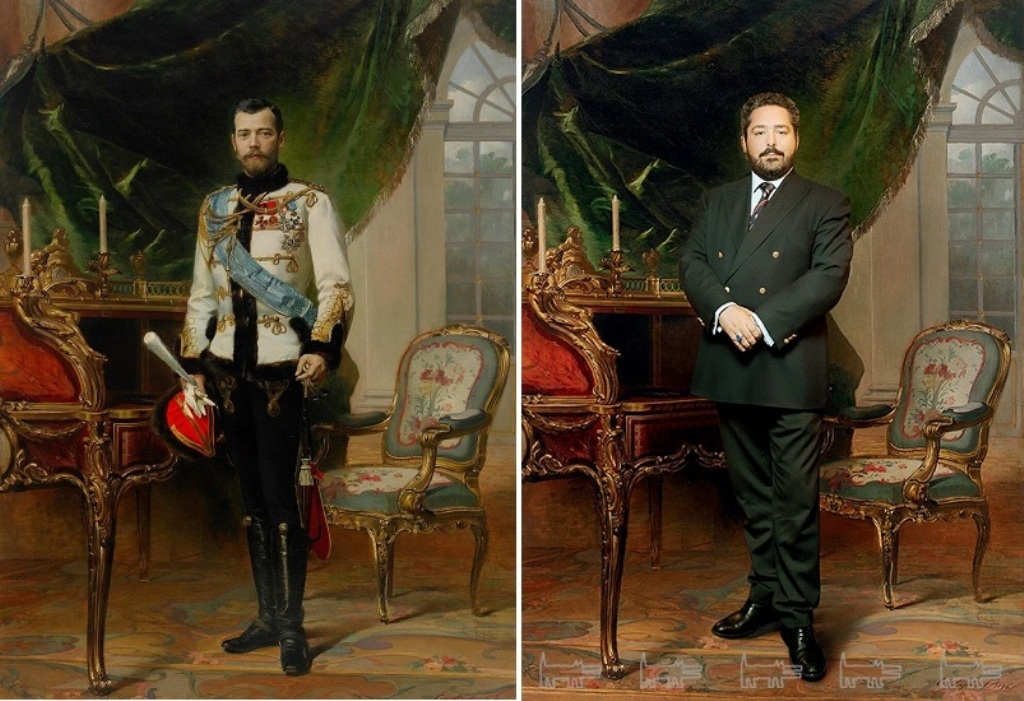
Someone has gone to a lot of trouble to photoshop Emperor Nicholas II out of this portrait, and replace him with the pompous and arrogant Prince George “Gosha” Mikhailovich Hohenzollern[1].
When I posted this dual image on my Facebook this morning, it caused outrage by more than 300 friends and followers, and more than 100 angry comments: “an abomination!”, wrote Elena Abramushkina, from Moscow.
While it is very doubtful that “Gosha” consented to this forgery, surely even he would agree that the image insults the memory of Russia’s last Emperor and Tsar?!
The ceremonial portrait of the Emperor was painted in 1914, by the famous Russian artist Ernst Karlovich Lipgardt (1847-1932).
During his years in St. Petersburg, Lipgardt painted at least ten portraits [known to this author] of Nicholas II. Lipgart was also a gifted decorater, taking on projects such as the palaces and theatres in the capital, including the stage curtain in the Hermitage Theatre.
He also took on more unusual requests, including decorating menus for the Nicholas II’s coronation in Moscow in May of 1896. He also painted 100 figures on a piano, telling the story of Orpheus. The piano was a present from the Tsar to Empress Alexandra Feodorovna.
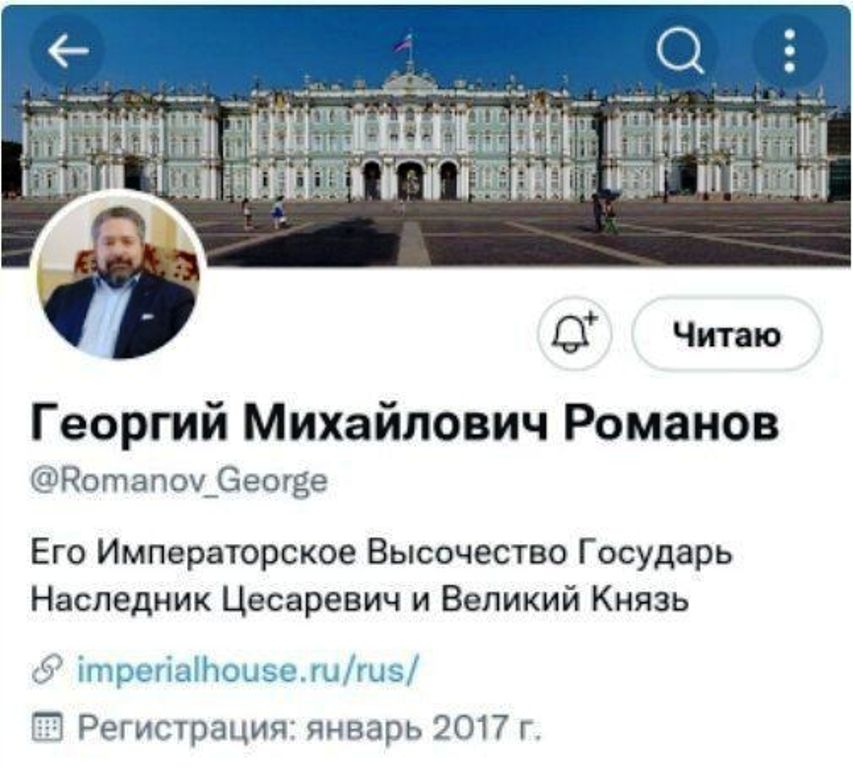
“Gosha” is the son of Princess Maria Vladimirovna[2], one of two claimants[3] to the non-existent Russian throne. He styles himself as Его Императорскому Высочеству Государю Наследник Цесаревичу и Великому Князю / His Imperial Highness Sovereign Heir Tsesarevich[4] and Grand Duke. In reality, he is nothing more than a Spanish-born businessman, who now lives and works in Moscow.
American Legitimists continually mislead others with claims that “Gosha” and his mother are very popular in Russia these days, however, nothing could be further from the truth!
The idea of restoring monarchy in post-Soviet Russia is not popular with most Russians. In the summer of 2019, a poll conducted by REGNUM of some 35,000 Russian citizens showed that only 28% supported the idea of restoring the monarchy, more than half (52%) of which would NOT support placing a “Romanov” on the throne!
Furthermore, according to the abbot of the Archangel Michael Monastery of the Alexander Diocese of the Russian Orthodox Church, Father Afanasy Selichev: “If we carefully read the latest edition of the law on succession to the throne, it becomes absolutely clear that the current Romanovs have no right to occupy the Russian throne.”
NOTES:
[1] George is the son of the Prussian Prince Franz Wilhelm of Hohenzollern [born 1943], and a great-grandson of Emperor Wilhelm II (1859-1941). He is legitimately a German prince, and has much more rights to the German throne than that of Russia. But George, albeit very conditional, is still Romanov on the female side, it is absolutely unrealistic to imagine that Russia, would ever accept him as their Tsar.
[2] Maria Vladimirovna is a Princess, not a Grand Duchess. The last grand duchess of Russia was Nicholas II’s younger sister Olga Alexandrovna, who died on 24th November 1960, in Toronto, Canada.
[3] The other claimant is the lesser known grandson of Grand Duchess Maria Kirillovna (1907-1951) Prince Nikolai Kirillovich, Prince of Leiningen (born 1952). Both he and Maria Vladimirovna are direct descendants of Grand Duke Kirill Vladimirovich – the traitor to Nicholas II. Neither one of them have any legal claim to the Russian crown.
[4] The title “tsesarevich” is most often confused with “tsarevich”, which is a distinct word with a different meaning: “Tsarevich” was the title for any son of a tsar, including sons of non-Russian rulers accorded that title, e.g. Crimea, Siberia, Georgia, whereas “Tsesarevich” was the title reserved for the heirs of the Emperors of Russia after Peter I.
“Gosha’s” use of the title “Sovereign Heir Tsesarevich” implies that he is heir to the Russian throne, which of course, he is not!
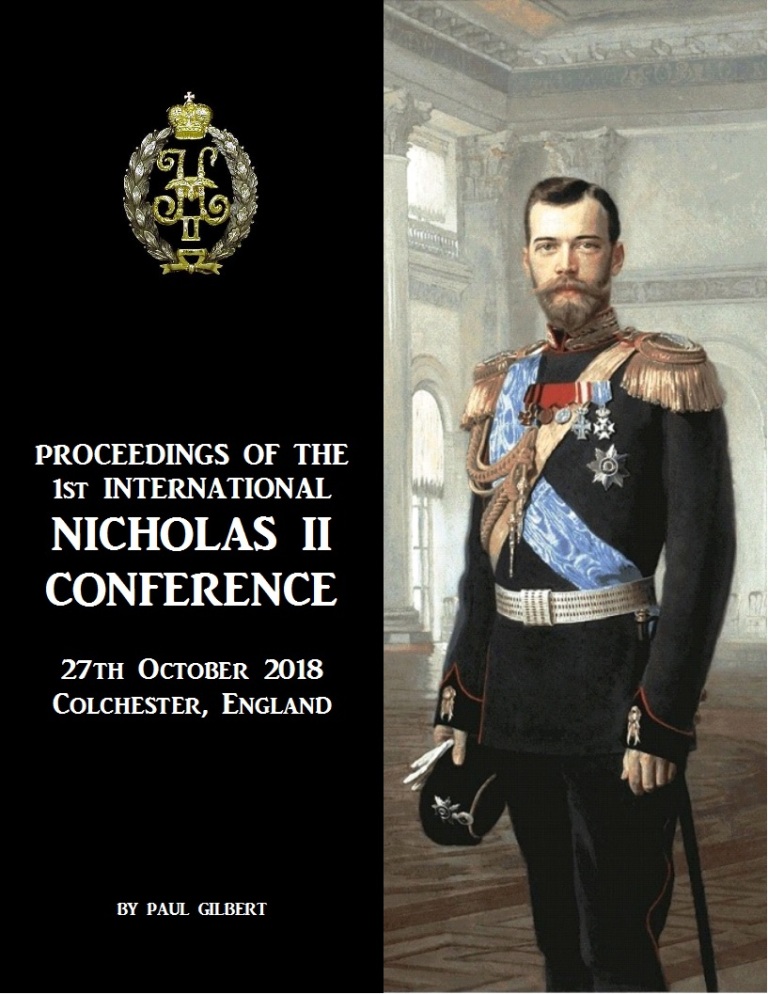
I am pleased to offer the proceedings of the 1st International Nicholas II Conference, in both hard cover and paperback editions, available exclusively from AMAZON.
The original edition of these proceedings published in 2018 is out of print. This NEW edition, has been revised and updated, featuring three additional articles, plus a comprehensive bibliography featuring more than 100 English-language titles on the life, reign and era of Russia’s much slandered Tsar.
In addition, this new edition also features full-colour photographs of the event, illustrated with 50 colour and black and white photographs.
* * * * *
In the autumn of 2018, people from nearly a dozen countries gathered in Colchester, England for a conference marking the 150th anniversary of the birth and the 100th anniversary of the death martyrdom of Russia’s last Tsar.
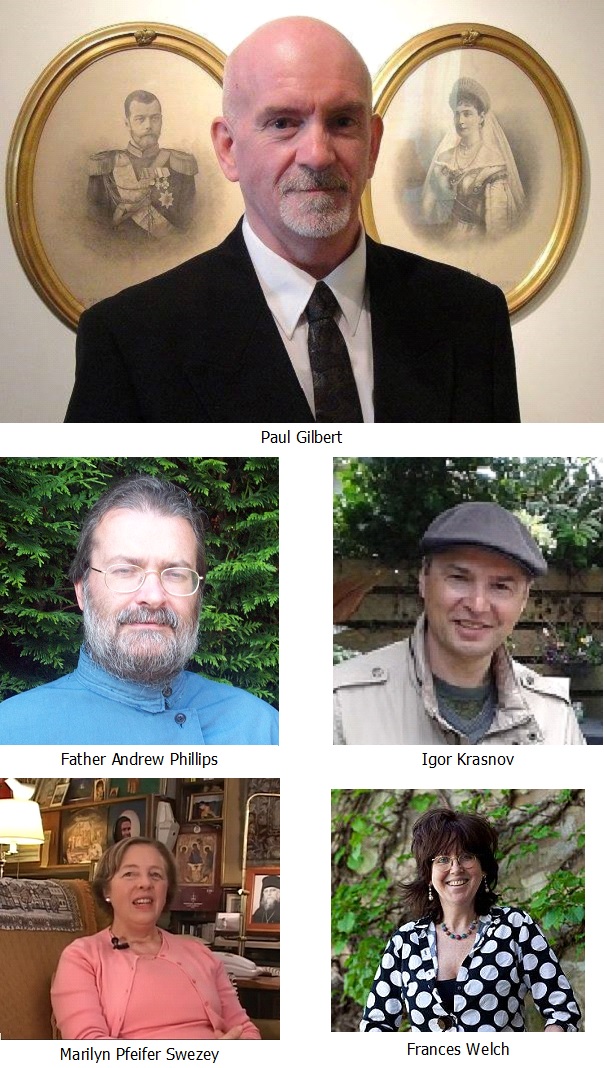
Five speakers, including Paul Gilbert, Archpriest Andrew Philips (ROCOR), Nikolai Krasnov, authors Frances Welch and Marilyn Swezey presented seven papers on Nicholas II.
Lectures included “A Century of Treason, Cowardice and Lies,” “Why Nicholas II is a Saint in the Russian Orthodox Church,” “Nicholas II and the Sacredness of a Monarchy,” “Nicholas II in Post-Soviet Russia,” among others.
The Grand Duchess Elizabeth Romanov Society UK were kind enough to provide 10 exhibit banners from the society’s mobile exhibition Romanovs During the First World War: Charity and Heroism. Click HERE to read a short summary of the Nicholas II Conference, held in Colchester, England on 27th October 2018.
I can truly understand why some people get so fed up with the drama acted out by narcissistic trolls on Facebook and other social media outlets. During the past 30 years of researching and writing about the history of the Romanov dynasty and Imperial Russia, my name and work have been a regular target for their nasty comments and criticisms. As far as I was concerned, most of these criticisms were water off a duck’s back. Having said that, however, I was forced to grow a thick skin against some of the more hostile attempts to discredit my work.
While Dodinsky’s comments above are indeed true, they also beg the question: where exactly is one expected to draw the line between constructive criticism and outright libel and slander, made by toxic narcissictic social media trolls?
Last month, it came to my attention that Nick Nicholson, had accused me of “ripping off” Romanov writer Helen Azar, and even going as far as accusing me of committing “plagiarism” of all things!
Not only did Nick tell an outright lie, he also committed libel in the process. Given that many people who follow me on Facebook, also follow either Helen and/or Nick, I decided to take the matter in hand and set the record straight once and for all.
Nick was referring to my article What kind of ice cream was served to Nicholas II?, which I published on my Nicholas II blog on 2nd August 2022. It was this article, which he claims I “ripped off” from Azar. The idea for this article was in fact inspired by a short article, which I found on Russian media: Какое мороженое подавали Николаю II?, published on 20th July 2022.
Nick’s post on Helen Azar’s Romanov Facebook group generated a flurry of nasty comments by Helen Azar and Marlene Eilers-Koenig, among several others. Nick continued to fan the flames, from which a flurry of spiteful jibes ensued, many of them made by Azar herself. Nick even referred to me as “a jerk”. Trust me, when I tell you that I have been called much worse, and by better people.
Such immature and childish behaviour by this trio of toxic trolls is nothing short of pathetic! I suppose I should take some solace in knowing that by attacking and bullying me on social media, they spared some other poor soul of their toxic behaviour.
I think what was most hurtful and disappointing was to discover that several of my so-called FB “friends” took part in Nick’s attack. Needless to say, I “unfriended” them.
I am not quite sure what Helen’s problem with me is, as I have never had anything to do with this egotistical woman. I have never taken any interest in her work, never followed her on Facebook, nor have I ever purchased or promoted any of her books. Quite frankly, I find her crude and vulgar, I don’t like her, and never have.
Back in the days when I administered my popular Royal Russia Facebook group – which at its peak had more than 175,000 followers – Helen took numerous liberties by posting and promoting herself on my FB page without my permission. Perhaps my rebuff and my declining her friend requests over the years was reason enough for her to belittle me and my work?
As far as Marlene Eilers-Koenig goes, I have no idea why she decided to stick her oar in the water? This toxic woman has been around for a long time, and is well known for her acid tongue and poison pen. I, like so many others, absolutely despise her.
Getting back to Nick’s post, which he later deleted [I made a copy of the post beforehand], and then issued an apology to Azar’s Romanov group, citing that he did so because he did not think it proper to encourage an “argument” on a group page. Another lie, to spare himself further embarrassment. The post was in fact removed by Facebook, because I reported it! My action then prompted Helen Azar to block me from her Romanov Facebook page.
Nick Nicholson is well known among the tightknit “Romanov circuit” on Facebook and other socia media. From April 2020 to September 2021, he served as Curator of the Russian History Museum in Jordanville, NY. In addition, he serves on the Board of Directors of the Russian Nobility Association In America.
Nick has had an axe to grind against me ever since I terminated our friendship of many years in April 2018. I unfriended and blocked him from my Facebook page, simply because I was sick and tired of his patronizing and condenscending attitude towards others. He has now made it his mission to discredit both myself and my work at every opportunity, and to any one who will lend him an ear. Helen Azar is no better.
Nick Nicholson is NO gentleman! In addition, his slanderous attacks against me are unbecoming of the good and caring Orthodox Christian, which he so desperately tries to portray to others. Quite frankly, I am so tired of people like Nick Nicholson, running around with a mouthful of scripture and a heart full of hate. May God forgive this man for his behaviour.
So, let me conclude by saying, I believe that my record of 30+ years speaks for itself. Not every one has to agree with my articles and posts, but that does not give them any right to attack me or my work on social media. Most people would tell me to ignore them, but again, and in my own defence, just where does one draw the line?
Dear reader, if you read any further toxic posts penned by Nicholson or Azar, I respectfully ask that you first give me the benefit of the doubt, and then to look at the source of these nasty spiteful comments: if you didn’t hear it from the horse’s mouth, stop listening to the ass who told you! And always remember . . . rumours are carried by haters, spread by fools and accepted by idiots.
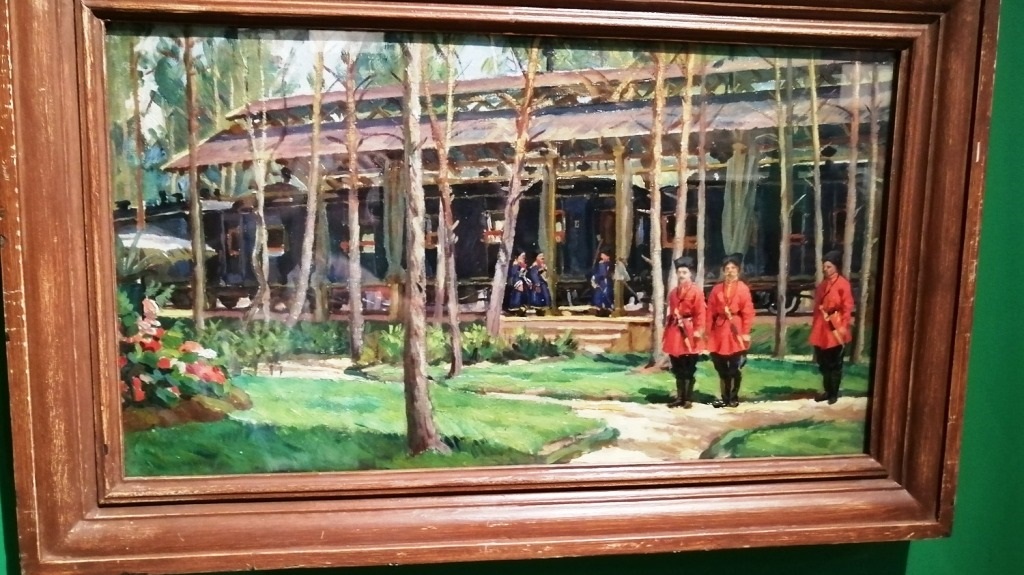
PHOTO: the Imperial Train at the specially built station at Mogilev. Artist unknown. From the Collection of the Tsarskoye Selo State Museum
In August 1915, after the German advance, the Headquarters [Stavka] of the Supreme Commander-in-Chief, was re-located from Baranovichi to Mogilev. The following month, September 1915, Emperor Nicholas II assumed personal command of the Russian Imperial Army, after dismissing his cousin, Grand Duke Nicholas Nikolaevich from the post.
In the years 1915-1917, Nicholas II spent long periods at the Stavka in Mogilev. He would arrive on the Imperial Train, which made frequent journeys back and forth between Tsarskoye Selo and Stavka.
With the outbreak of World War I, the number of carriages of the Imperial Train was reduced to three. The Imperial Train became both a travelling residence for the Emperor, as well as a military field office, equipped with telephone and telegraph communications.
PHOTO: the Imperial Train set in a pine grove near the Stavka near Mogilev. Nicholas II often went for walks in the surrounding forest, with walking stick in one hand, a cigarette in the other.
As the Imperial Train approached Mogilev, it was diverted to a separate branch line and station, specially constructed for the Imperial Train. It was from this station, that the Emperor and his retinue traveled by motorcar to General Headquarters – where Nicholas II lived, often with his son Tsesarevich Alexei – in Mogilev and back.
The location of the branch was determined by the fact that the forest masked the train from German bombers. The entire area surrounding the station was heavily guarded by police agents and gendarmes.
Trees were felled, and a wooden platform and protective roof were constructed on a privately owned pine forest just north of Mogilev. Pathways and landscaped gardens were laid out, as well as the installation of electric lighting for the tracks, water supply, sewerage, telephone and telegraph wires.
As Prince Michael of Greece notes in his pictorial album ‘Nicholas and Alexandra: The Family Albums‘: “It creates a romantic picture to see these luxurious wagons appear between the vertical tree trunks”.
The special branch line and station for Nicholas II’s Imperial Train at Stavka were both destroyed during the Great Patriotic War (1941-45).
To learn more about the Imperial Train of Nicholas II, please read my article – with photos – The fate of Nicholas II’s Imperial Train, published on 12th January 2021
I have not offered any new book titles through my AMAZON Bookshop – specializing in books on the life, reign and era of Nicholas II – since April. My cancer diagnosis in April, surgery in May, and chemo treatment since, pretty much brought my work to a grinding halt.
Despite the side effects from the chemo – which on some days leaves me very tired and drained of energy – I am pleased to say, that I am now slowly returning to my writing.
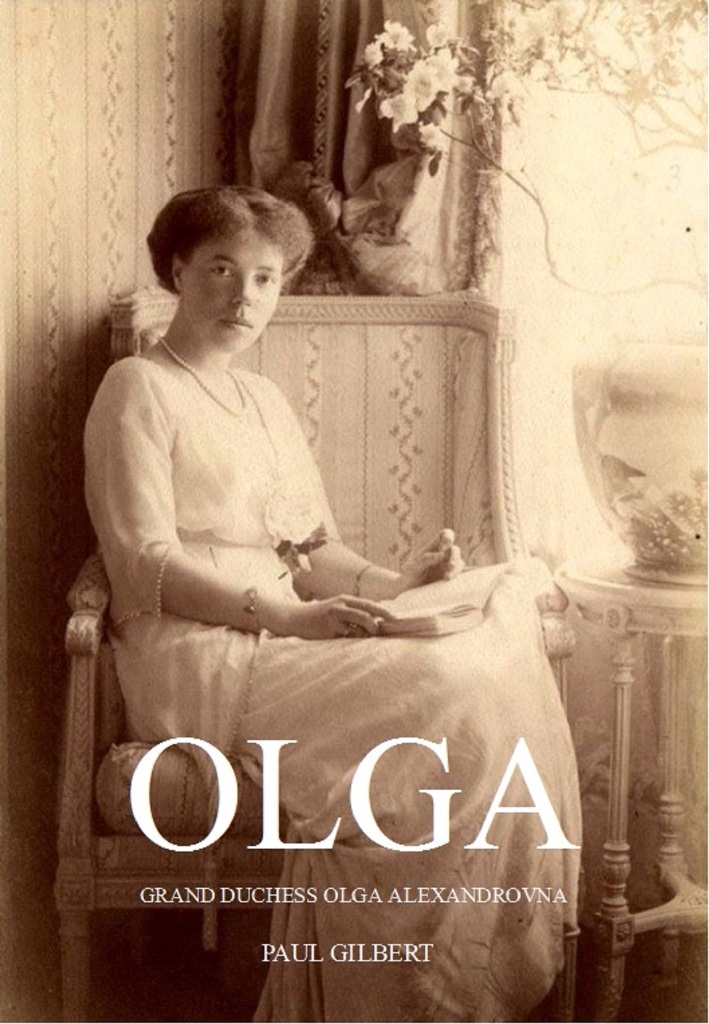
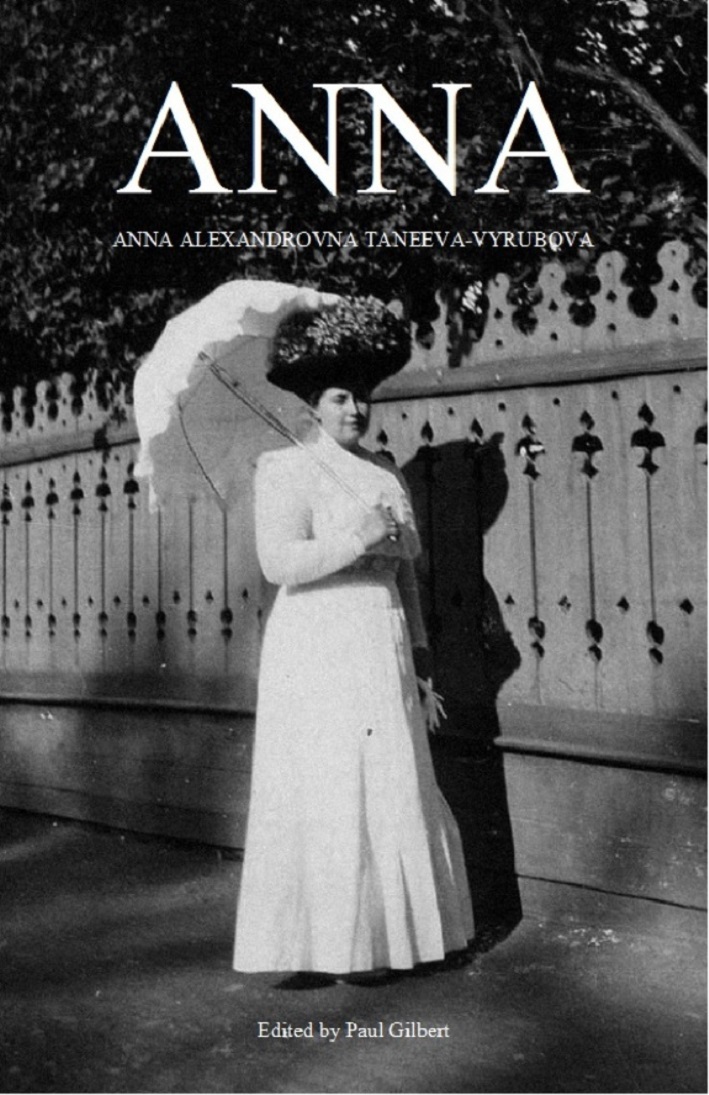
Pending no further health setbacks, I plan on publishing 2 NEW titles in September [with additional titles planned for the remaining months of this year]: one on Grand Duchess Olga Alexandrovna, the other on Anna Vyrubova. Both titles will be available exclusively through AMAZON.
An annoucement will be made here on my blog, my Facebook page, and to those who subscribe to my bi-weekly news updates (by e-mail), when these titles are available.
THANK YOU to all of you who support my work in keeping the memory of the Imperial Family and the history of Imperial Russia alive!
OLGA: GRAND DUCHESS OLGA ALEXANDROVNA Paperback. 148 pages
This book is a tribute to one of the most beloved and respected members of the Russian Imperial Family: Grand Duchess Olga Alexandrovna (1882-1960).
The first part explores her Russian, Danish and Canadian years respectively; the second part explores her love of painting – Olga painted more than 2,000 in her life; the third is about her work and dedication as a nurse during WWI; the fourth is an interview with her daughter-in-law Olga Kulikovsky-Romanoff (1926-2020), who shares her husband Tikhon’s anecdotes and details about his mother: the Grand Duchess of Russia.
Richly illustrated with more than 100 black and white photos
ANNA: ANNA ALEXANDROVNA TANEEVA-VYRUBOVA Paperback. 172 pages
Anna Alexandrovna Vyrubova (née Taneyeva), was born on 16th July 1884. She is most famous as the lady-in-waiting, the best friend and confidante of Empress Alexandra Feodorovna. She also become one of Grigorii Rasputin’s (1869-1916) most influential advocates.
This new book features 7 chapters, including a synopsis of Vyrubova’s memoirs – published in the 1920s; her home in Tsarskoye Selo; an interview with Anna in 1917; her life in exile in Finland; efforts to have her canonized, among others.
Vyrubova died in exile on 20th July 1964, at the age of 80. She was buried in the Orthodox section of Hietaniemi cemetery in Helsinki.
Illustrated with more than 60 black and white photographs
CLICK on the IMAGE above to watch a VIDEO about the Imperial Apartments in the Winter Palace. Duration: 12 minutes, 53 seconds. English subtitles
Please note that this article focuses on specific interiors of Emperor Nicholas II’s private apartments in the Winter Palace, it is part of a larger publishing project I am currently working on, that will feature a more comprehenvive study of this Imperial residence during the reign of Russia’s last Tsar – PG
On his accession, Nicholas II was keen to return to the Winter Palace residence in the capital. The palace architect, Alexander Feodorovich Krasovsky (1848-1918), was entrusted with creating private rooms for the Emperor and his wife, Alexandra Feodorovna. In December 1895 they moved into the Winter Palace and lived there permanently in the winter. Following the events of Bloody Sunday [22nd January (O.S. 9th) 1905], the Imperial Family moved to the Alexander Palace at Tsarskoye Selo, visiting the Winter Palace only for formal ceremonies, banquets and receptions.
Receptions and balls became rare events. The most famous ball held in the Winter Palace during the reign of Russia’s last Tsar was the luxurious Costume Ball, held in two stages on 11th and 13th February 1903. All the visitors dressed in bejeweled 17th-century style costumes. Nicholas II wore the costume of Tsar Alexei Mikhailovich (1629-1676); while the Empress Alexandra Feodorovna wore the costume of his first wife Tsarina Maria Ilyinichna Miloslavskaya (1624-1669).
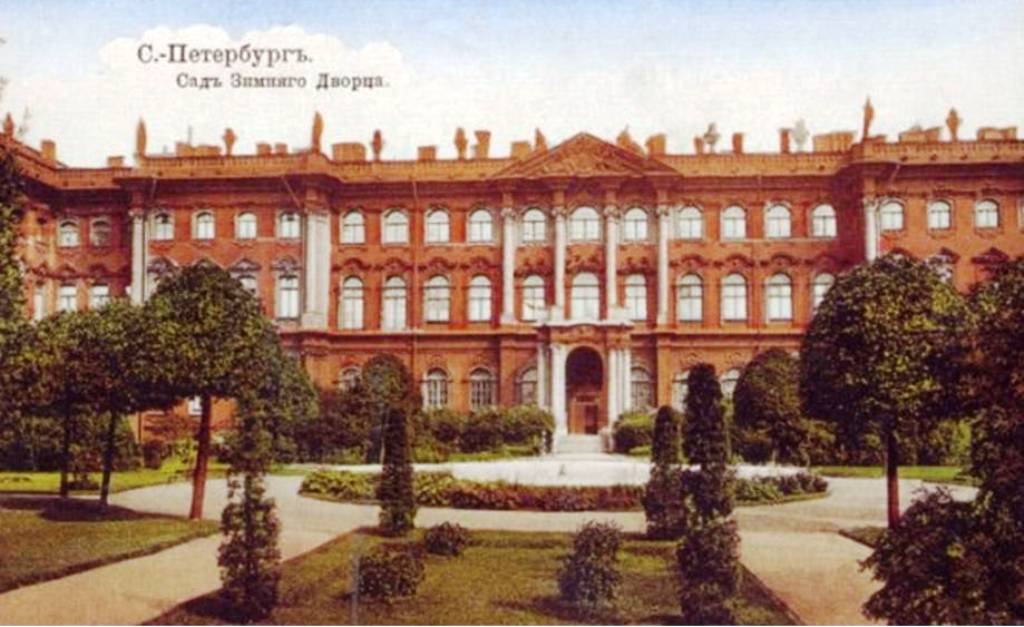
It was in 1897, that Emperor Nicholas II approved the project for a new colour of the facades of the Winter Palace. A brick-red hue was chosen, to match the red sandstone colour of the new fence of Her Majesty’s Own Garden. The Emperor’s decision was carried out in 1901 after the construction of the fence of the garden was completed.
PHOTO: view of the north-western corner block of the Winter Palace and Her Majesty’s Own Garden. The door in the center is the Saltykov Entrance, which led to the private apartments of Nicholas II and Alexandra Feodorovna, located on the 2nd floor
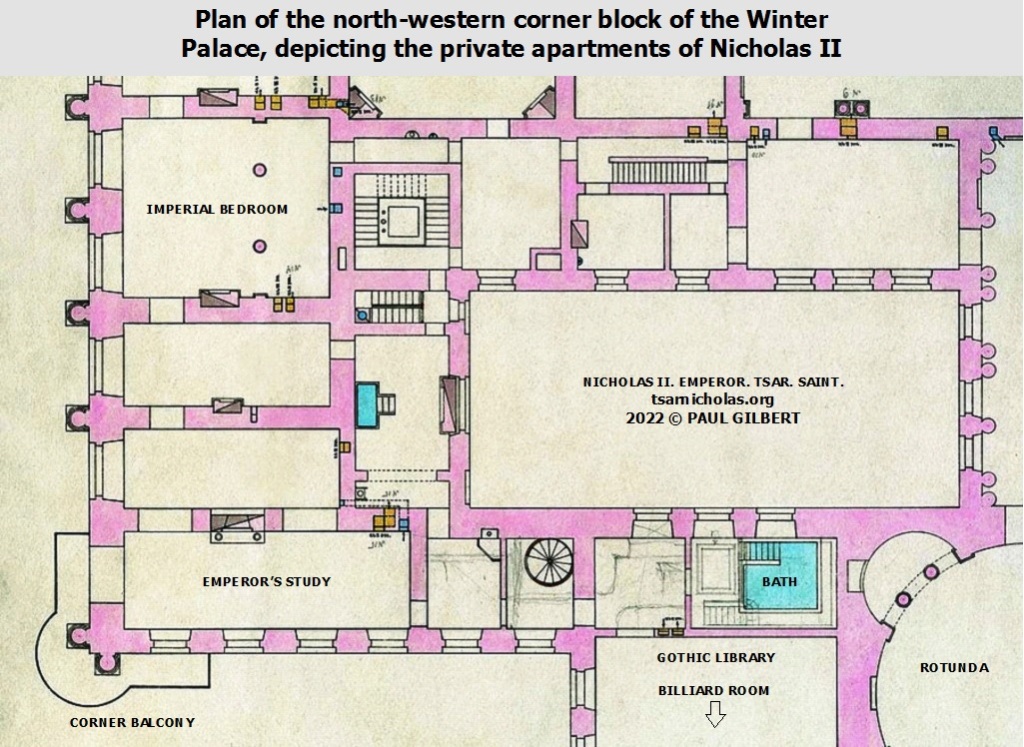
The personal apartments of Nicholas II and his wife were created in the second floor of the north-western corner block, beyond the Malachite Room that was among the state rooms of the palace whose historical appearance was preserved. The rooms which Alexander Bryullov (1798-1877) had decorated for Empress Alexandra Feodorovna (1798-1860) in 1838-39, were converted for Russia’s last Emperor and Empress.
The rooms were a self-enclosed complex, a separate apartment, designed to embody the young couple’s domestic ideal, a cosy, welcoming home. The Emperor’s diaries show that they both devoted much attention to the fitting out of their new apartments. Many of the rooms belonging to Nicholas II were small, narrow, dark and awkward in design, especially the Emperor’s narrow study.
Krasovsky, showed himself to be a master with immense erudition and superb taste. The combination of brilliant historical stylization with Moderne (Art Nouveau) elements made the apartments of the last Russian Emperor’s family a unique work of art. Each room that Krasovsky created was an elegant paraphrasing of the style of a particular historical era.
The second enfilade overlooked the Admiralty, which included the Imperial Bedroom, Nicholas II’s Study, theGothic Library, the Billiard Room, Nicholas II’s private bath, a drawing room, lavatory and a small Checkpoint at the Saltykov staircase. A private garden was created beneath the windows of the Imperial apartments on the site of a former parade ground, surrounded by a high wall topped with decorative iron-grille railings.
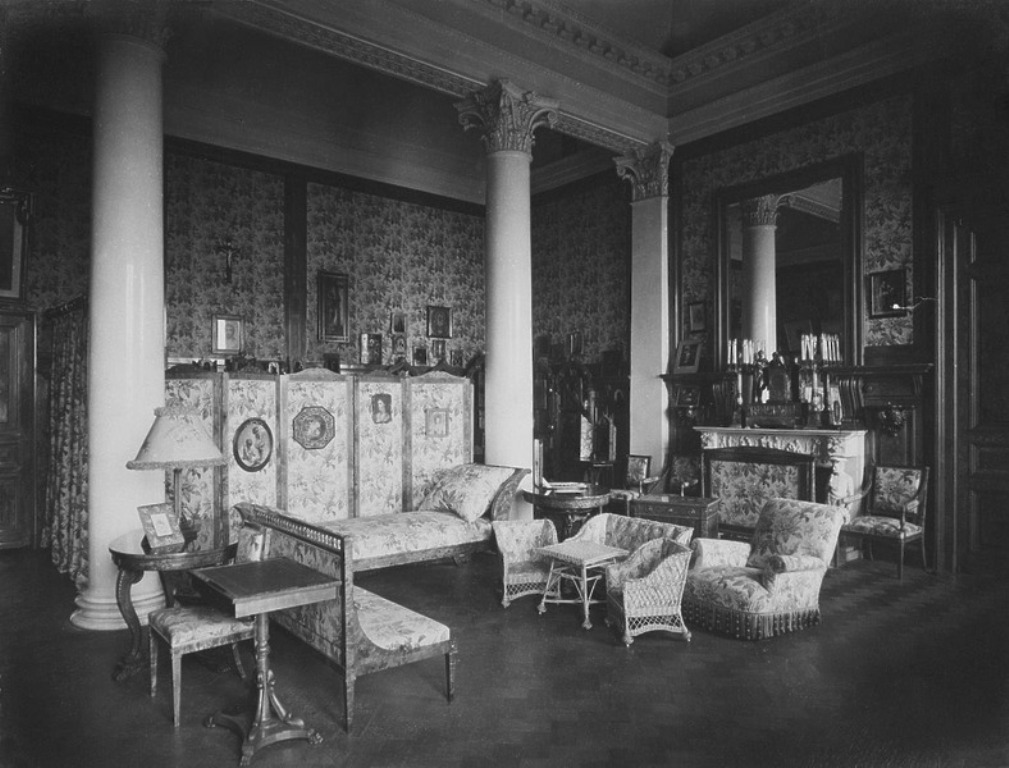
PHOTO: view of the Imperial Bedroom
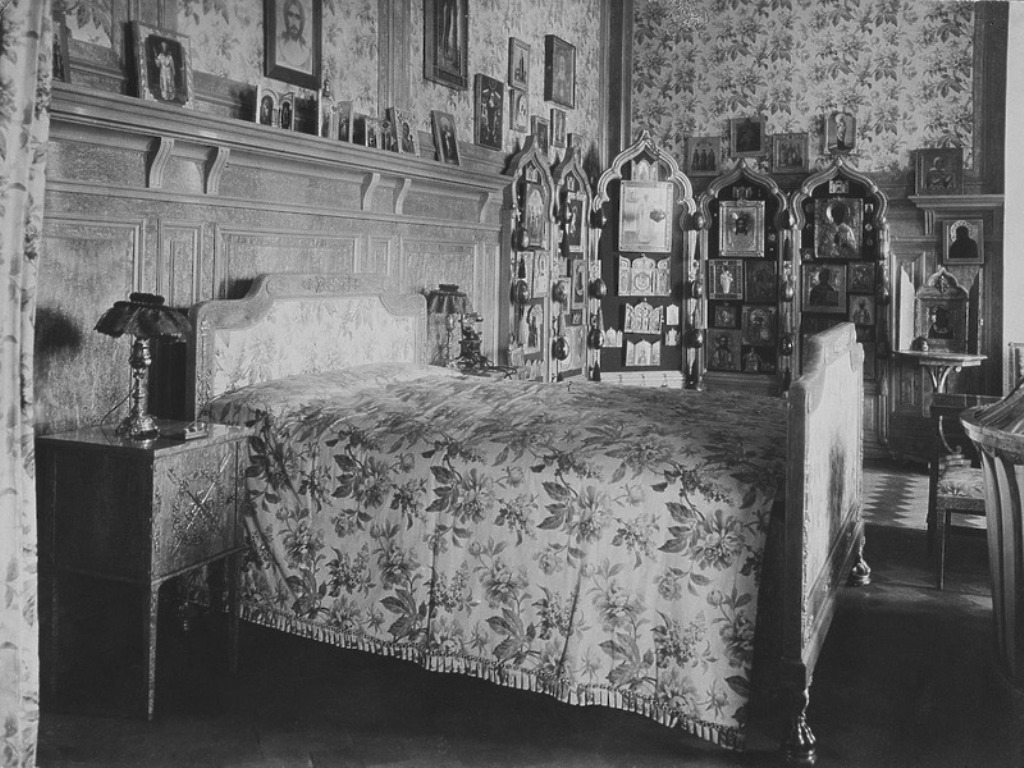
PHOTO: the bed which Nicholas and Alexandra shared, and the icon case
The Imperial Bedroom featured an alcove highlighted by two white stucco columns. The walls were decorated with cretonne, a heavy English cotton fabric featuring red flowers and green leaves. The wall panels and furniture were made of Karelian birch.
A small living room was created in front of a large folding screen which separated it from the alcove. It featured a number of pieces of furniture, including a comfortable sofa and chairs. In addition, where wicker furniture for the children. Alexandra Feodorovna spent many hours here, relaxing on the sofa with a book or needlework, while her children played nearby.
In the alcove, separated from the rest of the room by a folding screen was a large bed – unlike most sovereigns of the day, Nicholas II and his wife shared a bedroom. A large folding icon case – covered with icons – was situated against one wall.
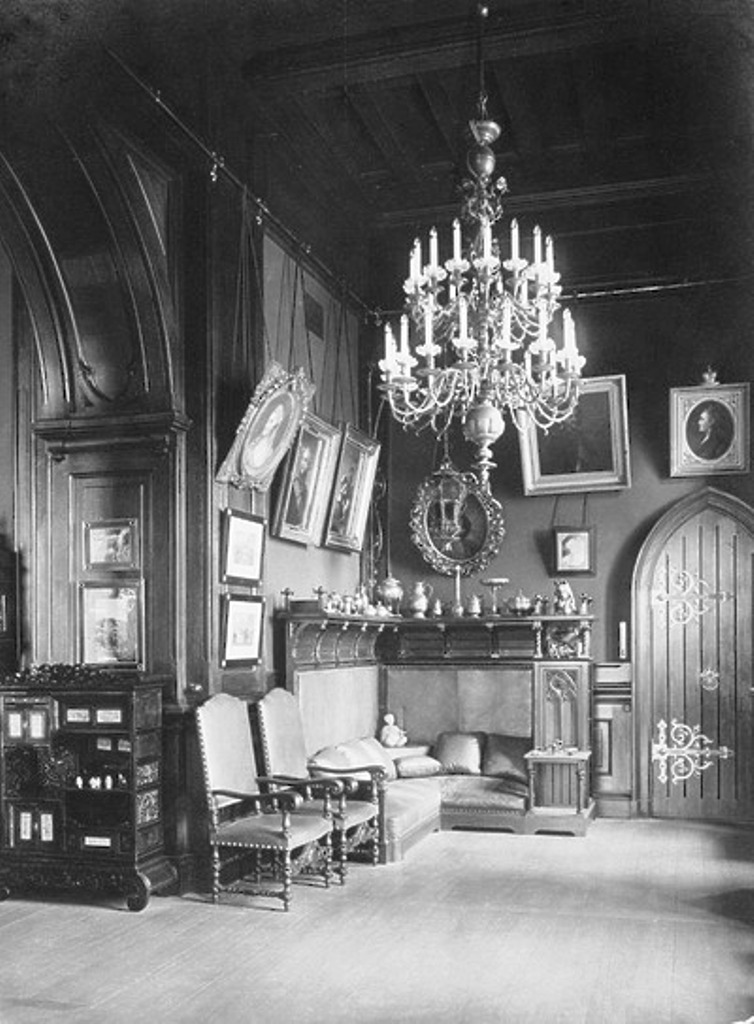
PHOTOS: two views of Emperor Nicholas II’s Study
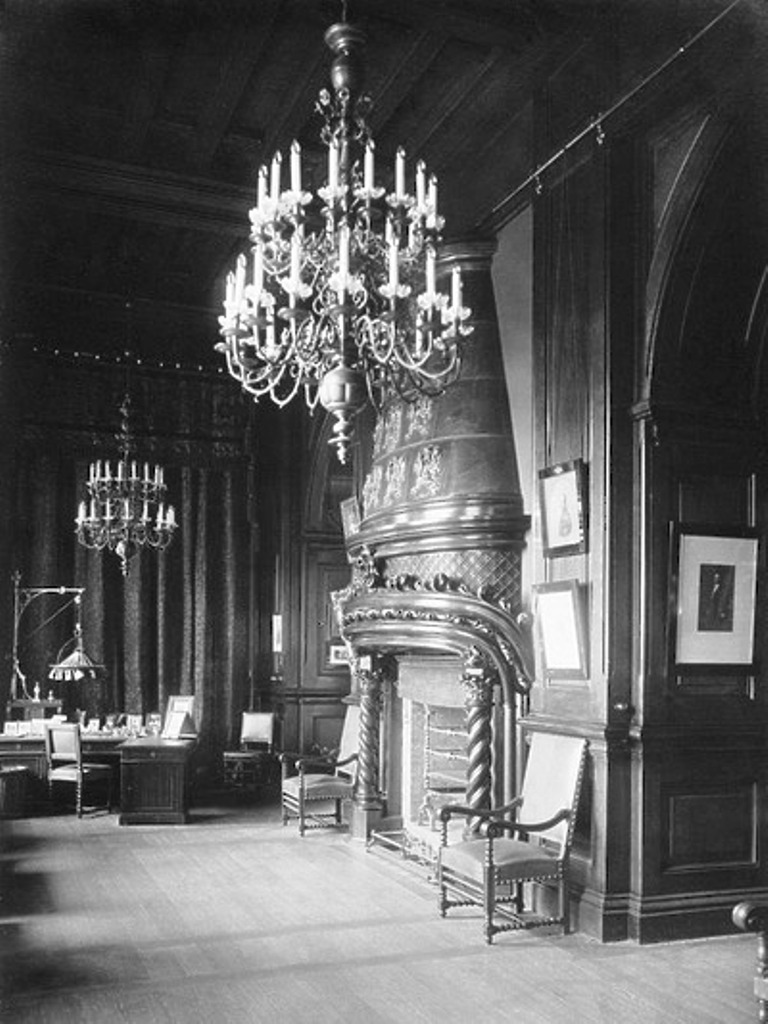
Nicholas II’s Study was arranged in the English Gothic style, decorated with oak. The beauty of the wood was enhanced by the matte surface of the upper part of the walls, painted in an oak colour and the rich green and yellow silk draperies which decorated the double-windows of the interior. The wall between the two arches was decorated with a huge fireplace, the upper part decorated with coloured tiles.
All the details of the interior and the furniture were enhanced with Gothic-style carvings. An important element in in this interior was the Gothic fireplace embellished with griffons and lions, heraldic figures from the arms of the Romanov House and the Hesse-Darmstadt House, to which the Empress belonged.
The Emperor’s desk was decorated with small busts of his grandfather Emperor Alexander II and great-grandfather Nicholas I, and numeroud framed family photographs. The walls were decorated with portraits of Nicholas II’s ancestors. In another part of room stood a piano, which the Imperial couple often played four hands. In the evenings, after returning from the theater, they often had dinner in front of the fireplace.
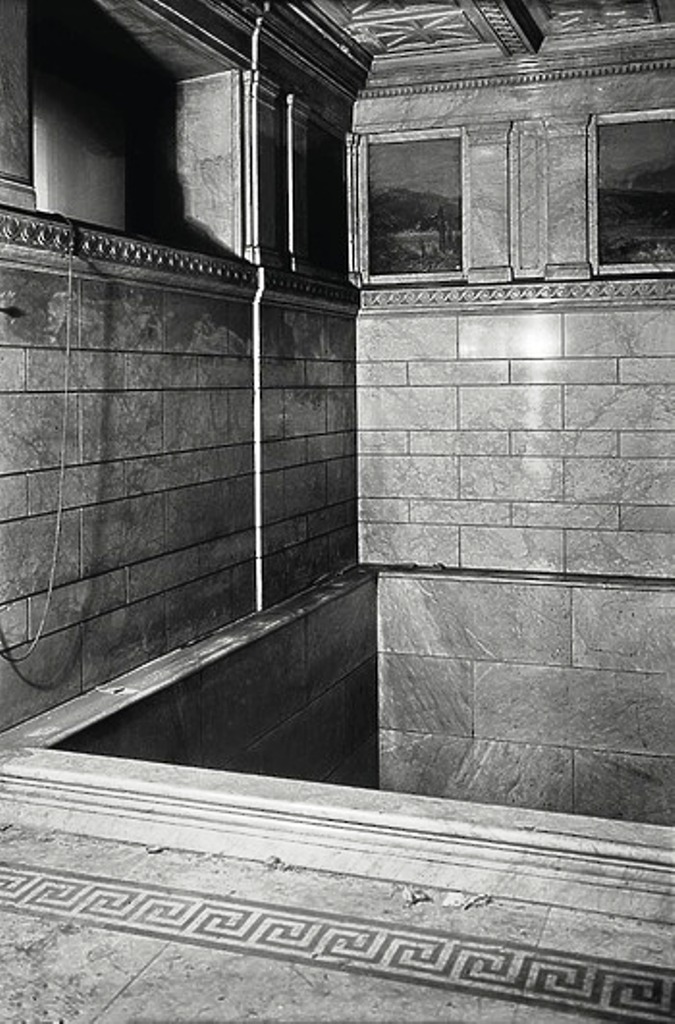
PHOTO: Emperor Nicholas II’s bath, located next to his Study. 1930s
A large marble bath was installed next to the Emperor’s Study. A small staircase connected to the Emperor’s dressing room and his Valet’s room. The pool was a rectangular recess with a marble staircase consisting of 9 steps. There was also an open shower niche and a water closet with a separate door.
In 1898, the size of the pool was increased to a size of 387 [152 in.] x 385 cm [151 in.] and a depth of 159 cm [63 in.]. The architect, Nikolai Ivanovich Kramskoy (1865-1938), who carried out the renovation managed to preserve the original marble wall cladding and frieze design seen in the photo above.
In 1938, Nicholas II’s bath was closed. While some parts of the decoration have been preserved, including the ceiling decoration with the original 19th lamp. It is difficult to ascertain what other elements have been preserved, as this room is today filled from floor to ceiling with shelves on which part of the Hermitage drawing fund is stored.
It is not known, if the bath itself was filled in during the 1930s, or whether it was covered with boards and flooring, just like they did to Nicholas II’s bath in the Alexander Palace at Tsarskoye Selo.
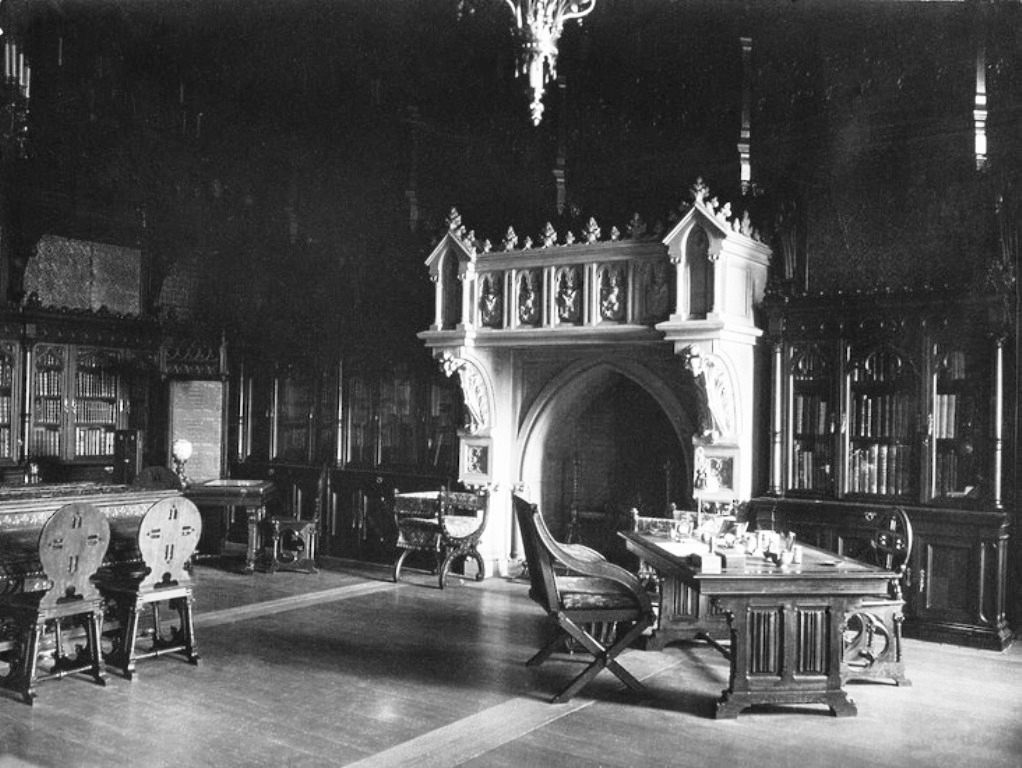
PHOTO: Emperor Nicholas II’s Gothic Library
The Gothic library was the largest room of the suite refurbished for Nicholas II by Krasovsky, who used the same English medieaval style used in the Emperor’s Study. The two-tiered interior, which included the ceiling, the bookcases, the stairs and upper gallery were trimmed with wax-polished walnut. They were decorated with ornaments characteristic of the Gothic style. The walls between the cabinets and the upper gallery were covered with embossed leather. This magnificent decoration was made at the worskhop of Nikolai Fedorovich Svirsky (1851-1915) – supplier to His Majesty’s Imperial Court.
A huge white stone fireplace, reminiscent of a Gothic portal with a frieze dominated the interior. Nicholas and Alexandra liked to spend their evenings reading in front of the fireplace.
Furniture was made in the Gothic style, according to Nabokov’s drawings, which included several tables, the Emperor’s desk in front of the fireplace, chairs and a lectern. A unique smoking table, decorated with gold and diamonds, with a well stocked selection of cigarettes and cigars was a unique addition. In this interior, reminiscent of a medieval hall, the Emperor often received officials.
The interior of the Gothic Library has survived, click HERE to read more about this interior.
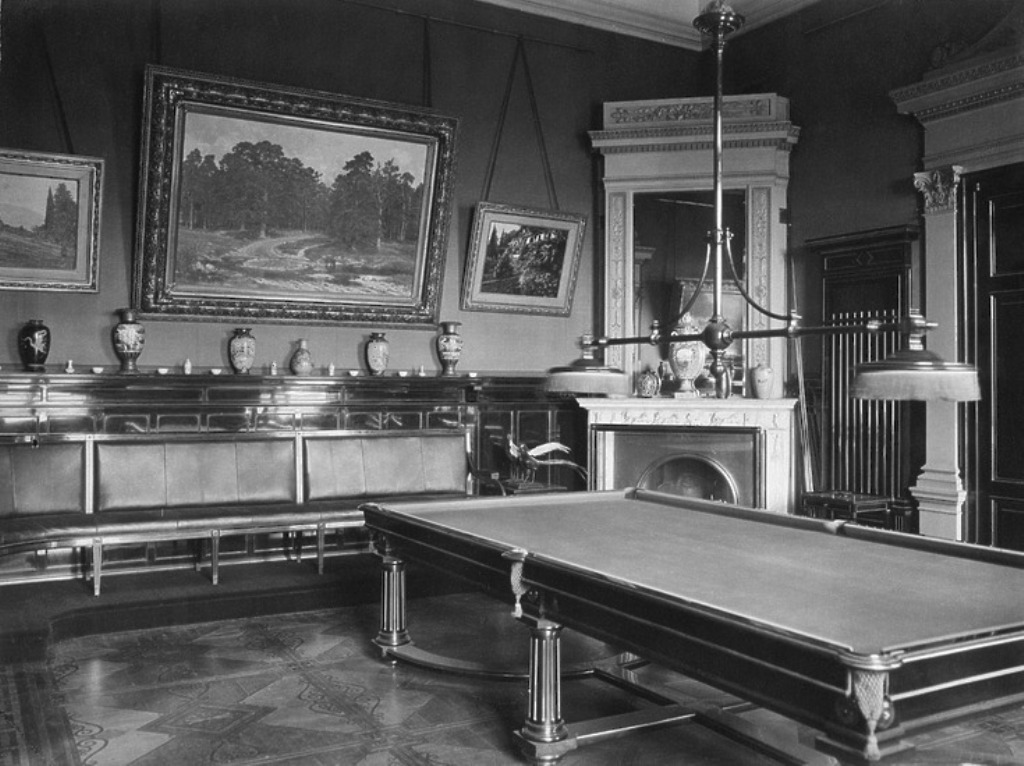
PHOTO: Emperor Nicholas II’s Billiard Room
Nicholas II, like many of his predecessors and relatives loved billiards. Sometimes he played a game or two with his adjutant wing on duty, whose post was in the adjoining Reception Room.
The interior of the Billiard Room was designed in the Neo-Classical style. The doors were framed in the form of portals with pilasters topped with a entablature and acroterium. The classic styled white marble fireplace was decorated with a frieze depicting cupids in chariots. Wall panels, doors and furniture were made of polished mahogany and decorated with copper inserts. Paintings and vases collected by Nicholas II during his Far Eastern journey in 1891-92, decorated the walls and shelves. The parquet floor from the Pompeian Dining Room, created by Alexander Pavlovich Bryullov (1798-1877) in 1838-39, was transferred to this interior.
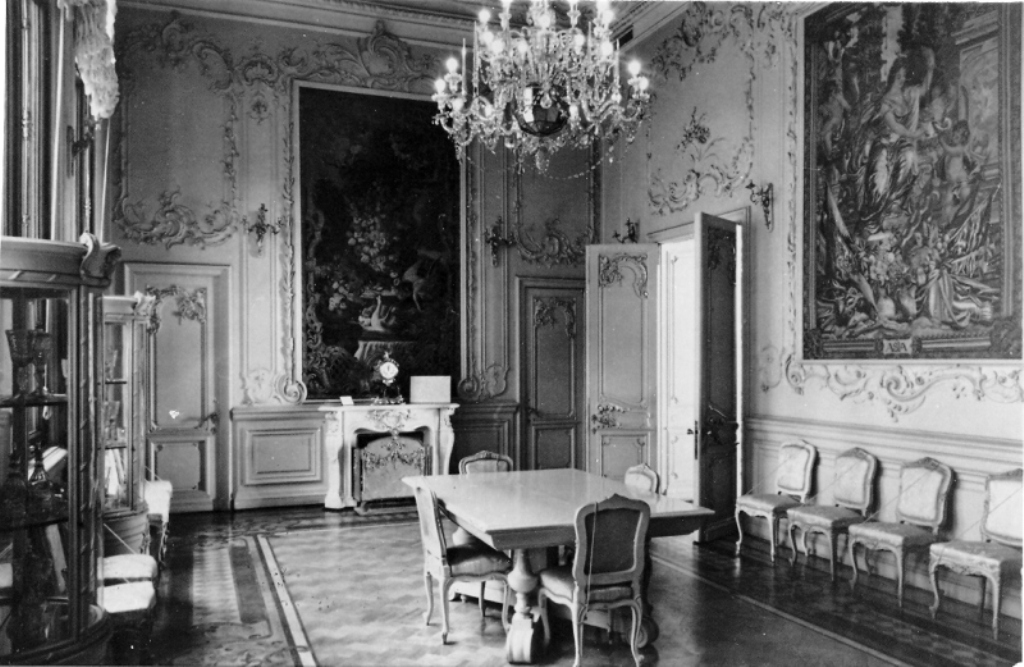
PHOTO: the Small Dining Room
Formerly known as the Pompeian Dining Room, the Small Dining Room was redecorated in 1894–95, by Krasovsky. A rococo plaster-work style was chosen to frame 18th-century St Petersburg tapestries. It was in this room, that Nicholas and Alexandra and their guests gathered for meals. The crystal chandelier was made in England in the 1760s, it was electrified during Nicholas II’s reign.
The hands of the clock on the mantle [seen on the far wall in the photo above] are stopped at 2.10, the time when the ministers of the Provisional Government were arrested in this room, during the early morning hours on 26th October 1917.
The Winter Palace had been the seat of the Provisional Government since July 1917. It’s leader Alexander Kerensky (1881-1970) wasted little time in acquisitioning the Emperor’s Gothic Library for his own personal use.
Following the Government’s arrest in the Small Dining Room, an eyewitness account records a systematic destruction of the apartments by the Bolsheviks:
“The Palace was pillaged and devastated from top to bottom by the Bolshevik[s]…Priceless pictures were ripped from their frames by bayonets. Packed boxes of rare plate and china…were broken open and the contents smashed or carried off. The library….was forced open and ransacked…..the Tsaritsa’s salon, like all other rooms, was thrown into chaos. The colossal crystal lustre, with its artfully concealed music, was smashed to atoms. Desks, pictures, ornaments—everything was destroyed.”
On 30th October 1917 the Military Revolutionary Committee of the government of the Russian Republic declared the palace “a state museum on a par with the Hermitage”. The palace was given over to the administration of the museum in 1922. In 1923 a programme was initiated under the direction of the architect Alexander Vladimirovich Sivkov (1890-1968) to convert the palace ensemble into a museum complex. This programme included the reconstruction of the Winter Palace that in the post-revolutionary period became known as the Palace of the Arts.
For a brief period following the revolution, the private apartments were open to the public to display the life of the former rulers, as this was the area of the palace where entry had been gained by the revolutionaries, and as a consequence, much had been destroyed so it is hard to know how accurate the depiction of the imperial private lives could have been.
In time the state rooms of the former imperial residence came to be used for exhibitions, while the living rooms and service premises were converted into display rooms, losing their decorations. In 1926, the “Historical Rooms of Emperor Nicholas II” were closed, dismantled and given over to exhibition use.
The only historic interiors which have survived from the time of Nicholas II are the Gothic Library and the Small Dining Room. Sadly, the remaining interiors have not survived and today we only have photographs, architect’s drawings and archive documents which preserve the memory of the former private apartments of Russia’s last emperor and tsar.
I have published more than 50 titles to date through AMAZON – featuring one of the largest selections of books on Nicholas II, the Romanov dynasty and the history of Imperial Russia.
Please CLICK on the BANNER or LINK above to review my current selection of titles in hardcover, paperback and ebook editions. Listings provide a full description for each title, pricing and a Look inside feature.
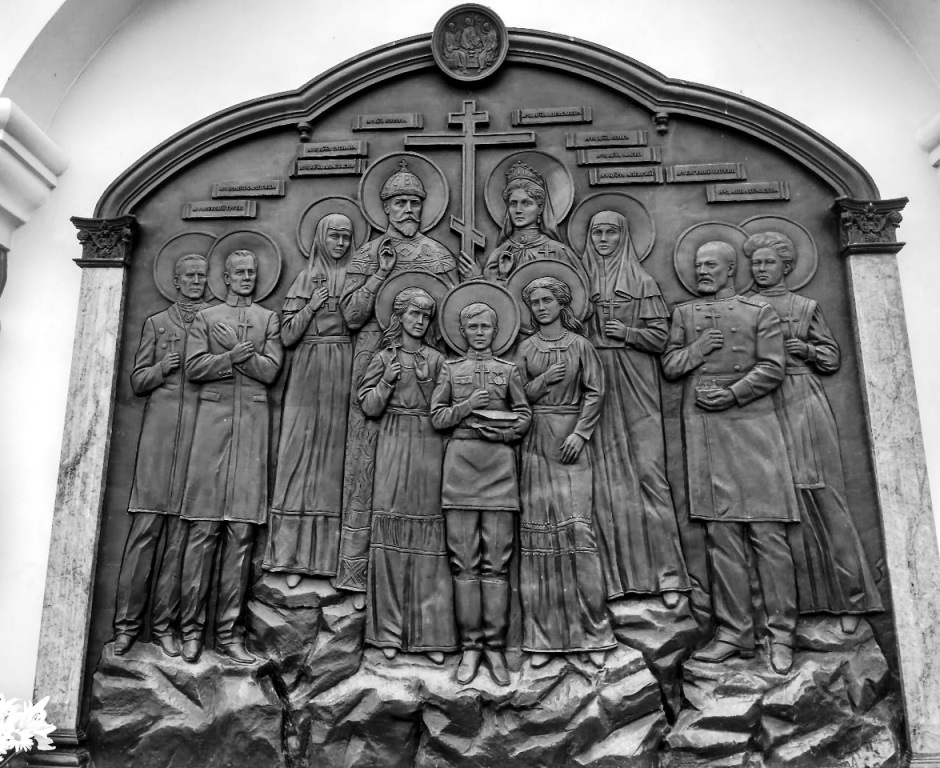
Bas-relief on the wall of the Chapel of the Royal Passion-Bearers in Kostroma
On this day – 20th August 2000 – after much debate, Emperor Nicholas II and his family were canonized as passion bearers by the Moscow Patriarchate
The Moscow Patriarchate canonized the family as passion bearers: people who face death with resignation, in a Christ-like manner, as distinguished from martyrs, the latter historically killed for their faith. Proponents cited the piety of the family and reports that the Tsarina and her eldest daughter Olga prayed and attempted to make the sign of the cross immediately before they died.
The term “passion-bearer” is used in relation to those Russian saints who, “imitating Christ, endured with patience physical, moral suffering and death at the hands of political opponents. In the history of the Russian Church, such passion-bearers were the holy noble princes Boris and Gleb (1015), Igor of Chernigov (+ 1147), Andrei Bogolyubsky (+ 1174), Mikhail of Tverskoy (+ 1318), Tsarevich Dimitri (+ 1591). All of them, by their feat of passion-bearers, showed a high example of Christian morality and patience.
Despite their official designation as “passion-bearers” by the August 2000 Council, Nicholas II and his family are referred to as “martyrs” in Church publications, icons, and in popular veneration by the people.
NOTE: The family was canonized on 1st November 1981 as new martyrs by the Russian Orthodox Church Outside Russia (ROCOR).
This bas-relief (above) also depicts their servants, who had been killed along with the Imperial family. They were also canonized as new martyrs by the ROCOR in 1981 The canonized servants were Yevgeny Botkin, court physician; Alexei Trupp, footman; Ivan Kharitonov, cook; and Anna Demidova, Alexandra’s maid. Also canonized were two servants killed in September 1918, lady in waiting Anastasia Hendrikova and tutor Catherine Adolphovna Schneider. All were canonized as victims of oppression by the Bolsheviks.
On 3 February 2016, the Bishop’s Council of the Russian Orthodox Church (Moscow Patriarchate) canonized Dr. Botkin as a righteous passion bearer. They did not canonize the servants, two of whom were not Russian Orthodox: Trupp was Roman Catholic, and Schneider was Lutheran.
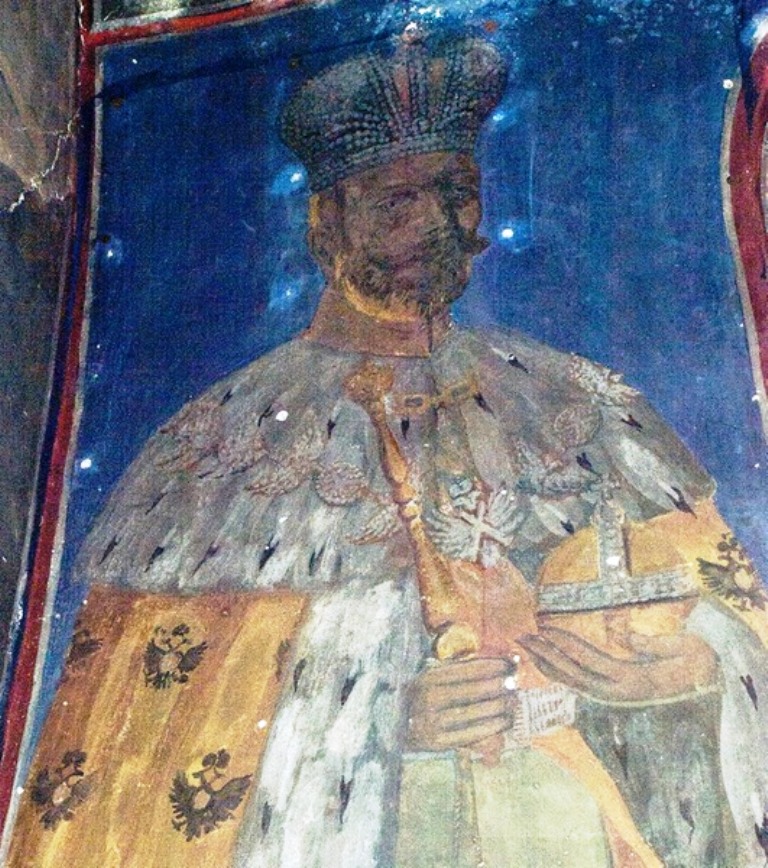
PHOTO: fresco depicting the image of Tsar-Martyr Nicholas II by Stepan Kolesnikov
On 11th August 1927, newspapers in Belgrade reported a miracle witnessed by the Russian artist Stepan Fedorovich Kolesnikov (1879-1955).
Kolesnikov had been invited to paint the frescoes in a new church in the ancient monastery of St. Naum. The master depicted the faces of fourteen saints, while leaving the fifteenth empty. He returned to the church at dusk, and unexpectedly saw that at the very place where he was supposed to draw another saint, the face of Nicholas II appeared.
Kolesnikov, who had met the Emperor on several conversations at exhibitions and remembered his face well. But the vision was so vivid that night Stepan Fedorovich seemed to be working from nature. Having finished the fresco, he wrote below: “All-Russian Emperor Nicholas II, who accepted the martyr’s crown for the prosperity and happiness of the Slavs.”
A few days later, the commander of the Bitolsky military district, General Rostich, arrived at the monastery. For a long time he stood in silence in front of the fresco of the Russian emperor, and then quietly said to Kolesnikov: “For us, Serbs, he will be the greatest and most revered of all saints.”
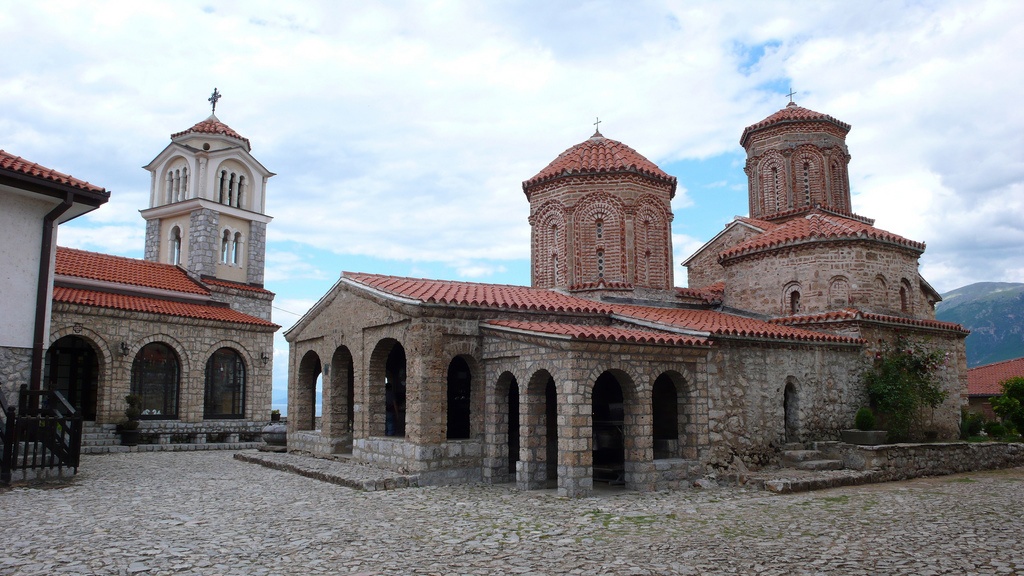
PHOTO: the Monastery of Saint Naum
The Monastery of Saint Naum is an Eastern Orthodox monastery in North Macedonia, named after the medieval Bulgarian writer and enlightener Saint Naum who founded it. It is situated along Lake Ohrid, 29 kilometres (18 mi) south of the city of Ohrid.
The monastery was established in the Bulgarian Empire in 905 by St Naum of Ohrid himself. St Naum is also buried in the church.
Since the 16th century, a Greek school had functioned in the monastery. The area where the monastery of St Naum lies belonged to Albania for a short period from 1912 until June 28, 1925, when Zog of Albania ceded it to Yugoslavia as a result of negotiations between Albania and Yugoslavia and as a gesture of goodwill.
Today, the Monastery of Saint Naum, is under the jurisdiction of the Macedonian Orthodox Church – Archdiocese of Ohrid, although many Serbs claim that the monastery is under the jurisdiction of the Serbian Orthodox Church.
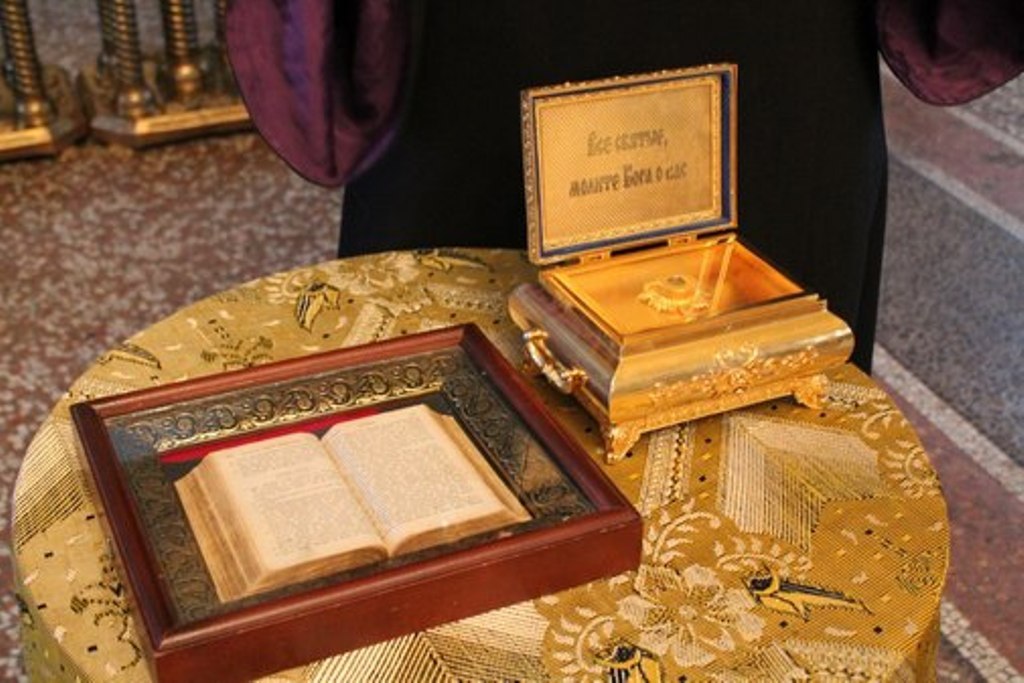
PHOTO: copy of the Old Testament with personal notes made by Emperor Nicholas II. On the right, is a small casket containing a milk tooth of Tsesarevich Alexei Nikolaevich
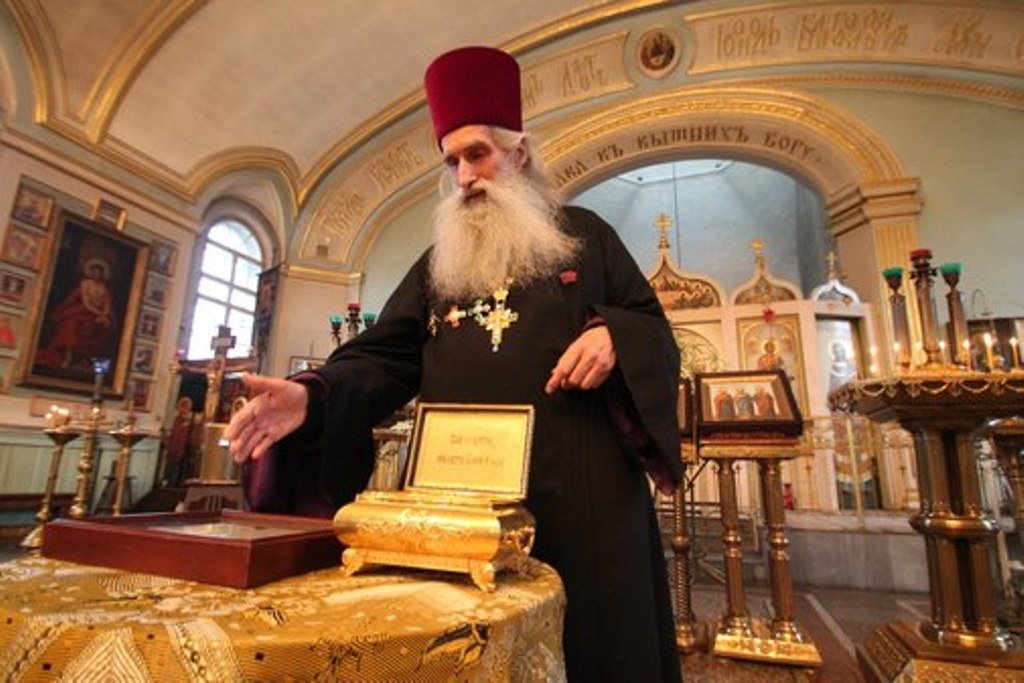
Tucked away in the Church of St. Alexander Nevsky in Zavelichye (Pskov), is a tiny little known museum. The museum was created by Archpriest Oleg Teor (born 1944), who over the years has collected and preserved numerous items and documents of historic value and significance of the diocese.
The museum’s most interesting item is a copy of the Old Testament belonging to Emperor Nicholas II, found on the Imperial Train in March 1917, which includes notes made in the margins, written in pencil. The sacred text lies in a special wooden box under glass. Sitting next to it, is a small casket containing a milk tooth of Tsesarevich Alexei Nikolaevich.
Recall that it was on on the night of 15th (O.S. 2nd March 1917, in a wagon of the Imperial train, stationed in the ancient Russian city of Pskov, Nicholas II, Emperor and Autocrat of All the Russias, in the forty eighth year of his life and the twenty third of his reign, surrendered the crown that his forebears had held since 1613.
PHOTO: Church of St. Alexander Nevsky in Zavelichye (Pskov)
How did the sacred text end up in Pskov?
The Church of St. Alexander Nevsky was built in 1907-1908, for the 96th Omsk Regiment. The church was closed by the Bolsheviks in 1918. In 1992, it was returned to the Russian Orthodox Church. Following an extensive restoration, the church was reconsecrated on 12th June 1995, new bells were consecrated on 2nd December 2008, marking the 100th anniversary of the church.
There are several theories among the parishioners, as to how the copy of the Old Testament ended up in Church of St. Alexander Nevsky. Some say that the Old Testament was donated to the church by an elderly woman from Pskov, while others claim that the donor was a man who wished to remain anonymous. Allegedly, he went into the church, placed the Bible on the table and, saying that it belonged to the Tsar, disappeared in an unknown direction. The most intriguing theory, however, the book was miraculously found in a looted imperial train car and passed to the woman for safekeeping from relatives.
According to Archpriest Oleg Teor, however, the Old Testament was given to him by the nephew of a veteran of the Great Patriotic War, who later took the clergy. “I know this man very well, and while still a boy, he came to visit his uncle and asked about the book. His uncle replied that it belonged to Tsar Nicholas II. Either the Emperor himself, who prior to his abdication was on the Imperial Train, or one of his aides handed the book to a relative of his uncle with the words “take it and safeguard it.” The uncle then gave the sacred text to his nephew, who some years later gave me the copy of the Old Testament repeating the words of his uncle “take it and safeguard it“. . .
The Old Testament contains two notes in the margins inscribed in a “sharp-edged graphite pencil” on pages 220 and 237. In addition, it contains many underlined passages. Perhaps the Tsar looked for answers to many of his questions in the Holy Scriptures? Perhaps the Old Testament, helped the Tsar put his thoughts and feelings in order and make the difficult decision to abdicate?
PHOTO: Archpriest Oleg Teor shows the sacred text, which lies in a special wooden box under glass
Forensic examination
In February 1997, Archpriest Oleg Teor met with Alexander Bogdanov, a forensic expert of the Internal Affairs Directorate of the Pskov Region, who was instructed to conduct an examination of the Old Testament, and establish whether the notes were indeed made by Nicholas II just before that fateful night in Pskov.
Bogdanov went to the State archives in Moscow, where he sorted through and examined Nicholas II’s documents, including the emperor’s notes, a notebook for playing dominoes and cards, as well as letters and diaries. Many of the documents contained brief alphabetic and digital notes made with a graphite pencil… the same type of pencil used in the margins of the Old Testament.
Bogdanov examined each document meticulously, then made copies with the use of a digital camera. He then took these documents back to the forensic center for further examination. But this was only the beginning of a great work that lasted several months. At the second stage, Valery Ivanov, a leading specialist in the field of handwriting, joined Bogdanov.
“Now the criminalists had to examine and compate the handwriting of the pencil notes found in the margins of the Bible with the handwriting of Emperor Nicholas II,” recalls Yuri Yashin, a colleague of Bogdanov and Ivanov, who oversaw the examination. To do this, it was necessary to identify a certain set of general and particular features of handwriting. As a result of the handwriting examination, a set of matching general and particular features was established.
Researchers of the Pskov State Historical and Architectural Museum-Reserve, who examined the book dated it to the 1870s 1890s. The sacred text shows signs of repairs of the book, probably made in the 20th century by an amateur bookbinder. Putting all the pieces of the puzzle into a single picture, Alexander Bogdanov and Valery Ivanov and their team of forensic experts came to a categorically positive conclusion. “The two handwritten texts found on pages 220 and 237, of the Old Testament were executed by the All-Russian Autocrat Emperor Nicholas II”.
PHOTO: the Old Testament which belonged to Emperor Nicholas II, is today preserved in a special wooden box under glass in the Church of St. Alexander Nevsky in Zavelichye (Pskov)
NOTE: There remains some speculation that it is highly unlikely that the Emperor himself, of his own free will, parted with his personal Bible. Based on the inventory of icons, shrines and spiritual books left after the regicide, it is clear that the Imperial Family treasured such books and carried them everywhere with them.
Known, for example, is a Bible belonging to Nicholas II, which was presented to him by his mother – Empress Maria Feodorovna, when he was Tsesarevich. It was this Bible that accompanied the Tsar, first to Tobolsk, and then to Ekaterinburg. Following the regicide, it was discovered by the Whites in the deserted Ipatiev House, and then, among with other personal items which belonged to the Imperial family, the Bible was given to the Emperor’s sister, Grand Duchess Xenia Alexandrovna, who later donated it to the Russian Orthodox Church of Saint Job in Uccle, Brussels.
The milk tooth of Tsesarevich Alexei Nikolaevich
The milk tooth of Tsesarevich Alexei Nikolaevich was first kept in the Winter Palace in St. Petersburg, where Nicholas II and his family lived until they moved to Tsarskoye Selo in 1905, then a small apartment in France and, finally, Orthodox Church of St. Nicholas in Saint-Louis, France [just one kilometer from the Swiss border].
The milk tooth of the innocently murdered Tsesarevich was carefully kept by his nurse-nanny Alexandra Alexandrovna Tegleva [wife of the Imperial children’s tutor Pierre Gilliard]. Both Tegleva and Gilliard accompanied the Imperial family into exile to Tobolsk in August 1917.
When the Empress was transferred to Ekaterinburg in April 1918, she passed her jewellery to the nanny and Alexei’s three milk teeth.
Having miraculously escaped execution, Alexandra Teglina fled Bolshevik Russia, eventually settling in Switzerland. Until her death on 21st March 1955, she carefully kept the precious box with the gifts of the Empress. After her death, her nephew gave the casket containing the Tsesarevich’s milk teeth to the Church of St. Nicholas in Saint-Louis.
The rector of the French parish of St. Nicholas ordered three icons of the Holy Royal Martyrs with three absolutely identical reliquaries for each tooth. A request was made by a member of the Russian clergy, who asked that one of these icons be sent to Russia, so that as many Orthodox as possible could see it.
One of these icons was given to the Church on the Blood in Ekaterinburg, built on the site of the Ipatiev House, where Nicholas II and his family met their death and martyrdom on 17th July 1918.
Another of these icons was given to Archpriest Oleg Teor by his friend the rector of the Orthodox church in Saint-Louis Vladimir Shibaev. According to Father Oleg, Father Vladimir requested that the milk tooth of the murdered Tsesarevich should be “returned home to Russia“.
NOTE:The purpose of this article is to address the many queries which I have received over the past few months, with regards to whether it is (a) still possible to visit Russia, and (b) if it is safe to visit Russia during these troubled times. The answer is “YES!”, you can still visit Russia, however, making arrangements are now much more challenging.
If you are even considering visiting Russia in the near future, I urge you to read the following. It is important to take into account, that things in Russia can change overnight – Paul Gilbert
This page was last updated on 22nd FEBRUARY 2023
When the Alexander Palace reopened to the public on 14th August 2021, many Romanovphiles – myself included – began making plans to return to St. Petersburg, in order to visit the reconstructed interiors of the private apartments of Emperor Nicholas II and Empress Alexandra Feodorovna in the Alexander Palace. Sadly, with the onset of the COVID-19 pandemic, the hopes and plans of many were dashed.
The COVID-19 pandemic hit Russia very hard. Since April 2020, more than 18 million cases and more than 372 thousand deaths have been reported. As a result, Russia closed its land borders to foreigners as a precautionary measure to try to stop the spread of coronavirus. While it was still possible to visit via air, Russia imposed very strict measures regarding vaccines, etc.
I myself, was scheduled to visit Russia in September 2020, however, Aeroflot were forced to cancel my flights to St. Petersburg and Ekaterinburg due to COVID.
On 15th July 2022, the Russian government lifted COVID-19 related entry restrictions. You may enter Russia by air, sea or land via any country, but non-Russian nationals must still produce a negative PCR test taken within 48 hours before their arrival in Russia.
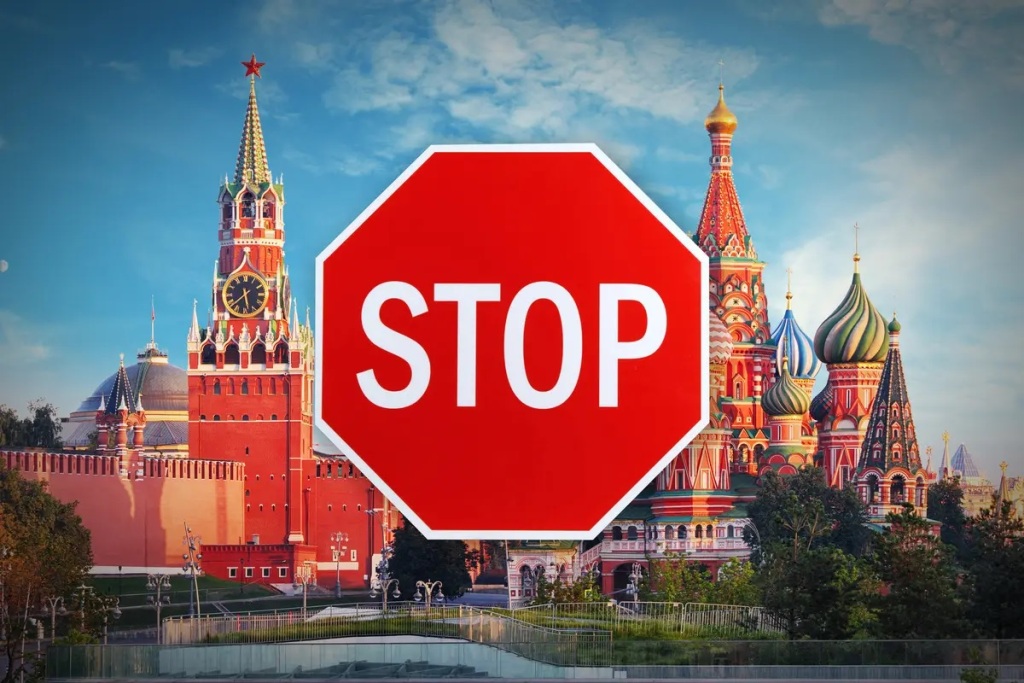
On 24th February 2022, Russia began a military invasion of Ukraine. The world responded with swift sanctions, which have now made it near impossible to visit Russia. This latest move has had a very negative effect on foreign travel to Russia, impacting plans for many of us, who were hoping to return to rediscover the Romanov legacy, a subject which is so near and dear to many of us.
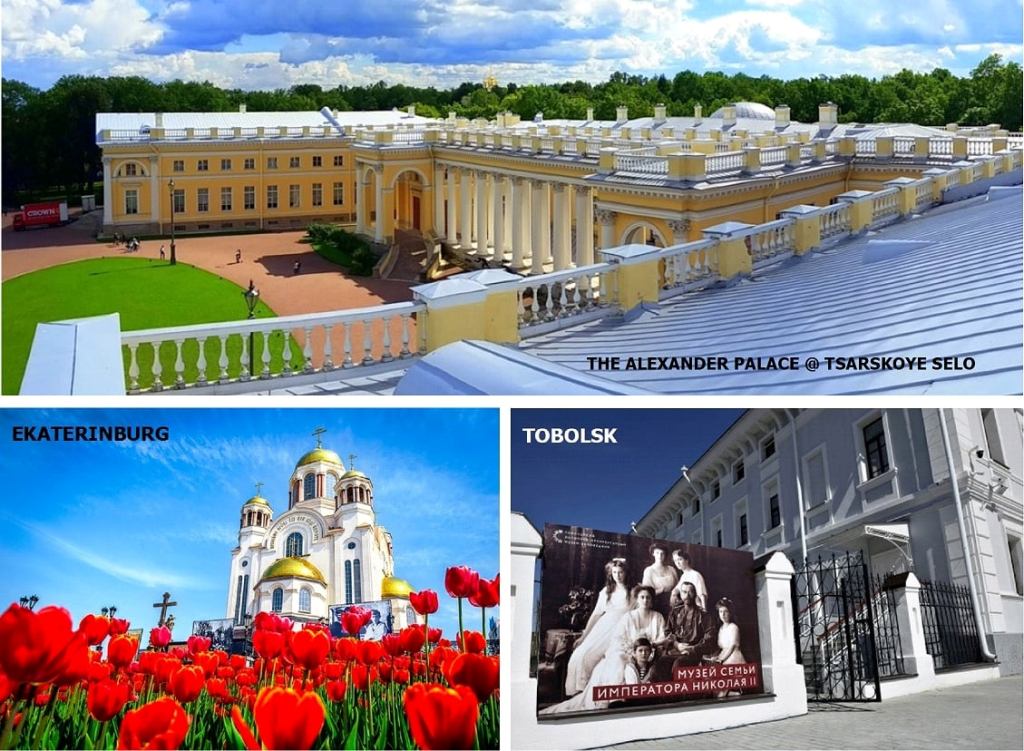
Prior to the outbreak of hostilities, I was already making plans to visit Russia in July 2023. My itinerary included St. Petersburg, Ekaterinburg and Tobolsk. On the agenda for this journey was the Alexander Palace at Tsarskoye Selo; the Museum of Emperor Nicholas II in Tobolsk; and the ceremonies marking the 300th anniversary of the founding of Ekaterinburg.
Warnings against visiting Russia
The governments of the United States, Canada, Great Britain, Australia and the European Union, have all issued warnings to nationals about visiting Russia, urging them to “avoid all travel to Russia due to the impacts of the armed conflict with Ukraine, including limited flight options and restrictions on financial transactions”.
While popular tourist destinations such as Moscow, St. Petersburg and Ekaterinburg are far removed from the current Russian-Ukranian conflict, there still remain risks, which must be taken into consideration before planning a visit. Please consult your respective government advisories for the latest updates.
Many of the countries which imposed sanctions, have restricted financial transactions and air connections with Russia. Russia has retaliated with similar measures.
The sanctions, the suspensions and the Russian retaliation may have an important impact on the availability and the provision of essential services.
The value of the Russian ruble is currently volatile and the value of holdings of rubles may fluctuate considerably.
If you decide to visit Russia despite government advisories, it is a good idea to register and update them with your contact information through your respective embassy. Please be aware that in the case of an emergency, you should not depend on your government to help you leave the country.
The U.S. Department of State has advised Americans of the potential for the singling out and harassment of U.S. citizens by local police and government security officials . . . and the possibility of violence against U.S. citizens by right-wing nationalists.
Some embassies are reporting an increased police presence and ID checks. As a result, you should keep your passport and Russian visa with you at all times. It is important to make copies of both, and keep them separate, such as a hotel safe.
In addition, please be aware that foreigners holding Russian citizenship “may be subject to call-up for mandatory military service.”
In August 2022, Ukraine began bombing of Crimea. There is no question that this region will continue to be a target of the Ukrainian armed forces therefore, this region should be avoided!
Updated travel advisory for US citizens
On 13th February 2023, the United States Embassy in Moscow informed its citizens to leave Russia immediately due to the war in Ukraine and the risk of arbitrary arrest or harassment by Russian law enforcement agencies.
“US citizens residing or traveling in Russia should depart immediately,” the US embassy in Moscow said. “Exercise increased caution due to the risk of wrongful detentions.”
“Do not travel to Russia,” the embassy said. Those who choose to stay or who have not yet determined a way to leave have essentially been advised to lay low and avoid contentious areas.
The United States has repeatedly warned its citizens to leave Russia. The last such public warning was in September 2022 after President Vladimir Putin ordered a partial mobilization.
“Russian security services have arrested US citizens on spurious charges, singled out US citizens in Russia for detention and harassment, denied them fair and transparent treatment, and convicted them in secret trials or without presenting credible evidence,” the embassy said.
Tourism to Russia Plummets to 4% of Pre-Pandemic Levels Amid Ukraine War
Foreign tourism to Russia fell below 4% of its pre-pandemic levels in 2022 as the country faced international condemnation over its invasion of Ukraine, the Association of Tour Operators of Russia (ATOR) has said.
A mere 200,100 tourists traveled to Russia last year, according to ATOR’s breakdown of Federal Security Service (FSB) border service data.
That marks a 96.1% decrease from the 5.1 million tourists who had visited Russia in 2019, before the start of the Covid-19 pandemic.
“The reasons are clear: closed skies between Russia and the vast majority of European countries, as well as the inability to use foreign-issued Visa and Mastercard cards in Russia,” ATOR said Wednesday, referring to the airspace closures and financial sanctions passed by Ukraine’s Western allies shortly after the invasion.
So, is it still possible to visit Russia?
Despite the sanctions imposed on Russia earlier this year by the United States, Canada, UK and EU, Russia has not closed its borders to foreign visitors. For the palaces, museums, art galleries and theatres, it is still business as usual. As far as shopping and dining goes, most of the major Western-owned hotel chains, retailers and restaurants have closed their doors.
The cost of transportation and transit time have increased significantly and remain very volatile due to high demand, limited flight availability and rerouting. Contact your travel agent or tour operator to determine if the situation will disrupt travel arrangements.
In May 2022, the UK government designated Aeroflot, Rossiya Airlines, Ural Airlines and Russian Railways for the purposes of UK sanctions. This means that British nationals and others who are bound by UK sanctions are prohibited from entering into transactions which result in making funds directly or indirectly available to these companies, such as purchasing tickets from them. On 23 May 2022, the Office for Financial Sanctions Implementation issued a general licence which means that for journeys originating in, or within, Russia, British nationals may purchase tickets from these companies without breaching UK sanctions.
The Russian aviation sector has been severely impacted by Western sanctions in the wake of the war in Ukraine. Aeroflot, in particular, landed in deep water with the grounding of planes and canceling flights to many international destinations.
Western countries have stopped deliveries of commercial airliners – popular with many Russian carriers – and spare parts and have obliged their lessors to return liners already leased from Russia.
It is important to note that Russian airlines suffered a number of incidents on their domestic services that saw more than 130 incidents including 28 plane crashes in 2022. In addition, there have been at least seven accidents involving air transport in the Russian Federation since the beginning of 2023. The main reason for mass breakdowns is due to the lack of proper maintenance of aircraft due to the shortage of spare parts in the country. Major Western plane makers Boeing and Airbus halted deliveries of new foreign jets and spare parts, forcing Russian airlines to “cannibalize” grounded aircraft.
It is still possible, however, to book flights on 3 foreign carriers – see below – to Moscow, St. Petersburg and Ekaterinburg.
Flights from North America, UK and EU
Following the outbreak of hostilities on the territory of Ukraine, Russian carriers are prohibited from flying to the EU countries, the UK, the USA, and Canada. At the same time, 11 airports in the south and central part of Russia have been closed since 24th February 2022.
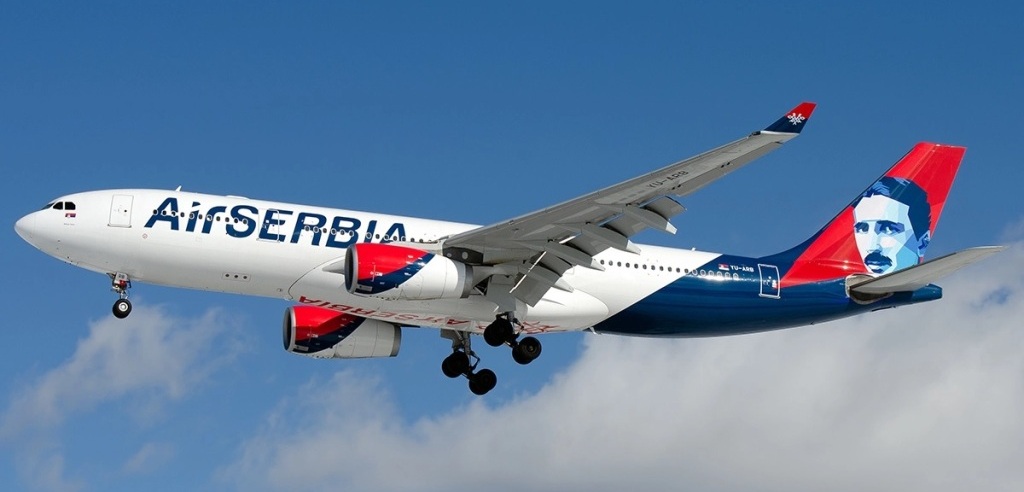
For Americans and Canadians, there are currently only 2 airlines offering flights to Russia: Air Serbia (via Belgrade) from New York (Daily) and Chicago (3 x a week beginning April 2023) to Moscow and St. Petersburg; Turkish Airlines (via Istanbul) to Moscow, St. Petersburg and Ekaterinburg.
NOTE: Air Serbia is currently evaluating a third North American route to Toronto, which would cater to the large Serbian and Balkan diaspora in Canada.
Both Air Serbia and Turkish Airlines offer flights from numerous cities in the UK and EU, with convenient connections to Moscow and St. Petersburg.
For Australians, Emirates offer flights from Sydney, Melbourne, and Perth (among other cities) to Moscow, St. Petersburg and Ekaterinburg – the latter via partner Fly Dubai.
By coach and train from Helsinkiand Tallinn
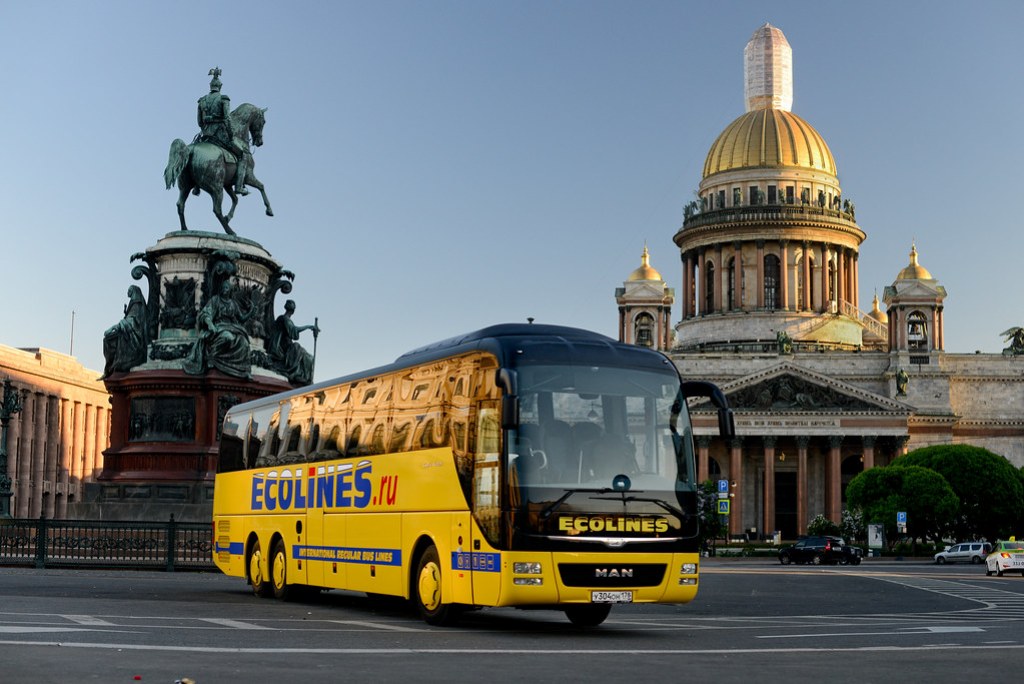
In addition, it is still possible to reach St. Petersburg by coach from Helsinki and Tallinn. International bus carriers Lux Express and Ecolines. Currently, Lux Express offers 4 daily buses from Helsinki St. Petersburg, while Ecolines offers 2 daily buses. Please note that seats sell out quickly, due to the high demand.
You can also travel by coach from Tallinn (Estonia) to St. Petersburg. Ecolines also offer 2 daily buses, while Lux Empress offer 4 weekly buses on the route.
Finnish Rail has currently suspended all trains from Helsinki to St. Petersburg and Moscow.
Accomodations
It is no longer possible to book accommodations in Russia using an online travel agency (ie. Expeida, Tripadvisor, etc.) or directly through Russian hotel web sites. Again, this is due to the inability to use foreign-issued credit cards in Russia. While you can still book a hotel via the respective hotel, you will be forced to pay for your stay upon arrival in cash.
Please note that the hotel can supply the necessary documents in which you will need to apply for a Russian Tourist Visa. In addition, they can also arrange transfer from the airport upon your arrival.
Russian Visas
The Russian Federation still maintain diplomatic relations with the United States, Canada, UK and EU, and have not restricted travel by nationals of these countries to Russia. Please consult the web site of the Russian Federation in your country to download and print Russian visa applications.
Currency exchange
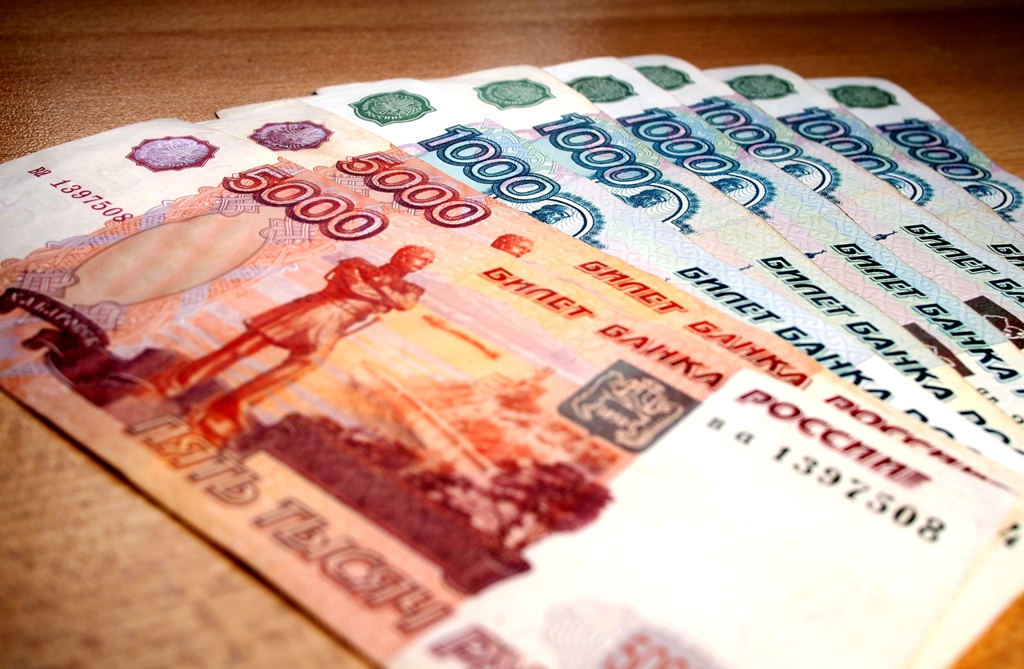
You are entitled to import/export up to $10,000 USD in cash into Russia, but sums over $3000 should be declared at customs. This applies to all foreign currencies and to rubles, with the exact quantities varying slightly from currency to currency.
MasterCard and Visa have suspended operations in Russia. This means that MasterCard and Visa cards issued outside of Russia will not work at Russian merchants or ATMs. You should be aware that it may not be possible for you to access your funds through Russian banks or to make payments to Russian businesses with non-Russian credit/debit cards.
You can change dollars and euros to rubles at any bank or foreign currency exchange outlet.
Disclaimer: the information contained in this article is for information purposes only. It is based on information from sources believed to be reliable. Should you embark on a visit to Russia during these troubled time, I urge you to err on the side of caution. I will not be held responsible for any problems which you may encounter in the planning of your visit, or during your stay in Russia. I will endeavour to update this page as new details are made available to me – PG








 Nicholas II
You must be logged in to post a comment.