KOSTYA: Grand Duke Konstantin Konstantinovich

*This title is available from AMAZON in the USA, UK, Canada,
Australia, France, Germany, Spain, Italy, Netherlands and Japan

CLICK HERE TO ORDER THE PAPERBACK EDITION @ $12.99 USD

BOOK DESCRIPTION

Paperback edition. 142 pages + 36 black & white photos

This is the first English language publication, dedicated to one of the most beloved and highly respected members of the Romanov dynasty: Grand Duke Konstantin Konstantinovich (1858-1915).

The Introduction by independent researcher Paul Gilbert, explores Grand Duke Konstantin Konstantinovich’s moral struggle with homosexuality, and the little-known attempt by the Bolsheviks in the 1920s, to plunder the grand duke’s tomb, located in the Grand Ducal Mausoleum of the Peter and Paul Fortress in St. Petersburg.

Also featured are first English translations of biographical studies of Grand Duke Konstantin, by two prominent Russian Romanov historians: Chief Curator of Pavlovsk Palace Alexei Guzanov and author and lecturer Zoia Beliakova.

In addition, are the memories of Grand Duke Konstantin Konstantinovich, written by two of his children: Prince Gabriel (1887–1955) and Princess Vera (1906-2001), both of whom died in exile.

© Paul Gilbert. 31 March 2022

“Nicholas II should have listened to Rasputin” – Metropolitan Hilarion

PHOTO: Grigory Rasputin and Emperor Nicholas II

The head of the Synodal Department for External Church Relations, Metropolitan Hilarion, believes that Nicholas II should have followed the advice of Grigory Rasputin and not entered the First World War, and thus saved both the monarchy and Russia.

“Rasputin was an ardent opponent of Russia’s entry into the war, and he *warned the Tsar that if Russia entered the war, it would threaten the entire country with catastrophic consequences,” the metropolitan stated during an interview on the Church and Peace program, aired recently on the Russia-24 TV channel.

*In July 1914, while still lying in bed in Siberia recovering from stab wounds he received during an attempt on his life, he telegraphed, “Let Papa [Nicholas II] not plan war, for with the war will come the end of Russia and yourselves and you will lose to the last man.” Anna Vyrubova, who delivered the telegram to the Emperor, reported that he angrily tore it to pieces.

The hierarch recalled that Tsar did not listen to Rasputin’s stark warning, “Russia entered the war and had every chance of winning by military means, but other factors entered the course of history, and as a result, Russia lost not only part of it’s lands, but the collapse of the Russian Empire.”

“A new state, a totalitarian state, was formed in Russia, and nothing remains of that old great Russia, of that Holy Russia which survived for many centuries, except, of course, the Russian Orthodox Church,” the bishop said.

At the same time, Metropolitan Hilarion noted that he had an ambivalent attitude towards the figure of Rasputin. In particular, he admitted that Rasputin committed all sorts of inappropriate acts, including drunkenness, which took place in front of many witnesses. “All this is documented, it would be impossible, it seems to me, to represent this as some kind of slander against a holy man,” he added.

© Paul Gilbert. 21 March 2022

14th March marks a day of treason against the Tsar

PHOTO: Grand Duke Kirill Vladimirovich and Emperor Nicholas II

On this day – 14th (O.S. 1st) March 1917 – Grand Duke Kirill Vladimirovich (1876-1938) committed treason against Emperor Nicholas II

* IMPORTANT – Click HERE to read more about Grand Duke Kirill’s act of treason against Emperor Nicholas II in greater detail, published on 26th May 2021

Before the Emperor’s abdication, Grand Duke Kirill Vladimirovich was one of the first Russian officers to commit an act of betrayal to his oath of loyalty to the Sovereign and to his dynastic duty. While commanding the Marine of the Guard, which was responsible for guarding the Imperial Family at Tsarskoye Selo, Kirill Vladimirovich marched them into Petrograd to declare their allegiance to the new Provisional Government.

Prior to that, the Grand Duke sent notes to the chiefs of the military units at Tsarskoye Selo, with a proposal “to join the new government”, following his own example.

In June 1917, Grand Duke Kirill was the first Romanov to flee Russia, along with his pregnant wife and their two children. Not only was his desertion “illegal”, Kirill, who was serving as a rear admiral in active military service in a country at war, had thus abandoned his honour and dignity. It is interesting to add, that the Kirillovich were the only branch of the Imperial Family who managed to escape the Bolsheviks, without losing any family members.

Not only was Grand Duke Kirill a moral coward, he was clearly a man who lacked a moral compass and a traitor to his Sovereign and to Russia. His acts of treason and desertion, and later his support of Adolf Hitler and the Nazis during his years in exile, thus deprived his descendants any rights to the Russian throne.

* Click HERE to read my article “The Russian Imperial House ended with the murder of Nicholas II” , published on 17th February 2021

© Paul Gilbert. 14 March 2022

Tsarskoye Selo director rejects idea to hold weddings in the Alexander Palace

PHOTO: Director of the Tsarskoye Selo Museum-Reserve Olga Taratynova, standing in front of the Alexander Palace

On 15th February, the Russian media reported that Mikhail Baryshnikov, a deputy of the City Legislative Assembly, plans to submit a new bill which would permit the use of historic palace-museums as venues for weddings—including both the Catherine and Alexander Palaces at Tsarskoye Selo.

This is the second attempt by St. Petersburg deputies to allow marriages to be registered outside the city registry offices. In 2017, they sent an initiative to change federal legislation to the Ministry of Justice for approval. But the department, outlined a wide range of problems and obstacles, and rejected the implementation of the idea.

In Pushkin, the Director of the Tsarskoye Selo Museum-Reserve Olga Taratynova, recalled that there are two palaces under their administration and both are functioning museums: “The Alexander Palace is fundamentally not suitable for such purposes, it is in many ways a memorial museum, where a very special atmosphere reigns. And the nearby Catherine Palace is overwhelmed with visitors to accomodate such events. This is a place where people come perhaps once in a lifetime. In order to conduct a wedding in one of the halls of either palace, we would be forced to close part of the visitor route, which would deprive ordinary visitors of the opportunity to see everything possible. In this regard, we believe that some of pavilions located in the Alexander and Catherine Parks would be more suitable for weddings. These are beautiful historical buildings, located in secluded and picturesque corners of parks – including the Evening Hall, the Cameron Gallery, Chapelle and others,” Olga Taratynova noted.

© Paul Gilbert. 12 March 2022

Nicholas II’s battle with typhoid in 1900

PHOTO: Emperor Nicholas II recovering from typhoid at Livadia, December 1900

During Tsarist times, typhoid, or “spotted fever”, affected every one from paupers to emperors—the often fatal illness did not discriminate. This intestinal infection caused by a specific type of Salmonella bacterium was a frequent guest in the imperial residences. And all because of poor sanitation. For example, the kitchen of the Winter Palace in St. Petersburg, only stopped taking water directly from the Neva River in 1868, while mineral filters and urns for boiling water were only installed in the palace in the 1920s! And we are talking here only of the water used by the Imperial Family: servants, valets, stokers and porters lived in, and bustled in and out of, the Winter Palace. The common folk and acquaintances that came to visit the Imperial Family in their tiny rooms had a very careless attitude to personal hygiene and as a result, the palace was teeming with lice, bedbugs, cockroaches and, of course, mice.

It is not surprising then that under these conditions that Empress Maria Alexandrovna, the spouse of Emperor Alexander II, their son Alexander Alexandrovich (future Alexander II) and the latter’s daughter Xenia Alexandrovna all caught typhoid fever.

During his stay in Livadia[1] in the autumn of 1900, Nicholas II became gravely ill with typhoid. Initially, doctors were afraid to diagnose the disease for a long time and then they argued about what medication to prescribe.

The Emperor fell ill with what proved to be a rather serious from of typhoid. The Empress had a great horror of the illness, but a crisis always found her self-possessed and resourceful. She nursed the Emperor herself, even doing the night nursing, and acted as his private secretary when he was able to attend to papers, transmitting his decisions to his Ministers. The Empress wrote to her sister, Princess Louis [aka Victoria of Battenberg], at the time:

“Nicky really was an angel of patience during his wearisome illness, never complaining, always ready to do all one bid him. His old valet and I nursed him. The shock of his illness and feeling myself necessary gave me new strength, as I had been very wretched before. I rebelled at a nurse being taken and we managed perfectly ourselves.”

Orchie [Alexandra’s old nurse] would wash his face and hands in the morning. She would bring the Empress her meals, where she would take them while resting on the sofa in her husband’s room. She suffered from head and heartache, the latter from nerves and many sleepless nights. When Nicholas began getting better, she read to him.

He first had a digestive upset on 22nd October 1900, and almost immediately the Emperor’s temperature rose to 39-40 degrees Celsius (102-104 degrees Fahrenheit). The high temperature and severe headache, coupled with food poisoning, continued until 12th November.

PHOTO: Alexandra Feodorovna standing behind her husband, who is seated in a wheelchair while recovering from typhoid. Nicholas II is seated in front of a table, wearing a dressing gown, and a rug placed over his legs. Livadia, Crimea. December 1900

The Emperor actually received no treatment. Despite being pregnant for the fourth time and in a lot of pain, Alexandra nursed him back to health, rarely leaving his side. While Alexandra Feodorovna was the one who looked after him, his sister Grand Duchess Xenia Alexandrovna, recorded her brother’s illness and recovery:

“Poor Nicky is lying in bed, he didn’t sleep at all at night because of terrible pains in his back. In the morning his temperature was 38.2 – during the day 38.7. His eyes are tired and pale! [Dr.] Girsh says that it’s influenza! Thank God there’s nothing in the lungs, or in general anywhere else. Poor Alix [Alexandra Feodorovna] – she looks very tired.” – Xenia’s diary, 27th October 1900

“Later on I drove to Livadia and looked in on Nicky for a minute. The back of his neck hurts terribly, and he doesn’t know where to turn his head. All the pain from his back and legs has gone upwards, and he is suffering terribly. Poor Alix has forgotten about her own sickness and is moving around more. Girsh is adamant, that it isn’t typhoid (we asked him). Girsh asked Nicky to call someone else, to put everyone’s mind at rest – it was decided to call for [Dr.] Tikhonov.” – Xenia’s diary, 29th October 1900

“We met Tikhonov, who told us that several symptoms of typhoid had developed, and that they were almost sure that it was typhoid! At Livadia we immediately questioned Girsh. It’s astounding that influenza should suddenly turn into typhoid!

“At Livadia we immediately questioned Girsh. It’s astounding that influenza should suddenly turn into typhoid! With Alix’s permission Professor Popov was sent for; we had lunch alone together downstairs; a little later [Count] Fredericks arrived, tearing his hair and saying he was in a terrible position, that everyone wanted news, while he was not allowed to tell anyone anything. He wanted us to persuade Alix to allow a bulletin to be published, which we were able to do. She agreed that there is nothing worse than trying to conceal things! We telegraphed poor Mama. Thank God Alix is so calm.” – Xenia’s diary, 31st October 1900

“Thank the Lord, Nicky had an excellent night – he slept until morning, his temperature was 38.7 and he felt well. Alix called me to see Nicky – he was in remarkably good spirits, and chatted and joked. Alix was also in a good mood, having slept well. They didn’t want to let me go, but in the end I left of my own accord, as he needs complete rest and had been talking to much.

“All the unnecessary furniture has been removed from the bedroom, and will be taken into Alix’s drawing room this afternoon. Alix is now sleeping in another bed, at least the doctors have achieved that much.” – Xenia’s diary, 1st November 1900

“They are not happy that Nicky’s temperature is so low 36°, but the pulse is good at 66. They are afraid of a haemorrhage, God preserve us! It’s so terrifying, help us God, save our Nicky!” – 13th November 1900

PHOTO: Nicholas II recovering from typhoid fever, with his sister Grand Duchess Xenia Alexandrovna. Livadia, Crimea. December 1900.

Against this background, discussions about who should succeed Nicholas II, in the event that he should die. The Empress attempted to persuade her husband to change the Laws of Succession to allow females to inherit the throne in the absence of any male heirs in order for their four-year-old daughter Grand Duchess Olga Nikolaevna [2] to inherit the empire, as opposed to her uncle, Grand Duke Michael Alexandrovich. Ultimately, these changes did not take place.

After 13th November, the Tsar’s temperature started coming down and on 30th November, for the first time, Nicholas spent half an hour on his balcony. “It was sunny, warm and still… Thank God my typhoid was mild and I didn’t suffer at all during the whole time. I had a strong appetite and now my weight is increasing noticeably every day…”

Nicholas recovered six months later, in May-June 1901, however, little Olga came down with typhoid. Alexandra would nurse their eldest daughter through her illness.

On the 24th November 1900 Nicholas wrote to his mother:

“About my little wife I can only say that she was my guardian angel, looked after me better than any sister of mercy!”

NOTES:

[1] Up until 1911, Nicholas II and his family stayed in the Small Livadia Palace during their visits to Crimea, after which they lived in the iconic white stone palace, which was constructed on the site of the Large Livadia Palace. The Small Palace survived until the Great Patriotic War (1941-45).

[2] The Succession Prospects of Grand Duchess Olga Nikolaevna (1895-1918) by Carolyn Harris, published in Canadian Slavic Papers, Volume 54, 2012 – Issue 1-2

© Paul Gilbert. 6 February 2021

The unholy alliance of Maria and Vlad

PHOTO: Maria Vladimirovna, clearly delighted in meeting Russian president Vladimir Putin, during her visit to Moscow, in September 2012

* This article was updated with additional information on 14th March 2022

On 24th February 2022, Russian president Vladimir Putin ordered the invasion of neighbouring Ukraine. Since that time, an estimated 2000+ civilians have been killed in Ukraine; cities and towns have been bombed to submission; nuclear plants have been bombed; and according to French president Macron “the worst is yet to come”.

Many monarchists and Romanovphiles awaited a statement on the invasion, from the Spanish born princess, Maria Vladimirovan, the self aclaimed “Head” of the now defunct Russian Imperial House, who resides in a luxurious apartment in Madrid, Spain.

Maria issued a carefully worded statement the same day, one which was promptly translated into English by Russell E. Martin, a prominent American mouthpiece for Maria Vladimirovna. Martin acts as both translator and International Communications Advisor to the so-called “Chancellery of Her Imperial Highness”.

Riding in Martin’s back pocket is Nicholas B.A. Nicholson, [aka “Mr. X”], a well known Facebook troll, who from April 2020 to September 2021, served as Curator of the Russian History Museum in Jordanville, NY.

Together, Martin and Nicholson coo and fawn over this ridiculous woman, and work diligently to spread her agenda to an English speaking audience in the West. Their work is aided by a small group of Legitimist zealots, most of whom are American.

In her statement, Maria noted that she is both “alarmed” and “grieved” by those who have been “pitted against each other and spilt their blood; how peaceful citizens are dying and suffering; how parents shed inconsolable tears over the coffins of their children . . . ”

She closes her statement by saying – “I, my son and heir, The Grand Duke George of Russia, and his spouse, Princess Victoria Romanovna, pray for the immediate implementation of peace.”

What is particularly disturbing, however, is Maria’s failure to acknowledge the one person who is responsible for all the blood spilt, human suffering and death: Vladimir Putin!

She further adds – “The Russian Imperial House does not make statements of a political nature, and in any event, in the current conditions we do not have complete information that would allow us to make them”.

If this so called “Empress de jure” knew anything about her ancestors, she would know, that each and every Romanov monarch was very much involved in politics. Claiming that she lacks “complete information” is a spineless wat if skirting the issue, especially given all the reliable sources available.

Several months back, Russell Martin noted in one of his articles, that the “Russian Imperial House maintained good relations with Vladimir Putin” – a comment which has since been deleted by the author. In truth, Putin merely tolerates this family, nothing more.

As an example of not getting “involved in politics”, it is interesting to note that Maria openly supported Russia’s annexation of Crimea in 2014. Not only did she snuggle up to Putin’s agenda, she illegally awarded Natalya Poklonskaya, a popular Russian politician, who from 2014 to 2016 served as Prosecutor of the Republic of Crimea, the Imperial Order of St. Anastasia. On 30th November 2017, Poklonskaya returned the Order and nobility title.

So, in light of recent events, why has Maria Vladimirovna not spoken out against Putin? While she has kept her word—for the most part, any way—that she does not involve herself in politics, she wouldn’t dare criticize Putin, knowing the consequences which she would face. For one, her “Chancellery” would be closed in Moscow; her son and his morganatic wife—both of whom live in Moscow—would be asked to leave the country; and Maria herself would be persona non grata in Russia. In addition, their Russian passports would most likely be revoked.

If Maria Vladimirovna wants to gain any respect, then she must take a stand, and denounce the deranged Russian president, who is obsessed with destroying Ukraine, and murdering thousands of innocent men, women and children.

As one of my Facebook followers noted: “Her “statement” was a masterpiece of pomposity and obfuscation, achievemening nothing other than massaging her own ego!”

© Paul Gilbert. 5 February 2021

Tsar’s Days: Journey to Ekaterinburg

*This title is available from AMAZON in the USA, UK, Canada,
Australia, France, Germany, Spain, Italy, Netherlands and Japan

CLICK ON THE LINK BELOW TO ORDER FROM AMAZON

HARD COVER EDITION @ $40 USD

PAPERBACK EDITION @ $25 USD

BOOK DESCRIPTION

Hardcover and Paperback editions. 152 pages + Richly illustrated with nearly
200 COLOUR PHOTOS, 65 of which were taken by the author

***

On 17th July 1998, independent researcher and writer Paul Gilbert travelled to St. Petersburg, for the interment of Emperor Nicholas II and his family. Twenty years later to the day, he journeyed to Ekaterinburg, to take part in Tsar’s Days and the events marking the 100th anniversary of the Tsar’s death and martyrdom.

In his own words and photographs, he shares his own personal experiences and impressions of the places associated with the last days of Emperor Nicholas II and his family, including the Church on the Blood, Ganina Yama, and Porosenkov Log. In addition, he writes about his visits to no less than three museums dedicated to the Holy Royal Martyrs, exhibitions, and the Patriarchal Liturgy performed on the night of 16/17 July by His Holiness Patriarch Kirill of Moscow and All Russia.

This book is complemented with 24 illustrated news articles about events leading up to Tsar’s Days in the Urals, from 1st to 31st July 2018.

Gilbert’s solemn journey to the Urals allowed him to experience history in the making, and to honour the memory of the Holy Royal Martyrs, a century after their death and martyrdom.

It may be years before most of us can visit Russia again, in the meantime, you can visit Ekaterinburg through the pages of this book from the comfort of your favourite chair.

© Paul Gilbert. 26 February 2022

Protecting the Tsar – Part 2: the security of Nicholas II in the Alexander Palace

PHOTO: security at the main gate leading to the Alexander Palace

This is the second of a two-part article, which explores efforts to ensure the safety and security of Russia’s last Tsar. Click HERE to read Part 1: How Nicholas II was Protected – PG

Following his father’s assassination in March 1881, Emperor Alexander III was advised that it would be difficult for him to be kept safe at the Winter Palace in St. Petersburg. As a result, he relocated his family to the Gatchina Palace, located 30 kilometres (20 mi) south of St. Petersburg. The palace was surrounded by moats, watch towers, and trenches, and soldiers were on guard night and day. Under heavy guard, he would make occasional visits into St. Petersburg, but even then he would stay in the Anichkov Palace on Nevsky Prospect, as opposed to the Winter Palace.[

In November 1894, Nicholas II ascended the throne. He had spent his youth in Gatchina Palace, however, he did not really like the fortress-like building, and returned to the capital, where, according to tradition, he settled in the Winter Palace.

In 1904, Russia was at war with Japan, and the newborn Tsesarevich Alexei was secretly ill; Nicholas and Alexandra permanently abandoned the Winter Palace, for the greater comfort, security and privacy of Tsarskoye Selo, where they settled into the Alexander Palace.

PHOTO: Emperor Nicholas II and Empress Alexandra Feodorovna, review His Imperial Majesty’s Own Convoy – the Cossack unit which served as the Tsar’s elite guard – on the parade ground in front of the Alexander Palace

External security of the Alexander Palace

Up until 1917, the Alexander Park (and the palace on its territory) was guarded along the outer contour by 26 round-the-clock and 3 temporary (daytime) posts. In addition, 5 Cossack patrols constantly covered the palace from nearby villages (Aleksandrovka and Bolshoye Kuzmino).

The intersections of the streets of Tsarskoye Selo which faced the park were also subject to constant surveillance; during the day, agents of the Palace Police dressed in civilian clothes walked along them, always on the alert for suspicious activity. In total, there were 13 additional such “hidden” posts (although all the locals were well aware of them).

If any members of the Imperial Family wanted to go for a walk in the Alexander Park, any employees (gardeners, etc.) were removed, and 3 more additional posts from staffed by local police officers were set up along the fence.

From 1906, at night, guard dogs began to be released into the Alexander Park from a specially created dog kennel in the village of Aleksandrovka. It turns out that even members of the Imperial Family could not just leave the palace during the evening, because the park was full of aggressive security dogs.

PHOTO: the Imperial Bedroom, situated in the eastern wing of the palace

Internal security of the Alexander Palace

The most important post of the internal security of the Alexander Palace was a secret guard post, located in the basement directly under the bedroom of Nicholas II and Alexandra Feodorovna. An alarm was installed in the Imperial Bedroom, which linked it to the guard room below. If the alarm was pressed, it triggered a signal in the guard post below. The guard on duty, regardless of any circumstances, had to immediately break into the room.

Until 1917, only two panic button signals were received by guards at their post: on the first occasion, the Empress accidentally placed a book on top of the alarm bell, and the other time, a curious Grand Duchess Anastasia pressed it. On both occasions, the guard immediately acted according to the instructions (and subsequently received the highest gratitude for vigilance).

In total, by 1914, there were 13 permanent (round-the-clock) guard posts inside the Alexander Palace, and at night an additional post was set up at the entrance to the private rooms of the August couple. A hidden security unit of 15 non-commissioned officers of the guard regiments also operated in the palace, disguised as palace servants.

PHOTO: plan of the underground tunnel, connecting the palace with the kitchen building, used by palace employees

PHOTO: the tunnel, through which palace employees used before the Revolution, it was filled in during the Soviet era and is now in the process of restoration

Palace employees entered the Alexander Palace only through a special underground tunnel (built during the time of Empress Catherine II), connecting the main residence with the kitchen building. The appearance of each employee who entered the palace was first checked against a photograph in a special catalogue (which was kept by security officers), and then thoroughly searched.

More senior visitors to the palace (officials, persons close to the Imperial Family, etc.) entered the building through the main palace entrances, but 95% of these people were also searched (even the personal dressmaker of the Empress Madame Bezac).

In order for a visitor to the palace not to be searched, a personal order of the Emperor or the Empress (temporary or permanent) was necessary. The privilege to enter the palace without being searched was, however, limited to few, for example, the court jeweller Peter Carl Faberge (1846-1920) and the court architect Roman Meltzer (1860-1943).

The security system turned out to be quite effective, and from 1906 until 1917 there were no special incidents in the Alexander Palace and Park.

© Paul Gilbert. 27 February 2022

Haemophilia gene confirms authenticity of Tsesarevich Alexei’s remains

PHOTO: Empress Alexandra Feodorovna, at the bedside of her son Alexei in 1912

In a new documentary aired on Russian television in January 2022, a member of the Russian Academy of Sciences, stated that the haemophilia gene was found in the remains of Emperor Nicholas II’s only son, discovered at Porosenkov Log in 2007.

“The haemophilia gene made it possible to confirm the authenticity of the remains of the son of Nicholas II, Tsesarevich Alexei Nikolaevich,” said the director of the Scientific Center for Genetics and Life Sciences of Sirius University, and Member of the Russian Academy of Sciences, Doctor of Biological Sciences Evgeny Rogaev in the documentary The Romanov Case. The Investigation Established.

DNA examinations were carried out along three lines – female, male and asexual. “We have now determined who was the carrier of the mutation, and who was not. The tests showed that Alexandra Feodorovna carried both a healthy variant and the diseased variant, as expected, because she has two X chromosomes. Sadly, Alexei carried the diseased variant of the X-chromosome.

Tests were also concluded the status of the Empress’s four daughters. “The older sisters Olga and Tatiana were not carriers of haemophilia, however, in one of the younger sisters we found that she was a carrier of the diseased variant. Based on anthropological studies, we have concluded that it was Anastasia who also carried the diseased variant”, said the expert.

In the burial site, in addition to bone fragments, a piece of burnt striped fabric was discovered, which we believe belonged to Tsesarevich Alexei, who was wearing a vest on the day of the murders in the Ipatiev House.

PHOTO: Only 44 pieces of Alexei and Maria’s bones [1] have been found at Porosenkov Log, near Ekaterinburg

On 30 April 2008, Russian forensic scientists announced that DNA testing had proven that the remains belong to the Tsesarevich Alexei and his sister Grand Duchess Maria. DNA information, made public in July 2008, that was obtained from the Ekaterinburg site and repeated independent testing by laboratories such as the University of Massachusetts Medical School revealed that the final two missing Romanov remains were indeed authentic. In March 2009, results of the DNA testing were published, confirming that the two bodies discovered in 2007 were those of Alexei and Maria.

For many years, it has generally been accepted that Alexei began bleeding from his navel at the age of six weeks . . . this has since been proven incorrect. This was based on an entry in Nicholas II’s diary, six weeks after the birth of Alexis . . . Alix and I were very concerned about the bleeding of little Alexei from his umbilical cord . . .”.

Two noted Romanov historians Margarita Nelipa and Helen Rappaport both tell us otherwise, that Alexei’s bleeding was noted the day following his birth. Their claim is based on two separate, yet reliable sources:

[1] “One day after Alexei’s birth, Grand Duke Peter Nikolaevich (1854-1931) came to congratulate the sovereign and stayed for lunch. Upon his departure, the sovereign mentioned the presence of “blood on the diapers”. Returning to his Znamenka estate (in Alexandria), he repeated this detail to his wife who telephoned Nikolai II (before visiting Alix later that evening). During their conversation, he said that the doctors had confirmed that the atypical bleeding was indeed due to haemophilia.”

Source: ‘Alexei. Russia’s Last Imperial Heir: A Chronicle of Tragedy’ by Margarita Nelipa. Published by Gilbert’s Books in 2015

[2] Grand Duke Peter Nikolaevich and his wife Grand Duchess Militza Nikolaevna (1866-1951) had driven over to the Lower Dacha the day Alexei was born . . . as their son Prince Roman Petrovich (1896-1978) later recalled in his memoirs [published in Danish].

‘When they returned in the evening to Znamenka, my father remembered that . . . the Tsar had told him . . . That the doctors were concerned about the frequent splatters of blood in his swaddling clothes. . . .”

Grand Duke Peter telephoned the palace, “When the Tsar answered that they had hoped that the bleeding would soon stop, my mother took the receiver and asked if the doctors could explain the cause of the bleeding. When the Tsar could not give her a clear answer, she asked him with the calmest of voices she could manage: ‘I beg you, ask them if there is any sign of haemophilia’ . . . The Tsar fell silent on the phone for a long time and then started to question my mother and ended by quietly repeating the word that had staggered him: haemophilia.”

Source: ‘Four Sisters. The Lost Lives of the Romanov Grand Duchesses’ by Helen Rappaport. Published in 2014

In addition, is a letter dated 1st August 1904 – 2 days after Alexei’s birth, in which the Emperor mentions the “unusual bleeding” to Grand Duchess Militza Nikolaevna:

Dear Militza,

I am writing Alix’s words to you: Thank God, the day passed calmly. After having a dressing at 12 o’clock and up to 9:30 in the evening, there was not a drop of blood. The doctors hope this will continue. Korovin stays overnight. Fedorov leaves for the city and will return tomorrow. We both like him immensely! The little “treasure” is surprisingly calm when a bandage is applied, or he sleeps or lies and laughs. The parents now have a little relief in their hearts. Fedorov says that the loss of blood over two days is roughly ⅛ – 1/9 of the total amount of blood.

Nicholas

Source: Alexei: Russia’s Last TsesarevichLetters, diaries and writings by George Hawkins. Independently published in 2022

NOTES:

[1] For years, the boxes containing 44 bone fragments remained on dusty shelves in the Russian State Archives. In December 2015, their remains were transferred to the Novospassky Monastery in Moscow, where they remain to this day.

© Paul Gilbert. 25 February 2022

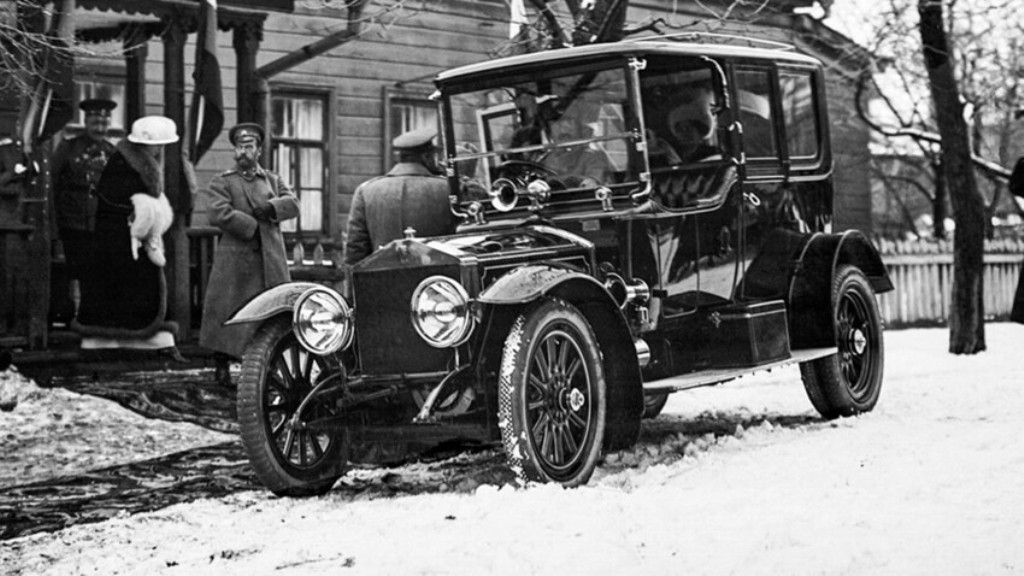
NEW 4-volume set of books celebrates Emperor Nicholas II’s motorcar collection

PHOTO: Царский выезд [Tsar’s Departure] will be published in 4-volumes

On 18th February, Russian writer and auto enthusiast Ivan Barantsev, published the first volume of Царский выезд [Tsar’s Departure] – a unique 4-volume set of books dedicated to Emperor Nicholas II’s motorcar collection and His Imperial Majesty’s Own Garage.

The release of the first volume, is timed to the opening of the Tsar’s Departure Exhibition, which opened in Moscow on 19th February 2022.

The albums offer many new photographs, most of which have never been published and only recently discovered by the author in various Russian archives. The author has also made corrections to errors found in previously published photographs. Some photos have been identified on the very day the photo was taken, and complemented with notes from Nicholas II’s diaries.

Barantsev claims: “there are so many photos, that they couldn’t fit under one cover, so the project will be published in four volumes”.

PHOTO: Volume 1 features 240 pages + more than 100 photos

Volume 1, is dedicated to the period 1895-1911. Large hard cover format 32 x 24 cm, with 240 pages, and more than 100 black and white photos with detailed descriptions.

*Volume 2, will be dedicated to the period 1911-1914; *Volume 3, to 1914-1915; and *Volume 4, to 1915-1917. *Not yet published!

The first volume is currently only available for purchase at the Tsar’s Departure Exhibition, which runs from 19th February to 17th April 2022, in the Special Purpose Garage [Pavilion No. 53] at the All-Russian Exhibition Center (VDNKh) in Moscow.

Please note that this set of books is ONLY available in Russian. No publication dates for the remaining three volumes have been announced. I have no doubt, that once all 4-volumes are published, that sets will be available to purchase from Russian booksellers online.

PHOTO © Ivan Barantsev

PHOTO © Ivan Barantsev

PHOTO © Ivan Barantsev

PHOTO © Ivan Barantsev

© Paul Gilbert. 22 February 2022