The Alexander Palace circa 1990

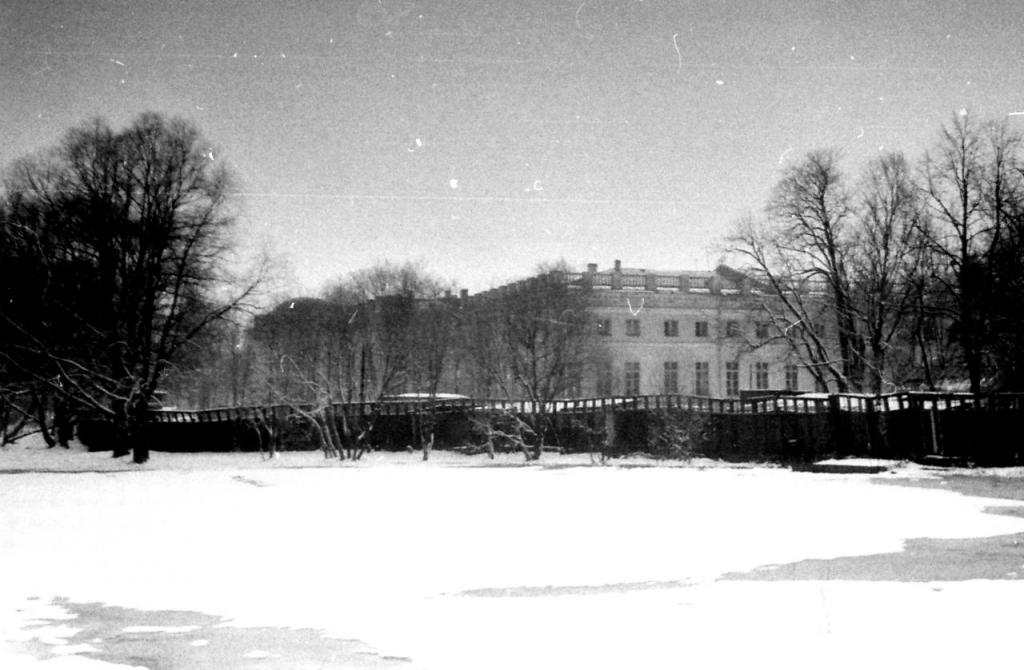
PHOTO: The Alexander Palace as it looked in the early 1990s

This photo reminds me of my visits to the Alexander Palace at Tsarskoye Selo in the 1990s, when the palace was surrounded by a security fence and watchtower, and off limits to visitors.

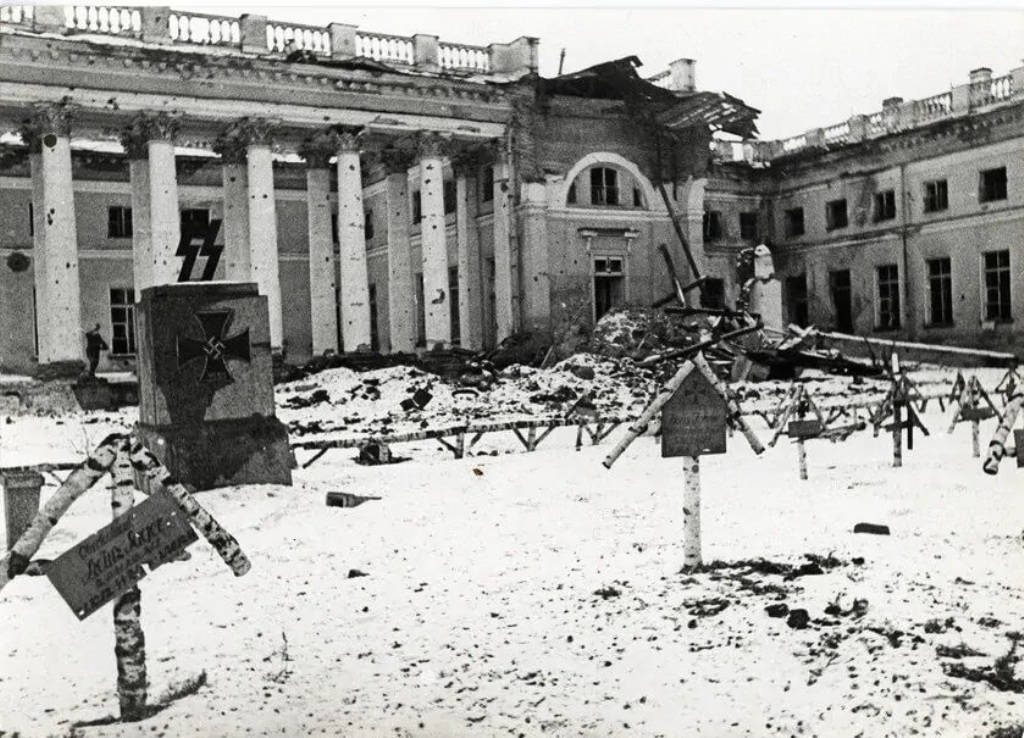
In 1951, by a government decree, the Alexander Palace was transferred to the Ministry of Defense. The Naval Department used the building as a top-secret, submarine tracking research institute of the Baltic Fleet. As a result, the former palace would be strictly off-limits to visitors for the next 45 years.

In 1996 the Alexander Palace was designated as one of the world’s 100 most endangered sites by the World Monuments Fund who issued a grant for the restoration of the palace. American Express donated $200,000 for urgent roof repair. This struck fear into the security-conscious Ministry of Defence, who feared that their top-secret facility might be bugged during the repairs.

In 1997, a permanent exhibition was created in the former apartments of Emperor Nicholas II and Empress Alexandra Feodorovna, located in the eastern wing of the palace. The remainder of the palace was still occupied by the Ministry of Defense and remained strictly off limits to both museum administration staff and visitors.

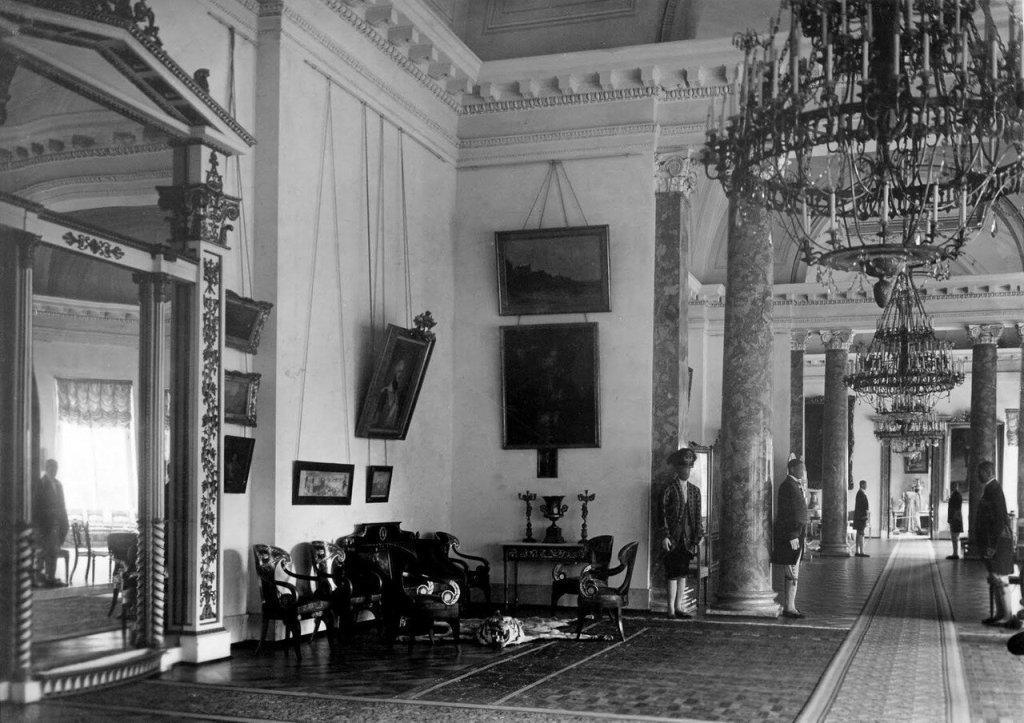
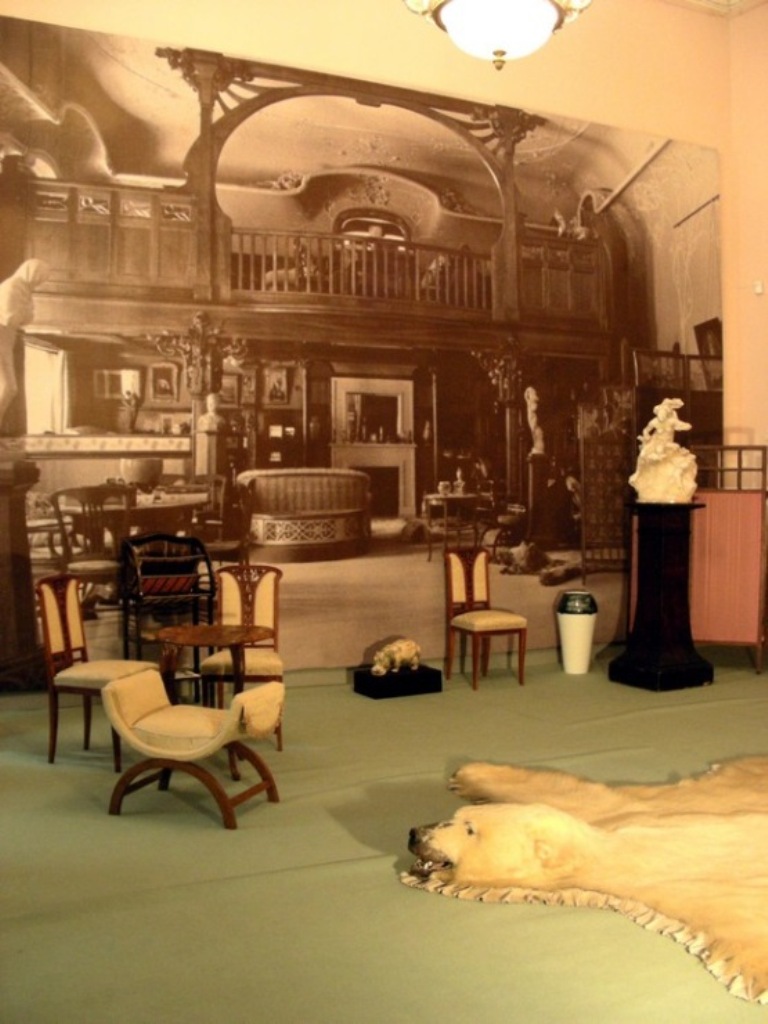
The exhibition Reminiscences in the Alexander Palace opened on 26th August 1997. The exhibition which consisted of twelve rooms did not attempt to recreate the palace’s historic appearance, instead featured furnishings and personal items set against the backdrop of an enormous historic photograph of the each respective room as it looked.

On 5th September 1997, I entered the Alexander Palace for the very first time. I was hosting my second tour to Russia, The World of Nicholas and Alexandra. My group which consisted of 18 persons from the United States and Canada had the honour of being one of the first groups of visitors to tour the Alexander Palace interiors since before the Great Patriotic War (1941-45), when the palace was a museum.

It was not until October 2009, according to the order of the Federal Property Management Agency, that the Alexander Palace was placed under the administration of the Tsarskoye Selo State Museum Reserve.

The Alexander Palace was closed in August 2015 for an extensive restoration, which included the reconstruction of the historic interiors of the private apartments of Nicholas II and Alexandra Feodorovna. The first 15 interiors located in the eastern wing of the palace are now scheduled to open in 2021.

In the future, the Alexander Palace will become a memorial museum of the Romanov family – from Catherine the Great to Nicholas II, showcasing the private, domestic life of the Russian monarchs who used the palace as an official residence. The eastern wing of the palace will be known as the Museum of the Russian Imperial Family. The multi-museum complex, which includes the Western wing is scheduled for completion no earlier than 2024.

© Paul Gilbert. 15 November 2020

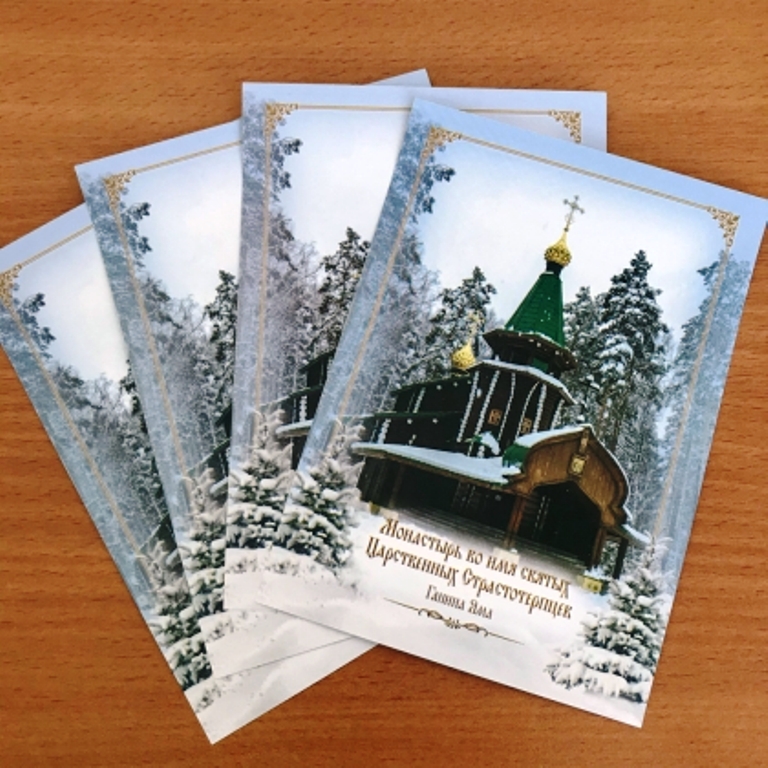
Monastery of the Holy Royal Martyrs at Ganina Yama marks 20th anniversary

PHOTO: A wooden causeway has been built around the edge of the mine shaft, a tall cross marks the edge of the mine shaft where the remains of Nicholas II, his family and four faithful retainers were their killers first discarded after their brutal murder.

On Wednesday, 23rd September, a solemn Divine Liturgy was held at Ganina Yama on the occasion marking the 20th anniversary of the founding of the Monastery of the Holy Royal Martyrs.

With the financial assistance from the Ural Mining and Metallurgical Company, the Russian Orthodox Church constructed the Monastery at the site in 2001. Seven chapels were later constructed at the site, one for each member of the Imperial family. Each chapel is dedicated to a particular saint or relic.

PHOTO: The Four Brothers mine (collapsed) is now visible as a depression in the ground. In July of each year, the former mine pit is covered with fragrant lily plants for the ceremony marking the regicide.

A tall cross marks the edge of the mine shaft – visible as a depression in the ground – where the remains of Nicholas II, his family and four faithful retainers were first discarded after their brutal murder in the basement of the Ipatiev House in Ekaterinburg.

The horrific crime that took place here at the Four Brothers mine near the village of Koptyaki – 15 km north from Ekaterinburg – was carried out in the early morning hours of 17th July 1918, when the men who took part in the regicide, threw the bodies of the Imperial family and their four retainers into the mine.

The murderers returned the following night, retrieved the remains, and reburied them in two separate graves at Porosenkov Log, situated about 3.8 km away.

Holy Royal Martyrs, pray to God for us!
Святы Царственные мученики, молите Бога о нас!

***

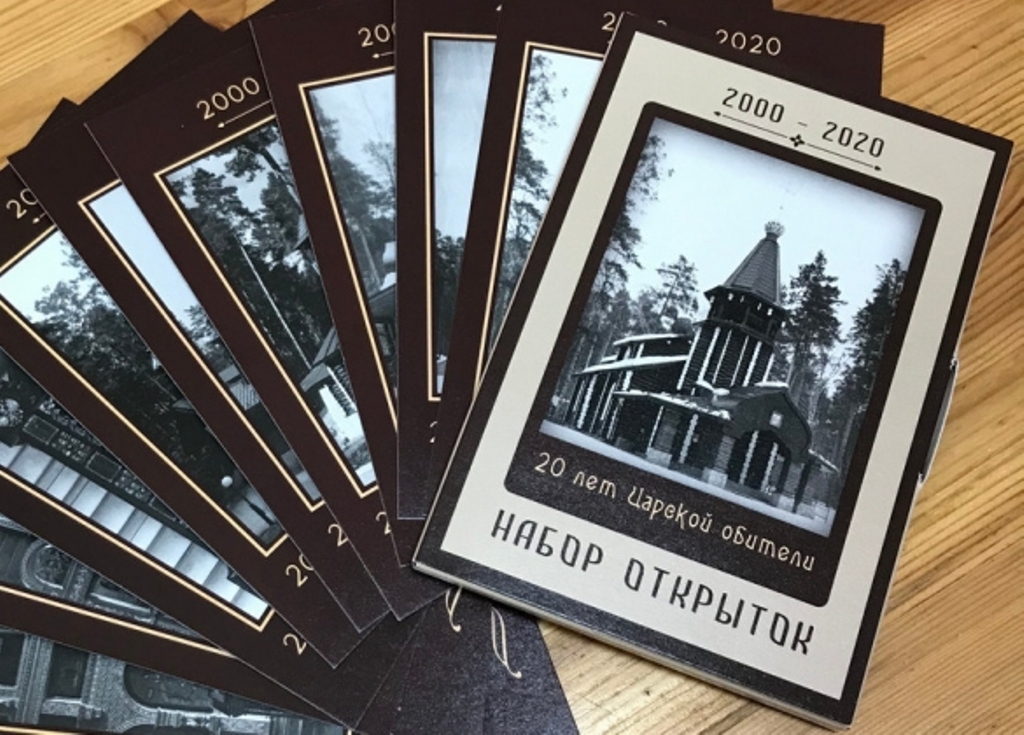
In honour of the 20th anniversary of the founding of the Monastery of the Holy Royal Martyrs, a video history of the monastery has been prepared. It consists of three parts and describes a chronology of events from the life of the monastery at Ganina Yama, between 1990 to 2020.

Part I: the period from 1990 to 2000 (Duration: 2 minutes, 25 seconds)

Part II: the period from 2000 to 2003 (Duration: 3 minutes)

Part III: the period from 2004 to 2020 (Duration: 4 minutes, 20 seconds)

© Paul Gilbert. 13 November 2020

Video tour of the Museum of the Family of Emperor Nicholas II in Tobolsk

CLICK on the IMAGE above to watch VIDEO (in Russian ONLY). Duration: 13 minutes

The Tobolsk Historical and Architectural Museum-Reserve have created a 13-minute video tour of the Museum of the Family of Emperor Nicholas II.

NOTE: this video is in Russian only, there is no English version. If you do not speak Russian, please do not allow this to deter you from watching this video. For those of you who will never have an opportunity to visit Tobolsk, this video is the next best thing, as it affords a virtual tour of the interiors of this very important museum, one which reflects the final years of Nicholas II and his family – PG

This virtual tour of the museum is presented in Russian by historian and writer Peter Valentinovich Multatuli, who was born in Leningrad on 17 November 1969. Multatuli is considered by many as Russia’s leading authority on the life and reign of Emperor Nicholas II.

He is the great-grandson of Ivan Mikhailovich Kharitonov (1872-1918), who served as the Head Cook of the Imperial family. He followed the tsar and his family into exile, and was murdered along with them in the Ipatiev House on 17th July 1918.

Multatuli takes viewers on a virtual tour of the former Governor’s House in Tobolsk, where Nicholas II, his family and entourage of those who followed the Imperial family into exile lived under house arrest from August 1917 to April 1918. Each room features unique exhibits from their daily life complemented with Multatuli’s vast knowledge of Russia last emperor and tsar.

NOTE: the large white circle located in the upper left hand corner of the video has 4 arrows, which allow you to move the camera to view the entire room and their respective displays – PG

The Museum of the Family of Emperor Nicholas II opened on 26th April 2018, in the former Governor’s Mansion in Tobolsk

PHOTO: Peter Multatuli in the Museum of the Family of Emperor Nicholas II, Tobolsk

***

Emperor Nicholas II and his family arrived in Tobolsk on 19th August (O.S. 6th August) 1917.

Upon arrival the Imperial family had to live for several days on the steamer Rus, waiting for the renovation of the “House of Freedom” – the former governor’s mansion – to be completed. They moved into the house on 24th August (O.S. 11th August).

Within a few days of their moving in, part of the square in front of the house was fenced off with a tall wooden fence, allowing for the family to take in fresh air and exercise. Some of the guards and those who accompanied the Imperial family into exile from Tsarskoye Selo were settled in the Kornilov house on the opposite side of the street.

In the beginning, the Imperial family were allowed to walk to the nearby Church of the Annunciation for worship, however, this was halted due to “concerns for their safety”. Despite this, the security regime in Tobolsk was more relaxed than in Tsarskoye Selo, allowing the family to lead a fairly calm life.

The Imperial family were housed in the former governor’s house until April, 1918, when they were transferred to Ekaterinburg, and subsequently murdered by the Ural Soviet on 17th July 1918.

© Paul Gilbert. 11 November 2020

The history and restoration of the Pallisander (Rosewood) Drawing Room in the Alexander Palace

PHOTO: view of the Pallisander (Rosewood) Drawing Room, as it looked in 1917

Among the living quarters of Empress Alexandra Feodorovna located in the eastern wing of the Alexander Palace is the Pallisander or Rosewood Drawing Room. The room got its name from its elegant rosewood interiors. Rosewood is a valuable tropical tree species of the genus Dalbergia, which has a high density and rich colour range, which can vary from light brown with a pinkish tint to dark brown with purple veins. A characteristic feature of this particular tree is its extreme slow growth – a full-fledged mature trunk taking almost two hundred years to mature. Rosewood has high moisture and wear resistance, high decorative qualities, and lends itself well to mechanical processing. The wall panels, fireplace, cornices and furniture were made of this material for the interiors in the Empress’s living room.

The upper part of the walls of the interior was covered with a yellowish silk fabric without a pattern, which was specially ordered in France from the famous Charles Burger company. The work carried out by Roman Feodorovich Meltser’s (1860-1943) firm was completed in 1895.

PHOTO: view of the Pallisander (Rosewood) Drawing Room, as it looked in 1917

The shelves and tables in the living room, were filled with collectibles and memorabilia, among which were figurines and vases. In addition, the interior was decorated with family photographs, paintings and watercolours with views of Hesse-Darmstadt – the Empress’s homeland.

Books in German, English and French, arranged on shelves, were mainly classics of foreign literature. Among them – The Necklace of Princess Fiorimonde by Mary de Morgan, Miss Esperance and Mr. Wycherly by Lizzie Allan Parker, The Innocence of Father Brown by G. K. Chesterton, The Side Of the Angels: A Novel by Basil King, Rosalind in Arden by Henry Marriott-Watson, The Valley of Fear by Arthur Conan Doyle, The Antiquary by Sir Walter Scott, and Laocoon: An Essay on the Limits of Painting and Poetry by Gotthold Lessing.

Two telephones were installed in the Pallisander Drawing Room, one of which connected the palace with the Headquarters during the First World War.

Since the dining room in the Emperor’s half of the eastern wing of the Alexander Palace was converted to the Reception Room, family dinners were often served in the Pallisander Drawing Room.

PHOTOS: detail of the Pallisander (Rosewood) Drawing Room fireplace

The recreation of the interior of the Pallisander Drawing Room is based on historical samples preserved in the palace-museum’s archives, including samples of wall fabric, curtains, and panels. The rosewood fireplace which once dominated the interior, decorated with bevelled mirrors has been recreated. Colour autochromes as well as vintage black and white photos also helped recreate the interiors.

During the restoration, a decision was made to recreate the frames for the paintings that were in this living room and preserved in the palace-museum collection. The difficulty in reconstructing these frames was that, like many frames in the palace, they were made according to individual orders of artists, and their sketches or drawings were not preserved, therefore, historical documents, photographs and descriptions were used to recreate them. Click HERE to read my article Original works of art will decorate recreated rooms in the Alexander Palace, published on 9th January 2020

PHOTO: the current look of the recreated Pallisander (Rosewood) Drawing Room

Work on the interiors of the Pallisander (Rosewood) Drawing Room continues. The production of a set of furniture for the living room will soon begin. The scientific staff of the museum are currently engaged in the search and selection of household items, porcelain, paintings, interior sculptures to replace those lost during the Great Patriotic War and the occupation.

***

The Pallisander (Rosewood) Drawing Room is now one of 15 interiors in the eastern wing of the palace, scheduled to open in 2021. Among the other interiors are the New Study of Nicholas II, Moorish Bathroom of Nicholas II, Working Study of Nicholas II, Reception Room of Nicholas II, Pallisander (Rosewood) Living Room, Mauve (Lilac) Boudoir, Alexandra’s Corner Reception Room, the Imperial Bedroom, among others.

In the future, the Alexander Palace will become a memorial museum of the Romanov family – from Catherine the Great to Nicholas II, showcasing the private, domestic life of the Russian monarchs who used the palace as an official residence. The eastern wing of the palace will be known as the Museum of the Russian Imperial Family. The multi-museum complex, which includes the Western wing is scheduled for completion no earlier than 2024.

***

Dear Reader: If you enjoy all my updates on the restoration of the Alexander Palace, then please help support my research by making a donation in US or Canadian dollars – donations can be made by GoFundMe, PayPal, credit card, personal check or money order. Click HERE to make a donation. Thank you for your consideration – PG

© Paul Gilbert. 11 November 2020

New monument to Nicholas II opens in Penza Region

On 15th October, a new monument-bust to Nicholas II was unveiled and consecrated in the Penza region.

The monument was installed on the grounds of the Church of the “Quick to Hearken” Icon of the Mother of God in the Russian village of Proletarsky Zemetchinsky.

“The money for the monument to the Tsar-Martyr was collected in the form of donations from all over Russia” said Anatoly Tashkin-Bury, one of the two initiators of the project.

According to him, the initiative received the blessing of the hierarchy of the Penza diocese. The unveiling and consecration ceremony of the monument was attended by more than 100 people.

Tashkin-Bury added that the event was also attended by a small group of local Communists, carrying posters with provocative slogans such as “Bloody Nicholas”.

© Paul Gilbert. 10 November 2020

The myth that Grand Duke Mikhail Alexandrovich was Russia’s last Tsar

The question of whether Grand Duke Mikhail Alexandrovich (1878-1918) was the last Emperor of Russia, remains a subject of debate among many historians and monarchists to this day.

A heartbeat from the throne

Mikhail Alexandrovich was the youngest son and fifth child of Emperor Alexander III and Empress Maria Feodorovna, and youngest brother of Emperor Nicholas II.

At the time of his birth, his paternal grandfather Alexander II was still the reigning Emperor. Mikhail was fourth-in-line to the throne after his father and elder brothers Nicholas and George. After the assassination of his grandfather in 1881, he became third-in-line and, in 1894, after the death of his father, second-in-line. His brother George died in 1899, leaving Mikhail as heir presumptive. The birth of Nicholas’s son Alexei in 1904 moved Mikhail back to second-in-line.

In 1912, Mikhail shocked Nicholas II by marrying Natalia Sergeyevna Wulfert, a commoner and divorcee. In a series of decrees in December 1912 and January 1913, Nicholas relieved Mikhail of his command, banished him from Russia, froze all his assets in Russia, seized control of his estates and removed him from the Regency.

After the outbreak of World War I, Mikhail returned to Russia, assuming command of a cavalry regiment. When Nicholas abdicated on 15 March [O.S. 2 March] 1917, Mikhail was named as his successor instead of Alexei. Mikhail, however, deferred acceptance of the throne until ratification by an elected assembly. Nicholas was appalled that his brother had “kowtowed to the Constituent Assembly” and called the manifesto “rubbish”.

Mikhail was never confirmed as Emperor and, following the Russian Revolution of 1917, he was imprisoned and subsequently murdered by the Bolsheviks near Perm on 13 June 1918 (aged 39).

Would Mikhail have made a good Tsar?

While many of Nicholas II’s detractors insist that Russia’s last Tsar was unprepared for the throne, his brother Mikhail was even less prepared. Mikhail had no aspirations for the throne, instead he preferred the life a playboy, and his gentle disposition would have made him an easy target for manipulative ministers and generals in helping nurture their own selfish interests.

His letters to his brother the Emperor reveal a rather devious and conniving side of Mikhail. In one such letter dated 7th November 1912, Nicholas writes to his mother:

“What revolts me more than anything else is his [Mikhail] reference to poor Alexei’s [the Tsesarevich] illness which, he [Mikhail] says, made him speed things up. [Mikhail is referring to his marriage. In the event of Alexei’s death, Mikhail would have become heir to the throne]. And then the disappointment and sorrow it brings to you and all of us and the scandal of it all over Russia mean absolutely nothing to him! At a time, too, when everyone is expecting war, and when the tercentenary of the Romanovs is due in a few months! I am ashamed and deeply grieved.”

Many believe that Mikhail’s ascension to the throne would have ushered in a constitutional monarchy and that this in itself would have preserved the dynasty and saved Russia. Russia, however, was not prepared for a constitutional monarchy, nor would it have preserved the dynasty nor would it have saved Russia. A constitutional monarchy would not have appeased the socialists and revolutionaries, and most certainly driven the radical elements such as the Bolsheviks to extreme measures. It has been argued that Russia should have adopted a European style monarchy. There is little similarity. Holy Russia did not need to adopt a Western style monarchy. For centuries Russia had been led by mystic forces. Monarchy was the social system that fit Russia best.

The legality of Nicholas II’s act of abdication 

Some historians further argue that Nicholas II’s act of abdication on 15 March 1917 (O.S. 2 March) 1917 was invalid for two reasons: one, because it was signed in pencil, violating all the necessary legal and procedural methods and format, and thus had no legal force; and two, because the instrument of abdication was never officially published by the Imperial Senate.

In his scholarly book ‘Russia 1917. The February Revolution,’ historian George Katkov, throws yet another interesting coal into the fire:

“ . . . when the Tsar abdicated, and later on behalf of his son, he was accused of having done so in contravention of the law of succession and with the aim of introducing a legal flaw into the instrument of abdication that would later allow him to declare it invalid.”

If this is true, it was a very clever move on the part of Nicholas II, not realizing the terrible fate which awaited him and his family 15 months later in Ekaterinburg.

Grand Duke Mikhail was not “Tsar for a day”

One thing, however, is certain—Grand Duke Mikhail Alexandrovich was NOT Russia’s last tsar! Nicholas II remained Emperor and Tsar of Russia until the day of his death and martyrdom on 17th July 1918.

As God’s Anointed, Nicholas II could not be displaced during his lifetime. Since the will of God was nowhere manifest, neither in the naming of his brother Grand Duke Mikhail to the throne, nor in the Tsar’s signing of the instrument of abdication, his status as Tsar remained inviolate and unassailable.

© Paul Gilbert. 6 November 2020

 * * *

486f

MISHA: GRAND DUKE MICHAEL ALEXANDROVICH
Compiled and Edited by Paul Gilbert

CLICK ON THE LINK BELOW TO ORDER FROM AMAZON

PAPERBACK EDITION – PRICE $12.99

BOOK DESCRIPTION

This book explores the milestones in the life of Grand Duke Michael in a series of essays by four distinct authors, and complemented with 50 black and white photographs.

Paperback edition. 136 pages + 50 black & white photographs

The history and restoration of the Mauve (Lilac) Boudoir in the Alexander Palace

PHOTO: View of the Mauve (Lilac) Boudoir in the Alexander Palace, as it looked in 1917
Popillon’s painting “The Dream of the Virgin” can be seen hanging on the wall 

The favourite room of Empress Alexandra Feodorovna in the Alexander Palace was the Mauve (aka Lilac) Boudoir. This interior was designed by Roman Feodorovich Meltser (1860-1943). According to legend, the empress gave him a lilac branch, her favourite flower, so that the architect could choose the colour scheme for the decoration of the room.

As a result, the walls were upholstered in mauve silk and crowned with a frieze decorated with an iris styled pattern. An ornamental Louis XV style painting decorated the ceiling of the room.

PHOTOS: views of the Mauve (Liliac) Boudoir in the Alexander Palace, as it looked in 1917

The furniture and upright piano by J. Becker were been painted with ivory enamel paint. Some of the furniture items were included in the composition of the walls and fastened to the wall panels. On the shelves, cabinets and fireplace were glass vases, mainly produced by the workshop of Emile Gallé, porcelain figurines and handmade souvenirs presented as gifts to the Empress, as well as family photographs. The room was decorated year-round with fresh flowers from the gardens or hothouses at Tsarskoye Selo.

Alexandra Feodorovna spent a lot of time in the Mauve Boudoir: it was here that she rested, read, and carried out her correspondence. In the evening, the whole family gathered here. The cabinets contained books from the empress’s personal library, sheet music, drawing supplies, and board games.

Thus, at the beginning of the 20th century, the room personified the comfort of a home.

Like many other rooms in the Alexander Palace, the Mauve Boudoir suffered a sad fate – the decoration and the interior were lost during the Great Patriotic War (1941-45).

PHOTO: the current look of the Mauve (Lilac) Boudoir after an extensive restoration

PHOTO: Recreated doors of the Mauve (Lilac) Boudoir in the Alexander Palace

During the current restoration, fabric upholstery for the walls and curtains (fragments of fabric had been preserved in the Pavlovsk State Museum-Reserve), furniture, carpets, wood panels, a fireplace, and a picturesque frieze were recreated, based on historical samples, archival documents and photographs.

A huge amount of work has been done to recreate the doors: first, models were made, then the doors were recreated from wood.

The collection of the Alexander Palace Museum contains Alexandra’s writing table from the Mauve Boudoir, found in the park in a ruined state after the war. In 2018, test cleanings of a paint layer of the writing table were carried out, thanks to which the initial colour of the finishing of the entire interior was determined, as well as the colour scheme for the panels, built-in furniture and cabinet doors. The museum plans to restore Alexandra’s writing table to its original, thanks to descriptions and old photographs.

A painting (see first photo above in this article) by the French artist Edouard Jerome Popillon “The Dream of the Virgin” which once hung in the Mauve Boudoir will be returned to the Alexander Palace from the Pavlovsk Museum-Reserve, where it has been held for many decades. Upon the reopening of the palace next year, the painting will be on display in the room for visitors to enjoy.

PHOTO: Nicholas II and Alexandra Feodorovna seated in the corner of the Mauve Boudoir

***

The Mauve Boudoir is now one of 15 interiors in the eastern wing of the palace, scheduled to open in 2021. Among the other interiors are the New Study of Nicholas II, Moorish Bathroom of Nicholas II, Working Study of Nicholas II, Reception Room of Nicholas II, Pallisander (Rosewood) Living Room, Mauve (Lilac) Boudoir, Alexandra’s Corner Reception Room, the Imperial Bedroom, among others.

In the future, the Alexander Palace will become a memorial museum of the Romanov family – from Catherine the Great to Nicholas II, showcasing the private, domestic life of the Russian monarchs who used the palace as an official residence. The eastern wing of the palace will be known as the Museum of the Russian Imperial Family. The multi-museum complex, which includes the Western wing is scheduled for completion no earlier than 2024.

***

Dear Reader: If you enjoy all my updates on the restoration of the Alexander Palace, then please help support my research by making a donation in US or Canadian dollars – donations can be made by GoFundMe, PayPal, credit card, personal check or money order. Click HERE to make a donation. Thank you for your consideration – PG

© Paul Gilbert. 4 November 2020

A peek inside the ‘Nicholas II 2021 Calendar’


CLICK ON THE IMAGE ABOVE TO ORDER MY 2021 CALENDAR

I am reaching out to friends and followers of my 26+ years of researching and writing about the life, reign and era of Emperor Nicholas II (1868-118).

If you enjoy my articles, news, photos and videos about Russia’s last emperor and tsar, please support my research in the coming new year ahead, by purchasing a copy of ‘Nicholas II 2021 Calendar’.

Each month features an iconic full-page photograph of Nicholas II (see images below), printed on glossy stock.

Each month features an iconic full-page photo
of Nicholas II printed on glossy stock


Each month features an iconic full-page photo
of Nicholas II printed on glossy stock

The entire net proceeds from the sale of each calendar goes towards my research, which includes the costly translation of articles and news from Russian media and archival sources, and more.

The price is only $10 + postage. Payment can be made by credit card or PayPal online or by personal check or money order (Click HERE to download and print an order form to pay be check or money order )

THANK YOU to those of you who have already purchased a copy,
your interest and support of my research is much appreciated – PG

© Paul Gilbert. 2 November 2020

The development of the Russian Empire during the reign of Nicholas II

Unlike those who talk about the unpreparedness, weakness and lack of will of Nicholas II, Russian historian Andrei Anatolyevich Borisyuk, is convinced that the Emperor knew what the country needed during the first years of his reign, and brilliantly fulfilled his mission as sovereign.

“He immediately took effective and ingenious steps for the development of the state,” says the historian. – The economy, bolstered by a growing railway system, was rapidly being developed. Metallurgy was being completely rebuilt. The Urals which was considered the main center of metallurgy, was soon outpaced by the Donbass region, where seven metallurgical plants were built under Nicholas II. Nearby were huge coal reserves, located in the Krivoy Rog iron ore basin. While firewood was being used to smelt metal in the Urals, coal was used in the Donbass. Before 1914, metalworking and mechanical engineering were developing at a record pace in the Empire. These rates even exceeded those of Stalin’s five-year plans.

Double-decker trains and aeroplanes

Recently a double-decker train was put into service between Moscow and Bryansk, but the implementation of the new railcars was delayed by a hundred years. Historic photographs prove that already in 1905, modern-looking double-decker cars, produced in Tver, were already running on Russian rails. It is clear that it was impossible to build them without a very high technological level of production.

During the reign of Nicholas II, the Empire began to produce aeroplanes and cars. During the First World War, 6,300 aircraft were built in “backward” Russia. At the same time, the production of submarines and other high-tech products was developing.

The production of cement increased 15 fold, which was necessary for the rapidly gaining momentum in the construction industry. Such an increase was a result of the changes to urban construction and development. For the first time, the construction of seven- and eight-story apartment buildings was underway in Russia. Many of these buildings have survived to this day in Moscow, where they are often mistaken for Stalinist ones, but in reality they were built during the reign of Emperor Nicholas II.

Agriculture was also increasing. In terms of the harvest of wheat and sugar beet, Russia ranked first in the world, in terms of the total volume of grain harvest – the United States ranking second. This growth was not accidental, it was the result of the reforms of Pyotr Stolypin (1882-1911), who served as Prime Minister of Russia, and Minister of Internal Affairs of the Russian Empire from 1906 to his assassination in 1911. But it is interesting to note that many of these reforms were already in place by the time the brilliant statesman came to head the government. The essence of the reforms resulted in the peasants having the right to personal ownership, giving a person the opportunity to buy and sell land without being constrained by any conditions. The Bolsheviks, on the other hand, drove everyone into collective farms, again turning people into disenfranchised slaves.

Huge sums of money were allocated for the creation of experimental agricultural enterprises. Farms, and experimental stations were emerging, and agronomy was developing. It was at this time that the first tractors appeared in villages.

1908: universal education program

The actions and decisions of the Emperor lead to a huge economic recovery. The state began to finance subsidized sectors of the economy, such as the social sector. The standard of living of the population was increasing. Education received tremendous support. In 1908, a universal education program was launched in the Russian Empire. During the reign of Nicholas II, more than 65 thousand schools were built.

“The pre-revolutionary program of universal education was denied in Soviet times,” says Andrei Borisyuk. – “The creation of this system was attributed exclusively to the Soviet Union, but documentary sources provide an unambiguous understanding that the universal education program began during the reign of Nicholas II. I researched the documents of the Ministry of Public Education of the Russian Empire, which are in the Russian State Historical Archives, and they prove that the program created 65 thousand new schools.”

The population was growing at a record pace, while mortality was decreasing. One of the many myths regarding the Russian Empire was that the population was allegedly starving, that every few years there was a terrible famine that claimed the lives of millions of people. Hunger in any case is reflected in the statistics, if there was one. But we know two peaks – the famine of the 1920s and 1930s. There were no such peaks in the Russian Empire; the mortality rate was consistently decreasing due to an increase in living standards. The claim that the revolution saved people from hunger does not stand up to scrutiny. At the beginning of the 20th century, the Russian Empire was an advanced high-tech country with rapidly developing industrialization and education.

Science was also developing. It was during the reign of Nicholas II, that the scientist Alexander Stepanovich Popov (1859-1906) invented the radio in 1895. In 1911, the world’s first broadcast of television data was carried out in Russia by Boris Lvovich Rosing (1869-1933). 

It is interesting to note that Rosing was one of the many talented pupils of the Russian education system. The Ministry of Public Education, which was established in 1802 by Emperor Alexander I, stated that any citizen of the Russian Empire, regardless of class, could receive an education. Some were able to finish one class of the primary parish school, others – three classes of the district school. There was further opportunity to study in gymnasiums, provincial schools, universities. Primary school education was free.

Another pupil Vladimir Ivanovich Vernadsky (1863-1945), went on to study the atom, and later said that nuclear energy will soon overshadow the power of the owners of gold, land and capital. The first radium laboratory was created and a radium mine under development.

Also noteworthy is Konstantin Eduardovich Tsiolkovsky (1857-1935) who is considered to be one of the founding fathers of modern rocketry and astronautics. His works later inspired leading Soviet rocket engineers such as Sergei Korolev and Valentin Glushko and contributed to the success of the Soviet space program. Tsiolkovsky was also one of the many talented pupils of the education system of the Russian Empire.

Choosing between Liberalism and Communism

“The development of Russian civilization evolved over many centuries, reaching amazing heights,” says Andrei Borisyuk. – From the birth of this civilization, we can say that Russia was a country of high values ​​and technology. Here churches and monasteries were being built, but at the same time industrial enterprises were opening, factories being built, radio was created, and advanced technological developments carried out. This is the land of scholars and holy ascetics. Why is this important to us now? In his book The Clash of Civilizations and the Remaking of World Order the American political scientist Samuel P. Huntington writes that modern geopolitics is built more along the borders of civilizations than along the geographical borders of countries. That is, civilization is primary for explaining the logic of historical processes. Civilization is a global space built on certain values. An understanding of basic values, that underlie our civilization is literally a matter of national security. What values ​​are at the heart of Russia? On what did the Russian people assert themselves? An appeal to historical Russia shows that these were the traditional values ​​of Faith, Motherland and Family. Relying on them, our country achieved maximum results and victories. Any attempt to deviate from these values resulted in very grave consequences for Russia. This ultimately happened in 1917. During that year the Russian people made a choice between Western European liberalism (February Revolution) and Western communism (October Revolution). The choice of the latter to deviate from the Russian Empire’s historical path of development, ended in failure. By putting pragmatic values ​​first, the economy began to develop more slowly under the Bolsheviks.

Vintage newsreels and old photographs captured many of the Empire’s achievements. The Sormovo machine-building plant, and the Putilovsky plant which produced steam locomotives are just two examples which speak otherwise. Both workshops have survived to this day. And then there are the oil refineries, the power plant in St. Petersburg which is considered a masterpiece of architecture in comparison with the present industrial buildings. It is interesting to note that the same tower cranes used during the construction of the Russian-Baltic Shipyard in 1913, are still in use today. “Backward Russia?”

One photo captured the agricultural equipment of the “joint-stock company of Bryansk factories”, which the then “marketers” brought to an agricultural fair in the Amur region. By 1916, the peasants in the Samara region rejoiced at the arrival of the first tractors which they used to plow the land at their experimental station.

The skylines of both St. Petersburg and Moscow were dotted by the cupolas of beautiful churches and cathedrals. In the village of Pidma, a two-story school was built, which even today stands out with its severity and grace. A post office and a rural store in the Arkhangelsk hinterland more resemble a village palace even today. And the houses in Borodino, near Moscow, are examples of design and style which reflect the beauty of the Russian Empire.

Civilization is life. The Russian Empire in this sense was much more civilized than the modern world, which distorts the concept of the family and imposes destructive ideas. During the reign of Nicholas II, the population of Russia grew by 50 million people. In the pre-revolutionary years, the country’s population increased by 3.6 million people annually. This population growth in itself refutes the assertions of the Bolshevik propaganda that both hunger and want reigned in the Empire. Sadly, of course, diseases were present, and class inequality was still visible, but the fact that the number of inhabitants of Russia was growing also testifies to its prosperity,

***

Born in Moscow on 15th November 1989, Andrey Anatolyevich Borisyuk is one of a new generation of post-Soviet researcher and historian dedicated to challenging the popular held negative myths and lies about Russia’s last emperor and tsar.

He studied at the Orthodox St. Tikhon University, where he earned bachelor’s and master’s degrees, in Russian history.

He is the author of 2 Russian language books on Nicholas II: История России, которую приказали забыть. Николай II и его время.2018; and Рекорды Империи. Эпоха Николая II. 2020.

© Paul Gilbert. 1 November 2020

The October Revolution 1917 in the International Context. Interview with Professor Dominic Lieven

CLICK on the IMAGE above to watch VIDEO in English. Duration: 24 minutes.

A remarkable interview with Cambridge Research Professor D. Lieven (born 19 January 1952) about the reasons for and the outcomes of the 1917 October Revolution, as well as his family’s personal experience with it. He also speaks about Russia’s involvement in WW1, the Russian-German relationships, and gives an extraordinarily objective evaluation of Tsar Nicholas II’s abilities as a ruler, and comments on the most important decisions during his reign. Dominic Lieven is a research professor at Cambridge University (Senior Research Fellow, Trinity College) and a Fellow of the British Academy and of Trinity College, Cambridge.

Professor Lieven is the third child, of five children, of Alexander Lieven, of the Baltic German princely family, tracing ancestry to Liv chieftain Kaupo. He is the elder brother of Anatol Lieven, British author, Orwell Prize-winning journalist, and policy analyst, and he is distantly related to Christopher Lieven (1774–1839), who was Ambassador to the Court of St James from Imperial Russia over the period 1812 to 1834, and whose wife was Dorothea von Benckendorff, later Princess Lieven (1785–1857), a notable society hostess in Saint Petersburg and influential figure among many of the diplomatic, political, and social circles of 19th-century Europe. Lieven is a great-grandson of the Lord Chamberlain of the Imperial Court of Russia.

He is the author of numerous books on on Russian history, on empires and emperors, on the Napoleonic era and the First World War, and on European aristocracy, including: Russia’s Rulers Under the Old Regime, Yale University Press (1989); The Aristocracy in Europe 1815/1914, Macmillan/Columbia University Press (1992); Nicholas II: Emperor of all the Russias, John Murray/St Martin’s Press/Pimlico (1993); and The End of Tsarist Russia: The March to World War I and Revolution, Penguin Random House (2015).

***

This video is produced as part of the project for the book The Romanov Royal Martyrs, which is an impressive 512-page book, featuring nearly 200 black & white photographs, and a 56-page photo insert of more than 80 high-quality images, colorized by the acclaimed Russian artist Olga Shirnina (Klimbim) and appearing here in print for the first time. EXPLORE the book / ORDER the book.

© Mesa Potamos Monastery. 30 October 2020