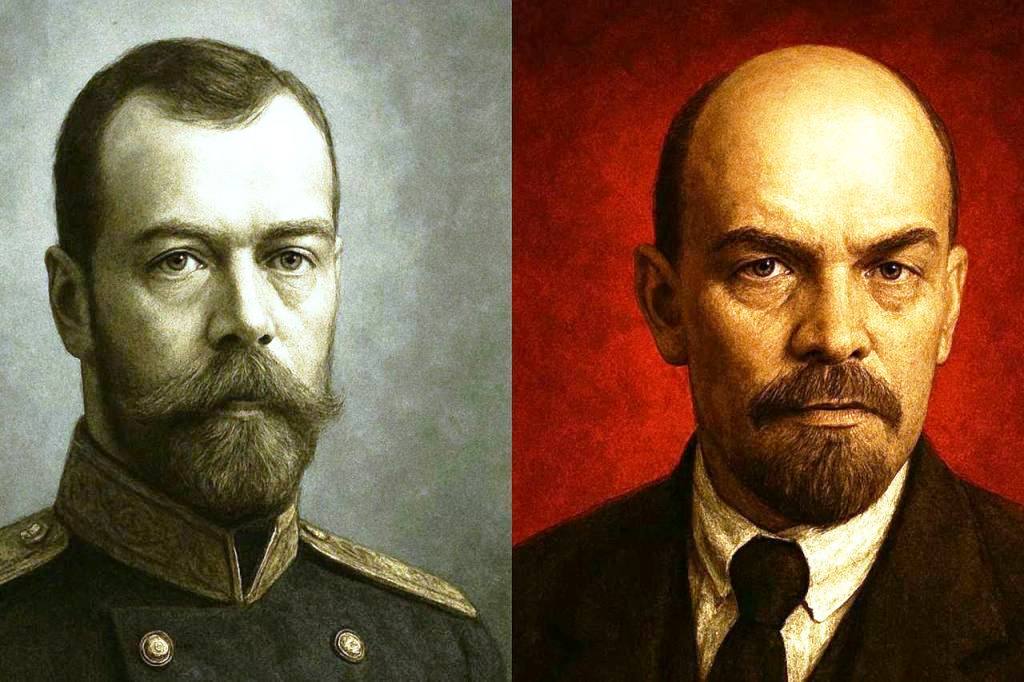
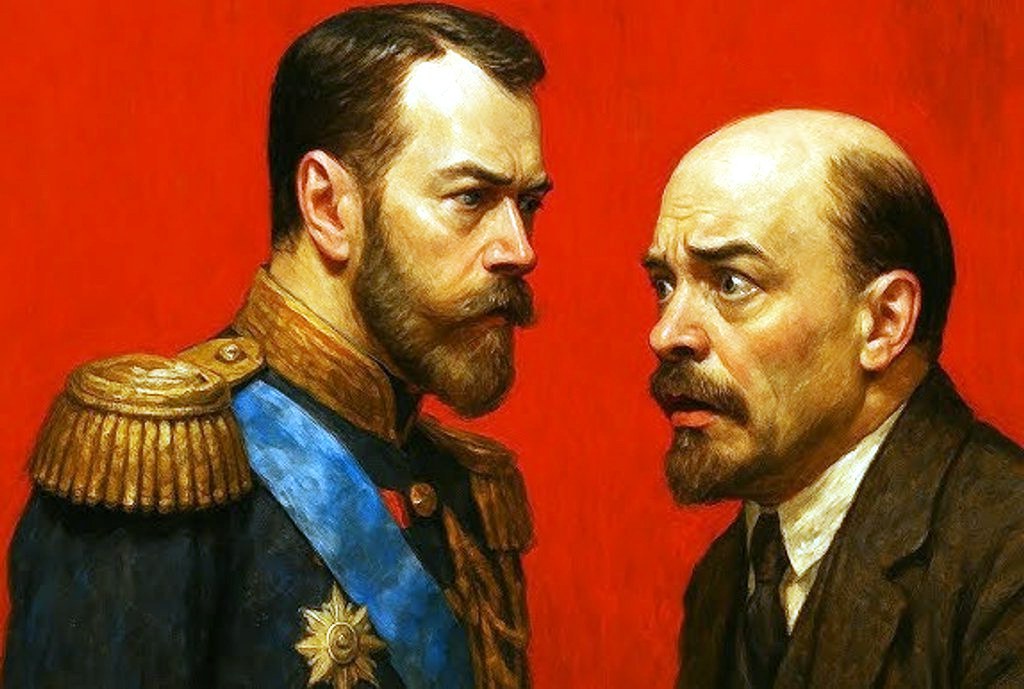
Nicholas II wanted reforms, Lenin wanted revolutions: who was right?

The question of whether Nicholas II was right with his desire for reform or Vladimir Lenin with his revolutionary ideology is at the heart of the debate about the fate of Russia in the early 20th century. Emperor Nicholas II, tried to modernize the country through gradual reforms, preserving its traditional foundations and monarchical system. Lenin, on the other hand, advocated a radical breakdown of the old order and the construction of a socialist society through revolution.

In this article, I argue that Nicholas II’s reform-based approach was more correct and patriotic, as he sought stability and prosperity for Russia, while Lenin’s revolutionary ideas led to chaos, civil war, and tragedy, including the deception and murder of the Imperial Family.

Nicholas II: Reforms for the Sake of Stability and Prosperity

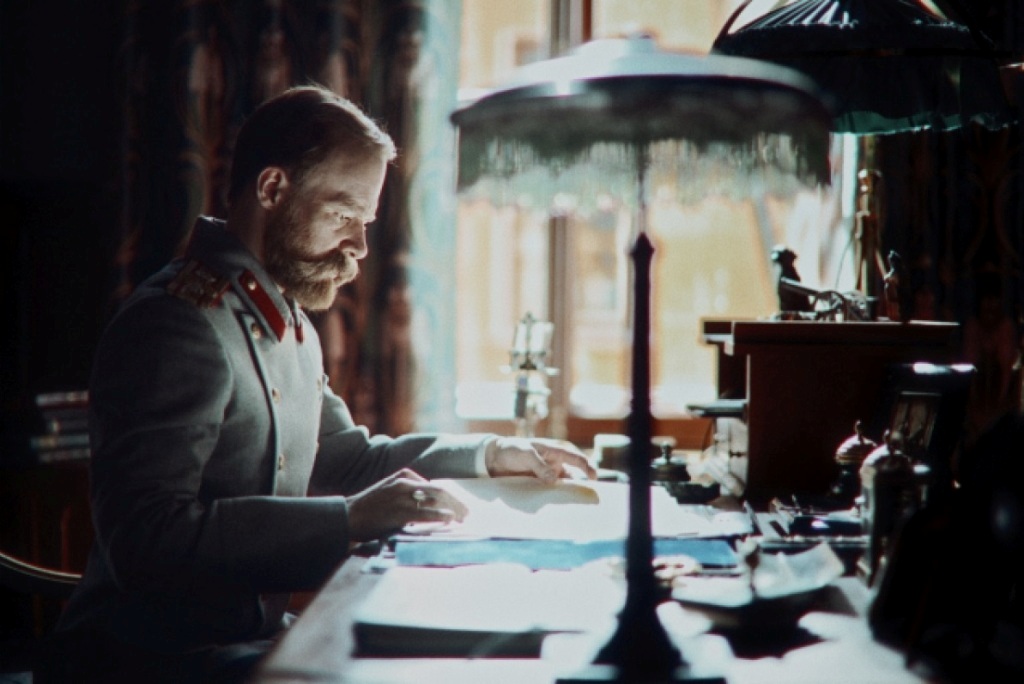
Nicholas II, who ascended the throne in 1894, inherited an empire that faced the challenges of modernization, social tensions, and domestic and external threats. His reign was far from perfect, but the Tsar sincerely sought reforms that would strengthen Russia, preserving its national identity and unity.

Economic and social reforms

Under the leadership of Nicholas II, Russia experienced significant economic growth. At the beginning of the 20th century, the country was one of the world’s leaders in industrialization. The construction of the Trans-Siberian Railway linking the east and west of the Russian Empire was completed, promoting trade and mobility for Russians. Industrial production doubled, and Russia became the largest exporter of grain. These achievements show that the Tsar saw the future of the country in economic development and modernization.

The key reform was Pyotr Stolypin’s agrarian reform, which began in 1906. It was aimed at creating a class of independent peasant landowners, which would strengthen agriculture and social stability. Nicholas II supported these measures, realizing that a strong economy and a satisfied peasantry were the basis of a stable state. The reforms were gradual to avoid upheavals, which testifies the foresight of the Tsar.

Political transformations

Nicholas II, despite his commitment to autocracy, made political concessions after the revolution of 1905. The Manifesto of 17th October 1905 introduced the State Duma, laying the foundations of a constitutional monarchy. Although the Duma had limited powers, it was a step toward democratization, showing the Tsar’s willingness to adapt to new realities. His reforms were aimed at preserving the unity of the country, avoiding radical upheavals that could split society.

Protection of traditions and faith

Nicholas II saw Orthodoxy and traditions as the basis of Russian identity. He supported the construction of churches and monasteries, strengthening the spiritual unity of the people. His reforms did not seek to destroy the historical heritage, but on the contrary, used it as a foundation for modernization. This made his approach patriotic, as he cared about preserving the culture of Russia.

Peacekeeping

Nicholas II initiated the Hague Conference of 1899, which was the first step towards international norms of warfare. This demonstrated his desire for peace and stability, which was especially important in the context of growing global conflicts. His efforts earned him a nomination for a Nobel Peace Prize in 1901. Even during the First World War, the Tsar personally participated in the management of the army, showing devotion to duty and country.

Lenin: Revolution for the Sake of Utopia

Vladimir Lenin, on the contrary, advocated a radical destruction of the existing order. His Marxist ideology demanded a revolution that would destroy the monarchy, the church, and capitalism, replacing them with the dictatorship of the proletariat. However, his actions led to disastrous consequences, proving that the revolutionary path was wrong.

Destruction instead of creation

The October Revolution of 1917, led by Lenin, overthrew the Provisional Government and led to a civil war (1917-1922) which claimed millions of lives. The nationalization of industry and collectivization destroyed the economy, causing hunger and poverty. Unlike the reforms of Nicholas II, which strengthened the economy, Lenin’s policy led to devastation. For example, the surplus-appropriation plundered peasants, which caused mass discontent and uprisings, such as the Kronstadt uprising in March 1921.

Red Terror and deception

Lenin sanctioned the first Red Terror, aimed at the destruction of “class enemies.” Thousands of innocent civilians, were executed or sent to gulags. Nicholas II, on the contrary, sought to avoid mass repressions, even during the February 1905 Revolution. Moreover, Lenin played a key role in the tragedy of the last Tsar and his family. The Imperial Family were held under house arrest and then shot in Ekaterinburg in 1918 on the direct order of Lenin. In the Bolshevik leader’s mind, as long as the Tsar, or any member of his family were left alive, they posed a threat to the new order and their reign of terror and repression.

Loss of territories

The Brest-Litovsk Peace Treaty of 1918, signed by Lenin, was humiliating for Russia. Huge territories, including Ukraine and the Baltic states, were given to Germany, which weakened the country. Nicholas II, even during the First World War, fought to preserve territorial integrity. When he took command of the Russian armed forces in August 1915, no further Russian territories were lost to the enemy. Lenin, on the other hand, sacrificed national interests for the sake of preserving his power, which can hardly be called patriotic.

Destruction of traditions

Lenin, as an atheist, declared war on Orthodoxy, destroying churches and persecuting and murdering thousands of members of priests, monks and nuns. This undermined the spiritual foundations of Russia, which Nicholas II defended. Lenin’s revolution rejected the historical legacy, replacing it with a utopian ideology that did not take into account the cultural and national characteristics of the country.

Who was right?

Nicholas II’s reform-based approach was correct, as he sought to modernize Russia without destroying its foundations. His reforms in the economy, agriculture, and politics (among others) were aimed at gradual development that could have led to prosperity had it not been for the revolutionary upheavals of 1917 and 1918.

The Tsar cared about the people, traditions and international prestige of the country, which makes his actions patriotic. His love for Russia was so deep, that he abdicated the throne, in order to save both his family and Russia from further bloodshed. His actions clearly emphasized his sacrifice.

Lenin, on the other hand, chose the path of revolution, which turned into chaos, civil war and the death of millions of innocent victims. His policies destroyed the economy and culture, and the deception and murders of the Imperial Family became symbols of his immoral approach. Popular support for Nicholas II frightened Lenin, as it threatened his power, which led to the regicide in Ekaterinburg.

Lenin, by destroying everything for the sake of a utopian idea, led Russia to disaster. Blackmail, deception and murder of Russia’s last Tsar only confirm that his methods were not only erroneous, but also immoral. History has shown that Nicholas II’s reforms could have made Russia stronger.

© Paul Gilbert. 16 September 2025

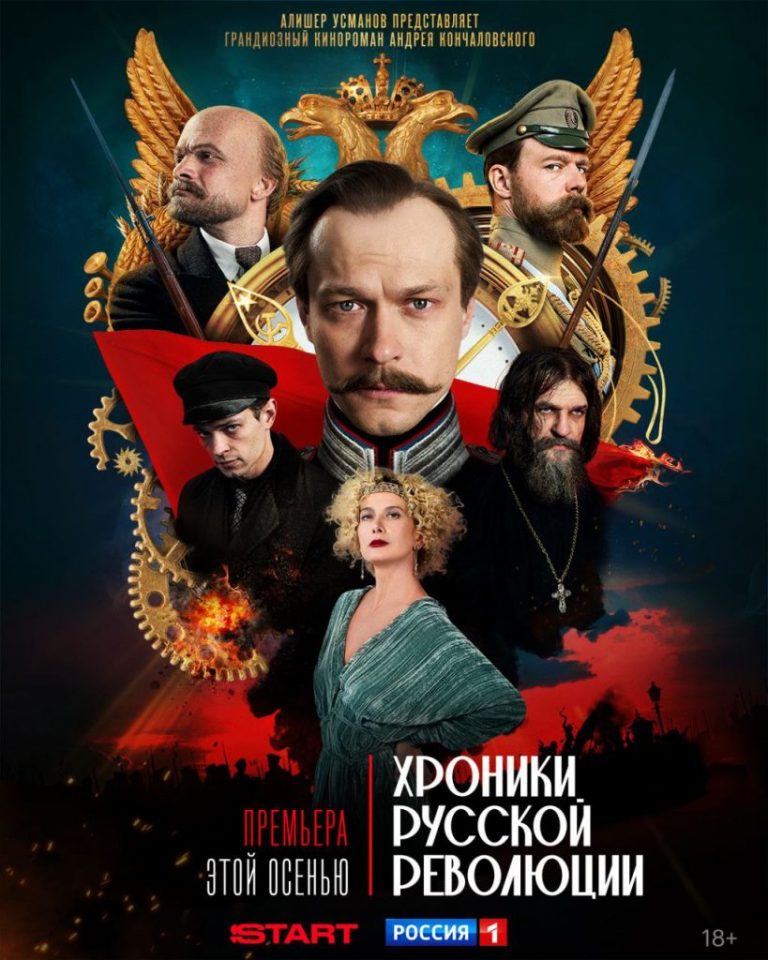
New film-series: Chronicles of the Russian Revolution

The premiere of the new Russian historical film-series Телесериал рассказывает о событиях / Chronicles of the Russian Revolution will take place in October 2025. The series will be aired on the Russian television Россия-1 / Russia-1 and the START streaming service. The project is the work of Russian director Andrei Sergeevich Konchalovsky [b.1937, Moscow].

The 16-episode series is the most ambitious work of Konchalovsky’s career. The Russian-language series explores historical events beginning with Bloody Sunday and the First Russian Revolution in 1905 to Lenin’s death and Stalin’s rise to power in 1924. Filming began in September 2022 and lasted almost a year in August 2023.

The script was written on a documentary basis, which required an in-depth study of archival materials. But rather than a detailed reproduction of historical events, the director instead has focused on the human destinies during a critical period of Russian history.

PHOTO: Nikita Efremov as Emperor Nicholas II

As Konchalovsky himself notes: “This film-series is an attempt to understand something about early 20th century Russia, about those who moved the revolution, and about those whom it swept away. Both had the right to be wrong. It is very important for me that the historical figures in this film evoke an emotional response: not the Emperor or Lenin as a leader and tribune, but simply as people with human weaknesses, dreams and hopes. But it was not easy, because there are many patterns, stereotypes, archetypes attached to each.”

“Nicholas II seemed to know that death awaited him.” And it is very interesting to look at a person through this prism” Konchalovsky added.

The main characters (both fictional), Mikhail Prokhorov played by Yura Borisov, a young officer of the security department, who is on duty trying to unravel the tangle of conspiracies against the Tsar, and the central female role of Ariadne played by Yulia Vysotskaya, a society lady and revolutionary. Among the main real-life characters are Emperor Nicholas II played by Nikita Efremov, the leader of the revolution Vladimir Lenin played by Yevgeny Tkachuk, Joseph Stalin played by Timofey Okroev.

CLICK on the image above to watch the Russian-language trailer
Duration: 1 minute 30 seconds
NOTE: click on auto-translate and CC (close captioning) for English subtitles

© Paul Gilbert. 9 September 2025

Why didn’t the “right” defend the monarchy in 1917?

PHOTO: Demonstration of the Black Hundreds in Odessa shortly after the announcement of the Manifesto on 17th October 1905[1]

The crisis of the Russian monarchy lasted more than a dozen years. It began during the Revolution of 1905-1907, which forced Nicholas II to make concessions, and ended in 1917, when he was forced to abdicate.

The February 1917 Revolution did not meet any organized resistance at all, neither from the Black Hundreds[2], nor from the military elite, nor from officials or the “moderate right”. Few of Russia’s military elite stood by Nicholas II, including Count Fyodor Arturovich Keller[3] (1857-1918); Alexander Pavlovich Kutepov[4] (1882-1930) and Commander of the Guard Cavalry Corps Huseyn Khan Nakhchivanski[5] (1863-1919) defended both their Emperor and the monarchy. In 1917, the conservative forces in Russia either left the political scene or were forced to “play by new rules.”

It is clear that by 1917 the Black Hundreds had greatly thinned out, were split and even in the Duma itself no longer had any particularly influence in the state of affairs. It is clear that the military could not leave the front and storm the insurgent Petrograd. It is clear that representatives of the military elite, industrialists, “moderate rightists”, even some monarchists like Vasily Vitalyevich Shulgin[6] (1878-1976) took an active part in the revolution itself.

Nevertheless, a number of features of “February” made the resistance of the pro-monarchist elements complicated and senseless. How so?

Circumstances led to a situation in which the Russian monarchists had to become “greater royalists than the Tsar himself.”

It was their belief, that as Nicholas II himself had abdicated the throne, it meant that he freed the rest of his supporters from any obligations to the monarch. Researcher A.A. Ivanov notes an important difference between the Revolution of 1917 and the Revolution of 1905:

“Taking into account past mistakes, the leaders of the liberal opposition managed to play the patriotic card, depriving the right of their main trump card – the monopoly on patriotism. Patriotic rhetoric allowed the liberal opposition (in contrast to the times of the first Russian revolution) to establish close contact with the highest ranks of the army and attract them to their side … thus, leading to the rapid defeat of the right in 1917.”

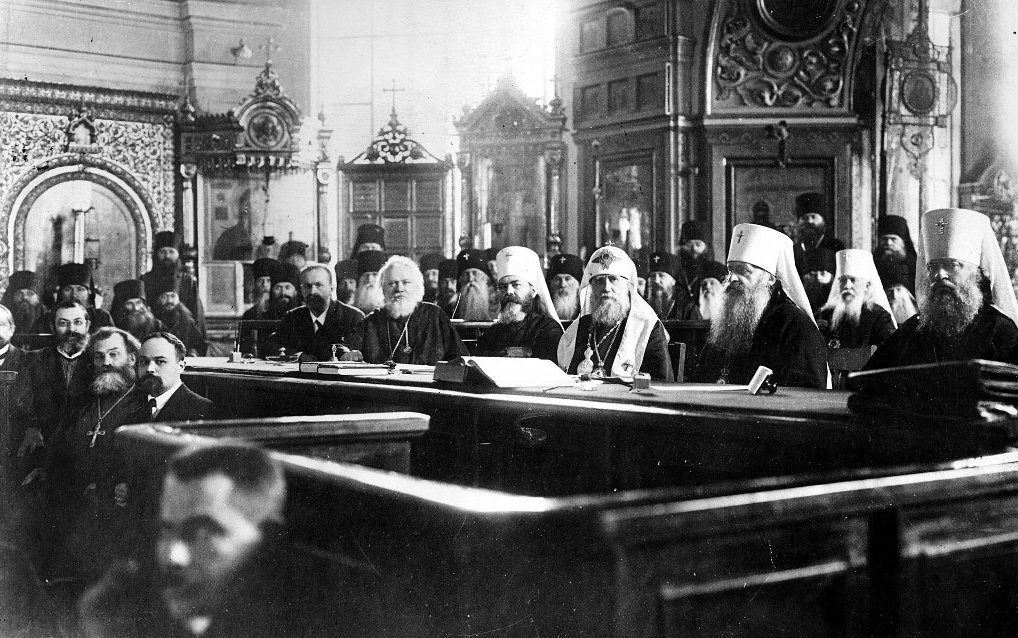
PHOTO: Meeting of the Local Council of the Orthodox Church in the Moscow Diocesan House, which existed from August 1917 to September 1918 (!). The Patriarch was elected in November 1917, already de facto under the Bolsheviks.

Following the example of the liberal opposition, the Bolsheviks also began using patriotic rhetoric to further their cause. Lenin would scream out slogans, such as “The Socialist Fatherland is in danger”, etc. Patriotism is a powerful tool, especially when used correctly and the right words are chosen.

Many future White generals in their memoirs write about the mistakes of the Provisional Government. And they themselves sometimes answer the question of why they didn’t intervene: they would have intervened, “had it not been for the war against the Germans, it’s impossible to turn it into a Civil War, and the Tsar had abdicated”.

Patriotic rhetoric and the formal “voluntary” abdication of the Emperor turned the hypothetical attempts of the right to change the situation into a rebellion against the will of the monarch, in a situation of war with an external enemy.

“The weakness and fragmentation of the monarchist forces, the self-elimination of the government, the “voluntary” abdication of the Tsar and the national character of the revolution, which met with the widest support in all strata of Russian society, deprived the political struggle for the restoration of autocracy … ” added A. A. Ivanov.

A few words must be said here about the Church[7]. After all, de facto, these are the main “pillars” of any monarchy – military power and religion. Russia has never been an exception in this regard. In 1917, the Holy Synod of the Russian Orthodox Church promptly changed the texts of oaths (ordination to the clergy) and prayers (“now we pray for the Provisional Government”), their actions thus recognizing the new shift in power. Those who disagreed were dismissed (as in the army). They even recommended that monarchical literature be removed from the parishes.

There is also a point of view according to which the church was interested in February, since the fall of the monarchy allowed it to free itself from the “excessive tutelage of the state” (which will also later play against them, as in the case of the liberal opposition).

In any case, in 1917, both the military and civilian “right”, simply had nothing to rely on. Foreign policy, the balance of power, brute force, ideology – everything now worked against them …

NOTES:

[1] The Manifesto was issued by Nicholas II, under the influence of Sergei Witte (1849–1915), on 30 October [O.S. 17 October] 1905 as a response to the Russian Revolution of 1905. Nicholas strenuously resisted these ideas, but gave in after his first choice to head a military dictatorship, his first cousin once removed Grand Duke Nicholas Nikolaevich (1856-1929), threatened to shoot himself in the head if the Tsar did not accept Witte’s suggestion. Nicholas reluctantly agreed, and issued what became known as the October Manifesto, promising basic civil rights and an elected parliament called the Duma, without whose approval no laws were to be enacted in Russia in the future.

[2] The Black Hundreds, was a reactionary, monarchist and ultra-nationalist movement in Russia in the early 20th century. It was a staunch supporter of the House of Romanov and opposed any retreat from the autocracy of the reigning monarch.

The Black Hundreds were founded on a devotion to Tsar, church and motherland, and lived by the motto: “Orthodoxy, Autocracy, and Nationality”. Despite certain program differences, all of the Black Hundreds organizations had one goal in common, namely their struggle against the revolutionary movement.

[3] Keller was military leader of the Russian Imperial Army and cavalry general. He was one of the leaders of the White movement in the South of Russia in 1918, a monarchist. He remained loyal to Nicholas II until the end of his life.

On 6th March 1917, Keller sent a telegram addressed to Nicholas II, in which he expressed indignation on behalf of the corps and himself against the troops that had joined the rebels, and also asked the Tsar not to leave the Throne.

The intercepted telegram came to the attention of General Mannerheim, who made an attempt to persuade Keller to submit to the Provisional Government, or, at least, to persuade him to refuse to influence his subordinates in this regard. However, the count did not make concessions, refused to swear allegiance to the Provisional Government, saying:

I’m a Christian and I think it’s a sin to change my oath.”

[4] Kutepov was a Russian military leader, general from infantry (1920), pioneer, active participant in the White movement, and a devout monarchist. Between 1928-1930, he served as Chairman of the Russian General Military Union (ROVS).

During the February Revolution, Colonel Kutepov, who was on a short vacation in Petrograd , was the only senior officer who tried to organize effective resistance to the insurgents.

On 26th January 1930, Kutepov was kidnapped in Paris by Soviet intelligence agents. Documents about the circumstances, place and time of his death are still secret and inaccessible to historians.

[5] A Muslim by religion, Khan Nakhchivanski remained loyal to the Russian Orthodox emperor and refused to swear allegiance to the Provisional Government.

When in the winter of 1917 the February Revolution began in Petrograd, he sent a telegram to the headquarters of the Supreme Commander-in-Chief to offer Nicholas II the use of his corps for suppression of the revolt, but Nicholas II never received this telegram.

It is presumed by a number of historians that Khan Nakhchivanski was executed in February 1919 together with four Romanov Grand Dukes in the Peter and Paul Fortress. However the exact circumstances of Khan Nakhchivanski’s death and his burial place still remain unknown.

[6] Shulgin was a Russian conservative monarchist, politician and member of the White movement. Shulgin opposed the revolution, but he was opposed to the idea of an absolute monarchy in Russia. Together with Alexander Guchkov (1862-1936) he persuaded Nicholas II to abdicate the throne since he believed that a constitutional monarchy with Grand Duke Michael Alexandrovich (1878-1918) being the monarch was possible, and that this or even a republic, if a strong government was established, would be a remedy for Russia. For the same reason he supported the Provisional Government and Kornilov’s coup. When all hope was lost he moved to Kiev where he participated in the White movement.

[7] Click HERE to read my article How the Orthodox Church supported the overthrow of the monarchy, published on 8th March 2020

© Paul Gilbert. 14 December 2021

The October Revolution 1917 in the International Context. Interview with Professor Dominic Lieven

CLICK on the IMAGE above to watch VIDEO in English. Duration: 24 minutes.

A remarkable interview with Cambridge Research Professor D. Lieven (born 19 January 1952) about the reasons for and the outcomes of the 1917 October Revolution, as well as his family’s personal experience with it. He also speaks about Russia’s involvement in WW1, the Russian-German relationships, and gives an extraordinarily objective evaluation of Tsar Nicholas II’s abilities as a ruler, and comments on the most important decisions during his reign. Dominic Lieven is a research professor at Cambridge University (Senior Research Fellow, Trinity College) and a Fellow of the British Academy and of Trinity College, Cambridge.

Professor Lieven is the third child, of five children, of Alexander Lieven, of the Baltic German princely family, tracing ancestry to Liv chieftain Kaupo. He is the elder brother of Anatol Lieven, British author, Orwell Prize-winning journalist, and policy analyst, and he is distantly related to Christopher Lieven (1774–1839), who was Ambassador to the Court of St James from Imperial Russia over the period 1812 to 1834, and whose wife was Dorothea von Benckendorff, later Princess Lieven (1785–1857), a notable society hostess in Saint Petersburg and influential figure among many of the diplomatic, political, and social circles of 19th-century Europe. Lieven is a great-grandson of the Lord Chamberlain of the Imperial Court of Russia.

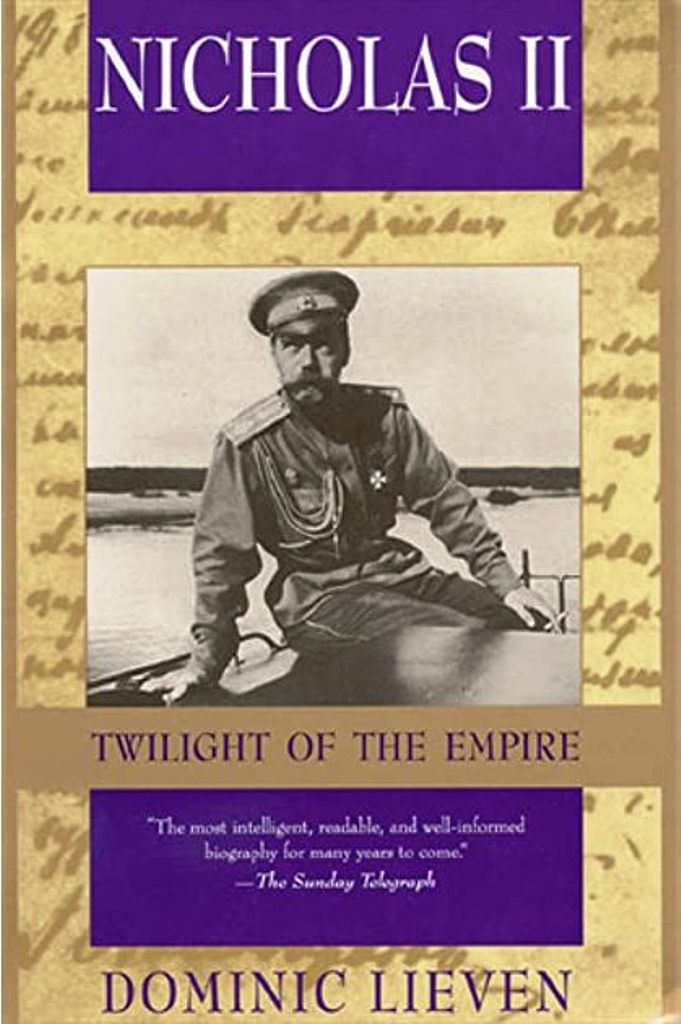
He is the author of numerous books on on Russian history, on empires and emperors, on the Napoleonic era and the First World War, and on European aristocracy, including: Russia’s Rulers Under the Old Regime, Yale University Press (1989); The Aristocracy in Europe 1815/1914, Macmillan/Columbia University Press (1992); Nicholas II: Emperor of all the Russias, John Murray/St Martin’s Press/Pimlico (1993); and The End of Tsarist Russia: The March to World War I and Revolution, Penguin Random House (2015).

***

This video is produced as part of the project for the book The Romanov Royal Martyrs, which is an impressive 512-page book, featuring nearly 200 black & white photographs, and a 56-page photo insert of more than 80 high-quality images, colorized by the acclaimed Russian artist Olga Shirnina (Klimbim) and appearing here in print for the first time. EXPLORE the book / ORDER the book.

© Mesa Potamos Monastery. 30 October 2020