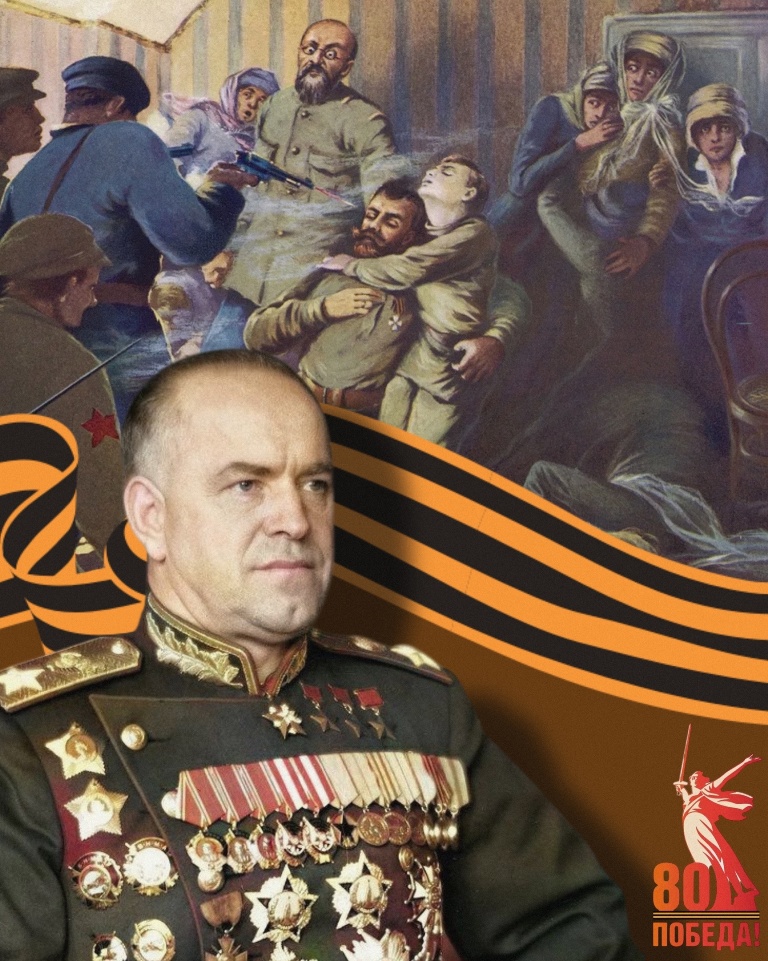
“I do not shake the hands of murderers” – General Zhukov to Yermakov

On 9th May 2025, Russia marked the 80th anniversary of the defeat of Nazi Germany. In recognition of this solemn day, I would like to draw attention to one of Russia’s most celebrated war heroes: Georgy Konstantinovich Zhukov (1896-1974).

Zhukov is among the many famous Soviet marshals and generals who impressed the world with their victories and heroism during the Great Patriotic War (1941-45). What many do not realize, is that they were once officers of the Russian Imperial Army – which from August 1915 to March 1917, was under the command of Emperor Nicholas II. Zhukov was awarded the St. George Cross twice for military merit, and promoted to the rank of non-commissioned officer for his bravery in battle. Following the war, Zhukov commanded the Ural Military District [the district headquarters was located in Sverdlovsk (Ekaterinburg]. 

According to his friends living in the Ural capital, Zhukov was fascinated by the history of Sverdlovsk [Ekaterinburg]. In particular, he took a great interest in the final days and subsequent execution of Russia’s last Tsar and his family. Zhukov’s friends claim that he was sympathetic to Nicholas II, and believed that the lives of the monarch and his family should have been spared.

Zhukov’s position was quite simple: he considered the regicide as “nothing short of a disgrace”. He was disgusted by the fact that local men had become executioners. After all, the Tsar posed no threat to the Bolsheviks, nor did he resist. As for the Ipatiev House, where the murders took place, Marshal Zhukov “despised it”.

According to Zhukov’s daughter, Margarita Georgievna Zhukova (1929-2010):

“Being the commander of the Ural Military District in Sverdlovsk, my father visited the “Ipatiev House”.

“This is how my elder sister Ella (1937-2009) recalls it . . . I remember the notorious Ipatiev House, where we were taken with special permission. The topic of the execution of the Imperial Family was forbidden in those years, and it was only during this visit that I learned about this tragedy for the first time. In the house at the entrance there was a small exposition with copies of some documents, red slogans and portraits of leaders hung on the walls. It was disgusting for my father to be there, surrounded by posters of Soviet propaganda whitewashing the murderers. Below, was the dreaded basement, where I did not want to go down. The atmosphere in the house was oppressive… I did not talk to my father about this.”

Source: M. G. Zhukova, “Маршал Жуков – мой отец / Marshal Zhukov – My Father“, Sretensky Monastery, 1999

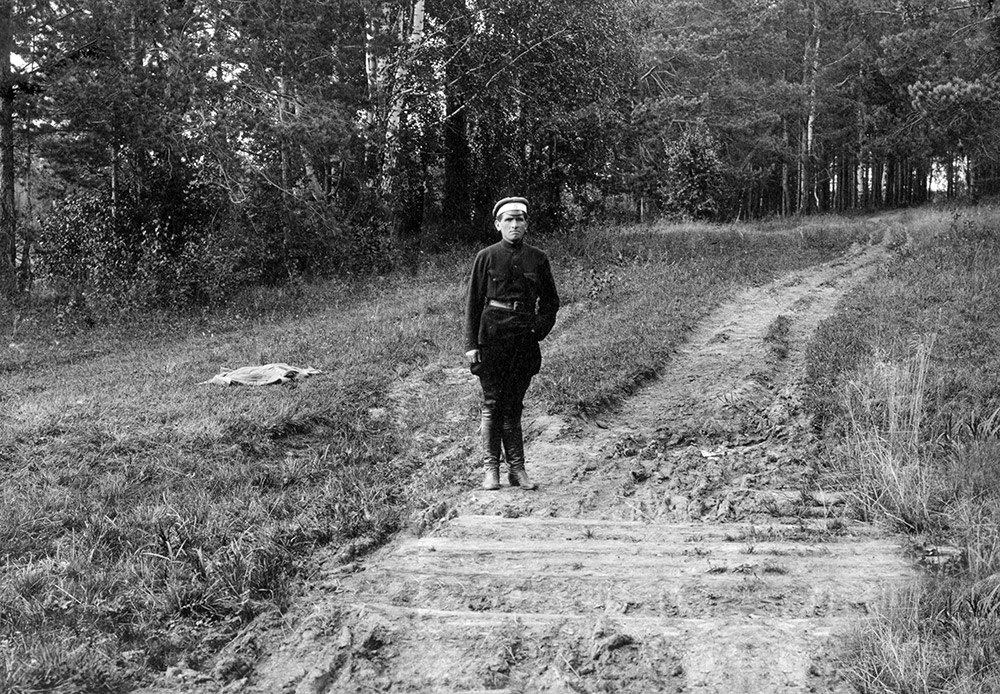
PHOTO: in the 1920s, the murderer Pyotr Yermakov returned to Porosenkov Log.
On the reverse of this photo, he wrote: “I am standing on the grave of the Tsar”.

“SHAME ON THE REGICIDE!”

It was also during Zhukov’s years as Commander of the Ural Military District, that he would come face to face with one of the regicides: Pyotr Zakharovich Yermakov (1884-1952).

Zhukov had heard about Yermakov from the newspapers, and he looked at all these honours with disgust. He did not understand how a murderer could be so exalted. But at that time, Yermakov seemed to many to be a hero, a liberator. He regularly met with groups of workers and bragged about how he had taken part in the murders, and how he pulled the trigger of the gun, which killed the Tsar.

According to Zhukov’s daughter, Margarita Georgievna Zhukova (1929-2010), the meeting took place on 1st May 1951, when the May Day parade was being held in Sverdlovsk [Ekaterinburg].

“What was really going on in my father’s soul can be understood from an episode that occurred later. I was told about it during my trip to the Urals by old-timers. It was at a solemn reception, where the entire local party elite had gathered. Yermakov, as before, spoke about his “heroic feats”, and decided to approach my father to shake hands as equals. Introducing himself, he announced that he was the same Yermakov who participated in the execution of the Imperial Family, and stretched out his hand. He expected surprise, questions, delight, but Yermakov was surprised by my father’s response, who disgusted and gritting his teeth, said firmly: “I do not shake the hands with the murderers!”.

Source: M. G. Zhukova, “Маршал Жуков – мой отец / Marshal Zhukov – My Father“, Sretensky Monastery, 1999

Yermakov shrugged his shoulders and walked away. That was the end of the conversation. Zhukov was sure that he had said everything he wanted. Moreover, he wanted to believe that Yermakov had at least learned something from this meeting.

Yermakov died in Sverdlovsk on 22nd May 1952 from cancer at the age of 67, he was buried in Ivanovo Cemetery in Ekaterinburg. In the 1960s, a street was named after Yermakov in Sverdlovsk [Ekaterinburg], however, during the 1990s, the street was renamed Ulitsa Klyuchevskaya.

Every year, since the 1990s, Yermakov’s grave has been vandalized by local monarchists, who douse his gravestone with red paint, symbolizing the blood which this evil man spilled, and his involvement in the murder of the Holy Tsar Nicholas II and his family in 1918.

FURTHER READING:

The fate of the regicides who murdered Nicholas II and his family

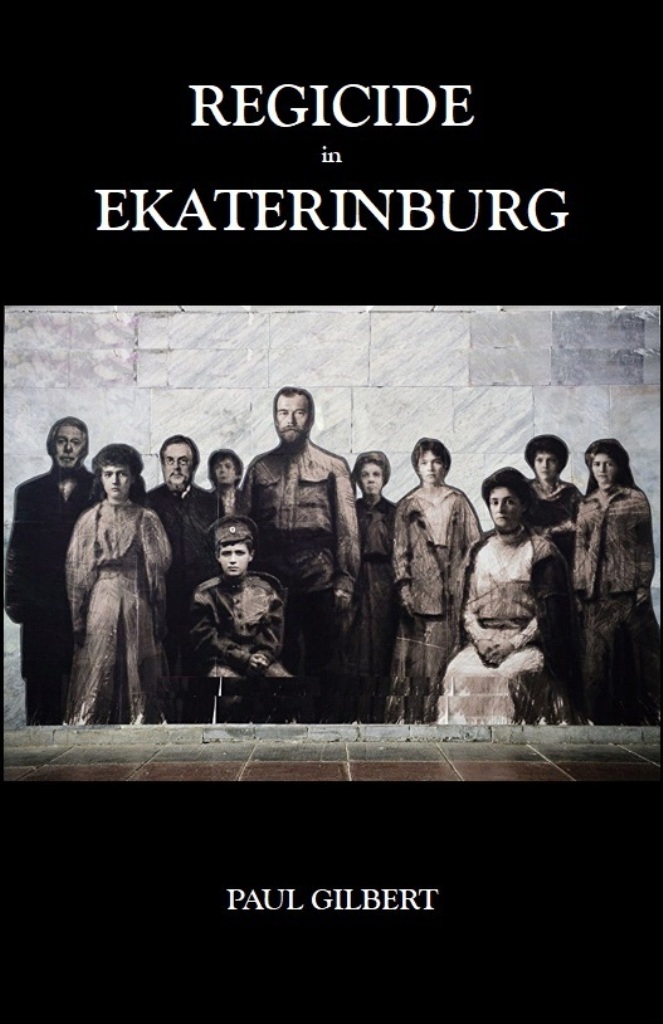
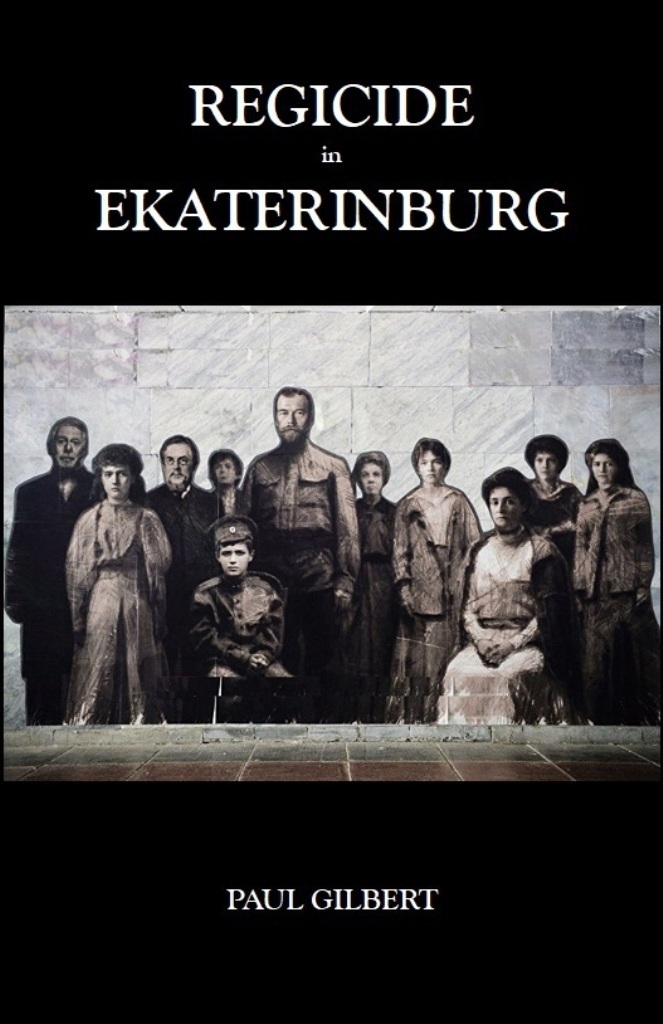
NEW BOOK – Regicide in Ekaterinburg by Paul Gilbert

Russian sculptor proposes removal of monuments to Bolsheviks in Ekaterinburg

© Paul Gilbert. 13 May 2025

On this day – Nicholas II is handed over to the Ural Soviet in Ekaterinburg

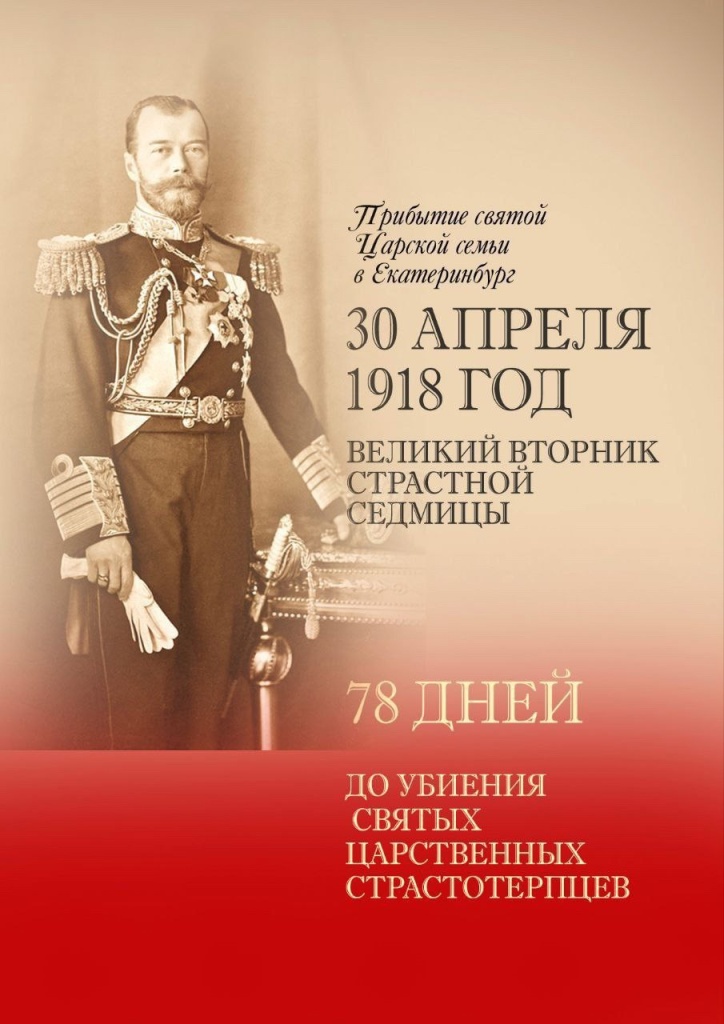
прибытие святой царской семьи в екатеринбуре. 30 април 1918 год. великий вторник старстной седмицы. 78 дней до убиения святых царственных страстотерпцев.

Arrival of the Holy Royal Family in Yekaterinburg. April 30, 1918. Great Tuesday of Holy Week. 78 days before the murder of the Holy Royal Passion-Bearers.

Today marks a very sad anniversary . . . it was on this day – 30th April (O.S. 17th April) 1918, Emperor Nicholas II, Empress Alexandra Feodorovna and Grand Duchess Maria were handed over to the Ural Soviets in Ekaterinburg

Nicholas II wrote the following in his diary:

“At 8.40 we arrived in Ekaterinburg. We stood for three hours in one station. There was a heated dispute between the local commissars and our own. In the end, the first prevailed and the train was moved to another goods terminal. After standing there for an hour and a half, we got off the train. Yakovlev handed us over to the local regional commissar, with whom we drove by motor through empty streets to the accommodation which has been prepared for us—the Ipatiev house. Slowly our people and our things began to arrive, but they would not let Valia through.

“The home is pleasant and clean. We have been given four large rooms. We were not able to unpack our things for a long time, as the commissar, the commandant and the guards captain had not had time to inspect our trunks. Then the inspection was like a customs search, just as strict, right down to the last capsule in Alix’s travelling medicine kit. This annoyed me so much that I expressed my opinion sharply to the commissar. By 9 o’clock we had at last settled in.

“This is how we installed ourselves: Alix, Maria and I together in the bedroom, sharing the dressing room, Demidova in the dining room, Botkin, Chemodurov and Sednev in the hall. The duty officer’s room is by the entrance. In order to go to the bathroom of W.C., it was necessary to go past the sentry at the door of the duty office. There is a very high wooden pallisade built all around the house, about two sajens from the windows, all along there was a line of sentries, in the little garden also.”

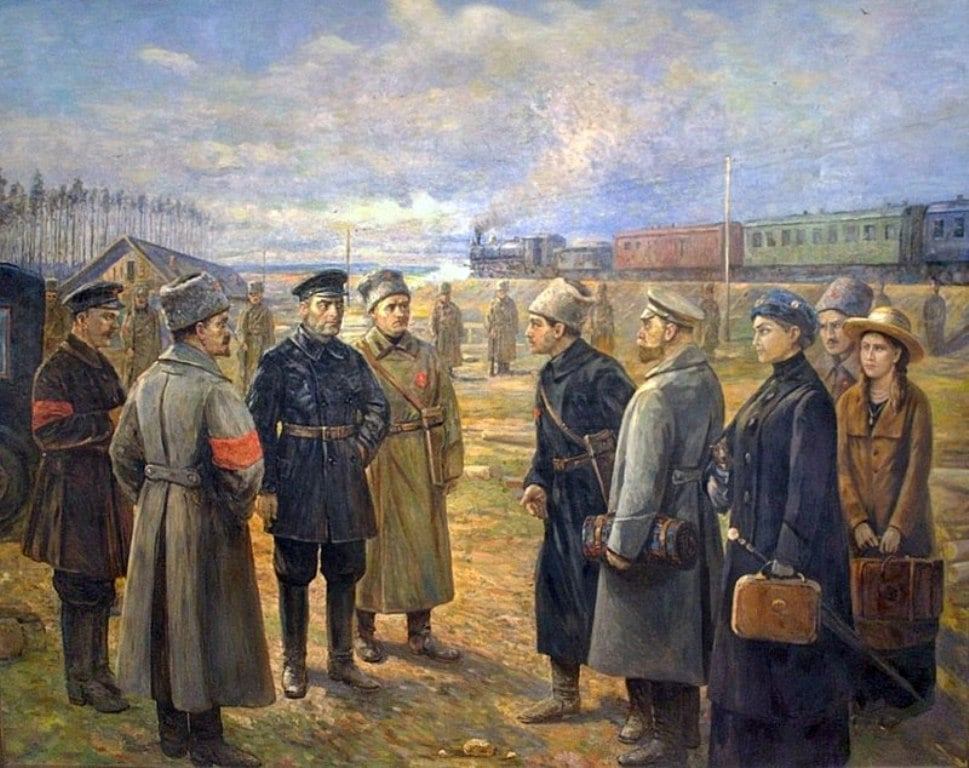
PHOTO: “Transfer of the Romanov family to the Ural Soviet” (1927)
Artist: Vladimir Nikolayevich Pchelin (1869-1941)

© Paul Gilbert. 30 April 2025 

Cossack witnesses miraculous vision on the site of Ipatiev House in Ekaterinburg in 1990


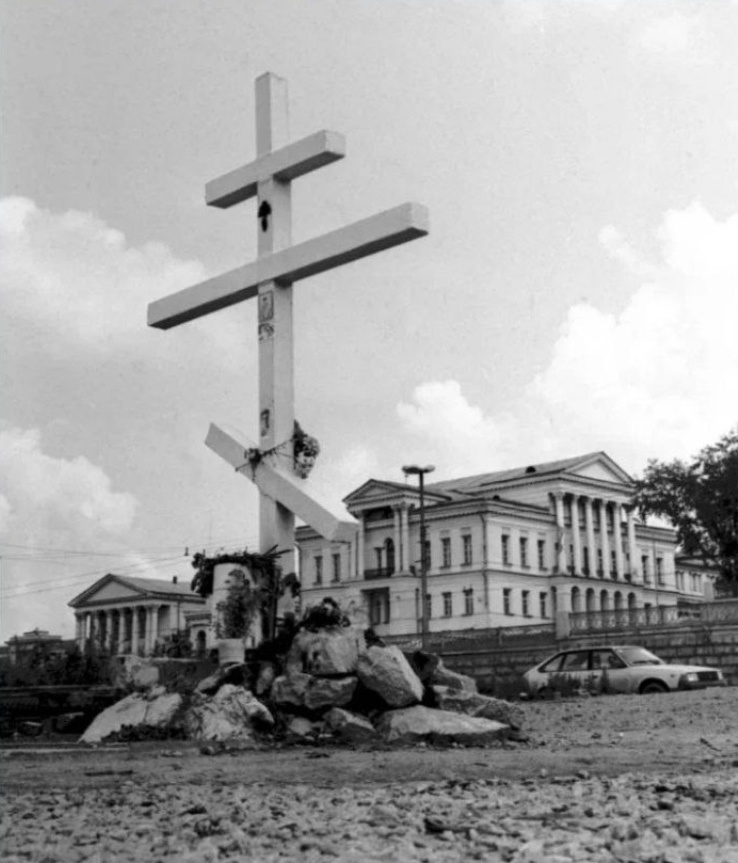
PHOTO: a large metal Orthodox cross was installed
on the site of the Ipatiev House in 1990

In the autumn of 1990, a Cossack by the name of Vladimir claims to have witnessed a miraculous vision, during the installation of a large metal Orthodox cross, on the site where the Ipatiev House once stood – demolished on 22-23 September 1977.

Whether you are a believer or not, this is just one of many miracles reported since the regicide in Ekaterinburg in July 1918.

Here is Vladimir’s testimony . . .

“I want to tell you about the appearance (sign) at the moment of the installation of the cross on the site of the Ipatiev house, where the Tsar and his family were murdered.

On 5th October 1990, at about 11-12 noon , a metal cross was brought by truck, a hole was dug in advance for its installation, and crushed stone was brought.

The weather was gloomy. The entire sky was completely covered with dark clouds and it was snowing sparsely.

The cross was removed from the truck and placed on the ground, then installed in the hole, and one of the people present, a man named Alexei, stepped forward to see how the cross was installed and whether there was any deviation.

And suddenly, Alexei ran up toward the others present and yelled: “Look up!”

We all raised our heads at first trembling, and then fear passed through our bodies: above us, that is, directly above the cross, the sky parted, and from there a ray of light fell on the cross. The sun was not visible, and the hole in the clouds rotated to the right, and on the ground, that is, around the cross within a radius of 50-100 meters there was, as it were, an illumination from heaven by this bright beam of light, and on the ground a bright circle of light; and the snow did not fall within it.

All this lasted about 30-40 minutes, the time it took to install the cross and secured with concrete, then the hole in the clouds closed. The light disappeared. At the same time, up to 30 people were present, many of whom were non-believers at that time.

When we later asked the priest about this apparition, he replied that it was obviously a sign. Those of us non-beleivers present believed in God after this miracle.”

From the memoirs of a Cossack from the village of Kamenskaya,
Vladimir.

FURTHER READING:

The face of the Tsar-Martyr Nicholas II seen July 1919

“He will help you!” Stories of miraculous help of Tsar Nicholas II

My [Paul Gilbert] cancer journey and prayers for the intercession of Tsar-Martyr Nicholas II

© Paul Gilbert. 11 September 2024

NEW BOOK – Regicide in Ekaterinburg

*You can order this title from most AMAZON outlets worldwide, including
the United States, United Kingdom, Canada, Australia,
France, Germany, Spain, Italy, Netherlands, Poland, Sweden and Japan
*Note: prices are quoted in local currencies

CLICK HERE TO ORDER THE PAPERBACK EDITION @ $20.00 USD

Language: English. 308 pages with 70 Black & White photos

regicide: the crime of killing a king or queen;
a person who is guilty of this crime

Touch not mine anointed
Psalm 105:15

This year marks the 106th anniversary of the regicide in Ekaterinburg: the execution of Russia’s last Imperial Family, a heinous crime committed on the morning of 17th July 1918. The murder of God’s anointed, his pious wife, their five precious children and their four faithful retainers, remains one of the darkest pages in 20th century Russian history.

This book presents fourteen studies on this tragic event, eleven of which are based on new documents sourced from Russian archival and media sources over the past decade.

The first part of this book features the complete and unabridged account of a British Intelligence officer and journalist, who was in Ekaterinburg in the summer of 1918. He was one of the first to investigate the regicide, even before that of Nicholas Sokolov’s famous, yet incomplete investigation in 1919. He goes on to write about meeting Yakov Yurovsky, and shares his impressions of the chief executioner of the last Tsar and his family.

The second part features two previously unpublished, first English translations. The first is about those who came to the aid of the Imperial Family during their captivity, including Princess Helen of Serbia and the nuns of the Novo-Tikhvin Monastery. In addition is the testimony of the priest, who perfumed the last sacred service for the Imperial Family, days before their murders.

The third part features eleven chapters which shed light on a number of topics, such as who were the eight faithful retainers who survived the regicide; why did Boris Yeltsin demolish the Ipatiev House in 1977; what about the executioners themselves—who were they, and what were their fates?; plus eight additional chapters.

***

On 1st September 2024, my new book ‘Regicide in Ekaterinburg‘ received it’s first AMAZON review, from a reader in the United States who gave it a 5-star rating! Thank you 🙂

© Paul Gilbert. 26 August 202

The abbess who came to the aid of the Imperial Family in Ekaterinbburg in 1918

Today – 29th July 2024 – marks the 90th anniversary of the death of Schema Magdalena (Dosmanova), the last abbess of the Novo-Tikhvinsky Convent[1] in Ekaterinburg before the October 1917 Revolution.

An early calling

Pelagia Stefanovna Dosmanova (future mother Magdalena) was born in 1847 into a merchant family in the city of Irbit, Perm province. In 1859, her pious parents brought their 12-year-old daughter to the Novo-Tikhvinsky Monastery[2] in Ekaterinburg.

For her first obedience, the young novice helped in the convent candle factory, then in the rector’s cells. Over the years, she was entrusted with more and more complex and responsible obediences, and Sister Pelagia performed every task with zeal. All the sisters loved her, sensing in her a special spiritual strength, which was combined with a soft, loving attitude towards every person.

In 1893, Pelagia Dosmanova was tonsured and became the nun Magdalena, and just two years later the sisters unanimously elected her abbess “in the conviction that she was of a pious life, of a meek disposition,” as they wrote in the act of election.

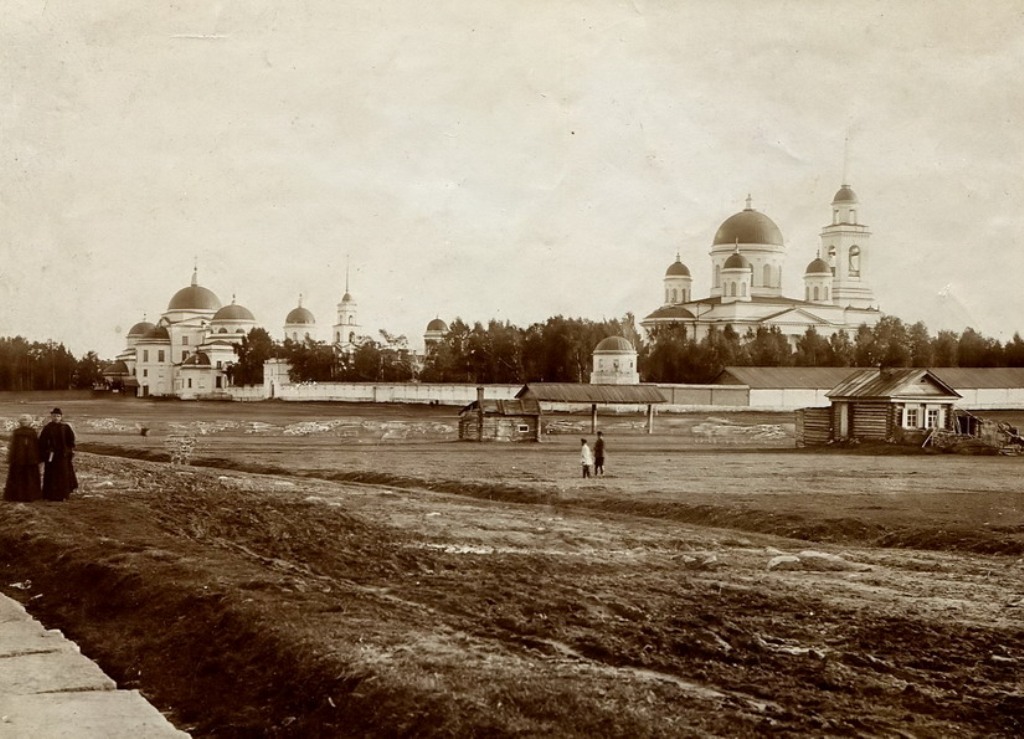
PHOTO: the Novo-Tikhvinsky Convent [Monastery] [2] in Ekaterinburg

Mother Magdalena

Having become abbess, Mother Magdalena worked tirelessly: she decorated the churches, equipped the cells of the sisters, ensuring that the monastery was in perfect order – she wanted the monastery to look like “paradise on earth”.

Matushka Magdalena taught the sisters to pray, and introduced them to reading books on which many generations of monastics were brought up from ancient times. She also took care of the spiritual needs of the faithful who lived near the monastery. Parents often came to visit the monastery, on one occasion a novice took them to the icon-painting workshop, Suddenly, unexpectedly for the parents, all the sisters who were there, as one, stood up and bowed low, with deep reverence. The parents were moved to tears.

Many girls came to the monastery to lead a monastic life under the wise guidance of Mother Magdalena. By 1917, the number of sisters had increased to almost a thousand.

During the First World War, Mother Magdalena, according to the commandment of the Lord, tried to ease the sorrows of her countrymen, the monastery donated money and valuables for the needs of Russia’s soldiers at the front; while an infirmary for wounded soldiers was arranged at the monastery.

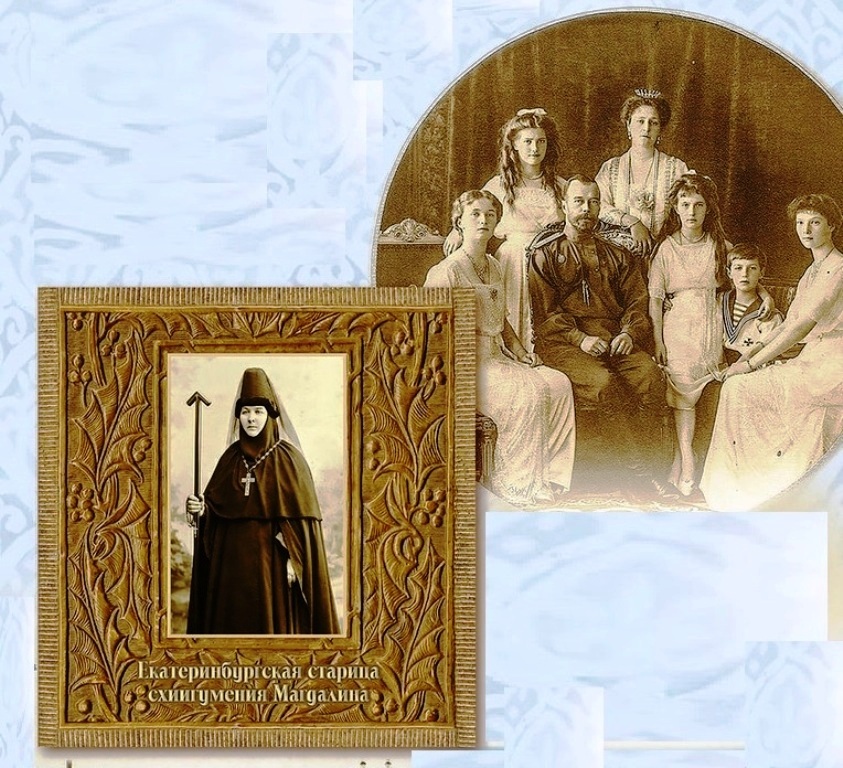
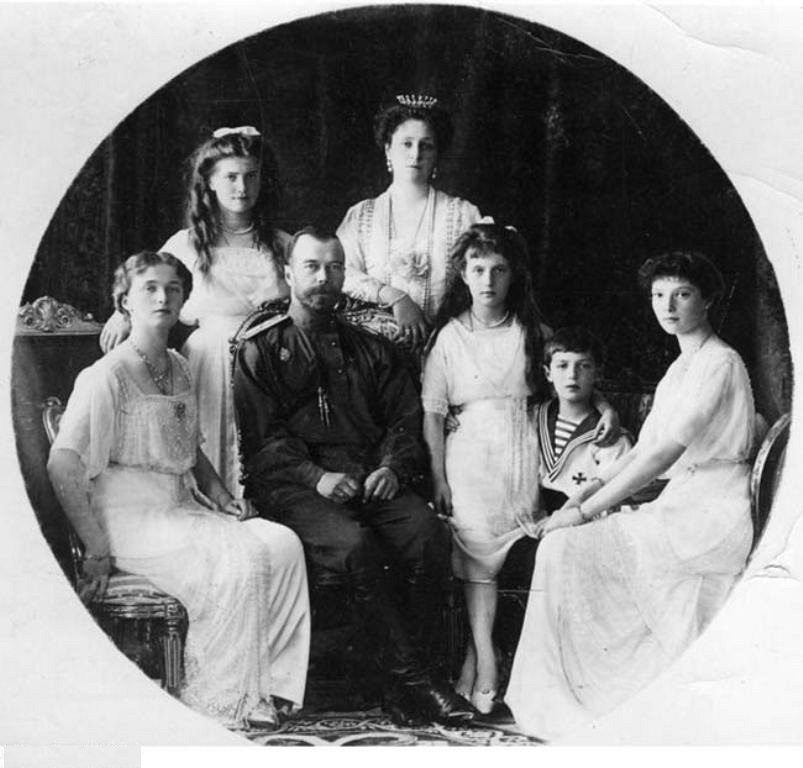
PHOTO: Emperor Nicholas II and his family. 1913.

Comes to the aid of the Imperial Family in the Ipatiev House

In 1918, Ekaterinburg became a place of exile for many people who were deemed objectionable to the new Bolshevik order, which included bishops, priests and members of the Imperial Family. Mother Magdalena’s heart ached for every innocent prisoner.

From April to July, when Nicholas II and his family were kept under arrest in the Ipatiev House, the nuns of the Novo-Tikhvinsky Convent were praying for them, asking God to relieve their sufferings, and to give them the strength to bear everything with Christian humility.

The sisters’ help came not only through prayer but also through deeds. Often disregarding their own safety, they supported the Tsar and his family, by bringing various foods to them through the guards.

Matushka Magdalena gave her blessing to the sisters to carry food to the Ipatiev House for the imprisoned Emperor and his family: milk for Tsesarevich Alexei, cream, eggs, butter, bread, pastries, vegetables, and meat.

On 18th June 1918, a month before their murder, Empress Alexandra Feodorvna acknowledged the kindness shown them by the nuns, and made the following entry in her diary: “The kind nuns are now sending milk and eggs for Alexei and for us, as well as cream.”

The sisters carried food every day until the last day – 16th July – the eve of which the Imperial Family and their four faithful retainers were all shot to death in the basement of the Ipatiev House.

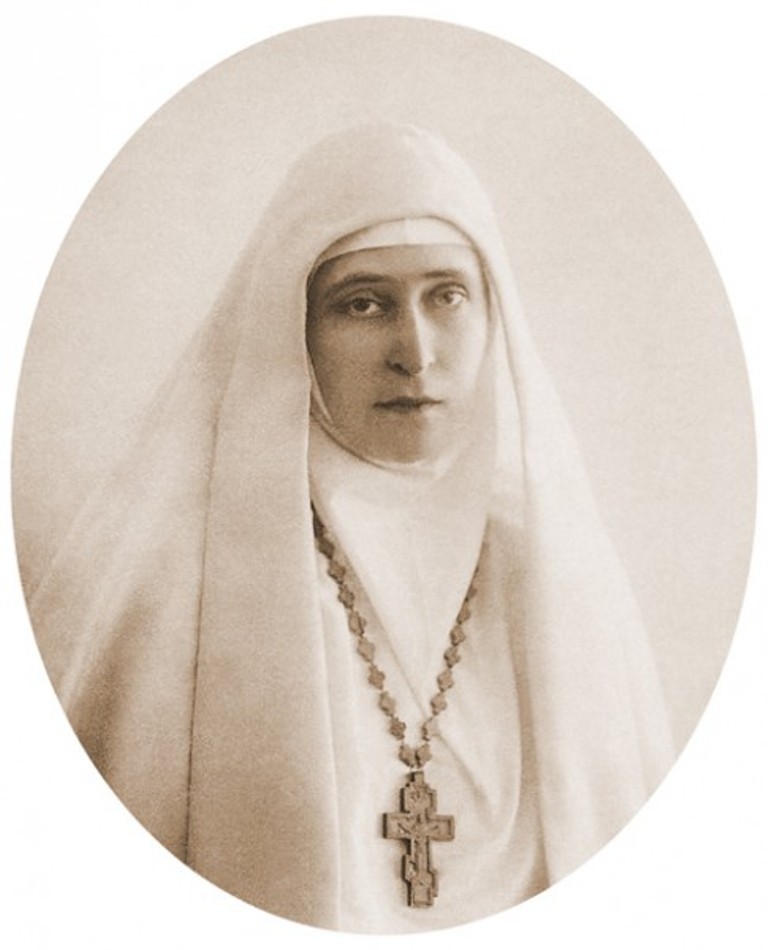
PHOTO: Grand Duchess Elizabeth Feodorovna

In May 1918, when the Grand Duchess Elizabeth Feodorovna arrived in Ekaterinburg, she was placed under house arrest, along with other members of the Romanov family], and two faithful retainers. They were all held in the Atamanovskie Rooms Hotel [the building has survived to the present day].

The sisters petitioned the Bolsheviks for the Grand Duchess to be allowed to live in the monastery. However, their request was rejected. Two months later, they were sent to the city of Alapaevsk, where they too were murdered.

The sisters also came to the aid of Bishop Germogen (Dolganev) of Tobolsk, also imprisoned in a local jail. The nuns delivered dinner to Vladyka from the monastery, Mother Magdalena visited him, and one day, at her request, Vladyka was allowed to serve a mass in prison, at which many prisoners took communion.

Matushka Magdalena and the sisters of the the Novo-Tikhvinsky Convent performed a confessional feat, by openly helping the Imperial Family and other prisoners. Indeed, at that time people were afraid not only to help political prisoners, but even simply to express sympathy for them, knowing that their punishment could lead to imprisonment or execution.

PHOTO: Bolsheviks seize and confiscate valuables
from the Novo-Tikhvinsky Monastery, 1920s

“Monastery” on the Third Zagorodnaya

Sadly, the Novo-Tikhvinsky Monastery did not escape the fate suffered by most Orthodox churches and monasteries. In 1920, the monastery was closed, all the sisters were evicted. Over the gates of the monastery, the Bolsheviks hung a large banner: “Long live the World Communist Revolution!“. Mother Magdalene and the sisters looked at this slogan with heartache, often coming to pray at the walls of their native monastery. The monastery, which they had been landscaping for years, was now a pitiful sight, ravaged and defaced with communist inscriptions.

Mother Magdalena settled not far from the monastery, in a private house on Tretya Zagorodnaya Street (now Schmidt Street). Eighteen sisters came to live with her, while the others often came to her for prayer, advice and spiritual edification. During this mournful period, the virtues of Mother Magdalena and her spiritual experience acquired over many years were fully manifested. Having lost her pastoral position and her native monastery, she did not lose heart nor faith. Despite the hardships and persecutions under the Bolshevik and later the Soviet regimes, Matushka Magdalena remained true to her Orthodox faith.

In the house on Tretya Zagorodnaya, the sisters lived as they did in the monastery – every night they read the akathist in front of the Tikhvin Icon of the Mother of God; during the day they worked, read the scriptures, and went to church together. Mother Magdalena combined prudent indulgence with moderate severity. She instructed the sisters to begin and end each day with the Jesus Prayer[3].

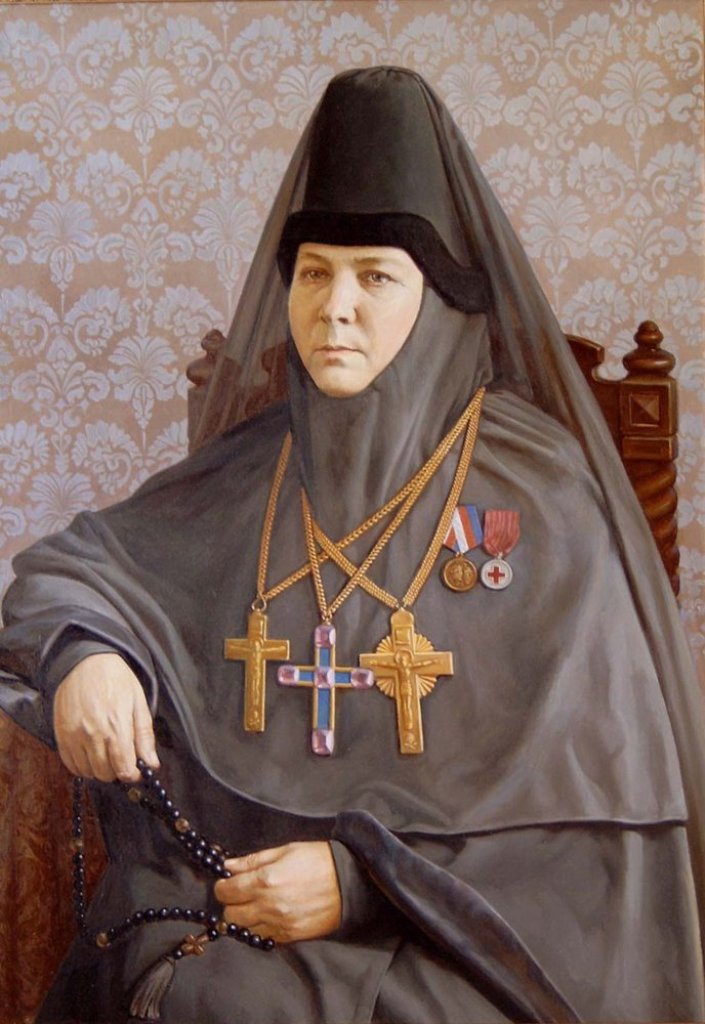
PORTRAIT: portrait of Schema Magdalena (Dosmanova). Artist unknown

Blessed Old Woman

The monastery had been closed for many years, yet despite this, new sisters still came to Mother Magdalena, who wanted to devote themselves to God.

In the 1920s, the Bolsheviks ordered the closure of churches and monasteries, and the arrest of priests, clergy, nuns and monks. The arrests carried out by the atheistic authorities did not bypass Mother Magdalena, but during interrogations she acted as a fool, which led the Chekists astray. She was arrested 8 times, and imprisoned for three months.

Three days before her death, Mother Magdalena predicted that she would die in three days. During the remaining three days of her life, she received daily communion of the Holy Mysteries of Christ. As Matushka Magdalena lay on her deathbed, many believers came to say goodbye to her. She blessed each of them with the icon of Christ the Redeemer, and the icon of St. Nicholas the Wonderworker.

On 29th (O.S. 16th) July 1934, surrounded by her “children”, Mother Magdalena calmly surrendered her spirit to the Lord. Just before her death, she overshadowed everyone with the Tikhvin Icon and said: “I hand you over to the Mother of God …”.

PHOTO: Mother Magdalena’s final resting place, on the
grounds of the Novo-Tikhvinsky Convent in Ekaterinburg

Mother Magdalena was buried at the Ivanovo Cemetery, located in the city center of Ekaterinburg. A wooden cross was placed on the grave, and on the tablet the spiritual daughters wrote with reverence and love: “Pray to God for us, dear Matushka!”.

On 5th February 2021, Mother Magdalena’s earthly remains were exhumed from her grave in the Ivanovo Cemetery, and reburied in a new resting place at the Novo-Tikhvinsky Convent.

Memory Eternal! Вечная Память!

NOTES:

[1] The Novo-Tikhvinsy Convent is a community of female monastics. It was founded in the late 18th century, growing out of an alms-house at the cemetery church in Ekaterinburg. It is the home of the icon of the Tikhvin Mother of God. During the Tsarist period, the convent grew to consist of six churches, numerous cells, a hospital, and an almshouse. The dominant building on the monastery grounds is the cathedral dedicated to St. Alexander Nevsky.

[2] In English usage since about the 19th century the term “convent” almost invariably refers to a community of women, while “monastery” refers to a community of men. In historical usage they are often interchangeable.

[3] “Lord Jesus Christ, Son of God, have mercy on me.

© Paul Gilbert. 29 July 2024

***

The following NEW title was compiled and edited by independent researchers and Romanov historian Paul Gilbert was published in August 2024. 

This fascinating new study features 14 chapters on this tragic event, which include the memoirs of a British intelligence officer and journalist, and two First-English translations. In addition, 11 chapters were written by Paul Gilbert, based on new documents sourced from Russian archival and media sources over the past decade.

Please refer to the link provided for further details about the content of this new title . . .

CLICK HERE TO READ MORE ABOUT THIS TITLE
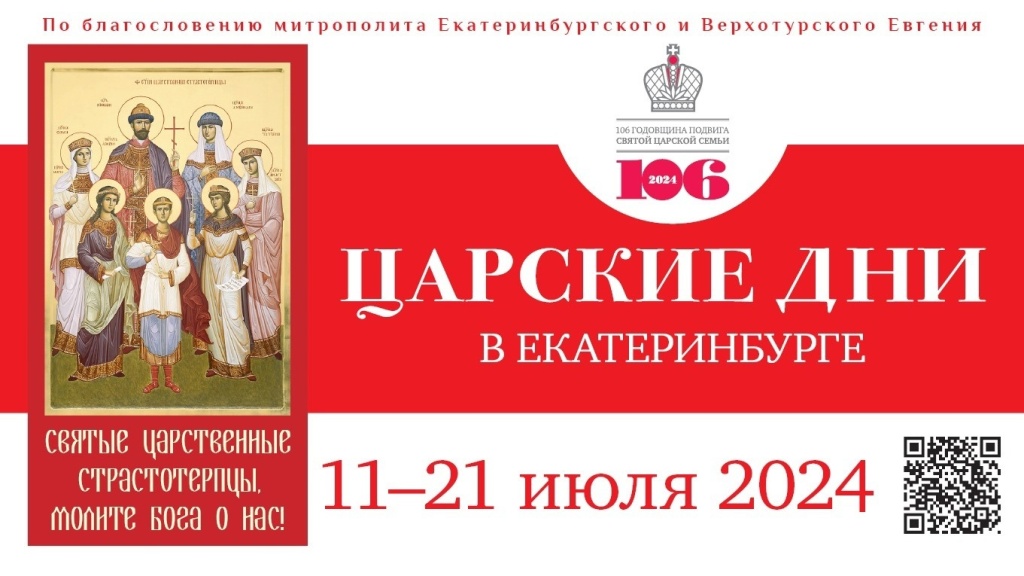
Tsar’s Days in Ekaterinburg 2024

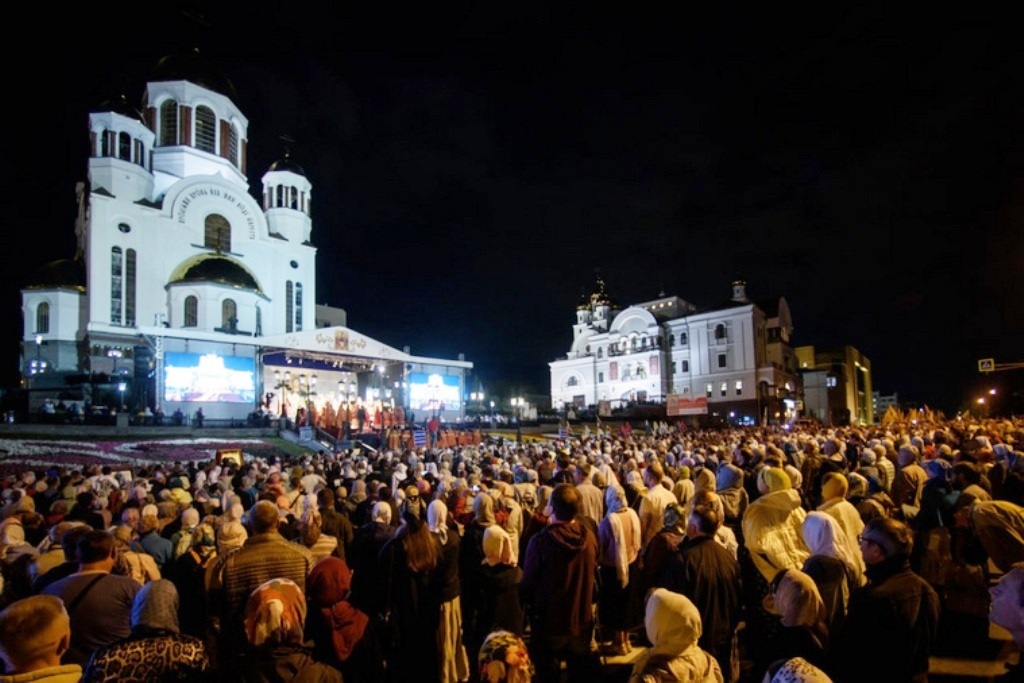
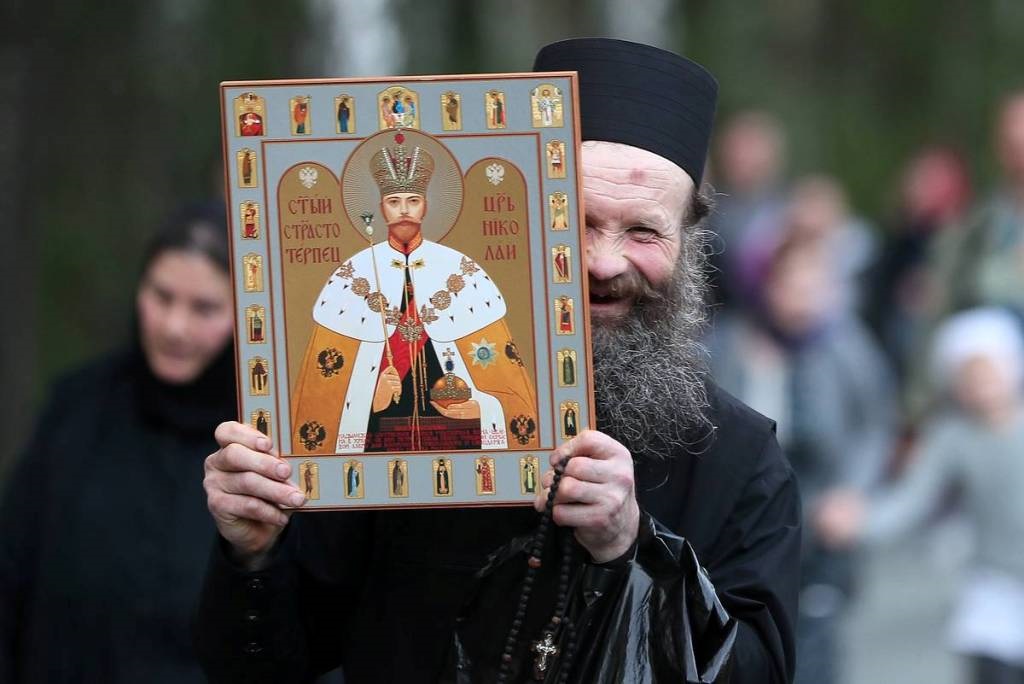
On the night of 16/17 July 2024, on the eve of the Feast Day of the Holy Royal Martyrs[1], the Hierarchal Divine Liturgy was celebrated at the Church on the Blood in Ekaterinburg. This year marks the 106th anniversary of the murder of Emperor Nicholas II, his wife, their five children, and four faithful retainers.

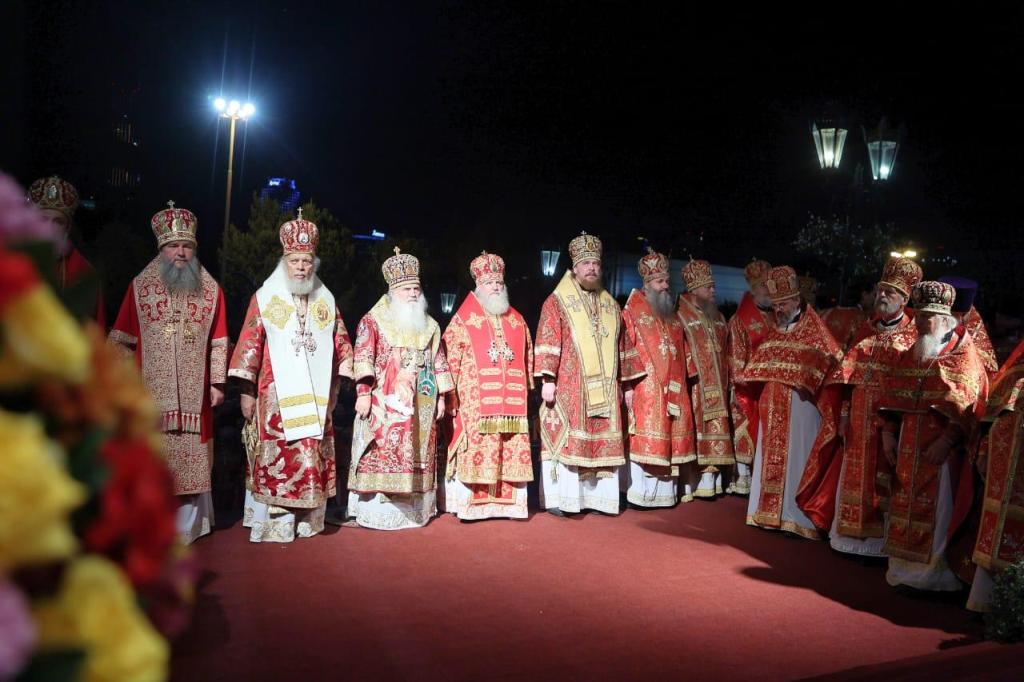
Divine services were held in the Imperial Room[2], were led by the bishops who had arrived in the Ural capitol for Tsar’s Days: Bishop Roman of Rubtsovsk and Aleysk, and Bishop Leonty of Syzran and Shigon.

Concelebrating with the bishops were Archpriest Nikolai Tarantin, head of the protocol service of the Ekaterinburg Diocese, Archpriest Maxim Minyailo, chairman of the diocesan department for Church relations with society and the media, senior priest of the Church on the Blood, and Priest Daniel Ryabinin, head of the diocesan missionary department; Priest Pavel Starkov, head of the Youth Department, spiritual father of St. Simeon’s Orthodox Gymnasium (School); Rector of the Ekaterinburg Theological Seminary, Hieromonk Korniliy Zaitsev, Chief of Staff of the Synodal Diocese of the Ekaterinburg Diocese, Hieromonk Simeon (Seregin), and other clergymen of the Ekaterinburg Diocese.

Traditionally, the Divine Liturgy on the night of 16th July is celebrated with a large crowd of faithful – hundreds of believers prayed in the church.

The hymns of the service were sung by the choir of the Ekaterinburg Theological Seminary under the direction of Anastasia Mukhlynina, a graduate of the seminary’s choir director’s department.

Archpriest Sergiy Alexeev, a cleric of the Holy Trinity Cathedral in Ekaterinburg, addressed the faithful present with a sermon on the pre-communion verse.

Communion on this day was performed from five chalices – many pilgrims arrived in Ekaterinburg to pray at the main services of the Tsar’s Days and honour the memory of the Holy Royal Family.

At the end of the service, Metropolitan Evgeny of Ekaterinburg and Verkhoturye greeted the bishops, clergy and pilgrims who had arrived from across Russia and other countries for the Tsar’s Days.

Metropolitan Evgeny asked everyone to preserve the memory of the Holy Royal Passion-Bearers and to imitate wisdom and strength in the love they showed. At 3:00 p.m., Little Vespers with an akathist to the Holy Royal Passion-Bearers was served in the Church-on-the-Blood, then at 4:30 p.m., the All-Night Vigil began on the square in front of the church, which was led by the Eminent Archpastors. The main service of the Tsar’s Days – the Divine Liturgy – began at midnight, followed by the Royal Cross Procession.

Procession of the Cross to Ganina Yama

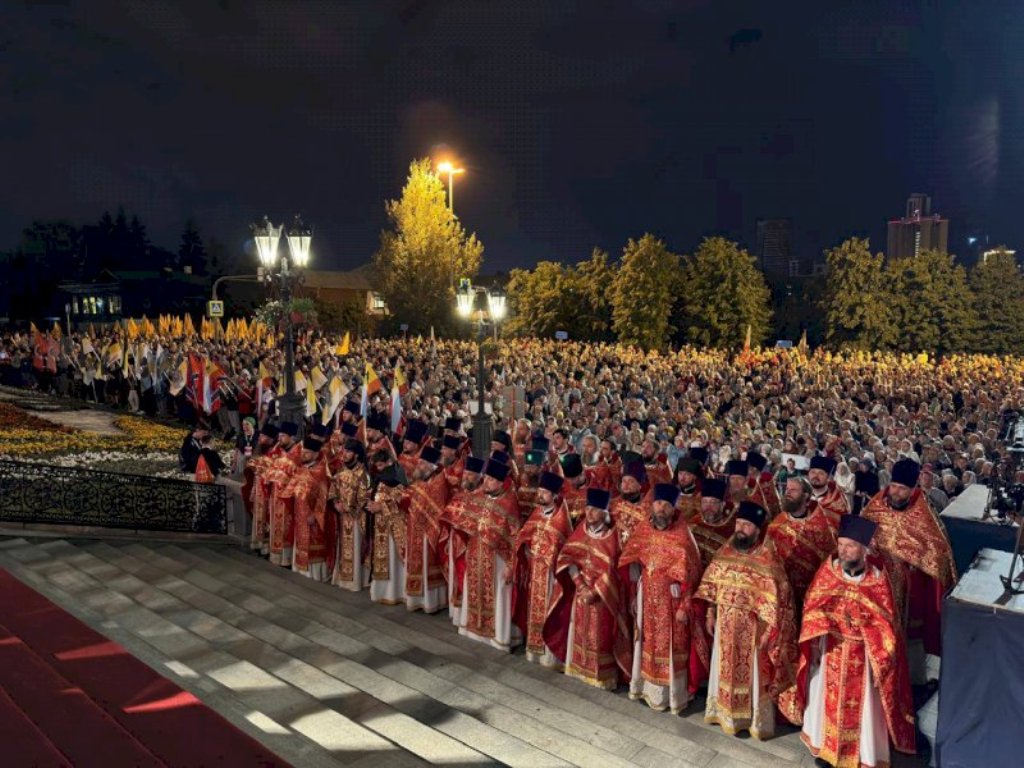
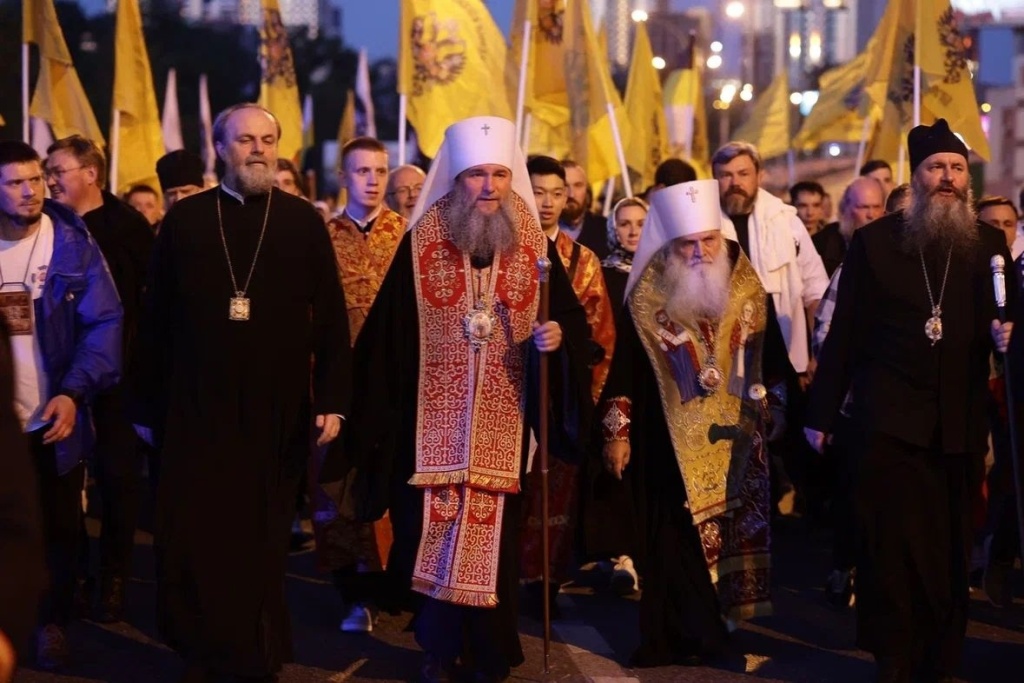
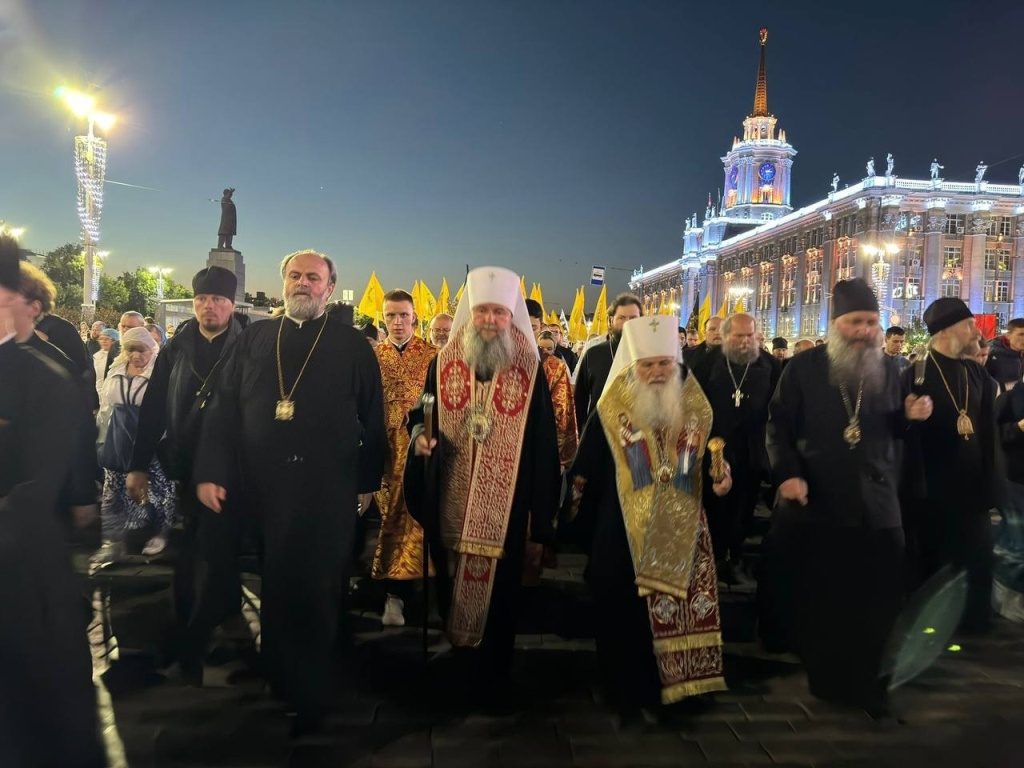
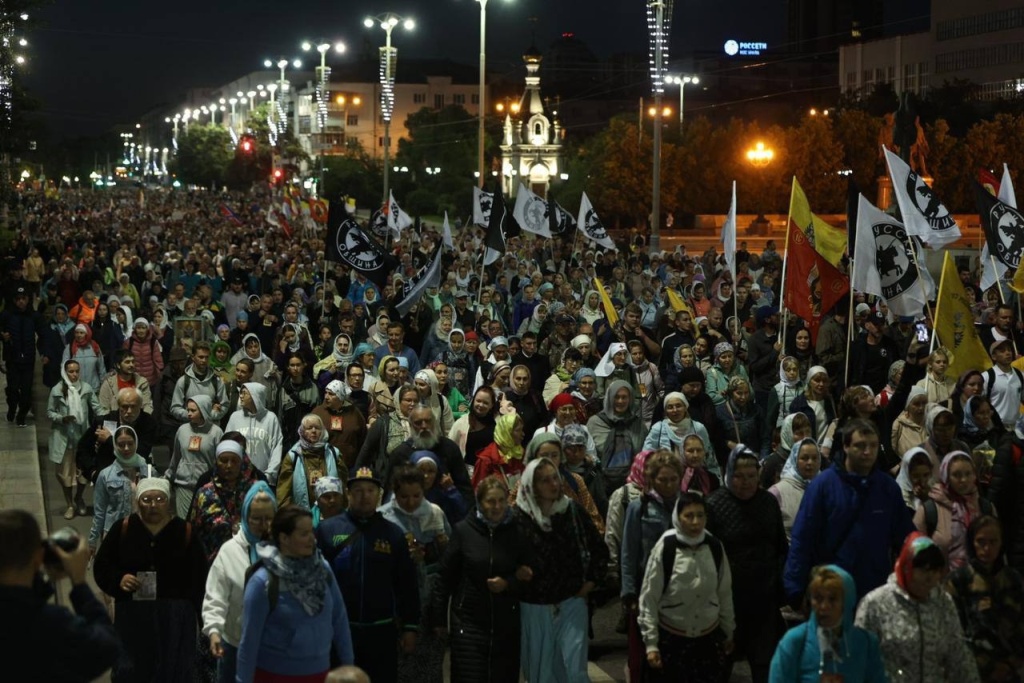
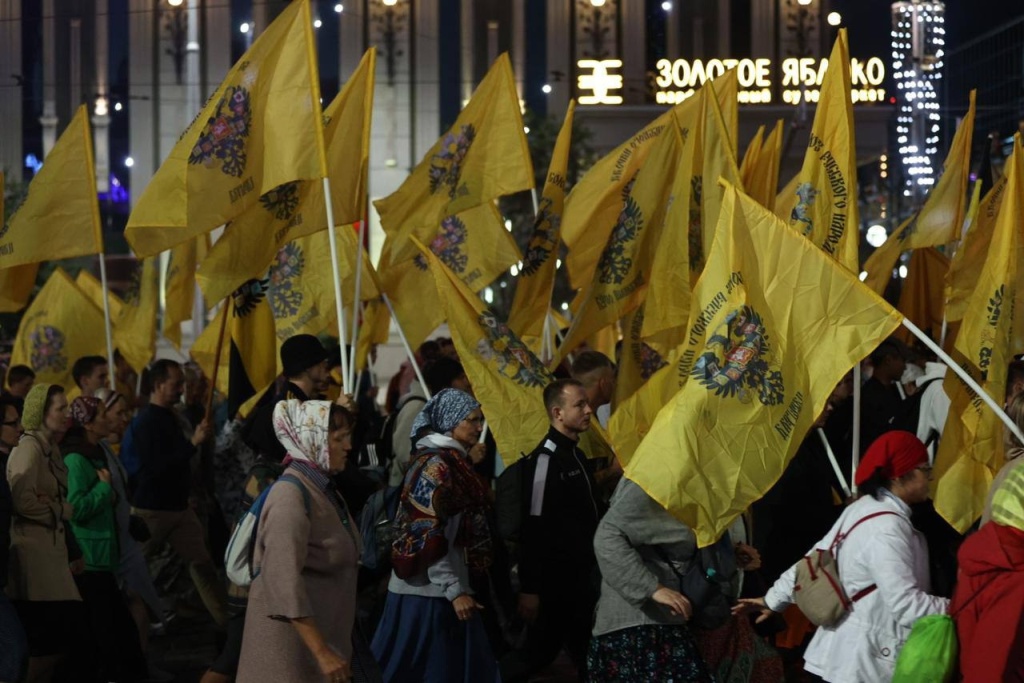
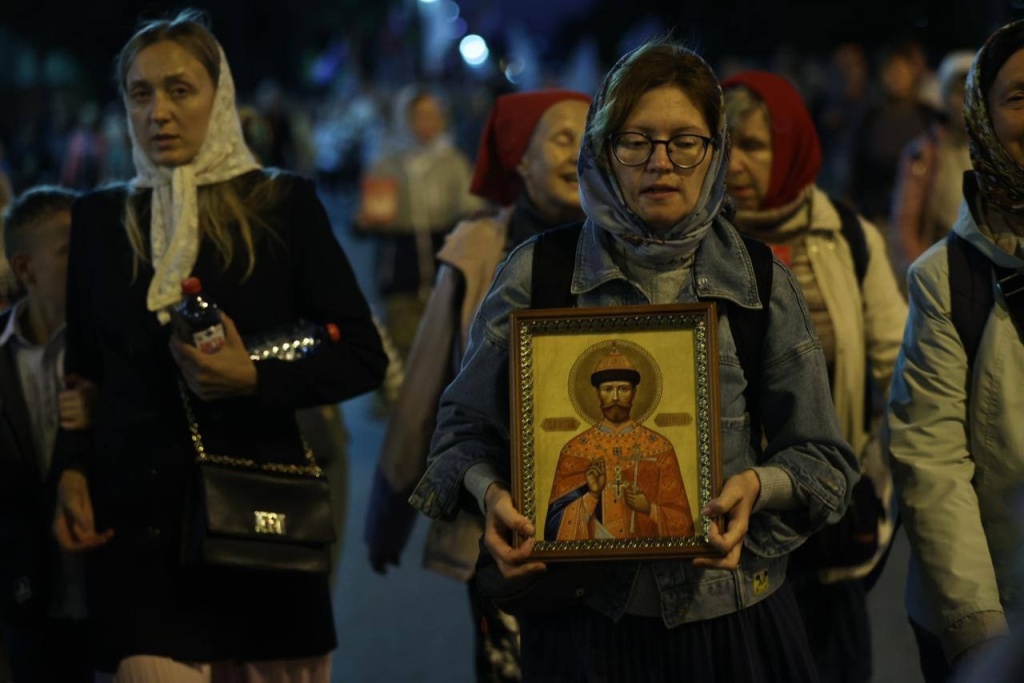
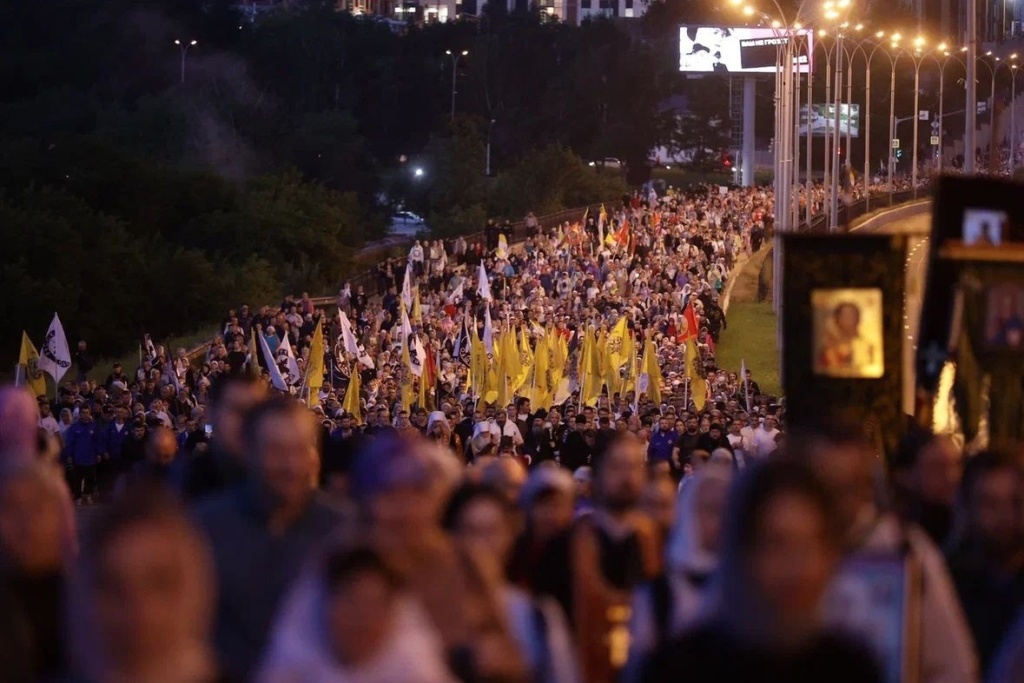
In the early morning hours of 17th July 2024, the traditional Royal Cross Procession was held from the Church on the Blood in Ekaterinburg to the Monastery of the Holy Royal Passion-Bearers at Ganina Yama – a 21 km.  [13 miles]  journey on foot[3]. The Cross Procession was preceded by a Divine Liturgy on the square in front of the church, which was headed by 13 bishops of the Russian Orthodox Church.

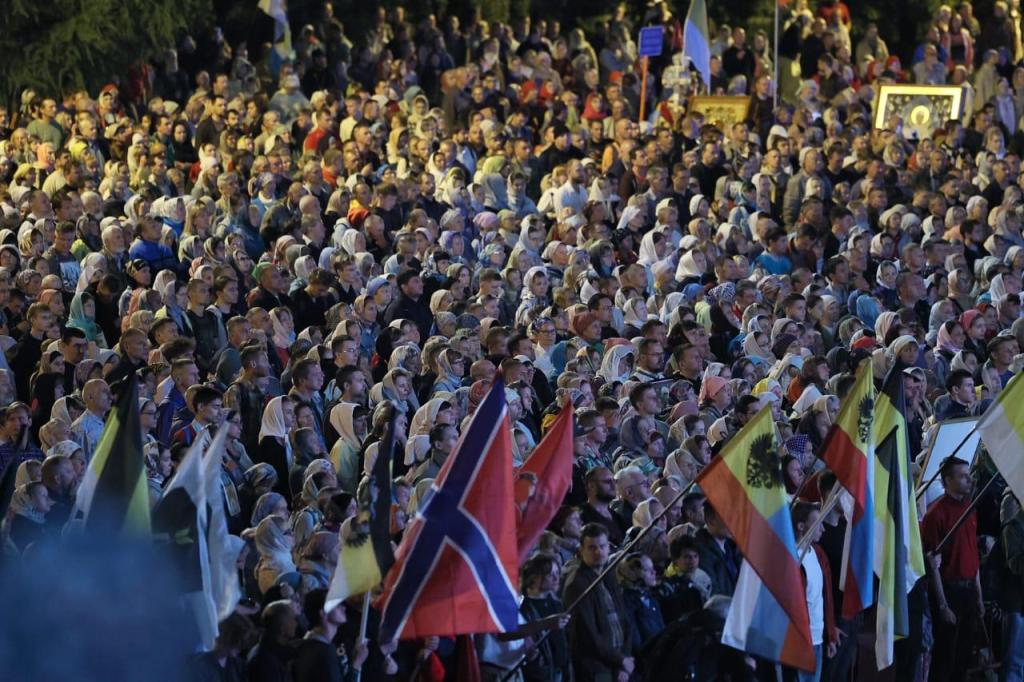
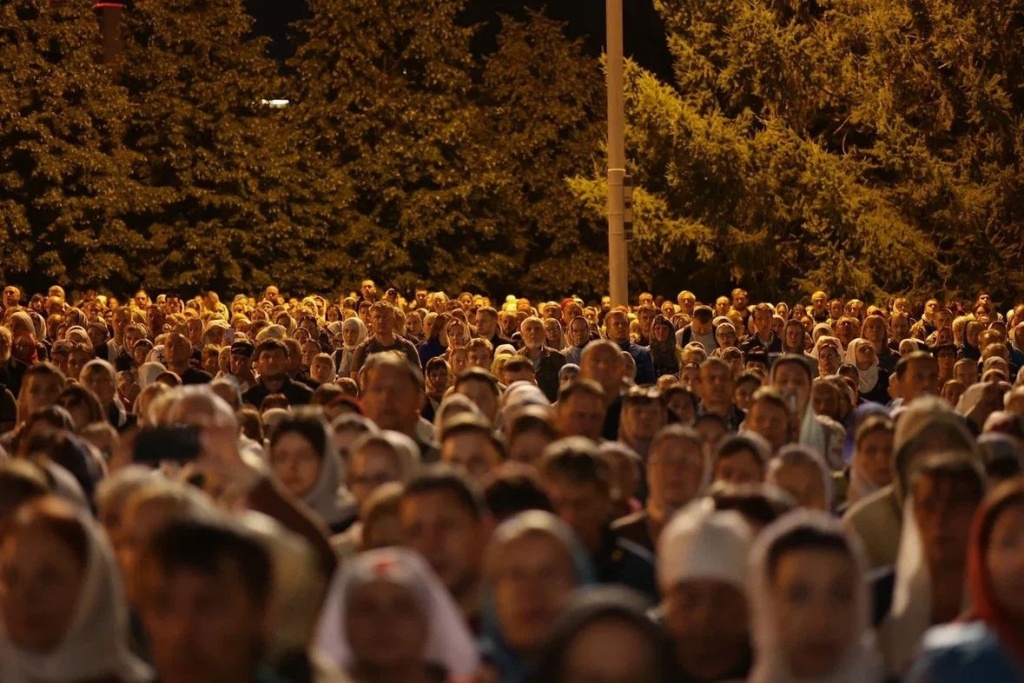
An estimated 45,000 faithful took part in this year’s Cross Procession, together with the head of the Ekaterinburg Metropolia, was led by Metropolitan Vikenty of Tashkent and Uzbekistan, head of the Central Asian Metropolitan District, and other archpastors.

Under the repentant Jesus Prayer: “Lord, Jesus Christ, Son of God, have mercy on us!” – the multi-thousand column of believers, clergy and laity from across Russia – covered the distance in about four to five hours. Those who took part in the procession came from every corner of the Russian Federation – from Stavropol to Novosibirsk, from Astrakhan to Arkhangelsk, as well as abroad.

The procession was accompanied by 10 mobile aid groups of the Orthodox Mercy Service and volunteers of the Tsar’s Days.

In the Cross Procession, two Reliquaries were carried, the first Reliquary containing a part of the Belt of the Most Holy Theotokos, which was donated to the Ekaterinburg Diocese, the second Reliquary containing the relics of 14 saints of the Ekaterinburg Metropolia: the Venerable Martyr Grand Duchess Elizabeth Feodorovna, the Venerable Martyr nun Varvara (Barbara) Yakovleva, the Venerable Basilisk of Siberia, the Righteous Simeon of Verkhoturye, the Blessed Cosmas of Verkhoturye, the Venerable Elijah Chebotarev, the Hieromartyr Alexander Malinovsky, the Hieromartyr Arkady Gariaev, Hieromartyr Konstantin Bogoyavlensky, Hieromartyr Lev Ershov, Venerable Arefa Katargin, Hieromartyr Alexis Budrin, Venerable Confessor John (Chevroletin) and Hieromartyr Alexander Adrianov.

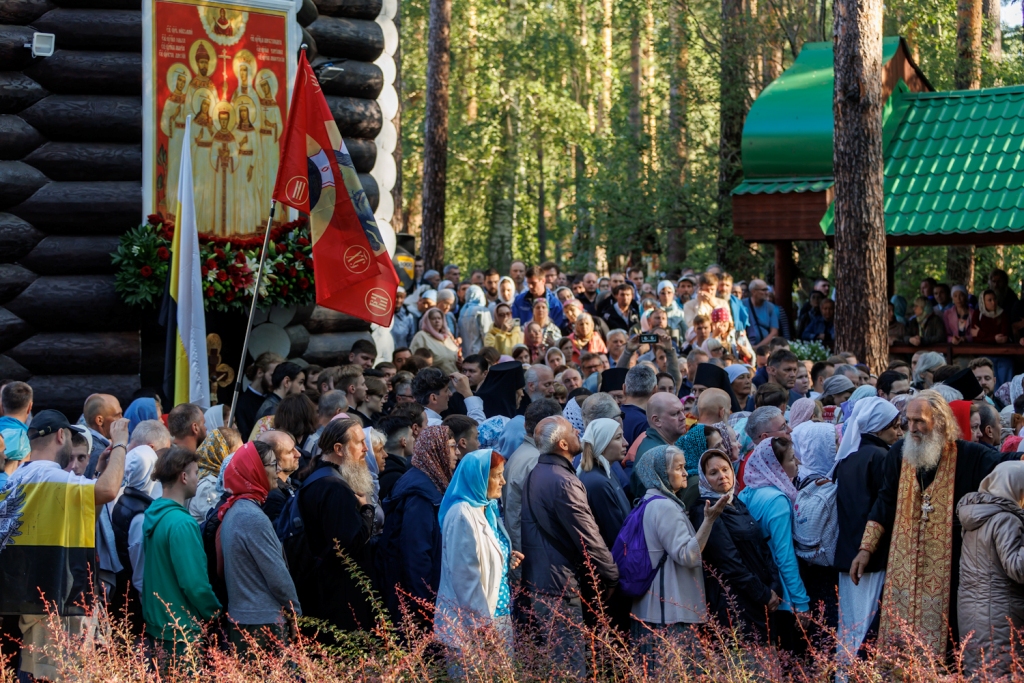
The Royal Cross Procession concluded with a moleben to the Holy Royal Passion-Bearers at the Monastery of the Holy Royal Martyrs at Ganina Yama.

The Most Reverend Archpastors, Bishop Evgeny and Bishop Vikenty, thanked the thousands of faithuful who took part in the Royal Cross Procession for their spiritual feat.

Divine Liturgies were celebrated in the seven churches of the monastery, the churches are dedicated to each of the seven members of the Imperial Family. As the day progresssed, more and more pilgrims arrived at the monastery for prayer and reflection.

Holy Royal Passion-Bearers, pray to God for us!
Святые Царственные страстотерпцы, молите Бога о нас!

NOTES:

[1] On 1st November 1981, the Imperial Family were canonized as new martyrs by the Russian Orthodox Church Outside Russia (ROCOR).

On 20th August 2000, the the Imperial Family were canonized as passion-bearers by the Moscow Patriarchate.

Passion-bearers are people who face death with resignation, in a Christ-like manner, as distinguished from martyrs, the latter historically killed for their faith. Proponents cited the piety of the Tsar and his family and reports that the Tsarina and her eldest daughter Olga prayed and attempted to make the sign of the cross immediately before they died.

Despite their official designation as “passion-bearers” by the Moscow Patriarchate, they are nevertheless spoken of as “saints” in Orthodox publications, icons, and in popular veneration by the people.

[2] The Imperial Room is situated in the lower church sanctified in honor of the Holy Royal Martyrs. It was established on the site of the room located in the basement of the Ipatiev House, where Emperor Nicholas II, his family, and four retainers were all brutally murdered on the night of 16/17 July 1918.

[3] Once again, Porosenkov Log was not included in this year’s Cross Procession. Porosenkov Log is where the remains of the Imperial Family were exhumed in two separate graves in 1991 and 2007 respectively. Due to the fact that the Moscow Patriachate does not yet recognize the Ekaterinburg Remains as those of the Imperial Family. Their official recognition rests with the Bishops’ Council of the Russian Orthodox Church.

© Paul Gilbert. 25 July 2024

Mobile exhibit dedicated to Empress Alexandra Feodorovna opens in Ekaterinburg

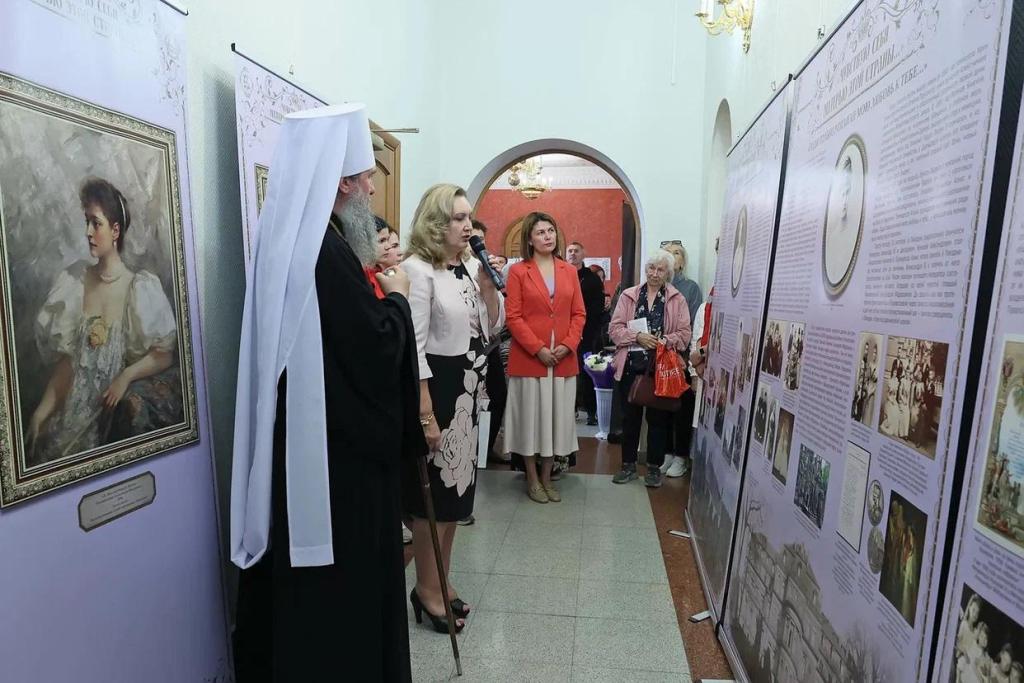
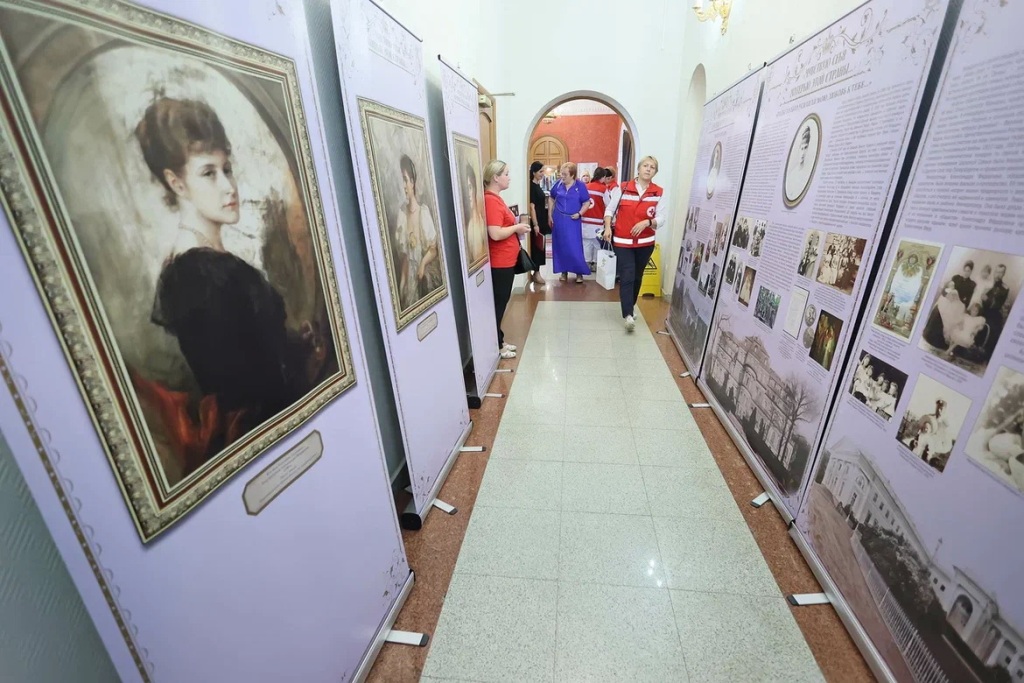
On 15th July 2024, a mobile exhibition dedicated to Empress Alexandra Feodorovna opened at the Tsarsky Cultural and Educational Center, which is situated in the Patriarchal Compound of the Church on the Blood in Ekaterinburg.

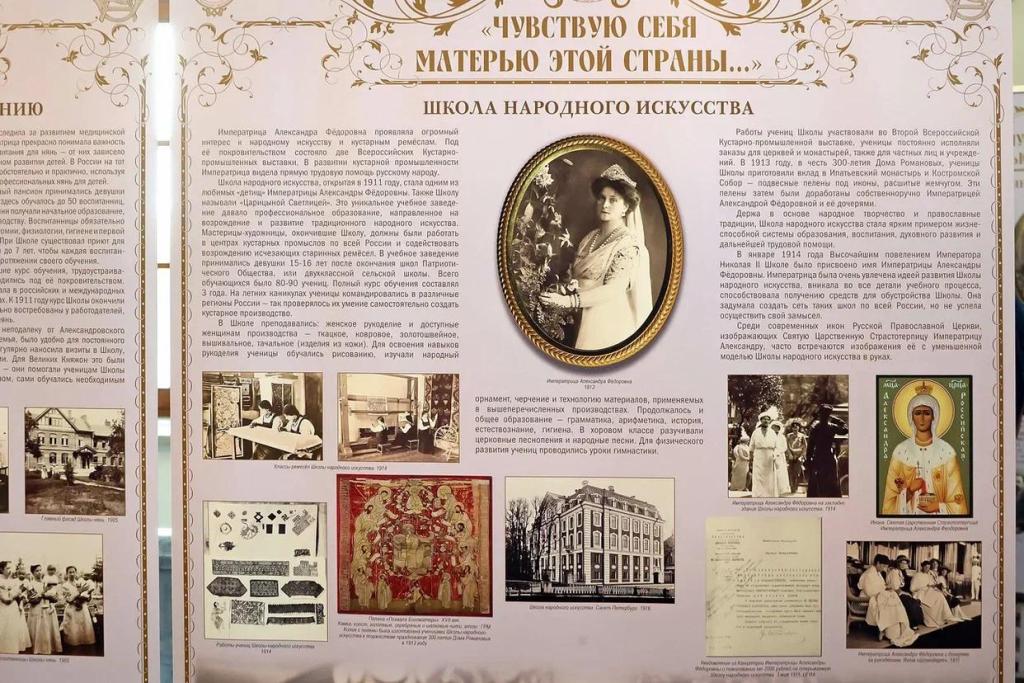
The exhibit titled “I feel like the mother of this country…” The Christian Feat of the Holy Royal Passion-Bearer Empress Alexandra Feodorovna, was organized by the Elizabeth-Sergius Educational Society Foundation (ESPO), in cooperation with the Institute of World History of the Russian Academy of Sciences.

For the first time, the exhibit gives a detailed story about the large-scale charitable activities of Empress Alexandra Feodorovna, which include her participation in the establishment and work of the Guardianship of the Houses of Industry; the School of Nannies in Tsarskoye Selo; the development of medical institutions specializing in pediatric medicine, orthopedics, surgery and women’s health; as well as her feat of mercy during the First World War; her patronage of science, medicine; and the education of her children.

The opening ceremony of the exhibition in Ekaterinburg was attended by Deputy Governor of the Sverdlovsk Region Pavel Krekov, Chairman of the Elizabeth-Sergius Educational Society Foundation (ESPO) Anna Gromova and Metropolitan of Yekaterinburg and Verkhoturye Evgeny.

The travelling exhibition was created in 2022, the year marking the 150th anniversary of the birth of Empress Alexandra Feodorovna. For the past two years, the exhibition has been presented in cities and towns across Russia.

In an interview with journalists, Anna Gromova, Head of the ESPO Foundation, said that while the exhibition had been traveling around Russia, that it arouses great interest, since the theme of the exhibition reveals unknown facets of the charitable and selfless activities of Empress Alexandra Feodorovna. Pavel Krekov, Deputy Governor of the Sverdlovsk Region, emphasized the extreme relevance of the exhibition, especially during this years Tsar’s Days events in the Ural capital.

Already on the first day of its work, the exhibition of the ESPO Foundation “I Feel Like the Mother of This Country…” The Christian Feat of the Holy Royal Passion-Bearer Empress Alexandra Feodorovna” was met with great interest by the residents and visitors, who arrived in the Ural capital for Tsar’s Days. Specialists of the ESPO Foundation have prepared a leaflet and a guide to the exhibition.

© Paul Gilbert. 18 July 2024

The last divine service for the Imperial Family in Ekaterinburg

On this day – 14th July (O.S. 1st July) 1918 – Archpriest Ioann Storozhev performed the last divine service for the Imperial Family in Ekaterinburg.

In October 1918 – three months after the death and martyrdom of Emperor Nicholas II and his family, Fr. John Storozhev, recalled the devine service he performed in the Ipatiev House on 14th July (O.S. 1st July) :

“… Taking up our [Fr. John Storozhev and Deacon Vasily Buimirov] places, the deacon and I began the reader’s service [similar to a liturgy, but much shorter since it does not include the Eucharist]. At a certain moment in the service, it is required to read the prayer “With the Saints Give Rest”. For some reason, on this particular occasion, the deacon, instead of reading, sang the prayer, and I, too, began to sing, somewhat disconcerted by this departure from the customary practice. But we had scarcely begun when I heard the members of the Romanov family, standing behind us, fell to their knees, and here I suddenly felt the sublime spiritual comfort that comes from shared prayer.

“This experience was even stronger when, at the end of the service, I read a prayer to the Mother of God, which, in highly poetic and moving words, expressed the plea of the afflicted person to be supported in his sorrows and receive the strength to bear his cross worthily.

“In addition, the deacon recited the Ectenia [often called by the better known English word litany], and I sang. Two of the grand duchesses sang along with me, and sometimes Nicholas Aleksandrovich sang in a low bass (for instance, he sang the “Our Father” and some other things). The service was uplifting and good, and the family prayed fervently.

PHOTO: Archpriest Ioann Vladimirovich Storozhev (1878-1927)

“The Tsar was clad in a khaki tunic and trousers with tall boots. On his chest he wore a St. George’s Cross. He had no shoulder boards [epaulettes]. He impressed me with his firm gait, his calmness. and especially his manner of looking steadfastly and firmly into one’s eyes. I didn’t notice any fatigue or traces of low spirits in him. It seemed to me that he had barely visible gray hair in his beard. His beard had been longer and wider when I saw him the first time. It seemed to me now to be trimmed.

“After the service, everyone approached the cross and the deacon handed prosphora [a small loaf of leavened bread used in Orthodox liturgies] to Nicholas Alexandrovich and Alexandra Feodorovna. Upon departing, I walked very close to the former grand duchesses, and heard a whispered “Thank you”. I don’t think it was just my imagination

“The deacon and I were silent until we reached the Art School building, and here, suddenly, he said to me: “You know, father, something’s changed there. Something’s happened”. His words struck a chord with me, and I stopped and asked why he he had gotten that impression. “Well, they were all different somehow. And also nobody sang.” And I have to say that, truly, this service of 14/1 July was the only one at which none of the Romanov’s sang with us (and the deacon had been present at all five services at the Ipatiev House).”

Source: The Last Sacred Service Observed by the Imperial Family in Yekaterinburg. The Testimony of Archpriest Ioann Vladimirovich Storozhev. First English translation published in Regicide in Ekaterinburg, compiled and edited by Paul Gilbert.

© Paul Gilbert. 14 July 2024

***

The following NEW title was compiled and edited by independent researchers and Romanov historian Paul Gilbert was published in August 2024. 

This fascinating new study features 14 chapters on this tragic event, which include the memoirs of a British intelligence officer and journalist, and two First-English translations. In addition, 11 chapters were written by Paul Gilbert, based on new documents sourced from Russian archival and media sources over the past decade.

Please refer to the link provided for further details about the content of this new title . . .

CLICK HERE TO READ MORE ABOUT THIS TITLE
Ekaterinburg prepares for Tsar’s Days

Preparations are underway for Tsar’s Days in Ekaterinburg. This year marks the 106th anniversary of the death and martyrdom of Emperor Nicholas II, his family and their faithful retainers in the Ural capital on 17th July 1918. The schedule of events in this years Tsar’s Days was discussed today at a conference attended by members of the Ekaterinburg Diocese headed by Metropolitan Evgeny of Yekaterinburg and Verkhoturye.

The archpastor noted the importance of the upcoming memorial events, which traditionally bring together thousands of faithful from across Russia and abroad.

The central event of Tsar’s Days is the Divine Liturgy held on the night of 16/17 July, followed by a 21-km [13 miles] Cross Procession, from the Church on the Blood in central Ekaterinburg to the Monastery of the Holy Royal Martyrs at Ganina Yama. for which “the whole of Russia gathers” in the Ural capital.

Tsar’s Days is part of the XXIII International Festival of Orthodox Culture, which will be held over a 10-day period from 11-21 July. Aside from divine services and religious processions, the festival will feature many events in honour of the Holy Royal Martyrs, including bell ringing, concerts and musical evenings, as well as exhibitions and conferences hosted by well-known historians, theologians and authors.

The veneration of Nicholas II

The veneration of Nicholas II and his family actually began just days after their murder in July 1918[1]. During the Soviet years, such activity would most certainly have been suppressed, forcing the faithful to honour the Holy Royal Martyrs in secret.

After the fall of the Soviet Union in 1991, everything changed, when in 2000, some 300 faithful gathered at the sight of the Ipatiev House. In 2002, the first Cross Procession in memory of the Holy Royal Martyrs was held in the Ural capitlal, attracting 3,000 faithful. The procession has been held every year since, the most important being in 2018, the year marking the 100th anniversary of the death and martyrdom of the Imperial Family.

NOTES:

[1] Gilbert, Paul. The Veneration of Nicholas II. Sovereign: The Life and Reign of Emperor Nicholas II, Summer 2024. pg. 63-70

© Paul Gilbert. 17 June 2024

Cross procession in memory of the Holy Royal Martyrs held in Ekaterinburg

PHOTO: “Transfer of the Romanov family to the Ural Soviet”. 1927. Artist Vladimir Nikolaevich Pchelin (1869-1941). From the Collection of the Sverdlovsk Regional Museum of Local Lore in Ekaterinburg.

On 30th April 2024, a Cross Procession along the “Path of Sorrows” honouring the memory of Emperor Nicholas II, Empress Alexandra Feodorovna, and their daughter Grand Duchess Maria Nikolaevna was held in Ekaterinburg. The day marked the 106th anniversary of their arrival in the Ural capital from Tobolsk.

Accompanying them were a number of servants: Dr. Evgeny (Eugene) Sergeyevich Botkin, Prince Vasily Alexandrovich Dolgorukov, maid Anna Stepanovna Demidova, valet Terentiy Ivanovich Chemodurov and boatswain Ivan Dmitrievich Sednev.

Every year on this day, the Ekaterinburg Diocese prayerfully celebrate the memory of the Holy Royal Martyrs. In churches, prayers are made to the Holy Imperial Family, and people also honour them by taking part in the Cross Procession along the “Ekaterinburg’s Path of Sorrow”, to the places associated with them on the day of their arrival in the Ural capital.

The clergy of the Ekaterinburg Diocese lead the Cross Procession along the “Ekaterinburg Cross Procession”, they are joined by Orthodox Christians, monarchists and other adherent’s to the last Tsar and his family. Together they prayfully walk the Path of Sorrows, walking in the footsteps of the Tsar, his family and their faithful servants, expressing their love and reverence for them.

The “Ekaterinburg Path of Sorrows” begin at the place where Emperor Nicholas II, Empress Alexandra Feodorovna and Grand Duchess Maria Nikolaevna disembarked from the train on 30th April 1918. Here, near the Shartash Railway Station (in 1918 – Yekaterinburg-II Station), a Memorial Cross and foundation stone were installed. A church in honour of the Valaam Icon of the Mother of God, one of the three miraculous icons that appeared during the reign of Nicholas II, will be constructed on this site.

The Cross Procession then proceeds along Vostochnaya Street, where the Church of the Icon of the Mother of God “Port Arthur” was erected at the intersection with Shevchenko Street. Here, according to the historical version, on 23rd May 1918, Tsesarevich Alexei Nikolaevich, Grand Duchesses Olga, Tatiana and Anastasia Nikolaevna arrived by train, placed under arrest, and then taken to the Ipatiev’s House.

In 2008, a memorial stone was laid at the site, and in 2017, the construction of the Church of the Icon of the Mother of God “Port Arthur” was completed, the consecration of the church was performed by Metropolitan Kirill of Yekaterinburg and Verkhoturye.

Not far from the railway station, in Nevyansky Lane, stands the Church in Honour of the Reigning Icon of the Mother of God. It was consecrated in 2011 by Metropolitan Kirill of Yekaterinburg and Verkhoturye. In 1918, the Yekaterinburg-I Station was located here, and it was here on 30th April 1918, that the train carrying the Tsar, his family and their servants stood for several hours. An angry mob had gathered at the station, forcing the train to travel to the Yekaterinburg-II Station.

PHOTO: view if the mosaic panel depicting the Holy Royal Martyrs, situated in the Imperial Room, a side-chapel located in the Lower Church of the Church on the Blood

The Cross Procession along the Path of Sorrows ends at the Church on the Blood on Tsarskaya Street. The Memorial Church was constructed on the site of the Ipatiev House, demolished in 1977. It was here, in the early morning hours of 17tj July 1918, that the Imperial Family and four faithful servants met their violent deaths at the hands of a firing squad and their martyrdom. Situted in the Lower Church there is the “Tsar’s Room” aka as “The Imperial Room” – the altar of the side-chapel in honour of the Holy Royal Martyrs, which was erected on the site of the murder room, with the blessing of Metropolitan Kirill of Yekaterinburg and Verkhoturye for the Tsar’s Days 2018.

© Paul Gilbert. 6 May 2024