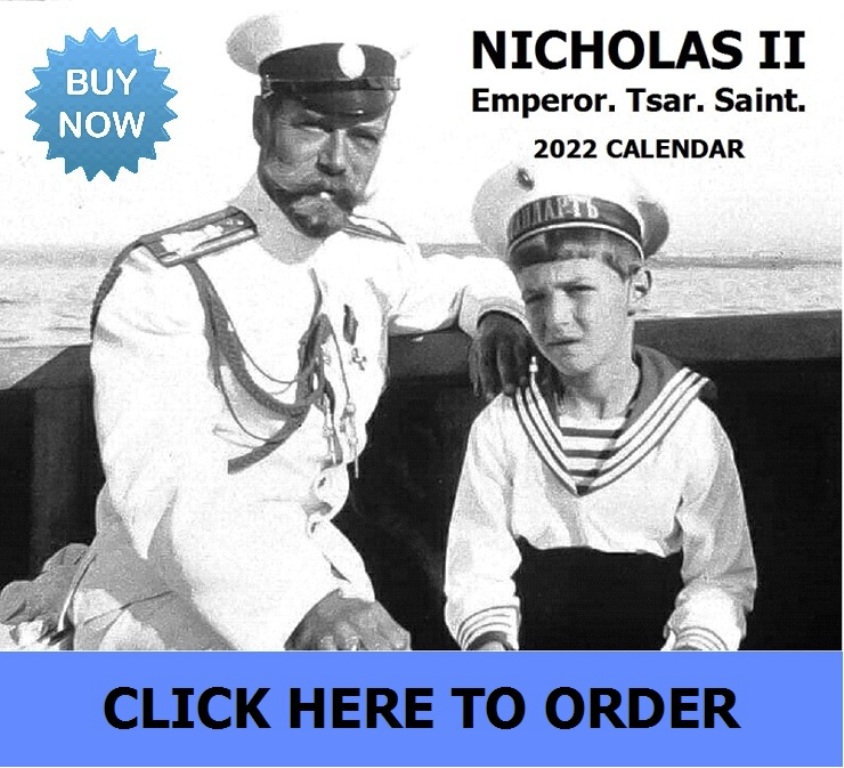
Nicholas II Calendar 2022

LIMITED PRINTING OF ONLY 200 COPIES!

I am pleased to offer copies of my 2022 calendar, dedicated to Emperor, Tsar and Saint Nicholas II, with a limited printing of only 200 copies!

Each month features a full-page black and white photograph of Russia’s last monarch, printed on quality glossy stock.

Nearly 70 major holidays in the United States, Canada, Great Britain, Australia and Russia are featured, with room to write in your own special dates and events.

Also featured, are the birth dates of members of Nicholas II, Alexandra Feodorovna, and their five children, as well as important dates in the reign of Russia’s last tsar.

The entire net sales from this calendar assist me with my research, but also with translation costs, the maintenance costs of my web site and news blog, as well as the organization and promotion of events.

The price of each calendar is $10 + postage (rates are noted on the order page, link below). I can ship to any country by Canada Post

NOTE: the postage rates quoted are for SINGLE copies ONLY! If you want to order more than one calendar, then please contact me by email at royalrussia@yahoo.com

Payment can be made securely online with a credit card or PayPal or by personal check, money order or cash – click HERE to download and print a mail order form

Thank you for your support of my research and dedication to clearing the name of Russia’s much slandered tsar

© Paul Gilbert. 4 September 2021
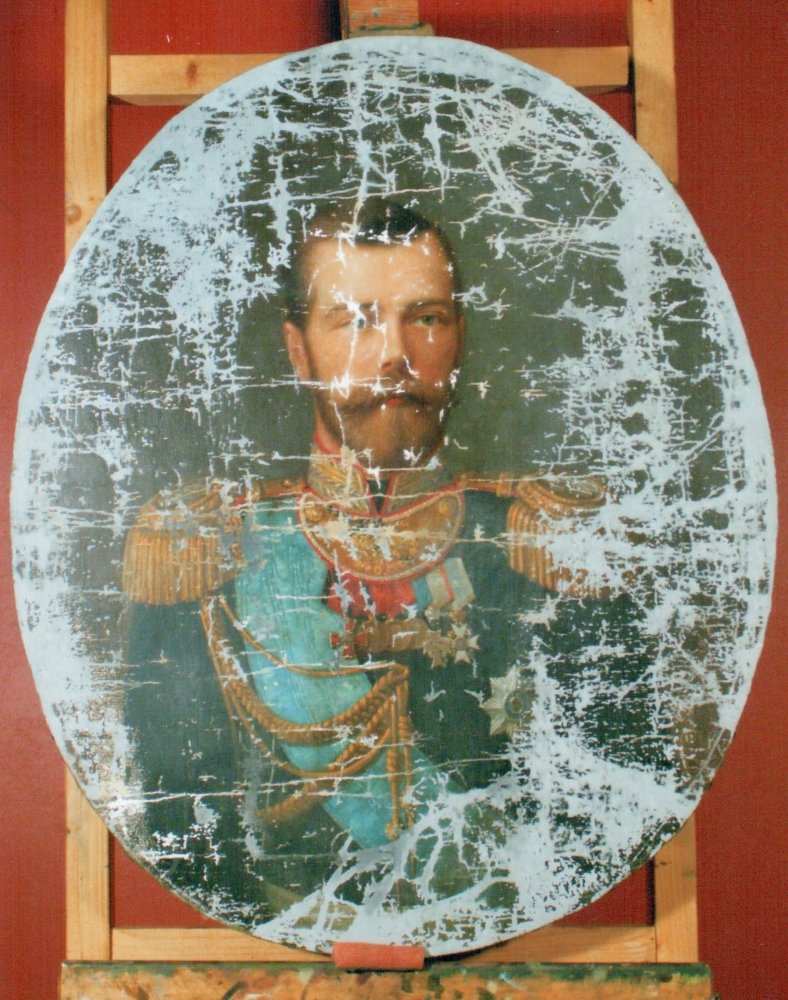
State Hermitage Museum restores rare portrait of Nicholas II

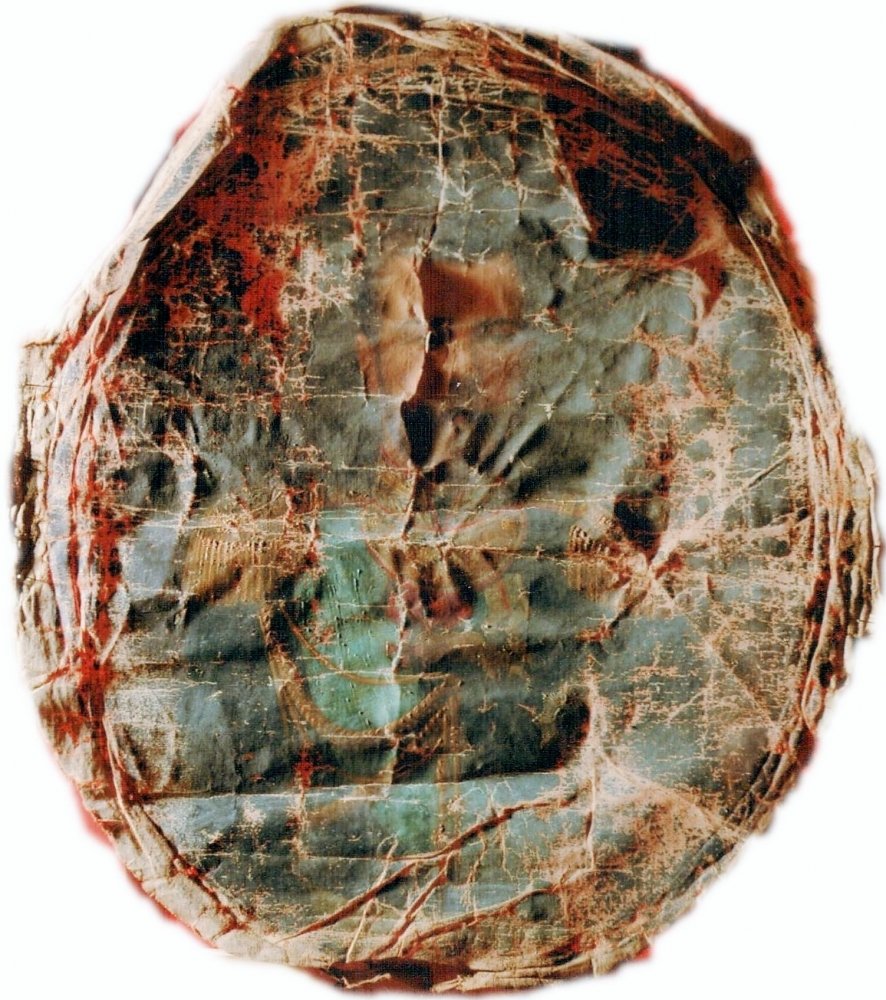
PHOTO: “as if in a misty haze, one could discern the face of Emperor Nicholas II”

In 2018, the State Hermitage Museum in St. Petersburg in cooperation with the Russian-American Cultural and Educational Society ‘Rodina’, embarked on a joint project headed by Candidate of Cultural Studies Viktor Faibisovich, on the restoration of a little-known portrait of Russia’s last tsar.

In 2004, a Moscow collector brought the portrait from the United States to the State Hermitage Museum, after discovering it in the Russian-American Cultural and Educational Society Museum.

The Rodina Society was founded in 1954 by Russian émigrés in Lakewood, New York. The head of Rodina, O.M. Krumins, noted that the portrait was brought from Paris in the late 1950s among other rarities of the Life Guards of the Semyonovsky, Izmailovsky and Pavlovsky regiments, the Nikolaevsky cavalry and the Konstantinovsky artillery schools.

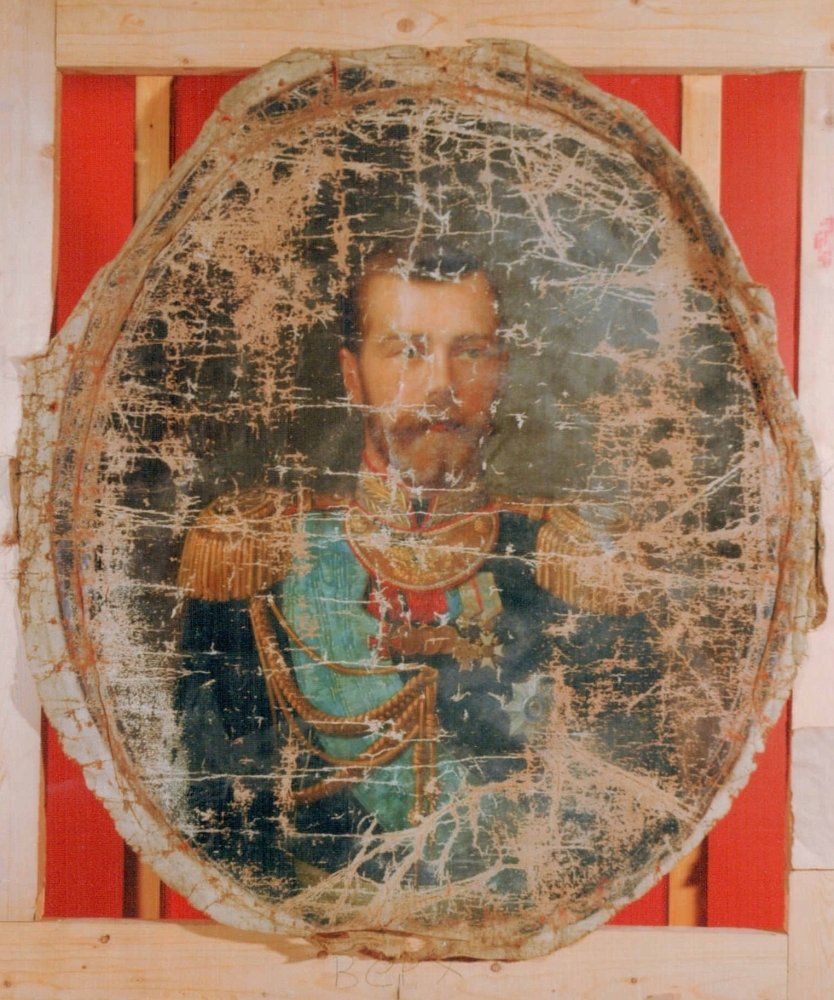
The portrait was in a terrible state, nearly destroyed after years of neglect. Within the remnants of the layer of paint, covered with numerous craquelures [a network of fine cracks in the paint or varnish of a painting], as if in a misty haze, one could discern the face of Emperor Nicholas II, distorted by a deep vertical fracture. But the portrait was in such a terrible state as the canvas had remained rolled up for almost half a century.

The restoration was entrusted to the masters of the Russian Academy of Painting, Sculpture and Architecture in St. Petersburg . It was established that Nicholas II was depicted in the ceremonial uniform of the Semenovsky Life Guards Regiment. The emperor was appointed chief of this regiment in 1894. Scrupulous attribution made it possible to establish that the portrait was made no earlier than 1896.

But how did it end up in Paris in the middle of the 20th century?

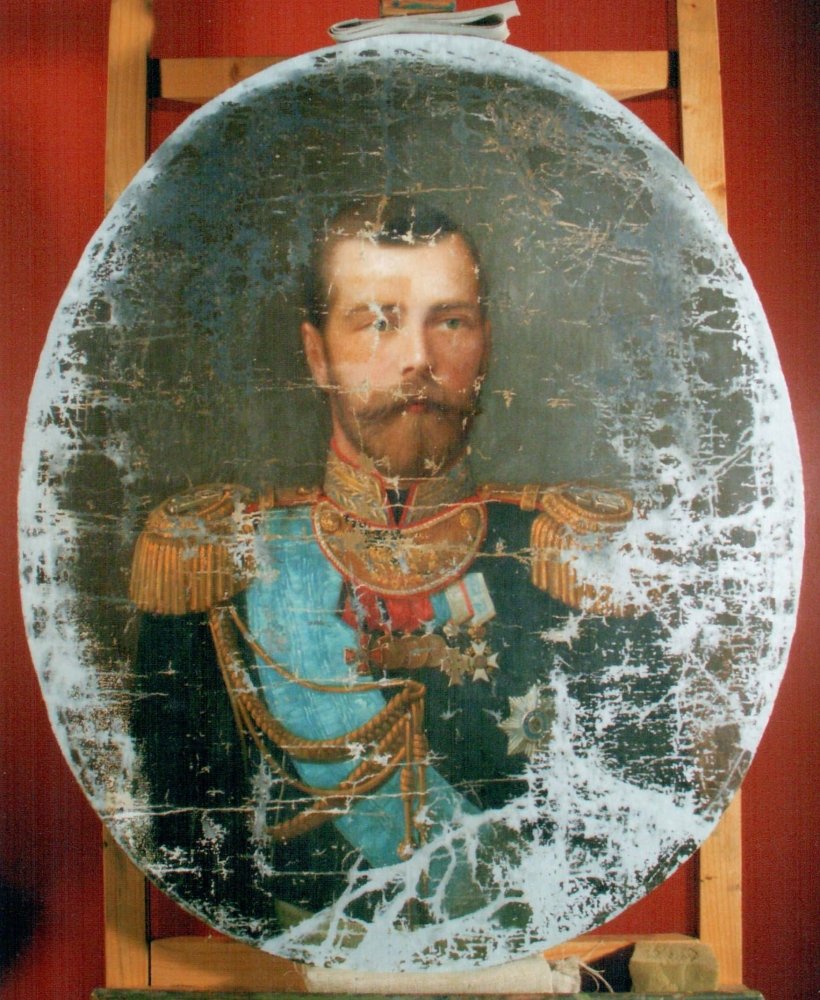
The photos show the various stages of restoration of the portrait

Semenovsky order

The portrait was commissioned by the officers of the Semyonovsky Life Guards Regiment, and hung in the dining room of the officers’ Assembly Hall. A certificate to confirm this was left by an officer of the regiment Yu.V. Makarov: “This dining room, the largest room in the Assembly, was so large that it could accommodate 130-150 diners. On the wall opposite from the entrance, right in the middle, hung a large half-length portrait of the sovereign founder of the regiment, Emperor Peter the Great, in dark oak In a quadrangular frame, the emperor was depicted in a green caftan, with a blue Semyonov collar. Two smaller portraits of Emperor Nicholas II in our uniform and Empress Alexandra Feodorovna in oval gold frames were positioned on either side of Peter’s portrait.”

The officers’ Assembly Hall was the center of regimental life. It was from here that in August 1914 the Semyonovsky Life Guards Regiment set out for battle. During the First World War, the regiment lost 48 officer. Then, in March 1917, the regiment lost its sovereign chief Nicholas II. In April, Colonel Alexander Vladimirovich Popov (1880-1963) was appointed the last Commander of the Semenovsky Life Guards Regiment.

It is to him that we owe the preservation of the portrait of Nicholas II.

PHOTO: Colonel Alexander Vladimirovich Popov (1880-1963)
Last Commander of the Semenovsky Life Guards Regiment

In December 1917, the Semyonovsky Life Guards regiment was disbanded. All military ranks, in accordance with the Decree of the Soviets of Workers ‘and Soldiers’ Deputies on the destruction of estates and civilian ranks, were ordered to remove their shoulder straps and hold elections for commanding officers in the new Semyonovsky Guards Regiment. Popov refused to participate in the elections, and transferred the interim duties of commander to Colonel N.K. von Essen (1885-1945). On 10th December 1917 left for Petrograd, taking with him the portrait of Emperor Nicholas II.

The photos show the various stages of restoration of the portrait

Preserved memory

Popov was one of the initiators of the formation of guards units in the White movement. The revived Semyonovsky Life Guards Regiment fought in the South of Russia. Alexander Vladimirovich carried the portrait of the last sovereign chief through the entire Civil War.

In 1919 he emigrated to France and lived in Paris, where he headed the Association of the Semyonovsky Life Guards Regiment in France, was a member of the Union of Zealots in memory of Emperor Nicholas II, the Society of Lovers of Russian Military Antiquity, the Union of Russian Cadet Corps, and an honorary member of the Union of Transfiguration. Popov also served as director of the regimental museum, in which he sacredly kept the portrait of Nicholas II. In the late 1950s, when it became more and more difficult to preserve museum exhibits, they were transferred to the United States.

A few years later, 82-year-old Colonel Popov passed away. In the magazine Sentinel under the heading “Unforgotten graves” was placed a modest mention: “On March 28, 1963, the chairman of the Association of the Semenovsky Life Guards Regiment, the last commander of the regiment, Colonel Alexander Vladimirovich Popov, died in Paris.”

He was buried in the Sainte-Genevieve-des-Bois Cemetery in Paris.

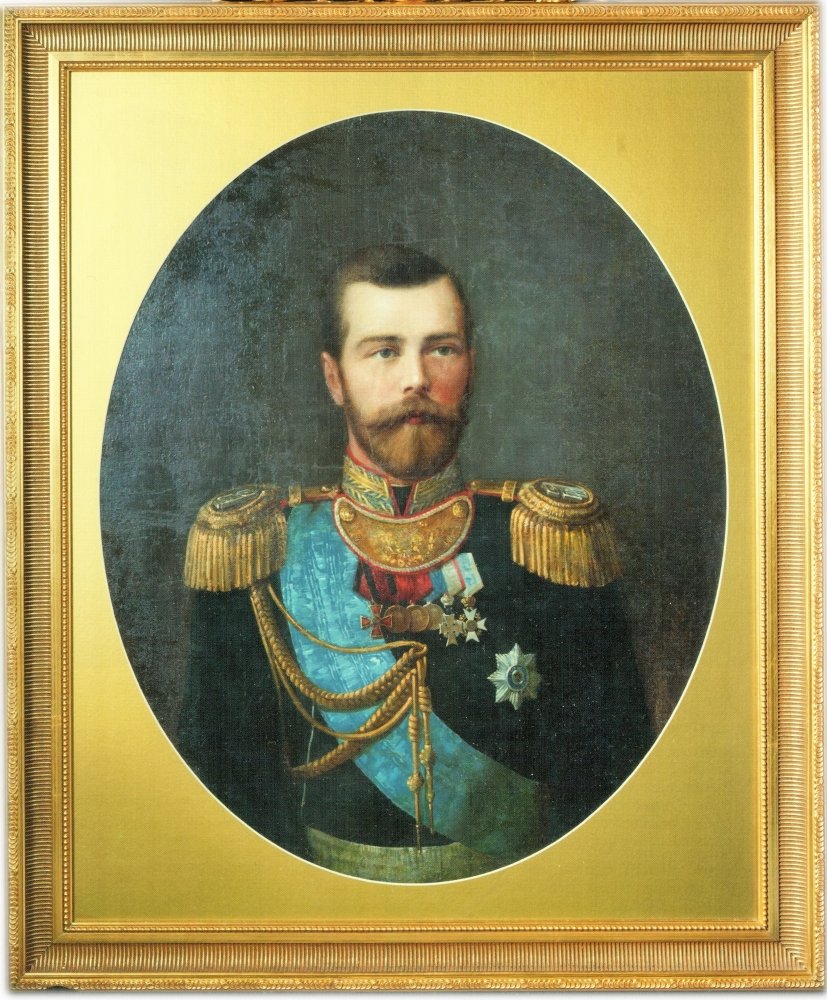
PHOTO: the portrait of Nicholas II, after restoration

After the death of the collector who brought the portrait of Nicholas II to Moscow, the portrait was donated to the Museum of the Russian Guard in the General Staff Building [across from the State Hermitage Museum] in St. Petersburg.

PHOTO: the restored portrait of Nicholas II displayed in the Winter Palace in 2018

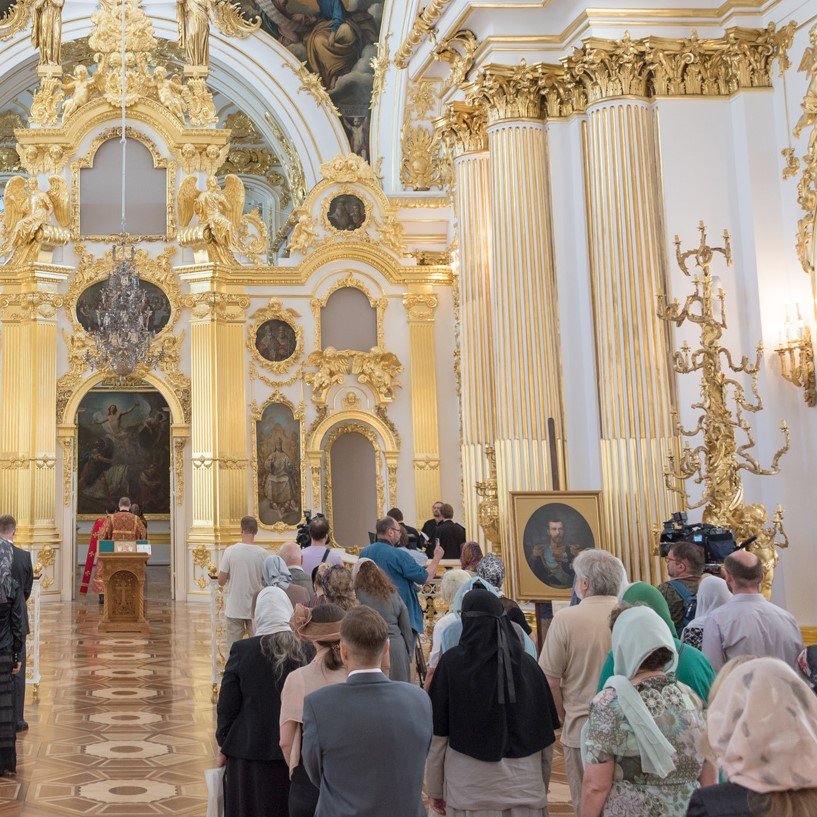
On 17th July 2018, the day marking the 100th anniversary of the death and martyrdom of Russia’s last emperor and tsar, a Divine Liturgy was performed in the Church of the Savior Not Made by Hands [the home church of the Imperial Family] in the Winter Palace, led by the rector of the Prince Vladimir Cathedral, Archpriest Vladimir Sorokin. The restored portrait of Nicholas II by an unknown artist of the late 19th-early 20th centuries was displayed in the cathedral. Popov would have been pleased.

© Paul Gilbert. 1 September 2021

4 NEW Romanov titles

I am pleased to offer 4 Romanov titles on AMAZON in both PAPERBACK and EBOOK editions. These are books which I published in paperback editions about 20 years ago, and have been out of print for some time. I decided to repackage each with new covers, and updated with prefaces and introductions.

Please note that these titles are only available in eBook editions at the present time, paperback editions are in the works, and will be announced as they become available.

Prices for eBooks start at $9.99 USD, paperback editions start at $12.99 USD. Each title offers a FREE Look Inside feature.

All of these books are available from any AMAZON site in the world and are priced in local currencies [CLICK on any of the following links]: Canada, United Kingdom, Germany, France, Spain, Italy, Netherlands, Japan, India, Brazil, Mexico and Australia

NOTE: the book covers depicted below are the eBook editions! The book covers for the paperback editions are different. Please refer to the links provided below to view – PG

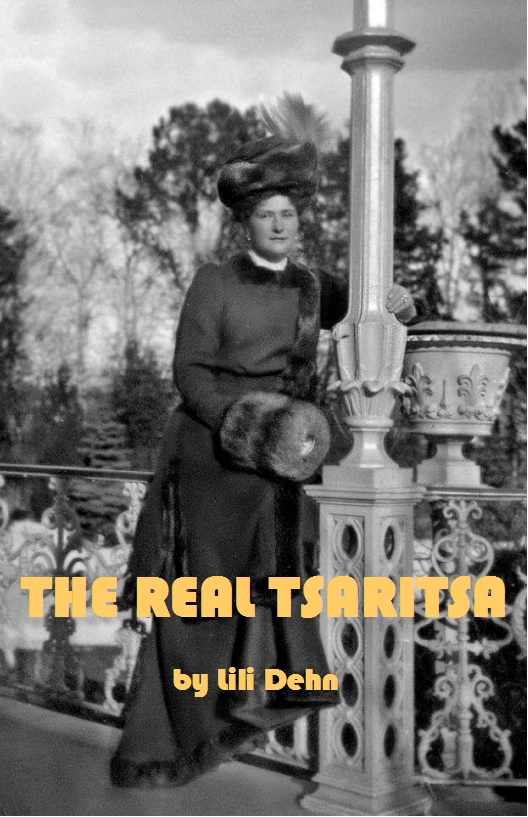
THE REAL TSARITSA
by Lili Dehn

CLICK HERE TO ORDER EBOOK EDITION

CLICK HERE TO ORDER PAPERBACK EDITION

Rumour was busy in her lifetime with amazing tales about the late Empress of Russia; how much or little truth lay behind such rumours was known only to her few closest friends, and one of the few was Lili Dehn (1888-1963).

Great-granddaughter of Prince Koutousoff, the famous defender of Moscow against Napoleon I, Lili Dehn was admitted, after her presentation at Court, into the home circle of the Tsaritsa, and a great friendship grew up between them. Her study of the Empress’s personality, habits, views, life as she led it, is intimate and illuminating. Here is the truth about Rasputin, with new light on the legend of his power over the Royal Household, the inner reason for the scandalous reports circulated concerning him and the Empress, and a grim, enthralling account of his death and burial. Lili Dehn was the first person to whom the Empress came with the news of the Tsar’s abdication, and she witnessed his return after that supreme humiliation.

There are dramatic elements in the narrative of the early days of the Revolution; life at Tsarskoe Selo while the Tsar and his family were under arrest; and in the record of the writer’s own imprisonment and adventurous escape. The interest of the book is intensified by the often deeply pathetic letters written to Lili Dehn by the Tsaritsa from captivity. This revelation at first hand of the whole tragedy of the Empress, as a wife and a mother, and of all that led to the downfall of a great dynasty, makes a profoundly human appeal.

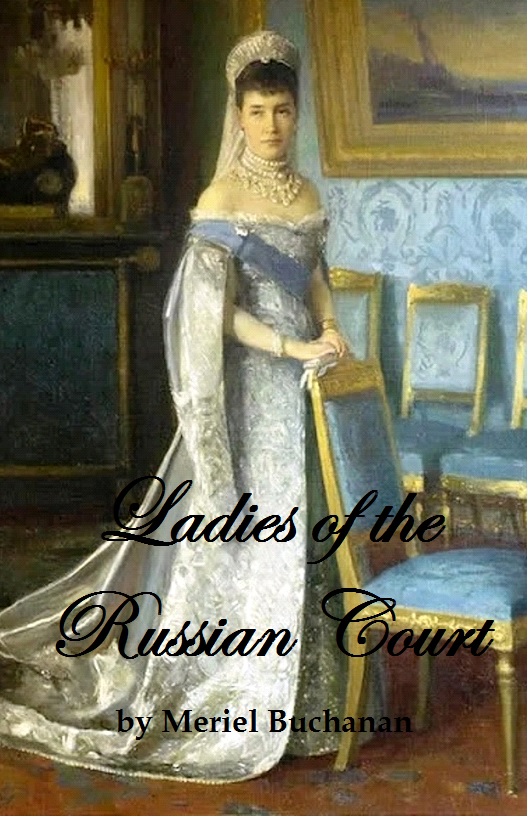
LADIES OF THE RUSSIAN COURT
by Meriel Buchanan

CLICK HERE TO ORDER EBOOK EDITION

CLICK HERE TO ORDER PAPERBACK EDITION

The daughter of Sir George Buchanan (1854-1924), British Ambassador at St. Petersburg in the First World War, lived among the Russian Imperial Court amid the fading glories of an age now past.

The stories which make up these six portraits are drawn from her own memories, stories of women whose lives were lived in the bright light that shines on royalty, many of whom she knew in their everyday existence.

In this gallery of portraits are included the Dowager Empress Marie Feodorovna, wife of Emperor Alexander III and mother of Emperor Nicholas II; the Grand Duchess Marie Pavlovna, the wife of Grand Duke Vladimir Alexandrovich; the Grand Duchess Elizabeth Feodorovna, the wife of the Grand Duke Sergei Alexandrovich and sister of Empress Alexandra Feodorovna; the Grand Duchess Victoria Feodorovna, the wife of the Grand Duke Cyril Vladimirovich; the Grand Duchess Olga Nicholaievna, eldest daughter of Emperor Nicholas II; and finally, Princess Zenaide Yousoupoff, the mother of the infamous Prince Felix Yousoupoff.

In dealing with these ladies of the Russian Court, the author evokes all the mystery, fascination, splendour, and elegance of Tsarist Russia. Ms Buchanan writes with a charm and ease most fitting to the characters she describes.

LAST DAYS AT TSARSKOE SELO
by Count Paul Benckendorff

CLICK HERE TO ORDER EBOOK EDITION

CLICK HERE TO ORDER PAPERBACK EDITION

Count Paul Benckendorff (1853-1921), belonged to the closest circle of Emperor Nicholas II. Following the collapse of the monarchy in 1917, Benkendorff and his wife shared the captivity of the Imperial Family at Tsarskoe Selo.

After the end of the First World War, he was accepted into court service: Adjutant General (1905). General of the Cavalry (1912). Ober-marshal of the Imperial Court. Benckendorff was also a Member of the State Council of the Russian Empire and the Imperial Yacht Club.

Benkendorff’s narrative provides a detailed eye-witness account of the Tsar’s abdication, his transfer to Tsarskoe Selo and his daily life in the Alexander Palace, where he was held under house arrest from February to August 1917.

Throughout his memoirs, Benckendorff characterizes Nicholas II and his wife Alexandra Feodorovna as courageous, gracious, and poised despite their obvious concern for their family.

Due to his age and poor health, Benckendorff was unable to follow the Emperor and his Imperial Family’s into exile to Tobolsk. One of the very few who were faithful, he parted with his Sovereign for the last time on 14th (O.S. 1st) August 1917.

TSAR NICHOLAS II
by A.G. Elchaninov

CLICK HERE TO ORDER EBOOK EDITION

CLICK HERE TO ORDER PAPERBACK EDITION

This short biography was originally published in 1913, to coincide with the 300th anniversary of the Romanov dynasty. The author served as a major-general in the Tsar’s suite, and a professor of military art in the General Staff Academy in St. Petersburg.

Many contemporary historians claim that Nicholas II was not fit to rule the Russian Empire. Elchaninov, however, rebukes these claims based on first-hand experience.

The first chapters describe Russia’s last Tsar as a caring, devoted and loving husband and father. The remaining focus on his relationship with his government, the church, the army, the Russian people, and the policies which he pursued during the first 18 years of his reign.

Written before the First World War and the 1917 Revolution. Elchaninov writes in glowing patriotic language portraying Nicholas II as an indefatigable “Imperial worker” in the service of Russia’s best interests and the “Sovereign father” of the Russian people.

This new expanded edition features an introduction by independent researcher Paul Gilbert, and two detailed appendices: a chronology of events during the reign of Nicholas II (1894-1917); and 100 facts about Nicholas II and the many reforms he made during his reign.

© Paul Gilbert. 31 August 2021

Healthcare reform under Nicholas II

PHOTO: Nicholas II with wounded soldiers at a military hospital near the front in World War I. Artist: Pavel Viktorovich Ryzhenko (1970-2014)

During the 1920s, the Bolsheviks boasted of how they had improved healthcare in Russia after the overthrow of Nicholas II, however, this is just one more lie which the new order utilized in their campaign to discredit the reforms of Russia’s last Tsar. And to this day, Nicholas II’s detractors continue to claim that the Russian people “suffered” and that the Tsar did “nothing” to help them.

During the reign of Nicholas II, the population of the Russian Empire increased from 122 million in 1894 to 182 million in 1914 – an increase of 62 million! Given such a staggering increase in the country’s population, Nicholas II’s health care reforms were nothing short of impressive.

After Nicholas II ascended the throne in 1894, healthcare reform in the Russian Empire became the subject of special concern for the new Emperor. It was during his reign that the development of medicine and healthcare accelerated throughout the Russian Empire.

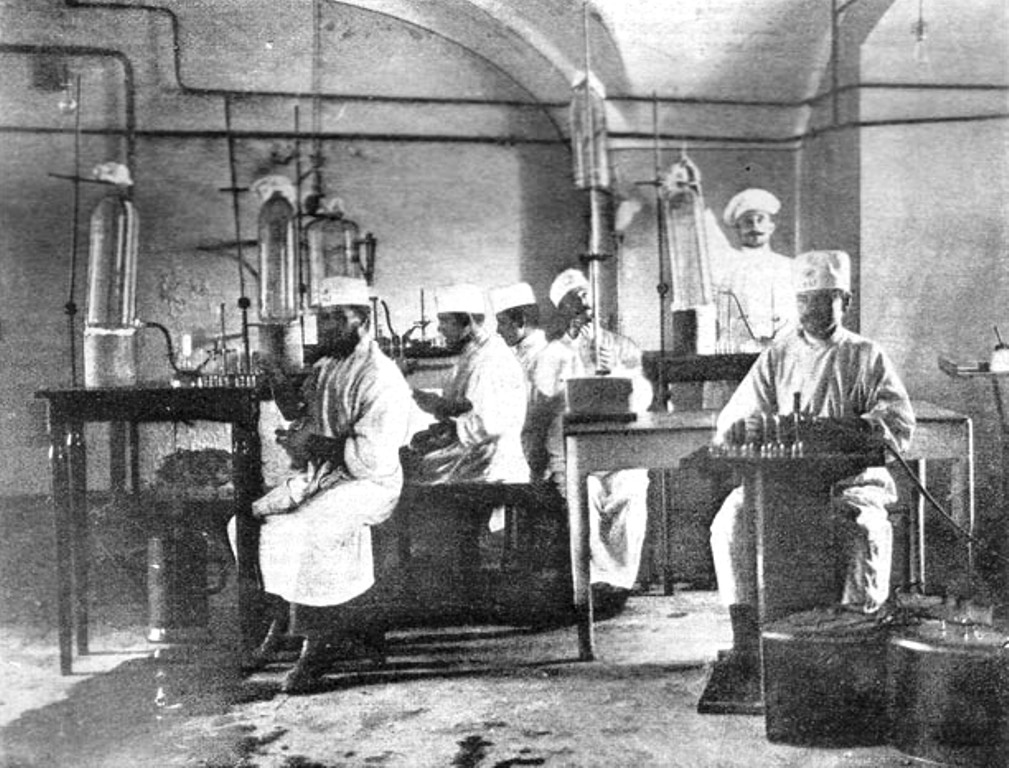
On 11th January 1897, Nicholas II approved a Special Commission on measures to prevent and combat plague, chaired by Duke Alexander Frederick Constantin of Oldenburg [1] whom the Tsar allowed to use the premises of the Emperor Alexander I Fort at Kronstadt for experimental anti-plague purposes. In October 1897, Oldenburg traveled to Turkestan to take emergency measures to prevent the plague from entering the Empire, for which he received “His Imperial Majesty’s deepest gratitude for the labours incurred” for his efforts to spare European Russia and the rest of Europe from plague penetrating their borders.

PHOTO: preparation of anti-bacterial plague drugs in the Plague Control Laboratory of the Emperor Alexander I Fort at Kronstadt

One of the main reasons for the spread of disease, was of course poor sanitation. As a result, in August 1908, Nicholas II advised the Minister of Internal Affairs to pay “serious attention to the dismal state of sanitation in Russia. It is necessary at all costs to achieve its improvement”. The Emperor emphasized the need to be able to “prevent epidemics, not just fight them”. He demanded that the case of streamlining the sanitary-medical organization in Russia be urgently developed and submitted for legislative consideration.

Various commissions were established during Nicholas II’s reign to prevent the occurrence of highly infectious diseases. In March 1912, the Emperor approved the Interdepartmental Commission for the revision of medical and sanitary legislation, writing in the margins of the Journal of the Council of Ministers: “This is to be done at an accelerated pace.” The head of the commission was appointed the chairman of the Medical Council of the Ministry of Internal Affairs, honorary life surgeon academician Georgy Ermolaevich Rein (1854-1942). In the spring of 1912, the commission presented its project for the transformation of the central and local authorities of medical and sanitary affairs. After reviewing it, Nicholas II noted: “Submit to the Council of Ministers. Continue to conduct business at an accelerated rate. “

Nicholas II supported the introduction of a territorial system of medical districts within the Russian Empire, a system not found anywhere else in the world at the time. This system was later adopted by the Bolsheviks, who appropriated its authorship. In the course of the health care reform in the Russian Empire, a three-tier structure of medical assistance to the population was formed: a medical department, a county hospital, and a provincial hospital. Treatment in these health facilities was free of charge.

The opening of new hospitals and medical institutions developed at a rapid pace. The number of hospitals increased from 2,100 in 1890 to 8,110 in 1912 and 8,461 in 1916 +170 psychiatric hospitals. The number of hospital beds increased from 70,614 in 1890 to 227,868 in 1916. The number of doctors also increased from 13,000 in 1890 to 22,772 doctors in 1914 and 29,000 in 1916.

In addition, there were 5,306 medical districts and paramedic points. By 1914 there were 28,500 medical assistants, 14,194 midwives, 4,113 dentists, 13,357 pharmacies. In 1913, 8,600 students studied at 17 medical universities.

In 1901, 49 million people received medical care in Russia, three years later, in 1904 – 57 million, in 1907 – 69 million, in 1910 – 86 million and in 1913 – 98 million. These efforts led to a significant decrease in overall mortality. In the period 1906-1911 there were 29.4 deaths per thousand inhabitants, 26 deaths per thousand in 1911, and 25 per thousand in 1912.

Mortality from smallpox decreased 2.5 times, from typhus decreased 2 times, from acute childhood diseases decreased 1.4 times. In the period from 1891 to 1895 – 587 thousand people died on average from acute infectious diseases, and steadily decreased during the period from 1911 to 1914 to 372 thousand people.

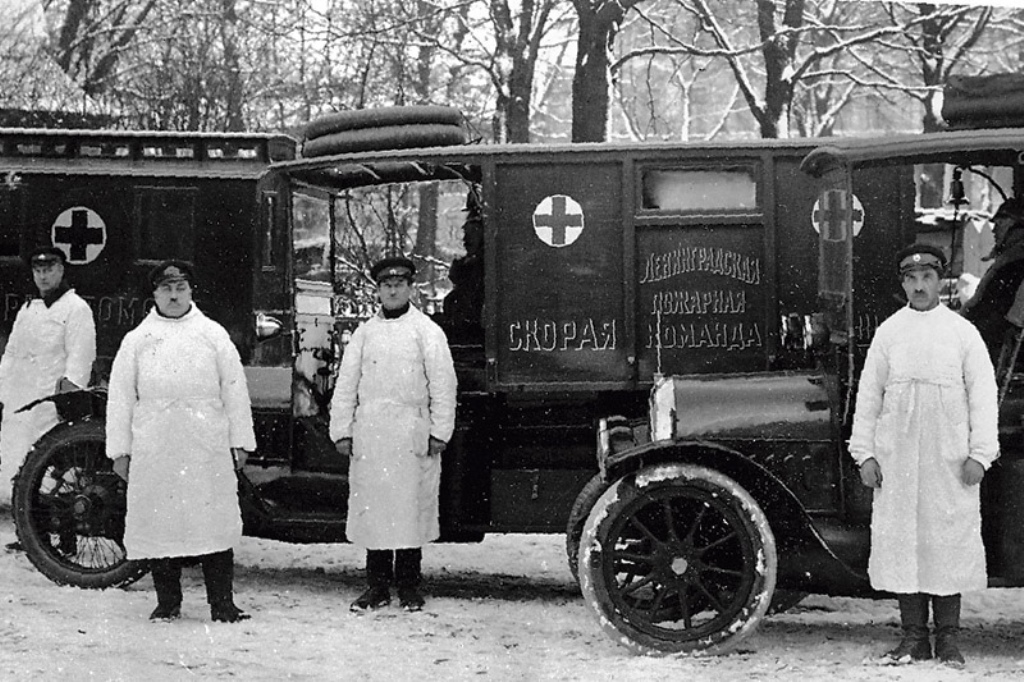
On 19th March 1899, Russia’s first ambulance station was opened in St. Petersburg.

PHOTO: the first ambulance station was opened in St. Petersburg on March 19, 1899

Under Nicholas II, Russian scientific medicine received world recognition, which could not have developed without state support. For the first time, Russian medical scientists were awarded the Nobel Prize: physiologist Ivan Petrovich Pavlov (1904) and microbiologist Ilya Ilyich Mechnikov (1908). Russian medical science carried out pioneering studies of the structure of the brain, and the origins of such fields of medicine as forensic psychiatry, gynecology and hygiene. At the beginning of the 20th century. more than 150 general and specialized scientific medical journals were published in Russia.

Despite the advancements in health care in the Russian Empire, serious health problems remained. For instance, at the beginning of the 20th century Russia experienced a high mortality rate from common widespread infections: plague, smallpox, cholera, typhoid. It was not until the 1940s and the invention of antibiotics did things improve.

Infant mortality under Nicholas II steadily declined. The downward trend in mortality (both children and adults) began before the revolution. According to statistics, the death rate during the reign of Nicholas II per 1000 people had been steadily decreasing.

PHOTO: Medical examination of children in a children’s clinic, St. Petersburg. 1903

Emperor Nicholas II also made efforts to fight against drunkenness. Both the Tsar and Russian society, considered the situation with drunkenness in Russia depressing. Russian historian and journalist Sergei Sergeiivich Oldenburg (1888-1940) wrote that in 1913, “The Tsar, during his trip to the Russian provinces, saw bright manifestations of gifted creativity and labour; but next to this, with deep sorrow, one saw sad pictures of national weakness, family poverty and abandoned households – the inevitable consequences of a drunken life.”

In 1913, the year marking the 300th anniversary of the House of Romanov, Emperor Nicholas II stated that he “came to the firm conviction that the welfare of the treasury should not be made dependent on the ruin of my loyal subjects.”

From 1914, schools of the Ministry of Public Education have been instructed to teach high school students a course in hygiene with the obligatory reporting of information about the dangers of alcohol. In March 1914, the Holy Synod of the Russian Orthodox Church decided to establish a national day of sobriety on 29th August[2], the day of the Beheading of John the Baptist. This holiday was held annually and collected donations for the fight against drunkenness.

By 1913, there were about 1,800 temperance societies in Russia with a total number of members of more than half a million.

As a result of this important decision of Nicholas II, serious changes took place in the country, affecting both the private life of people and their health, and the economy of Russia. The Emperor noted: “Sobriety is the basis of the well-being of the people.”

On 11th August 1908, Emperor Nicholas II initiated the creation of a unified state health care system. In July 1914, a few days before the outbreak of World War I, a bill to create the Ministry of Health was introduced to the Council of Ministers. On 1st September 1916, the Chairman of the Medical Council of the Russian Empire, Honorary Life Surgeon, Academician Georgy Ermolaevich Rein (1854-1942), who held these duties until 27th February 1917. Thus, Georgy Ermolaevich became the first and last Minister of Health of the Russian Empire.

PHOTO: in 1897, the Women’s Medical Institute (the first medical institute of this kind in Russia) opened in St. Petersburg

NOTES:

[1] Father-in-law of Nicholas II’s younger sister Grand Duchess Olga Alexandrovna (1882-1960), who was married to his only son Duke Peter Alexandrovich (1868-1924), from August 1901 to October 1916.

[2] A national Day of Sobriety was revived in 21st century Russia, today an unofficial Russian holiday instituted by the Russian Orthodox Church. The date of 11th September (O.S. 29th August) was chosen because on this day Orthodox Christians celebrate the Beheading of the Holy and Glorious Prophet, Forerunner and Baptist John. On this day, the faithful are expected to observe a strict fast, which includes abstinence from alcohol.

© Paul Gilbert. 7 August 2021

Nicholas II’s passion for ice hockey

PHOTO: Grand Duke George, Grand Duchess Xenia, Grand Duke Mikhail and Grand Duke Nicholas Alexandrovich [future Emperor Nicholas II] playing ice hockey on the skating rink of the Anichkov Palace, St. Petersburg. 1880s.

Emperor Nicholas II, was perhaps the most avid sportsman of all Russian tsars. He took up cycling at an early age, and, and from the 1890s developed a great passion for lawn tennis. In addition, he enjoyed hiking, swimming, shooting, and all kinds of physical activity, from long walks in the park with his dogs, chopping wood and shovelling snow.

In his youth, Nicholas also enjoyed ice skating and hockey. He learned how to skate during his family’s residency at Gatchina, where the garden would be flooded during the winter months, whereby the children of Emperor Alexander III would ice skate.

When the garden of the Anichkov Palace – the residence of Alexander III in St. Petersburg – was expanded, ice mountains and a skating rink were arranged in the garden. The August children: Nicholas, George, Xenia, Mikhail and later Olga, gathered here with invited friends, the Emperor often taking part in their games on the frozen ice.

Nicholas knew how to skate, but he was not a big fan, he preferred ice hockey. He even played hockey without skates, but in boots, with bent sticks [see photos], chasing a rubber ball.

During his first years as Emperor, Nicholas Alexandrovich managed to find time to visit the skating rink at the Anichkov Palace, where his mother Dowager Empress Maria Feodorovna was living at the time. During the winter of 1894–1895, when the 26-year-old Tsar was overwhelmed with his duties as Emperor and Autocrat. In addition, his young wife Empress Alexandra Feodorovna demanded attention. Nevertheless, during the winter of 1895, Nicholas managed to enjoy the skating rink at the Anichkov Palace on three separate occasions: 13th and 20th January and 8th February respectively.

PHOTO: Grand Duke Nicholas Alexandrovich [future Emperor Nicholas II] with members of his family playing ice hockey on the skating rink of the Anichkov Palace, St. Petersburg; his father Emperor Alexander III is seated on the far right. Late 1880s-early 1890s.

Nicholas II was delighted when he discovered that his beloved Alix also knew how to skate, especially since his 23-year-old wife constantly complained of pain in her legs. The tsar wrote: “We skated, Alix is very good on them.” Due to health issues, Alexandra Feodorovna was forced to hang up her ice skates.

In January 1896, Nicholas II and Alexandra Feodrovna settled down in the new apartments prepared for them in the Winter Palace. As a loving son, the Emperor and his wife went daily to tea at the Anichkov Palace to see his mother, where he often took the opportunity to skate for a couple of hours on the rink with old friends.

On 4th January 1896, Nicholas II wrote in his diary: “Went to breakfast in Anichkov. We walked in the garden and played as before on the rink; Xenia and Sandro were skating.” Nicholas II often visited the skating rink that winter. In January 1896 he visited the rink 13 times. Even in bad weather Nicholas skated regardless: “There was a blizzard on the rink, so you could hardly see the balls”; “A strong wind was blowing, preventing the balls from flying”; “The fog was very thick, so it was difficult to play on the rink because the balls were not visible.”

However, life took its toll. The Emperor matured, his family grew rapidly. Political problems grew, and by the early 1900s, his winter skating rinks, which he enjoyed so much moved into the realm of dreams past.

© Paul Gilbert. 2 August 2021
Did Saint Seraphim of Sarov predict the death and martyrdom of Russia’s last tsar?

PHOTO: Emperor Nicholas II, Empress Alexandra Feodorovna and Grand Duchess Elizabeth Feodorovna were present at the canonization of Seraphim of Sarov (1754-1833) on 1 August (O.S. 19 July) 1903

On 1st August, Russian Orthodox Christians celebrate the canonization of Seraphim of Sarov (1754-1833), one of the most revered saints in the Russian Orthodox Church.

During his reign, the pious Emperor Nicholas II sanctioned the canonization of more saints than any previous sovereign. Among those glorified during his reign were: St. Theodosius of Chernigov (glorified in 1896), St. Isidore of Yuriev (1897), St. Euphrosyne of Polotsk (1909), St. Anna of Kashin (1910), St. Joasaph of Belgorod (1911), St. Hermogenes of Moscow (1913), St. Pitirim of Tambov (1914), St. John (Maximovich) of Tobolsk (1916) and St. Paul of Tobolsk (1917).

At the end of January (O.S.) 1903, the Most Holy Synod, having received approval from Emperor Nicholas II, announced Seraphim’s forthcoming glorification. In early July 1903, his relics were transferred from their original burial place to the Church of Saints Zosimus and Sabbatius in Sarov.

A beautiful marble shrine was arranged by Nicholas II and Alexandra Feodorovna – “a luxurious work of art in the Russian style of Moscow,” said Metropolitan Veniamin (Fedchenkov). In addition, the August couple provided a new cypress coffin to receive the relics. The rug which covered the tomb was embroidered by the Empress’s own hands.

The solemn canonization festivities took place in Sarov on 1st August (O.S. 19th July) 1903 and were attended by Emperor Nicholas II, his wife Empress Alexandra Feodorovna, his mother Empress Maria Feodorovna, and numerous grand dukes and grand duchesses of the Imperial Family. More than 100,000 faithful from across the Russian Empire arrived in Sarov to take part in the Cross Procession.

The events at Sarov marked a momentous occasion in the life of Nicholas II. It was during this visit that the Emperor received a letter written by the saint some 70 years earlier. Shortly before his death in 1833, the saint had written this letter, sealed it with five wax seals and addressed it “to the fourth sovereign who will arrive in Sarov, and as yet is not known”.

PHOTO: wall painting depicting Emperor Nicholas II and Empress Alexandra Feodorovna with Blessed Parasceva Fool-for-Christ, in the Church of Our Lady of Kazan of the Diveyevo Monastery

He then gave it to Elena Motovilova, whose husband is now well-known for recording his conversation with the saint about the acquisition of the Holy Spirit. She kept that letter for seventy years and gave it to the Tsar at the glorification ceremony.

Although the Sovereign never revealed the letter’s contents, it is believed that it was a prophecy of the bloodshed that would engulf Russia in less than fifteen years. According to the recollections of eyewitnesses, after reading the letter the Emperor wept bitterly.

Seraphim of Sarov correctly predicted the inevitable death of the Emperor and his family. He said that after him there will be no more tsars in Russia. But he noted that Nicholas II would be elevated higher than all the tsars, apparently anticipating the canonization of the Imperial family.[1] The saint also predicted future trials for Russia: the plundering of monasteries and church property, the tragic death of a large number of people, troubled times and rebirth after.

Furthermore, on the return trip from Sarov, the Imperial Family visited St. Seraphim’s Diveyevo Convent where Blessed Parasceva Fool-for-Christ [2] spoke to them for several hours; it is said that she foretold to them their own martyrdom as well as that of Holy Russia.

Following the Bolshevik Revolution, as part of their persecution of the Russian Orthodox Church, the Bolsheviks confiscated many relics of saints, including St. Seraphim. The fate of the letter remains unknown.

In 1991, St. Seraphim’s relics were rediscovered after being hidden in a Soviet anti-religious museum for seventy years. This caused a sensation in post-Soviet Russia and throughout the Orthodox world. A crucession (religious procession) escorted the relics, to her final resting place, near the altar of the Trinity Cathedral of the Seraphim-Diveevsky Monastery. [3]

PHOTO: Icon of Saint Tsar-Martyr Nicholas II holding an icon of Saint Seraphim of Sarov

NOTES:

[1] On 1st November 1981, Emperor Nicholas II and his family were canonized as new martyrs by the Russian Orthodox Church Abroad (ROCOR), however, it was not until 20th August 2000, that they were canonized as passion bearers by the Moscow Patriarchate of the Russian Orthodox Church.

[2] Praskovya Semyonovna Dybina was born in 1795. The famous nun confessor died on 5th October (O.S. 22nd September) 1915, at the age of 120.

On 31st July 2004, Blessed Paraskeva was numbered among the locally revered saints of the Nizhny Novgorod diocese, and on 6th October of the same year, the Council of Bishops of the Russian Orthodox Church established her church-wide veneration. The holy relics were uncovered on 20th September 2004 and now rest in the Church of Our Lady of Kazan of the Seraphim-Diveevsky Monastery. Her memory is celebrated on 5th October (O.S. 22nd) September.

[3] The Seraphim-Diveevsky Monastery is situated 12 km from Sarov, and 185 km from the city of Nizhny Novgorod.

© Paul Gilbert. 1 August 2021
Nicholas II and the opening of the Romanov Museum in Kostroma, 1913

PHOTO: Nicholas II opens the Romanov Museum in Kostroma, 19th May 1913

The idea of ​​creating the Romanov Museum belonged to the chairman of the Kostroma Provincial Scientific Archive Commission, who proposed opening a special Romanovsky department “for collecting and storing information and data about the ancestors of the ancestor of the reigning house of Tsar Mikhail Fedorovich.” His proposal was supported by Emperor Nicholas II, who approved the official use of the name “Romanovsky department”.

As the number of exhibits multiplied each year, the Romanovsky department ran out of space, and the question of creating a separate museum building arose. In 1907 the governor of Kostroma Alexei Porfirievich Veretennikov (1860-1927), reported to Moscow about the funding for the construction of the museum (donated by the Kostroma City Duma, industrialists, nobles and local residents) and a plot of land for the future museum. The permission to use the name “Romanov Museum” and the promise of co-financing came from Moscow.

In 1908, the project of the building was developed by the architect Nikolai Ivanovich Gorlitsyn (1870-1933), the construction began in 1909. In 1912, Nicholas II issued an order of 35 thousand rubles for the completion of the internal arrangement and interior decoration of the Romanov Museum, as well as the external decoration necessary for the opening of the museum.

In May 1913, Nicholas II and his family arrived in Kostroma as part of the celebrations marking the 300th anniversary of the Romanov dynasty and attended the official opening of the Romanov Museum. The Emperor and his family became the first visitors to the museum and left their names in the memorial book, which has survived to this day.

Currently, the Romanov Museum has several expositions, but one remains unchanged – about the role of Kostroma in the history of the Romanov dynasty.

***

Bust of Nicholas II unveiled in Kostroma

Earlier this week, a new bronze bust of Emperor Nicholas II was presented to the Romanov Museum in Kostroma, where it now stands in the foyer of the museum [photo above]. The Emperor is depicted wearing the uniform of the Guards crew, complete with orders and medals.

The inscription on the wall reads: “The Romanov Museum began construction on 21 June 1909, and opened on 19 May, 1913 in the presence of their Imperial Majesties, the Tsesarevich Alexei and the August daughters of their Imperial Majesties”

The bronze bust was created by the contemporary Moscow sculptor Vasily Moskvitin [photo below]. The sculptor who is passionate about Russian history, has created sculptures and busts dedicated to Russian princes and saints, including Patriarch Tikhon (1865-1925).

The theme of the last emperor is the latest in the work of Moskvitin. For the Romanov Museum in Kostroma, however, the master decided to create a different sculptural portrait.

“Yes, he was also made to wear a crown of thorns, however, I did not want to present Nicholas II in the tragic image he is so often depicted. Instead, he is presented as the living soul of a person, to reveal his true character. Nicholas II was a very intelligent person, cheerful, with radiant eyes, which emitted kindness. I tried to capture all these features in my bust,” said Moskvitin.

© Paul Gilbert. 23 July 2021

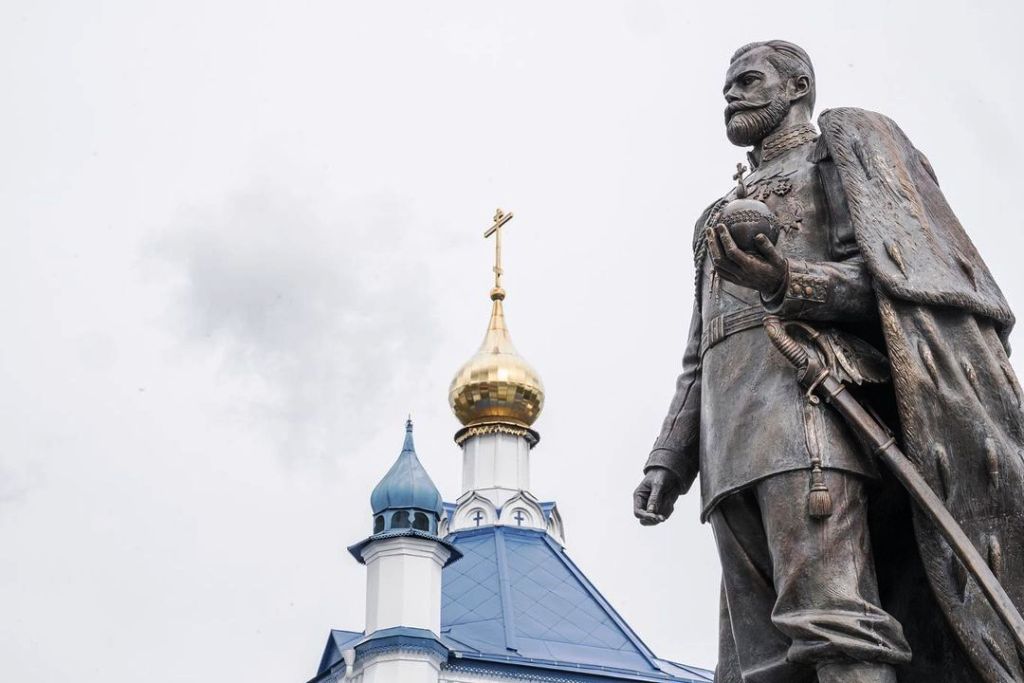
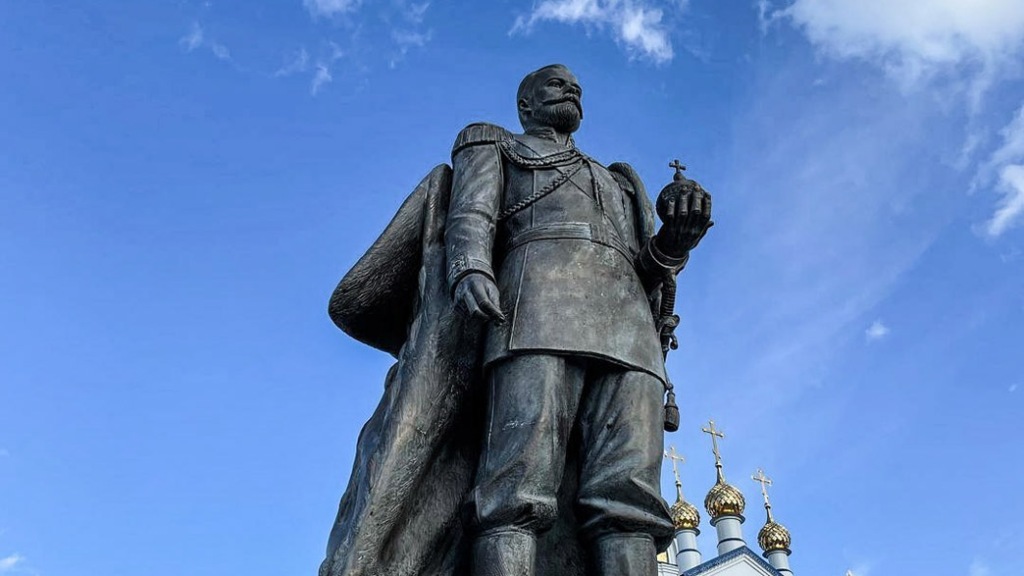
Russia’s 2nd equestrian monument to Nicholas II consecrated in Nizhny Novgorod region

On 9th July 2021, Russia’s second equestrian monument to Emperor Nicholas II was installed on the grounds of the Church of the Holy Martyr Mikhail (Gusev) in Kulebaki of the Nizhny Novgorod region.

On 17th July – the day marking the 103rd anniversary of the death and martyrdom of Nicholas II – the monument to Russia’s last emperor and tsar was officially unveiled and consecrated by Bishop Barnabas of Vyksa and Pavlovsk.

According to the initiators of the project, the installation of the monument was initially planned for 17th July 2020, however, a lack of funds delayed the project by one year. The cost of the monument was 5 million rubles ($80,000 USD), collected from donations within the diocese.

PHOTO: on 17th July 2021, Russia’s second equestrian monument to Emperor Nicholas II was installed on the grounds of the Church of the Holy Martyr Mikhail (Gusev) in Kulebaki of the Nizhny Novgorod region

PHOTO: the monument was consecrated by Bishop Barnabas of Vyksa and Pavlovsk

The initiators of the minument-project were inspired by the famous dictum of the old man Nikolai Guryanov :

“The reason for the spiritual illness in Russia is the conciliar sin of treason against the Tsar, in allowing the slaughter of the Holy Royal Family and in the unrepentance of hearts … We lost the pure, strengthening grace that poured out on the sacred head of the Anointed One, and through him on all of Russia. By rejecting the Tsar, we raised a hand to everything holy and to the Lord. Without true repentance, there is no true glorification of the Tsar. There must be spiritual awareness. ”

“The Russian people are entirely guilty for the death of the tsar,” said the rector of the Church of the Holy Martyr Mikhail (Gusev) Father Nikolai Boldyrev,  who considers the monument a step of repentance “for the sins of the fathers.” He draws parallels between the last tsar and Christ, believing that a curse hangs over Russia, and calls for repentance.

PHOTOS: on 17th July 2021, Russia’s second equestrian monument to Emperor Nicholas II was installed on the grounds of the Church of the Holy Martyr Mikhail (Gusev) in Kulebaki of the Nizhny Novgorod region

“Our goal is to return historical memory, to reveal the true image of Tsar Nicholas, so that the Russian people may know who he was for us. He knew throughout his life that he would have to suffer. Three saints told him about that he would be a martyr and that his family would perish, and that all his nobles, military leaders would betray him” said Father Nikolai – “He died for us, for the Russian people, who betrayed him, to the Russian Golgotha. He forgave everyone who slandered him,” he added.

PHOTOS: on 17th July 2021, Russia’s second equestrian monument to Emperor Nicholas II was installed on the grounds of the Church of the Holy Martyr Mikhail (Gusev) in Kulebaki of the Nizhny Novgorod region

The sculptor of the monument is Irina Makarova, who also created monuments to the Holy Royal Martyrs at the St. Seraphim-Diveyevo Convent in July 2017; the meeting of Nicholas II and Alexandra Feodorovna in Alushta, Crimea; and a monument to the Holy Royal Martyrs in Tyumen.

PHOTO: Father Nikolai Boldyrev standing in front of Russia’s second equestrian monument to Emperor Nicholas II on the grounds of the Church of the Holy Martyr Mikhail (Gusev) in Kulebaki of the Nizhny Novgorod region

Below, is a short VIDEO of the official opening and consecration of Russia’s second equestrian monument to Emperor Nicholas II, on the grounds of the Church of the Holy Martyr Mikhail (Gusev) in Kulebaki of the Nizhny Novgorod region. CLICK on the IMAGE below to watch the VIDEO – duration 1 minute, 9 seconds

***

Russian news and social media continually claim that the equestrian monument of Nicholas II in Kulebaki is Russia’s first equestrian monument to Nicholas II, however, this is incorrect, Russia’s first equestrian monument to the Tsar was erected in Moscow in December 2014.

PHOTO: Equestrian of Nicholas II dominates the Monument to the Heroes of World War One in Moscow

On 16 December 2014, Russia’s Defense Minister Sergei Shoigu opened a sculptural composition dedicated to the heroes of World Wars I and II on the grounds of the Ministry of Defense on the Frunze Embankment in Moscow. The WWI monument features Nicholas II on horseback, recognizing and honouring his efforts during the Great War.

© Paul Gilbert. 17 July 2021

***

Dear Reader: If you enjoy my articles, news stories and translations, then please help support my research by making a donation in US dollars to my project The Truth About Nicholas II – please note that donations can be made by PayPal or credit card. Thank you for your consideration – PG

70 facts about Emperor Nicholas II and his reign

His Imperial Majesty Sovereign Emperor Nicholas II

More than a century after his violent murder, Russia’s last Tsar continues to remain a victim of myths and lies which germinated during the Soviet years and exist to this day.

His detractors continue to base their often negative assessment of Nicholas II’s life and reign by the tragedies which cast a dark cloud over his reign, in particular, the Khodynka Tragedy (1896) and Bloody Sunday (1905), among others.

Sadly, much of the negative assessment of Nicholas II is further fuelled by a steady stream of poorly researched books and documentaries by academically lazy historians, particularly those in the United States and Great Britain. In 2018, one popular British author scoffed at the idea of Nicholas II being a reforming tsar. It is a shame that today we know so little about Nicholas II’s reformist activities.

It is very unfortunate that there are people today who refuse to remove their blinders and educate themselves further on Nicholas II’s life and reign by consulting the many new archival documents released since 1991. Instead, they continue to cling to the old myths, lies and Bolshevik propaganda.

Historian and author Pyotr Multatuli, Russia’s country’s leading authority on Nicholas II, hit the nail on the head when he wrote the following about the Sovereign’s modern-day detractors:

“We combine indifference to our own history with our maximalism and categorical judgments. Thus we lose the ability to hear others. Everybody is content with his own biases without thinking that in the case of Nicholas II, his opinion is borrowed and that he was too lazy to form his own opinion. Thirty years have passed since the collapse of the USSR, and truthful books on the Imperial Family were published since as early as perestroika. But most people don’t read them and retain the outdated stereotypical views.”

NOTE: the text highlighted in red are links to full-length articles on the subject – PG

***

Following the death of his father Emperor Alexander III (1845-1894),Nicholas Alexandrovich Romanov (1868-1918) ascended the throne as Russia’s last monarch on 2nd November (O.S. 20th October) 1894. Emperor Nicholas II ruled Russia for more than twenty-two years: from 2nd November [O.S 20 October] 1894 to 15 March [O.S. 2 March] 1917. During his reign, Russia made great advances on both the world stage and within the Russian Empire. The following list explores 70 facts, noting just some of the many reforms and accomplishments he made during his reign.

  1. Nicholas II spoke three languages fluently: Russian, French and English, and could speak German and Danish. Like his father, he preferred to speak Russian. He spoke Russian to his children and wrote in Russian and French to his mother Maria Feodorovna. He spoke and wrote in English to his wife Alexandra Feodorovna.
  2. Nicholas II was the most widely travelled of the Romanov emperors. In 1890-91, he embarked on a journey around the greater part of the Eurasian continent. The total length of the journey exceeded 51,000 kilometers, including 15,000 km of railway and 22,000 km of sea routes. The Eastern journey of Tsesearvich Nicholas Alexandrovich took him to Greece, Egypt, India, Ceylon, Siam, China, and Japan. He then travelled across the expanse of the Russian Empire to St. Petersburg. During the autumn of 1896, Nicholas II accompanied by his wife made a tour of Europe, which included visits to Denmark, Germany, Austria, France and Great Britain. During his reign, Nicholas made additional visits to Denmark, Britain, France, Italy, Austria, and Sweden.
  3. Deeply religious, he combined his studies with an in-depth knowledge of spiritual literature. He became the last Orthodox Tsar of Russia [VIDEO].
  4. He received the best of military and legal education. He served in the army with the rank of colonel. When high-standing members of the military tried to convince him to take the rank of general, Nicholas allegedly answered, “Gentlemen, you need not worry about my rank. You’d better be thinking about rising through the ranks yourselves.”
  5. Nicholas II was the most athletic of all Russian tsars. He used to do morning exercises from an early age, taking daily walks, he loved kayaking and could hike tens of kilometers at a time. He loved to watch and participate in horse races. He was an excellent swimmer and a dedicated lover of billiards. He also enjoyed tennis. During winter, he was a passionate skater and ice hockey player.
  6. Nicholas II enjoyed the company of his canine companions, particularly during his long walks. At Tsarskoye Selo, he maintained a kennel of nearly a dozen English collies – his favourite breed.
  7. The future Emperor grew up in the Spartan atmosphere of his father Alexander III’s palace at Gatchina. As a boy, he had to sleep in a hard iron bed, and eat basic food. Throughout his reign, Nicholas II continued to wear the same suits and military uniforms after they had been patched and mended numerous times.
  8. Nicholas II and his family donated hundreds of thousands of rubles at a time to a large number of causes, helping renovate Russia’s medical equipment, building new hospitals, primary and vocational schools, maternity wards and orphanages.
  9. Nicholas II was a voracious reader. He maintained magnificent libraries in the Winter Palace in St. Petersburg and the Alexander Palace in Tsarskoye Selo. He read equally well in Russian, English and French and he could manage in German and Danish. Each month, new books were supplied by his private librarian, who provided the Tsar with twenty of the best books from all countries.
  10. Nicholas II granted a pardon to nearly all clemency applications that were submitted to him. During his reign, there were 120 times fewer death sentences pronounced and executed than the number of people sentenced to death during Stalin’s rule in the USSR.
  11. The total number of convicts during Nicholas II’s reign was considerably lower than later in the USSR or today’s Russian Federation. In 1908, there were 56 convicted criminals per 100,000 population. In 1949, this number rose to 1537 per 100,000; in 2011 it counted 555 per 100,000.
  12. In 1903, the number of government functionaries was 163 per 100,000 population. In 2010, less than a hundred years after his death, this figure reached 1153.
  13. During their detention in Tobolsk, the Imperial family was never idle. The Emperor cut wood, cleared the snow and worked in the garden. Seeing all that, one of the peasant guards allegedly said, “Had we given him a plot of land, he’d have earned the whole of his Russia back by working!”
  14. When the members of the Provisional Government were considering the possibility of accusing the Emperor of treason, one of them suggested making his private correspondence with the Empress public. To which he was told, “We can’t do that! If we do, the Russian nation will worship them as saints.”
  15. The Emperor wasn’t guilty of the Khodynka stampede tragedy. When he learned about it, he immediately provided financial help and moral support for the victims.
  16. During the events of Bloody Sunday in 1905, revolutionary provocateurs were the first to begin shooting at the troops. The total number of dead was 130 and not 5000 as Lenin later claimed. Those who were wounded by the troops’ return fire were immediately administered first aid and taken to hospitals. The Emperor wasn’t even in St Petersburg that day. When he found out what had happened, he immediately provided considerable financial help and moral support for the victims. He paid in total 50,000 rubles of his own money to the injured. The revolution of 1905-1907 was largely prevented due to the Emperor’s commitment and determination.
  17. He secured Europe’s largest empire that knew few rivals in its military and economic power and prosperity either before or after his reign.
  18. The Russian Orthodox Church was the second largest in the world. By 1913, it numbered 53,900 churches and 1,000 monasteries in the Russian Empire alone that were situated in every corner of the vast country. The Russian Orthodox Church enjoyed considerable influence in the Holy Land and offered guidance to all Orthodox Christians in Europe, Asia and even Africa.
  19. The construction and renovation of churches was either financed by the state or supported directly by funds provided by Nicholas from the crown. The Emperor himself took part in the laying of the first cornerstones and the consecration of many churches. He visited churches and monasteries in all parts of the country and venerated their saints. Nicholas ensured that state subsidies to the Church increased annually from 30 million rubles in 1908 to 53 million rubles in 1914.
  20. Emperor Nicholas II ‘s concern for the Russian Orthodox Church extended far beyond the borders of his Empire. Thanks to the sovereign’s generous donations, 17 new Russian churches were built in European cities. In addition, Orthodox churches in Greece, Bulgaria, Serbia, Romania, Montenegro, Turkey, Egypt, Syria, Libya, Palestine, Argentina and the United States, all benefited from donations made by the Emperor.
  21. During the more than twenty-two years of Nicholas II’s reign, the Russian population had grown by 62 million.
  22. In 1897, Nicholas II approved the Russian Imperial Census, the first and the only census carried out in the Russian Empire. Nicholas took part in the census, in the field ‘occupation’ Nicholas wrote: ‘Owner of the Russian land’. The data processing took 8 years using Hollerith card machines. Publication of the results started in 1898 and ended in 1905.
  23. By the beginning of the 20th century, the judicial reforms of Nicholas II were firmly established throughout the Empire.
  24. In 1909, the Emperor went on a sixteen-mile forced march in order to test the new foot soldiers equipment. The combined weight of his gear exceeded seventy pounds. The only people he let in on his plans were the Minister of the Court and the Palace Commandant.
  25. He shortened compulsory military service to three years in the Army and five years in the Navy.
  26. During the course of the First World War, the Emperor took frequent trips to the front line, often accompanied by his son and heir Alexei, to demonstrate that his love for his people and his homeland made him defy death. His wife and daughters toiled in military hospitals tending to the wounded and assisting at surgeries. Later, when the Russian army suffered its hardest times, he assumed supreme command of the troops. During that period, not a single grain of the Russian soil was surrendered to the enemy. Nicholas’ troops didn’t let Wilhelm II past Galicia (the Western part of Ukraine and Belarus). Military historians now believe that had the revolution not interfered, Russia was bound to have won the war. Russian prisoners of war were considered its victims. They kept their ranks, decorations and wages. The duration of their captivity was counted towards their length of service. Of the 2,417,000 Russian PoWs only 5% died.
  27. The percentage of conscripts was the lowest in Russia of all the countries involved in military action: 39% of all men aged between 15 and 49 as compared to 81% in Germany, 74% in Austria-Hungary, 79% in France, 50% in Great Britain and 72% in Italy. Per thousand population, Russia lost 11 men compared to 31 in Germany, 18 in Austria, 34 in France and 16 in Great Britain. Russia was the only country that didn’t have problems with food supplies. The German wartime ersatz bread was unthinkable in Russia.
  28. The Peasants’ Land Bank offered large loans to farmers. By 1914, Russian peasants and farmers owned or rented 100% of all agricultural land in Siberia and the Asian part of Russia and 90% in its European zones. In Siberia, special state-owned depots provided the local population with agricultural equipment.
  29. The total per capita taxes in the Russia of 1913 was half of that in France and Germany and a quarter of that in Great Britain. The Russian population kept getting richer. The wages of Russian workers were on a par with those in Europe, second only to those of their American counterparts.
  30. Starting June 1903, all industrialists were obliged to pay a monthly allowance and pension to all workers injured in industrial accidents and their families. The amount of such allowance was set at 50 to 66% of the injured person’s needs. The country’s first trade unions were formed in 1906. A law of June 23 1912 introduced obligatory health and accident insurance for workers.
  31. The Russian law On Obligatory Social Insurance was one of the first of its kind in the world, preceding those of the United States and some leading European countries.
  32. Russia had one of the most progressive labor legislations of the time. According to some sources, American President William Taft commended the Russians on it saying, “No democratic state boasts such a perfect labor legislation as the one conceived by your Emperor.”
  33. On 15th (O.S. 2nd) June 1897, Emperor Nicholas II issued a decree prohibiting work in factories and other enterprises on Sundays and holidays.
  34. Prices for home-grown produce were the lowest in the world.
  35. During Nicholas II’s reign, the country’s budget grew almost threefold.
  36. The reign of Nicholas II was characterized by a deficit-free state budget, i.e. government revenues exceeded government spending. In the pre-war decade, the excess of state revenues over expenditures was 2.4 billion rubles. Public finances flourished. As a result of the deficit-free budget, redemption payments for peasants were cancelled, railway tariffs were lowered, and some taxes were eliminated.
  37. The adoption of the gold standard during the monetary reform of 1897 resulted in a much stronger ruble. According to the country’s finance minister Sergei Witte, “Russia has solely Emperor Nicholas II to thank for the introduction of gold currency.”
  38. Between 1894 and 1914, the amount of household deposits in savings banks increased sevenfold. The amount of deposits and equity deposited in small credit institutions increased 17 times. Deposits into joint-stock commercial banks between 1895-1915 increased 13 times.
  39. The grounds of the obligatory primary education were laid in 1908, aiming to achieve 100% literacy by 1925-1926. By 1916, the percentage of literate Russians more than doubled, from 21.1% in 1897 to 56%. By the beginning of the first World War, Russia had over a hundred higher education facilities that numbered over 150,000 students, placing Russia in a shared third place in the world (with Great Britain). The financing of education grew from 25 million to 161 million rubles. That’s not counting council schools whose financing had grown from 70 million in 1894 to 300 million in 1913. In total, the education budget grew 628%. The number of secondary school students grew from 224,000 to 700,000. The numbers of university students doubled while the number of all children attending school grew from 3 to 6 million. By 1913, Russia had 80,000 primary schools. A new law drafted just before the revolution introduced free schooling for everyone, including full board. Seminaries were free for the children of clergy, including full board.
  40. The early 1900s saw the introduction of free medicine. All Russian nationals had the right to free medical help; they received thorough checkups followed by detailed consultations. “The Russian system of municipal medicine has been the biggest achievement of our time in the field of social medicine as it offers free medical help available to anyone and also has a considerable awareness-raising value,” wrote the Swiss professor Friedrich Erissmann. Russia was second in Europe and third in the world for the number of qualified doctors.
  41. Kindergartens, maternity wards, orphanages and overnight shelters for the homeless mushroomed all over Russia.
  42. Patriotic sentiment was one of the strongest engines of the country’s politics during Nicholas II’s reign who saw his purpose in defending Russian interests at all levels. A great number of patriotic organisations, parties and movements functioned in Russia, covering the country in a vast net of institutions where a Russian person could turn to in an hour of need or to seek protection from injustice.
  43. Industry grew rapidly, raising the gross domestic product four times in the period from 1890 to 1913. Coal mining grew 500% and iron smelting, 400% within 20 years. Copper and manganese mining grew 500% within the same period. Investment capital in engineering factories rose 80% between 1911 and 1914. The total length of railroads and telegraph lines doubled within 20 years. The Russian river fleet doubled as well. Industry was rapidly becoming mechanised. In 1901, Russia produced 12,120,000 tons of crude oil as compared to 9,920,000 tons in the United States. In the period from 1908 to 1913, the growth in labor efficiency outpaced that of the United States, Germany and Great Britain — the top-ranking industrial giants. Nicholas II’s activity resulted in remarkable economic stability. As the world plunged into the depths of the economic crisis in 1911-1912, Russia preserved its momentum.
  44. Crude oil manufacturers paid a special tax on their activities which was then used to advance domestic production.
  45. In 1914, Russia sent a group of 2000 military engineers and other War Department workers to the United States in order to advance its heavy armaments industry.
  46. Russia hit the list of top countries in national income growth, increase in labor efficiency and concentration of production. It became one of the biggest exporters of textiles, a major steel and non-ferrous industry manufacturer and one of the biggest machine manufacturers and coal-mining countries.
  47. Russia became the world’s largest exporter of grain, cereals and dairy products. Its grain crops were 1/3 larger than the combined crops of the United States, Canada and Argentina.
  48. Grain production doubled, its combined yield growing 12%.
  49. Cattle stocks grew 60%. Russia had more horses than any other country and was also one of the biggest breeders of cattle, sheep, goats and pigs.
  50. The following territories became either part of Russia or its protectorates: North Manchuria, Tianjin, Northern Iran, Urianhai, Ukrainian Galicia, the Ukrainian provinces of Lviv, Peremysl, Ternopol and Chernovitsk, as well as Western Armenia. Russian pioneers reclaimed vast territories of Siberia, Kazakhstan and the Far East.
  51. Nicholas II strove to remain unbiased and impartial to various lobbies’ interests. Many economic reforms as well as the anti-alcohol campaign were conceived and controlled personally by the Emperor, sometimes against the Duma’s judgment.
  52. The amount of freedom of speech and of press was larger than in any other period in Russia before or after his reign.
  53. Russia’s gold reserves became the largest in the world, making the ruble the hardest currency.
  54. Russia boasted one of the fastest-growing railway systems in the world. The length of miles of track increased from 31,623 in 1905 to 50,403 in 1917.
  55. Nicholas II personally supervised and controlled the building and completion of the Trans-Siberian Railway.
  56. Russia possessed one of the numerically strongest and quickest developing armies. It employed the Mosin’s rifle renowned for its efficiency, the 1910 Russia-improved version of the Maxim heavy machine gun and the 76-mm light field guns which were considered some of the best in the world.
  57. By the time of its creation in 1910, the Russian Air Force possessed some 263 aircraft which made it one of the biggest in the world. By autumn 1917, the number of aircraft had increased to 700.
  58. By 1917, the Imperial Russian Navy was second only to the British and German fleets. Its new-generation destroyers and battleships were among the best in the world; its mine laying operation tactics were considered the best of their kind.
  59. Nicholas II was the originator of the first Hague Peace Conference and its Permanent Court of Arbitration. In 1901, the Emperor was nominated for a Nobel Peace Prize, in recognition of his efforts to limit armaments and promote peace among the great powers.
  60. Russia’s per capita alcohol consumption was one of the lowest in Europe, second only to Norway (3.4 litres of pure alcohol a year per capita in Russia as compared to 16.5 in France and 11.2 in Germany), culminating in Nicholas’ introduction of the prohibition law in 1914.
  61. The numbers of mentally ill persons were estimated at 187 per 100,000 population. A hundred years later in 2010 this figure topped 5,598 per 100,000.
  62. The numbers of suicides were estimated at 4,4 per 100,000 population in 1912, as compared to 29 in 2009.
  63. Both inflation and unemployment were non-existent although the dwindling amount of agricultural land forced many farmers to seek employment in cities.
  64. The crime rate was comparable with that of the United States and European countries. The 1913 International Criminological Congress in Switzerland recognised the Moscow detective police as “the best in the world”.
  65. The unprecedented boom of Russian culture resulted in a breathtaking rise in art, music, theatre, literature and architecture. The French poet and literary critic Paul Valéry called it “one of the three greatest summits in humanity’s history”, liking it to Greek Antiquity and Italian Renaissance.
  66. Nicholas II’s reign became the golden age of Russian science and philosophy.
  67. Russians became the first in the world to invent, among other things: Wireless radio transmission (by Alexander Popov who built his radio transmitter in 1894 and demonstrated it on May 7 1895, as opposed to Guglielmo Marconi, accordingly 1895 and 1896); Helicopter (by Igor Sikorsky in 1912); and the Television (by Boris Rosing who performed the first television transmission on May 9 1911)
  68. Russia became one of the leading manufacturers of motorcars and motorcycles, zeppelins and double-deckers. In 1902, Russian engineer Boris Lutskoi improved Maybach’s six-cylinder engine which he then supplied to Daimler, including the racing Mercedes 120PS in 1906.
  69. Russia’s motorcar industry at the time rivalled that of Germany; its aircraft production was comparable to America. Russian steam engines were among the best in the world. The Russo-Balt cars were known for their strength and reliability, successfully competing in such prestigious contests as the Monte Carlo and San Sebastian rallies.
  70. The famous Chanel No 5 scent was created by the Russia-born chemist Ernest Beau, the Romanov family’s unfailing perfumer who had emigrated to France after the Russian revolution of 1917. Beau was introduced to Coco Chanel by Grand Duke Dmitri Pavlovich (1891-1942).

All of the above was achieved without any kind of pressure on the Russian population, without reverting to violence, robbing farmers of their livelihood, without reverting to the practice of prison camps or destroying the Russian people by the millions.

RECOMMENDED READING:

To learn more about the life and reign of Russia’s last Tsar, please refer to the following title, originally published in 1913, and personally authorized by Nicholas II himself. Nicholas II reviewed and corrected the proofs himself in January 1913. He made changes to the text.

In dition to Elchaninov’s biography on the Tsar, this new 2023 edition features an expanded introduction by independent researcher Paul Gilbert, 25 black and white photographs, and three comprehensive appendices: a chronology of events during the reign of Nicholas II (1894-1917); 100 facts about Nicholas II and the many reforms he made during his reign, and a bibliography of more than 100 English language books written over the past century on Russia’s last Tsar. Click HERE to read more about this title, and to order your copy from AMAZON.***

© Paul Gilbert. 13 July 2021