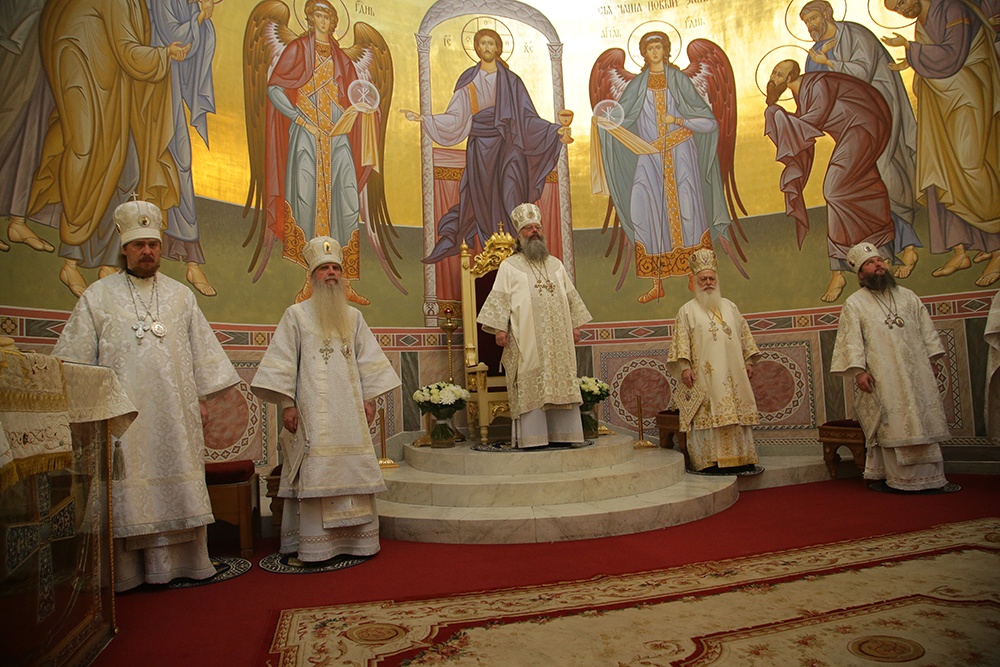
Bishop’s gather for a Divine Liturgy in the Church on the Blood in Ekaterinburg
NOTE: All of the articles pertaining to Nicholas II and his family which were originally published in my Royal Russia News blog, have been moved to this Nicholas II blog. This article was originally posted on 19 May 2018 in my Royal Russia News blog – PG
On 19th May 2018, on the day marking the 150th anniversary of the birth of Emperor Nicholas Alexandrovich, a festive Bishop’s Divine Liturgy was held in the Church on the Blood in Ekaterinburg.
The Divine Liturgy was headed by the Metropolitan of Pereleimon (Greek Orthodox Church), Metropolitan of Pereleimon (Greek Orthodox Church), and also by the bishops of the Ekaterinburg Metropolis: Metropolitan Kirill of Yekaterinburg and Verkhoturye, Bishop Mefody of Bishop of Kamen and Alapayev, Bishop of Nizhny Tagil and Nevyansky Eugene, Bishop of Serov and Krasnoturinsky Alexis. The Most Reverend Bishops were served by numerous clergy of the Ekaterinburg Diocese.
Metropolitan Petyeleimon of Berea arrived in the Ekaterinburg Diocese from Greece, specially to celebrate the 150th anniversary of the birth of the Emperor. Prayers and hymns in Greek were heard during the service.
Hymns for worship were performed by the choir of the Sretensky Monastery, who travelled from Moscow to the Ural capital to pay tribute to the memory of the Holy Tsar-Martyr.
Participants of a public forum dedicated to Nicholas II, held in the Cosmos Theater also took part in the Divine Liturgy, including the famous historian and author Petr Valentinovich Multatuli, representative of the Russian Academy of Sciences historian Vladimir Mikhailovich Lavrov, among others.
A sacramental verse, a sermon about the holy Tsar-Passion-Bearer was read by senior priest of the Church on the Blood, Protopriest Maxim Miniyailo. Fr Maxim noted that the birthday of the sovereign, which was always a public holiday in the Russian Empire. He spoke about the personality of the sovereign himself, reminding the Faithful that Nicholas II was “our Heavenly patron and an example to each of us in faith, in service to the Lord and Fatherland , in relation to his family and neighbor, on the anniversary of the Sovereign as an occasion to think about salvation.”
The number of parishioners in attendance at the Divine Liturgy filled the Church on the Blood to capacity, with the number of faithful spilling out onto the church’s porch, and into the street.
Vladyka Metropolitan congratulated everyone on the occasion of the 150th anniversary of the birth of the Emperor, thanking those who travelled to Ekaterinburg to pay tribute to the memory of the Holy Tsar Martyr, including guests from Greece, Serbia and Bulgaria; thanked the bishop of Vera Panteleimon; thanked the Sretensky Choir for the wonderful concert that took place the day before, and for today’s participation in the Diving Liturgy.
VIDEO of the entire Forum (in Russian only) – duration 2 hours, 20 minutes
NOTE: All of the articles pertaining to Nicholas II and his family which were originally published in my Royal Russia News blog, have been moved to this Nicholas II blog. This article was originally posted on 20 May 2018 in my Royal Russia News blog – PG
On 18th May 2018, on the eve of the 150th anniversary of the birth of the last Russian emperor, a public forum was held in Ekaterinburg to preserve the heritage of Tsar Nicholas II.
Scientists, historians and authors, along with representatives of the public, gathered to discuss the urgent issues of preserving the historical memory of the sovereign, including recognizing the merit of Nicholas II for the development of the Russian state and an assessment of the murder of the Tsar’s family committed a hundred years ago.
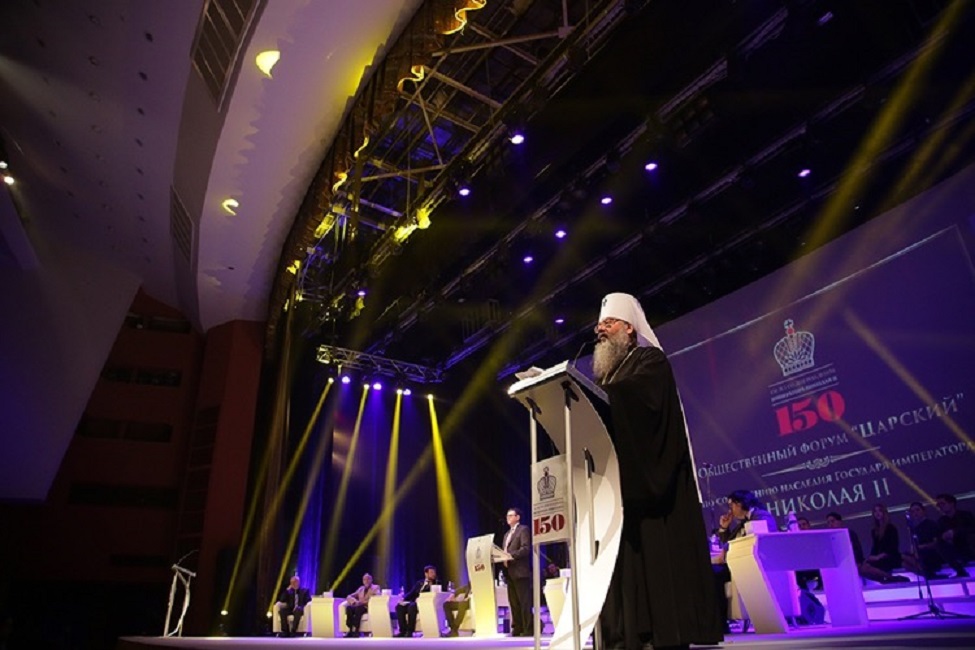
Metropolitan Kirill of Ekaterinburg and Verkhoturye
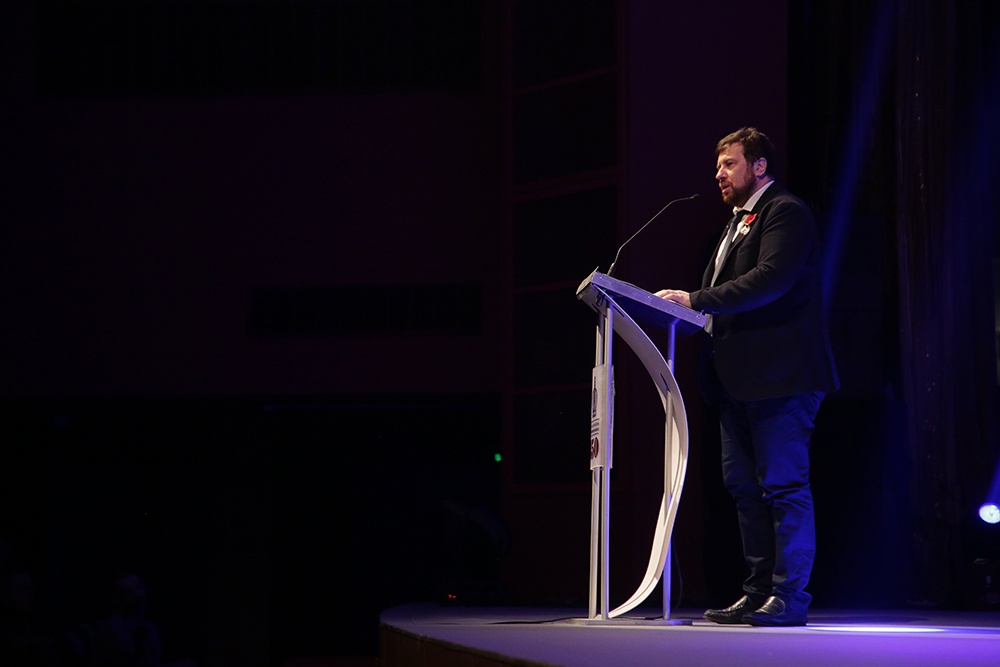
Opening the forum was Metropolitan Kirill of Ekaterinburg and Verkhoturye, who noted that Ekaterinburg “has become a symbol of the tragedy of the Tsar’s family and, together with her, our Motherland.”
“Since these tragic events, which took place 100 years ago, tragedy befell Russia and it’s people. It is here, on the 150th anniversary of the birth of Emperor Nicholas Alexandrovich, that our holy cause is to gather and reflect on what the Russian Empire was during his reign, what was good about our great country, and what should we take from the past, what lessons, what edifications should we learn for our own lives” – said His Eminence.
The special guest of the forum – the Chairman of the Double-Headed Eagle Society the media group Tsargrad Konstantin Valerievich Malofeev, noted “the triumph of the reign of Emperor Nicholas II, is unparalleled in the thousand-year history of Russia.
“During the history of the Russian Empire, it was the most powerful, the largest, the happiest during the reign of Nicholas II. We should not forget this, and our forum is dedicated to this, which we, the society of historical enlightenment Double-Headed Eagle Society, proudly hold together with the Ekaterinburg Metropolis where our local branch is working under the guidance of Metropolitan Kirill.”
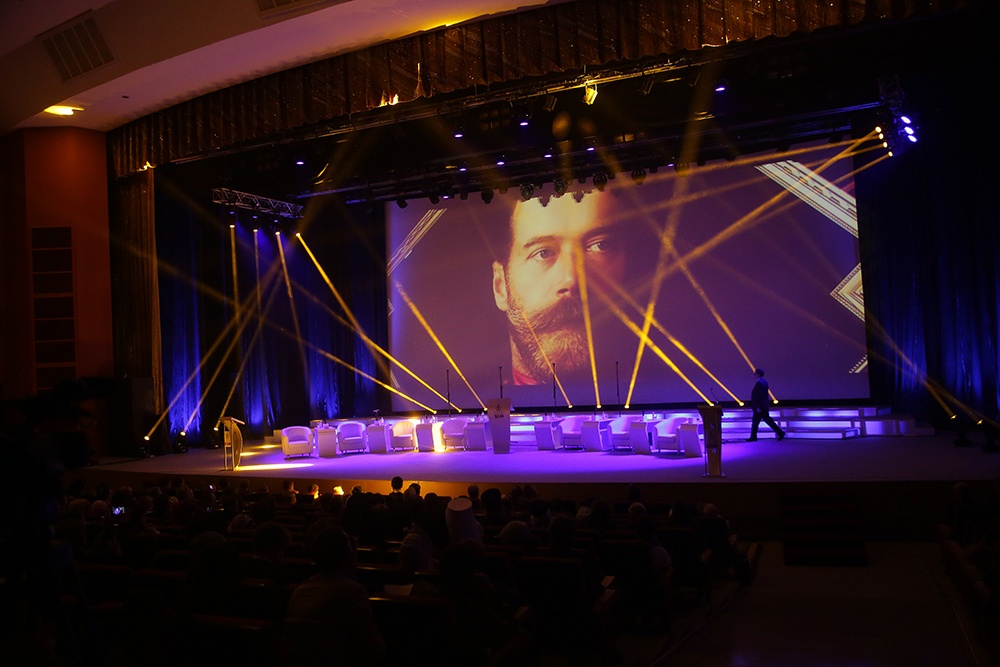
The stage is set for the Nicholas II Forum, held at the Cosmos Theater, Ekaterinburg
The forum was also attended by Bishop Evgeny of Nizhny Tagil and Nevyansky, Bishop of Serov and Krasnoturinsky Alexy, Minister of Education of the Sverdlovsk Region Yury Biktuganov, First Deputy Minister of Culture of the Sverdlovsk Region Vladimir Manturov, as well as representatives of the Double-Headed Eagle Society, the World Russian People’s Council, the Imperial Palestinian Orthodox Society, arriving from various regions of Russia.
Historians, philosophers, theologians, public figures from Russia (among them also experts from Moscow and St. Petersburg), Serbia and Bulgaria discussed issues related to the restoration and preservation of the historical memory of Nicholas II.
Within the framework of the forum, experts assessed the era of the reign of the last Russian emperor as a time, providing great breakthroughs in the development of the state and creating the foundations of socio-economic, including technological development for decades to come. Experts came to the conclusion that Nicholas II was one of the most effective Russian rulers and issued a number of initiatives to perpetuate the memory of Emperor Nikolai Aleksandrovich as an outstanding statesman.
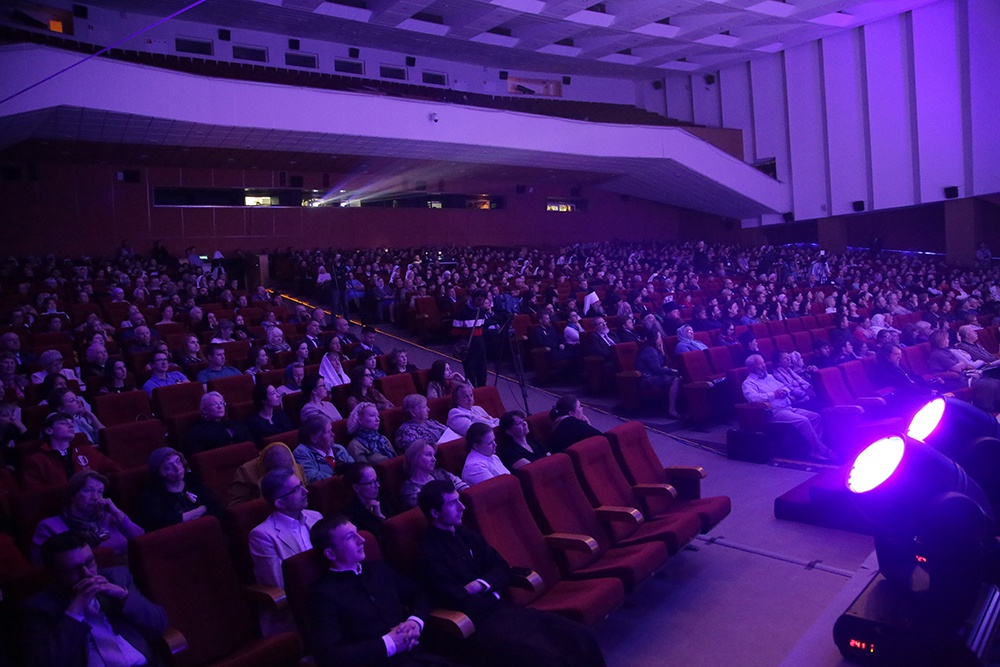
More than 2,000 people attended the Nicholas II Forum on 18th May
Among the proposals included in the final document of the forum is the need for a large-scale federal information and enlightenment campaign on Russia’s achievements in the era of Nicholas II, the development of textbooks and other scientific and educational literature on the basis of reliable scientific information on era, the state order for quality works of art in various fields of culture and art; importance of historical archival research and public dialogue among the scientific community and citizens interested in history; installation in the cities and towns of Russia monuments to the sovereign – an initiative put forward by a member of the Regional Public Chamber, chairman of the Ural branch of the Union of Russian Paratroopers Yevgeny Teterin.
An important topic of the forum was the discussion of the need for public evaluation of the murder of the Imperial Family and their faithful servants, which occurred a century ago in the Ipatiev House in Ekaterinburg. The tragedy of 1918, crowned with the feat of the Holy Royal Passion-Bearers, has not yet been properly evaluated at the state level.
The experts of the forum supported the initiative of Moscow colleagues – participants of a recent round-table hosted by the Parliamentary Newspaper (Парламентская газета) where representatives of the Russian Orthodox Church, State Duma deputies, jurists and political scientists condemned the murder of the Tsar’s family as an unacceptable and unjustifiable crime.
Russia’s leading expert on Nicholas II, historian and author Pyotr Valentinovich Multatuli
During the forum on May 18, in Ekaterinburg, experts presented their views on the sovereign and the era at the forum by:
– Pyotr Valentinovich Multatuli, Russia’s leading expert on the life and reign of Nicholas II, candidate of historical sciences, member of the Council of the Society for the Development of Russian Historical Education of the Double-Headed Eagle Society, and regular commentator of the television channel “Tsargrad”;
– Vladimir Mikhailovich Lavrov, Doctor of Historical Sciences, Member of the Council of the Russian Historical Education Development Society of the Double-Headed Eagle Society, Academician of the Russian Academy of Natural Sciences, Chief Researcher of the Institute of Russian History of the Russian Academy of Sciences;
– Konstantin Valerievich Malofeev, chairman of the Society for the Development of Russian Historical Education of the Double-Headed Eagle Society.
– Yegor Stanislavovich Kholmogorov, publicist, blogger, editor-in-chief of the Russian Observer and New Chronicles sites, author and presenter of the 100 books website;
– Nikola Tanasich, teacher of the Faculty of Philosophy, Belgrade State University;
– Georgi Dimov, Doctor of Science, Senior Researcher of the Bulgarian Academy of Sciences;
– Dmitry Borisovich Grishin, chairman of the Sergievsky Memorial Society (Moscow).
Other participants of the forum were Vladislav Nikolayevich Mayorov, military journalist, expert on the history of Nicholas II and author of the “Royal Calendar”; Vladimir Ilyich Bolshakov, Doctor of Philosophy, Vice-Rector for Research of the Russian Academy of Painting, Sculpture and Architecture Ilya Glazunov (Moscow), as well as members of the Urals Association in Moscow and other experts.
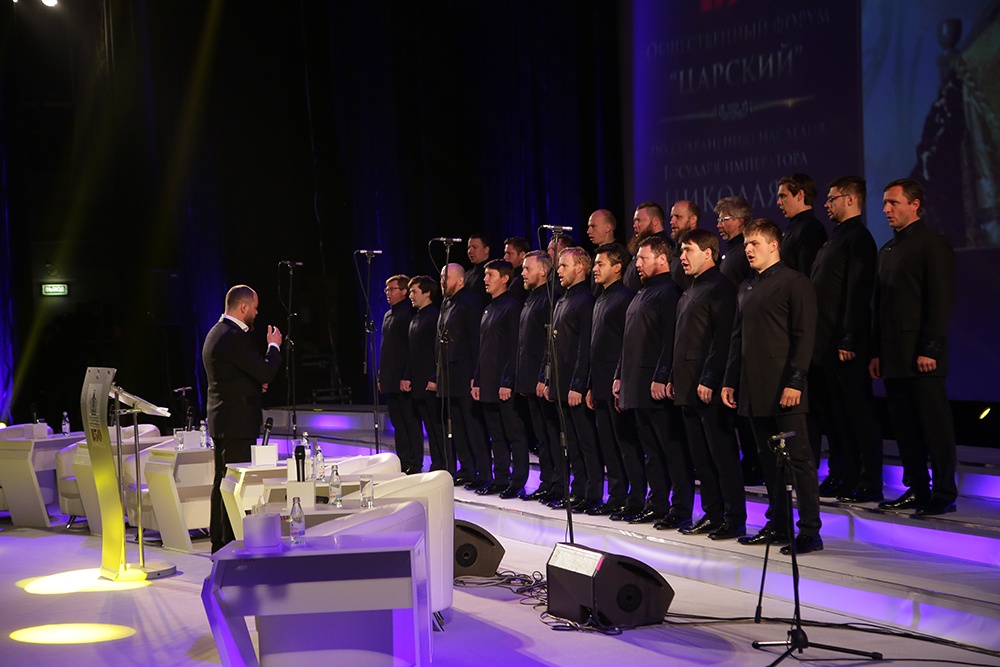
The Sretensky Monastery Choir
The Forum came to close with the singing of God, Save the Tsar and Glory! and A Life for the Tsar, performed by the Sretensky Monastery Choir – please take a moment to watch/listen at the end of the video posted at the top of this post – PG.
The Forum on the preservation of the historical heritage of the Emperor Nicholas II was held in the Kosmos Theater in Ekaterinburg. More than 2,000 people participated in the historic Forum. The event, which became a significant public event, was covered by the leading federal and regional media and was broadcast by the Orthodox television channel Soyuz to 82 countries with a multi-million audience.
NOTE: All of the articles pertaining to Nicholas II and his family which were originally published in my Royal Russia News blog, have been moved to this Nicholas II blog. This article was originally posted on 21 May 2018 in my Royal Russia News blog – PG
On 19th May 2018, members of the All-Russian public movement “National Idea of Russia” and the Kuban Cossacks laid flowers at the monument to Emperor Nicholas II in the village of Taininskoye (Mytishchi), which is situated about 19 km northeast of Moscow.
Like the fate of the Sovereign, the monument has a tragic history, being blown up twice by extremists. However, the monuments’ scupltor Vyacheslav Mikhailovich Klykov (1938-2006) restored it each time.
The monument to Emperor Nicholas II was installed in the suburban village of Taininskoye, on the site of the royal road in May 1996.
The opening of the monument was timed to coincide with the 100th anniversary of the coronation of the last Russian Tsar (held in Moscow on 26 May (O.S. 14 May) 1896. This is one of several monuments to Nicholas II in Moscow and region. The inscription on the monument read: “To the Emperor Nicholas II from the Russian people with repentance”.
Sadly, it did not stand for long: on 1st April 1997, the monument was blown up by the left-wing extremists of the group “Revolutionary Military Council”. Their reason, was their opposition to the removal of Lenin’s corpse from the mausoleum in Red Square.
In November 1998, the monument was restored, however, in the winter of the same year it was again blown up.
Then the sculptor of the monument Vyacheslav Klykov created for the third time a new copper monument, which was unveiled in August 2000. The crowned emperor stands proudly, dressed in an ermine mantle, holding a scepter in one hand, mantel in the other. The sculpture represents him at his highest triumph – his ascension to the Russian throne.
After the second explosion, Klykov donated money from his own pocket to help finance the restoration of his monument to Nicholas II.
He noted at the unveiling: “If in days gone by, the Russian people could not protect their tsar, now, believe me, we can do it.”
The ceremony was timed to coincide with the day of the canonization of the Imperial family by the Moscow Patriarchate on 15 August 2000.
Since the fall of 2004, believers from all over the Russian Land have been drawn to the village of Taininskoye. And the appeal of the Russian people “To the Russian Emperor Nicholas II Russian people with repentance”, seemingly destroyed along with the first monument, turned out to be prophetic! The explosion, which was to erase the very idea of repentance before the Emperor Nicholas II, could not change the Providence of God.
So on 19th May 2018, many Orthodox Christians and monarchists came to the monument to pray, lay flowers, unfurl Tsarist-era flags, all in preparation for the procession. The Kuban Cossacks brought with them the Cossack penitential icon of the holy martyr Tsar Nicholas.
Thanks to the talented Russian sculptor Vyacheslav Mikhailovich Klykov, we have the opportunity to honor the memory of the Emperor. Forgive us, Sovereign!
Paul Gilbert visiting the monument to Emperor Nicholas II in the village of Taininskoye (Mytishchi) in March 2015
PHOTO: Memorial to the Holy Royal Martyrs in the Monastery of Dajbabe in Montenegro
The Serbian Orthodox Church in Montenegro and devotees of Romanov dynasty have marked the anniversary of the murder of Nicholas II and Russia’s imperial family.
The Serbian Orthodox Church in Montenegro has commemorated the centenary of the killing of the Russian imperial family at Ekaterinburg with numerous events held under the slogan “The Romanov Family – 100 years of Holiness”.
Ending on Wednesday, the church held four days of masses for the Romanov family across the country, organized roundtables, exhibitions and book promotions while hosting the Russian Church and state officials.
In the monastery of Dajbabe, near the capital, Podgorica, the Serbian Church also erected a memorial (see photo above) to the Russian imperial family who were murdered by the Bolsheviks one year after the revolution that ended 300 years of Romanov rule.
Russia’s last tsar and his family were shot on the night of 16/17 July 1918. Besides Nicholas II, they killed the Empress Alexandra and all their children, Alexei, Olga, Tatyana, Maria and Anastasia.
The Russian Church canonized the imperial family in 2000 and their remnants are now held in the Peter and Paul Cathedral in St. Petersburg. The Serbian Church also considers the martyred Romanovs as “saints“.
The Serbian Orthodox Church said on Wednesday that people in Montenegro should never forget their gratitude to the Tsars.
“Without the help of Russia, there would have been no liberation of our people from Ottoman slavery… We are aware of this, and with the great gratitude we remember the great love of the Russian people and the Russian tsar for Montenegro,” Joanikije, the Bishop of Budimlike-Niksic, said.
The masses and other events were attended by delegates of the Patriarch of Alexandria, Theodore, Moscow Patriarch Kiril, representatives of the Orthodox Palestinian Society, Russian scholars, academics and former state officials from Moscow.
The Serbian Orthodox Church’s senior bishop in Montenegro, Amfilohije, said that the murder of the imperial family had been a great crime.
“They killed the emperor and the empress, and even though the emperor had given up power to save his people, they killed their children … You can imagine what a crime that was,” Amfilohije said.
The Russian and Serbian Orthodox Church in Montenegro cherish close relations dating back to the 19th century, during the rule of the Montenegrin prince-bishop, Njegos.
NOTE: All of the articles pertaining to Nicholas II and his family which were originally published in my Royal Russia News blog, have been moved to this Nicholas II blog. This article was originally posted on 5 June 2018 in my Royal Russia News blog – PG
The following exhibition ran from 24th May to 30th December 2018
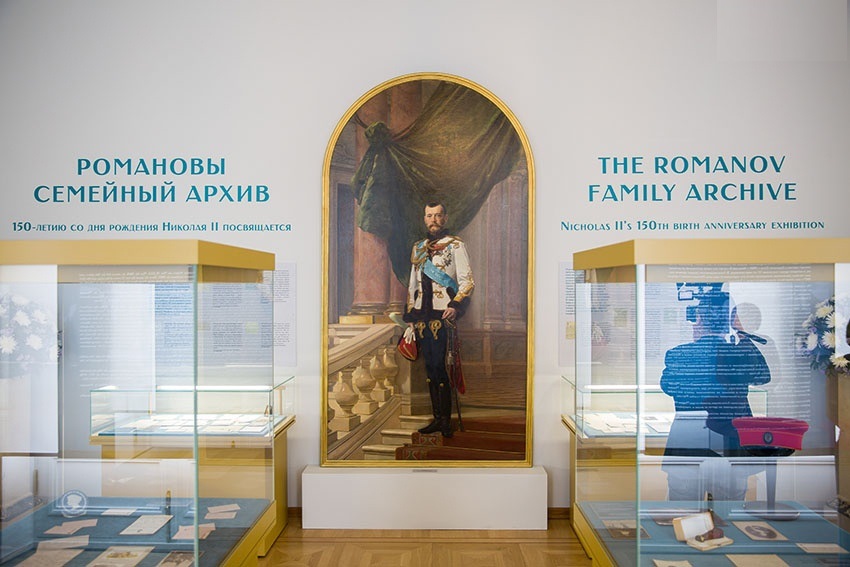
On 24th May 2018, the exhibition The Romanovs. Family Archive, opened in the Catherine Palace at Tsarskoye Selo. The exhibit presents the largest collection of documents and photographs associated with the Imperial family, acquired in the hundred-year history of the museum. The collection of personal documents and photos of the families of Emperors Alexander III and Nicholas II, was acquired at an auction in London in 2017 thanks to the financial support of Sberbank of Russia.
The exhibit is dedicated to the 150th anniversary of the birth of Nicholas II, whose life was closely connected with Tsarskoye Selo: on 18 May (O.S. 6 May) 1868, Nicholas Alexandrovich was born in the Alexander Palace. From his birth, Russia’s last tsar held Tsarskoye Selo close to his heart, and from 1905, made the Alexander Palace his permanent residence, in which he spent the last 12 years of his reign. It was in the Alexander Palace, in which the Emperor was held under house arrest during the first months of his abdication on 15 March (O.S. 2 March) 1917. It was from here on 14 August (O.S. 1 August) 1917, that he and his family were sent into exile to Tobolsk in Siberia.
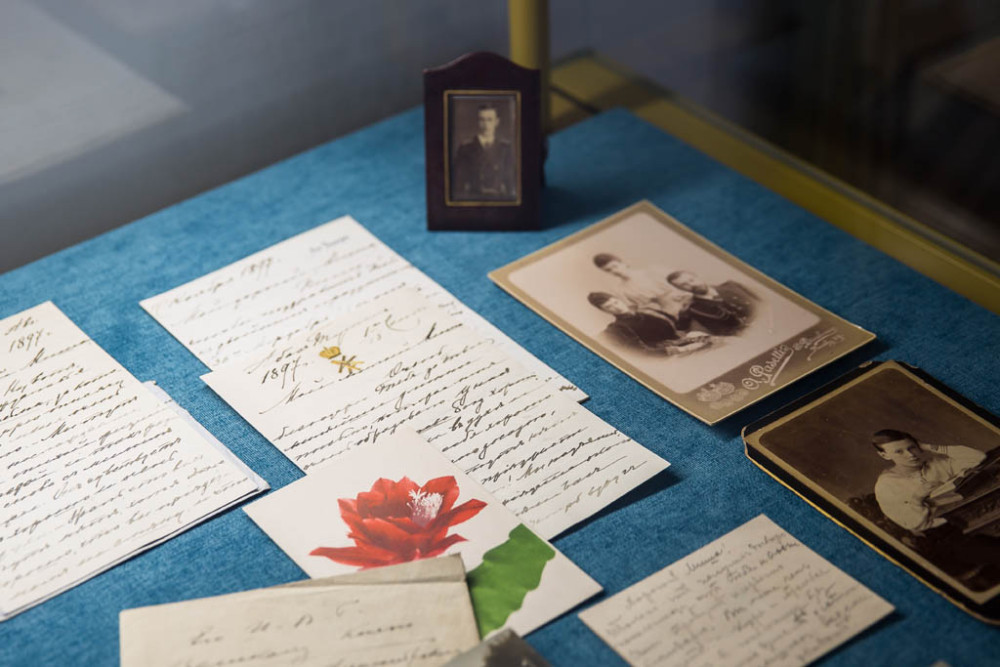
The archive which spans from 1866 to the 1920s, includes 200 items from the museum collection. Among them – telegrams with warm messages to their children from Emperor Alexander III and his wife Maria Feodorovna. These laconic, but warm parental messages testify to how the August couple cherished family values. In separation, the loving father always found the time to write letters to his children, sharing with them his successes in hunting, fishing, his health, and about how he misses them when they are apart.
The exhibition also presents the letters of Grand Duchess Xenia Alexandrovna to her younger brother Mikhail, with whom she was in correspondence from a young age. Hardly having learned to write, the little brother and sister shared impressions of new discoveries, and humourous anecdotes from their still carefree life. Later, after marrying the Grand Duke Alexander Mikhailovich, Xenia never forgot her “dear Mishkin.” The young couple often wrote to the Grand Duke from their estates “Ai-Todor” in Crimea, and “Abas-Tuman” in the Caucasus. In letters from the French city of Biarritz, Alexander Mikhailovich also shared his interest and passion of motor-driving, his hobbies, hunting, fishing, archaeological excavations, playing tennis, golf and maps.
Of particular importance for the museum was the acquisition of several autographs of Emperor Nicholas II and his wife Alexandra Feodorovna. A letter written by the empress at Easter to her sister-in-law Xenia, included one of her handmade watercolour drawings with a congratulatory signature.
The tragic events of 1917-1918 are described in the letters of Grand Duke Nikolai Mikhailovich to Prince Georgi Shervashidze – the Ober-Hofmeister, who served the Dowager Empress Maria Feodorovna. The grand duke’s letters, which reflect his diary entries record his vision and understanding of the fate which awaits Russia in the future.
From revolutionary Petrograd, Nikolai Mikhailovich writes to his friend in the Crimea: “It’s hard to tell what’s going on here, not only here, but all over Russia. If the Bolshevik regime comes to an end, then little good can be expected from their successors – socialist-revolutionaries or anarchists. . . ”
With the growing nationalization of property, which took place in Russia, the Grand Duke noted in February 1918: “Yesterday I was forced to leave my palace, to leave my rooms and personal things to the mercy of fate and move to another house, an apartment of one of the employees … I now live in one room on the 4th floor … My palace is now the headquarters of the new Red Army … “. As if in anticipation of his tragic fate, the Grand Duke finishes the letter with a hopeless line: “I do not know if we are destined to meet again on this earth, but in the next world my feelings for you will remain invariably friendly. All your NM. ”
The meeting was not destined to take place. Georgi Dmitrievich Shervashidze died in the Crimea on 26 March 1918, and Grand Duke Nikolai Mikhailovich was shot the following year on 9 January 1919 in the Peter and Paul Fortress in St Petersburg.
The collection also includes several letters from the widowed British Queen Alexandra, the sister of Empress Maria Feodorovna, to Grand Duchess Xenia Alexandrovna during her life in exile.
The exhibition The Romanovs. Family Archive runs until 30 December 2018 in the Catherine Palace at Tsarskoye Selo.
NOTE: All of the articles pertaining to Nicholas II and his family which were originally published in my Royal Russia News blog, have been moved to this Nicholas II blog. This article was originally posted on 5 June 2018 in my Royal Russia News blog – PG
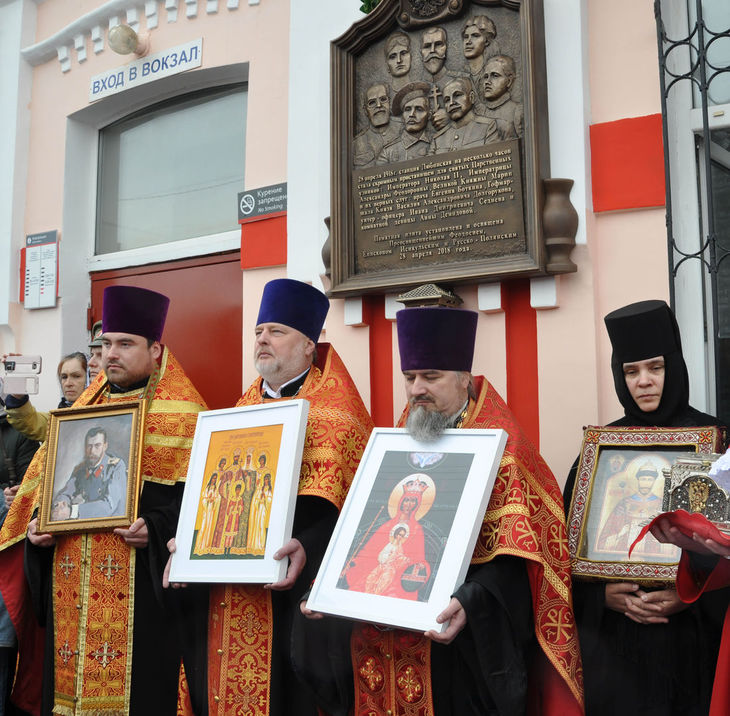
On 28th April, a bronze plaque was unveiled at the Lubinskaya railway station (situated on the Omsk-Ishim-Tyumen Line in Siberia), marking the brief stay of Emperor Nicholas II and members of his family and entourage on the same date a century before.
In the spring of 1918, the Bolsheviks had ordered that the Imperial Family be taken from Tobolsk. Due to the illness of the children, the move was made in two stages. The first included Emperor Nicholas II, along with members of his family and entourage, who made their way from Tobolsk to Tyumen, where they boarded a train originally headed towards Ekaterinburg. Accompanying them was the Commissar of the Central Executive Committee Vasily Yakovlev. It was during the journey, however, that Yakovlev unexpectedly changed the route and quickly ordered the train in the opposite direction to Omsk. Why he changed the route is still a mystery, one which historians continue to debate to this day.
The Tsar’s train almost reached Omsk, stopping at Lubinskaya station. Laying ahead was Kulomzinskaya station, from which it was impossible to turn to the railway line leading to Chelyabinsk, bypassing Ekaterinburg. Kulomzinskaya was blocked by a special revolutionary detachment. The train could not go any further, so Yakovlev went to negotiate with the Omsk Revolutionary Committee.
Meanwhile, Nicholas II and members of his family and entourage spent the next several hours in the train at Lubinskaya Station. At Omsk, Yakovlev received an order from Yakov Sverdlov in Moscow ordering him to proceed to Ekaterinburg. The last hope of salvation had disappeared.
On the bronze memorial is written: “On April 28, 1918, Lubinskaya Station for a few hours became a modest haven for the Holy Royal prisoners: Emperor Nicholas II, Empress Alexandra Feodorovna, Grand Duchess Maria and their faithful servants: the physician Evgeny Botkin, Hofmarshal Prince Vasili Alexandrovich Dolgorukov , non-commissioned officer Ivan Dmitrievich Sednev and maid Anna Demidova.”
The solemn ceremony was part of the city’s Imperial Days in Omsk. The memorial plaque was consecrated by His Eminence Theodosius, Bishop of Isilkul and Russko-Polyansky.
NOTE: All of the articles pertaining to Nicholas II and his family which were originally published in my Royal Russia News blog, have been moved to this Nicholas II blog. This article was originally posted on 6 June 2018 in my Royal Russia News blog – PG
The following exhibition ran from 5th June to 23rd September 2018
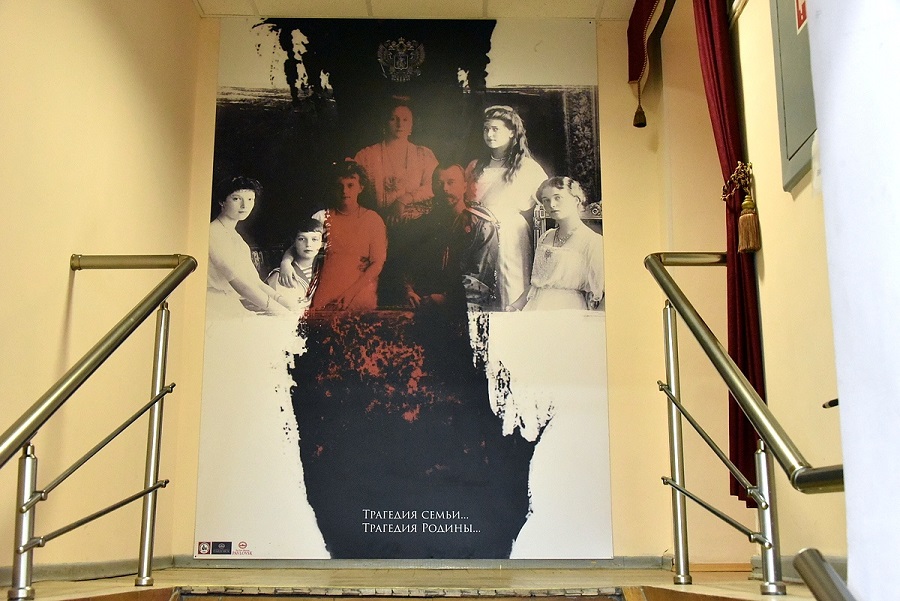
The exhibition project The Tragedy of the Family … The Tragedy of the Motherland, dedicated to the Romanov family, opened on 5th June 2018 in the Ural city of Ekaterinburg.
The venue for the exhibition is the Poklevsky-Kozell House – a branch of the Sverdlovsk Regional Museum. The exhibit is a joint historical and art project with the Pavlovsk State Museum-Reserve, and the Elisavetinsky-Sergievskoe Enlightenment Society.
Visitors to the exhibition can acquaint themselves with the private life of members of the Imperial family in the palaces of St. Petersburg, Tsarskoye Selo, Peterhof and Pavlovsk. The exhibition presents more than 150 unique items, including examples of fine and applied art, watercolours and amateur photographs, lovely trinkets from private collections and priceless gifts to the emperor, the Empress and their children.
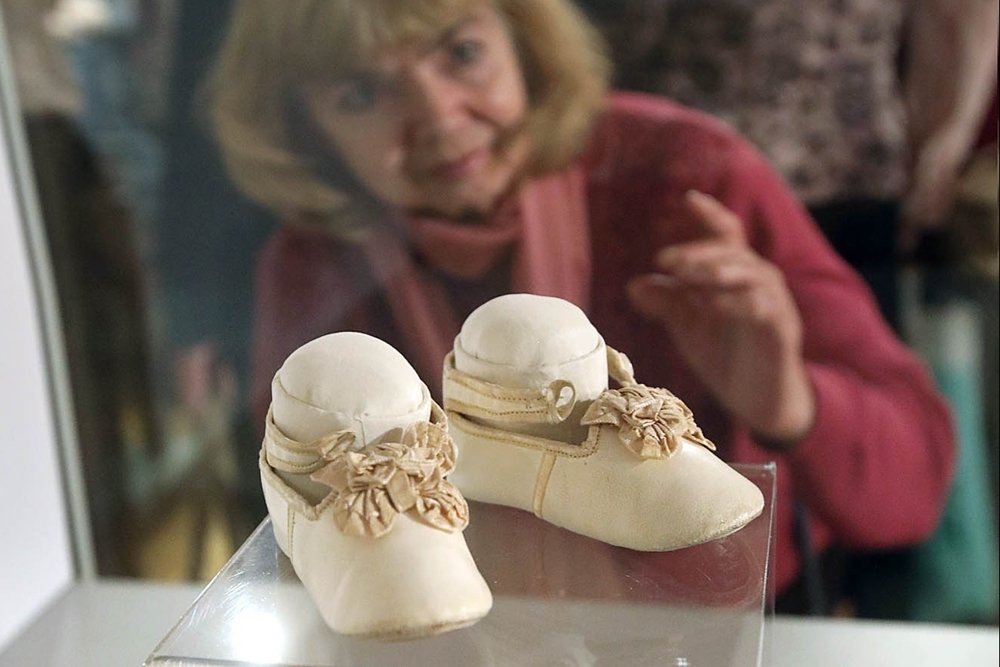
For the first time in the Urals, numerous well-executed original photographs taken by court photographers are exhibited: a portrait of a young Tsesarevich Alexei, ordered by the Empress herself. The photograph in an elegant frame, accompanied Alexandra Feodorovna from Tsarskoye Selo first to Tobolsk, then to Ekaterinburg, and now stored in the collection of the Pavlovsk State Museum-Reserve. Also among the exhibits are the beautifully preserved children’s shoes of Grand Duchess Olga Nikolaevna and a house dress of the last empress, in which only the closest people saw her; two silver cigarette case of Nicholas II, one of which he had with him during his internment in the Ipatiev House. Also on display – for the first time – is a unique, rare banner with the Romanov emblem, made for the 200 year anniversary celebrations of 1913.
The exhibition The Tragedy of the Family … The Tragedy of the Motherland ran from 5th June to 23rd September 2018, in the Poklevsky-Kozell House in Ekaterinburg.
Recent poll shows Nicholas II as the most popular figure in the 20th century Russian history
NOTE: All of the articles pertaining to Nicholas II and his family which were originally published in my Royal Russia News blog, have been moved to this Nicholas II blog. This article was originally posted on 26 June 2018 in my Royal Russia News blog – PG
Public attitudes towards Nicholas II have undergone several shifts since the collapse of the Soviet Union in the early 1990s, with the most recent studies carried out during the last few years showing an increase in appreciation of the monarch. This is partially due to the the efforts of the Russian Orthodox Church, and research by post Soviet Russian historians. Both have worked diligently by challenging the negative assessments of the life and reign of Russia’s last emperor and tsar, disproving the lies and myths which continue to be popular to this day, particularly by Western historians and biographers.
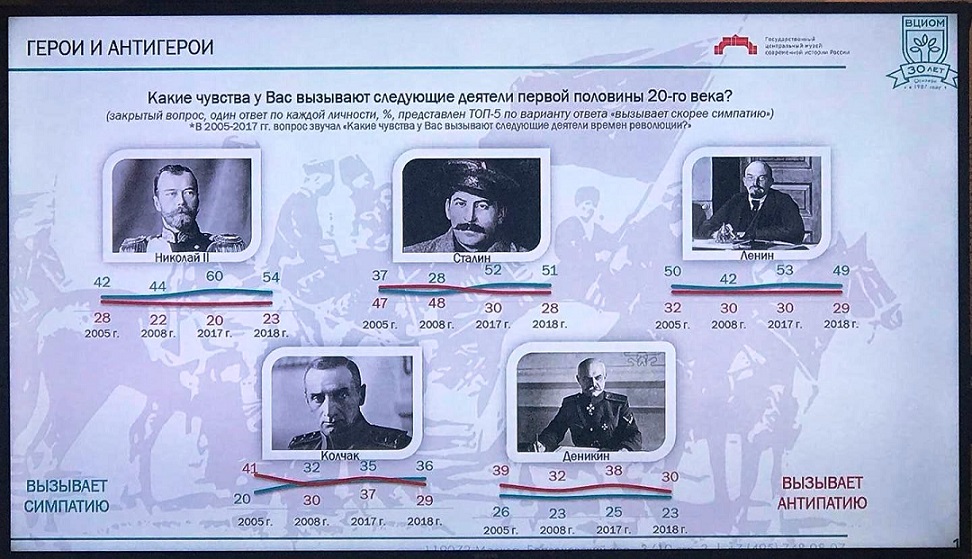
According to the most recent poll, Emperor Nicholas II, Soviet dictator Joseph Stalin, and Bolshevik leader Vladimir Lenin are the most popular figures among Russians from the 20th century.
Research conducted by the Russian state-run public opinion center VTSIOM showed that the last Russian emperor is now the most popular of all historical figures throughout the volatile 20th century – 54 percent of respondents said that they sympathize with the monarch. Joseph Stalin was second with 51 percent and the head of the Bolshevik party and the mastermind behind the 1917 revolution, Vladimir Lenin, was on the third place with 49 percent. Leader of the White Movement during the Russian Civil War, Alexander Kolchak was in fourth place with 36 percent, while general of the White Movement during the Russian Civil War Anton Denikin came in fifth place with 30 percent.
The share of respondents who told researchers that the feeling they had towards these people was strongly negative was 23 for Nicholas II, 28 for Stalin and 29 for Lenin. Most of the other prominent figures of the period, both among the revolutionaries and on the Tsarist sides, cause neither good nor bad emotions in the Russian public, research revealed.
Results of the poll show Nicholas II more popular among Russian than both Stalin and Lenin
The least liked figures were the leader of the Ukrainian anarchists Nestor Makhno, and the founder of the Red Army Leon Trotsky. 58 and 46 percent of Russians described their attitude to them as negative and only 12 and 20 percent confessed to sympathizing with them.
In the same poll researchers asked the Russian public what sources they used to get information about the October Revolution and the Civil War. 79 percent of respondents named schools and universities, 48 percent said they got information from books and 30 percent mentioned films and television series.
A different poll conducted by VTSIOM in late 2017, in connection with the 100th anniversary of the Russian Revolution, revealed that 92 percent of Russians wanted similar events prevented at any cost, up from 78 percent five years ago. Only 5 percent of respondents told researchers that they considered a new revolution necessary (13 percent in 2012). 3 percent of respondents said that they had no opinion on the issue.
Still, 46 percent of the public agreed with the statement that the 1917 revolution was in the interests of the majority of Russians. 13 percent hold that the revolution benefited a minority and 33 percent said that only a small group of people managed to gain anything from the events of 1917.
38 percent of Russians currently think that the 1917 Revolution was a major stimulus for the social and economic development of the country. 23 percent agreed that the revolution “had opened a new era in Russia’s history.” At the same time, 14 percent of the poll participants said that the revolution had seriously impeded the development of Russia and 13 percent called the events a total disaster. 12 percent remained undecided over the role that the revolution had played in the Russian history.
NOTE: All of the articles pertaining to Nicholas II and his family which were originally published in my Royal Russia News blog, have been moved to this Nicholas II blog. This article was originally posted on 6 July 2018 in my Royal Russia News blog – PG
The State Historical Museum in Moscow have announced that the portrait of Emperor Nicholas II by Léon Bakst, has been returned from their restoration workshop.
After the 1917 Revolution, the portrait was hidden in the museum funds. In September, the portrait will be presented for the first time at an exhibition dedicated to Nicholas II and his family, the first time it has been displayed in more than a century.
Léon (Lev) Nikolaevich Bakst – born as Leyb-Khaim Izrailevich (later Samoylovich) Rosenberg, (1866-1924) was a Russian painter and scene and costume designer. He was a member of the Sergei Diaghilev circle and the Ballets Russes, for which he designed exotic, richly coloured sets and costumes.
During his years in St Petersburg, he taught painting to the children of Grand Duke Vladimir Alexandrovich. In 1902, Nicholas II commissioned Bakst to paint The Meeting of Russian Sailors. In 1914, Bakst was elected a member of the Imperial Academy of Arts.
NOTE: All of the articles pertaining to Nicholas II and his family which were originally published in my Royal Russia News blog, have been moved to this Nicholas II blog. This article was originally posted on 26 July 2018 in my Royal Russia News blog – PG
Most Russians believe the murder of the last Russian tsar, Nicholas II, and his family members in 1918 had no justification, describing it as a monstrous crime rather than an act of retribution, a poll conducted by the Russian Public Opinion Research Center ahead of the centenary of the murders of the Imperial family showed earlier this month.
“Most Russians (57%) believe that the murders of the Imperial family is a heinous unjustified crime (this number is bigger among people aged 35+ than among the younger generation aged between 18 and 34). Another 29% said the last Russian emperor paid too high a price for his mistakes. Nevertheless, young people believe that he had to be punished for them, with 46% among those aged between 18 and 24 more often expressing this point of view. Just 3% of those polled were certain that the Imperial family’s execution was the public’s just retribution for the emperor’s blunders,” the pollster said.
That said, Russians generally see Nicholas II in a positive light (43%). This viewpoint was expressed most often by people aged 45 (45-46%).
On the other hand, 22% tend to think of him negatively. Young people aged between 18 and 24 often said they disliked the last Russian emperor. However, 7% of the respondents stressed they were indifferent to Nicholas II, while 4% said they felt empathy for him.
“By now, the Soviet narrative, which claimed the murders of the Tsar’s family by their Bolshevik captors near Ekaterinburg during [Russia’s] Civil War was a necessary and fair act of revenge for the blunders and crimes committed by the Romanov family, has finally exhausted its credibility. Regardless of their political views and relations towards the tragic events that occurred a century ago, Russians consider that a crime, which has no justification whatsoever. Amid this sentiment, the last tsar, whatever his accomplishments or failures, is seen by today’s public as a nice person who deserves compassion, at the very least,” the pollster’s Director General Valery Fyodorov noted.
The survey was conducted by the Russian Public Opinion Research Center on July 11, 2018, with 1,600 people aged 18 and above interviewed over the phone. The margin of error does not exceed 2.5% with a probability of 95%.














 Nicholas II
You must be logged in to post a comment.