Romania Hosts Nicholas II Exhibition

044a

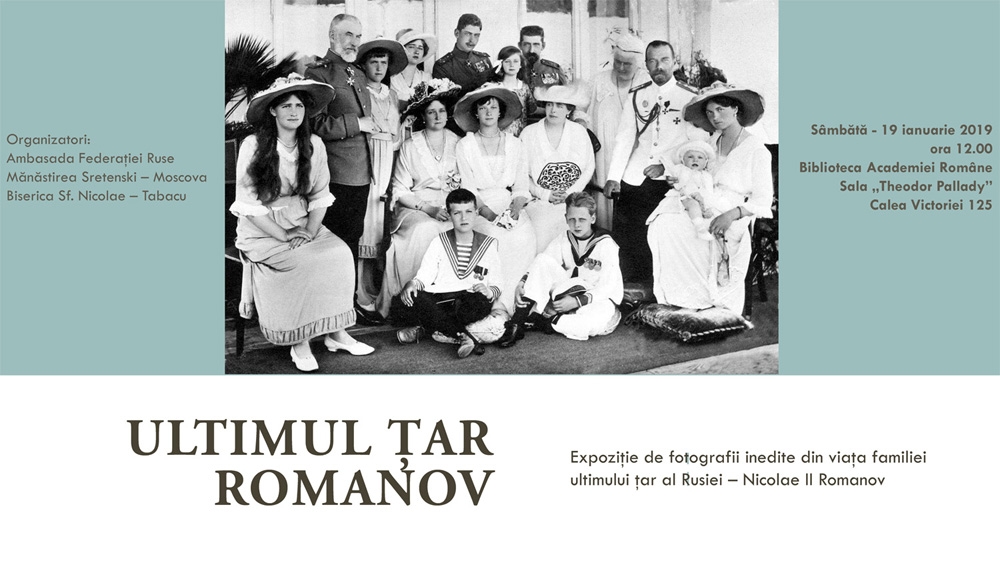
Poster promoting the Bucharest exhibit held in January 2019

On 14th March 2019, a photo exhibition dedicated to Tsar Nicholas II and his family opened in the Museum of Icons in the Romanian city of Alba Iulia. The exhibition The Last Emperor – the Most Beautiful Memories of the Romanovs is timed to the centenary of the martyrdom of the Tsar’s family in 2018. 

Situated in the west-central part of Romania, Alba Iulia is best known to monarchists for the Orthodox Unification Cathedral (built between 1921-1923). It was here that the first monarchs of the Unified Romania, King Ferdinand I (1865-1927) and Queen Marie (1875-1938) were crowned on 15 October 1922.  In commemoration of the event, busts of the king and queen were placed on the grounds in 2008.

044b

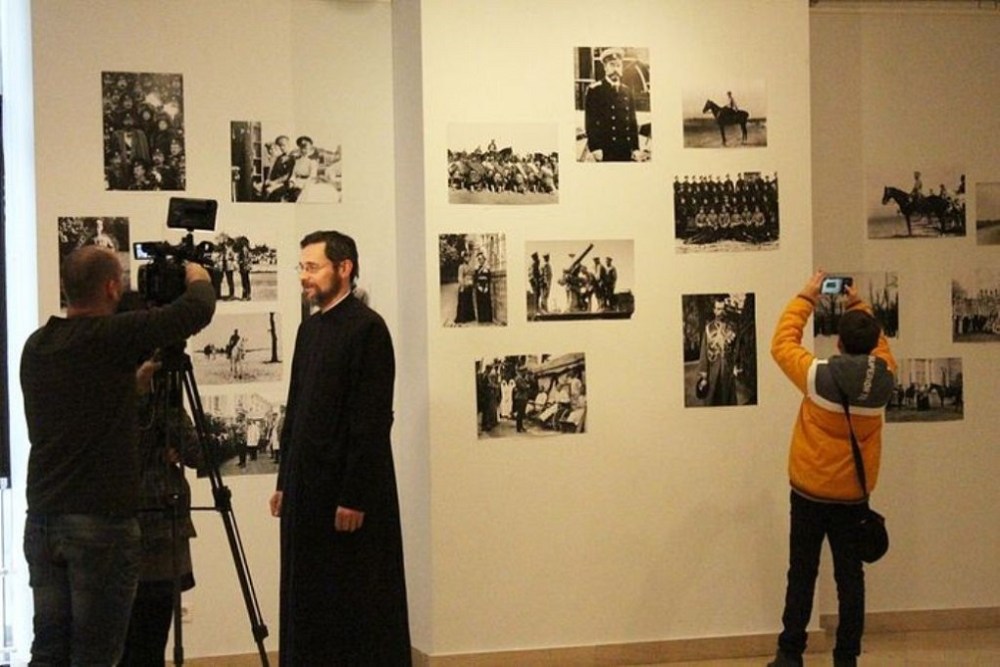
View of the Alba Iulia exhibit

The exposition presents more than 100 photographs of the Royal Passion-Bearers, which reflect their lives, family relationships, charitable activities, and the diplomatic activities of Nicholas II

The exhibition was prepared on the initiative of the Romanian Association “Tradition” with the support of the Moscow Sretensky Monastery.

A similar photo-exhibition opened on 19th January 2019,  in the library of the Romanian Academy of Sciences in Bucharest – see video above.

The event was organized by the Embassy of the Russian Federation in Bucharest, the Sretensky Monastery (Moscow) and the parish of the Church of St. Nicholas Tabaka. 

The exhibition was opened by Ambassador Extraordinary and Plenipotentiary of the Russian Federation to Romania V.I. Kuzmin. “The historical ties between the Russian and Romanian dynasties share very interesting relations between the two countries,” the Russian ambassador noted. “The culmination of these ties was the visit of the Imperial family to Constanza on the eve of the First World War. It was during this visit that the Russian and Romanian royal families discussed the possible engagement between Grand Duchess Olga Nikolaevna (1895-1918) and Crown Prince Carol (1893-1953), who later became King Carol II.” The ambassador also noted that Nicholas II was a martyr who kept the faith, despite the sufferings he was subjected to by his captors.

044c

View of the Bucharest exhibit

Hieromonk Ignatius (Shestakov) spoke about the history of the exhibition and its spiritual and moral importance. In this exhibition, which has already been held in more than a hundred locations in both Russia and abroad, it focuses on three main topics – family life, service to the Fatherland and mercy. The family of Nicholas II, according to the priest, is an example of a true Christian family, which is very important today, when the whole world is experiencing a crisis of family values.

© Paul Gilbert. 24 March 2019

Nicholas II: Noteworthy Articles No. 1 (2019)

042

This new series features links to full-length articles from English media sources. They include contemporary assessments of the lies and myths about Nicholas II, exhibitions, book reviews and more.

“PAINFUL POINTS” OF NICHOLAS II’s REIGN
Truth and Fiction

Yuri Pushchaev spoke with doctor of historical sciences and associate professor in the department of history at Moscow State University Fedor Gaida about the most frequent claims against the last Russian Emperor and how fair and appropriate they are.

A NEW LOOK AT THE LAST TSAR + VIDEO

An exhibition at the State Historical Museum in Moscow presents over 750 photographs of Nicholas II and his family, as well as paintings, objects and memorabilia, and some commentary from people who knew the tsar and his family. Many of the exhibits are rarely shown or have never been shown before.

NICHOLAS II ORTHODOX TSAR

After the extreme westernization of the eighteenth-century Tsars, Tsar Nicholas began to restore Russia, and the Russian autocracy, to her Byzantine and Orthodox roots.

HOW THE ROYAL HOUSES OF EUROPE ABANDONED THE ROMANOVS

They were all related but, as Helen Rappaport shows, nationalism prevailed over sentiment.

There is bitter irony in the story Ms Rappaport skilfully tells. Posterity finds something horrifying about the sovereigns of Europe, who virtually formed a single extended family, sending their subjects to slaughter one another. But in the end, nationalism also constrained the family loyalties of the continent’s monarchs, who could or would not save their Russian relatives from murder — the centenary of which was commemorated in Russia in 2018. The rites were solemn, but the massacre was a gruesome mess.

© Paul Gilbert. 23 March 2019

The Canonization of Nicholas II

041a

The canonization of the last Imperial Family of Russia was the elevation to sainthood of Tsar Nicholas II, his wife Tsarina Alexandra, and their five children, the Grand Duchesses Olga, Tatiana, Maria, Anastasia, and the Tsesarevich Alexei – by the Russian Orthodox Church. The family were murdered by the Bolsheviks on 17 July 1918 at the Ipatiev House in Ekaterinburg; the site of their murders is now beneath the altar of the Church on Blood.

They are variously designated as new martyrs by the Russian Orthodox Church Abroad (ROCOR) and as passion bearers by the Moscow Patriarchate. The family was canonized on 1 November 1981 as new martyrs by the Russian Orthodox Church Abroad. Their servants, who had been killed along with them, were also canonized. The canonized servants were their court physician, Yevgeny Botkin; their footman Alexei Trupp; their cook, Ivan Kharitonov; and Alexandra’s maid, Anna Demidova. Also canonized were two servants killed in September 1918, lady in waiting Anastasia Hendrikova and tutor Catherine Adolphovna Schneider. All were canonized as victims of oppression by the Bolsheviks. The Russian Orthodox Church did not canonize the servants, two of whom were not Russian Orthodox: Trupp was Roman Catholic, and Schneider was Lutheran.

In 2000 Metropolitan Laurus became the First Hierarch of the ROCOR and expressed interest in the idea of reunification. The sticking point at the time was the ROCOR’s insistence that the Moscow Patriarchate address the slaying of Tsar Nicholas II and his family in 1918 by the Bolsheviks. The ROCOR held that “the Moscow Patriarchy must speak clearly and passionately about the murder of the tsar’s family, the defeat of the anti-Bolshevik movement, and the execution and persecution of priests.”

Some of these concerns were ended with the jubilee Council of Bishops in 2000, which canonized Tsar Nicholas and his family, along with more than 1,000 martyrs and confessors.

On 20 August 2000, the Moscow Patriarchate ultimately canonized the family as passion bearers: people who face death with resignation, in a Christ-like manner, as distinguished from martyrs, the latter killed explicitly for their faith. They noted the piety of the family and reports that the Tsarina and her eldest daughter Olga prayed and attempted to make the sign of the cross immediately before they died. On 3 February 2016, the Bishop’s Council of the Russian Orthodox Church canonized Botkin as a righteous passion bearer.

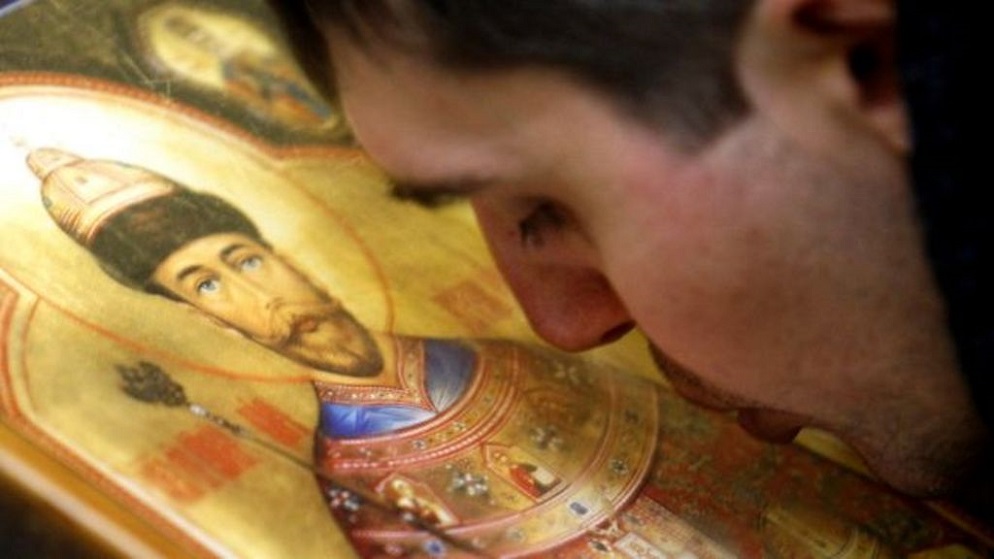
Despite their official designation as “passion-bearers” by the Moscow Patriarchate, they are nevertheless spoken of as “martyrs” in Church publications, icons, and in popular veneration by the people.

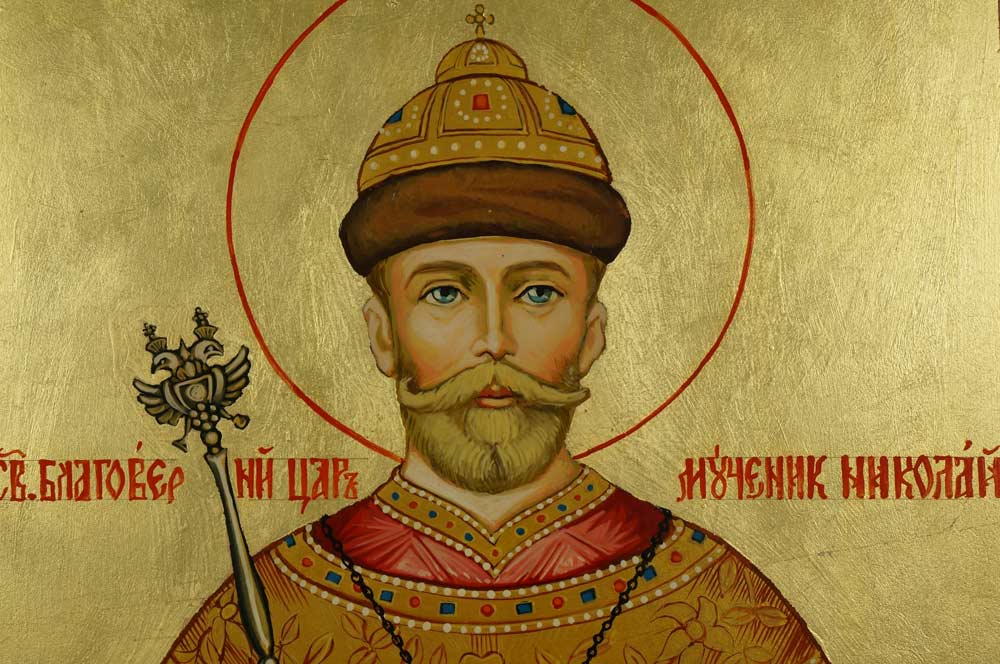
In particular icons of both the Tsar and his family are displayed in a growing number of churches across Russia, where the faithful come to venerate them. Gift shops in Ganina Yama and the Church on the Blood in Ekaterinburg sell icons depicting the image of the Holy Royal Passion-Bearer Nicholas II.

041

Click HERE to read the Report of the Holy Synod Commission on the Canonization of Saints with Respect to the Martyrdom of the Royal Family / 9-10 October 1996

© Paul Gilbert. 20 March 2019

TSAR’S DAYS. EKATERINBURG 2019

038e

This year’s Tsar’s Days in Ekaterinburg will be held from 16-19 July 2019. The events mark the 101st anniversary of the the deaths and martyrdom of Emperor Nicholas II and his family, all of whom were brutally murdered on the night of 16/17 July 1918 in the Ipatiev House in the Ural city of Ekaterinburg. 

Memorial events will include liturgies and prayers, historical conferences, sacred music concerts and exhibitions. Tens of thousands of people from across Russia, and abroad, will once again gather in Ekaterinburg for this annual event.

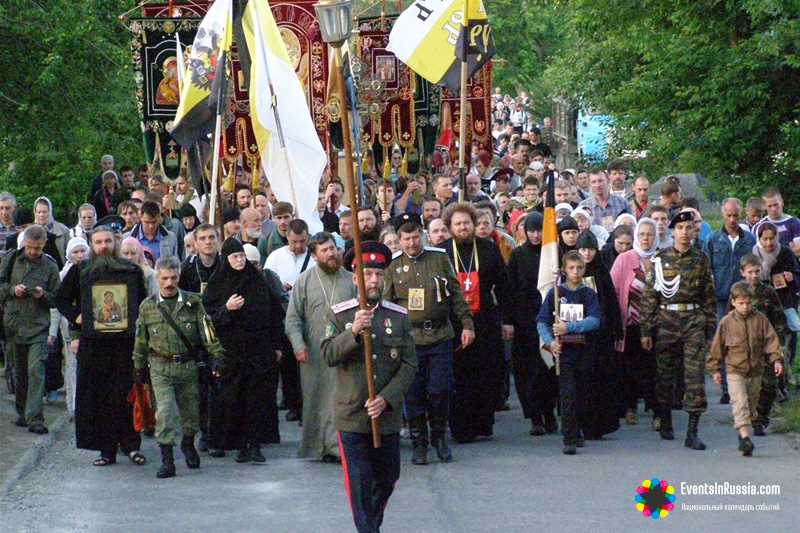
The main event of the Tsar’s Days is the Divine Liturgy held at the Church on the Blood (built on the site of the Ipatiev House) on the night of 16th July, followed by a religious procession in the early morning hours of 17th July, from the Church on the Blood in Ekaterinburg to the Monastery of the Holy Royal Martyrs at Ganina Yama (21 km). 

The first procession in memory of the Royal Passion-bearers, headed by the ruling bishop, took place in 2002, in which more than 2 thousand pilgrims and about 100 clerics participated. In 2012, for the first time since the construction of the Church on the Blood in Ekaterinburg, an all-night vigil and night Divine Liturgy were performed in the open air. In 2018, more than 100,000 pilgrims from across Russia and around the world took part in the Patriarchal Liturgy and procession of the cross from the Church on the Blood to the Ganina Yama.

Please note that updates on the 2019 Tsar’s Days events in Ekaterinburg will be posted as further details become available.

Click HERE for information on the 2018 Tsar’s Days marking the 100th anniversary of the deaths and martyrdom of Emperor Nicholas II and his family, and HERE for information on the 2017 Tsar’s Days in Ekaterinburg + colour photos and video.

038f

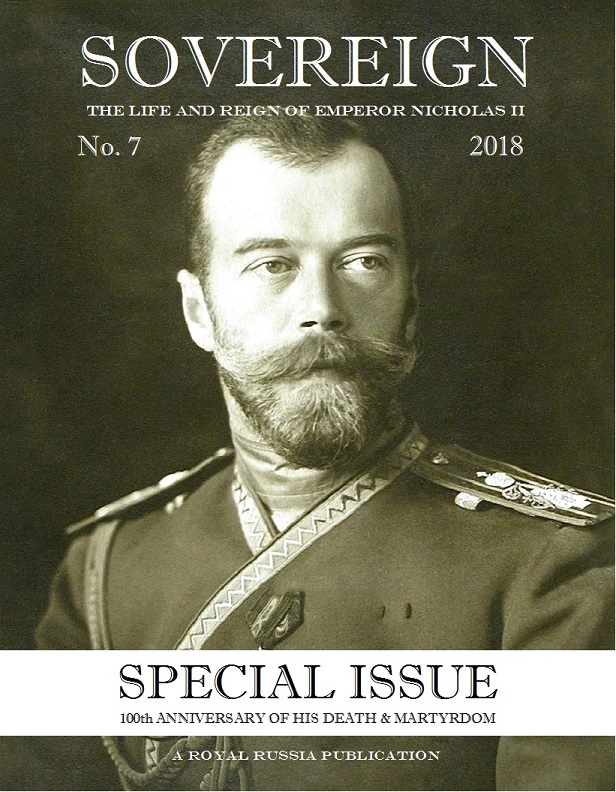
I was fortunate to attend the 2018 Tsar’s Days in Ekaterinburg, and have dedicated a special issue of SOVEREIGN dedicated to the centenary – featuring 144 pages, 7 full-length articles, and richly illustrated with 150 black and white photos. Click HERE to order your copy!

© Paul Gilbert. 20 March 2019

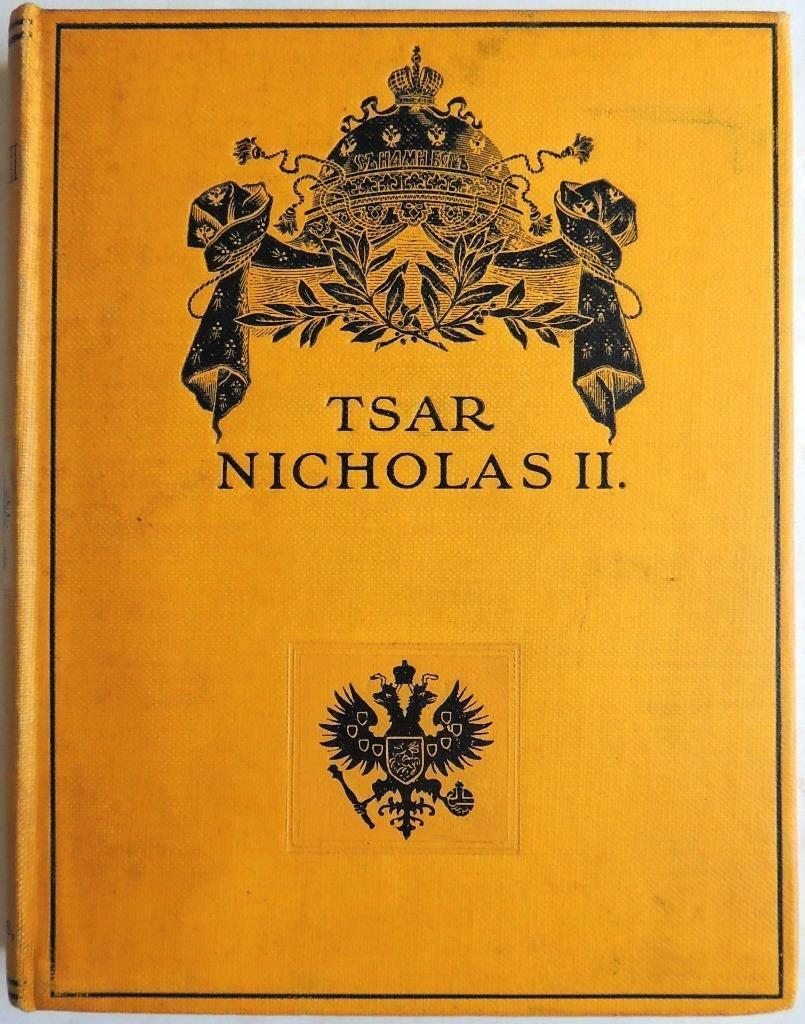
Tsar Nicholas II by Major-General A. Elchaninov (1913)

039

Back in the 1990s, I was fortunate to track down a copy of this rare book. I then issued a new edition, and after several reprints is now out of print. The text of Elchaninov’s biography on Nicholas II, was published in the premiere issue of SOVEREIGN in 2011.

This unprecedented authorized account of Emperor Nicholas II, by Major-General Andrei Georgievich Elchaninov (1868-1918) was released in early 1913, to coincide with the celebration of the 300th anniversary of the Romanov dynasty. It was originally published in excerpts or installments in many major newspapers during and after the tercentenary events.

The Russian edition was issued in 1913, followed by English (titled The Tsar and His People) and French (titled Le rèine de S.M. l’Empereur Nicolas II) editions in 1914. The latter was translated by Princess Paley (nee Olga Pistolkors), the wife of the Grand Duke Paul Alexandrovich, “so that foreigners, and especially the French, had a correct idea of Russia and her tsar, a country that is a friend and ally.”[1]

While many contemporary biographers claim that Nicholas II was not fit to rule Russia, the author of this work claims otherwise, writing from first-hand experience. The first few chapters show Nicholas to be a caring, devoted and loving father and husband while the remaining chapters focus on his relationship with his government, the church, the army, the Russian people and on the policies which he pursued in his first eighteen years as tsar which he firmly believed were steering Russia towards a better future.

According to Richard S. Wortman, “Elchaninov organized his text to permit the broadest possible dissemination in newspapers.”[2] He notes that the book presents “a unique statement of how Nicholas himself understood his office and wished himself to be perceived.”[3]

Elchaninov gathered considerable material for the twelve brief chapters about Nicholas’s personal life based on observations and impressions of “all those, who standing in close proximity to the throne, have honoured me with their confidence . . .”.[4]

Written before the First World War and the Russian Revolution, Elchaninov writes in glowing patriotic language, portraying Nicholas II as an indefatigable “imperial worker” in the service of Russia’s best interests and the “sovereign father” beloved by the Russian people.

Nicholas reviewed and corrected the proofs himself in January 1913. He made changes to the text, and requested the removal of sentences describing the Tsesarevich Alexei’s illness.

The author, was a member of the emperor’s suite, and a professor of military art in the General Staff Academy in St. Petersburg.

According to the memoirs of Tatiana Evsseva Alexina, Времена не выбирают (Time Does Not Choose) in which she writes about the fate of the Russian noble family Elchaninov, her ancestor Major-General Andrei Georgievich Elchaninov was arrested by the Bolsheviks after the Revolution. He was placed on a raft along with other officers of the Imperial army and drowned in the River Neva in 1918.

Now, more than a century after its’ publication, rare copies of the English and French translation of his book on Nicholas II are highly sought after by collectors, selling for large sums in antiquarian book fairs in the United States, Great Britain and Europe.

NOTES:

1. Wortman, Richard S., Scenarios of Power: Myth and Ceremony in Russian Monarchy, Vol. II. Princeton, NJ. Princeton University Press, 2000. pg. 489
2. Ibid, pg. 489
3. Ibid, pg. 490
4. Ibid, pg. 490

© Paul Gilbert. 19 March 2019

Photos 37 – 40 of Nicholas II

PHOTOS: Four views of Nicholas II seated in the Mauve (Lilac) Boudoir

Situated in a corner of the Mauve (Lilac) Boudoir of the Alexander Palace, was a large, plush arm-chair with a high backing, and covered with the Moscow-made silk. This chair is among the most photographed spots in the Alexander Palace. There are countless photos of the Empress Alexandra Feodorovna, and her five children posing in the now infamous arm-chair.

Other family members who have been photographed in this spot include the Empress’s sister Grand Duchess Elizabeth Feodorovna, Grand Duchess Xenia Alexandrovna with her husband Grand Duke Alexander “Sandro” Mikhailovich, and Grand Duchess Olga Alexandrovna.

chair05

Copy of the now famous chair in the Mauve (Lilac) Boudoir of the Alexander Palace

The original chair did not survive, however, a copy of the chair was made in 2000, and used by Russian director Gleb Panfilov to shoot a scene for Романовы. Венценосная семья (The Romanovs: An Imperial Family), a film on the last days of Tsar Nicholas II and his family. The copy of the chair remains part of the collection of furniture in the Alexander Palace to this day.

I must apologize for the quality of some of the photographs, however, this is something which I have no control over. Where possible, photographs have been chosen for their visual impact, but historical accuracy has made it vital to include a number of photographs whose quality is poor, but whose value as historical documents is considerable. Sadly, during the Soviet years, many photographs of the Imperial family were stored under poor conditions and their standard is low – PG

© Paul Gilbert. 18 March 2019

Nicholas II and the Boy Scout Movement in Russia

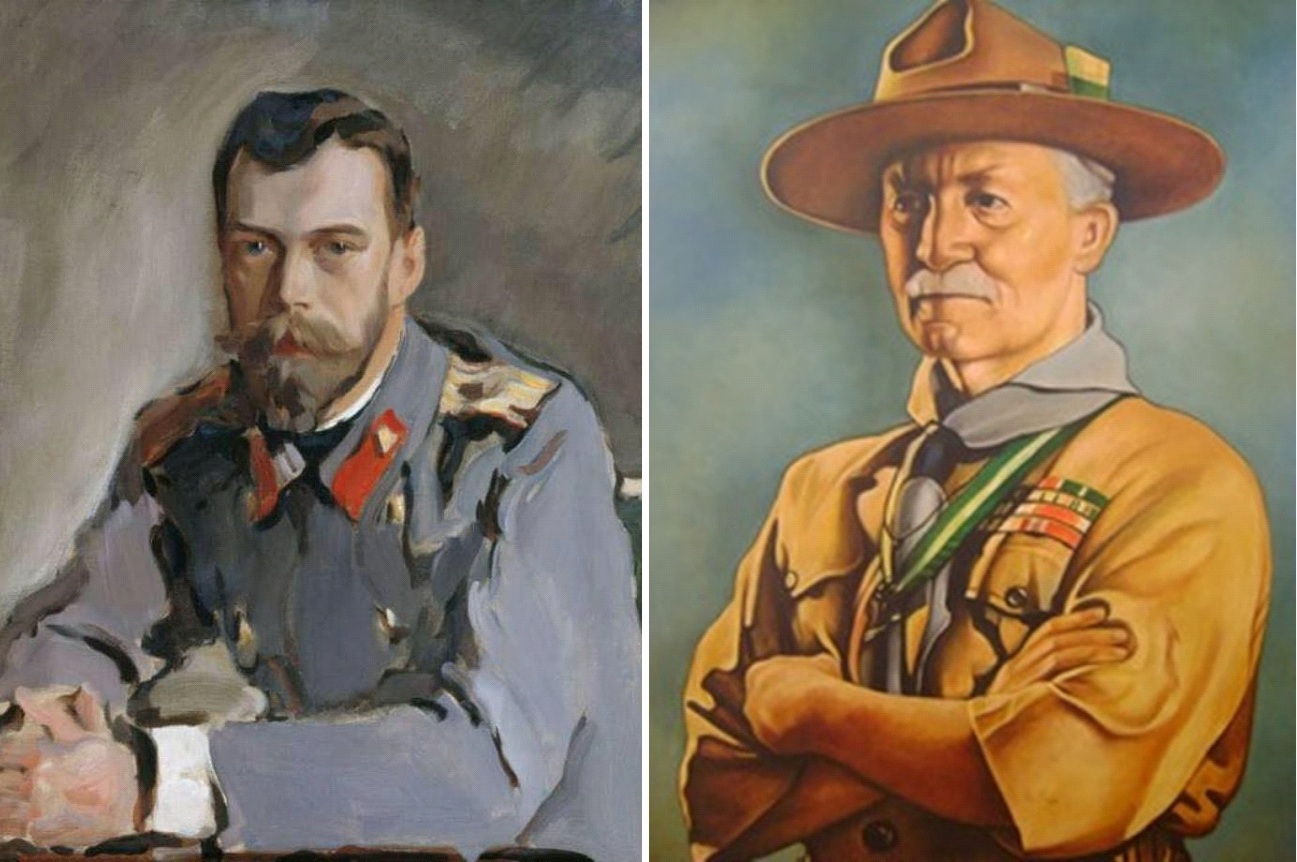
PHOTO: Emperor Nicholas II and Robert Baden-Powell

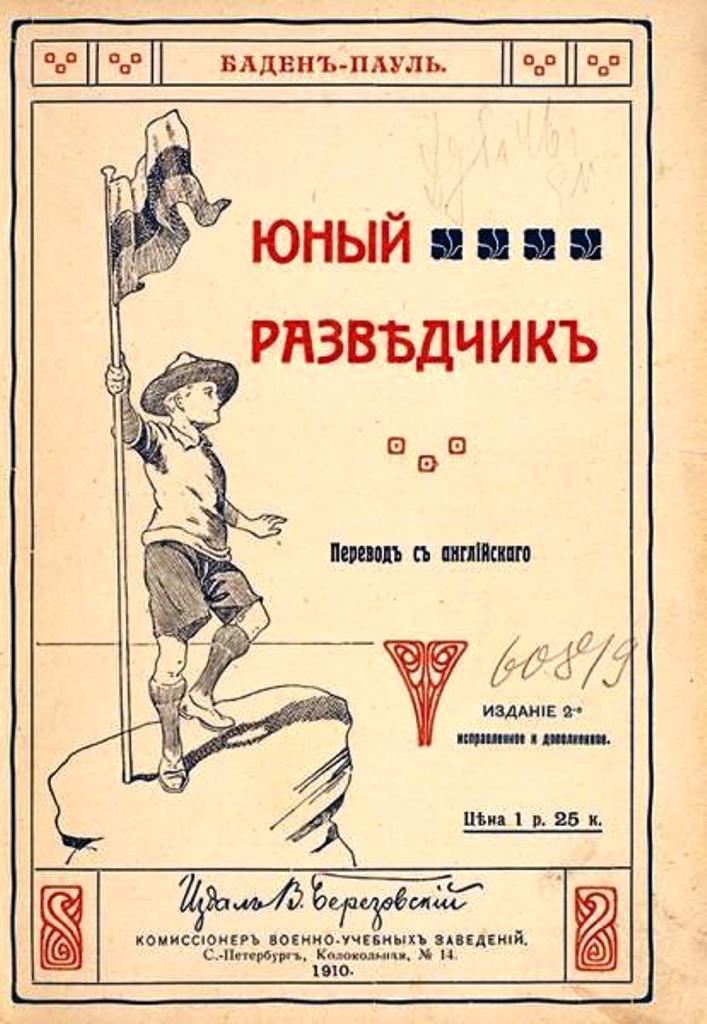
After reading the English language edition of Robert Baden-Powell’s book Scouting for Boys, Tsar Nicholas II immediately issued an order for its translation and publication of a Russian-language edition. An initial printing of 25,000 copies of the Russian edition of  ‘Юный Разведчик’ (Young Scout) were issued in 1908.

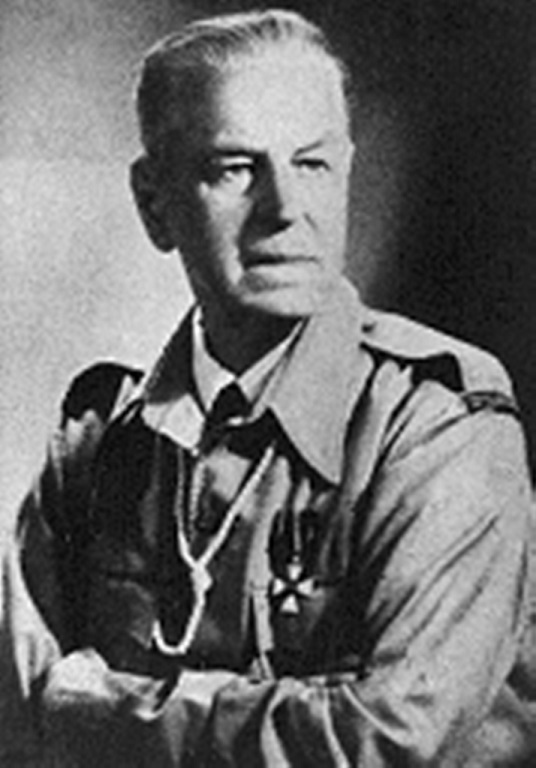
The book inspired a young Russian officer, Colonel Oleg Ivanovich Pantyukhov (1882-1973),  to set up the first Russian Scout patrol the following year.

Colonel Oleg Ivanovich Pantyukhov was born in Kiev on 25 March 1882, to a family of a military physician and an anthropologist. From 1892 to 1899 he studied at Tifflis cadet school. During his studies he became a member of the group named Pushkin club. The group was somehow similar to the modern Boy Scouts. Every weekend they went on hiking trips with camping in the nearby mountains.

From 1899 to 1901, Pantyukhov studied at the Pavlovsk Military School. After graduation he became an officer of the Leib Guard (Russian Imperial Guard) 1st infantry battalion stationed in Tsarskoye Selo. In 1908 he married Nina Mikhaylovna Dobrovolskaya, who later became one of the pioneers of the Girl Guide movement in Russia. 

In 1908–09 Pantyukhov became acquainted with the works of Robert Baden-Powell and decided to try these ideas on Russian soil. He organized the first Russian Scout troop Бобр (Beaver) in Pavlovsk, on 30 April [O.S. 17 April] 1909. By late 1910 scout organizations existed in Tsarskoye Selo, St. Petersburg and Moscow.

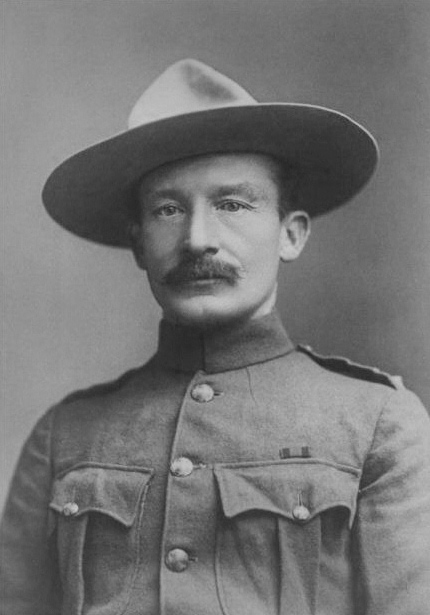
PHOTOS: Robert Baden-Powell (1857-1941) and
Colonel Oleg Ivanovich Pantyukhov (1882-1973)

Nicholas II extended a personal invitation to Baden-Powell to visit St. Petersburg and Moscow in December 1910 – January 1911. The Tsar personally received the Boy Scout leader in his study in the Alexander Palace on 2 January 1911.

“There was no ceremony about him,” Baden-Powell recorded in his diary. “He shook hands and, speaking in very good English, asked me about my visit and then went on to talk about the Boy Scouts.” They then had “a very cheery talk (no one else present) of over half an hour,” after which they parted. 

The Tsar had explained to Baden-Powell how he had ordered the translation and publication of the Boy Scout handbook and reviewed the first Russian Scout detachment, and went on to outline his hopes for the movement. According to Baden-Powell, Nicholas II was “much impressed by the possibilities which lie in the Movement for developing discipline, patriotism and character,” and approved “teaching the boys by methods which really appealed to their imagination and keenness.”

PHOTO: A copy of the second edition of Young Scout (Юный
Разведчик, published in 1910. Priced at 1 ruble, 25 kopecks

Baden-Powell departed fully convinced that the Tsar was absolutely sincere, and that he had “grasped the idea” of scouting. There is no question of Nicholas II’s interest in scouting was clearly genuine. Apart from ordering the Russian publication of Scouting for Boys, he seems personally to have arranged to meets its author. With Baden-Powell installed in the Imperial capital’s grand Hotel de France, the Tsar could have left any official interview to one of his ministers. Instead, he issued a private invitation through the British Embassy, a request that apparently took his visitor by complete surprise. This encounter was also quite unlike those with his Ministers and Duma politicians, meetings that the Tsar could not avoid, however much he disliked the advice they forced upon him. Put differently, with Baden-Powell it was Nicholas and Nicholas alone who both took the initiative and the agenda, and had no need to disguise his opinions or dissemble behind a mask of good manners.

On 19 December 1910, Pantyukhov met in St. Petersburg with Baden-Powell, the pair becoming good friends. The latter invited Pantyukhov to visit Scout organizations in England, the Netherlands, Sweden and Denmark. On his return he wrote the first Russian Scouting books “Памятка Юного Разведчика” (Handbook for the Young Scout) and “В гостях у Бой-скаутов” (Visiting the Boy Scouts) (both 1912). In 1913 he wrote a book named “Спутник Бойскаута” (The Boy Scout Companion). Pantyukhov met Nicholas II and gifted a Scouting badge for Tsesarevich Alexei, who formally became a Scout.

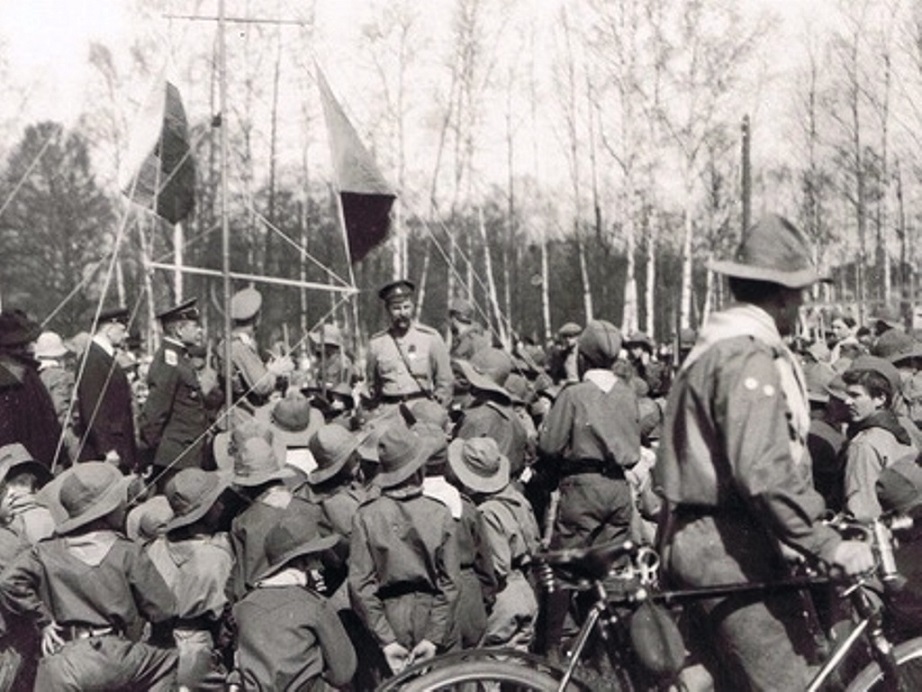
In 1914, Pantyukhov established a society called Русский Скаут (Russian Scout ). The first Russian Scout patrol consisting of seven boys campfire was lit in the woods of Pavlovsk Park. A Russian Scout song exists to remember this event. Scouting spread rapidly across Russia and into Siberia, and by 1916 there were about 50,000 Scouts in Russia.

037c

PHOTO: Pantyukhov with scouts in 1915

During World War I Pantyukhov received the Cross of St. George, for bravery. During the October Revolution of 1917, he was the leader of the cadets who unsuccessfully defended the Kremlin from the Bolsheviks. In 1919 in Novocherkassk (controlled at the time by the White Army), Pantyukhov was unanimously elected the Chief Scout of Russia

With the advent of communism after the October Revolution of 1917, and during the Russian Civil War from 1917 to 1922, most of the Scoutmasters and many Scouts fought in the ranks of the White Army and interventionists against the Red Army. In 1918, a purge of the Scout leaders took place, in which many of whom perished under the Bolsheviks. Those Scouts who did not wish to accept the new Soviet system either left Russia for good, like Pantyukhov and others, or went underground.

However, clandestine Scouting did not last long. On 19 May 1922, all of those newly created organizations were united into the Young Pioneer organization of the Soviet Union (it existed until 1990). Since that year, Scouting in the Soviet Union was banned.

In closing, it is interesting to note that the quiet support of Nicholas II played a crucial role in the survival of the scouting movement in pre-revolutionary Russia. This fact is notable, since it is indicative of preferences and insights not usually associated with the last tsar. If Baden-Powell is only partially correct in his depiction of Nicholas’s motives, intentions, and a vision of a future Russia, the picture presented still suggests a man somewhat different from the shallow autocrat of legend. 

© Paul Gilbert. 18 March 2019

Documentary: The Return of Pierre Gilliard

035

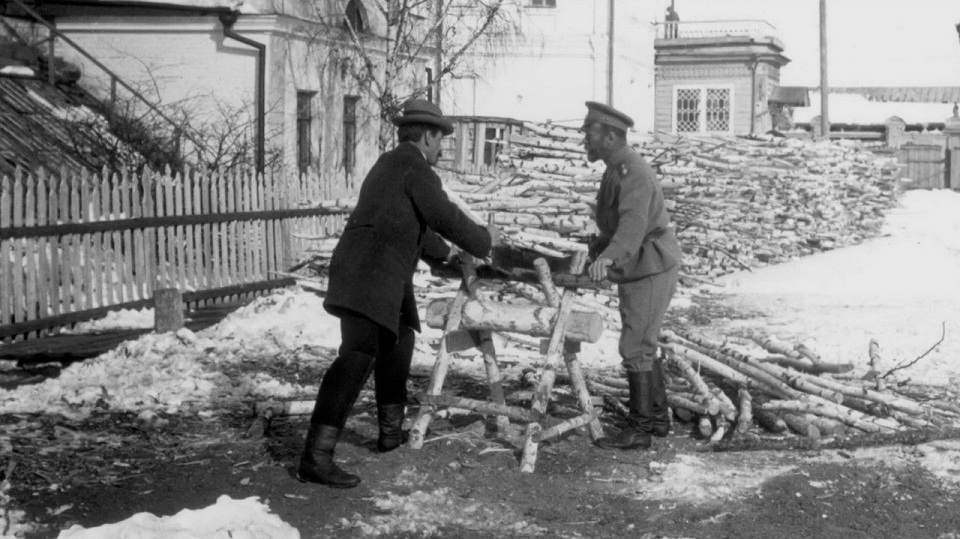
Pierre Gilliard and Nicholas II sawing wood during their house arrest in Tobolsk

«Возвращение Пьера Жильяра» (The Return of Pierre Gilliard) is the name of a new Russian language documentary film dedicated to the the French language tutor to the five children of Emperor Nicholas II of Russia from 1905 to 1918.

Work on on the documentary began in 2018, and was recently completed at the “NATAKAM” film studio; the script was written and directed by Lyudmila Shakht and Konstantin Kozlov. The premiere was held earlier this month in the House of Cinema, with additional viewings scheduled on 20th March at the Knowledge of Russia Society, and on 24th April at the Boris Yeltsin Presidential Library in St. Petersburg. Gilliards’ grand-nephews – writer Pierre-Frederic Gilliard and doctor Jacques Moser talk about the life and fate of Pierre Gilliard (1879-1962). The film is based on family memories, diaries, letters and photographs, on their famous uncle, a true friend of the Imperial family.

After returning from Russia to Switzerland, he wrote and published the book Le tragique destin de Nicolas II et de sa famille (1921). An English language edition Thirteen Years in the Russian Court was published in 1927. 

The Swiss-born Pierre Gilliard first gave French lessons to Grand Duchesses Olga and Tatiana, then to Maria and Anastasia. He first began to teach French to the Tsesarevich and Heir Alexei in 1913. Gilliard grew fond of the family and following the Russian Revolution of 1917, he followed them into internal exile to Tobolsk, Siberia. The Bolsheviks prevented Gilliard from joining his pupils when they were moved to the Ipatiev House in Ekaterinburg in May 1918.

Gilliard remained in Siberia after the murders of the Imperial family, assisting White Russian investigator Nicholas Sokolov. In 1919, he married Alexandra Tegleva (1894-1955), who had been a nurse to Grand Duchess Anastasia. In 1920, he returned to Switzerland through Vladivostok, along with wife. He managed to save his archive – diaries, letters, memorabilia, photographs. In 1958, Gilliard was severely injured in a car accident in Lausanne, Switzerland. He never fully recovered and died four years later on 30 May 1962

035b

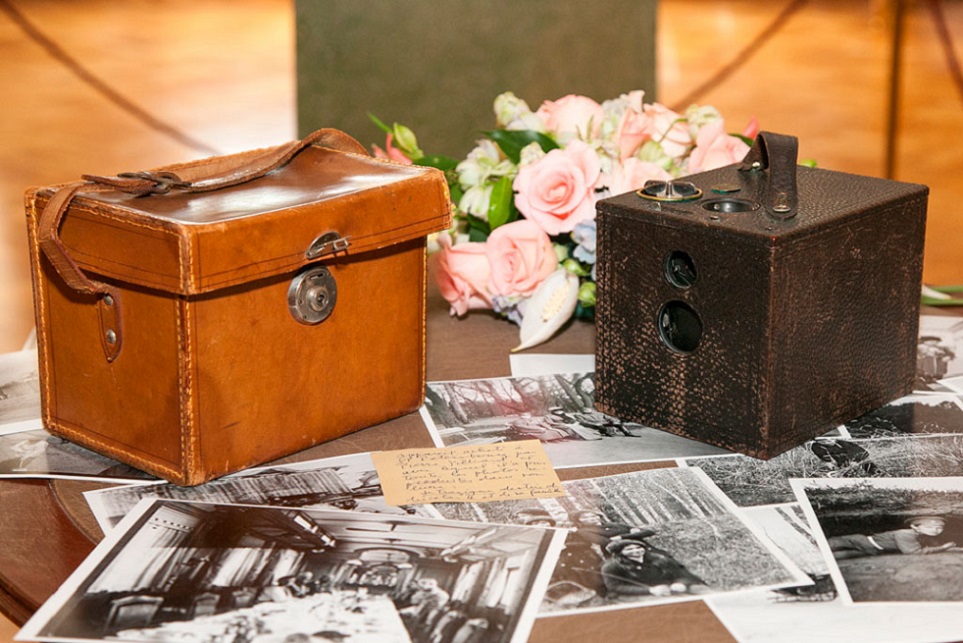
Pierre Gilliard’s  Eastman Kodak Bulls Eye camera

It is important to note that in recent years Pierre Gilliard descendants have donated several memorial items to the Tsarskoye Selo State Museum. Among these are the *Eastman Kodak Bulls Eye camera (above)  from which he photographed the Imperial family in Tsarskoye Selo and later in exile in Tobolsk. According to Mr. Moser, his mother, the goddaughter of Gilliard, inherited this camera and explained that “Uncle Pierre” took all the photos at the Russian Court, and that “the emperor himself actually held the camera in his hands.” She showed pictures – in particular the one in which Gilliard and the Tsar sawed wood in Tobolsk (above). The photos which are featured in the documentary film illustrate the dramatic fate of the last Russian emperor and his family. The museum also received a tea set and a set of tableware, a gift to Gilliard from Grand Duchess Anastasia Nikolaevna, as well as a Faberge brooch and a Paul Bure golden pocket watch gifted by Empress Alexandra to Gilliard’s wife Alexandra Tegleva.

*Pierre Gilliard’s Eastman Kodak Bulls Eye camera was recently displayed in The Last Tsar: Blood and Revolution Exhibition, at the Science Museum in London, England

035c

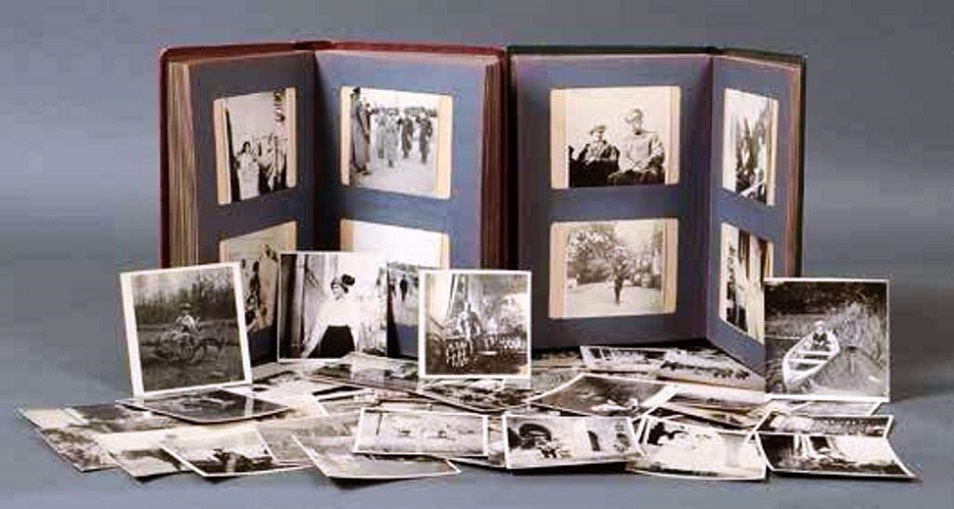
In recent years photos taken by Gilliard of the Imperial family were sold at auction

© Paul Gilbert. 17 March 2019

Nicholas II: the Tsar with the dragon tattoo

031

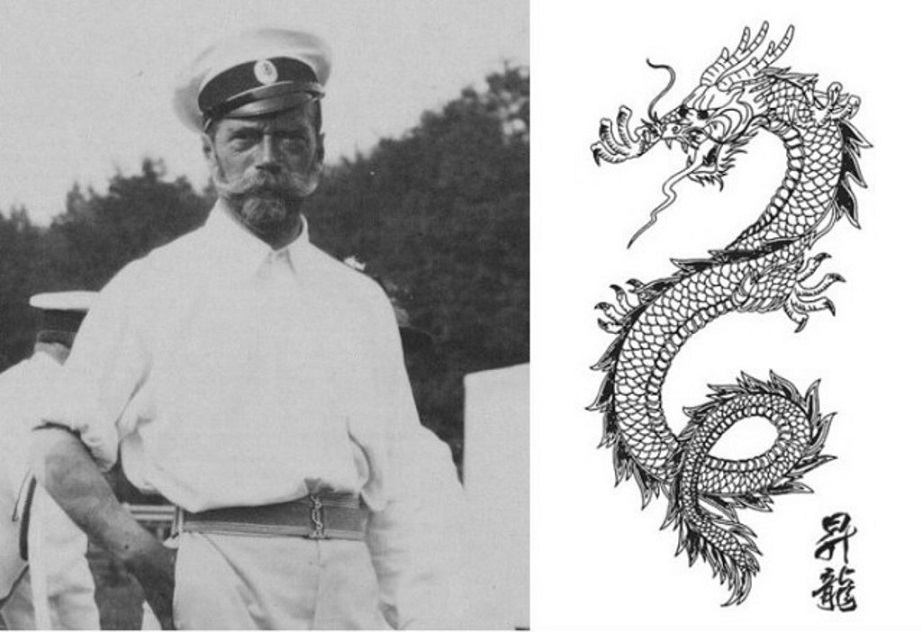
PHOTO: A dragon tattoo can be seen on Nicholas II’s right forearm

In 1890, the Tsesarevich and Grand Duke Nicholas Alexandrovich (future Tsar Nicholas II), embarked on a 9-month journey on-board the Imperial Russian cruiser Pamyat Azova (Memory of Azov) to the Far East. He travelled through Austria-Hungary, Greece, Egypt, India, Ceylon, Singapore, Siam, China and Japan – the total length of the journey exceeded 51,000 kilometres, including 15,000 km of railway and 22,000 km of sea routes. 

It was during his visit to Otsu, Japan, that by Tsuda Sanzō (1855–1891), one of his escorting policemen, who swung at the Tsesarevich’s face with a sabre. Nicholas was left with a 9 centimeter long scar on the right side of his forehead, but his wound was not life-threatening.

Tsesarevich Nicholas showed great interest in Japanese traditional crafts, and in Nagasaki he decided to get himself a tattoo on his right forearm. Local residents were surprised by this, because tattoos were only associated to criminals, or members of the lower classes.

It should be noted, that from the mid-19th century, tattoos had became fashionable among young European and British aristocrats. The first British monarch to be tattooed was Prince Edward, the future king Edward VII, “the Uncle of Europe”. While still an heir, he had a Jerusalem cross tattooed on his chest. His sons followed their father’s example – George (future King George V) and Albert Victor – both of whom had their tattoos in Japan, renown for having the best tattoo artists at the time.

PHOTO: Emperor Nicholas II and his dragon tattoo

In April 1891, during an official event held in Kyoto headed by Prince Arisugawa Taruhito (1835-1895), that Nicholas made a request to his Japanese host to introduce him to local tattoo artists. The following day, two masters from Nagasaki were brought aboard the flagship of the Russian squadron. One of them tattooed the image of a black dragon with yellow horns, green paws and a red belly, on the Tsesarevich’s right forearm. The painful process lasted seven hours.

A number of photographs exist which clearly show that Nicholas II had indeed had a dragon tattoo on his right forearm. Other photographs indicate that he had a similar tattoo on his left forearm as well. These photos were taken at Livadia, where the tsar loved to play tennis with his daughters and officers of the Imperial yacht Standart.  The above image, however, depicts Nicholas relaxing with his shirt sleeves rolled up revealing a dragon tattoo on each forearm. 

© Paul Gilbert. 16 March 2019

Archival documents regarding the murder of the Imperial family in Ekaterinburg

033

The State Archive of the Russian Federation have disclosed documents on the history of the murder of the Imperial family, from its funds, as well as the funds of the Russian State Archive of Socio-Political History (RGASP), the Russian State Archive of Modern History (RGANI), the Archive of the President of the Russian Federation, and the State Archive of the Sverdlovsk Region. 

A total of 281 documents were published on their web site [по-русски / in Russian only], revealing the circumstances of the Tsar’s arrest, his transfer to Tobolsk and Ekaterinburg, the deaths of the Imperial family, including the materials of the investigation by Nikolai Alekseevich Sokolov (1882-1924).

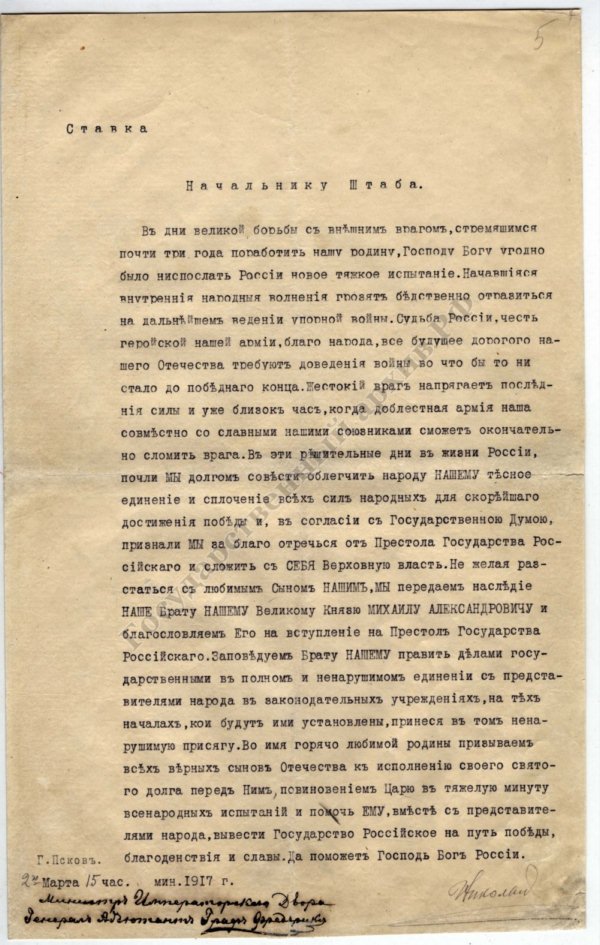
Among the documents is the Act of the Abdication of Emperor Nicholas II, signed by the tsar with a simple pencil. Telegrams on the movements of Nicholas II and his family; as well as telegrams with a request to report the accuracy of the rumors spread in Moscow about the murder of Nicholas II; a telegram to Lenin and the chairman of the All-Russian Central Executive Committee Yakov Sverdlov, that the former tsar had been shot on the night of 16th July 1918, and the family evacuated; and the Ural Regional Commissar of Supply Pyotr Voikov orders three jugs and five pounds of sulfuric acid from the
warehouse. According to investigator Sokolov, the acid was delivered to the mine on 17th and 18th of July, to help the murderers destroy the bodies of the Imperial family.
033a

(1) Photo: State Archive of the Russian Federation

(1) The Act of Abdication of the Emperor Nicholas II. Script. Typescript. Nicholas II has signed the document with a pencil, and countersigned by the Minister of the Imperial Court, Count Vladimir B. Fredericks (1838-1927).
033b

(2) Photo: State Archive of the Russian Federation

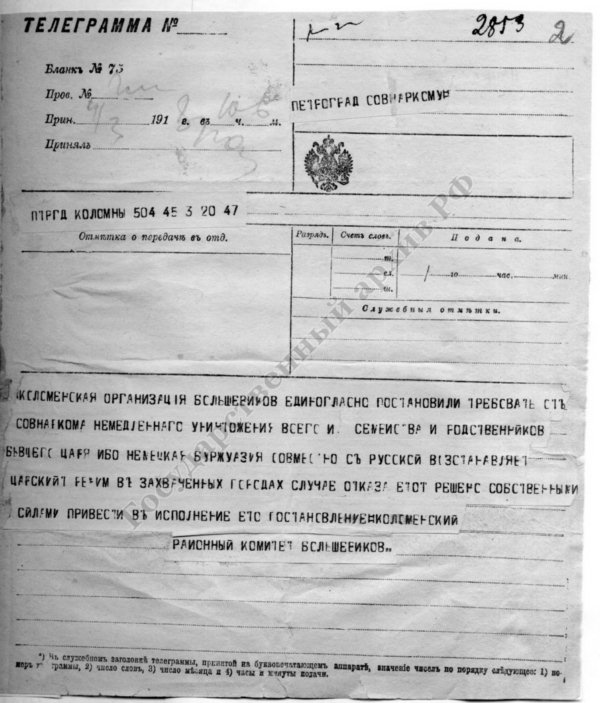
(2) Telegram of the Kolomna district organization of Bolsheviks to the Council of People’s Commissars (Sovnarkom) demanding the immediate execution of “the entire family and relatives of the former tsar.”
033c

(3) Photo: State Archive of the Russian Federation

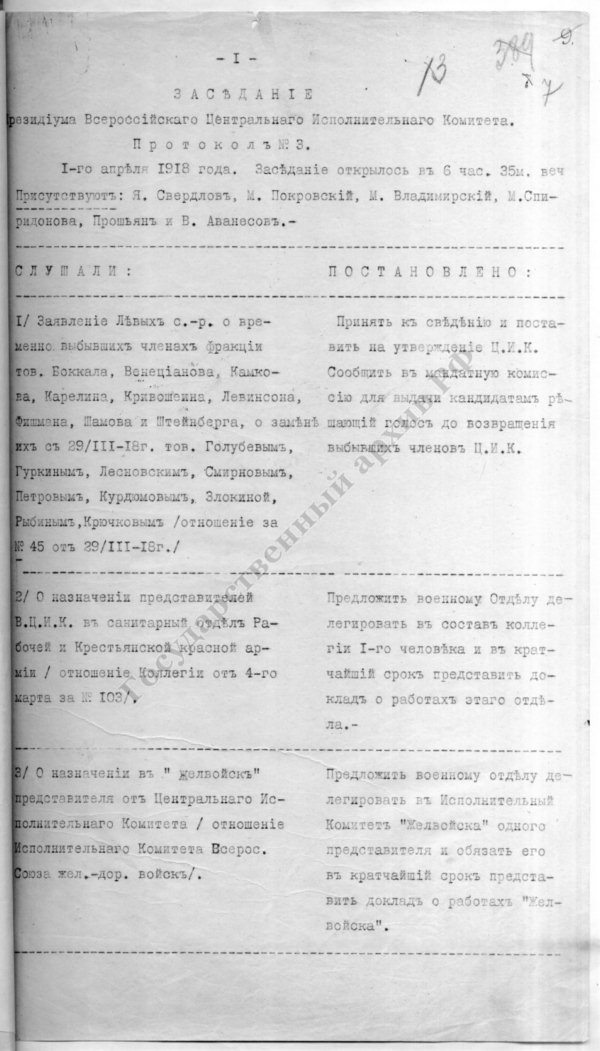
(3) From the protocol number 3 of the meeting of the Presidium of the Central Executive Committee, paragraph 11 – “Message on the protection of the former tsar.” Decided: to ask the special purpose detachment to remain at their post until reinforcements arrive, to strengthen the supervision of those under arrest, to supply the detachment with money, machine guns and grenades.
033d

(4) Photo: State Archive of the Russian Federation

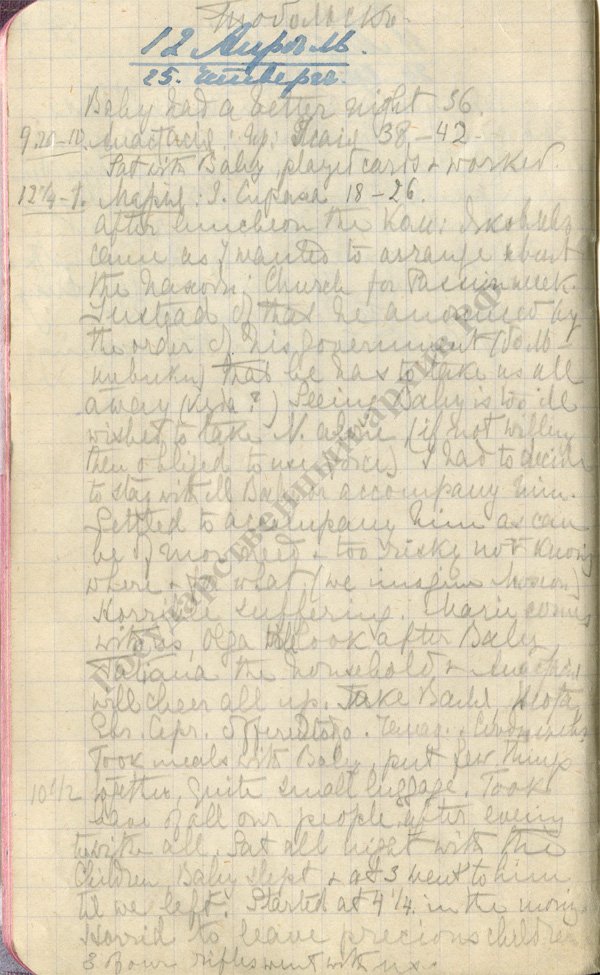
(4) An excerpt from the diary of Empress Alexandra Feodorovna: “April 12 (25). Thursday. Tobolsk. Baby had a better night, 36 °. […] After lunch, Commissioner Yakovlev came, because I wanted to organize a visit to the church during Holy Week. Instead, he announced the order of his government (the Bolsheviks) that he should take us away (where?). Seeing that Baby was very sick, he wanted to take Nicky alone (if not willing, then obliged to use force).

I had to decide whether to stay with  ill Baby or accompany him [Nicky]. Settled to accompany him, as can be of more need and too risky not to know where and for what (we imagined Moscow). Horrible suffering. Maria comes with us. Olga will look after Baby, Tatiana – the household, and Anastasia will cheer all up. We take Valya [Dolgorukova], Nyut [Demidov], and Evgeny Sergeyevich Botkin offered to go with us […]

Took meals with Baby, put few things together, quite small luggage. Took leave of all our people after evening with all. Sat all night with the children. Baby slept, and at 3 o’clock I went to him before our departure. We went at 4 o’clock in the morning. Horrid to leave precious children. […] “

(5) Telegram No. 6707 (above) from Ekaterinburg, Chairman of the Ural Regional Council A.G. Beloborodov to Moscow, Chairman of the Council of People’s Commissars Vladimir Lenin and the chairman of the All-Russian Central Executive Committee Yakov Sverdlov, about the acceptance from Commissioner Yakovlev of the “former tsar” Nicholas II, the “former tsarina” Alexandra Feodorovna and their daughter Maria Nikolaevna, and about moving everyone into the mansion [Ipatiev House] under guard.

033g

(6) Photo: State Archive of the Russian Federation

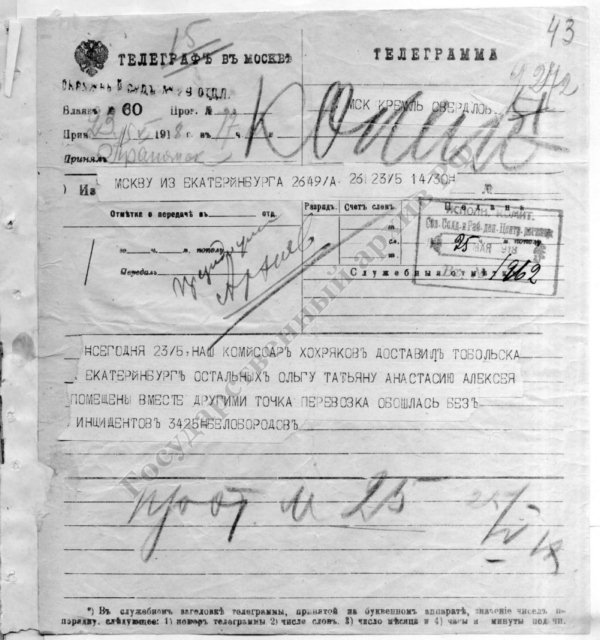
(6) Telegram of A. G. Beloborodov, Chairman of the Ural Regional Council, from Ekaterinburg to Moscow, to the Chairman of the All-Russian Central Executive Committee Yakov Sverdlov on the delivery of Olga, Tatiana, Anastasia and Alexey by Commissioner Khokhryakov from Tobolsk to Ekaterinburg.

(7) Telegram No. 2729 (above) of Vladimir Bonch-Bruyevich, who managed the affairs of the Council of People’s Commissars in Ekaterinburg, to the chairman of the Ural Regional Council with a request to report on the accuracy of the rumors spread in Moscow about the murder of Nicholas II; on the back is the answer, recorded by Secretary Korobovkin, that the rumors “are another provocative lie.”

033j

(8) Photo: State Archive of the Russian Federation

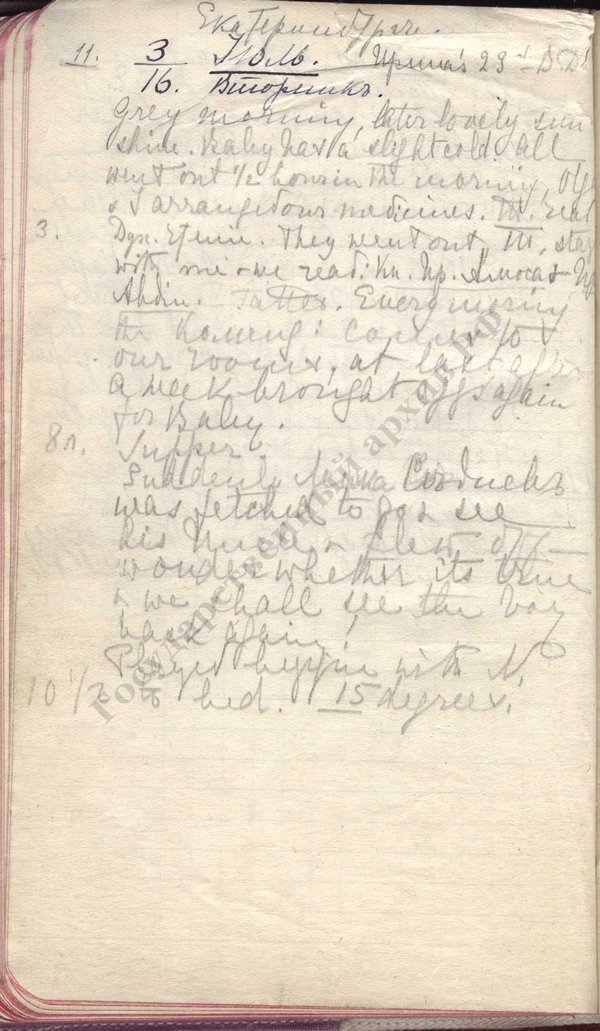
(8) From the diary of Empress Alexandra Feodorovna: “Ekaterinburg. 3 (16). July. Grey morning, later lovely sunshine. Baby has a slight cold. All went out for a walk in the morning for ½ hour. Olga and I arranged our medicines. Tatiana read Spiritual reading. They went out. Tatiana stayed with me, and we read Book of prophet Amos and prophet Audios. Tatted. Every morning the Kommandent comes to our rooms, at last after a week brought eggs for Baby again.

Suddenly, Lenka Sednev was fetched to visit her uncle, and he flew off – wonder whether it is true and we shall see the boy back again! […] “

(9) Telegram (above) of the Presidium of the Ekaterinburg Council to the Chairman of the Council of People’s Commissars V. I. Lenin and the Chairman of the All-Russian Central Executive Committee Yakov Sverdlov about the shooting of the former tsar on the night of 16 July and the evacuation of the family.

033m

(10) Photo: State Archive of the Russian Federation

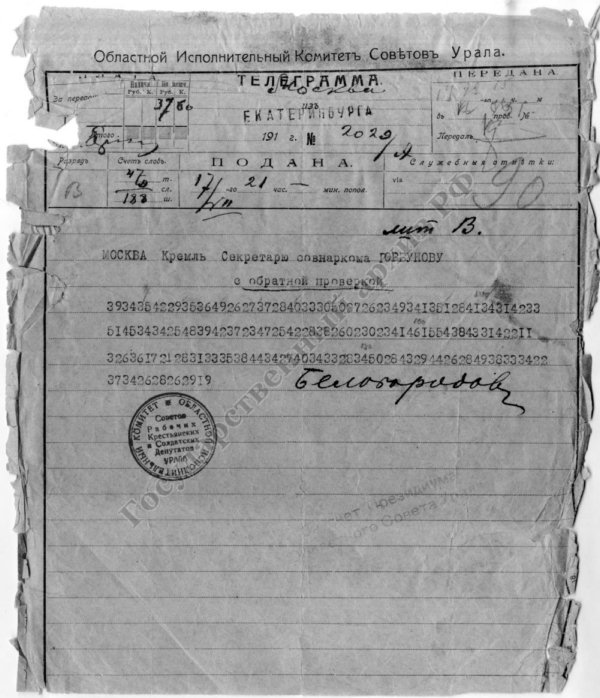
(10) Encrypted telegram of A. G. Beloborodov, Chairman of the Ural Regional Council, to Secretary of the Council of People’s Commissars N. P. Gorbunov with the message: “Tell Sverdlov that the whole family has suffered the same fate as the head. Officially, the family will die during the evacuation.”

(11) The orders (above) of the Ural Regional Commissar of Supply Pyotr Voikov and a note on the issuance of three jugs and five pounds of sulfuric acid from the warehouse.

The declassification of the Russian archives was carried out between 1992-1998. It was during this period that thousands of documents of Chekists, participants in the murder of the Imperial family, including the leader of the firing squad, Yakov Yurovsky, surfaced for the first time. 

Click HERE to review all the archival documents on the history of the murder of the Imperial family [по-русски / in Russian only]

© Paul Gilbert. 15 March 2019