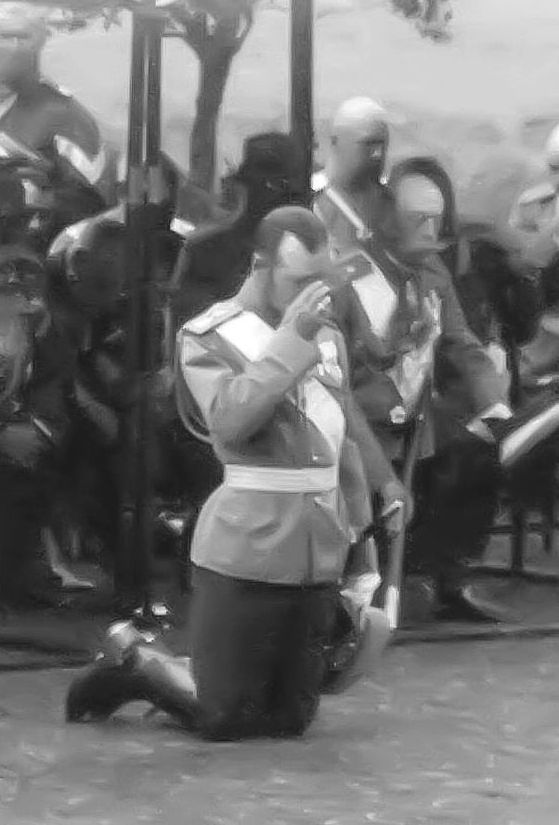
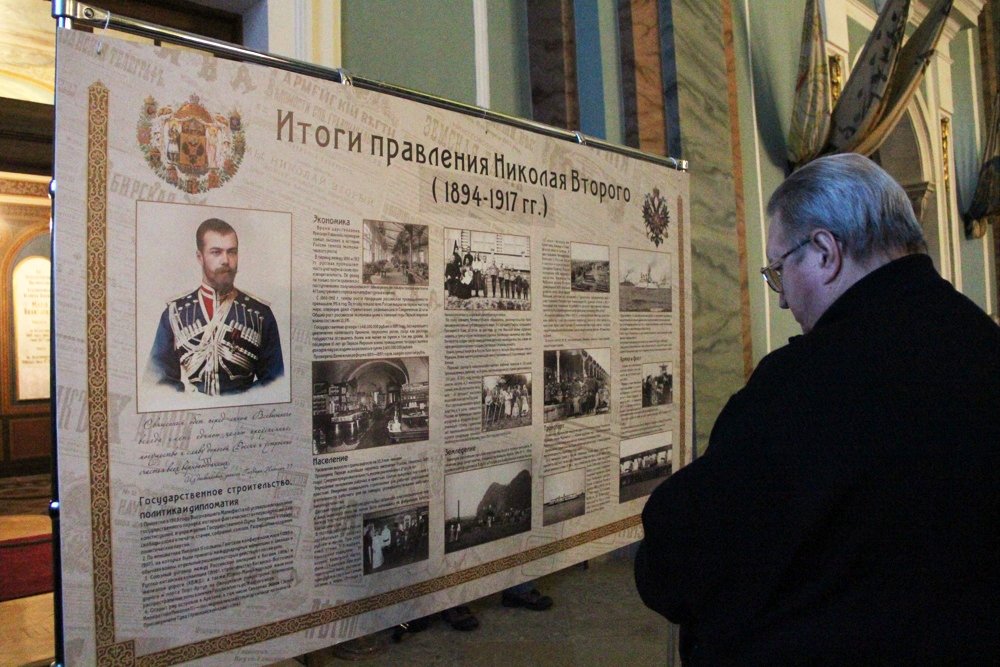
Photos 25 – 28 of Nicholas II

I must apologize for the quality of some of the photographs, however, this is something which I have no control over. Where possible, photographs have been chosen for their visual impact, but historical accuracy has made it vital to include a number of photographs whose quality is poor, but whose value as historical documents is considerable. Sadly, during the Soviet years, many photographs of the Imperial family were stored under poor conditions and their standard is low – PG

© Paul Gilbert. 15 February 2019

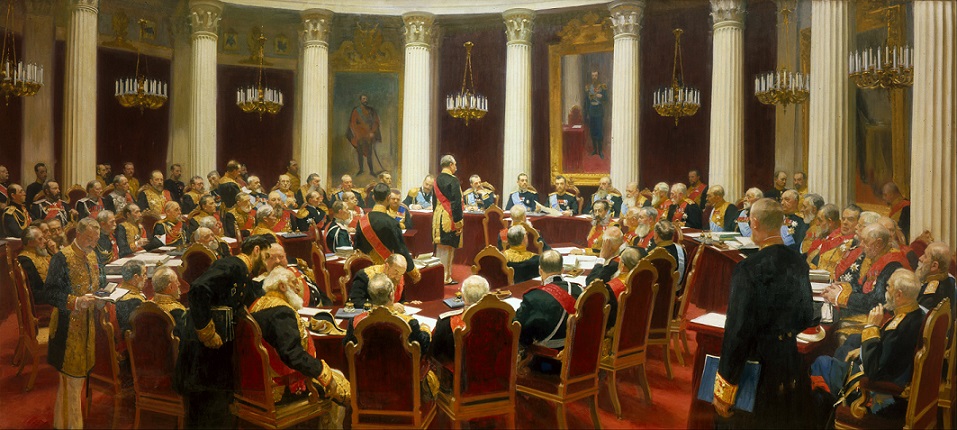
Repin’s ‘Ceremonial Meeting Of The State Council 1901’ to be Displayed in Moscow

The staff of the State Russian Museum in St. Petersburg, have began packing up 78 paintings by Ilya Repin (1844-1930) to participate in an upcoming Ilya Repin exhibition at the Tretyakov Gallery in Moscow.

The most prominent of the paintings in the exhibition is one of the most significant and largest paintings from the collection of the State Russian Museum: the large-format canvas “Ceremonial Meeting Of The State Council 7 May 1901 …,” measuring 4 by 8 meters.

“The Ceremonial Meeting Of The State Council 7 May 1901” – a collective portrait with 81 figures, was painted one hundred and sixteen years ago (1903), in which Repin was paid a large fee. The customer of the canvas, Emperor Nicholas II, was pleased with the result.

The century-old frame of the picture will be left in St. Petersburg – it was decided not to expose it to the dangers of transportation. Only the canvas itself will be carefully packed and transported to Moscow in a special temperature and humidity controlled truck. Then, after careful preparation of the exhibition hall, the painting will be set in a new frame for the exhibit.

019b

The Ceremonial Meeting Of The State Council 7 May 1901. Artist: Ilya Repin, 1903

Founded by Tsar Alexander I (1801-1825), the State Council celebrated its centenary with a ceremonial sitting in the Round Room of the Mariinsky Palace in St. Petersburg on 7 May 1901. All the members of the State Council and the State Chancellery attended in full-dress uniform. Tsar Nicholas II (1894-1917) and senior members of the Imperial family are flanked by their ministers. Repin painted the scene from behind the chairs on the right (next to the columns).

He rapidly sketched the original modello on a canvas on which the perspective of the hall had already been marked out, working from a previously selected point. The artist later turned this study into a large picture with the help of two students from the Imperial Academy of Arts Boris Kustodiev (1878-1927) and Ivan Kulikov (1875-1941). Every member of the State Council is depicted in natural and diverse poses, with strong physical resemblances.

The Ilya Repin exhibition will include works from 26 museums in Russia and abroad, as well as from a number of private collections. The exhibit opens in the New Tretyakov Gallery in Moscow on 16 March, and runs till 18 August 2019.

© Paul Gilbert. 12 February 2019

New Conspiracy Theory Claims Medvedev Descendant of Nicholas II

018c

Prime Minister Dmitry Medvedev and President Vladimir Putin

DISCLAIMER: For the record, I do not support ANY conspiracy theory that ANY member of the Imperial family survived the regicide of 17 July 1918 – Nicholas II, Alexandra Feodorovna, and their five children were all murdered – there were NO survivors!

So, why am I publishing this article? That despite the fact that science has proved that the family perished, new conspiracy theories continue to surface a century after after their deaths. I trust that readers will agree just how ridiculous Solovyov’s article is – PG

Note: after reading the article below, please take a moment to read Why so many people believe conspiracy theories by

***

The latest conspiracy theory making headlines in Russia this week, is that the country’s Prime Minister Dmitry Medvedev is a descendant of Emperor Nicholas II. According to RIA VistaNews correspondent Alexander Solovyov, that while Medvedev is in power, the House of the Romanov protects Vladimir Putin and protects Russia’s interests among the elites of Britain, Spain, Denmark, Norway and other countries with which he has family ties. 

It is no secret that after the crisis in Ukraine in 2014 and the reunification of Crimea with Russia, relations between Europe and Russia have noticeably cooled since. However, they cannot be compared with tensions between the Russian Federation and the United States. Despite the fact that the countries of the European Union supported the anti-Russian sanctions of Washington, many in the EU from the first days opposed hostility with Russia, and today some countries even demand that restrictions on Moscow be lifted. Experts claim that this trend is dictated not by common sense, but by economic factors. At the same time, it cannot be excluded that the Russian Federation today has a powerful lobby in Europe, one in which the Russian Imperial House plays an important part.

018b

Grand Duchess Maria Vladimirovna and Vladimir Putin at Borodino in 2012

The Head of the Russian Imperial House is Grand Duchess Maria Vladimirovna. Although her status continues to be contested by some monarchists, she has a very large influence in Europe not only on the representatives of the Russian diaspora, but also on the political and economic elites of the leading EU countries. For example, her son and the only heir to the Imperial House, Grand Duke Georgy Mikhailovich, is a direct descendant of the British Queen Victoria and stands 140th in the order of succession of the British throne. In addition, he has family ties with many of the now-reigning dynasties of Europe. The grand duke is the cousin of Prince Charles of Wales and the cousin of the former King of Spain Juan Carlos, and the nephew of King of Norway Harald V, King of Sweden Carl XVI Gustav and Queen of Denmark Margrethe II. Family ties with the monarchies of the leading countries of Europe allow the Romanovs to have influence on the highest circles of European society. Understanding the importance of allied and partner ties with Europe against the background of constantly growing relations with the United States, Russian President Vladimir Putin certainly did not neglect the opportunity to take advantage of the position of Grand Duchess Maria Vladimirovna and her family. Perhaps no other role in their relationship is played by none other than Dmitry Medvedev.

As is known, the head of the Russian Imperial House actively supports the policies of President Putin. The head of state has long given the grand duchess due respect and contributes to the development of the historical memory of monarchism in Russia. Moreover, the closest rapprochement between the Kremlin and the Romanovs falls on the very period of the presidency of Dmitry Medvedev. The crown of respect for the person of the Grand Duchess and her family was the transfer in 2012, under her patronage of the guard ship “Yaroslav the Wise” of the Baltic Fleet of the Russian Navy. Relations with the Imperial House developed so rapidly that in 2014 the grand duchess, partially recognized as the heiress of the Russian throne , supported Vladimir Putin’s decision to reunify Crimea to the Russian Federation. And this is despite the fact that the position on this issue in Europe was very ambiguous. In 2018, she, together with her son George Mikhailovich, visited the peninsula and drove along the newly built Crimean bridge. Maria Vladimirovna also actively protects the position of the Russian leadership in the EU countries, which, perhaps, was one of the reasons for the rise of pro-Russian sentiments in a number of European countries.

018a

Dmitry Medvedev and Emperor Nicholas II

But what does Dmitry Medvedev have to do with it? Several years ago, collages began to appear on the Internet of  Vladimir Putin’s closest ally, with what many saw as an amazing resemblance to the last Russian emperor, Nicholas II. The prime minister turned out to be similar to the tsar, not only in the shape of his face and physique, but also in the outlines of his eyes, nose, and hair. Talking about Medvedev’s kinship with Nicholas II did not come as a joke, however, if you dig deeper, you can find very strange coincidences. For example, some historians have recently allegedly established the connection of the family of Dmitry Anatolyevich with the murderers of the tsar. The network referred to genealogy studies which allegedly show that the grandfather of the Prime Minister of Russia Afanasy Fyodorovich was the nephew of Mikhail Medvedev. The latter, under the command of Yakov Yurovsky, the head of the Imperial family’s guard, a member of the Ural Regional Cheka Collegium, on July 17, 1918, according to official data, shot Nicholas II, his spouse Alexander Fedorovna, and their children, among whom was a very young Tsarevich Alexei.

Conspiracy theorists have repeatedly stated that the Imperial family were not shot on that day. The credibility of those tragic events is still disputed by some historians. In this regard, it is possible that the “Chekists” saved at least the innocent children of Nicholas II, in particular his son Alexei, from being shot. It is likely that Mikhail Medvedev subsequently issued the Tsarevich for his nephew Athanasius Fedorovich. In a strange way, in the biography of Dmitry Medvedev it is indicated that his grandfather was born in 1904 – the same year when Tsarevich Alexei was born. The prime minister himself during numerous interviews about his family and pedigree spoke for some reason reluctantly and evasively. Perhaps Dmitry Anatolyevich was simply afraid that the secret of his origin would be revealed, but the Imperial appearance of the prime minister eventually played a cruel joke on him. It can be assumed that the Russian Imperial House in exile in the person of Grand Duchess Maria Vladimirovna knew about the existence of a direct descendant of Nicholas II. The head of the dynasty itself has repeatedly stressed that the Romanovs have no claim to power in Russia. Perhaps this is not required, since the heir to the emperor “Dmitry I” is already in the leadership of the country, and in return for this, Maria Vladimirovna and her family provide the lobby of Russia and Putin in Europe. Such a disposition suits the grand duchess herself, who, not recognizing Medvedev as heir to the throne, will remain the head of the Imperial House. Experts have long wondered why Vladimir Putin will not get rid of the scandalous prime minister, despite all the hype around his name. Maybe the president specifically holds the descendant of Nicholas II with him to save the union with Europe. In this case, everyone gets what he wants. But does the “heir to the emperor” like this scheme?

© Alexander Solovyov. 10 February 2019


An Imperial Movement: A Society of Tsar Nicholas II

017

During his second talk at the Nicholas II Conference held on 27 October 2018, at St. John’s Orthodox Church in Colchester, England, Archpriest Father Andrew proposed the idea of forming an Imperial Movement or Society in honour of Tsar Nicholas II in the United Kingdom.

The purpose of such a movement or society would firstly be to defend the honour of the Tsar-Martyr Nicholas II and the Imperial Martyrs from the injustices, prejudices and misunderstandings which still surround them.

As a Society based in England, we could have a role to play in the English-speaking world in spreading the Truth about the Imperial Family. A century after the death of Russia’s last emperor and tsar, a society such as this is both timely and important for the sake of historical accuracy and truth.

I myself, am committed to being a part of such a Society, and despite the fact that the Atlantic Ocean separates England from Canada, I am prepared to travel to England to offer my assistance in helping such a Society to fruition. A first meeting of supporters could prepare a mission statement, select members for a Committee, discuss and organize events, and numerous other projects. 

Please note that the full text of Father Andrew’s talk An Imperial Movement: A Society of Tsar Nicholas II can be found in Sovereign No. 9 Nicholas II Conference Proceedings 2018, available from the Royal Russia Bookshop, Booksellers van Hoogstraten (The Hague, Netherlands), Librairie Galignani (Paris, France), and Amazon (USA)

© Paul Gilbert. 9 February 2019


Photos 21 – 24 of Nicholas II

I must apologize for the quality of some of the photographs, however, this is something which I have no control over. Where possible, photographs have been chosen for their visual impact, but historical accuracy has made it vital to include a number of photographs whose quality is poor, but whose value as historical documents is considerable. Sadly, during the Soviet years, many photographs of the Imperial family were stored under poor conditions and their standard is low – PG

© Paul Gilbert. 9 February 2019

Religion and the Church Under Nicholas II

016d

The Russian Orthodox Church under Emperor Nicholas II flourished. In 1914, it consisted of 68 dioceses, 54,923 churches, 953 monasteries, 4 theological academies, 185 religious schools, 40,530 schools and 278 periodicals. The clergy consisted of 157 bishops, 68,928 priests, 48 ​​987 clerics, 21,330 monks in monasteries and 73,229 nuns in convents.

Emperor Nicholas II, as a Christian Sovereign, was the Supreme Defender and Guardian of the dogmas of the predominant Faith and is the Keeper of the purity of the Faith and all good order within the Holy Church.

The sovereign was the first of the Russian monarchs to approve the holding of the Local Council. He actively sought the canonization of Seraphim of Sarov, and in 1903 he led the celebration in Sarov, where 150,000 pilgrims gathered. During his reign, Theodosius Uglitsky, Joasaph Belgorod, Patriarch of Moscow and All Russia Hermogenes, Pitirim Tambovsky, John Tobolsky were all canonized saints. In 1895, he personally participated in the acquisition of the Purple Gospel, the rarest manuscript of the sixth century, from the Greek community. Nicholas II personally contributed funds for the publication – 12 volumes of the Orthodox Theological Encyclopedia and 12 volumes of the Explanatory Bible. 

The construction of new churches had the full support of the emperor. During his reign, Nicholas II approved funding for the construction of over 7576 churches and chapels, and the opening of 211 monasteries. 

Under the sovereign father, the structure of the military clergy was formed. By 1917, there were about 5,000 military priests in the army and navy. 

The sovereign attached enormous support for the unity of the Russian Orthodox Church. On 17 April 1905, Nicholas II issued the Edict of Toleration. The decree gave legal status to religions not of the Russian Orthodox Church. This was followed by the edict of 30 October 1906 giving legal status to schismatics and sectarians of the ROC

In 1910, more than half of the parishes had charitable foundations. By 1917, almost all churches and monasteries maintained charitable institutions for the elderly and disabled, orphanages for orphans, which housed more than 600,000 people.

© Paul Gilbert. 7 February 2019

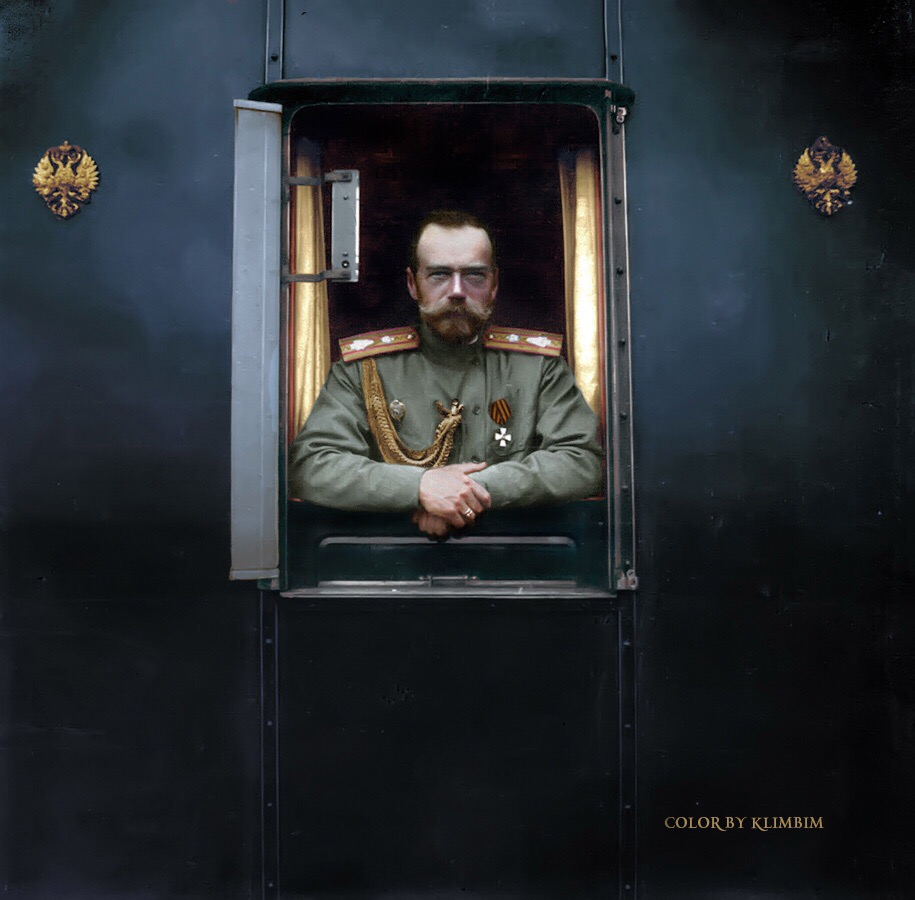
Nicholas II on board the Imperial Train

015

Colourized by Olga Shirnina, also known as Klimbim

This photograph of Nicholas II, standing at the window of the Imperial train is one of the most popular images of Russia’s last sovereign. It has been published in countless books and web pages, but is quite often misidentified at Pskov, after signing his abdication in “1917”. This is incorrect. 

The photograph, is one of a series taken at the Stavka military headquarters at Mogilev in 1915, by one of his daughters. It does not depict a man who has just signed over his throne, but that of a very well-composed Emperor and Tsar.

Click HERE to view more of Olga Shirnina’s excellent colourization of vintage photographs of famous Russians, including many images of Nicholas II and his family.

© Paul Gilbert. 4 February 2019

‘My mission to clear the name of Russia’s last tsar’ – Paul Gilbert

newbanner

This year marks the 25th anniversary of Royal Russia. Since 1994, I have dedicated myself to the full time research and writing on the Romanov dynasty, their legacy, and the history of Imperial and Holy Russia. I have been able to accomplish this through my web site, news blog, and Facebook pages, nearly 30 working visits to Russia, and the publication of numerous books and journals.

My primary interest has always been the life and reign of Russia’s last emperor and tsar Nicholas II. Beginning in 2019, I will be devoting much of my time and resources to the research and writing on the much slandered tsar.

In 1967, Pulitzer Prize–winning author Robert K. Massie released Nicholas & Alexandra. To date, it has sold more than 7 million copies, and translated into dozens of languages including Russian. In 2012, Random House issued a new edition containing much new information. Thanks to Massie’s book, millions of readers were given a fresh and very different look into the life of Russia’s last tsar. Instead of the ‘Bloody Nicholas’ portrayed in Bolshevik propaganda, Massie introduced his readers to a devoted husband and loving father, one who was dedicated to his God anointed position as autocratic ruler of the Russian Empire.

In the last 50 years, Massie’s now classic work opened a floodgate of new biographies and studies by Western historians (both professional and amateur). They claim that their works are the final say on the life and reign of Nicholas II. They do not! 

‘Re-examine all that you’ve been told . . . dismiss that which insults your soul’

Walt Whitman’s famous words are a reminder that it is now time to re-examine the many biographies and studies of Nicholas II, published in the past half century by Western historians.

Sadly, many of them have rehashed the many myths and lies about Nicholas II which were planted more than a century ago by his detractors, and allowed to germinate during the 20th and into the current century.

Their works are based on resources made available to them during their research. Having said that, however, much of that research remains stuck in the 1960s and 70s. It is time to take a fresh look at their works, re-evaluate and compare them to the research of their post-Soviet Russian contemporaries.
issues

SOVEREIGN

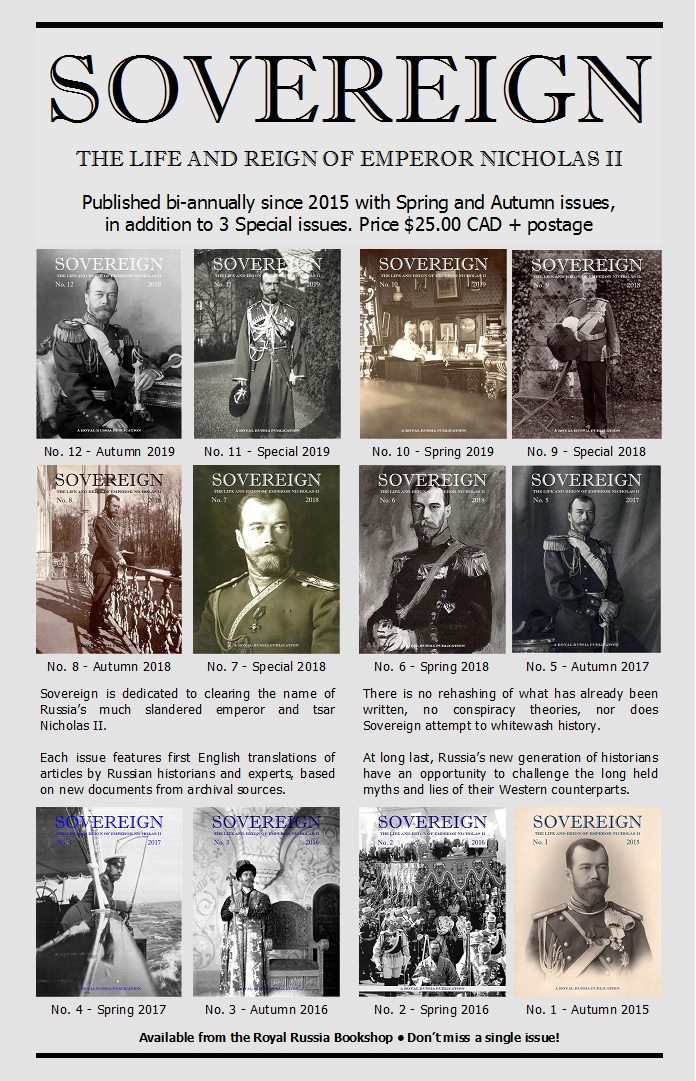
It was the enduring myths and lies about the reign of Russia’s last emperor and tsar, which compelled me to launch the publication Sovereign: The Life and Reign of Emperor Nicholas II in 2015. Published bi-annually (Spring and Autumn), this unique journal gives voice to Russian historians, and features research based on new documents discovered in Russian archives since the fall of the Soviet Union.

By the end of this year, a total of 12 issues will have been published, including 3 Special Issues: No. 7 – Tsar’s Days in Ekaterinburg, July 2018; No. 9 – Nicholas II Conference Proceedings, October 2018; and No. 11 – the Royal Russia Papers.

Sovereign gained a much wider readership in 2018, the year marking the 150th anniversary of the birth, and the 100th anniversary of the death of Nicholas II. This was thanks to a full page colour advert in the July issue of Majesty Magazine, the Nicholas II Conference held in Colchester, England, and numerous media coverage.

img_0444 (1)

Paul Gilbert at St. John’s Orthodox Church, Colchester, England

NICHOLAS II CONFERENCE

As noted above, 2018 marked the 150th anniversary of the birth, and the 100th anniversary of the death and martyrdom of Nicholas II. It was such an honour to organize and host the Nicholas II Conference at St. John’s Orthodox Church, in Colchester, England, on 27th October,

More than 100 people from 11 countries attended this historic event, which featured 5 speakers, who presented 7 papers on the life, reign, and sainthood of Russia’s last tsar. The proceedings have been published in the No. 9 2018 issue of Sovereign.

This historic event received congratulations and support from the Russian, Serbian, and Greek Orthodox Churches, as well as the Head of the Russian Imperial House HIH Grand Duchess Maria Vladimirovna.
0176d

MEDIA INTEREST

In 2018, I participated in a a special 6-part video series commemorating the Romanovs Martyrdom Centennial, prepared by the Monastery of St John the Forerunner Mesa Potamos. Click on the above image to watch part 5, my interview The Conspiracy Against Nicholas II.

I was also the subject of an interview for the English language Russia Beyond (a project/brand established by the TV-Novosti company owned by the Rossiya Segodnya which is a state news agency in Russia). Click on the following link to read Why does a Brit fight for the truth about Nicholas II and the Romanovs? by Alexandra Guzeva. To date, it has been translated into SerbianGerman, Italian, PortugueseBulgarianCroatian, among several other languages.
untitled2untitled

NEW WEB SITE & FACEBOOK PAGES

I am pleased to announce that a new web site and Facebook page, dedicated to Nicholas II have been launched. My NEW Facebook page was launched on 1st January, and my NEW web page was launched on 22 January. Both feature articles, news from Russian media, exhibitions, videos, photos, book reviews, and more. Please click on the above banners to review each of them.

Both will present articles and news which acknowledge the many accomplishments made by Nicholas II during his reign from 1894-1917. In an effort to present a more honest assessment of his life and reign, the widely held negative myths and lies, will be discussed and debunked with new facts and information. 

The Facebook page also includes a link to the my new discussion group Царебожники / Tsarebozhnikiwhich was launched on 18th May 2018, the day marking the 150th anniversary of the birth of Nicholas II.

Tsarebozhniki brings together adherents of Nicholas II to discuss his life and reign, and features current news, review books and documentaries, photos, videos, and more. This group is open to Russophiles, Romanovphiles, Orthodox Christians, monarchists, and others who share an interest in Russia’s last sovereign and Christian monarch. Tsarebozhniki currently has more than 600 members.

NEW PUBLISHING PROJECTS

After downsizing many projects affiliated with Royal Russia, I can now focus on a number of publishing projects, which I have planned or are nearing completion.

These include: Nicholas II. Portraits & Monuments (2019); My Russia. Ekaterinburg (2019); Nicholas II in Post-Soviet Russia (2019); and Nicholas II. A Century of Myths and Lies (2020). Note: the covers of the titles depicted above are subject to change prior to publication.

Much of the research which I have put into each of these titles is based widely on my many visits to Ekaterinburg, St. Petersburg, Moscow and Crimea over the years, my own photographs, and Russian language sources, thus presenting much new information to those interested in the life and reign of Russia’s last emperor and tsar.

0117

MY EFFORTS TO CLEAR THE NAME OF NICHOLAS II

My efforts to take a fresh look at the life and reign of Russia’s last emperor and tsar have been met with both praise and indignation.

The praise comes from monarchists, members of the Orthodox community, and adherents to Nicholas II, all of whom do not accept the widely accepted negative assessment of Nicholas II, which has stood for much of the past century.

The indignation comes from Nicholas II’s many detractors, among them Communists, Leninites, anti-monarchists, etc. They accuse me of hagiography. romanticizing or whitewashing the truth, or viewing the reign of Nicholas II through “rose tinted glasses.” So be it! What is so frustrating is that these are the same people who simply refuse to remove their blinders and examine new documents and research discovered in post-Soviet archives in Russia in recent years.

Russian historian Pyotr Multatuli hit the nail on the head when he wrote, “We combine indifference to our own history with our maximalism and categorical judgments. Thus we lose the ability to hear others. Everybody is content with his own biases without thinking that in the case of the holy passion-bearer his opinion is borrowed and that he was too lazy to form his own opinion. More than twenty-five years have passed since the collapse of the USSR, and truthful books on the Imperial Family were published since as early as perestroika. But most people don’t read them and retain the outdated stereotypical views.”

© Paul Gilbert. 31 January 2019

The emperor’s wallet. How much did Nicholas II spend on charity?

banner

Poster for the international scientific conference “The Righteous Live Forever …”

On 24-25 January 2019, an international scientific conference “The Righteous Live Forever …” was held in the Peter and Paul Fortress in St. Petersburg.

The conference, which was organized by the Elisavetinsko-Sergievsky Educational Society Foundation, was the conclusion of events marking the 100th anniversary of the murders of members of the Russian Imperial Family in 1918 and 1919 by the Bolsheviks.

Often acting anonymously

One of the central themes of the conference was the enormous charitable activities carried out by the Imperial family. According to historians, the Bolsheviks did much to shape a negative image of the Imperial family. They created myths that Nicholas II spent enormous funds for his own needs, although in fact he and his family lived quite modestly. In addition, each member of the Imperial family had their own personal “charity programs,” making sizable donations from their own pockets, for the maintenance of hospitals, educational institutions, and other charitable organizations. 

Nicholas II had enormous funds at his disposal, however, an annual budget of the Imperial Court was strictly adhered to, which included the personal expenses of the family. There were strict calculations, in which even the purchase of new clothes was regulated, says historian Professor Igor Zimin, one of Russia’s foremost experts and author of numerous books on the last tsar and his family. 

The Russian State Historical Archive has in its collection, an accounting book of Nicholas II. In fact, the ‘Emperor’s Personal Wallet’, record donations he made to a number of charities. These include expenses on pensions, the maintenance of boarders and the upbringing of children, donations, allowances, gifts and cash awards. Plus extraordinary expenses that went in favor of educational or charitable institutions, including churches. The accounting book records various sums of donations – 16,400 rubles, 44 thousand rubles, 11 thousand, 500 rubles, etc.

wx1080

Delegates attending the conference held on 24-25 January in St. Petersburg

The sovereign received a large amount of correspondence with requests to help or participate in charity events. It is recorded that in 1898, Nicholas II gave 5 thousand rubles for the completion of an Orthodox church in a remote region of Russia. And to help someone’s widow he gave out 350 rubles annually from his own funds. The first St. Petersburg State Medical University emerged largely due to the participation of the emperor. Often the sovereign acted anonymously. In 1901 he ordered the transfer of 50 rubles to the editorial office of a magazine for Russian disabled persons – as an anonymous donation.

Help and aid

According to Professor Zimin, all members of the Imperial family considered it their direct duty to help and give to those less fortunate. The expenses of the Romanovs grew precisely because donations increased every year.

The Emperor’s wife, Alexandra Feodorovna, initiated the annual Christmas trees for children from poor families. She contributed to the founding of numerous educational institutions, shelters, and hospitals. She worked as a Red Cross Nurse when the war between Germany and Russia began in 1914. It is impossible to imagine the spouse of a member of the Politburo working as a nurse in a soldiers’ hospital during Soviet times. During the war, her children asked that in lieu of gifts, that the money be given to help orphans and soldiers. 

“Once the sovereign with his family stopped at one of the railway stations. A local official turned to him telling the tsar that his small salary was not enough for his large family. Nicholas II promised that he would receive 30 rubles a month, and his son and heir Tsesarevich Alexei said that he would add another 40 rubles a month,” notes Chief Specialist of the State Archive of the Russian Federation Vladimir Khrustalev.

4_1b71481d

Information boards told the story of the Imperial family’s philanthropy

“The Grand Duchesses Olga and Tatiana headed committees which provided direct assistance to those who suffered in hostilities as well as their families,” says the head of the history department of Kaliningrad State Technical University, Professor Alexei Khitrov.

Their respective committees created more than a dozen forms of assistance and 30 projects to collect donations. All those in need received money, clothes, and work. They had the support of local governors, representatives of the diocese, zemstvo, city public administration, leaders of the nobility, and representatives of charitable organizations. 

In cooperation with the central government and the patronage of the Imperial Court, this created a system of democratic centralism, working effectively through the years of the First World War. In 1914, thousands of refugees from the Polish and Baltic provinces flooded into Russia. But thanks to the work of the committees, they were all fed, clothed and sheltered. 

The Olginsky and Tatiana Committees distributed 68 million rubles in aid. There were no allegations of corruption, dishonesty, or wasting money.  By the beginning of 1917, the committees set up work on registering and assisting refugees. The Olginsky and Tatiana committees were recognized as the most viable of all the institutions of that time. They worked effectively until the spring of 1918, after the Russian Empire crumbled under the Bolshevik order.

© Paul Gilbert. 31 January 2019

Photos 17 – 20 of Nicholas II

I must apologize for the quality of some of the photographs, however, this is something which I have no control over. Where possible, photographs have been chosen for their visual impact, but historical accuracy has made it vital to include a number of photographs whose quality is poor, but whose value as historical documents is considerable. Sadly, during the Soviet years, many photographs of the Imperial family were stored under poor conditions and their standard is low – PG

© Paul Gilbert. 30 January 2019