Faithful to the End: Prince Vasily Alexandrovich Dolgorukov (1868-1918)
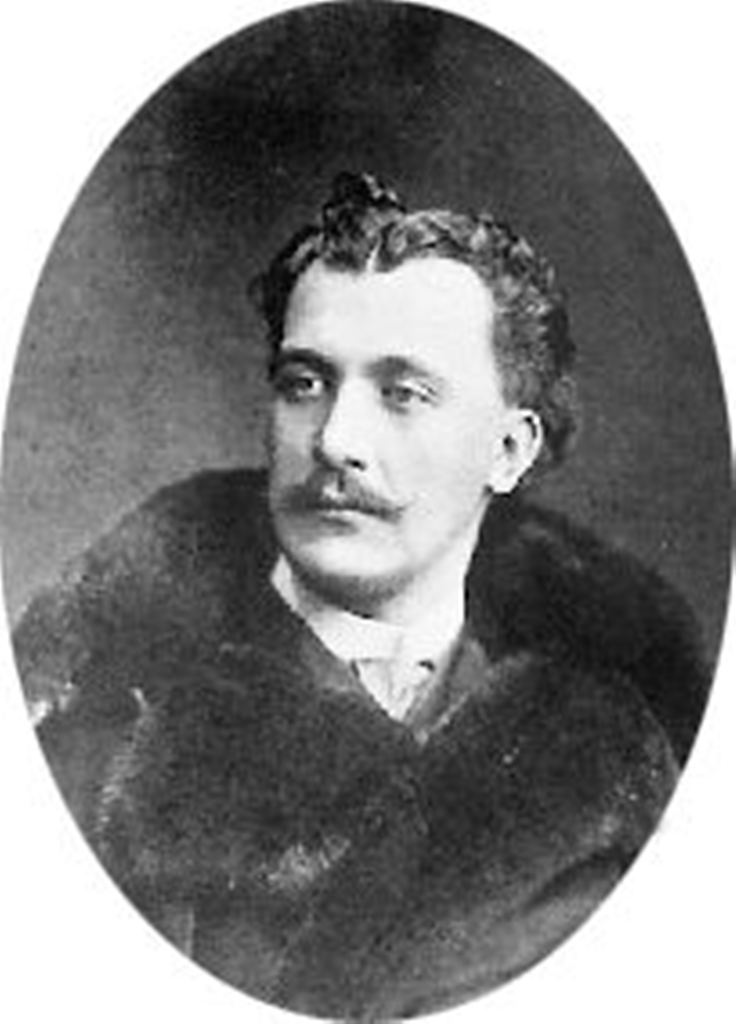
Prince Vasily Alexandrovich Dolgorukov (1868-1918)

Prince Vasily Alexandrovich Dolgorukov was born on 13th August 1868, in Karlsruhe, Baden-Württemberg. He was one of three children born to Prince Alexander Vasilyevich Dolgorukov (1839-1876) and Princess Maria Sergeevna, née von Benckendorff (1846-1936). Vasily had a sister Olga (1865-1961) and a brother Alexander (1866-1919). His mother outlived both of her sons.

Vasily’s mother served as a maid of honour at the Imperial Court. His father was known as “a bitter man and violent drunkard”, who was killed in a duel in 1876. On 29th September 1897, Maria entered into a second marriage to Count Paul Leopold Johann Stephan Graf von Benckendorff [later, the famous Pavel [Paul] Konstantinovich Benckendorff (1853-1921), who served as Chief Marshal of the Imperial Court, and member of the inner circle of Emperor Nicholas II. The couple had no children.

In 1880 Vasily graduated from the Corps de Pages. He then served as a cornet in the Life Guards Cavalry Regiment, and in March 1904, he was promoted to colonel and commanded a squadron.
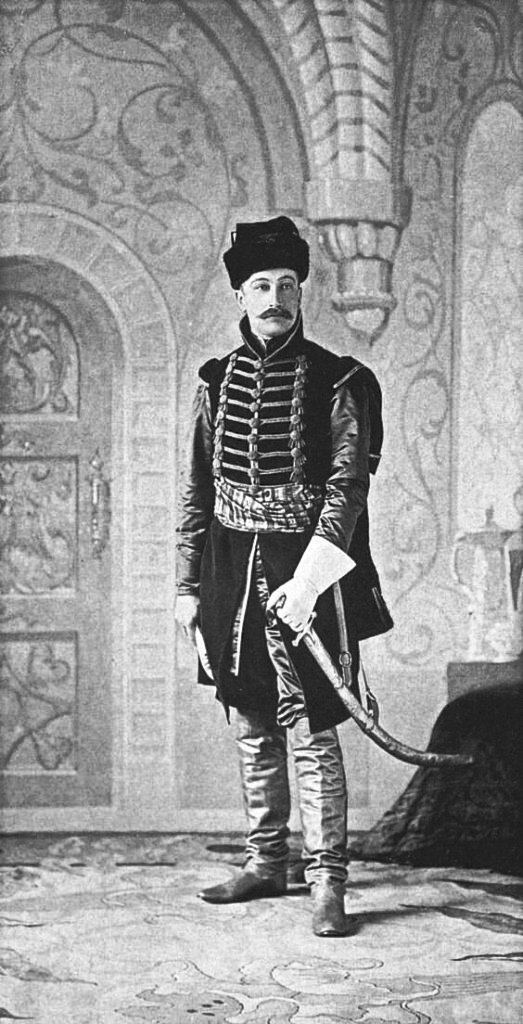
PHOTO: Dolgorukov dressed in 17th-century costume, for the
famous Costume Ball, held in the Winter Palace in February 1903

In 1896, he was appointed aide-de-camp to His Imperial Majesty Emperor Nicholas II.

From 16th March 1910 to 3rd March 1912, Vasily served as commander of the 3rd Novorossiysk Dragoon Regiment. In March 1912, he was promoted to the rank of Major General and enlisted in the retinue of His Imperial Majesty. He served as commander of the Life Guards Horse Grenadier Regiment from 3rd March, 1912 to 4th February 1914. From 3rd March 1912 to 4th February 1914). February 4, 1914 – July 23, 1914 – commander of the 1st Brigade of the 1st Guards Cavalry Division.

From 23rd July 1914 he was appointed Knight Marshal of the Court of His Imperial Majesty Emperor Nicholas II. During the First World War, Vasily was at the Headquarters of the Supreme Commander-in-Chief, first at Baranovichi, and from 8th August 1915 – in Mogilev.

During his lifetime, Vasily Dolgorukov was the recipient of 7 orders of the Russian Empire, and 17 orders from the various courts of Europe.
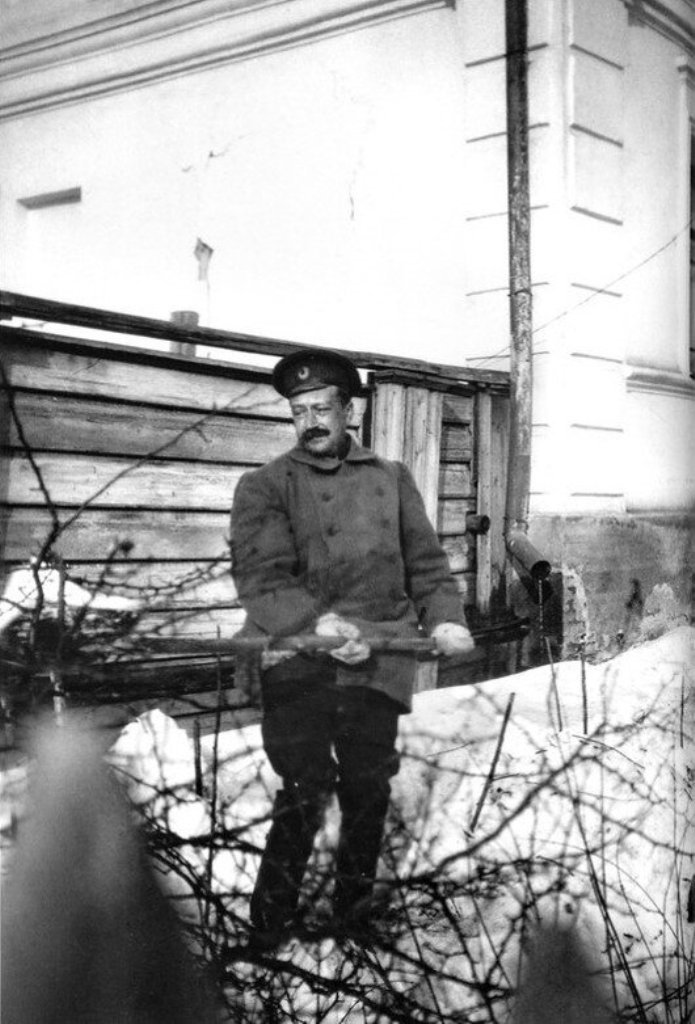
PHOTO: Dolgorukov shovelling snow in the garden of the Governor’s House, where the Imperial Family were being held under house arrest, in the winter of 1917-18

The Emperor and Empress were both very fond of Vasily, and nicknamed him Valya. Vasily Alexandrovich Dolgorukov selflessly served Emperor Nicholas II and remained faithful to his Tsar until his martyrdom.

Following the Tsar’s abdication on 15th March (O.S. 2nd March), he returned to Tsarskoye Selo. Upon his arrival at the station, he was met by Colonel Eugene Stepanovich Kobylinsky (1875-1927), who recalls: “The Tsar was accompanied by many members of his retinue. When the train arrived at the station, the members of the Tsar’s retinue spilled onto the platform and began to quickly scatter in different directions, like rats, looking around, apparently imbued with a sense of fear that they would be recognized. It was a very ugly scene to witness!”

The Tsar got out of the carriage, and quickly moved along the platform, without looking at anyone, and got into the motorcar waiting for him. Of all those who accompanied the Tsar on the train, only one faithful member of his retinue followed him: Prince Vasily Dolgorukov. With dignity, he took a seat in the motorcar next to the Emperor.

The Tsar and his family were placed under house arrest, the Alexander Palace had now become a prison. Dolgorukov often accompanied the Tsar during his walks in the Alexander Park. It was during these walks, that Vasily Alexandrovich tried to come between the Tsar and the guards, protecting the Tsar as much as possible from the rudeness of the unbridled soldiers. In the midst of general fear and betrayal, Vasily Alexandrovich retained courage and fortitude.

Alexander Aleksandrovich Bublikovm (1875-1941), a State Duma deputy and staunch anti-monarchist noted “from the Emperor’s retinue, only the Knight Marshal of the Imperial Court, Prince Dolgorukov, behaved with true dignity!”
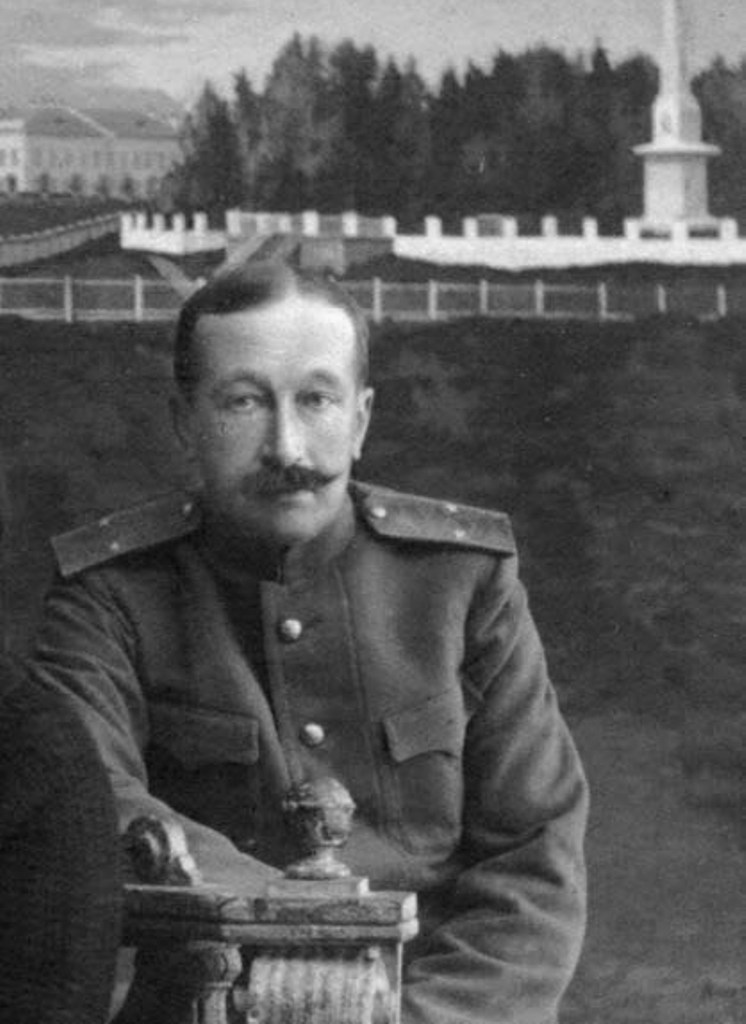
PHOTO: Prince Vasily Alexandrovich Dolgorukov. 1917.

On 14th (O.S. 1st) August 1917, he voluntarily followed the Emperor and his family into exile to Siberia, where they were held under house arrest in Tobolsk until April 1918. During imprisonment, Vasily worked alongside Nicholas in the large garden, sawing wood, clearing the snow, digging in the garden, etc.

The Tsar and Dolgorukov were separated only in Ekaterinburg, the latter, who upon his arrival in the Ural city was arrested on false charges “in order to protect public safety.” He was placed in the political block of the Ekaterinburg prison. The Chekists tried to accuse him of planning the escape of the Imperial Family, although historians call these accusations groundless.

On 10th June 1918, Prince Vasily Dolgorukov, along with General Ilya Leonidovich Tatishchev, were shot in a wooded area near the city’s Ivanovskoe Cemetery. Their bodies were later discovered by a unit of the White Army, and buried in the autumn of 1918 in the cemetery (lost during the Soviet years) of the Novo-Tikhvinsky Convent in Ekaterinburg.

In November 1981, Dolgorukov was canonized by the Russian Orthodox Church Outside of Russia (ROCOR). In October 2009, he was rehabilitated among 52 close associates of the Imperial Family, after a ruling made by the Prosecutor General of the Russian Federation.

On 13th June, a new monument to four faithful servants of Emperor Nicholas II, was installed and consecrated on the grounds of Novo-Tikhvin Convent. The monument features four bas-reliefs, honouring Prince Vasili Alexandrovich Dolgorukov (1868-1918), Lieutenant General Ilya Tatishchev (1859-1918), Tsesarevich Alexei’s “nanny” sailor Klimenty Grigorievich Nagorny (1887-1918) and boatswain Ivan Dmitriyevich Sednev (1881-1918).

Memory Eternal! Вечная Память!

© Paul Gilbert. 21 June 2025
Exhibition dedicated to Nicholas II and his family opens in Istra

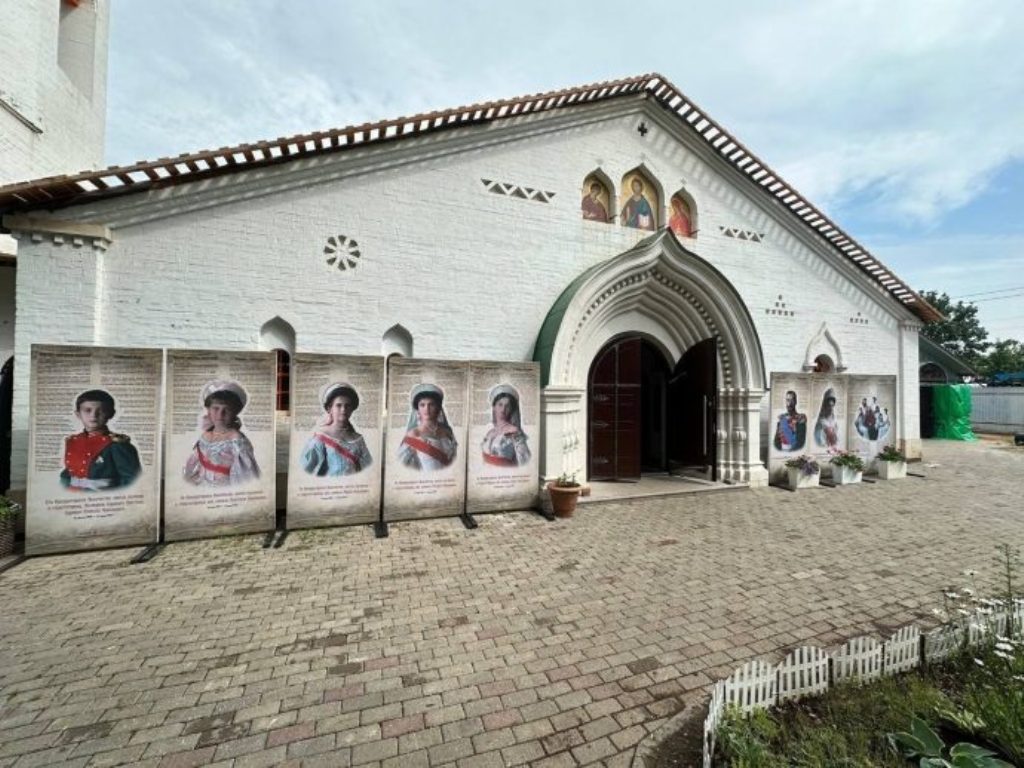
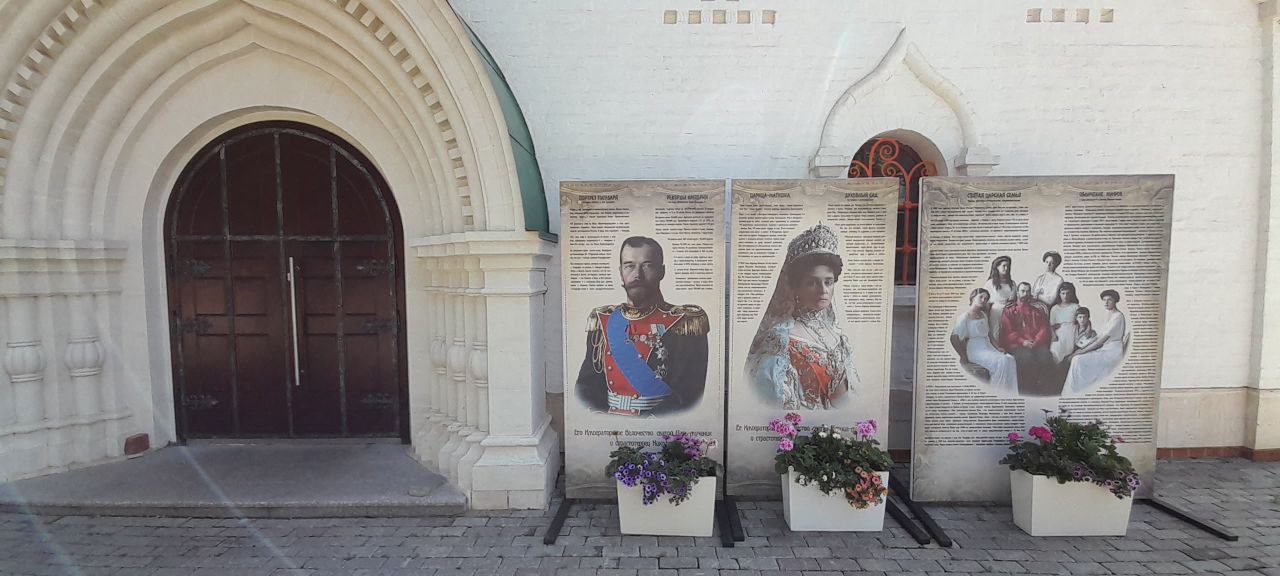
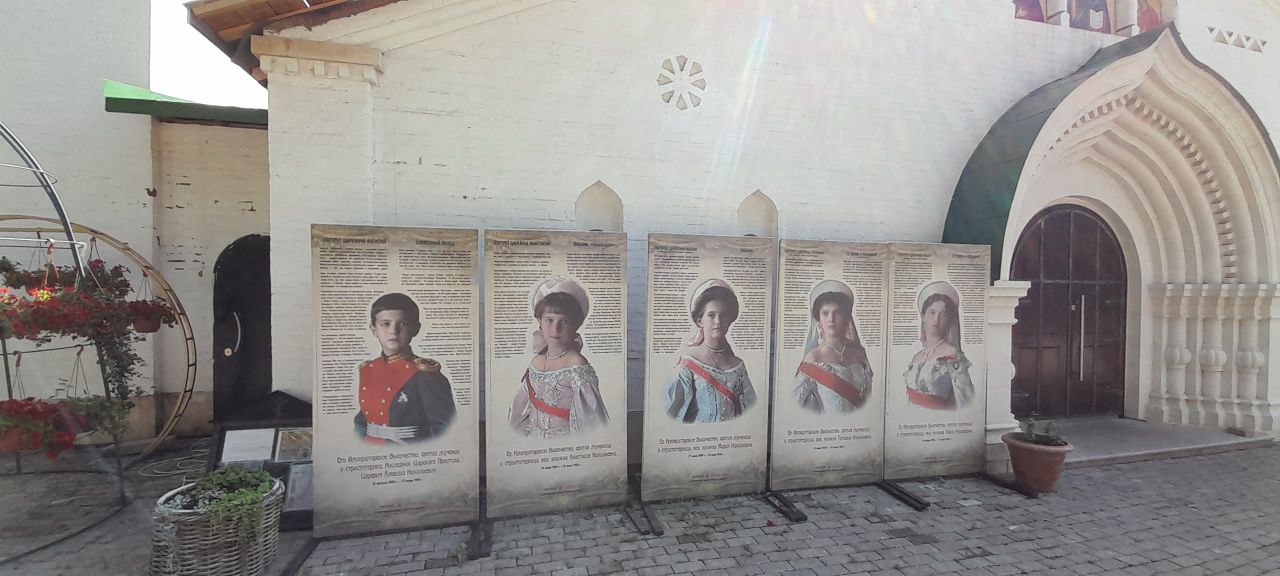
Earlier this month, a unique outdoor exhibit dedicated to Emperor Nicholas II and his family opened on the grounds of the Mironositsky Church [the Church of the Holy Myrrh-Bearing Women] in the Russian city of Istra [Moscow oblast].

The Tsar’s Crown, featured 8 posters, which provide visitors with a deeper understanding of the life of the Imperial Family during the late 19th and early 20th centuries, and their death and martyrdom.

The exhibition ran until June 15, and has now moved to the St. George Church in the city of Dedovsk.

***

*As I have noted in previous posts, I support any initiative – big or small – to help keep the memory of Nicholas II and his family alive in 21st century Russia – PG

© Paul Gilbert. 16 June 2025

Russian court rules on the fate of Tsar’s family grave near Ekaterinburg

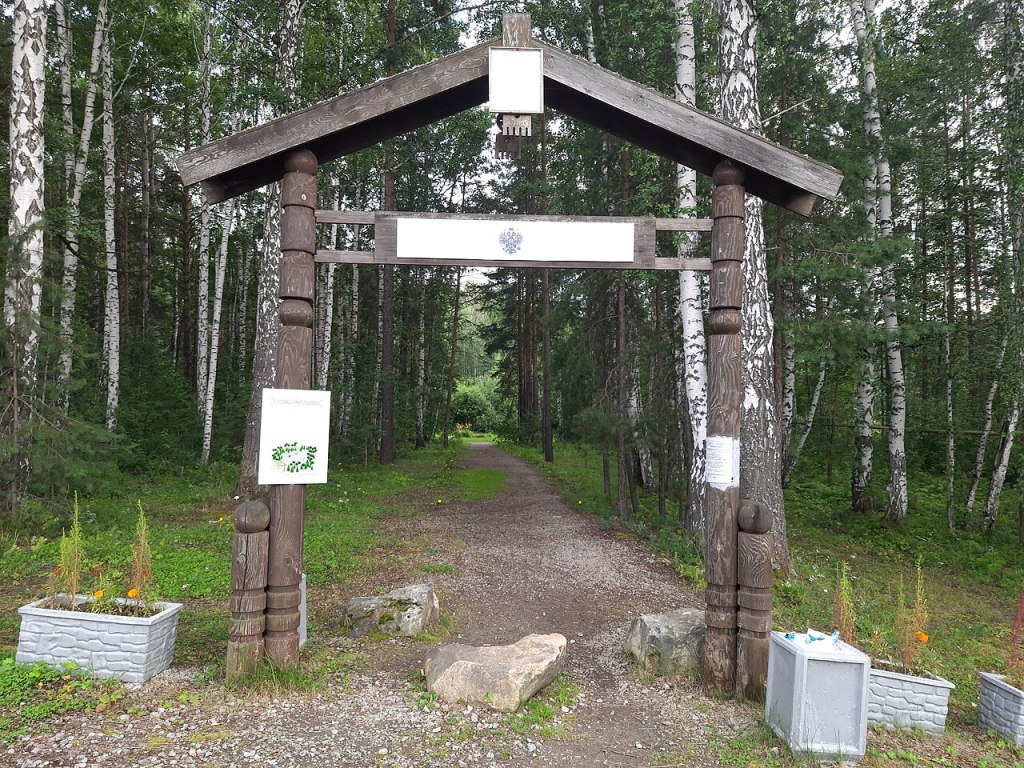
PHOTO: the entrance to the Romanov Memorial at Porosenkov Log

On Monday, 2nd June 2025, the Sverdlovsk Regional Court ruled on the fate of Porosenkov Log, situated on the old Koptyaki Road near Ekaterinburg. The Court’s ruling ensures that the place where the remains of Russia’s last Tsar, his family and their four faithful retainers were found is protected from developers.

Recall that in 2014, the Department of State Protection of Cultural Heritage Sites of the Sverdlovsk Region (UGOOKN) included the Romanov Memorial at Porosenkov Log on the list of protected monuments. However, 10 years later, in September 2024, the state security department removed the memorial’s protective status.

After the decree was issued, workers came to the memorial in Porosenkov Log and removed the information steles. In addition, workers began to remove part of the soil layer around the main grave, without even carrying out any digs to ensure that there were no remaining fragments of the bodies of members of the Imperial Family that have not yet been found. At the same time, no one coordinated the work with the Romanov Memorial Charitable Foundation and it’s founder Ilya Korovin, who has preserved the memorial since July 1999.

To avoid any further destruction of the Romanov Memorial, Korovin was forced to file a lawsuit in the Regional Court. In the lawsuit, Korovin noted that the removal of the protected status jeopardizes the damage or destruction of religious objects. He requested that the Court cancel the order.

The judge of the Sverdlovsk Regional Court, Maxim Rudakov, sided with the charitable foundation and declared the disputed order invalid. The department has a month to appeal. Despite the Court’s ruling, however, Ilya Korovin believes that it is too early to celebrate, since the department can appeal the court’s decision.

Since 2021, the Romanov Memorial Foundation has been fighting against development which threaten Porosenkov Log. Korovin claims that the Russian Orthodox Church wants to build a monastery in Porosenkov Log similar to that in Ganina Yama – the Monastery of the Holy Royal Martyrs.

© Paul Gilbert. 15 June 2025

Nicholas II monument planned for Lugansk

A new monument to Emperor Nicholas II, will be installed in Lugansk, a city with a population of nearly 400,000 people, situated in the Donbass region.

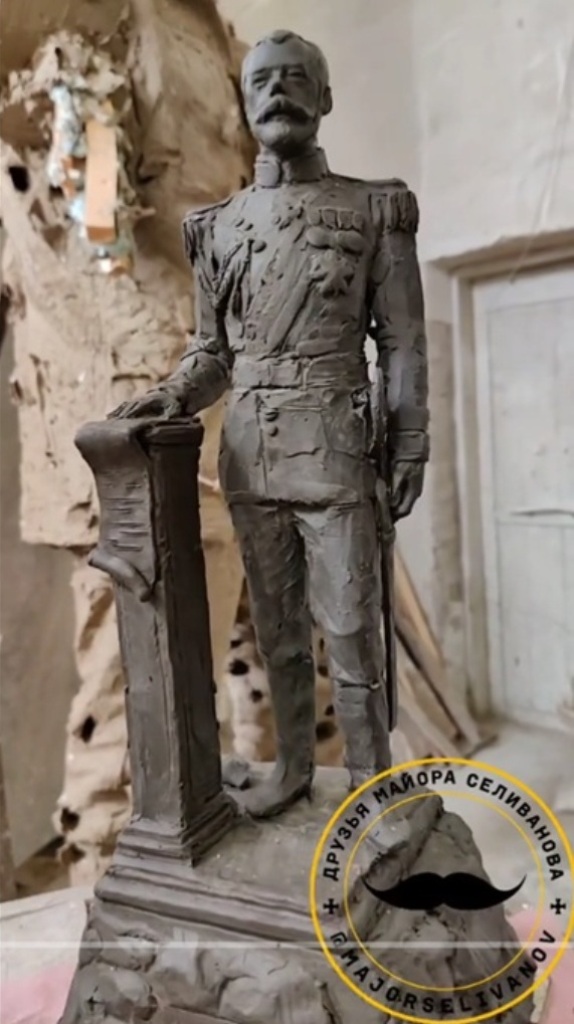
A local Lugansk sculptor, the author of many works, is currently preparing a model of the life-sized sculpture in his studio. The completed monument will stand more than 2 meters [more than 6 ft., including the base] in height.

The monument to the Holy Passion-Bearer Nicholas II is the sole initiative of Lugansk believers. Of the required 2 million rubles [$25,000 USD], they have already collected 330 thousand [more than $4,000 USD].

According to Russian social media, a meeting was recently held with the sculptor, to discuss the correct recreation of the uniform and awards. A decision on the exact location of the monument is expected to be announced shortly, although it is believed that it will be installed on the grounds of a local Orthodox Church in Lugansk.

The Lugansk monument will now make a total of three new monuments to Nicholas II – which are known to this author – that will be installed in various Russian cities within the next year, the others include, one in the Ural city of Verkhneuralsk, the other in St. Petersburg.

© Paul Gilbert. 13 June 2025

Obituary: Maria Dmitrievna Ivanova-Tatishcheva (1930-2025)

Maria Dmitrievna Ivanova-Tatishcheva (1930-2025)

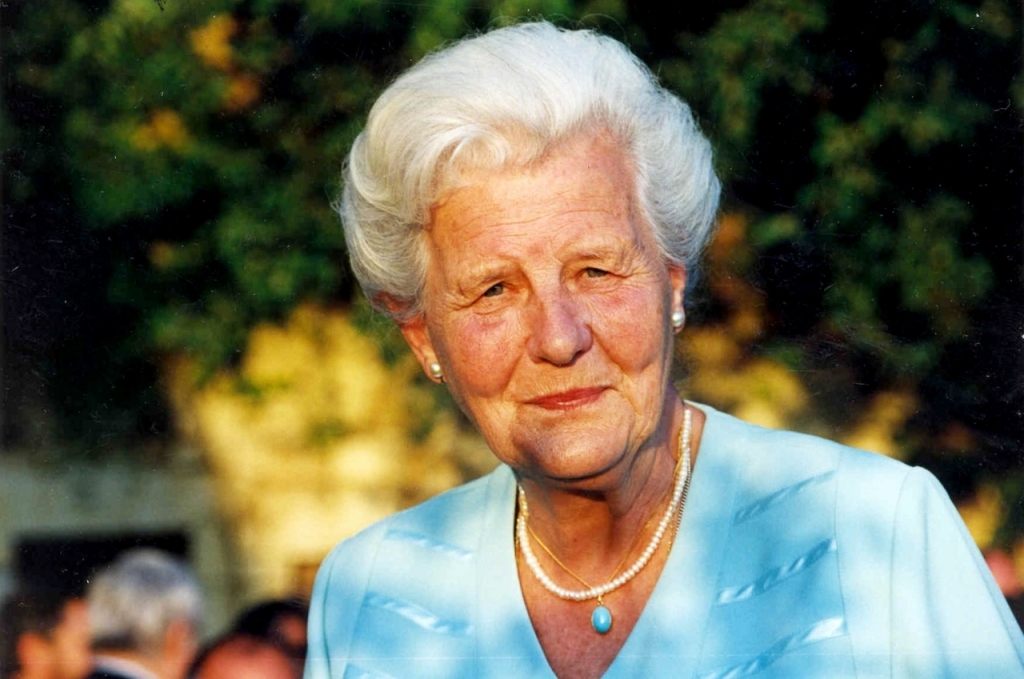
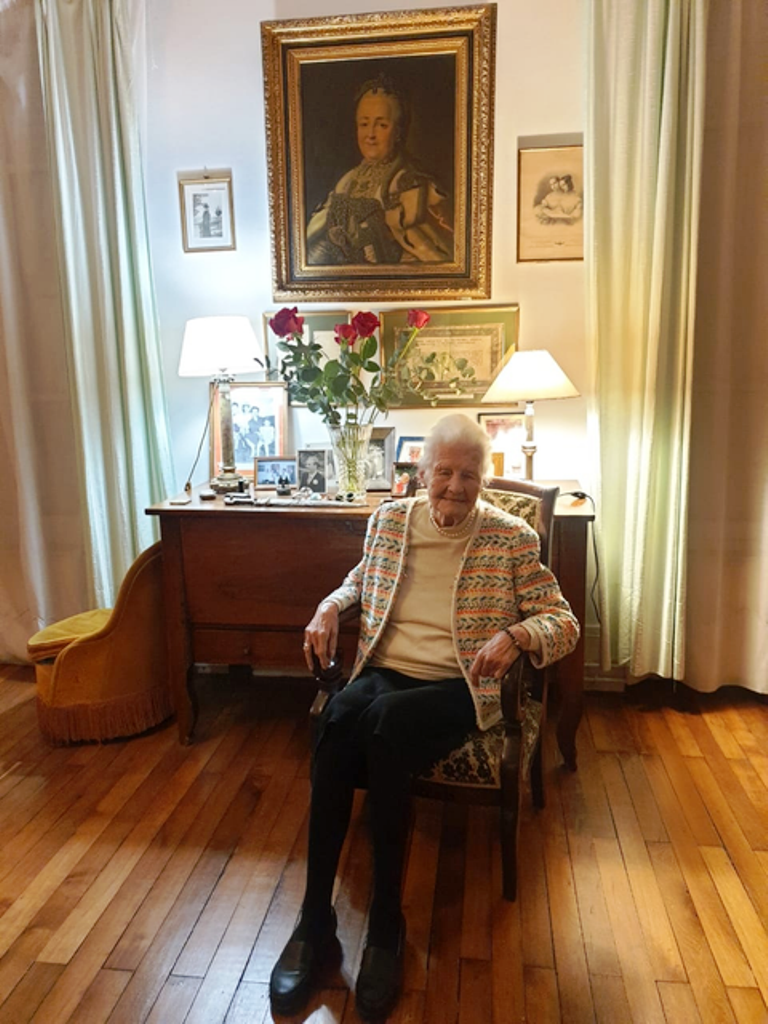
On 27th May 2025, Maria Dmitrievna Ivanova [born Countess Tatishcheva], died in Paris, at the age of 96.

Born in Nice on 26th February 1930, Maria is a direct descendant of the founder of Ekaterinburg, the sixth generation great-granddaughter of Vasily Nikitich Tatishchev (1686-1750), and niece of Adjutant General Vasily Nikitich Tatishchev (1859-1918), a devoted and loyal subject of Emperor Nicholas II.

Maria recalled in her memories: “My father, Count Dmitry Sergeevich Tatishchev (1898-1972), graduated from the Corps of Pages, whereupon he was promoted as an ensign in the Preobrazhensky Life Guards Regiment, in which almost all the Tatishchevs served. He was 18 years old, and after a month of training in St. Petersburg, he was sent to the Front, where he was awarded the Order of St. Anna’s 4th Class for Bravery. But after 4 months the commander of the Preobrazhensky, General Kutepov, disbanded the regiment. . . . Following the Tsar’s abdication and the October Revolution, he joined the North-Western Army of General Yudenich, which fought against the Bolsheviks.”

In 1920, Maria’s father fled Bolshevik Russia. From 1921 he lived in Marseille, then in Nice, before finally setting in Paris. In exile, he dedicated his life to perpetuating the memory of the last Russian emperor. Dmitry Tatishchev served as vice-chairman of the Union of Adherents for the Memory of Emperor Nicholas II [ Союз ревнителей памяти Императора Николая II] an independent, voluntary educational and charitable association of White Russian emigrants and their descendants, who venerated the memory of Emperor Nicholas II and his Family. Dmitry also worked on a Russian-language documentary about Nicholas II. 

In 1929, Tatishchev married Countess Emilia Alekseevna Kapnist (1908-1996), the couple had one child, Maria Dmitrievna Tatishcheva.

PHOTO: Maria Dmitrievna Ivanova [Born Countess Tatishcheva], at her home in Paris

Maria Dmitrievna Tatishcheva lived in Paris, where she devoted her entire life helping Russians who fled Bolshevik Russia after the Revolution, and emigrated to France. In 1948, she began working at the Help Center for Russian Emigrants. The center helped émigrés to find employment, housing, obtain documents and organized children’s shelters.

In 1949, Maria married Yuri Alexandrovich Ivanov (1923-1987). The couple had one son Sergei Yuryevich.

From 1964, Maria headed the Russian parish school at the Cathedral of St. Alexander Nevsky Church in Paris, for children, grandchildren and great-grandchildren of Russian emigrants living in France.

From 1987 to 2000, she was in charge of the Tolstoy Foundation, which helped Russian refugees who emigrated from the USSR.

Maria first went to Russia in 2003, visiting Ekaterinburg, when the city celebrated its 280th anniversary, as a descendant of the founder of the city. It was during this visit to the Ural capital that the head of the Yekaterinburg Metropolia informed Maria that the diocesan Commission for the Canonization of Saints was currently preparing documents for the canonization of her uncle Vasily Nikitich Tatishchev (1859-1918).

Maria Dmitrievna Ivanova-Tatishcheva died in Paris on 27th May 2025. A memorial service was held on Friday, 30th May in the Cathedral of Saint Alexander Nevsky in Paris. She was buried in the Sainte-Genevieve-des-Bois Russian Cemetery, situated 25 km south from Paris.

Memory Eternal! Вечная Память!

***

234b

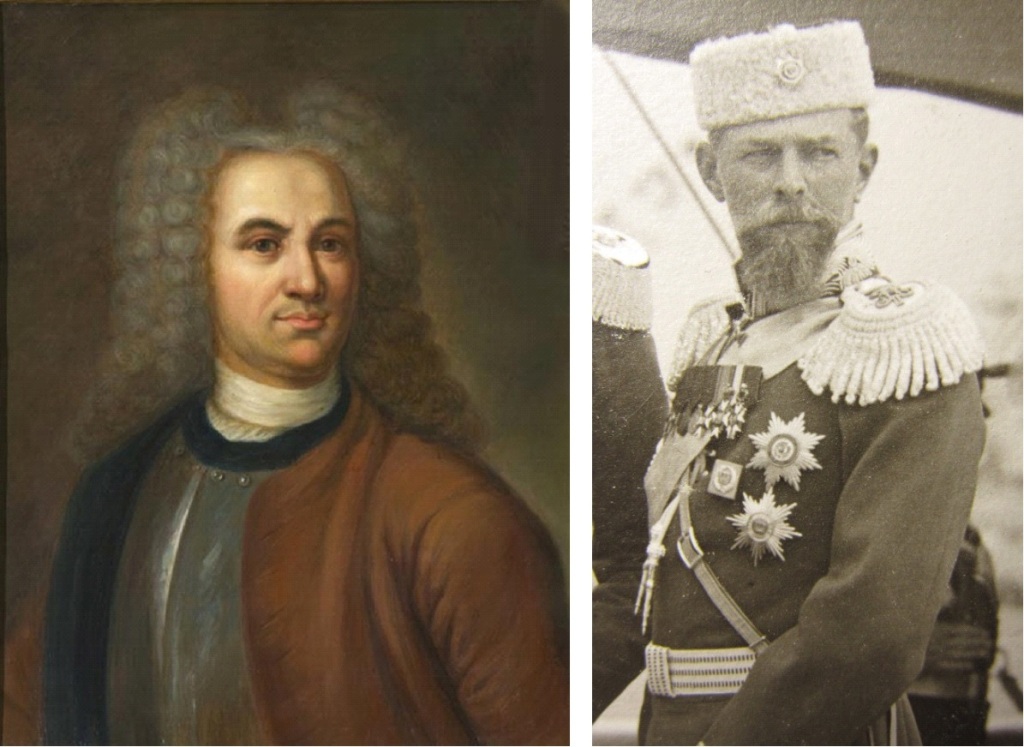
PHOTO: Vasily Nikitich Tatishchev (left) and Ilya Leonidovich Tatishchev (right)

At the invitation of Nicholas II, the devoted Adjutant General Vasily Nikitich Tatishchev followed the Tsar’s family into exile to Tobolsk, where, he played an important role, caring for the august family and offering spiritual support. When Nicholas II and the Empress Alexandra Feodorovna and her daughter Maria left Tobolsk for Ekaterinburg, Tatishchev remained with the Tsar’s children. On 23rd May 1918, upon arrival in Ekaterinburg with Tsesarevich Alexi and the Grand Duchesses Olga, Tatyana, Anastasia, the Adjutant General was separated from the Tsar’s family and imprisoned in Ekaterinburg.

On 10th June 1918 Ilya Leonidovich Tatishchev was shot by the Bolsheviks. According to church historians, he was buried in the cemetery of the Novo-Tikhvin Convent. [Note: Tatishchev’s grace was lost during the Soviet years – PG] 

The head of the Ekaterinburg Metropolis informed Maria Dmitrievna that the diocesan commission for the canonization of saints is currently preparing documents for the canonization of her uncle. [Note: Ilya Leonidovich Tatishchev was canonized by the Russian Orthodox Church Outside Russia (ROCOR) in 1981 – PG]

“It is known that not only did he know the gospel by heart, but lived the life a devout Orthodox Christian.

© Paul Gilbert. 1 June 2025

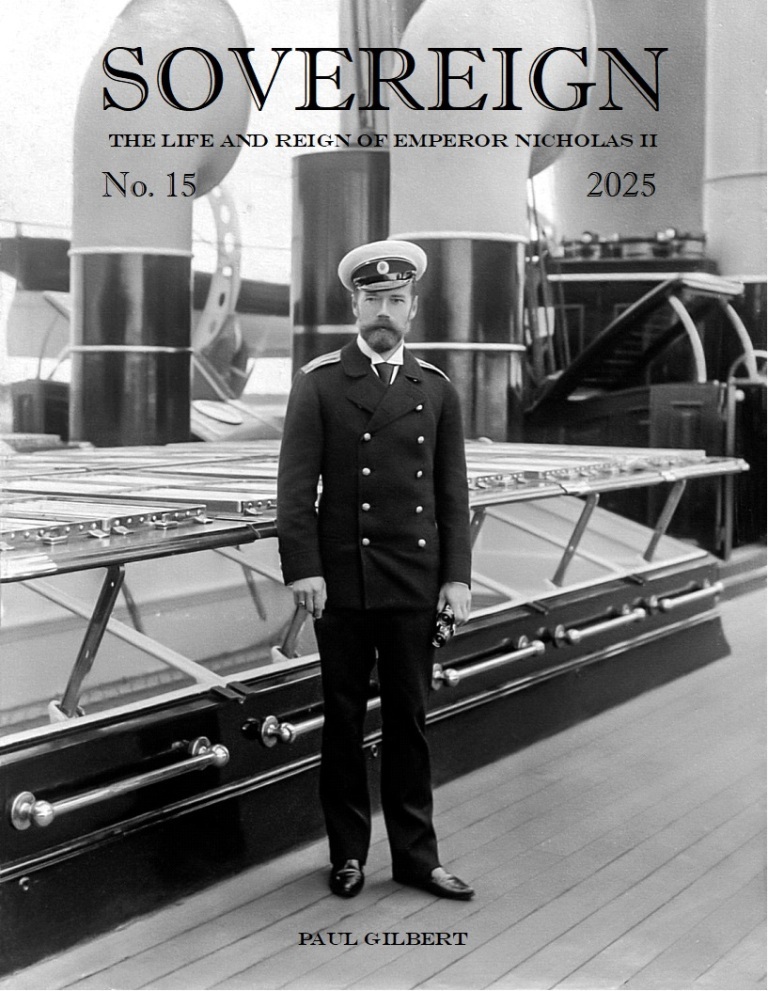
NEW BOOK – Sovereign No. 15 (Summer 2025)

*You can order this title from most AMAZON outlets, including
the United States, United Kingdom, Canada, Australia,
France, Germany, Spain, Italy, Netherlands, Poland, Sweden and Japan
*Note: prices are quoted in local currencies

CLICK HERE TO ORDER THE PAPERBACK EDITION @ $20.00 USD

English. Large format 8-1/2″ x 11-1/2″. 130 pages. 131 Black & White photos

The No. 15 Summer 2025 issue of SOVEREIGN features more than 20 articles about Russia’s last Tsar, his family, the Romanov dynasty and the history of Imperial Russia. These articles have been researched and written by independent historian and author Paul Gilbert. His works are based on new research from Russian archival and media sources.

In an effort to preserve his 30+ years of research, the author has reproduced a selection of the nearly 900 articles he has written for his blog. They are made available in a printed format for the first time. The author has updated many of the articles in this issue with additional information and photos. In addition, this issue features one new First English translation.

The No. 15 issue features the following 23 articles:

[1] Film Review: Nicholas and Alexandra

[2] Smoking: the Tsar’s bad habit

[3] St. Catherine’s Chapel. The Final Resting Place of Nicholas II

[4] What were Lenin’s plans on Nicholas II’s fate?

[5] The “Imperial Palace” of Emperor Nicholas II in Paris – October 1896

[6] The hidden wealth of the Bolshevik devil Yakov Sverdlov

[7] In 1897 Nicholas II approved the Winter Palace to be painted red

[8] Romanov archives of Charles Sydney Gibbes

[9] The Tsar’s Railway Pavilion in Nizhny Novgorod

[10] Ministers of Foreign Affairs During the Reign of Nicholas II

[11] Nicholas II’s little known third brother: Alexander (1869-1870)

[12] Nicholas II’s Diaries 1894-1918

[13] God, Save the Tsar! Боже, Царя храни!

[14] Emperor Nicholas II Foundation Marks 4th Anniversary

[15] Serov Portrait of Nicholas II to be exhibited in London

[16] Faithful to the Tsar and His Family: Pierre Gilliard (1879-1962)

[17] Portrait of Nicholas II returned to Russia from America

[18] What is Nicholas II’s correct date of birth?

[19] New museum dedicated to Nicholas II and his family opens in Pskov region

[20] Reconstruction of the Imperial Train Pavilion at Tsarskoye Selo

[21] The human side of the Tsar

[22] Father Vasiliev: Confessor to the Imperial Family

[23] Obituary: Zurab Konstantinovich Tsereteli (1934-2025)

***

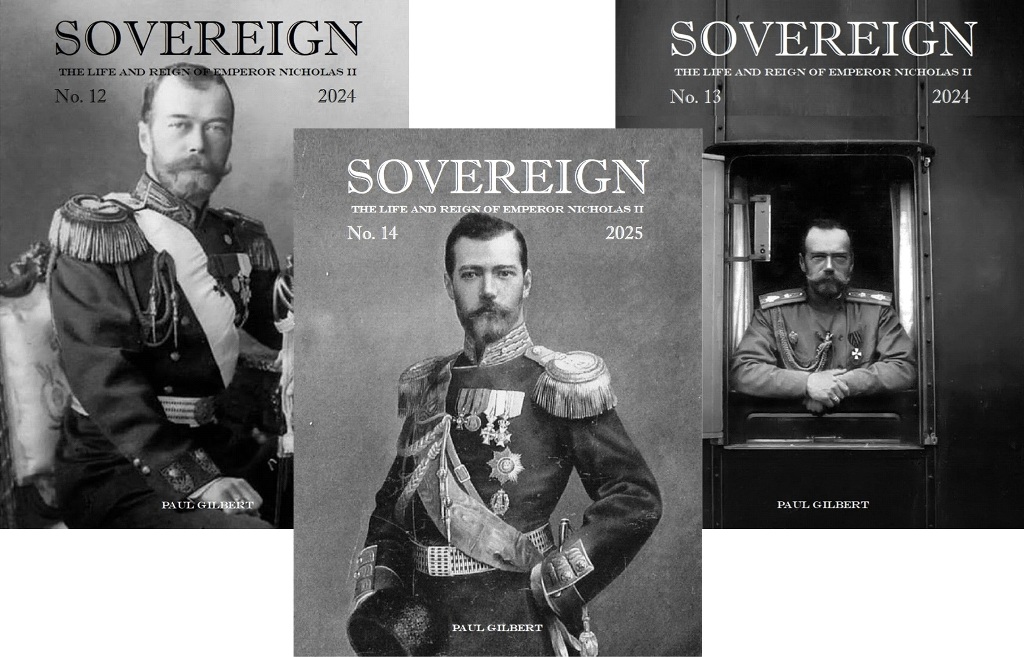
Back issues of SOVEREIGN

No. 14 Winter 2025

No. 13 Summer 2024

No. 12 Winter 2024

NOTE: back issues of Nos. 1 to 12 are now out of print.
Second-hand copies are available on AMAZAON eBay
.

© Paul Gilbert. 1 June 2025

Rare glimpse inside the Tsar’s Railway Pavilion in Nizhni Novgorod

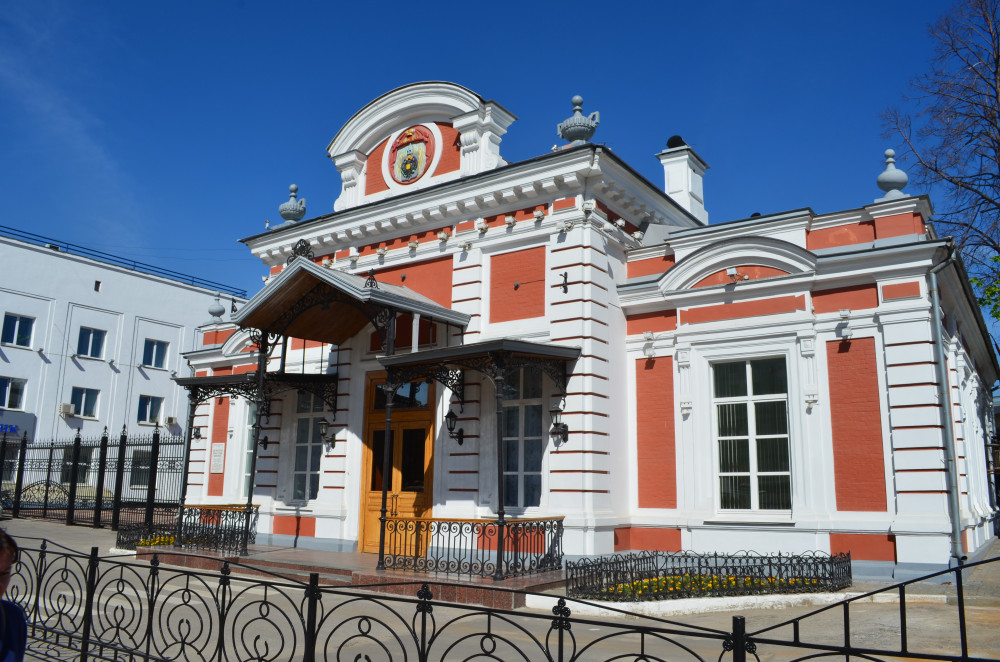
On 17th May 2025, the Tsar’s Railway Pavilion in Nizhni Novgorod opened it’s doors to visitors for a rare glimpse inside to view the building’s historic interiors. The pavilion, which dates back to Tsarist times, has survived to the present day, with many of it’s original elements preserved.

The Pavilion is rarely open to visitors, however, the Gorky Railway opted to take part in this years’ Night of Museums[1]. The Pavilion was only open for four hours, from 19:00 to 23:00. Admission was free. Visitors were admitted in groups of 15 persons at a time. As they entered, they were warmly greeted by harpsichord and harp music, performed by local musicians in the main hall of the building. 

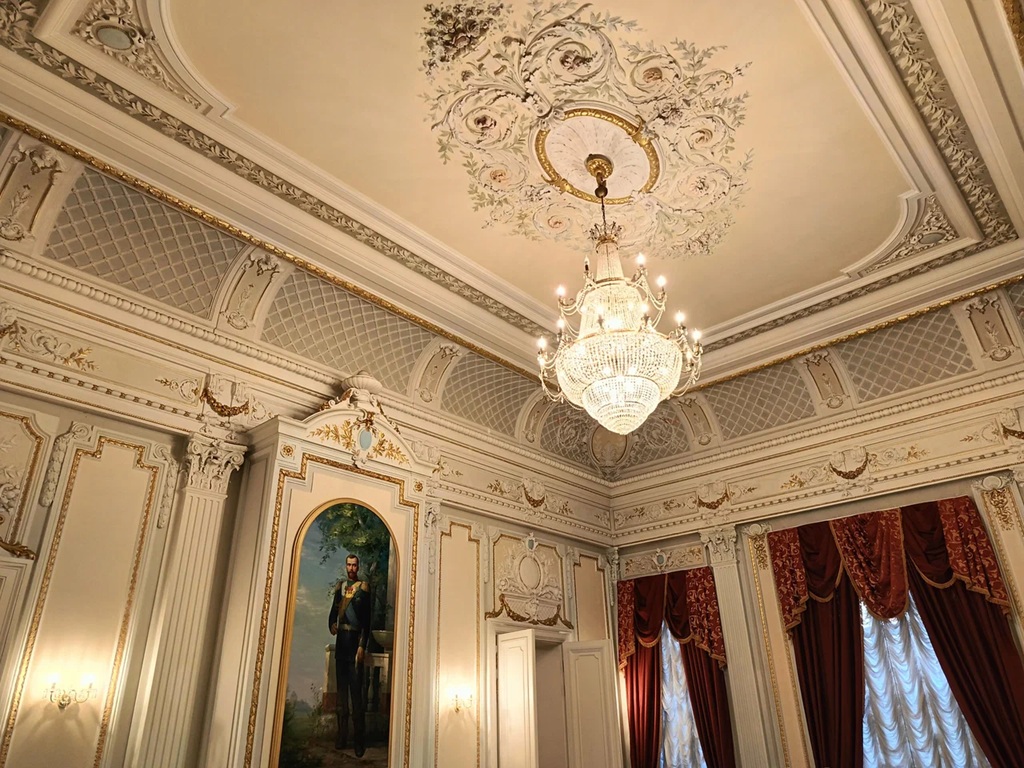
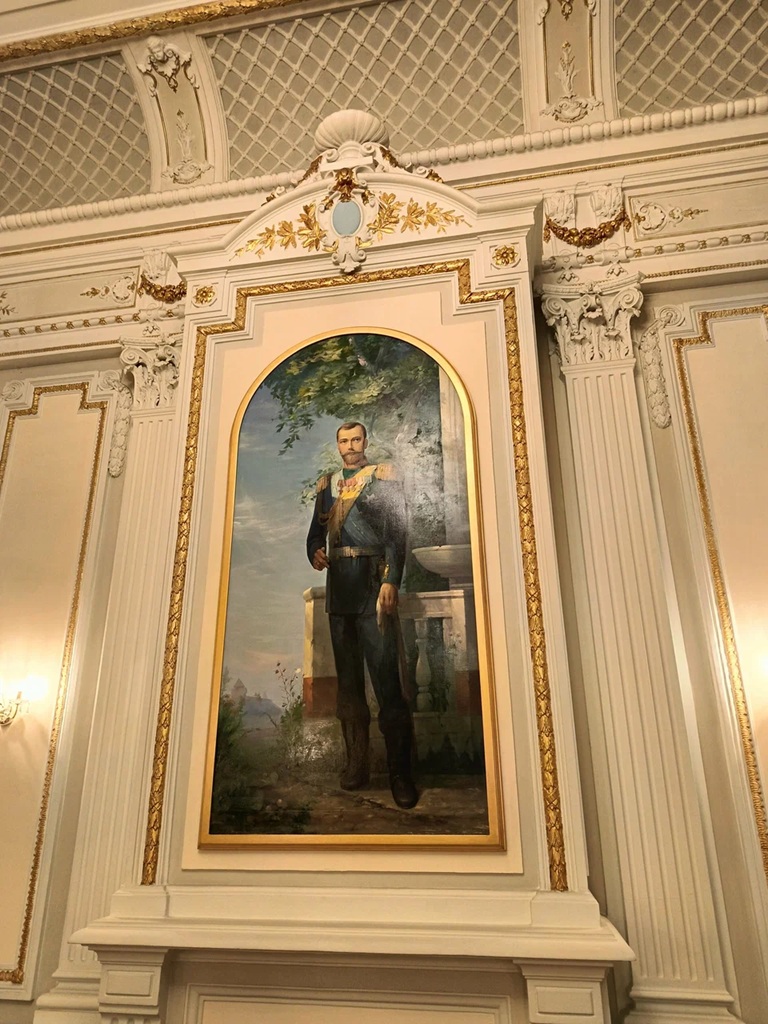
PHOTO: the Main Hall of Tsar’s Railway Pavilion in Nizhni Novgorod
is dominated by a portrait of Emperor Nicholas II (artist unknown)

The elegant one-story building is located on Vokzalnaya Square [renamed Revolution Square in 1967] next to the Nizhny Novgorod railway station. It was constructed between 1891-94, by the Russian architect Dmitry Chichagov (1835-1894) on the initiative of merchants of the All-Russia Industrial and Art Exhibition, an event which showcased the achievements of the industrial development in Russia.

The pavilion offered a place to rest for members of the Imperial Family and the reception of honoured guests, who arrived in Nizhny Novgorod by rail to attend the famous fair. The All-Russia Industrial and Art Exhibition was held from 9th June (O.S. 28th May) to 13th (O.S. 1st) October 1896. The 1896 exhibition was the largest pre-revolution exhibition held in the Russian Empire and was organized with money allotted by Emperor Nicholas II.

During his 22+ year reign, the Tsar’s Railway Pavilion in Nizhny Novgorod welcomed Emperor Nicholas II on two occasions: on 17th July 1896, during the All-Russia Exhibition, he was met by Governor Nikolai Mikhailovich Baranov and Mayor Dmitry Nikolaevich Delvig. His second visit was on 17th May 1913, to mark the events associated with the 300th anniversary of the Romanov dynasty.

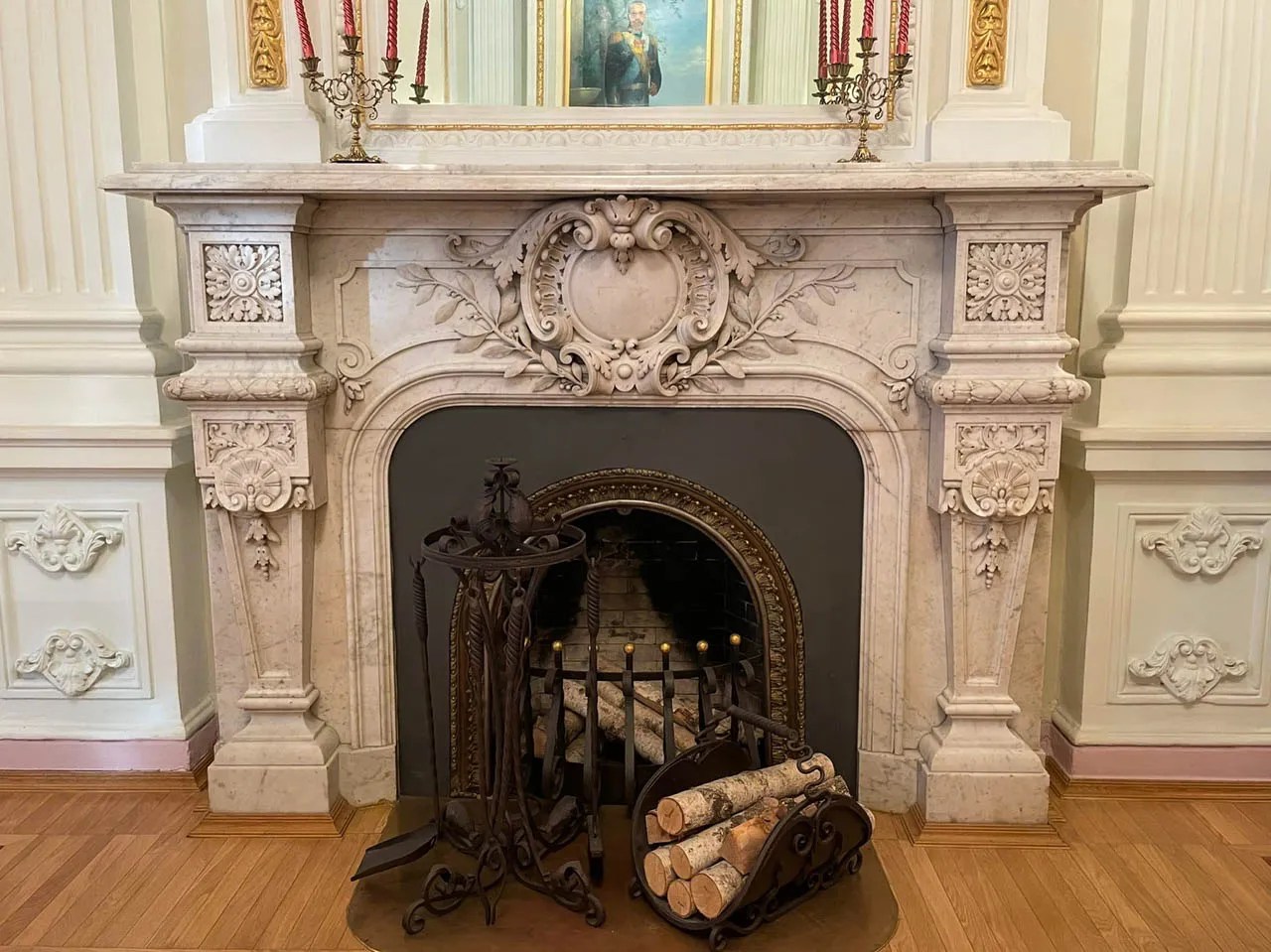
PHOTO: the original carved fireplace made of white Italian marble in the Main Hall

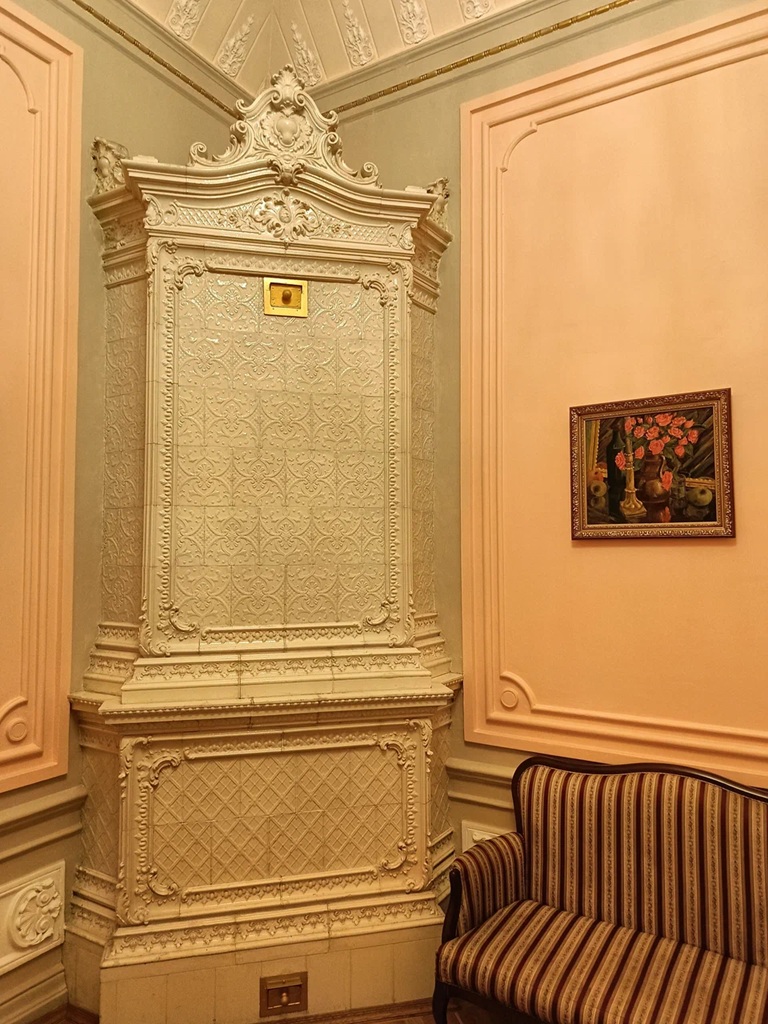
PHOTO: late 19th century tiled stoves heated the interiors of the Pavilion

The pavilion was divided into eight rooms: a heated vestibule and a spacious central hall, which was decorated with a carved fireplace made of white Italian marble, a mirror in a plaster frame and a large portrait of Nicholas II (artist unknown).

Separate studies for the Emperor and Empress were decorated with Renaissance and the Louis XV style furniture, made by the Moscow workshop of Mikhail Kutyrin. The walls of the Emperor’s Study were upholstered with silk fabric, which was chosen by the architect D.N. Chichagov. Unfortunately, this element of the interior has not been preserved. In the center of Study was a large table, whereby the Emperor listened to the reports of Nizhny Novgorod officials on the state of affairs in the province. A telephone was installed in this room.

The ceilings and walls of the eight interiors were decorated with stucco Renaissance style elements, the rooms were heated by stoves lined with majolica tiles. In addition, were rooms for the suite and separate water closets were designed for His and Her Imperial Majesties, decorated in mahogany.

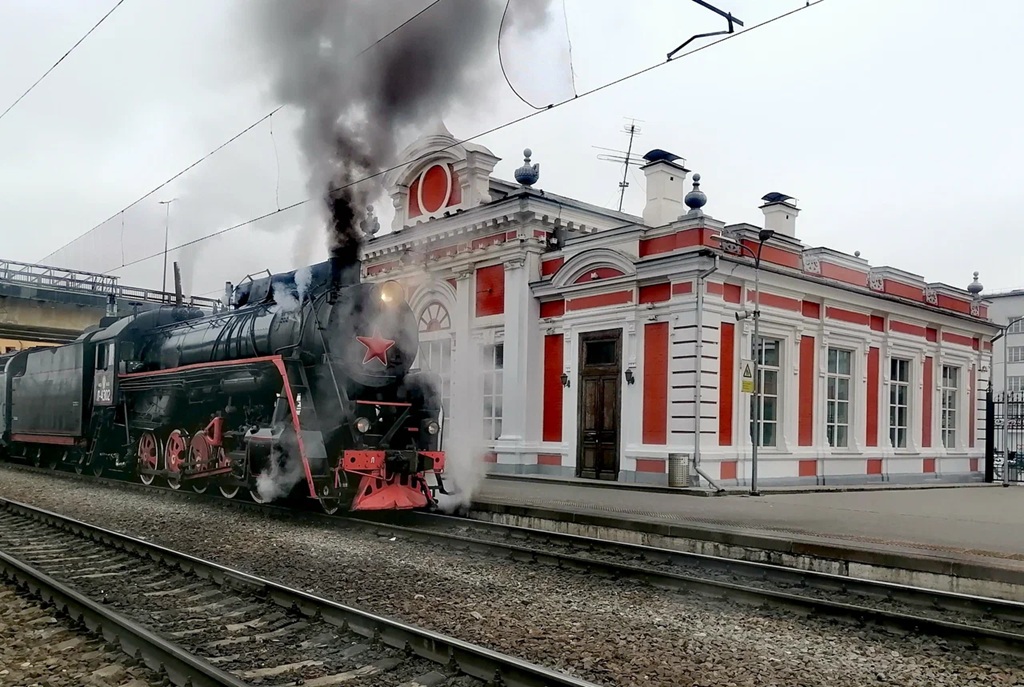
PHOTO: an old Soviet-era steam engine at the Tsar’s Railway Pavilion, this is the track where the Imperial Train would have stopped when bringing Nicholas II to Nizhny Novgorod in 1896 and 1913

Despite its century-old history, the building itself has never been rebuilt and has retained almost all of its historic appearance to this day. What happened to the original interiors is not known for sure, however, some local historians believe that they suffered during the December 1905 armed uprising, when workers seized and held the station building.

In 2005, on the initiative of the Gorky Railway, restoration work was carried out in some rooms of the Tsar’s Pavilion. These include the vestibule, central hall with a fireplace, the Emperor and Empress’s Study’s, and a water closet have been restore to their historical original. 

NOTES:

[1] The Night of Museums is an annual event that takes place on the night of 17/18 May, coinciding with the International Museum Day. This event is organized by the Ministry of Culture of Russia and the portal Culture.RF and aims to make art more accessible and popular among the public. Russia’s museums offer guided tours, lectures, workshops and other events. Visitors can enjoy free entry to museums, art galleries, art spaces, and libraries, making it a great opportunity to explore and learn about various cultural and historical aspects of Russia

© Paul Gilbert. 27 May 2025

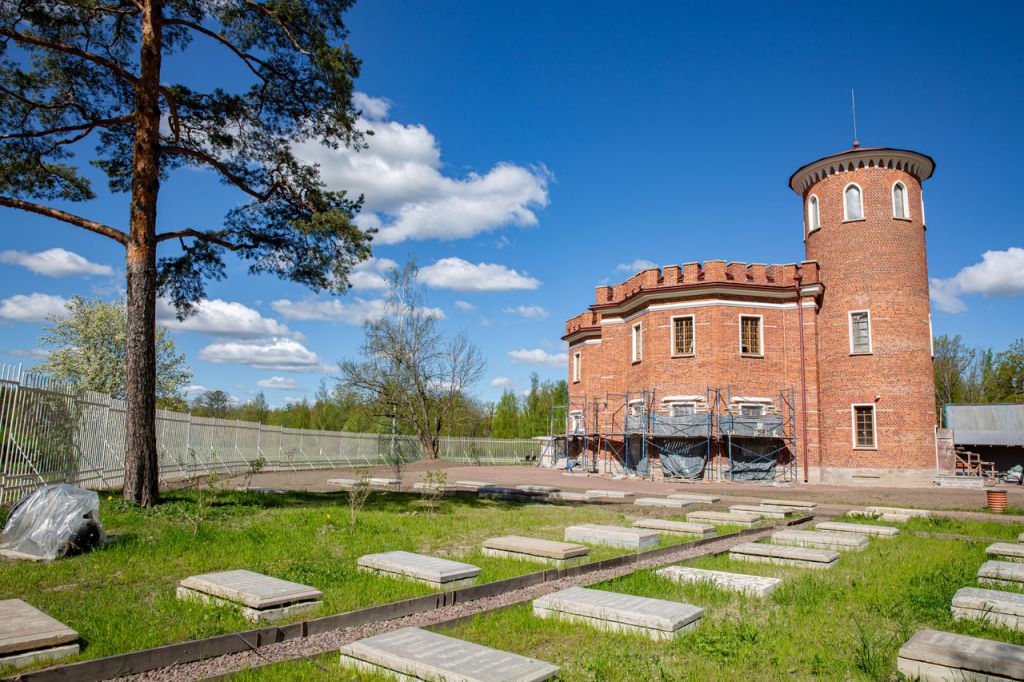
Pensioner’s Stable Pavilion and Horse Cemetery at Tsarskoye Selo to open end of 2025

Photo: Press Service of the Tsarskoye Selo State Museum-Reserve

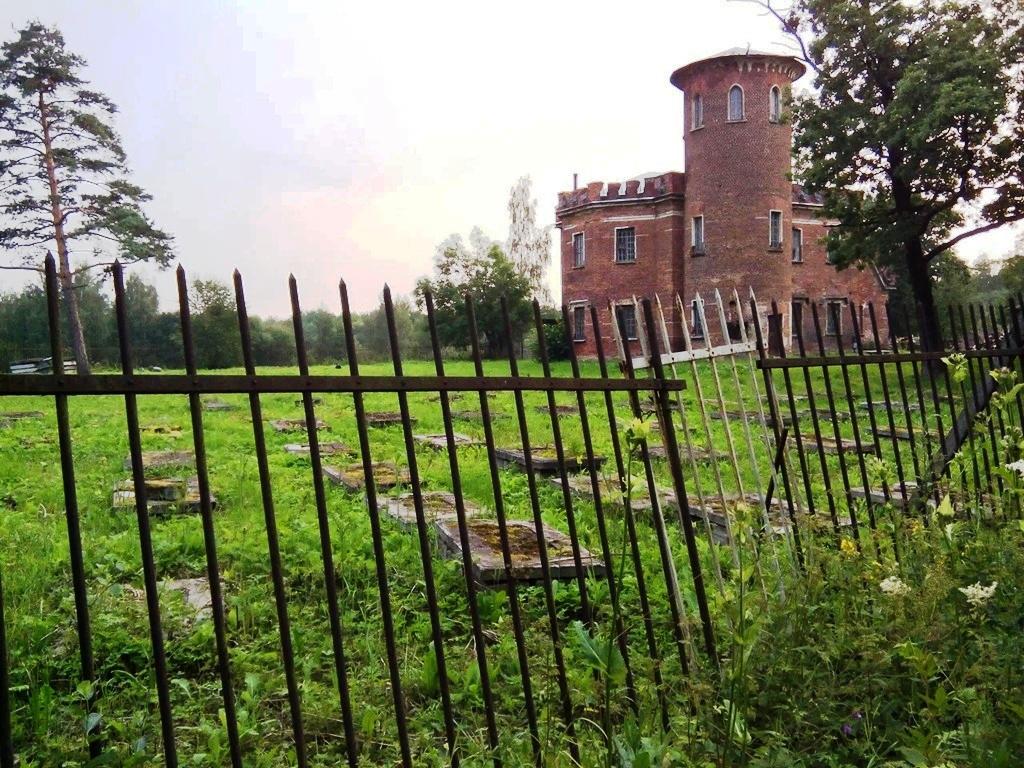
The Tsarskoye Selo State Museum-Reserve have announced plans to complete the restoration of the Pensioner’s Stable Pavilion and Imperial Horse Cemetery, situated in the Alexander Park. The opening is scheduled for the end of 2025.

“This is a unique place where you can study the history of horses that served the Russian emperors and empresses. We managed to research the names of the horses, and we will recreate nameplates for each of the graves. For the first time, the current generation will see this place as it looked during Tsarist times,” said the director of the museum Olga Taratynova.

The idea for an equine graveyard was conceived by Emperor Nicholas I (1796-1855) when he commissioned the Scottish-born architect and landscape designer Adam Menelaws (1753-1831), to build a retirement home for his favourite horses in 1826.

Between 1827-1830, Menelas constructed a red-brick gothic fantasy in an English style quite out of keeping with the baroque and Russian-style buildings found throughout the Alexander and Catherine Parks. The Pavilion included a single tower with rooms for the stable boys, and low, arched windows in the stables, through which the elderly horses could peer. There was room for eight horses to live out their pension years in peace. The old horses were allowed to walk about in the meadow during summer.

It was upon the death of his wife Empress Alexandra Feodorovna’s (1798-1860) beloved horse “Beauty”, which belonged to her for 24 years, that Emperor Nicholas I issued an imperial edict stating that the horse should be buried there. The cemetery became the final resting place for the horses of Emperors Alexander I, Nicholas I, his wife Alexandra Feodorovna, Alexander III and Nicholas II.

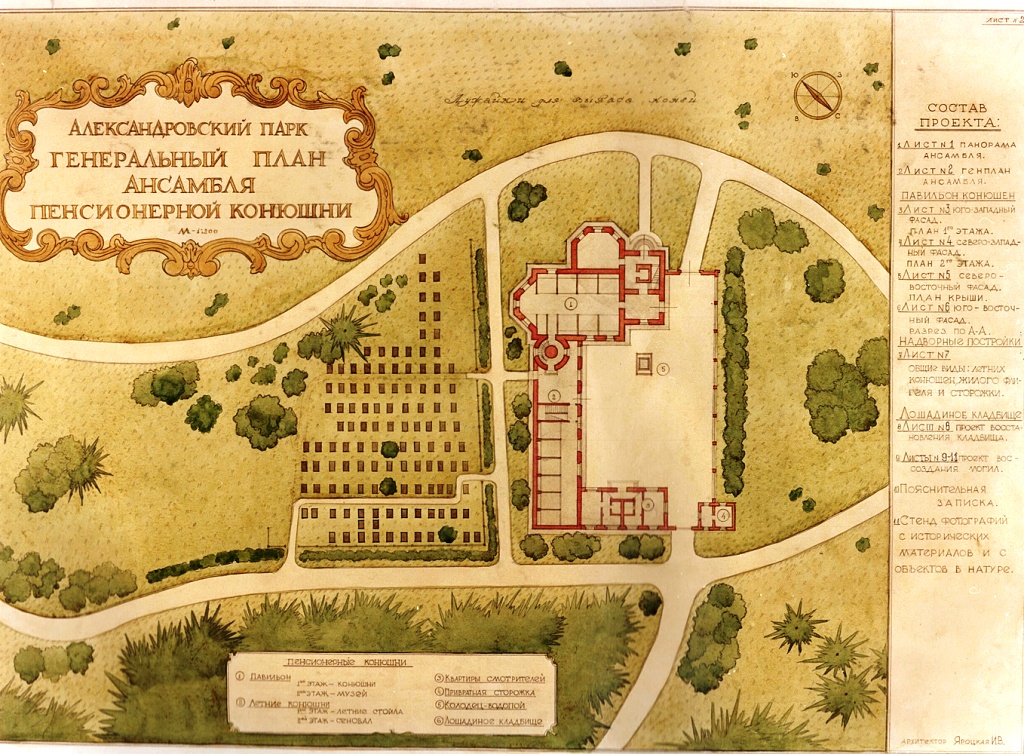
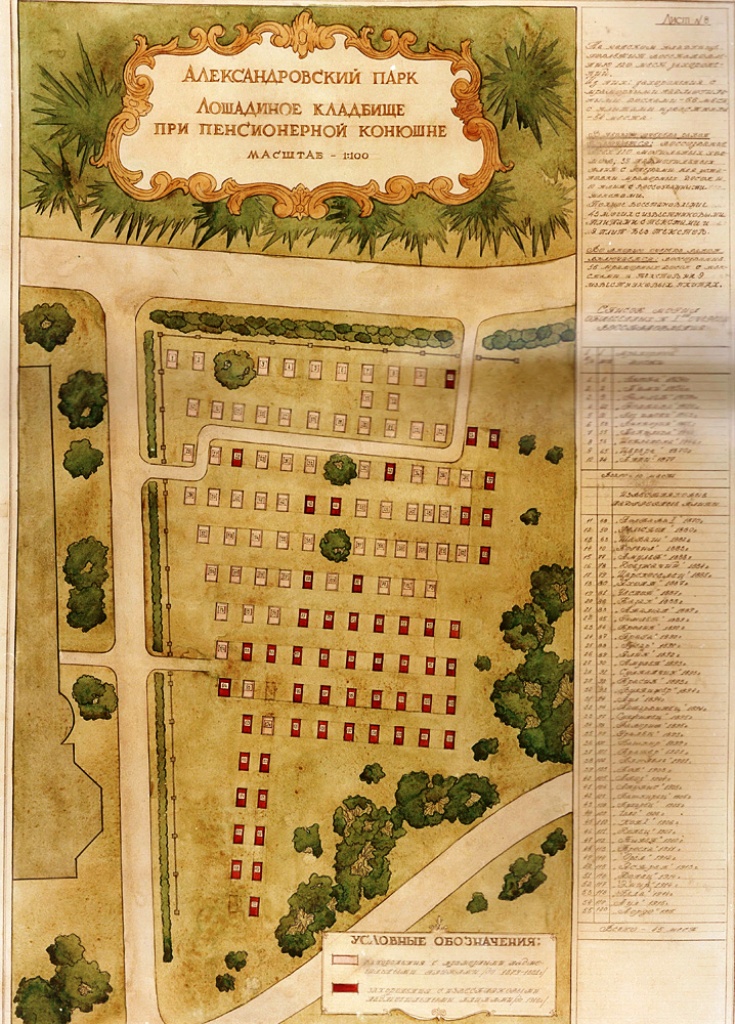
PHOTOS: 19th century drawings of the layout of the Pensioner’s Stable Pavilion and Imperial Horse Cemetery. The bottom drawing shows the graves (filled in red, with a number), the list on the lower right, gives the name of the horse buried in each grave.

Marble slabs mark the final resting places of the favorite horses of the Russian emperors and empresses. Here lies “L’Ami”, the horse on which Emperor Alexander I rode triumphantly into Paris at the end of the Napoleonic wars; “Flora”, the horse that carried the Emperor Nicholas I during the Siege of Varna in 1828; and “Cob” the horse, which the Emperor Alexander III used to ride, when he reviewed his troops.

In 1901, Emperor Nicholas II’s favourite horse “Bluebell”, from 1875, died at the age of 30. After her death, Nicholas II issued an edict for “Bluebell” to be buried in the Imperial Horse Cemetery. 

In total, there are more than 110 graves in the cemetery. Each slightly larger than a human grave, the plots were originally decorated with gold leaf lettering. But the gilt paste has long since washed away as the headstones disintegrated over the years, due the harsh elements and from neglect.

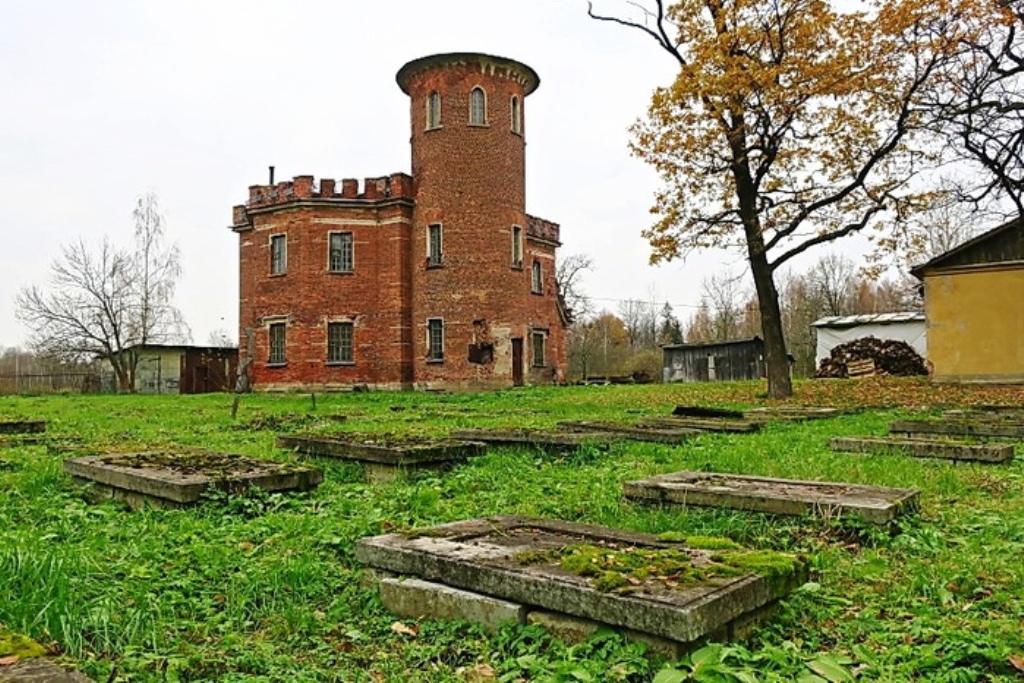
PHOTOS: For decades, the gravestones were barely visible beyond heaps
of crumpled junk metal, through a haze of long grass and spring flowers.

Following the 1917 Revolution, the Bolsheviks used the Imperial Horse Cemetery for propaganda purposes, citing the exaggerated nonsense – which the Bolsheviks were famous for – that the Romanovs treated their horses better than they did the peasants.

During the Great Patriotic War (1941-45), the stable building was slightly damaged, and over time it fell into disrepair. For decades, the gravestones were barely visible beyond the broken iron fences, heaps of crumpled junk metal, and through a haze of long uncut grass and weeds. There were calls for the pavilion and cemetery’s restoration, but with so many of the city’s more mainstream museums in desperate need of funding, the Pensioner’s Stable Pavilion and horse cemetery was not considered a priority.

In 2001, work began on the excavation of some of the graves. Money had been raised abroad by French writer Jean-Louis Gouraud [b. 1943], who was so intrigued by the cemetery when he first saw it that he dedicated himself to campaigning for its restoration. Nearly $400,000 USD was raised. “It is an incredibly important historical site because it tells us so much about the Imperial Family, who loved their horses,” he said.

Work was temporarily halted, due to lack of funds, however, work resumed in 2019, when a comprehensive restoration project funded by the museum began. The facades of Pensioner’s Stable Pavilion were restored, general construction work was carried out, utilities and joinery elements were recreated.

In 2025, the restoration of the layout of the Imperial Horse Cemetery and tombstones began, as well as the recreation of marble nameplates with inscriptions for each grave will be completed.

After the restoration is completed, a new museum dedicated to the Imperial Horse Stable and Cemetery will open in the Pensioner’s Stable Pavilion. Among the exhibits will be a decorative harness and its festive trimmings for a donkey and cart presented to Tsesarevich Alexei Nikolaevich, by the Italian King Victor Emmanuel III (1869-1947) and his wife Queen Elena (1873-1952), during the visit of Nicholas II to Italy in October 1909.

© Paul Gilbert. 24 May 2025

The Tsesarevich’s Mentor. The Story of Charles Sydney Gibbes

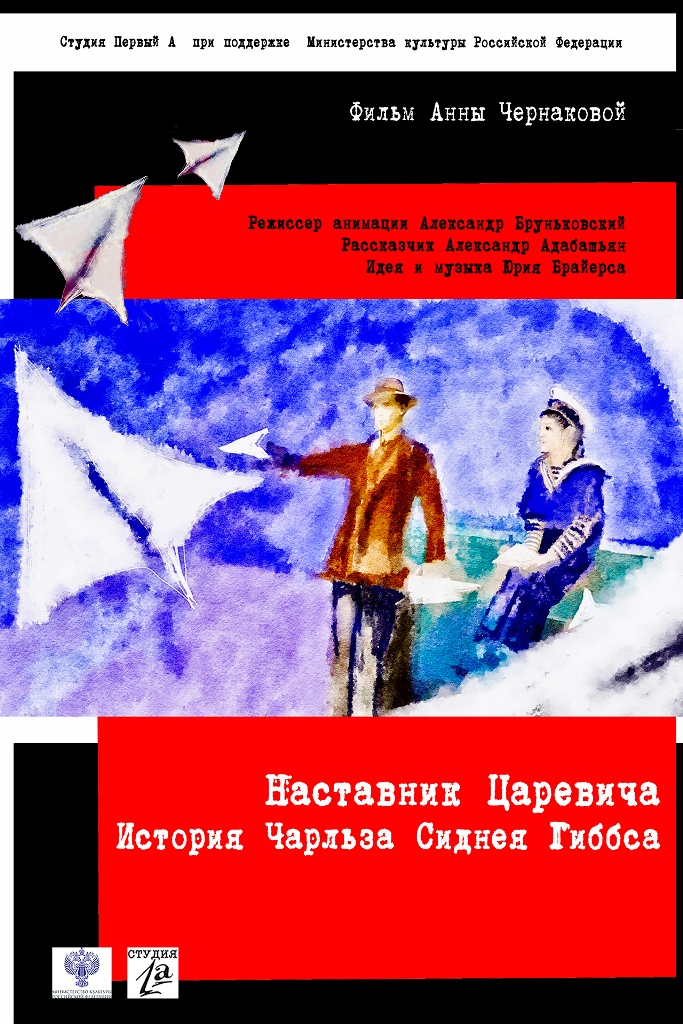
On 29th May 2025, the premiere of a new Russian-language documentary-film entitled The Tsesarevich’s Mentor. The Story of Sydney Gibbes, will be shown in the Courtyard of the Sovereign Military Chamber, situated near the Alexander Palace at Tsarskoye Selo.

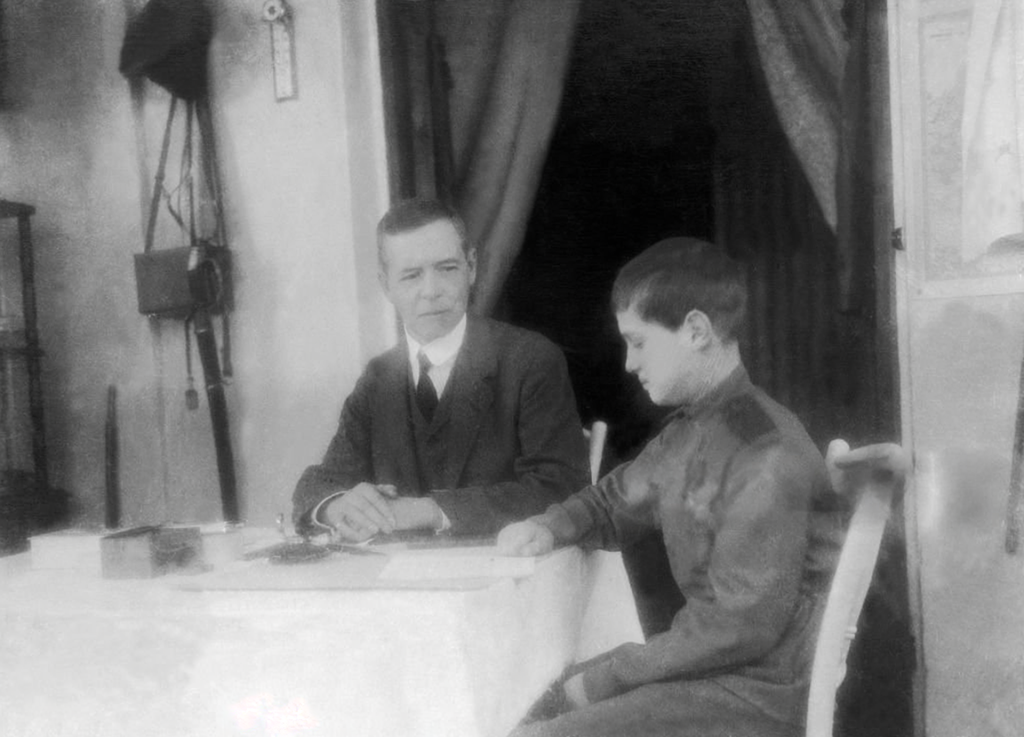
The film tells the story of Englishman Charles Sydney Gibbes (1876-1963), a Cambridge graduate who arrived in Russia in 1901. Gibbes lived and worked in St. Petersburg, and from 1908 he served as an English teacher for the children of Emperor Nicholas II – first for the Grand Duchesses, and later for Tsesarevich Alexei.

In August 1917, Gibbes voluntarily followed the Imperial Family into exile to Tobolsk. And after their tragic death in July 1918, he left Russia and returned to England, where he converted to Orthodoxy several years later. Gibbes was later ordained a priest, becoming Father Nikolai, and founded an Orthodox parish in Oxford, which still exists today.

PHOTO: Charles Sydney Gibbes and Tsesarevich Alexei Nikolaevich (circa 1914-16)

The documentary-film The Tsesarevich’s Mentor. The Story of Charles Sydney Gibbes was filmed by Studio First A with the support of the Ministry of Culture of the Russian Federation. Director-producer Anna Chernakova, animation director Alexander Brunkovsky, script by Alexander Adabashyan and Yuri Bryers, composer Yuri Bryers.

The film uses documentary materials from Russian and British archival sources, with additional film segments filmed in the UK.

On a personal note, a documentary about Charles Sydney Gibbes is long overdue, and while I commend and support this Russian-language documentary about his life and service to the Imperial Family, it also begs the question . . . WHY has there never been a British-made documentary about Gibbes? – PG

© Paul Gilbert. 23 May 2025

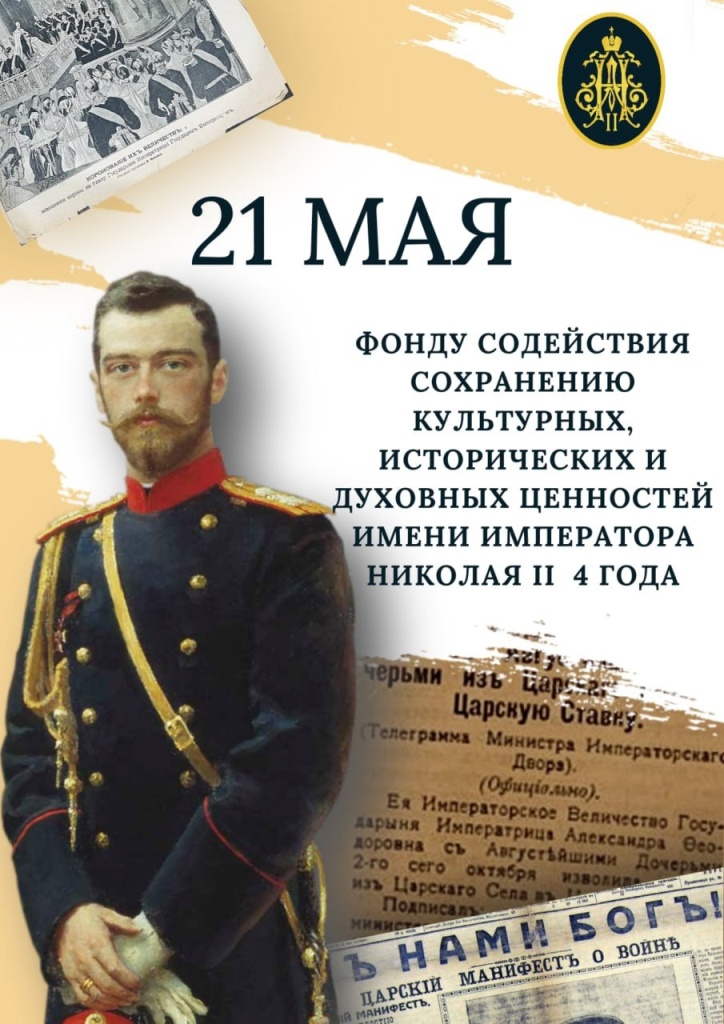
Emperor Nicholas II Foundation marks 4th anniversary

On 21st May 2025, the Emperor Nicholas II Foundation celebrated it’s 4th anniversary. The Foundation was created in 2021, to support the Museum of Emperor Nicholas II (Moscow), as well as other initiatives to help restore and disseminate the historical truth about Emperor Nicholas II and his era.

The Foundation is dedicated to the historical education of the Holy Sovereign Emperor Nicholas II and his family, and to the creation and prosperity of the Museum of Emperor Nicholas II Museum. During the last 4 years, the Foundation have hosted dozens of events, offered hundreds of museum tours, while expanding their collection with new acquisitions.

In addition, the Foundation has been involved in several Russian language publishing projects, such as Последний духовник Императора Николая II и его Семьи: тобольский протоиерей Владимир Хлынов / The last confessor of Emperor Nicholas II and his Family: Tobolsk Archpriest Vladimir Khlynov (2018).

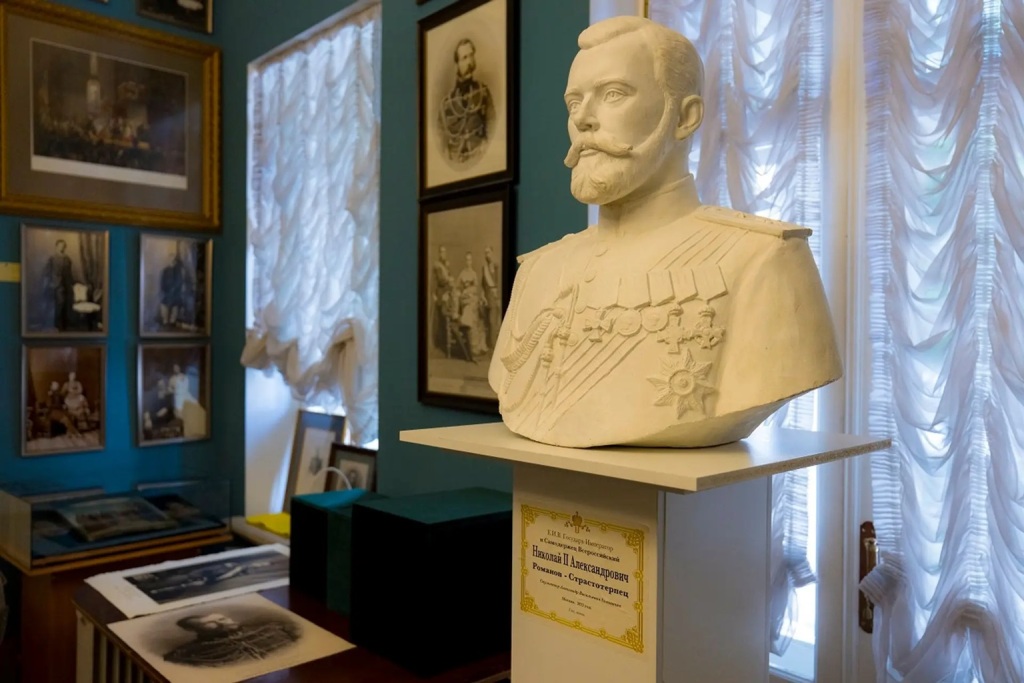
PHOTO: bust of Emperor Nicholas II on display in the Museum of Nicholas II

The Museum of Emperor Nicholas II is based on the unique collection of the famous Russian art historian Alexander Vasilyevich Renzhin, which was formed over the course of 35 years and contains more than three thousand authentic objects dating from 1868 to 1918, including personal items which belonged to the last Russian Emperor and his family: icons, church utensils, rare books, ceremonial portraits of Emperors Alexander II, Alexander III, Nicholas II, more than 500 original photographs, autographs, state documents, porcelain, glass and bronze, a unique collection of gifts from the 1896 Coronation, memorial items of the Romanov dynasty, a full set of state awards established by Nicholas II, postcards, chromolithography, engravings and much more.

***

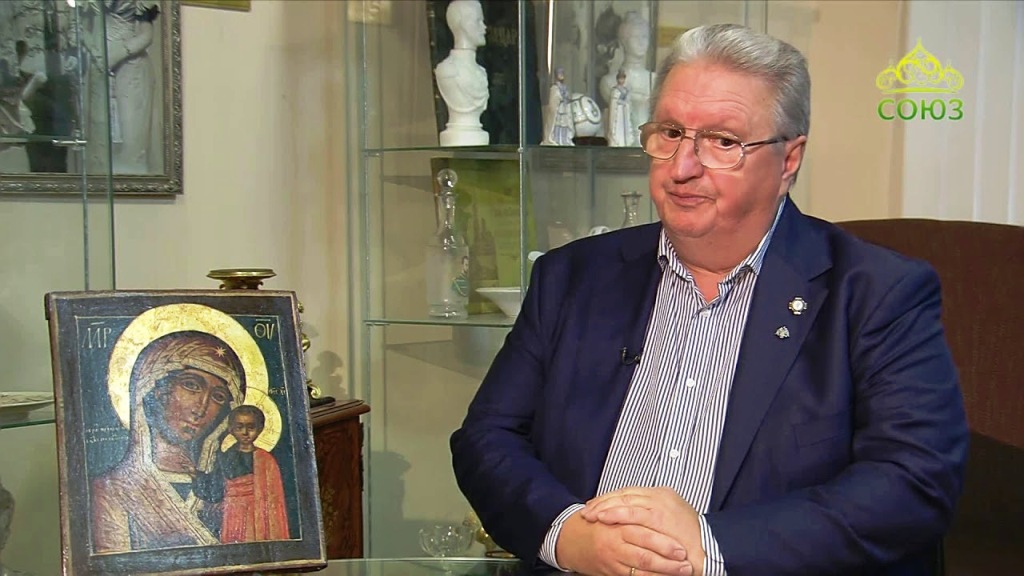
PHOTO: Alexander Vasilyevich Renzhin,
director of the Museum of Emperor Nicholas II in Moscow

The following is from an interview on 14th May 2024:

Russian art historian Alexander Vasilyevich Renzhin, and director of the Museum of Emperor Nicholas II, for many decades has been amassing a collection of personal items belonging to the last Russian Tsar and his family. Renzhin himself, could not have imagined that his collection of rare and unique items would form an exposition which reflect an important page in late 19th to early 20th century Russian history, one which would fill an entire museum.

— Alexander Vasilyevich, why did you start the museum.

“I had been living with the dream of opening a museum for many years. It so happened that I learned about the history of pre-revolutionary Russia, as they say, first-hand. Both of my grandfathers were simple peasants from the Vyatka province, they lived through the Great War, the 1917 Revolution, the Civil War, the Great Patriotic War and still, both lived to be 90 years old. And despite all the events which they experienced, they still retained the people’s love for the Sovereign, always referring to him in their memoirs as “Tsar-Father”. This absolutely respectful attitude towards the Tsar was deeply observed by the Russian people.

“Once a photograph of Emperor Nicholas II fell into my hands, which I remembered for the rest of my life. In it, the Emperor is depicted visiting a factory and talking to the workers. He does not look “official” or “superior”, but as if the workers are old acquaintances. So a completely new page in history began to open for me, which began with the memories that my two grandfathers shared with me. It was at this point in my life, that I started to collect books and objects related to the history of the Imperial Family.”

— Did you have like-minded people who helped open the museum?

“Yes, this would be Anna Vitalievna Gromova, a well-known public figure, historian and Chairman of the Elisabeth-Sergius Educational Society Foundation (ESPO). Thanks to her, we were able to acquire a building for our museum.”

— Are all the exhibits presented in the museum from your personal collection?

“Some things were given to us by people who kept them, often hidden away from even their closest friends and relatives. Our museum is direct evidence that not everything related to Nicholas II was destroyed, and that the Russian people did not forget the Tsar. During the 1920s and 30s, it was forbidden to be in possession of photographs or portraits depicting the Tsar. People who did so, risked losing everything, and even the risk of being shot. Nevertheless, people preserved these items to this day.

“They kept these items hidden in their chests and closets, hiding them from every one. One old woman who brought me a mug from the Tsar’s Coronation told me that her grandmother, when she invited them to visit her, opened a drawer, and showed this mug and said: “Look, this mug was held in the hands of the Tsar-Father.”

“She received it on the Khodynka Field from the hands of the Tsar himself (!). And now this rarity can be seen in our museum. Things related to the Tsar in one way or another were kept by these dear souls, who loved Russia, who loved their Tsar, as the most important treasure in life.

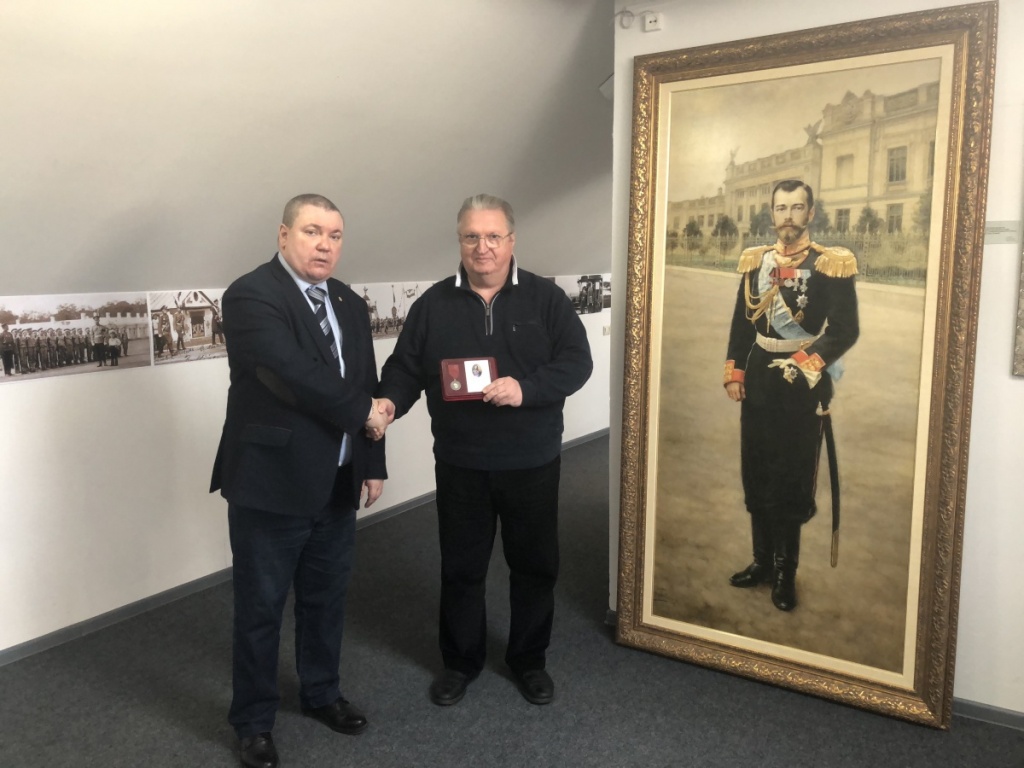
PHOTO: On 24th April 2018, the head of the Military Orthodox Mission Igor Evgenievich Smykov (left) visited the Museum of Emperor Nicholas II in Moscow. With the blessing of the First Hierarch of the Russian Orthodox Church Outside of Russia (ROCOR), Metropolitan Hilarion (1948-2022), he presented Alexander Renzhin (right) with a commemorative medal “In Memory of the Reign of St. Emperor Nicholas II Alexandrovich.”

– What kind of person, in your opinion, was Nicholas II?

“He was a creator. We see this in the fruits of his labours. He was very firm in his decision-making, that’s obvious. Each time he thought them over carefully, always trying to find an inner balance. Thanks to Nicholas II, 46,000 kilometers of railways were built during his twenty-two year reign.

“The plan for the electrification of the country was created in 1903 on his personal initiative, although the Bolsheviks later took credit for it. Some 118,000 educational institutions were opened. In 1894, only 24 percent of the population was literate, and in 1917 it was 67 percent. It was the Tsar who issued a decree on parochial schools. Even if a priest did not have the means to hire a teacher, he was obliged to teach himself. Primary education was offered at every church throughout the Russian Empire.

“Nicholas II was a man of very strong character, and no one ever saw him angry, always trying to remain calm, even during the many trials and tribulations of his reign. When in the company of officers, he could drink as much as the rest, but no one saw him drunk. His worst outburst of anger, as one of his retinue recalled, came during a conversation with an officer who had abandoned his soldiers on the front lines. The Tsar fell silent, turned his back to the officer, went to the windowsill and began to tap it with his fingers.

“Nicholas II was an exemplary father to his children and a father to his subjects. Suffice it to say that in the First General Census of the Population of the Russian Empire (1897), in the column “Occupation, position or trade” he wrote: “Master of the Russian land.”. That is, he felt like a master – an owner, responsible for everything and everyone.”

— What do you think visitors will learn during their visit to your museum?

“Judging by the reviews our visitors leave, for the majority, regardless of education or age, our museum is a discovery. Many people do not realize, that once Tsarist Russia was ruled by a just, honest man who loved our Fatherland with all his heart and gave not only his life for it, but also the lifves of his family, who, went with him to their death and martyrdom.

“Young people who come to our museum are very interested in history, their eyes shine while looking at the exhibits. This new generation is like a blank slate, and it is necessary to write on it, it is necessary to give them knowledge, genuine, real historical knowledge, on the basis of documents that have been preserved. When they see the fragments of the Russian Empire, they will understand what they should be striving for. They will understand what our ancestors cherished for a thousand years.”

© Paul Gilbert. 22 May 2025