An Imperial Movement: A Society of Tsar Nicholas II

017

During his second talk at the Nicholas II Conference held on 27 October 2018, at St. John’s Orthodox Church in Colchester, England, Archpriest Father Andrew proposed the idea of forming an Imperial Movement or Society in honour of Tsar Nicholas II in the United Kingdom.

The purpose of such a movement or society would firstly be to defend the honour of the Tsar-Martyr Nicholas II and the Imperial Martyrs from the injustices, prejudices and misunderstandings which still surround them.

As a Society based in England, we could have a role to play in the English-speaking world in spreading the Truth about the Imperial Family. A century after the death of Russia’s last emperor and tsar, a society such as this is both timely and important for the sake of historical accuracy and truth.

I myself, am committed to being a part of such a Society, and despite the fact that the Atlantic Ocean separates England from Canada, I am prepared to travel to England to offer my assistance in helping such a Society to fruition. A first meeting of supporters could prepare a mission statement, select members for a Committee, discuss and organize events, and numerous other projects. 

Please note that the full text of Father Andrew’s talk An Imperial Movement: A Society of Tsar Nicholas II can be found in Sovereign No. 9 Nicholas II Conference Proceedings 2018, available from the Royal Russia Bookshop, Booksellers van Hoogstraten (The Hague, Netherlands), Librairie Galignani (Paris, France), and Amazon (USA)

© Paul Gilbert. 9 February 2019
 

Photos 21 – 24 of Nicholas II

I must apologize for the quality of some of the photographs, however, this is something which I have no control over. Where possible, photographs have been chosen for their visual impact, but historical accuracy has made it vital to include a number of photographs whose quality is poor, but whose value as historical documents is considerable. Sadly, during the Soviet years, many photographs of the Imperial family were stored under poor conditions and their standard is low – PG

© Paul Gilbert. 9 February 2019
Religion and the Church Under Nicholas II

016d

The Russian Orthodox Church under Emperor Nicholas II flourished. In 1914, it consisted of 68 dioceses, 54,923 churches, 953 monasteries, 4 theological academies, 185 religious schools, 40,530 schools and 278 periodicals. The clergy consisted of 157 bishops, 68,928 priests, 48 ​​987 clerics, 21,330 monks in monasteries and 73,229 nuns in convents.

Emperor Nicholas II, as a Christian Sovereign, was the Supreme Defender and Guardian of the dogmas of the predominant Faith and is the Keeper of the purity of the Faith and all good order within the Holy Church.

The sovereign was the first of the Russian monarchs to approve the holding of the Local Council. He actively sought the canonization of Seraphim of Sarov, and in 1903 he led the celebration in Sarov, where 150,000 pilgrims gathered. During his reign, Theodosius Uglitsky, Joasaph Belgorod, Patriarch of Moscow and All Russia Hermogenes, Pitirim Tambovsky, John Tobolsky were all canonized saints. In 1895, he personally participated in the acquisition of the Purple Gospel, the rarest manuscript of the sixth century, from the Greek community. Nicholas II personally contributed funds for the publication – 12 volumes of the Orthodox Theological Encyclopedia and 12 volumes of the Explanatory Bible. 

The construction of new churches had the full support of the emperor. During his reign, Nicholas II approved funding for the construction of over 7576 churches and chapels, and the opening of 211 monasteries. 

Under the sovereign father, the structure of the military clergy was formed. By 1917, there were about 5,000 military priests in the army and navy. 

The sovereign attached enormous support for the unity of the Russian Orthodox Church. On 17 April 1905, Nicholas II issued the Edict of Toleration. The decree gave legal status to religions not of the Russian Orthodox Church. This was followed by the edict of 30 October 1906 giving legal status to schismatics and sectarians of the ROC

In 1910, more than half of the parishes had charitable foundations. By 1917, almost all churches and monasteries maintained charitable institutions for the elderly and disabled, orphanages for orphans, which housed more than 600,000 people.

© Paul Gilbert. 7 February 2019
Nicholas II on board the Imperial Train

015

Colourized by Olga Shirnina, also known as Klimbim

This photograph of Nicholas II, standing at the window of the Imperial train is one of the most popular images of Russia’s last sovereign. It has been published in countless books and web pages, but is quite often misidentified at Pskov, after signing his abdication in “1917”. This is incorrect. 

The photograph, is one of a series taken at the Stavka military headquarters at Mogilev in 1915, by one of his daughters. It does not depict a man who has just signed over his throne, but that of a very well-composed Emperor and Tsar.

Click HERE to view more of Olga Shirnina’s excellent colourization of vintage photographs of famous Russians, including many images of Nicholas II and his family.

© Paul Gilbert. 4 February 2019

‘My mission to clear the name of Russia’s last tsar’ – Paul Gilbert

newbanner

This year marks the 25th anniversary of Royal Russia. Since 1994, I have dedicated myself to the full time research and writing on the Romanov dynasty, their legacy, and the history of Imperial and Holy Russia. I have been able to accomplish this through my web site, news blog, and Facebook pages, nearly 30 working visits to Russia, and the publication of numerous books and journals.

My primary interest has always been the life and reign of Russia’s last emperor and tsar Nicholas II. Beginning in 2019, I will be devoting much of my time and resources to the research and writing on the much slandered tsar.

In 1967, Pulitzer Prize–winning author Robert K. Massie released Nicholas & Alexandra. To date, it has sold more than 7 million copies, and translated into dozens of languages including Russian. In 2012, Random House issued a new edition containing much new information. Thanks to Massie’s book, millions of readers were given a fresh and very different look into the life of Russia’s last tsar. Instead of the ‘Bloody Nicholas’ portrayed in Bolshevik propaganda, Massie introduced his readers to a devoted husband and loving father, one who was dedicated to his God anointed position as autocratic ruler of the Russian Empire.

In the last 50 years, Massie’s now classic work opened a floodgate of new biographies and studies by Western historians (both professional and amateur). They claim that their works are the final say on the life and reign of Nicholas II. They do not! 

‘Re-examine all that you’ve been told . . . dismiss that which insults your soul’

Walt Whitman’s famous words are a reminder that it is now time to re-examine the many biographies and studies of Nicholas II, published in the past half century by Western historians.

Sadly, many of them have rehashed the many myths and lies about Nicholas II which were planted more than a century ago by his detractors, and allowed to germinate during the 20th and into the current century.

Their works are based on resources made available to them during their research. Having said that, however, much of that research remains stuck in the 1960s and 70s. It is time to take a fresh look at their works, re-evaluate and compare them to the research of their post-Soviet Russian contemporaries.

issues

SOVEREIGN

It was the enduring myths and lies about the reign of Russia’s last emperor and tsar, which compelled me to launch the publication Sovereign: The Life and Reign of Emperor Nicholas II in 2015. Published bi-annually (Spring and Autumn), this unique journal gives voice to Russian historians, and features research based on new documents discovered in Russian archives since the fall of the Soviet Union.

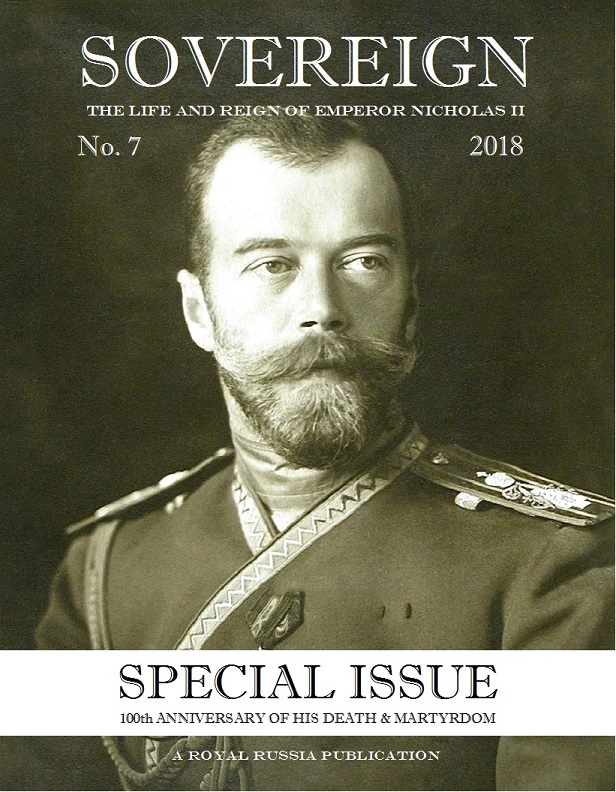
By the end of this year, a total of 12 issues will have been published, including 3 Special Issues: No. 7 – Tsar’s Days in Ekaterinburg, July 2018; No. 9 – Nicholas II Conference Proceedings, October 2018; and No. 11 – the Royal Russia Papers.

Sovereign gained a much wider readership in 2018, the year marking the 150th anniversary of the birth, and the 100th anniversary of the death of Nicholas II. This was thanks to a full page colour advert in the July issue of Majesty Magazine, the Nicholas II Conference held in Colchester, England, and numerous media coverage.

img_0444 (1)

Paul Gilbert at St. John’s Orthodox Church, Colchester, England

NICHOLAS II CONFERENCE

As noted above, 2018 marked the 150th anniversary of the birth, and the 100th anniversary of the death and martyrdom of Nicholas II. It was such an honour to organize and host the Nicholas II Conference at St. John’s Orthodox Church, in Colchester, England, on 27th October,

More than 100 people from 11 countries attended this historic event, which featured 5 speakers, who presented 7 papers on the life, reign, and sainthood of Russia’s last tsar. The proceedings have been published in the No. 9 2018 issue of Sovereign.

This historic event received congratulations and support from the Russian, Serbian, and Greek Orthodox Churches, as well as the Head of the Russian Imperial House HIH Grand Duchess Maria Vladimirovna.

0176d

MEDIA INTEREST

In 2018, I participated in a a special 6-part video series commemorating the Romanovs Martyrdom Centennial, prepared by the Monastery of St John the Forerunner Mesa Potamos. Click on the above image to watch part 5, my interview The Conspiracy Against Nicholas II.

I was also the subject of an interview for the English language Russia Beyond (a project/brand established by the TV-Novosti company owned by the Rossiya Segodnya which is a state news agency in Russia). Click on the following link to read Why does a Brit fight for the truth about Nicholas II and the Romanovs? by Alexandra Guzeva. To date, it has been translated into SerbianGerman, Italian, PortugueseBulgarianCroatian, among several other languages.

untitled2untitled

NEW WEB SITE & FACEBOOK PAGES

I am pleased to announce that a new web site and Facebook page, dedicated to Nicholas II have been launched. My NEW Facebook page was launched on 1st January, and my NEW web page was launched on 22 January. Both feature articles, news from Russian media, exhibitions, videos, photos, book reviews, and more. Please click on the above banners to review each of them.

Both will present articles and news which acknowledge the many accomplishments made by Nicholas II during his reign from 1894-1917. In an effort to present a more honest assessment of his life and reign, the widely held negative myths and lies, will be discussed and debunked with new facts and information. 

The Facebook page also includes a link to the my new discussion group Царебожники / Tsarebozhnikiwhich was launched on 18th May 2018, the day marking the 150th anniversary of the birth of Nicholas II.

Tsarebozhniki brings together adherents of Nicholas II to discuss his life and reign, and features current news, review books and documentaries, photos, videos, and more. This group is open to Russophiles, Romanovphiles, Orthodox Christians, monarchists, and others who share an interest in Russia’s last sovereign and Christian monarch. Tsarebozhniki currently has more than 600 members.

NEW PUBLISHING PROJECTS

After downsizing many projects affiliated with Royal Russia, I can now focus on a number of publishing projects, which I have planned or are nearing completion.

These include: Nicholas II. Portraits & Monuments (2019); My Russia. Ekaterinburg (2019); Nicholas II in Post-Soviet Russia (2019); and Nicholas II. A Century of Myths and Lies (2020). Note: the covers of the titles depicted above are subject to change prior to publication.

Much of the research which I have put into each of these titles is based widely on my many visits to Ekaterinburg, St. Petersburg, Moscow and Crimea over the years, my own photographs, and Russian language sources, thus presenting much new information to those interested in the life and reign of Russia’s last emperor and tsar.

0117

MY EFFORTS TO CLEAR THE NAME OF NICHOLAS II

My efforts to take a fresh look at the life and reign of Russia’s last emperor and tsar have been met with both praise and indignation.

The praise comes from monarchists, members of the Orthodox community, and adherents to Nicholas II, all of whom do not accept the widely accepted negative assessment of Nicholas II, which has stood for much of the past century.

The indignation comes from Nicholas II’s many detractors, among them Communists, Leninites, anti-monarchists, etc. They accuse me of hagiography. romanticizing or whitewashing the truth, or viewing the reign of Nicholas II through “rose tinted glasses.” So be it! What is so frustrating is that these are the same people who simply refuse to remove their blinders and examine new documents and research discovered in post-Soviet archives in Russia in recent years.

Russian historian Pyotr Multatuli hit the nail on the head when he wrote, “We combine indifference to our own history with our maximalism and categorical judgments. Thus we lose the ability to hear others. Everybody is content with his own biases without thinking that in the case of the holy passion-bearer his opinion is borrowed and that he was too lazy to form his own opinion. More than twenty-five years have passed since the collapse of the USSR, and truthful books on the Imperial Family were published since as early as perestroika. But most people don’t read them and retain the outdated stereotypical views.”

© Paul Gilbert. 31 January 2019

The emperor’s wallet. How much did Nicholas II spend on charity?

banner

Poster for the international scientific conference “The Righteous Live Forever …”

On 24-25 January 2019, an international scientific conference “The Righteous Live Forever …” was held in the Peter and Paul Fortress in St. Petersburg.

The conference, which was organized by the Elisavetinsko-Sergievsky Educational Society Foundation, was the conclusion of events marking the 100th anniversary of the murders of members of the Russian Imperial Family in 1918 and 1919 by the Bolsheviks.

Often acting anonymously

One of the central themes of the conference was the enormous charitable activities carried out by the Imperial family. According to historians, the Bolsheviks did much to shape a negative image of the Imperial family. They created myths that Nicholas II spent enormous funds for his own needs, although in fact he and his family lived quite modestly. In addition, each member of the Imperial family had their own personal “charity programs,” making sizable donations from their own pockets, for the maintenance of hospitals, educational institutions, and other charitable organizations. 

Nicholas II had enormous funds at his disposal, however, an annual budget of the Imperial Court was strictly adhered to, which included the personal expenses of the family. There were strict calculations, in which even the purchase of new clothes was regulated, says historian Professor Igor Zimin, one of Russia’s foremost experts and author of numerous books on the last tsar and his family. 

The Russian State Historical Archive has in its collection, an accounting book of Nicholas II. In fact, the ‘Emperor’s Personal Wallet’, record donations he made to a number of charities. These include expenses on pensions, the maintenance of boarders and the upbringing of children, donations, allowances, gifts and cash awards. Plus extraordinary expenses that went in favor of educational or charitable institutions, including churches. The accounting book records various sums of donations – 16,400 rubles, 44 thousand rubles, 11 thousand, 500 rubles, etc.

wx1080

Delegates attending the conference held on 24-25 January in St. Petersburg

The sovereign received a large amount of correspondence with requests to help or participate in charity events. It is recorded that in 1898, Nicholas II gave 5 thousand rubles for the completion of an Orthodox church in a remote region of Russia. And to help someone’s widow he gave out 350 rubles annually from his own funds. The first St. Petersburg State Medical University emerged largely due to the participation of the emperor. Often the sovereign acted anonymously. In 1901 he ordered the transfer of 50 rubles to the editorial office of a magazine for Russian disabled persons – as an anonymous donation.

Help and aid

According to Professor Zimin, all members of the Imperial family considered it their direct duty to help and give to those less fortunate. The expenses of the Romanovs grew precisely because donations increased every year.

The Emperor’s wife, Alexandra Feodorovna, initiated the annual Christmas trees for children from poor families. She contributed to the founding of numerous educational institutions, shelters, and hospitals. She worked as a Red Cross Nurse when the war between Germany and Russia began in 1914. It is impossible to imagine the spouse of a member of the Politburo working as a nurse in a soldiers’ hospital during Soviet times. During the war, her children asked that in lieu of gifts, that the money be given to help orphans and soldiers. 

“Once the sovereign with his family stopped at one of the railway stations. A local official turned to him telling the tsar that his small salary was not enough for his large family. Nicholas II promised that he would receive 30 rubles a month, and his son and heir Tsesarevich Alexei said that he would add another 40 rubles a month,” notes Chief Specialist of the State Archive of the Russian Federation Vladimir Khrustalev.

4_1b71481d

Information boards told the story of the Imperial family’s philanthropy

“The Grand Duchesses Olga and Tatiana headed committees which provided direct assistance to those who suffered in hostilities as well as their families,” says the head of the history department of Kaliningrad State Technical University, Professor Alexei Khitrov.

Their respective committees created more than a dozen forms of assistance and 30 projects to collect donations. All those in need received money, clothes, and work. They had the support of local governors, representatives of the diocese, zemstvo, city public administration, leaders of the nobility, and representatives of charitable organizations. 

In cooperation with the central government and the patronage of the Imperial Court, this created a system of democratic centralism, working effectively through the years of the First World War. In 1914, thousands of refugees from the Polish and Baltic provinces flooded into Russia. But thanks to the work of the committees, they were all fed, clothed and sheltered. 

The Olginsky and Tatiana Committees distributed 68 million rubles in aid. There were no allegations of corruption, dishonesty, or wasting money.  By the beginning of 1917, the committees set up work on registering and assisting refugees. The Olginsky and Tatiana committees were recognized as the most viable of all the institutions of that time. They worked effectively until the spring of 1918, after the Russian Empire crumbled under the Bolshevik order.

© Paul Gilbert. 31 January 2019

Photos 17 – 20 of Nicholas II

I must apologize for the quality of some of the photographs, however, this is something which I have no control over. Where possible, photographs have been chosen for their visual impact, but historical accuracy has made it vital to include a number of photographs whose quality is poor, but whose value as historical documents is considerable. Sadly, during the Soviet years, many photographs of the Imperial family were stored under poor conditions and their standard is low – PG

© Paul Gilbert. 30 January 2019

Unknown Photos of the Imperial family Discovered in the Caucasus

0296a

Fedushkin (center), and fellow officers with Grand Duchesses Maria, Anastasia and Olga

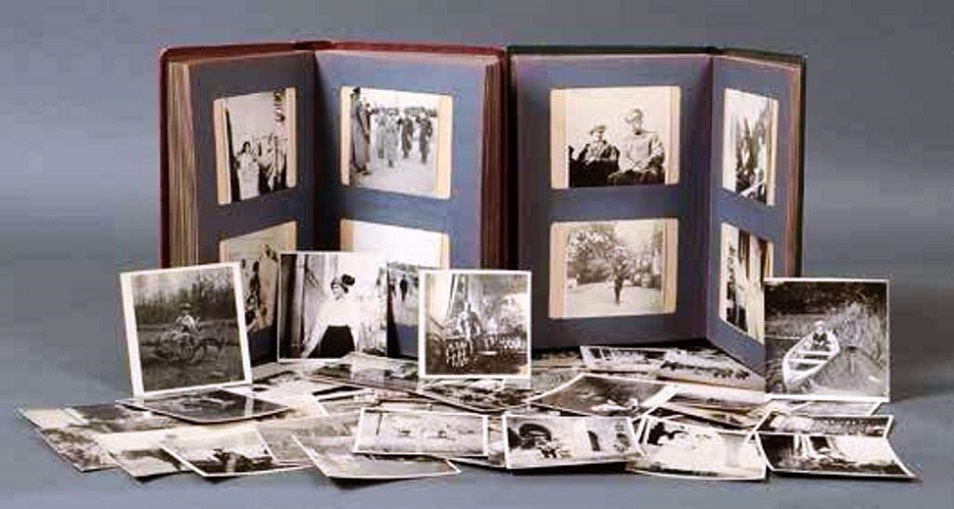
An envelope containing previously unseen photographs of the Imperial family, hidden for more than a hundred years was discovered last year in the attic of an old two-story mansion located in Yessentuki, a city in Stavropol Krai, Russia, located at the base of the Caucasus Mountains.

The workers stumbled upon the pictures during the repair of the roof of the building, where the photos were found in an envelope under a decrepit beam.

In pre-revolutionary times, the owner of the mansion was Colonel Zaretsky, but after the revolution the house, like most other buildings, was nationalized by the Bolsheviks.

Today, the mansion houses the Federal Treasury Department in the Stavropol Territory. It was in August of last last year, that a half-decayed envelope, which had been stored under an old attic beam was discovered, containing the miraculously preserved photographs.

“In seven of the nine cards – the same person – a tall, handsome Cossack, is photographed with colleagues and members of the family of Nicholas II, ” said Vera Samarina, Deputy Head of the Regional Treasury Administration.

Samarina was able to establish the alleged personality of the mysterious Cossack, who was among those close to the Imperial family – his name was Anatoly Semyonovich Fedushkin (1887-1958). He was born in the village of Chervlennoy of the Terek Cossack Army. Today this village is on the territory of the Chechen Republic. He later served in His Own Imperial Majesty’s Convoy. the military unit responsible for guarding the emperor and his family.

Two of the cards, judging by their inscriptions were presented to him by the four grand duchesses: Olga, Tatiana, Maria and Anastasia bearing the date “April 1917” on the back. A separate photo postcard depicts the heir to the throne Tsesarevich Alexei, bearing the inscription “Anatoly Semenovich” on the back.

Another photograph found in the Yessentuki hiding place, shows Fedushkin standing next to the emperor, Alexei, two of the grand duchesses and other people against the backdrop of snow-capped mountains. Unfortunately, the photo is in such a poorly preserved state, it is unsuitable for publishing or sharing.

It is worth noting that service in His Own Imperial Majesty’s Convoy, was a family tradition of the Cossack family Fedushkin. After the abdication of Nicholas II, the members of His Own Imperial Majesty’s Convoy remained completely loyal to their oath of allegiance to the tsar.

Apparently, the Imperial family held Anatoly Semyonovich Fedushkin in their trust very closely. His name, is repeatedly mentioned in the diaries and letters of the Grand Duchesses and the Empress Alexandra Feodorovna herself.

0296b

Fedushkin with fellow officers

In June 1916, when several officers of the Imperial convoy were to go to the front, the empress presented each of them with an icon. Among those who accepted the gift was Anatoly Fedushkin. Grand Duchess Tatiana gave him a silk shirt with a pinned note: “May God bless and keep you, dear Jusik! Tatyana”. According to Samarina, Fedushkin took it with him when he went into exile.

Anatoly Fedushkin was among the White emigres, and after leaving Russia, he lived in different countries. He died, according to various sources, in 1958, either in New York, or in San Francisco. The envelope containing the photos dear to his heart was apparently hidden before fleeing Russia. After all, if the Bolsheviks had arrested him, and found such incriminating photographs, he would have surely been shot.

The photographs are now in the collection of the Museum of the Regional Department of the Federal Treasury in the Stavropol Territory.

© Paul Gilbert. 29 January 2019


Photos 13 – 16 of Nicholas II

I must apologize for the quality of some of the photographs, however, this is something which I have no control over. Where possible, photographs have been chosen for their visual impact, but historical accuracy has made it vital to include a number of photographs whose quality is poor, but whose value as historical documents is considerable. Sadly, during the Soviet years, many photographs of the Imperial family were stored under poor conditions and their standard is low – PG

© Paul Gilbert. 23 January 2019

Nicholas II Last Russian Emperor (Episode 59) – Orthodox Christian Podcast

Take a few minutes to listen to Fr. Artemy, an English-speaking Russian Orthodox priest from the Moscow Theological Academy, who presents this beautifully written podcast about the life and martyrdom of Russia’s last emperor and tsar, as well as the miracles of the Tsar Martyr. This Orthodox Christian Podcast series produced by Voice of Russia Radio Network, is currently owned by Sputnik News.

Intro – “Beloved brothers and sisters! This time we will tell you the story of the Holy Martyr, last Russian Emperor Nicholas II. It is quite significant that long before Nicholas II’s ascension to the throne a monk at the Glinsk monastery in Russia, Iliador, chanced to have an enigmatic vision at end of the 19th century.”

Duration: 26 minutes (ENGLISH). The beautiful Russian sacred background music is from the Anthology of Russian Sacred Music album (2009), produced by Melodia.

Click on the CC button located at the bottom of the video to initiate the closed captioning option.

© Voice of Russia Radio Network. 22 January 2019