The myth of Nicholas II’s indifference to the Khodynka tragedy
0298a

More than a century after his death and martyrdom, a number of tragic events continue to haunt the legacy of Russia’s last tsar. It was the Khodynka tragedy, in which thousands were killed or injured during a stampede, that would haunt Nicholas II throughout his 22-year reign.

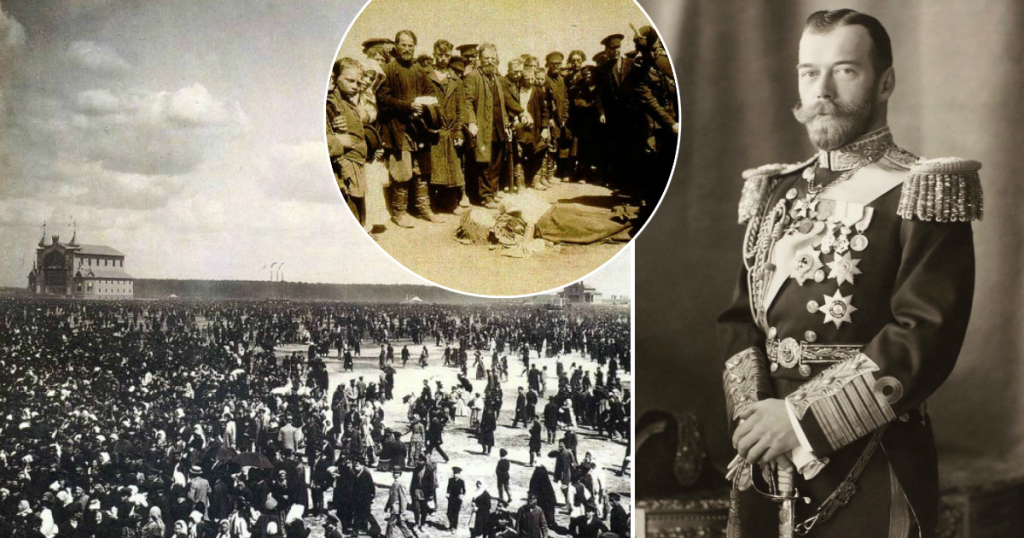
On the morning of 31st May [O.S. 18th May] 1896, over half a million revelers had gathered on the Khodynka Field in Moscow for ceremonies marking the Coronation of Emperor Nicholas II.

Organizers had set up 150 stalls to distribute 400 thousand free gifts to the people, a souvenir of the historic event.

The gift included a commemorative enamelled metal cup, bearing the cyphers of Nicholas II and Alexandra Feodorovna 1896 and the Imperial Crown on one side, the Imperial coat of arms on the reverse.

The cup was distributed along with a variety of food presents, which included a 400 gram loaf of bread; 200 gram sausage stick; Vyazemsky gingerbread; a small bag full of sweets, nuts, and dried fruits.

Everything was tied in a bright calico commemorative scarf, on which the portraits of the imperial couple were printed on one side, and a view of the Kremlin on the reverse.

Sadly, the day began in tragedy. Rumours began to spread among the people that there was not enough beer or pretzels for everybody, and that the enamel cups contained a gold coin. A police force of 1,800 men failed to maintain civil order, and a catastrophic crowd crush and panic resulted in an estimated 1,389 people being trampled to death, and an additional 1300 injured, in what has become known as the Khodynka Tragedy.

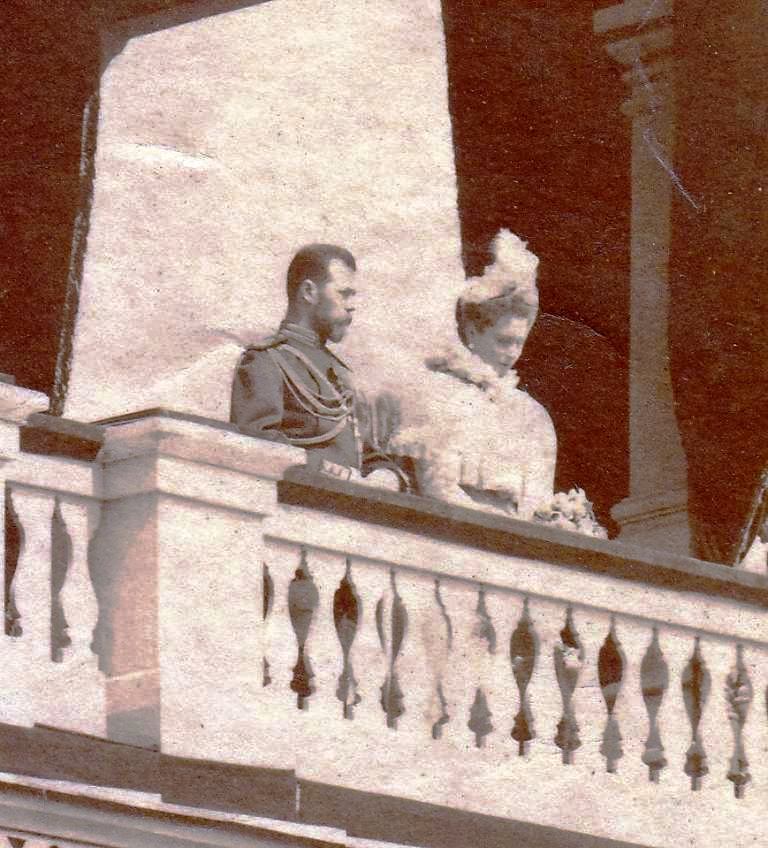
Despite the tragedy, the program of festivities continued as planned elsewhere on the Khodynka field, with many people unaware of the tragedy that had taken place. The Emperor and Empress made a brief appearance in front of the crowds on the balcony of the Tsar’s Pavilion in the middle of the field around 2 p.m. By that time the traces of the incident had been cleaned up. The couple were clearly shaken by the news.
0298d

PHOTO: The Emperor and Empress on the balcony of the Tsar’s Pavilion in the middle of the Khodynka Field

It was the Emperor’s attendance at a grand ball held on the evening of the tragedy, however, which planted a seed of gross misunderstanding and ridicule, one which Nicholas is criticized to this very day. I would like to take a closer look at this . . . 

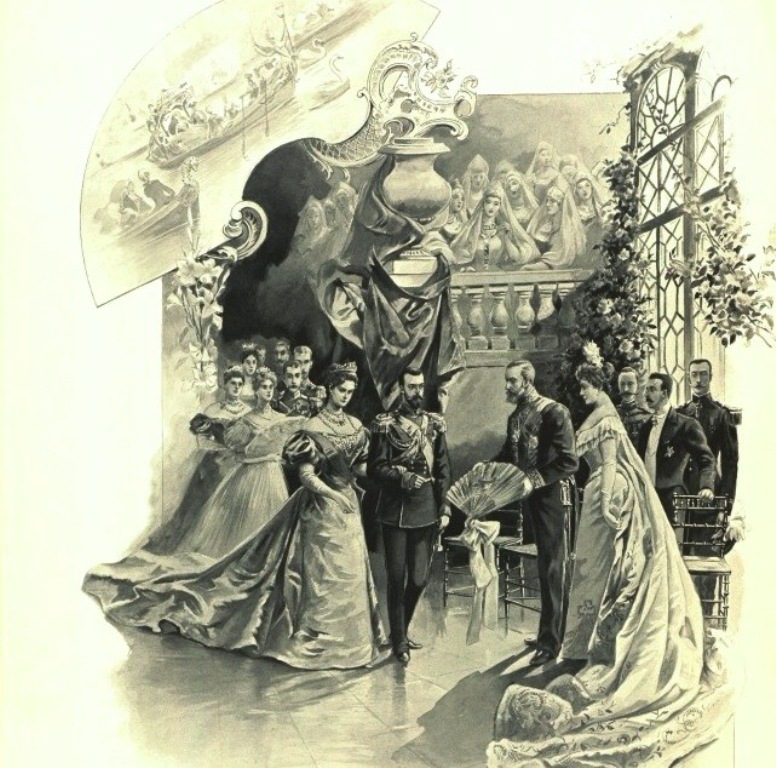
The ball was hosted by the French ambassador Gustave Lannes de Montebello (1838-1907), in Moscow. The French spared no expense in the extravagant preparations for the ball. The ball in part marked the recently signed Franco-Russian alliance.

For the arrival of Their Majesties, foreign princes, princesses, members of the Imperial Family, representatives of the foreign diplomatic corps, court officials gathered in the halls of the embassy. For hours this mass paraded through the halls. The excitement was everywhere. Their Majesties were greeted by the French ambassador and his wife at the entrance and remained at the embassy until 2 am.

The tsars’ sister Grand Duchess Olga Alexandra wrote: “The French government had gone to immense expense and trouble to arrange the ball. Tapestries and plate were brought from Versailles and Fontainebleau and 100,000 roses from the south of France.

“Other guests shared their descriptions: “some of the rooms had been converted into winter gardens” . . . “in one room a fountain lit up with colourful electric lights”. 

The grand ball at the French ambassador’s party ended with a fine dinner. During the ball, the ladies were offered luxurious fans and bouquets of flowers brought from France. In general, the ball was wonderful; full of animation, luxury, extraordinary brilliance, it left an indelible impression on many.

During the ball, an orchestra played and a choir of Russian singers in luxurious Russian costumes sang. The wide hospitality of the French embassy was extended to all guests.

An open buffet, champagne, fine French wines, a magnificent dinner, flowers for guests – everything was there. The tables in the Tsar’s rooms especially stood out – among the luxurious silver there were literally mountains of fragrant flowers.
0298b

PHOTO: Nicholas and Alexandra are greeted by the French ambassador and his wife

It was clear that the newly crowned Emperor and Empress did not want to attend the ball. Some historians believe that Nicholas was bullied by his uncles, urging him to attend. Because of the extravagant preparation for the ball, caused in part by France’s delight at the recently signed alliance with Russia, the failure of Nicholas and Alexandra to attend would have been a great slight.

According to the Countess Maria Eduardovna Kleinmichel (1846-1931), “in view of the terrible expense, the French ambassador begged the Imperial couple to attend, He urged the Emperor to agree to at least attending the reception, even if for a short while. The Tsar looked all haggard and pale as a white sheet. The Imperial couple walked in silence through the halls, bowing to those who had assembled. Then they went into the ambassador’s drawing-room, and shortly thereafter departed. The French were in despair, but they seem to have realized that their demands after such a tragedy, one which shook the Emperor and Empresses so deeply, were simply impossible.” 

Grand Duchess Olga Alexandra also noted: “I know for a fact that neither of them wanted to go. It was done under great pressure from his advisers . . . Nicky’s ministers insisted that he must go as a gesture of friendship to France.”

Count Sergei Witte, who served as Prime Minister under Nicholas II recalled that Nicholas “looked sick” and was “obviously depressed”.

“I know that both Nicky and Alicky spent the whole of that day in visiting one hospital after another,” wrote Grand Duchess Olga Alexandrovna.

Nicholas allotted some 90 thousand rubles to the victims families out of his own personal funds, and not the states. He ordered that a thousand bottles of port and Madeira were to be sent to hospitals for the wounded, and the sovereign himself visited the wounded in the hospitals and attended the funeral service for the dead. Further, all orphans received a pension until they were of age.

In their book A Life for the Tsar, co-authors Greg King (1964-2025) and Janet Ashton wrote: “They [Nicholas and Alexandra] visited the wounded in Moscow’s hospitals, and Nicholas announced that he would compensate the victims . . . yet the visits were mechanical and the pledge of financial aid went largely unfulfilled.” What is interesting to note is that their 189-page book, contains no less than 1,349 citations, yet there is no citation for their claim that Nicholas reneged on his promise to compensate victims. This in itself suggests that such a claim is based on rumour and not fact.

The Emperor’s kindness and empathy towards the victims and their families has been widely documented by numerous historians, both Western and Russian. The claim by King and Ashton that the “pledge of financial aid went largely unfulfilled”, simply goes against the personal character and deeply pious Orthodox beliefs of Nicholas II.

When asked if Nicholas II showed indifference to the victims of the Khodynka tragedy, Professor M.V. Lomonosov, who serves as associate professor of the history faculty of Moscow State University said:

“Here it is necessary to clearly separate the two matters. On one hand we have a situation related to human relationships, issues of empathy, compassion and mercy. On the other hand, there are issues of diplomacy and diplomatic protocol. And in this situation, they overlap one another.

“There was an official reception with the French ambassador, and it was necessary to demonstrate good relations with France. It was quite obvious that if Nicholas II for any reason ignored this event, then it would have a negative impact on Russian-French relations. As you know, his attendance at the ball was purely official.

“The  reception was not an entertainment event as such. It was political. There are things which need to be done, despite the fact that a tragic event overshadowed it.

“By attending, Nicholas II fulfilled his duties and Russia received a certain European political resonance.”

0298c

PHOTO: Emperor Nicholas II at the bedside of a victim injured during the Khodynka tragedy

That evening Nicholas briefly noted the event in his diary: “Up until now, thank God, everything went perfectly. The crowd spending the night on the Khodynka meadow, in anticipation in the distribution of the food and mugs, broke through the barrier and there was a terrible crush, during which it is terrible to say about 1300 people trampled!!”

His lack of emotion or empathy in this entry for the victims does not reflect his private feelings. His detractors often cite this in their negative assessment of his reign. [for more on Nicholas II’s diaries, please refer to my article Nicholas II’s Diaries 1894-1918.]

Whatever the Emperor’s private feelings, the Khodynka tragedy created a number of negative images and impressions which would colour all later views of Nicholas, his government and his reign. The first such image was that of a young monarch dancing at a fabulous ball on the evening of a day when hundreds of his subjects had lost their lives as a result of the incompetence of his own government.

“The image was unfair,” notes Russian historian Dominic Lieven. Not for the last time, however, the Emperor’s self-control exposed him in temperamental Russian eyes to accusations of heartlessness and indifference.

Sadly, Nicholas and his government never erased the image which Khodynka implanted in the public mind.

© Paul Gilbert. 23 August 2020
The Romanov Family Photo Albums at Yale University

Today, August 19th marks World Photography Day – a perfect day to present the following article on the Romanov Family Albums stored in the collections of the Beinecke Rare Book Library at Yale University in New Haven, Connecticut

The first Kodak camera was gifted to the Tsesarevna Grand Duchess Maria Feodorovna (future Empress Maria Feodorovna) in the late 1860s, when she took a serious interest in photography.

Her passion later became one of the favourite pastimes of her son Emperor Nicholas II and his family, who were often seen carrying Kodak Brownie Box cameras. They snapped thousands of images, pasted them in albums, many of which have survived to this day.

The family’s passion for photography was also shared by close friends, the most popular being Anna Aleksandrovna Vyrubova (1884-1964), the best friend and confidante of Empress Alexandra Feodorovna,

Anna was an avid photographer, one who captured the private day-to-day lives of Russian’s last tsar and his family on camera. During her years at the Russian Court, she diligently preserved her photograph collection into large handsome sturdy albums, bound in textured leather—green, blue, and brown.

In her memoirs, Vyrubova wrote that she and Alexandra pasted the photos onto the pages together. Often, the tsar himself—a notoriously fastidious man—stood over the two women, supervising them as they worked. “He could not endure the sight of the least drop of glue on the table,” wrote Vyrubova.

0299b

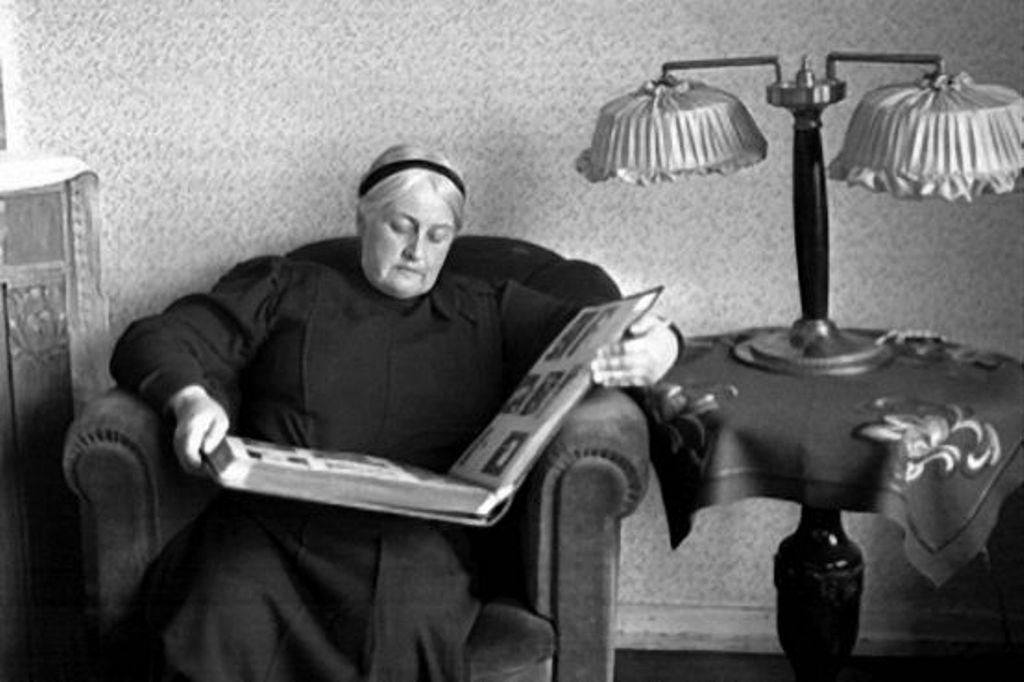
Anna in old age and in exile, reliving memories of the Imperial family before the Revolution

Six of the *seven personal photo albums of Anna Vyrubova are today kept at Yale University in New Haven, Connecticut. The albums contain about three thousand (!) photographs of the everyday life of Emperor Nicholas II and his family.

[*Anna presented Album No. 1 to Queen Louise, who bequeathed it to Prince Ludwig. This album is now stored in Darmstadt – PG]

When Anna fled Bolshevik Russia in 1920, the albums were one of the few things she took with her into exile to Finland. In 1937, Robert D. Brewster, then a student at Yale University, visited Anna to learn more about the family of the last Emperor. In his article The Golden Hours of the Romanovs, published in the Summer 2003 issue of the Yale Alumni Magazine, writer Tim Townsend explains Brewster’s interest in the subject began after seeing the 1932 film Rasputin and the Empress.

Life in exile was not good for Anna,  her health was poor, she lived in very cramped conditions, she had no income, and she was even denied citizenship. As a result, Brewster persuaded Anna to sell him the albums, as well as 35 letters written by her from prisons of the Provisional and Bolshevik governments. In 1951, Brewster donated the albums and letters to his alma mater.

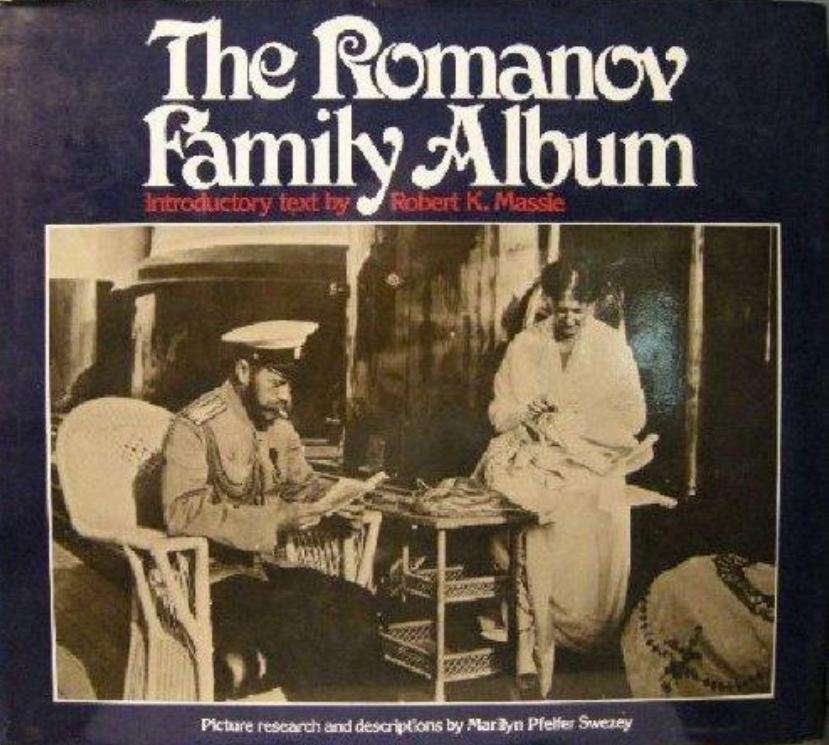
The albums were transferred to the Beinecke Rare Book and Manuscript Library, where they were catalogued and remained there until 1966, almost unknown to anyone. It was not until the autumn of 1966, when the Pulitzer laureate Robert K. Massie, was finishing his now classic bestseller Nicholas and Alexandra, that brought him to Yale and discover the now famous photograph collection.

Click HERE to view ALL 6 Romanov Family Albums stored in the collections of the Beinecke Rare Book and Manuscript Library at Yale University in New Haven, Connecticut. Note; click on each album to open and view the photographs.

147c

Robert K. Massie (1929-2019)  wrote the introductory text for the book The Romanov Family Album (published by Vendome Press in 1982), explaining how he discovered the Romanov albums and of their immense historic value:

“I see wonderful things!” – exclaimed British archaeologist Howard Carter, when he first poked his head into Tutankhamun’s tomb and there, by the light of a flickering candle, glimpsed the glitter of golden objects that had slept for thirty centuries. Something of the same thing came over me the first time I saw the collection of Romanov photographs from which the present series has been selected.

My wife and I found them almost by accident. In the autum of 1966, I was nearing the end of three years work on Nicholas and Alexandra. Suzanne, long involved with the research and editing, had taken complete charge of the search for illustrations, scouring commercial film libraries and seeking individual pictures in private hands. At the time, she was also writing about ballet and had become a friend of Evgenia Lekhovich, the director of the School of American Ballet. Evgenia and her husband Dmitry both were interested in our attempt to recreate the life of the last Russian Imperial family, and Evgenia suggested that I might like to meet a Russian friend of their, Sergei Taneyev, who lived in New York. Taneyev was the brother of Anna Vyrubova, the intimate friend and confidante of the Empress Alexandra. Perhaps, Evgenia suggested, he could add something to the story his sister told in her book Memories of the Russian Court [published by Macmillan in 1923 – PG]. I was eager, but Mr. Taneyev, it developed, was not; he had apparently tired of being identified as “Anna Vyrubova’s brother”. But he did say to Evgenia Lekhovich: “Tell Mr. Massie that Yale University has some of my sister’s things.”

I reacted casually to these words. After telephoning New Haven, where a charming research librarian named Marjorie Wynne, confirmed that Yale did, have certain materials catalogued as “Romanov Memorabilia”. I arranged to go and take a quick look on Saturday morning before attending a football game. I had been writing myself into exhaustion; an afternoon in the fresh air seemed a healthy prescription.

And so, on an October morning in 1966, Suzanne and I walked into Yale’s Beinecke Rare Book and Manuscript Library. We met Miss Wynne and filled out the required forms. Soon, from behind closed doors, a small, rolling table was wheeled in, laden with six fat albums in cloth and leather, all peeling and cracking at the edges. We opened the first album. Here were photographs of an Edwardian family in the lighter moments of life. But, incredibly, they were not just any Edwardian family; they were the Russian Imperial family, which a few years later would be obliterated in the revolution, along with so much of the life and culture of Old Russia. Turning the pages, we found hundreds of pictures, collectively confirming the millions of words that I had read about the life of this couple and her children. It was an extraordinary collection: the most complete set of intimate photographs of the imperial family to survive the holocaust of the revolution. Not only had most images of this kind been lost, scattered or confiscated during the revolution itself, but afterwards there were stories of attempts by Soviet agents to locate, remove, and destroy from all public and commercial archives any photographs depicting the last tsar and his family as normal human beings, whose faces and activities might arouse a shred of interest or sympathy.

But here they were, like Tutankhamen’s treasure, miraculously surviving. We have them today because of an unusual set of circumstances. The years when these pictures were taken coincided with the first days of the age of popular photography. The capturing of images on a light-sensitive surface was half a century old by the turn of the 20th century, but it was during the pre-war years of the Edwardian era that amateurs began regularly to take informal pictures – we call them snapshots – of family and friends, on guard and off. Kings and Queens, no less than nobleman and middleclass folk, issued the command: “Look this way! Now hold very still!” pointing their Brownies at each other.

Nicholas II had an especially keen interest in photography. [see my article Nicholas II: The Amateur Photographer – PG] It was he who commissioned the extraordinary collection of color photographs of the Russian Empire by Sergei Prokudin-Gorskii, a collection that has recently been published. Traveling for six years across the expanse of Russia, Prokudin-Gorsii took pictures of rivers, lakes and forests, of simple wooden churches and thick-walled fortress monasteries, of muddy village streets and everyday peasant life, of canals, locks and bridges, and brought them back so that the Emperor could see his Empire. Naturally, like most monarchs of the day, Nicholas II also employed official court photographers who recorded the ceremonial scenes of pomp and flourish which went with the specialized work of royalty. In addition, however – and this is where we today are extremely fortunate – Nicholas kept some of these photographers on assignment even when he and his family were off-duty; now the cameraman’s task was to capture moments of intimate family life. And so the shutters clicked while the Emperor went rowing, finished a set of tennis, or strolled off into the woods in search of mushrooms. They recorded the Empress knitting on her yacht or wading barefoot along a rock-strewn beach. They caught the little Tsarevich Alexei playing soldier and teasing his kittens. Sometimes, the cameras were in fact, held by royal hands – several of the pictures in this book were taken by Empress Alexandra herself.

Once the films had been processed, duplicate prints were delivered to the Imperial apartments. There, after dinner, the family hugely enjoyed settling down to an evening of pasting pictures into green leather albums stamped in gold with the Imperial monograph. After 1907, the Empress’ closest friend Anna Vyrubova, joined this intimate circle. She too had copies of the prints, and she arranged and captioned them in her own albums.

© Paul Gilbert. 19 August 2020


Ekaterinburg residents asked to help in glorifying General Tatishchev

0297

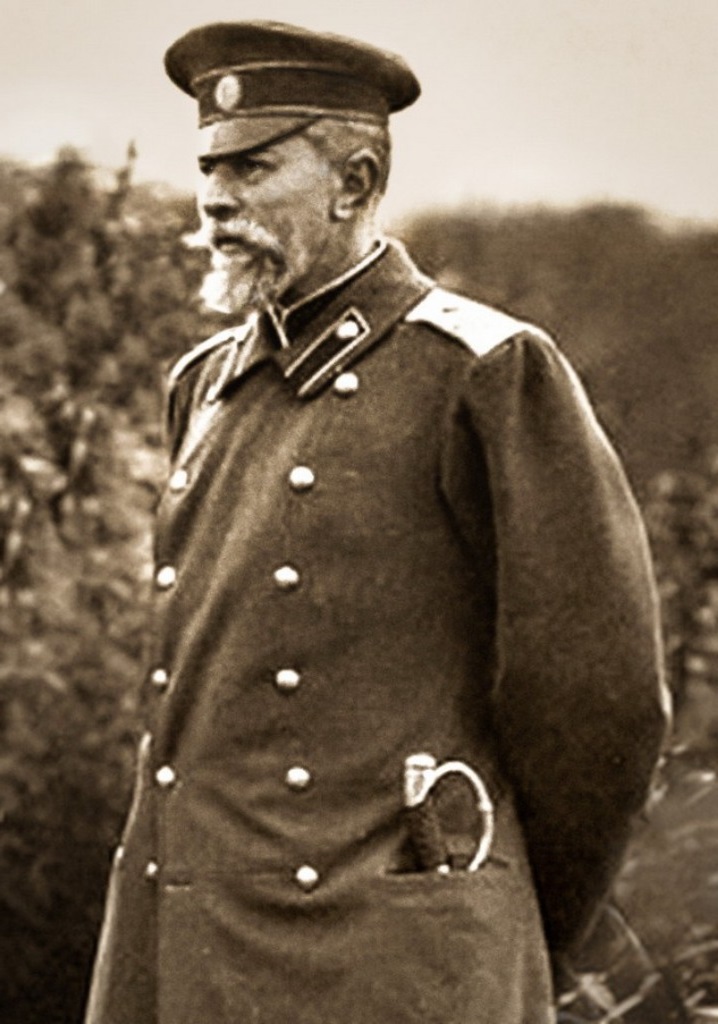
General Ilya Leonidovich Tatishchev (1859-1918) was glorified by the Russian Church Abroad in 1981 as the holy warrior martyr Elijah. The sisters of the Novo-Tikhvin Convent in Ekaterinburg now hope that he will canonized by the Moscow Patriarchate.

Residents of Ekaterinburg are invited to pray for General Ilya Leonidovich Tatishchev. Requiems will be performed every Tuesday after Vespers in the Novo-Tikhvin Convent.

Remembered as “a man of touching kindness,” Tatishchev was a noble and deeply pious man – he knew the entire Gospel by heart! For many years he selflessly served Emperor Nicholas II, and in 1917 voluntarily followed him into exile to Tobolsk and Ekaterinburg.

It was in Ekaterinburg that he was separated from the Tsar and his family and placed under house arrest. On 10th June 1918, he accepted a martyr’s death at the hands of the Bolsheviks together with Prince Vasily Dolgorukov. He was buried in the cemetery of the Novo-Tikhvin Convent. His grave has not survived, since during the Soviet years the convent’s cemetery was razed to the ground. And now, when we pray for the repose of the soldier Elijah, he prays for us before the throne of the Lord.

In an appeal to the citizens of Ekaterinburg, the sisters of the Novo-Tikhvin Convent said:

“Dear ones, now a lot depends on you and me! If we turn with prayer to the soldier Elijah, receive help and testify about this, then we can find in the saints another intercessor for our loved ones, our city, for the entire Ural region! Therefore, we ask you very much: report cases of miraculous help through the prayers of the soldier Elijah! Any information can serve to glorify him!”

Memory Eternal! Вечная Память!

Click HERE to read Divine Liturgy for Tatishchev and Dolgorukov Performed in Ekaterinburg, published on 10th June 2020

© Paul Gilbert. 10 August 2020

Putin, the Church and the last Tsar

0296a

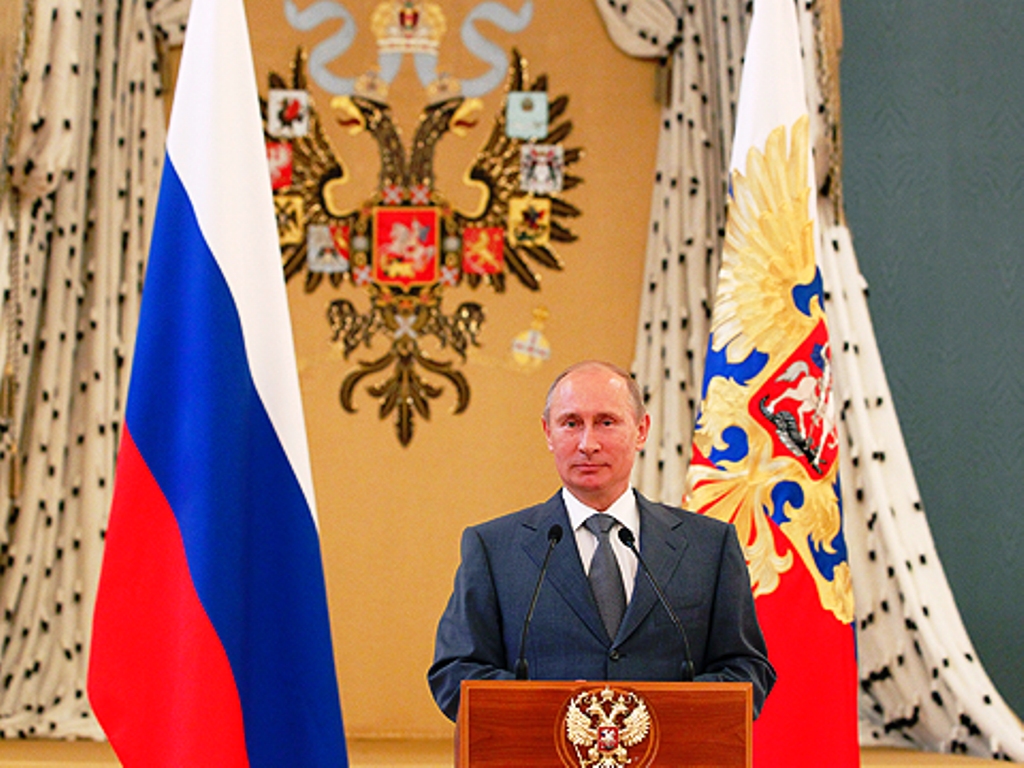
Russian President Vladimir Putin

Since coming to power in 1999, Russian President Vladimir Putin has embraced the Russian Orthodox Church and the symbols of Imperial Russia

Today, the Romanovs are the subject of a rather unusual debate between two powers that have reconciled in Putin’s Russia: the Church and the State.

For more than two decades, the heads of the Russian Orthodox Church (ROC) – Patriarch Alexei II (1929-2008) and Patriarch Kirill (2009-present) – both refused to recognize the remains found in the vicinity of Ekaterinburg as those belonging to the Imperial family.

Even after successive DNA tests, the ROC prevented the bones of Tsesarevich Alexei and his sister Grand Duchess Maria from being buried with the rest of the their family in the Cathedral of St. Peter and St. Paul in St. Petersburg.

The issue made headlines again in July, when the Russian Investigative Committee, the country’s top criminal investigation body, confirmed that, after 37 new forensic analyzes, it was possible to conclude – again – that the bones belonged to members of the Imperial family.

“Based on the numerous findings of the experts, the investigation came to the conclusion that the remains belong to Nicholas II, his family and their retainers,” said a committee spokesperson.

But why does Russia’s leading criminal investigation body continue to reconfirm facts related to a homicide that happened more than a century ago?

0296b

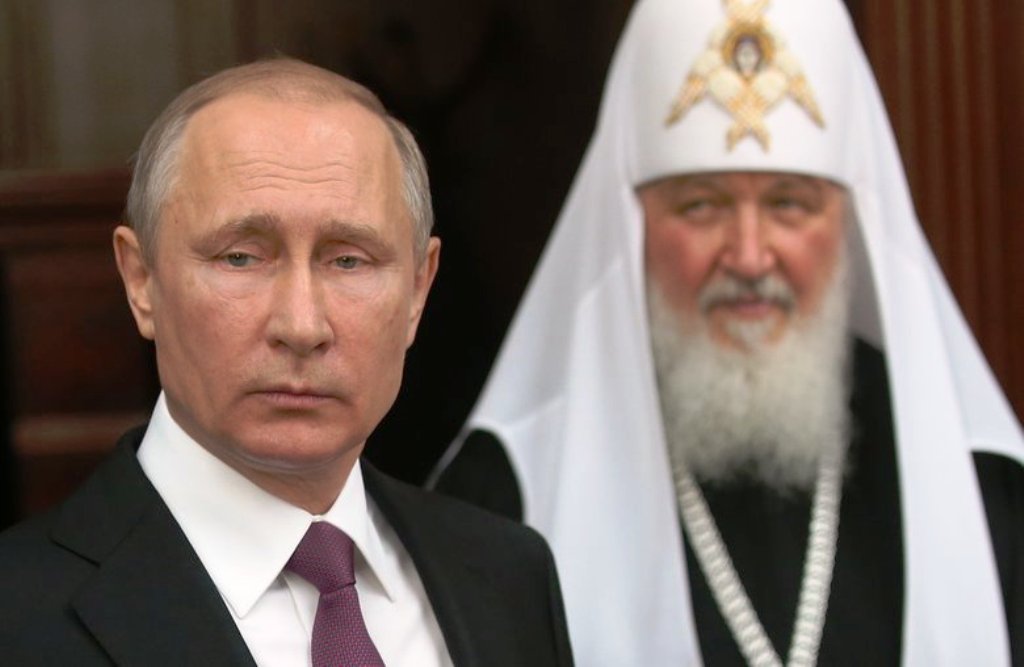
President Vladimir Putin and Patriarch Kirill of Moscow and All Russia

A long way

The whereabouts of the remains of the Imperial family were one of the best kept secrets during the Soviet period.

Only in 1979 did a geologist with an amateur detective streak, Alexander Avdonin, discover the first bones in the vicinity of Porosenkov Log, near Ekaterinburg.

Citing fear of reprisals from the regime, he reburied them where he found them and kept them there until 1991, after the Soviet Union disintegrated.

An extensive investigation and a series of DNA tests (for which even Prince Philip donated blood) proved that the bones belonged to Nicholas II, his wife, three of their five children and four retainers who were also murdered with the Imperial family.

One of the big questions Russia was asking at the time was where were the remains of the Imperial couple’s other two children. Anastasia’s whereabouts were also cause for speculation, but evidence has since proven that she died along with her family.

“In 1998, after a five-year investigation, the Russian government decided to bury the bones in the Romanovs family tomb in St. Peter and St. Paul’s Cathedral in St. Petersburg, as a political gesture of reconciliation and atonement for the crimes committed in the Soviet period”, says Marina Alexandrova, a professor at the University of Texas, in the United States.

The Holy Synod, the governing body of the Orthodox Church, however, opposed the decision and called for a more thorough investigation before the burial.

“Due to the political motivation of the event and the absence of consultation with the Russian Orthodox Church, the patriarch did not participate in the ceremony and rejected the test results,” says the professor.

The country’s president at the time, Boris Yeltsin, challenged the Church and gave the green light for the funeral. The act was the background of great friction that marked the Yeltsin government and the head of the Orthodox Church – at the time still weakened by decades of Soviet oppression.

Yeltsin would resign shortly afterwards, on the night of December 31, 1999, leaving the post in the hands of his then prime minister, a former KGB agent who had become his discreet shadow: Vladimir Putin.

A new stage in the relationship between State and Church then began.

0293

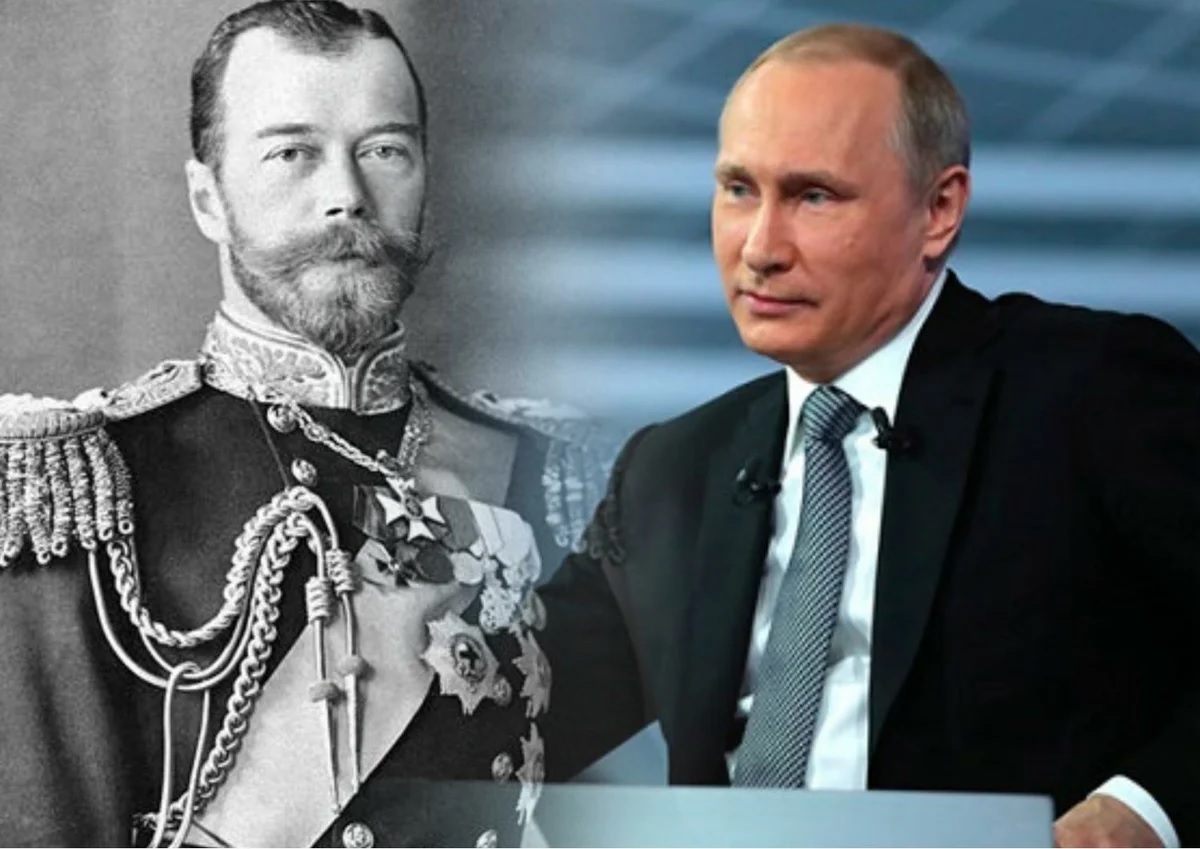
Emperor Nicholas II and Russian President Vladimir Putin

Putin, the Church and the last tsar

As Pablo de Orellana, professor at King’s College London, UK, explains, the beginning of Putin’s government marked a new phase, of “rescuing” the Romanov dynasty, which went beyond the golden double-headed eagles and other symbols of Imperial Russia.

“In his administration, some traditions of Tsarist Russia were re-instituted,”  he points out, “But I believe that one of the most important elements in this regard is the rebirth of the Orthodox Church, which has returned to being as powerful as before and is now recognized as the country’s official religion.”

In a referendum held in June to determine whether Putin would remain in power until 2035, Russians also voted Orthodoxy the country’s official religion, which was seen as a consolidation of relations between the Moscow Patriarchate and the Kremlin.

And it is in this new context that the Romanovs become key figures for the powers. “The Russian Imperial family is vital for the current regime and for the nationalist narrative that drives it, because it is the connection between Russia’s past and present, between the before and after of the Soviet regime,” says De Orellana.

“For the Church, the Romanovs’ theme is central, because the Russian Orthodox Church is part of the Imperial family and the Imperial family is part of the Church.”

Since Putin’s rise to power, the head of the Russian Orthodox Church has proclaimed the last tsar, his wife and children, as saints, which was viewed with fear in a country where the Imperial family are still victims of a century of myths and lies, much of which are based on Bolshevik propaganda.

In addition to canonization, the Church also decided to build a grand church on the spot where the family was murdered in Ekaterinburg.

But one theme remained an obstacle: the authenticity of the remains of the last tsar.

“The Russian Church has been reluctant to recognize the bones as belonging to the Romanov family since they were officially exhumed in 1991 near Ekaterinburg,” says Alexandrova.

“And although multiple DNA tests and forensic analyzes in Russia and other countries have shown that they do indeed belong to the Imperial family, their doctor and three faithful servants, the issue remains controversial to this day.”

083b

Alexei and Maria

The remains of the tsar’s two other children who were not found with the family were not discovered until many years later, in 2007.

“DNA tests carried out both inside and outside Russia have confirmed that they are the remains of Alexei and Maria,” says the professor at the University of Texas.

“The Russian Orthodox Church, however, again refused to acknowledge the discovery and denied the burial in the family tomb.”

In the years that followed, the boxes containing 44 bone fragments remained on dusty shelves in the Russian State Archives. In December 2015, their remains were transferred to the Novospassky Monastery in Moscow, where they remain to this day.

“Their remains have not yet been buried, which, ironically, runs counter to orthodox tradition in general.”

0296c

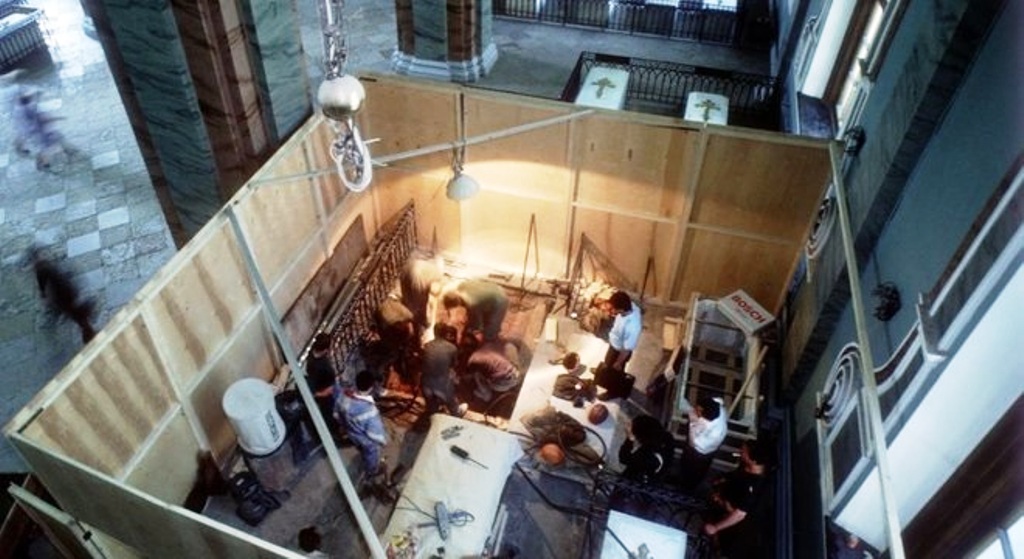
Members of the Imperial family were exhumed so that new DNA tests could be performed

New investigations

In 2008, the Russian Supreme Court officially rehabilitated the Imperial family and recognized that Nicholas II and his family were victims of political repression.

Two years later, another Russian court ordered the investigation into the murder to be reopened, which was in charge of the country’s top criminal investigation body.

In 2015, as determined by instances of the Orthodox Church, the remains of the Imperial family were once again exhumed and subjected to DNA tests, which confirmed again that it was the Tsar and his family – including Alexei and Maria.

The funeral of the last Romanovs was scheduled to take place in October of this year, but the Church asked to postpone the ceremony again to conduct an investigation of its own. “To date, no results have been announced,” says Alexandrova.

On the eve of the centenary of the massacre in 2018, the Russian government announced that the new investigation had once again confirmed that the bones belonged to the Romanovs. This year, again on a date close to the anniversary, they again released the findings.

0296d

The reasons for the debate

According to De Orellana, the dispute over the authenticity of the remains found in Ekaterinburg shows how, during the Putin government, the Church once again became a “legitimizing institution” – and that, therefore, “also legitimizes what one wants to tell about history. “.

“We see this in how the Church on several occasions had the final say, as in the question of where the bodies will be”, he points out.

In this sense, the expert believes that the position of the church in the case of the Romanovs generates a delicate political conflict.

“The Putin government needs to end the story, it needs the bodies to be ‘found’ also symbolically, ‘to bring them home’ and to have a place where they can be celebrated.”

“All this reconstruction is important, because Putin reinvented Russian nationalism based on the same nationalist theories as the tsars. In other words, it is not just an obsession to demonstrate that the bones actually belong to the last Tsar and his family, but an effort to establish continuity between the past and today’s Russia”, he adds.

Roman Lunkin, director of the Center for the Study of Religion and Society, a state organization, assesses that both the government and the Church are involved in a mutual process of revisionism of the history of Tsarism for “their own benefit”.

“The Russian Church does not want to recognize that the remains belong to the Imperial family, because there is a risk of internal division as a consequence of this,” he ponders.

According to Alexandrova, according to orthodox beliefs, it is a serious sin to pray before “false images”. The church, for its part, is reluctant to accept the result of the investigations carried out until today on the grounds that it was not invited to participate in the process.

There are still some people who believe that members of the Imperial family had managed to escape and live in secrecy in Europe and the United States.

“They think that what happened in 1918 was a ritual murder by Bolsheviks of Jewish origin. There is also a movement that sees Nicholas II as a Christlike figure who died for the sins of the Russians.”

Even if these movements are not really popular, he says, they would be strong enough to cause repercussions in the media, something that the head of the Church would certainly like to avoid.

“For the Church, the murder of the Imperial family is a symbol of all the evil of the Soviet period, of Satanism and of Marxist ideology. For the State, however, the Soviet period is also a period of victories – and the last tsar is not an example of a strong leader, “says Lunkin.

“So it is evident that the glorification of the Imperial family means different things for both the state and the church.”

© Paul Gilbert. 10 August 2020

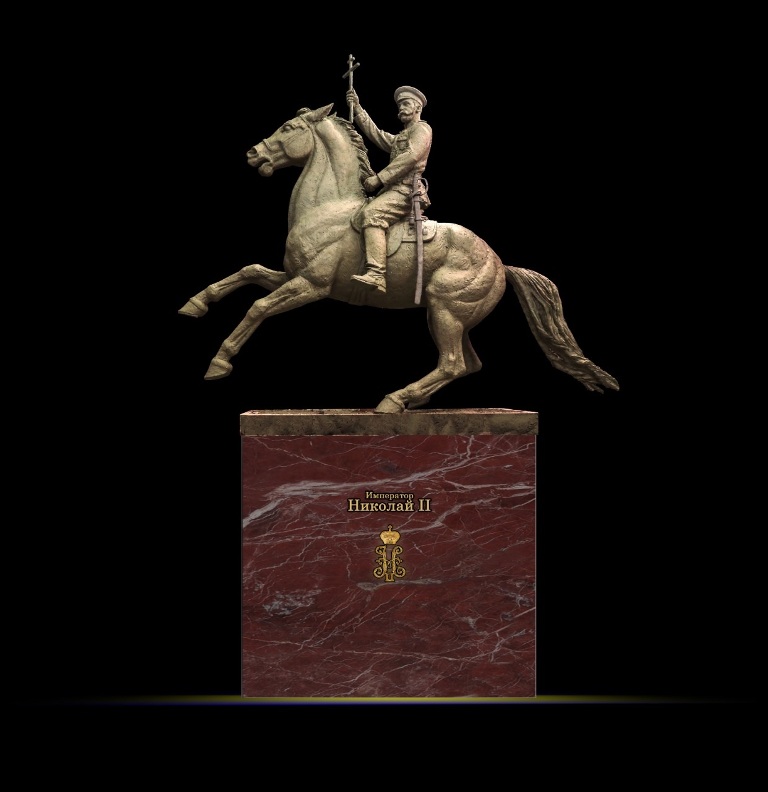
Fundraising for equestrian monument to Tsar-Martyr Nicholas II

0295

The installation of Russia’s second equestrian monument to Nicholas II has been delayed due to lack of funds.

The amount of 2.3 million rubles ($31,000 USD) has already been collected, however, a further 2.7 million rubles ($37,000 USD) is still needed. The equestrian monument to Tsar-Martyr Nicholas II has already been cast and is located at the plant in Zhukovsky.

The following video shows Russian sculptor Irina Makarova making final preparations on her equestrian monument of Nicholas II – 15th July 2020

The monument was planned to have been installed on 17th July on the grounds of the Church of the Holy Martyr Michael (Gusev), in Kulebaki, Nizhny Novgorod Region.

Click on the following links to read Nicholas II Equestrian Monument Planned for the Russian city of Kulebaki and UPDATE: Nicholas II Equestrian Monument in Kulebaki

© Paul Gilbert. 9 August 2020

What is Nicholas II’s correct date of birth?

0294

PHOTO: Russian historian Peter Valentinovich Multatuli

In recent years there has been much confusion by non-Orthodox Christians and Westerners with regard to the correct dates of important events (births, deaths, marriages, etc.) among members of the Russian Imperial Family, according to the New Style calendar.

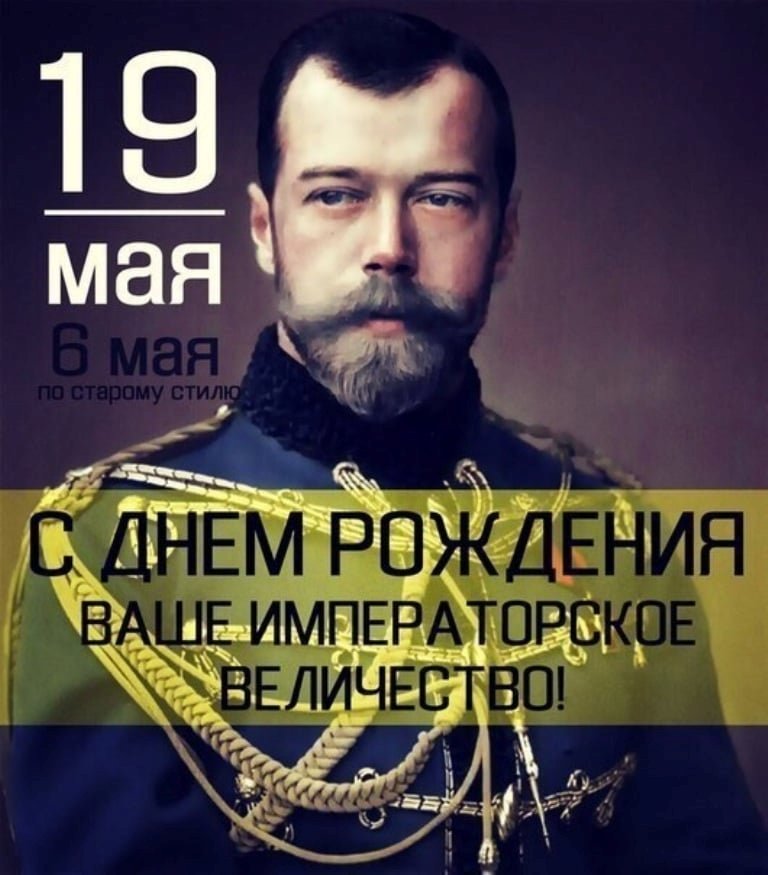
For instance, the anniversary of the birth of Nicholas II has been widely marked on the 18th of May in the Gregorian (New Style) calendar. This, however, is incorrect, it is in fact the 19th of May, an error which many historians (myself included) are guilty.

With the passage of every leap day that is on the Julian (Old Style) Calendar but not on the Gregorian Calendar, the difference between the two calendars grows another day. Currently, the Gregorian Calendar is 13 days ahead of the Julian Calendar. Beginning on 14th March 2100 (29th February 2100 Julian), the difference will be 14 days.

The Gregorian calendar was implemented in Russia on the 14th of February 1918 pursuant to a decree signed on 24th January 1918 (Julian) by Bolshevik leader Vladimir Lenin. Despite this, the Russian Orthodox Church continues to use the Julian Calendar.

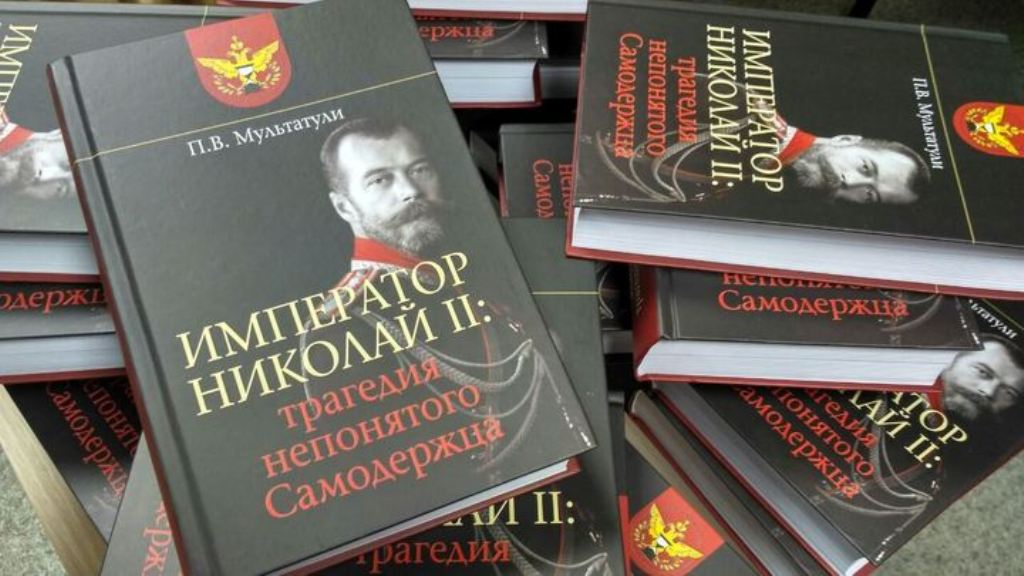
Russia’s highly respected and prominent authority on the life and reign of Russia’s last emperor and tsar, Peter Valentinovich Multatuli reminds us of the true dates of the history of Russia and its Tsars!

n2bd

“The birthday of Sovereign Emperor Nicholas Alexandrovich should be celebrated on 19th May,” says Multatuli, “not the 18th as many English language books and websites note.” Further, he adds: “and the day of Nicholas II’s accession to the throne is on 2nd November. If the correct dates in the New Style are not followed, then these and other historical events are distorted.”

“Everyone knows that Emperor Nicholas II was born on St. Job of the Long Suffering. The church celebrates this day on 6th May, according to the Julian calendar. In the Gregorian calendar in the 19th century. this number corresponded to 18th May, but in the 20th and 21st centuries. this date falls on 19th May. Celebrating the birthday of the Emperor on 18th May, is not the day we celebrate the birth of St. Job! This is a sin!”

“The same is true with the death of Alexander III and accession to the throne of Nicholas II. This happened on the day of Saint Artemius the Great Martyr and the righteous youth Artemiy, on 20th October (2nd November). And if this day is celebrated on 1st November or 3rd, then we are not commemorating the memory of these saints. Do not rely on any dates on Wikipedia which often provide the incorrect dates of the Gregorian calendar for the 19th century.”

0294b

Peter Valentinovich Multatuli was born in Leningrad on 17 November 1969. He is a Russian journalist, historian and biographer. Multatuli is the author of numerous books and articles about the reign of Emperor Nicholas II.

He is the great-grandson of Ivan Kharitonov (1872-1918), who served as the Head Cook of the Imperial family. He followed the tsar and his family into exile, and was murdered along with them in the Ipatiev House on 17th July 1918.

© Paul Gilbert. 7 August, 2020

Putin’s plan to restore the Romanovs

0293

This 3-part series by Matthew Dal Santo was published in The Interpreter, which features in-depth analysis & expert commentary on the latest international events, published daily by the Lowry Institute.

Although dated – originally published in July 2016 – it is still an interesting and thought provoking read.

He is the author of the forthcoming book, A Tsar’s Life for the People: The Romanovs and the Redemption of Putin’s Russia, to be published by Princeton University Press.

Putin’s plan to restore the Romanovs (Part 1) published 16th July 2016

Official treatment of Stalin reflects the result of this impasse, neither to suppress nor promote popular support for his legacy.

Putin’s plan to restore the Romanovs (Part 2) published 17th July 2016

If there’s a Russian leader whose reputation has been unequivocally rehabilitated during the Putin era, it’s Nicholas II.

Putin’s plan to restore the Romanovs (Part 3) published 18th July 2016

Russian monarchists are remarkably fond of observing that nobody says Russia’s next tsar must be a Romanov.

***

Dr. Matthew Dal Santo has been a Danish Council Post-Doctoral Research Fellow at the Saxo Institute, University of Copenhagen since 2014. He writes on conservatism as an ideological programme in modern Russia, with a special interest in Russian foreign policy. He has written analysis and commentary on Russian and European affairs for The Australian Broadcasting Casting Corporation (ABC) and has appeared on Radio National’s Counterpoint programme.

His work has been published by The Australian Strategic Policy Institute (Canberra, Australia), The Lowy Institute (Sydney, Australia), The Center for the National Interest (Washington, D.C.) , The Nation (New York), and The Spectator Australia. He travels frequently to Russia and is currently writing a book (provisionally entitled The Romanovs, 1917 and the Redemption of Putin’s Russia) on the cult of Russia’s last tsar, Nicholas II, and on how ordinary Russians see their country’s place in the world in the approach of the 2017 centenary of the Russian Revolution.

He studied history and European languages (BA first-class honours and University Medal) at the University of Sydney (1999-2004) and graduate-level history (MPhil, PhD) at the University of Cambridge (2004-9). In 2007, he was elected a Fellow of Trinity College, Cambridge and taught as an Associate Lecturer in Cambridge’s Faculty of History. In 2011, he entered the Australian Department of Foreign Affairs and Trade. Matthew speaks Russian, French, Italian, and Danish. He lives in Copenhagen, Denmark, with his wife and daughter.

© Paul Gilbert. 3 August 2020
Nicholas II in the NEWS – July 2020

0292b

At the end of each month I will post links to noteworthy articles about Nicholas II from English language media sources, complemented with photos and videos.

Please click on the titles (highlighted) below to read each respective article:

Inherited Love: On the families of the parents of holy Royal Martyrs Nicholas II and Tsarina Alexandra by Xenia Grinkova. Published in Russian Orthodoxy on 31st July 2020

When we look at the life of the holy Royal Passion-Bearers, their podvig as a family strikes us most. Truly, they succeeded in embodying the Christian family ideals on the earth and bringing up their daughters and son in it like nobody else. And, of course, it was from their wise parents that the saints, like “most honorable branches of the pious root” (from the service to Right-Believing Prince Alexander Nevsky), received the rudiments of what later blossomed forth and led them to heavenly abodes.

banner3

The Khodynka tragedy: A coronation ruined by a stampede by Yulia Afanasyenko Published in Russia Beyond on 23rd July 2020

A huge public celebration of the coronation of Nicholas II was planned at the Khodynskoe field in Moscow, but poor organizing caused a disaster.

This terrible tragedy is one in which contemporary historians like to flog like a dead horse, some of whom blame the newly crowned emperor for the incident. Sadly, it is one which haunted him to the final days of his reign.

indifference

A Life Blessed by the Tsaritsa by Vladimir Soloviev. Published in Russian Orthodoxy on 17th July 2020

Not long ago was the fortieth day after the repose of Archbishop Agapit (Gorachek) of Stuttgart (ROCOR). More and more reminiscences about this remarkable man have been sent to the Russian website Pravoslavie.ru and continue to come; that is what an indelible impression this bright personality has left in the hearts of those who knew him.

This is a story of Archbishop Agapit, but through him of the “Ekaterinburg remains”—bone fragments discovered in a gully outside Ekaterinburg, which recent investigations have shown with near certainty to be those of the Royal Family. These investigations were conducted for over ten years on the highest level. They encompassed all aspects of forensic science, including genetic testing in a number of laboratories. It is told by one of the main investigators, who through his work gained a personal understanding of Archbishop Agapit’s close connection with the Holy Royal Martyrs and his service to them in this important matter.

*** 

VIDEO OF THE MONTH: Nicholas II. The Early Years

Rare photographs from the childhood and teenage years of Tsar Nicholas II, whose exceptional virtues from his earliest years of age were politeness, affability, and affection. His characteristic shy, tender, and somewhat sad smile always made an impression on all. He tried to see only the good side of people and was ready to show love to all.

All the quotes used in the captions of this video are from the book “The Romanov Royal Martyrs: What Silence Could Not Conceal”.

Duration: 8 minutes, 47 seconds

***

0292a

THANK YOU to every one who responded to my annual summer appeal for donations. Your contributions will help me greatly with my research to clear the name of Russia’s much slandered tsar during the coming year ahead.

There are many web sites, blogs and Facebook pages dedicated to the Romanovs. Therefore, I am especially grateful to those of you who follow my work faithfully on a daily basis.

I work very hard searching Russian archival and media sources to bring something new to the table every day. This includes articles researched by a new generation of Russian historians; news on the Romanovs, their palaces, exhibitions, etc; photos, videos and more.

Click HERE to make a donation with GoFundMe

Click HERE to make a donation by credit card or PayPal

Click HERE to make a donation by personal check or money order

THANK YOU for your consideration, and for your continued interest and support of my work.

PAUL GILBERT
Independent Researcher and Publisher

© Paul Gilbert. 31 July 2020

Documentary – The Murder of the Romanovs: Facts and Myths

Daria Strizhova talks with Elena Chavchavadze about her new documentary. Please note that this video is only available in Russian (click on the image above to watch)

On July 19, the television channel Russia-1 showed the second film of “The Murder of the Romanovs” documentary project. This new Russian-language documentary sheds light on one of the most tragic pages in the history of the Russian state.

The first film, “Regicide: A Century-long Investigation” tells about the origins of the investigation into the murder of the Imperial Family. The second part, “Murder of the Romanovs: Facts and Myths” is the result of the painstaking research work by E. N. Chavchavadze and G. I. Ogurnaya—who together, introduce the viewer to unique archival documents.

—Elena Nikolaevna, tell us about the background of making these films dedicated to the Imperial Family. How did it all begin?

—Part of the code of honor for me and my family is to always seek the truth in everything. By the time we started working on the films on the murder of the Romanov Dynasty for the TV channel Russia, we had already filmed five episodes of the series, “Romanovs: A Royal Matter,” “War and Peace of Alexander I,” “Alexander III: Strong, Powerful.” The material itself showed us which direction to go next. And it was impossible to avoid the topic of regicide.

I was worried, realizing that the topic is too big. Let’s recall the words of Voykov who said: “The world will never find out what we did to them.” This poses a challenge to researchers. Is it possible to unravel this tragic mystery? But you know how it is: Fear has big eyes. As far as I know, a number of fundamental studies by anthropologists, criminologists, geneticists, graphologists, and other scientists are nearing completion. And we hope that the next film in the cycle will be dedicated to the results of this long-term work.

—Your film is called, “Murder of the Romanovs: Facts and Myths.” I’d like to dwell on this in more detail. What is a fact and what is a deliberately created myth? The film quotes Lenin’s words: “We don’t need to tell Joffe the truth (about the murder), so it will be easier for him to lie later.”

—We tried to clearly show the mechanism by which a myth turns into fact, and a fact becomes a myth and dissolves with time.

I must say that the plan of “blurring” the truth worked on a global level. All the Bolsheviks’ negotiations and diplomatic correspondence was constructed so as to divert suspicion away from the top of the Soviet leadership. This is a very thoughtful, masterly calculation. Only such a position would have allowed them to remain in power, as at that time they were entirely dependent upon Germany.

And how “interesting” the newspaper articles were! How well they were edited—again with an understanding of the colossal power of influence on the public consciousness! It’s in the papers, so it must be true.

When the investigator Sokolov managed, with much difficulty, through Prince Orlov’s agency in Russia, to get an agitation pamphlet talking about the murder of the Imperial Family while he was in France, he included it to the case. But this primitive article, intended for the proletariat, had been carefully edited by someone by then. We don’t know who the editor was, but probably it was Pokrovsky, a famous falsifier of history. But he was certainly a very astute man. But unfortunately, Sokolov took it all at face value. And today many people adhere to the theory that was presented in his book, because it was the only work on the topic of regicide at the time. And given that the book was created under certain conditions, under the pressure of the circumstances, and on the basis of such obviously unreliable documents, who will figure out the truth? The investigator Sokolov did a great job, and no one belittles the significance of his works for history. But, you know, the details settle everything.

—Unfortunately, the majority form their personal opinion not based on documents, not on the materials of the investigation, but on articles in the press and online. How many books have been written justifying this or that theory!

—And therefore, I think it’s necessary to dive into the archival material, to compare facts. Who was familiar with whom and when; where could this or that declaration have come from? Beginning my work on the film, the director G. Ogurnaya and I decided not to stick to any of the previously voiced theories. We simply did our work, during which connections and details started to emerge. Our films feature previously unknown documents that have only now become available—in particular, the note of Colonel Baftalovsky, which is of great interest. It is the testimony of the officers who were the first to arrive at Ganina Yama.

—There is an opinion, including from experts, that they could in no way have destroyed their bodies at Ganina Yama; and there are opposite statements as well. This is difficult to understand…

—Clothing and personal items were burned. Baftalovsky’s note is a very important testimony. Undoubtedly, the interest around this topic is so great that various people sprout up like mushrooms in the information space, clearly and colorfully expounding various theories. And amateur trackers—they are innumerable—sometimes write appalling nonsense. But people believe them, revere them, and look up to them. But there is another position, which was voiced by His Holiness Patriarch Kirill, and for us it is the only true and possible one: it is the path of painstaking work and conscientious scientific methods. I believe the truth will be voiced by the Russian Orthodox Church.

The first film—“Regicide: A Century-long Investigation”—is dedicated exclusively to the murder that was committed in the Ipatiev House. The second film—“Murder of the Romanovs: Facts and Myths,” which was aired thanks to the channel Russia-1 and the History of the Fatherland Foundation—covers a short period of time in the summer of 1918 and reveals a certain connection between three crimes. At first we had the idea of focusing more on each of the events and making an individual film for each—on Perm, Alapaevsk, and Ekaterinburg—and we could have gathered enough material for this. But, unfortunately, we were limited by screen time. So we tried to isolate the main points.

Even now you can find opinions among the researchers dealing with the Romanovs that, for example, Alapaevsk (the murder of the Grand Duchess Elizabeth) and Perm (the murder of Grand Duke Michael) were both the decision of the local Council of People’s Commissars. Gabriel Myasnikov, for example, wrote an entire book about this. But when we went to Perm and started talking with people who work in the archives with the originals, we were presented a completely different picture. We were fortunate enough to meet some wonderful archivists.

—You managed to convey their very conscientious attitude to the work: It’s not just an academic interest, but a deep personal experience.

—People work for decades with great love for their inconspicuous but extremely important work, not expecting any encouragement or reward. They know their topic incredibly well. As you have correctly noted, they perceive what happened as if it happened yesterday in front of their eyes. Just like us, they perceive these events very deeply, and I’m glad that our joint work on the film expands our circle of not only professional acquaintances, but also personal ones.

—The film provides a unique archival audio recording. How did you manage to get it?

—It’s a restored archival audio recording that was preserved as “top secret.” It just recently became available to researchers, and, indeed, it sheds light on many facts. Other materials are stored in the Russian state archive of socio-political history. Many storylines from this story were not included in the film. We would be happy to continue this work, but not before all the appointed examinations are finished. This is science, not the pursuit of spectacular sensations. Even if the resolution of the investigation doesn’t suit someone, or disappoints someone, or someone says: “No, it can’t be,” because some materials came from people who aren’t very religious, for example—it’s still an insufficient argument.

—How much only the information trail from Geliy Ryabov is worth…

—Geliy Ryabov became a believer in much thanks to what happened. He spoke with Archpriest Alexander Shargunov and passed on some of his findings to him. We filmed Fr. Alexander for “Regicide: A Century-long Investigation.” Ryabov’s second wife told us a lot. All the circumstances of his story turned out to be simpler and more logical, and in the end, everything really falls into place, like pieces of a puzzle.¹

The murder of Tsar Nicholas II is spoken of as a ritual act, but it would be more correct to speak of it as sacred; and I, as a researcher, cannot completely deny this. But to be fair, it should be said that when we were in New York, working with newspapers published before the revolutionary events of 1917, we came across cartoons in articles about Russia where the head of Emperor Nicholas II was drawn separately. Can be this be considered an argument for the theory about his decapitation? I don’t think so. Why would they have carried his head to Moscow, thus taking a completely unjustified risk, since random people could have witnessed it? And as you’ve probably already realized from the documents presented in our film, the last thing in the world Lenin and his cohorts wanted was to be connected with the murder of Emperor Nicholas—for political gain, of course. And these people knew how to appreciate benefits.

—In other words, the expression “sacred murder” has a symbolic meaning?

—The expression “sacred murder” is just not only in relation to the Sovereign Emperor Nicholas Alexandrovich, but first of all to Grand Duke Michael Alexandrovich, who in fact was the main contender for the Russian throne.

The reception of power was postponed until the Constituent Assembly was called. And if Kolchak had managed to win, no doubt the Constituent or National Assembly would have been called first. It’s quite likely that it would have called Michael Alexandrovich to head the state, because the dynasty was not interrupted. The Pavlovian Laws (the Act of Succession of 1797) provided that if someone leaves, then another member of the dynasty is placed on the throne by force of law, “so the state wouldn’t be without heirs, so the heir would be appointed by the law itself, so there wouldn’t be even the slightest doubt as to who is to inherit, so as to preserve the right of birth in the inheritance, without violating the rights of the natural heir, and to avoid difficulties in the transition from generation to generation.”

That’s why the murder of Grand Duke Michael Alexandrovich was first. The Bolsheviks weren’t sure of their position; they had to hurry. According to the documentary evidence, the greatest amount of disinformation was aimed at concealing the murder of Grand Duke Michael Alexandrovich.

As bitter as it is to realize, investigator Sokolov and other researchers paid very little attention to the investigation in Perm. The official story is that it was a disappearance. A man disappeared. He was there, and then he suddenly disappeared. There was a lot of evidence that he was seen here and there, then in Harbin, then somewhere else. The officers swore they caught a glimpse of him in the crowd—a mass psychosis, an unwillingness to accept the reality. If Michael Alexandrovich is alive—no matter where—it means they have hope. And Russia has hope. Do you get it? This is a very deep motive. And it is this motive that can cast doubt on all such evidence taken together.

When we put the three murders in a line, a lot of things became obvious. At that time, the English Consul Preston—who reported in London on what was happening—was in Ekaterinburg, along with a mass of representatives of international organizations, including the American, Finnish, and Swedish Red Cross. It was full of outside observers. The Brest Peace, which was treasonous to Russia, had already been concluded. The Germans were sitting in the Council of People’s Commissars—just like the Americans sat in our government under Chubais² a few decades later.

—There is the view that a “ticking time bomb” was placed under the edifice of the Russian state at this time. What do you think about this?

—I agree with this hypothesis. It’s no accident that the name “Union of Soviet Socialist Republics” doesn’t have the word “Russia” in it. An interesting fact: In August 1916 in Switzerland, there was a meeting of bankers from warring powers, including Germany, to which Russia was not invited.

Russia was to be divided into spheres of influence according to the principle of divide and conquer. This would have been impossible to do under the existing monarchy. Lenin was entrusted with ensuring that Russia lose the war. The plan was to have Russia leave the war through the revolution and, as a result, violate the agreements with its allies about how no one warring party should conclude a separate peace treaty. This would automatically exclude Russia from the list of future winners, which is what happened. A massive information attack to discredit Tsar Nicholas II was carried out throughout the entire world. When we were dealing with this historical period for the film “Revolution: A Trap for Russia” and were communicating with English researchers, they said that in England society was even more certain than in Russia that revolution was coming in Russia, that the Tsaritsa was a German spy, and that everything was controlled by Gregory Rasputin, and so on. That’s how the propaganda worked.

0291a

—One of the conclusions of your film is that the facts of the history are very malleable, and to establish the truth, we still have to reexamine and reevaluate our past. The question for modern man is: If this was done on such a scale and with such success, is it possible that the mechanism turning myths into facts is still active today?

—Of course. We see this in the example of our brothers in Ukraine, or if we look at what is happening in the United States right now. If we replace the word “proletariat” with “black,” we’ll get a traced copy of the events of a century ago in Russia. The scenery changes, but the rhetoric remains the same: “oppressors and the oppressed”—it’s nothing new.

There’s an expression: You have to accept your past, your successes, and your failures. It seems to me this is happening in Russia now. The best thing we can do is to accept the historical truth. It’s my Russia, and I accept its history as God gave it to us, to paraphrase Pushkin.

***

1. Together with Alexander Avdonin, in 1979, Ryabov discovered the remains that are believed to belong to the Royal Martyrs.—Trans.

2. A Russian politician and businessman who was responsible for privatization in Russia as an influential member of Boris Yeltsin’s administration in the early 1990s—Trans.

© Daria Strizhova / Pravoslavie.ru. Translated by Jesse Dominick. 27 July 2020

“Judge Not Lest Ye Be Judged” – in Defence of Empress Alexandra Feodorovna

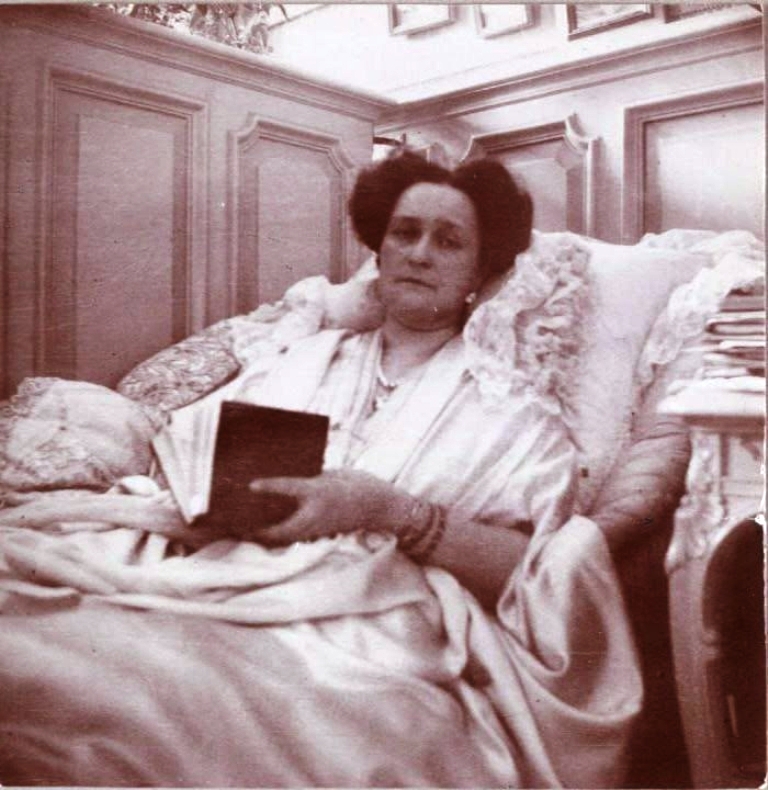
Empress Alexandra Feodorovna (1872-1918)

In a letter to his mother dated 8th June 1910, Nicholas II reflects his deep concern and anxiety about his wife’s condition . . .

“I am completely run down mentally by worrying over her health.”

Over the past 5 years, I have posted many photos of Empress Alexandra Feodorovna on my personal Facebook page, but I am sadly disheartened by the numerous bitter, nasty comments often left by people. This poor woman has been criticized for everything from “never smiling”, “looking miserable” or depicting a “sour face” – just to name a few.

Just last week I received a nasty email from a Facebook troll who noted how much Alexandra is “hated” by “noted historians”.

During her life, Alexandra carried much grief, worry and sorrow on her shoulders, all of which began at an early age. She lost her brother Friedrich to haemophilia in May 1873; her sister Marie died of diphtheria in November 1878; and the following month, her beloved mother Princess Alice also died of diphtheria in December 1878.

After her mother and sister’s deaths, Alix became more reserved and withdrawn. She described her childhood before her mother and sister’s death as “unclouded, happy babyhood, of perpetual sunshine, then of a great cloud.”

In March 1892, her father Grand Duke Louis IV, died of a heart attack. According to Baroness Sophie Buxhoeveden, Alix regarded the death of her father as perhaps “the greatest sorrow of her life”. Buxhoeveden recalled in her 1928 biography [The Life and Tragedy of Alexandra Feodorovna] that “for years she could not speak of him, and long after when she was in Russia, anything that reminded her of him would bring her to the verge of tears”. This loss was probably so much greater for Alix because Grand Duke Louis IV had been Alix’s only remaining parent since she was six years of age.

0290b

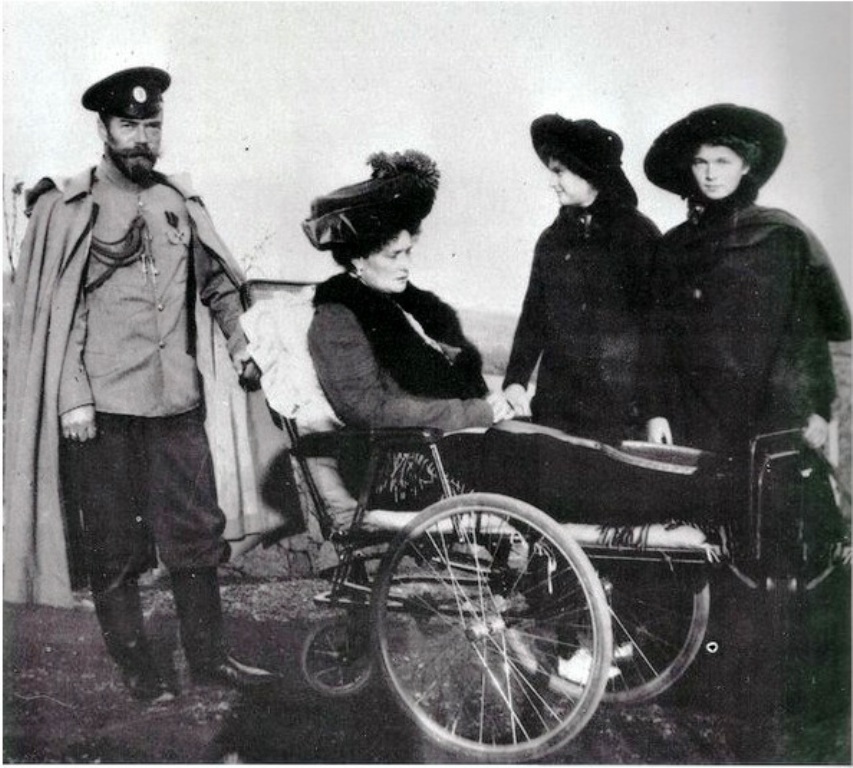
PHOTO: In later years, the Empress’s immobility forced her to use a wheelchair

Alexandra’s health was never robust and her five pregnancies, wreaked havoc on her body. Some historians attribute the semi-invalidism of her later years to nervous exhaustion from obsessive worry over the fragile health of her son. She spent most of her time in bed or reclining on a chaise in her boudoir or on a veranda. This immobility enabled her to avoid the social occasions that she found distasteful. Alexandra regularly took a herbal medicine known as Adonis Vernalis in order to regulate her pulse. She was constantly tired, slept badly, and complained of swollen feet. She ate little, but never lost weight – she had become a vegetarian. She may have suffered from Graves Disease (hyperthyroidism), a condition resulting in high levels of the thyroid hormone, which can also result in atrial fibrillation, poor heartbeat and lack of energy.

After the birth of Alexei, the long awaited heir to the Russian throne, Alexandra felt guilt for having passed haemophilia to her son. Most historians believe that she had a breakdown due to the constant worry for her son’s health, and later perhaps suffered from mental health issues.

From the day which she arrived in St. Petersburg, members of the Imperial Family, along with the ladies of the aristocracy took a particular dislike to Russia’s new Empress. Alexandra was a deeply religious woman, and she took great lengths to keep both herself and later he children at a distance from the debauchery of the capital.

Alexandra was also isolated for being foreign. Increasingly, she became an even more unpopular figure with the Imperial Family, the aristocracy, and the Russian people for numerous reasons, including her association with Rasputin and Anna Vyrubova. During the Great War, she became unpopular because of her German birth and upbringing, when that country was an enemy of the Russian Empire. Alexandra became a primary focus for the increasing unrest associated with opposition to the monarchy.

alix judge

And despite all her health issues, during the First World War, Empress Alexandra Feodorovna threw herself heart and soul into Russia’s war effort.

Burning with patriotism for her beloved adopted country, filled with energy and enthusiasm, she plunged into hospital work to help relieve the sufferings of Russian soldiers.

Nursing became her passion. She had the Catherine Palace at Tsarskoye Selo converted into a military hospital, and before the end of 1914 some 85 hospitals were operating under her patronage in the Petrograd [St. Petersburg] alone.

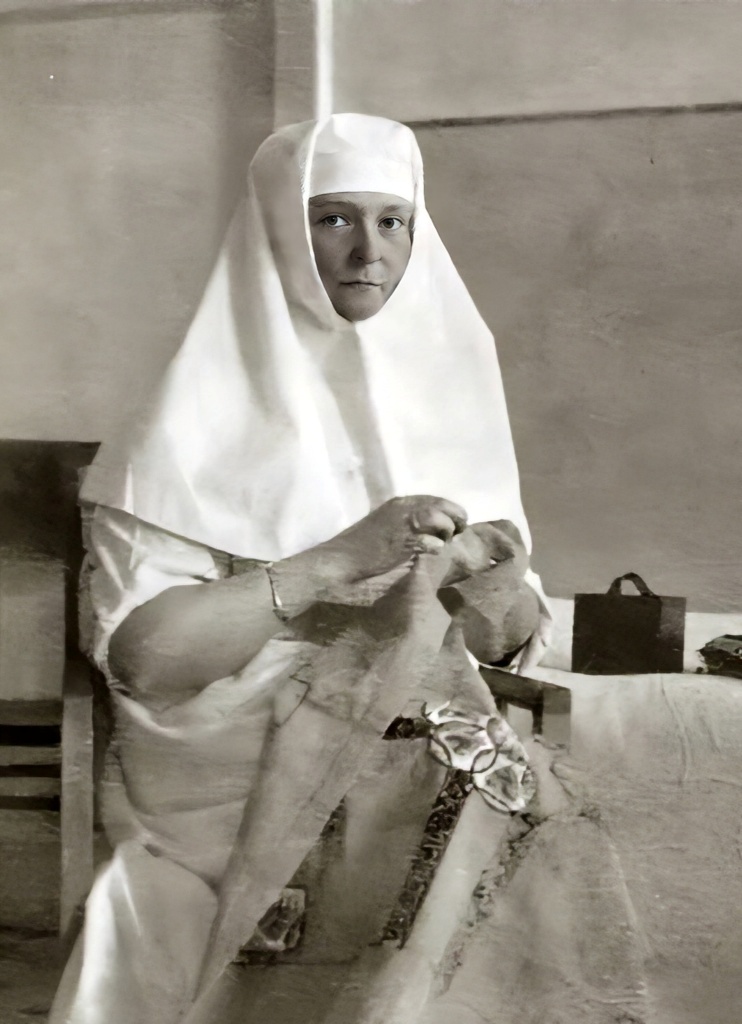
Each morning the Empress was up at seven, attended church, then dressed in the grey uniform of a nursing sister, she arrived at the nearby hospital at Tsarskoye Selo with her two eldest daughters Grand Duchesses Olga and Tatiana, and her devoted companion Anna Vyrubova. Here they washed and bandaged the wounded soldiers, the Empress assisted with surgeries in the operation theater.

She spent her afternoons visiting other hospitals. Moving through the aisles between hospital beds, the tall figure of the Empress in her nurse’s uniform stirred the wounded men. They reached out bandaged hands to touch her; they wept as she knelt beside their beds to pray. Officers and soldiers, facing amputations, cried from their beds, “Tsaritsa, stand near me. Hold my hand that I may have courage.”

Source: ‘Nicholas and Alexandra’ by Robert K. Massie

judge

Whatever her shortcomings as Empress, let us be more careful in the words we choose before we pass judgement on this poor woman.

© Paul Gilbert. 20 July 2020