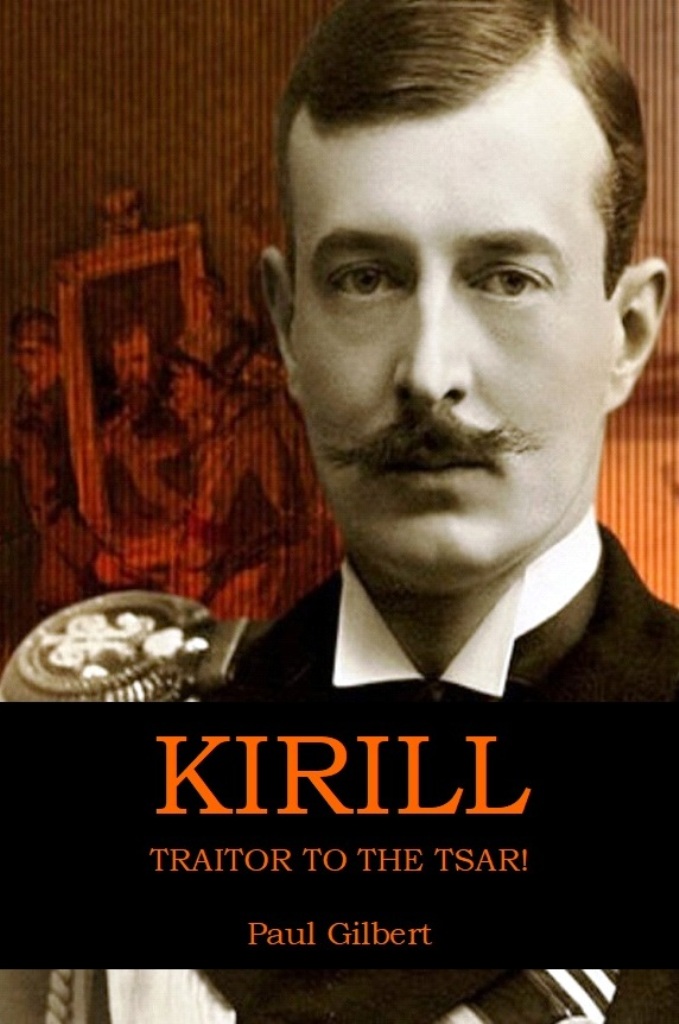
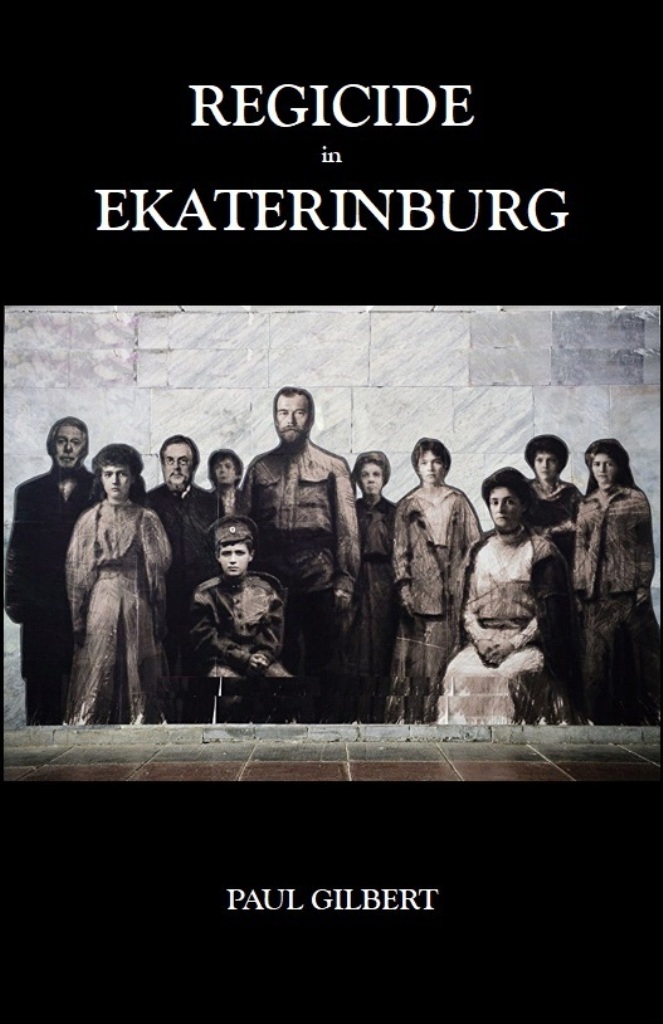
NEW BOOK – Regicide in Ekaterinburg

*You can order this title from most AMAZON outlets worldwide, including
the United States, United Kingdom, Canada, Australia,
France, Germany, Spain, Italy, Netherlands, Poland, Sweden and Japan
*Note: prices are quoted in local currencies

CLICK HERE TO ORDER THE PAPERBACK EDITION @ $20.00 USD

Language: English. 308 pages with 70 Black & White photos

regicide: the crime of killing a king or queen;
a person who is guilty of this crime

Touch not mine anointed
Psalm 105:15

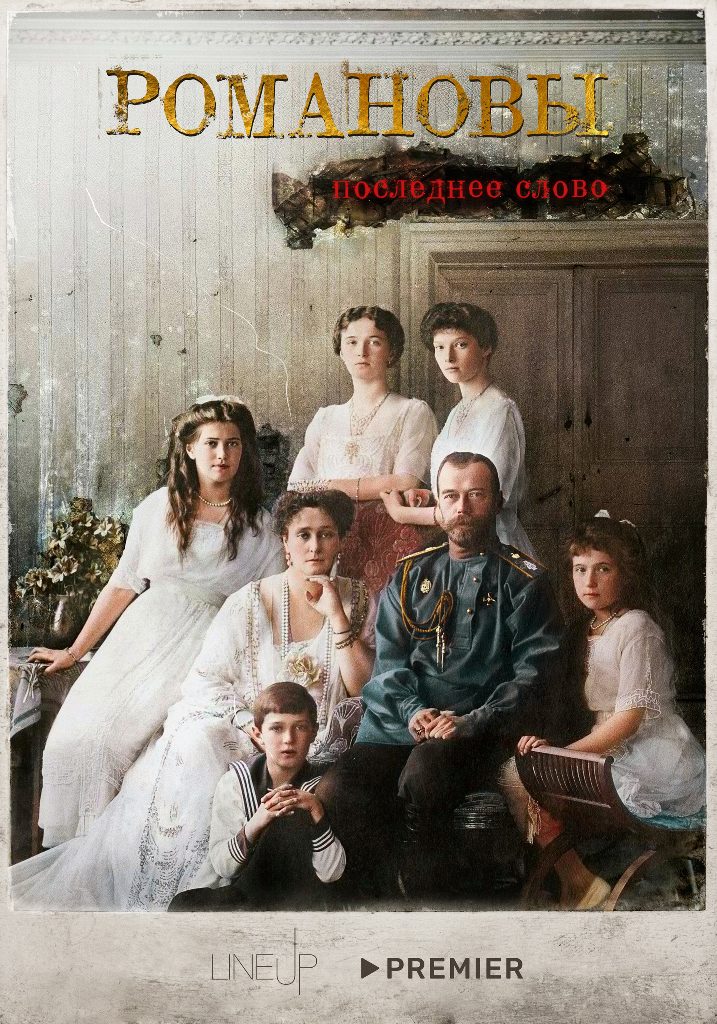
This year marks the 106th anniversary of the regicide in Ekaterinburg: the execution of Russia’s last Imperial Family, a heinous crime committed on the morning of 17th July 1918. The murder of God’s anointed, his pious wife, their five precious children and their four faithful retainers, remains one of the darkest pages in 20th century Russian history.

This book presents fourteen studies on this tragic event, eleven of which are based on new documents sourced from Russian archival and media sources over the past decade.

The first part of this book features the complete and unabridged account of a British Intelligence officer and journalist, who was in Ekaterinburg in the summer of 1918. He was one of the first to investigate the regicide, even before that of Nicholas Sokolov’s famous, yet incomplete investigation in 1919. He goes on to write about meeting Yakov Yurovsky, and shares his impressions of the chief executioner of the last Tsar and his family.

The second part features two previously unpublished, first English translations. The first is about those who came to the aid of the Imperial Family during their captivity, including Princess Helen of Serbia and the nuns of the Novo-Tikhvin Monastery. In addition is the testimony of the priest, who perfumed the last sacred service for the Imperial Family, days before their murders.

The third part features eleven chapters which shed light on a number of topics, such as who were the eight faithful retainers who survived the regicide; why did Boris Yeltsin demolish the Ipatiev House in 1977; what about the executioners themselves—who were they, and what were their fates?; plus eight additional chapters.

***

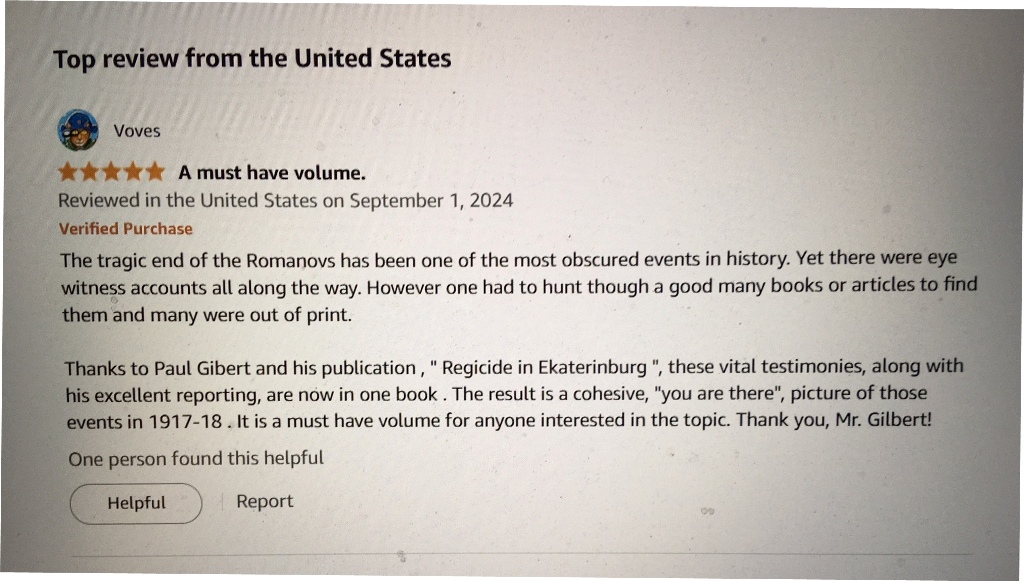
On 1st September 2024, my new book ‘Regicide in Ekaterinburg‘ received it’s first AMAZON review, from a reader in the United States who gave it a 5-star rating! Thank you 🙂

© Paul Gilbert. 26 August 202

Russian court fines local communist for slandering Nicholas II

In an unprecedented move, a Russian court has fined a local communist for slandering Emperor Nicholas II. On 16th August 2024, the Vlasovsky District Court of the Saratov Region found a 72-year-old local resident guilty of “publicly disseminating knowingly false information” about Russia’s last Tsar.

According to the case file, in January 2024, the man published 4 messages on his VKontakte social media page, in which he referred to Nicholas I as “bloody” . . . “the worst ruler in the history of Russia” among other libelous insults.

“It was established that the citizen – a devout communist – deliberately slandered the Holy Emperor Nikolai Alexandrovich Romanov, although he was aware of the monarch’s achievements – industrialization, economic growth and the introduction of the gold ruble,” said prosecutor Vsevolod Bronin.

The accused fully admitted his guilt and asked the court for leniency, as he committed his illegal actions “under the influence of Bolshevik propaganda, which he was duped by while he was studying.” Taking into account the advanced age and repentance of the pensioner, the court decided not to deprive the offender of liberty and limit himself only to a fine of 100 thousand rubles [$1,118 USD].

Recall that on 1st October 2008, the Presidium of the Supreme Court of the Russian Federation granted the judicial rehabilitation of Emperor Nicholas II and his family. Ninety years after a Bolshevik execution squad gunned down the last Tsar and his family, the country’s supreme court declared the Imperial family as “victims of political repression.” The regicide was condemned, and that the false accusations against the Tsar, that he was an enemy of the people…were at long last proven to be false.

© Paul Gilbert. 18 August 2024

Update on the next Nicholas II Conference

I continue to receive emails and messages from people enquiring about another Nicholas II Conference. First of all, I would like to say how grateful I am for the interest and support shown for this event. In answer to all these queries, I can say that YES!, I am intend planning on organizing and hosting a second conference. I can also confirm that several discussions on the proposed event have already taken place.

Once this dreadful war is over, I have every intention of hosting a 2nd International Nicholas II Conference, which will most likely be held in the UK.

As some of you may recall, my initial plan to host the conference in May 2021 at the Holy Trinity Monastery in Jordanville, NY, was cancelled due to the COVID pandemic.

My second attempt to host the conference in September 2023 at St. John’s Orthodox Church in Colchester, England was also cancelled, due to the outbreak of hostilities between Russia and Ukraine.

So, will I have better luck the third time?

The number of people who have followed my work, since the 1st conference in October 2018, has grown substantially, especially in the UK, therefore, I am anticipating an even larger number of attendees at the next conference.

Stay tuned for further updates on dates, venue, speakers, topics, and much more.

PHOTO: this is the first of two 6-ft. banners, that I have
designed for the 2nd International Nicholas II Conference

***

1st International Nicholas II Conference
St. John’s Orthodox Church, Colchcester, England
27th October 2018

PHOTO: researcher and author Paul Gilbert presenting one of his two lectures on Nicholas II, at St. John’s Orthodox Church in Colchester, England. 27th October 2018

The 1st International Nicholas II Conference was timed to the 150th anniversary of the birth of Emperor Nicholas II in 1868, and the 100th anniversary of his death and martyrdom in 1918.

More than 100 people from nearly a dozen countries attended the event, which featured 5 speakers, who presented 7 lectures on the life and reign of Russia’s last Tsar, including Paul Gilbert, Archpriest Andrew Philips (ROCOR), Nikolai Krasnov, authors Frances Welch and Marilyn Swezey presented seven papers on Nicholas II.

In addition, the Grand Duchess Elizabeth Romanov Society UK provided a small exhibit, which generated much interest among those attending. Two stalls were set up during the conference, which offer an interesting selection of new book titles for sale. A light lunch was provided for those attending.

Click HERE to read more about the 1st International Nicholas II Conference in Colchester, England, which includes photos from the event.

© Paul Gilbert. 8 August 2024

Artist concept of Imperial Railway Pavilion restoration project at Tsarskoye Selo

CLICK on the above image to watch the VIDEO
Duration: 1 minute

The Tsarskoye Selo Railway Station Charitable Foundation has released a stunning video which presents the Foundation’s concept for the restoration of the Imperial Railway Pavilion at Tsarskoye Selo [now part of the town of Pushkin], which began in the summer of 2023.

According to the concept being developed, it is planned to restore the Pavilion building with the restoration of its historical appearance based on the surviving photographs, documents and research by specialists. During the restoration of the facades, it is planned to restore the plaster layer and decorative elements. Inside the Pavilion, it is planned to restore wall and ceiling paintings to their original colours, floor coverings and stucco, and restore lost stoves.

After the completion of the restoration, a museum space with access to the ceremonial rooms will be developed inside the station building. The reconstruction of the Tsar’s Station involves the construction of the lost metal frame of the landing stage (covered railway platform) – as seen in the artist’s drawings (below) and video.

Inside the openwork riveted trusses, it is planned to construct a building in the form of a railway passenger car. Work is also planned to develope the area surrounding the station building.

The former Imperial Railway Pavilion is located a short distance from the Alexander Palace, the Feodorovsky Sovereign Cathedral and the Feodorovsky Gorodok.

Tsarskoye Selo Railway Station Charitable Foundation © 2024

FURTHER READING:

Imperial Railway Pavilion in Tsarskoye Selo is being restored – published on 18th August 2023 – includes 13 colour photos

Update on the restoration of the Imperial Railway Pavilion at Tsarskoye Selo – published on 16th April 2024

The sad state of the Imperial Railway Pavilion in Tsarskoye Selo includes 20 PHOTOS! – originally published on 29th December 2019

Imperial Railway Pavilions During the Reign of Nicholas II – originally published on 23rd October 2019

© Paul Gilbert. 6 August 2024

***

COMING SOON!
Publication date to be announced

My book on the Imperial Train was scheduled to be published last year, however, I delayed it, and for good reason. Given that the Imperial Railway Station at Tsarskoye Selo was the main terminus for the Imperial Train, it only stood to reason, that I should devote a chapter to this historic building.

My forthcoming book is the first English language title to explore the history of the Tsar’s luxurious mode of transport on rails. It will include detailed descriptions – including vintage photos and floorplans – of the train’s interiors. My book also tells about the fate of the Imperial Train, the Imperial Railway Pavilions constructed solely for the use of the Imperial Train in Tsarskoye Selo, St. Petersburg and Moscow, and much more.

‘The Imperial Train of Emperor Nicholas II’ will be published in paperback edition, 150 pages, and richly illustrated throughout. It will be available on Amazon shortly after the completion of the restoration of the Imperial Railway Pavilion at Tsarskoye Selo has been completed – PG

‘Nicholas II: The Last Orthodox Tsar of Russia’ with Paul Gilbert

CLICK on the above image to watch the VIDEO
Researched, written and narrated by Paul Gilbert
Duration: 20 minutes. Language: English

Emperor Nicholas II reigned for 22+ years – from November 1894 to February 1917. With his murder, the last Orthodox Christian monarch, along with the thousand-year history of thrones and crowns in Russia, ended, ushering in an era of lawlessness, apostasy, and terror, one which would sweep Holy Orthodox Russia into an abyss which would last more than 70 years.

This new video production is based on the research of project colleague and independent researcher Paul Gilbert, who also narrates this video.

In the first 24 hours of it’s release on YouTube, some 3,000 people had watched the video! Since it’s release in July 2020, it has been viewed by more than 134.000 people.

The creators have done a remarkable job of incorporating a wonderful collection of photos – both vintage B&W and colourized by Olga Shirnina (aka KLIMBIM) – historical newsreel film footage and music.

282

Vintage B&W photo of Nicholas II colourized by Olga Shirnina (aka KLIMBIM)

One viewer noted on social media: “Only 20 minutes long, this is the BEST portrayal of the last Tsar’s Orthodox faith I have ever seen. Very well-made, historical and moving.”

The crowning moment of this video is near the end, which shows film footage of the actual canonization ceremony of Emperor Nicholas II and his family, performed on 20th August 2000 by Patriarch Alexei II (1929-2008) in the Christ the Saviour Cathedral in Moscow. You can hear His Holiness calling out each of the names of the Imperial Family. The footage is extremely moving to watch.

This 20-minute video is presented in the framework of the production of the book The Romanov Royal Martyrs: What Silence Could Not Conceal published by Mesa Potamos Publications in 2019.

126b

The Romanov Royal Martyrs is an impressive 512-page book, featuring nearly 200 black & white photographs, and a 56-page photo insert of more than 80 high-quality images, colourized by the acclaimed Russian artist Olga Shirnina (Klimbim), and appearing here in print for the first time.

Click HERE to read my review Romanov Book of the Year: The Romanov Royal Martyrs

Click HERE to explore the book. Click HERE to order the book

***

I am truly honoured to be a research colleague of this important publishing project. I am most grateful to Father Prodromos Nikolaou and the Holy Monastery of St. John the Forerunner of Mesa Potamos in Cyprus for giving me the opportunity to be a part of this new video which tells the story about Russia’s last Orthodox Christian monarch.

NOTE: my name is now inscribed as a project colleague in the 2nd edition of this book, which also includes several corrections, which I suggested to the publisher after reading the 1st edition – PG

Below, is my second video produced within the framework of the production of the book The Romanov Royal Martyrs: What Silence Could Not Conceal published by Mesa Potamos Publications in 2019. My first video The Conspiracy Against Nicholas II was released in 2018 with more than 32,000 views to date:

CLICK on the above image to watch the VIDEO
Researched, written and narrated by Paul Gilbert
Duration: 7 min. 36 sec. Language: English

© Paul Gilbert / Holy Monastery of St. John the Forerunner of Mesa Potamos. 4 August 2024 (Originally published on 9 July 2020)

Is it true that Nicholas II wanted to move the Russian capital to Crimea?

Emperor Nicholas II was all very fond of his residence in Livadia, a magnificent white limestone palace perched on a ledge overlooking the Black Sea on the southern coast of Crimea.

The old Large wooden palace[1] was demolished to make way for the new Imperial Residence. Construction on the new palace began on 21st January 1910, and after only 17 months, was inaugurated on 11th September 1911. The Tsar spent about 4 million gold rubles – from his own funds – to finance it’s construction. The palace had 116 rooms, with interiors furnished in different styles, and surrounded by beautifully landscaped gardens.

The Imperial Family stayed in the new Livadia Palace in the autumn of 1911 and 1913 and in the spring of 1912 and 1914, their visits lasting months at a time.

But, is it true that Nicholas II wanted to move the capital of the Russian Empire to Yalta?

PHOTO: Northern facade of the Livadia Palace
Watercolour by Nikolay Petrovich Krasnov (1864-1939)

A diplomat, a Russian general, Alexander Mossolov[2], wrote in his diary, noting a conversation he had had with the Emperor, who told him about his idea of ​​transferring the capital from rainy St. Petersburg to sunny Crimea.

According to Mossolov, while returning from Uchan-Su[3] along a path high above the highway with a beautiful view of Yalta, the Emperor noted that he was tied to the southern coast of Crimea and did not want to leave. And when Mossolov inquired whether the Emperor would have liked to transfer the capital to Yalta, Nicholas II replied: “This idea has flashed through my mind more than once.”

True, after a few minutes the Emperor admitted that it was impossible to do this.

“And if it were the capital, I probably would have stopped loving this place.” Some dreams, the diplomat quoted the emperor.

***

Any one who has ever visited Livadia, and stood at the windows on the balconies admiring the magnificent views of both the mountains behind and the Black Sea in front, can appreciate why this place was so loved by the Imperial Family.

Following the Tsar’s abdication in February 1917, the Imperial Family were held under house arrest in the Alexander Palace at Tsarskoye Selo, until the end of July. It was the decision of the Head of the new Provisional Goverment Alexander Kerensky who decided to send the Imperial Family into exile. Nicholas hoped that they would be allowed to settle in Livadia, where they would be far removed from the capital, however, Kerensky had other plans – he sent them to Tobolsk in Siberia.

Sadly, the Imperial Family’s “peace” would have been short lived. During the First World War, Crimea was occupied by German forces. On 30th April 1918, German troops entered Livadia, and immediately began to plunder the palace, many of its artefacts lost forever. The Imperial Family would have been forced to flee or be captured by the enemy.

NOTES:

[1] The Large or Grand Imperial Palace was constructed between 1862-66 by the famous Russian architect Ippolit Antonovich Monighetti (1819-1878) for Emperor Alexaander II, his wife Empress Maria Alexandrovna and their children. Emperor Nicholas II and his family resided in the nearby Small or Maly Palace (where Nicholas’s father Emperor Alexander III died on 2nd November (O.S. 20th October) 1894). from 1894 until 1911. The

[2] Lieutenant-General Alexander Alexandrovich Mossolov (1854-1939) served as Head of the Office of the Ministry of the Imperial Court. He was one of the few people of who remained faithful to Nicholas II. Mossolov is the author of ‘At the Court of the Last Tsar.’ The English language edition was published in 1935, the content of which is somewhat different from the Russian version.

[3] Uchan-Su is the highest (98 metres /322 ft) waterfall in Crimea, situated 7 km from Yalta, on the southern slopes of the Crimean Mountains.

© Paul Gilbert. 3 August 2024

The myth that Nicholas II’s death was met with indifference by the Russian people

PHOTO: Revolutionaries burning the Tsar’s portrait in 1917. Artist: Ivan Alekseevich Vladimirov (1869-1947)

NOTE: this article was last updated on 24th July 2024 – PG

Contemporary historians have led us to believe that news of Nicholas II’s death was met with indifference among the Russian people. Rather than conduct their own research on the matter, they choose instead to rehash the popular Bolshevik version of events – this is in itself is not the sign of a good historian.

Recall that following the abdication of Nicholas II in February 1917 and the October 1917 Revolution, which resulted in a Bolshevok coup, it was clear that a return of the monarchy in Russia was hardly possible. But no one in Russia expected the brutal murder of the Tsar and his family. Earlier, the Bolsheviks had planned to hold an open trial of Nicholas II – in order to draw a symbolic line under the era of Tsarism in Russia. In particular, Trotsky advocated such a trial. Lenin, in turn, feared that the Romanovs were still loved by the people, and therefore the trial might not bring the fruits that the Bolsheviks would have wanted. Lenin considered that based on the events of the Civil War it would be more expedient to secretly kill the entire Imperial Family and remain silent about it as long as possible.

While the elation exhibited by the revolutionaries is indeed true, it did not reflect the heartfelt sentiments of millions of Orthodox Christians, monarchists and others in the former Russian Empire.

Patriarch Tikhon (1865-1925), openly defended the Imperial family, by condemning the Bolsheviks for committing regicide.

When the tragic news of the murder of the Tsar and his family came, the Patriarch immediately served a memorial service at a meeting of the Local Council of the Russian Orthodox Church; then served the funeral Liturgy, saying that no matter how how the Sovereign was judged by his enemies, his murder after he abdicated was an unjustified crime, and those who committed him should be branded as executioners.

During his sermon at the Kazan Cathedral in Moscow, Patriarch Tikhon said:

“… a terrible thing has happened: the former Tsar Nikolai Alexandrovich was shot, by decision of the Ural Regional Soviet of Workers’ and Soldiers’ Deputies, and our highest government, the Executive Committee, not only approved it but deemed it as legitimate. But our Christian conscience, guided by the Word of God, cannot agree with this. We must, in obedience to the teaching of the Word of God, condemn this act, otherwise the Tsar’s blood will fall not just on those who committed it, but on all of us.

“We will not evaluate and judge the deeds of the former Sovereign: an impartial trial of him belongs to history, and now he faces the impartial judgment of God, but we know that he, abdicating the throne, did so with the good of Russia in mind and out of love for the Motherland. He could, after his abdication, have found security and a comparatively quiet life abroad, but he did not do so, choosing to stand with Russia. He did nothing to improve his situation, instead he meekly submitted to fate,

“… and suddenly he is sentenced to death somewhere in the depths of Russia, by a small handful of people, not for any guilt, but only for the fact that someone allegedly wanted to kidnap him [the Bolsheviks claimed that the Tsar’s family and supporters were attempting to rescue him]…

“Our conscience cannot be reconciled to this, and we must declare it loudly, as Christians, as sons of the church. Let them call us counter-revolutionaries for this, let them imprison us, let them shoot us. We are ready to endure this in the hope that the words of the Savior will be attributed to us: “Blessed are those who hear the Word of God and keep it.”

PHOTO: Emperor Nicholas II with Archbishop (future Patriarch) Tikhon
at the Transfiguration Monastery. Yaroslavl, 21 May 1913

And others condemned the regicide . . .

Eugenie Fraser, born and raised in Russia writes about her years in Petrograd and news of the tsar’s death: “In August, filtered through from Siberia, came the news of the slaughter of the Royal family by the sadistic thugs of the Bolshevik party. Horror and revulsion touched every decent thinking citizen in the town. To execute the Tsar and his wife in this barbaric fashion was bad enough, but to butcher the four young girls and the helpless boy was the work of mindless criminals. In churches people went down on their knees and openly wept as they prayed for the souls of the Tsar and his family.”

“Even in all this turmoil and confusion, and even among those with little sympathy for the abdicated tsar, the brief five-line announcement in July 1918 of the execution of Nicholas II and his family in Ekaterinburg caused a terrible shock,” writes Serge Schmemann. He further notes “Prince Sergei Golitsyn recalled in his diary how people of all levels of society wept and prayed, and how he himself, as a nine year old boy, cried night after night in his pillow.”

Major-General Sir Alfred Knox further noted in his memoirs: “An old soldier . . . breathed into my ear that the Emperor was a good man, and fond of his people, but was surrounded by traitors.”

It is important to recall that it was in the summer of 1918, when Lenin unleashed the first Red Terror. People lived in fear of punishment from the thugs and criminals of the new order, for showing any sympathy for the murdered tsar. Many hid their framed portraits of the tsar, and kept their grief and monarchist sentiments to themselves.

NOTE: This article has been excerpted from my forthcoming book Nicholas II: A Century of Myths and Lies [publication date yet to be announced]

© Paul Gilbert. 24 July 2024

The sakkos from the coronation of Nicholas II on display in Russia for the first time

A new exhibition Russian Masters. Artistic Traditions and Ideals has opened at the State Museum of the History of Religion in St. Petersburg. The exhibition presents objects of the Orthodox liturgy and reveals their symbolic meaning, including vestments, censers, lampadas, crosses, icons in luxurious casings, and items of Russian silversmithing of the 19th-early 20th centuries.

Among the 100 items on display is an episcopal liturgical vestment – sakkos – which was made for the Orthodox clergy who participated in the Holy Coronation of Emperor Nicholas II, held in Moscow on 27th May (O.S. 14th) May 1896. It is made of a rich brocade fabric and intricately decorated with traditional Russian eagles. The sakkos is being exhibited for the very first time.

The exhibition Russian Masters. Artistic Traditions and Ideals runs until 25th January 2025.

***

The sakkos is a vestment worn by Orthodox bishops instead of the priest’s phelonion. The bishop wears the sakkos when he celebrates the Divine Liturgy and other services when called out by the rubrics.

© Paul Gilbert. 10 July 2024

Efforts to locate the remains of Nicholas II and his family during the Brezhnev era

PHOTO: Nikolai Anisimovich Shchelokov (1910-1984)

Nikolai Anisimovich Shchelokov (1910-1984) was a Soviet statesman. From 1966 to 1982 he served as Minister of Internal Affairs of the USSR. He was a member of the Communist Party of the Soviet Union (CPSU) from 1931 to 1984, and member of the Central Committee of the CPSU from 1968 to 1983.

Shchelokov was the first person who began the search for the remains of Emperor Nicholas II and his family. When asked about the initiative, Shchelokov told the film director, screenwriter, acclaimed author Geliy Trofimovich Ryabov (1932-2015): “We, as Russian people, must fulfill our duty and find the remains of the Tsar”. Shchelokov ordered the head of the Sverdlovsk Internal Affairs Directorate for their full cooperation in the search.

What made the representative of the highest echelon of Soviet power, who had been building communism all his life, deviate so radically from the general line of the party and make every effort to resurrect one of the darkest pages of early 20th century Russian history?

PHOTO: Leonid Ilyich Brezhnev (1906-1982)

Acquaintance with Leonid Brezhnev

Born on 13th November 1910 in the family of a metallurgist, Nikolay Shchelokov got his first job as a horseman in a mine at the age of 16, and at the same time received a higher education at the Dnepropetrovsk Metallurgical Institute.

After spending a year at the Dnepropetrovsk Metallurgical Plant, Nikolay Shchelokov was elected 1st Secretary of the Krasnogvardeysky District Committee of the Communist Party (Bolsheviks) of Ukraine in Dnepropetrovsk. It was during the years 1938-39 that he first met with Leonid Ilyich Brezhnev (1906-1982), who later took the post of General Secretary of the Central Committee of the CPSU, and persuaded his old acquaintance to move to Moscow and head the Ministry of Internal Affairs.

Nikolai Anisimovich received this offer in 1966, and before that he managed to become a participant in the Great Patriotic War (1941-45), after which he was appointed to the post of executive secretary of the party commission at the political department of the Carpathian Military District, where Leonid Brezhnev served as the head.

From August 1946, Shchelokov held a position in the Ministry of Industry of the Ukrainian ASSR, worked in the apparatus of the Communist Party of the same republic, and in 1951 he was sent to the Moldavian ASSR, where he rose to the post of second secretary of the Central Committee of the Communist Party.

In Moscow

Having lured the energetic leader to Moscow, Brezhnev set him the task of reviving the Ministry of Internal Affairs abolished in 1960 by Nikita Sergeyevich Khrushchev (1894-1971).

His mandate was to restore the fallen authority of the police in Soviet society To do this, among other things, he used the power of art. It was during this period that many detective stories appeared in bookshelves, where law enforcement officers where depicted to the reader in a positive light, and films about the daily exploits of ordinary employees of the Ministry of Internal Affairs were released on cinema screens.

Shchelokov coped with the duties assigned to him brilliantly, for which he was awarded the title of Hero of Socialist Labor of the USSR.

PHOTO: Nikolai Shchelokov with his daughter Irina Shchelokova

Friendship with dissidents

An interesting fact about Nikolai Anisimovich was his open friendship with dissidents who had liberal and monarchist views.

Among the disgraced personalities with whom he had warm relations were the musician Mstislav Rostropovich, the singer Galina Vishnevskaya, the writer Alexander Solzhenitsyn, the artist Ilya Glazunov, and Archbishop Pimen of Saratov and Volsk.

Perhaps it was after communicating with them that Shchelokov had the idea to find the remains of the murdered Imperial Family and bury them according to the Christian rite.

According to the memoirs of Irina Shchelokova (d. 2021), the daughter of the Minister of Internal Affairs, her father could not be convicted of dissent. She explained his interest in the last Tsar and his family by his high level of erudition, a keen sense of justice, as well as the fact that her father got hold of materials -which were classified at the time – regarding the investigation of the circumstances of the death of Nicholas II and his family.

At the same time, Boris Konstantinovich Golikov, an assistant to Shchelokov, believed that his boss became obsessed with the idea of finding the remains of the Romanovs after a meeting with a former NKVD officer, a certain “Snegov”. The latter was taken into custody in the 1930s and sat in the same cell with a prisoner who participated in the burial of the bodies of the Imperial Family in July 1918. Subsequently, this man was shot, but he managed to tell “Snegov” about the burial place of the remains, which the latter later told Shchelokov, and even handed him a hand-drawn map.

PHOTO: Geliy Trofimovich Ryabov (1932-2015)

Help for filmmakers

To implement his plan to find the remains of the Romanovs, Nikolai Anisimovich sought the help of Geliy Ryabov, co-author of the book “Born by the Revolution”.

According to Ryabov’s memoirs, who held the position of consultant of the Ministry of Internal Affairs on cultural issues, in 1976, he was supposed to visit Sverdlovsk (now Ekaterinburg) on a working trip. Before embarking on his journey, he was summoned by Shchelokov and casually told that not so long ago he had visited the Ipatiev House, where the Imperial Family had been murdered by the Ural Soviet (Bolsheviks) on 17th July 1918. He communicated this information to Ryabov in the hope of getting him interested in the case and was not mistaken.

The writer, having arrived in the capital of the Urals, also wanted to visit the site where the Tsar and his family had been murdered, and somehow without any problems received the appropriate permission. After making a tour of the house, Ryabov was inspired by the idea of finding the remains of Nicholas II and his family.

Returning to Moscow, Ryabov turned to Shchelokov with a request for assistance in this dangerous assignment. The delighted Minister of Internal Affairs contacted Leonid Brezhnev and asked him to provide Ryabov with access to the “Tsar’s Archive”.

A month later, the Secretary General gave his go-ahead, and Ryabov plunged headlong into the study of classified documents, trying to find at least some clue.

As a result, his efforts were crowned with success aftern he discovered the “Yurovsky Note” – written by the commandant of the Ipatiev House and chief executioner of the the Imperial Family, which contained the coordinates of the burial place of the bodies of the Tsar and his family.

Having provided Ryabov with accurate topographic maps of the area, and having organized his protection and unhindered work, Shchelokov began to wait for news of the investigation. On 1st June 1979, Geliy Trofimovich and geologist Alexander Avdonin, who helped him in the search, found the sought-after remains.

However, Shchelokov did not manage to organize a dignified reburial of the Imperial Family’s remains, he was forced to abandon his search by a discrediting campaign that began against him.

Alternate versions

At was at this time, that several more interpretations of why the Minister of Internal Affairs abandoned the search for the remains of the Imperial Family.

Some researchers argued that he did not act on his own, but carried out the order of higher authorities who wanted to find and destroy the bones of the murdered Imperial Family.

Other theories included an outrageous claim insisting that Shchelokov wanted a royal burial in order to find and remove any jewelry from the gravesite.

Even more ridiculous was from Igor Bunich’s work of fiction “The Tale of Lawlessness, or the Syndrome of Nicholas II” a hypothesis is put forward that Shchelokov launched a search for the remains of the Romanovs in order to secretly sell them to the West. The buyer was allegedly a certain monarchical structure associated with the British Royal Family. For the deal, the Home Secretary was allegedly offered £200,000, of which £30,000 was given to him as an advance and spent by him on the organization of the search operations.

It was not until 1991, that the remains of Emperor Nicholas II and his family were exhumed and later buried in the SS Peter and Paul Cathedral in St. Petersburg on 17th July 1998.

© Paul Gilbert. 9 July 2024

Caucasian sword belonging to Nicholas II to be auctioned in London

Despite Western sanctions against Russia, which include the cancelation of all cultural exchanges [i.e. exhibitions, auctions, etc.], works of Imperial Russian art continue to break records at British, American and French auctions. Paintings by Aivazovsky, Vereshchagin and Repin, luxurious pieces of jewelry made by Fabergé, find their new buyers. Despite the political chaos, the antique market continues to thrive.

On 13th July 2024, a unique Caucasian shashka, which, according to researchers belonged to Emperor Nicholas II, will be sold at the Apollo Art Auctions in London,

The extremely fine-quality Caucasian shashka given to Nicholas II, when he was Tsesarevich (heir apparent). Research suggests the saber was presented to Nicholas during a tour of the Caucasus with his father Emperor Alexander III, in 1888. An Arabic inscription in gold on the blade translates to: (M)ay the dominance of the owner of this sword grow, and his life, and his greatness, and may Allah bless his family, and he will achieve his goal.

It is also monogrammed with the Cyrillic letters “HA” – “NA” in English – (for Nicholas Alexandrovich), surrounded by a golden laurel and surmounted by the Imperial Russian Crown. Its wonderfully-decorated scabbard bears a calligraphic Arabic inscription that would be the equivalent of a European maker’s mark. Translated, it says “Abdullah worked.”

Held in consecutive European private collections, including the Eugene Mollo collection (Switzerland), it is the first royal sword ever to be offered for public sale. It requires an opening bid of £1,200,000 ($1,516,300 USD).

Photos provided in this post are courtesy of the Apollo Art Auctions

© Paul Gilbert. 8 July 2024