PHOTO: a pin – depicting the image of Nicholas II – worn by conductors on the vintage train from Ekaterinburg.
In December 2022, a vintage train journey was initiated from Ekaterinburg, which tells passengers, the story of the last days of Nicholas II and his family in the Urals. The train runs from Ekaterinburg to the Shuvakish station and back, on Friday evenings, and also on Saturday and Sunday mornings.
The locomotive (see photo below) is not from the Imperial times, but a 1963 steam engine, made in Czechoslovakia. The interiors, however, have been remodeled to resemble that of an early 20th century Russian train.
Passengers travelling on the vintage train are greeted on the platform by hospitable conductors wearing uniforms of early 20th century Imperial Russia-style, and white gloves (see photo below).
The train has four wagons: First Class, Economy Class, a dining car (see photo below) and a sightseeing car, which operates during the summer months. One compartment is decorated with framed photographs of the Imperial Family.
During the 3-hour train journey, passengers can sit back, relax and enjoy the view, while listening to an audio-guide, which tells the story of the last days of Russia’s last Tsar, his family and their four faithful retainers.
The audio begins with the Imperial Family’s train journey from Tsarskoye Selo to Tyumen, then by boat to Tobolsk, where they were held under house arrest in the former Governor’s House, from August 1917 to March 1918.
The story continues, with the transfer of the Imperial Family to Ekaterinburg, where they were held under house arrest in the Ipatiev House, from March to July 1918. The audio-guide further tells of their fate, their burial at what is today known as Ganina Yama, and the discovery of their remains, almost 100 years later on the Old Koptyaki Road.
Tea is served to passengers from a traditional samovar. Conductors bring the tea in beautiful faceted glasses in iron cup holders, on which the Double-Headed Eagle of the Russian Empire is depicted.
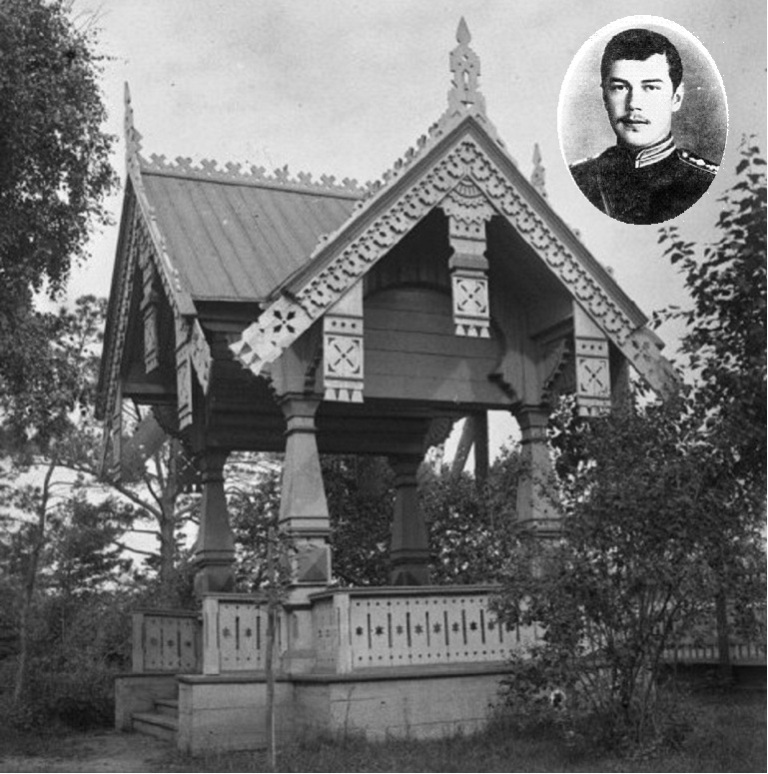
The train stops at Shuvakish Station (Zheleznodorozhny district), where passengers are free to disembark the train to a wooden platform, decorated with benches, a bell and a manual semaphore signal. The stop lasts a little more than an hour.
Inside the wooden pavilion, passengers can enjoy music, which includes a variety of waltzes and melodies from the repertoire of Alexander Serov.
Passengers can also try on the uniforms of the White Guards, take photos, and enjoy a cup of hot tea, bagels and local berries.
PHOTO: tea is served at Shuvakish Station
***
*As I have noted in previous posts, I support any initiative – big or small – to help keep the memory of Nicholas II and his family alive in 21st century Russia – PG
Since the fall of the Soviet Union in 1991, more than 100 monuments, busts and memorials have been installed in cities and towns across in Russia – six of which have been installed in Ekaterinburg. Recall that it was here, in the Ural capital, where the last Tsar and his family were held under house arrest and subsequently murdered.
Once a bastion of Bolshevism, Ekaterinburg has slowly shed its status as the “capital of atheism”. Since the fall of the Soviet Union in 1991, the Urals has experienced a revival of faith, with Ekaterinburg as the center of Orthodox Russia in the region.
It is important to add, that Ekaterinburg has done more to honour Russia’s last Tsar and his family than any other city in Russia. It is home to the Church on the Blood [built on the site of the Ipatiev House, where the Imperial Family were murdered]; the Monastery of the Holy Royal Martyrs at Ganina Yama; the Romanov Memorial at Porosenkov Log; three museums and no less than six monuments, dedicated to the Imperial Family.
Church on the Blood, Ekaterinburg
The Church on the Blood in Ekaterinburg, was built in 2000-2003m on the site of the Ipatiev House, where the Imperial family and their faithful retainers were all brutally murdered by members of the Ural Soviet on 17th July 1918.
The monument to Emperor Nicholas II and his family, created by the sculptor Konstantin Vasilievich Grunberg was installed in 2003 on the grounds of the Church on the Blood in Ekaterinburg. The Tsar is depicted carrying the invalid Tsesarevich Alexei in his arms.
The staircase on the left represents the 23 steps the Imperial Family and their four faithful retainers descended to their death and martyrdom in the Ipatiev House in the early morning hours of 17th July 1918.
The door seen in the lower right is the entrance to the Lower Church, sanctified in honour of the Holy Royal Martyrs in the Church, where the Imperial Room – built on the site of the murder room.
PHOTOS: two views (above and below) of the bust-monument to Emperor Nicholas II, in the Patriarchal Compound of the Church on the Blood
Several years back, a bronze bust on a marble pedestal of Emperor Nicholas II was installed at the top of the staircase leading to the Museum of the Holy Royal Family in the Tsarsky Cultural and Educational Center, situated in the Patriarchal Compound of the Church on the Blood.
In July 2023, the bust was replaced with a similar bust of the Tsar’s son and heir Tsesarevich Alexei Nikolaevich. The bust of the Emperor was temporarily moved to the new permanent exhibition The Romanovs in the Urals, located at the Poklevsky-Kozell House Museum of the Sverdlovsk Regional Museum of Local Lore in Ekaterinburg.
PHOTO: the bust-monument to Tsesarevich Alexei Nikolaevich, in the Patriarchal Compound of the Church on the Blood
Ekaterinburg museums
PHOTO: Bust of Emperor Nicholas II on display at the Hermitage-Ural Museum in Ekaterinburg – a branch of the State Hermitage (St. Petersburg)
PHOTO: a copy of the “The Night at the Ipatiev House” sculptural composition by Russian sculptor Zurab Tsereteli (1934-2025), greets visitors to the permanent exhibition ‘The Romanovs in the Urals‘ located in the Poklevsky-Kozell House Museum in Ekaterinburg.
***
Monastery of the Holy Royal Martyrs, Ganina Yama
Ganina Yama is the site of the Four Brothers mine situated near the village of Koptyaki, 15 km north from Ekaterinburg. It was here that in the early morning hours of 17th July 1918 the bodies of Tsar Nicholas II, his family and four servants were secretly transported to Ganina Yama and thrown into a 9′ deep pit. The murderers returned the following day, exhumed the remains and reburied them in two unmarked graves at Porosenkov Log, which is situated 3.8 km away.
In 2001, the Russian Orthodox Church constructed the Monastery of the Holy Royal Martyrs at the site in 2001. Between 2008-2011, three monuments to the Holy Royal Martyrs were installed on the grounds of the monastery:
The bronze bust (above) of Emperor Nicholas II was installed and consecrated on 19th (O.S. 6th) May 2008, the day marking the sovereign’s 90th birthday. A bas-relief (below) depicting Empress Alexandra Feodorovna and her five children, is located on the lower section of the monument to Emperor Nicholas II
The bronze monument (above) to Empress Alexandra Feodorovna was installed and consecrated in 2011.
The bronze monument (above) of Grand Duchesses Olga, Tatiana, Maria, Anastasia and Tsesarevich Alexei, was installed and consecrated on the grounds of the Monastery of the Holy Royal Martyrs at Ganina Yama in 2011.
Sredneuralsk, Sverdlovsk Oblast
The Sredneuralsky Convent in Honour of the Icon of the Mother of God “The Conqueror of Bread”, is an Orthodox convent located on the outskirts of the city of Sredneuralsk, 15 km northwest of Ekaterinburg.
In 2014, the Trinity Church was consecrated in the monastery, which was built based on the ancient Russian architecture of the era of the formation of the Moscow kingdom. It is dedicated to the family of the last Russian Tsar Nicholas II. The basement of the Ipatiev House – where the Imperial Family were shot – was recreated in the lower part of the church. A large Poklonny cross dedicated to the Imperial Family, and a bust of Tsar Nicholas II were installed on the grounds of the monastery.
Available in Hard cover and Paperback edtions. 294 pages. With photographs and Notes
Originally published in 1921, this new edition of ‘Thirteen Years at the Russian Court’, features a new 32-page introduction by Romanov historian Paul Gilbert
A Personal Record of the Last Years and Death of the Emperor Nicholas II. and his Family
Thirteen Years at the Russian Court is a personal record by Pierre Gilliard, a Swiss author and academic who served as the French language tutor to Russian Emperor Nicholas II’s five children.
The book, first published in 1921, offers a unique perspective on the final years of the Romanov dynasty through Gilliard’s personal experiences as a tutor to the August children of Russia’s last Tsar.
The memoir blends historical narrative with personal eye-witness anecdotes, providing an intimate look into the opulence and decline of Imperial Russia. Gilliard’s recollections are not merely memoirs but vital historical documents that bridge the gap between the glamour of Court life and the impending doom of a centuries-old regime.
Gilliard’s memoir serves as an invaluable resource for anyone interested in Russia’s last Tsar, Russian history, monarchy, or the complexities of life at the Russian Imperial Court during the early 20th century.
PIERRE GILLIARD (1879-1962)
Pierre Gilliard was a Swiss academic and author, best known as the French language tutor to the five children of Emperor Nicholas II of Russia from 1905 to 1918. In 1920, he returned to his native Switzerland, where he wrote his memoirs, Thirteen Years at the Russian Court, about his time with the Russian Imperial Family.
The Tsarskoye Selo State Museum continue to recreate items lost from the Alexander Palace during the Second World War . . . the Tsarskoye Selo Restoration Workshop are currently recreating the armchair for the large desk in the Working Study of Emperor Nicholas II.
The chair is being recreated from a vintage 1917 photograph by masters of the Tsarskoye Selo Restoration Workshop, who during the past few years recreated other items of furniture for this interior, as well as other interiors in the recreated Private Apartments of Emperor Nicholas II and Empress Alexandra Feodorovna, located in the Eastern Wing of the Alexander Palace.
Furniture items which have been recreated for the Working Study of Emperor Nicholas II include a large table with a lamp; in June 2023, a beautiful Ottoman and a large Persian Farahan carpet was recreated to upholster the Large Ottoman sofa; in December 2024, a table and chair, among other pieces. Upon completion, each piece was returned to it’s original historic place in the Study.
PHOTO: Nicholas II seated in the armchair (currently being recreated) in 1901
Recall that the Alexander Palace closed in the Autumn of 2015 for an extensive restoration, which saw the reconstruction of the Private Apartments of Emperor Nicholas II and Empress Alexandra Feodorovna, situated in the Eastern Wing of the palace. Work on the project took 6 years to complete. The Alexander Palace reopened it’s doors to visitors in August 2021.
The question of whether Nicholas II was right with his desire for reform or Vladimir Lenin with his revolutionary ideology is at the heart of the debate about the fate of Russia in the early 20th century. Emperor Nicholas II, tried to modernize the country through gradual reforms, preserving its traditional foundations and monarchical system. Lenin, on the other hand, advocated a radical breakdown of the old order and the construction of a socialist society through revolution.
In this article, I argue that Nicholas II’s reform-based approach was more correct and patriotic, as he sought stability and prosperity for Russia, while Lenin’s revolutionary ideas led to chaos, civil war, and tragedy, including the deception and murder of the Imperial Family.
Nicholas II: Reforms for the Sake of Stability and Prosperity
Nicholas II, who ascended the throne in 1894, inherited an empire that faced the challenges of modernization, social tensions, and domestic and external threats. His reign was far from perfect, but the Tsar sincerely sought reforms that would strengthen Russia, preserving its national identity and unity.
Economic and social reforms
Under the leadership of Nicholas II, Russia experienced significant economic growth. At the beginning of the 20th century, the country was one of the world’s leaders in industrialization. The construction of the Trans-Siberian Railway linking the east and west of the Russian Empire was completed, promoting trade and mobility for Russians. Industrial production doubled, and Russia became the largest exporter of grain. These achievements show that the Tsar saw the future of the country in economic development and modernization.
The key reform was Pyotr Stolypin’s agrarian reform, which began in 1906. It was aimed at creating a class of independent peasant landowners, which would strengthen agriculture and social stability. Nicholas II supported these measures, realizing that a strong economy and a satisfied peasantry were the basis of a stable state. The reforms were gradual to avoid upheavals, which testifies the foresight of the Tsar.
Political transformations
Nicholas II, despite his commitment to autocracy, made political concessions after the revolution of 1905. The Manifesto of 17th October 1905 introduced the State Duma, laying the foundations of a constitutional monarchy. Although the Duma had limited powers, it was a step toward democratization, showing the Tsar’s willingness to adapt to new realities. His reforms were aimed at preserving the unity of the country, avoiding radical upheavals that could split society.
Protection of traditions and faith
Nicholas II saw Orthodoxy and traditions as the basis of Russian identity. He supported the construction of churches and monasteries, strengthening the spiritual unity of the people. His reforms did not seek to destroy the historical heritage, but on the contrary, used it as a foundation for modernization. This made his approach patriotic, as he cared about preserving the culture of Russia.
Vladimir Lenin, on the contrary, advocated a radical destruction of the existing order. His Marxist ideology demanded a revolution that would destroy the monarchy, the church, and capitalism, replacing them with the dictatorship of the proletariat. However, his actions led to disastrous consequences, proving that the revolutionary path was wrong.
Destruction instead of creation
The October Revolution of 1917, led by Lenin, overthrew the Provisional Government and led to a civil war (1917-1922) which claimed millions of lives. The nationalization of industry and collectivization destroyed the economy, causing hunger and poverty. Unlike the reforms of Nicholas II, which strengthened the economy, Lenin’s policy led to devastation. For example, the surplus-appropriation plundered peasants, which caused mass discontent and uprisings, such as the Kronstadt uprising in March 1921.
Red Terror and deception
Lenin sanctioned the first Red Terror, aimed at the destruction of “class enemies.” Thousands of innocent civilians, were executed or sent to gulags. Nicholas II, on the contrary, sought to avoid mass repressions, even during the February 1905 Revolution. Moreover, Lenin played a key role in the tragedy of the last Tsar and his family. The Imperial Family were held under house arrest and then shot in Ekaterinburg in 1918 on the direct order of Lenin. In the Bolshevik leader’s mind, as long as the Tsar, or any member of his family were left alive, they posed a threat to the new order and their reign of terror and repression.
Loss of territories
The Brest-Litovsk Peace Treaty of 1918, signed by Lenin, was humiliating for Russia. Huge territories, including Ukraine and the Baltic states, were given to Germany, which weakened the country. Nicholas II, even during the First World War, fought to preserve territorial integrity. When he took command of the Russian armed forces in August 1915, no further Russian territories were lost to the enemy. Lenin, on the other hand, sacrificed national interests for the sake of preserving his power, which can hardly be called patriotic.
Destruction of traditions
Lenin, as an atheist, declared war on Orthodoxy, destroying churches and persecuting and murdering thousands of members of priests, monks and nuns. This undermined the spiritual foundations of Russia, which Nicholas II defended. Lenin’s revolution rejected the historical legacy, replacing it with a utopian ideology that did not take into account the cultural and national characteristics of the country.
Who was right?
Nicholas II’s reform-based approach was correct, as he sought to modernize Russia without destroying its foundations. His reforms in the economy, agriculture, and politics (among others) were aimed at gradual development that could have led to prosperity had it not been for the revolutionary upheavals of 1917 and 1918.
The Tsar cared about the people, traditions and international prestige of the country, which makes his actions patriotic. His love for Russia was so deep, that he abdicated the throne, in order to save both his family and Russia from further bloodshed. His actions clearly emphasized his sacrifice.
Lenin, on the other hand, chose the path of revolution, which turned into chaos, civil war and the death of millions of innocent victims. His policies destroyed the economy and culture, and the deception and murders of the Imperial Family became symbols of his immoral approach. Popular support for Nicholas II frightened Lenin, as it threatened his power, which led to the regicide in Ekaterinburg.
Lenin, by destroying everything for the sake of a utopian idea, led Russia to disaster. Blackmail, deception and murder of Russia’s last Tsar only confirm that his methods were not only erroneous, but also immoral. History has shown that Nicholas II’s reforms could have made Russia stronger.
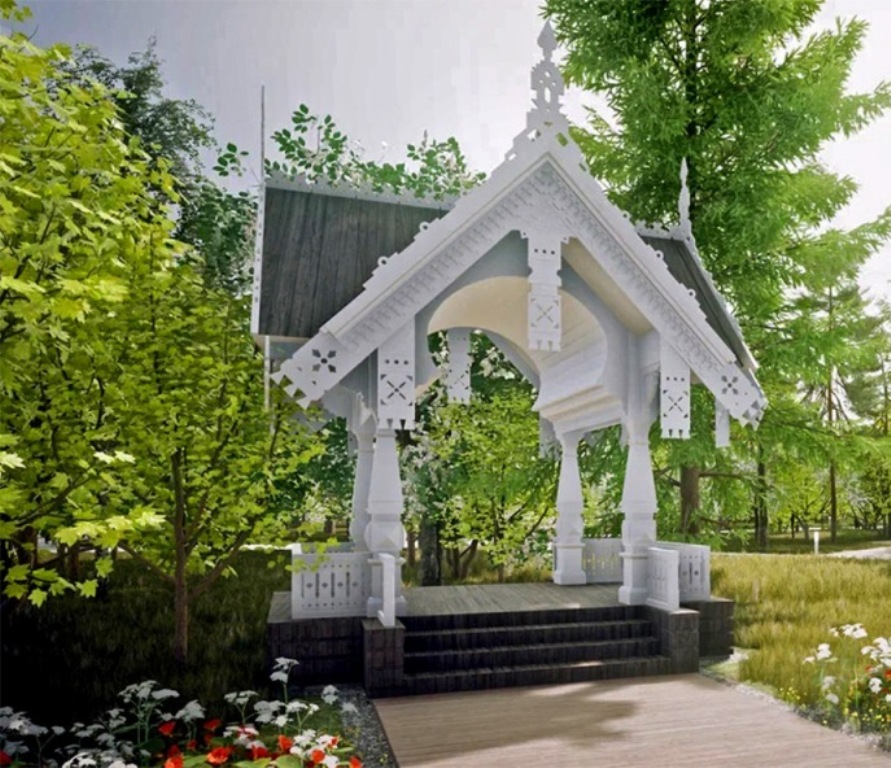
PHOTO: artist’s concept for the Emperor Nicholas II museum complex proposed for Mogliev
On 3rd July 2024, I reportedthat a new museum complex dedicated to Emperor Nicholas II was being planned for Mogliev in Belarus. The complex was to be constructed on a hill in Gorky Park, next to the Church of the Holy Royal Passion-Bearers. Unfortunately, the proposal was met with protests from locals, who were opposed to the demolition of a 16th-century castle to make way for the new museum complex.
A new place for the museum complex was chosen in the historical heart of Mogliev. As specified in the OJSC “Institute “Mogilevgrazhdanproekt”, the museum complex will be located on the Square of Glory[1], on the site of the former building of the General Headquarters of Emperor Nicholas II, situated in the southwestern part of the adjacent Gorky Park. The museum complex will form a single architectural ensemble within the framework of the Church of the Holy Royal Passion-Bearers.
PHOTO: artists concept for the proposed Emperor Nicholas II museum complex in Mogliev (above), and map showing it’s location in the in the southwestern part of the adjacent Gorky Park
The new museum will be dedicated to the events of the early 20th century: the First World War, the Headquarters of the Supreme Commander-in-Chief of the Russian Imperial Army, the stay of of Emperor Nicholas II in Mogliev, the Knights of St. George, and the February Revolution of 1917.
Walking paths will stretch throughout the park, observation decks, sculptural compositions, small architectural follies, and beautifully landscaped flower beds. The concept of the project provides for the improvement of Gorky Park from the central entrance group of the museum complex to the existing Regional Museum of Local Lore.
The realization of the proposed Nicholas II museum complex is of course is pending approval. Town hall meetings will be held in Mogliev, in which citizens will have an opportunity to have their say.
***
PHOTO: the former Governor’s House and later General Headquarters in Mogilev. 1915
On 8th August 1915, the Headquarters (Stavka) of the Supreme Commander-in-Chief of the Armed Forces of the Russian Empire was transferred from Baranovichi to Mogilev. From August 1915 to March 1917, Emperor Nicholas II, served as Commander-in-Chief[2], and the city assumed the role of Military Capital of the Russian Empire.
The Tsar travelled back and forth on the Imperial Train, from Tsarskoye Selo to Mogilev, where he settled in the Governor’s House, situated on Governor’s Square. He was often accompanied by his son and heir Tsesarevich Alexei Nikolaevich.
The official historiographer in the retinue of Nicholas II, Dmitry Dubensky, describes the Emperor’s quarters as follows:
“The Emperor’s rooms were located on the 2nd floor of the Governor’s House. His Majesty’s office had two windows overlooking the square. It was decorated modestly furnished with simple provincial furniture, a sofa and a small desk, which the Tsar kept some of his papers. Adjacent to this room was the bedroom of His Majesty and Heir with iron camp beds, a washbasin, a dressing table, and several chairs. On the walls over the beds, there were many Orthodox crosses, many of which were gifts from family members.
“From the hall to the left is a dining room, quite large, decorated with simple ordinary furniture. There are two additional rooms for the Minister of the Imperial Court Count Vladimir Borisovich Frederiks (1838-1927) and one for Major-GeneralVladimir Nikolaevich Voeikov (1868-1947).
“In addition, there were small rooms for five or six servants, the Tsar’s valet, cooks, and others.”
Sadly, the former Governor’s House, which housed the General Headquarters was destroyed during the Nazi invasion of 1941-45. In the years following the Great Patriotic War, the Soviets showed no interest in reconstructing the historic building. The only building which survived to the present is the former District Court House, which today houses the Mogilev Regional Museum of Local Lore, which features permanent exhibition rooms dedicated to the stay of Nicholas II in Mogilev, from 1915 to 1917.
NOTES:
[1] The 16th century square, originally named as Torgovaya Square, was situated on a high hill at the confluence of the Dubrovenka and Dnieper rivers. After the annexation of Mogilev to Russia in 1772, Torgovaya Square was named Governor’s Square. In 1919, the square was named Sovetskaya, and in 2014, the year marking the 70th anniversary of the liberation of Belarus from the Nazi invaders, it was renamed Square of Glory.
It is very rare for a new Romanov exhibition to escape my notice, however, I only just recently learned of a very interesting exhibition of a contemporary Russian artist’s portraits of Emperor Nicholas II, which was held in Moscow in the Spring of 2024.
The Romanovs. Cultural Heritage exhibition showcased portraits of the last Tsar byYuri Ashikov, a contemporary artist, who is virtually unknown of in the West. The exhibition was held from 28th April to 15th May 2024, in the Museum of Emperor Nicholas II in Moscow.
On display were the artist’s portraits of members of Emperor Nicholas II and his family, painted or drawn in the revived and almost lost, rare school of Russian realism in the portrait class, made popular during the late 19th and early 20th century by the famous Russian artist Valentin Alexandrovich Serov (1865-1911).
It is significant that Valentin Serov was the last artist to paint Emperor Nicholas II. In Yuri Ashikov’s paintings and drawings, you see the whole essence and beauty of the School of Russian Realism in a modern interpretation.
The culture of the late 19th century is directly and very closely related to the style in which the artist’s works are painted. Ashikov has managed to capture his August subject from iconic vintage photographs and paintings of the Tsar and his family. For instance, the portrait used for the exhibition poster (seen above) is based on a 1905 photograph of Nicholas II holding his infant son Alexei on his lap (see photo below) – it is truly beautiful beyond words!
I posted the above photo on my Facebook page several years ago, it was one of a series of four or five similar photos (though there are probably others?), but this one in particular, touched my heart.
This endearing image shows the Emperor Nicholas II seated on the porch of the Lower Dacha, Peterhof, while holding his infant son and heir Tsesarevich Alexei, c. 1905.
The Emperor is seen as a ‘proud papa’ pointing at something which has caught his eye in the garden, and he wants to share with Alexei.
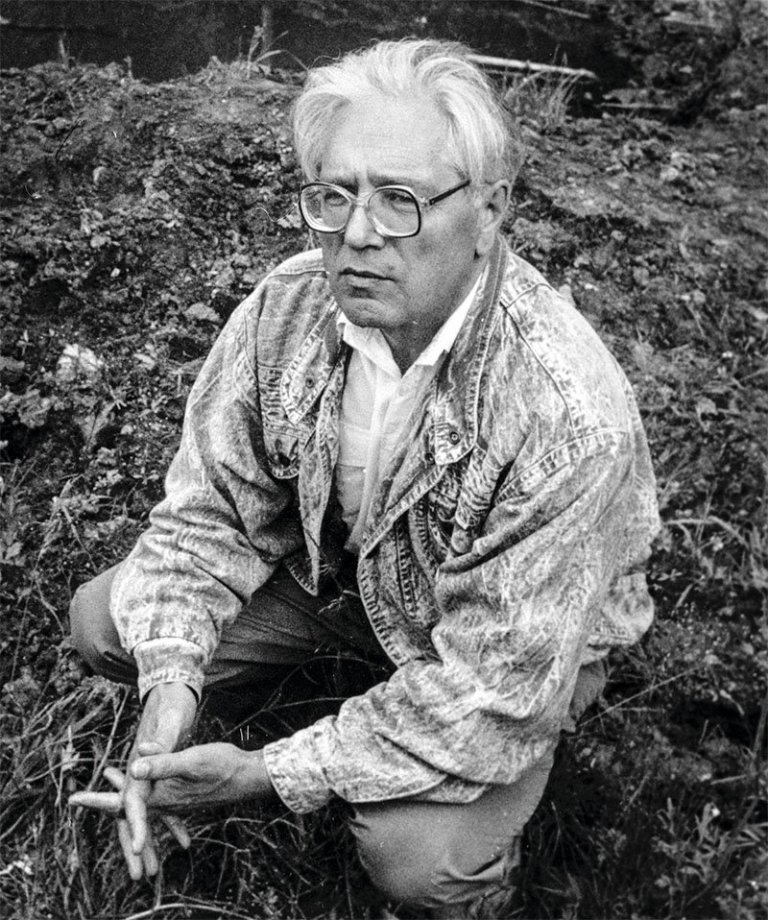
PHOTO: the contemporary Russian artist Yuri Ashikov visiting his “favourite museum”, while posing in front of a portrait of Emperor Nicholas II
Born in 1994, Yuri Ashikov is a contemporary Russian painter, photographer, sculptor, architect and art designer. He graduated, from the Stroganov School Faculty of Design in Moscow, trained in London and Japan, Latvia and Italy, studying not only drawing, but also design and architecture.
For three years, the artist worked on the “Romanov project”, creating a number of both paintings and charcoal drawings of the Tsar, his wife and children. Yuri wrote: “… I want the paintings to be alive, and each work to evoke emotions in the person… Each new project sets its own style, technique and materials. But most of my work I start in the traditional style – with charcoal.”
His exquisite paintings, which are recreated from iconic photographs and paintings of Russia’s last Tsar. They have been exhibited in cities across the Russian Federation, including Moscow and St. Petersburg.
Below, are some of Yuri Ashikov’s portraits of Emperor Nicholas II . . .
On 5th September 2025, a travelling photo exhibition The Romanovs: 23 Steps[1] to Immortality, opened at the Central City Library in the town of Karabash, situated in the south Urals. The collection of photographs of the Imperial Family was provided from the funds of the State Historical Museum of the South Urals. The exposition is timed to coincide with the 107th anniversary of the death and martyrdom of Russia’s last Tsar and his family.
On the night of 16/17 July 1918, Emperor Nicholas II, his wife Alexandra Feodorovna, Grand Duchesses Olga, Tatiana, Maria, Anastasia, Tsesarevich Alexei, as well as four servants were murdered in the basement of the Ipatiev House in Ekaterinburg.
The exhibition presents unique photographs of members of the Imperial Family, diary entries of Nicholas II, anecdotes from the memoirs of people who knew the Imperial Family intimately, as well as materials related to the abdication of the Emperor in March 1917, their private life in the Alexander Palace at Tsarskoye Selo, Tobolsk and Ekaterinburg. The exposition tells not only about the Romanov family, but also includes notes and memoirs of regicides, which allows visitors to look at the events from different angles.
The travelling exhibition The Romanovs: 23 Steps to Immortality was initially launched in 2018, the year marking the 100th anniversary of the death and martyrdom of Emperor Nicholas II and his family. It has since, toured towns and cities in the Urals, as well as other cities in the Russian Federation.
NOTES:
[1] Referring to the staircase – which consisted of 23 steps – in the Ipatiev House, in which, on the night of 16/17 July 1918, the Imperial Family and their four faithful retainers descended to their death and martyrdom in the Ipatiev House in Ekaterinburg.
*As I have noted in previous posts, I support any initiative – big or small – to help keep the memory of Nicholas II and his family alive in 21st century Russia – PG
PHOTO: Generals Nikolai Ivanov, Fyodor Keller and Huseyn Khan Nakhchivanski
The abdication of Nicholas II, continues to be shrouded in controversy, myths and lies. Modern day academically lazy historians continue to spread the century old myth that the Tsar was betrayed by all of his generals in the days leading up to his abdication. This is not true!
During the February 1917 Revolution, while most all of Russia’s top military leaders agreed with the position of the chief of staff of the General Headquarters (Stavka) of the Russian Imperial Army, General Mikhail Alexeev, that Emperor Nicholas II must abdicate the throne. Among them, was the Tsar’s first cousin Grand Duke “Nikolasha” Nikolaevich (1856-1929).
A fact, which is often overlooked by today’s historians and authors, is that there were in fact three generals who remained loyal to their oath to the Emperor: Nikolai Iudovich Ivanov (1851-1919), Fyodor Arturovich Keller (1857-1918), and Huseyn Khan Nakhchivanski (1863-1919). All three generals had distinguished military careers and highly decorated with orders and medals for their service, duty and bravery.
It was during the February 1917 Revolution, that these generals offered the Tsar the services of their troops to suppress the revolution. And when the Tsar abdicated, and it was time to swear allegiance to the new Provisional Government, these same three generals defiantly refused.
Sadly, the lives of these generals ended tragically. None of them survived the Civil War, and yet they remained loyal to Emperor Nicholas II until the end of their days.
Memory Eternal! Вечная Память!
Nikolay Ivanov
The origin of Nikolai Iudovich Ivanov (1851-1919) origin remains a subject of debate, some sources say that he came from a noble family from the Kaluga Governorate, but other sources claim that he was the son of a cantonist[1]. Despite all of these sources, the origin of where Ivanov’s family came from, remains a mystery.
After graduating from the military gymnasium, Nikolai Ivanov continued his military education and became an artillery officer. He served in the 3rd Guards and Grenadier Artillery Brigade, he then participated in the Russo-Turkish War of 1877-1878. During the Russo-Japanese War of 1904-1905, he commanded a corps and repeatedly showed personal bravery, for which he was awarded the Order of St. George 3rd and 4th Class and a Gold Sword for Bravery. In 1908, Ivanov received the highest rank of general of the branch of the armed forces (artillery) at that time.
During the First World War, Ivanov commanded the troops of the South-Western Front. Later at the end of 1915, he conducted a failed operation by the 11th Army against the enemy’s forces. And in March 1916, he was replaced by General Aleksei Brusilov as the commander-in-chief of the Southwestern Front. Ivanov he was then appointed a member of the State Council, and adjutant to Emperor Nicholas II.
On 27th February 1917, the Emperor received disturbing reports about the civil and social unrest in Petrograd, and that the garrison of the capital refused to obey their superiors. Ivanov was appointed commander of the Petrograd Military District with extraordinary powers and subordination of all ministers to him. The Georgievsky Battalion (aka Knights of St. George), were reinforced by two machine-gun companies, which were placed at his disposal. In addition, Ivanov was to be sent two cavalry and infantry regiments from the Northern and Western Fronts.
The Emperor instructed Ivanov and ordered him to go to Tsarskoye Selo to ensure the safety of the Empress and her children. Military units loyal to the Tsar sent from the Fronts were also supposed to arrive there. Ivanov was to take command of them all at Tsarskoye Selo and from there to march on Petrograd to quell the unrest.
Now it is known that the chief of staff of the General Headquarters (Stavka) of the Russian Imperial Army at Mogilev, General Mikhail Alexeev (1857-1918), and the commanders of the Fronts sabotaged the Emperor’s order on the allocation of troops.
After Ivanov learned about the Tsar’s abdication, he went back to the Headquarters at Mogilev, but was arrested and taken to Petrograd. By order of the Minister of Justice of the new Provisional Government Alexander Kerensky (1881-1970), Ivanov was released. In 1918, General Pyotr Krasnov (1869-1947) of the White Army, appointed Ivanov commander of the Special Southern Army, consisting of the Voronezh, Astrakhan and Saratov corps.
On 29thJanuary 1919, after a short but serious illness (from typhus), the former commander-in-chief of the Southern Army, General of Artillery Nikolai Iudovich Ivanov died in Odessa.
Fyodor Keller
Fyodor Arturovich Keller (1857-1918) came from a military family of Russified Germans, many members of which were generals. In 1877, he volunteered for the Russo-Turkish War and awarded the St. George’s Cross 1st and 2nd Class for bravery.
In 1906, Keller survived two attempts on his life by revolutionaries. In 1907, he was awarded the rank of Aide-de-Camp and in July of the same year, he was promoted to major general with enrollment in His Imperial Majesties Retinue.
In August 1914, while commanding the 10th Cavalry Division, he won a number of victories over the enemy, for which in 1916 Emperor Nicholas II awarded him a golden sword. In addition, for services in battle he was awarded the Order of St. George 3rd and 4th Classes.
The news of the abdication of the Emperor found Keller in the post of commander of the 3rd Cavalry Corps. On 6th March 1917, he sent a telegram to Nicholas II, in which he begged him not to leave the throne and offered his troops to suppress sedition. The telegram never reached the Emperor, having been intercepted by supporters of the Provisional Government.
Keller refused to take the oath of allegiance to the new Provisional Government, and was dismissed from his position on 15th March. He left for Kharkiv, where his family lived at that time.
Keller was not happy with the White movement, as it refused to put forward monarchist agenda. He moved to Kiev, where on 19th November 1918 he was appointed by the puppet pro-German “Hetman of Ukraine” Pavlo Skoropadskyi, to lead the armed forces formed from the Russian officers in Kiev, who were there to protect the city from Symon Petliura’s[2] followers.
Skoropadskyi needed the support of Russian monarchists, but Keller understood the appointment as the beginning of his own dictatorship. Keller instituted a five-member Council of the State Defense, composed entirely of the monarchist politicians, and stated that he served one Russian state. Skoropadskyi dismissed Keller on 26th November for “overstepping his authorities”.
Sadly, the events which unfolded in Kiev turned out to be fatal for Keller. When Petliura’s followers entered the city, Keller was in hiding in the St. Michael’s Golden-Domed Monastery. He had categorically rejected the Germans’ proposal to hide in their units, changing the Russian uniform for the German one.
Finally, on 21st (O.S. 8th) December 1918, Petliura’s followers captured and shot Keller along with two of his adjutants (December 21, 1918). His golden sword was presented to Petliura.
Keller’s body was buried under a false name in the Holy Intercession Monastery in Kiev. His grave has not been preserved, his body never found.
Huseyn Khan Nakhchivanski
Huseyn Khan of Nakhichevan (1863-1919) came from a family of hereditary khans of Nakhichevan, who took Russian citizenship in 1828. From this family came a number of Muslim generals, which was rare in the Russian Imperial Army. After graduating from the Corps of Pages with honours, Huseyn Khan regularly participated in the solemn receptions of foreign monarchs in St. Petersburg.
During the Russo-Japanese War, Huseyn Khan served as commander of the 2nd Dagestan Volunteer Cavalry Regiment. During the war the regiment distinguished itself, and Huseyn Khan himself received seven decorations. On 27th January 1907, he was decorated with the Order of St George 4th Class and the Golden Saint George Sword for launching a successful cavalry onslaught to save an encircled Russian infantry unit.
At the very beginning of the First World War, Huseyn Khan was appointed commander of the Combined Cavalry Corps and participated in the offensive against East Prussia. From 19th October 1914 he was commander of the 2nd cavalry corps and on 22nd October 1914, he was decorated with the Order of St George 3rd Class, which was presented to him personally by Emperor Nicholas II. In June 1915, he was appointed General-Adjutant of His Imperial Majesty and became the only Muslim to hold that position.
The news of the February 1917 Revolution found Huseyn Khan as the commander of the reserve Guards Cavalry Corps. On 3rd March 1917, he sent a telegram to General Alexeev at Mogilev, in which he expressed his readiness to die for the Tsar. His telegram, like Keller’s was not handed over by Alexeev to the Emperor.
Huseyn Khan refused to swear allegiance to the Provisional Government. As a result, Huseyn Khan was officially dismissed from the army on 16th April. His chief of staff, Major General Baron Alexander Wienen, shot himself.
Huseyn Khan returned to Petrograd, where he lived with his family. He was one of the few Azeri figures who did not support the newly formed Azerbaijan Democratic Republic, remaining a staunch Russian monarchist.
Following the October 1917 Revolution and the assassination of the head of Petrograd Cheka, Moisei Uritsky (1873-1918) in August 1918, Nakhchivanski together with some other prominent citizens of Petrograd was taken hostage by the Bolsheviks. He was held in the Shpalernaya Prison along with the Grand Dukes Paul Alexandrovich, Nicholas Mikhailovich, George Mikhailovich and Dmitry Konstantinovich. Also in the same prison was Prince Gabriel Constantinovich, who used to serve under the command of Huseyn Khan and who later managed to escape, and who mentioned in his memoir that he met Huseyn Khan during their walks in the prison yard.
The Grand Dukes were executed in the Peter and Paul Fortress on 29th January 1919. It is presumed by a number of Russian historians that Huseyn Khan was executed together with the Grand Dukes. However, the exact circumstances of his death and his burial place still remain unknown.
NOTES:
[1] A cantonist refers to Jewish boys conscripted into military service in the Russian Empire, particularly during the reign of Emperor Nicholas I (1825-1855). They were educated in special cantonist schools, where they were subjected to harsh conditions and pressure to adopt Christianity. The system began in 1827, and by 1857, it was abolished due to public and international criticism, highlighting the inhumane treatment of these young conscripts.
[2] Symon Vasyliovych Petliura (1879-1926) was a Ukrainian politician and journalist. He served as the Supreme Commander of the Ukrainian People’s Army (UNA) and led the Ukrainian People’s Republic during the Ukrainian War of Independence, a part of the wider Russian Civil War.
I am committed to clearing the name of Russia’s much slandered Tsar. In exchange for this 18-page booklet, please consider making a small $5 or $10 donation in aid of my research. These donations are of great assistance in helping me offset the cost of obtaining and translating documents from Russian archival sources, which are often paid for out of my own pocket. It is these documents which help present new facts and information on the life and reign of Nicholas II. In addition, my research continues to debunking many of the myths and lies which exist more than a century after his death and martyrdom.
Please note, that there is NO obligation, thank you for your consideration!
You must be logged in to post a comment.