‘Point of No Return’ – Ekaterinburg Street Art in Memory of the Russian Imperial Family

166a

NOTE: All of the articles pertaining to Nicholas II and his family which were originally published in my Royal Russia News blog, have been moved to this Nicholas II blog. This article was originally posted on 26 July 2018 in my Royal Russia News blog – PG

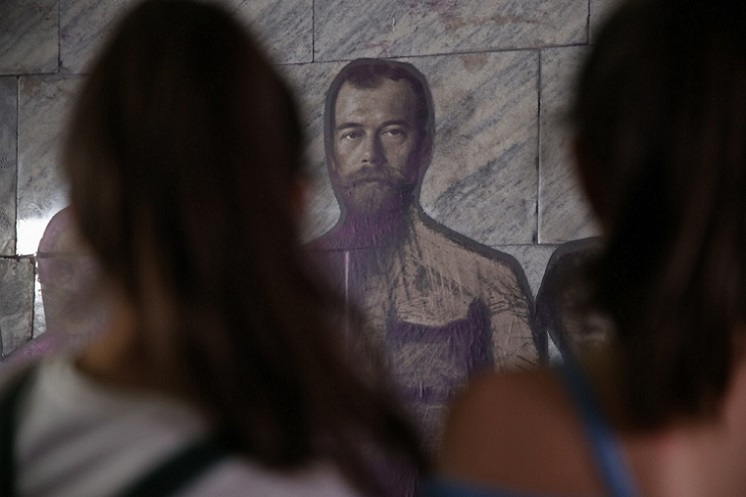
Unique street art in memory of the Russian Imperial Family has been created in an underground passage in the center of Ekaterinburg. The work entitled “Point of no return” depicts two groups of people on opposite walls of the passage.

On one side are depicted: Emperor Nicholas II, his wife Empress Alexandra Feodorovna, their five children, and four faithful retainers – all of whom were murdered on the night of 16/17 July 1918 in the basement of the Ipatiev House in Ekaterinburg.

166b

On the other side the murderers: the Ural Chekists and the guard of the “House of Special Purpose”, the participants in the murders of the Romanovs. Between the two images on the floor is a red circle – Точка невозврата (Point of no return), standing on which, one gets a sense of being in the line of fire.

The appearance of the street art is timed to the 100th anniversary of the deaths of the Imperial Family in Ekaterinburg. The underground passage is located in close proximity to the Church on the Blood, built on the site of the Ipatiev House.

166c

The executor of the work was the GREAT Advertising Group (St. Petersburg), and the ZNAK Information Agency.

“The idea belongs to the GREAT Advertising Group. We liked it, and immediately accepted it. This work is a desire to recall the tragedy of the shooting in the basement of the Ipatiev House, which included the murder of innocent children and servants. It became a symbol of the tragedy of all Russia, a great tragedy of the twentieth century. This shooting really became a ‘point of no return’ for Russia. We believe it is important that a person can feel this point, literally stand on it, even for a moment,” said Dmitry Kolezev, deputy editor-in-chief of Znak.com.

“We wanted to create something without any gadgets and technologies, something with simple and affordable means, which would allow people to get a sense of what it must have felt to face the murderers. To try to literally immerse yourself in a tragic moment, to become a part of it, to stand between the defenseless Imperial family and their murderers with revolvers,” said the creators from the GREAT Advertising Group.

166d

Sadly, the work was only temporary for the 100th anniversary marking the regicide – the artwork was not done with paint, but with a film, making it easy to remove, and leaving the transition walls clean.

© Paul Gilbert. 7 December 2019

Serbs celebrate Royal Martyrs with Liturgy and procession in Belgrade

NOTE: All of the articles pertaining to Nicholas II and his family which were originally published in my Royal Russia News blog, have been moved to this Nicholas II blog. This article was originally posted on 29 July 2018 in my Royal Russia News blog – PG

Tsar Nicholas II was “one of the greatest rulers and tsars of Russia in his moral and spiritual qualities,” the Serbian patriarch said.

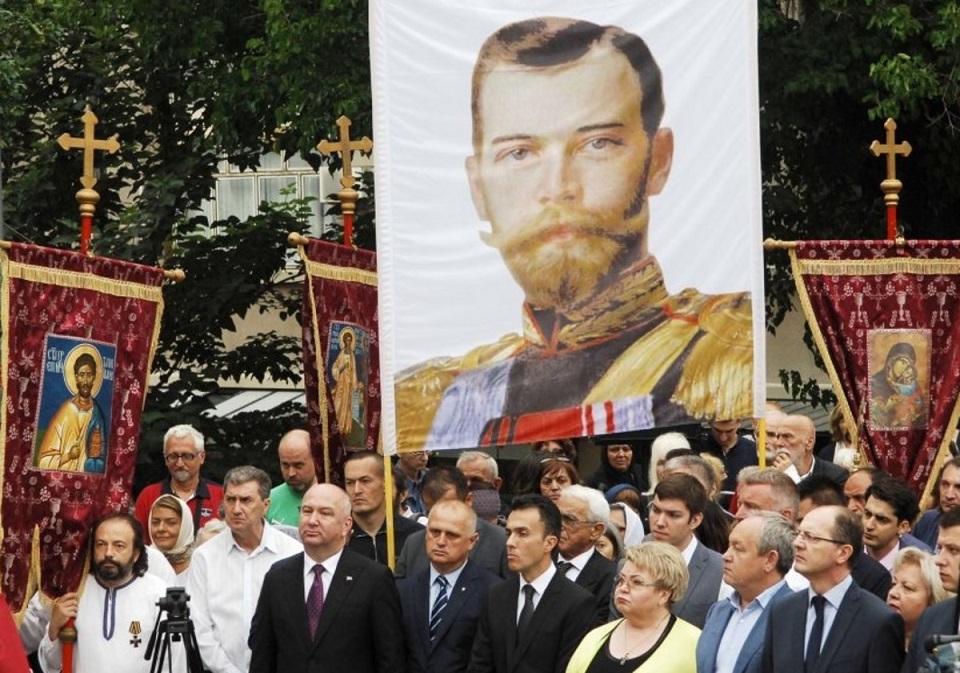
While 100,000 Orthodox faithful gathered in Ekaterinburg on the night of 16/17 July 2018 to honor the 100th anniversary of the Royal Martyrs, they were honored with another Divine Liturgy and procession in Belgrade the following morning.

During the events, His Holiness Patriarch Irinej of Serbia praised Tsar Nicholas as one of the greatest Russian rulers, of high moral and spiritual character.

The day began with the Hierarchical Divine Liturgy in the courtyard of the Russian Church of the Holy Trinity in Belgrade, after which a festive procession passed through the capital city’s central streets.

The procession was announced in all Belgrade churches last Sunday, and according to police estimates, the procession gathered about 10,000 faithful, including clergy, representatives of Russian-Serbian friendship organizations, and citizens of Serbia and Russia participated in the march. As the procession moved past the Serbian Parliament building, the choir sang “God Save the Tsar.”

165a

Serbs gather in Belgrade to honour Nicholas II

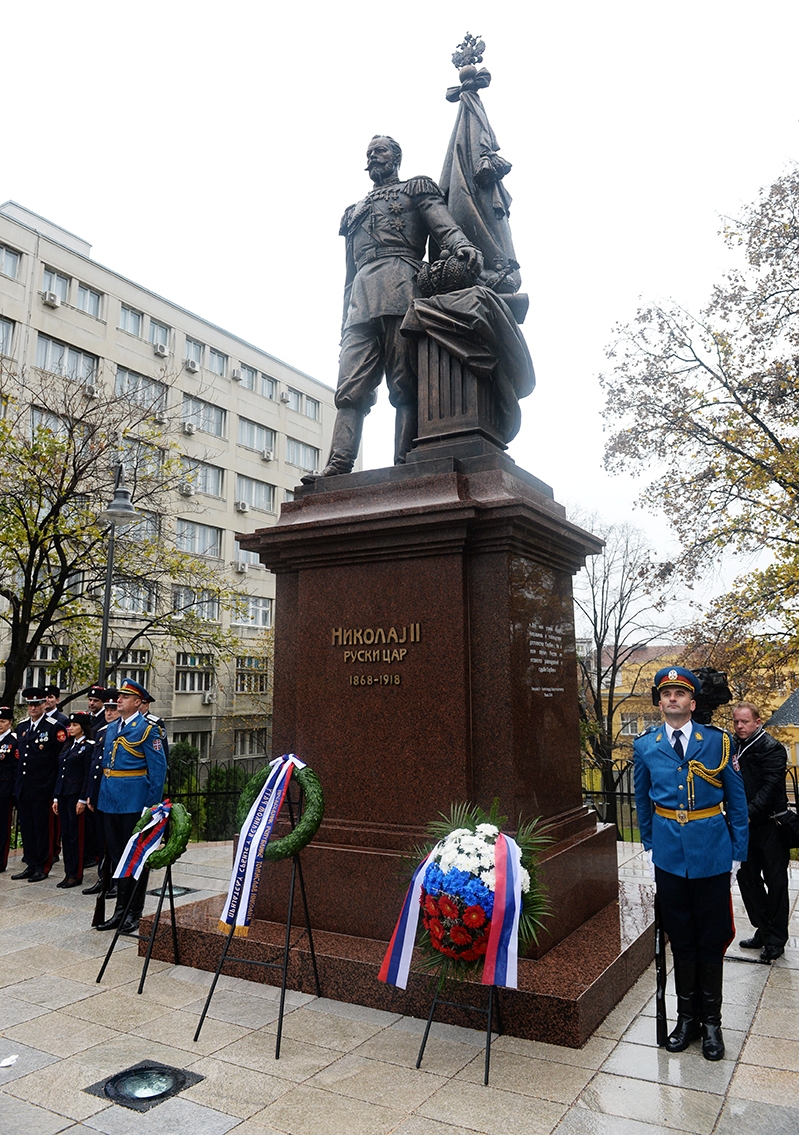
The procession came to an end at Belgrade’s monument to the slain Russian Tsar, where Pat. Irinej celebrated a festive moleben and addressed the gathered faithful, in which he referred to the Tsar-Martyr’s Orthodox character.

“All his life, he was accompanied by distrust, slander, and underestimation of his personality. And this happened, if we look at the time when tsarist Russia had numerous enemies, as it does now,” the Serbian primate said. In his words, the entire Romanov family behaved in a “deeply Christian manner” to the very end.

“No one knows what would have happened with Serbia and the Serbian people if he had not entered into the First World War,” the patriarch also added.

Then wreaths were laid at the monument to Tsar Nicholas II, with the participation of representations from the Russian embassy, Serbian politicians, priests, and public figures.

165b

Monument to Emperor Nicholas II in Belgrade

The monument to Tsar Nicholas was unveiled in November 2014 by His Holiness Patriarch Kirill and former President Tomislav Nikolic. On the pedestal is quoted in Russian and Serbian Tsar Nicholas’ telegram to King Alexander of Serbia, saying, “All my efforts will be directed towards maintaining the dignity of Serbia… In any case, Russia will not remain indifferent to Serbia’s fate.”

© Paul Gilbert. 7 December 2019

Monument to Nicholas II in Archedinskaya

164

NOTE: All of the articles pertaining to Nicholas II and his family which were originally published in my Royal Russia News blog, have been moved to this Nicholas II blog. This article was originally posted on 2 August 2018 in my Royal Russia News blog – PG

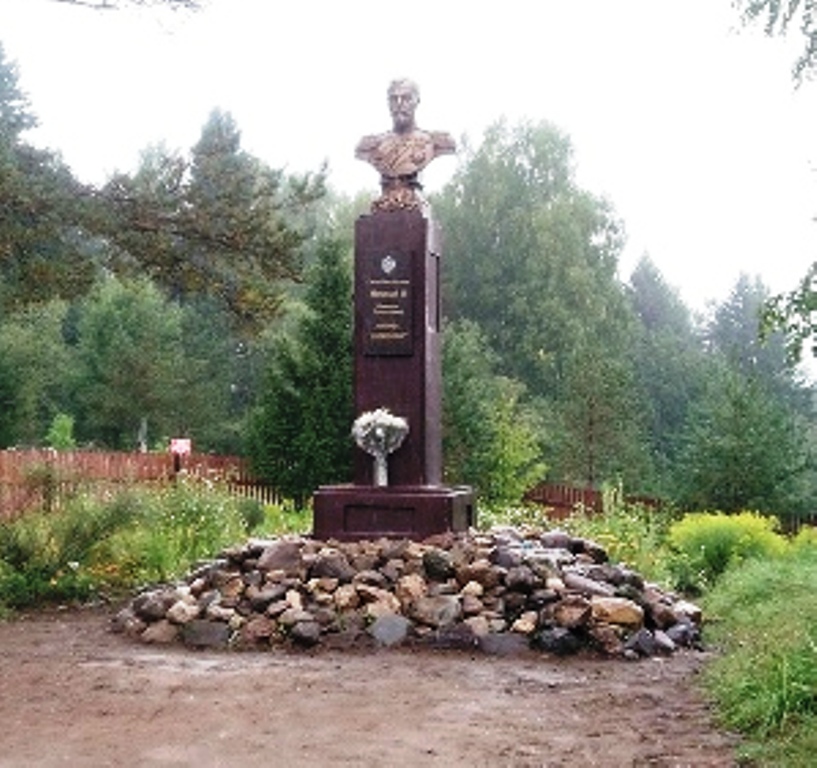
On 17th July 17 2018, on the day marking the 100th anniversary of the murder of the Imperial Family, a bust of Emperor Nicholas II was was established on the grounds of the Church of the Assumption of the Most-Holy Mother of God in the Russian village of Archedinskaya, situated in the Volgorad region. The bronze bust is a copy of an original work by the famous Russian sculptor Vyacheslav Mikhailovich Klykov (1939-2006).

A capsule containing earth from the mines at Ganina Yama and Alapaevsk – where the Bolsheviks attempted to dispose of the bodies of the murdered members of the Imperial family – was placed inside the bust of the Emperor. The bottle of Holy water for consecration was brought from the Church on the Blood of Ekaterinburg. A honourary guard made up of members of the Don Cossacks participated in the event.

After the Divine Liturgy, the consecration of the monument was performed by the Bishop of Uryupinsk and Novoanninsky Elisha.

The bust of the Emperor was made according to a project of the Russian sculptor Vyacheslav Mikhailovich Klykov, who died in 2006. Copies of his sculptures of Nicholas II have been are installed in Mytishchi, Vladivostok, Simferopol, Russia, and Melbourne, Australia.

© Paul Gilbert. 7 December 2019

‘The Conspiracy Against Nicholas II’, with Paul Gilbert

CLICK ON THE IMAGE ABOVE TO WATCH VIDEO

The Conspiracy Against Nicholas II is a short seven minute interview with researcher Paul Gilbert, produced by the Monastery of St John the Forerunner Mesa Potamos in Cyprus.

Paul speaks about the Emperor’s abdication on 15th March [O.S. 2nd March] 1917, and the ‘treachery, cowardice and deceit’ which surrounded him.

He further discusses the main plots which aimed to overthrow Nicholas II from his throne, by his ministers, and even members of his own family. He then discusses some of the myths regarding Nicholas’ II alleged weakness as a ruler, and allegations that his death was met with indifference by the Russian people.

The video includes coloured pictures of the Romanovs and other historical figures, by acclaimed Russian colourist Olga Shirnina, from the forthcoming book The Romanov Royal Martyrs: What Silence Could Not Conceal, published in 2019.

The Conspiracy Against Nicholas II is the fifth of a special multi-episode tribute featuring exclusive interviews with Mesa Potamos Monastery research colleagues: Helen Azar, Helen Rappaport, Nicholas B.A. Nicholson and Paul Gilbert. Click HERE to view ALL six episodes.

memorial

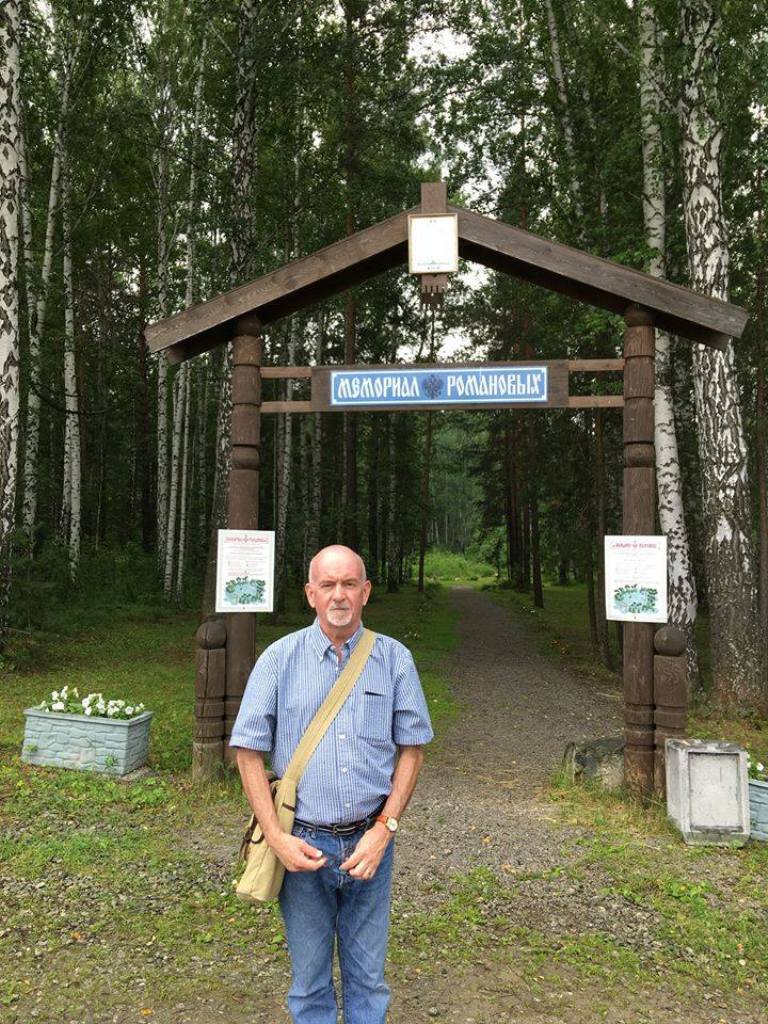
PHOTO: Paul Gilbert at the Romanov Memorial, Porosenkov Log. July 2018.

Paul Gilbert is an independent researcher specializing in the life, reign and era of Emperor Nicholas II, and who is dedicated to clearing the name of Russia’s much slandered Tsar through his news blog Nicholas II. Emperor. Tsar. Saint., his semi-annual journal Sovereign, and Conferences. The 1st International Nicholas II Conference was held on 27th October 2018, in St. John of Shanghai Church in Colchester, England.

© Paul Gilbert. 6 December 2019

Nicholas II memorial plaque in Nikolsk-Ussuriysk

NOTE: All of the articles pertaining to Nicholas II and his family which were originally published in my Royal Russia News blog, have been moved to this Nicholas II blog. This article was originally posted on 27 August 2018 in my Royal Russia News blog – PG

On 17th July 2018 a memorial plaque in honour of Tsesarevich and Grand Duke Nicholas Alexandrovich (future Emperor Nicholas II) was unveiled on the northern facade of the Church of the Intercession of the Holy Virgin in the Far-eastern Russian city of Nikolsk-Ussuriysk.

The memorial plaque was established in honour of the August visit of Nicholas Alexandrovich on 3-4 June 1891, as part of his Eastern Journey, and the construction of the Ussuri section of the Trans-Siberian Railway. The memorial also marks the 120th anniversary of the granting of the status of the city with the name Nikolsk-Ussuriysk on 16th April 1898, by the will of the Sovereign Emperor Nicholas II to Nikolsky, and, subsequently – the city coat of arms.

The work on the preparation of the memorial plaque was initiated by a group of historians, parishioners and residents of the city. The project was agreed and approved, with the blessing of Metropolitan Veniamin of Vladivostok and Primorye.

Associate Professor of the Far Eastern Federal University Yaroslav Popov, who headed the group, said that exactly at this place, in the wooden St. Nicholas Church (Nikolsk-Suifunsky), the Tsesarevich Nicholas Alexandrovich prayed during his visit in 1891. After the Liturgy, the Tsesarevich addressed the soldiers of the Nikolsk fortress, Russian residents and settlers, representatives of local peoples, Chinese and Korean diasporas, thanking everyone for their warm welcome.

The Divine Liturgy held on 17th July 2018 was attended by the mayor of Ussuriysk, Evgeny Evgenevich Korzh and the head of the Ussuriisk urban district Nikolai Nikolayevich Rud. After the consecration of the memorial sign, the choir of the parishioners of the church performed the hymn of the Russian Empire “God Save the Tsar”.

This was followed by the reading of the poems of the famous Russian poet Sergei Sergeivich Bekhteev (1879-1954), who escaped Russia after the Revolution. Bekhteev’s poems are full of love for the Motherland, the monarchy and the Holy Royal Martyrs. Countess Anastasia Hendrikova managed to pass five of Bekhteev’s poems to the Tsar’s family during their house arrest in Tobolsk. Emperor Nicholas II, was so moved by Bekhteev’s poem “God Save the Tsar”, that he shed a tear and asked to convey his gratitude to the poet for sharing his loyal feelings.

© Paul Gilbert. 5 November 2019

Film: Assassin of the Tsar

155a

Watch ‘The Assassin of the Tsar’

Click on the image above to watch the English version
of the film in it’s entirety. Duration: 1 hour, 40 mins.

The Assassin of the Tsar is a 1991 Soviet drama film, starring the English actor Malcolm McDowell and the Soviet/Russian actor Oleg Yankovsky (1944-2009). It was entered into the 1991 Cannes Film Festival. There are two versions. One is filmed in English which later was dubbed over the Russian actors, and one in Russian.

Timofyev (Malcolm McDowell) is a patient in an asylum who claims to be the man who assassinated Tsar Alexander II in 1881, and his grandson Tsar Nicholas II in 1918. Doctor Smirnov (Oleg Yankovsky) decides to apply a peculiar therapeutic method on him, but things go in an unexpected way.

A good portion of the film depicts the last days of the Russian Imperial Family in Ekaterinburg, largely narrated by Timofyev’s voice-over from the perspective of Yakov Yurovsky, the chief guard and ultimately executioner of the family. In the scenes, Yurovsky is impersonated by Timofyev (McDowell) and Tsar Nicholas II by Dr. Smirnov (Yankovsky). Other members of the family function merely as background, with few or no lines.

PHOTOS: Soviet/Russian actor Oleg Yankovsky as Tsar Nicholas II; the
Imperial family in Crimea; and Malcolm McDowell as Yakov Yurovsky

The cast includes:

Oleg Yankovsky — Dr.Smirnov / Tsar Nicholas II
Malcolm McDowell — Timofyev / Yakov Yurovsky
Armen Dzhigarkhanyan — Alexander Yegorovich, Smirnov’s superior
Olga Antonova — Empress Alexandra
Dariya Majorova — Olga Nikolaevna
Evgeniya Kryukova — Tatiana Nikolaevna
Alyona Teremizova — Maria Nikolaevna
Olga Borisova — Anastasia Nikolaevna
Aleksei Logunov — Alexei Nikolaevich
Yury Belyayev — Alexander II of Russia
Anastasiya Nemolyaeva — nurse
Anzhelika Ptashuk — Marina, Smirnov’s mate

Of particular interest in this film are the recreation of the facade and the haunting interiors of the Ipatiev House, where the Imperial family where all murdered on the night of 16/17 July 1918, by a Bolshevik firing squad.

PHOTOS: The facade and interiors of the Ipatiev House were recreated for this film

© Paul Gilbert. 5 November 2019

Monument to Nicholas II Established Near St. Petersburg

154a

NOTE: All of the articles pertaining to Nicholas II and his family which were originally published in my Royal Russia News blog, have been moved to this Nicholas II blog. This article was originally posted on 3 September 2018 in my Royal Russia News blog – PG

On 2nd September 2018, a new monument to Emperor Nicholas II, was unveiled in the village of Efimovsky, situated in the Boksitogorsky district of the Leningrad region. The opening of the monument is timed to the 100th anniversary of the martyrdom of the Imperial Family.

The monument was established on the grounds of the church in the name of the Holy Prophet Elijah. The church was constructed in 1908, for which half of the necessary sum for its construction was paid by Nicholas II from his personal funds.

A large area was arranged for the monument. It is situated at the end of a wide avenue, lined with flower beds. The monument is situated between an old pine tree, which symbolizes the glorious past of the House of Romanov, and a very young birch tree, which symbolizes hope for the future restoration of the tsar’s throne in Russia. The bust of the Sovereign is turned to face the church, which he helped build.

The bust is mounted on a high granite pedestal, standing on a pile of collapsed Golgotha ​​stone. The inscription on the monument reads: “Holy Tsar-Martyr Nicholas II, Emperor of All Russia. In gratitude for the building of the church of the holy prophet Elijah of God. In memory of the 100th anniversary of the martyr’s death.”

The opening of the monument was attended by the head of the local administration Sergei Ivanovich Pokrovkin, which gave the event a state status. The consecration of the monument was performed by the priest of the church, Fr Mikhail Lomakin and Archpriest Father Gennady Belovolov. After the consecration, a prayer was offered to the Holy Royal Martyrs at the monument. The ceremony ended with the singing of the former national anthem “God, Save the Tsar”, to the accompaniment of the accordion.

154b

Father Mikhail thanked the head of the Alley of Russian Glory Foundation Mikhail Leonidovich Serdyukov for the charity donation of the bust. Serdyukov made busts of Tsar Nicholas II and Tsesarevich Alexei specially for the 100th anniversary of the martyrdom of the Tsar’s Family, and is willing to donate them to those who wish to establish them in significant places in Russia.

This event is important not only for the village of Efimovsky, but also for the whole of Russia. The fact is that in this year of this tragic year marking the 100th anniversary of the death and martyrdom of Russia’s last emperor and tsar, virtually no events were held at the state level, a program for the memorialization of the memory of the Holy Royal Martyrs was not realized, and very few monuments were established to the Tsar-Martyr.

Such monuments are very necessary for Russia, since the monuments are considered by some as a “public canonization” to the memory of the Holy Royal Martyrs. Although the Moscow Patriarchate canonized the Imperial family 18 years ago, there still remains great disagreement among many Russians with regard to the reign of the last Russian Tsar, a lack of understanding of his deed and service, condemnation and denigration of his image.

Thanks to such monuments, we return the name of Nicholas II to our public consciousness, we affirm the tsar’s idea among the people, we conclude the tragic century, which lived without a tsar on the Russian throne.

© Paul Gilbert. 5 November 2019

Tribute to Robert K. Massie, 1929-2019

147

On 2nd December 2019, Robert K. Massie, best known as author and historian of pre-Revolutionary Russia, passed away at his home in Irvington, New York at the age of 90. The cause of death was complications associated with Alzheimer’s Disease.

Life, Education and Career

Robert Kinloch Massie III was born in Versailles, Kentucky on 5 January 1929. He later grew up in Nashville, Tennessee, graduated from Yale University, and was a Rhodes Scholar at Oxford University where he read Modern History. For four years, he served as an air intelligence officer aboard aircraft carriers in the Mediterranean and the Pacific. 

Mr. Massie was on the staff of Newsweek from 1959 to 1962, where he was a book reviewer, foreign news writer, and United Nations Bureau Chief. His writing has also appeared in The New Yorker, Vanity Fair, The New York Times, Architectural Digest, and other publications. Over the years, he worked as an historical adviser to, and has made frequent appearances on, a number of national television programs and documentaries.

Massie was married twice. His first wife, Suzanne Rohrback (from 1954 to 1990), an author whose books about Russian culture (Land of the Firebird: The Beauty of Old Russia in 1980 and Pavlovsk: The Life of a Russian Palace in 1990),  brought her to the attention of Ronald Reagan and into international politics.  The couple had a son and two daughters. In 1992, Massie remarried his literary agent Deborah Karl. The couple had a son and two daughters.

Books: Nicholas and Alexandra

Robert K. Massie, spent almost half a century studying Tsarist Russia, his personal interest in the last Imperial family was triggered by the birth of his eldest son Robert Jr., who was born with hemophilia, a hereditary disease that also afflicted Tsar Nicholas II’s son, Alexei.

His first book, Nicholas and Alexandra (1967), which remained on the New York Times Bestseller List for 46 weeks, was translated into seventeen languages, and made into a film that was nominated for numerous Academy Awards. Though nearly 1,000 pages long, it sold more than 4.5 million copies and is regarded as one of the most popular historical studies ever published. Praised in The New York Times as a long-needed and balanced account of the last tsar and his family. In his study, Nicholas comes across not as the “stupid, weak or bloodthirsty” monarch, as he is often been portrayed by his Western counterparts.

Nicholas and Alexandra made Massie a celebrity, phoned by strangers who invited him for lunch, and a magnet for relatives and alleged relatives of the Romanovs. He discussed hemophilia with the Duke and Duchess of Windsor, and with Earl Mountbatten of Burma, a grandson of Queen Victoria.

It was Massie’s now classic study of Emperor Nicholas II and Empress Alexandra Feodorovna, which presented the most comprehensive study of Russia’s last Imperial family in a whole new light, but it was far from perfect.

During his research for Nicholas and Alexandra, Massie did not have complete information because the Soviet government would not permit him access to the Romanov archives. During the Soviet years, access to these files were restricted solely for propaganda purposes only. It was only in 1991, when the Soviet Union was dissolved and the Romanov archives were open, did Massie complete their story, writing a continuation, The Romanovs: The Final Chapter (1995)

Film: Nicholas and Alexandra (1971)
147b

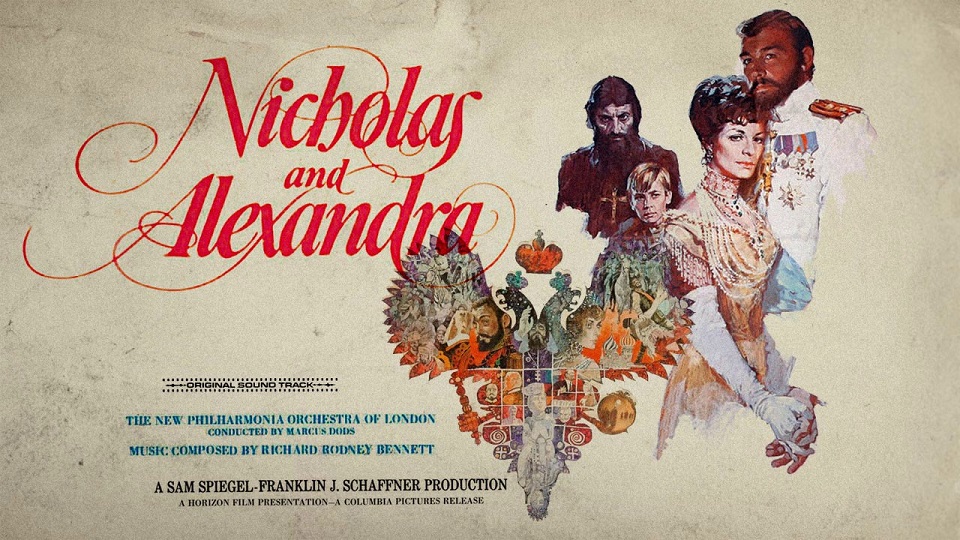
In 1971, Massie’s bestseller was made into a British biographical film directed by Franklin J. Schaffner, written by James Goldman, and starring Michael Jayston as Emperor Nicholas II and Janet Suzman as Empress Alexandra Feodorovna.

The film won Academy Awards for Best Art Direction-Set Decoration and Best Costume Design and was nominated for Best Actress in a Leading Role (Janet Suzman), Best Cinematography, Best Music, Original Dramatic Score and Best Picture.

Despite the detailed production design, photography and strong performances from the cast, Nicholas and Alexandra failed to find the large audience it needed to be a financial success.

It is interesting to note that aside from its historical inaccuracies, not a single scene was filmed in Russia. This of course is due to the fact that in 1971 Russia was still the Soviet Union, and the discussion or promotion of the last tsar was still taboo. Instead, the film was shot entirely in Spain and Yugoslavia.

Other Books
147c

Massie penned two additional books on the Romanov dynasty: Peter the Great: His Life and World (1981), which won a Pulitzer Prize. His biography led to the production of Peter the Great (1986) which became a major network miniseries, winning three Emmy Awards.

Two decades later he wrote, Catherine the Great (2011), which was awarded the Andrew Carnegie Medal for Excellence in Nonfiction by the American Library Association.

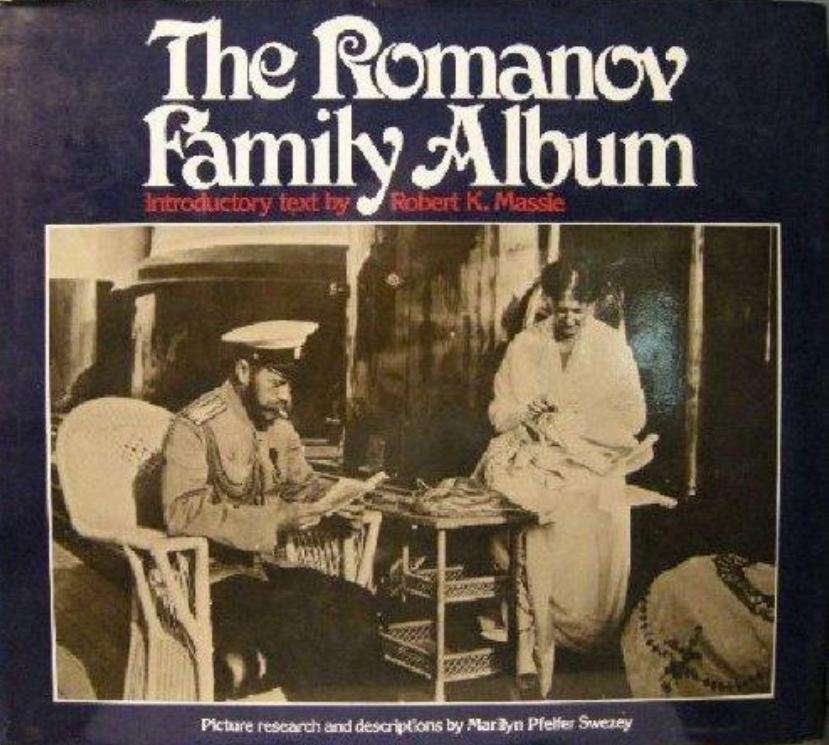
And we cannot forget two additional pictorials for which Massie wrote the introductory text: Last Courts of Europe: Royal Family Album, 1860–1914 (Vendome Press, 1981) and The Romanov Family Album (Vendome Press, 1982), the latter of which is highly sought after by collectors to this day.

His other works include Journey (1975), Dreadnought: Britain, Germany and the Coming of the Great War (1991),  and Castles of Steel: Britain, Germany and the Winning of the Great War at Sea (2004), among others.

While Massie’s books have sold more than 6 million copies, however, he will always be remembered for Nicholas and Alexandra, which captivated a whole new generation with detailed accounts of Nicholas II and his family. For many it was Massie’s now classic study which launched their personal interest in the Imperial family, leading them on a quest for for accurate and truthful information. For that alone, we owe Robert Massie an immense debt of gratitude.

Robert K. Massie is survived by his second wife Deborah Karl, their son, Christopher, and two daughters Sophia and Nora Massie; and his son Bob Jr., and two daughters, Susanna Thomas and Elizabeth Massie, from his first marriage; as well as seven grandchildren and one great-grandson.

Memory Eternal! Вечная Память!

© Paul Gilbert. 4 December 2019

Exhibition: ‘The Romanovs. Family Chronicles’ in Moscow

NOTE: All of the articles pertaining to Nicholas II and his family which were originally published in my Royal Russia News blog, have been moved to this Nicholas II blog. This article was originally posted on 12 September 2018 in my Royal Russia News blog – PG

The following exhibition ran from 14 September to 28 October 2018

Beginning 14th September 2018, the Tretyakov Gallery in Moscow will present unique materials from the archives of the Russian Imperial family. An exhibition of photo documents from the Gallery’s collections will showcase a previously unknown collection of photographs.

The Romanovs. Family Chronicles exhibition features photographs taken during the reign of Russia’s last three emperors – Alexander II (1855-1881), Alexander III (1881-1894) and Nicholas II (1894-1917) – the collection dating from the 1870s to 1914.

The exhibits were sent to the Tretyakov Gallery in 1932 from two former imperial residences: the Gatchina Palace, where the Empress Maria Feodorovna Dowager lived after the death of her husband Alexander III, and the Alexander Palace, the last residence of the family of Emperor Nicholas II.

From the middle of the 19th century, the Imperial families employed the services of court photographers for both official and leisure images, photographing them in the interiors of the Imperial palaces and country residences, at official receptions, on vacations, hunting trips, and other leisure activities. The “Kodak” camera was first used by the Grand Duchess Maria Feodorovna (future Empress Maria Feodorovna) in the 1860s, when she took a great personal interest in photography. Over time, her enthusiasm for photography was taken up by her son Nicholas II and his family. His wife Alexandra Feodorovna are often seen in leisure photographs with the famous Kodak Brownie camera in hand.

Various photos from the time of the Emperor Alexander III include: portraits of Grand Duchess Maria Feodorovna, Grand Duchess Xenia Alexandrovna, Prince George Maximilianovich, Duke of Leichtenberg (K. I. Bergamasco), Grand Duchess Olga Aleksandrovna (S. L. Levitsky). The Polish photographer Conrad Brandel recorded events and trips of Emperor Alexander III with his family to Poland: a military review in Brest, an inspection of the new station in Brest, Emperor Alexander III and Maria Feodorovna with a delegation of local residents or at a children’s choir performance.

A series of photos from the family album-boxes of Maria Feodorovna are also featured. These charming amateur photographs offer an intimate look at family time together: walks to the Finnish skerries on the Imperial yacht Tsarevna, picnics on the beach, and leisure time onboard the yacht. In the album there are 60 photographs-business cards. A small folding album contains nine photographs of the installation of the monument to Empress Catherine II by the sculptor M.M. Antokolsky in Vilna in 1904.

In the section dedicated to the family of Emperor Nicholas II, photographs include the exteriors and interiors of the Alexander Palace, views of the park and pavilions scattered throughout the parks in Tsarskoye Selo, as well as photos from “Yacht Zarnitsa” album.

These historic photo chronicles are represented mainly by beautifully bound albums, some of which are interesting examples of arts and crafts of the turn of the century. These albums were produced in a single copy, using precious metals on the occasion of significant events for the members of the imperial family.

The album “Medzhybozh” was presented to Grand Duchess Olga Alexandrovna, chief of the 12th Hussar Akhtyrsky Regiment, on the occasion of her visit to the headquarters in the Medzhibozh Castle on 11th December 1908. The album includes 30 photos documenting the anniversary visit: the chief of the regiment enters the castle, the review of the regiment, the squadron’s songwriters, the hunting team, a group of regimental officers among others.

The photo album, which belonged to the heir Tsesarevich Alexei Nikolaevich, contains 289 small-format photographs from 1909-1914, which depict trips made by the imperial family to Germany, the Finnish skerries and Crimea, and onboard the Imperial yacht Standart, among others.

The exposition also includes a unique series of 40 photos received as a gift in 2004, dedicated to the first official visit of Emperor Nicholas II, Empress Alexandra Feodorovna and Grand Duchess Olga Nikolaevna to France in 1896.

During the preparation of the exhibition, the staff of the scientific and reference department of photo-materials of the Tretyakov Gallery conducted research work to determine the names of the photographers and unknown persons in the photographs, dates and places. The results of the work are included in an exhibition catalogue published in the Russian language only.

The Romanovs. Family Chronicles exhibition ran from 14th September to 28th October 2018, in the New Tretyakov Gallery, Halls 80-82

© Paul Gilbert. 4 November 2019

Captured on Film by U.S. Cameramen – The Romanov Murder Scene (1918)

NOTE: All of the articles pertaining to Nicholas II and his family which were originally published in my Royal Russia News blog, have been moved to this Nicholas II blog. This article was originally posted on the First World War in Film web site by Ron van Dooperen. It was reposted on 12 September 2018 in my Royal Russia News blog – PG

In December 1918, a photographic team of the U.S. Signal Corps led by Captain Howard Kingsmore arrived in Yekaterinburg, Russia, where they filmed inside the house where Tsar Nicholas II and his family was brutally murdered. Against all odds, we recently found Kingsmore’s personal story on this photographic assignment, as well as part of these historic films.

The execution of the last Russian Tsar and his family hardly needs an introduction. After the Bolsheviks had taken over power the Romanov family was moved to a so-called ‘House of Special Purpose’ in Yekaterinburg. The Imperial family was kept in strict isolation within the walls of a sinister heavily guarded building that was surrounded by a palisade. The Bolsheviks initially wanted to put the Tsar on trial, but in the summer of 1918 anti-Communist forces were at the gates of Yekaterinburg, and the Reds feared their captives would fall into enemy hands. As a result, death to the Romanovs was declared. Tsar Nicholas II, his wife Tsarina Alexandra and their five children Olga, Tatiana, Maria, Anastasia, and Alexei were shot, bayoneted and clubbed to death on the night of 16-17 July 1918. Their bodies were disposed of in a most gruesome manner.

The Cameramen

Howard P. Kingsmore was the photographic officer of a U.S. Signal Corps camera team that recorded the operations of the American Expeditionary Army in Siberia. Born in 1886, Kingsmore started his photographic work for the Philadelphia Inquirer, covering the burial of President McKinley, the coal strikes of 1901-1902 and the 50th anniversary of the Civil War battle of Gettysburg. Around 1907 Kingsmore became chief photographer for the Philadelphia Evening Ledger. For this newspaper he covered the civil war in Mexico, as well as the Punitive Expedition by General Pershing into that country in 1916. When the United States entered World War I he applied for a commission in the U.S. Signal Corps as a photographic officer. He was commissioned as a Lieutenant in September 1917, appears to have made mostly training pictures while he was in America and in Augustus 1918 was promoted to Captain, when a photographic section was set up for the Siberian Expedition. After the First World War Kingsmore became a cameraman for Fox News.

150a

The Ipatiev House in Ekaterinburg. 1918

Interview with Kevin Brownlow

Judging from the production file of the films that were made by Kingsmore and his camera team, they filmed across Siberia between November 1918 and February 1919, covering various operations by the Expeditionary Force that was trying to push the Red Army out of Russia. We have described this Signal Corps footage from Russia in more detail in a previous weblog. Five men were selected for this photographic team, including two movie camera operators. One of Kingsmore’s men, Philip Tannura, was interviewed by Kevin Brownlow for his book The War, the West and the Wilderness. Tannura was among Kingsmore’s cinematographers and in the interview with Brownlow Tannura mentioned how he accompanied Kingsmore while they visited the place where the Tsar and his family were executed. “We couldn’t find out whether they had actually been killed or not”, Tannura said. “We photographed all the rooms.”

Kingsmore said he boarded a Red Cross freight train in Vladivostok in November 1918. The trip across Siberia took about nine weeks. The accommodation on the train was of a most primitive nature. The American cameramen traveled in box cars that were originally built for cattle. Arriving in Yekaterinburg, the cameramen found the city controlled by Czech forces. These had taken Yekaterinburg shortly after the Tsar and his family were murdered. Kingsmore was told the Romanovs were subjected to many indignities by the Communist soldiers who guarded them. It should be noted here that at the moment when Kingsmore and Tannura arrived in Yekaterinburg an official investigation was still being carried out on the mysterious disappearance of the Imperial family. As far as the Kremlin was concerned, they had simply vanished into thin air and the Communists denied any allegation they had killed the Romanovs.

Photographic Evidence of the Romanov Execution

Kingsmore’s and Tannura’s pictures indicate this was a fabricated lie. One of their still photographs shows the cellar where the Romanovs were executed. Bullets were dug out of the wall by the Bolsheviks to destroy evidence of the crime, but the holes still remained and were clearly visible. Their pictures also demonstrate how the Tsar’s children had to sleep on the floor, as well as the search by the investigating committee for further proofs of the execution. Kingsmore also appears to have talked with eye witnesses. One told him the Romanovs were on their knees begging for mercy while they were executed in the basement of the house.

Part of the footage that was shot at Yekaterinburg has been retrieved and identified by the authors in the film collection of the National Archives in Washington, D.C. These scenes were probably taken by Tannura and show an exterior of the Czech military headquarters, the house the Romanovs lived in, as well as shots of the Czarina’s room and the room that was occupied by the Tsar’s daughters. We edited these historic scenes into a short clip that has been posted on our YouTube channel.

Click HERE to read the newspaper article In the House Where Romanoffs Were Put to Death, published in the Grand Forks Herald on 6 June 1919

© Ron van Dopperen. 3 December 2019