NOTE: when referring to dates in this article, I have used the Old Style (O. S.) Juliann Calendar, which in the 20th century was 12 days behind the New Style Hregorian Calendar used in the West. In the 21st century, the Julian calendar is 13 days behind the Gregorian calendar – PG
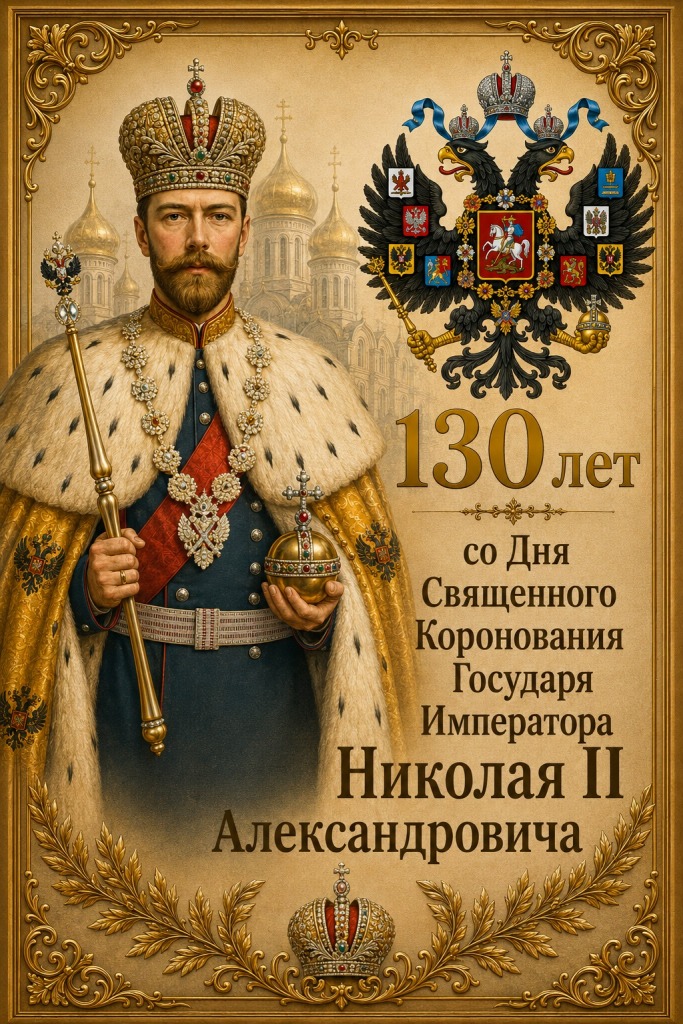
Today – 27th (O.S. 14th) May – marks the 130th anniversary of the Holy Coronation of Emperor Nicholas II and Empress Alexandra Feodorovna in Moscow. The celebrations – which lasted 3 weeks, from 7th May to 27th May 1896 – marked the crowning of Russia’s last Tsar.
The responsibility for the preparation of the coronation was assigned to the Minister of the Imperial Court Count Illarion Ivanovich Vorontsov-Dashkov (1837-1916), who was appointed to the rank of Supreme Marshal. The preparations began in early as February 1895.
A coronation detachment was formed consisting of 82 battalions, 36 squadrons, 9 hundreds, and 28 batteries under the command of the new Emperor’s uncle Grand Duke Vladimir Alexandrovich (1847-1909).
The coronation of 1896 is considered one of the most magnificent and expensive in the history of the Russian Empire, according to some estimates, about 7 million rubles (about $5.38 million USD)[1]. For the manufacture of three mantles (for Nicholas II, Alexandra Feodorovna and the Dowager Empress Maria Feodorovna) 6,561 rubles (about $5,046 USD)[1] were paid for the fabric alone.
Tsesarevich and Grand Duke Nicholas Alexandrovich became Emperor on 2nd November [O.S. 20th October] 1894 – the day marking the death of his father, Emperor Alexander III (1845-1894). However, a respectable period of mourning was the reason his coronation was postponed for a year and a half.
After the death of Emperor Alexander III, a year of mourning was declared. All magnificent solemn state events were cancelled during this time. Nicholas II himself selected the date of the coronation, taking into account various circumstances, including the church calendar[2] – church fasts and holidays. There was no need to hurry, because the coronation celebrations were preceded by grandiose preparations.
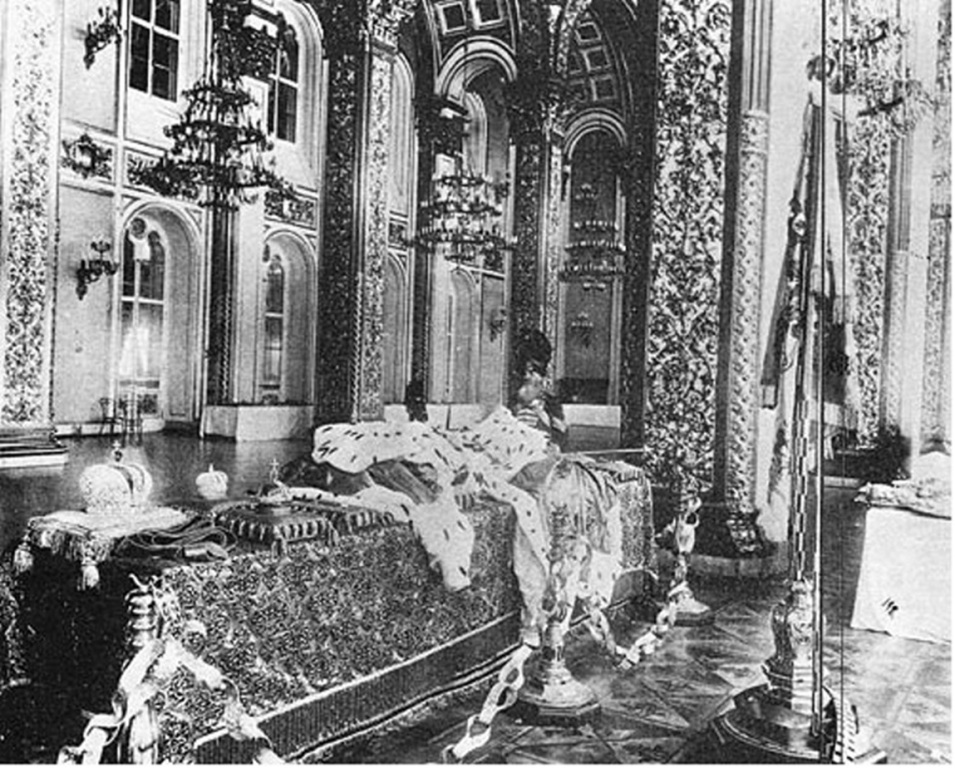
PHOTO: the Imperial Reglaia is laid out in St. Andrew’s Hall of the Grand Kremlin Palace in Moscow, in preparation for the Holy Coronation of Emperor Nicholas II. May 1896
On 1st January (O.S.) 1896, Emperor Nicholas II in his Imperial Manifesto announced the date of his coronation in Moscow.
On 14th (1st O.S.) January, 1896, the Imperial Manifesto “On the Upcoming Sacred Coronation of Their Imperial Majesties” was issued, according to which the coronation ceremony was to take place in May of that year.
On 4th April (O.S.) 1896, the Imperial regalia were delivered by train from the Diamond Room of the Winter Palace in St. Petersburg to the Armoury Chamber in Moscow. The Imperial Regalia consisted of the Great Imperial Crown, the Small Crown, the Imperial Sceptre, the Imperial Orb, the Mantle, the Big Chain and Star of the Order of St. Andrew, the state shield, the state sword, and the state seal.
Moscow began to prepare for the celebrations. An eyewitness wrote: “Moscow is now unrecognizable, even for a native Muscovite. As if by magic, here and there, more and more new structures appear – one richer and more elegant than the other. Pavilions, obelisks, masts, towers and turrets decorated with double-headed eagles, monograms, coats of arms – what luxury, what brilliance, what beauty!”
The coronation was covered by both domestic and foreign media sources. Famous Russian artists were also invited to sketch and paint the celebrations: Viktor Vasnetsov, Ilya Repin, Valentin Serov, Vladimir Makovsky, Andrei Ryabushkin and Mikhail Nesterov. Commissioned by the Academy of Arts, their paintings and portraits were reproduced in the Coronation Album, which was published in 1899 in Russian and French editions.
In May 1896, four French cameramen from the Lumiere Brothers (Paris) arrived in Moscow to film the coronation celebrations of Emperor Nicholas II. The organizer of the shooting of the film was Camille Cerf. He filmed the entire solemn procession of the route in 35 mm, duration 1 hour 33 min. It is immportant to note that cameras were not permitted inside Orthodox churches at the time. It was to be he first full-length documentary-film made in Russia. A copy of the film was presented by Lumiere to Emperor Nicholas II, which apparently, met with his approval.
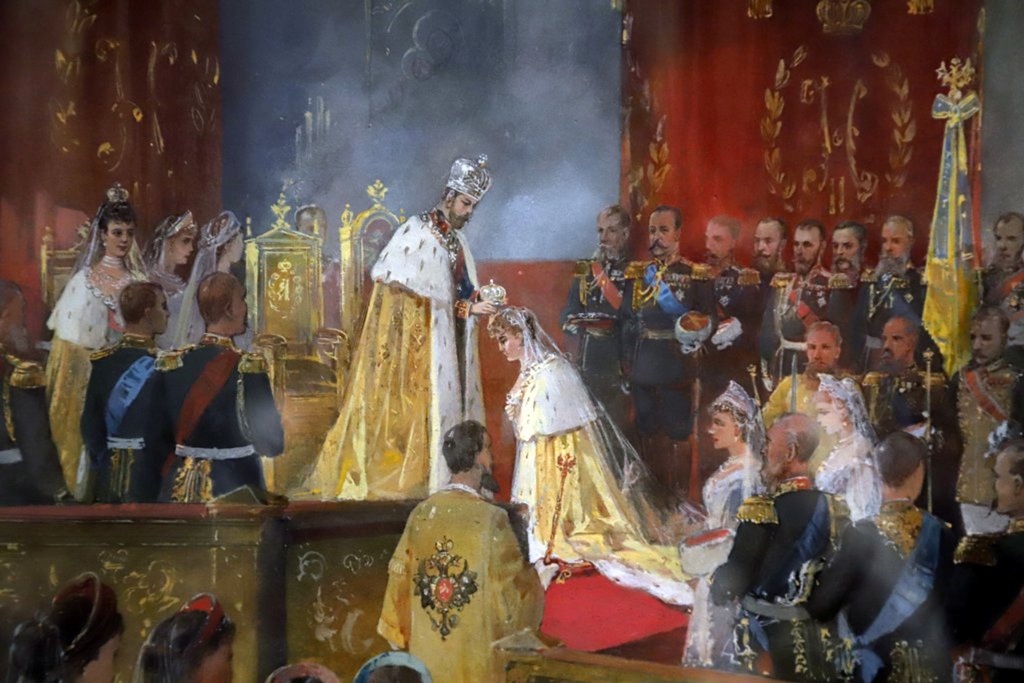
PHOTO: A splendid study of the Coronation of Emperor Nicholas II on 27th May (O.S. 14th) May, 1896 in Moscow. In this work, the Tsar is depicted wearing the Great Imperial Crown of the Russian Empire, while placing a second Small Imperial Crown on the head of Empress Alexandra Feodorovna. Artist: Danish artist Laurits Regner Tuxen (1853–1927).
The coronation celebrations lasted from May 6 to May 26 (old style), 1896.
On 6th (O.S.) May – the birthday of Emperor Nicholas II – The August couple arrived at the Petrovsky Traveling Palace near Moscow. Starting from 1797, all Russian Emperors and Empresses stopped here before their official entry into Moscow for their coronation in the Assunption [aka Dormition] Cathedral, situated in the heart of the Kremlin.
Long before the appointed day, guests from all over the Russian Empire and abroad began to arrive in Moscow. By the time of the Tsar’s arrival – his birthday, 6th (O.S.) May – the whole of Moscow was decorated with flags and coloured lanterns. On 9th (O.S.) May, the ceremonial entry from the Petrovsky Palace, situated on the outskirts of Moscow into the capital took place.
According to the memoirs of eyewitnesses of the event, “the life in the city was incredible. People were moving through the streets in continuous streams… The troops, numbering about fifty thousand, stood in trellises along the entire eight-kilometer route to the Kremlin. The first to set off were two golden carriages decorated with precious stones, each drawn by eight white horses, the carriages of the Empress and the Dowager Empress, followed by the Emperor on horseback. He also rode on a white horse. All the people stood with their heads bare, shouting a resounding ‘Hurrah!'”
On the morning of 14th (O.S.) May, the Imperial Regalia were brought from the Armoury Chamber to the Assumption Cathedral, at 9 a.m. At 9:15 the Dowager Empress proceeded to the cathedral. At 10 a.m., the procession of Emperor Nicholas II and Empress Alexandra Feodorovna began from the halls of the Grand Kremlin Palace to the Assumption Cathedral.
Princess Maria Sergeyevna Baryatinskaya (1872-1933) recalled: “Emperor Nicholas wore the uniform of the Preobrazhensky Regiment – the oldest Guards regiment, and the Empress was dressed in a white Russian dress trimmed with pearls. Since they had not yet been crowned, no symbols of power were carried before them. The Empress was exceptionally beautiful… The Emperor’s eyes were bright, as if he was looking to the future with hope and confidence.”
Three thrones were placed in the Assumption Cathedral: for the Emperor, the Empress and the Dowager Empress. These were the thrones of Tsars Ivan III Vasilyevich, Mikhail Feodorovich and Alexei Mikhailovich.[3]
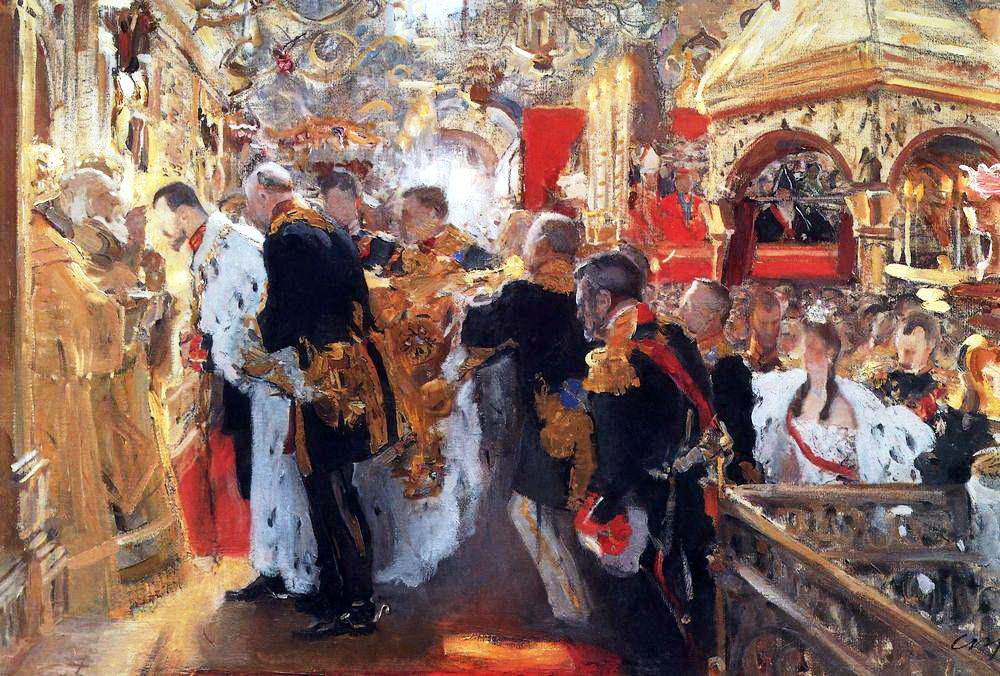
PHOTO: Confirmation of Nicholas II in the Assumption Cathedral. 1896.
Artist: Valentin Alexandrovich Serov (1865–1911)
The solemn rite of the Holy Coronation began. The Tsar read aloud the Orthodox Symbol of Faith and crossed himself three times. After the prayers and the reading of the Holy Gospel, Metropolitan Palladius[4] (1827-1898) laid his hands on the head of the Tsar in the form of a cross and read a prayer, calling upon the Lord to vouchsafe “Thy faithful servant the Great Tsar Nicholas Alexandrovich” with anointing “with the oil of joy, to clothe Him with power from on high, to place a crown on His head and to grant Him many days.” Then an ermine-trimmed mantle was placed over Nicholas II’s shoulders, and he wore a diamond chain of the Order of St. Andrew the First-Called. The Emperor was presented with the Great Imperial Crown, which was given to him by Metropolitan Palladius. The Emperor took the crown and placed it on his own head. Then the Metropolitan handed the Tsar the scepter and orb.
Wearing the mantle and the Great Imperial Crown of the Russian Empire, holding the scepter in his right hand and the orb in his left, the Tsar sat on the throne. Then Emperor Nicholas Alexandrovich placed on the Empress’s head a small crown, then an ermine-trimmed mantle and diamond chain of the Order of St. Andrew the First-Called.
The Divine Liturgy began, at which the Anointing of the Tsar was performed, and the Emperor and the Empress communed of Christ’s Holy Mysteries. It should be noted that the Tsar communed in the altar “according to the imperial rite,” as the clergy do.
In the evening, Moscow lit up with multi-colored lights. The electric illumination consisting of 500,000 lights was created from drawings by artists Nikolai Karazin, Alexandre Benois and Alexei Prokofiev. According to the memoirs of an eyewitness, “the Kremlin illuminations lit up in an instant, at the very moment when the Empress took in her hands a bouquet of electric flowers presented to her. The bouquet lit up, and at that moment the whole Kremlin lit up with multi-colored electric lights, as if painted with a fiery brush in the darkened sky.”
The coronation surpassed all previous ones in pomp and splendour. According to the testimonies of the participants of the event, including foreigners, it was the most impressive sight in their lives.
The last Holy Coronation and Chrismation in Imperial Russia was complete. The Emperor and the Empress were united with Russia, with her subjects.
The 22-year reign of the last Emperor was filled with both glorious and tragic pages. The words of Metropolitan Sergius (Lyapidevsky) of Moscow (1867-1944) came true, who gave the August couple a parting word on the day of the coronation, saying: “just as there is no higher or more difficult royal power on earth, there is no burden heavier than royal service.”
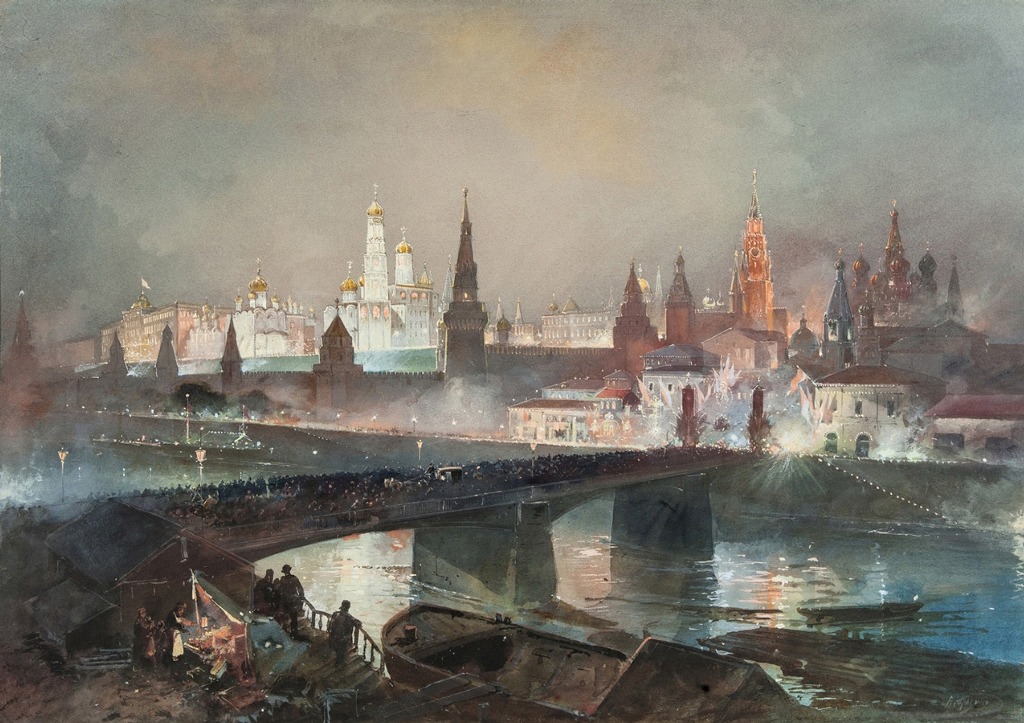
PHOTO: Watercolour depicting the illuminations decorating the Kremlin in Moscow, on the day of the Holy Coronation of Emperor Nicholas II, on 27th May (O.S. 14th) May, 1896. ARTIST: Nikolai Nikolaevich Karazin (1842-1908)
NOTES
[1] In 1896, the official rate introduced during the monetary reform was used for recalculation: the ruble was equated to 0,386 troy ounce of pure gold, and the US dollar was worth about 0,0483 troy ounce. Thus, The ruble was valued at about 0,797 US. Note: the direct conversion of currencies from the 19th century to modern dollars does not have an exact economic equivalent due to changes in the price structure, but taking into account dollar inflation, the purchasing power of this amount would be ten times greater.
[2] Up until 1918 Russia used the Old Style Julian calendar, which was 12 days behind the New Style Gregorian calendar used in the West. In the 21st century, the Julian calendar is 13 days behind the Gregorian calendar.
[3] Following the coronation, the three thrones were moved into St. Andrew’s Hall of the Grand Kremlin Palace. The fate of the thrones is unknown, although they could be in the Collection of the State Armoury in Moscow. In 1939 the thrones were replaced by a marble statue of Lenin. When St. Andew’s Hall was restored in the 1990s, replicas of the three thrones were placed in their historic spot of the grand ceremonial hall.
[4] Bishop of the Russian Orthodox Church; 18 October 1892 until his death he served as Metropolitan of St. Petersburg and Ladoga, the first member of the Most Holy Synod.
© Paul Gilbert. 27 May 2026
***
My #1 Bestseller for more than 20 years!!
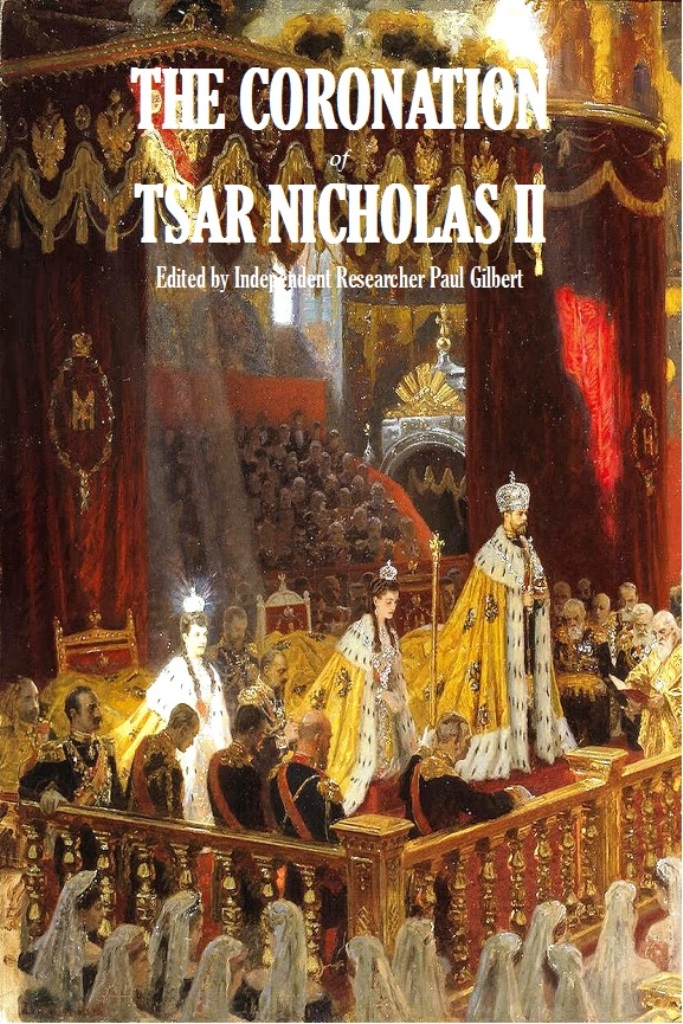
THE CORONATION OF TSAR NICHOLAS II
Compiled and Edited by Paul Gilbert
CLICK ON THE LINK BELOW TO ORDER FROM AMAZON
HARD COVER EDITION – PRICE $30.00
PAPERBACK EDITION – PRICE $25.00
BOOK DESCRIPTION
Available in hard cover and paperback editions, with 456 pages
PLUS more than 200 black & white photographs
Six eyewitness accounts of the crowning of Russia’s last tsar with more than 200 rare vintage photographs & illustrations
The pomp and pageantry surrounding the Coronation of Nicholas II is told through the eye-witness accounts of six people who attended this historic event at Moscow, held over a three week period from 6th (O.S.) to 26th (O.S.) May 1896.


You must be logged in to post a comment.