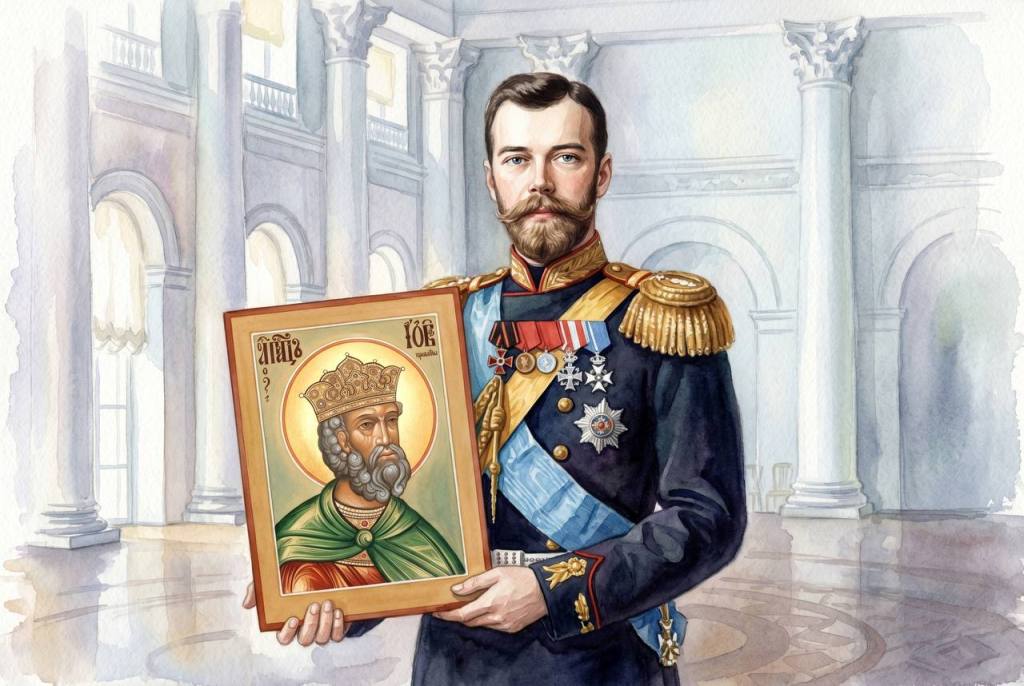
PHOTO: an AI generated image depicting Emperor Nicholas II
holding an icon depicting Saint Job the Long-suffering
On 19th May, the Russian Orthodox Church honours the memory of the Old Testament righteous Job the Long-suffering. On the same day, according to the church calendar, the last Russian emperor was born, the holy passion-bearer Nicholas Alexandrovich Romanov.
. Both the Russian Orthodox Church and Nicholas himself viewed this as a deeply prophetic omen, believing his life would parallel the Old Testament figure’s endless trials, suffering, and eventual loss of all earthly status.
Emperor Nicholas II was born on 6th May 1868 according to the Old Style (O. S.) Julian calendar in Tsarskoye Selo. In the New Style Gregorian or civil European calendar of the time, it was 18th May, as the difference between the Julian and Gregorian calendars was then 12 days. Today, 6th May, according to the church calendar, corresponds to 19th May according to the new style. Therefore, for church memory, the sovereign’s birthday remains associated with the celebration of the righteous Job the Long-suffering.
At birth, the future emperor received not the name Job, but the traditional name for the House of Romanov Nicholas – in memory of his uncle, Tsesarevich and Grand Duke Nicholas Alexandrovich (1843-1865), the elder brother of Emperor Alexander III (1845-1894), who died at the age of 21 in 1865. But, despite this, the spiritual connection between Nicholas II and St. Righteous Job is seen as especially deep.
Job the Long-Suffering went down in sacred history as an example of faith, patience and trust in God in the midst of the most difficult trials. Having lost wealth, children, health and the support of loved ones, he did not deny the Lord and did not blaspheme Him. His words: “The Lord giveth, and the Lord taketh away; blessed be the name of the Lord” — became an expression of supreme humility before God’s Providence.
We see a similar uncomplaining acceptance of sorrows in the life of the Holy Tsar Nicholas II. He had to endure severe trials: wars, turmoil, betrayal, renunciation, imprisonment, humiliation and martyrdom along with his family. But through all this he strove to preserve faith, meekness, dignity and hope in God.
That is why the Church glorified Emperor Nicholas II, Empress Alexandra Feodorovna, their children and faithful servants as Holy Passion-bearers. Their podvig[1] is not in earthly victory, not in political triumph, but in Christian endurance of suffering, in gentleness, patience and faithfulness to Christ to the end.
It is difficult for us to imitate such a feat to the fullest. But the memory of Righteous Job the Long-suffering and the Holy Passion-Bearer Nicholas II reminds each of us that the path to salvation passes through trust in God. Not only in joy and well-being, but also in sorrows, losses, misunderstandings and trials.
The saints teach us not to grumble, not to become hardened and not to lose faith, but to walk with thanksgiving the path that the Lord allows us for the sake of our salvation.
Source: Orthodoxy in Tatarstan. Information and educational website of the Tatarstan Metropolis
NOTES
[1] In Orthodox Christianity, podvig is understood as a spiritual struggle or ascetic practice aimed at purifying the soul and drawing closer to God. It involves mastering the body and overcoming passions through practices such as fasting, prayer, prostrations, and other forms of self-denial, helping the practitioner achieve theosis (deification) and spiritual growth.
© Paul Gilbert. 21 May 2026
 Nicholas II
You must be logged in to post a comment.