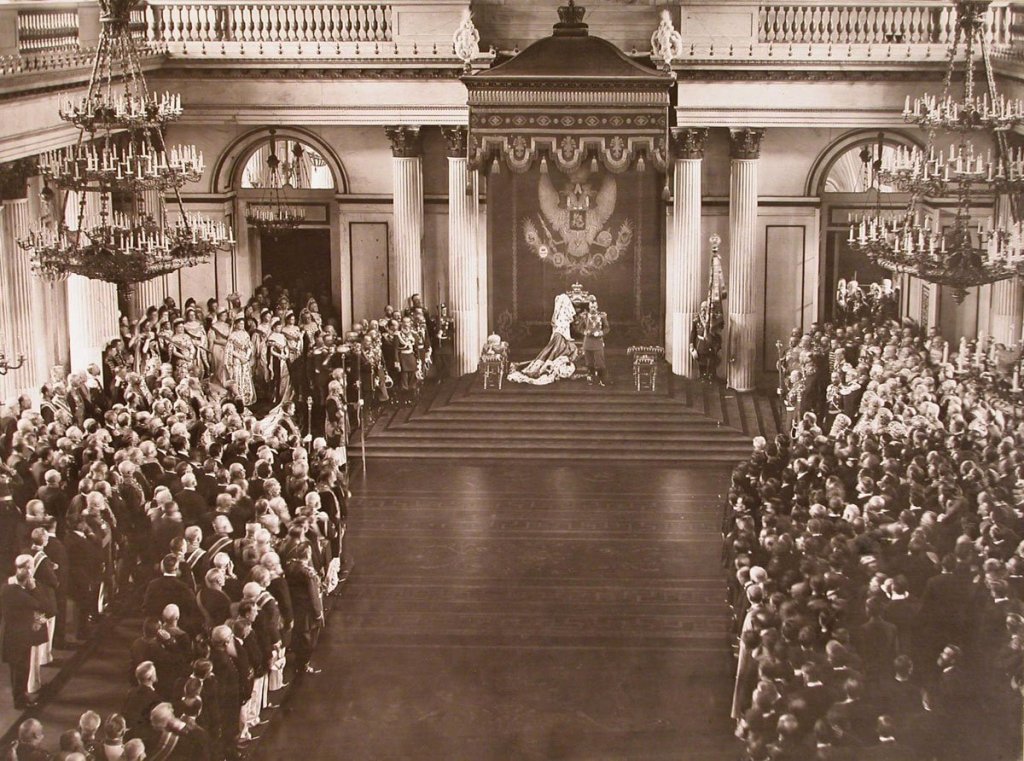
Today marks the 120th anniversary of the inauguration of the Russian State Duma [Parlement].
It was on this day – 10th May [O.S. 27th April] 1906 – that the Inauguration of the State Duma [Parliament] and State Council took place in St. Petersburg.
The photo shows Emperor Nicholas II standing in front of the throne in St. George’s Hall of the Winter Palace. Draped and flanked by the Imperial Regalia, the Imperial family (to the left of the throne) and members of the 1st State Duma (to the right) witness the Tsar opening the First Duma. The latter “in black frockcoats, like jackdaws, they jostled among the brilliant uniforms of the tsar’s suite,” wrote one eyewitness.
Emperor Nicholas II gave a welcoming speech in which he expressed the hope that the “best people” of the Russian Land would contribute to the implementation of new reforms, help to identify the real and most important and urgent needs of the population and facilitate the administration of the Russian Empire.
Unfortunately, most of the Duma deputies were occupied solely with party interests and, above all, with the continuation of their revolutionary work in order to overthrow the monarchy. As the future proved, among the “best people” there were a large number of state criminals and traitors to the Motherland. The Tsar’s sister Grand Duchess Olga Alexandrovna, who was present at this event, recalls in her memoirs: “The workmen….looked as though they hated us”.
The main issue in the work of the first State Duma of the Russian Empire was the land issue. The Duma also made active and unsuccessful attempts to carry out political reforms, came up with initiatives to end repressions against the participants in the revolution of 1905-1907. All in all, during the work, the deputies approved one bill – the law introduced by the government on the allocation of 15 million rubles to help victims of crop failure. The First Duma was dissolved by Nicholas II, noted in history as the “Duma of Popular Wrath”.
The Imperial Manifesto of 30th October 1905, transformed Russia from an autocracy to a semi-constitutional monarchy.
Why a constitutional monarchy would not have saved Russia
Nicholas II is often and unfairly criticized for not adopting a European-style constitutional monarchy for Russia. It is alleged that on the day of his grandfather Emperor Alexander II’s assassination in 1881, the Emperor had earlier in the day signed a manifesto which would have ushed in a constitution, creating two legislative commissions made up of indirectly elected representatives. This document, however, does not exist in the archives today, nor is their any evidence of ites existence.
It is interesting in that those who believe that a constitution would have appeased the revolutionaries, are sadly mistaken. Various revolutionary groups in the capital were relentless in their goal of assassinating the “Tsar-Liberator”, the same man who in 1861, issued the historic Edict of Emancipation, which officially abolished Russian serfdom. This did not appease the revolutionaries.
The revolutionaries succeed in their mission on 14th March [O.S. 1st March] 1881, when Alexander II was assassinated in St Petersburg. This act of terrorism shook his heir and the Russian Empire to the core. Fearing an attempt on his life, Alexander moved his family to the fortress-like palace at Gatchina. The revolutionaries still pursued him, numerous plots were foiled, which resulted in the imprisonment, exile, even death of the revolutionaries.
The last Russian tsar Nicholas II was further pursued by the revolutionaries, who were growing in numbers and tactics. One has only to read the memoirs of his security chief General Alexander Spiridovitch to fully understand the number of plots to assassinate Nicholas, which were foiled, and the efforts to protect Russia’s last Tsar.
Again, had Nicholas adopted a constitution, he would not have saved Russia – the revolutionaries were not seeking democratic reforms or a European-style monarchy – they wanted a new socialist world order!
Russia had no need for a Euorpean-style monarchy. Why? It’s simple, Russia was not European. The Russian Empire was Orthodox. On the day of his Holy Coronation in Moscow in May 1896, Nicholas II took a solemn oath before God to uphold autocracy in Russia, this is WHY he refused to share power or appease members of the Duma, which were made up mostly of left-wing or revolutionary factions.
© Paul Gilbert. 10 May 2026


You must be logged in to post a comment.