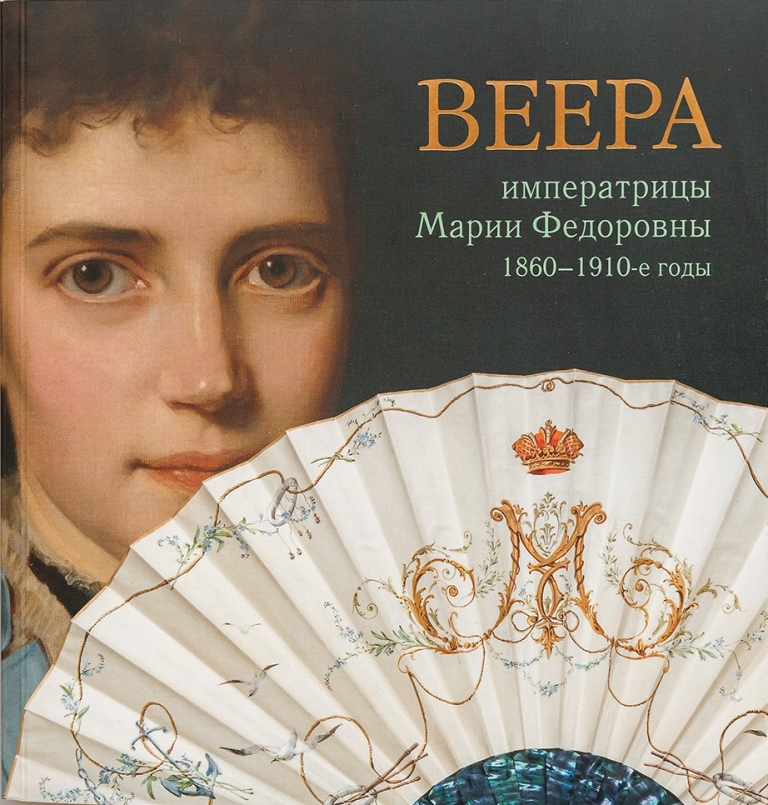
PHOTO: cover of the Fans of Empress Maria Feodorovna exhibition catalogue
– see below
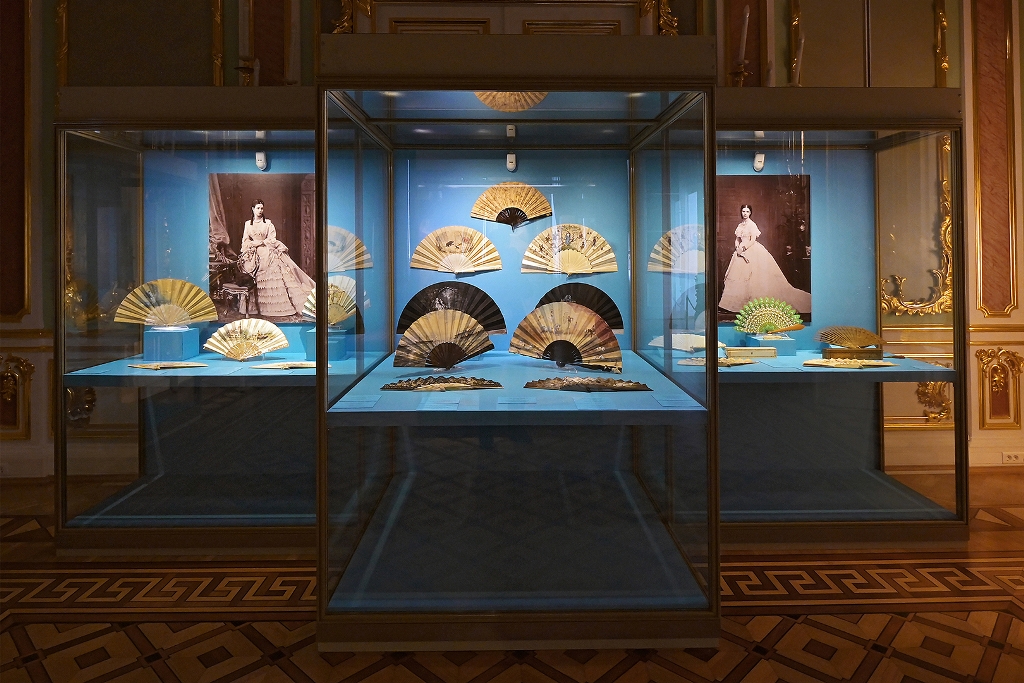
On 29th April 2026, the exhibition “Fans of Empress Maria Feodorovna. 1860s–1910s” from the collection of the State Hermitage Museum[1] opened in the Small Church[2] of the Winter Palace. The exhibition presents a range of fans which belonged to Maria Feodorovna, the wife of Emperor Alexander III and mother of Emperor Nicholas II, are superb examples of the fan-maker’s art.
These items, made between the 1860s and the early 1910s, entered the Hermitage from the Anichkov Palace, the Empress’s favourite St. Petersburg residence, where she lived after her marriage to the Tsesarevich Alexander Alexandrovich, and also after his death, as the Dowager Empress.
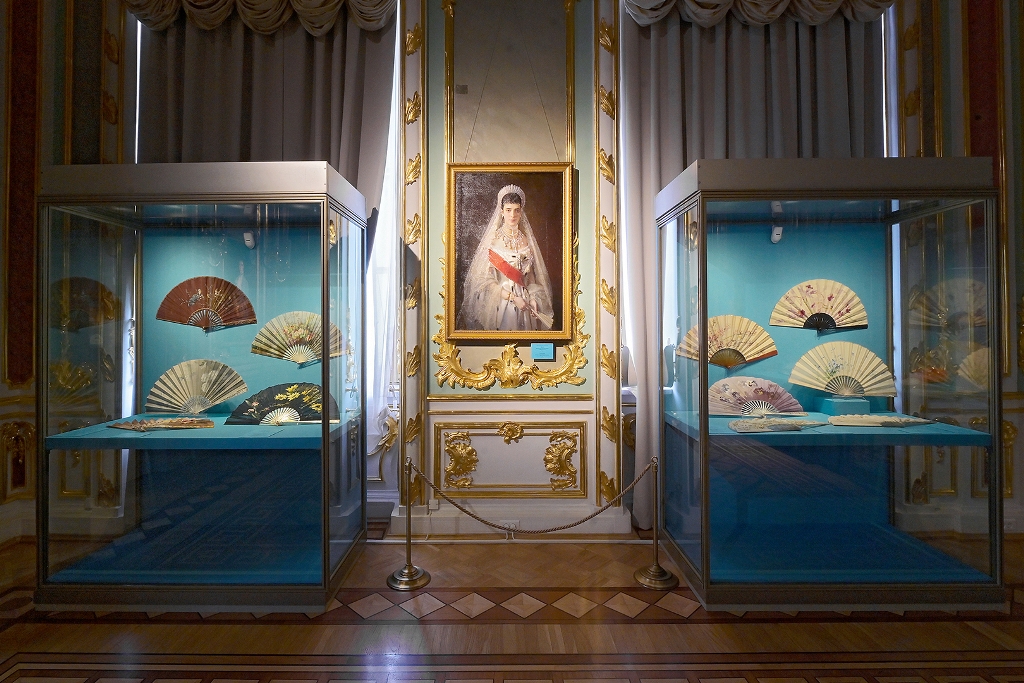
Maria Feodorovna (1847–1928), born Princess Dagmar of Denmark, came to Russia in 1866 as the bride of the Tsesarevich (heir to the throne). The earliest fans on display are ones she brought with her from Denmark. After becoming a member of one of Europe’s wealthiest imperial houses, Maria Feodorovna was able to order accessories from leading fan producers such as Duvelleroy and Alexandre.
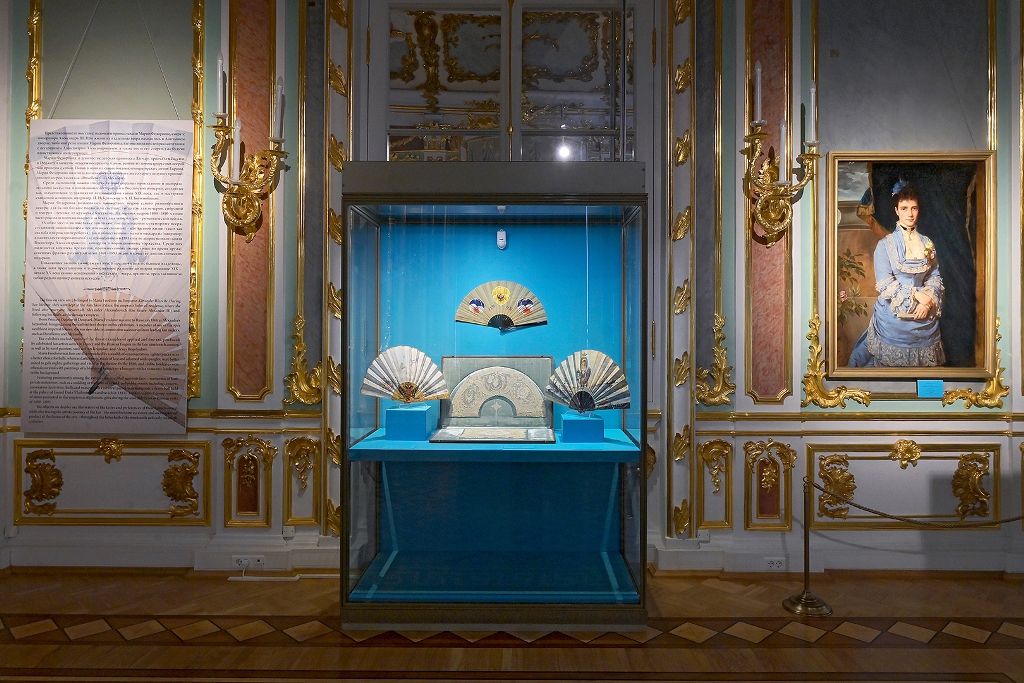
The exhibition features fans of foreign and Russian manufacture. Since such accessories sometimes reflected important events in Maria Feodorovna’s person’s life, the glass showcases depict different types of fans – wedding, mourning and souvenir. Maria Feodorovna’s souvenir fans were mainly keepsakes connected with events in the life of the Imperial Court – notable anniversaries, weddings, christenings, balls and masquerades (for example, in memory of a costume ball held in 1883 at the palace of Grand Duke Vladimir Alexandrovich). A separate group is formed by fans that were diplomatic gifts from the time of the friendly Franco-Russian visits of 1891–93.
The theme of the fan as a costume accessory is complemented in the exhibition by some of the Empress’s evening gowns – which are also on display.
The exhibition curator is Yulia Valeryevna Plotnikova, Candidate of Art History, Leading Researcher in the State Hermitage’s Department of the History of Russian Culture.
The exhibition “Fans of Empress Maria Feodorovna. 1860s–1910s” runs until 28th March 2027
NOTES:
[1] A large number of Empress Maria Feodorovna’s fans are currently in the Collection of Pavlovsk Palace, where they are now on permanent display in their Museum of Costumes. Given that the Dowager Empress never lived at Pavlovsk, how did they end up there?
[2] Church of the Saviour Not Made by Hands – the home church of the Imperial family in the Winter Palace.
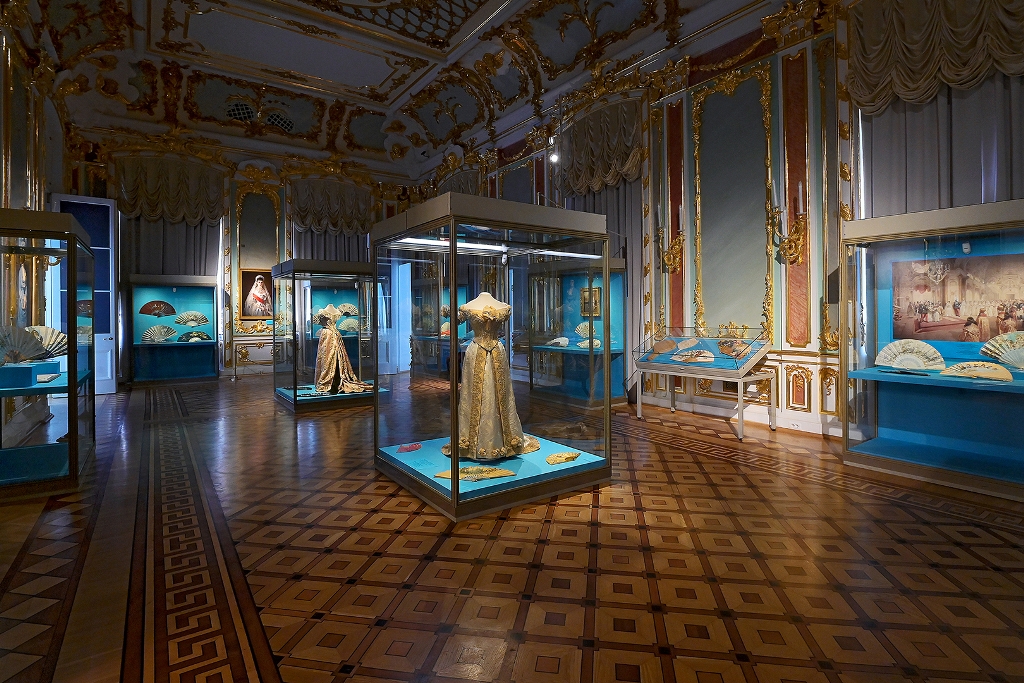
Empress Maria Feodorovna’s fan collection
The items on display accompanied their owner through various periods of her life, from her youth until her departure from Saint Petersburg on the eve of revolutionary events. Among these works of decorative and figurative art are some of the finest examples of one of the most feminine costume accessories, made in France and the Russian Empire by famous fan artists and easel painters, including Ivan Kramskoi and Alexei Bogoliubov.
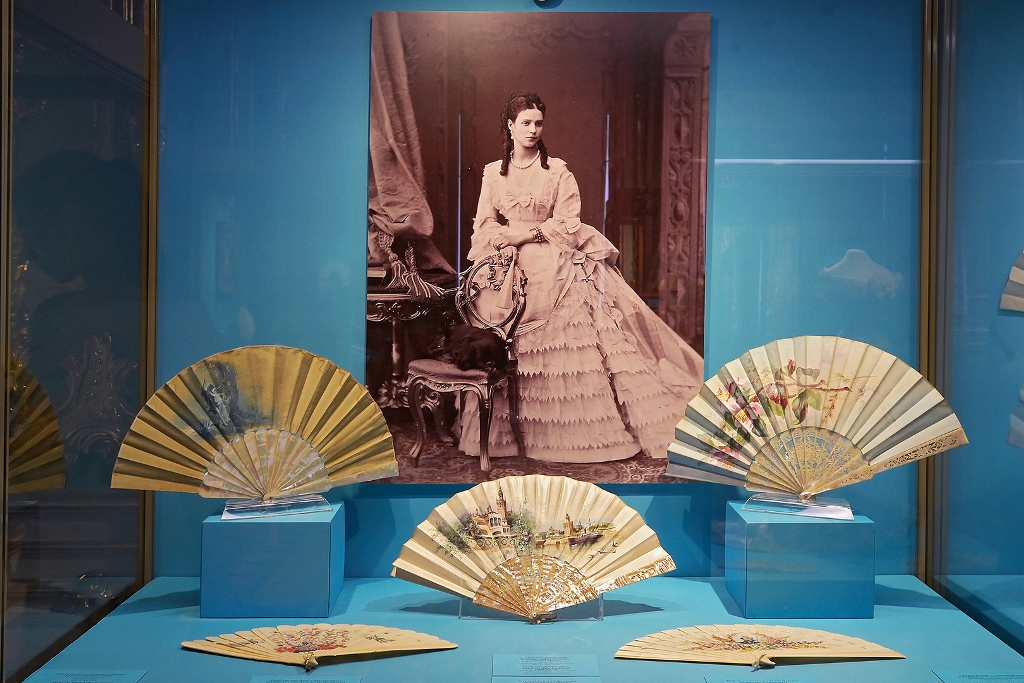
Maria Feodorovna used many fans with a wide variety of decoration: lighter coloured ones were more suitable for balls, while darker ones, of lace with sequins, were for evening parties, social gatherings and the theatre. The leaves of fans from the 1880s–90s often have a flowering branch or bouquet painted on them, with a romantic landscape in the background. Among the “brighter” fans are two made of iridescent mother-of-pearl. The silk leaf of one of them depicts views of Seville in Spain.
Of great interest is a folding brisé fan with blades shaped like lily-of-the-valley flowers and leaves. In the 1860s–70s, there was a vogue for simple fans of smooth wooden or ivory blades, painted with flowers or decorated with photographic portraits set in a floral bouquet. Fans of this type were produced by the Austrian firm Gebrüder Rodeck, supplier to the royal courts of Austria and Great Britain, that in 1872 was also awarded the title of Supplier to the Russian Imperial Court. The young Maria Feodorovna is depicted with this fan in one of the earliest photographs taken soon after her arrival in Saint Petersburg.
By the late 1880s, fan-making began to be considered a separate form of decorative art. Producers tried to devise new shapes and saw the object itself as not just a fashion accessory but a work of art requiring special creative techniques. It was at that time that fan-making flourished anew: famous artists, whose easel works were shown at the annual Paris Salons, worked on the painting of the leaves and the carving of the frames of the finest examples. The leading fan-producing firms at this time were the Maisons Faucon and Duvelleroy, who had France’s leading decorative artists working with them.
A significant role in the development of the Art Nouveau style was played by Western artists’ fascination with the Orient, initially manifesting itself as the direct borrowing of decorative art objects – screens, tables, fans; robes and cushions embroidered with magnificent patterns; prints depicting flowers, birds, and animals – the “Chinoiserie of the second half of the 19th century”. The finest artists of the era reworked the decorative techniques that they admired with such talent and creativity that the Oriental style, having passed through Western culture and art, acquired its own unique character – asymmetrical composition, exquisite colour combinations.
At the turn of the 1890s, the rather bold creations of Charles Worth’s house came into fashion. The couturier was not afraid to combine in them contrasting colours – pink and pale green, black and yellow. Empress Maria Feodorovna also had outfits from Worth in her wardrobe. Like any work of high fashion, each such a toilette required a suitable accessory. That might be a fan of black gauze painted by Felix Gardon, with yellow dahlias and flowers seemingly emerging from the darkness.
At the same time, fans with gallant or classical subjects continued to be used. These were now described as being in the Louis XV and Louis XVI style, and includes the Watteau fan featuring shepherdesses breakfasting on the grass under a blue sky. The Empress is holding a similar fan in one of her official photographs from the early 1890s.
A separate group comprises the so-called wedding fans. For her own wedding Maria Feodorovna received two fans as gifts, both striking examples of the style known as the “Rococo Revival”. At the time, this trend bore the name of the favourite of the French king Louis XV, Madame Pompadour. However, the “Pompadour” style actually meant a unique synthesis of the artistic manners of the entire 18th century. Another “Rococo Revival” fan presented for the Tsarevna’s wedding, came in a pearl-grey velvet-covered case with a mother-of-pearl crown on the lid.
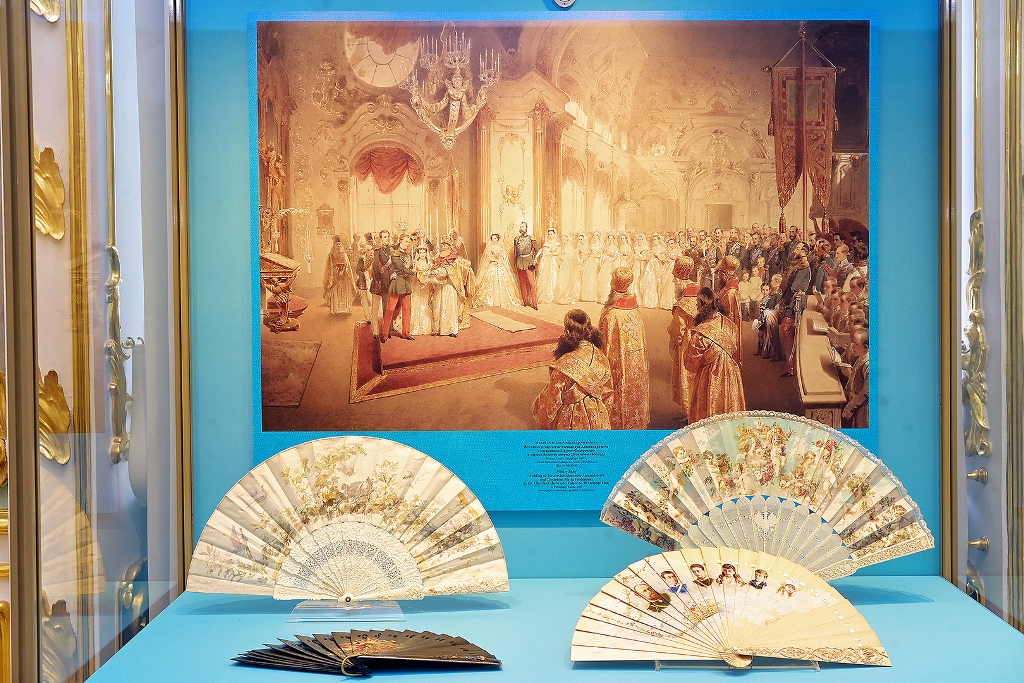
One of the fans presented to the Empress was painted by the famous Russian portraitist Ivan Kramskoi. Executed in oils on the smooth wooden blades of the fan are likenesses of Alexander III and all the imperial couple’s children. At the bottom, a basket of flowers and a pair of flying doves are depicted. Based on the ages of the children in the portraits, the fan can be dated to 1886, suggesting that it was made for the Emperor and Empress’s twentieth wedding anniversary.
Fans were also a form of diplomatic gift presented during friendly visits. A whole set of items belonging to Empress Maria Feodorovna has survived, including such ceremonial tokens. Most of them date from the Franco-Russian exchanges of 1891–93. For those occasions, the French government commissioned several fans for the Empress from the best firm of the day – Duvelleroy.
The exhibits shown, many of which are on display for the first time, reflect the taste and preferences of their former owner and also give an idea of the artistic development of that most feminine accessory – the fan – in the second half of the 19th and early 20th centuries, representing a rare example of a synthesis of the arts.
Source: State Hermitage Museum
Exhibition catalogue
NOTE: this catalogue is ONLY available in Russian, there is NO English language edition. Sadly, due to the current Western economic sanctions, it is not possible to order this catalogue from the State Hermitage’s online shop – PG
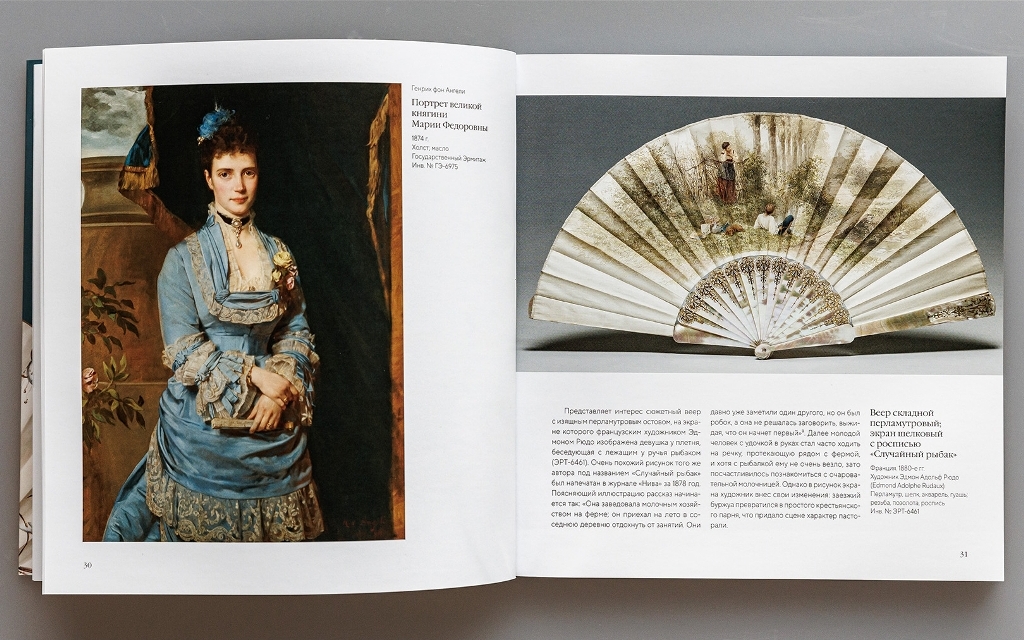
The State Hermitage Publishing House has prepared a scholarly illustrated catalogue entitled Fans of Empress Maria Feodorovna. 1860–1910s” (St. Petersburg, 2026). The author of the catalogue is Yulia Valerievna Plotnikova, Leading Researcher of the Department of the History of Russian Culture of the State Hermitage, curator of the exhibition.
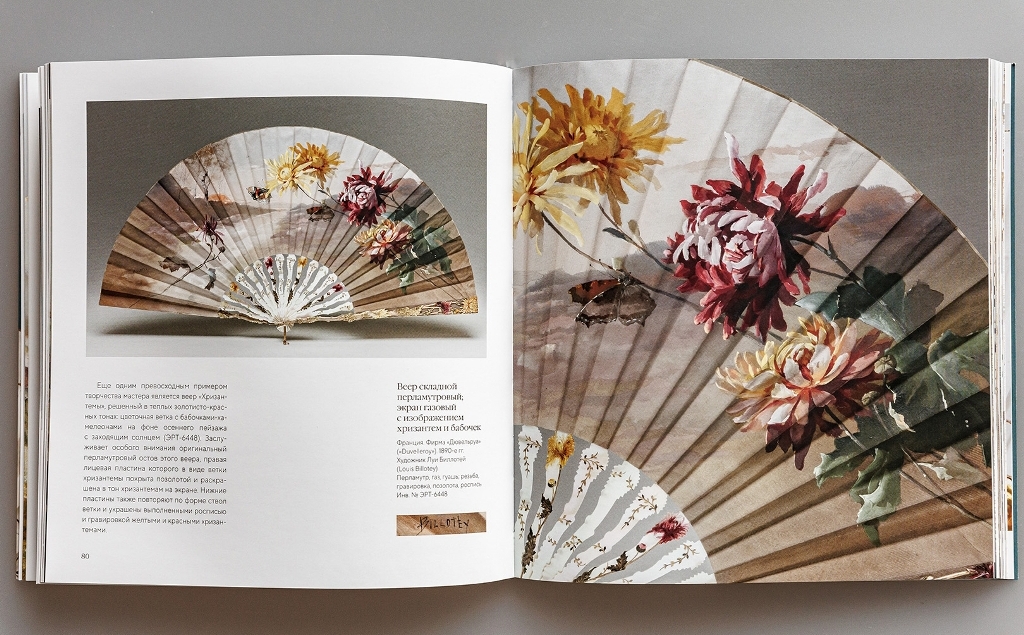
The publication prepared for the exhibition “Fans of Empress Maria Feodorovna. The 1860s–1910s” from the collection of the State Hermitage, offers the reader the items that accompanied their owner in different periods of her life from her youth to her departure from St. Petersburg on the eve of the revolutionary events. Among these works of applied and fine art, you can see the best examples of one of the most feminine costume accessories, made in France and the Russian Empire by famous fan artists and easel painters, including I. N. Kramskoy and A. P. Bogolyubov. A special place is occupied by the so-called souvenir fans, which served as a reminder of certain events in both private life (wedding, birth of a child) and public (balls, masquerades, concerts, coronation celebrations). Among them, a set of items stands out, which are diplomatic gifts presented to the Empress during the Franco-Russian visits of 1891-1893.
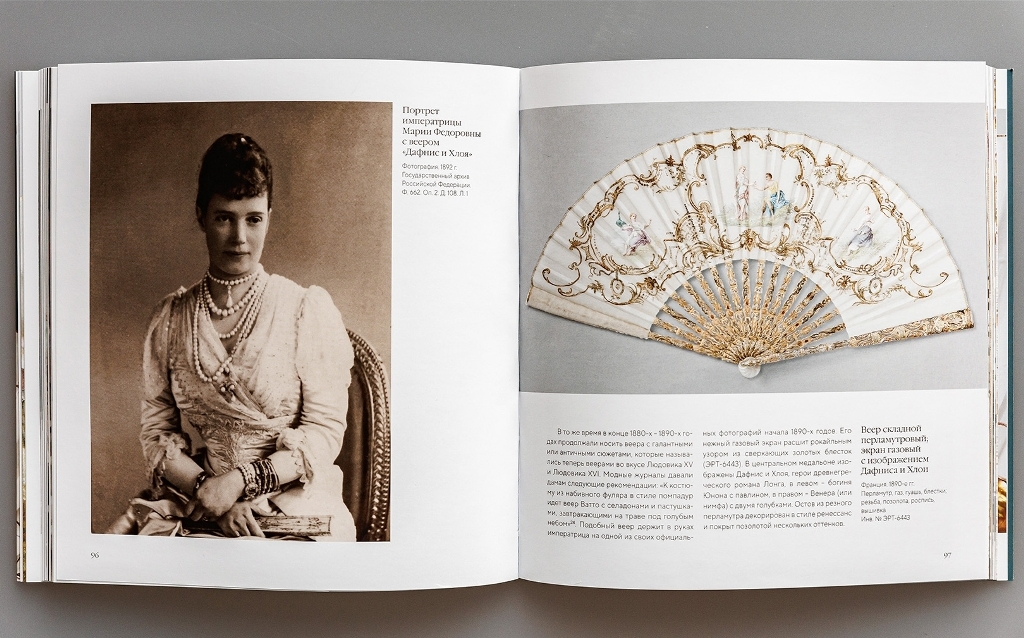
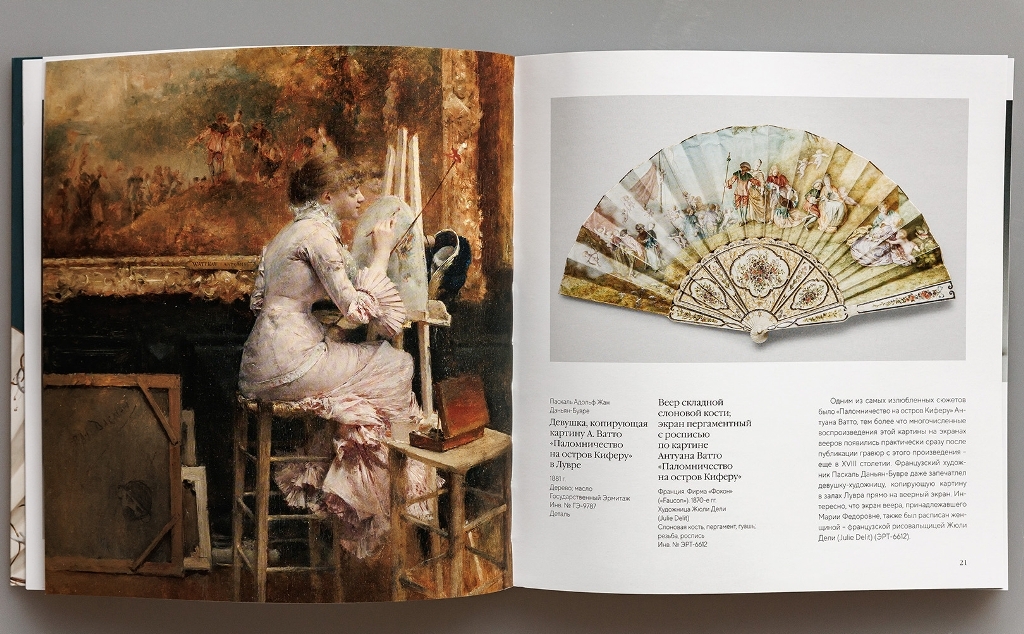
The exhibits shown at the exhibition, many of which are shown for the first time, reflect the taste and preferences of their former owner, and also give an idea of the artistic development in the second half of the 19th and early 20th centuries of the most elegant accessory – the fan, which is a rare example of the synthesis of arts.
The catalogue is intended for lovers of Russian and Western European art.
The catalogue can only be purchased in the main gift shop and at the book stalls of the State Hermitage Museum.
© Paul Gilbert. 15 May 2026


You must be logged in to post a comment.