What Russia’s Last Emperor Lived By

027

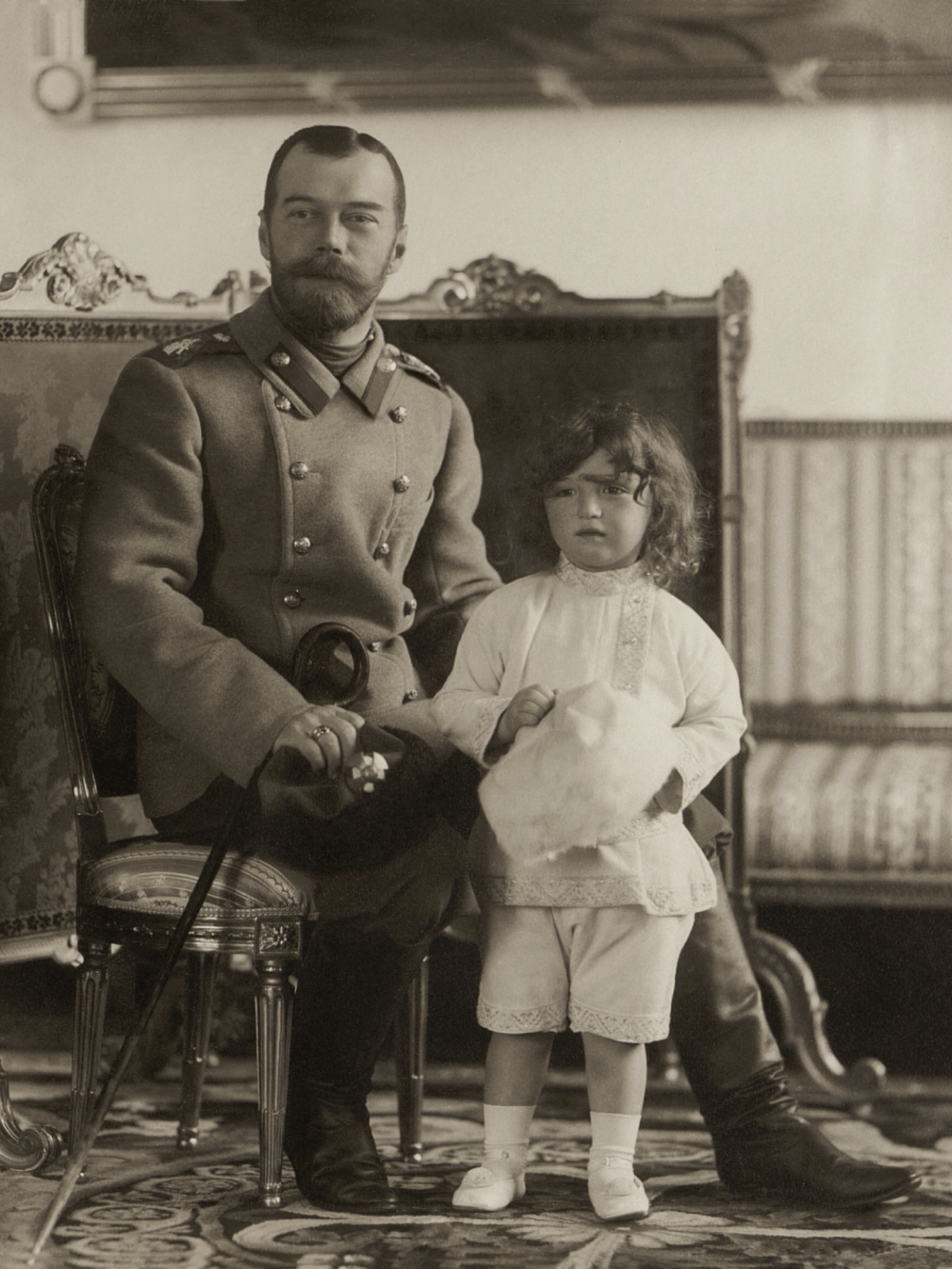
Nicholas II with his son and heir Tsesarevich Alexei. 1908

Tsar Nicholas II, Russia’s last Emperor, is considered one of the most widely discussed and controversial people of the twentieth century. But what trustworthy and accurately describes his character are the diaries he carefully kept since he was fourteen. What kind of person was the Tsar? What inspired and comforted him? In this series we shall speak about personal details that are usually omitted in most history books.

Tsar Nicholas II is often considered Russia’s most family loving monarch. That must be for a reason; we can find evidence in the Tsar’s diaries. On October 20, 1894, his father, Emperor Alexander III, died after a prolonged illness. Alexander’s son’s notes made at that time are permeated with filial tenderness and love.

Click HERE to read What Russia’s Last Emperor Lived By

© Maria Litzman / Pravoslavie.ru. 5 March 2019

How Old Believers suffered from the overthrow of Nicholas II

023d

Nicholas II receives bread and salt from the Yaroslavl Old Believer Ascension Community. 1913

Writer Alexander Solzhenitsyn (1918-2008) once said that if it were not for the church schism of the 17th century, the revolution of 1917 would not have happened. Some modern historians believe that the writer was correct in the literal sense and that the Russian Old Believers played a significant role in the political cataclysms of the early 20th century. 

The position of the Old Believers in Russia in the pre-revolutionary years

By the end of the 19th century, the Old Believers held considerable material resources in their hands. “The entire Russian market was dominated by the Old Believers,” says A. V. Pyzhikov, a doctor of historical sciences, and author of the book Грани русского раскола (The Edge of Russian Schism). Merchant dynasties among the Old Believers began to emerge in the era of Catherine II, who encouraged free enterprise.

The Old Believers held a fair share of the national income, particularly in Russia’s vast raw materials and manufacturing industries. They also owned banks, railways, and shipping companies. The Old Believers firms received state orders, including the manufacture of weapons.

At the turn of the 20th century, not all Old Believers dared to confess their religious affiliation openly (their actual numbers far exceeded that indicated in official documents), for fear of persecution.

In 1905, Emperor Nicholas II signed an act of religious freedom that ended the persecution of all religious minorities in Russia. The Old Believers gained the right to  build churches and monasteries, to ring church bells, to hold processions and to organize themselves. It became prohibited (as under Catherine the Great—reigned 1762–1796) to refer to Old Believers as raskolniki (schismatics), a name they consider insulting. People often refer to the period from 1905 until 1917 as “the Golden Age of the Old Faith”. One can regard the Act of 1905 as emancipating the Old Believers, who had until then occupied an almost illegal position in Russian society. Nevertheless, some restrictions for Old Believers continued: for example, they were forbidden from joining the civil service.

On 16 April 1905, divine services were allowed in the Old Believer churches of the Rogozhsky cemetery in Moscow. On 19 April, Emperor Nicholas II wrote in his diary: “I christened myself with the Old Believers.” 

The authorities clearly wanted to live in harmony with the Old Believers. But did the Old Believers want to live in harmony with the authorities?

023c

The altar of the Old Believer Pokrovsky Cathedral, Rostov-on-Don. 1905

The attitude of Old Believers to autocracy

It is widely believed that, without exception, the Old Believers hated the Imperial House of the Romanovs to the depths of their hearts. It is not hard to substantiate this point of view, since the schism of 1650–1660, which had driven the followers of the old rite underground during the reign of Tsar Alexei Mikhailovich (1645 to 1676), and lasted for more than three centuries.

The Old Believers, referred to Tsar Peter I as “the Antichrist” (although, the persecution of the schismatics was far less severe than during his father’s reign), but any Romanov on the throne, up to the early 20th century, was regarded likewise.

But even educated citizens, businessmen, publishers, politicians, who observed the strict archaic and patriarchal structure characteristic of the Old Believers in their homes, were hardly guided in their thoughts and actions for historical and religious reasons.

They were modern practical people who, like many in that era, believed that the social structure of the country conditioned by the autocracy hampered its development, including the development of its economy and business.

The manifestos of 1905 “On the improvement of the state order” and “On the establishment of the State Duma”, thanks to which Russia had its own parliament for the first time, together with the Tolerance Ordinance, gave some Old Believers hope of a better future. However, some believed that there would be no changes, and that things would return to the old ways.

O. P. Ershov, a researcher on the history of Old Believers, writes that in 1917 one of the regional meetings of Old Believers recognized the autocracy incapable of ensuring the rights granted by the Tolerance Ordinance and not in the interests of the people. This case was not an isolated one.

The relation of the autocrat to the Old Believers

The question of how Nicholas II really treated the Old Believers remains open. A number of researchers of the Old Believers, including the historian and literary critic MA Dzyubenko, believe that the emperor sympathized with them and even hoped to unite the two branches of the Russian Church, but there is no direct evidence of this.

An indirect argument is, for example, Nicholas II’s interest in Neo-Byzantine church architecture and music, which may well be explained for aesthetic and partly diplomatic reasons. Moreover, it is extremely doubtful that most Old Believers would have taken the idea of ​​uniting with the Russian Orthodox Church with any enthusiasm.

023

Old Believers in early 20th century Imperial Russia

The participation of Old Believers in the preparation of revolutionary events

In all likelihood, the theory gaining popularity in recent years that Old Believers were perhaps the main driving force of all three Russian revolutions is greatly exaggerated. However, the fact of the participation of the Old Believers in the revolutionary movement is indisputable.

Since the end of the 19th century, they were in active contact with various groups of the political opposition. According to the historian Pyzhikov, “the Orthodox Slavophile merchant elite is moving towards a liberal-constitutional path.”

For wealthy people, who also had access to the communal capital of the Old Believers, the most simple and convenient way to influence the events was the financing of the opposition. The most famous example is the manufacturer and philanthropist Savva Morozov, for whose money the Iskra social-democratic newspaper, the Bolshevik publications The Struggle and the New Life were published.

In addition, Morozov supplied his own workers with prohibited literature and was the author of the note “On the Causes of the Strike Movement. Requirements for the introduction of democratic freedoms”. He penned it in January 1905, a few days after Bloody Sunday, in the hope that it would be supported by the other shareholders of the Nikolskaya manufactory, which did not happen. It is also known that Savva Morozov’s funds secretly purchased weapons for the Bolsheviks.

Many Old Believers or people from Old Believer families themselves were members of opposition parties in the Duma and other factions. Often these same people who held important government positions before the February Revolution became members of the Provisional Government afterwards, allowing for assumptions to the “revolution came from above” theory.

Thus, one of the leaders of the Progressive Party A. I. Konovalov, a member of the Fourth State Duma (15 November 1912 – 6 October 1917), later occupied the post of Minister of Trade and Industry in the Provisional Government. His closest associate, P. P. Ryabushinsky, publisher of the newspaper “Morning of Russia”, was a member of the State Council and chairman of the Military Industrial Committee. The founder of the party “Union on October 17” and the chairman of the Third State Duma (7 November 1907 – 9 June 1912) A. I. Guchkov became the Provisional Government’s Minister of War and Navy.

Collapse of hope

Many Old Believers greeted the establishment of the Provisional Government with sincere joy. Thus, the magazine Слово Церкви (Word of the Church), published the greeting of the monks of the Transfiguration Monastery: “I firmly believe the brethren of your wise government, that you will try to improve everything for the good of the motherland and fatherland, and to enlighten the Russian land.”

As we know, the Provisional Government failed to cope with these tasks. In August 1917, an obvious fact was stated at a meeting held at the Bolshoi Theater: “the situation was hopelessly out of control.”

After the October Revolution, almost all the Old Believers lost their fortunes, while many others lost their freedom or their life. Those who succeeded, emigrated. Some, such as Guchkov and Konovalov, continued their political and social activities in Europe.

Note: Many congregations emigrated to the United States, where their descendants still live, observing the ancient customs of the Old Believer’s Church.

023f

Head of the Russian Orthodox Old Believer Church, Metropolitan Cornelius

The Old Believers View of Nicholas II in Post-Soviet Russia

During an interview with the Ekaterinburg media 66.ru, the head of the Russian Orthodox Old Believer Church, Metropolitan Cornelius, was asked:

66.ru – In July, “Tsar’s Days” took place in Yekaterinburg, timed to coincide with the execution of Nicholas II and his family. The Patriarch of Moscow and All Russia Kirill came to us, who declared the guilt of the whole people in the death of the tsar . What is the attitude of the Old Believer Church to the personality of Nicholas II? Why do you think these events happened a hundred years ago in the Urals?

Metropolitan Cornelius – Nicholas II, of all the Romanovs, did a great blessing for the Old Believers to give the Old Believers freedom in 1905 after 300 years of persecution during the rule of the Romanovs. But we must understand that Nicholas II is not in our church, he was a new believer. And there is no question of canonization.

Of course, the murder of the entire royal family and Nicholas is a tragedy, this should not have taken place. Alexander Solzhenitsyn very wisely said about this: the 17th century spawned 1917. Who ruined the church and beat the priests? Russian people themselves. Not the French, not the Germans, not the British, but the Russians, who had lost the foundations of their faith after a church schism. It was then that the destruction of the foundation of the faith began, Russia turned to the West, the Church lost its primacy: an official began to rule the church instead of the patriarch. As a result, godless people came to power, killed the tsar and destroyed everything. To prevent this from happening, we need to return to our foundations, our religion.

Click HERE to learn more about the The Russian Old Believer Church

© Paul Gilbert. 4 March 2019
“He will help you!” Stories of miraculous help of Tsar Nicholas II

025

To mark the centenary (2018) of the Russian Imperial Family’s murders, the Sretensky Monastery Publishing House (Moscow) published a book by Archpriest Alexander Shargunov, Царь. Книга о святых царственных страстотерпцах (The Tsar. A Book About the Royal Passion-Bearers)

Archpriest Alexander Shargunov regularly preaches sermons on the holy martyrs on the radio and answers readers’ letters to Russky Dom magazine; he has made several compilations of the Miracles worked by the Royal Martyrs. The present book tells us about the role of monarchy in Russian history, about the martyric life of Russia’s last emperor and his royal family, and the miracles worked by the saints after praying to them. We present a few excerpts on the miracles of the Holy Royal Martyrs.

Click HERE to read “He will help you!” Stories of miraculous help of Tsar Nicholas II

© Archpriest Alexander Shargunov / Pravoslavie.ru. 3 March 2019

Photos 29 – 32 of Nicholas II

Emperor Nicholas II with his only son and heir Tsesarevich Alexei

I must apologize for the quality of some of the photographs, however, this is something which I have no control over. Where possible, photographs have been chosen for their visual impact, but historical accuracy has made it vital to include a number of photographs whose quality is poor, but whose value as historical documents is considerable. Sadly, during the Soviet years, many photographs of the Imperial family were stored under poor conditions and their standard is low – PG

© Paul Gilbert. 25 February 2019

Copy of Nicholas II’s Abdication Sells at Moscow Auction

022

The signature of Nicholas II is located in the bottom right, and co-signed by Count Vladimir Frederiks, who served as Imperial Household Minister (1897 – 1917), is located in the bottom left

A copy of the act of abdication of Russia’s last emperor Nicholas II went under the hammer during an auction held on 19th February at Sotheby’s Moscow. 

The document refers to the era of “damned days”, one of the most interesting for Russian historians. Therefore, experts had no doubt that there would be a buyer.

“Any document signed by a member of the Imperial family, particularly the last Russian emperor Nicholas II, is always popular with collectors and lovers of Russian history,” explained Dmitry Butkevich, an expert in the antique market.

“This is a very important historical document, previously such things have never been put on the market by private individuals,” Butkevich explained.

“In the state archives there are several versions of the act of the abdication of Nicholas II from the throne, and all of them are considered authentic,” added Butkevich, who explained the circumstances of this phenomenon.

“There were a lot of people who wanted to destroy this act, so a tricky move was invented: several originals were created, all with the tsar’s handwritten signature,” he explained. “Then they made copies of them — for example, the lot that was exhibited was copied using a glass scanner. Then these samples served as the basis for other reproductions of the document.

The starting price of the lot, which includes a copy of the act of the abdication of Nicholas II was 90 thousand Rubles ($1,400 USD). It sold for ten times the amount at 900 thousand rubles ($13,000 USD). Click HERE to read The Document That Ended an Empire by Charles G. Palm, from the collection of the Hoover Institute.

© Paul Gilbert. 25 February 2019


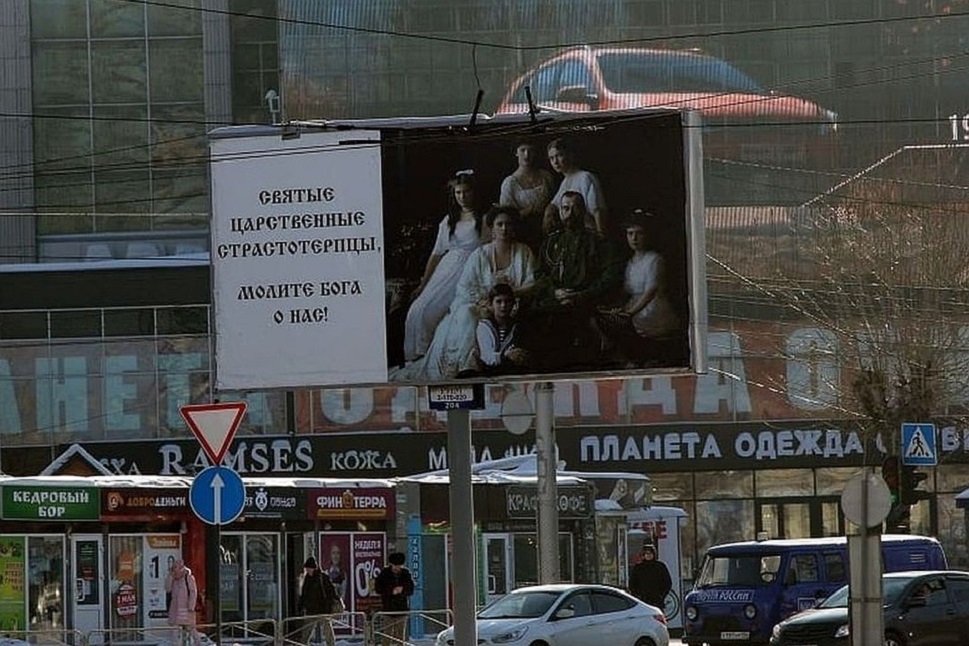
Billboards depicting Nicholas II in Novosibrisk

021b

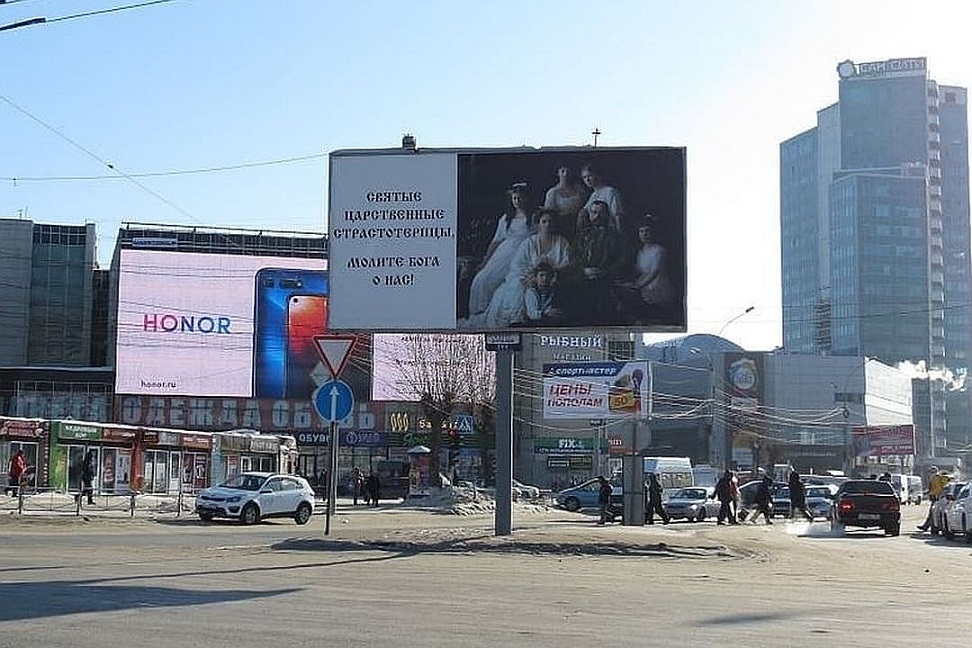
Novosibirsk billboard bearing the inscription “Holy royal passion-bearers pray for us”

021a

In February 2019, a billboard bearing a portrait of Nicholas II and family and the inscription “Holy royal passion-bearers pray for us” was established on Karl Marx Square, in the Siberian city of Novosibirsk. 

“Our city bore the name of Emperor Nicholas II for almost thirty years. From 1895 to 1904 – as a village. From 1904 to 1926 – as a city. This year marks the 115th anniversary since the decree signed on 10 January 1904 [O.S. 28 December 1903] by Emperor Nicholas II on the transformation of the village into the city of Novo- Nikolaevsk. The billboards are a reminder to the people of Novosibirsk about the history of our city,” said the Novosibirsk Orthodox social activist Ivan Kvasnitsky, noting that billboards depciting the Imperial family have appeared on the main streets of the city every month since June 2017.

He added that this action is being carried out by the Novosibirsk Coordination Council in defense of public morality, culture and traditional family values ​​with the support of donations from caring Siberians. Kvasnitsky noted that more historical banners will continue to be established on the streets of the city, with the help of additional donations.

***

021c

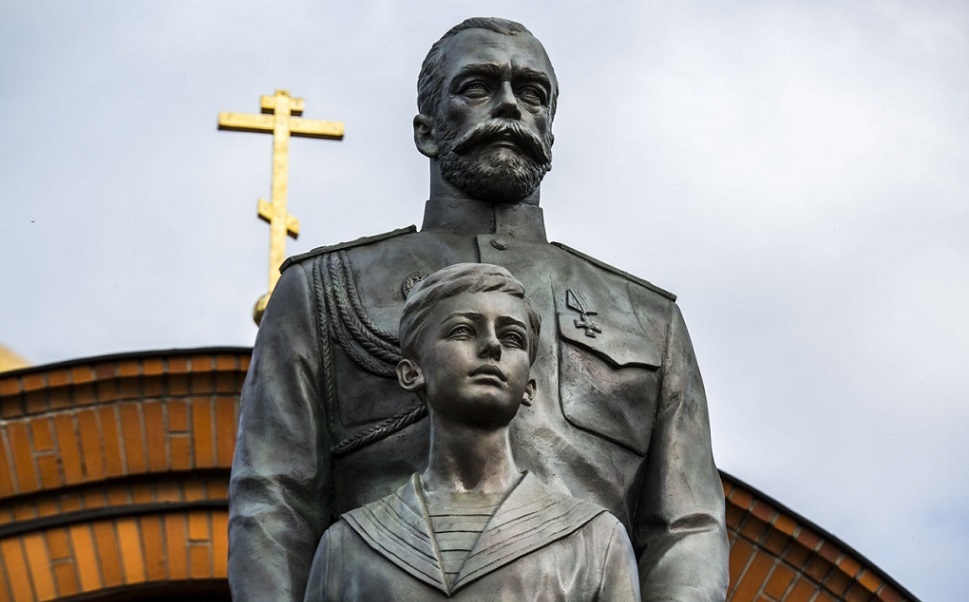
Monument of Emperor Nicholas II and Tsesarevich Alexei in Novosibirsk

A monument of Emperor Nicholas II with his son and heir Tsesarevich Alexei was established on 17th July 2017, on the grounds of the St. Alexander Nevsky Cathedral in Novosibirsk.

The following month, a 31-year-old Novosibirsk man placed a ladder against the newly-consecrated monument, and, having climbed up it, dealt several blows with an axe. The man was arrested and charged. The monument was restored and reconsecrated in September 2017.

© Paul Gilbert. 19 February 2019


New web site dedicated to the era of Nicholas II launched in Ekaterinburg

020a

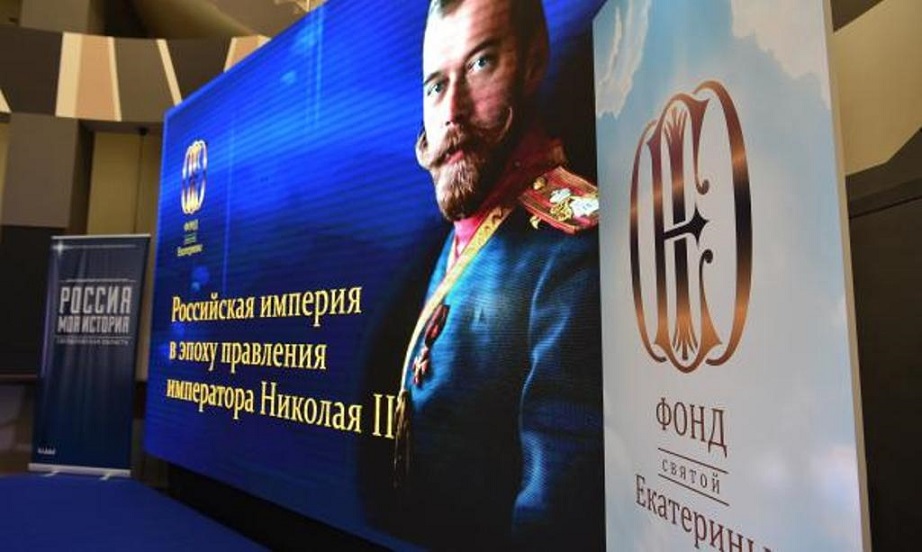
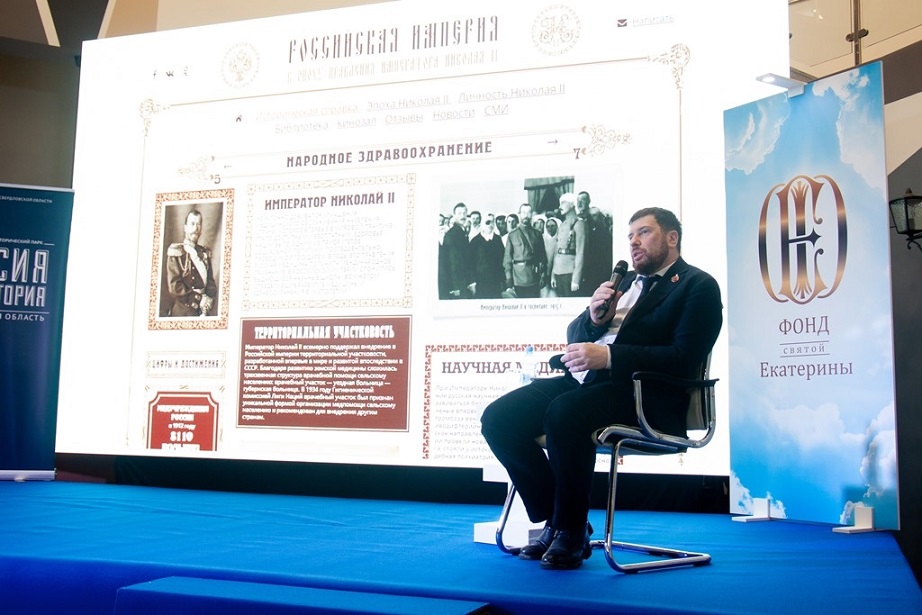
The multimedia museum “Russia – My History” in Ekaterinburg was the venue for the event

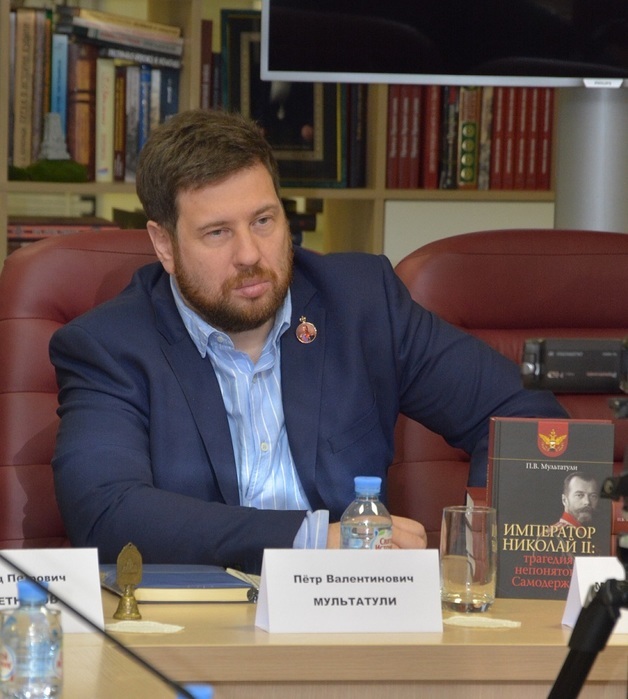
On 16th February 2019, historian Peter Multatuli, Ph.D., arrived in the Urals to present a unique project. Multatuli, who is considered the country’s leading authority on the life and reign of Nicholas II, talked with local historians about the myths surrounding Russia’s last tsar, about his achievements and reforms in particular.

The presentation of the new web site “The Russian Empire in the Era of the Reign of Emperor Nicholas II ” («Российская империя в эпоху правления императора Николая Второго») took place in the multimedia museum “Russia – My History” in Ekaterinburg.  The event was hosted by the Club of Historians, a joint project of the St. Catherine Foundation and the History Park.

“The St. Catherine Foundation took part in the Tsar’s Days events held in Ekaterinburg in July 2018, and the presentation of this new site is the completion of the Imperial Year. This site is not about the Tsar’s family, it is about the many achievements of the Russian Empire during the reign of the last Russian sovereign,” noted Tatyana Balanchuk, project manager of the St. Catherine Foundation.

“It was one of the greatest epochs of reforming the country” added Peter Multatuli – “the country that the emperor accepted in 1894, and the country which he was forced to give up in 1917, were very different countries. Everything was not perfect, however, more reforms were carried out in Russia under Emperor Nicholas II,  than that undertaken by either Peter the Great and Alexander II.”

020b

Russian historian Peter Multatuli, Ph.D.

The new site is based on the calendar “Russia in the Rra of the Reign of Emperor Nicholas II”, released last year. It has fact-filled sections detailing the essence of reforms under Nicholas II, as well as debunking the many myths which exist to this day about his reign. “We realized that we needed a more complete source of information, and launched a website which details the achievements and reforms during the reign Nicholas II,” added Balanchuk.

The site became part of a large project organized by the St. Catherine Foundation: in conjunction with the multimedia museum Russia – My History, outdoor events, as well as workshops and lectures on late 19th and early 20th century Russian history. The site was launched in September 2018 and aroused great interest among a wide audience of more than 600 thousand people.

Peter Multatuli, Candidate of Historical Sciences, gave a presentation lecture at the Saturday event. He noted, that “myths are designed to ignore facts, and to defame the last Russian tsar.” For example, the events of 9th January 1905 (Bloody Sunday) were not a planned punishment of the “insidious ruler over the unhappy workers.”

Multatuli went on to state that “although the city at the time of the execution of the Romanovs bore the name of St. Catherine, in fact it already belonged to Yakov Sverdlov.”

“Yekaterinburg was the patrimony of Sverdlov and his henchmen — including  Yakov Yurovsky and Filipp Goloshchekin. These were Sveredlov’s devotees during 1905–06, when he organized a revolutionary gang that engaged in looting, murder and expropriation,” said Multatuli.

Speakers also talked about the importance of preserving the historical names of cities. According to Tatyana Balanchuk, project manager of the St. Catherine Foundation, “the topic of preserving names and toponymy is very relevant now.”

020d

Tatyana Balanchuk, project manager of the St. Catherine Foundation

“Russian cities were often named in relation to what was produced in a city, such as in honor of the heavenly patron or in honor of a river, which flows nearby, etc.” said Multatuli. “Many names which reflected the Tsarist era were changed after the 1917 Revolution. Many streets named after prominent figures of Russian history are forgotten, instead they reflect those from the Soviet period.”

The historian noted that the original names, which were assigned to the streets at the time of their creation at one or another period of history, could tell a lot about the history of this place, and history needs to be studied in order to educate a citizen in a person who will be responsible for his country .

***

020e

Russian historian Peter Multatuli, Ph.D.

Peter Valentinovich Multatuli was born in Leningrad on 17 November 1969. He is a Russian journalist, historian and biographer. Multatuli is the author of numerous books and articles about the reign of Emperor Nicholas II. He is the great-grandson of Ivan Kharitonov (1872-1918), who served as the Head Cook of the Imperial family. He followed the tsar and his family into exile, and was murdered along with them in the Ipatiev House on 17th July 1918.

His comprehensive Russian language studies of the life and reign of Emperor Nicholas II are often overlooked or simply ignored by his Western counterparts.

***

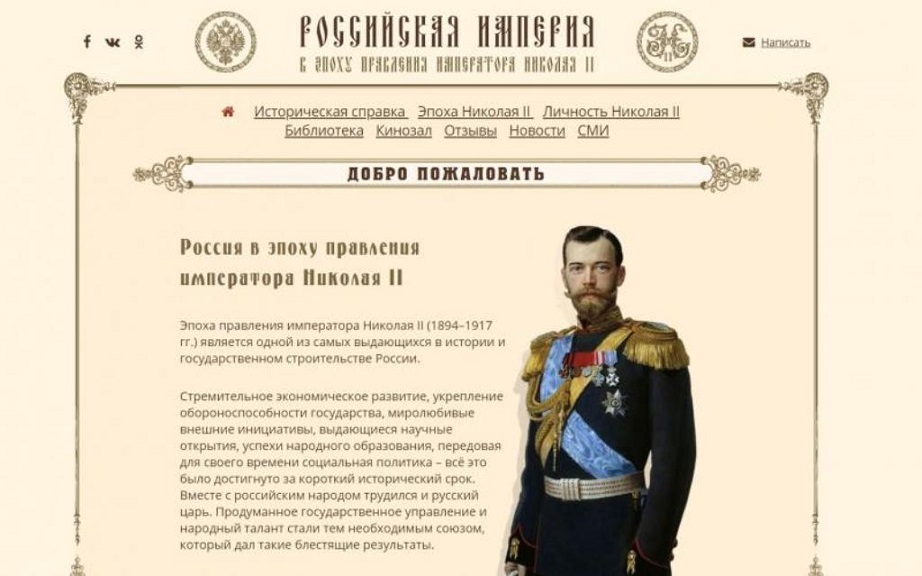
Российская империя в эпоху правления императора Николая Второго
Russia During the Reign of Emperor Nicholas II

020c

Click on the image to review the new site (in Russian only)

The era of the reign of Emperor Nicholas II (1894–1917) remains one of the most prominent in the history and development of Russia.

Rapid economic development, the strengthening of the state’s defense, peace-loving external initiatives, outstanding scientific discoveries, the successes of public education, advanced social policy for this period — were all achieved in a short historical period. Thanks to the policies and reforms of Nicholas II, sophisticated state administration and the talents of statesmen, helped shape the necessary union which produced such brilliant results.

Topics found in the new Russian site include monetary, agrarian, military reforms, industrialization, energy, public health, scientific breakthroughs, Russian Geographical Society, constitutional state, foreign and domestic trade, religious and church life, mail, telegraph and postal services, charity and patronage, the birth of Russian aviation, foreign policy, and much more.

Please note that this Russian language site is still under development, and once complete will also feature articles, news, and videos.

***

On a personal note, I would like to add that this new Russian site is of great importance. It allows us to reexamine what we have been led to believe is the truth on the era of Nicholas II, from the many books and documentaries produced over the past fifty years. Many have been written by people who have failed to examine all the facts, especially those from Russian sources.

As an example, during a BBC radio programme Beyond Belief held on 20th August 2018, the programmes’ host Ernie Rea was joined by four guests to discuss Russia’s last emperor and tsar. Among them was Andrew Phillips, Archpriest of the Russian Orthodox Church (ROCOR) and rector of St. John of Shanghai Orthodox Church in Colchester, England, who stated during the programme that “Nicholas II was a reforming tsar”. Fellow panelist and Romanov historian Helen Rappaport did not comment on Father Andrew’s statement, however, she wasted little time in taking to social media to rebuke him. “The assertion by Father Andrew that he [Nicholas II] was a reforming tsar took it too far” – she argued during a discussion on Facebook with her “Romanov circuit”.

I also believe that Nicholas II was a reforming tsar, the information presented in this new Russian site providing the facts. Therefore, I respectfully disagree with Dr. Rappaport’s comments, and her rebuke of Father Andrew’s comment alone raises a red flag.

I have argued for years that researchers need access to new documents discovered in post-Soviet archives in Russia. Perhaps this would help put an end to the obsessive rehashing by Western historians of the tragedies which befell Nicholas II during his reign. It is time to begin focusing on his reforms and achievements. I cannot emphasize enough the importance of an English version of the «Российская империя в эпоху правления императора Николая Второго» web site.

© Paul Gilbert. 18 February 2019

Photos 25 – 28 of Nicholas II

I must apologize for the quality of some of the photographs, however, this is something which I have no control over. Where possible, photographs have been chosen for their visual impact, but historical accuracy has made it vital to include a number of photographs whose quality is poor, but whose value as historical documents is considerable. Sadly, during the Soviet years, many photographs of the Imperial family were stored under poor conditions and their standard is low – PG

© Paul Gilbert. 15 February 2019

Repin’s ‘Ceremonial Meeting Of The State Council 1901’ to be Displayed in Moscow

The staff of the State Russian Museum in St. Petersburg, have began packing up 78 paintings by Ilya Repin (1844-1930) to participate in an upcoming Ilya Repin exhibition at the Tretyakov Gallery in Moscow.

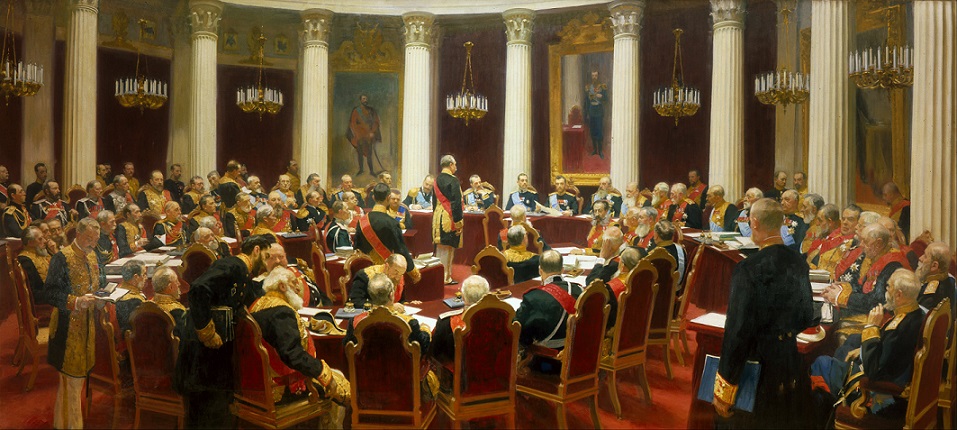
The most prominent of the paintings in the exhibition is one of the most significant and largest paintings from the collection of the State Russian Museum: the large-format canvas “Ceremonial Meeting Of The State Council 7 May 1901 …,” measuring 4 by 8 meters.

“The Ceremonial Meeting Of The State Council 7 May 1901” – a collective portrait with 81 figures, was painted one hundred and sixteen years ago (1903), in which Repin was paid a large fee. The customer of the canvas, Emperor Nicholas II, was pleased with the result.

The century-old frame of the picture will be left in St. Petersburg – it was decided not to expose it to the dangers of transportation. Only the canvas itself will be carefully packed and transported to Moscow in a special temperature and humidity controlled truck. Then, after careful preparation of the exhibition hall, the painting will be set in a new frame for the exhibit.

019b

The Ceremonial Meeting Of The State Council 7 May 1901. Artist: Ilya Repin, 1903

Founded by Tsar Alexander I (1801-1825), the State Council celebrated its centenary with a ceremonial sitting in the Round Room of the Mariinsky Palace in St. Petersburg on 7 May 1901. All the members of the State Council and the State Chancellery attended in full-dress uniform. Tsar Nicholas II (1894-1917) and senior members of the Imperial family are flanked by their ministers. Repin painted the scene from behind the chairs on the right (next to the columns).

He rapidly sketched the original modello on a canvas on which the perspective of the hall had already been marked out, working from a previously selected point. The artist later turned this study into a large picture with the help of two students from the Imperial Academy of Arts Boris Kustodiev (1878-1927) and Ivan Kulikov (1875-1941). Every member of the State Council is depicted in natural and diverse poses, with strong physical resemblances.

The Ilya Repin exhibition will include works from 26 museums in Russia and abroad, as well as from a number of private collections. The exhibit opens in the New Tretyakov Gallery in Moscow on 16 March, and runs till 18 August 2019.

© Paul Gilbert. 12 February 2019

New Conspiracy Theory Claims Medvedev Descendant of Nicholas II

018c

Prime Minister Dmitry Medvedev and President Vladimir Putin

DISCLAIMER: For the record, I do not support ANY conspiracy theory that ANY member of the Imperial family survived the regicide of 17 July 1918 – Nicholas II, Alexandra Feodorovna, and their five children were all murdered – there were NO survivors!

So, why am I publishing this article? That despite the fact that science has proved that the family perished, new conspiracy theories continue to surface a century after after their deaths. I trust that readers will agree just how ridiculous Solovyov’s article is – PG

Note: after reading the article below, please take a moment to read Why so many people believe conspiracy theories by

***

The latest conspiracy theory making headlines in Russia this week, is that the country’s Prime Minister Dmitry Medvedev is a descendant of Emperor Nicholas II. According to RIA VistaNews correspondent Alexander Solovyov, that while Medvedev is in power, the House of the Romanov protects Vladimir Putin and protects Russia’s interests among the elites of Britain, Spain, Denmark, Norway and other countries with which he has family ties. 

It is no secret that after the crisis in Ukraine in 2014 and the reunification of Crimea with Russia, relations between Europe and Russia have noticeably cooled since. However, they cannot be compared with tensions between the Russian Federation and the United States. Despite the fact that the countries of the European Union supported the anti-Russian sanctions of Washington, many in the EU from the first days opposed hostility with Russia, and today some countries even demand that restrictions on Moscow be lifted. Experts claim that this trend is dictated not by common sense, but by economic factors. At the same time, it cannot be excluded that the Russian Federation today has a powerful lobby in Europe, one in which the Russian Imperial House plays an important part.

018b

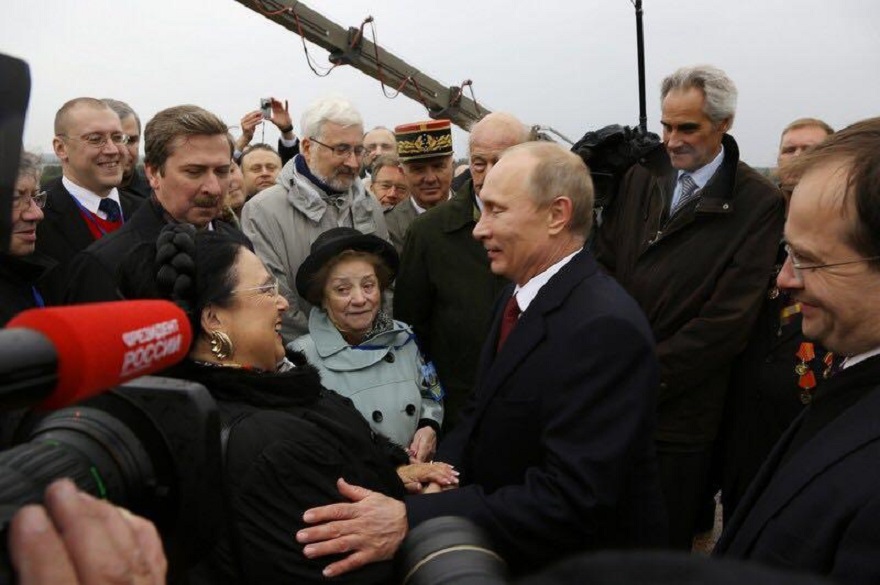
Grand Duchess Maria Vladimirovna and Vladimir Putin at Borodino in 2012

The Head of the Russian Imperial House is Grand Duchess Maria Vladimirovna. Although her status continues to be contested by some monarchists, she has a very large influence in Europe not only on the representatives of the Russian diaspora, but also on the political and economic elites of the leading EU countries. For example, her son and the only heir to the Imperial House, Grand Duke Georgy Mikhailovich, is a direct descendant of the British Queen Victoria and stands 140th in the order of succession of the British throne. In addition, he has family ties with many of the now-reigning dynasties of Europe. The grand duke is the cousin of Prince Charles of Wales and the cousin of the former King of Spain Juan Carlos, and the nephew of King of Norway Harald V, King of Sweden Carl XVI Gustav and Queen of Denmark Margrethe II. Family ties with the monarchies of the leading countries of Europe allow the Romanovs to have influence on the highest circles of European society. Understanding the importance of allied and partner ties with Europe against the background of constantly growing relations with the United States, Russian President Vladimir Putin certainly did not neglect the opportunity to take advantage of the position of Grand Duchess Maria Vladimirovna and her family. Perhaps no other role in their relationship is played by none other than Dmitry Medvedev.

As is known, the head of the Russian Imperial House actively supports the policies of President Putin. The head of state has long given the grand duchess due respect and contributes to the development of the historical memory of monarchism in Russia. Moreover, the closest rapprochement between the Kremlin and the Romanovs falls on the very period of the presidency of Dmitry Medvedev. The crown of respect for the person of the Grand Duchess and her family was the transfer in 2012, under her patronage of the guard ship “Yaroslav the Wise” of the Baltic Fleet of the Russian Navy. Relations with the Imperial House developed so rapidly that in 2014 the grand duchess, partially recognized as the heiress of the Russian throne , supported Vladimir Putin’s decision to reunify Crimea to the Russian Federation. And this is despite the fact that the position on this issue in Europe was very ambiguous. In 2018, she, together with her son George Mikhailovich, visited the peninsula and drove along the newly built Crimean bridge. Maria Vladimirovna also actively protects the position of the Russian leadership in the EU countries, which, perhaps, was one of the reasons for the rise of pro-Russian sentiments in a number of European countries.

018a

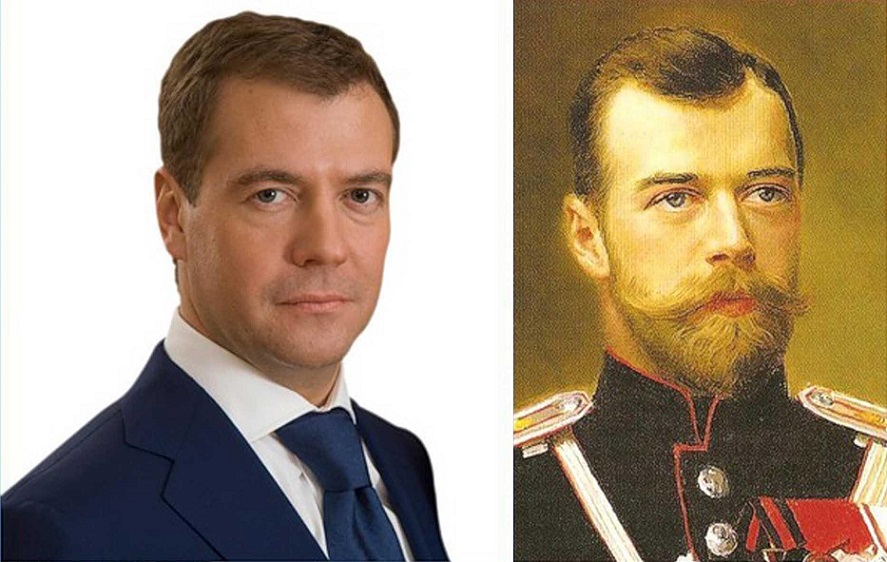
Dmitry Medvedev and Emperor Nicholas II

But what does Dmitry Medvedev have to do with it? Several years ago, collages began to appear on the Internet of  Vladimir Putin’s closest ally, with what many saw as an amazing resemblance to the last Russian emperor, Nicholas II. The prime minister turned out to be similar to the tsar, not only in the shape of his face and physique, but also in the outlines of his eyes, nose, and hair. Talking about Medvedev’s kinship with Nicholas II did not come as a joke, however, if you dig deeper, you can find very strange coincidences. For example, some historians have recently allegedly established the connection of the family of Dmitry Anatolyevich with the murderers of the tsar. The network referred to genealogy studies which allegedly show that the grandfather of the Prime Minister of Russia Afanasy Fyodorovich was the nephew of Mikhail Medvedev. The latter, under the command of Yakov Yurovsky, the head of the Imperial family’s guard, a member of the Ural Regional Cheka Collegium, on July 17, 1918, according to official data, shot Nicholas II, his spouse Alexander Fedorovna, and their children, among whom was a very young Tsarevich Alexei.

Conspiracy theorists have repeatedly stated that the Imperial family were not shot on that day. The credibility of those tragic events is still disputed by some historians. In this regard, it is possible that the “Chekists” saved at least the innocent children of Nicholas II, in particular his son Alexei, from being shot. It is likely that Mikhail Medvedev subsequently issued the Tsarevich for his nephew Athanasius Fedorovich. In a strange way, in the biography of Dmitry Medvedev it is indicated that his grandfather was born in 1904 – the same year when Tsarevich Alexei was born. The prime minister himself during numerous interviews about his family and pedigree spoke for some reason reluctantly and evasively. Perhaps Dmitry Anatolyevich was simply afraid that the secret of his origin would be revealed, but the Imperial appearance of the prime minister eventually played a cruel joke on him. It can be assumed that the Russian Imperial House in exile in the person of Grand Duchess Maria Vladimirovna knew about the existence of a direct descendant of Nicholas II. The head of the dynasty itself has repeatedly stressed that the Romanovs have no claim to power in Russia. Perhaps this is not required, since the heir to the emperor “Dmitry I” is already in the leadership of the country, and in return for this, Maria Vladimirovna and her family provide the lobby of Russia and Putin in Europe. Such a disposition suits the grand duchess herself, who, not recognizing Medvedev as heir to the throne, will remain the head of the Imperial House. Experts have long wondered why Vladimir Putin will not get rid of the scandalous prime minister, despite all the hype around his name. Maybe the president specifically holds the descendant of Nicholas II with him to save the union with Europe. In this case, everyone gets what he wants. But does the “heir to the emperor” like this scheme?

© Alexander Solovyov. 10 February 2019