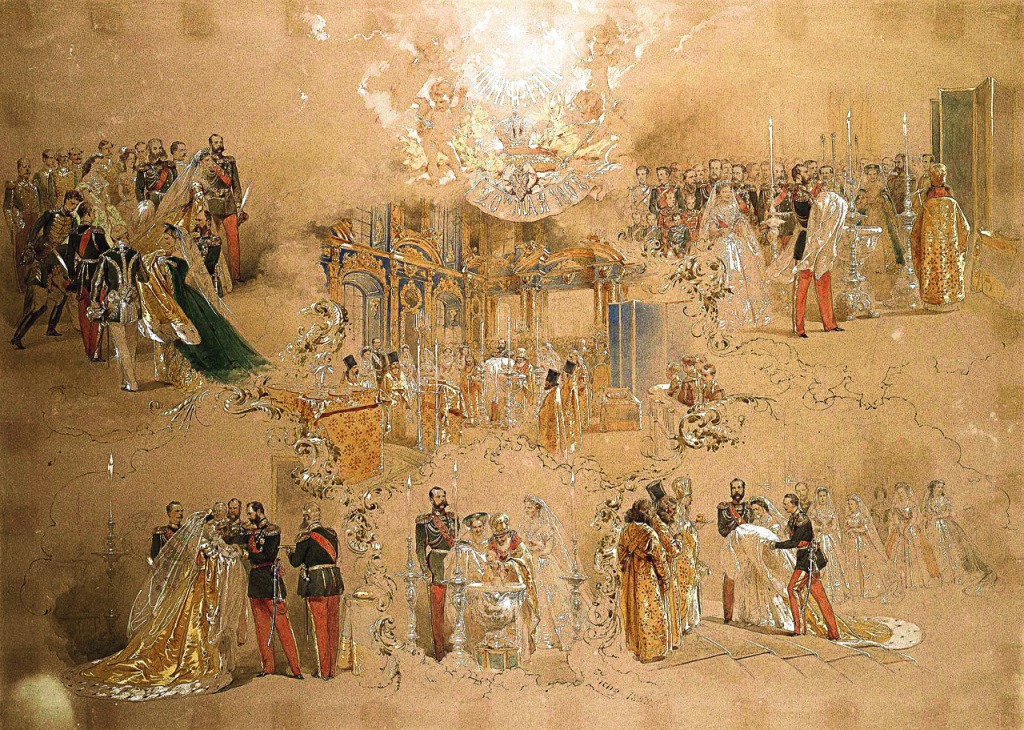
PHOTO: the baptism of Grand Duke Nicholas Alexandrovich [future Tsesarevich and Emperor] on 2nd June (O.S. 20th May) 1868, by Mihály Zichy (1827-1906). The watercolour depicts four baptismal scenes, and two of them show Alexander II holding his grandson in his arms.
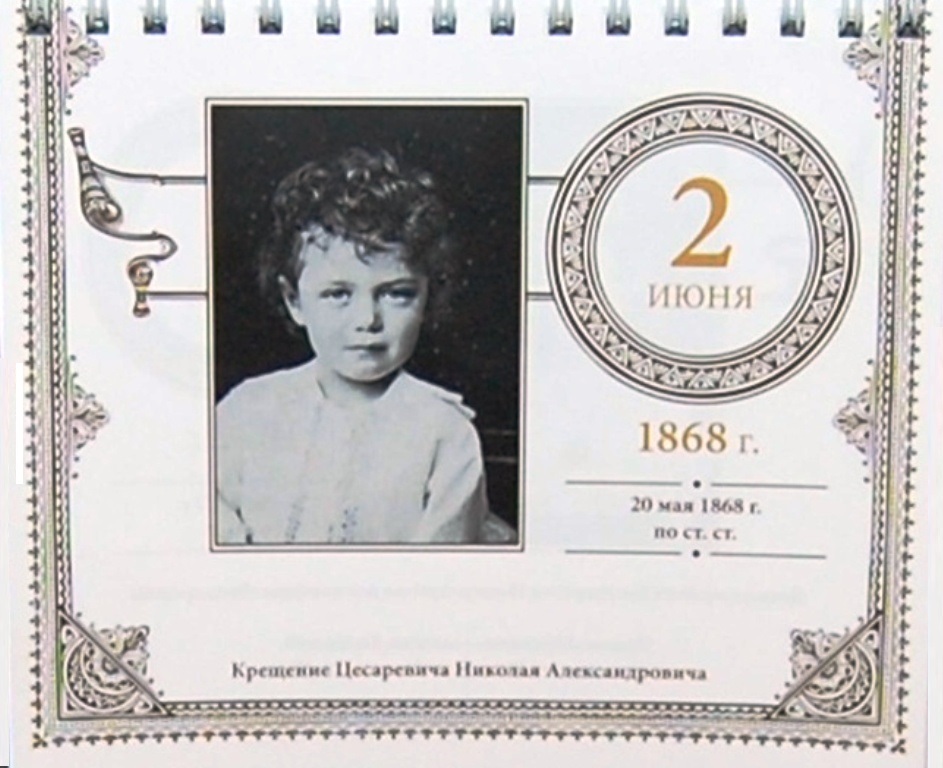
On 2nd June (O.S. 20th May) 1868 – two weeks after his birth on 19th (O.S. 6th) May 1868 – His Imperial Highness Grand Ouke Nicholas Alexandrovich was baptised in the Church of the Resurrection of Christ in the Catherine Palace at Tsarskoye Selo. The baptism was performed by the Imperial family’s confessor Protopresbyter Vasily Bazhanov (1800-1883).
The boy received the traditional name for the House of Romanov – Nicholas. He was named in memory of his father’s elder brother and mother’s first fiancé, Tsesarevich Nikolai Alexandrovich (1843-1865), who died at the age of 21, from cerebro-spinal meningitis.
“You can’t imagine how happy Minnie [future Empress Maria Feodorovna] and I are to be able to name our first child Nicholas,” Tsesarevich Alexander Alexandrovich [future Emperor Alexander III] wrote to his uncle Grand Duke Mikhail Nikolaevich (1832-1909) – “and how dear that name is to both of us, after so many sad memories of poor Nyx.”
The infant’s paternal grandfather Emperor Alexander II echoed his son’s joy in a letter to the Danish king and the maternal grandfather of the newborn Christian IX: “The birth of little Nicholas was also the fulfillment of all our prayers, and you will surely understand why we gave him this name, which is doubly dear to us.”
Emperor Alexander II, took a very active role in the solemn ceremony. He clearly understood that not only was this his first grandson, but also that a future Emperor was being baptised. It is noteworthy that during the baptism, both Alexander II and his son, Tsesarevich Alexander Alexandrovich, acted as assistants to the lady of state. The fact that the father, breaking tradition, took an active part in the baptism[1], apparently, was due to its historic significance. Two emperors, current and future, held their successor in their arms, strengthening the foundation of the infant’s legitimacy[2].
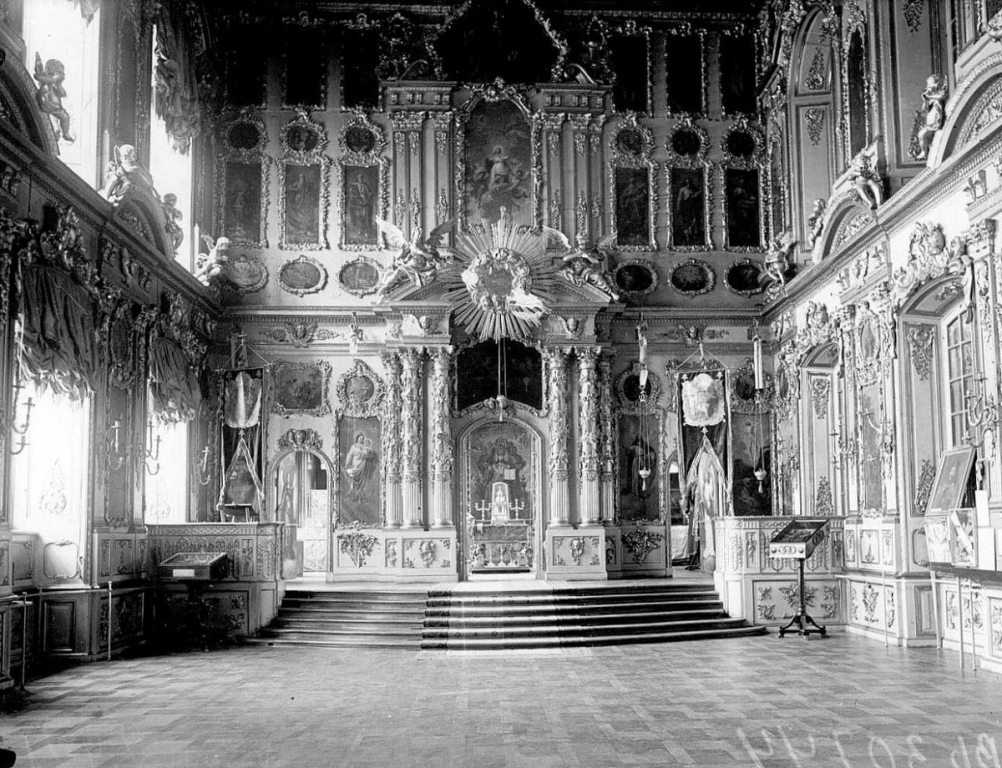
PHOTO: late 19th century view of the Church of the Resurrection
of Christ in the Catherine Palace at Tsarskoye Selo
As for the mother [future Empress Maria Feodorovna], she did not have the right to be present at the baptism of her baby at all [in accordance with a tradition that originates in the Old Testament]. However, even if Maria Fedorovna wanted to break the custom, she could not do so, due to the fact that her doctors advised her not to walk following the birth of her son, and instructed her to rest on that eventful the day. [3]
The infant’s godparents were the newborn’s grandfather, Emperor Alexander II, maternal grandmother, Queen Louise of Denmark, his uncle, Crown Prince Frederick of Denmark, and Grand Duchess Elena Pavlovna[4].
It was Alexander II and Grand Duchess Elena Pavlovna, who carried the baby to the font for baptism. In addition, Nicholas Alexandrovich’s godparents, his Danish grandmother and uncle, Queen Louise and Crown Prince Friedrich took part.
Tsesarevuch Alexander Alexandrovich described the day’s events as follows:
“The entrance was magnificent, and there were a lot of people in the palace and also in the garden. The little one was transported in a golden carriage with much pomp and ceremony, accompanied by an escort on horseback.”
During the ceremonial procession through the halls of the Catherine Palace at Tsarskoye Selo, the newborn was carried to the palace church by the lady of state Princess [Alexandra Aleekseevna] Kurakina (1840-1919), supported on the one side by the State Chancellor Prince [Alexander Mikhailovich] Gorchakov (1798-1883), and on the other by Field Marshal Prince Alexander [Ivanovich] Baryatinsky (1815-1879) – both old and lame, but they endured excellently and helped as much as they could.
“The exit was magnificent, and , still there were a lot of people in the palace and also in the garden,’ Tsesarevich Alexander described the day of his son’s christening to Grand Duke Mikhail Nikolayevich. – “Tsarskoye Selo was unrecognizable that day; the streets were full of people and carriages, the whole city is celebrating. At 5 o’clock, a large banquet was held in the Great Hall, which was lit splendidly by the sun. It’s been a very tiring day, and poor Mama [Empress Maria Alexandrovna] is very tired. After the baptism, the entire family gathered at my place [the Alexander Palace] to congratulate Minnie [Grand Duchess Maria Feodorovna], and all little ones were there too. An excellent breakfast was served, and then everyone went home.”
Nearly 13 years later, in March 1881, Grand Duke Nicholas Alexandrovich became the Heir Tsesarevich, and in October 1894, he became Russia’s last Emperor and Tsar.
Prince Pyotr Vyazemsky (1792-1878), a poet and friend of Alexander Pushkin, dedicated the poem “May 6, 1868” to the birth of Grand Duke Nicholas Alexandrovich – future Emperor Nicholas II, referring to the infants feelings of his paternal grandmother, Empress Maria Alexandrovna:
Yesterday, a beauty, you are a grandmother today.
Yes, grandmother! So what is it? Great, good luck!
Providence has rewarded you with the cherished blessing.
We admired the Empress Mother in you,
We admire the Tsarina-grandmother twice.
To the family crown and to the imperial crown
A living flower clings to it, a native treasure.
Your grandmother’s name, of course, does not suit you,
But in this word you have such a charm of sound,
There’s so much love in him, so much happiness in him
That, blessing your grandson with a joyful tear,
You are young in heart, as young in face.
And your feelings, and your joy,
Having responded with its soul, Russia is no stranger to
And prays with you over the sweet cradle,
In which the star of the future glows.
NOTES:
[1] According to Orthodox tradition at that time, the father was required to leave the church at the time of the baptism of his child, giving way to the godfather. Emperor Nicholas II was not in the church when his son Alexei was baptised in August 1904.
[2] Zimin, Igor Viktorovich. Children’s world of imperial residences. Life of monarchs and their environment. Baptism of children. 2010
[3] Ibid.
[4] Grand Duchess Elena Pavlovna (1807-1873), born Princess Charlotte of Württemberg, the wife of Grand Duke Michael Pavlovich, the youngest son of Emperor Paul I and Duchess Sophie Dorothea of Württemberg – later Empress Maria Feodorovna.
© Paul Gilbert. 2 June 2022 – UPDATED on 2 June 2026
***

I am dedicated to clearing the name of Russia’s much slandered Tsar. If you enjoy all the articles, news, photos, and videos on my blog, please help support my work in the coming year ahead by making a donation. I am reaching out to friends and followers with a request for making a small $5 or $10 donation in aid of my research.
These donations are of great assistance in helping me offset the cost of obtaining and translating documents from Russian archival and media sources, which are often paid for out of my own pocket. It is these documents which help present new facts and information on the life and reign of Nicholas II. In addition, my research continues to debunk many of the myths and lies which exist more than a century after Nicholas II’s death and martyrdom.
As a token of my gratitude, please accept a copy of my 22-page booklet Nicholas II Bibliography – it’s FREE! My 2026 edition features a NEW 4-page article about Nicholas II’s libraries and book collection; 8 black and white photos; and a list of more than 125 English-language books on the life and reign of Nicholas II.
Please note, that there is NO obligation, the booklet is FREE to every one! ENJOY!


You must be logged in to post a comment.