Paul Gilbert celebrates Russia Day on “Russian soil”

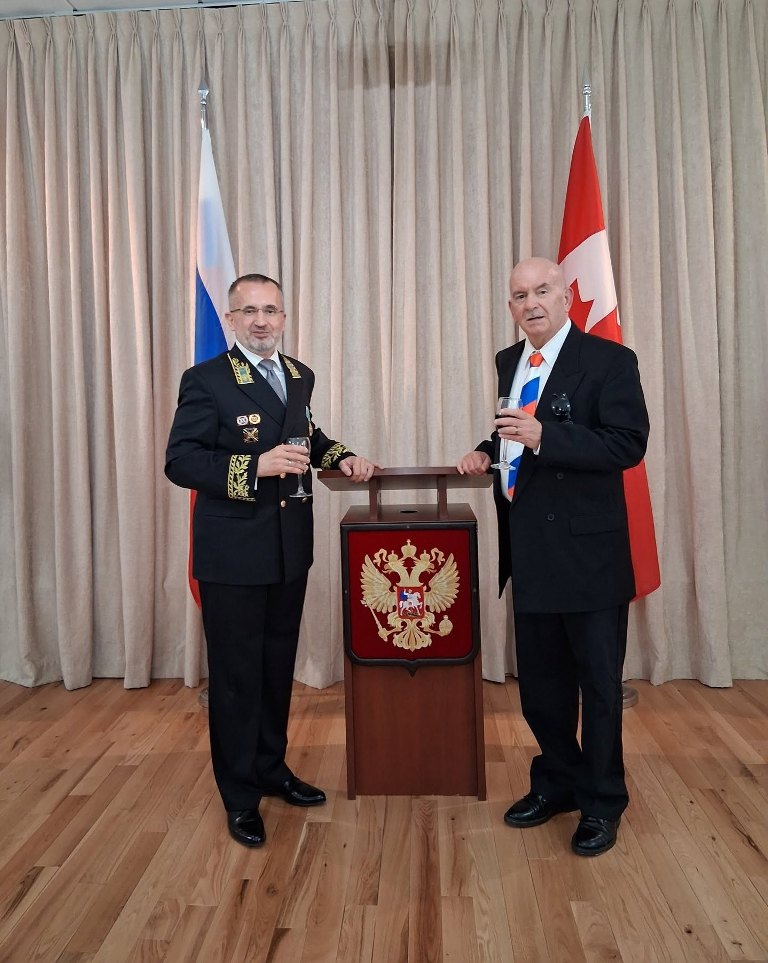
His Excellency Oleg Stepanov, Ambassador of the Russian Federation to Canada
with historian and author Paul Gilbert, during a reception held at the
Russian Embassy in Ottawa, Canada on 11th June 2026

On Thursday, 11th June 2026, I celebrated Russia National Day on “Russian soil” in Canada. I was just one of the guests invited to attend a reception held at the Russian Embassy in Ottawa. I was truly honoured to be invited to this event, as it gave me an opportunity to celebrate my heartfel love for Russia, it’s history and it’s people.

I travelled to our nation’s capital by train, a four-hour journey from where I currently live. I have not been on a Canadian train since I was 4 years old – that was 65 years ago!! As this was a special occasion, I decided to travel Business Class, which made the journey all the more enjoyable. I was served a hot breakfast on the way to Ottawa, and a hot dinner on the way home, the latter of which was served with a delightful red wine from the Niagara region of Ontario. I appreciated the extra perks that came with Business Class, such as use of the Business Class Lounge in Ottawa and priority boarding.

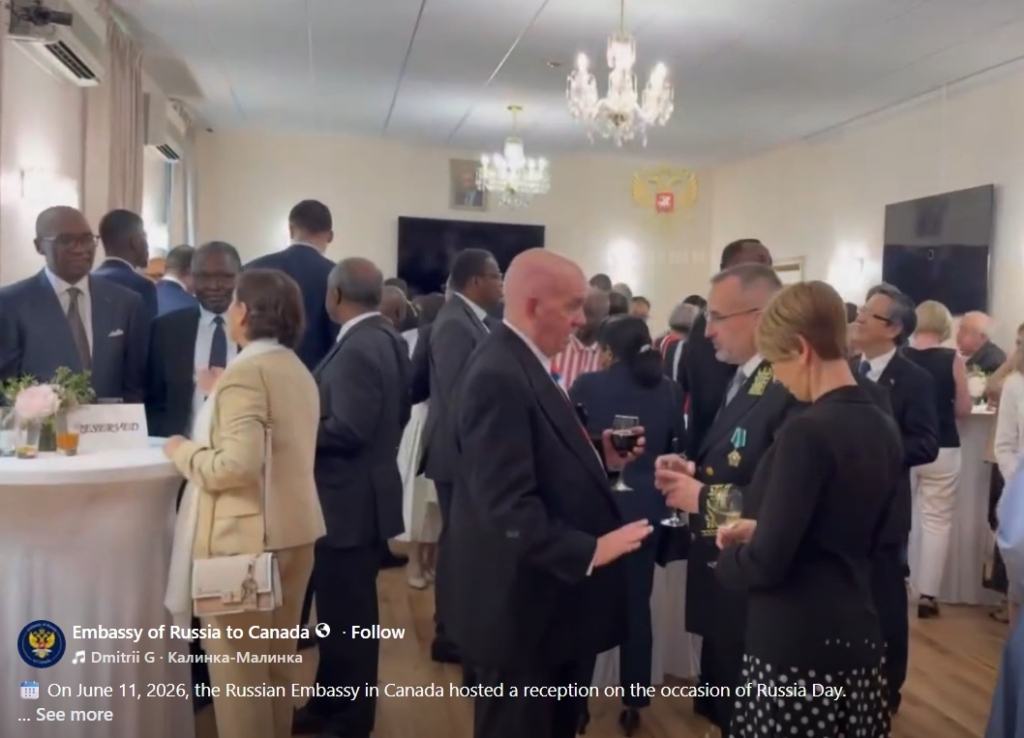
PHOTO: In the foreground, Paul Gilbert with Oleg Stepanov, Ambassador of the Russian Federation to Canada and his wife Mrs. Julia Stepanova, during a reception held at the Russian Embassy in Ottawa, Canada on 11th June 2026

Upon arrived each guest was warmly greeted by His Excellency Oleg Stepanov, Ambassador of the Russian Federation to Canada and his wife Mrs. Julia Stepanova. All the guests were photographed with their hosts.

Between 100-200 people attended the reception. They included ambassadors and other diplomats from countries friendly to Russia, Orthodox priests, academics, historians, among others. The guests – both gentlemen and ladies were impeccably dressed for the event.

After all the guests had arrived, His Excellency gave a speech followed by a toast, wishing every one present a “Happy Russia National Day’. A buffet of Russian delicacies was offered to guests, the main tale of which was crowned with a Russian samovar.

It was a very friendly event: smiling guests mingled and chatted, while clinking glasses. I met some very interesting people, and my tie received a number of compliments. I had ordered a special white, blue and red tie – the colour of the Russian flag for the event. I also had an opportunity of speaking with His Excellency and His wife privately, in which we discussed Russian history and other mutual interests.

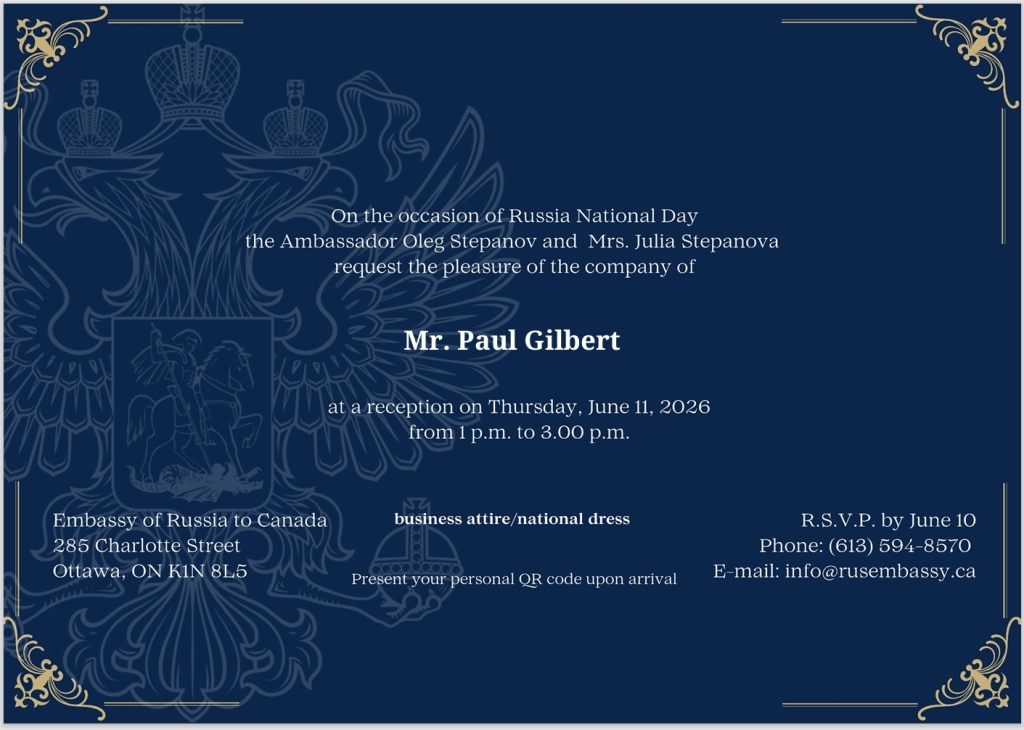
PHOTO: my invitation to attend a reception in honour of Russia National Day
held at the Russian Embassy in Ottawa, Canada on 11th June 2026

Russia Day is the national holiday of the Russian Federation, celebrated annually on 12th June. It commemorates the adoption of the Declaration of State Sovereignty by the Russian Soviet Federative Socialist Republic (RSFSR) in 1990, marking the beginning of the country’s modern constitutional history.

The holiday was originally known as Independence Day and later renamed “Day of Adoption of the Declaration of State Sovereignty” before officially becoming Russia Day in 2002. It is a national public holiday in Russia, characterized by a day off for the general population. Celebrations focus on national pride, unity, and heritage, and typically include award ceremonies, festive events and fireworks.

С Днем России всем моим друзьям в России! 🇷🇺

Happy Russia Day to all my friends in Russia! 🇷🇺

© Paul Gilbert. 12 June 2026

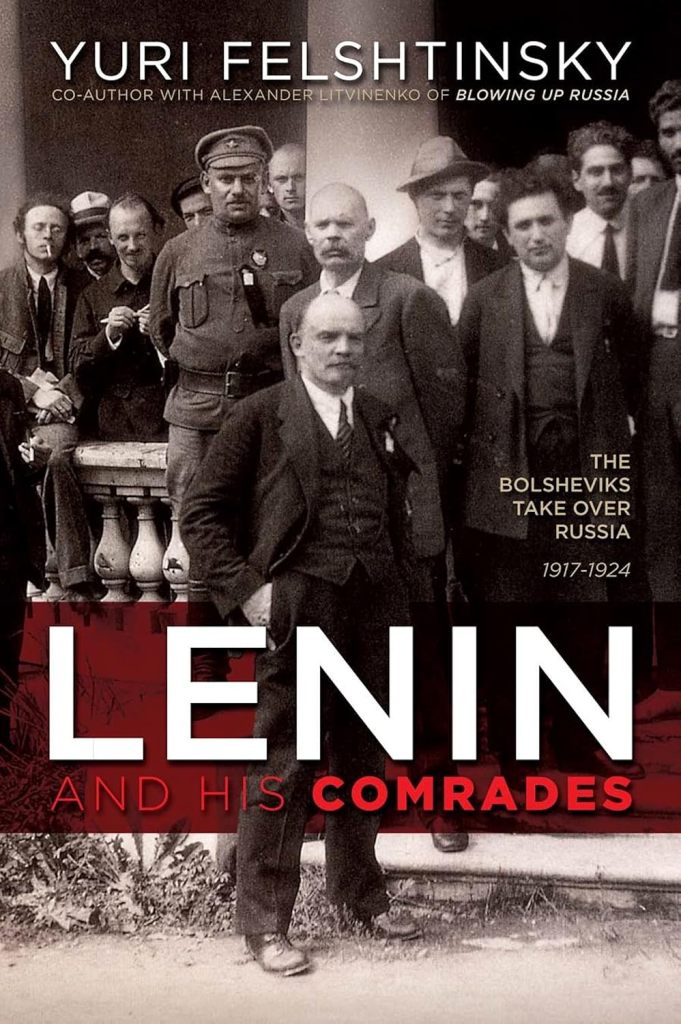
Recommended reading: Books on Lenin and the Bolsheviks

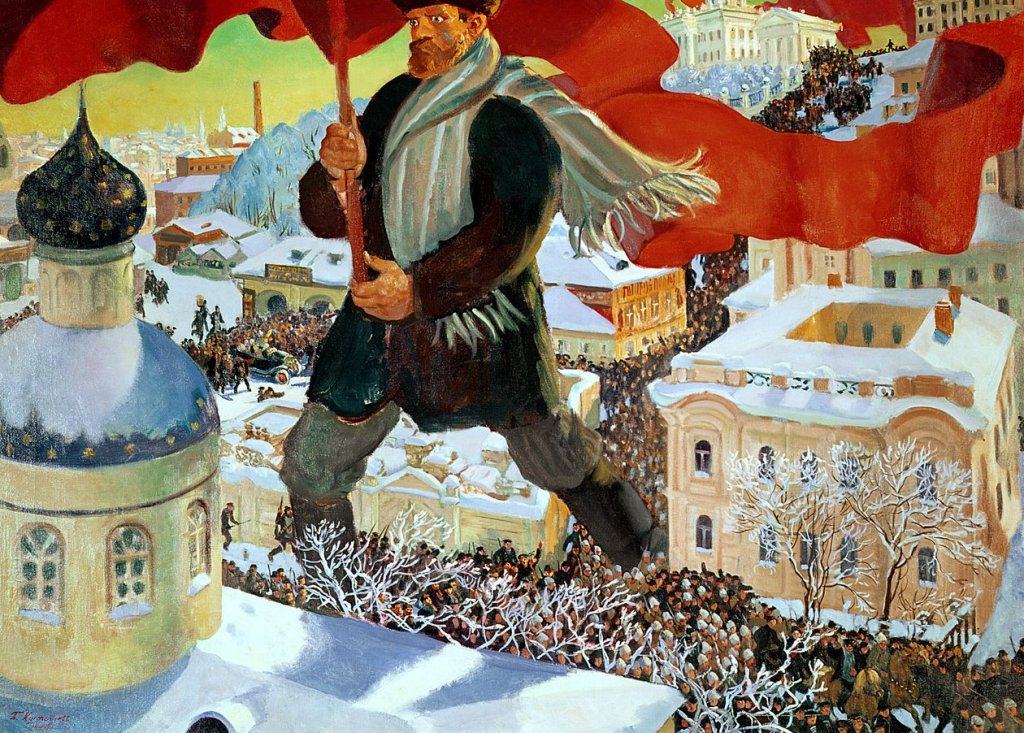
‘The Bolshevik’ (1920)
by Boris Mikhaylovich Kustodiev (1878-1927)
From the Collection of the State Tretyakov Gallery, Moscow

On 7th November (25 October, O.S.) 1917, the October Revolution began. It is officially known in Soviet historiography as the ‘Great October Socialist Revolution’, an illegal coup organized by the Vladimir Lenin and the Bolsheviks. This tragic date was instrumental in the larger Russian Civil Warm which lasted from 1917–23. The Bolsheviks plunged the once great Russian Empire into an abyss.

Their crimes are unprecedented, and included the nationalization [a fancy word for robbery and theft] of the Imperial palaces and all their contents; the destruction of all monuments of emperors and tsars; tearing down tsarist symbols from buildings; placing a bounty on the heads of all members of the Russian Imperial Family, which resulted in the murder of more than a dozen grand dukes and duchesses and princes of the imperial blood.

It is important to note that while it was not the Bolsheviks who overthrew Emperor Nicholas II, they were indeed responsible for the end of both the monarchy and the Russian Empire, by ordering the murder of Russia’s last Tsar, his wife, heir and four daughters.

In January 1918, Lenin ushered in the First Red Terror, and thus setting the stage for his successor Joseph Stalin, who carried out his own Red Terrors.

The Bolsheviks persecution of the Russian Orthodox Church resulted in the desecration and looting churches and monasteries, followded by the closure and destruction of Orthodox places of worship. Thousands of priests, clergy, nuns and believers were persecuted, imprisoned and murdered.

During the First World War the Russian-Soviet artist Ivan Alekseevich Vladimirov (1869-1947) was living in Petrograd. He created a series of paintings and coloured drawings about life in Petrograd under the Bolsheviks, during the Revolution and the Civil War. After the abdication of Emperor Nicholas II, he joined the the Petrograd militia and illustrated events of the Russian Revolution.

His works reflect his personal eye witness account of the savagery and brutality of the Bolsheviks during the 1917 revolution, the consequences of which resulted in the deaths, imprisonment and displacement of millions of innocent men, women, and even children, atrocities against the Russian Orthodox Church, and the destruction of Imperial and Holy Russia.

Vladimrov was just one of the artists who captured the atrocities of the Bolsheviks on canvas, but what about those who recorded the tyranny and horror of that time in words and photographs? English-language studies of Bolshevik atrocities are few and far between, however, there are a few noteworthy works to consider.

I have compiled a short list of 3 titles, which I highly recommend to those of you who are interested in early 20th century Russian history. They paint an accurate picture of the wanton path of fear, death and destruction left by Lenin and the Bolsheviks. All of the titles listed below can be ordered from your favourite bookseller or AMAZON, while second-hand copies can be found on eBay, Alibris and Bookfinder.

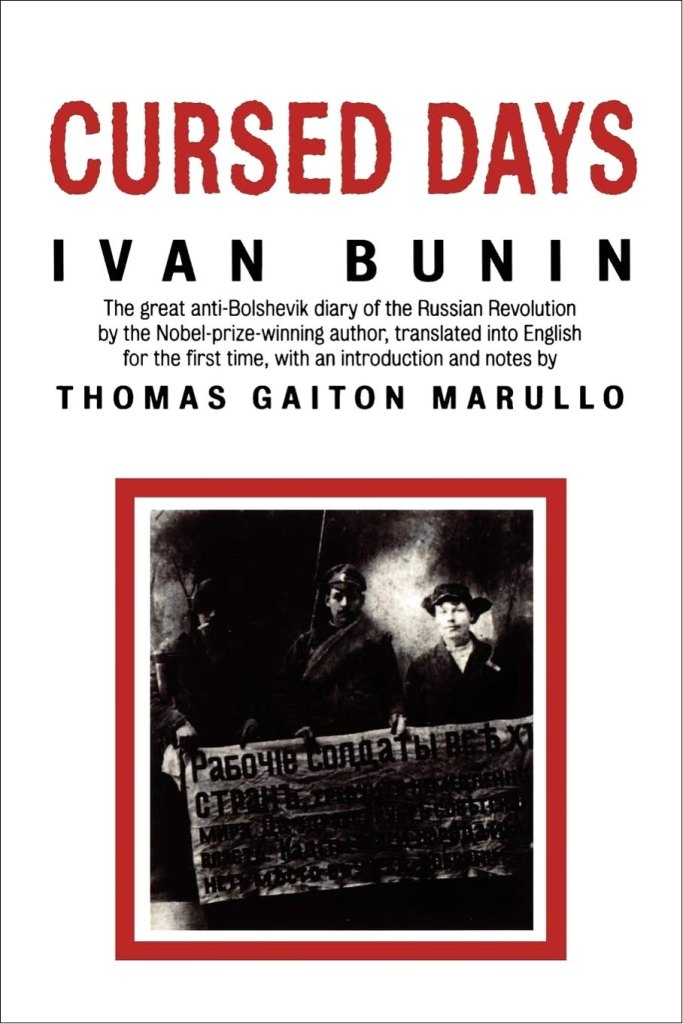
‘Cursed Days’ by Ivan Bunin (1998), reflects the authors’ diary of the years 1918–1920 in Moscow and Odessa. It is regarded as one of the very few anti-Bolshevik diaries to be preserved from the time of the Russian Revolution and Civil War.

Bunin’s account of his last days in Bolshevik Russia recreate events with graphic and gripping intimacy. His scathing criticism of Bolshevik leaders is unparalleled, referring to them as “pitiful, dull, mangy-looking creatures.”

On hearing of the death of the Bolshevik leader, Vladimir Lenin, in January 1924, Bunin gave an emotional speech in Paris, in which he dubbed Lenin “a degenerate by birth, who committed the monstrous crime of crashing the world’s most powerful nation and killing several million people.”

‘Cursed Days’ was originally published in 1925–1926 in the Paris-based ‘Vozrozhdenye’ newspaper (its final version was published by ‘Petropolis’ in 1936). The first English-language edition was published in 1998. ‘Cursed Days’, was banned in the Soviet Union until the late 1980s, it has since been published in 15 editions!

Bunin was the first Russian writer to win the Nobel Prize for Literature (1933). He was revered among White Russian emigres for his anti-Bolshevik views, and regarded him as a true heir to the tradition of realism in Russian literature established by Tolstoy and Chekhov.

Ivan Alekseyevich Bunin died in Paris on 8 November 1953.


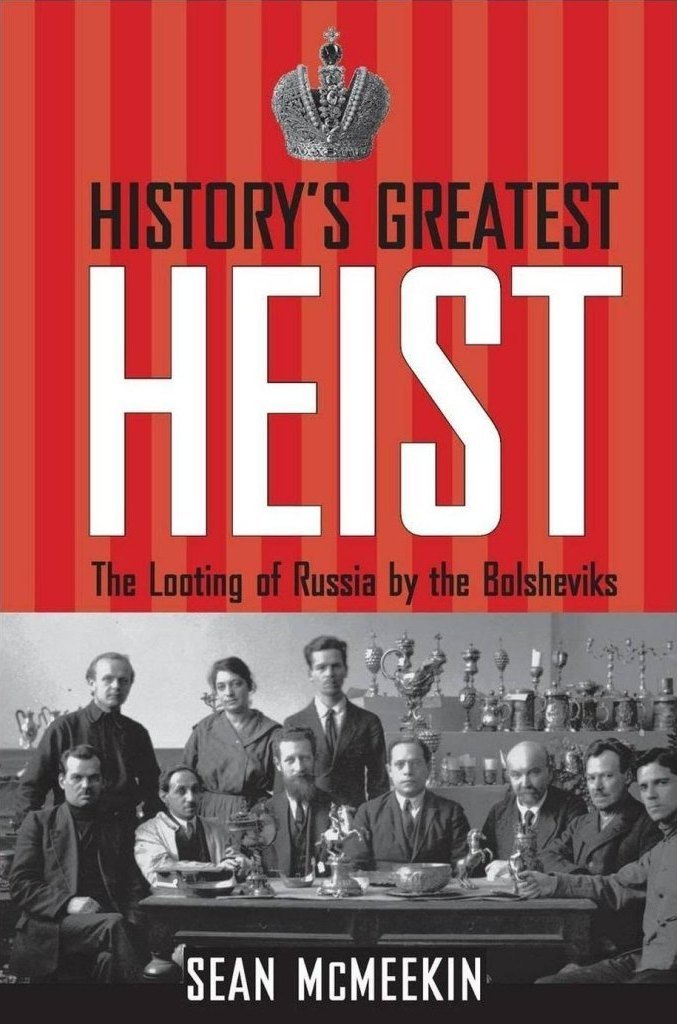
‘History’s Greatest Heist: The Looting of Russia by the Bolsheviks’ (2009) is among my TOP 10 favourite reads. Author Sean McMeekin’s book, which draws on previously undiscovered materials from the Soviet Ministry of Finance and other European and American archives to expose some of the darkest secrets of Russia’s early days of communism.

Building on one archival revelation after another, the author reveals how the Bolsheviks financed their aggression through astonishingly extensive thievery. Their looting of imperial palaces, churches, the nobility included everything from the cash savings of private citizens to gold, silver, diamonds, jewelry, icons, antiques, and artwork.

McMeekin’s prodigious research exposes the rape of the culture of Old Russia, and the Bolshevik plundering of her people. The reader is left feeling sorrowful and revengeful for the actions of these robbers.The author points out what a lax citizenship will allow, when a small band of violent rebels and thugs,set out to destroy your country, your culture, and your person.

This is an extraordinary story, a real page turner, and scholarship at its best! 


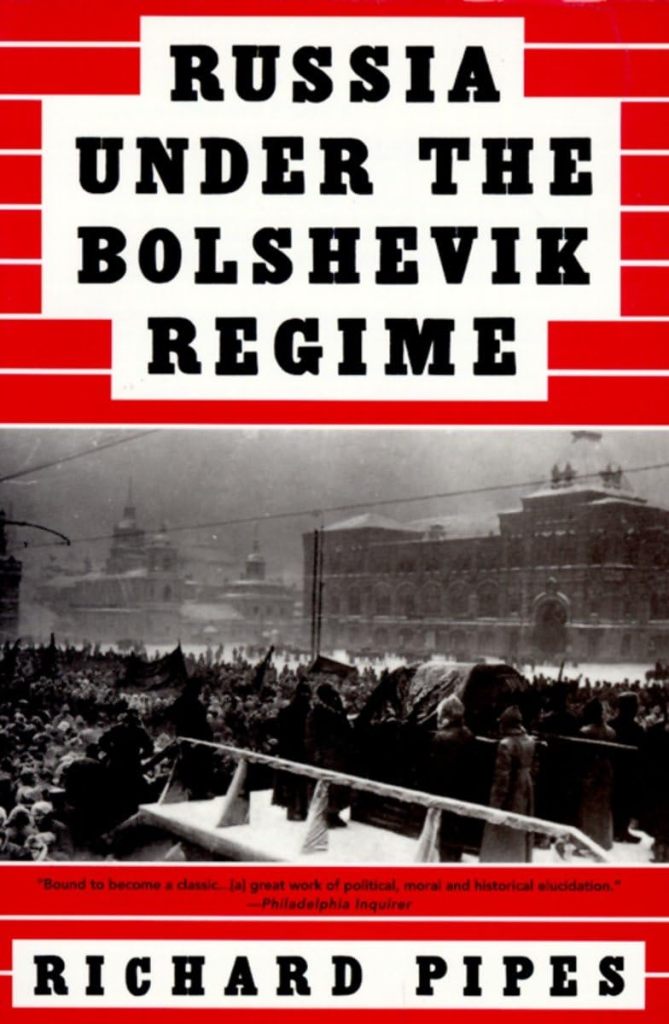
‘Russia Under the Bolshevik Regime’ (1993) by Richard Pipes is the most definitive English language study of the Bolsheviks to date.

Pipes examines the Bolsheviks’ efforts to defend and expand their dominion during the Civil War, highlighting the destructive nature of this conflict and its impact on Russian society. The book discusses the crises faced by the Bolshevik regime, including political and economic failures, and the devastating famine of 1921, which tested the resilience of the new government.Pipes also addresses the cultural and religious policies implemented by the Bolsheviks, which were often aimed at reshaping Russian society according to Communist ideals.

Pipes argues that the Bolshevik regime represented a significant attempt to impose a master plan on the entire life of the country, a precursor to totalitarian regimes that would follow in Europe. He emphasizes that many of the techniques used by the Bolsheviks were later adapted by leaders like Mussolini and Hitler for their own purposes.

‘Russia Under the Bolshevik Regime’ is a massive 500+ page read, one which is hard to put down!

***

Dear Reader, If you know of any other books on the Bolsheviks which you think of Lenin should be added to this list, please e-mail me at royalrussia@yahoo.com – PG

© Paul Gilbert. 10 June 2026

Chapel dedicated to Nicholas II and his family opens at Murmansk airport

PHOTO: Chapel of the Holy Passio-Bearers
Tsar Nicholas II and his family at Murmansk Airport

On 20th November 2025, the new domestic terminal at Murmansk Airport welcomed its first flight. The walls of the terminal building are decorated with paintings of landscapes of the Kola Arctic.

On 4th May 2026, a chapel dedicated to Emperor Nicholas II and his family. The small chapel is located in the second hall of the terminal, immediately after the check-in counters.

According to Archpriest Vladimir Semenov of the Murmansk Diocese: “Work on the chapel began in December 2025. Now, we must complete the decoration of the interior. The date of the it’s consecration has yet to be announced.”

Recall that on 31st May 2019, Russian President Vladimir Putin issued a decree naming Murmansk Airport after the founder of the city, Nicholas II.

Murmansk was the last city founded in the Russian Empire. Russia’s first ice free port was founded here in 1916 by Nicholas II and named Romanov-on-Murman. It was officially named Murmansk during the Soviet years.

Prior to that, residents of the Russian Arctic city had voted in favour of naming the airport in honour of Russia’s last Tsar, who received 68,260 votes (48%).

More than 5.5 million people took part in the ‘Great Names of Russia’, a national competition in which the Russian people could cast votes to rename 42 of the country’s major airports.

***

Since 2019, great efforts have been made to draw attention to Murmansk residents and visitors of Nicholas II’s connection to the Arctic city . . .

Exhibition dedicated to Nicholas II opens at Murmansk Airport

In November 2020, a permanent photo exhibition dedicated to Emperor Nicholas II opened in the main terminal building of Murmansk Airport – [the link above features 12 photos]

There have been proposals for the square in front of the airport terminal, however, whether these plans come to fruition remains to be seen . . .

New monument of the Imperial Family to be installed at Murmansk Airport

On 26th January 2023, a St Petersburg architecture and landscaping firm, published an artist’s concept of the new square in front of the Nicholas II-Murmansk Airport, the highlight of which will be a major sculptural composition depicting the last Russian Imperial Family.

© Paul Gilbert. 7 June 2026

New monument to Nicholas II unveiled in Ussuriysk

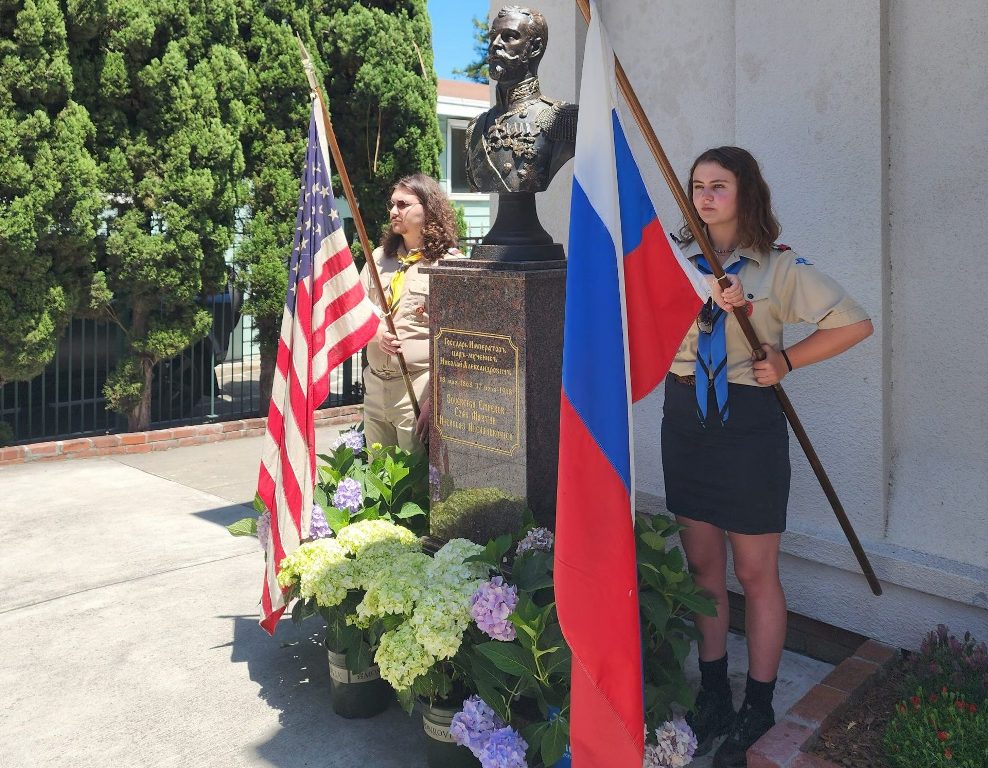
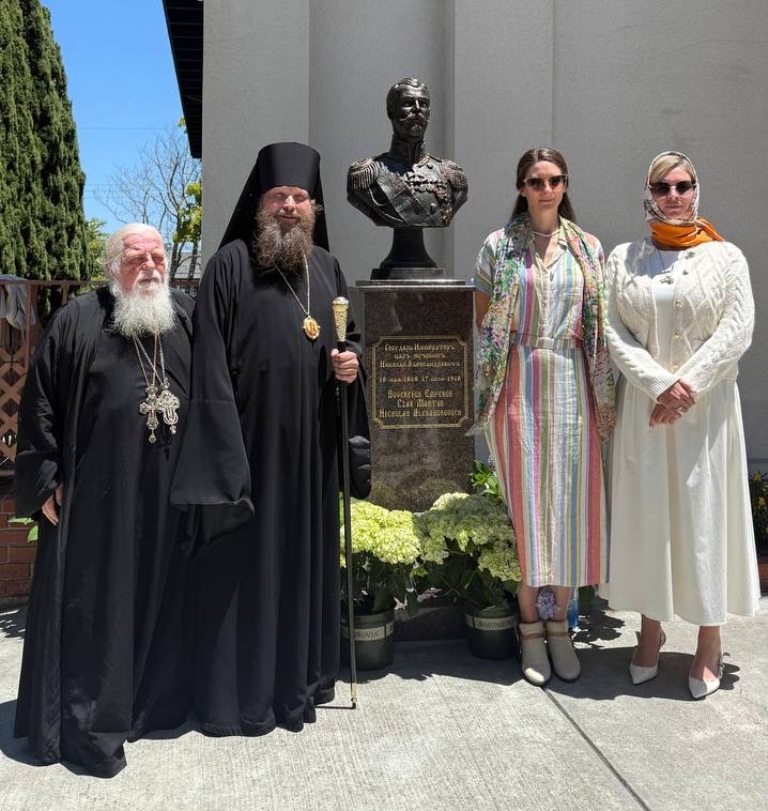
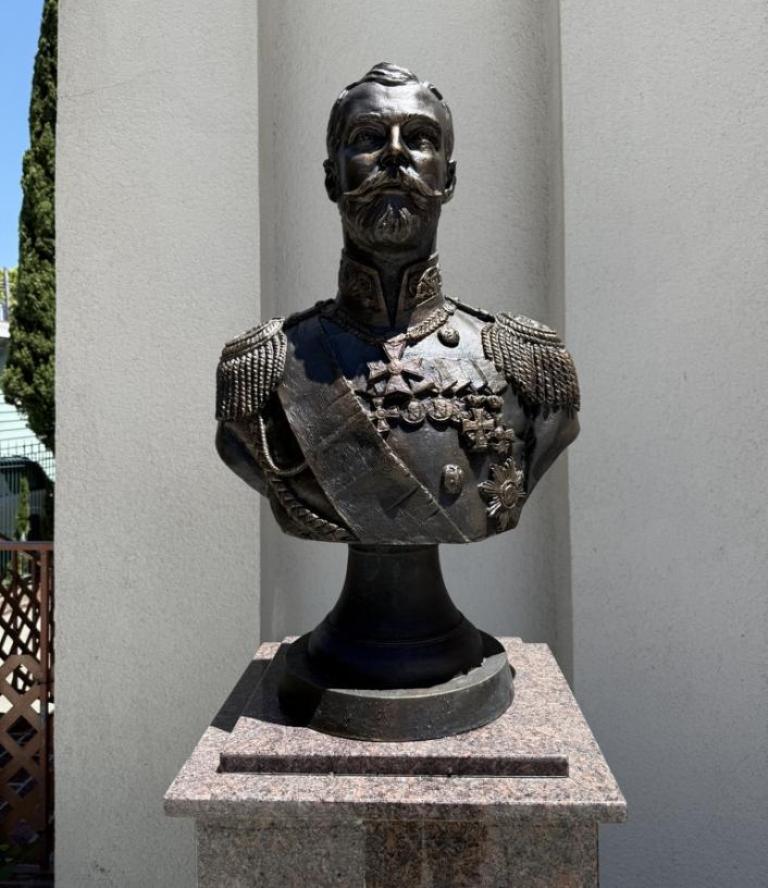
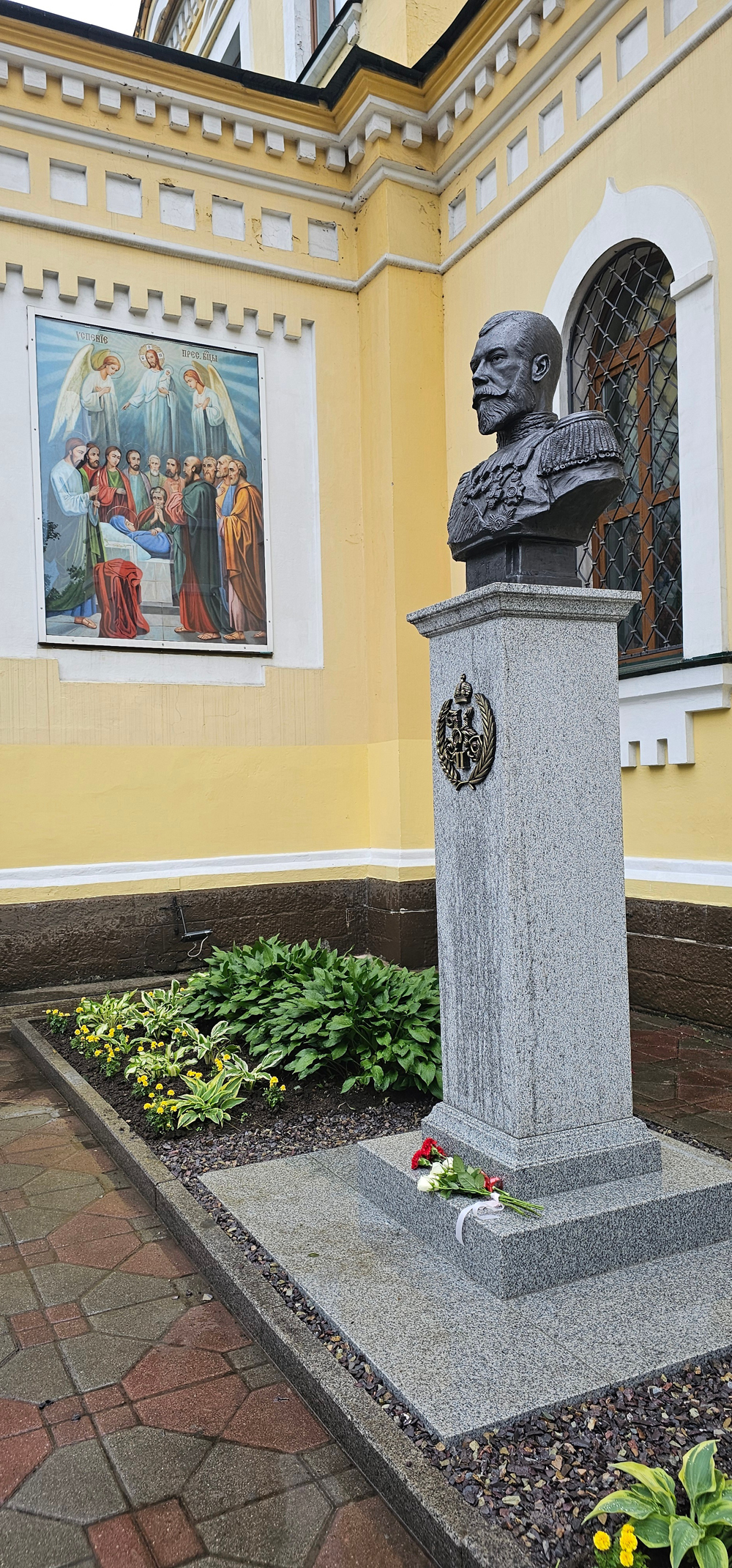
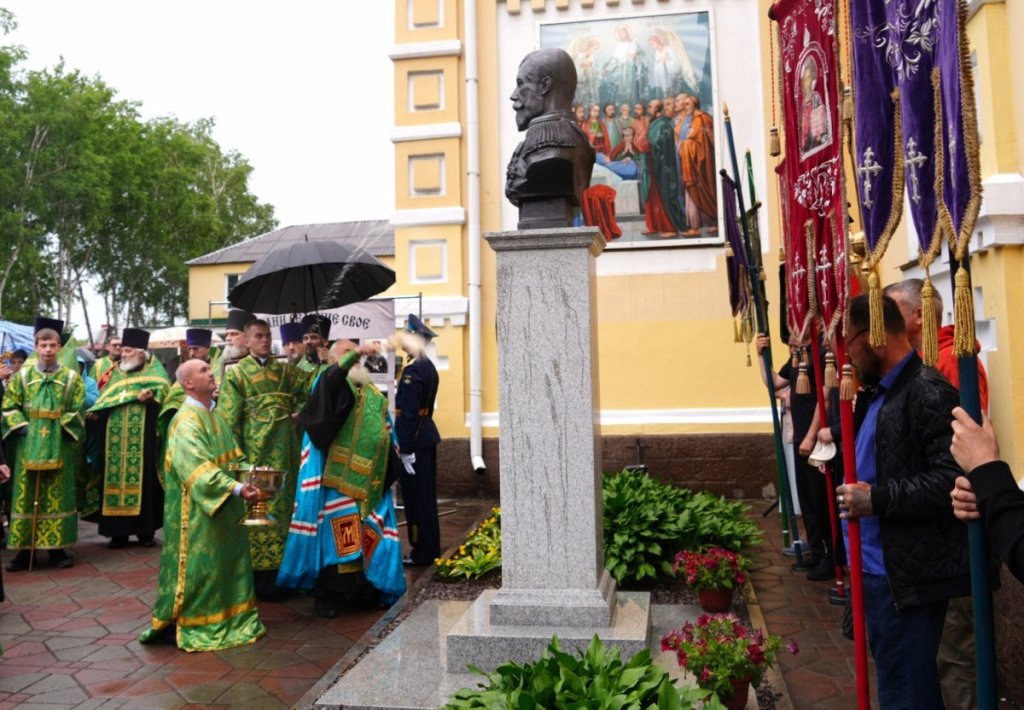
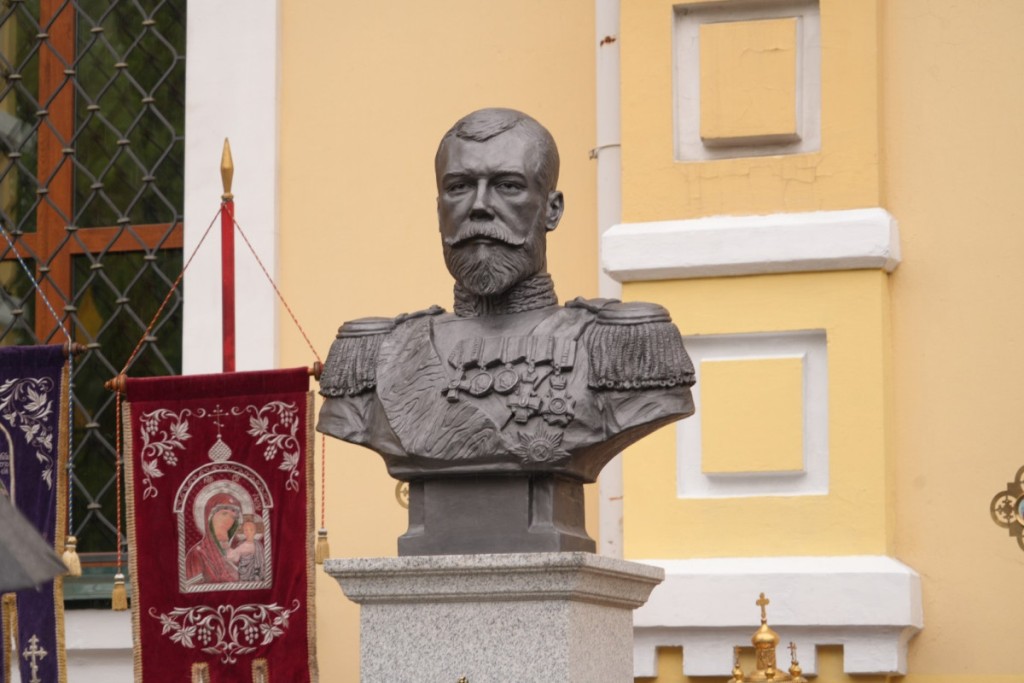
On 5th June 2026, a new bust-monument to Emperor Nicholas II was unveiled and consecrated on the grounds of the Church of the Intercession of the Most Holy Theotokos in the Russian city of Ussuriysk – situated 98 kilometers (61 mi) north of Vladivostok. This is the seventh monument to be installed in Russia in the last six months!

The installation of the bust-monument in Ussuriysk is timed to preserve the memory of the visit of Tsesarevich Nikolai Alexandrovich to Ussuriysk (then the village of Nikolskoye) in May 1891, following his Eastern Journey to India and the Far East. It was during this visit, that the future Emperor of Russia attended a Divine Liturgy in the Cathedral of St. Nicholas the Wonderworker [demolished by the Bolsheviks in 1932].

Before the ceremony, a divine liturgy was held in the church, followed by a cross procession, with the participation of the clergy of the Vladivostok Diocese, parishioners, Cossacks, war veterans, local government officials, parishioners and local residents.

The rite of consecration of the bust-monument was performed by Metropolitan Veniamin (Pushkar).

In his welcome speech, Andrey Podoplelov, Deputy Chairman of the Duma of the Ussuriysk City District, said:

“Today we pay tribute to the man whose name is inextricably linked with the history of our city. It was Nicholas II, who visited Nikolskoye [renamed Ussuriysk in 1935], supported the initiative to assign the status of a city to the village of Nikolskoye. We must remember our history, and the installation of this bust-monument is a sign of continuity and respect for the past of Ussuriysk.”

Elena Lishchyshyna, Acting Deputy Head of Administration, Chief of Staff, further added:

“The opening of this monument is a tribute to the ruler, a tribute to a man who was loyal to Russia, was faithful to his duty, loyal to his people and sincerely believed in God. I hope that our future generations will value their history, remember the great Tsar.” .

The installation of the brozen monument and granite pedestal was made possible thanks to the assistance of the deputy of the Legislative Assembly of the Primorsky Territory Alexander Kirilyuk, who supported the organization and financing of the project. The author of the monument is a sculptor from Vladivostok, a member of the Union of Artists of Russia Ilya Topchiy.

© Paul Gilbert. 5 June 2026

New exhibition to showcase Nicholas II’s wedding uniform

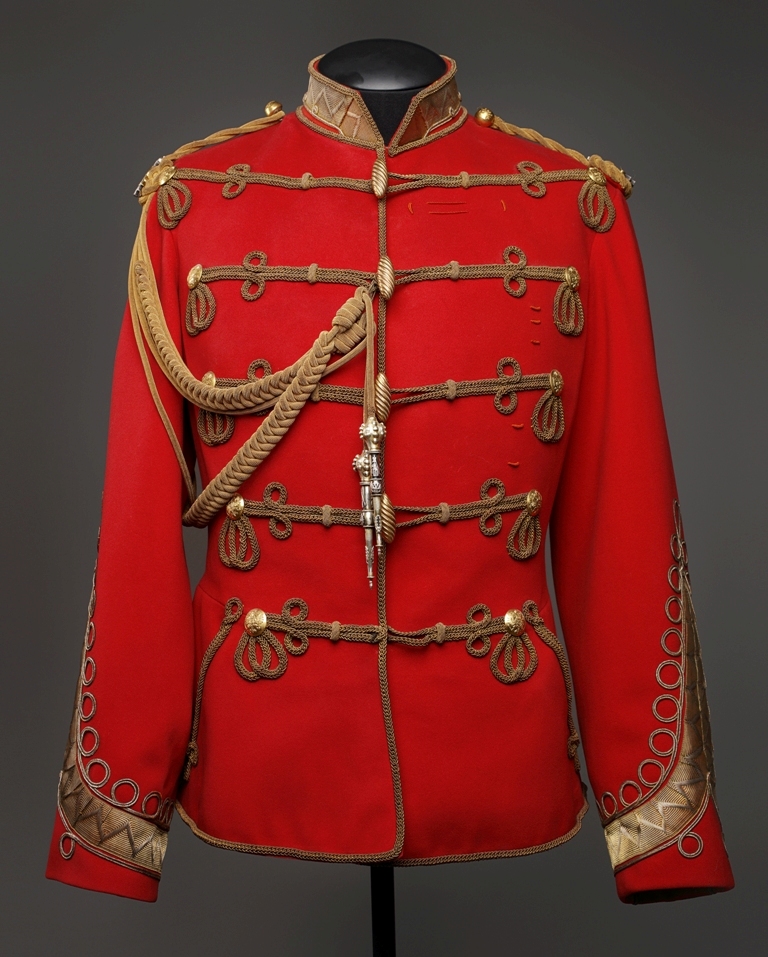
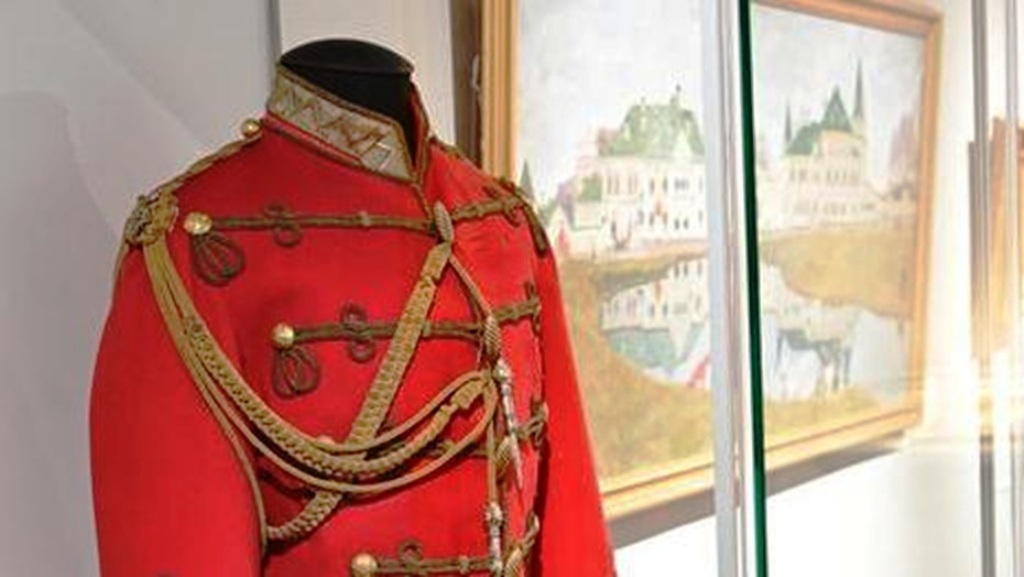
PHOTO: the red uniform of the Colonel of His Majesty’s Hussar Life Guards
Regiment, worn by Emperor Nicholas II at his wedding in November 1894
© Tsarskoye Selo State Museum

On 10th June 2026, a new exhibition Tsarskoye Selo. Masterpieces of the Imperial Residence, will open at the Museum of Fine Arts in Ekaterinburg. The exhibition will showcase some 360 items from the Collection of the Tsarskoye Selo State Museum.

One section of the exhibition will be devoted to Russia’s last Tsar and the Alexander Palace. Among the many historic items is the uniform worn by Emperor Nicholas II at his wedding in November 1894.

His Majesty wore the red dress uniform with medals of the Colonel of His Majesty’s Hussar Life Guards Regiment and an orange sash of the Order of Hesse and by Rhine. Nicholas II served as Regiment colonels-in-chief of the regiment (established in 1775), from the day of his ascension to the throne in November 1894 to his abdication in March 1917.

On the lining of the collar, there is a silk label with the text: “His Majesty was married in this uniform. Save forever.”

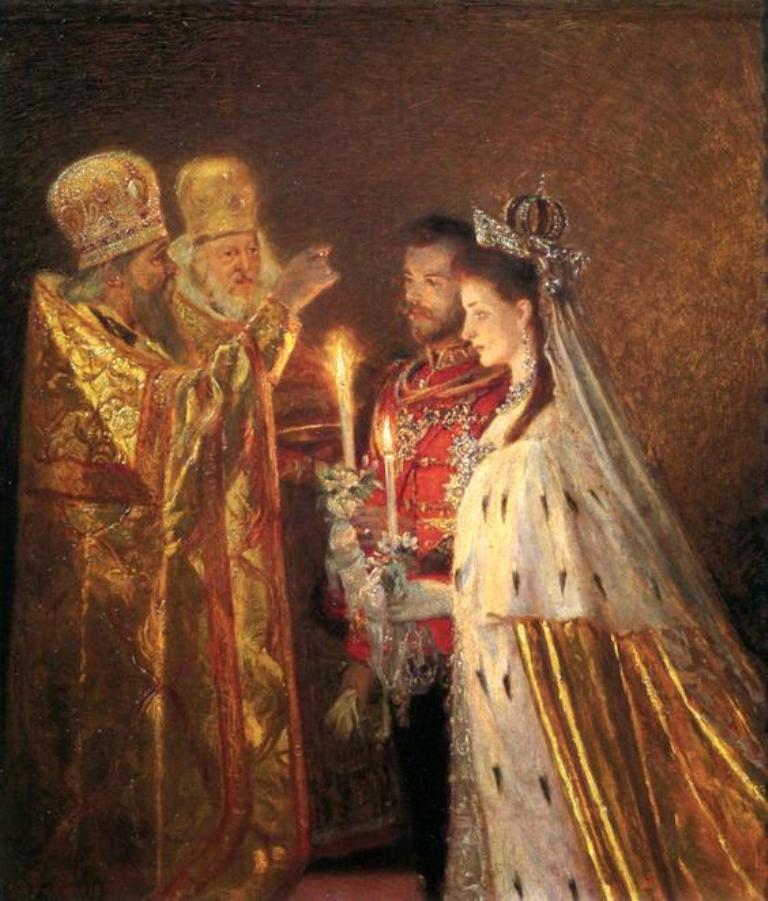
PHOTO: Emperor Nicholas II depicted wearing the red
uniform Colonel of the Life Guards Hussar Regiment, 1894

Recall that the wedding of Emperor Nicholas II and Grand Duchess [future Empress] Alexandra Feodorovna, took place on 27th (O.S. 14th) November 1894. The ceremony took place in the Church of the Saviour Not Made by Hands (the home church of the Imperial Family) of the Winter Palace in St. Petersburg.

The Museum of Fine Arts celebrates it’s 90th anniversary this year – the author of this article visited the museum in July 2018.

The exhibition Tsarskoye Selo. Masterpieces of the Imperial Residence runs until 16th August 2026 at the Museum of Fine Arts in Ekaterinburg.

© Paul Gilbert. 4 June 2026

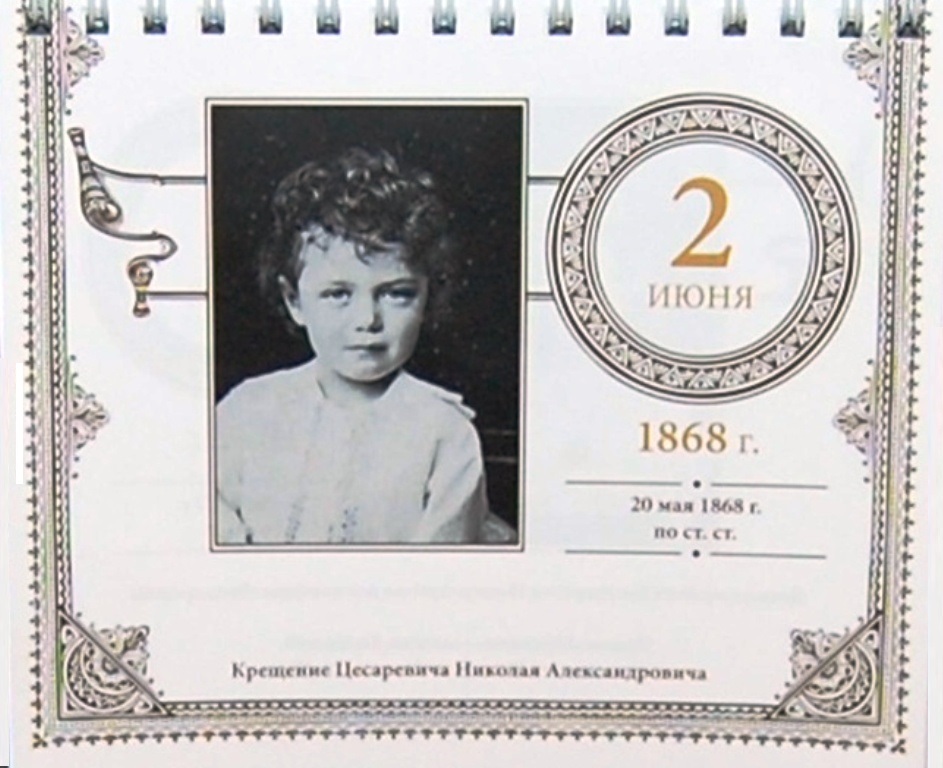
The baptism of Russia’s last Tsar – 2nd June 1868

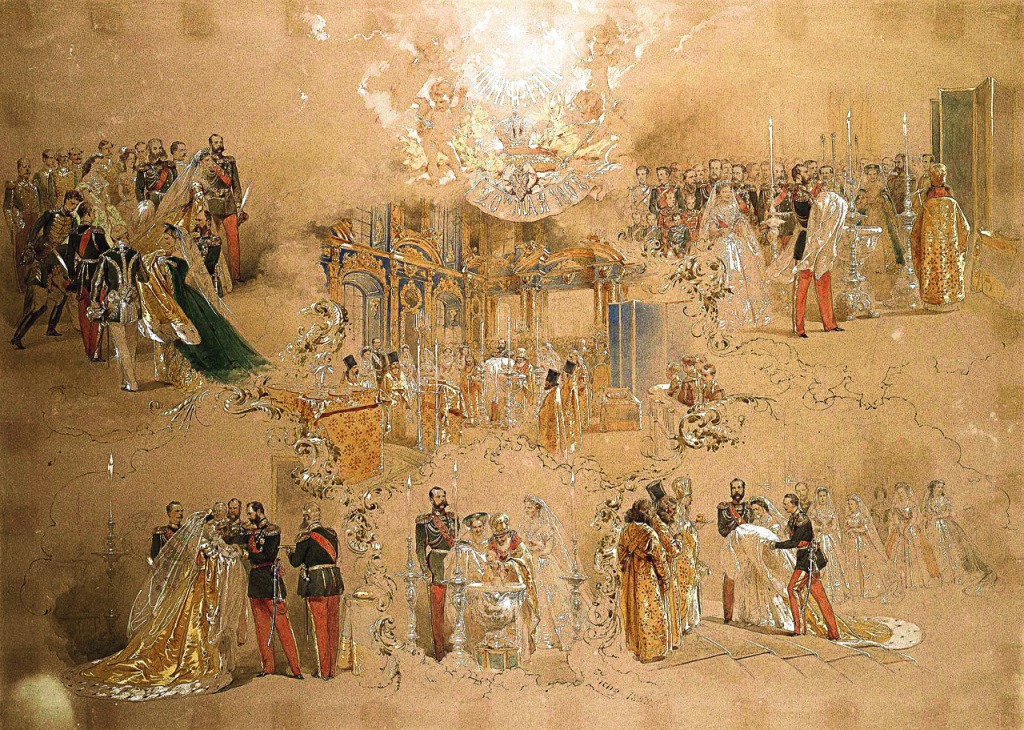
PHOTO: the baptism of Grand Duke Nicholas Alexandrovich [future Tsesarevich and Emperor] on 2nd June (O.S. 20th May) 1868, by Mihály Zichy (1827-1906). The watercolour depicts four baptismal scenes, and two of them show Alexander II holding his grandson in his arms.

On 2nd June (O.S. 20th May) 1868 two weeks after his birth on 19th (O.S. 6th) May 1868 – His Imperial Highness Grand Ouke Nicholas Alexandrovich was baptised in the Church of the Resurrection of Christ in the Catherine Palace at Tsarskoye Selo. The baptism was performed by the Imperial family’s confessor Protopresbyter Vasily Bazhanov (1800-1883).

The boy received the traditional name for the House of Romanov – Nicholas. He was named in memory of his father’s elder brother and mother’s first fiancé, Tsesarevich Nikolai Alexandrovich (1843-1865), who died at the age of 21, from cerebro-spinal meningitis.

“You can’t imagine how happy Minnie [future Empress Maria Feodorovna] and I are to be able to name our first child Nicholas,” Tsesarevich Alexander Alexandrovich [future Emperor Alexander III] wrote to his uncle Grand Duke Mikhail Nikolaevich (1832-1909) – “and how dear that name is to both of us, after so many sad memories of poor Nyx.”

The infant’s paternal grandfather Emperor Alexander II echoed his son’s joy in a letter to the Danish king and the maternal grandfather of the newborn Christian IX: “The birth of little Nicholas was also the fulfillment of all our prayers, and you will surely understand why we gave him this name, which is doubly dear to us.”

Emperor Alexander II, took a very active role in the solemn ceremony. He clearly understood that not only was this his first grandson, but also that a future Emperor was being baptised. It is noteworthy that during the baptism, both Alexander II and his son, Tsesarevich Alexander Alexandrovich, acted as assistants to the lady of state. The fact that the father, breaking tradition, took an active part in the baptism[1], apparently, was due to its historic significance. Two emperors, current and future, held their successor in their arms, strengthening the foundation of the infant’s legitimacy[2].

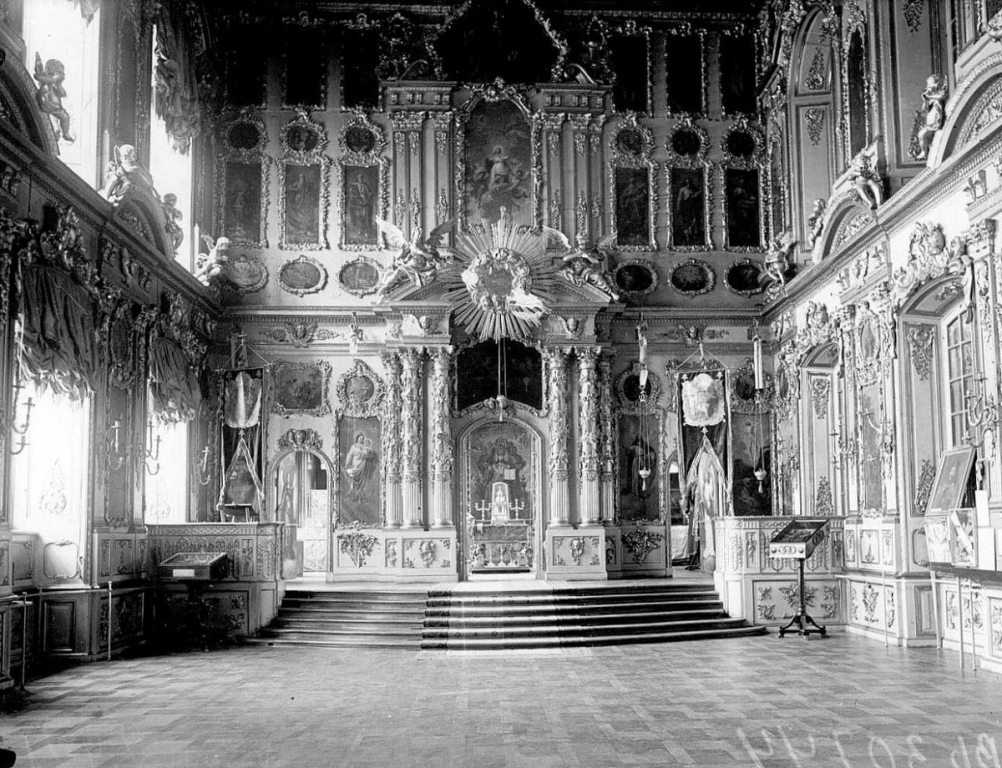
PHOTO: late 19th century view of the Church of the Resurrection
of Christ in the Catherine Palace at Tsarskoye Selo

As for the mother [future Empress Maria Feodorovna], she did not have the right to be present at the baptism of her baby at all [in accordance with a tradition that originates in the Old Testament]. However, even if Maria Fedorovna wanted to break the custom, she could not do so, due to the fact that her doctors advised her not to walk following the birth of her son, and instructed her to rest on that eventful the day. [3]

The infant’s godparents were the newborn’s grandfather, Emperor Alexander II, maternal grandmother, Queen Louise of Denmark, his uncle, Crown Prince Frederick of Denmark, and Grand Duchess Elena Pavlovna[4].

It was Alexander II and Grand Duchess Elena Pavlovna, who carried the baby to the font for baptism. In addition, Nicholas Alexandrovich’s godparents, his Danish grandmother and uncle, Queen Louise and Crown Prince Friedrich took part.

Tsesarevuch Alexander Alexandrovich described the day’s events as follows:

“The entrance was magnificent, and there were a lot of people in the palace and also in the garden. The little one was transported in a golden carriage with much pomp and ceremony, accompanied by an escort on horseback.”

During the ceremonial procession through the halls of the Catherine Palace at Tsarskoye Selo, the newborn was carried to the palace church by the lady of state Princess [Alexandra Aleekseevna] Kurakina (1840-1919), supported on the one side by the State Chancellor Prince [Alexander Mikhailovich] Gorchakov (1798-1883), and on the other by Field Marshal Prince Alexander [Ivanovich] Baryatinsky (1815-1879) – both old and lame, but they endured excellently and helped as much as they could.

“The exit was magnificent, and , still there were a lot of people in the palace and also in the garden,’ Tsesarevich Alexander described the day of his son’s christening to Grand Duke Mikhail Nikolayevich. – “Tsarskoye Selo was unrecognizable that day; the streets were full of people and carriages, the whole city is celebrating. At 5 o’clock, a large banquet was held in the Great Hall, which was lit splendidly by the sun. It’s been a very tiring day, and poor Mama [Empress Maria Alexandrovna] is very tired. After the baptism, the entire family gathered at my place [the Alexander Palace] to congratulate Minnie [Grand Duchess Maria Feodorovna], and all little ones were there too. An excellent breakfast was served, and then everyone went home.”

Nearly 13 years later, in March 1881, Grand Duke Nicholas Alexandrovich became the Heir Tsesarevich, and in October 1894, he became Russia’s last Emperor and Tsar.

Prince Pyotr Vyazemsky (1792-1878), a poet and friend of Alexander Pushkin, dedicated the poem “May 6, 1868” to the birth of Grand Duke Nicholas Alexandrovich – future Emperor Nicholas II, referring to the infants feelings of his paternal grandmother, Empress Maria Alexandrovna:

Yesterday, a beauty, you are a grandmother today.
Yes, grandmother! So what is it? Great, good luck!
Providence has rewarded you with the cherished blessing.
We admired the Empress Mother in you,
We admire the Tsarina-grandmother twice.
To the family crown and to the imperial crown
A living flower clings to it, a native treasure.

Your grandmother’s name, of course, does not suit you,
But in this word you have such a charm of sound,
There’s so much love in him, so much happiness in him
That, blessing your grandson with a joyful tear,
You are young in heart, as young in face.
And your feelings, and your joy,
Having responded with its soul, Russia is no stranger to
And prays with you over the sweet cradle,
In which the star of the future glows.

NOTES:

[1] According to Orthodox tradition at that time, the father was required to leave the church at the time of the baptism of his child, giving way to the godfather. Emperor Nicholas II was not in the church when his son Alexei was baptised in August 1904.

[2] Zimin, Igor Viktorovich. Children’s world of imperial residences. Life of monarchs and their environment. Baptism of children. 2010

[3] Ibid.

[4] Grand Duchess Elena Pavlovna (1807-1873), born Princess Charlotte of Württemberg, the wife of Grand Duke Michael Pavlovich, the youngest son of Emperor Paul I and Duchess Sophie Dorothea of Württemberg – later Empress Maria Feodorovna.

© Paul Gilbert. 2 June 2022 – UPDATED on 2 June 2026

***

I am dedicated to clearing the name of Russia’s much slandered Tsar. If you enjoy all the articles, news, photos, and videos on my blog, please help support my work in the coming year ahead by making a donation. I am reaching out to friends and followers with a request for making a small $5 or $10 donation in aid of my research.

These donations are of great assistance in helping me offset the cost of obtaining and translating documents from Russian archival and media sources, which are often paid for out of my own pocket. It is these documents which help present new facts and information on the life and reign of Nicholas II. In addition, my research continues to debunk many of the myths and lies which exist more than a century after Nicholas II’s death and martyrdom.

As a token of my gratitude, please accept a copy of my 22-page booklet Nicholas II Bibliography – it’s FREE! My 2026 edition features a NEW 4-page article about Nicholas II’s libraries and book collection; 8 black and white photos; and a list of more than 125 English-language books on the life and reign of Nicholas II.

Please note, that there is NO obligation, the booklet is FREE to every one! ENJOY!

CLICK HERE TO MAKE A DONATION
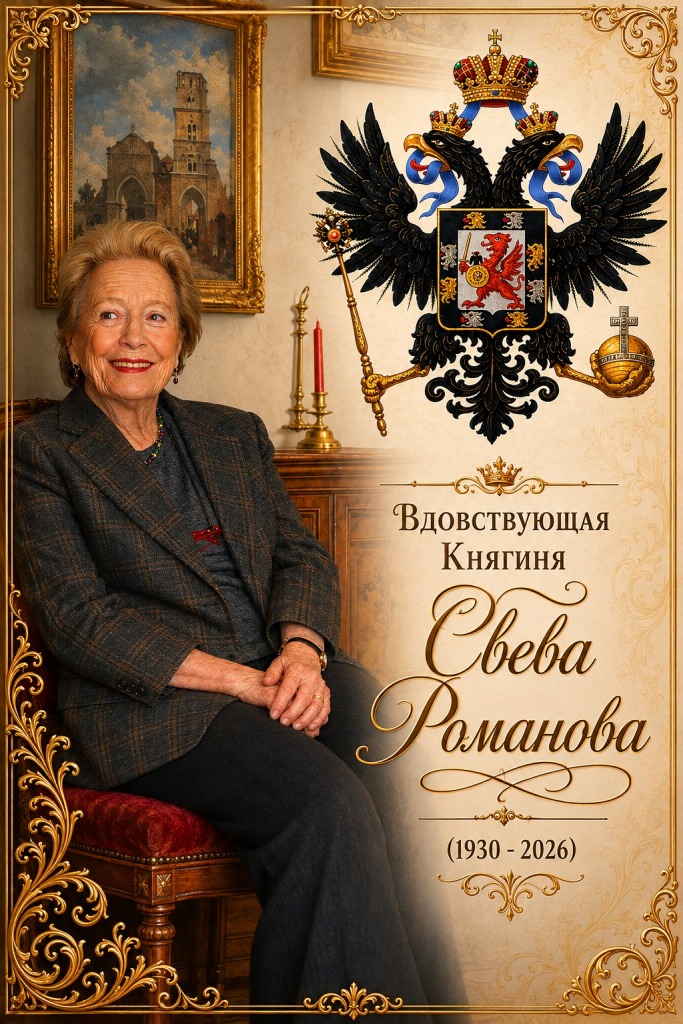
Obituary: Princess Sveva della Gherardesca (1930-2026)

On 31st May 2026, Princess Sveva della Gherardesca (1930-2026), died at the age of 95.

Born Countess Sveva della Gherardesca in Tuscany, Italy, she is a representative of the famous aristocratic Italian family, a member of the Romanov family by marriage, widow of Prince Nicholas Romanovich (1922-2014) – who served as Head of the House of Romanov and President of the Romanovs Family Association.

She was born on 15th July 1930, together with her twin brother Manfredi (1930-1955) to the family of Count Walfredo della Gerardeski (1894-1953) and his wife Countess Nicoletta, born di Picoletti (1898-1970). Through her paternal line, she is a descendant of the famous Italian aristocratic family of counts della Gerardesco, known since the 10th century and sung about in Dante’s famous poem “The Divine Comedy“. Through her maternal grandmother, she is a descendant of the American President Martin Van Buuren.

Countess Seva’s childhood was spent on a family farm in rural Tuscany, where her father was engaged in cattle breeding and winemaking. She recived a private home education with her brother. She spoke three languages: French, Italian and English. During a party in Rome in 1950, she met her future husband Prince Nicholas Romanovich, the eldest son of the Prince of Imperial Blood Roman Petrovich and Princess Praskovia Dmitrievna, born Countess Sheremeteva.

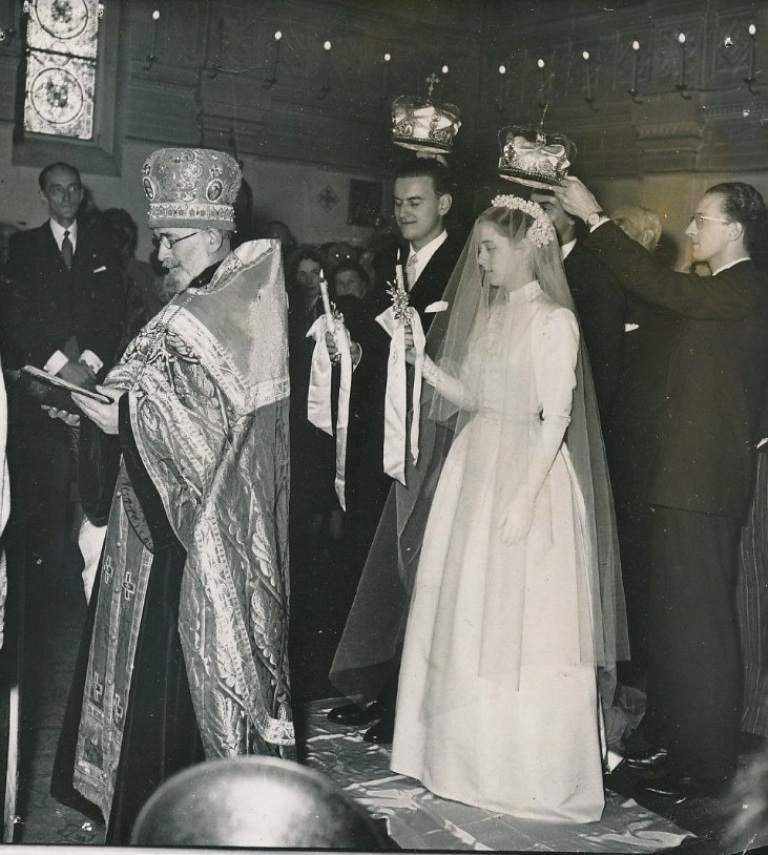
PHOTO: Prince Nicholas Romanovich and Countess Sveva della Gherardesca married in St. Michael the Archangel Church in Cannes, France on 21st January 1952

The couple married on 21st January 1952 in St. Michael the Archangel Church (Russian Orthodox) in Cannes, France, while a civil marriage took place on 31st December 1951 in Florence, Italy.

Prince Nicholas and his wife had three daughters:

  • Natalia Nikolaevna (b. 1952), who married Giuseppe Consolo (b. 1948) in 1973, and had two children;
  • Elisabeth Nikolaevna (b. 1956), who married Mauro Bonacini (b. 1950) in 1982, and had two children;
  • Tatiana Nikolaevna (b. 1961), who married Gian Battista Alessandri (b. 1958) in 1983, divorced in 1988, remarried Giancarlo Tirotti (b. 1947), and had one child.

From 1955, Princess Sveva lived with her husband and their children on the family farm in Tuscany.

“My husband had to take over the management of our large family farm in Tuscany. Imagine, the heir to the Russian Imperial House, who had never worked in agriculture, had to learn to be a farmer, a real peasant! We grew vegetables, fruits, we made wine. . . . Oh, what a difficult time it was… At the time in Italy, the “Fascists” were popular, and the mayor of our commune was a communist! He was constantly putting sticks in Nikolai’s wheels – constant bans and money collectors. When the children were grown and we got got older, we said to ourselves: “That’s it, let’s retire!” We sold the farm in Tuscany and moved to Switzerland.”

Since 1980, the couple lived seven months of the year in the towns of Ruzmont, Switzerland and the other five months in Italy with their daughters. Princess Sveva first visited Russia in June 1992, when her husband acted as a translator for a business group. In July 1998, she took part in the ceremony of the burial of the remains of Emperor Nicholas II and his Family in the SS Peter and Paul’s Cathedral, and in September 2006, attended the reburial ceremony of Empress Maria Feodorovna in Copenhagen and St. Petersburg. Up until her death, she lived in the town of Bolgeri, near Tuscany.

“She lived a full life surrounded by the love of family and friends. We were fortunate to have her as part of our family, and her example enriched our lives in countless ways. Today, we mourn the passing of an extraordinary woman, a living link to another era, a true princess, and one of the last representatives of a generation defined by dignity and a profound sense of duty.

“She leaves behind countless cherished memories and a legacy of love that will live forever in the hearts of all who had the privilege of knowing her,” wrote her niece, Foteini Filippovna, wife of Prince Rostislav Rostislavovich of Russia.

© Paul Gilbert. 1 June 2026