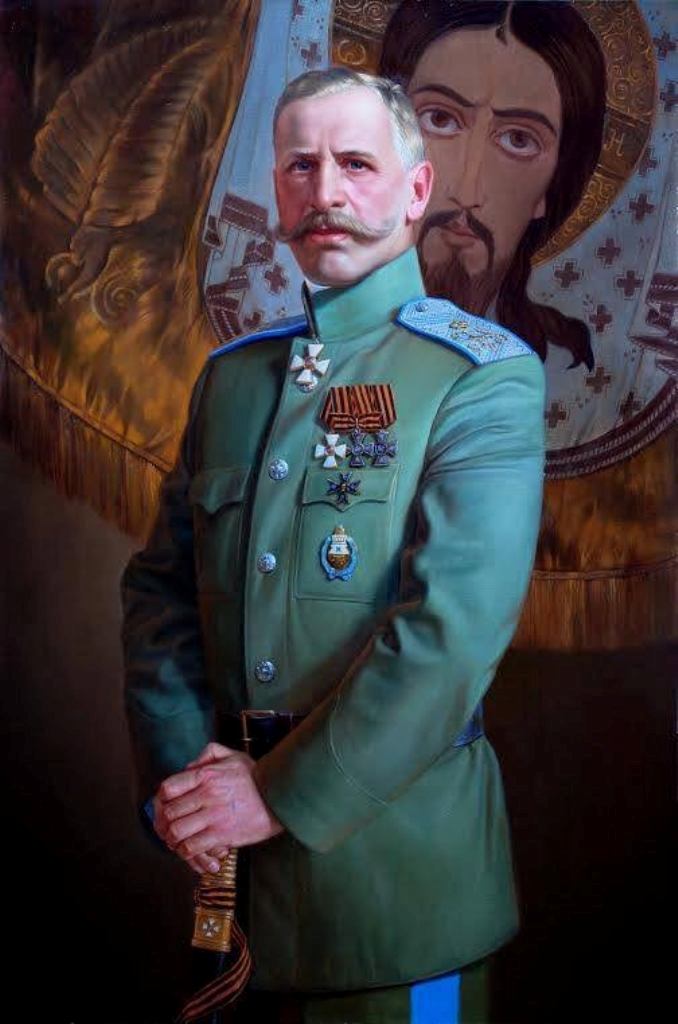
General Count Fyodor Arturovich Keller (1857-1918) Artist: Philipp Moskvitin
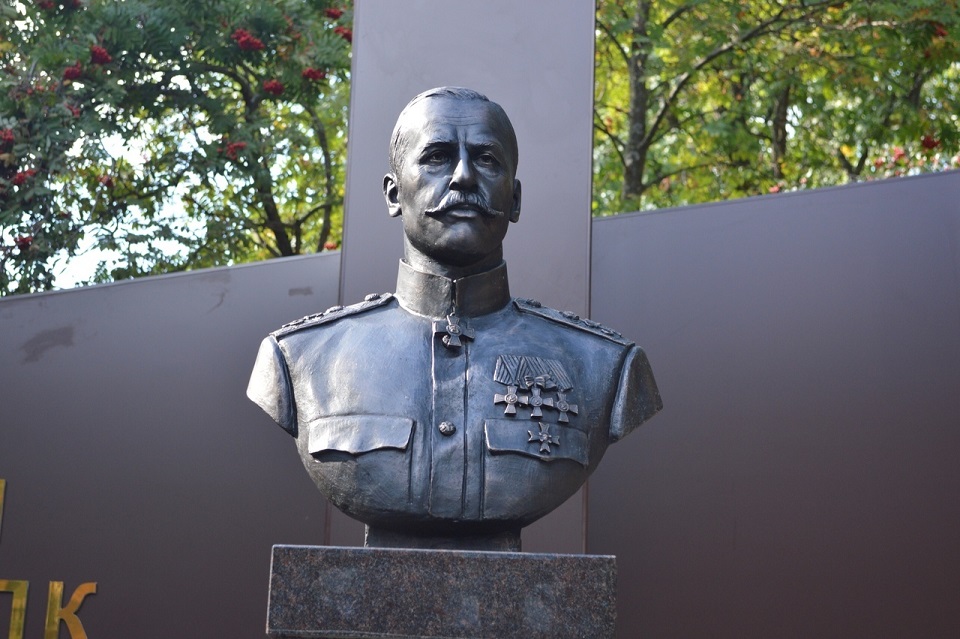
On 5th September, Russia’s first monument to General Count Fyodor Arturovich Keller (1857-1918) was established in Peterhof, where the Izmailovsky Life Guard Regiment, which had been under Keller’s command from 1906, had been housed before the 1917 Revolution.
Sadly, the barracks have only been partially preserved, and currently house the Military Institute of Railway Troops and Military Communications, where there is also a museum dedicated to the history of Izmailovsky Life Guard Regiment. It is here that the monument to their legendary commander was established.
The sculpture was made by Moscow sculptor Victoria Alexandrovna Tishchenko (born 1986), the completion of the project is thanks to the efforts of the Emperor Alexander III Educational Society.
PHOTO: Monument to General Count Fyodor Arturovich Keller, Peterhof
PHOTO: Monument to General Count Fyodor Arturovich Keller, Peterhof
General who did not betray Nicholas II
The abdication of Nicholas II, continues to be shrouded in controversy, myths and lies. Western academically lazy historians have led us to believe that the Tsar was betrayed by all of his generals in the days leading up to his abdication.
This is incorrect.
Aside from General Count Fyodor Arturovich Keller (1857-1918), Generals Nikolai Ivanov (1851-1919) and Commander of the Guard Cavalry Corps Huseyn Khan Nakhchivanski (1863-1919), a Muslim by religion, turned out to be the three Tsarist generals, who remained loyal to the emperor and refused to swear allegiance to the Provisional Government.
Nakhchivanski and Keller sent telegrams to the Tsar at Mogliev expressing their loyalty to Nicholas II, and offering their troops to defend the monarchy. Neither telegram ever reached their sovereign, having been intercepted by supporters of the Provisional Government.
Keller was shot by Petliurists on 21st (O.S. 8) December 1918. His body was buried under a false name in the Intercession Monastery in Kiev. His grave has not been preserved.
I am pleased to present these new photographs of the ongoing reconstruction of the historic interiors and the recreation of their respective furnishings and elements of the Private Apartments of Emperor Nicholas II and Empress Alexandra Feodorovna, situated in the eastern wing of the Alexander Palace.
These images are courtesy of Studio44, ArtCorpus interiors, and Stavros (St. Petersburg), the firms commissioned to carry out this important project.
According to Stavros, the reconstruction of the Mauve (Lilac) Boudoir is nearing completion, including the installation of the wall panels, doors and furniture. The next stage is the launch of the production of furniture for the Maple Drawing Room.
Reconstruction of the Mauve (Lilac) Boudoir
Mauve (Lilac) Boudoir
Mauve (Lilac) Boudoir
Mauve (Lilac) Boudoir
Mauve (Lilac) Boudoir
Mauve (Lilac) Boudoir
Reconstruction of the Maple Drawing Room
Maple Drawing Room
Maple Drawing Room
Maple Drawing Room
Maple Drawing Room
Maple Drawing Room
Reconstruction of Nicholas II’ Bathroom
Nicholas II’s Bathroom
Nicholas II’s Bathroom
Nicholas II’s Bathroom
The Alexander Palace, has been closed for restoration since August 2015. The palace was scheduled to reopen in July 2018, however, numerous delays have pushed now back the reopening date to the end of 2019.
For more articles and photographs of the reconstruction and recreation of the historic interiors of the Private Apartments of Emperor Nicholas II and Empress Alexandra Feodorovna in the Alexander Palace, please refer to the following:
VIDEO: The consecration of monument to Alexander II in the presence of Emperor Nicholas II, Kiev 30th August 1911. Duration: 11 minutes, 17 seconds. Music.
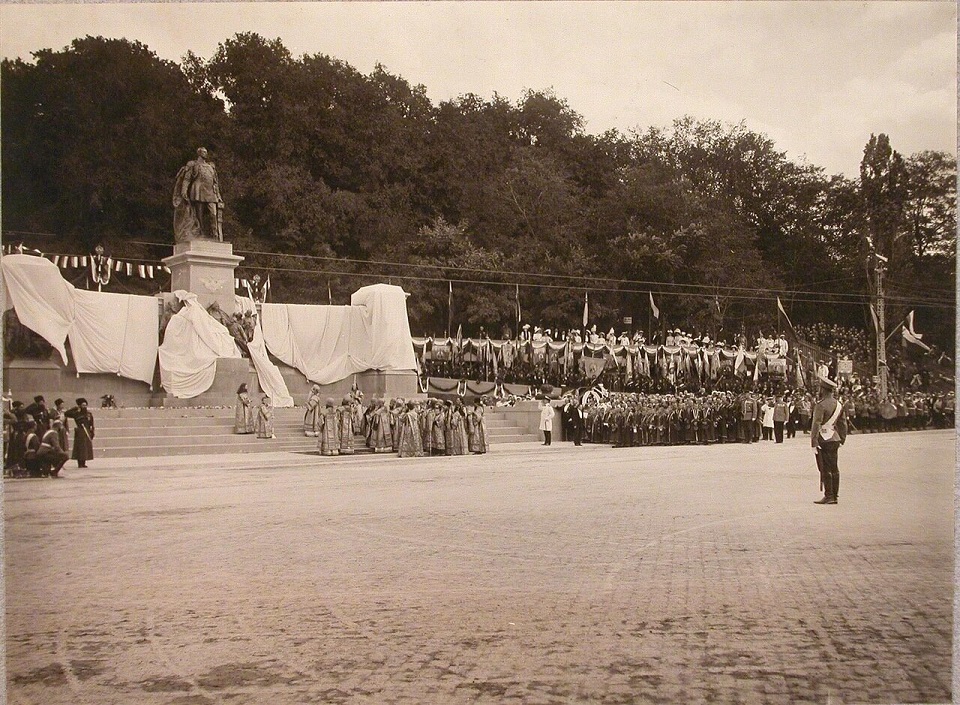
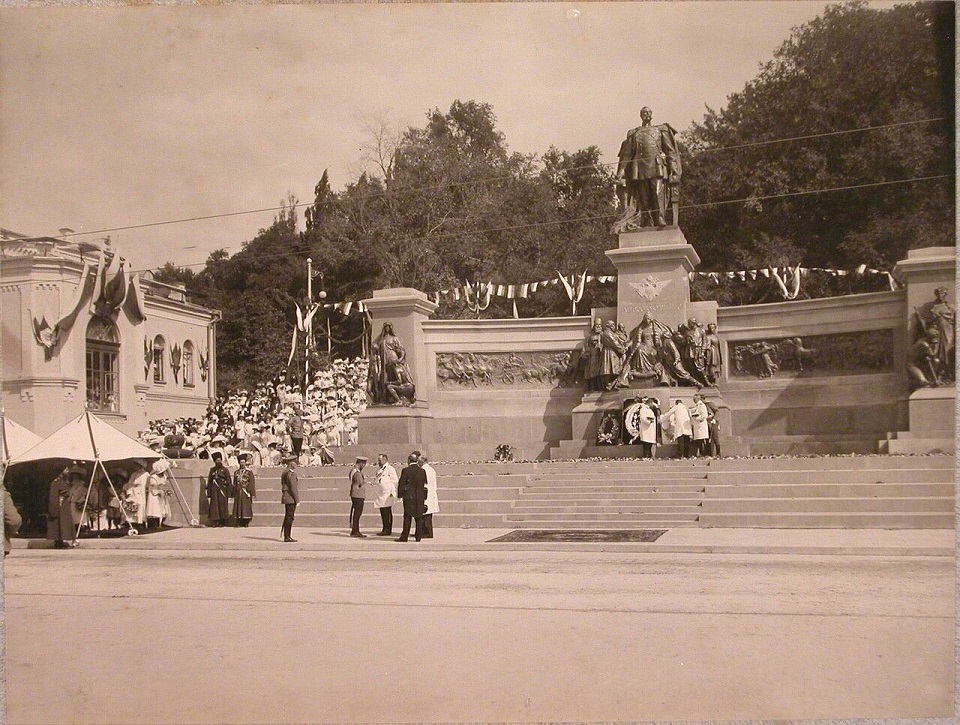
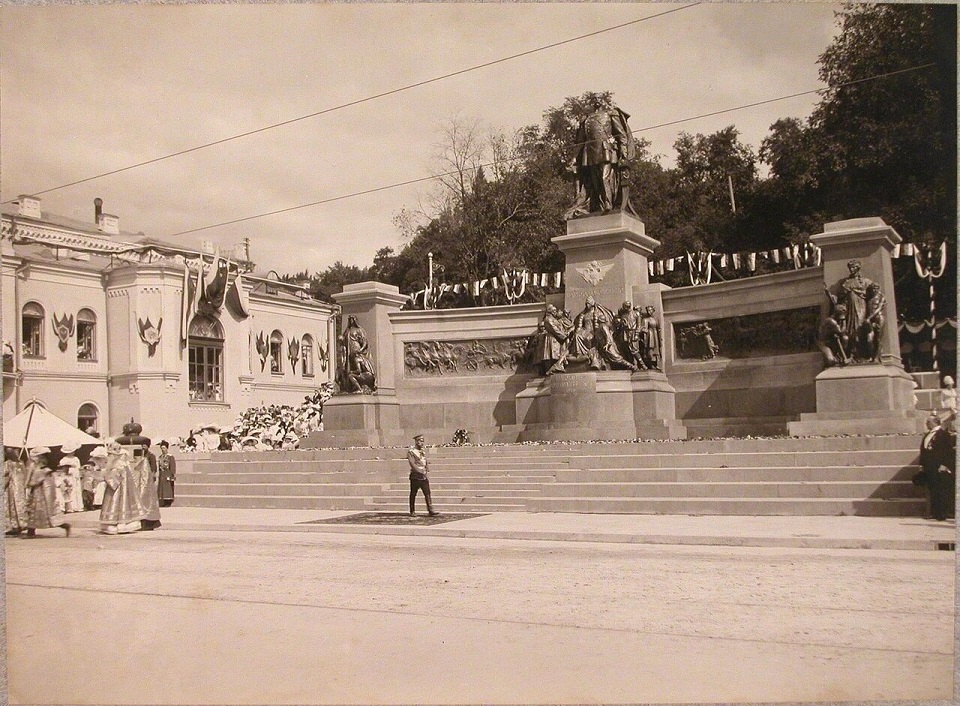
In 1911, a monument to Emperor Alexander II by the sculptor Ettore Ximenes and architect Hippolyte Nikolaev, was established in Kiev. The monument was established in connection with the 50th anniversary of the abolition of serfdom and was the largest monument to Alexander II in the Russian Empire.
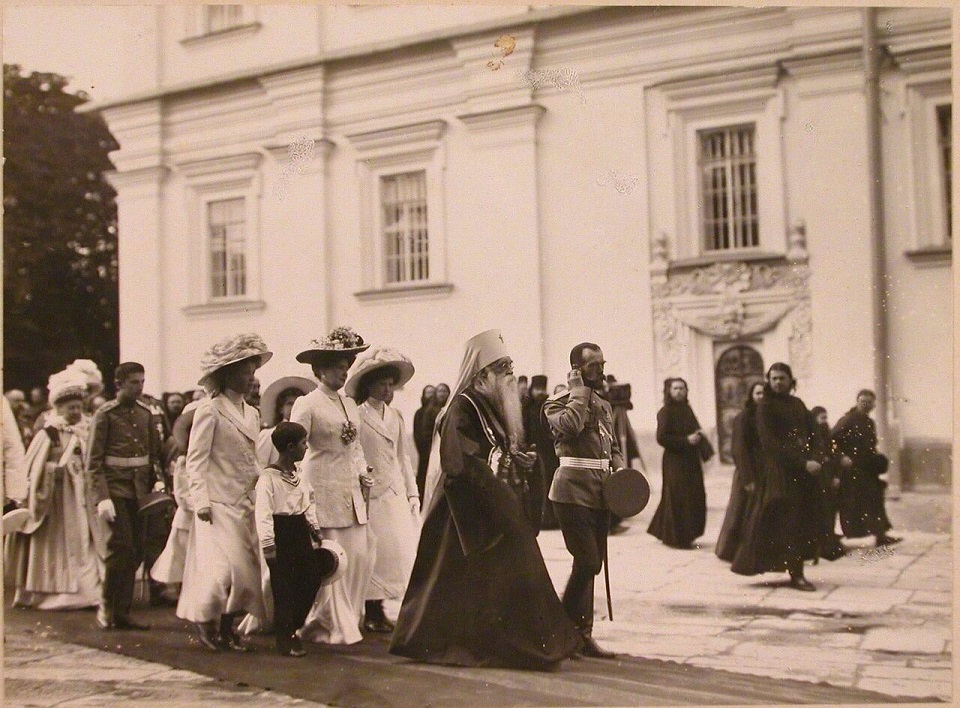
Photo: Emperor Nicholas II, Metropolitan of Kiev, members of the imperial family including Empress Alexandra Feodorovna and her five children, and Crown Prince Boris of Bulgaria
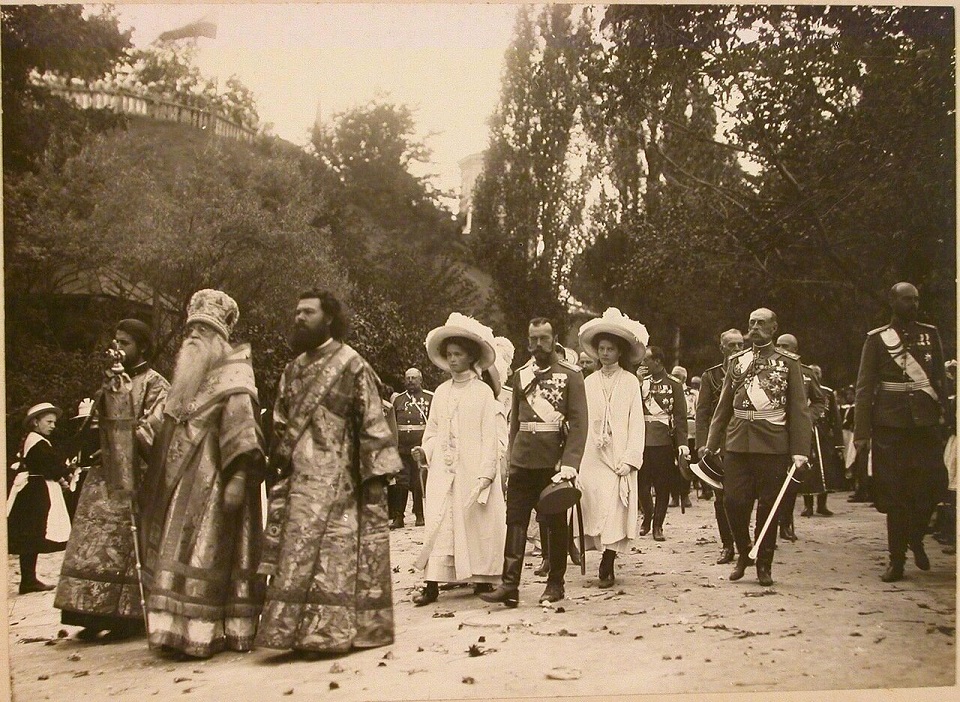
Photo: Members of the Clergy, Emperor Nicholas II, Grand Duchesses Olga (left) and Tatiana (right), Minister of the Imperial Court Count V. B. Frederiks (second right), and Grand Duke Sergei Mikhailovich (far right)
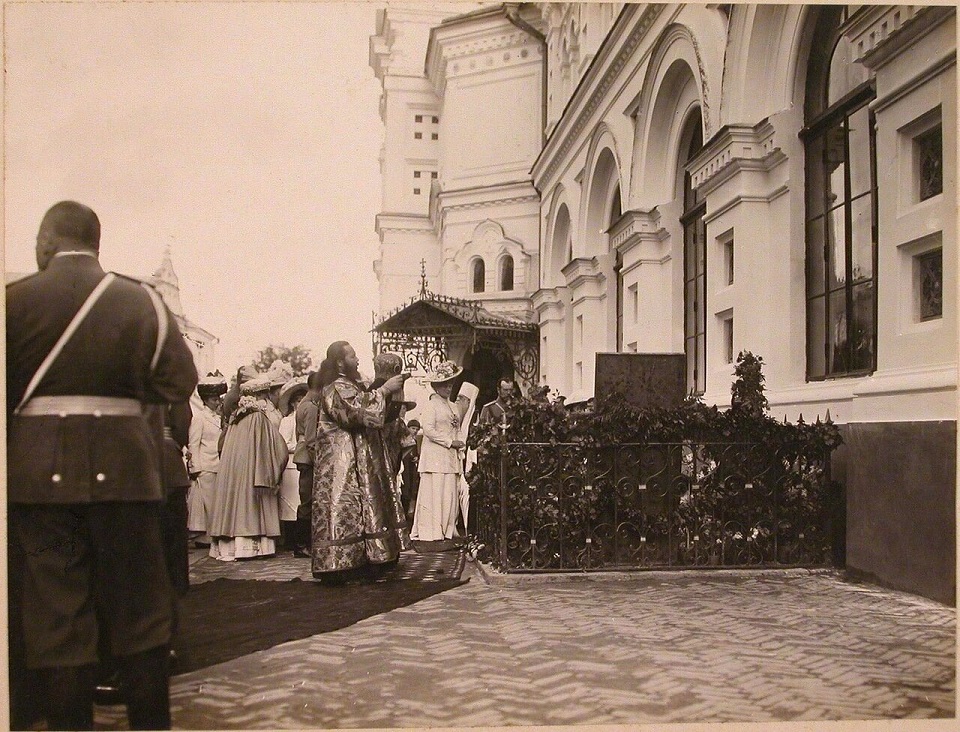
Photo: Emperor Nicholas II, Empress Alexandra Feodorovna, Grand Duchesses, members of the Clergy at the tomb of Iskra and Kochubey, in the Kiev Pechersk Lavra
Description
The monument to Alexander II was located in the central part of Kiev, on Tsarskaya Square at the entrance to the Merchants Garden.
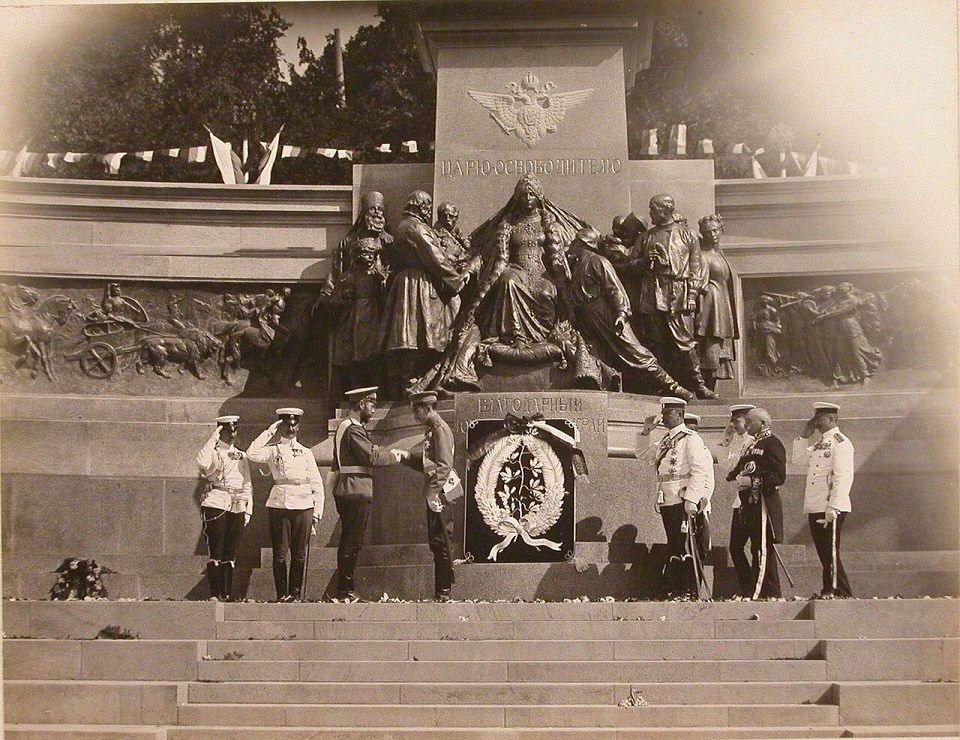
The monument consisted of three pedestals. On the central tower stood a bronze statue of the emperor. He was depicted in full height in a uniform and a mantle thrown over his shoulders, in his right hand he held the Manifesto on the abolition of serfdom, his other hand resting on the arm of his throne. Around the monument on the lower pedestal was a bas-relief depicting peasants – representatives of the peoples of the empire in national costumes, among which stood out the figure of a woman in traditional Russian costume symbolizing Russia.
The central pedestal was decorated with the emblem of the Russian Empire – a two-headed eagle – and the inscription: “The South-Western Territory is grateful to the Tsar-Liberator. 1911″. In front of the flank pedestals, sculptural compositions of Mercy and Justice were installed. All three pedestals were united by a wide pediment with bas-reliefs depicting individual moments of the emperor’s life and work. The pedestal was made of pink granite, the steps of grey granite. Imperial bronze crowns were installed on the side ledges of the steps
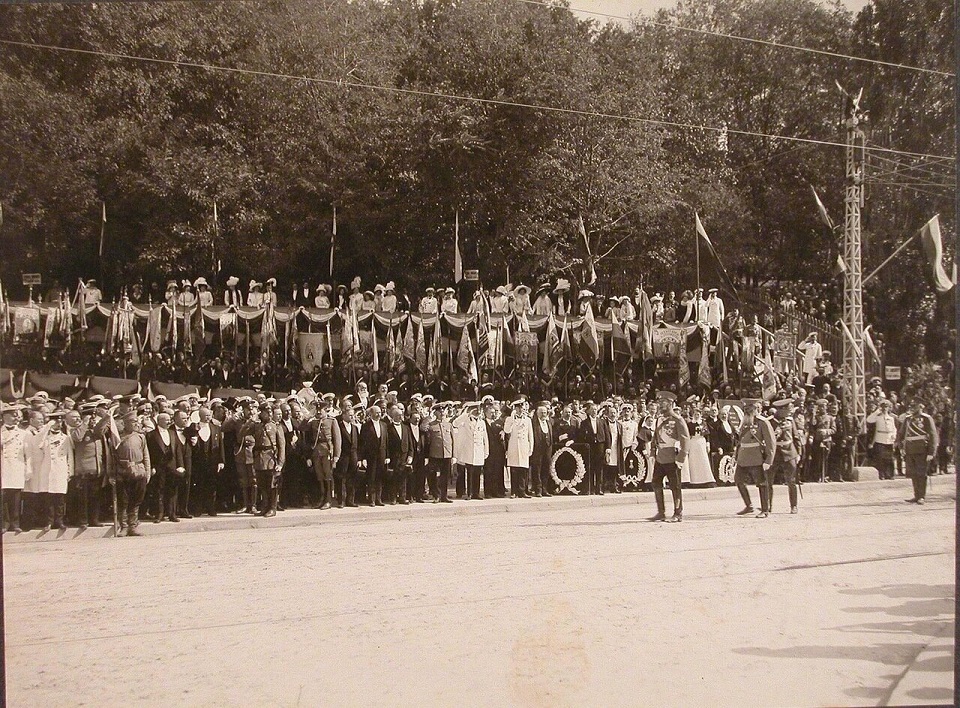
Photo: Participants at the opening ceremony of the monument before the parade
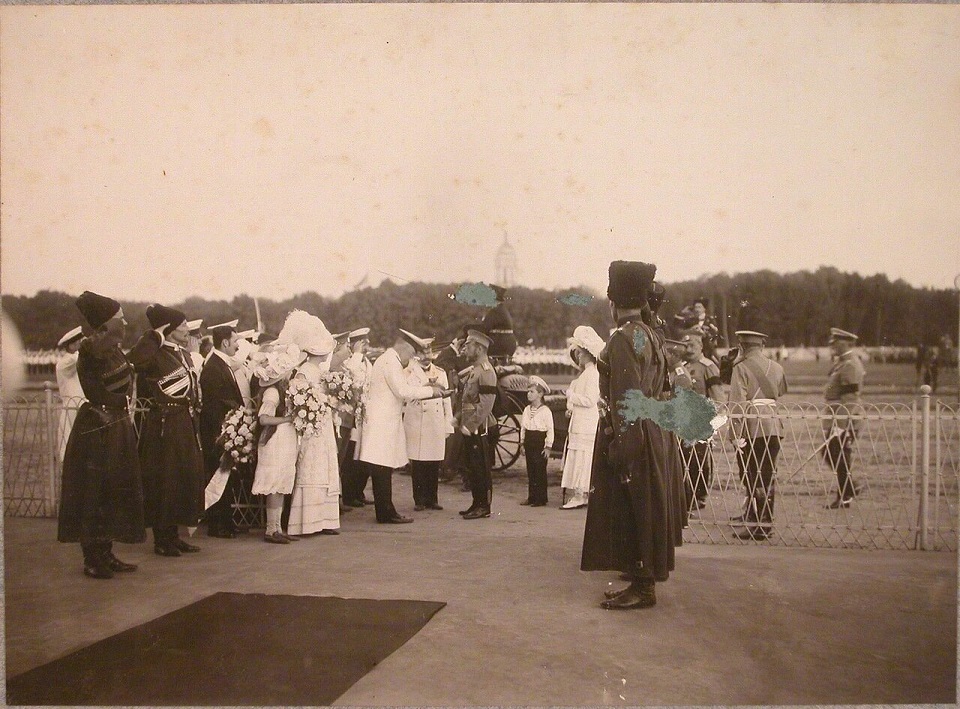
Photo: The mayor of Kiev brings the traditional bread and salt to Emperor Nicholas II
Photo: A moleben is performed at the monument to Emperor Alexander II
Consecration
A visit to Kiev by Emperor Nicholas II with his family and members of the Imperial Court was scheduled for August 1911. The delegations prepared a special program of events during their stay in Kiev, including solemn prayers, theatre visits, troop reviews, a walk along the Dnieper to Chernigov among other events. The main event of the program and the main purpose of the tsar’s visit to Kiev was the opening of the monument to Alexander II on Tsarskaya Square.
The construction of the monument to Alexander II was completed. Triumphal arches were built. The streets and the facades of buildings were richly decorated with flags, wreaths and buntings. Troops of the Russian Imperial Army arrived in the city to participate in manoeuvres.
Nicholas II arrived to open the monument to his grandfather in late August 1911. The ceremony itself took place on 12th September (O.S. 30th August) 1911), the day of memory of the Holy Prince Alexander Nevsky, in whose honour his emperor grandfather Alexander Nikolaevich was named. The monument was opened in the presence of Emperor Nicholas II and members of his family, Prime Minister Pyotr Stolypin , Chief Prosecutor of the Holy Synod Vladimir Sabler , chief of the gendarmes Kurlov, Minister of Education Kasso, son and heir of Tsar Ferdinand I of Bulgaria, government and Court officials, representatives of the Austro-Swedish and Swiss consulates. During the festivities, citizens received postcards with photographic reproductions of the monument.
Sadly, the celebration on the occasion of the unveiling of the monument in Kiev was overshadowed by the assassination of Prime Minister Peter Stolypin, whom the terrorist Social Revolutionary Dmitry Bogrov shot dead on 14 (O.S 1 September 1911.
Work on the improvement of the monument continued after its opening. In particular, in July 1914, elegant bronze grates were installed, decorated with state emblems, and a parterre lawn was built around the monument. The monument was illuminated by four lamps.
Photo: Emperor Nicholas II and members of the City Duma at the monument to Emperor Alexander II
Photo: Priests and Emperor Nicholas II at the monument to Emperor Alexander II
Photo: Emperor Nicholas II greets Crown Prince Boris Of Bulgaria at the monument to Emperor Alexander II
Destruction by the Soviets
The monument as part of the city’s history was a short one, ending nine years after its consecration. In April 1919, the Bolshevik city newspaper raised the question of liquidating the monument to Alexander II by 14 (O.S. 1 May), but the plan failed, and the monument was covered with a large black drape. The tsar’s figure was removed from the pedestal in November 1920, while all the metal parts were dismantled and sent to the Arsenal smelting plant.
The preserved pedestal of the monument has long been used by the Bolsheviks as a propaganda tool. In particular, in place of the tsar, an eight-meter figure of a Red Army soldier made of plywood in a Budenovka coat, overcoat and a rifle in his hands was installed. This work was called the “Monument to the Red Army – Defender of the Masses.” There were plans to replace the Monument to the Red Army, and replace it with a monument to the October Revolution on this site, however, the project never came to fruition.
In 1932, the city authorities decided to dismantle the pedestal, which had previously been designed as a decoration for the entrance of the Proletarian Garden. At the end of the 1930s, a cascade of fountains was built here and a statue of Joseph Stalin was installed. After the liberation of Kiev from Nazi troops, the statue of Joseph Stalin was restored; while the square itself was renamed in honour of Stalin (on the eve of his 65th birthday in December 1944). But this lasted only until the decisions of the XX Congress of the CPSU in 1956. Since that time, no monuments stood in the park. Now where the monument to Alexander II stood, the entrance to Khreshchaty Park is located, there are pedestrian sidewalks, a small amount of green space, an entrance to the underpass, advertising signs.
Since the fall of the Soviet Union nearly 30 years ago, there have been hundreds of new Russian language books published on the life, reign and era of Emperor Nicholas II.
Sadly, very few of these titles will ever be translated into English. The reasons are many, but most importantly are the cost of translations (which can cost thousands of dollars), and a limited English language market. These two factors alone make such publishing endeavours economically unfeasible.
One interesting fact about the Russian publishing, is that the number of copies printed is indicated in each book. For instance, only 3000 copies of the title listed below were published in Russian. This is also an indication of the limited market such books have even in Russia.
In the years leading up to the 400th anniversary of the Romanov Dynasty in 2013, and the 100th anniversary of the death of Nicholas II and his family, a plethora of new titles were published in English. Sadly, the number of new titles are becoming fewer and fewer, and it may be the specialty publishers such as my own publishing business – which celebrates its 25th anniversary this year – who will be left to carry on the tradition.
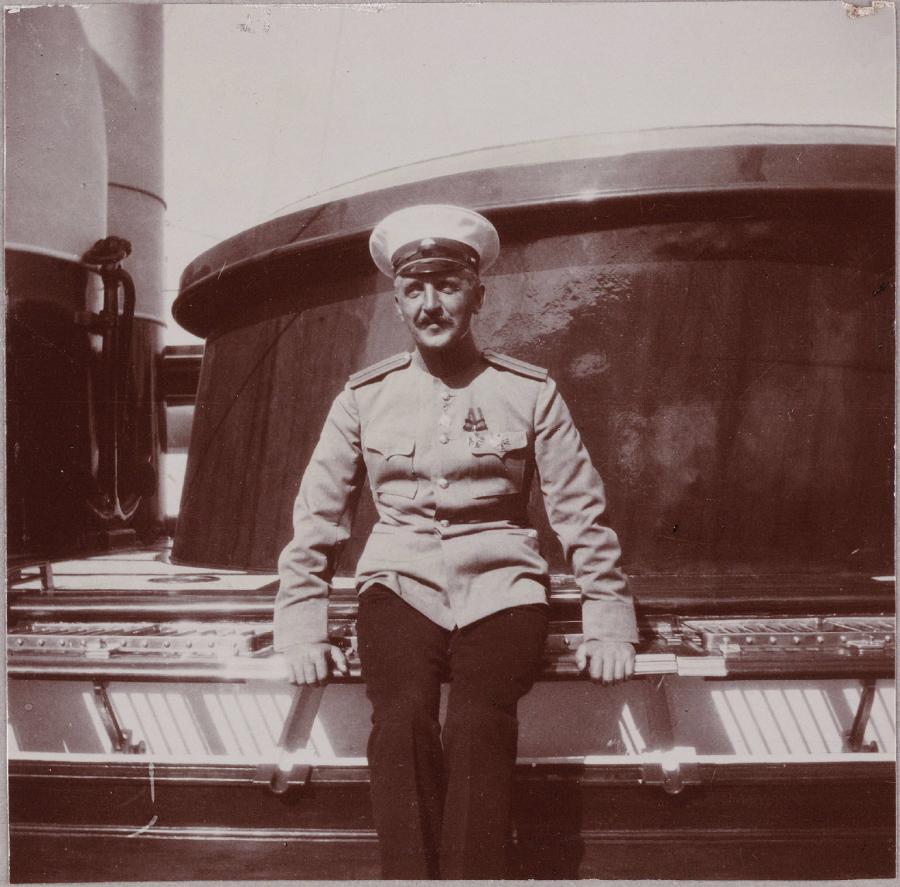
Commander of the Imperial yacht ‘Standart’ Nikolai Pavlovich Sablin (1880-1937)
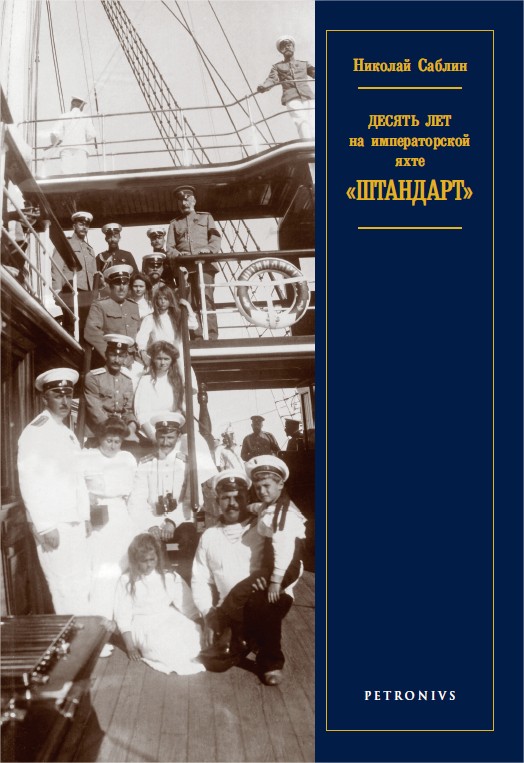
One of the many books which I would like to see an English edition is ‘Десять лет на императорской яхте Штандарт‘ (Trans. ‘Ten years in the imperial yacht Standart’) by Nikolai Sablin
These are the memoirs of Nikolai Pavlovich Sablin (1880-1937), who served as commander of the Imperial yacht ‘Standart’ of Emperor Nicholas II. The author describes events between 1906-1914, of which he was a direct witness and participant. His memoirs reflect the last decade, not yet overshadowed by the horrors of the First World War and revolutionary upheavals, which also became the last years of the prosperity of the Russian Empire.
The memoirs of N.V. Sablin acquaints the readers with details of the private life of the imperial family and their immediate environment, as well as little-known aspects of state affairs. The book contains interesting information about the official visits of Nicholas II while sailing on the ‘Standart,’ meetings with the heads of state and representatives of the reigning houses of Europe, gala receptions hosted on board the imperial yacht, and the important political decisions made during these voyages.
The episodes of yachting life, the mood of the officers of the fleet and society in general, subtly noticed by Sablin, convey a bygone era. His observations and humour make his personal memoirs a very interesting story, yet another page from the life and reign of Nicholas II, which has been sadly neglected by Western historians. The 382 pages of text is accompanied by more than 200 photographs, many of which were taken by Sablin himself and are published for the first time in this book.
One of the perks of my job over the past 25 years, is that I receive a copy of each new book published on the Romanovs and Imperial Russia. This is just one reason why my personal library is as large as it is – over 2,000 volumes.
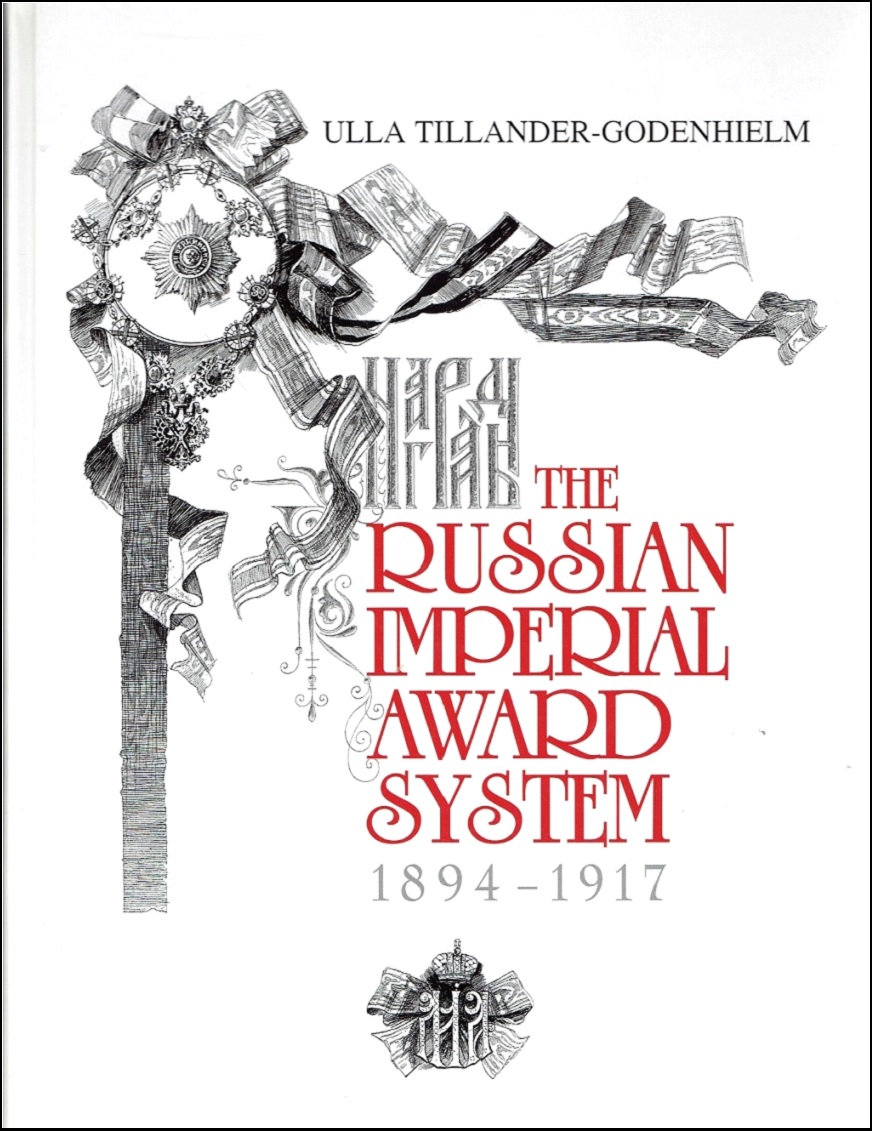
One of the gems of my collection is The Russian Imperial Award System 1894-1917 by Ulla Tillander-Godenhielm, published by the Finnish Antiquarian Society in Helsinki (2005)
It is a massive heavy book: it measures 8-1/2” x 11″ x 1-1/2” in diameter, weighs over 2 kg., 566 pages, more than 160 colour and black & white photos, with extensive notes and bibliography. Text is in ENGLISH!
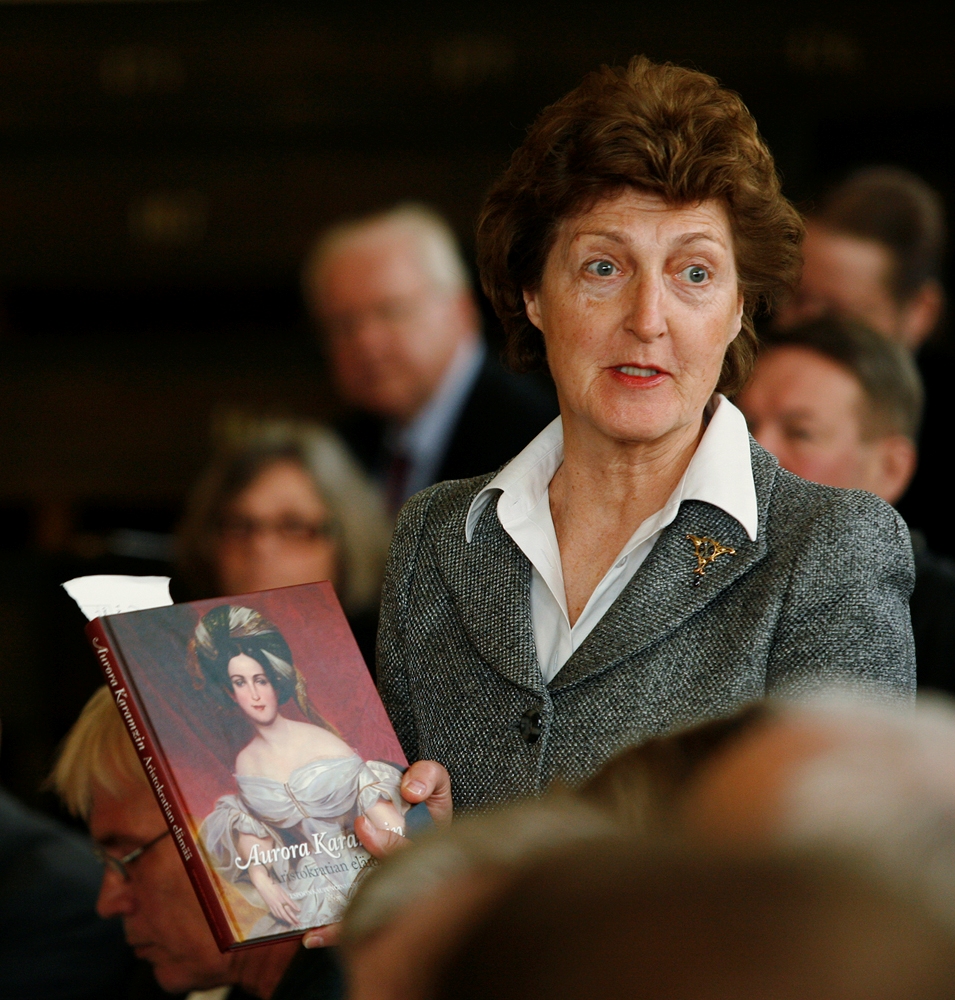
Ulla Tillander-Godenhielm
Ulla Tillander-Godenhielm, Ph.D., is the great-granddaughter of the St. Petersburg goldsmith Alexander Tillander, a leading supplier to the Imperial Russian Court of Nicholas II. She has been researching the oeuvre of Russian jewellers for many years. Her doctoral dissertation was on the labrinthe and intriguing award system of Imperial Russia. Her work takes her around the world: lecturing, consulting for art exhibitions and writing in exhibition catalogues and for art publications. She has published several books on her speciality, the art of the jewellers of Imperial St. Petersburg.
* * *
Arja-Leena Paavola offers the following review of this book in the Spring 2006 issue of Universitas Helsingiensis the quarterly of the University of Helsinki:
The practice of rewarding citizens for good work and loyalty proved an efficient way of strengthening the bonds between subject and monarch. In many respects the system was defined by the service hierarchy created by Peter the Great known as the Table of Ranks. Ulla Tillander-Godenhielm, Ph.D., who defended her doctoral dissertation in the field of art history in October, examined the Russian imperial award system during the reign of Russia’s last tsar, Nicholas II.
“A decree of 1898 defined twelve award categories, over half of which were decorations, titles, expression of the emperor’s favour, grants of money, and gifts made of precious materials. For over one hundred years, the system was also in use in the Grand Duchy of Finland, whose subjects were entitled to the same honours as any other individual in the service of the empire,” says Tillander-Godenhielm.
Subsequent generations have often created an image of a system of unsurpassed luxury and opulence that catered exclusively to the elite of the country. In reality, the value of an award could not exceed an individual’s yearly salary. In addition, there were many awards designed specifically for the lower echelons, including factory workers. Each of the twelve categories had an internal hierarchy. A young man who started his career at the lowest rung of the hierarchical ladder, through diligent service, could earn for himself the highest honours the empire had to offer.
Tillander-Godenhielm points out that the gift items bestowed were not merely symbolic tokens but were in fact a subtle means of remuneration. These gifts were luxurious and often quite elaborate. While they did speak of one’s importance and position within Russia’s service hierarchy – which consisted of fourteen classes, or ranks – they also were a means of augmenting an individual’s wages, which were frequently low. A general, for example, could not always support the lifestyle his position demanded on his official salary. If this was the case, he had the option of returning his gift to the Cabinet of His Imperial Majesty for its full value in cash. In fact, over sixty percent of gifts presented to ranks five and lower were sold back in this way. The widows or children of the original recipients could also return them; thus, they served as a kind of pension or life insurance.
“A fine silver or gold pocket watch was a typical gift. When travelling by sea to Finland, the Russian emperors would present watches to the pilot boat captains, and when travelling by train, every station manager along the way would receive one, as would the policemen responsible for the safety of the imperial family.”
Tillander-Godenhielm is herself a fourth generation member of a goldsmith family with Russian connections. Several Finnish goldsmiths were employed as suppliers by the Cabinet of His Imperial Majesty, and Tillander-Godenhielm’s grandfather was one of them. While working in the family business, she became interested in Russian gold and silver objects, many of which have remained in Finland, some still in the possession of the original recipient’s family.
Sometimes orders for multiples of the same gift item were placed. “Archival research has revealed account books showing requests for ten silver cigarette cases decorated with a double-headed eagle of a specific design, or twelve rings set with specific gemstones. This type of gift was destined for lower-ranking servitors. The more valuable gifts intended for higher ranking officials were all unique in design.”
PHOTO: Cabinet of His Imperial Majesty, St. Petersburg
Coveted investments
The Cabinet of His Imperial Majesty had inspectors to ensure that the gold and silver objects it received were of the highest quality. Many of these items were bestowed upon foreign dignitaries and thus served as a means of showcasing the skill of Russian craftsmen. During state visits, these valuable gifts were written about in papers and put on public display.
These award items – especially those with a known provenance – have increased steadily in value since the Revolution and nowadays can fetch astronomical sums. For example, a table portrait of Nicholas II presented to the French prime minister René Viviani in 1914 sold at Sotheby’s last year for £350,000. As a result, however, they have become the object of numerous forgeries.
A substantial number of the surviving objects made for the Russian imperial award system are today in museums or in the private collections of various European monarchs and American millionaires. In the 1930s, Stalin had many of these items sold in the West in order to obtain much needed foreign currency.
Ulla Tillander-Godenhielm has had the privilege of personally handling many of the items she discusses in her dissertation. “You cannot really study objects such as these without examining them up close.
A known provenance of course greatly in-creases the interest of an object. Those pieces really make my heart skip a beat. Fortunately, Russian archives have now been opened up to researchers and it has become possible to trace the origins of many of these items.”
The real story uncovered
In the 1930s, all kinds of stories were concocted in order to increase the value of these objects and boost sales. “The empress gave her obstetrician, Professor Ott, a monogrammed snuffbox for every child he helped deliver. Many of these have been sold in the United States as gifts from the emperor to the empress. “But who would seriously believe that a man would give a snuffbox to his wife for giving birth to their baby?” Tillander-Godenhielm chuckles. “I think true stories about the real officials and servitors of the time are much more interesting.”
It is not, after all, that long ago. While in St Petersburg, Tillander-Godenhielm discovered that a hospital built by Dr. Ott was still in operation. “When visiting the hospital, I was asked if I would like to meet the great-granddaughter of the good doctor, who as chance would have it works as an obstetrician there. I met this young woman who told me a great deal about her great-grandfather. The family no longer possessed any of the awards he had been given, so she was delighted when I showed her pictures of two of the thirteen snuffboxes Dr. Ott had received for his services.”
Tillander-Godenhielm’s study has raised interest all over the world, and for once, a dissertation has proved to be a “best seller”, but only 1,200 copies of her book were published.
“A great deal has been written about the Russian nobility and Russian orders and decorations in isolation. My study examines these subjects within the context of the larger system of which they were but one part.”
I am pleased to offer copies of my 2020 calendar, dedicated to Emperor, Tsar and Saint Nicholas II, with a limited printing of only 200 copies!
Each month features an iconic full-page black and white photograph of Russia’s last monarch, printed on quality glossy stock.
Nearly 70 major holidays in the United States, Canada, Great Britain, Australia and Russia are featured, with room to write in your own special dates and events.
ALL net proceeds from the sale of each calendar will go into my research, including the cost of translating articles and news from Russian archival and media sources.
The price of each calendar is $10 + postage (rates are noted on the order page, link below). I can ship to any country by Canada Post
NOTE: the postage rates quoted are for SINGLE copies ONLY! If you want to order more than one calendar, then please contact me by email at royalrussia@yahoo.com
Payment can be made securely online with a credit card or PayPal or by personal check, money order or cash – click HERE to download and print a mail order form
Thank you for your support of my research and dedication to clearing the name of Russia’s much slandered tsar
Today, I have received the blessing of His Grace Bishop Luke of Syracuse, Abbot of Holy Trinity Monastery, to host the 2nd International Nicholas II Conference at the Holy Trinity Monastery in Jordanville, New York in the Spring of 2021.
A number of historians and writers have already expressed interest in speaking at the Conference. I hope to confirm the actual date within the next few weeks.
Truly, my prayers have been answered. I am so pleased that we can now honour Tsar-Martyr Nicholas II at the Holy Trinity Monastery in Jordanville.
While the event is still more than a year away, I wanted to share this wonderful news with all of you! I will continue to keep you posted of any new developments.
During the Soviet years, the Alexander Palace was established as a museum. This video shows a group walking through the former rooms of Nicholas II and his family. The year of 1918 is noted in the video, however, this is incorrect – PG
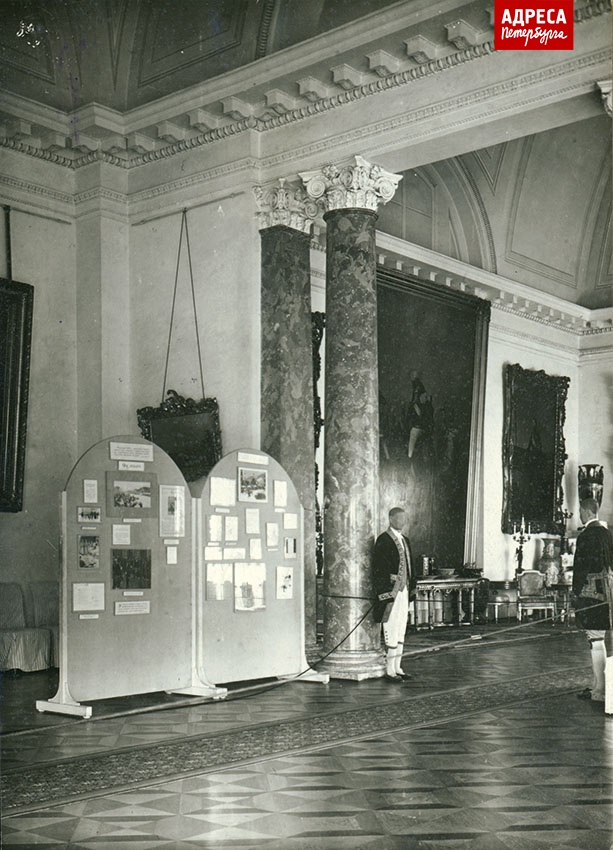
In 1918 the former residence of Tsar Nicholas II and his family was established as a museum and open to the public. The exhibit included the historical interiors in the central part of the building and the private apartments of the last tsar and his family located in the east wing of the palace.
In 1919, the west wing was turned into a rest home for staff of the People’s commissariat for Internal Affairs (NKVD), while on the second floor of the east wing the former rooms of Nicholas II’s children became an orphanage named after the “Young Communards”.
Enfilade of ceremonial halls of the Alexander Palace. 1920s
The Soviet regime were hostile towards the ‘Romanov Museum,’ and made constant threats throughout the 1930s to close the museum and sell off its treasures. Luckily, the museum staff managed to dissuade the government from this step and the museum operated up until the beginning of the Second World War.
In the first months after the Nazi invasion chandeliers, carpets, some items of furniture, eighteenth-century marble and porcelain articles were evacuated from the Alexander Palace. Most of the palace furnishings remained in the halls.
A cemetery for members of the SS was established in front of the Alexander Palace
During the occupation of Pushkin the palace housed the German army staff and the Gestapo. The cellars became a prison and the square in front of the palace a cemetery for members of the SS.
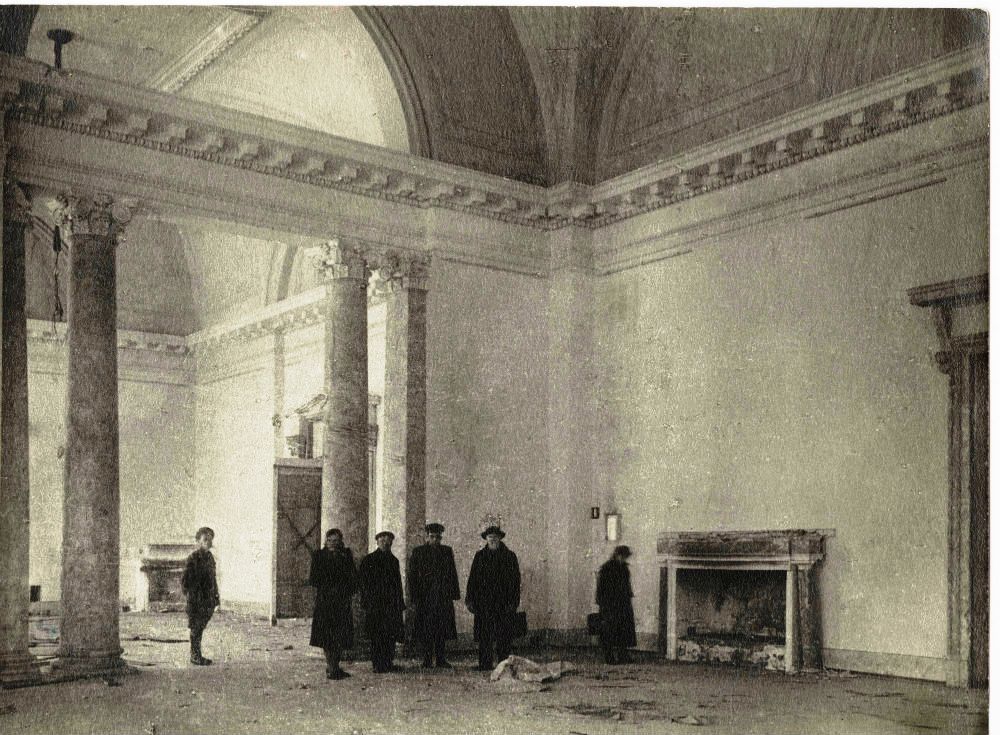
The palace survived World War II with minor damage, according to military records—unlike the Catherine Palace, the Palace of Pavlovsk and the Grand Palace of Peterhof, which were almost completely destroyed during the German occupation. Although the exterior was damaged, the majority of the interiors were reported as unharmed, with the exception of some rooms which received moderate to serious shell damage.
The palace had been looted by the retreating Nazi’s which resulted in many of the palaces works of art, furniture and other items being stolen. According to the Ministry of Cultural Affairs of the Russian Federation, registered inventory for the Alexander Palace had—30,382 items, of which 22,628 items were recorded as lost or stolen at the end of World War II.
Representatives of the State Emergency Commission and museum workers examine the destruction of the large central hall of the Alexander Palace. Photo by S. G. Gasilov. May 1944.
At the end of the war the Alexander Palace was mothballed. Conservation work was carried out in the palace and in 1946 it was handed over to the USSR Academy of Sciences for the storage of the collections of its Institute of Russian Literature and to house a display of the All-Union Pushkin Museum. As a consequence in 1947-51 refurbishment began in the palace, in the course of which it was intended to restore the surviving Quarenghi interiors and extant fragments of décor and also to recreate the interiors from the time of Nicholas I and Nicholas II. However, during the work many elements in the décor of Empress Alexandra Feodorovna’s Maple and Palisander Drawing-Rooms, as well as Nicholas II’s (Moresque) Dressing-Room were actually destroyed. These rooms of the palace were recreated to a project by the architect L.M. Bezverkhny (1908–1963) “in accordance with the architectural norms of the time of Quarenghi and Pushkin”.
Opening day of the All-Union Museum of A. S. Pushkin (Alexander Palace), on 10th June 1949
In 1951 a government decision handed the Alexander Palace to the Ministry of Defense. The Naval Department used the building as a top-secret, submarine tracking research institute of the Baltic Fleet. As a result, the former palace would be strictly off-limits to visitors for the next 45 years.
The palace’s stocks that were among the evacuated items in the Central Repository of Museum Stocks from the Suburban Palace-Museums passed to the Pavlovsk Palace Museum. A total of 5,615 items were moved from the palace to Pavlovsk. Of these, nearly 200 pieces were originally from the Alexander Palaces’ three ceremonial halls: the Portrait, Semi-Circular and Marble Halls. These include 39 pieces of porcelain, 41 paintings, 73 decorative bronze pieces, and 28 pieces of furniture.
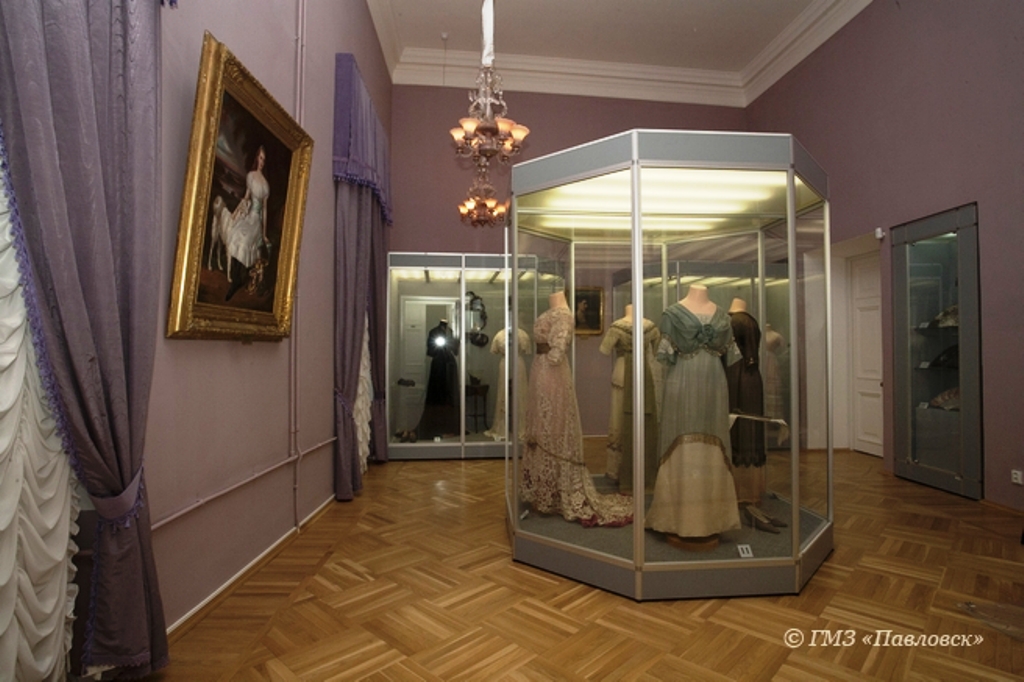
Pavlovsk’s collection today includes Imperial gowns originally from the Alexander Palace
It is also interesting to note that the Pavlovsk Palace Museum also have a large number of elegant evening gowns, dresses, shoes, hats, umbrellas, gloves, handbags, fans among other personal items of the Dowager Empress Maria Feodorovna and the Empress Alexandra Feodorovna, neither of whom ever resided in Pavlovsk. They are from the Alexander Palace, however, they are now on permanent display in the Museum of the Emperor’s Dress, which is located on the ground floor, of the northern semicircular wing of Pavlovsk Palace, the ground floor.
NOTE: this text has been excerpted from ’My Russia. The Rebirth of the Alexander Palace,’ published in Royal Russia No. 3 (2013), pgs. 1-11.
The Museum of the Russian Imperial Family in the Alexander Palace is expected to reopen at the end of 2019, or early 2020. Under restoration since August 2015, the new multi-museum complex will feature a number of reconstructed historic interiors of Nicholas II and Alexandra Feodorovna.
One year ago today – 7th August 2018 – my interview The Conspiracy Against Nicholas II, aired on YouTube, which to date has been viewed by nearly 20,000 people.
My seven-minute interview was one of a special six-part video series commemorating the Romanovs Martyrdom Centennial in 2018, prepared by the Monastery of St John the Forerunner Mesa Potamos in Cyprus.
During my interview I speak about the Tsar’s abdication in 1917, and the only two generals who remained faithful to their Sovereign. I go on to discuss the main plots which aimed to overthrow Nicholas II from his throne, and the betrayal by his ministers, generals, and even members of his own family.
Among the members of the Imperial family who were plotting against Nicholas II, were the Grand Dukes Nicholas Nicholaevich (1856-1929) and Nicholas Mikhailovich (1859-1919), and the Vladimirovich branch of the family, led by the power hungry Grand Duchess Maria Pavlovna (1854-1920), the widow of Grand Duke Vladimir Alexandrovich.
I also talk about some of the myths and lies regarding Nicholas’ II, such as his alleged weakness as a ruler, and the popular myth that his death at the hands of the Bolsheviks was met by indifference by the Russian people.
The video features beautiful colourized pictures of the Romanovs and other historical figures, by acclaimed Russian colourist Olga Shirnina, from the forthcoming book The Romanov Royal Martyrs, due to be published in September 2019.
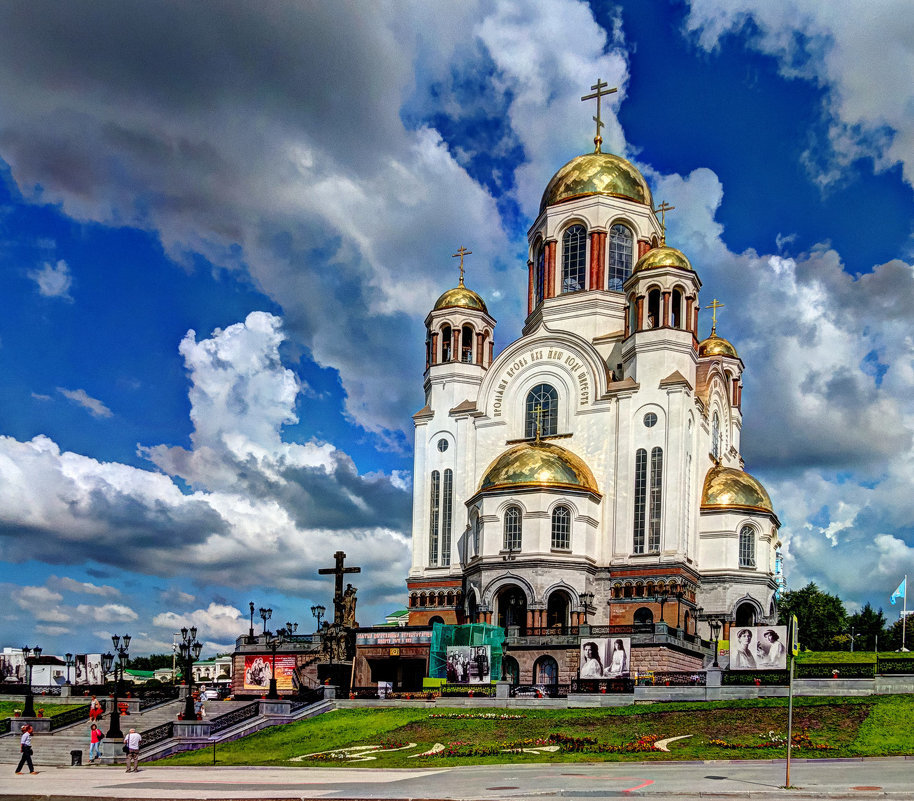
The Church on the Blood, built on the site of the Ipatiev House in Ekaterinburg
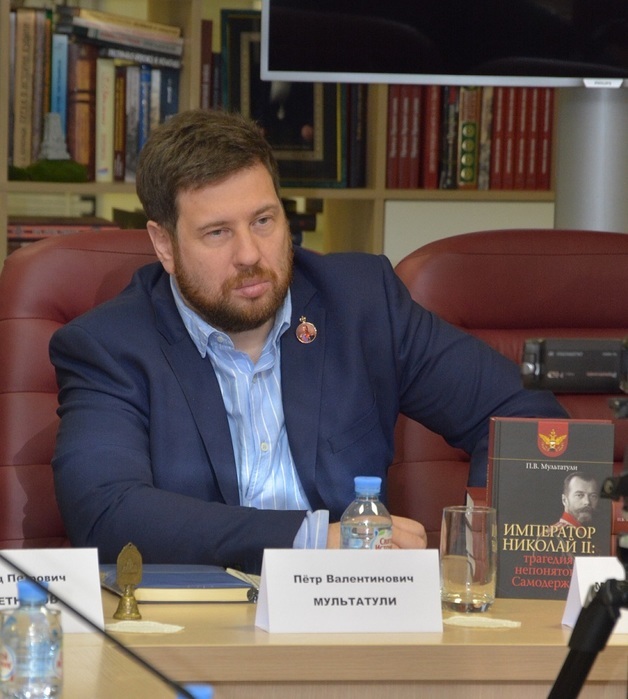
The Ural city of Ekaterinburg occupies an important place in the modern spiritual life of Russia. This conclusion was reached by Russian historian *Peter Multatuli following the results of the International Festival of Orthodox Culture Tsar’s Days 2019.
“On a spiritual level, Ekaterinburg is the last capital of the Russian Empire, because the residence of the Sovereign was always considered the capital in Russia. Peter the Great never officially transferred the capital from Moscow to St. Petersburg, but since he lived there, it was the capital,” said Multatuli.
He noted that in 1918, for 78 days, Emperor Nicholas II and his family lived in Ekaterinburg, and that is why the Ural capital can be considered the last capital of the Russian Empire.
[It is important to note that many historians – myself included – firmly believe that the Tsar’s signing of the instrument of abdication, his status as Tsar remained inviolate and unassailable – PG]
“Petrograd and Moscow to one degree or another welcomed his overthrow, and they bear a greater responsibility in this than any other Russian city. No matter what anyone says, it was Ekaterinburg that served as the last Imperial residence, which, according to God’s special plan, became the Royal Golgotha,” added Peter Multatuli.
According to him, in the near future, Ekaterinburg will play a great role in the history of Russia, because “the city named after St. Catherine and becoming the Royal Golgotha will be the city of Russian resurrection.”
[Once a bastion of Bolshevism, Ekaterinburg has slowly shed its status as the “capital of atheism”. Since the fall of the Soviet Union in 1991, the Urals has experienced a revival of faith, with Ekaterinburg at the into the center of Orthodox Russia in the Urals. Ekaterinburg has done more to honour Nicholas II and his family than any other city in Russia. Thanks to my visits to Ekaterinburg in 2012, 2016 and 2018, it is a city which I have grown to admire and love – PG]
Peter Valentinovich Multatuli
*Peter Valentinovich Multatuli was born in Leningrad on 17 November 1969. He is a Russian journalist, historian and biographer. Multatuli is the author of numerous books and articles about the reign of Emperor Nicholas II. He is the great-grandson of Ivan Kharitonov (1872-1918), who served as the Head Cook of the Imperial family. He followed the tsar and his family into exile, and was murdered along with them in the Ipatiev House on 17th July 1918.
Multatuli’s comprehensive Russian language studies of the life and reign of Emperor Nicholas II are often overlooked or simply ignored by his Western counterparts.








 Nicholas II
You must be logged in to post a comment.