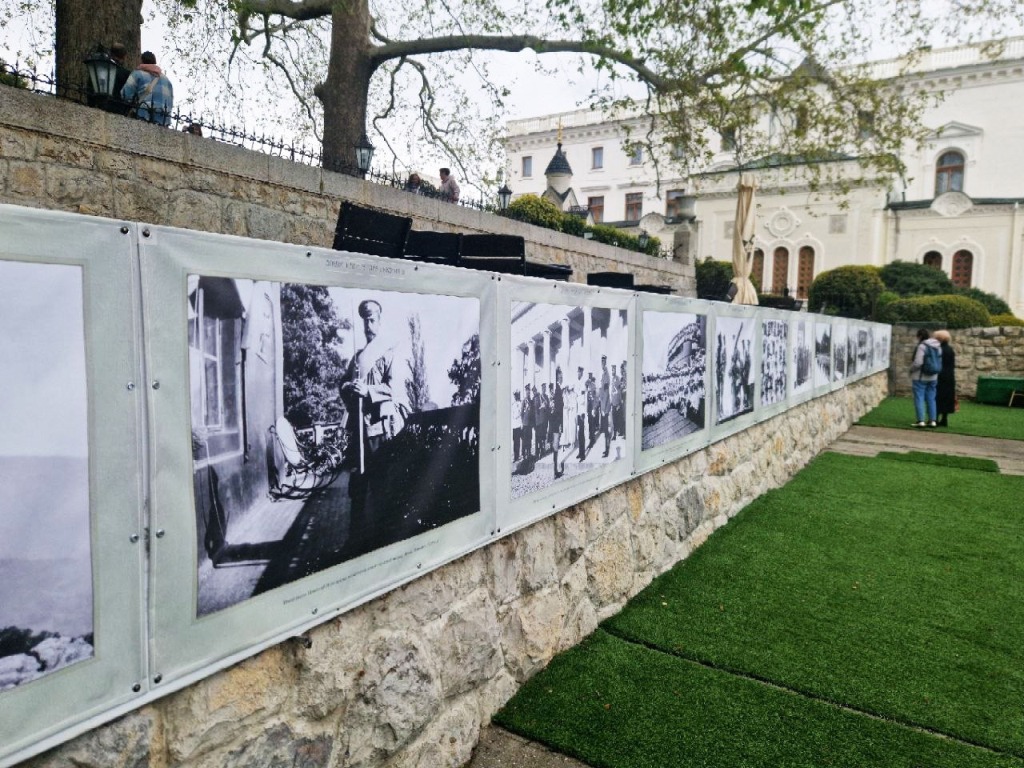
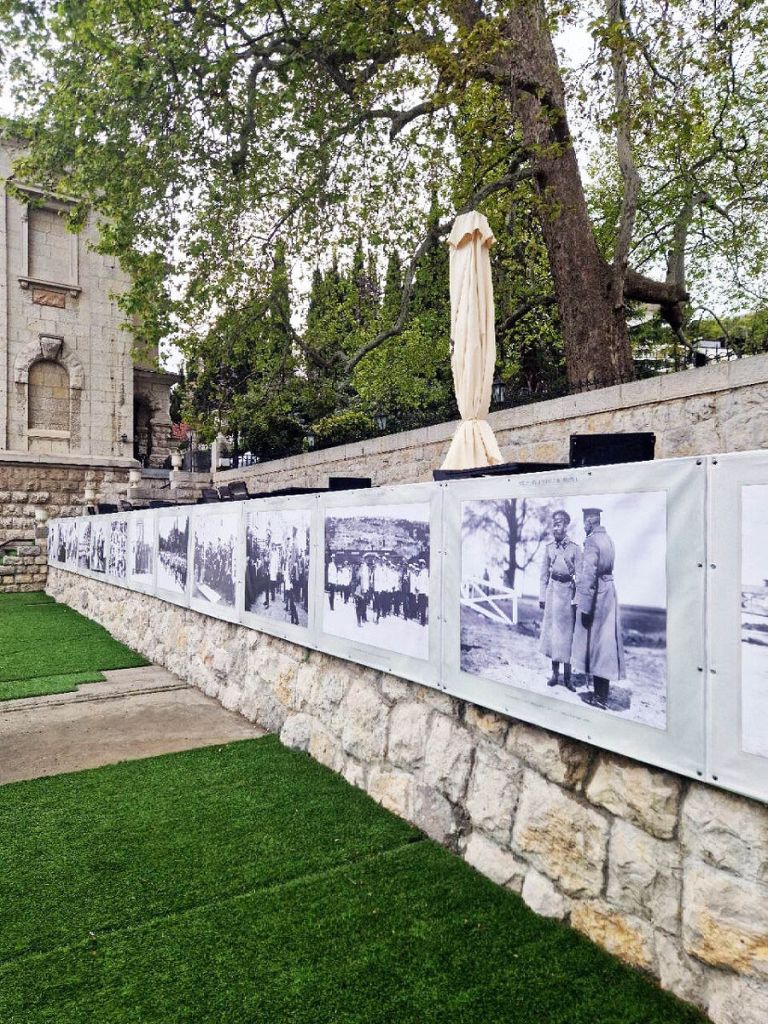
On 14th May 2026, a new public exhibition The Era of Nicholas II opened at Livadia. The outdoor photo-exhibit features 100 historical photographs 0f Emperor Nicholas II and his family.
The photographs are depicted on banners, which have been mounted on the brick walls near the former house of Count Vladimir Borisovich Frederiks (1838-1927), who served as Minister of the Imperial Court between 1897 and 1917. His residence is situated on the path which leads to both the Church of the Exaltation of the Holy Cross and the Livadia Palace.
A significant part of the photographs reflect the visits of Emperor Nicholas II and members of his family to the Crimea, as well as other interesting pages of history related to the state and social activities of the last Russian Tsar, who is now glorified as a saint.
The exhibition received the blessing of Metropolitan Tikhon of Simferopol and Crimea and was prepared by the caring parishioners of the Church of the Exaltation of the Holy Cross with the support of the brethren of the Moscow Sretensky Monastery.
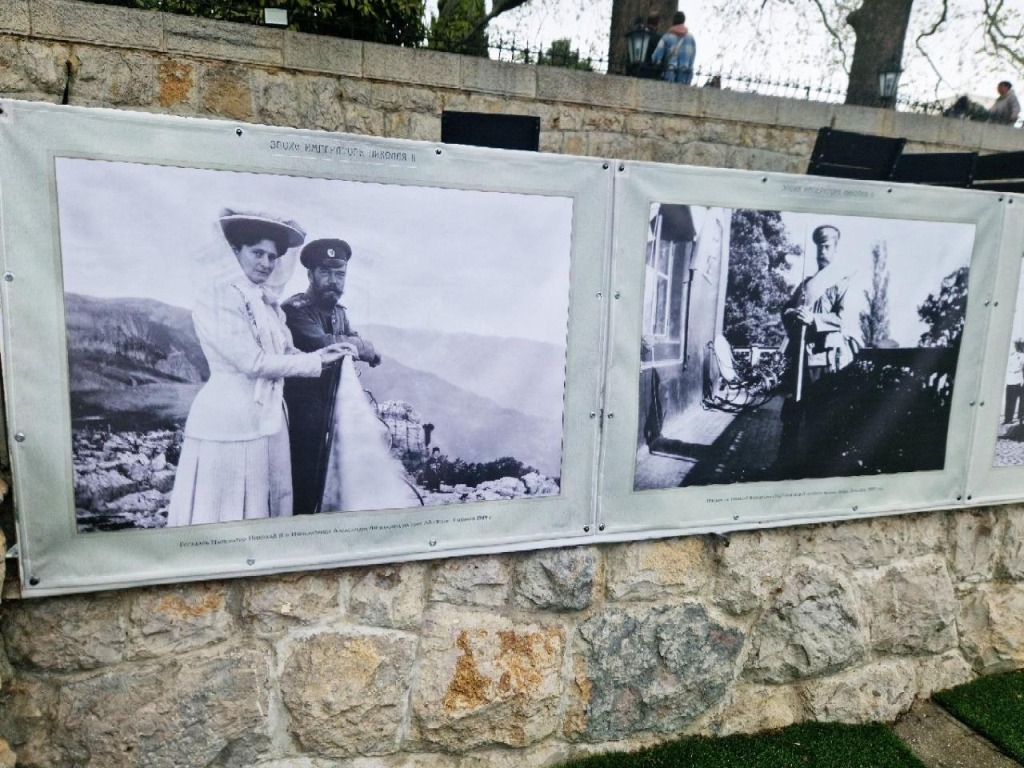
PHOTO: many of the photos in the exhibition reflect the Imperial Family’s visits to Crimea. In the photo above: Nicholas and Alexandra at Ai-Petri (left) Nicholas II tests new uniforms for the soldiers of his army (right). Both photos were taken during their visit in the Autumn of 1909
Recall that up until 1911, Nicholas II and his family stayed in the Small (Maly) Palace during their visits to Livadia. From 1911, the Imperial Family stayed at their iconic white stone palace overlooking the Black Sea.
The new palace was constructed in the Italian Neo-Renaissance style by the Russian architect Nikolai Krasnov (1864-1939), on the site of the Large wooden palace. It is interesting to note, that Emperor Nicholas II spent about 4 million gold rubles on the construction palace. The palace contains 116 rooms, with interiors furnished in different styles.
The Imperial family stayed in the New Livadia Palace in the autumn of 1911 and 1913 and in the spring of 1912 and 1914, their visits lasting months at a time.
It was here in Livadia that Emperor Alexander III died on 2nd November [O.S. 20th October] 1894. The same day, his son and heir Tsesarevich Nicholas Alexandrovich ascended the throne. It was also at Livadia that the holy righteous John of Kronstadt (1829-1908) anointed Princess Alice of Hesse, who became the Orthodox faithful Grand Duchess and future Empress Alexandra Feodorovna.
According to Lieutenant-General Alexander Alexandrovich Mossolov (1854-1939), who served as Head of the Office of the Ministry of the Imperial Court, Nicholas II considered moving the capital of the Russian Empire from St. Petersburg to Yalta.
Emperor Nicholas II visited Livadia a total of 13 times, his last visit was in May 1916 – three months before the outbreak of World War I. The Imperial Train arrived in Sebastopol on 12th May, and on 16th May, the Tsar and his family visited Yevpatoria.
Following the Tsar’s abdication 15th March 1917 (O.S. 2nd March) 1917, Nicholas requested that he and his family be allowed to settle permanently at Livadia, however, his request was denied by the new Provisional Government in Petrograd.
On 19th May 2015, a bust monument to Emperor Nicholas II was unveiled at the main entrance to the Livadia Palace. It is made of artificial stone after the model of the sculptor A.A.Appolonov and bronze. Marble pedestal.
On 18th November 2017, in the presence of the President of the Russian Federation Vladimir Putin, a monument to Emperor Alexander III was unveiled on the site of the former Small Palace.
On 27th September 2022, a restored bronze bust of Emperor Nicholas II – which was damaged with bullet holes – was unveiled and consecrated on the grounds of the Church of the Exaltation of the Cross – the home church of the Russian Imperial Family, at Livadia Palace in Crimea.
FURTHER READING
Livadia Palace marks 100th anniversary as a museum + 18 PHOTOS
© Paul Gilbert. 17 May 2026


You must be logged in to post a comment.