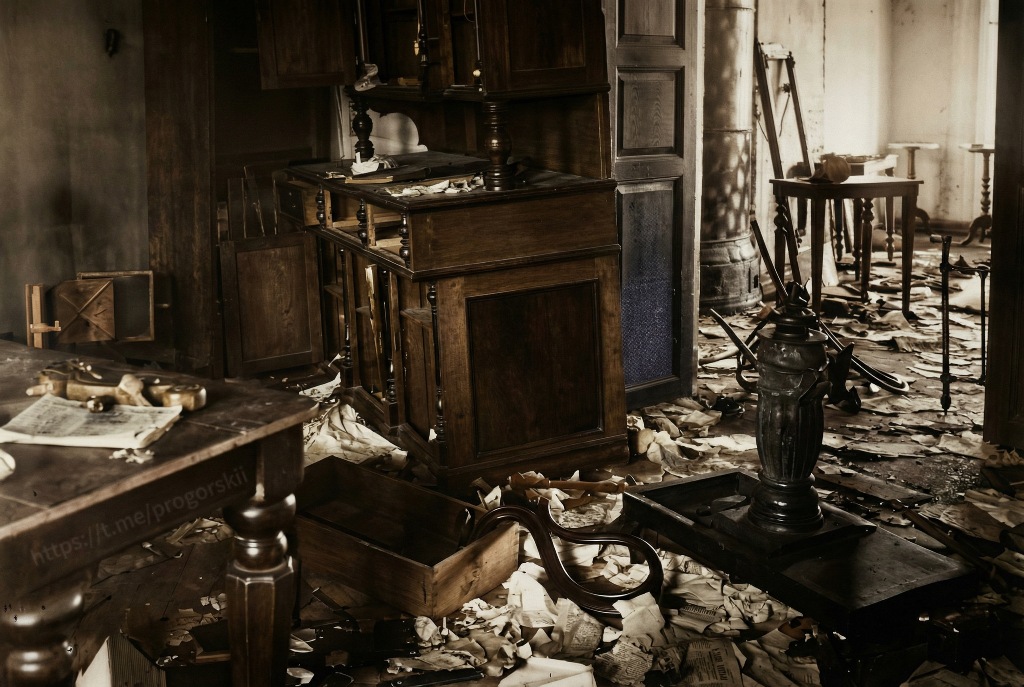
PHOTO: view of the Ipatiev House, following the regicide of 17 July 1918
During the investigation in Ekaterinburg (April 15–25, 1919) Judicial investigator Nikolai Alekseevich Sokolov (1882-1924) conducted an inspection of the Ipatiev House, recording traces of the crime committed there and examed items discovered both by himself and earlier by IIvan Alexandrovich Sergeev (1872–1919), who served as as a member of the Ekaterinburg District Court.
The following is an excerpt from Sokolov’s investigation into the deaths of Emperor Nicholas II and his family. The discovery of the personal items belonging to the Imperial Family in and around the Ipatiev House, as well as the nearby Popov House, must have been very troubling for the team and evidence of the regicide which took place in the basement of the now infamous Ipatiev House in the early morning hours of 17th July 1918.
NOTE: this is just a partial list of items found in the garbage pit on the grounds of the Ipatiev House, and in the nearby *Popov House:
* Recall that in 1918, the Popov House, located at the corner of Voznesensky Avenue and Voznesensky Lane, housed the guards who served in the House of Special Purpose (Ipatiev House).
No. 98. Wooden icon with a bent metal ring. The face of the Saint cannot be discerned. On the reverse side, written in pencil by the hand of the Empress: “Save and preserve. Mama. 1917, Tobolsk.” Above the inscription is an image of a cross.
No. 99. Wooden icon. It is impossible to make out the images of the Saint. On the reverse side are remnants of an inscription in the Old Slavonic language, and it seems possible to make out only the word: “those who sorrow.”
No. 100. White marquisette blouse for an adult woman, finished with stitching and embroidered with satin stitch.
No. 101. White batiste ladies’ handkerchief.
No. 102. Ladies’ pouch-purse made of black silk fabric.
No. 103. Pink silk ribbon with gray sheen.
No. 104. A black moiré tie with a ribbon of the Order of St. Vladimir sewn onto it, with the ribbon cut diagonally at the place where the order is sewn; tie lining is quite worn.
No. 105. St. George ribbon 672 inches long, 1 inch wide, soiled with mud.
No. 106. Officer’s cockade.
No. 107. Glass jar
No. 108. A bottle with an image of St. Simeon of Verkhoturye, half-filled with water.
No. 109. Image of St. Seraphim of Sarov the Wonderworker, framed in a metal frame.
No. 110. Image of St. Simeon of Verkhoturye on enamel.
No. 111. A small water bottle with an inscription on it: “Your faith will save you. Holy Trinity. Sergiev. Laurels.’
No. 112. Six vials of different sizes with medicinal substances.
No. 113. A piece of brown leather with an embossed pattern from a handbag or reticule.
No. 114. Glass tube with white powder.
No. 115. Photo card frame with round hole; its outer and inner edges are covered with a copper baguette.
No. 116. Metal frame of a picture frame.
No. 117. A small keychain with a photographic card, the image of which was destroyed beyond recognition.
No. 118. Wooden egg-shaped keychain with the letters “H.V.” engraved.
No. 119. Copper plate with the image of a crown.
No. 120. Round glass from a photographic frame.
No. 121. Small decanter-shaped bottle with powder.
No. 122. Lead tube with ointment.
No. 123. White metal cover from a soap dish.
No. 124. Metal cup.
No. 125. A small faience piece from a tea cup with the letters “Boy”.
No. 126. A bottle with some ointment.
No. 127. Copper powder case.
No. 128. Octagonal perfume bottle with a copper sprayer.
No. 129. General’s epaulette.
No. 130. Soldier’s cockade
No. 131. Four tin steamboats and one tin horseman-hussar are children’s toys.
No. 132. Copper coin with a denomination of five kopecks.
No. 133. A medium-sized cameo from Pompeii depicting a female profile.
No. 134. Three wooden lotto circles with the numbers 1, 4, and 9.
No. 135. Seven small wooden building blocks — children’s toys.
No. 136. Faience lid from a bowl.
No. 137. Metal thimble.
The items found in the Popov House and in the garbage pit near the Ipatiev House were packed in dozens of boxes during the investigation, and subsequently taken out of Ekaterinburg by Sokolov in July 1919 during the advance of the Red Army.
Thank you to my social media friend Gary Mosher, for bringing this to my attention.
FURTHER READING
Nikolai Sokolov honoured at Ganina Yama + PHOTOS and VIDEO
© Paul Gilbert. 24 November 2026


You must be logged in to post a comment.