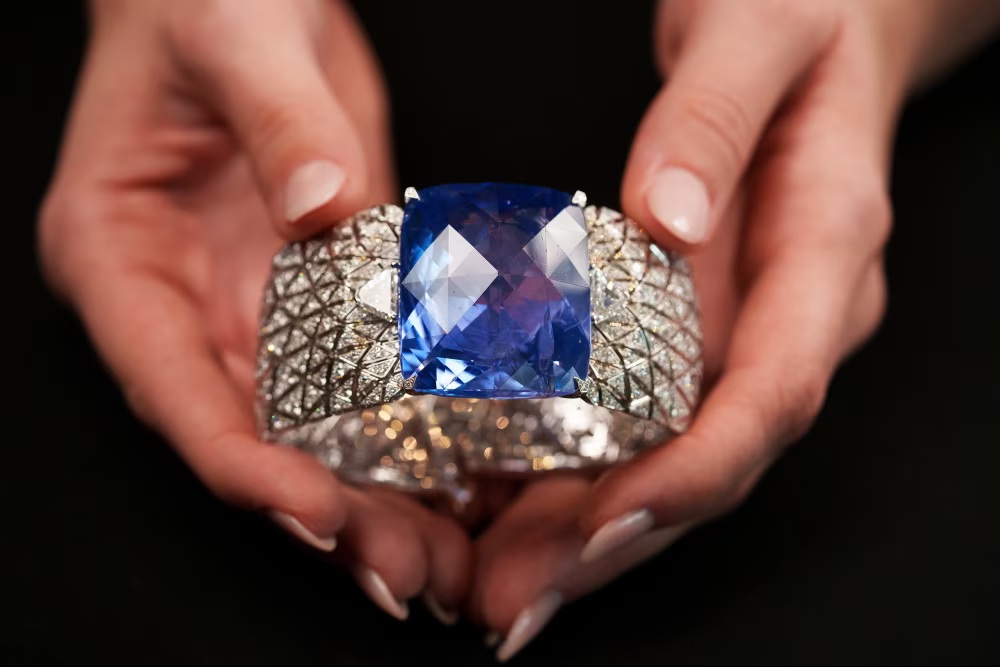
On 11th November 2026, an exquisite 197.80-carat sapphire, documented among the Russian Crown Jewels sold at a Geneva auction for more than 4.1 million Swiss francs [$4.9 million USD].
The opening bid for the sapphire was set at 600,000 Swiss Francs [$730,000 USD], the estimate was 850,000 to 1.7 million Swiss Francs [$1,030,800 to 2,1 million USD].
The Romanov Sapphire, an unheated Ceylon gemstone formerly mounted by Fabergé, was the leading lot in the Sotheby’s ‘Royal & Noble Jewels‘ sale. The auction was held at the Mandarin Oriental in Geneva.
Initially, the sapphire was paired with another stone weighing 249.25 carats. Both precious stones belonged to the Dowager Empress Maria Feodorovna, the wife of Emperor Alexander III and the mother of Emperor Nicholas II.
Following the Russian Revolution, the sapphire was recorded in the Fersman inventory of the Russian Crown Jewels before being sold during the Soviet government’s dispersal of imperial treasures.
It subsequently entered the collection of opera singer and socialite Ganna Walska (1887-1984), who acquired it from Cartier in 1927. The stone later returned to auction at Sotheby’s in New York in 1971 and Geneva in 1992. Cartier created its present transformable bracelet setting in 2015, incorporating brilliant-cut diamonds and accented by modified shield step-cut diamonds and an interchangeable rock crystal centerpiece.
Reports from the Swiss Gemmological Institute (SSEF) and Gubelin confirm the sapphire’s Ceylon origin and unheated status. Sotheby’s says the combination of its size, rarity and documented imperial provenance makes it one of the most significant surviving gemstones associated with the Russian Crown Jewels.
Paul Gilbert. 12 November 2026
***

CLICK ON THE LINK BELOW TO ORDER FROM AMAZON
HARD COVER EDITION – PRICE $35.00
PAPERBACK EDITION – PRICE $25.00
BOOK DESCRIPTION
Also known as the Fersman Catalogue, this book documents the Romanov jewels seized from the Imperial Family in 1917. The Bolshevik government attempted to sell them in the 1920s, with only limited success. Originally published as a four-part folio in 1925, this highly sought after historic record is now available in a book format [both hardcover and paperback editions] for the very first time.
Large format 8-1/2″ x 11″ hard cover and paperback editions.
English language. 206 pages + 100 black & white photos


You must be logged in to post a comment.