New monument to Nicholas II to be installed in Vladimir

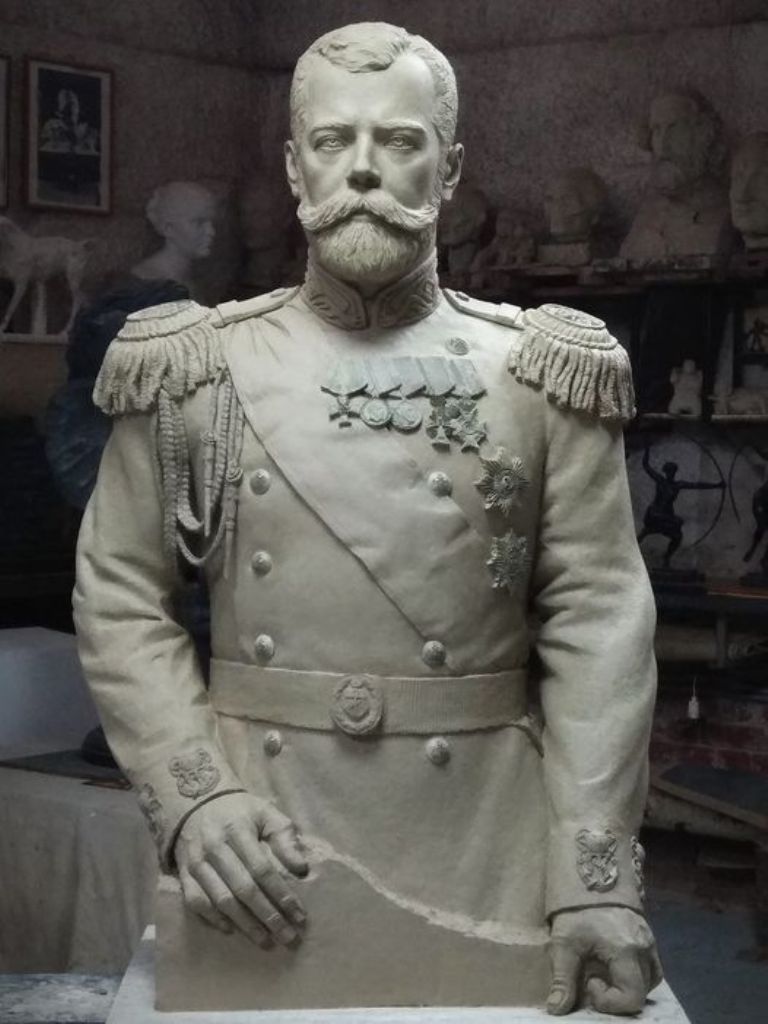
PHOTO: the clay model of the monument to Nicholas II by sculptor Ilya Shanin

A new monument to Emperor Nicholas II will be installed later this year on the grounds of the Church of the Life-Giving Trinity in the Russian city of Vladimir.

The monument is created by the famous Vladimir sculptor Ilya Shanin. The pedestal will be created by Nikolai Andrianov, and the memorial plaques by Yuri Tumarkin and artist Olga Rozanova.

The emperor will be presented from the waist up wearing a ceremonial uniform, with a ribbon over his shoulder, crosses, orders and medals. The height of the sculpture without a pedestal is 125 centimeters [app. 4 ft.]. According to Shanin, the sculpture has been completed, the removal of the mould from the clay model will be done next. The monument will be cast from bronze at a plant in Smolensk.

The monument will be erected on the grounds of the Vladimir Trinity Church on Museum Street, to the left of the entrance. A pedestal will be erected for the sculpture, the area around monument will be landscaped.

It is planned that funds for the casting and installation of the monument will be collected with the help of donations. According to Ilya Shanin, the project will cost about 1.5 million rubles [$20,000 USD]. The sculptor estimates that the monument will be unveiled in the summer of 2022.

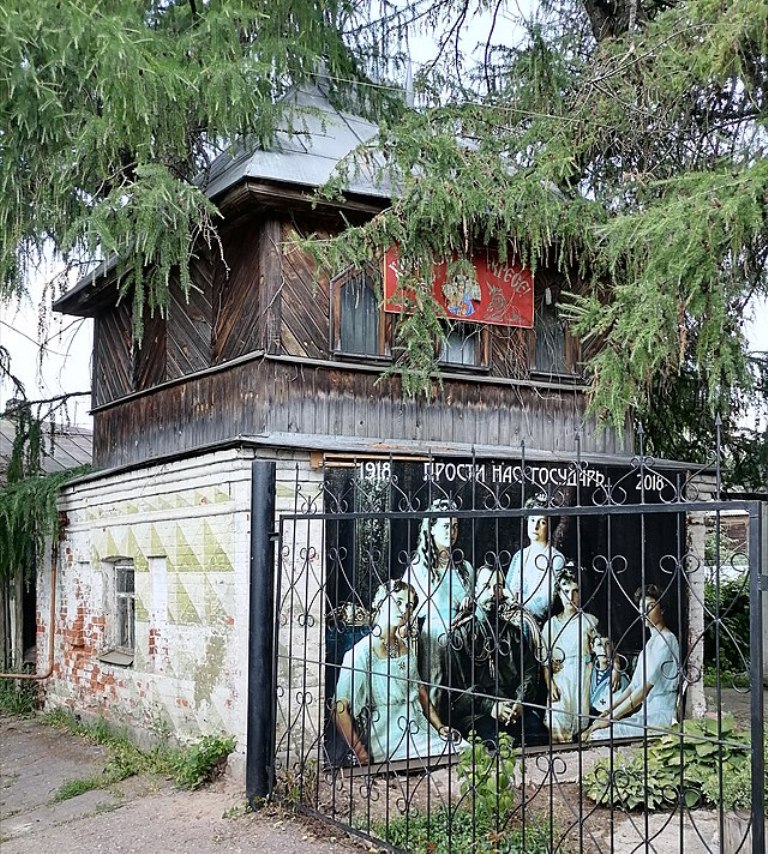
PHOTO: the wall of the cell of the gatekeeper of the Church of the Life-Giving Trinity in Vladimir, is decorated with a mural of marking the 100th anniversary of the death and martyrdom of the Imperial Family. The Russian caption reads 1918 прости нас государь 2018 / 1918 Forgive us Sovereign 2018

According to Shanin, the idea to install the monument of the Emperor near the Church of the Life-Giving Trinity, belongs to Father Eugene. During divine liturgies, he often prays for Nicholas II and his family, who were murdered in Ekaterinburg on 17th July 1918.

Ilya Shanin is a parishioner of the church. He believes that the numerous troubles and catastrophes of the Russian people during the 20th century are partly a punishment for the bloody murder of the Imperial Family in the Ipatiev House. The sculptor hopes that the monument to the emperor will give people a purpose to delve into history or start discussions about the life and reign of Nicholas II, but will also help people look into themselves, repent and to pray for forgiveness.

The installation of the monument to Nicholas II in Vladimir will be a first for the city. The only monument to a Russian monarch was that of Emperor Alexander II, which was installed in 1913 on Cathedral Square, in front of the bank building. After the February Revolution of 1917, it was removedfrom the pedestal, and replaced with a sculpture of the Bolshevik leader Vladimir Lenin.

Note that Nicholas II visited Vladimir once, on 16th May 1913. Together with members of the Imperial Family, he visited the ancient city in the year marking the 300th anniversary of the House of Romanov. It was on this day, that a solemn meeting was organized on the platform of the Vladimir railway station, after which Nicholas II visited the Assumption Cathedral.

© Paul Gilbert. 10 January 2022

Russia’s Treasure of Diamonds and Precious Stones 

CLICK ON THE LINK BELOW TO ORDER FROM AMAZON

HARD COVER EDITION @ $35 USD

PAPERBACK EDITION @ $25 USD

BOOK DESCRIPTION

Large format 8-1/2″ x 11″ hard cover and paperback editions, 206 pages + 100 black & white photos

* * *

This is the first time that the original 1925 four-part folio, has been published in book format – both hard cover and paperback editions – a facsimile of the copy from the private collection of Paul Gilbert.

The spectacular gem and jewellery collection of the Romanov dynasty is documented in Russia’s Treasure of Diamonds and Precious Stones, documenting Russia’s regalia and crown jewels at the time of the overthrow of the tsarist government in 1917.

Published in 1925-26 by the Bolshevik government, the catalogue project was overseen by noted mineralogist Alexander Evgenevich Fersman (1883-1945), with the help of specialists, experts and jewellers including Agathon Fabergé from the House of Fabergé.

Of the 406 separate pieces in the treasure, 110 are documented as having come from the reign of Catherine II (1762-1796) and her son Paul I (1796-1801). The treasure is comprised of the Imperial Sceptre set with the approximately 190 carat (ct) Orlov diamond, the Imperial Globe set with an approximately 200 ct Ceylon (Sri Lanka) sapphire, the Great Imperial Crown featuring an approximately 402 ct spinel, the Imperial Nuptial Crown, chains, stars, crosses, emblems, diadems, necklaces, brooches, rings, earrings, as well as loose diamonds, emeralds, sapphires, rubies, spinels, pearls and alexandrites.

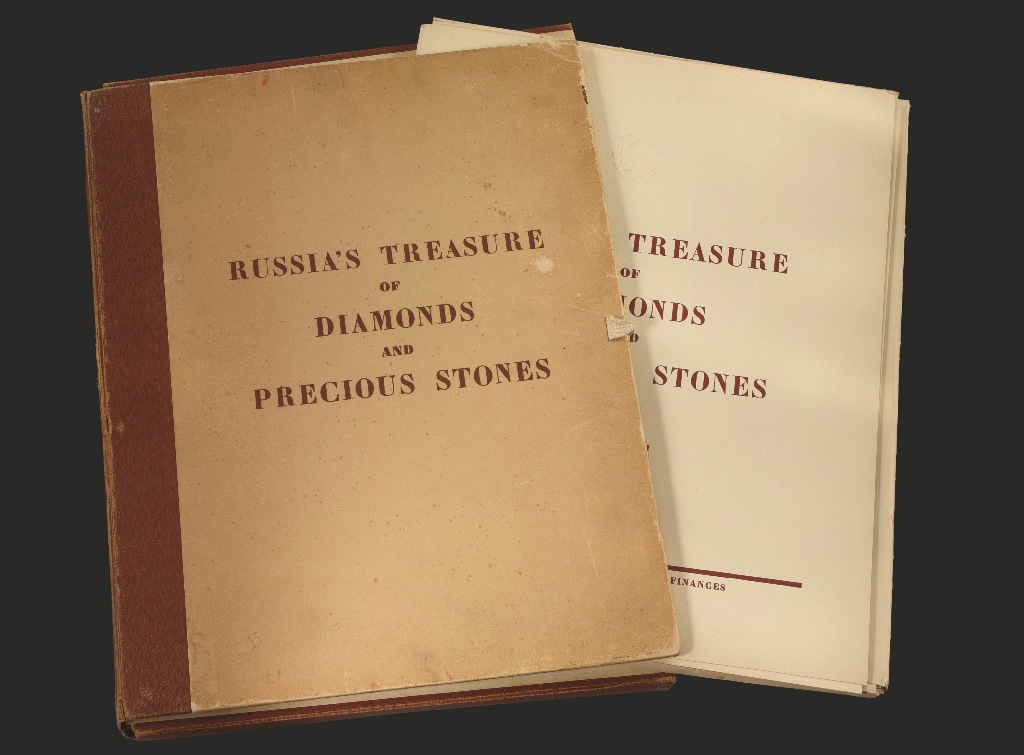
PHOTO: Russia’s Treasure of Diamonds and Precious Stones was originally published as a four-part folio in 1925. It is now available in a book format [both hardcover and paperback editions] for the very first time

The Fersman catalogue states that the jewels, considered national property, would never be “sold or done away with.” Because the new Soviet Union desperately needed capitol, however, copies of the catalogue were sent to potential jewellery buyers anyway. Although the treasure was later removed from the market, some of the pieces were sold to a syndicate and eventually wound up at auction at Christie’s London on March 16, 1927. The majority of the collection remains in Russia at the Kremlin Diamond Fund in Moscow.

Only 350 copies of the catalogue were printed in three languages: Russian, French and English, copies of which are highly sought after by collectors. At least 20 copies of the English language catalogue are known to exist today. As such, it is an exceedingly rare work in any of the three languages, and much desired by gemologists, jewellers, historians and collectors of books about the Romanovs.

Every now and then a copy has been offered by one of the auction houses, selling for up to tens of thousands of dollars. For instance: a copy in 2011 for £42,000 GBP [$56,000 USD]; in 2018 for $8,260 USD; in 2019 for £25,000 GBP [$33,500 USD].

I am pleased to present the original 1925 four-part folio in a book format for the very first time, a facsimile of the copy from my own private collection, and at a price which is affordable for all.

© Paul Gilbert. 3 January 2022

The Romanovs on ‘Seinfeld’?!

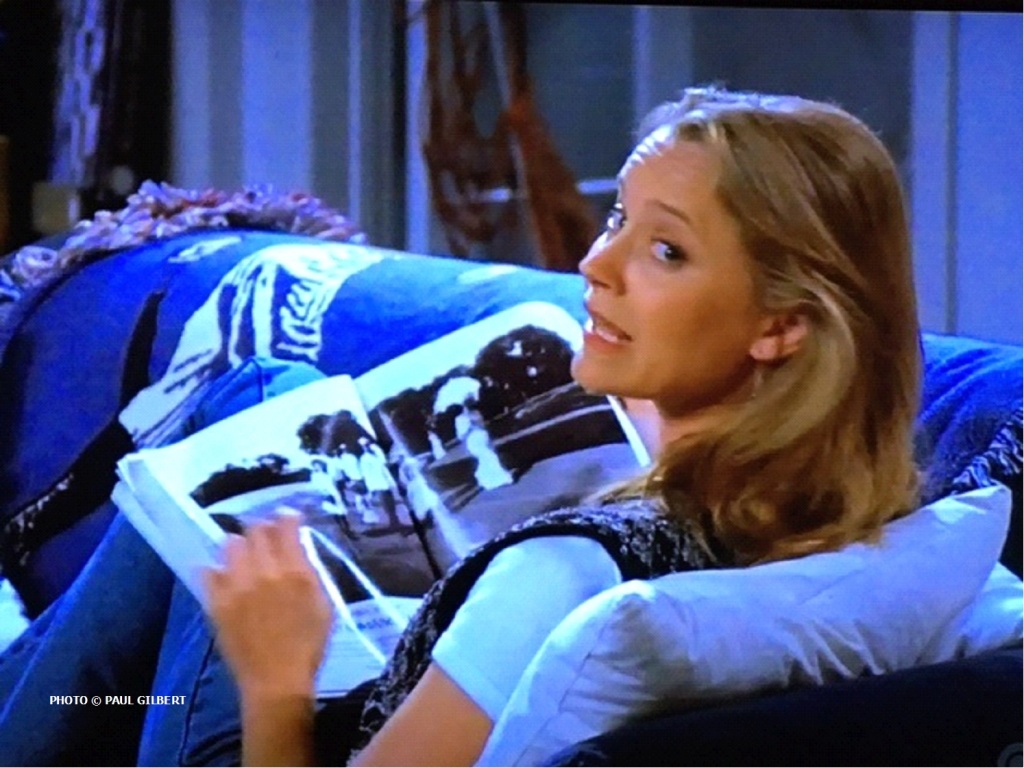
PHOTO: “Susan” leafing through an August 1995 issue of The New Yorker, which depicts a photo of Emperor Nicholas II and his family

Last night, I was watching an old 1995 episode of ‘Seinfeld’, when one particular clip grabbed my attention. “Susan Ross” (played by Heidi Swedberg, is seen relaxing on the sofa while flipping through a magazine. As she turned the page, I immediately recognized the photo of Nicholas II and his family walking through a park—possibly Alexandria at Peterhof or Livadia?

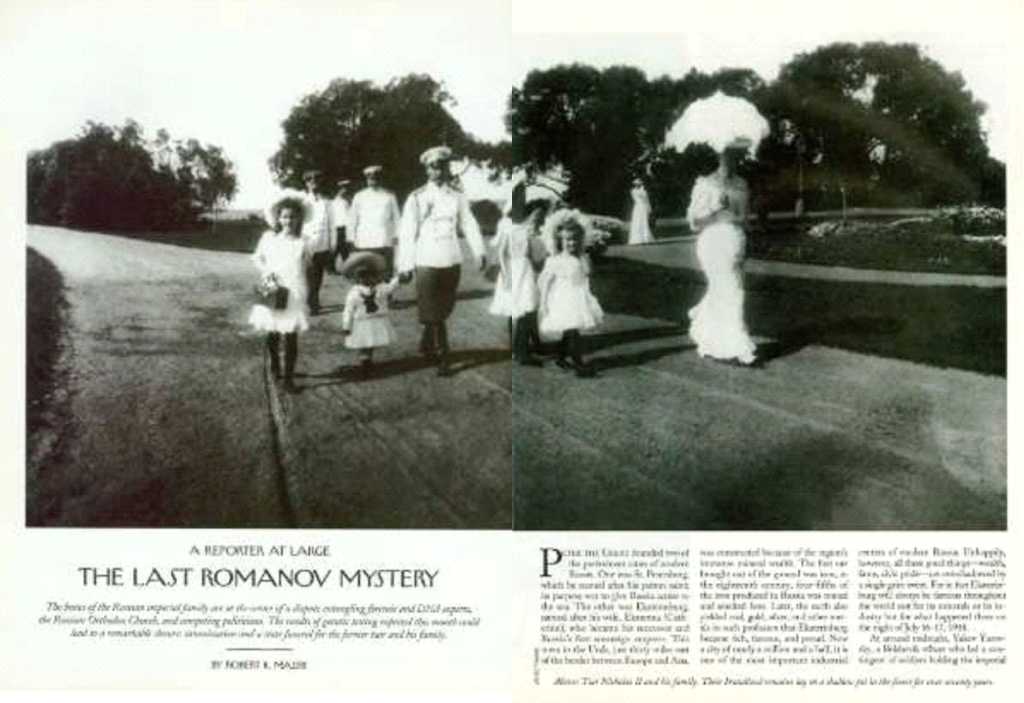
PHOTO: pages 72 and 73 of the August 21st, 1995 issue of The New Yorker

As it turns out, she is reading the August 21st, 1995 issue of The New Yorker magazine, which featured an excerpt from The Romanovs: The Final Chapter by Robert K. Massie, published by Random House the same year. The excerpt was titled The Last Romanov Mystery.

I immediately grabbed my iPhone and snapped the photo seen at the top of this article, and then compared it the issue of The New Yorker (seen above). Sure enough, the photo was published on pages 72 and 73.

I am delighted to share this interesting observation and little known television trivia.

© Paul Gilbert. 2 January 2022

The Romanov Restaurant in Tobolsk

PHOTO: entrance to the Romanov Restaurant, Hotel Slavyanskaya, Tobolsk

With the recent opening of the new airport in Tobolsk in September 2021, the popular although remote Siberian city is expecting to attract more visitors.

Founded in 1590, Tobolsk is the second-oldest Russian settlement east of the Ural Mountains in Asian Russia, and is a historic capital of the Siberia region. Tobolsk is rich in history. Aside from the beautiful Kremlin, numerous museums and other historic sights, the Museum of the Family of Emperor Nicholas II, which opened in 2018, has become a popular venue for visitors.

For any one pursuing their interest in the last Tsar and his family, the Hotel Slavyanskaya is the perfect place to stay. Opened in June 1994, the Hotel Slavyanskaya was the first European-level hotel in the region, located in the city center. It offers 177 rooms equipped with Italian handmade furniture in the style of Louis XV.

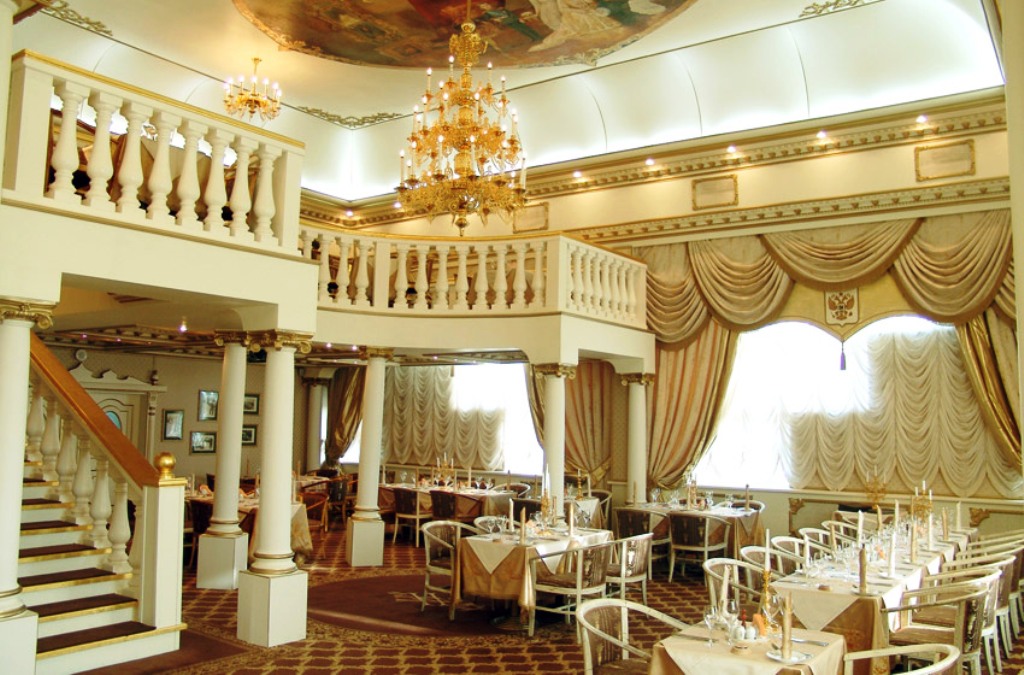
PHOTO: elegant interior of the Romanov Restaurant, Hotel Slavyanskaya, Tobolsk

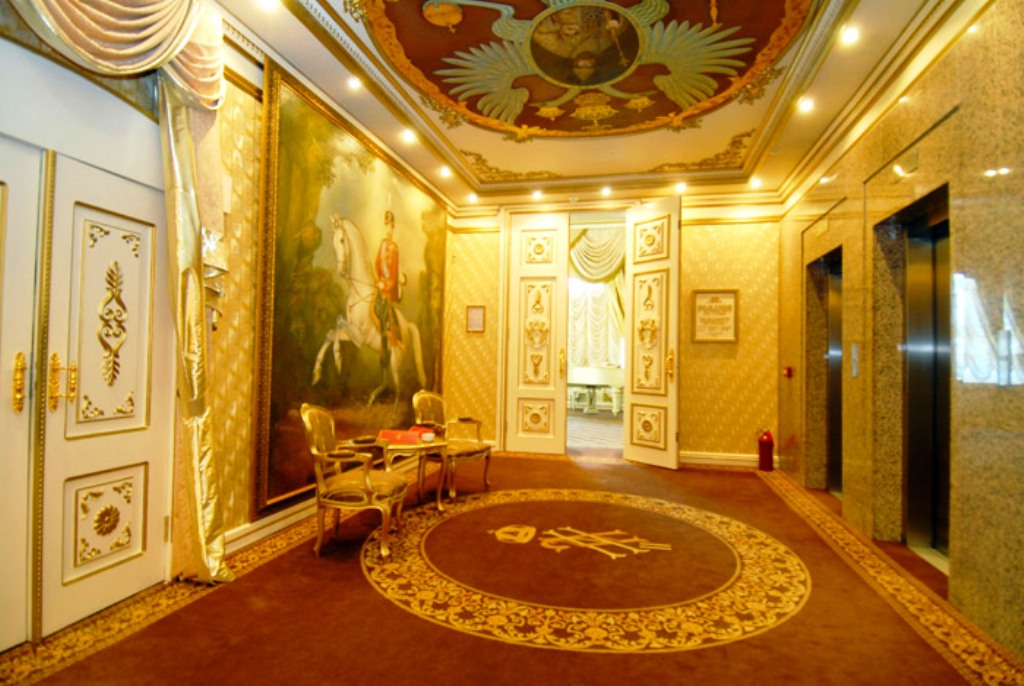
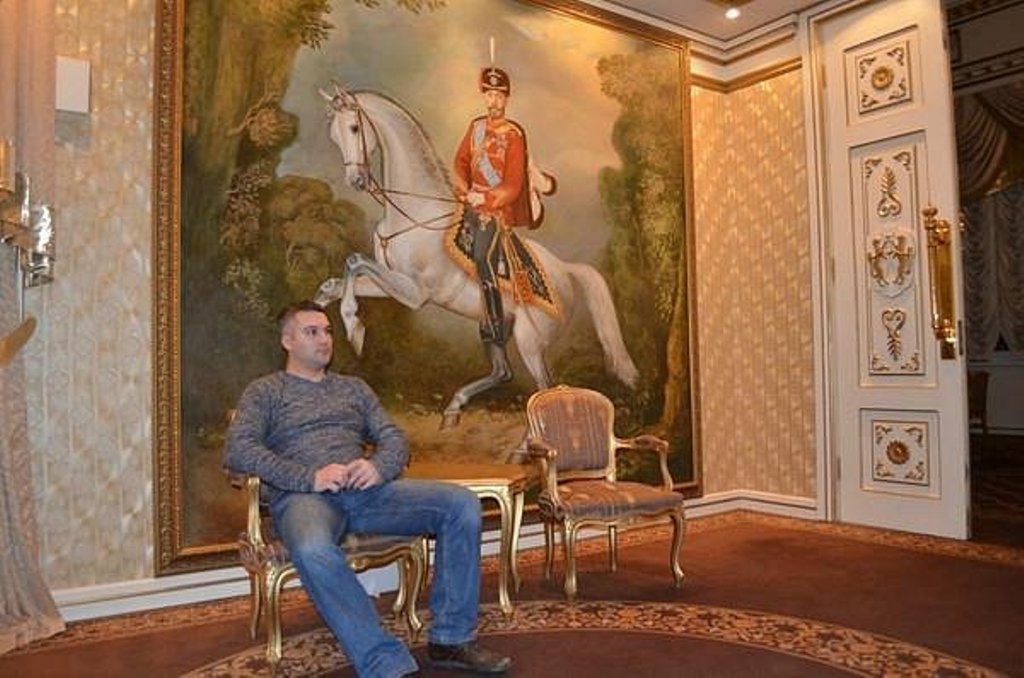
The Romanov Restaurant is located on the sixth floor of the Slavyanskaya. As you exit the lift, where guests are greeted by a large equestrian portrait of Emperor Nicholas II, and elegant heraldic symbols thus creating a regal atmosphere.

PHOTO: equestrian portrait of Emperor Nicholas II, outside the entrance to the restaurant

The interior is on two-levels, a grand staircase leading to the upper tier, the railings are covered with gold leaf. The decor of the hall is designed in light golden-beige tones with attributes of a royal theme. The walls are covered with panels draped in noble fabrics. And the exquisite design of the curtains on the windows give the hall the looks of a grand palace. The interior is complemented by Corinthian columns, cornices with gilded brackets.

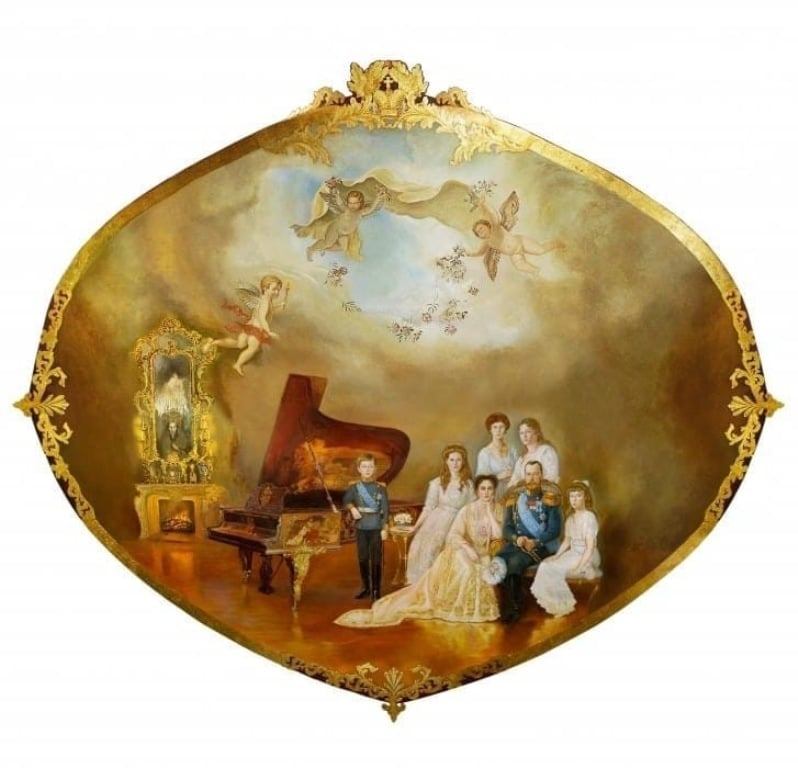
The stylized monogram of Nicholas II is present in many elements of decor, dishes, serving utensils, napkins, tablecloths, etc. The restaurant is also decorated with a large mirror in a carved gilded frame, and a restored ivory grand piano made by the world famous F. Muhlbach firm.

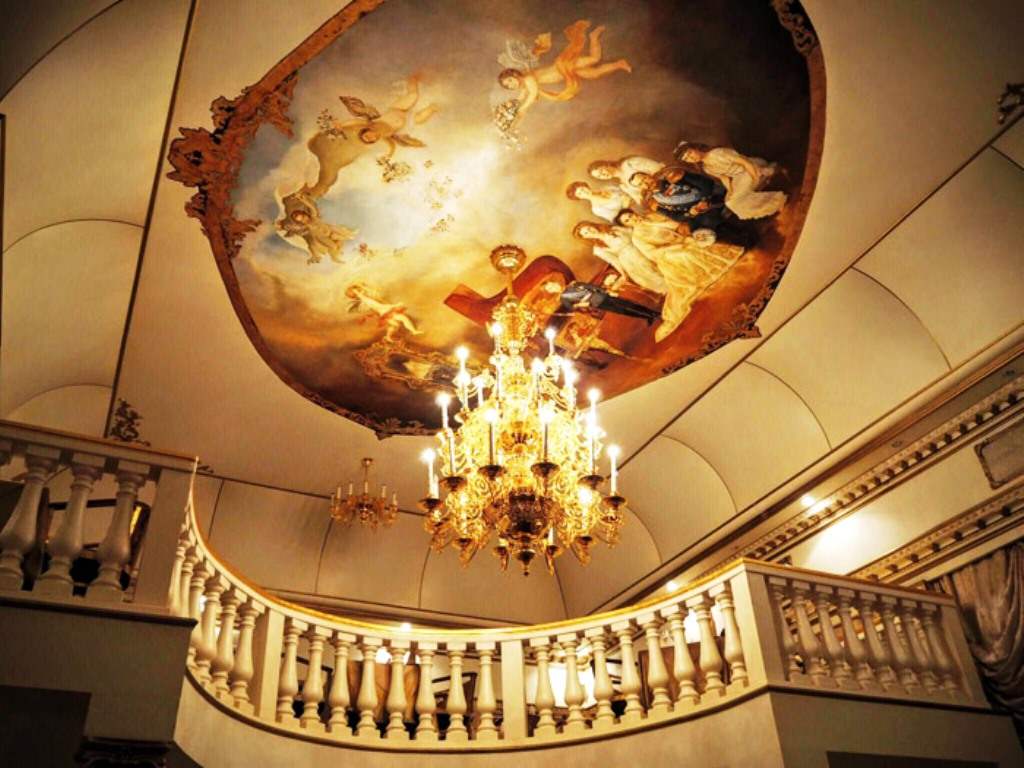
PHOTO: portrait of Nicholas II and his family by Ekaterina Masyutina

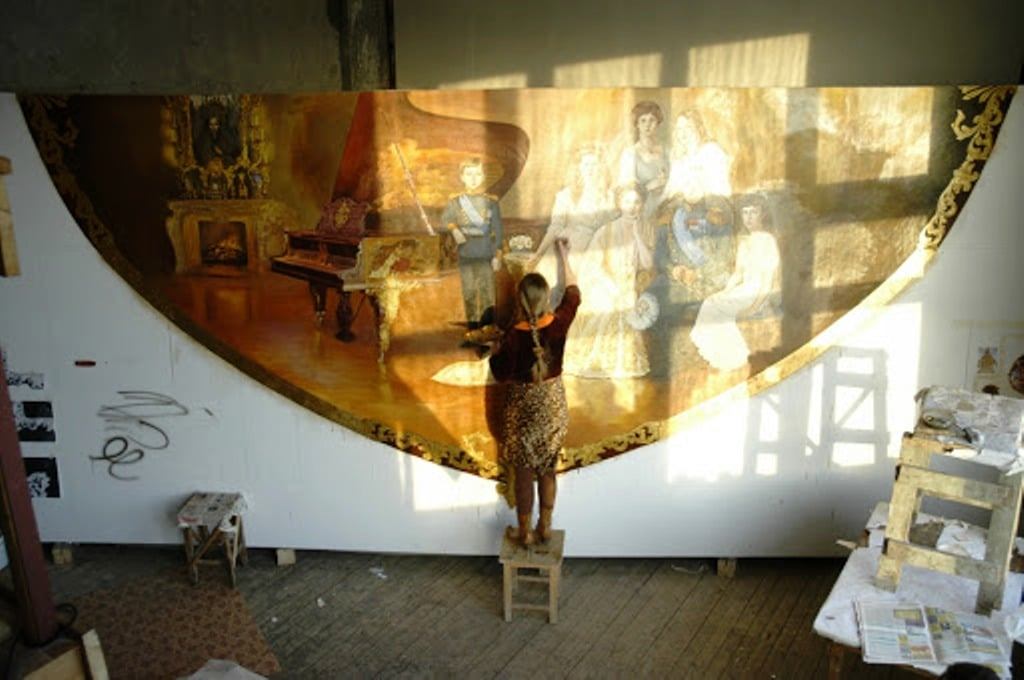
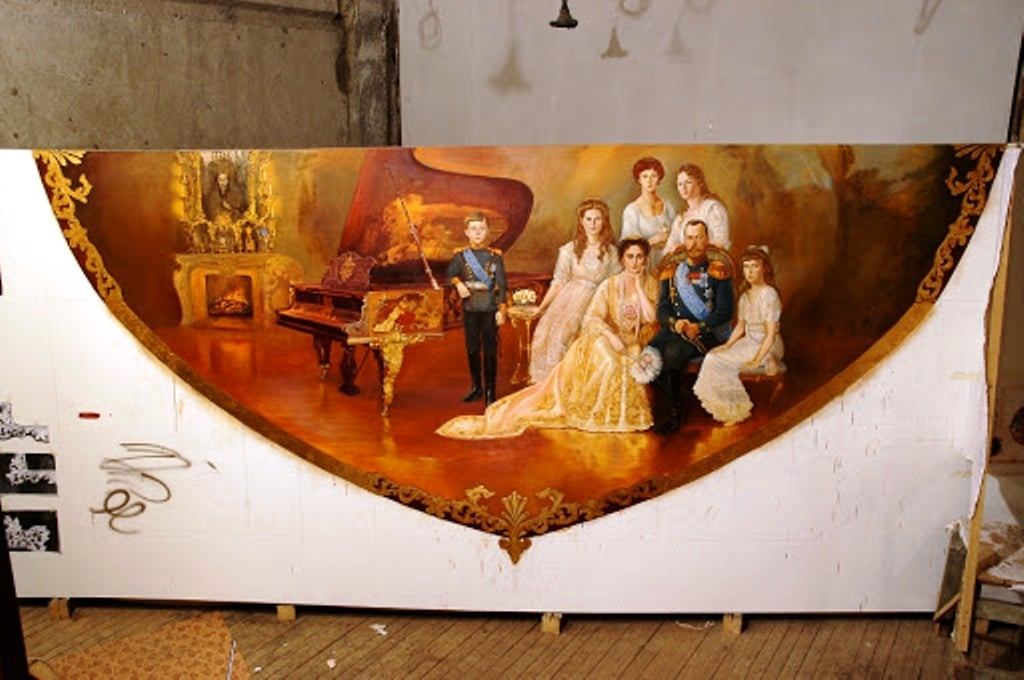
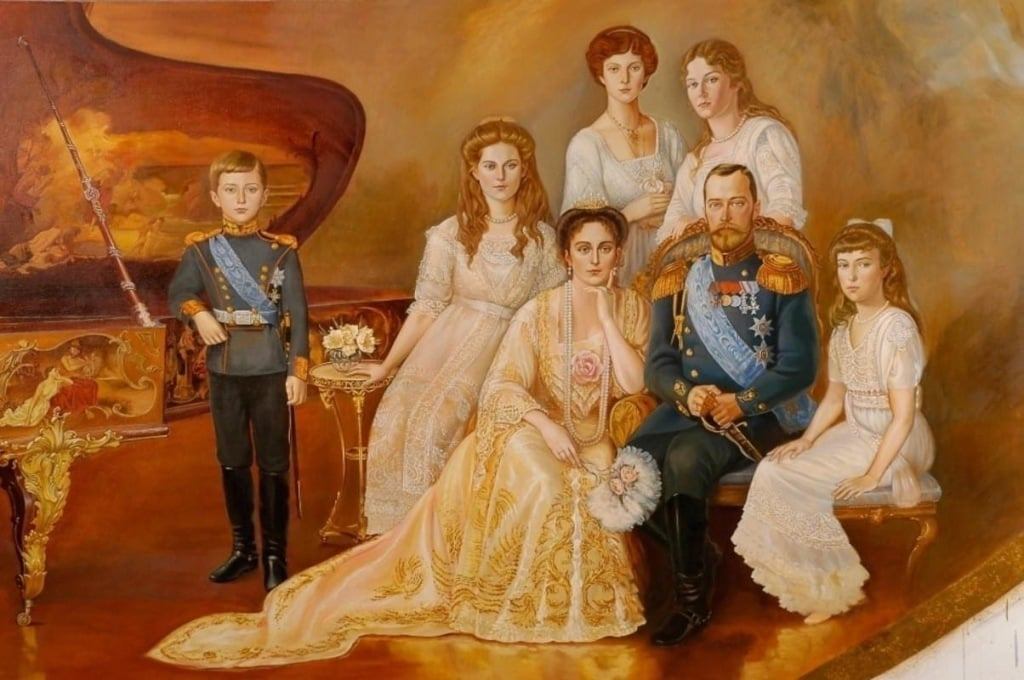
The most striking element of the Romanov Restaurant is the oval-shaped plafond with a group portrait of Emperor Nicholas II and his family, created by the Russian artist Ekaterina Masyutina.

PHOTOS: Artist Ekaterina Masyutina working on her portrait of the Imperial Family

PHOTO: detail of Emperor Nicholas II and his family

PHOTO: portrait of Emperor Nicholas II and his family, created by the Russian artist Ekaterina Masyutina, Romanov Restaurant, Hotel Slavyanskaya, Tobolsk

© Paul Gilbert. 1 January 2022

5 NEW Romanov Titles for December 2021

I am pleased to offer 5 additional Romanov titles – published in December 2021 – available in HARDCOVER and PAPERBACK editions on AMAZON. Prices for hardcover editions start at $29.99, while paperback editions start at $12.99 USD. Each title offers a FREE “Look Inside” feature.

All of these titles are available from any *AMAZON site in the world and are priced in local currencies: Canada, United Kingdom, Germany, France, Spain, Italy, Netherlands, Japan, India, Brazil, Mexico and Australia.

*NOTE: Hardcover editions are only available in certain countries!

NOTE: if you cannot locate a specific title in your preferred AMAZON site, please contact me by email [royalrussia@yahoo.com] and I will be happy to provide you with the respective link – PG

Please refer to the links provided below to view this month’s selection:

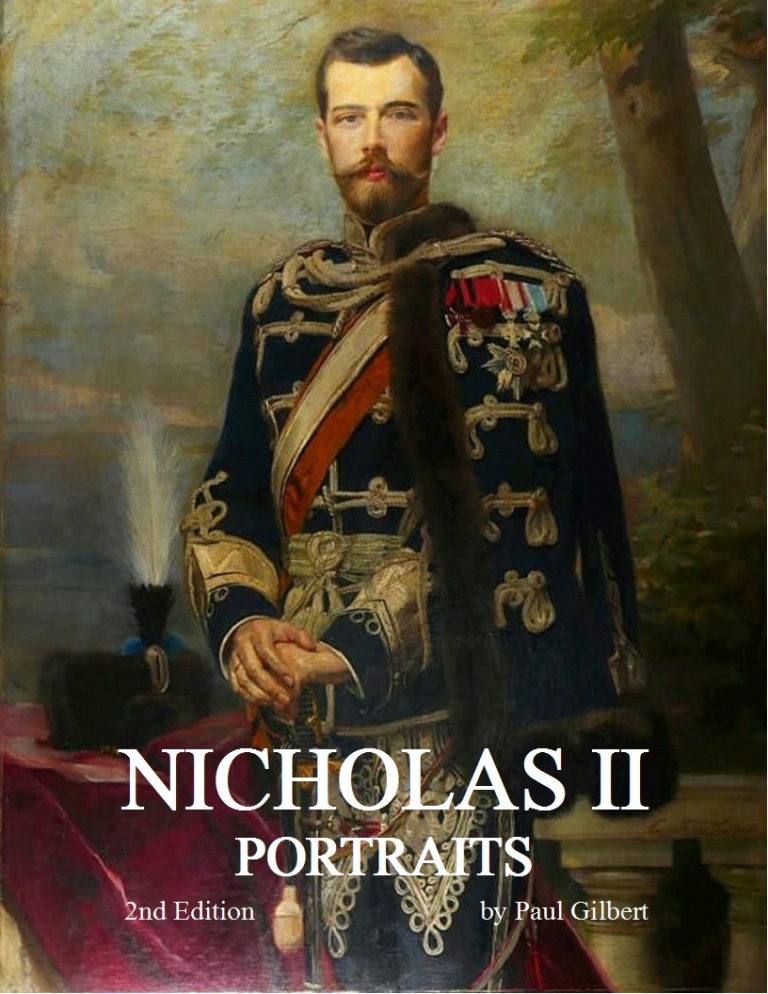
NICHOLAS II. PORTRAITS
by Paul Gilbert

CLICK ON THE LINK BELOW TO ORDER FROM AMAZON

HARD COVER EDITION @ $50 USD

PAPERBACK EDITION @ $40 USD

BOOK DESCRIPTION

Large format 8-1/2″ x 11″ hard cover and paperback editions, with 178 pages + 200 Colour and black & white photographs

SECOND EDITION, FEATURING 185 FULL COLOUR PHOTOS!

I am pleased to announce the publication of my latest book Nicholas II. Portraits, in both hard cover and paperback editions. This is first hard cover book and my first book featuring full colour photographs.

Originally published in 2019, with 140 pages with 175 black and white photos, this new expanded edition features more pages and more photographs: 180 pages + more than 200 photos, including 185 FULL COLOUR and 30 black & white!

Nicholas II. Portraits explores a century of portraits of Russia’s last emperor and tsar, through the eyes of pre-revolutionary and contemporary Russian, and foreign artists.

This unique title – the first book of its kind ever published on the subject – features an introduction, as well as a series of short articles, and richly illustrated, including many full-page, with detailed and informative captions.

The cover features a portrait of Tsesarevich and Grand Duke Nicholas Alexandrovich (1889), the future Emperor Nicholas II, by the artist Baron Ernst Friedrich von *Lipgart (1847-1932).

* Lipgart painted a whole gallery of portraits of Nicholas II, my book features 10 of them – all in COLOUR!

The Emperor is depicted in the uniform of the Prussian 8th Hussar Regiment, of which he was appointed an Honourary Chief in 1889, his cape is decorated with the Royal Prussian Order of the Black Eagle.

The painting hung from 1890 to 1995 in the former dining room of Neuhaus Castle, directly opposite the portrait of Elector Clemens August of Bavaria. The officers of the 8th Hussar Regiment established a club for their meetings here and in the adjacent premises. The Prussian regiment was stationed at Neuhaus and Paderborn castle from 1851 to 1919. Following the end of World War I, the regiment was disbanded.

From the Collection of the Museum of the House of Bavarian History in Regensburg, Bavaria.

The articles include: Serov’s Unfinished 1900 Portrait of Nicholas II; A Nun’s Gift to Russia’s New Tsar. The Fate of a Portrait; Galkin’s Ceremonial Portrait of Nicholas II Discovered; among others!

Famous portraits and their respective artists are all represented, including Serov, Repin, Lipgart, Tuxen, Bakmanson, Becker, Bogdanov-Belsky, Kustodiev, and many others.

The last section of the book is dedicated to the works of contemporary Russian artists, who have painted outstanding portraits of Nicholas II since the fall of the Soviet Union in 1991.

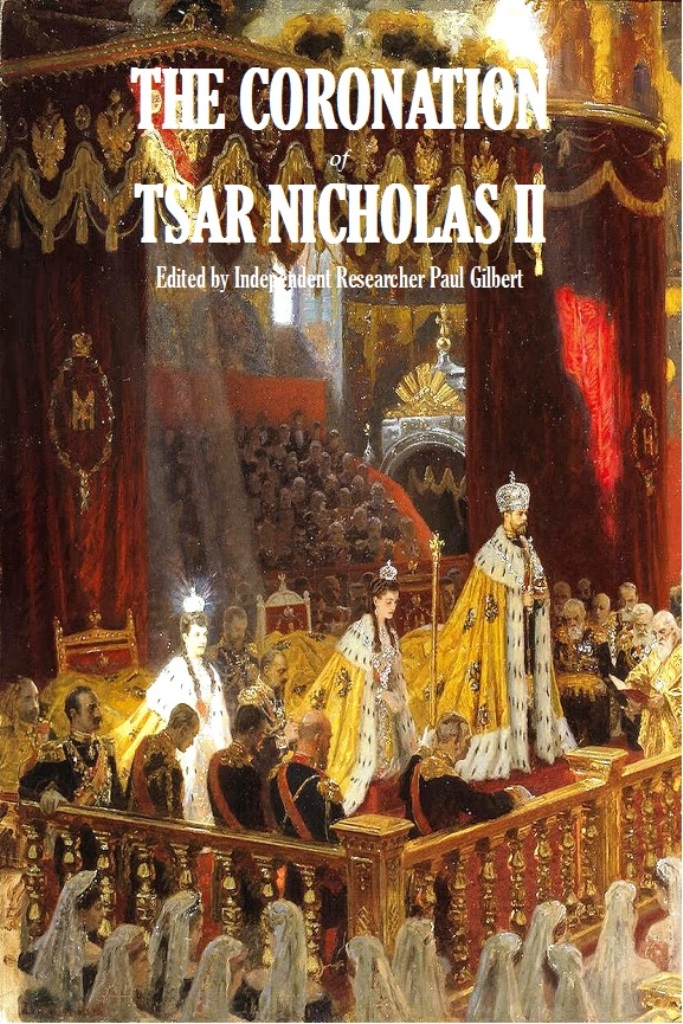
THE CORONATION OF TSAR NICHOLAS II
Compiled and Edited by Paul Gilbert

CLICK ON THE LINK BELOW TO ORDER FROM AMAZON

HARD COVER EDITION @ $29.99 USD

PAPERBACK EDITION @ $18.99 USD

BOOK DESCRIPTION

Hard cover and paperback editions, with 456 pages + more than 200 black & white photographs

Six eyewitness accounts of the crowning of Russia’s last tsar with more than 200 rare vintage photographs & illustrations

The pomp and pageantry surrounding the Coronation of Nicholas II is told through the eye-witness accounts of six people who attended this historic event at Moscow, held over a three week period from 6th (O.S.) to 26th (O.S.) May 1896.

The authors came from all walks of life and different nations: Francis W. Grenfell and Mandell Creighton, Bishop of Peterborough (Great Britain); John A. Logan, Jr., Kate Koon Bovey and Richard Harding Davis (United States); and Boris Alexandrovich Engelgardt (Russia).

Historians have left us only brief descriptions of this historic event, but it is thanks to the authors of this unique book that we are grateful. They recorded their observations in diaries and letters, leaving to posterity a first-hand record that allows modern-day readers to relive the crowning of Russia’s last tsar and the splendour and opulence of a world that is gone forever.

These exceptional memoirs offer a wealth of information that include the preparations and events leading up to and during the coronation festivities, the tsar’s entry into Moscow, the procession to the cathedral, the crowning of the tsar and the celebrations that followed. No two memoirs are alike; each of the authors guides the reader through this historic event through his or her own eyes.

Paul Gilbert is an independent researcher specializing in the study of the life and reign of Emperor Nicholas II. He has committed his research to clearing the name of Russia’s much slandered Tsar.

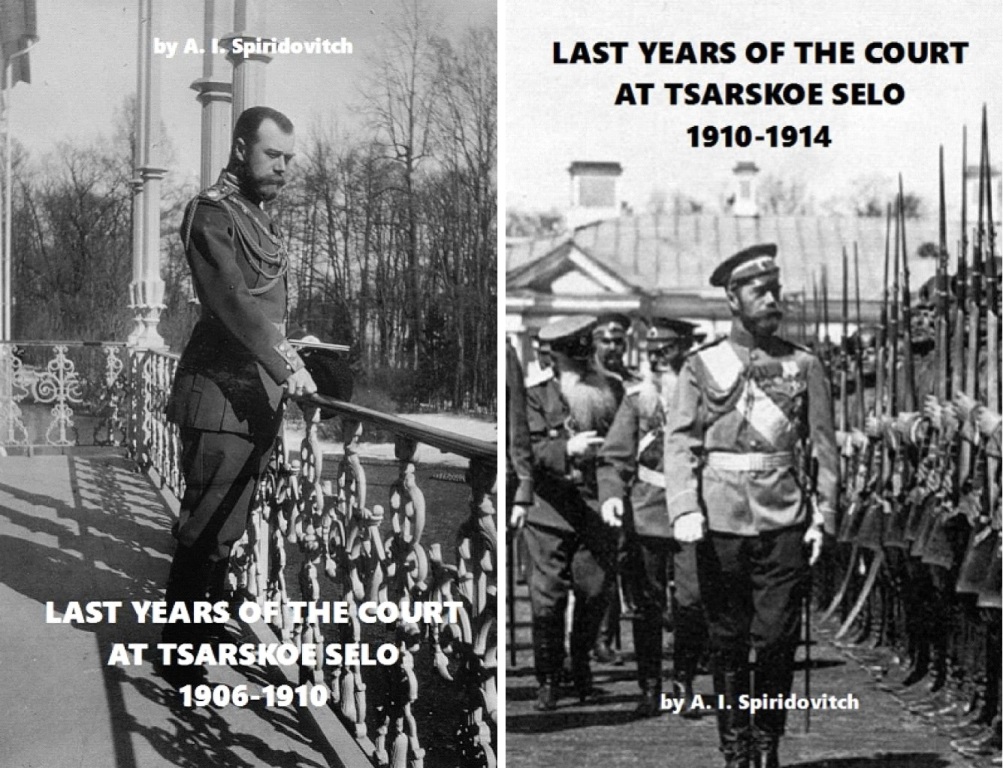
LAST YEARS OF THE COURT AT TSARSKOE SELO – 2 Volumes
by Alexander Spiridovitch

CLICK ON THE LINK BELOW TO ORDER FROM AMAZON

VOLUME I – 1906-1910. PAPERBACK EDITION @ $18.99 USD

VOLUME II – 1910-1914. PAPERBACK EDITION @ $18.99 USD

BOOK DESCRIPTION

Volume I – 1906-1910, with 458 pages + 59 black & white photographs

Volume II – 1910-1914, with 480 pages + 65 black & white photographs

This is the first English translation of the first volume of the memoirs of A. I. Spiridovitch (1873-1952).

Alexander Ivanovich Spiridovitch was handpicked by Emperor Nicholas II to serve as his personal security chief from 1906-1916. He was also responsible for the security of the tsar’s residences.

His memoirs offer a rare eye-witness glimpse into the private world of the last tsar and his family and their day to day life. Thanks to his eye for detail, he takes us through the imperial residences, the Imperial yacht Standart and his journeys with the Imperial family through the Finnish fjords and to Livadia in the Crimea.

Spiridovitch and his men were highly recognized for their counter-terrorist work. His memoirs reveal the numerous plots to assassinate Nicholas II and other members of the Imperial family by terrorist groups working within Russia.

Spiridovitch was a pillar of honesty and trust, articulate, and intelligent, loyal to his God, the Tsar and Mother Russia. He was truly a gentleman beyond reproach. His memoirs offer one of the most honest accounts of the character and personality of Tsar Nicholas II and life at the Russian Imperial Court in its twilight years.

Many of the photographs in this 2-volume set come from the private collection of the author himself who was an avid photographer.

In 1950 he moved to the United States, where he died in 1952 at the age of 78.

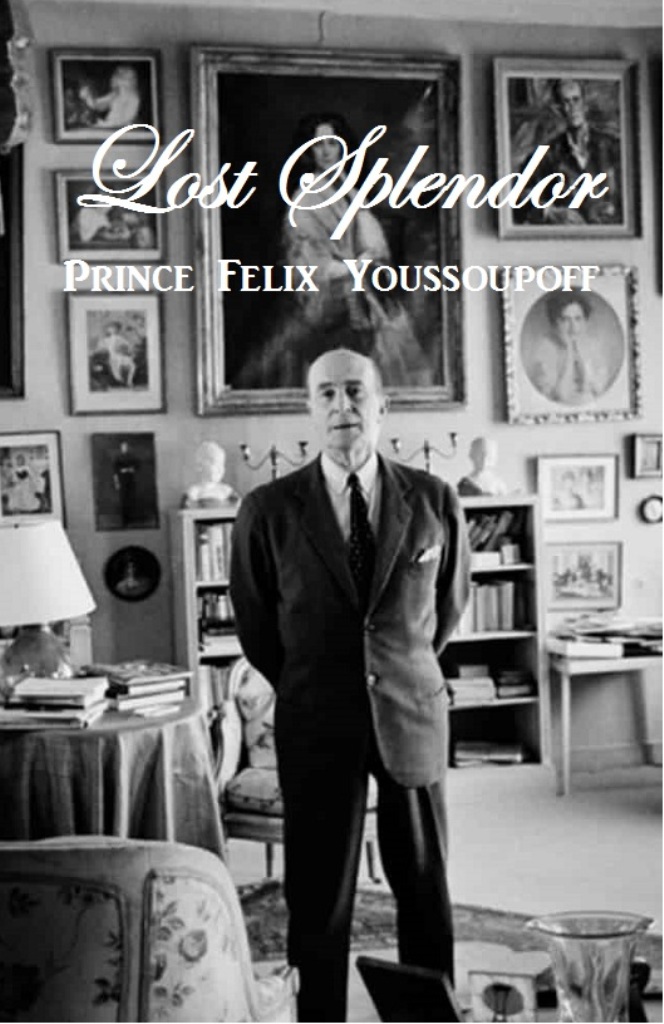
LOST SPLENDOR
by Prince Felix Youssoupoff

CLICK ON THE LINK BELOW TO ORDER FROM AMAZON

PAPERBACK EDITION @ $15.99 USD

BOOK DESCRIPTION

Paperback edition, with 370 pages + 29 black & white photographs

An astonishing memoir brings you deep inside the world of majesty and intrigue at the end of the Romanov dynasty

Born to great riches, master of vast feudal estates and many palaces, Prince Felix Youssoupoff led the life of a grand lord in the days before the Russian Revolution. Married to a niece of Tsar Nicholas II, he could observe at close range the rampant corruption and intrigues of the imperial court, which culminated in the rise to power of the sinister monk Rasputin. Finally, impelled by patriotism and his love for the Romanov dynasty, which he felt was in danger of destroying itself and Russia, he killed Rasputin in 1916 with the help of the Grand Duke Dmitri Pavlovich and others. More than any other single event, this deed helped to bring about the cataclysmic upheaval which ended in the advent of the Soviet regime.

The author describes the luxury and glamour of his upbringing, which to us seems like some tale from the Arabian Nights, fantastic episodes at night clubs and with the gypsies in St. Petersburg, grand tours of Europe, dabbling in spiritualism, occultism, and an occasional conscience-stricken attempt to alleviate the lot of the poor.

Here is an extraordinary personal history which has all the excitement of a thriller—and is also important in the history of one of the greatest events of modern times.

Click HERE to view 4 NEW Romanov titles published in November 2021

Click HERE to view 5 NEW Romanov titles published in October 2021

Click HERE to view 5 NEW Romanov titles published in September 2021

Click HERE to view 4 NEW Romanov titles published in August 2021

© Paul Gilbert. 30 December 2021

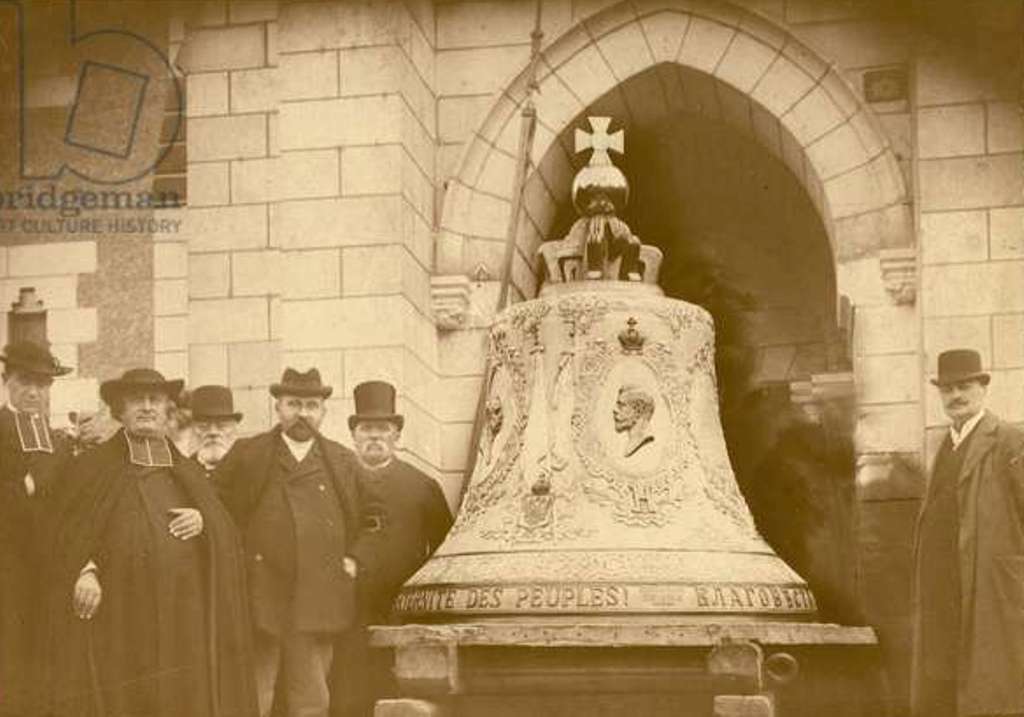
Nicholas II gifts bell to French parish in 1897

PHOTO: Bell gifted by Emperor Nicholas II to the town of Châtellerault, 1897

For the last 124 years, a tiny French parish has held a secret with a little known connection to Russia’s last emperor and tsar Nicholas II.

In 1891, Russia placed a large order for rifles from the Manufacture de Châtellerault in France. The Manufacture d’Armes de Châtellerault was recognized throughout France for the manufacture of Lebels rifles. From 1891 to 1894, a Russian mission stayed in Châteauneuf, to supervise the manufacture of 500,000 rifles ordered by Emperor Alexander III.

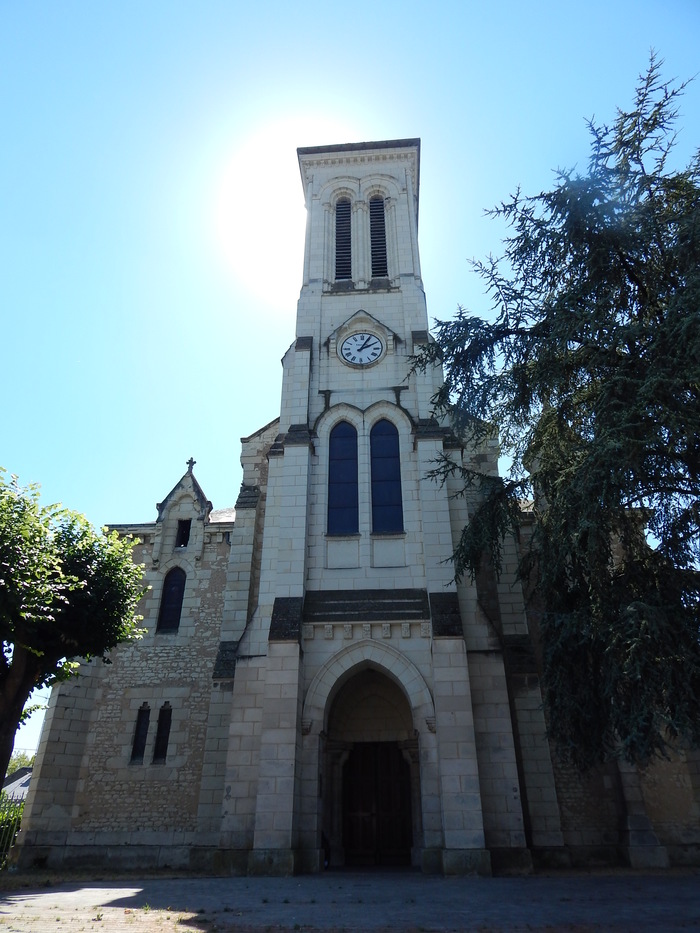
When the Russian garrison came to take possession of the arms, they received a warm welcome by the town and especially, the parish priest of Saint-Jean-l’Évangéliste Church on rue Clément Jannequin in Châteauneuf, who opened the doors of his Catholic church so that a priest could perform an Orthodox Liturgy for their Russian guests.

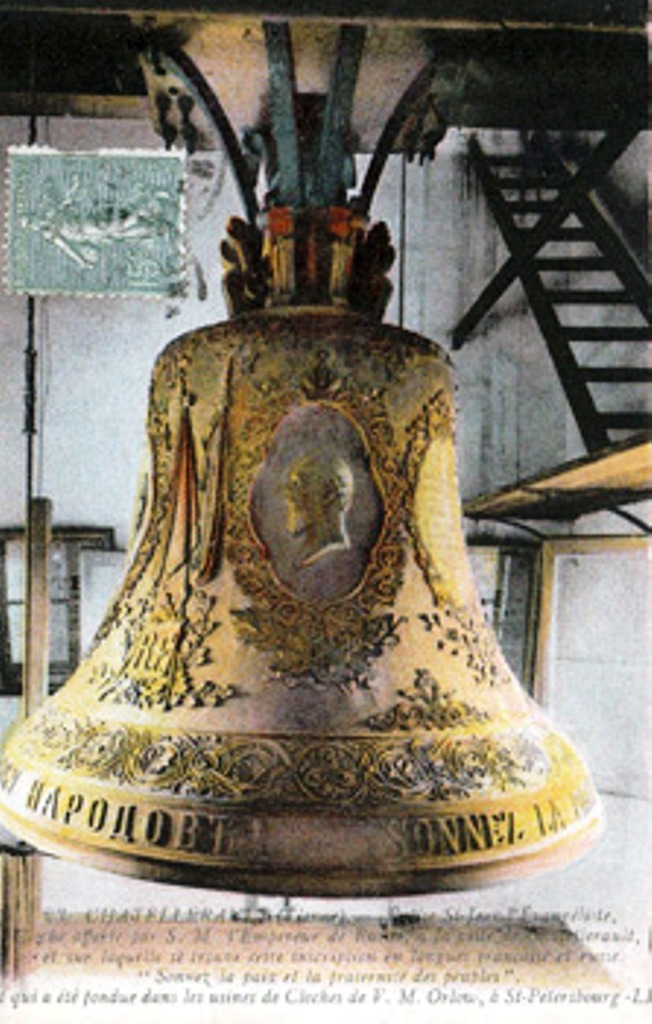
PHOTO: The brass bell weighed 2600 kg and was covered with a layer of silver

Following Alexander III’s death in 1894, a memorial service was organized in the square in front of the church on 8th November 1894. In gratitude, for their kindness to the memory of his beloved father, Emperor Nicholas II gifted a beautifully ornate bell to the parish of Châteauneuf, a town situated on the Vienne River, located in the Nouvelle-Aquitaine region of France.

The bronze bell was cast at the V.M. Orlov bell factory in Saint Petersburg, with a diameter of 1.75m, weighing more than 2600 kg and is covered with a layer of silver. It was decorated with four medallions representing two Russian Tsars, Alexander III and Nicholas II, and two French presidents, Sadi Carnot and Félix Faure, in honour of the Franco-Russian Alliance. The inscription in both French and Russian reads: “Ring for the peace and fraternity of all people”.

In 2012, the bell was listed as an historic monument, and thus eligible for funding for its restoration. The bell had been silent for several years, however, in 2017 a decision was made to make repairs. The work was carried out at the Bodet company, located in Maine-et-Loire at a cost of 15,000 euros. One specialist in clocks and bells remarked in admiration: “It is one of the most beautiful bells that I have seen”.

PHOTO: Saint-Jean-l’Évangéliste Church in Châteauneuf,

For 10 days, the workers assembled a wooden easel and installed an electronic system to ring the bell again. But unlike before, it was no longer used solely to indicate the time, it now rings during services: masses, weddings and baptisms. The rare Russian bell rang once again on 11th May 2017, and continues to ring to this day.

© Paul Gilbert. 24 December 2021

Alexander Palace Curator answers questions about the Imperial residence

Maria Filiptseva. Photo © Ruslan Shamukov

The curator of the Alexander Palace exposition, Maria Filiptseva, answers questions about the Imperial Residence at Tsarskoye Selo.

Tatiana Grinchuk: Will the children’s rooms be restored?

Maria Filiptseva: Unfortunately, the reconstruction of the interiors of the Children’s wing[1] is not planned, this is due to the lack of historical sources to carry out such works.

Katya Meshalkina: What is it that you like most about your work? Are there any items in the exposition that you are your personal favourite?

Maria Filiptseva: I really like the opportunity to work creatively, especially in the Alexander Palace, where we talk about the everyday life of Nicholas II and his family. I really love to conduct historical research, because an exhibit should not just simply stand on a shelf, you need to study its origin, the history of existence. Among my favourite items, are the works of the Danish Royal Porcelain Factory. Be sure to pay attention to the porcelain figurines of animals and birds that are exhibited in many of the palace’s interiors.

Irina Zrazhevskaya: Why is the hidden safe in the bedroom of Nicholas and Alexandra not available for viewing? Has it survived?

Maria Filiptseva: The safe was lost either during the war, or during the restoration work carried out in the 1950s.

Irina Zrazhevskaya: What happened to Kuchumov’s album, into which fabric samples were pasted, etc. the Imperial chambers?

Maria Filiptseva: The albums created by Anatoly Mikhailovich Kuchumov[2] are in the collection of the Pavlovsk Museum.

Irina Zrazhevskaya: Why are there no descriptions of the exhibits in the apartments?

Maria Filiptseva: We have tried to recreate the interiors as close as possible to their historic original as they looked more than a hundred years ago, and present them as a home. An audio guide will be available soon in the museum, making it possible to obtain descriptions and information on the most significant items of each interior.

Irina Zrazhevskaya: What is the progress of the restoration of the other interiors?

Maria Filiptseva: The Mountain [Mountain] Hall with a recreated slide and the State Halls are still in the process of being recreated. There are also plans to recreate the Raspberry Drawing Room.

Irina Zrazhevskaya: Please tell us about the keys to the Alexander Palace, which are now displayed in the main corridor which separate the Imperial apartment. Were they previously kept in the Museum of the History of Modern Russia?

Maria Filiptseva: The keys were provided for temporary storage by the State Central Museum of Contemporary History of Russia (GCMSIR), they have now been returned to the palace. The keys to the apartments were preserved by the family of the assistant to the commandant of the Alexander Palace V.M.Dommazyants, who was appointed to this position in June 1917. After his death, his relatives handed over the keys for storage to the Museum of the Revolution (now the State Center for Contemporary Art).

NOTES:

PHOTO: the second floor of the eastern wing of the Alexander Palace, where the former rooms of the August children were located. The original interiors have been lost.

[1] The children’s rooms were located on the second floor of the eastern wing of the Alexander Palace. The original interiors have been lost. In 2011, they were refitted for temporary exhibitions, and open to visitors for the first time in more than 80 years. The first exhibition “Alexander Palace. Visiting the Children’s Rooms” ran from 2nd June to 11th September 2011. Framed portraits of OTMAA decorated the walls leading to their rooms. A small catalogue [in Russian] was published.

[2] Anatoly Mikhailovich Kuchumov (1912-1993), was a museum worker, art historian, honoured culture worker of the Russian Soviet Federative Socialist Republic (1975), honorary citizen of the town of Pavlovsk (1992).

In 1932, he worked as a cataloguer of the Pavlovsk Palace Museum; from 1937, he headed the Alexander Palace Museum in Pushkin. In 1941, Kochumov took charge of Pushkin museum collections evacuation to Gorky, then to Novosibirsk. In 1944, he returned to Leningrad, and took part in setting up the Central Depository of Museum Collections, becoming its first director.

Kuchumov was a member of the Investigation Commission for Valuables Looted by the Nazis (with Kuchumov’s assistance, over 12,000 exhibits were found and returned to museums).

In 1956, he was appointed chief curator of Pavlovsk Palace Museum, and became one of the authors of the project of restoration of its interiors. A specialist in the 18th -19th centuries Russian material culture history, Kuchumov provided consulting support to the Hermitage, the State Museum of History, Tretyakov Gallery and other museums.

© Paul Gilbert. 21 December 2021

Kirillovichi commit sacrilege against Tsar-Martyr Nicholas II

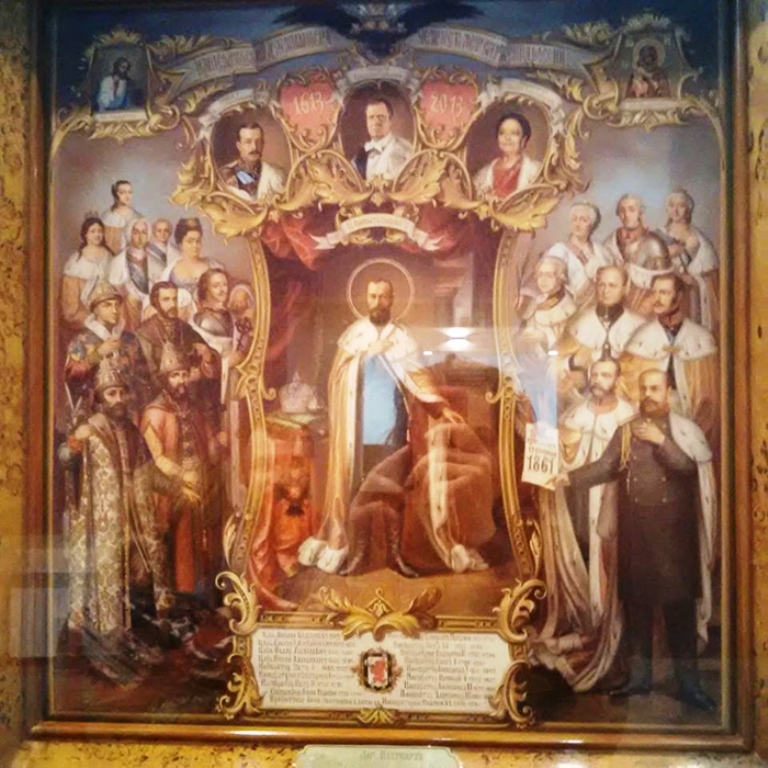
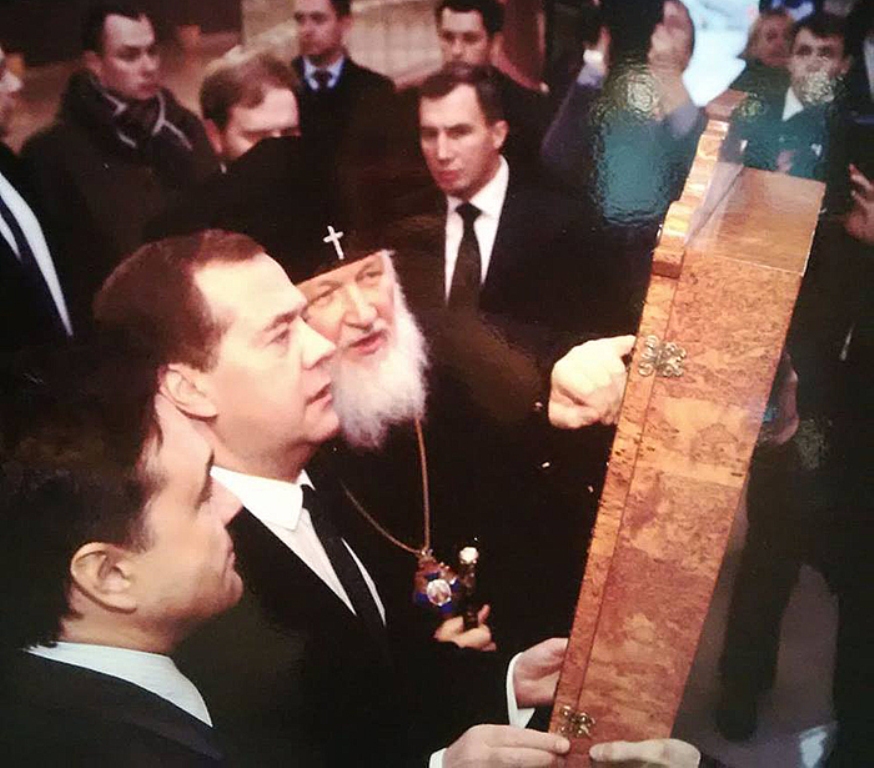
In the autumn of 2016, the then Russian prime minister Dmitry Medvedev and the Governor of the Moscow Region Vorobyov, presented the New Jerusalem Museum and Exhibition Complex with a framed picture (above) in honour of the 400th anniversary of the Romanov dynasty (1613-2013).

PHOTO: Former Russian prime minister Medvedev and Patriarch Kirill examine the framed picture presented to New Jerusalem Museum and Exhibition Complex in October 2016

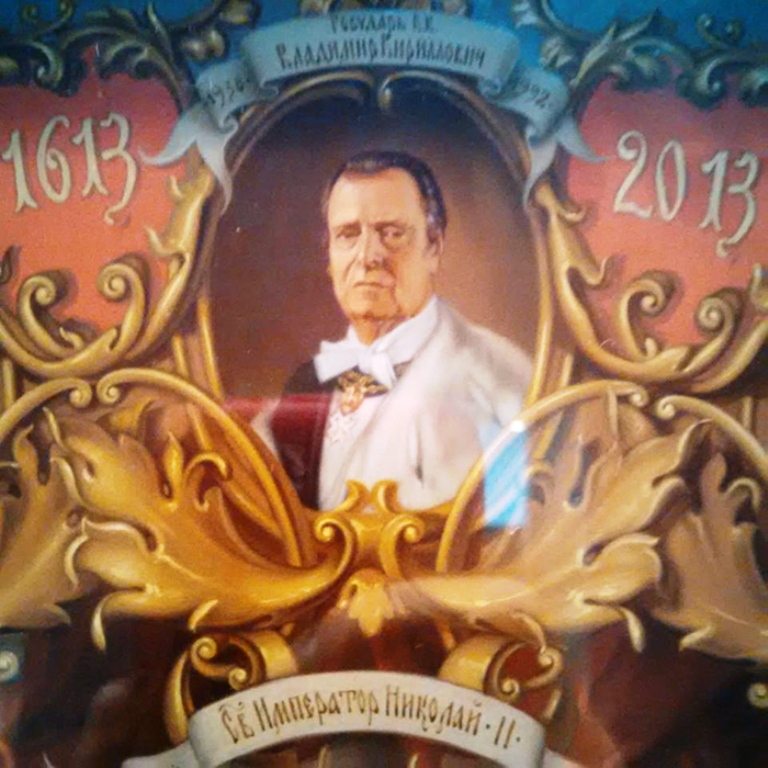
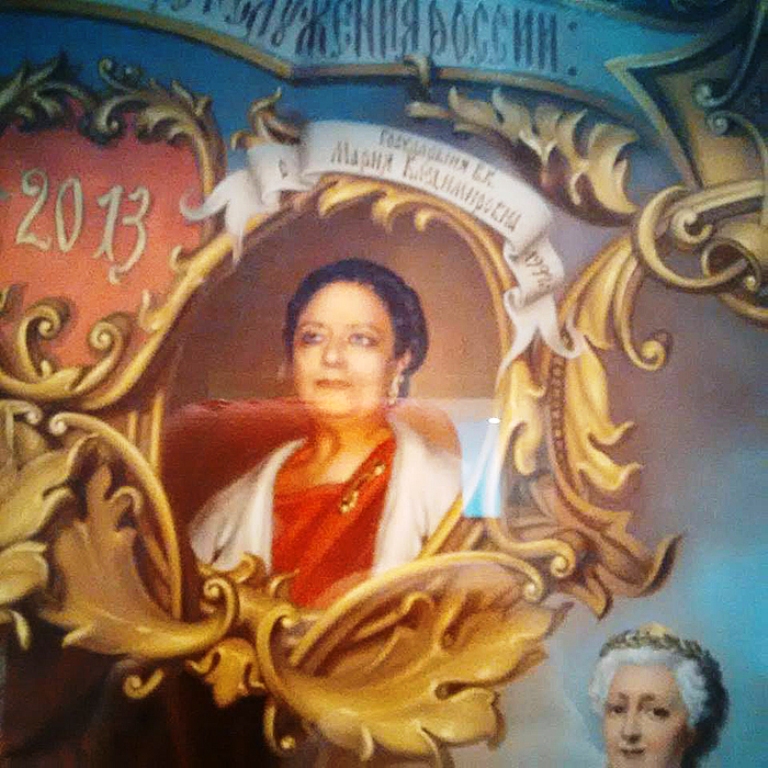
The picture depicts many of the former tsars, emperors and empresses, including Russia’s last tsar Nicholas II, who is depicted as a saint in the center. What is so disturbing about this picture, are the images of the Kirillovich branch of the Imperial Family, who are depicted disrespectfully above that of the Tsar-Martyr.

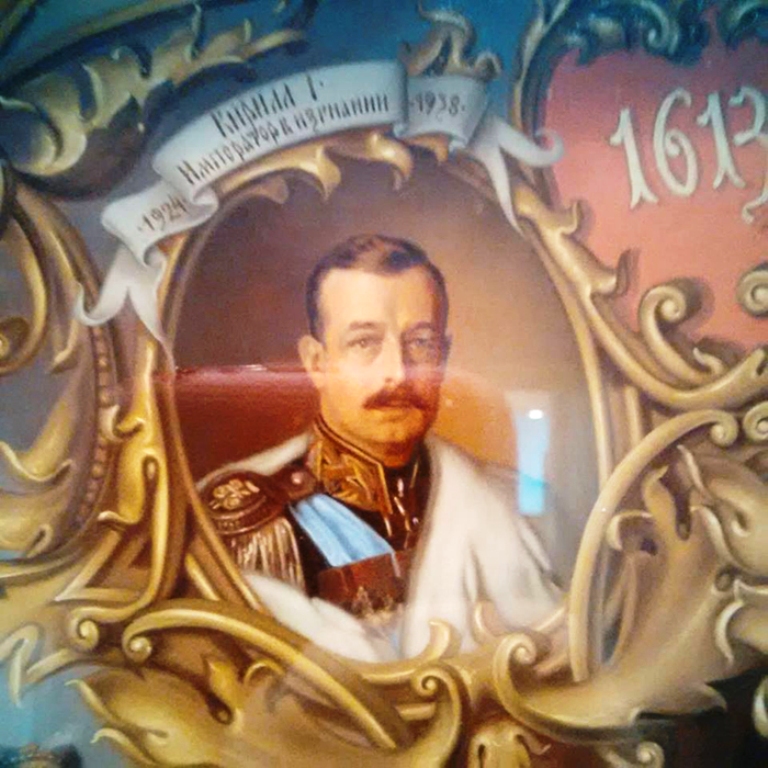
PHOTO: portraits of the Kirillovich depicted disrespectfully above the image of the Holy Tsar-Martyr Nicholas II

Each of their portraits bears a small white marker noting their false titles [Государь]: “Kirill I Emperor in Exile”, “Sovereign Vladimir Kirillovich”, and “Sovereign Maria Vladimirovna”.

Recall that it was Kirill – not only a coward, but the grand duke who lacked a moral compass – one who committed treason against his cousin Emperor Nicholas II in 1917. Vladimir and his daughter Maria are prince and princess, neither had any legal status as “head” of the Russian Imperial House or claimant to the non-existent Russian throne.

PHOTO: the marker reads “Kirill I Emperor in Exile” 1924-1938

PHOTO: the marker reads “Sovereign Vladimir Kirillovich” 1938-1992

PHOTO: the marker reads “Sovereign Maria Vladimirovna” 1992 –

The framed picture is clearly the work of the current “pretenders” and their supporters. One Romanov blogger in Russia, referred to the picture as “sacrilege,” and rightly so!

© Paul Gilbert. 19 December 2021

How British intelligence tried to get Nicholas II out of Russia

PHOTO: King George V and Emperor Nicholas II

In 1917, British intelligence officers developed several options for evacuating Tsar Nicholas II from Russia without delay, but the British government and King George V did not have enough resolve to carry out this operation. An article published by the BBC News русская служба [Russian Service], by Russian journalist Olga Ivshina, revealed some interesting new details from recently declassified secret service documents and the Royal Archives,

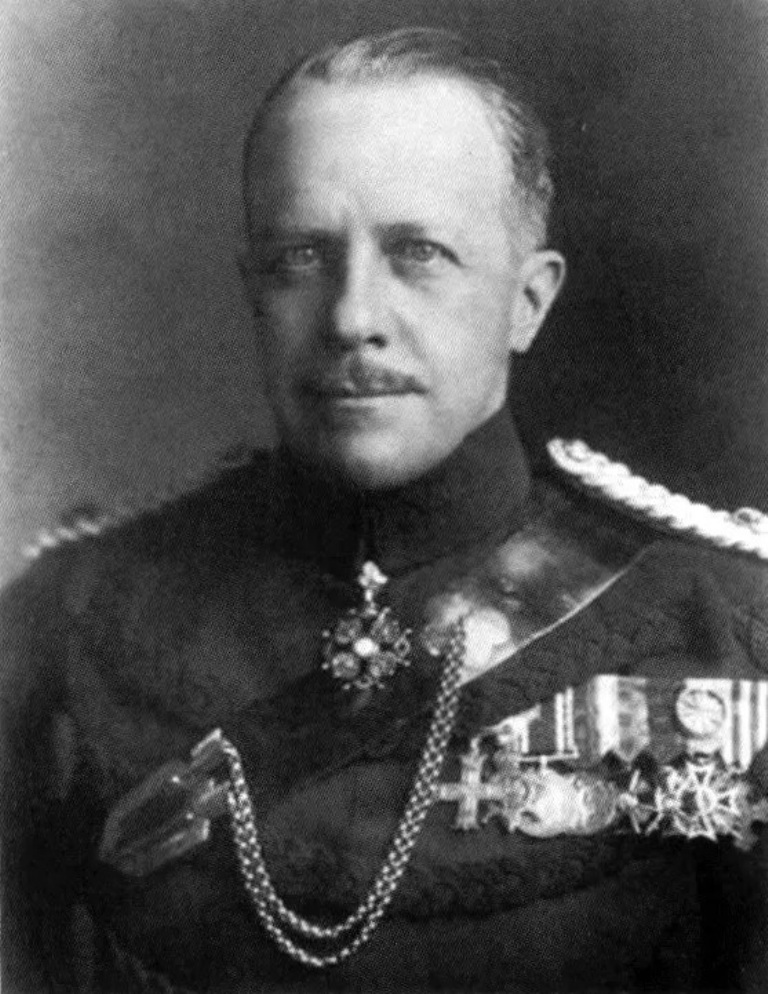
Discussions on the possible evacuation of Nicholas II from Russia began almost immediately after the Tsar’s abdication from the throne on 2nd March 1917. Already on 19th March, British General Sir John Hanbury-Williams met with Nicholas II’s mother, Dowager Empress Maria Feodorovna.

Britain’s concerns for the Romanov family is explained by the fact that King George V was a cousin of both Nicholas II and his wife Alexandra. The two monarchs were close and often corresponded, calling each other ‘old Nicky’ and ‘dear Georgie’. In addition, Britain and Russia were allies in the First World War.

The British general and the dowager empress agreed that the abdicated tsar should leave Russia as soon as possible. Maria Feodorovna – born in Copenhagen and holding the title of Danish princess before marriage – advocated that her son be evacuated to Denmark. She expressed concern that in the event of a longer sea voyage, that the ship carrying her son could be sunk by a German submarine. The British general assured Maria Feodorovna that he could ensure the safety of the Tsar. He even offered to personally accompany the Imperial Family out of Russia to England. Maria Fedorovna agreed. The British Ambassador to Russia Sir George Buchanan began negotiations with representatives of the Russian interim government on possible evacuation routes.

Several obstacles remained. First, it was necessary to convince Nicholas II of the need to leave, who, judging by his diary entries, still wanted to stay and dreamed of spending the rest of his days in Crimea with some kind of special honourary status. Secondly, it was necessary to obtain the final confirmation of the operation from London. And thirdly, it was necessary to figure out how to get the Romanovs out of Russia by passing the armed detachments of the Bolsheviks.

The fact is that at that moment the Provisional Government did not fully control the volatile situation in the country. It was strongly opposed by the influential Petrograd Soviet of Workers ‘and Soldiers’ Deputies, which were against the departure of Nicholas II and demanded that he be tried.

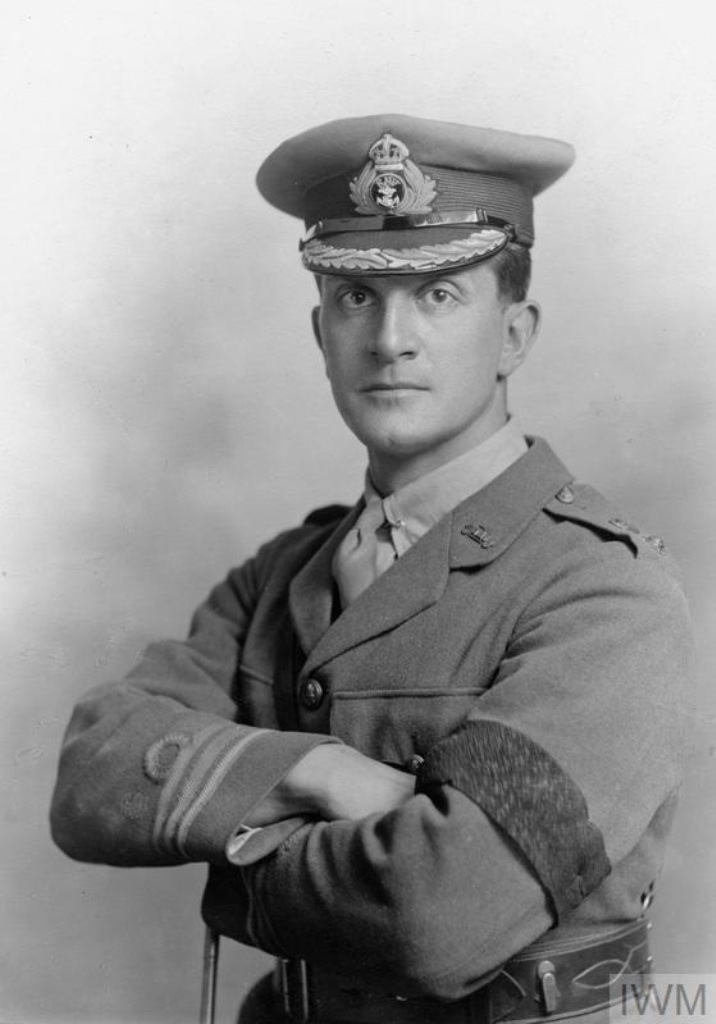
PHOTO: Oliver Locker-Lampson (1880-1954)
© Imperial War Museum

Plan one – creative

While the politicians were negotiating, intelligence scouts got to work. Some of the documents shedding light on the events of those days remain classified. Researchers Richard Aldrich, Rory Cormac and Andrew Cook managed to piece together the details of several plans.

One of them was proposed by Oliver Locker-Lampson (1880-1954), an officer of the Royal Navy. He was simultaneously the commander of a division of machine-gun armoured vehicles and a member of the British Parliament.

In 1916, the Locker-Lampson[1] division was transferred to Russia, where he immediately took action. According to his memoirs, in 1917 he was instructed to develop a plan for the rescue of Nicholas II.

By this time, Locker-Lampson managed to recruit one of the servants who worked in the Alexander Palace – it was there that the Imperial Family were being held under arrest after the Tsar’s abdication. According to the intelligence plan, on the designated day, the servant was supposed to come, shave off Nicholas II’s beard, change clothes with him and attach himself a false beard, similar to that of the emperor.

Nicholas II then had to calmly leave the palace and walk to the place where British intelligence officers would be waiting for him in a motorcar. Then the Tsar would be transferred to an armoured vehicle, then taken to Arkhangelsk under the protection of the British military and sent to London.

At first glance, the plan looked naive. But, as subsequent events showed, Locker-Lampson had previous experience of evacuation operations. In 1933, he helped Albert Einstein escape from Nazi persecution, and in 1936 he transported Emperor Haile Selassie of Ethiopia to England so that he would not fall into the hands of Italian dictator Benito Mussolini. During World War II, Locker-Lampson evacuated dozens of Jewish families from Germany.

The officer’s plan had one weak point – it meant the salvation of only Nicholas II himself. A devout husband and father, the forsaken Emperor had made it very clear, that he would not leave Russia without his beloved wife and children.

There was still one other obstacle to Lampson’s plan: it was necessary to get the approval of London and send a warship to Russia to evacuate the Romanovs. Time was quickly running out for both the Imperial Family and the scouts. General Hanbury-Williams sent an urgent telegram after telegram to Britain, but there was still no answer.

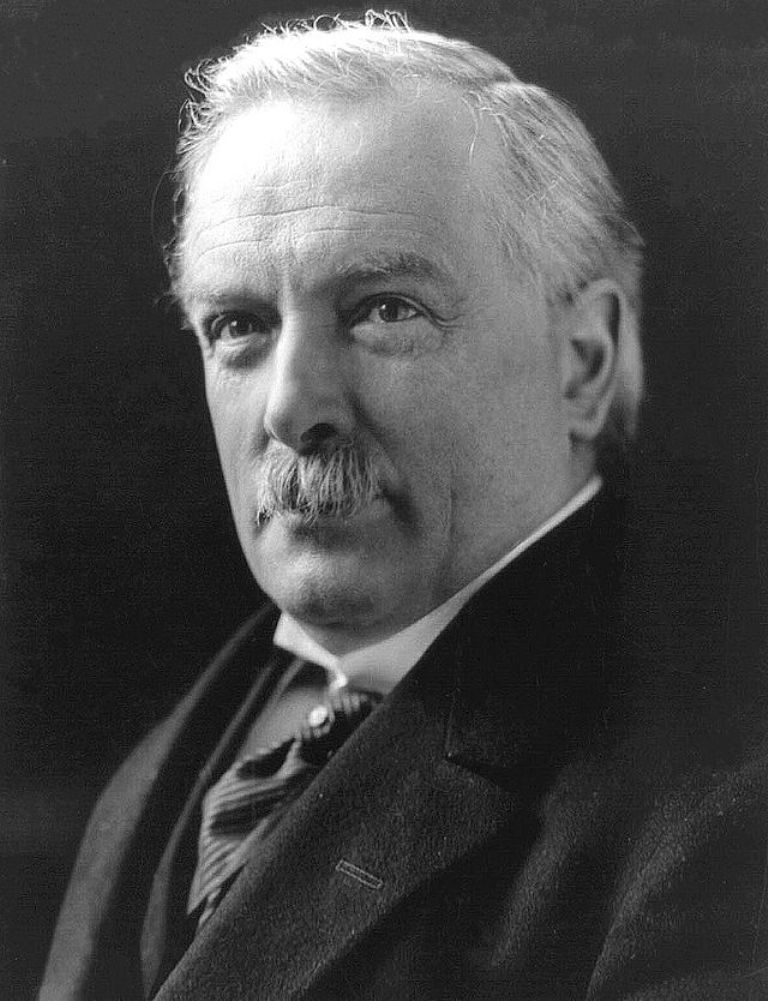
PHOTO: Prime Minister David Lloyd George

Wasteful and bloody

The General’s telegrams reached Downing Street, but the government was in no hurry to make a decision. So, in a note from the King’s secretary, Lord Stamfordham, for example, it is mentioned that Prime Minister David Lloyd George was very interested in the question of how much money Nicholas II would need to live in England. The First World War drained Britain’s budget and the prime minister did not seem to be pleased with the prospect of any additional burden on the treasury.

“Can you find out what private savings the emperor has?” – the prime minister asked the British ambassador to Russia, George Buchanan.

At that time, there were legends in London about the extravagant wealth of the Russian Imperial Family in British and other foreign banks. The British negative perception of the Romanovs was influenced by stories about the adventures of their “friend” Grigory Rasputin.

Lloyd George also expressed concerns about the presence of the Romanovs in Britain. At that time, the socialist movement was gaining popularity in Britain. After the dispersal of the procession of St. Petersburg workers in 1905, left-wing politicians spoke of Nicholas II only in a negative way, often referring to him as “Nikolai the Bloody”. Lloyd George – among others – feared that the arrival of the Tsar would provoke an increase in revolutionary sentiments in Britain itself.

The Provisional Government in Petrograd repeatedly asked London to provide the Tsar and his family with asylum, at least for the duration of the war. Lloyd George paused for a long time, but Petrograd continued to be Britain’s ally in the First World War. As a result, the government still officially invited Nicholas II and his family to London.

By now, King George V was against any plan to bring his cousin to Britain. The monarch’s secretary in his papers notes that when he heard about the government’s decision, the king “fell into a panic.” The fact is that George began to receive more and more information from his personal secretary and acquaintances that the possible evacuation of the Romanov family to Britain is being widely discussed by workers, Labour MPs, and even members of the British nobility in a negative way.

Not only were people worried about Nicholas II, but also by his wife Alexandra Feodorovna, a German by birth. Having married Nicholas, the German princess converted to Orthodoxy and, as far as can be judged, imbued with love and respect for her adopted Russia. However, rumours continued to circulate in society that she secretly sympathized with Germany, her detractors often claiming that she was a Germn spy.

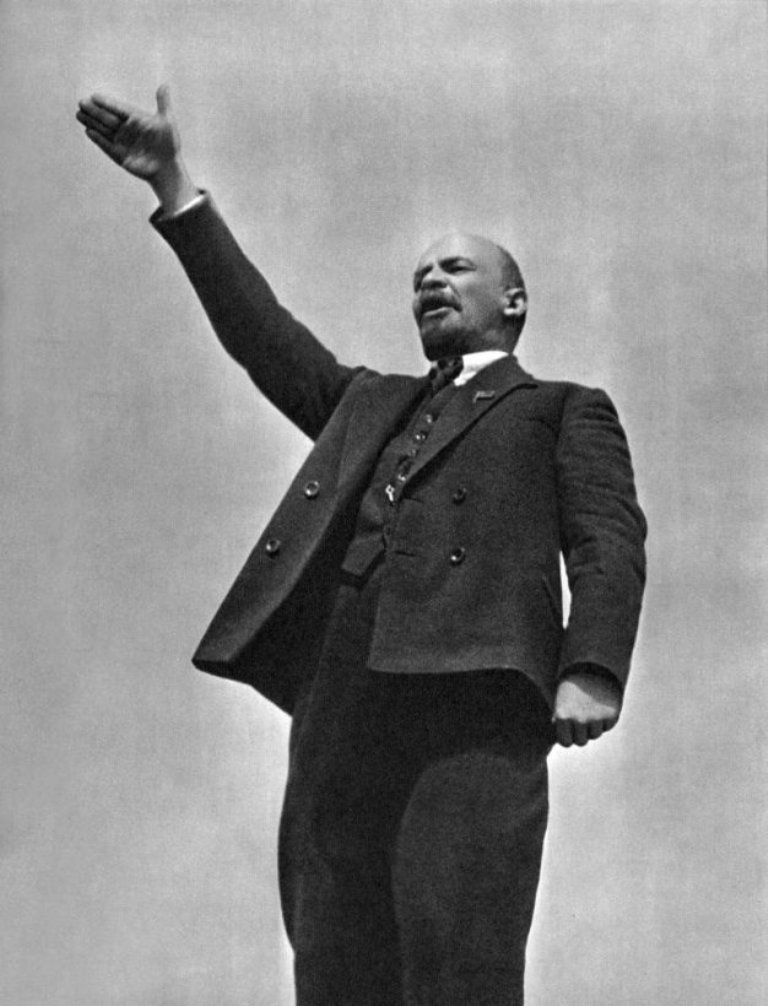
PHOTO: Bolshevik leader Vladimir Lenin

The second plan was ambitious

In parallel with the development of plans for the evacuation of the Romanov family, British intelligence officers also worked to undermine or overthrow the new Bolshevik order.

“A large scale invasion is the only thing that can save the situation and Russia,” the cavalier of military orders, the captain of the Royal Navy, Francis Cromie, telegraphed to London.

Together with the legendary British intelligence officer Sidney Reilly, they drew up plans for the landing of the Entente military formations in Russia. The head of the British diplomatic mission under the Soviet government, Robert Bruce Lockhart, at first was against such a plan, but later, realizing the inevitability of intervention, agreed.

In parallel, British intelligence officers tried to help the Socialist-Revolutionaries and monarchists organize an uprising against the Bolsheviks in Arkhangelsk [2]. There is one version which claims that the British were secretly organizing the assassination of Lenin, however, despite years of research, any evidence of such a plot has never been found.

Soviet historians write that diplomat Lockhart called the assassination of Lenin “the primary and most important task.” To this they added that the ambassadors of France and the United States were also involved in the conspiracy. However, Lockhart’s own reports say nothing of the kind, only about the arrest, but not the murder of the Bolshevik leader.

PHOTO: polar explorer Fridtjof Nansen (1861-1930)

The third plan was desperate

By August 1917, any opportunity to rescue the Imperial Family was looking more and more dismal. The provisional government, trying to somehow ensure the safety of the Tsar and his family, sent them away from radical revolutionaries in Petrograd into exile to Tobolsk in Siberia. This significantly complicated the task for British military and intelligence officers. Now they not only had to devise a plan to take Nicholas out from under the noses of the Bolsheviks, but to also overcome thousands of kilometres with him along the vast expanse of the Russian land. However, the officers did not give up.

The head of the Secret Service, Mansfield Cumming, began developing a new plan to rescue the Romanovs. This time the stake was made on Norwegian businessmen and travelers.

It is known that the British turned to the Norwegian polar explorer Fridtjof Nansen (1861-1930) for help. This scientist attracted the attention of British intelligence because he knew well not only the main Siberian roads, but the waterways along the Yenisei, which could be very useful in the evacuation of the Tsar. The British also brought in the merchant Jonas Leed to develop the new plan. He often traveled to Siberia, representing the interests of Norwegian companies in the wood and coal mining industries.

Very little is known about the details of the plan involving Leed and Nansen. All that is known for certain is that Leed dined several times with representatives of the Secret Service, as well as with the head of intelligence of the British Navy.

Captain Stefan Ellie may also have been one of the participants in this new plan to save the Tsar. He spoke Russian fluently, since his family had lived in Russia since the 1870s. Ellie is one of the few British people who stayed to work in Russia even after the evacuation of the British embassy in late 1917.

Many details of Ellie’s mission remain unknown. But in 2006, his relatives found a notebook among his belongings. One of the spreads showed a hand-drawn map of the area in and around the Ipatiev house in Ekaterinburg, where Nicholas II was transferred in April of 1918, and a description of the house.

According to declassified data, on 24th May 1918, Ellie reported to London about his readiness to carry out an operation, during which “seven important persons” would be taken to Murmansk[3]. In the report, he listed the names of six people who were supposed to take part in the operation. Ellie noted that they were all fluent in Russian and could impersonate local residents. The scout also asked for £1,000[4] “due to increased operating costs.”

Researchers agree that this plan could not have been worked out without the prior approval of the British government and King George V.

PHOTO: Captain Stefan Ellie’s notebook helped learn details of MI6’s latest plan to rescue the Imperial Family

From recently declassified documents, it becomes clear that British intelligence had evidence that Germany was also preparing a plan to take the Imperial Family out of Russia. Technically, the Germans had a chance to do this, since a significant number of their military and equipment were already in Russian territories due to their participation in the First World War.

European royal historian and researcher Karina Urbach, who has access to German archives, confirms that there was a plan to “kidnap Nikolai Romanov” from the German special services. Information about this plan was gradually leaked to British intelligence officers.

Despite the fact that Kaiser Wilhelm II was at war with Russia, but was also the godfather of Tsesarevich Alexei and sincerely wanted to save him. Urbach notes that after the Bolsheviks seized power in Russia, it was Germany that objectively had the best opportunity to rescue the Tsar and his family.

Berlin could have done this with the help of its own spies or, with much more success, through diplomatic negotiations. Researchers believe that Germany could have raised the issue of the “extradition” of the Romanovs as one of the conditions for signing a peace treaty with the Bolsheviks.

Judging by the declassified correspondence of the British Foreign Office, on 28th May 1918, diplomats discussed for the last time whether they should raise the issue of evacuating Nicholas II’s five children during negotiations with Leon Trotsky, who at that time was chairman of the Supreme Military Council. During the discussion, they came to the conclusion that even if Trotsky agrees, the Romanovs will need to be guarded on the way to Murmansk. However, the Bolshevik guard was unreliable, and it was feared that the presence of a British guard could provoke attacks on the Imperial Family along the way. As a result, the British found themselves in a vicious circle – their intervention would only further harm those whom they were trying to save.

Historian Andrew Cook believes that telegrams with details of the evacuation plan for Nicholas II, sent by Major Ellie to London, could have been intercepted by the Bolsheviks. Perhaps this was the reason for the increased security of the Ipatiev House and the Imperial Family in the summer of 1918.

On 17th July 1918, Nicholas II with his wife, their five children and four faithful servants were all brutally murdered in Ekaterinburg—there were no survivors.

Less than a year later, the British battleship Marlborough rescued Dowager Empress Maria Feodorovna, along with other Romanovs with their families to the British naval base in Malta.

NOTES:

[1] Locker-Lampson became somewhat entangled in Russian politics at this time. He said later that he had been asked to participate in the 1916 assassination of Rasputin. It is also alleged that in September 1917 he was involved in Kornilov’s attempted coup against the provisional government of Alexander Kerensky.

[2] The city resisted Bolshevik rule from 1918 to 1920 and was a stronghold of the anti-Bolshevik White Army supported by the military intervention of British-led Entente forces.

[3] Murmansk, Russia’s first ice free port was founded in 1916 by Nicholas II and named Romanov-on-Murman.

[4] In terms of today’s money, this is approximately 50 thousand British pounds (66 thousand US dollars or 4.9 million rubles).

© Paul Gilbert. 18 December 2021
Visiting Tobolsk just got easier!

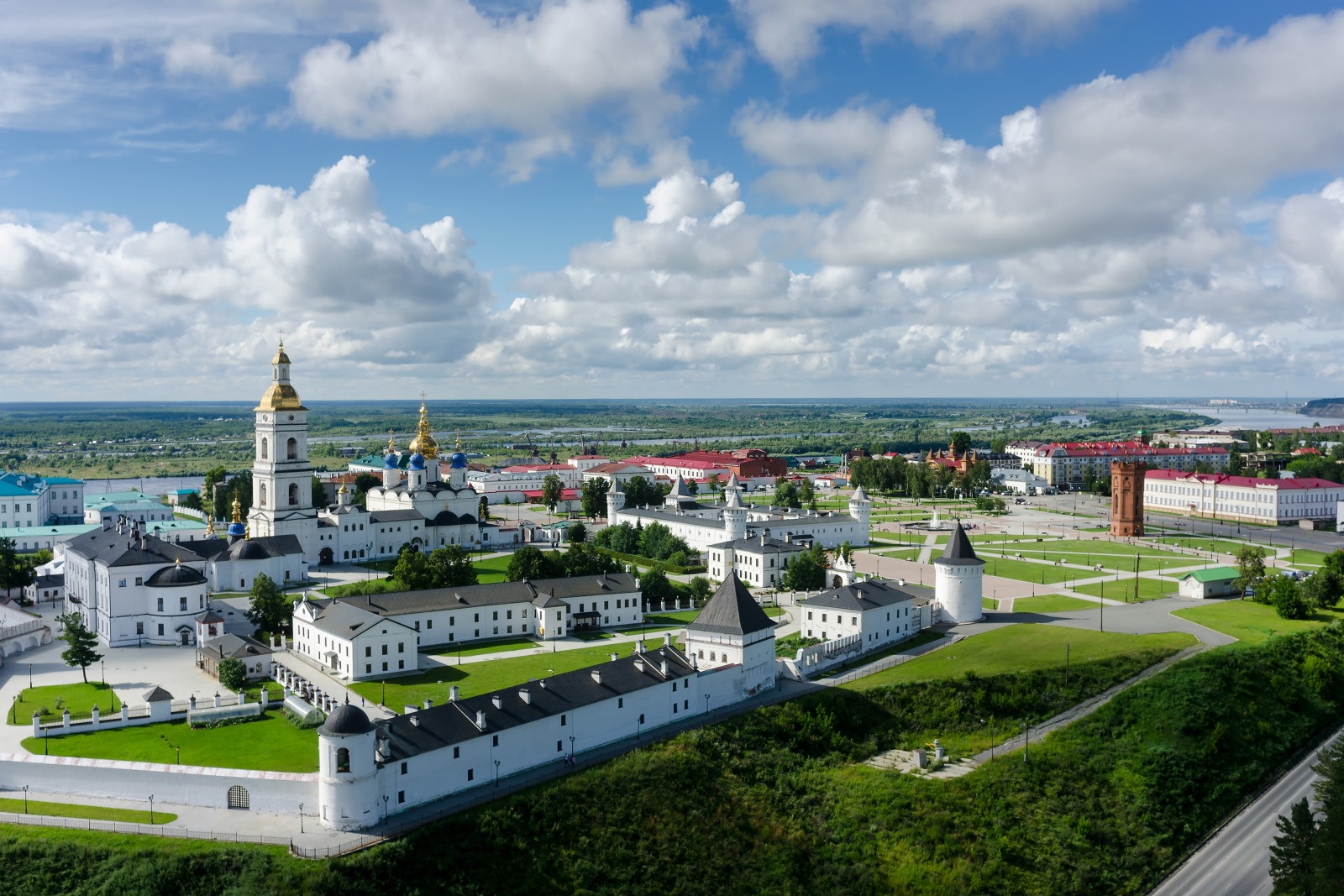
PHOTO: aerial view of the Tobolsk Kremlin

If you have a desire to visit the Museum of the Family of Emperor Nicholas II in Tobolsk, and are planning a future journey to Russia, please note that Tobolsk is now easier to reach, than ever before!

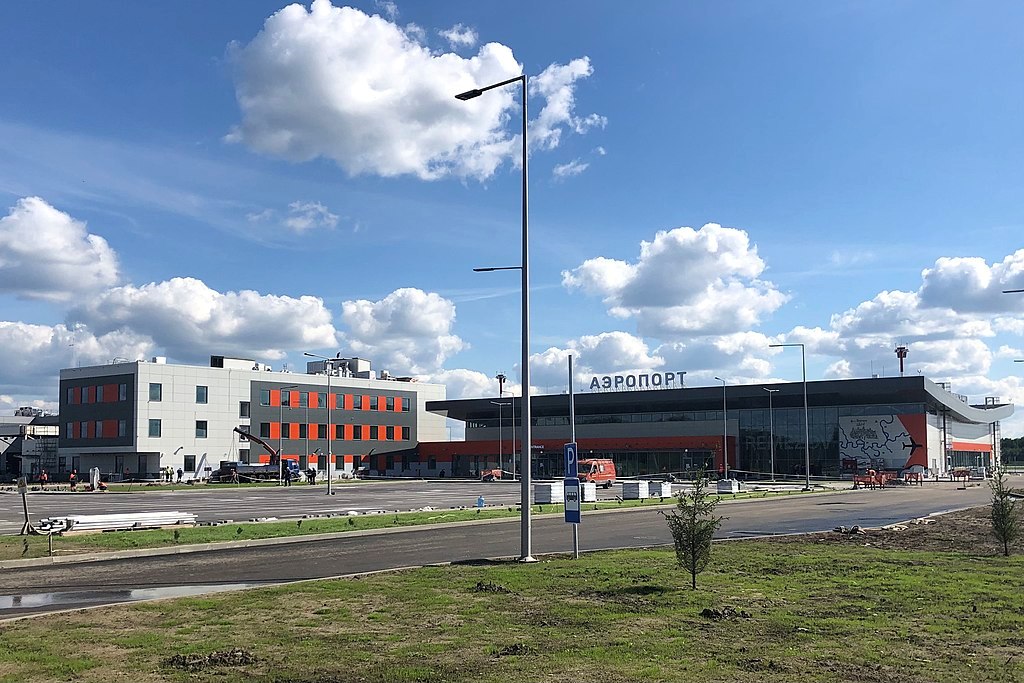
On 24th September 2021, Rеmezov Airport in Tobolsk, received its first passenger flight. The new airport, located about 10 km south of Tobolsk, will now make it so much easier for foreigners to visit this beautiful city, one which has a strong connection with the final days of Russia’s last Imperial Family.

Between August 1917 and April 1918, it was here, that Emperor Nicholas II and his family were held here under house arrest in the former governor’s mansion [renamed “House of Freedom” by the Bolsheviks]. From Tobolsk, they were sent to Ekaterinburg and subsequently murdered on 17th July 1918.

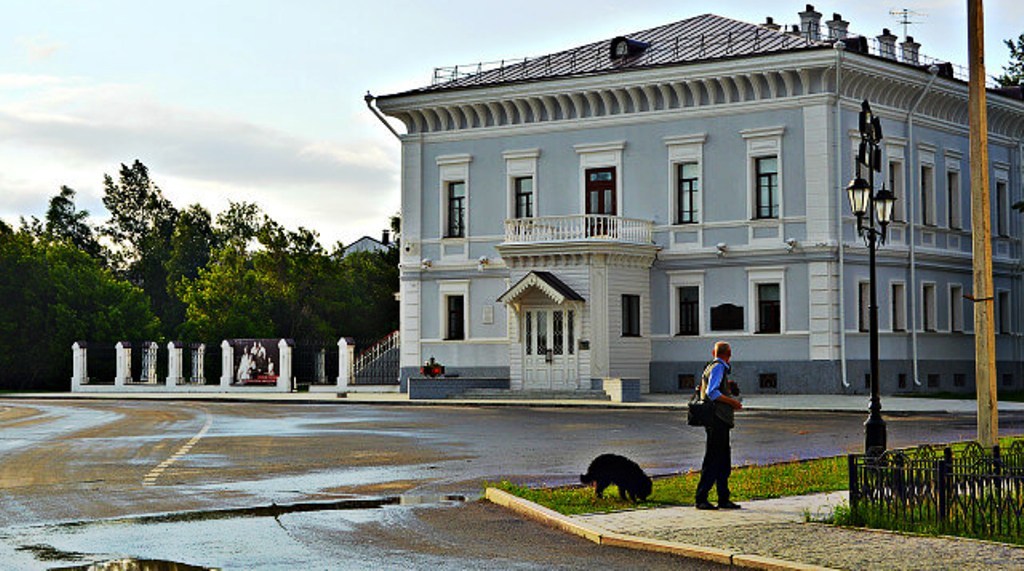
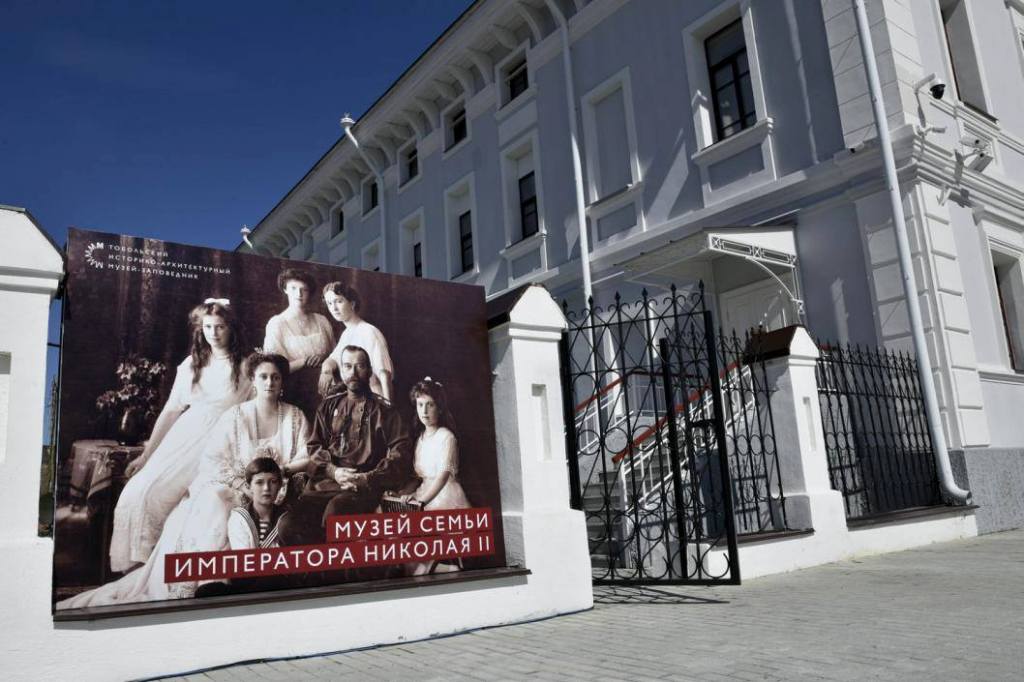
PHOTO: Museum of the Family of Emperor Nicholas II in Tobolsk

Today, the former Governor’s House is home to the Museum of the Family of Emperor Nicholas II, opened on 26th April 2018. This museum is the main draw for those who have an interest in the Imperial Family.

Tobolsk is expected to become a key tourist hotspot in Siberia. Aside from Romanov museum, the city is rich in history, including the Tobolsk Kremlin, Sophia-Uspensky Cathedral (1686) – the first stone church built in Siberia, the Tobolsk Prison Castle as well as well as Tsarist architecture dating from the late 19th to early 20th centuries. In addition, are restaurants offering original Siberian cuisine.

For years, visitors to Russia have often been put off by the accessibility of Tobolsk. The new airport, now allows travellers wishing to visit ‘Siberia’s original capital’ will be able to reach the city directly, rather than having to fly to Tyumen and take a four-hour road or railway journey to Tobolsk, as they did in the past. In addition, visitors from Europe and the United States, will no longer be forced to take a train from Ekaterinburg – a full day or overnight journey!

PHOTO: Rеmezov Airport is 10 minutes from the center of Tobolsk

Regular scheduled flights will offer direct flights to/from Moscow by Pobeda airline (part of Aeroflot Group) with plans to operate *four flights per week, on Mondays, Tuesdays, Thursdays and Saturdays. The flights will originate at Moscow’s Vnukovo airport.

In addition, the airport will offer *two flights per week to Ekaterinburg by Red Wings airline. Additional planned routes include *twice-weekly flights to Novosibirsk by S7 airlines, and *four flights per week to Saint Petersburg by Aeroflot.

*Frequency of flights is subject to change

Rеmezov Airport is capable of receiving and servicing SSJ-100, Boeing-737 and Airbus A320/321 jets.
© Paul Gilbert. 16 December 2021