Memories of Nicholas and Alexandra’s love that have transcended time

PHOTO: aerial view of Schloss Wolfsgarten, near Darmstadt

Hidden away from the eyes of most visitors to Wolfgarten in Germany and the State Hermitage Museum in Russia, are two haunting mementoes etched into simple window panes of each of the two former royal residences. Despite revolution, two world wars and palace renovations, these glass windows with inscriptions written by Emperor Nicholas II and Empress Alexandra Feodorovna have miraculously survived to this day.

Wolfsgarten, Germany

Schloss Wolfsgarten is a former hunting seat of the ruling family of Hesse-Darmstadt, located in the German state of Hessen, situated 15 kilometers south of Frankfurt. The hunting lodge was established between 1722 and 1724 by Landgrave Ernst Ludwig of Hesse-Darmstadt. In 1768, Wolfsgarten was abandoned until the 1830s when the grand ducal family began to restore and expand the property. From 1879, Wolfsgarten became a favourite country retreat for Grand Dukes Ludwig IV and his son Ernst Ludwig, brother of Princess Alix, the future Empress Alexandra Feodorovna.

PHOTO: the years marking visits by Nicholas and Alexandra are etched in a window at Schloss Wolfsgarten

In November 1903 Nicholas II and Alexandra Feodorovna visited the *divorced and not yet remarried Grand Duke Ernst Ludwig. It was on this occasion, that the couple updated the record of their visits to Wolfsgarten, by carving the year on a glass window, as they had done on prior visits in 1896 and 1899 respectively. The Imperial couple returned to Wolfsgarten in 1910.

*On 19th April 1894 Ernst Ludwig married his cousin Victoria Melita von Edinburgh, among the European royals and nobility in Coburg. Ernst and Victoria divorced on 21st November 1901. Victoria married Grand Duke Kirill Vladimirovich on 8th October 1905.

On 9th October 1937, Ernest Louis died after a long illness at Schloß Wolfsgarten. He received what amounted to a state funeral on 16 November 1937 and was buried next to his daughter, Elisabeth, in a new open air burial ground next to the New Mausoleum he had built in the Rosenhöhe park in Darmstadt.

PHOTO: contemporary view of the Winter Palace (State Hermitage Museum)

Winter Palace, St. Petersburg

From December 1895, Emperor Nicholas II and Empress Alexandra Feodorovna, resided for periods during the winter in the Winter Palace. They extended and redesigned the rooms which had been prepared for Nicholas, as Tsesarevich two years earlier. The architect Alexander Krasovsky was commissioned to redecorate a suite of rooms in the northwest corner of the palace.

Following the events of Bloody Sunday in 1905, Nicholas II and his family abandoned the Winter Palace in favour of the more private Alexander Palace at Tsarskoye Selo. From this date until the fall of the monarchy, the Winter Palace was used only for formal state occasions.

PHOTO: Alexandra records a memory from March 1902 on a window in her Study

On 25th October 1917, following the Provisional Government’s arrest in the Small Dining Room of the Winter Palace, an eyewitness account records a systematic destruction of the Imperial apartments by the Bolsheviks. The only original interior to have survived to the present is Nicholas II’s Gothic Library. The remainder of the Imperial couple’s private apartments including the bulk of their contents have been lost.

One tiny memento, however, has survived. Hidden from view by a lace curtain in the former Study of Empress Alexandra Feodorovna, a memory was recorded by Alexandra. On 7th March 1902, taking her diamond ring, she etched the following in one of the windows: “Nicky 1902 looking at the Hussars. 7 March”.

In 1926 the former living quarters of the Imperial couple were handed over to the State Hermitage Museum for use as exhibition halls. The same year the décor of the Study was destroyed: the yellow damask wall covering was removed and the vault painting with flowers and garlands was painted over (it has since been restored). The viewing platform in the corner was dismantled, from which the Imperial couple liked to look at the Neva River at different times of the year from “Alix’s window” as Nicholas II used to call it in his diary.

Today, Room 185 houses the exhibition dedicated to the work of the famous St Petersburg furniture maker Heinrich Gambs. On view here are pieces of furniture and objects of decorative and applied art executed in the Classicism style.

CLICK on the VIDEO below, which shows not only the former Study of Alexandra Feodorovna, but also the view from the window, which will give you a better perspective of where the engraved window is exactly:

© Paul Gilbert. 4 May 2021

Plots against Nicholas II by members of the Imperial Family

PHOTO: detail from a painting of Nicholas II by Pavel Ryzhenko (1970-2014)

Historian and author Brian Moynahan (1941-2018) writes about the plots hatched against Nicholas and Alexandra by members of the Imperial Family, following the murder of Grigory Rasputin, :

“At the weekend, over cards and liqueurs in the Imperial Yacht Club, the grand dukes aired plans to remove Alexandra to a nunnery. Sometimes Nicholas was to go too, to be replaced by one of themselves. [Grand Duke] Mikhail [Alexandrovich], his kindly and weak-willed brother, was one candidate. He had left Russia before the war after a clandestine marriage to the ex-wife of a captain in his own regiment. He had come back with the war, but his command of a Cossack brigade had been disastrous and he had been shuffled off to an obscure inspectorship. [Grand Duke] Nikolai Mikhailovich, the tsar’s cousin, had a more realistic claim, for his relative liberalism had won him the nickname “Nicholas Egalité.” Cynical, disparaging, and jealous by temperament, he was a historian who “worked only with words,” and was “too fond of scandal” to act decisively.

“No secrecy was observed in these intrigues. On Sunday, Petrograd rang with details of a coming coup. One theory was that a famous fighter pilot, Captain Kostenko, intended to crash his aircraft onto the imperial limousine. Another had several grand dukes plotting to use four regiments for a night march on the palace at Tsarskoye Selo to force the emperor to abdicate in favour of his son and a regent. Prince Gabriel Constantinovich gave a supper party for his mistress, a former actress, on Monday, December 26. The guests included Grand Duke Boris [Vladimirovich], the industrialist Alexei Putilov, a dozen officers, and a squad of elegant courtesans. They talked nonstop about the conspiracy and the details of which the regiments were to be seduced. All this was done with “the servants moving about, harlots looking on and listening, gypsies singing.”

“Tongues loosened by streams of Brut Imperial [a French sparkling wine] were heard by Okhrana agents. Nicholas and Alexandra were informed. They sent the grand dukes no Christmas presents that year and soon moved them and Rasputin’s murderers out of Petrograd. Grand Duke Dmitri [Pavlovich] was ordered to join the army staff in Persia, Yusupov was exiled to his family estates in the south. Vladimir Purishkevich had already gone to the front, where the military police were keeping an eye on him. The other grand dukes were sent to their estates or away on urgent naval business. The press was forbidden to mention Rasputin’s name.”

Source: Comrades. 1917 Russia in Revolution (1992) by Brian Moynahan (1941-2018)

CLICK on the LINK to watch THE CONSPIRACY AGAINST NICHOLAS II with Paul Gilbert

The Tsar’s poignant diary entry of March 2nd 1918 bore much truth to the betrayal by his ministers, generals, soldiers, and even members of his extended family who turned their back on their sovereign breaking their oath of allegiance and thus committing treason in the process. Even his distant relations, members of the various royal families of Europe, turned their back on the Emperor. Treachery was indeed everywhere.

© Paul Gilbert. 26 April 2021

Gothic Library of Nicholas II in the Winter Palace

PHOTO: The Gothic Library of Emperor Nicholas II in the Winter Palace, as it looks today

The Gothic Library of Emperor Nicholas II in the Winter Palace in St. Petersburg, remains one of the most beautiful interiors to have survived to the present day. In addition, the library is the only interior of the Emperor’s private apartments in the Winter Palace to have retained its historical appearance without undergoing any changes.

This library was created in 1894-95 by the Russian architect Alexander Fedorovich Krasovsky (1848 – 1918). Krasovsky embodied the restrained spirit of old English castles: an abundance of wood trim, a ceiling with caissons and openwork chandeliers, bookcases placed along the walls as well as a massive fireplace. For it’s decoration, the architect made extensive use of the English Gothic style.

This interior with its decorative panels of tooled and gilded leather, monumental fireplace and tall windows with tracery carry visitors back to the Middle Ages, thus creating an incredible historical ambiance. It also features a coffered walnut ceiling embellished by quatrefoils. On the desk is a porcelain sculpture portrait of Nicholas II, an identical copy of the original the biscuit porcelain bust of the Emperor completed in 1896 by the Russian sculptor Léopold Bernstamm.

The library was located in a separate wing of the private apartments of Nicholas II. To accommodate the vast library, an upper balustrade and staircase were added. The walls above the bookcases were decorated with panels of embossed gilded leather.

An important element of the interior was the Gothic fireplace decorated with images of griffins and lions – heraldic figures of the family coats of arms of the House of Romanovs and the House of Hesse-Darmstadt, to which the empress belonged.

PHOTO: Furniture for the Gothic Library of Nicholas II, designed by N. V. Nabokov, made by N. F. Svirsky

The furniture which decorates the room was designed by the architect Nikolay Vasilyevich Nabokov (1838 – after 1907), and made by Nikolai Fedorovich Svirsky, at his workshop located at 45/47 Borovaya Street in St. Petersburg. The Russian State Historical Archive [RGIA] has preserved Svirsky’s furniture design drawings to the present day. Some of his creations for the Gothic Library were displayed in a temporary exhibition held in the State Hermitage Museum in 2018.

In 1905, Nicholas II and his family moved to Tsarskoye Selo, where they took up permanent residence in the Alexander Palace. Following his abdication in February 1917, the Imperial Residences were all nationalized under the new Provisional Government. It’s leader Alexander Kerensky (1881-1970) wasted little time in acquisitioning the Gothic Library for his own personal use.

PHOTO: Kerensky seated in Nicholas II’s Gothic Library in the Winter Palace, 1917

In March 1917, a decree was issued declaring the contents of the Winter Palace as state property. Only a portion of the library’s original book collection have been *preserved. Today’s caretakers in the State Hermitage mUSEUM confirm that the Emperor read all the books that were kept, often leaving his notes in them.

*In the 1930s and early 1940s, 10,915 titles, 15,720 volumes from Nicholas II’s library in the Winter Palace, were sold to various libraries in the United States, including Harvard, NYPL, and Stanford. In addition, about 2,800 volumes were acquired by the Library of Congress in Washington, D.C.

I am pleased to share a link to a beautiful three-dimensional panorama of the Gothic library of Nicholas II in the Winter Palace, courtesy of the State Hermitage Museum – Click HERE to view.

***

Click HERE to read my article Nicholas II’s apartments in the Winter Palace – includes photos, video and plan – published on 30th August 2022

© Paul Gilbert. 22 April 2021

New documentary series defends the reign of Nicholas II

A new Russian language documentary is “important for historical parallels”, experts say, by dispelling the myth that Russia was a backward nation during the reign of Nicholas II – 1894 to 1917.

More than a hundred years have passed since the catastrophic events of the February 1917 Revolution in Petrograd, but their significance has not diminished during the last 100+ years.

The February Revolution left behind a lot of questions. With all the chronological clarity of those events, their interpretations to this day contradict each other. What was the Russian Empire like on the eve of the February Revolution? What was the position of the peasants and workers? What was the state of the economy and events of the First World War? For decades (especially during the Soviet period) it was believed that life in Russia at that time was characterized by poverty, backwardness, military devastation. oppression by the autocracy, etc. So, what is the truth?

In his new Russian language documentary series Гибель империи. Российский урок / Death of the Empire. Russian Lesson [18 episodes, each one a duration of 15 to 20 minutes] Metropolitan of Pskov and Porkhov Tikhon (Shevkunov), analyzes the economy of the Russian Empire, its domestic and foreign policy, the activities of the tsar, military, political elites, but most importantly, the state of Russian society during that period.

Metropolitan Tikhon clearly notes that during the First World War, the Russian Empire was neither economically nor militarily in any worse state than that of other countries. On the eve of the First World War, the Russian economy was developing rapidly, the standard of living rose significantly, the population during the reign of Nicholas II increased by 50 million people.

By 1917, Russia had increased the production of cast iron 4 times, copper 5 times, coal 5 times, and from 1911 to 1914 the machine-building industry increased 2 times. Before World War I, Russia produced 9.4% of world GDP and was ranked 4-5 in the world in terms of its volume. Most importantly, the land issue was not a decisive factor in the revolution. So, by 1916, in the European part of Russia, 90% of arable land was in the hands of the peasantry, and100% in the Asian part of the empire.

A key factor in the tragedy of 1917 was played out by Russia’s so-called “allies” – Great Britain and France, who directly indulged the conspirators. The British delegation led by Lord Alfred Milner (1854-1925) presented an ultimatum to the Emperor on the eve of the revolution, in which he demanded, a change in the state system in Russia with the introduction of the concept of “responsible” (before the Duma) government. An outrageous demand by a foreign power, especially during war with Germany. In the aftermath of the Tsar’s abdication in 1917, the “allies” abandoned the Russian Sovereign, who in the end, was the only true ally who honoured his commitment to the war.

PHOTO: Metropolitan of Pskov and Porkhov Tikhon (Shevkunov)

The betrayal of the elites was even more tragic. At the beginning of 1917, Russia was on the verge of winning the war – during the planned spring-summer offensive. The Russian Imperial Army would surely have broken through the German positions, which would have resulted in the enemy being forced to cede all the territories to Russia, promised under the Sykes-Picot Agreement and enormous reparations. The commander-in-chief of the German army General Erich Ludendorff (1865-1937), even admitted: “Our defeat seemed inevitable.” But then the February Revolution broke out in Russia.

One of the main problems of pre-revolutionary Russia was its “enlightened” society, who literally dreamed of a revolution. Many prominent writers, scientists and publicists supported the underground movements in one way or another, some even through financing and campaigning.

Russia’s “enlightened” society created, in fact, a parallel state. It had almost all the attributes of statehood – its own army (terrorist), its own mass media, its own informal budget, its own “courts” and governing bodies. As a result, by 1917, public opinion in Russia was prepared for a conspiracy and a change of power. however, in the end, many of those who were so thirsty for revolution then perished during the civil war and the subsequent Bolshevik repressions.

The key problem of the Russian people, according to the testimonies of eyewitnesses of the events cited by Father Tikhon, was the colossal impatience of the people and their pliability to the provocative speeches of revolutionary agitators. It is simply amazing how in 1917 a significant number of people fell so easily for the fables about “freedom, equality and brotherhood” – who in the end received any such promises.

Malicious gossip and revolutionary propaganda, helped to turn the people against their Tsar. Lies spread like wildfire during the war years. References were made to the “bloody tsarist regime”. Emperor Nicholas II was referred to as “an alcoholic”, and his wife as “a German spy”, as well as the “destructive influence of Grigory Rasputin”. References to the “bloody tsarist regime”, were published daily by the liberal press, often prompted by Western propaganda. German planes dropped leaflets with cynical cartoons of Nikolashka in the trenches of Russian soldiers.

“Russia was ruined by gossip,” Vladyka Tikhon quotes the outstanding Russian writer Ivan Lukyanovich Solonevich (1891-1953), a devout monarchist, who believed that “monarchy was the only viable and historically justified political system for Russia”.

© Paul Gilbert. 21 April 2021

***

Dear Reader

If you enjoy my articles, news stories and translations, then please help support my research by making a donation in US or Canadian dollars to my project The Truth About Nicholas II – please note that donations can be made by GoFundMePayPal, credit cardpersonal check or money order. Thank you for your consideration – PG

The fate of the obelisk to Nicholas II in Kaluga

PHOTO: The obelisk erected in memory of the visit of Emperor Nicholas II to Kaluga
in 1904, was erected in 1908, and demolished by the Bolsheviks in the 1920s.

By the late spring of 1904, the Russo-Japanese War was already in full swing. In an effort to boost morale, Emperor Nicholas II personally went to Kaluga to inspect the garrison.

The Emperor arrived on the Imperial Train in Kaluga on 20th (O.S. 7) May 1904, accompanied by his brother Grand Duke Mikhail Alexandrovich, and their uncle Grand Duke Sergei Alexandrovich.

Upon arrival, the Emperor stepped off the Imperial Train and mounted a horse given to him by the Kaluga military. Accompanied by the Grand Dukes and his retinue, they proceeded to the town’s military field, where the Kaluga garrison had assembled for inspection, before being sent to defend Russia during the Russo-Japanese War. The garrison included the 9th Ingermanland Infantry Regiment, the 10th Newlingermanland Infantry Regiment and the 31st Cavlary Artillery Brigade.

PHOTO: Emperor Nicholas II arrives on the Imperial Train
in Kaluga on 20th (O.S. 7) May 1904

Nicholas II headed for the line of troops who awaited him. The commander of the division presented the Emperor with his combat report, the troops stood at attention, music played, and the military slowly lowered their banners in front of their Sovereign. Nicholas followed the front line with his retinue and greeted each military unit separately. The orchestra played the Imperial anthem God, Save the Tsar!, which prompted enthusiastic shouts of “Hurrah!” from the regiments.

The Emperor then stood in front of the pavilion, at which point the troops marched past in front of him in a ceremonial march. Then the officers were gathered, the Sovereign questioned those who had already participated in the war. After that he granted each with an icon of St. Nicholas the Wonderworker and made a parting speech to the troops.

The tsar wrote in his diary that night: “We arrived at a field near Kaluga, where the 9th Ingermanland Infantry Regiments, the 10th Newermanland Regiments, the 31st Cavlary Artillery Brigade. and two flying artillery regiments were lined up. Due of the rains over the past few days, the field had turned into a swamp. Despite this, it did not deter the troops.”

PHOTOS: Emperor Nicholas II, Grand Duke Mikhail Alexandrovich, and Grand Duke
Sergei Alexandrovich, leave the Holy Trinity Cathedral in Kaluga

In 1907, Kaluga Governor Alexander Alexandrovich Ofrosimov proposed to erect a monument- an obelisk in honour of this event. The laying took place on 29th June 1907, the unveiling and consecration was held three days later on 30th July 1908. The monument to Nicholas II was the first monument to appear in the Kaluga region.

The fourteen-meter obelisk was made of granite blocks, and crowned with a bronze double-headed eagle made of bronze by S.A. Pozhiltsov). The pedestal featured a commemorative plaque, which included the names of the Kaluga officers who participated in the Russo-Japanese War. Many of these men died during the war, therefore, the monument became a memorial to those Kaluga officers and soldiers who perished in 1904-1905. The composition was complemented by two cast-iron cannons at the base.

The obelisk was demolished by the Bolsheviks in the 1920s, who regarded the monument as a reminder of Tsarism.

The idea of restoring the obelisk for the 400th anniversary of the Romanov dynasty in 2013 was considered, but it was not implemented. Instead, a bust of Nicholas II was installed in the Central Park of Culture and Leisure in Kaluga on July 31, 2016.

© Paul Gilbert. 17 April 2021

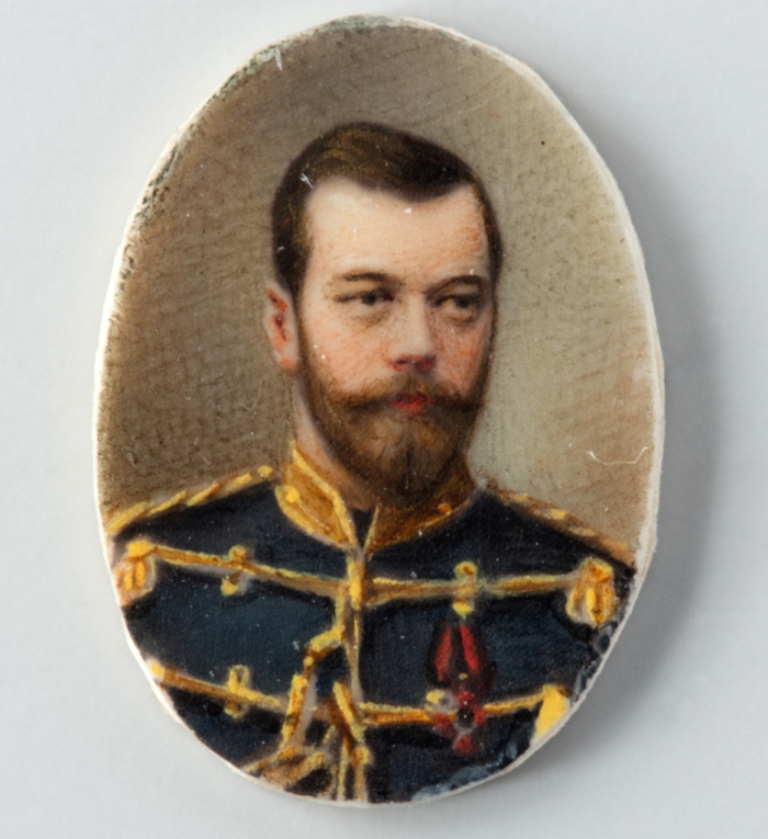
Nicholas II historic figurines

Collecting historical figures, miniatures and toy soldiers is a hobby which dates back hundreds of years.

Faberge in particular were famous for their miniature figures. The figures were typically only 25–75 mm long or wide, with some larger and more rare figurines reaching 140–200 mm tall, and were collected throughout the world; the British Royal family has over 250 items in the Royal Collection.

In 2013, a Faberge Cossack guard figurine sold for $5.2 million US dollars.

Toy soldiers in particular have probably been around as long as real soldiers. But mass-produced toy soldiers only date to the 1890s, when new manufacturing techniques made them inexpensive to produce and collect.

It was very common for male members of the Russian Imperial Family to have entire collections of miniature soldiers, including Nicholas II’s son Tsesarevich Alexei Nikolaevich.

During the last 30 years, more and more figures of Russia’s emperors and empresses has become increasingly popular. There are a growing number of figures of Nicholas II, which vary in likeness, size and price.

I have assembled a small collection of photographs of some of the more higher quality figures. Few are sold in shops, but through dealers and artists – all of whom live in Russia – who hand paint each figure ordered. I will add additional photos as they become available.

Disclaimer: please note that this post is for information purposes only. I am not promoting or endorsing any particular figure or its respective artist – PG

The figures of Emperor Nicholas II, Empress Alexandra Feodorovna and Metropolitan Palladium of St. Petersburg (seen in the photo below) are mounted on a wooden box. The composition was made in memory of their Coronation, held on Tuesday, 14th May 1896 in the Assumption Cathedral of the Moscow Kremlin.

This work of art by a contemporary Russian artist embodies this historic event in great detail. The figurines of Nicholas II and Alexandra Feodorovna have been recreated and painted from the historic painting by Danish artist Laurits Tuxen (1853-1927). Made of tin and beech wood, size: 22 x 23 x 20 cm.

© Paul Gilbert. 17 April 2021

What if Nicholas II had lived …

I found this image on a Russian site earlier this week. I am not ascribing to any conspiracy theory that Nicholas II survived the regicide in Ekaterinburg in 1918.

I was so impressed by this age enhanced photograph of the Emperor, that I wanted to share it on my blog. Personally, I think it a very good likeness!

An unknown person created it, used FaceApp and Photoshop to create this colour image of what Nicholas II might have looked in 1936, at the age of 68.

It is sad to think what could have been. A handsome and urbane gentleman with a truly pure heart. Now glorified in Heaven, our Blessed Holy Tsar-Martyr

© Paul Gilbert. 13 April 2021

Taininskoye: the site of Russia’s greatest monument to Nicholas II

PHOTO: Klykov’s first monument to Nicholas II was consecrated 26th May 1996
in the former village of Taininskoye, situated 19 km northeast of Moscow

Like his father, Nicholas II preferred Russia’s old capital to that of Peter the Great’s new modern capital. According to French historian Marc Ferro: “Nicholas II preferred Moscow to St. Petersburg because the old city embodied the past, whereas St. Petersburg represented modernity, the Enlightenment and atheism.”

During his reign, Nicholas expressed the desire to spend Holy Week in the former Russian capital, and it was here, during the coronation festivities in 1896 and the Romanov Tercentennary in 1913, Moscow’s fervent greeting to their Tsar confirmed his feeling for the city.

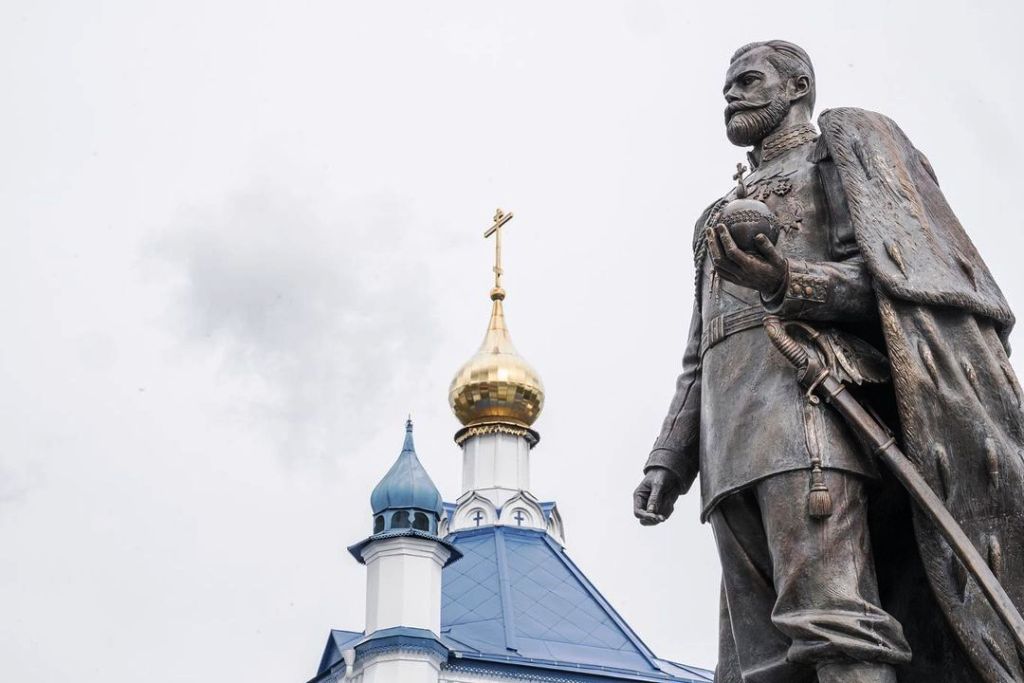
Today, Moscow is home to at least a dozen monuments and busts to Russia’s last emperor and tsar. Among them are five large-scale monuments, including (1) the monument established in September 2016 at the Moscow State Transport University; (2) the monument established in October 2013 to Tsar Mikhail Feodorovich and Emperor Nicholas II in the Novospassky Monastery; (3) the monument established in 1998 on the grounds of the Church of the Royal Passion-Bearers in the Pleshcheevo estate (in Podolsk); and (4) the magnificent equestrian monument to Nicholas II, established on the grounds of the Ministry of Defense on the Frunze Embankment. In addition, are a number of bust-monuments established at various locations in and around Moscow.

PHOTO: Klykov’s first monument to Nicholas II nearing completion in 1996

The finest and most impressive full-scale monument to Nicholas II has to be the one erected in the former village of Taininskoye [the village was incorporated in the Mytishchi district of the Moscow region in 1961], situated 19 km northeast of Moscow.

Like the fate of the Sovereign, the monument has a tragic history, having been the target of extremists in 1997. However, the monuments’ sculptor Vyacheslav Mikhailovich Klykov (1938-2006) replaced it in 2000.

According to the sculptor’s son Andrey Klykov, the monument was supposed to be erected on Borovitsky Hill in central Moscow. The project had the support of Yuri Luzhkov, who served as mayor at the time. Members of the city’s Communist party were outraged at the idea, so the project was pulled.

Klykov was offered another site in Mytishchi, near the site of a former royal traveling palace [built in 1749 for Empress Elizabeth Petrovna, it was destroyed by fire in 1823]. The site was situated near the 11th century Church of the Annunciation of the Holy Mother of God [built in 1675-1677]. As it turned out, due to the smaller number of approvals and red tape, the monument was easier to install on the church grounds, and had the support of the diocese.

PHOTO: the sculptor Vyacheslav Klykov stands in front of his monument
to Nicholas II, destroyed on 1st April 1997 by left-wing extremists

The opening of the monument was timed to coincide with the 100th anniversary of the coronation of the last Russian Tsar (held in Moscow on 26 May (O.S. 14 May) 1896.

On the morning of 1st April 1997, at 05:25 am, the monument was blown up by members of the left-wing extremist organization Revvoensovet [named after the Revolutionary Military Council of 1918]. Their reason, was their opposition to a proposal to remove Lenin’s corpse from the mausoleum in Red Square.

On 31st August 2006, The Moscow City Court found Igor Gubkin, a member of the Revvoensovet (RVS) extremist group, guilty of organizing and committing a number of explosions in Moscow, and sentenced to 19 years in prison.

After the explosion, Klykov, a staunch monarchist, donated his personal money from the fee he had been paid for the monument to General Zhukov [erected in Moscow in 1995]. When asked why, Klykov replied sternly: “If at one time the Russian people could not protect their tsar, now, believe me, we will do it!”

The monument that we see today in the village of Tayninskoye, was installed on 20th August 2000 on the site of the first monument. The erection of the second monument was timed to coincide with the canonization of the Tsar [the Moscow Patriarchate canonized Nicholas II on 20 August 2000].

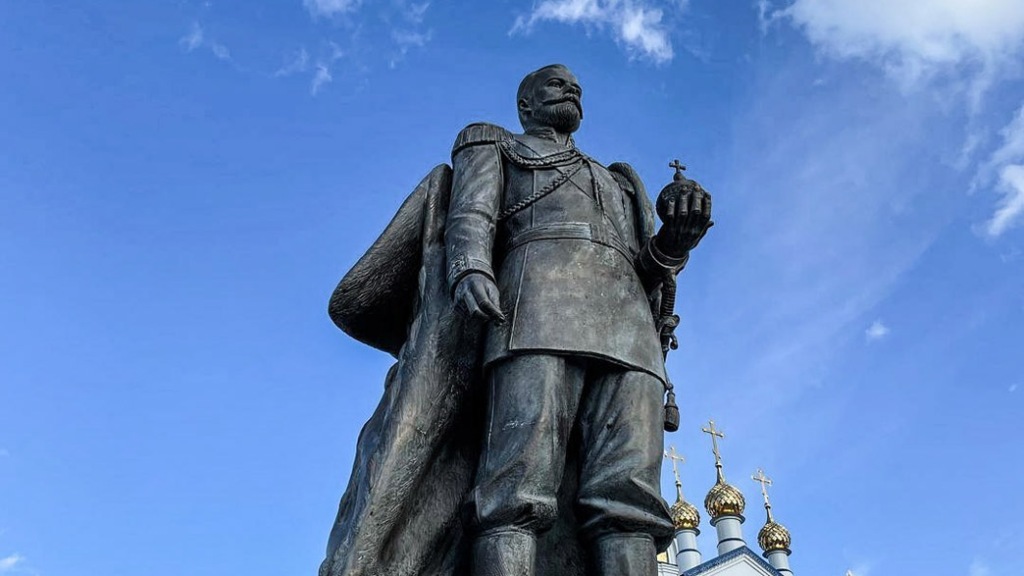
Klykov forged his new monument from copper. The Emperor stands proudly, dressed in ermine robes, holding a sceptre and orb. The sculpture reflects the moment of his greatest triumph – his accession to the throne. The inscription on the monument read: “To the Emperor Nicholas II from the Russian people with repentance”.

The monument has become a popular place of pilgrimage for Russian monarchists and nationalists, who believe that only “repentance for the murder of Tsar Nicholas II will lead to the salvation of Holy Russia”

On 19th May 2018, members of the All-Russian public movement “National Idea of ​​Russia” and the Kuban Cossacks laid flowers at the monument to Emperor Nicholas II in the village of Taininskoye (Mytishchi). The event marked the 150th anniversary of the birth of Nicholas II, on 19th (O.S. 6th) May 1868, in the Alexander Palace at Tsarskoye Selo.

PHOTO: Klykov’s second monument to Nicholas II was cast
in bronze, it was opened on the same site in August 2000

Klykov was determined not to be threatened or bullied by thugs and radicals. Thanks to his efforts and determination, Orthodox Christians, monarchists and adherents to Russia’s last monarch, today have the opportunity to honour the memory of the Tsar, to offer flowers and prayers, but also to reflect on the life and reign of Russia’s much slandered Sovereign.

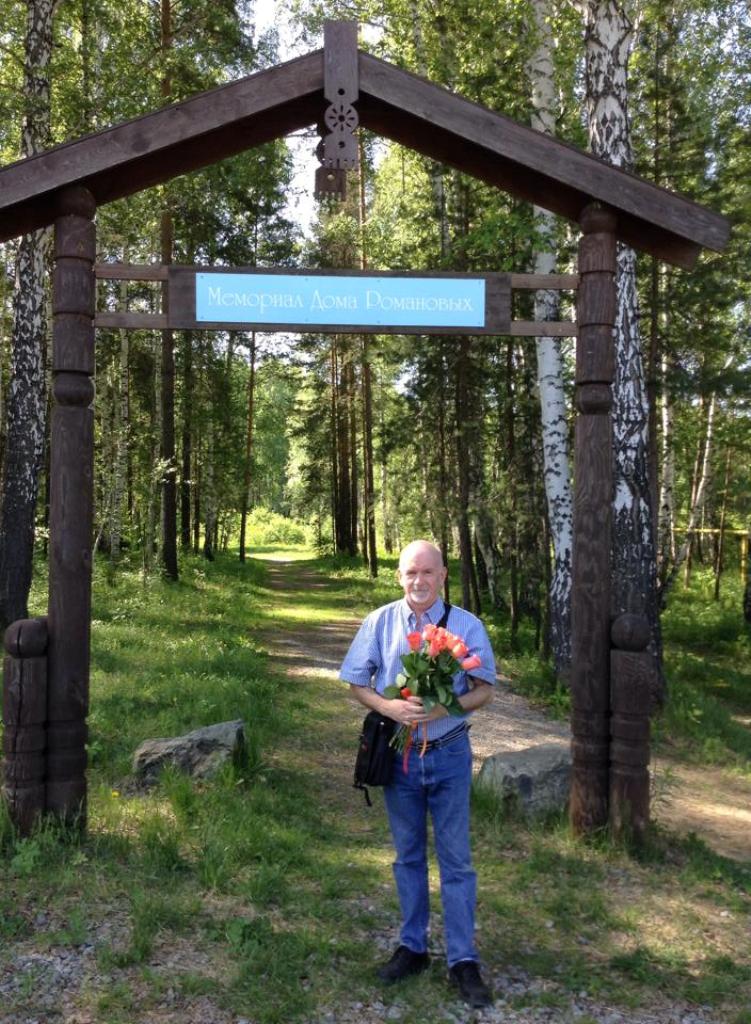
Nicholas II researcher Paul Gilbert at the monument to Nicholas II
at Taininskoye, during his visit to Moscow on 15th March 2015 

“To His Majesty Emperor Nicholas II, the Russian people with repentance”
Duration: 2 minutes with hauntingly beautiful music audio.
CLICK ON THE IMAGE ABOVE TO WATCH VIDEO

On 19th May 2018, members of the National Idea of Russia Movement and the Kuban Cossacks laid flowers at the monument to Nicholas II in the former village of Taininskoye (Mytishchi) near Moscow.

***

PHOTO: Vyacheslav Mikhailovich Klykov (1938-2006)

Vyacheslav Mikhailovich Klykov was born on 19th October 1939, in the village of Marmyzhi, Kursk Region.

In the second half of the 1980s, Klykov’s work focused on Orthodox-patriotic themes. During his life, he created more than two hundred monuments: memorial plaques and crosses. In addition, he created numerous works for other cities across Russia, but also in Ukraine, Greece and Italy.

One of his greatest works was a monument to St. Sergius of Radonezh, inspired by the painting by MV Nesterov “Vision to the youth Bartholomew”. The monument was installed on 29th May 1988, in the village of Gorodok (Radonezh) near the Trinity-Sergius Lavra. He also created a monument to Grand Duchess Elizabeth Feodorovna in the Martha-Mariinsky Convent in Moscow.

Vyacheslav Klykov died on 2nd June 2006 in Moscow. He was buried in his native village.

Memory Eternal! Вечная Память!

© Paul Gilbert. 13 April 2021

Ceremonial portrait of Nicholas II found in Mogilev, now a holy icon


PHOTO: Ceremonial portrait of Nicholas II. Artist and year unknown.

This year marks 30 years since the revival of the St. Nicholas Monastery in Mogilev. This Orthodox monastery is one of the oldest – the first mentions of the monastery appears in the annals of 1522 – and most famous spiritual centers in eastern Belarus, its history is closely connected with Emperor Nicholas II.

The pearl of the monastery is a unique wooden carved iconostasis, made in a special technique of Belarusian carving of the 17th century. Only three such iconostases have survived in the world: in the Novodevichy Convent in Moscow, in the Assumption Cathedral in Smolensk and in the St. Nicholas Monastery in Mogilev. The first abbess of the revived monastery, Abbess Evgenia Voloshchuk and her sisters worked hard during the restoration of the St. Nicholas Monastery.

Difficult fate

St. Nicholas Convent operated from 1637 to 1719, and then was transformed into a male monastery, which existed until 1754. Later, the St. Nicholas Cathedral became the parish church.

Like all Orthodox places of worship, the monastery shared a similar fate – during the years of persecution of the Russian Orthodox Church during the Soviet years, the church’s icons and other contents were confiscated, the iconostasis was destroyed. In 1934, with the death of the priest Mikhail Pleshchinsky, St. Nicholas Cathedral was closed. In 1937, the Mogilev diocese ceased to exist.

In 1937, St. Nicholas Cathedral was used as a transit prison (closed in 1941). In 1991, during the restoration of the monastery, numerous human remains were discovered – most likely victims of Stalinist repressions.

It was not until 1989, that the Mogilev Diocese was restored. It was at this time, that the reigning archbishop of Mogilev and Mstislavsky Maxim (Krokha) began the revival of the St. Nicholas Monastery.

On 28th March 1991, the St. Onufrievsky Church was consecrated. On 18th June of the same year, the monastery was visited by His Holiness Patriarch Alexy II (1929-2008) of Moscow and All Russia.


PHOTO: St. Nicholas Cathedral, St. Nicholas Monastery in Mogilev

Monastery and the Romanov family

The history of the monastery is closely connected with the last Tsar and his family. Between 1915-1917, the headquarters of the Supreme Commander-in-Chief of the Russian Armed Forces was located in Mogilev. During that time, Nicholas II and his family often attended Divine Liturgies held in St. Nicholas Cathedral.

During the canonization by the Russian Orthodox Church of the New Martyrs and Confessors of Russia of the 20th century in the summer of 2000, a ceremonial portrait of the emperor was miraculously found in the niche of an old wall of one of the houses in Mogilev. Local Orthodox Christians, believing the discovery as a miracle and turned the portrait into an icon, transferring it to the St. Nicholas Cathedral.

The icon hangs today, on the left side-altar of the church consecrated in memory of the Holy Royal Martyrs. A five-ruble gold coin is also attached to the icon, which was once presented to the boy Simeon Khalipov by Emperor Nicholas II during a visit to the monastery.

© Paul Gilbert. 28 March 2021

ROC Metropolitan blames Nicholas II for February 1917 Revolution

PHOTO: Revolutionaries burning a portrait of Nicholas II on 5th March 1917
Artist: Ivan Alekseevich Vladimirov (1869-1947)

On 23rd February (O.S.) 1917, workers unrest and mass demonstrations began in the capital of the Russian Empire, Petrograd. Thus began the February Revolution, which brought an end to the monarchy and lead the country into chaos.

On 2nd March (O.S.) 1917, Russia’s last emperor Nicholas II, betrayed by the elites, members of his inner circle, generals and even members of his own family abdicated the throne. Although historians continue to argue about the authenticity of the renunciation manifesto, it was then, at the Pskov railway station, that the Imperial Family’s journey to Golgotha ​​began.

On the recent 104th anniversary of the events which proved fatal for Russia, Metropolitan of Pskov Tikhon (Shevkunov)¹ talked about the drama and lies of the Russian Revolution during a discussion on the YouTube channel “Seraphim”.

Metropolitan Tikhon said that the last Russian emperor Nicholas II was responsible for the February Revolution of 1917, since he was the supreme ruler of the country and failed to discern the impending threat.

“The first person is always to blame for the troubles that befall the country. Always!” – said Tikhon. He explained that Nicholas II was glorified in the person of the saints in a special way – as a passion-bearer², in connection with the tragic circumstances of the deaths of the Imperial family.

At the same time, Tikhon recalled an article by Winston Churchill (1874-1965) in the Illustrated Sunday Herald about the revolutionary events in Russia, where the British politician spoke positively about Nicholas II and emphasized the inevitability of the victory of the Russian Empire in World War I, if not for the revolutionary events.

PHOTO: Metropolitan of Pskov Tikhon (Shevkunov)

“Nicholas II was one of the most successful and yet one of the most tragic leaders of our state,” said Metropolitan Tikhon, referring to the rapid growth of the empire’s population, the economic and industrial boom during the reign of the last emperor. “This is evidence of his caring for the Russian people and the ever-increasing standard of living,” he added.

According to Metropolitan Tikhon, during his 22 year reign, although he was a decent and even selfless person, Nicholas II “bored” Russian society, and “could not see the terrible situation which was developing”. He went on to say that “the aristocratic and noble monarchy,” played a fatal role in the fate of the Russian Empire.

NOTES

¹ Tikhon is the Metropolitan of Pskov and Porkhov and Bishop of the Russian Orthodox Church. He is often referred as the personal confessor of Russian President Vladimir Putin.

² Nicholas II was glorified as a saint by the ROCOR in 1981, and as a passion-bearer by the Moscow Patriarchate in 2000

© Paul Gilbert. 23 March 2021

***

Dear Reader

If you enjoy my articles, news stories and translations, then please help support my research by making a donation in US or Canadian dollars to my project The Truth About Nicholas II – please note that donations can be made by GoFundMePayPal, credit cardpersonal check or money order. Thank you for your consideration – PG